Abstract
In this paper, an anomalous advection-dispersion model involving a new general Liouville–Caputo fractional-order derivative is addressed for the first time. The series solutions of the general fractional advection-dispersion equations are obtained with the aid of the Laplace transform. The results are given to demonstrate the efficiency of the proposed formulations to describe the anomalous advection dispersion processes.
1. Introduction
Fractional differential equations have been widely applied to describe the anomalous phenomena in multiple scientific fields, such as physical chemistry, environmental engineering, biology, etc. [1,2,3,4]. In general, the fractional advection-dispersion models with the Caputo fractional derivative [5] may match the real observation better than the classical advection-dispersion models [6,7], which were applied to describe the transport of chemical pollutants in shale gas exploitation [8]. For example, the time- [9] and space- [10] fractional advection-dispersion models have been verified to be able to capture some non-Fickian transport. The tempered advection-dispersion models, such as the promising models, can capture the scale-dependent dispersion (see [5]) and predict the truncated power-law breakthrough curves very nicely (see [11]). In fact, the spatial evolution of the conservative solute molecules with the complex distribution is closely related to the physical and chemical interactions between them and the porous media [12,13,14]. To describe the characteristics of the solute molecules, the entropy solution was used to discuss a class of the fractional degenerate advection-dispersion models in [15]. The fractional transient advection-dispersion model for the entropy density of a reactive plume was discussed in [16].
Recently, a great many new fractional calculus operators have been proposed in [17,18,19,20,21]. For example, the Prabhakar fractional operator via the three-parameter Mittag-Leffler function was suggested in [17]. More recently, a family of the general fractional calculus operators containing the Mittag-Leffler functions were presented in [18]. In particular, Giusti and Colombaro [17] presented how these general fractional calculus operators can reduce to the classical fractional calculus operators. The new general fractional calculus operators of Mittag-Leffler type had been employed to characterize the anomalous relaxation behaviors [19], linear viscoelastic system [20] and anomalous diffusion [21]. The new general Liouville–Caputo fractional derivative operator of Wiman type was considered to describe the anomalous relaxation behavior in [18]. However, the new general Liouville–Caputo fractional derivative operator of Wiman type has not been applied to model the advection-dispersion processes.
In view of the above, the principal objective of this paper is to explore the anomalous advection-dispersion equation describing the pollutant transport in shale gas exploitation within the general Liouville–Caputo fractional derivative operator of Wiman type.
The remainder of the present work is arranged as follows. In Section 2, brief reviews of the definitions of the Mittag-Leffler functions and generations and the new general Liouville–Caputo fractional operator of Wiman type are presented. In Section 3, the series solutions of an anomalous advection-dispersion models via the general Liouville–Caputo fractional derivative operator of Wiman type are obtained. Finally, the conclusions are summarized in Section 4.
2. Mittag-Leffler Function and a New General Liouville–Caputo Fractional Derivative of Wiman Type
In this section, we introduce the family of the Mittag-Leffler function and the new general Liouville–Caputo fractional derivative operator of Wiman type.
2.1. Mittag-Leffler Functions
In this subsection, the definitions of the Mittag-Leffler functions are called (see [1,2,17,18,20,21,22]).
Let , and be the sets of complex numbers, real numbers and positive integers, respectively.
Definition 1.
The Mittag-Leffler function with one parameter, proposed by Gösta Magnus Mittag-Leffler in 1903, is defined as (see [23]):
where and is the Gamma function.
Definition 2.
In 1905, Wiman extended the Mittag-Leffler function with two parameters, given as [24]:
where and
Definition 3.
Definition 4.
The Laplace transform of the function is defined by [26]:
where L is the Laplace transform operator.
The Laplace transforms of the family of the Mittag-Leffler functions are listed in Table 1 (see [18,22,27]).
Table 1.
The Laplace transforms of Mittag-Leffler functions with power-law functions.
2.2. A New General Liouville–Caputo Fractional-Order Derivative of Wiman Type
Definition 5.
Let and . A new general Liouville–Caputo fractional-order derivative of Wiman type is defined as [18]:
where
If there exists [17]
then the Liouville–Caputo fractional derivative is the special case of the general Liouville–Caputo fractional-order derivative of Wiman type.
3. The Anomalous Advection-Dispersion Model with General Liouville–Caputo Fractional-Order Derivative of Wiman Type
3.1. The Model Background
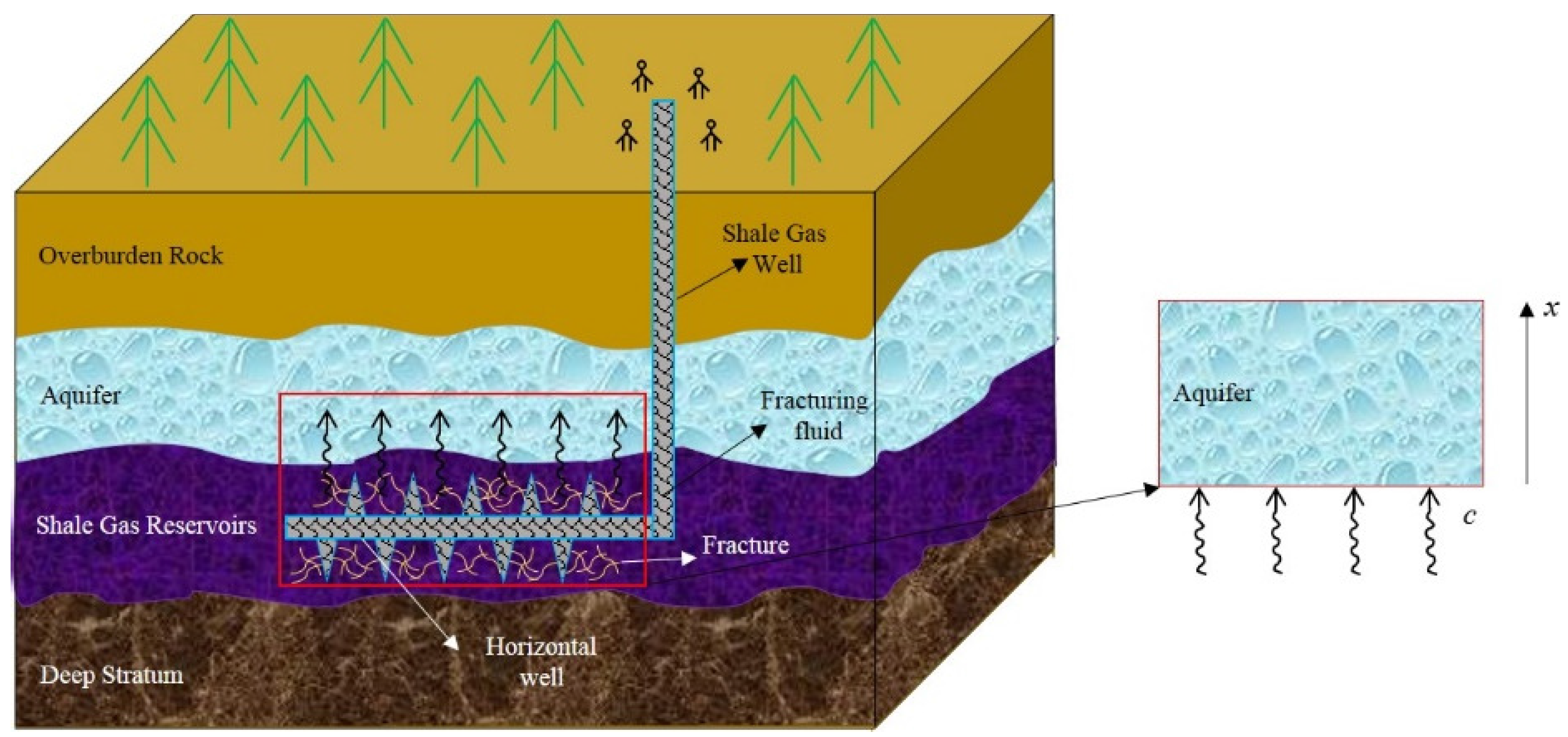
The unconventional oil or gas (e.g., shale gas) development benefits many countries economically while bringing serious environmental pollution [8,28]. In this process, the fracturing fluids containing many chemical additives will diffuse into the aquifers through the porous media, resulting in the formation contamination [8]. The mathematical model of the advection dispersion of the chemical pollutants in shale gas extraction is shown in Figure 1.
Figure 1.
The mathematical model of the advection dispersion of the chemical pollutants in shale gas extraction involving general Liouville–Caputo fractional-order derivative of Wiman type.
The mathematical model of anomalous advection-dispersion process with general Liouville–Caputo fractional-order derivative of Wiman type is given by
with the initial value condition
and the boundary value conditions
where is the concentration of chemical pollutants in the aquifers, k is the dispersion coefficient of the aquifers, is the seepage velocity of chemical pollutants, c is the concentration of chemical pollutants at the lower boundary of aquifers, and B is bounded.
3.2. The Series Solutions for General Fractional Advection-Dispersion Equation
Now, we find the series solutions for the general fractional advection-dispersion model within general Liouville–Caputo fractional-order derivative of Wiman type.
On performing the Laplace transform of Equation (8), we obtain
where
In a similar manner, the corresponding boundary-value conditions can be written as:
Substituting Equation (9) into Equation (11), we have
where
Making use of the eigenvalue method [8], we obtain the general solution of Equation (13), given as:
With the aid of Equation (12), we have
In order to obtain the solution of Equation (8) in the series form, we present
where
Furthermore, can be expanded as:
The substitution of Equation (17) into Equation (16) results in
where
With the use of Table 1, we have
where represents the inverse Laplace transform operator.
Finally, substituting Equation (19) into Equation (18), we have the series solution of Equation (8) as:
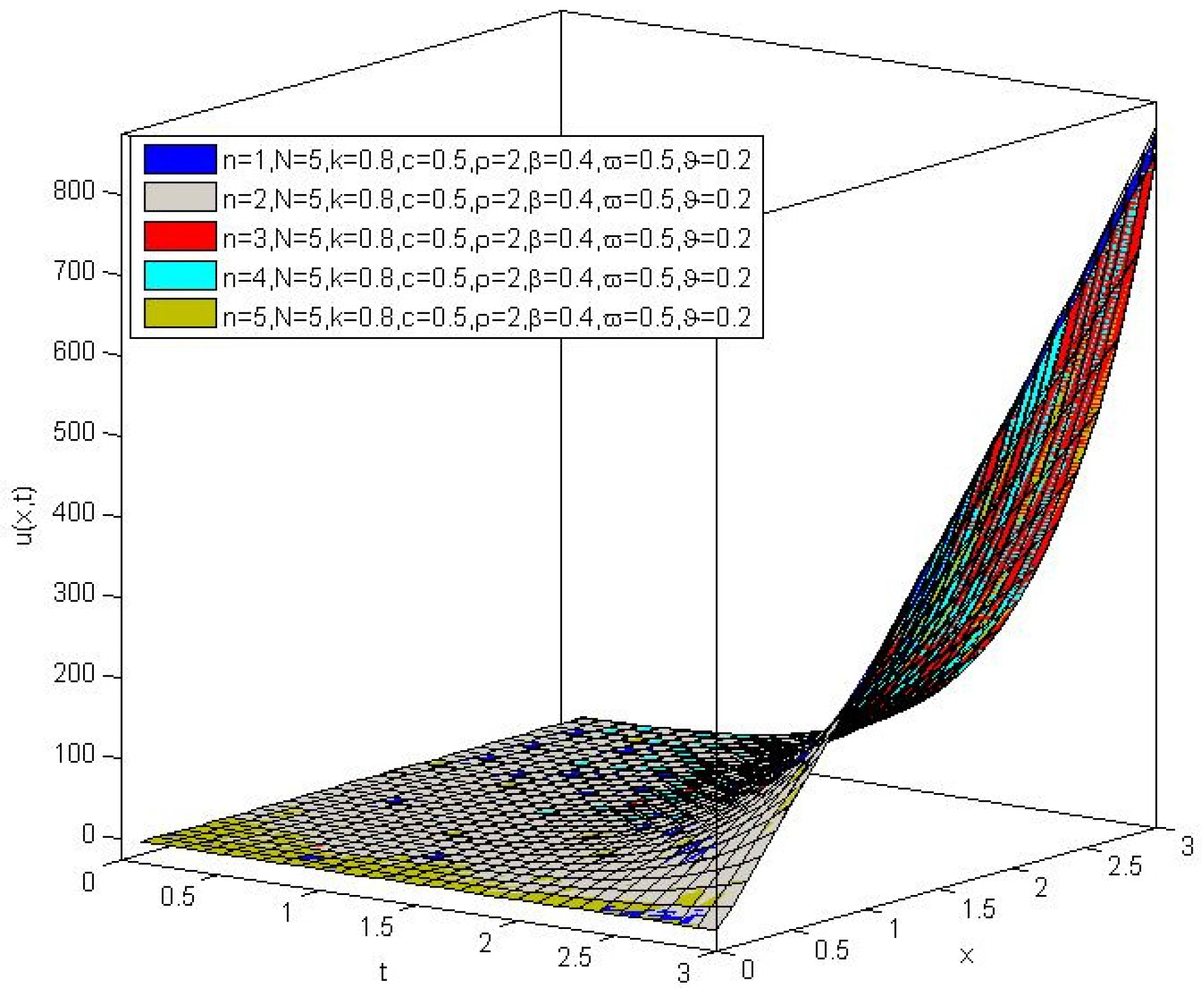
and the corresponding plots of the changes of the concentration for the different parameters are displayed in Figure 2.
Figure 2.
The concentration of chemical pollutants in the aquifers for the values , , , and 5, and the parameters , , , , , , .
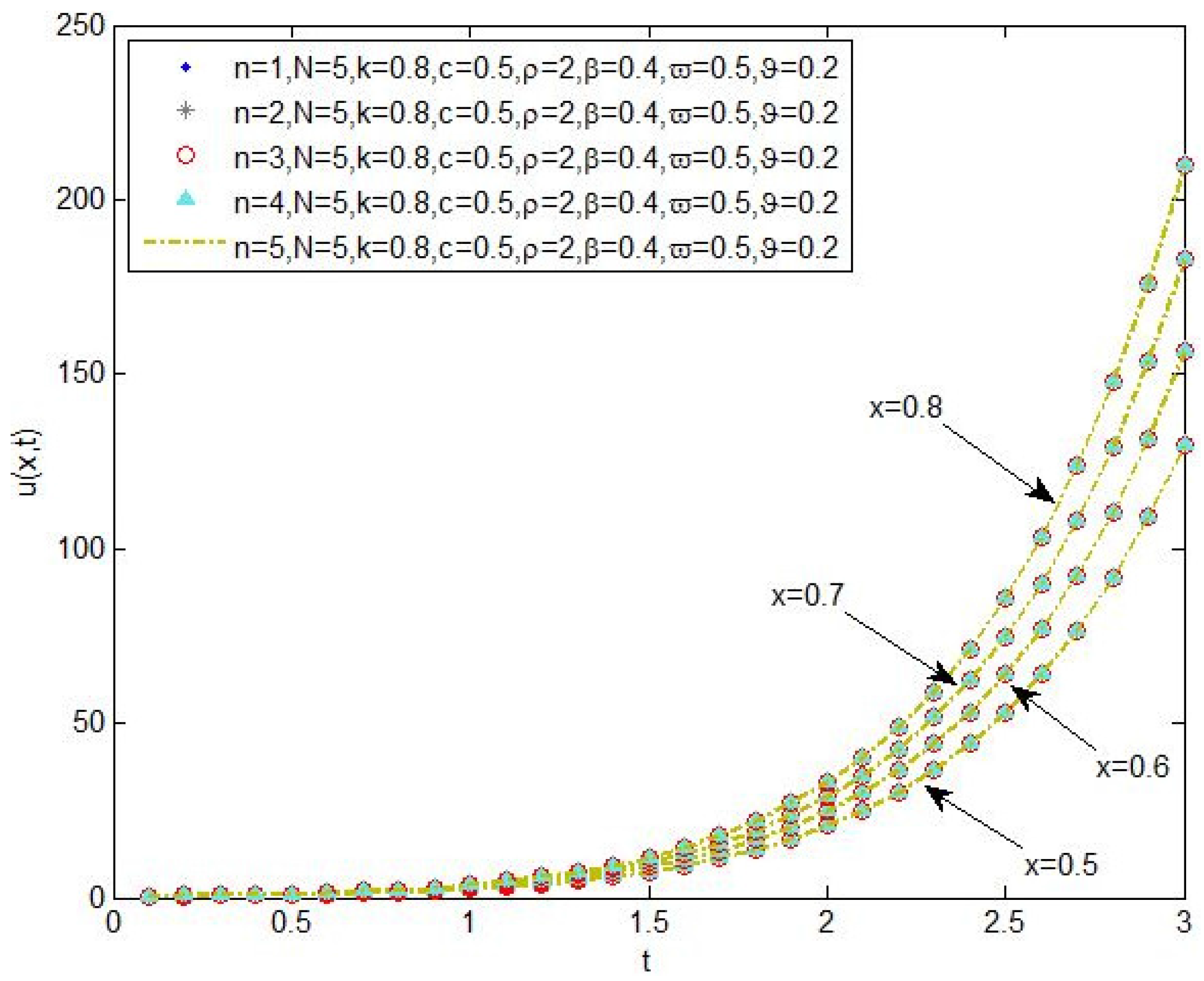
The plot of the changes of the concentration of chemical pollutants in the aquifers for the values , , , and 5, and the parameters , , , , , , in the spaces , , and is demonstrated in Figure 3.
Figure 3.
The changes of the concentration of chemical pollutants in the aquifers for the values , , , and 5, and the parameters in the spaces , , and .
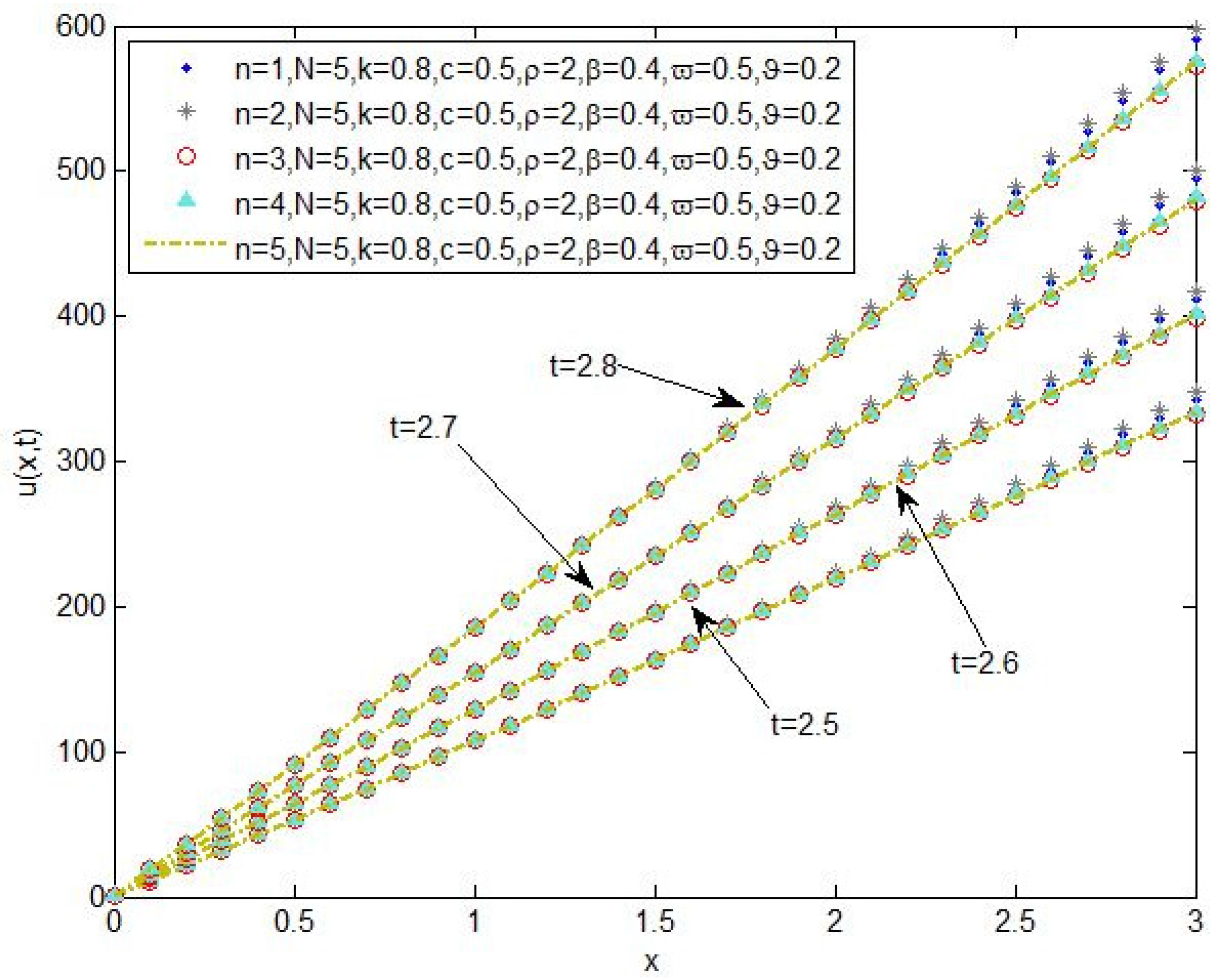
The plot of the changes of the concentration of chemical pollutants in the aquifers for the values , , , and 5, and the parameters in the times , , , and is shown in Figure 4.
Figure 4.
The change plot of the concentration of chemical pollutants in the aquifers for the values , , , and 5, and the parameters in the times , , , and .
4. Conclusions and Remarking Comments
In the current work, a novel anomalous advection-dispersion model with general Liouville–Caputo fractional-order derivative of Wiman type was proposed. The series solution of the anomalous advection-dispersion equation was obtained with the aid of the Laplace transform. The fractional advection-dispersion equation within fractional Liouville–Caputo fractional derivative is a special case due to the fact that the Liouville–Caputo fractional derivative is obtained by the general Liouville–Caputo fractional-order derivative of Wiman type. The proposed model is more efficient for the description of the anomalous advection-dispersion process than the classical model with Liouville–Caputo fractional-order derivative [9], which reduces to the classical advection-dispersion [6,7]. The results show that the general Liouville–Caputo fractional-order derivative of Wiman type is important for us to model power-law behaviors in nature.
Acknowledgments
This research was financially supported by the National Natural Science Foundation of China (51574219) and the Initiation Fund of Doctor’s Research (No. 107-451117008). We would like to express thanks for the anonymous reviewers to improve the manuscript.
Author Contributions
All authors have worked equally in this manuscript. All authors have read and approved the final manuscript.
Conflicts of Interest
The authors declare no conflict of interest.
References
- Yang, X.J.; Machado, J.A.T. A new fractional operator of variable order: Application in the description of anomalous diffusion. Phys. A Stat. Mech. Appl. 2017, 481, 276–283. [Google Scholar] [CrossRef]
- Gao, F. General fractional calculus in nonsingular power-law kernel applied to model anomalous diffusion phenomena in heat-transfer problems. Therm. Sci. 2017, 21, S11–S18. [Google Scholar] [CrossRef]
- Ionescu, C.; Lopes, A.; Copot, D.; Machado, J.A.T.; Bates, J.H.T. The role of fractional calculus in modelling biological phenomena: A review. Commun. Nonlinear Sci. Numer. Simul. 2017, 51, 141–159. [Google Scholar] [CrossRef]
- Singh, M.K.; Chatterjee, A.; Singh, V.P. Solution of one-dimensional time fractional Advection dispersion equation by homotopy analysis method. J. Eng. Mech. 2017, 143, 1–16. [Google Scholar] [CrossRef]
- Garrard, R.M.; Zhang, Y.; Wei, S.; Sun, H.G.; Qian, J.Z. Can a Time Fractional-Derivative Model Capture Scale-Dependent Dispersion in Saturated Soils? Groundwater 2017, 55, 857–870. [Google Scholar] [CrossRef] [PubMed]
- Huang, K.; Toride, N.; Genuchten, M.T.V. Experimental investigation of solute transport in large, homogeneous and heterogeneous, saturated soil columns. Transp. Porous Media 1995, 18, 283–302. [Google Scholar] [CrossRef]
- Danckwerts, P.V. Continuous flow systems: Distribution of residence times. Chem. Eng. Sci. 1953, 2, 1–13. [Google Scholar] [CrossRef]
- Liang, X.; Liu, G.N.; Su, S.J. Applications of a novel integral transform to the convection-dispersion equations. Therm. Sci. 2017, 21, S233–S240. [Google Scholar] [CrossRef]
- Zhang, H.; Liu, F.; Phanikumar, M.S.; Meerschaert, M.M. A novel numerical method for the time variable fractional order mobile–immobile advection—Dispersion model. Comput. Math. Appl. 2013, 66, 693–701. [Google Scholar] [CrossRef]
- Benson, D.A.; Wheatcraft, S.W.; Meerschaert, M.M. Application of a fractional advection-dispersion equation. Water Resour. 2000, 36, 1403–1412. [Google Scholar] [CrossRef]
- Meerschaert, M.M.; Zhang, Y.; Baeumer, B. Tempered anomalous diffusion in heterogeneous systems. Geophys. Res. Lett. 2008, 35, L17403. [Google Scholar] [CrossRef]
- Gorenflo, R.; Mainardi, F.; Moretti, D.; Pagnini, G.; Paradisi, P. Fractional diffusion: Probability distributions and random walk models. Phys. A Stat. Mech. Appl. 2002, 305, 106–112. [Google Scholar] [CrossRef]
- Vot, F.L.; Abad, E.; Yuste, S.B. Continuous-time random-walk model for anomalous diffusion in expanding media. Phys. Rev. E 2017, 96, 032117. [Google Scholar] [CrossRef] [PubMed]
- Magin, R.L.; Ingo, C. Entropy and information in a fractional order model of anomalous diffusion. IFAC Proc. Vol. 2012, 45, 428–433. [Google Scholar] [CrossRef]
- Povstenko, Y. Generalized boundary conditions for the time-fractional advection diffusion equation. Entropy 2015, 17, 4028–4039. [Google Scholar] [CrossRef]
- Chiogna, G.; Rolle, M. Entropy-based critical reaction time for mixing-controlled reactive transport. Water Resour. Res. 2017, 53, 7488–7498. [Google Scholar] [CrossRef]
- Giusti, A.; Colombaro, I. Prabhakar-like fractional viscoelasticity. Commun. Nonlinear Sci. Numer. Simul. 2018, 56, 138–143. [Google Scholar] [CrossRef]
- Yang, X.J. General fractional calculus operators containing the generalized Mittag-Leffler functions applied to anomalous relaxation. Therm. Sci. 2017, 21, S317–S326. [Google Scholar] [CrossRef]
- Yang, X.J. Fractional derivatives of constant and variable orders applied to anomalous relaxation models in heat-transfer problems. Therm. Sci. 2017, 21, 1161–1171. [Google Scholar] [CrossRef]
- Yang, X.J. New general fractional-order rheological models with kernels of Mittag-Leffler functions. Rom. Rep. Phys. 2017, 69, 118. [Google Scholar]
- Yang, X.J.; Machado, J.A.; Baleanu, D. Anomalous diffusion models with general fractional derivatives within the kernels of the extended Mittag-Leffler type functions. Rom. Rep. Phys. 2017, 69, 115. [Google Scholar]
- Gorenflo, R.; Kilbas, A.A.; Mainardi, F.; Rogosin, S.V. Mittag-Leffler Functions, Related Topics and Applications; Springer: New York, NY, USA, 2014; pp. 7–16, 83,98. [Google Scholar]
- Mittag-Leffler, G.M. Sur la nouvelle function Eαx. C. R. Acad. Sci. 1903, 137, 554–558. [Google Scholar]
- Wiman, A. Über den Fundamentalsatz in der Teorie der Funktionen Eαx. Acta Math. 1905, 29, 191–201. [Google Scholar] [CrossRef]
- Prabhakar, T.R. A Singular Integral Equation with a Generalized Mittag-Leffler Function in the Kernel. Yokohama Math. J. 1971, 19, 7–15. [Google Scholar]
- Liang, X.; Gao, F.; Su, S.J.; Wang, Z.; Yang, X.J. Classifications and duality relations for several integral transforms. J. Nonlinear Sci. Appl. 2017, 10, 6324–6332. [Google Scholar] [CrossRef]
- Mathai, A.M.; Haubold, H.J. Special Functions for Applied Scientists; Springer: New York, NY, USA, 2008; p. 95. [Google Scholar]
- Torres, L.; Yadav, O.P.; Khan, E. A review on risk assessment techniques for hydraulic fracturing water and produced water management implemented in onshore unconventional oil and gas production. Sci. Total Environ. 2016, 539, 478–493. [Google Scholar] [CrossRef] [PubMed]
© 2018 by the authors. Licensee MDPI, Basel, Switzerland. This article is an open access article distributed under the terms and conditions of the Creative Commons Attribution (CC BY) license (http://creativecommons.org/licenses/by/4.0/).