

COVID-19-Related Social Media Fake News in India


Abstract
1. Introduction
2. Conceptualizing Fake News
3. COVID-19-Related Online Fake News
4. Themes and Typologies of Fake News
5. Content Types of Fake News
6. Sources of Fake News
7. Aims of Fake News
- RQ1: What are the popular COVID-19-related themes of social media fake news?
- RQ2: What are the different content types of COVID-19-related social media fake news?
- RQ3: What are the prevalent sources of COVID-19-related social media fake news?
- RQ4: What are the aims of COVID-19-related social media fake news?
- RQ5: What are the coverage patterns of COVID-19-related social media fake news?
8. Research Methods
9. Results
10. Discussion and Conclusions
Funding
Institutional Review Board Statement
Informed Consent Statement
Conflicts of Interest
References
- Alimardani, Mahsa, and Mona Elswah. 2020. Online Temptations: COVID-19 and Religious Misinformation in the MENA Region. Social Media + Society 6: 2056305120948251. [Google Scholar] [CrossRef] [Scilit]
- Allcott, Hunt, and Matthew Gentzkow. 2017. Social Media and Fake News in the 2016 Election. Journal of Economic Perspectives 31: 211–36. [Google Scholar] [CrossRef] [Scilit]
- Allport, Gordon W., and Leo Postman. 1946. An Analysis of Rumor. Public Opinion Quarterly 10: 501. [Google Scholar] [CrossRef]
- Alvarez-Risco, Aldo, C. R. Mejia, J. Delgado-Zegarra, S. Del-Aguila-Arcentales, A. A. Arce-Esquivel, M. J. Valladares-Garrido, M. Rosas del Portal, L. F. Villegas, W. H. Curioso, M. C. Sekar, and et al. 2020. The Peru Approach against the COVID-19 Infodemic: Insights and Strategies. The American Journal of Tropical Medicine and Hygiene 103: 583–86. [Google Scholar] [CrossRef] [Scilit]
- Al-Zaman, M. Sayeed. 2019. Digital Disinformation and Communalism in Bangladesh. China Media Research 15: 68–76. [Google Scholar]
- Al-Zaman, M. Sayeed. 2020. Healthcare Crises in Bangladesh during the COVID-19 Pandemic. The American Journal of Tropical Medicine and Hygiene 103: 1357–59. [Google Scholar] [CrossRef] [Scilit] [PubMed]
- Al-Zaman, M. Sayeed. 2021. Social Media Fake News in India. Asian Journal for Public Opinion Research 9: 25–47. [Google Scholar] [CrossRef]
- Al-Zaman, M. Sayeed, Sifat A. Sife, Mushfiqa Sultana, Mahbuba Akbar, Kazi T. S. Ahona, and Nandita Sarkar. 2020. Social Media Rumors in Bangladesh. Journal of Information Science Theory and Practices 8: 77–90. [Google Scholar] [CrossRef]
- Arun, Chinmayi. 2019. On WhatsApp, Rumours, and Lynchings. Economic and Political Weekly 54: 30–36. [Google Scholar]
- Avaaz. 2019. US 2020: Another Facebook Disinformation Election? In Facebook Uncovered: Vol 01. New York: Avaaz. [Google Scholar]
- Bharti, Misha, and Jeba B. Mondal. 2020. Steps Taken towards Curbing of Fake News in India. LatestLaws.com. Available online: http://latestlaws.com/articles/steps-taken-towards-curbing-of-fake-news-in-india (accessed on 1 May 2020).
- Bordia, Prashant, Elizabeth Jones, Cindy Gallois, Victor J. Callan, and Nicholas DiFonzo. 2006. Management Are Aliens!: Rumors and Stress during Organizational Change. Group and Organization Management 31: 601–21. [Google Scholar] [CrossRef] [Scilit]
- Brennen, J. S., F. M. Simon, P. N. Howard, and R. K. Nielsen. 2020. Types, Sources, and Claims of COVID-19 Misinformation. London: University of Oxford. [Google Scholar]
- Carlson, Matt. 2009. The reality of a fake image news norms, photojournalistic craft, and brian walski’s fabricated photograph. Journalism Practice 3: 125–39. [Google Scholar] [CrossRef] [Scilit]
- Casero-Ripolles, Andreu. 2020. Impact of COVID-19 on the media system: Communicative and democratic consequences of news consumption during the outbreak. El Profesional de La Información 29. [Google Scholar] [CrossRef] [Scilit]
- Cinelli, M., W. Quattrociocchi, A. Galeazzi, C. M. Valensise, E. Brugnoli, A. L. Schmidt, P. Zola, F. Zollo, and A. Scala. 2020. The COVID-19 Social Media Infodemic. Scientific Reports. [Google Scholar] [CrossRef] [Scilit] [PubMed]
- Coleman, A. 2020. “Hundreds dead” because of Covid-19 misinformation. BBC News. Available online: http://bbc.com/news/world-53755067 (accessed on 13 September 2020).
- Difonzo, N., and P. Bordia. 2006. Rumor Psychology: Social and Organizational Approaches. Washington, DC: Amer Psychological Assn. [Google Scholar]
- Dore, B. 2020. How are Indian Scientists Fighting fake News about COVID-19? World Economic Forum. Available online: https://www.weforum.org/agenda/2020/04/indian-scientists-covid19-false-infomation-coronavirus (accessed on 2 May 2020).
- Dowd, S. B., and R. Davidhizar. 1997. Rumors and gossip in radiology. Radiology Management 19: 46–49. [Google Scholar] [PubMed]
- Duffy, A., E. Tandoc, and R. Ling. 2019. Too good to be true, too good not to share: The social utility of fake news. Information, Communication and Society 23: 1965–79. [Google Scholar] [CrossRef] [Scilit]
- Erku, D. A., S. A. Belachew, S. Abrha, M. Sinnollareddy, J. Thomas, K. J. Steadman, and W. H. Tesfaye. 2020. When fear and misinformation go viral: Pharmacists’ role in deterring medication misinformation during the “infodemic” surrounding COVID-19. Research in Social and Administrative Pharmacy 17: 1954–63. [Google Scholar] [CrossRef] [Scilit] [PubMed]
- Farooq, G. 2018. Politics of Fake News: How WhatsApp Became a Potent Propaganda Tool in India. Media Watch 9: 106–17. [Google Scholar] [CrossRef] [Scilit]
- Floridi, L. 2011. The Philosophy of Information. London: Oxford University Press. [Google Scholar]
- Funke, D., and D. Flamini. 2019. A Guide to Anti-Misinformation Actions around the World. Poynter. Available online: http://poynter.org/ifcn/anti-misinformation-actions/ (accessed on 1 May 2020).
- Gradon, K. 2020. Crime in the time of the plague: Fake news pandemic and the challenges to law-enforcement and intelligence community. Society Register 4: 133–48. [Google Scholar] [CrossRef] [Scilit]
- Guacho, G. B., S. Abdali, N. Shah, and E. E. Papalexakis. 2018. Semi-supervised content-based detection of misinformation via tensor embeddings. Paper presented at 2018 IEEE/ACM International Conference on Advances in Social Networks Analysis and Mining, ASONAM 2018, Barcelona, Spain, August 28–31; pp. 322–25. [Google Scholar] [CrossRef] [Scilit]
- Haque, M. 2019. “Fake news” in social media: Conceptualizing, detection and finding ways of prevention. Nirikkha 223: 9–18. [Google Scholar]
- Higdon, Nolan. 2020. What is Fake News? A Foundational Question for Developing Effective Critical News Literacy Education. Democratic Communiqué 29: 1–18. [Google Scholar]
- Jaster, R., and D. Lanius. 2018. What is Fake News? Versus XLVII: 207–24. [Google Scholar] [CrossRef]
- Ji, Peinan, Xi Yan, and Guang Yu. 2020. Can Rumor Clarification Eliminate the Effects of Rumors?: Evidence From China. International Journal of Asian Business and Information Management (IJABIM) 11: 48–62. [Google Scholar] [CrossRef] [Scilit]
- Jo, D. G. 2002. Diffusion of Rumors on the Internet. The Information Society Review 2002: 77–95. [Google Scholar]
- Kadam, Abhay B., and Sachin R. Atre. 2020. Negative impact of social media panic during the COVID-19 outbreak in India. Journal of Travel Medicine, 27. [Google Scholar] [CrossRef] [Scilit]
- Kamins, M. A., V. S. Folkes, and L. Perner. 1997. Consumer Responses to Rumors: Good News, Bad News. Journal of Consumer Psychology 6: 165–87. [Google Scholar] [CrossRef] [Scilit]
- Kanozia, R., R. Arya, S. Singh, G. Ganghariya, and S. Narula. 2021. A Study on Fake News Subject Matter, Presentation Elements, Tools of Detection, and Social Media Platforms in India. Asian Journal for Public Opinion Research 9: 48–82. [Google Scholar] [CrossRef]
- Kapferer, J.-N. 1992. How rumors are born. Society 29: 53–60. [Google Scholar] [CrossRef] [Scilit]
- Keelery, S. 2020. COVID-19 Impact on Media Consumption by Type of Media 2020. Available online: http://statista.com/statistics/1113485/india-coronavirus-impact-on-media-consumption-by-media-type/ (accessed on 5 May 2020).
- Khan, S. A., M. H. Alkawaz, and H. M. Zangana. 2019. The Use and Abuse of Social Media for Spreading Fake News. Paper presented at 2019 IEEE International Conference on Automatic Control and Intelligent Systems, I2CACIS 2019-Proceedings, Selangor, Malaysia, June 29; pp. 145–148. [Google Scholar] [CrossRef] [Scilit]
- Knapp, R. H. 1944. A Psychology of Rumor. Public Opinion Quarterly 8: 22. [Google Scholar] [CrossRef] [Scilit]
- Laato, S., A. K. M. N. Islam, M. N. Islam, and E. Whelan. 2020. What drives unverified information sharing and cyberchondria during the COVID-19 pandemic? European Journal of Information Systems 29: 288–305. [Google Scholar] [CrossRef] [Scilit]
- Mayhew, F. 2020. Poll suggests shift from print to digital will last beyond pandemic. Press Gazette. Available online: pressgazette.co.uk/poll-more-people-consuming-news-digitally-than-in-print-during-pandemic-lockdown/ (accessed on 1 September 2020).
- Meel, P., and D. K. Vishwakarma. 2020. Fake news, rumor, information pollution in social media and web: A contemporary survey of state-of-the-arts, challenges and opportunities. Expert Systems with Applications 153: 112986. [Google Scholar] [CrossRef] [Scilit]
- Menon, S. 2020. Coronavirus: The human cost of fake news in India. BBC News. Available online: https://www.bbc.com/news/world-asia-india-53165436 (accessed on 1 February 2021).
- Mezaris, V., and D. Teyssou. 2019. Video Verification in the Fake News Era. Berlin/Heidelberg: Springer. [Google Scholar]
- Mosseri, A. 2017. Working to Stop Misinformation and False News. Facebook Media. Available online: http://about.fb.com/news/2017/04/working-to-stop-misinformation-and-false-news/ (accessed on 1 August 2020).
- Muigai, J. W. W. 2019. Understanding Fake News. International Journal of Scientific and Research Publications (IJSRP) 9: 29–38. [Google Scholar] [CrossRef] [Scilit]
- Mukherjee, R. 2020. Mobile witnessing on WhatsApp: Vigilante virality and the anatomy of mob lynching. South Asian Popular Culture 18: 79–101. [Google Scholar] [CrossRef] [Scilit]
- Naeem, S. B., and R. Bhatti. 2020. The Covid-19 ‘infodemic’: A new front for information professionals. Health Information and Libraries Journal 37: 233–39. [Google Scholar] [CrossRef] [Scilit]
- Nazmi, S. 2019. Why India shuts down the internet more than any other democracy. BBC News. Available online: http://bbc.com/news/world-asia-india-50819905 (accessed on 1 August 2020).
- Orso, D., N. Federici, R. Copetti, L. Vetrugno, and T. Bove. 2020. Infodemic and the spread of fake news in the COVID-19-era. European Journal of Emergency Medicine, Publish Ah 27: 327–28. [Google Scholar] [CrossRef] [Scilit]
- Ouedraogo, N. 2020. Social Media Literacy in Crisis Context: Fake News Consumption during COVID-19 Lockdown. SSRN Electronic Journal, 1–43. [Google Scholar] [CrossRef] [Scilit]
- Parikh, S. B., and P. K. Atrey. 2018. Media-Rich Fake News Detection: A Survey. Paper presented at Proceedings-IEEE 1st Conference on Multimedia Information Processing and Retrieval MIPR, Miami, FL, USA, April 10–12; pp. 436–41. [Google Scholar] [CrossRef] [Scilit]
- Pennycook, G., J. McPhetres, Y. Zhang, and D. Rand. 2020. Fighting COVID-19 misinformation on social media: Experimental evidence for a scalable accuracy nudge intervention. Psychological Science 31: 770–80. [Google Scholar] [CrossRef] [Scilit]
- Rodríguez, Pulido, C., B. Villarejo Carballido, G. Redondo-Sama, M. Guo, M. Ramis, and R. Flecha. 2020. False news around COVID-19 circulated less on Sina Weibo than on Twitter. How to overcome false information? International and Multidisciplinary Journal of Social Sciences 9: 107–28. [Google Scholar] [CrossRef]
- Quandt, T., L. Frischlich, S. Boberg, and T. Schatto-Eckrodt. 2019. Fake News. In The International Encyclopedia of Journalism Studies. Edited by T. P. Vos, F. Hanusch, M. Geertsema-Sligh, A. Sehl and D. Dimitrakopoulou. Wiley Blackwell: vol. 114, pp. 1–6. [Google Scholar] [CrossRef] [Scilit]
- Raj, A., and M. P. Goswami. 2020. Is fake news spreading more rapidly than COVID-19 in India? Journal of Content, Community and Communication 11: 208–20. [Google Scholar] [CrossRef] [Scilit]
- Rosnow, R. L., J. H. Yost, and J. L. Esposito. 1986. Belief in rumor and likelihood of rumor transmission. Language and Communication 6: 189–94. [Google Scholar] [CrossRef] [Scilit]
- Rovetta, A., and A. S. Bhagavathula. 2020. COVID-19-Related Web Search Behaviors and Infodemic Attitudes in Italy: Infodemiological Study. JMIR Public Health and Surveillance 6: e19374. [Google Scholar] [CrossRef] [Scilit] [PubMed]
- Shin, J., L. Jian, K. Driscoll, and F. Bar. 2018. The diffusion of misinformation on social media: Temporal pattern, message, and source. Computers in Human Behavior 83: 278–87. [Google Scholar] [CrossRef] [Scilit]
- Sutaria, S. 2020. Coronavirus Misinformation in India Is Not Limited to Health Misinformation. Available online: https://meedan.com/reports/coronavirus-misinformation-in-india-is-not-limited-to-health-misinformation/ (accessed on 1 August 2020).
- Tandoc, E. C., D. Lim, and R. Ling. 2020. Diffusion of disinformation: How social media users respond to fake news and why. Journalism 21: 381–98. [Google Scholar] [CrossRef] [Scilit]
- Tandoc, E. C., Z. W. Lim, and R. Ling. 2018. Defining “Fake News”: A typology of scholarly definitions. Digital Journalism 6: 137–53. [Google Scholar] [CrossRef] [Scilit]
- Tapia, L. 2020. COVID-19 and Fake News in the Dominican Republic. The American Journal of Tropical Medicine and Hygiene 102: 1172–74. [Google Scholar] [CrossRef] [Scilit]
- ToI. 2020. Coronavirus myth vs. Fact: WhatsApp forward claiming turmeric and black pepper home remedy to cure COVID-19 is fake. Times of India (ToI). Available online: http://timesofindia.indiatimes.com/life-style/health-fitness/health-news/coronavirus-myth-vs-fact-whatsapp-forward-claiming-turmeric-and-black-pepper-home-remedy-to-cure-covid-19-is-fake/photostory/76995286.cms (accessed on 7 September 2020).
- Vetticad, Anna M. M. 2020. Indian Media Accused of ISLAMOPHOBIA for its Coronavirus Coverage. [Newspaper]. Al Jazeera. Available online: https://www.aljazeera.com/news/2020/5/15/indian-media-accused-of-islamophobia-for-its-coronavirus-coverage (accessed on 30 December 2020).
- Wardle, C. 2017. Fake News. It’s Complicated. First Draft. Available online: https://firstdraftnews.org/latest/fake-news-complicated/ (accessed on 1 May 2020).
- Wheaton, Gracie Claire. 2018. Birthers, Hand Signals, and Spirit Cooking: The Impact of Political Fake News Content on Facebook Engagement during the 2016 U.S. Presidential Election. Master’s thesis, Virginia Polytechnique Institute and State University, Blacksburg, VA, USA. Available online: http://vtechworks.lib.vt.edu/handle/10919/89055 (accessed on 1 May 2020).
- Wu, Liang, and Huan Liu. 2018. Tracing Fake-News Footprints. Paper presented at Eleventh ACM International Conference on Web Search and Data Mining-WSDM, Los Angeles, CA, USA, Ferbuary 6–8, vol. 18, pp. 637–45. [Google Scholar] [CrossRef] [Scilit]
- Zhou, Xinyi, and Reza Zafarani. 2020. A Survey of Fake News: Fundamental Theories, Detection Methods, and Opportunities. ACM Computing Surveys 53: 1–34. [Google Scholar] [CrossRef] [Scilit]
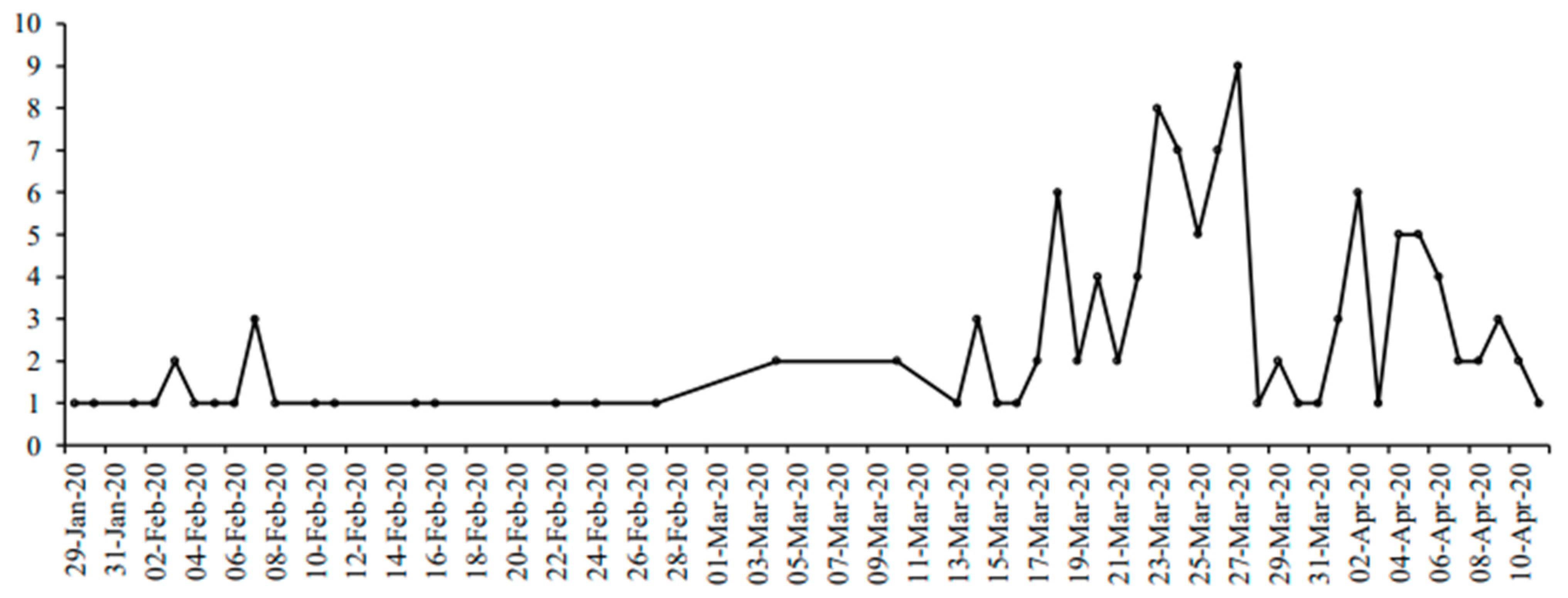

| Serial | Date | Frequency | Percent | Serial | Date | Frequency | Percent |
|---|---|---|---|---|---|---|---|
| 1 | 27-Mar-20 | 9 | 7.2 | 26 | 10-Apr-20 | 2 | 1.6 |
| 2 | 23-Mar-20 | 8 | 6.4 | 27 | 29-Jan-20 | 1 | 0.8 |
| 3 | 24-Mar-20 | 7 | 5.6 | 28 | 30-Jan-20 | 1 | 0.8 |
| 4 | 26-Mar-20 | 7 | 5.6 | 29 | 1-Feb-20 | 1 | 0.8 |
| 5 | 18-Mar-20 | 6 | 4.8 | 30 | 2-Feb-20 | 1 | 0.8 |
| 6 | 2-Apr-20 | 6 | 4.8 | 31 | 4-Feb-20 | 1 | 0.8 |
| 7 | 25-Mar-20 | 5 | 4.0 | 32 | 5-Feb-20 | 1 | 0.8 |
| 8 | 4-Apr-20 | 5 | 4.0 | 33 | 6-Feb-20 | 1 | 0.8 |
| 9 | 5-Apr-20 | 5 | 4.0 | 34 | 8-Feb-20 | 1 | 0.8 |
| 10 | 20-Mar-20 | 4 | 3.2 | 35 | 10-Feb-20 | 1 | 0.8 |
| 11 | 22-Mar-20 | 4 | 3.2 | 36 | 11-Feb-20 | 1 | 0.8 |
| 12 | 6-Apr-20 | 4 | 3.2 | 37 | 15-Feb-20 | 1 | 0.8 |
| 13 | 7-Feb-20 | 3 | 2.4 | 38 | 16-Feb-20 | 1 | 0.8 |
| 14 | 14-Mar-20 | 3 | 2.4 | 39 | 22-Feb-20 | 1 | 0.8 |
| 15 | 1-Apr-20 | 3 | 2.4 | 40 | 24-Feb-20 | 1 | 0.8 |
| 16 | 9-Apr-20 | 3 | 2.4 | 41 | 27-Feb-20 | 1 | 0.8 |
| 17 | 3-Feb-20 | 2 | 1.6 | 42 | 13-Mar-20 | 1 | 0.8 |
| 18 | 4-Mar-20 | 2 | 1.6 | 43 | 15-Mar-20 | 1 | 0.8 |
| 19 | 10-Mar-20 | 2 | 1.6 | 44 | 16-Mar-20 | 1 | 0.8 |
| 20 | 17-Mar-20 | 2 | 1.6 | 45 | 28-Mar-20 | 1 | 0.8 |
| 21 | 19-Mar-20 | 2 | 1.6 | 46 | 30-Mar-20 | 1 | 0.8 |
| 22 | 21-Mar-20 | 2 | 1.6 | 47 | 31-Mar-20 | 1 | 0.8 |
| 23 | 29-Mar-20 | 2 | 1.6 | 48 | 3-Apr-20 | 1 | 0.8 |
| 24 | 7-Apr-20 | 2 | 1.6 | 49 | 11-Apr-20 | 1 | 0.8 |
| 25 | 8-Apr-20 | 2 | 1.6 | Total | 125 | 100 |
| Rank | Themes | Frequency | Percent | Cumulative Percent |
|---|---|---|---|---|
| 1 | Health | 84 | 67.2 | 67.2 |
| 2 | Religiopolitical | 21 | 16.8 | 84.0 |
| 3 | Political | 9 | 7.2 | 91.2 |
| 4 | Crime | 3 | 2.4 | 93.6 |
| 5 | Entertainment | 3 | 2.4 | 96.0 |
| 6 | Religious | 3 | 2.4 | 98.4 |
| 7 | Miscellaneous | 2 | 1.6 | 100.0 |
| Total | 125 | 100.0 |
| Rank | Content Types | Frequency | Percent | Cumulative Percent |
|---|---|---|---|---|
| 1 | Text and Video | 59 | 47.2 | 47.2 |
| 2 | Text and Photo | 40 | 32.0 | 79.2 |
| 3 | Text | 14 | 11.2 | 90.4 |
| 4 | Audio | 6 | 4.8 | 95.2 |
| 5 | Video | 3 | 2.4 | 97.6 |
| 6 | Text and Photo and Video | 2 | 1.6 | 99.2 |
| 7 | Photo | 1 | .8 | 100.0 |
| Total | 125 | 100.0 |
| Rank | Source types | Frequency | Percent | Cumulative Percent |
|---|---|---|---|---|
| 1 | Online media | 118 | 94.4 | 94.4 |
| 2 | Mainstream media | 7 | 5.6 | 100.0 |
| Total | 125 | 100.0 |
| Rank | Aims | Frequency | Percent | Cumulative Percent |
|---|---|---|---|---|
| 1 | Negative | 79 | 63.2 | 63.2 |
| 2 | Positive | 28 | 22.4 | 85.6 |
| 3 | Unknown | 18 | 14.4 | 100.0 |
| Total | 125 | 100.0 |
| Rank | Coverages | Frequency | Percent | Cumulative Percent |
|---|---|---|---|---|
| 1 | International | 68 | 54.4 | 54.4 |
| 2 | National | 57 | 45.6 | 100.0 |
| Total | 125 | 100.0 |
Publisher’s Note: MDPI stays neutral with regard to jurisdictional claims in published maps and institutional affiliations. |
© 2021 by the author. Licensee MDPI, Basel, Switzerland. This article is an open access article distributed under the terms and conditions of the Creative Commons Attribution (CC BY) license (http://creativecommons.org/licenses/by/4.0/).
Share and Cite
Al-Zaman, M.S. COVID-19-Related Social Media Fake News in India. Journal. Media 2021, 2, 100-114. https://doi.org/10.3390/journalmedia2010007
Al-Zaman MS. COVID-19-Related Social Media Fake News in India. Journalism and Media. 2021; 2(1):100-114. https://doi.org/10.3390/journalmedia2010007
Chicago/Turabian StyleAl-Zaman, Md. Sayeed. 2021. "COVID-19-Related Social Media Fake News in India" Journalism and Media 2, no. 1: 100-114. https://doi.org/10.3390/journalmedia2010007
APA StyleAl-Zaman, M. S. (2021). COVID-19-Related Social Media Fake News in India. Journalism and Media, 2(1), 100-114. https://doi.org/10.3390/journalmedia2010007

