
Understanding Consumer Engagement in Digital Sport Commerce: A Kano-SERVQUAL Evaluation of Interactive Features and Platform Quality




Abstract
1. Introduction
2. Materials and Methods
2.1. Participants and Procedure
2.2. Measurement
2.3. Data Analysis
3. Results
3.1. Service Quality Attributes Classification Using the Kano Model and Combined Impact Score Analysis
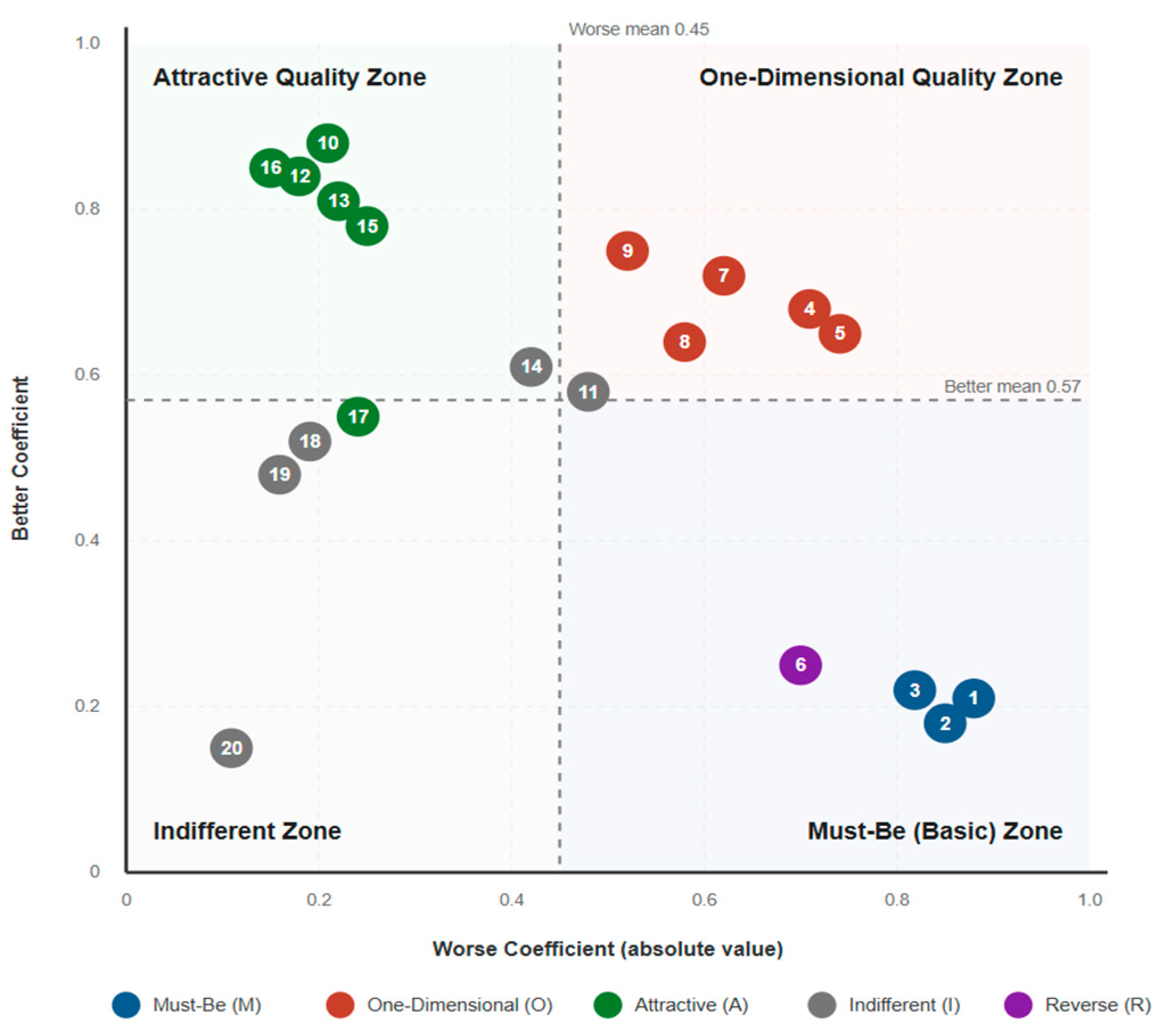
3.2. Better–Worse Matrix Results
4. Discussion
4.1. Technical Infrastructure: Moving Beyond Minimum Requirements
4.2. Content and Community: Strategy for Differentiating Platform Experience
4.3. Graphics and UI: Baseline Management and Optimization
4.4. Personalization and Adaptive Systems (Addressing Reverse and Indifferent Qualities)
5. Conclusions
Author Contributions
Funding
Institutional Review Board Statement
Informed Consent Statement
Data Availability Statement
Conflicts of Interest
References
- Vial, G. Understanding digital transformation: A review and a research agenda. In Managing Digital Transformation; Routledge: London, UK, 2021; pp. 13–66. [Google Scholar]
- Cochoy, F. Platforms or flatforms? Insights from an auto-ethnographic account of a virtual cycling app. J. Cult. Econ. 2025, 18, 175–193. [Google Scholar] [CrossRef] [Scilit]
- Carvalho, B.; Soares, M.M.; Neves, A.; Soares, G.; Lins, A. Virtual Reality devices applied to digital games: A literature review. Ergon. Des. 2016, 125–141. [Google Scholar] [CrossRef] [Scilit]
- Hudson, S.; Matson-Barkat, S.; Pallamin, N.; Jegou, G. With or without you? Interaction and immersion in a virtual reality experience. J. Bus. Res. 2019, 100, 459–468. [Google Scholar] [CrossRef] [Scilit]
- Talwar, S.; Kaur, P.; Nunkoo, R.; Dhir, A. Digitalization and sustainability: Virtual reality tourism in a post pandemic world. J. Sustain. Tour. 2023, 31, 2564–2591. [Google Scholar] [CrossRef] [Scilit]
- Hu-Au, E.; Lee, J.J. Virtual reality in education: A tool for learning in the experience age. Int. J. Innov. Educ. 2017, 4, 215–226. [Google Scholar] [CrossRef] [Scilit]
- Schramka, F.; Arisona, S.; Joos, M.; Erath, A. Development of virtual reality cycling simulator. J. Comput. 2018, 13, 603–615. [Google Scholar] [CrossRef] [Scilit]
- Jain, S.K.; Gupta, G. Measuring service quality: SERVQUAL vs. SERVPERF scales. Vikalpa 2004, 29, 25–38. [Google Scholar] [CrossRef] [Scilit]
- Morrison Coulthard, L.J. A review and critique of research using SERVQUAL. Int. J. Mark. Res. 2004, 46, 479–497. [Google Scholar] [CrossRef] [Scilit]
- Jasinskas, E.; Reklaitiene, D.; Svagzdiene, B. Evaluation of service quality in fitness centres. Transform. Bus. Econ. 2013, 12, 108–124. [Google Scholar]
- Yang, H.; Coates, N. Internal marketing: Service quality in leisure services. Mark. Intell. Plan. 2010, 28, 754–769. [Google Scholar] [CrossRef] [Scilit]
- Matzler, K.; Hinterhuber, H.H. How to make product development projects more successful by integrating Kano’s model of customer satisfaction into quality function deployment. Technovation 1998, 18, 25–38. [Google Scholar] [CrossRef] [Scilit]
- Pratminingsih, S.A.; Astuty, E.; Widyatami, K. Increasing customer loyalty of ethnic restaurant through experiential marketing and service quality. J. Entrep. Educ. 2018, 21, 1–11. [Google Scholar]
- Wahyono, W.; Nurjanah, U. Building customer loyalty through strategy experiential marketing, service quality, and customer satisfaction. Manag. Anal. J. 2020, 9, 122–131. [Google Scholar] [CrossRef] [Scilit]
- Chin, H.; Marasini, D.P.; Lee, D. Digital transformation trends in service industries. Serv. Bus. 2023, 17, 11–36. [Google Scholar] [CrossRef] [Scilit]
- Li, C.; Feng, W.X.; Han, S.; Gupta, S.; Kamble, S. Digital adaptive governance, digital transformation, and service quality in logistics enterprises. J. Glob. Inf. Manag. 2022, 30, 1–26. [Google Scholar] [CrossRef] [Scilit]
- Polyakova, O.; Mirza, M. Perceived service quality models: Are they still relevant? Mark. Rev. 2015, 15, 59–82. [Google Scholar] [CrossRef] [Scilit]
- Nafei, W.A.; Ghoneim, M.A.; Mujtaba, B.G.; Khanfar, N.M. Digitalization as a socioeconomic challenge: Assessing the mediating role of digital service quality on digitalization’s impact on sustainable competitive advantage. SocioEcon. Chall. 2025, 9, 1–20. [Google Scholar] [CrossRef] [Scilit]
- DeLone, W.H.; McLean, E.R. The DeLone and McLean model of information systems success: A ten-year update. J. Manag. Inf. Syst. 2003, 19, 9–30. [Google Scholar] [CrossRef] [Scilit]
- Dewi, S.K. Service quality assessment using SERVQUAL and Kano Models. J. Tek. Ind. 2019, 20, 94–104. [Google Scholar] [CrossRef] [Scilit]
- Andriani, M.; Irawan, H.; Asyura, N.R. Improving quality using the Kano model in overcoming competition in the service industry. Int. J. Eng. Sci. Inf. Technol. 2021, 1, 13–18. [Google Scholar] [CrossRef] [Scilit]
- Kim, H.; Song, H.; Park, Y.T. Customer perception of auto service quality using Kano-SERVQUAL integrated approach—Focusing on the auto service of ‘H’ Company. J. Korean Soc. Qual. Manag. 2016, 44, 965–981. [Google Scholar] [CrossRef] [Scilit]
- Garibay, C.; Gutiérrez, H.; Figueroa, A. Evaluation of a digital library by means of quality function deployment (QFD) and the Kano model. J. Acad. Librariansh. 2010, 36, 125–132. [Google Scholar] [CrossRef] [Scilit]
- Materla, T.; Cudney, E.A.; Antony, J. The application of Kano model in the healthcare industry: A systematic literature review. Total Qual. Manag. Bus. Excell. 2019, 30, 660–681. [Google Scholar] [CrossRef] [Scilit]
- Polechoński, J.; Szczechowicz, B.; Ryśnik, J.; Tomik, R. Recreational cycling provides greater satisfaction and flow in an immersive virtual environment than in real life. BMC Sports Sci. Med. Rehabil. 2024, 16, 31. [Google Scholar] [CrossRef] [Scilit] [PubMed]
- Verma, M.; Awasthi, A. Evaluating bikesharing service quality: A case study for BIXI, Montreal. Int. J. Prod. Qual. Manag. 2020, 29, 45–61. [Google Scholar] [CrossRef] [Scilit]
- Chung, K.S. A study on airline service quality assessment using potential customer satisfaction improvement index based on Kano model—Centered around Chinese passengers. J. Korean Soc. Qual. Manag. 2016, 44, 813–831. [Google Scholar] [CrossRef] [Scilit]
- Kim, S.C. A study on the service quality improvement by Kano model & weighted potential customer satisfaction index. J. Distrib. Sci. 2010, 8, 17–23. [Google Scholar] [CrossRef] [Scilit]
- Parasuraman, A.; Zeithaml, V.A.; Berry, L.L. SERVQUAL: A multiple-item scale for measuring consumer perceptions of service quality. J. Retail. 1988, 64, 12–40. [Google Scholar]
- Timko, M.; Walden, D. Kano’s methods for understanding customer-defined quality. Cent. Qual. Manag. J. 1993, 2, 2–36. [Google Scholar]
- Kano, N.; Seraku, N.; Takahashi, F.; Tsuji, S. Attractive quality and must-be quality. J. Jpn. Soc. Qual. Control 1984, 14, 39–48. [Google Scholar]
- Shahin, A.; Pourhamidi, M.; Antony, J.; Hyun Park, S. Typology of Kano models: A critical review of literature and proposition of a revised model. Int. J. Qual. Reliab. Manag. 2013, 30, 341–358. [Google Scholar] [CrossRef] [Scilit]


| Division | Frequency | Ratio (%) | |
|---|---|---|---|
| Gender | Male | 344 | 75.1 |
| Female | 114 | 24.9 | |
| Age | 20–29 | 95 | 20.7 |
| 30–39 | 162 | 35.4 | |
| 40–49 | 125 | 27.3 | |
| 50 or older | 76 | 16.6 | |
| Weekly usage frequency | 1–2 times | 82 | 17.9 |
| 3–4 times | 328 | 71.6 | |
| 5 times or more | 48 | 10.5 | |
| Platform usage tenure | Less than 6 months | 22 | 4.8 |
| 6 months to less than 1 year | 208 | 45.4 | |
| 1 year to less than 2 years | 158 | 34.5 | |
| 2 years or more | 70 | 15.3 | |
| Primary purpose of use | Supplementary training for outdoor riding | 82 | 17.9 |
| Virtual racing participation and competition | 152 | 33.2 | |
| Community activity and social engagement | 37 | 8.1 | |
| Health management and weight control | 181 | 39.5 | |
| Other | 6 | 1.3 | |
| Total | 458 | 100 | |
| Factor | Items | F1 | F2 | F3 | F4 | F5 |
|---|---|---|---|---|---|---|
| Tangibles | Graphics quality and visual realism | 0.824 | 0.121 | 0.054 | 0.113 | 0.088 |
| UI convenience and readability | 0.795 | 0.154 | 0.098 | 0.042 | 0.132 | |
| Sophistication of design, including avatar implementation | 0.761 | 0.087 | 0.112 | 0.154 | 0.051 | |
| Sophistication of platform composition (theme and menu) | 0.718 | 0.133 | 0.141 | 0.095 | 0.104 | |
| Reliability | Connection stability (e.g., smart rollers and heart rate monitors) | 0.115 | 0.851 | 0.074 | 0.062 | 0.091 |
| Accurate pedal resistance response to gradient changes | 0.094 | 0.816 | 0.123 | 0.104 | 0.054 | |
| Consistency of data (e.g., power/speed) | 0.142 | 0.788 | 0.051 | 0.119 | 0.102 | |
| Server stability under large-scale simultaneous connections | 0.081 | 0.742 | 0.158 | 0.071 | 0.135 | |
| Responsiveness | Content updates (e.g., new riding courses/maps) | 0.062 | 0.114 | 0.833 | 0.089 | 0.074 |
| Diversity of events (e.g., group riding and challenges) | 0.121 | 0.058 | 0.791 | 0.124 | 0.102 | |
| Technical support in case of system errors or bugs | 0.094 | 0.142 | 0.756 | 0.051 | 0.119 | |
| Actual reflection of user suggestions for the service | 0.147 | 0.082 | 0.712 | 0.141 | 0.085 | |
| Assurance | Training expertise (e.g., verified workout programs) | 0.102 | 0.064 | 0.115 | 0.846 | 0.092 |
| Tools for measuring individual performance (e.g., tests) | 0.054 | 0.119 | 0.078 | 0.812 | 0.134 | |
| Provision of professional reports (e.g., post-ride segment records) | 0.131 | 0.095 | 0.142 | 0.785 | 0.061 | |
| Clarity of guides (e.g., tutorials for beginners) | 0.118 | 0.101 | 0.052 | 0.733 | 0.154 | |
| Empathy | Social interaction (e.g., real-time chat and cheering during rides) | 0.074 | 0.091 | 0.084 | 0.112 | 0.865 |
| Competitive system with others via segment leaderboards | 0.135 | 0.052 | 0.121 | 0.094 | 0.812 | |
| Reward system supporting leveling up and exercise continuation | 0.091 | 0.124 | 0.105 | 0.141 | 0.794 | |
| Personalized goal-setting and customized riding recommendations | 0.072 | 0.093 | 0.084 | 0.112 | 0.777 | |
| Eigenvalues | 3.842 | 3.421 | 3.115 | 2.954 | 2.718 | |
| % of Variance | 19.21 | 17.11 | 15.58 | 14.77 | 13.59 | |
| Cumulative % | 19.21 | 36.32 | 51.90 | 66.67 | 80.26 | |
| Cronbach’s α | 0.845 | 0.882 | 0.814 | 0.856 | 0.839 | |
| Items | Kano | Better Coefficient (Rank) | Worse Coefficient (Rank) | Combined Impact Score (Range) |
|---|---|---|---|---|
| Graphics quality and visual realism | M | 0.21 (18) | −0.88 (1) | 1.09 |
| UI convenience and readability | M | 0.18 (19) | −0.85 (2) | 1.03 |
| Sophistication of design, including avatar implementation | M | 0.22 (17) | −0.82 (3) | 1.04 |
| Sophistication of platform composition (theme and menu) | O | 0.68 (8) | −0.71 (5) | 1.39 |
| Connection stability (e.g., smart rollers and heart rate monitors) | O | 0.65 (9) | −0.74 (4) | 1.39 |
| Accurate pedal resistance response to gradient changes | R | 0.25 (16) | −0.70 (6) | 0.95 |
| Consistency of data (e.g., power/speed) | O | 0.72 (7) | −0.62 (7) | 1.34 |
| Server stability under large-scale simultaneous connections | O | 0.64 (10) | −0.58 (8) | 1.22 |
| Content updates (e.g., new riding courses/maps) | O | 0.75 (6) | −0.52 (9) | 1.27 |
| Diversity of events (e.g., group riding and challenges) | A | 0.88 (1) | −0.21 (15) | 1.09 |
| Technical support in case of system errors or bugs | I | 0.58 (12) | −0.48 (10) | 1.06 |
| Actual reflection of user suggestions for the service | A | 0.84 (3) | −0.18 (17) | 1.02 |
| Training expertise (e.g., verified workout programs) | A | 0.81 (4) | −0.22 (14) | 1.03 |
| Tools for measuring individual performance (e.g., tests) | I | 0.61 (11) | −0.42 (11) | 1.03 |
| Provision of professional reports (e.g., post-ride segment records) | A | 0.78 (5) | −0.25 (12) | 1.03 |
| Clarity of guides (e.g., tutorials for beginners) | A | 0.85 (2) | −0.15 (19) | 1.00 |
| Social interaction (e.g., real-time chat and cheering during rides) | A | 0.55 (14) | −0.24 (13) | 0.79 |
| Competitive system with others via segment leaderboards | I | 0.52 (15) | −0.19 (16) | 0.71 |
| Reward system supporting leveling up and exercise continuation | I | 0.58 (13) | −0.16 (18) | 0.74 |
| Personalized goal-setting and customized riding recommendations | I | 0.15 (20) | −0.11 (20) | 0.26 |
Disclaimer/Publisher’s Note: The statements, opinions and data contained in all publications are solely those of the individual author(s) and contributor(s) and not of MDPI and/or the editor(s). MDPI and/or the editor(s) disclaim responsibility for any injury to people or property resulting from any ideas, methods, instructions or products referred to in the content. |
© 2026 by the authors. Licensee MDPI, Basel, Switzerland. This article is an open access article distributed under the terms and conditions of the Creative Commons Attribution (CC BY) license.
Share and Cite
Kwon, J.; Nam, S.; Yoon, K. Understanding Consumer Engagement in Digital Sport Commerce: A Kano-SERVQUAL Evaluation of Interactive Features and Platform Quality. J. Theor. Appl. Electron. Commer. Res. 2026, 21, 325. https://doi.org/10.3390/jtaer21090325
Kwon J, Nam S, Yoon K. Understanding Consumer Engagement in Digital Sport Commerce: A Kano-SERVQUAL Evaluation of Interactive Features and Platform Quality. Journal of Theoretical and Applied Electronic Commerce Research. 2026; 21(9):325. https://doi.org/10.3390/jtaer21090325
Chicago/Turabian StyleKwon, Jaeyoon, Sangback Nam, and Kyunghan Yoon. 2026. "Understanding Consumer Engagement in Digital Sport Commerce: A Kano-SERVQUAL Evaluation of Interactive Features and Platform Quality" Journal of Theoretical and Applied Electronic Commerce Research 21, no. 9: 325. https://doi.org/10.3390/jtaer21090325
APA StyleKwon, J., Nam, S., & Yoon, K. (2026). Understanding Consumer Engagement in Digital Sport Commerce: A Kano-SERVQUAL Evaluation of Interactive Features and Platform Quality. Journal of Theoretical and Applied Electronic Commerce Research, 21(9), 325. https://doi.org/10.3390/jtaer21090325