
Article

Consumer Trust and Privacy Concerns in AI-Driven E-Commerce: Evidence from a Hybrid SEM–ANN Study

by
Israt Jahan Shithii
1,2,
Afrosa Al-Jahan
2 and
Md Abdul Hannan Mia
1,*
1
Department of Management Information Systems, Faculty of Business Studies, University of Dhaka, Dhaka 1000, Bangladesh
2
Department of Management Information Systems, Faculty of Business Studies, Noakhali Science and Technology University, Noakhali 3814, Bangladesh
*
Author to whom correspondence should be addressed.
J. Theor. Appl. Electron. Commer. Res. 2026, 21(7), 228; https://doi.org/10.3390/jtaer21070228
Submission received: 5 May 2026 / Revised: 13 June 2026 / Accepted: 15 June 2026 / Published: 16 July 2026
(This article belongs to the Special Issue Emerging Technologies and Innovations in Electronic Commerce)

Abstract

Framing the study within the Unified Theory of Acceptance and Use of Technology (UTAUT) and the extended online privacy concern model, this study investigates the effects of effort expectancy, social influence, privacy concerns, and perceived risk on e-commerce consumer behavior, while positioning trust in AI as a key mediating factor. The data were collected from 250 active e-commerce users in Bangladesh, and the analysis was done with a hybrid approach that integrates partial least squares structural equation modeling (PLS-SEM) with artificial neural network (ANN) analysis. The SEM results indicate that effort expectancy and social influence have significant positive effects on consumer behavior. Social influence also shows a significant positive effect on trust in AI. Trust in AI exhibits a significant positive effect on consumer behavior. However, perceived risk does not show a significant effect on either trust in AI or consumer behavior. Privacy concerns demonstrate a significant positive relationship with both trust in AI and consumer behavior, contrary to the hypothesized negative relationships. The mediation analysis shows that trust in AI significantly mediates the relationship between social influence and consumer behavior, while no significant mediation effects are observed for privacy concerns or perceived risk. The ANN results further confirm the dominance of social influence as the most important predictor of both trust in AI and consumer behavior, followed by effort expectancy and trust in AI, while perceived risk shows minimal predictive relevance. Overall, the findings suggest that consumer adoption of AI-enabled e-commerce is primarily driven by benefit-oriented factors rather than risk-based considerations in the present context. The study contributes to the literature by extending UTAUT and privacy calculus theory to AI-mediated commerce and by demonstrating the value of combining SEM and ANN to capture both explanatory relationships and predictive importance. From a managerial perspective, the results highlight the importance of strengthening social influence mechanisms, improving system usability, and building trust in AI systems to enhance consumer engagement in AI-driven e-commerce environments.

1. Introduction

From money transactions to data exchange, online buying and selling of goods and services is known as e-commerce and has been growing rapidly due to technological advances and consumer trends. Artificial intelligence (AI) has emerged as a cornerstone for businesses as it drives operational efficiency, personalizes consumer services, and secures digital transactions. AI-based chatbots, recommender systems, and fraud detection systems result in a considerable increase in conversion rates and customer loyalty rates [1,2]; on the other hand, live streaming on e-commerce apps uses AI to evaluate influencer popularity as well as consumer engagement simultaneously [3]. Big giants, such as Amazon and Walmart, use AI-driven predictive analytics to improve inventory control and supply chain operations, helping reduce waste while increasing fulfillment efficiency [4,5,6]. AI also has a strategic significance in customer-facing operations, and it is positioned as a competitive differentiator in digital transformation [7,8].
Yet, the adoption of AI has serious issues with data privacy and ethical concerns. The excessive extraction, retention, and use of personal information, such as an individual’s web search histories, shopping profile, or biometric characteristics, may present significant risks to consumers’ privacy [9]. Decisions in pricing, recommendations, or credit scoring influenced by algorithmic biases can lead to the delivery of inefficient or unjust outcomes and risk becoming even more harmful for socially disadvantaged groups [10,11]. Moreover, the complexity and variety of AI mechanisms tend to hide how they work from both consumers and even regulators under frameworks such as GDPR or CCPA [12,13], thus eroding consumer trust, an essential condition for e-commerce sustainability [14,15]. Emerging techniques like federated learning, differential privacy, and blockchain provide opportunities for privacy-preserving AI, enabling knowledge generation while safeguarding personal data [16,17]. AI-secured systems working based on privacy, combined with AI infrastructure, also enhance transparency, accountability, and fraud prevention [18,19,20]. Consumer trust thus continues to be a critical determinant of e-commerce participation as it reduces perceived risks and promotes transaction willingness [21,22].
AI-enabled e-commerce differs fundamentally from traditional e-commerce, mobile commerce, and social commerce due to its reliance on autonomous, data-driven decision-making systems. Unlike conventional platforms where consumers actively search and evaluate alternatives, AI-based systems increasingly influence what users see, purchase, and prefer through algorithmic recommendations [23]. This shift introduces a new form of human–system interaction in which decision-making is partially delegated to machine intelligence. While this reduces cognitive effort, it also introduces uncertainty regarding how recommendations are generated and how personal data is used, thereby reshaping the mechanisms underlying trust formation and perceived risk.
Existing research on technology adoption has primarily relied on theoretical frameworks such as the Unified Theory of Acceptance and Use of Technology (UTAUT) and privacy calculus theory. UTAUT emphasizes the role of effort expectancy and social influence in shaping behavioral intention, while privacy calculus theory explains user decisions as a trade-off between perceived benefits and privacy-related risks. However, these models were largely developed for traditional digital environments in which systems function as passive tools rather than autonomous agents. As a result, they may not fully capture the behavioral dynamics emerging in AI-mediated commerce, where algorithmic systems actively shape consumer choices.
In addition, most prior studies have adopted linear modeling approaches such as structural equation modeling (SEM) to examine relationships among adoption constructs. While SEM is valuable for theory testing and hypothesis validation, it assumes linear relationships and limited interaction effects among variables. This may restrict its ability to capture complex behavioral patterns typical of AI-driven environments, where multiple factors may interact in non-linear ways. To address this limitation, recent studies have suggested the integration of machine learning techniques, such as artificial neural networks (ANNs), which allow for non-linear modeling and the identification of relative predictor importance.
This study contributes to the literature in three key ways. First, it extends UTAUT and privacy calculus theory to AI-enabled e-commerce. Second, it advances methodological practice by integrating SEM and ANN to capture both explanatory relationships and non-linear predictive importance. Third, it provides empirical insights from an emerging economy context, where AI adoption is still evolving and consumer behavior may differ from developed markets.

2. Literature Review

2.1. AI in E-Commerce

With the advancement of artificial intelligence, e-commerce has been revolutionized, allowing for customized customer experiences, greater operational effectiveness, and smarter decision-making. Applications of AI, from recommendation engines and chatbots to demand forecasting and fraud detection, reduce the cost of searching and improve consumer satisfaction and brand loyalty by utilizing big data analytics to tailor offerings [24,25]. They also enable dynamic pricing [26], context-aware interfaces [27], and predictive analytics that enhance the fulfillment experience of the user, where the fulfillment proprietary model maintains its optimal function [3]. Consumer interfaces using AI are efficient and easy to use, but they have created questions about trust, the extent to which users rely on algorithmic recommendations, and ethical concerns in relation to personal data processing. Closely linked with trust, privacy-related concerns complicate consumer decision-making in AI-based e-commerce environments. Privacy-related concerns, which are inherently close to the concept of trust, are amplified in an AI setting due to massive-scale data collection and processing. The well-documented privacy paradox reinforces the difference between people’s stated privacy concerns and their actual online behavior, reminding them of the trade-off between convenience and personalization/perceived benefit [28,29,30]. In terms of consumer acceptance, empirical evidence from cross-border e-commerce has found that higher perceived risk reduces trust and engagement, suggesting that AI privacy concerns in the context of consumers’ behavioral intention research should not be overlooked [31].
Apart from personal risk and privacy calculations, there is an extra stratum that affects a company’s behavior in AI-driven applications: the social dimension. Social impact strongly affects consumers’ behavior, especially in interactive/social commerce, e.g., live streaming. Social proof, influencer interaction, and normative behavior can create a significant boost in purchase intention but are associated with concerns of trustworthiness, voluntariness, and peer pressure [32,33]. Social influence is one of the drivers in decisions to use, and theories like TPB and UTAUT position social influence as a prominent constituent of behavioral intention or influences of subjective norms. A recent investigation of social commerce found that features in platform designs, such as the degree to which they mimic social stimuli, promote perceived trust and purchase intention, thus doubling as a testament to the association drawn here between social influence and trust and behavior [34], linking social influence with cognitive antecedents, including effort expectancy and privacy concerns.
However, apart from the efficiency–privacy trade-offs, trust is a dominant factor in determining how consumers understand and use AI-powered systems. Trust is a primary concern in AI-facilitated trade and acts as both a precursor to and intermediary of the emergence of customers’ behavior.
Despite the abundance of literature on AI-influenced e-commerce, there remain some gaps. Critical factors such as trust, privacy concerns, social influence, and perceived risk have often been examined separately in prior studies, with limited research integrating these constructs within a single model, focusing on the context of developing countries. The existing literature does not yet clearly establish whether trust in AI functions as a mediating or moderating mechanism in the relationship between social influence, effort expectancy, privacy concern, perceived risk, and customer behavior. While prior research has largely examined these relationships using SEM, this study employs both SEM and ANN to investigate these relationships.
The concept of privacy calculus demonstrates that individuals weigh the benefits provided through technology against the perceived risk to privacy, and in doing so, trust, familiarity, and perceived usefulness are taken into consideration when making this judgment [35,36,37]. Risk perception, such as suspicion about the misuse or abuse of people, has a negative effect on trust and behavioral intention. Therefore, it is important to explore the relationship between trust, perceived risk, and privacy in AI adoption in e-commerce.

2.2. Hypothesis and Research Model

2.2.1. Effort Expectancy (EE)

EE is the ease of use in relation to using a system or technology, specifically how easy it is for users to learn and operate a platform [38]. As one of the main elements of the UTAUT, EE incorporates elements from Perceived Ease of Use (TAM) [39], Complexity (MPCU) [40], and Ease of Use (IDT) [41]. EE is particularly relevant in the early stages of technology adoption because it encourages individuals to accept the new technology more readily [42]. EE significantly influences attitudes and intention, which is relevant for AI-enabled e-commerce [43]. Effort expectancy influences behavioral intention to adopt AI-powered e-commerce tools, highlighting ease of use as a key predictor of engagement in AI-enhanced shopping environments [44]. Research on e-commerce customer engagement further shows that effort expectation contributes to behavioral responses such as loyalty and satisfaction [45], supporting the role of EE in driving online purchase behavior. Even in specialized retail contexts, effort expectancy remains relevant when measuring technology adoption in digital shopping platforms [46].
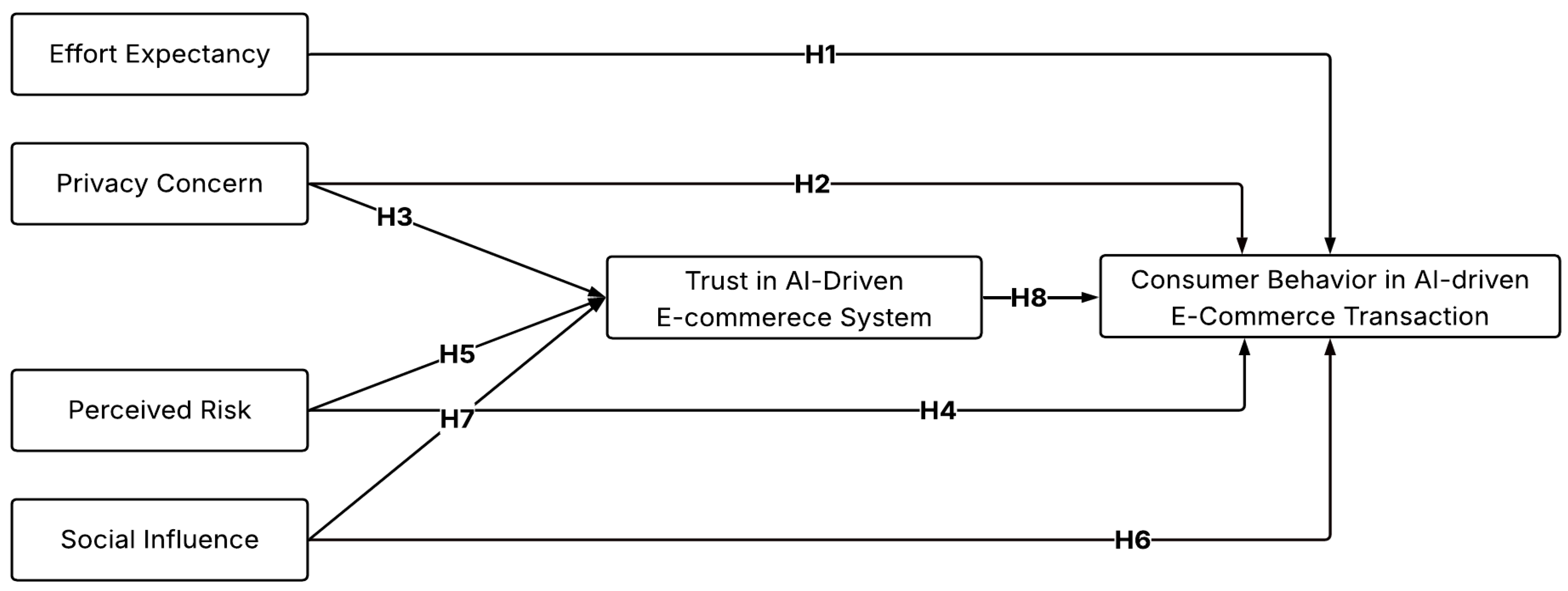
H1. 
EE has a positive effect on consumer behavior (CB) in AI-driven e-commerce transactions.

2.2.2. Privacy Concern (PC)

PC refers to the extent to which internet users worry that their personal information may be misused for opportunistic purposes or accessed by unauthorized parties [47]. According to research, privacy and trust are significantly correlated, making it a major barrier to the growth of e-commerce. Concerns, sometimes unjustified, about what goes on “under the hood” of free apps or websites are growing with awareness of technologies that monitor user behavior and collect data without consent. Such perceptions can hinder communication, restrict the flow of information, and influence individuals’ willingness to use online services [48]. Trust is crucial for lowering privacy concerns and persuading users that the advantages of disclosure outweigh the risks [49]. Privacy concerns limit businesses’ ability to use digital marketing and feedback tools to personalize communications, suggest offerings, and build relationships [50,51]. They can also erode trust and willingness to share information. Customers may feel less involved, less satisfied, and less able to access cutting-edge services when there is a lack of customization. Therefore, it is necessary to comprehend the ramifications of PC in order to minimize adverse effects and improve consumer and business engagement [52].
H2. 
PC has a negative effect on consumer behavior (CB) in AI-driven e-commerce transactions.
H3. 
PC has a negative effect on trust in AI-driven e-commerce systems.

2.2.3. Perceived Risk (PR)

PR, in the AI-based e-commerce transaction context, is the subjective assessment of customers’ willingness to be ready for expected negative outcomes from divulgence of personal information and doing online business. PR is the “potential loss in achieving the desired goal of e-service use,” and it is important to understand with greater specificity for online environments [53]. PR has a significant negative impact on consumers’ behavioral intention of using online platforms [54]. PR, defined as [55,56] the perception of potential loss, runs through users’ assessment and has direct effects on consumer trust. The Theory of Reasoned Action [57] states that PR has a negative impact on attitudes towards online purchase. Higher risk perception can decrease trust and reduce the propensity to adopt e-services [54,58]. Therefore, in AI-based e-commerce platforms, perceived risk plays a significant role as a barrier to both consumer behavior and trust. Higher PR leads to lower levels of trust [59] and weaker purchase intention and actual consumer behavior [60]. Additionally, research on AI-driven e-commerce contexts indicates that perceived risk negatively affects users’ behavioral intentions, as concerns about privacy and system performance undermine consumers’ willingness to engage with AI features [1].
H4. 
PR has a negative effect on consumer behavior (CB) in AI-driven e-commerce transactions.
H5. 
PR has a negative effect on trust in AI-Driven e-commerce systems.

2.2.4. Social Influence (SI)

SI represents the degree to which individuals perceive that people important to them, such as family members, friends, or colleagues, influence their decision to adopt or use a new system [39,61]. Similarly, social factors, image construct, and subjective norm in TPB, TRA, IDT, and MPCU are all reflective of the notion that an individual is going to modify their behaviors based on how others think of them [42]. People are using technology not just because they love it but also to comply with standards. Empirical studies have shown that social influence at the individual level plays a significant role in shaping behavioral acceptance [62]. Its influence is stronger in the early phases of technology acceptance [40,42]. The rationale is to enhance intimacy with significant others by concordance with their beliefs around certain behaviors [63,64]. The past literature has repeatedly examined SI as a major predictor of technology acceptance [65,66] and how it can directly impact system usage. In fact, with new e-commerce platforms, users are more likely to make a purchase when they see their friends endorsing or sharing positive experiences with products. Consequently, individuals are often more inclined to adopt a new technology when encouraged by people they consider important. SI has been found to be significant in behavioral intention in a number of studies [38,61,67] and positively affects the intention of young and old consumers to shop online. However, the literature also presents contradictory results. Specifically, research on mobile wallet acceptance [68] did not find support for the social-influence–behavioral-intention association.
H6. 
SI has a positive effect on consumer behavior in AI-driven e-commerce transactions.
H7. 
SI has a positive effect on trust in AI-driven e-commerce systems.

2.2.5. Trust in AI (TAI)

Trust is the consumer’s confidence in the reliability and competence of a service provider, which shapes their decisions and behavior when engaging with AI-powered e-commerce platforms [69]. It depicts a perception of the intentions and behavior that will be displayed by an exchange partner, which directly influences favorable purchasing attitudes and indirectly shapes willingness to buy [70]. In e-commerce, trust in information privacy—compromised by unauthorized tracking or misuse of personal information—represents the platform’s commitment to protect users’ personal data [71]. The extended privacy concern model [35] argues that trust affects the willingness to share personal information, and willingness fosters behavioral intentions. The role of trust is to enhance the impact of privacy and service quality on consumer behavior [72,73], while in e-business, empathy is a factor that could potentially reinforce this effect relationship [74,75]. In AI-enabled e-commerce, trust is critical for making sure that consumers are in a safe and engaged state, despite the fact that AI-mediated platforms may moderate the relationship between people’s trust and their engagement in a negative way [76]. Trust acts both as a motivator and as a moderator of positive consumer behavior [77]. Empirical evidence supports the proposition that higher levels of trust in AI-driven systems are linked to more favorable consumer behaviors.
H8. 
TAI has a positive effect on consumer behavior (CB) in AI-driven e-commerce transactions.

2.3. Proposed Conceptual Model

Adoption of technology in privacy-sensitive digital environments depends on usability expectations, as well as privacy concerns. We draw on elements of the extended UTAUT model as well as the extended privacy concern model to elucidate consumers’ adoption of AI-powered e-commerce platforms. The UTAUT model, developed by Venkatesh [61], has become one of the most used theories to predict the behavior related to intention to use technology, especially in organizations. An extension of it, UTAUT2 [38], customized the theory for consumer behavior, applying conditions of individual usage. In this research, EE and SI are taken from the Extended UTAUT as primary determinants, and perceived risk is used as a critical extension to capture the uncertainty of digital commerce [78]. The dependent construct is consumer behavior (CB) in terms of the behavioral intention with respect to AI-enabled e-commerce platforms. CB is operationalized as consumers’ behavioral intention to engage with and use AI-enabled e-commerce platforms. Consistent with the UTAUT framework, behavioral intention is treated as a precursor to future usage behavior. For privacy-related dynamics, PC and trust are included from the Extended Model of Online Privacy Concern [35,79] extension of IUIPC [80] and APCO [81].
The Extended Model of Online Privacy Concern was selected because it explicitly incorporates trust as a central mechanism linking privacy-related perceptions to behavioral outcomes. The earlier frameworks primarily focus on privacy concerns and information disclosure; the extended model recognizes that trust plays a critical role in shaping consumer responses in digital environments. This perspective is particularly relevant to AI-enabled e-commerce, where consumers interact with autonomous recommendation systems and algorithmic decision-making processes that require reliance on technology beyond traditional website interactions. By integrating privacy concerns, perceived risk, and trust with UTAUT constructs illustrated in Figure 1, the present study provides a more comprehensive theoretical framework for explaining consumer behavior in AI-mediated commerce.

3. Methodology

3.1. Research Setting and Sampling Technique

Customers who actively participate in e-commerce transactions facilitated by artificial intelligence (AI) features like dynamic pricing, automated service systems, and personalized recommendations were the subject of the study, which was carried out in Bangladesh. Purposive sampling, a method that is appropriate when the study seeks insights from participants with particular experiences, was used to guarantee the relevance of the data [82]. In order to reach a demographically diverse population while adhering to the study’s goals, the online survey was disseminated digitally through university networks, social media platforms, and e-commerce user groups. Bangladesh’s rapidly growing digital commerce industry and growing consumer dependence on AI-enabled platforms make the country’s research context especially pertinent [83]. Although this approach enabled efficient access to respondents familiar with AI-driven e-commerce, the use of non-probability sampling may limit the generalizability of the findings beyond the sampled population.

3.2. Questionnaire Design and Sample Size

A structured equation questionnaire was adopted from earlier studies and is provided in Appendix A. While PR and PC were taken from the Privacy Concern Model [35,79], constructs like EE and SI were taken from the UTAUT model [38,73]. Validated items from the literature on e-commerce adoption were used to operationalize trust in AI and consumers’ behavioral intention toward AI-enabled e-commerce transactions [84]. Each item was rated using a five-point Likert scale, where 1 represented “strongly disagree” and 5 represented “strongly agree.” Out of the 320 collected responses, 70 were excluded due to missing data and inconsistencies, and the final usable sample was 250 for subsequent statistical analyses. Notably, the sample size exceeds the 10-times rule, confirming its suitability for PLS-SEM analysis [85].

3.3. Data Analysis

The data analysis was conducted in two phases, with the first using SmartPLS 4.0 for PLS-SEM to assess the measurement and structural models. Cronbach’s alpha and composite reliability were used to evaluate reliability, and convergent and discriminant validity tests were used to analyze validity [86,87]. To assess potential common method bias arising from the use of self-reported, cross-sectional survey data, Harman’s [88] single-factor test was conducted using Principal Axis Factoring. All measurement items were loaded into an unrotated exploratory factor analysis to determine whether a single factor accounted for the majority of the variance. To make sure the structural model was robust, model fit indices, coefficient of determination (R2), effect sizes (f2), and predictive relevance (Q2) were also examined. Hypothesis testing was directed using a bootstrapping procedure, applying one-tailed significance testing, as all hypotheses were directionally stated. Next, ten-fold cross-validation and artificial neural network (ANN) analysis were used in the second stage to improve predictive accuracy and identify possible non-linear relationships [89]. Artificial neural networks (ANNs) mimic the human brain by learning from data and allow researchers to evaluate the effects of different antecedents [90]. A popular strategy for striking a balance between theory-driven causal testing and predictive modeling is the SEM–ANN hybrid approach [91]. Strong predictive performance and explanatory power were both made possible by this combination, which is especially important in research on e-commerce and technology adoption.
Additionally, SPSS (version 23.0) was utilized to analyze demographic data using the frequency and percentage approaches. An ANN study was carried out using Python 3.12 in Google Colab, utilizing TensorFlow/Keras for model creation and Scikit-learn for variable importance estimation, in order to supplement the PLS-SEM analysis and capture potential non-linear correlations. Two distinct ANN models were created: Model A looked at PR, SI, and PC as predictors of TAI, whereas Model B looked at PC, PR, SI, EE, and TAI as predictors of CB. A feedforward multilayer perceptron (MLP) architecture with two hidden layers of 10 and 5 neurons, respectively; ReLU activation functions; a linear output neuron; Adam optimizer (learning rate = 0.01); and MSE as the loss function were used in both models. The models were trained over 100 epochs with a batch size of 8. The dataset of 250 valid responses was randomly partitioned into a training set (90%, n = 225) and a testing set (10%, n = 25). To account for variability arising from random weight initialization, each neural network model was estimated through ten independent runs. Predictive performance was assessed using the Root Mean Square Error (RMSE) for both training and testing datasets. In line with prior SEM–ANN hybrid studies [89,91,92], variable importance was computed using permutation-based importance scores. These scores were averaged across the ten runs and subsequently normalized, with the most influential predictor assigned a benchmark value of 100% to facilitate comparative interpretation.

3.4. Ethical Approval

Ethical approval for this study was obtained from the Ethical Approval Committee, Department of Management Information Systems (MIS), University of Dhaka [Ref: MIS/FBS/DU/2025/05; Date: 1 March 2025]. The research involved anonymous survey data from adult participants, posed no foreseeable risk, and complied with institutional ethical guidelines. Informed consent was obtained from all respondents prior to data collection.

4. Result and Discussion

4.1. Demographic Analysis

Table 1 represents the demographic analysis of the 250 respondents presents a balanced and diverse sample. Gender distribution shows 54% male and 46% female, with no representation outside the binary. The age profile is dominated by young adults, as 58% fall within 21–30 years and 20% within 31–40 years, while smaller proportions include those below 20 (15%), 41–50 (4%), and above 50 (2%). Educational attainment indicates a highly educated group, with 45% undergraduates and 38% graduates, while the remainder (17%) have secondary, vocational, or alternative education. Occupationally, 55% are self-employed, 22% are formally employed, and 23% are unemployed, reflecting both entrepreneurial trends and employment challenges in Bangladesh. Income levels are varied, with 25% earning below 10,000, 32% between 10,000 and 20,000, 30% between 20,000 and 30,000, and 13% above 30,000. Collectively, the sample represents a youthful, educated, and economically diverse population, providing an important socio-cultural context for interpreting the study’s findings.

4.2. Measurement Model

The construct validity of the measurement model was examined using indicator reliability, internal consistency reliability, and convergent and discriminant validity.
As evidenced in Table 2, all of the items’ outer loadings were above the recommendation threshold value [86] of 0.70, and therefore, indicator reliability was established. As an example, items of consumer behavior (CB) loaded from 0.742 to 0.835, and effort expectancy (EE) ranged from 0.734 to 0.832. These findings indicate that each indicator strongly contributes to its underlying construct. Items CB3, PC2, and TAI3 were eliminated from the analysis after the indicator reliability assessment because their outer loadings were below the suggested level of 0.70, which is standard procedure in PLS-SEM to guarantee indicator reliability [86].
Cronbach’s alpha (CA) estimates were between 0.724 (SI) and 0.820 (EE), above the minimum of 0.70 [93]. Composite (rho_a and rho_c) reliability CR was also above 0.80 for all constructs in Table 2, which supports the internal consistency reliability [94].
The convergent validity was supported as the AVE values of all constructs were from 0.545 (SI) to 0.698 (TAI), which are higher than the cutoff point of 0.50 [95]. This suggests that every construct captures more than 50% of the variance in its observed indicators.
The variance inflation factor (VIF) values fell far below the cutoff of 3.0, between 1.300 and 1.895 (Table 2), verifying that there was no multi-collinearity among the indicators used to measure those factors [86].
Common method bias was assessed using Harman’s [88] single-factor test. The results indicate that a single factor emerged, explaining 39.51% of the total variance, which is below the recommended threshold of 50%. Since no single factor accounts for the majority of covariance among the variables, common method bias is not considered a serious concern in this study.

4.3. Discriminant Validity

Discriminant validity was examined through the HTMT ratio and the Fornell–Larcker criterion. Although some HTMT values approached the conservative threshold [87,96] of 0.85, all values reported in Table 3 are below the more lenient cutoff of 0.90 [87,97], indicating that the constructs are adequately distinct from one another. Likewise, the Fornell–Larcker criterion was met (Table 4) with diagonal values of the square root of the AVEs that were higher than their correlations among constructs (off-diagonal values). Here, the square root of the AVE of consumer behavior (0.801) was higher than their correlations with EE (0.659), PC (0.573), PR (0.563), SI (0.630), and TAI (0.575). This stability of the pattern holds for all constructs and confirms that each construct is empirically separable [95].
Fit of the model was examined by SRMR, d_ULS, d_G, Chi-square, and NFI (refer to Table 5). SRMR values for the saturated (0.067) and estimated (0.068) models were both below the 0.08 cutoff [98], showing a good fit. Both d_ULS (1.122; 1.169) and d_G (0.480; 0.487) were in line with the recommendations of Henseler [87], indicating no strong misspecification issues. Although both NFI (0.750; 0.749) values were lower than the commonly adopted cutoff of 0.90 used in CB_SEM, in PLS-SEM contexts, they only need to exceed 0.70 [86]. Therefore, these results provide approximate diagnostic support for the model.

4.4. Structural Model Result

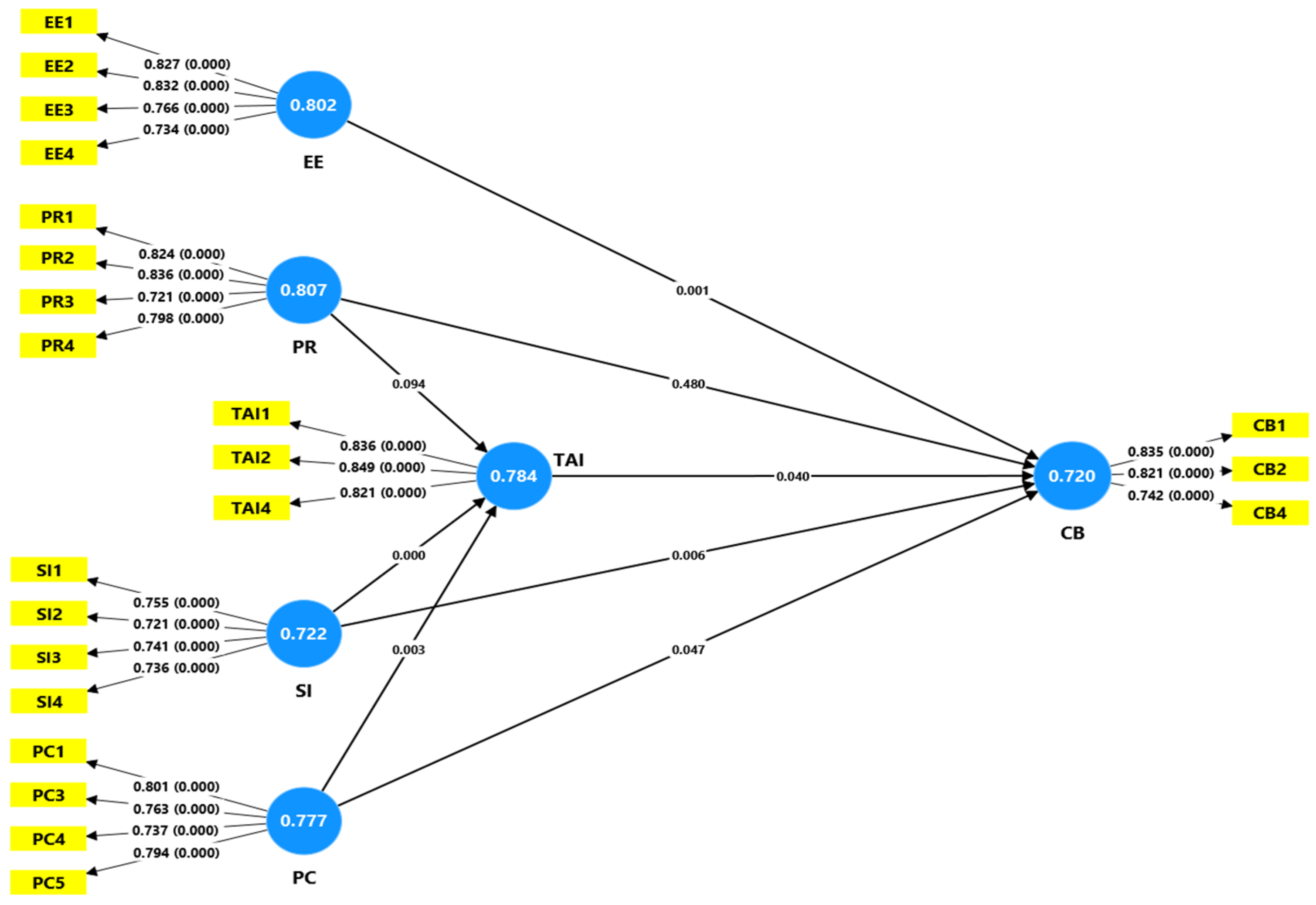
The R2 values (Table 6) were 0.521 for CB and 0.501 for TAI, above the threshold of 0.50, which denotes moderate explanatory power [86]. These findings imply that the model accounts for a moderate proportion of variance in CB and TAI. The structural model obtained from the PLS analysis is depicted in Figure 2.
As Table 7 illustrates, the Q2 values were 0.312 for CB and 0.276 for TAI. Both values are greater than zero, which means there was satisfactory predictive relevance of the model [86]. These values are reported as evidence of medium predictive validity of the model [86].
The summary of the structural model is presented in Table 8, where we report path coefficients up to significance levels and f2 effect sizes. The table results have been obtained using one-tailed tests in SmartPLS, as the hypotheses were directional. The direct impact of EE on CB was significant (β = 0.333, p = 0.001, f2 = 0.093), in agreement with H1. It is also found that PC was positively correlated with CB (PC → CB: β = 0.137, p = 0.047, f2 = 0.018) and TAI (PC → TAI: β = 0.212, p = 0.003, f2 = 0.043), suggesting the rejection of H2 and H3, respectively. Reduced perceived risk had no significant direct effect on either consumer behavior (PR → CB: β = 0.005, p = 0.480, f2 = 0.000) or trust (PR → TAI: β = 0.109, p = 0.094, f2 = 0.010), which led to H4 and H5 being rejected. Social influence was identified as a major factor, which significantly influenced both customer behavior (SI → CB: β = 0.231, p = 0.006, f2 = 0.043) and trust (SI → TAI: β = 0.469, p = 0.000, f2 =0.216), providing evidence for H6 and H7. Trust itself also positively influenced consumer behavior (TAI → CB: β = 0.131, p = 0.040) and this contribution was significant, so H3 is supported.
Table 9 shows the mediation effects of trust on AI-based e-commerce (TAI). The relationship between PC and consumer behavior was not mediated, as the indirect effect through TAI was not significant (β = 0.028, p = 0.087), although the direct effect remained statistically significant (β = 0.137, p = 0.047). On the other hand, perceived risk was not mediated, as noted by both direct (β = 0.005, p > 0.05) and indirect paths (β = 0.014, p > 0.05). For social influence, partial mediation was supported: the direct impact (β = 0.231, p = 0.006) and indirect influence through TAI (β = 0.062, p = 0.041) were also significant; the total effect β value was equal to 0.293. This study presents an interesting insight: trust mediates the effect of social influence on AI-driven consumer behavior, whereas it does not mediate privacy or risk perceptions or their impact on consumer outcomes.

4.5. Performance Evaluation Using RMSE

Table 10 shows the ANN outputs of both models offer key findings on the factors affecting TAI and CB in AI-based e-commerce. SI was the most important determinant of trust (100%) in Model A, followed by PC (56.85%) and PR (22.41%). These findings suggest that consumer trust in AI systems is predominantly influenced by social perceptions and the cues given by society, particularly about privacy and risk. On the other hand, Model B indicates that user behavior is strongly influenced by SI (100%), TAI in AI systems (70.09%), EE (57.79%), and to a moderate degree PC, as this last dimension reached only 24.83%, while perceived risk = 7.01% (negligible). From the predictive point of view, both models perform well with low training and test RMSE (Model A: 0.492 vs. 0.491; Model B: 0.434 vs. 0.548). It was found that the very close proximity of training and testing RMSE values in Model A signifies high generalizability with minimal overfitting, whereas Model B shows a noticeable difference between these values, indicating comparatively lower generalizability with some degree of overfitting. Nevertheless, both models demonstrate acceptable predictive performance, supporting the recommendation for reporting predictive validity in advanced modeling [99]. Although both models confirm that SI is dominant, they also show a significant difference in privacy and risk perceptions.

4.6. Results of Sensitivity Analysis

The sensitivity analysis of both approaches demonstrates the stability and prediction accuracy of the ANN model; the results of sensitivity analysis are presented in Table 11. For Model A, low training (RMSE = 0.491) and testing RMSE = 0.421 reflect an accurate model with relatively small prediction errors on average. The small testing RMSE and low standard deviations (training SD = 0.068, testing SD = 0.068) indicate that the model generalizes well to new data and does not overfit. This means that the predictors (PR, SI, and PC) are effective in profiling trust variance in AI-driven e-commerce. Also, Model B’s results presented slightly higher, although still acceptable, error rates (average training and testing RMSE = 0.454 and 0.554). The relatively close training and testing RMSE with moderate standard deviations (training SD = 0.057, testing SD = 0.070) indicate stability as well as a reasonable degree of generalizability. Even for models that included extra predictors (EE and TAI), ANNs still provided consistent prediction power across different runs, which again demonstrated solid reliability. In general, both models support strong predictive validity, with Model A performing better in terms of lower testing RMSE, and Model B studying a broader scope by including more behavioral variables.

5. Discussion

The results of this study offer critical implications to understand the factors influencing customers on TAI and how it affects CB, using SEM and ANN modeling approaches. We interpret and discuss the findings from a risk–benefit perspective, where factors such as perceived risk (PR) and privacy concern (PC) correspond to the risks of AI adoption, whereas social influence (SI), effort expectancy (EE), and trust in AI constitute its benefits. SEM results revealed that SI had the greatest positive impact on CB and TAI (H6, H7 supported), whereas PR was not significant with respect to CB and TAI (H4 and H5 rejected). Contrary to earlier studies that identify perceived risk as a key inhibitor of online adoption [100], our findings indicate that perceived risk did not significantly influence trust in AI or consumer behavior within the context of AI-enabled e-commerce adoption in Bangladesh. Existing studies suggest that PR minimizes trust, which influences BI and thereby establishes an indirect pathway between PR and consumer outcomes.
Research in cross-border e-commerce demonstrates that PR negatively affects trust, which subsequently drives purchase intention [31], while other studies show that trust mediates the relationship between PR and behavioral intention [101], indicating that the impact of risk is often transmitted indirectly rather than exerted directly. However, the study also highlights that the influence of PR is neither stable nor universally significant, as its effect varies across contexts and user characteristics [102]. Furthermore, meta-analytical findings confirm that trust can attenuate or even override perceived risk, emerging as the dominant predictor of consumer behavior in digital settings [103]. This study found that perceived risk had no significant effect on either trust in AI or consumer behavior. Again, the indirect effect through trust was also not statistically significant among the sampled users of AI-enabled e-commerce platforms.
Strong trust mechanisms and positive social influence reduce users’ attention to potential risks. This result is in contradiction with the former stream of research, which emphasizes risk as a great obstacle for online transactions, but is consistent with some more recent research suggesting that trust and system dependability together diminish the role of risk in digital systems [84,104].
The analysis revealed that PC exerted a significant positive effect on both CB and TAI, contrary to the hypothesized negative relationships; therefore, H2 and H3 were rejected. This unexpected finding may be explained through the privacy paradox, where consumers continue engaging with AI-enabled e-commerce platforms despite acknowledging privacy concerns because the perceived benefits of convenience, personalization, and social influence outweigh perceived privacy-related costs [105]. The combined non-significant impact of PR and PC supports that risk-related constructs are less important in influencing TAI and CB in AI commerce environments.
EE had a strong positive effect on CB (H1 supported). EE emerged as an important antecedent of CB, emphasizing that consumer involvement is highly interrelated with perceptions of ease and effortlessness in using AI-based platforms. TAI also had a significant direct effect on CB (H8 supported). TAI partially mediated the relationship between social influence and consumer behavioral intention, suggesting that trust formation plays an important role in translating social influence into adoption intentions toward AI-enabled e-commerce platforms, which suggested that consumers’ transactional behavior in AI was contingent on the formation of trust in line with previous studies on trust [106] in e-commerce [58,84]. These results suggest that the benefit side outweighs the risk side for forming digital commerce intention. Comparable to disadvantage-driven constructs were the substantial effects for benefit categories.
Results of the mediation analysis show that SI partially mediated the relationship with CB through TAI; PR did not exhibit either a significant direct effect or a significant indirect effect through trust in AI within the present study. These results are consistent with previous research, which reveals that trust and social influence have more critical roles in e-commerce adoption, where the direct impact of risk perceptions is seemingly attenuated [53,86].
The findings were further validated by the ANN analysis, which continuously placed SI as the greatest predictor in trust and consumer behavior models. These findings lead to the existing work demonstrating the importance of SI in building trust over digital media [107]. SI remained the strongest predictor of TAI and CB in both SEM and ANN, implying that SI plays a crucial role in technology adoption, as suggested by UTAUT [38]. However, ANN showed that the second and third most powerful predictors of CB were EE and TAI, whereas PR had almost zero influence in prediction, consistent with the SEM outcomes. This is consistent with prior results indicating that, in the context of online shopping, trust and perceived usability are stronger than PR factors in influencing purchase intention [108].
While SI remained dominant across both SEM and ANN models, the ANN results provided additional insight by revealing the relative importance and non-linear interactions among predictors, where EE and TAI emerged as the second and third strongest determinants of consumer behavior. Notably, PR demonstrated negligible predictive power in the ANN model, corroborating the SEM findings that PR was not a significant predictor of trust in AI on consumer behavior within the investigated sample. This aligns with prior evidence suggesting that trust and perceived usability outweigh risk considerations in online purchasing decisions [109,110]. The ANN results extend beyond validation by illustrating that benefit-driven factors (SI, EE, and TAI) exert stronger non-linear and combined effects on consumer behavior, whereas risk-related factors fail to contribute meaningfully even in complex predictive settings. This provides additional support for the proposed shift toward a trust-dominant and benefit-oriented decision framework, where perceived risk is not only statistically insignificant but also practically irrelevant in influencing outcomes. By integrating SEM and ANN, this study demonstrates that while SEM confirms theoretically grounded relationships, ANN uncovers deeper predictive patterns and relative variable importance, thereby offering a more inclusive understanding of consumer choice and decision-making. Collectively, these findings suggest that consumers in the present sample placed greater emphasis on social influence, effort expectancy, and trust in AI than on perceived risk when engaging with AI-enabled e-commerce platforms. The results indicate an asymmetric cost–benefit evaluation in which perceived benefits were more influential than perceived risks within the investigated context.

6. Conclusions

This paper used the UTAUT constructs and Privacy Calculus model to investigate trust and consumer behavior in AI-supported e-commerce, using two methods: SEM and ANN. The findings reveal a risk–benefit exchange, in which benefit-accepting factors—social influence, effort expectancy, and trust in AI—contribute significantly to consumer behavioral intention toward AI-enabled e-commerce platforms, but perceived privacy and risk have an insignificant impact. Privacy concerns demonstrated a statistically significant positive effect on both consumer behavior and trust in AI, contrary to the hypothesized relationships, indicating the presence of a privacy paradox in the studied context. Leveraging theory-driven causal testing (SEM) with predictive modeling (ANN), the paper makes methodological and practical contributions to information systems research for managers. From the findings, it is clear that companies should focus on social proof, effort expectancy, and trust mechanisms rather than overemphasizing privacy and risk reduction. Theoretical implications of our study include expanding the literature on privacy calculus to AI-powered platforms and reinforcing that the role of social context is crucial in digital acceptance. The findings of this study provide several important implications for managers and practitioners in the AI-driven e-commerce domain. The results suggest that organizations should focus on strengthening social influence, improving platform usability, and building trust in AI systems. Strategies such as customer reviews, influencer endorsements, transparent AI practices, and personalized user experiences can enhance consumer adoption and engagement. While privacy protection remains important, managers should prioritize delivering clear value and trustworthy AI-enabled services to achieve sustained competitive advantage. By integrating these practices into their digital strategies, e-commerce organizations can improve customer satisfaction, foster loyalty, and achieve sustainable competitive advantages in an increasingly technology-driven marketplace. Collectively, this study shows that social influence, effort expectancy, and trust in AI were more influential predictors of consumer behavior than perceived risk among Bangladeshi users of AI-enabled e-commerce platforms. These findings contribute to understanding technology adoption in AI-supported digital commerce environments.

7. Implication

7.1. Theoretical Implication

This study offers several important theoretical contributions to the understanding of AI-enabled e-commerce adoption and consumer trust.
First, the findings extend the UTAUT by demonstrating that social influence remains a dominant determinant of consumer behavior and trust even in AI-enabled environments where algorithmic systems actively participate in decision-making. AI-enabled e-commerce platforms employ autonomous recommendation systems and intelligent decision-support mechanisms that influence consumer choices. The present findings suggest that social validation continues to play a central role in AI-driven commerce, thereby extending the applicability of UTAUT.
Second, the study contributes to privacy calculus theory by challenging the assumption that perceived risk consistently acts as a primary barrier to technology adoption. While privacy calculus proposes that consumers evaluate technologies through a trade-off between expected benefits and perceived risks, the results indicate that risk-related considerations may become less influential when consumers perceive substantial benefits from AI-enabled services. These findings contribute to ongoing discussions regarding the contextual boundaries of privacy calculus theory and suggest that its explanatory power may vary across different technological settings.
Third, the results advance the literature on trust in AI by demonstrating that trust functions as more than a simple mediating construct. Trust in AI not only directly influences consumer behavior but also serves as a mechanism through which social influence translates into behavioral outcomes. This finding highlights the central role of trust in shaping consumer responses to algorithmic systems and supports the argument that trust in AI should be conceptualized as a distinct form of technology trust. As consumers increasingly rely on AI-driven recommendations and automated decision-making processes whose internal logic may not be fully observable, trust becomes a critical explanatory mechanism for understanding technology adoption and usage behavior.
Fourth, the findings provide additional insights into the privacy paradox literature. Although consumers reported privacy concerns, these concerns exhibited positive relationships with both trust in AI and consumer behavior. This suggests that consumers may continue to engage with AI-enabled platforms despite recognizing potential privacy issues when they perceive substantial benefits such as convenience, personalization, and improved service quality.
Finally, this study contributes methodologically by demonstrating the value of integrating structural equation modeling (SEM) and artificial neural networks (ANN) in technology adoption research. While SEM confirmed the theoretical relationships and mediation effects proposed by the research model, ANN provided additional insights into non-linear predictive patterns and the relative importance of predictors.

7.2. Practical Implication

The results offer several practical insights for companies using AI in e-commerce.
First, social influence has the strongest impact on consumer behavior. This means companies can increase trust and engagement by using social proof strategies such as peer reviews, testimonials, and influencer endorsements. Marketing campaigns that show community acceptance can significantly boost adoption. Second, effort expectancy is an important driver of consumer behavior. Platforms should focus on usability, intuitive design, and smooth AI interactions. Features like automation, personalized recommendations, and clear navigation make it easier for users to interact with the system and increase customer retention. Third, trust in AI partially mediates the relationship between social influence and consumer behavioral intention. Developers and policymakers should prioritize building trust by explaining how AI makes decisions, providing transparent data usage policies, and offering strong customer support. Rather than focusing only on reducing perceived risk, companies should show that their systems are reliable, fair, and accountable, giving consumers confidence in their decisions. Finally, the weak influence of perceived risk suggests that consumer hesitation is less about fear of risk and more about trust and perceived benefits. While compliance frameworks, certifications, and privacy labels help establish credibility, the main value comes from providing a smooth, useful, and enjoyable experience for customers.

8. Limitations and Future Research

This study has limitations while contributing to the field. The present study also suffered from the use of self-reported survey-based data, which could potentially suffer from social desirability effects. As the purposive sampling and online distribution methods were used, the sample may overrepresent digitally active and younger consumers.
For future researchers, experimental or longitudinal designs could be used to gain a better understanding of the time-varying nature of consumer trust and behavior. Second, the research was based on one nation only, which raises concerns of generalizability. There may be cultural and institutional variations in how consumers perceive trust, risk, and technology adoption. Our results need to be cross-validated across countries and multiple contexts to determine their cross-cultural generalizability. Third, although SEM and ANN analyses yielded explanatory and predictive findings, other advanced analytical techniques like fuzzy-set qualitative comparative analysis or Bayesian networks might be useful to identify alternative causal paths and configurational patterns. Finally, the analyses were restricted to a few constructs (EE, SI, PC, PR, TAI, and CB). Further, it may be possible to extend the model by including trust-building factors (e.g., algorithmic transparency, fairness perceptions) or psychological factors (e.g., emotions, digital literacy) to develop a more comprehensive view of how consumers interact with AI-based commerce.

Supplementary Materials

The following supporting information can be downloaded at: https://www.mdpi.com/article/10.3390/jtaer21070228/s1, Table S1.

Author Contributions

I.J.S.: Writing—review and editing, Writing—original draft, Visualization, Software, Resources, Methodology, Investigation, Formal analysis, Data curation, Conceptualization. A.A.-J.: Writing—review and editing, Writing—original draft, Visualization, Validation, Supervision, Software, Project administration, Methodology, Investigation, Formal analysis, Data curation, Conceptualization. M.A.H.M.: Writing—review and editing, Writing—original draft, Visualization, Validation, Supervision, Resources, Project administration, Methodology, Investigation, Funding acquisition. All authors have read and agreed to the published version of the manuscript.

Funding

No external funding was received for this study. The APC was funded by the University of Dhaka.

Institutional Review Board Statement

Ethical approval for this study was obtained from the Ethical Approval Committee, Department of Management Information Systems (MIS), University of Dhaka [Ref: MIS/FBS/DU/2025/05; Date: 1 March 2025]. The research involved anonymous survey data from adult participants, posed no foreseeable risk, and complied with institutional ethical guidelines. Informed consent was obtained from all respondents prior to data collection.

Informed Consent Statement

Informed consent was obtained from all subjects involved in the study.

Data Availability Statement

The authors declare that the data has been given in the Supplementary File.

Acknowledgments

The authors of this study declare that there are no potential conflicts of interest associated with this research. This statement underscores their commitment to transparency and ethical standards in scientific publication, ensuring that their findings and conclusions remain free from any influence of personal, financial, or professional interests. The authors gratefully acknowledge the University of Dhaka for providing financial support through its International Research Publication Grant, which covered the Article Processing Charge (APC) for this publication.

Conflicts of Interest

The authors declare no conflicts of interest.

Appendix A

ConstructMeasured ItemsCitation
Effort ExpectancyE-commerce is clear and understandable.
E-commerce helps me become skillful in using the system.
E-commerce is user-friendly.
Learning to operate e-commerce is easy for me.
[38,61,111]
Privacy ConcernI am concerned about my online privacy.
I am concerned about extensive collection of my personal information over the internet.
I am concerned that the information I submit on the internet could be misused.
I am concerned about submitting information on the internet because it could be used in a way I did not foresee.
I am concerned that my private information can show up on the internet.
[36,112,113]
Perceived RiskSharing my personal information online could lead to misuse.
Websites may share my personal information without my consent.
Providing personal information to websites poses privacy risks.
There is a high chance of losing privacy when sharing personal information online.
Websites could use my personal information inappropriately.
[36,114]
Social InfluencePeople who influence my behavior think that I should use e-commerce
People who are important to me think that I should use e commerce
People whose opinions that I value prefer that I should use e-commerce
The environment around me favors the use of e-commerce.
[38,61,112]
Trust in AII believe AI technologies are trustworthy in how they handle personal information.
I trust that AI-driven e-commerce systems always have customers’ best interests in mind.
I have confidence that AI technologies will function as promised in e-commerce systems.
I trust AI recommendation systems to be transparent in how they use my personal data.
[20,75]
Consumer BehaviorI intend to continue using AI-driven e-commerce platforms in the future.
I intend to shop on AI-powered e-commerce websites whenever possible.
I am likely to make purchases on AI-driven e-commerce platforms.
I would frequently use AI-driven e-commerce platforms for my shopping needs.
[20,50,73]

References

  1. Marjerison, R.K.; Zhang, Y.; Zheng, H. AI in E-Commerce: Application of the Use and Gratification Model to the Acceptance of Chatbots. Sustainability 2022, 14, 14270. [Google Scholar] [CrossRef]
  2. Schafer, J.B.; Konstan, J.A.; Riedl, J. E-Commerce Recommendation Applications. In Applications of Data Mining to Electronic Commerce; Kohavi, R., Provost, F., Eds.; Springer: Boston, MA, USA, 2001; pp. 115–153. [Google Scholar] [CrossRef]
  3. Zhang, D.; Pee, L.G.; Cui, L. Artificial Intelligence in E-Commerce Fulfillment: A Case Study of Resource Orchestration at Alibaba’s Smart Warehouse. Int. J. Inf. Manag. 2021, 57, 102304. [Google Scholar] [CrossRef]
  4. Cui, L.; Huang, S.; Wei, F.; Tan, C.; Duan, C.; Zhou, M. SuperAgent: A Customer Service Chatbot for E-Commerce Websites. In Proceedings of the ACL 2017, System Demonstrations; Bansal, M., Ji, H., Eds.; Association for Computational Linguistics: Vancouver, BC, Canada, 2017; pp. 97–102. [Google Scholar]
  5. Guha, J.; Heger, C. Machine Translation for Global E-Commerce on Ebay. In Proceedings of the AMTA; Association for Machine Translation in the Americas: Vancouver, BC, Canada, 2014; Volume 2, pp. 31–37. [Google Scholar]
  6. Rosaroso, R.C. Using Reliability Measures in Test Validation. Eur. Sci. J. 2015, 11, 369–377. [Google Scholar]
  7. Hassan, N.; Abdelraouf, M.; El-Shihy, D. The Moderating Role of Personalized Recommendations in the Trust–Satisfaction–Loyalty Relationship: An Empirical Study of AI-Driven e-Commerce. Future Bus. J. 2025, 11, 66. [Google Scholar] [CrossRef]
  8. Papastamoulou, P.; Antonopoulos, N. Artificial Intelligence in E-Commerce: A Comparative Analysis of Best Practices Across Leading Platforms. Systems 2025, 13, 746. [Google Scholar] [CrossRef]
  9. Butt, J.S. The General Data Protection Regulation of 2016 (GDPR) Meets Its Sibling the Artificial Intelligence Act of 2024: A Power Couple, or a Clash of Titans? Acta Univ. Danub. Jurid. 2024, 20, 7–52. [Google Scholar]
  10. Mishra, A.; Mou, S.N.; Ara, J.; Sarkar, M. Regulatory and Ethical Challenges in AI-Driven and Machine Learning Credit Risk Assessment for Buy Now, Pay Later (BNPL) in U.S. E-Commerce: Compliance, Fair Lending, and Algorithmic Bias. J. Bus. Manag. Stud. 2025, 7, 42–51. [Google Scholar] [CrossRef]
  11. Akter, S.; Sultana, S.; Mariani, M.; Wamba, S.F.; Spanaki, K.; Dwivedi, Y.K. Advancing Algorithmic Bias Management Capabilities in AI-Driven Marketing Analytics Research. Ind. Mark. Manag. 2023, 114, 243–261. [Google Scholar] [CrossRef]
  12. Amaral Cejas, O. Artificial Intelligence-Enabled Automation for Compliance Checking Against GDPR. Ph.D. Dissertation, University of Luxembourg, Luxembourg, 2023. [Google Scholar]
  13. Pasquale, F. The Black Box Society: The Secret Algorithms That Control Money and Information; Harvard University Press: Cambridge, MA, USA, 2015. [Google Scholar]
  14. Cadogan, R.A. The Ethics Of Data Privacy In An Electronic Marketplace: The Incorporation Of Fair Information Practice Principles Into Privacy Policies. Rev. Bus. Inf. Syst. RBIS 2003, 7, 23–36. [Google Scholar] [CrossRef]
  15. Quach, S.; Thaichon, P.; Martin, K.D.; Weaven, S.; Palmatier, R.W. Digital Technologies: Tensions in Privacy and Data. J. Acad. Mark. Sci. 2022, 50, 1299–1323. [Google Scholar] [CrossRef] [PubMed]
  16. Ouadrhiri, A.E.L.; Abdelhadi, A.; Member, S. Differential Privacy for Deep and Federated Learning: A Survey. IEEE Access 2022, 10, 22359–22380. [Google Scholar] [CrossRef]
  17. Yang, Q. Toward Responsible Ai: An Overview of Federated Learning for User-Centered Privacy-Preserving Computing. ACM Trans. Interact. Intell. Syst. TiiS 2021, 11, 1–22. [Google Scholar] [CrossRef]
  18. Adanyin, A. Ethical AI in Retail: Consumer Privacy and Fairness. arXiv 2024, arXiv:2410.15369. [Google Scholar]
  19. Narapareddy, V.S.R. Federated learning and privacy-preserving AI. Int. Res. J. Mod. Eng. Technol. Sci. 2025, 7, 4622–4639. [Google Scholar]
  20. Rana, M.M.; Siddiqee, M.S.; Sakib, M.N.; Ahamed, M.R. Assessing AI Adoption in Developing Country Academia: A Trust and Privacy-Augmented UTAUT Framework. Heliyon 2024, 10, e37569. [Google Scholar] [CrossRef] [PubMed]
  21. Palvia, P. The Role of Trust in E-Commerce Relational Exchange: A Unified Model. Inf. Manag. 2009, 46, 213–220. [Google Scholar] [CrossRef]
  22. Zhang, J.-X.; Yang, H.-Y. Research on the Influencing Factors of Consumers’ Purchase Behavior of Pinduoduo E-Commerce Platform Based on the UTAUT Model. DEStech Trans. Econ. Bus. Manag. 2019, 69–75. [Google Scholar] [CrossRef][Green Version]
  23. Oncioiu, I. AI Transparency and User Behavior in Human–AI Collaboration: Evidence from E-Commerce Recommendation Systems. J. Theor. Appl. Electron. Commer. Res. 2026, 21, 153. [Google Scholar] [CrossRef]
  24. Tian, Z.; Wang, J.; Zhang, X.; Li, Y.; Chen, Y.; Liu, H.; Wang, S. Big Data Analytics and AI for Consumer Behavior in Digital Marketing: Applications, Synthetic and Dark Data, and Future Directions. Big Data Cogn. Comput. 2024, 10, 46. [Google Scholar] [CrossRef]
  25. Gavade, M.V.; Patil, J.; Khot, J.; Patil, S. Artificial Intelligence for Pricing in E-Commerce: A Comprehensive Review with Emphasis on Market Trend Adaptation. Foundry J. 2024, 27, 178–199. [Google Scholar]
  26. Gour, S.; Pal, H.; Joshi, M.; Qureshi, A.R.K. E-Commerce and Consumer Psychology: A Case Study of Online Shopping Behavior in Bhopal City. Sci. Technol. Dev. Appl. 2025, 6, 138–147. [Google Scholar] [CrossRef]
  27. Shi, M. Research on Innovative Applications of AI Virtual Anchor Live Streaming E-Commerce in the Context of Artificial Intelligence. J. Humanit. Arts Soc. Sci. 2024, 8, 1609–1613. [Google Scholar] [CrossRef]
  28. Azmi, I.M. E-Commerce and Privacy Issues: An Analysis of the Personal Data Protection Bill. Int. Rev. Law Comput. Technol. 2002, 16, 317–330. [Google Scholar] [CrossRef]
  29. Muneer, A.; Razzaq, S.; Farooq, Z. Data Privacy Issues and Possible Solutions in E-Commerce. J. Account. Mark. 2018, 7, 1000294. [Google Scholar] [CrossRef]
  30. Yao, H.; Tarofder, A.K. Privacy Concerns in E-Commerce Marketing: A Systematic Literature Review Study. Int. J. Glob. Econ. Manag. 2024, 2, 64–75. [Google Scholar] [CrossRef]
  31. Ma, D.; Dong, J.; Lee, C.-C. Influence of Perceived Risk on Consumers’ Intention and Behavior in Cross-Border e-Commerce Transactions: A Case Study of the Tmall Global Platform. Int. J. Inf. Manag. 2025, 81, 102854. [Google Scholar] [CrossRef]
  32. Drydakis, N. Artificial Intelligence and Reduced SMEs’ Business Risks. A Dynamic Capabilities Analysis during the COVID-19 Pandemic. Inf. Syst. Front. 2022, 24, 1223–1247. [Google Scholar] [CrossRef] [PubMed]
  33. Sharma, S.; Islam, N.; Singh, G.; Dhir, A. Why Do Retail Customers Adopt Artificial Intelligence (AI) Based Autonomous Decision-Making Systems? IEEE Trans. Eng. Manag. 2024, 71, 1846–1861. [Google Scholar] [CrossRef]
  34. Ab Aziz, Y.; Poureisa, A. Social Commerce Dynamics in Online Retail: Examining Instagram’s Design and Its Technology. Int. J. Technol. Hum. Interact. IJTHI 2025, 21, 1–31. [Google Scholar] [CrossRef]
  35. Anic, I.D.; Škare, V.; Kursan Milaković, I. The Determinants and Effects of Online Privacy Concerns in the Context of E-Commerce. Electron. Commer. Res. Appl. 2019, 36, 100868. [Google Scholar] [CrossRef]
  36. Dinev, T.; Bellotto, M.; Hart, P.; Russo, V.; Serra, I.; Colautti, C. Privacy Calculus Model in E-Commerce—A Study of Italy and the United States. Eur. J. Inf. Syst. 2006, 15, 389–402. [Google Scholar] [CrossRef]
  37. Maseeh, H.I.; Jebarajakirthy, C.; Pentecost, R.; Arli, D.; Weaven, S.; Ashaduzzaman, M. Privacy Concerns in E-Commerce: A Multilevel Meta-Analysis. Psychol. Mark. 2021, 38, 1779–1798. [Google Scholar] [CrossRef]
  38. Venkatesh, V.; Thong, J.Y.; Xu, X. Consumer Acceptance and Use of Information Technology: Extending the Unified Theory of Acceptance and Use of Technology. MIS Q. 2012, 36, 157–178. [Google Scholar] [CrossRef]
  39. Davis, F.D. Perceived Usefulness, Perceived Ease of Use, and User Acceptance of Information Technology. MIS Q. 1989, 13, 319–340. [Google Scholar] [CrossRef]
  40. Thompson, R.L.; Higgins, C.A.; Howell, J.M. Personal Computing: Toward a Conceptual Model of Utilization. MIS Q. 1991, 15, 125–143. [Google Scholar] [CrossRef]
  41. Moore, G.C.; Benbasat, I. Development of an Instrument to Measure the Perceptions of Adopting an Information Technology Innovation. Inf. Syst. Res. 1991, 2, 192–222. [Google Scholar] [CrossRef]
  42. Venkatesh, V.; Davis, F.D. A Theoretical Extension of the Technology Acceptance Model: Four Longitudinal Field Studies. Manag. Sci. 2000, 46, 186–204. [Google Scholar] [CrossRef]
  43. Kbaier, E.; Bakini, F.; Oueslaty, K. Investigating the Influence of AI Chatbot Interactions on Attitudes and Purchase Intentions: Extending the UTAUT Framework from Brands Perspective. J. Bus. Strategy 2025, 46, 29–50.\. [Google Scholar] [CrossRef]
  44. Mensah, J.K.; Xu, Y. Adoption of E-Commerce Technologies among SMEs in Ghana under the Influence of Integrated UTAUT and TOE Frameworks. Inf. Dev. 2025. [Google Scholar] [CrossRef]
  45. Taheri, B.; Yousaf, A.; Gannon, M.; Mishra, A. E-Commerce Website Customer Engagement: Delineating the Role of UTAUT, Vividness, and Compulsion. J. Retail. Consum. Serv. 2024, 79, 103835. [Google Scholar] [CrossRef]
  46. Hasbullah, N.N.; Kiflee, A.K.R.; Rahim, H.; Shahid, F.Z.; Anwar, S.; Ramachandran, K. Exploring the Adoption of Sustainable Omni-Channel Grocery Technologies among Generation Z in Malaysia: The Moderating Role of Risk Mitigation for Perishability. Discov. Sustain. 2025, 6, 336. [Google Scholar] [CrossRef]
  47. Eastlick, M.A.; Lotz, S.L.; Warrington, P. Understanding Online B-to-C Relationships: An Integrated Model of Privacy Concerns, Trust, and Commitment. J. Bus. Res. 2006, 59, 877–886. [Google Scholar] [CrossRef]
  48. Dinev, T.; Hart, P. Internet Privacy Concerns and Their Antecedents—Measurement Validity and a Regression Model. Behav. Inf. Technol. 2004, 23, 413–422. [Google Scholar] [CrossRef]
  49. Luo, X. Trust Production and Privacy Concerns on the Internet: A Framework Based on Relationship Marketing and Social Exchange Theory. Ind. Mark. Manag. 2002, 31, 111–118. [Google Scholar] [CrossRef]
  50. Amil, Y. The Impact of AI-Driven Personalization Tools on Privacy Concerns and Consumer Trust in E-Commerce. Master’s Thesis, University of Liège, Liège, Belgium, 2024. [Google Scholar]
  51. Chen, T.; Liu, F.; Shen, X.-L.; Wu, J.; Liu, Y. Conceptualization of Privacy Concerns and Their Influence on Consumers’ Resistance to AI-Based Recommender Systems in e-Commerce. Ind. Manag. Data Syst. 2025, 125, 1844–1868. [Google Scholar] [CrossRef]
  52. Gao, L.; Bai, X. A Unified Perspective on the Factors Influencing Consumer Acceptance of Internet of Things Technology. Asia Pac. J. Mark. Logist. 2014, 26, 211–231. [Google Scholar] [CrossRef]
  53. Pavlou, P.A. Consumer Acceptance of Electronic Commerce: Integrating Trust and Risk with the Technology Acceptance Model. Int. J. Electron. Commer. 2003, 7, 101–134. [Google Scholar] [CrossRef]
  54. Alalwan, A.A.; Dwivedi, Y.K.; Rana, N.P. Factors Influencing Adoption of Mobile Banking by Jordanian Bank Customers: Extending UTAUT2 with Trust. Int. J. Inf. Manag. 2017, 37, 99–110. [Google Scholar] [CrossRef]
  55. Bauer, R.A. Consumer Behavior as Risk Taking. In Risk Taking and Information Handling in Consumer Behavior; Cox, D.F., Ed.; Harvard University Press: Boston, MA, USA, 1967; pp. 23–33. [Google Scholar]
  56. Mayer, R.C.; Davis, J.H.; Schoorman, F.D. An Integrative Model of Organizational Trust. Acad. Manag. Rev. 1995, 20, 709–734. [Google Scholar] [CrossRef]
  57. De Ruyter, K.; Wetzels, M.; Kleijnen, M. Customer Adoption of E-Service: An Experimental Study. Int. J. Serv. Ind. Manag. 2001, 12, 184–207. [Google Scholar] [CrossRef]
  58. McKnight, D.H.; Choudhury, V.; Kacmar, C. Developing and Validating Trust Measures for E-Commerce: An Integrative Typology. Inf. Syst. Res. 2002, 13, 334–359. [Google Scholar] [CrossRef]
  59. Wang, S.; Peng, K.-L.; Huang, Z.; Ma, L. AI-Generated Videos: Influencing Trustworthiness, Awe, and Behavioral Intention in Space Tourism E-Commerce. J. Theor. Appl. Electron. Commer. Res. 2025, 20, 307. [Google Scholar] [CrossRef]
  60. Lee, G.K.S. Trust in Social Commerce: Challenges and Opportunities for Building Consumer Confidence and Shaping Purchase Intention. Int. J. Appl. Res. Bus. Manag. 2025, 6, 10–51137. [Google Scholar] [CrossRef]
  61. Venkatesh, V.; Morris, M.G.; Davis, G.B.; Davis, F.D. User Acceptance of Information: Towar a Unified View. MIS Q. 2003, 27, 425–478. [Google Scholar] [CrossRef]
  62. Lin, X.; Wang, X. Towards a Model of Social Commerce: Improving the Effectiveness of e-Commerce through Leveraging Social Media Tools Based on Consumers’ Dual Roles. Eur. J. Inf. Syst. 2023, 32, 782–799. [Google Scholar]
  63. Hernández, M.S. Beliefs and Attitudes of Canarians towards the Chilean Linguistic Variety. Leng. Mod. 2023, 62, 183–209. [Google Scholar]
  64. Ifinedo, P. Applying Uses and Gratifications Theory and Social Influence Processes to Understand Students’ Pervasive Adoption of Social Networking Sites: Perspectives from the Americas. Int. J. Inf. Manag. 2016, 36, 192–206. [Google Scholar] [CrossRef]
  65. Dwivedi, Y.K.; Rana, N.P.; Jeyaraj, A.; Clement, M.; Williams, M.D. Re-Examining the Unified Theory of Acceptance and Use of Technology (UTAUT): Towards a Revised Theoretical Model. Inf. Syst. Front. 2019, 21, 719–734. [Google Scholar] [CrossRef]
  66. Lunney, A.; Cunningham, N.R.; Eastin, M.S. Wearable Fitness Technology: A Structural Investigation into Acceptance and Perceived Fitness Outcomes. Comput. Hum. Behav. 2016, 65, 114–120. [Google Scholar] [CrossRef]
  67. Lian, J.-W.; Yen, D.C. Online Shopping Drivers and Barriers for Older Adults: Age and Gender Differences. Comput. Hum. Behav. 2014, 37, 133–143. [Google Scholar] [CrossRef]
  68. Ofori, K.S.; Boakye, K.G.; Addae, J.A.; Ampong, G.O.A.; Adu, A.S.Y. An Empirical Study on the Adoption of Consumer-to-Consumer E-Commerce: Integrating the UTAUT Model and the Initial Trust Model. In International Conference on e-Infrastructure and e-Services for Developing Countries; Springer: Cham, Switzerland, 2017; pp. 281–292. [Google Scholar]
  69. Kwiatek, P.; Morgan, Z.; Thanasi-Boçe, M. The Role of Relationship Quality and Loyalty Programs in Building Customer Loyalty. J. Bus. Ind. Mark. 2020, 35, 1645–1657. [Google Scholar] [CrossRef]
  70. Hui, K.L.; Teo, H.H.; Lee, S.Y.T. The Value of Privacy Assurance: An Exploratory Field Experiment. MIS Q. Manag. Inf. Syst. 2007, 31, 19–33. [Google Scholar] [CrossRef]
  71. Hoffman, D.; Novak, T.; Peralta, M. Information Privacy in the Market Space: Implications for the Commercial Uses of Anonymity on the Web. Inf. Soc. 1999, 15, 129–140. [Google Scholar] [CrossRef]
  72. Eshiett, I. Online Shopping Tendency and Customer Trust in Nigerian Service Sector. Mark. Brand. Res. 2021, 8, 66. [Google Scholar] [CrossRef]
  73. Sultan, F.; Urban, G.L.; Shankar, V.; Bart, I.Y. Determinants and Role of Trust in E-Business: A Large Scale Empirical Study. In MIT Sloan School of Management Working Paper 4282-02; Massachusetts Institute of Technology: Cambridge, MA, USA, 2003. [Google Scholar]
  74. Jaramillo, C. Empathy in Young Children: Associations with Children’s Attachment Security and Maternal Protective and Risk Factors. Ph.D. Thesis, Mills College, Oakland, CA, USA, 2016. Available online: https://search.worldcat.org/title/1403889215 (accessed on 18 July 2025).
  75. Muthuswamy, V.V.; Dilip, D. Impact of AI and E-Business Related Factors on Consumer Behaviour Intention: Moderating Role of Customer Trust. Int. J. eBusiness eGovernment Stud. 2024, 16, 162–182. [Google Scholar]
  76. Chen, A.N.; Thomas, J.Y.; McMurtrey, M.E.; Ellis, M.E. E-Payment Adoption in Saudi Arabia. J. Int. Technol. Inf. Manag. 2022, 31, 125–145. [Google Scholar] [CrossRef]
  77. Acharya, N.; Sassenberg, A.-M.; Soar, J. Consumers’ Behavioural Intentions to Reuse Recommender Systems: Assessing the Effects of Trust Propensity, Trusting Beliefs and Perceived Usefulness. J. Theor. Appl. Electron. Commer. Res. 2022, 18, 55–78. [Google Scholar] [CrossRef]
  78. Widyanto, H.A.; Kusumawardani, K.A.; Yohanes, H. Safety First: Extending UTAUT to Better Predict Mobile Payment Adoption by Incorporating Perceived Security, Perceived Risk and Trust. J. Sci. Technol. Policy Manag. 2022, 13, 952–973. [Google Scholar] [CrossRef]
  79. Wu, K.W.; Huang, S.Y.; Yen, D.C.; Popova, I. The Effect of Online Privacy Policy on Consumer Privacy Concern and Trust. Comput. Hum. Behav. 2012, 28, 889–897. [Google Scholar] [CrossRef]
  80. Malhotra, N.K.; Kim, S.S.; Agarwal, J. Internet Users’ Information Privacy Concerns (IUIPC): The Construct, the Scale, and a Causal Model. Inf. Syst. Res. 2004, 15, 336–355. [Google Scholar] [CrossRef]
  81. Smith, H.J.; Dinev, T.; Xu, H. Information Privacy Research: An Interdisciplinary Review. MIS Q. 2011, 35, 989. [Google Scholar] [CrossRef]
  82. Etikan, I.; Musa, S.A.; Alkassim, R.S. Comparison of Convenience Sampling and Purposive Sampling. Am. J. Theor. Appl. Stat. 2016, 5, 1–4. [Google Scholar] [CrossRef]
  83. Azad, M.M.; Hasan, M.M. E-Commerce Aspect of Developing Countries like Bangladesh. Int. J. Res. Rev. Comput. Eng. 2011, 1, 55–60. [Google Scholar]
  84. Gefen, D.; Karahanna, E.; Straub, D.W. Trust and TAM in Online Shopping: An Integrated Model. MIS Q. 2003, 27, 51–90. [Google Scholar] [CrossRef]
  85. Hair, J.F.; Ringle, C.M.; Sarstedt, M. PLS-SEM: Indeed a Silver Bullet. J. Mark. Theory Pract. 2011, 19, 139–152. [Google Scholar] [CrossRef]
  86. Hair, J.F.; Risher, J.J.; Sarstedt, M.; Ringle, C.M. When to Use and How to Report the Results of PLS-SEM. Eur. Bus. Rev. 2019, 31, 2–24. [Google Scholar] [CrossRef]
  87. Henseler, J.; Ringle, C.M.; Sarstedt, M. A New Criterion for Assessing Discriminant Validity in Variance-Based Structural Equation Modeling. J. Acad. Mark. Sci. 2015, 43, 115–135. [Google Scholar]
  88. Harman, H.H. Modern Factor Analysis, 2nd ed.; University of Chicago Press: Chicago, IL, USA, 1967. [Google Scholar]
  89. Chong, A.Y.-L. Predicting M-Commerce Adoption Determinants: A Neural Network Approach. Expert Syst. Appl. 2013, 40, 523–530. [Google Scholar] [CrossRef]
  90. Shahzad, M.; Qu, Y.; Rehman, S.U.; Zafar, A.U. Adoption of Green Innovation Technology to Accelerate Sustainable Development among Manufacturing Industry. J. Innov. Knowl. 2022, 7, 100231. [Google Scholar] [CrossRef]
  91. Shmueli, G.; Ray, S.; Estrada, J.M.V.; Chatla, S.B. The Elephant in the Room: Predictive Performance of PLS Models. J. Bus. Res. 2016, 69, 4552–4564. [Google Scholar] [CrossRef]
  92. Liébana-Cabanillas, F.; Marinković, V.; Kalinić, Z. A SEM-Neural Network Approach for Predicting Antecedents of m-Commerce Acceptance. Int. J. Inf. Manag. 2017, 37, 14–24. [Google Scholar] [CrossRef]
  93. Nunnally, J.C. Psychometric Theory, 2nd ed.; McGraw-Hill: New York, NY, USA, 1978. [Google Scholar]
  94. Hair, J.F., Jr.; Hult, G.T.M.; Ringle, C.M.; Sarstedt, M. A Primer on Partial Least Squares Structural Equation Modeling (PLS-SEM); SAGE Publications: Thousand Oaks, CA, USA, 2021. [Google Scholar]
  95. Fornell, C.; Larcker, D.F. Evaluating Structural Equation Models with Unobservable Variables and Measurement Error. J. Mark. Res. 1981, 18, 39–50. [Google Scholar] [CrossRef]
  96. Voorhees, C.M.; Brady, M.K.; Calantone, R.; Ramirez, E. Discriminant Validity Testing in Marketing: An Analysis, Causes for Concern, and Proposed Remedies. J. Acad. Mark. Sci. 2016, 44, 119–134. [Google Scholar]
  97. Franke, G.; Sarstedt, M. Heuristics versus Statistics in Discriminant Validity Testing: A Comparison of Four Procedures. Internet Res. 2019, 29, 430–447. [Google Scholar] [CrossRef]
  98. Hu, L.; Bentler, P.M. Cutoff Criteria for Fit Indexes in Covariance Structure Analysis: Conventional Criteria versus New Alternatives. Struct. Equ. Model. Multidiscip. J. 1999, 6, 1–55. [Google Scholar] [CrossRef]
  99. Hyndman, R.J.; Koehler, A.B. Another Look at Measures of Forecast Accuracy. Int. J. Forecast. 2006, 22, 679–688. [Google Scholar] [CrossRef]
  100. Featherman, M.S.; Pavlou, P.A. Predicting E-Services Adoption: A Perceived Risk Facets Perspective. Int. J. Hum.-Comput. Stud. 2003, 59, 451–474. [Google Scholar] [CrossRef]
  101. Hong, I.B.; Cha, H.S. The Mediating Role of Consumer Trust in an Online Merchant in Predicting Purchase Intention. Int. J. Inf. Manag. 2013, 33, 927–939. [Google Scholar] [CrossRef]
  102. Marriott, H.R.; Williams, M.D. Exploring Consumers Perceived Risk and Trust for Mobile Shopping: A Theoretical Framework and Empirical Study. J. Retail. Consum. Serv. 2018, 42, 133–146. [Google Scholar] [CrossRef]
  103. Handoyo, S. Purchasing in the Digital Age: A Meta-Analytical Perspective on Trust, Risk, Security, and e-WOM in e-Commerce. Heliyon 2024, 10, e29714. [Google Scholar] [CrossRef] [PubMed]
  104. Kim, M.-J.; Chung, N.; Lee, C.-K. The Effect of Perceived Trust on Electronic Commerce: Shopping Online for Tourism Products and Services in South Korea. Tour. Manag. 2011, 32, 256–265. [Google Scholar] [CrossRef]
  105. Norberg, P.A.; Horne, D.R.; Horne, D.A. The Privacy Paradox: Personal Information Disclosure Intentions versus Behaviors. J. Consum. Aff. 2007, 41, 100–126. [Google Scholar] [CrossRef]
  106. Wen, J.; Li, X. AI Digital Human Responsiveness and Consumer Purchase Intention: The Mediating Role of Trust. J. Theor. Appl. Electron. Commer. Res. 2025, 20, 246. [Google Scholar] [CrossRef]
  107. Soomro, R.B.; Al-Rahmi, W.M.; Dahri, N.A.; Almuqren, L.; Al-mogren, A.S.; Aldaijy, A. A SEM–ANN Analysis to Examine Impact of Artificial Intelligence Technologies on Sustainable Performance of SMEs. Sci. Rep. 2025, 15, 5438. [Google Scholar] [CrossRef] [PubMed]
  108. Lo, P.-S.; Dwivedi, Y.K.; Wei-Han Tan, G.; Ooi, K.-B.; Cheng-Xi Aw, E.; Metri, B. Why Do Consumers Buy Impulsively during Live Streaming? A Deep Learning-Based Dual-Stage SEM-ANN Analysis. J. Bus. Res. 2022, 147, 325–337. [Google Scholar] [CrossRef]
  109. Leong, L.-Y.; Hew, T.-S.; Ooi, K.-B.; Lee, V.-H.; Hew, J.-J. A Hybrid SEM-Neural Network Analysis of Social Media Addiction. Expert Syst. Appl. 2019, 133, 296–316. [Google Scholar] [CrossRef]
  110. Saltelli, A.; Ratto, M.; Andres, T.; Campolongo, F.; Cariboni, J.; Gatelli, D.; Saisana, M.; Tarantola, S. Global Sensitivity Analysis: The Primer, 1st ed.; Wiley: Hoboken, NJ, USA, 2007. [Google Scholar] [CrossRef]
  111. Goswami, A.; Dutta, S. E-Commerce Adoption by Women Entrepreneurs in India: An Application of the UTAUT Model. Bus. Econ. Res. 2017, 6, 440. [Google Scholar] [CrossRef]
  112. Anic, I.D.; Budak, J.; Rajh, E.; Recher, V.; Skare, V.; Skrinjaric, B. Extended Model of Online Privacy Concern: What Drives Consumers’ Decisions? Online Inf. Rev. 2019, 43, 799–817. [Google Scholar] [CrossRef]
  113. Dinev, T.; Hart, P. An Extended Privacy Calculus Model for E-Commerce Transactions. Inf. Syst. Res. 2006, 17, 61–80. [Google Scholar] [CrossRef]
  114. Dinev, T.; Xu, H.; Smith, J.H.; Hart, P. Information Privacy and Correlates: An Empirical Attempt to Bridge and Distinguish Privacyrelated Concepts. Eur. J. Inf. Syst. 2013, 22, 295–316. [Google Scholar] [CrossRef]
Figure 1. Proposed model.
Jtaer 21 00228 g001
Figure 2. Structural Model.
Jtaer 21 00228 g002
Table 1. Sampling Profile.
VariablesQuestionFrequencyPercentage
GenderMale13554%
Female11546%
Other00%
AgeBelow 20 3815%
21–30 14558%
31–40 5020%
41–50 104%
Above 50 52%
Educational levelSecondary208%
Undergraduate11345%
Graduate9538%
Other (Technical and Vocational, International Schools, Madrasah)229%
OccupationEmployed5522%
Self-Employed (Any self-managed job such as business, tuition and freelancing)13855%
Unemployed5723%
Income LevelLess than 10,0006325%
10,000 < 20,0008032%
20,000 < 300007530%
30,000 < 40,0003213%
Table 2. Outer loadings, Cronbach alpha, rho_a, rho_c, AVE, VIF.
ConstructItemsOuter LoadingsCACR (rho_a)CR (rho_c)AVEVIF
Consumer BehaviorCB10.8350.7290.7290.8420.6411.488
CB20.8211.548
CB40.7421.300
Effort ExpectancyEE10.8270.8200.8200.8700.6261.635
EE20.8321.869
EE30.7661.526
EE40.7341.561
Privacy ConcernPC10.8010.7820.7820.8570.5991.565
PC30.7631.493
PC40.7371.460
PC50.7941.583
Perceived RiskPR10.8240.8130.8130.8740.6341.801
PR20.8361.895
PR30.7211.414
PR40.7981.722
Social InfluenceSI10.7550.7240.7240.8270.5451.373
SI20.7211.370
SI30.7411.338
SI40.7361.348
Trust in AITAI10.8360.7850.7850.8740.6981.591
TAI20.8491.755
TAI40.8211.593
Table 3. HTMT ratio.
CBEEPCPRSITAI
CB
EE0.847
PC0.7630.811
PR0.7300.8770.861
SI0.8610.8660.8280.891
TAI0.7560.7820.7400.7180.892
Table 4. Fornell–Larcker Discriminant Validity.
CBEEPCPRSITAI
CB0.801
EE0.6590.791
PC0.5730.6400.774
PR0.5630.6990.6840.796
SI0.6300.6660.6240.6800.738
TAI0.5750.6190.5780.5720.6750.836
Table 5. Model fit result.
Saturated ModelEstimated Model
SRMR0.0670.068
d_ULS1.1221.169
d_G0.4800.487
Chi-square670.709674.725
NFI0.7500.749
Table 6. R2 value.
Table 6. R2 value.
VariablesR2Adjusted R2RemarksBenchmarks [85]
CB0.5210.512Moderate0.25 = Weak, 0.50 = Moderate, 0.75 = Substantial
TAI0.5010.495Moderate0.25 = Weak, 0.50 = Moderate, 0.75 = Substantial
Table 7. Predictive Relevance (Q2) Results.
Endogenous ConstructQ2Interpretation
Consumer Behavior (CB)0.312Medium Predictive Relevance
Trust in AI Systems (TAI)0.276Medium Predictive Relevance
Table 8. Path Coefficient.
HPathβMSTDt Statisticsp Valuesf2Decision
H1EE → CB0.3330.3430.1063.1350.0010.093Accepted
H2PC → CB0.1370.1230.0821.6760.0470.018Rejected (significant positive effect contrary to hypothesis)
H3PC → TAI0.2120.2170.0772.7630.0030.043Rejected (significant positive effect contrary to hypothesis)
H4PR → CB0.0050.0190.0910.0510.4800.000Rejected
H5PR → TAI0.1090.1080.0821.3170.0940.010Rejected
H6SI → CB0.2310.2170.0912.5360.0060.043Accepted
H7SI → TAI0.4690.4600.0746.3220.0000.216Accepted
H8TAI → CB0.1310.1320.0751.7550.0400.017Accepted
Note: “→” indicates the hypothesized directional relationship between constructs.
Table 9. Indirect effect (mediation results).
PathDirect EffectSpecific Indirect EffectTotal EffectDecisionMediation Type
βt-Valuep-Valueβt-Valuep-Value
PC → TAI → CB0.1371.6760.0470.0281.3590.0870.137 + 0.028
=0.165
RejectedNo Effect
PR → TAI → CB 0.0050.0510.4800.0140.9970.1590.005 + 0.014
=0.019
RejectedNo Effect
SI → TAI → CB 0.2312.5360.0060.0621.7360.0410.231 + 0.062
=0.293
AcceptedPartial
Note: “→” indicates the directional relationship between constructs in the mediation model.
Table 10. RMSE Values.
Model A (PR, SI, PC → TAI)Model B (PR, SI, PC, TAI → CB)
SIPCPRSITAIEEPCPR
NN (1)0.1950.0710.0110.0600.0080.1650.1470.028
NN (2)0.0630.5250.0400.1940.1640.0360.0120.009
NN (3)1.0520.0410.0130.0280.3390.0080.0070.045
NN (4)0.0010.4390.0480.0500.0130.0500.0230.015
NN (5)0.0200.3440.0090.1110.0000.0200.1030.030
NN (6)0.3310.0380.3590.2430.0690.1830.0070.011
NN (7)0.6080.0670.1850.0520.1540.1310.0440.076
NN (8)0.8080.0000.0030.0380.0060.0400.0660.104
NN (9)0.1990.1430.2600.2220.0110.1150.0420.004
NN (10)0.1560.3950.0390.1450.0750.0080.0060.034
Average importance0.3390.1930.0760.1140.0800.0660.0280.008
Normalized importance (%)10056.8522.4110070.0957.7924.837.01
Training RMSETesting RMSE
Model AModel BModel AModel B
Mean0.4920.4340.4910.548
Std Dev0.0670.0470.0700.064
Note: “→” indicates the direction from input variables to the output variable in the ANN model.
Table 11. Sensitivity Analysis.
Training TestingTotal Samples
Model AModel BModel AModel B
NSSERMSESSERMSENSSERMSESSERMSE
022545.9640.45251.5180.4792254.4380.4219.8070.626250
122547.0870.45737.6730.4092255.3840.4646.1460.496250
222558.3740.50976.4460.5832254.5200.42511.5080.678250
322546.2350.45354.6430.4932254.6550.4326.7990.522250
4225102.0650.67452.6140.4842258.2180.57310.1010.636250
522546.8050.45642.1870.4332254.6220.4306.3510.504250
622553.8830.48937.5300.4082257.5980.5516.2070.498250
722547.7910.46134.8550.3942257.5250.5496.3460.504250
822557.0580.50443.8230.4412258.8560.5958.4730.582250
922546.4990.45538.3010.4132255.6060.4746.1920.498250
Mean 22555.1760.49146.9590.4542254.4380.4217.7930.554250
Std 017.1400.06812.5190.05701.7200.0682.0170.0700
Disclaimer/Publisher’s Note: The statements, opinions and data contained in all publications are solely those of the individual author(s) and contributor(s) and not of MDPI and/or the editor(s). MDPI and/or the editor(s) disclaim responsibility for any injury to people or property resulting from any ideas, methods, instructions or products referred to in the content.