
Article

Navigating the Robot–Human Paradox: An Integrated Model of Trust, Rapport, and Ambivalent Behavioral Responses to Service Robots

1
Joint Institute of Ningbo University and the University of Angers, Ningbo University, 818 Fenghua Road, Jiangbei District, Ningbo 315211, China
2
Esthua, Institut National de Tourisme-INNTO France, Université d’Angers, 7 Allée François Mitterrand, 49004 Angers, France
*
Author to whom correspondence should be addressed.
J. Theor. Appl. Electron. Commer. Res. 2026, 21(6), 180; https://doi.org/10.3390/jtaer21060180
Submission received: 9 May 2026 / Revised: 1 June 2026 / Accepted: 4 June 2026 / Published: 8 June 2026
(This article belongs to the Topic Artificial Intelligence and Tourism Transformation)

Abstract

Drawing on the uncanny valley framework, trust theory, and similarity attraction theory, this study examines how customers’ multidimensional perceptions of humanoid service robots shape their approach and avoidance behaviors through two relational states: trust and rapport. Subsequently, structural equation modeling and mediation analysis were employed for testing. The results indicate that customers’ overall perceptions of service robots not only encourage approach behaviors but may simultaneously intensify avoidance tendencies, reflecting the ambivalent nature of human–robot interactions. We interpret this dual activation through the uncanny valley framework, in which humanlike robots simultaneously elicit attraction and aversion. Trust and rapport play critical mediating roles in this process, effectively reducing avoidance responses while strengthening customers’ approaches. Further analyses reveal that different perceptual dimensions operate through distinct mechanisms in the formation of trust and rapport. This study aims to deepen the comprehension of customer response mechanisms to humanoid service robots through a relational perspective, and offers practical insights for hotels seeking to balance operational efficiency with emotional experience in robot design and management.

1. Introduction

In the service sector, humanoid service robots are increasingly employed with the goal of improving operational efficiency and providing innovative service experiences [1]. Despite their growing adoption, a fundamental paradox persists [2]. Some customers perceive them as engaging, innovative, and trustworthy [3,4], while others experience discomfort, anxiety, and even actively avoid interacting with them [5]. This coexistence of attraction and aversion reflects a critical yet underexplored tension in human–robot interaction.
Existing research has largely approached this phenomenon from a fragmented perspective. Three streams of recent work clarify what this paper adds. Some studies have documented the macro-economic incentives behind hotel robot adoption but stop short of explaining customer behavior [6,7]. Some scholars have probed customer attitudes but treat them as single-valence outcomes, leaving ambivalence unexplained [2,8]. Tussyadiah’s curated review of automation in tourism flags ambivalence as the dominant unresolved phenomenon [9]. Against this backdrop, our contribution is to specify the relational mechanism: trust and rapport, through which an ambivalent perception is converted into either approach or avoidance, and to test that mechanism empirically with hotel-customer data.
This study adopts a relational perspective by integrating trust theory and similarity attraction theory [10,11] to make relevant contributions. Specifically, we take the two key dimensions of relational states—trust and rapport—as mediators between customers’ perceptions and their behavioral responses. This approach allows us to capture the transformation process through which cognitive evaluations of robot attributes are translated into both approach and avoidance behaviors.
By simultaneously examining positive and negative behavioral outcomes within a unified framework, this study has made contributions in three ways. First, it moves beyond the dominant single-outcome perspective by explaining the ambivalent nature of customer responses. Second, it emphasizes the complementary yet distinct functions of trust and rapport as relational mechanisms in human–robot interaction. Third, it provides a more comprehensive perspective of how multidimensional perceptions impact behavioral responses in high-contact service contexts.

2. Literature Review and Hypothesis Development

2.1. Humanoid Service Robots in Hospitality Services

Due to the rapid advancement of digital technologies, the introduction of service robots has been accelerated in tourism and hotel industries [1,7,12]. Some scholars argued that service robots fundamentally reshape service delivery processes, workforce structures, and firm performance, emphasizing their transformative role in modern hospitality systems [6]. These robots are also becoming more extensively utilized to complete tasks like reception, concierge service, information provision, room delivery, and daily operations [13]. Unlike the conventional self-service technology, humanoid service robots connect with customers through humanlike appearances, conversation, and socially responsive behaviors [14]. These make them regarded as entities with social attributes, not just functional tools [15].
The hospitality industry places human interaction and customer experience at the heart of its service [16]. For example, factors such as hotel employees’ job performance and service quality will significantly affect customers’ attitude and experience [17]. The previous COVID-19 has significantly increased the service robot usage, but it has also increased the physical and emotional distance between consumers and employees as a result [8]. Therefore, when humanoid service robots take on the role of service providers, customer responses extend beyond evaluations of task performance to broader psychological and relational judgments [1]. Cross-cultural evidence confirms that ambivalence, rather than wholesale acceptance or rejection, is the dominant customer response, motivating the relational mechanism account developed below [2,9].

2.2. Perception of Humanoid Service Robots

The perception of humanoid service robots by users is not limited to a single dimension but refers to the overall assessment of the robot [18]. They are based on the robots’ attributes, strengths, risks, and ability to achieve goals [19,20]. These factors are very important to the service industry [18]. According to previous studies, perception can be divided into four dimensions [21]. Functional perception serves as a key index for users to evaluate the robot’s service efficiency and capability [22,23]. Innovation evaluation examines whether robots are advanced enough to keep up with the trend of the times [24,25]. Conversely, rigidity represents the potential mechanical reaction and social interaction obstacles [26,27]. Meanwhile, the “risk” also reflects users’ concerns about errors and uncertainties [28].
Generally speaking, perception includes both positive and negative aspects and significantly affects users’ acceptance, trust, and participation, especially in industries that need personalization and relationship building [13,29]. Rather than representing separate attitudes, functionality, innovativeness, rigidity, and perceived risk reflect different evaluative facets through which customers form an overall cognitive assessment of humanoid service robots [21]. During service encounters, customers simultaneously consider both enabling attributes and potential concerns when evaluating a robot. Consequently, perception is conceptualized as a higher-order cognitive evaluation in which approach-affording cues (functionality and innovativeness) and avoidance-affording cues (rigid and risky) coexist within the same judgment process [18,21].
This conceptualization is consistent with the inherently ambivalent nature of human–robot interaction suggested by the uncanny valley literature [30,31]. Therefore, the four dimensions are modeled as complementary manifestations of a broader perception construct and are specified as a reflective higher-order construct rather than being treated as separate perceptual categories.

2.3. Approach–Avoidance Behavior Towards Humanoid Service Robots

Approach and avoidance behavior are some of the most important human reactions to different stimuli [32,33]. Approach behavior is the inclination of a person to become actively involved in a target or situation and is usually caused by positive feelings (e.g., interest, trust) or expected gains [34]. Avoidance behavior can be defined as the propensity of the person to actively avoid a target or a situation, which can be influenced by negative emotions (e.g., fear or anxiety) or expected risks [35].
The uncanny valley account is the dominant theoretical explanation of why humanlike agents are simultaneously attractive and unsettling [30]. It predicts a non-monotonic relation between humanoid and affinity: as the robot becomes more humanlike, affinity rises to a critical threshold, beyond which minor mismatches between expected and actual behavior trigger discomfort. In quantitative replications, Mathur and Reichling have located this empirically and have shown that affinity and discomfort co-vary in the same agent [36]. Meta-analytic evidence confirms that anthropomorphic and risk-related cues exert opposite-signed effects on customer outcomes within the same encounter [31]. The uncanny valley implies that approach and avoidance can co-occur in a single human–robot encounter, a structural prediction that motivates the dual-outcome specification adopted in our hypotheses [32].
Previous research conducted in the tourism and hotel sectors demonstrate that, when users believe that robots are user-friendly and that they can deliver precise services, their acceptance and readiness to use machines will also rise [22,37]. Emphasizing emotional perception and relationship building can significantly reduce users’ negative behaviors [23,38]. It is worth noting that most research on humanoid service robots only considers a single positive or negative behavior [1]. This limits the understanding of user feedback. In fact, humanoid service robots are regarded as service entities with both technical and social attributes; they may bring novelty, familiarity, and efficiency advantages, but they may also cause discomfort, anxiety, or psychological pressure [27,39]. Overall, existing studies highlight their beneficial effects [40]. So, we make the following hypotheses:
H1. 
Perception will significantly and positively influence users’ approach behavior.
H2. 
Perception will significantly and negatively influence users’ avoidance behavior.

2.4. Trust Formation in Human–Robot Interaction

Trust has long been recognized as a fundamental mechanism governing decision-making under uncertainty, initially conceptualized within interpersonal contexts [11]. With the rise of automation and intelligent systems, this concept has been extended to human–robot interaction, where trust relies on system performance, cognitive expectations, transparency, and contextual factors [41,42].
In this service robot context, trust becomes even more complex due to the integration of technological and social attributes [43]. Unlike traditional machines, humanoid robots engage users through social cues, which may activate trust formation processes similar to those observed in interpersonal relationships [44,45]. As a result, trust in robots is shaped by both functional reliability and perceived social qualities [46,47].
Hotel services are complex, and they tend to be sensitive about time, service quality, and experience value [1,48]. Users assess the capability of robots to perform the tasks correctly, process information accurately, and prevent the errors of service [20,22]. Therefore, trust is a multidimensional and interactive process that indicates both the performance of the robot on different levels and the impact of the human perceptions during the interaction process [18,43].

2.5. Similarity Inference and Similarity Attraction Theory

People tend to be more attracted to and feel comfortable and intimate with those perceived as similar to themselves, and this is the central tenet of the similarity attraction theory [10]. Traditionally, this similarity has been conceptualized in terms of shared attitudes, values, or personal traits, leading to stronger interpersonal attraction [10,49].
However, applying this framework to human–robot interaction presents a conceptual challenge, as similarity cannot be directly observed or compared in the same way as in human interactions [50,51]. Instead, individuals rely on inferential processes to assess similarity, using observable characteristics to form judgments about alignment in goals, preferences, and interaction styles [52,53,54].
In this context, customers evaluate whether a robot’s attributes, such as functional capability, interaction style, and perceived risk, align with their expectations and preferences [21,31,55]. These evaluations collectively form perceived similarity, which enhances attraction and relational comfort [51,56]. Therefore, similarity in human–robot interaction is not based on direct comparison but on subjective inference derived from multidimensional cues [52,53]. This perspective provides a theoretical foundation for understanding how customers develop relational bonds with humanoid service robots.

2.6. Integrating Trust and Rapport: Relational States

Regarding the customer–employee relationship, the relational states are the cognitive assessment of the emotional condition of customers after communication with the employees and consist of two fundamental dimensions: trust and rapport [4,15]. During the interaction process, trust is a combination of logical reasoning and emotional response formed [47,57]. Rapport is regarded as a pleasant relationship bond formed, emphasizing emotional resonance and personalized connection [26].
Although trust and rapport can promote positive results when interacting with humanoid service robots, the psychological mechanism behind them is different [45,58]. Trust mainly relieves users’ worries about uncertainty, vulnerability, and risk through the reliability and ability of robots [18,47]. Distinct from trust, rapport reflects social comfort and emotional resonance built through interaction [4,59].
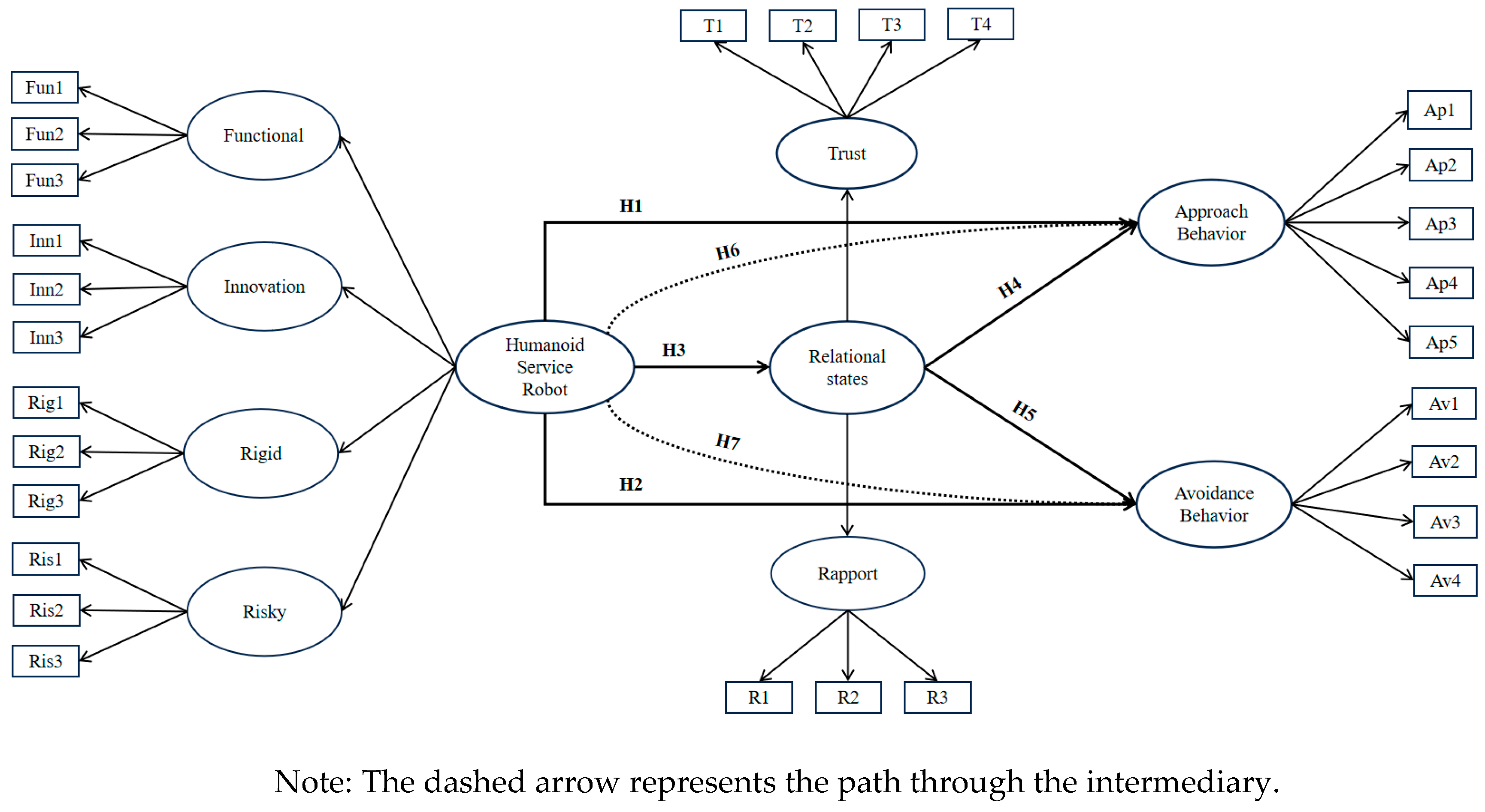
Therefore, to better understand the distinct roles of the two, this research suggests that customers’ perceptions of humanoid service robots shape their approach and avoidance behaviors through the relational states perspective, that is, trust and rapport. This framework more comprehensively explains how user perception evaluation is transformed into behavioral response in human–robot interaction. To test the mediating effect of relationship state, we put forward the following hypotheses and the conceptual model is shown in Figure 1:
H3. 
Perception significantly and positively influences relational states.
H4. 
Relational states significantly and positively influence approach behavior.
H5. 
Relational states significantly and negatively influence avoidance behavior.
H6. 
Relational states mediate between perception and approach behavior.
H7. 
Relational states mediate between perception and avoidance behavior.

3. Methodology

3.1. Research Design

This study uses 12 items developed by Wu et al. (2025) to evaluate users’ perception of humanoid service robots, including functional, innovation, rigid and risky, and each dimension consists of three items [21]. The relational states are evaluated by seven items proposed by Kim et al. (2022), including trust (4 items) and rapport (3 items) [37]. According to Chen & Girish (2023), the approach behavior was evaluated by five items [34]. In addition, this research uses Wang et al.’s (2023) four items to evaluate avoidance behavior [5]. A 7-point scale was employed for the questionnaire (1 = strongly disagree, 7 = strongly agree).
The research team translated the questionnaire originally designed in English into Chinese and it was reviewed by China tourism scholars. The final version was administered in Chinese. Subsequently, a pilot study was conducted on 20 customers who had experience in using humanoid service robots. According to the feedback, the wording had been slightly adjusted to improve the clarity of the project and reduce ambiguity. No measured items were removed.

3.2. Data Collection

The sample was collected from Chinese Mainland. It is one of the most dynamic markets for service robots in the world, with strong manufacturing capacity, wide application scenarios, and high acceptance of new technologies [21]. Therefore, it provides a valuable context for understanding robot deployment, application diversity, and user feedback.
All respondents were recruited through face-to-face interactions immediately after they had experienced a humanoid service robot at a hotel. They were briefed with the purpose of this project and their informed consent was obtained. A total of 507 completed surveys were collected. In total, 51.3% were female, the 25 to 34 age group accounted for 49.1% of the sample, a bachelor’s degree or above was held by 88.2% of the sample, and 63.1% earned a monthly income of RMB 10,000 (see Table 1).

4. Results

4.1. Measurement Model

The reliability and validity of the model are demonstrated by all standardized factor loadings exceeded 0.600 [60]. The reliability of the scale meets the standards, as demonstrated by the reliability test results (see Table 2). Further analysis reveals that all Cronbach’s alpha coefficients exceed the standard of 0.700, indicating the scale has good internal consistency. Then the validity test is carried out by examining the convergence validity and the discriminant validity. The average variance extraction value (AVE) of each concept is higher than the standard of 0.500. All composite reliability (CR) values are between 0.875 and 0.953, exceeding 0.700 [61].
The Fornell–Larcker criterion and the Heterotrait–Monotrait ratio (HTMT) were utilized to assess discriminant validity. As shown in Table 3, bold-faced diagonal elements are the square root of the AVE, which are higher than the correlation coefficient between constructs [61]. Then, following Franke and Sarstedt [62], all ratios were less than 0.900, meeting the criterion (see Table 4). Therefore, both tests consistently demonstrate that the measurement model possesses good discriminant validity.
Harman’s single-factor test extracted five factors with eigenvalues above 1.0. The largest factor explained 36% of the variance, considerably below the 50% threshold [63]. Common method bias is therefore unlikely to threaten our findings. The structure of humanoid service robot perception was evaluated using Confirmatory Factor Analysis (CFA). The results indicated good model fit (χ2 = 146.194, df = 48, χ2/df = 3.046), which is below the conventional threshold of 5 and acceptable given the sensitivity of the χ2 statistic to sample size [64]. The incremental-fit indices were satisfactory, with NFI = 0.953 and GFI = 0.953 both exceeding the recommended 0.90 threshold; CFI = 0.968 and TLI = 0.956 both exceeded the strict 0.95 benchmark advocated by Hu and Bentler [65], indicating excellent comparative fit. The RMSEA = 0.064 fell within the acceptable range of 0.05–0.08 [66], indicating reasonable approximation error. Collectively, these indices demonstrate that the measurement model fits the data well [67].

4.2. Structural Model

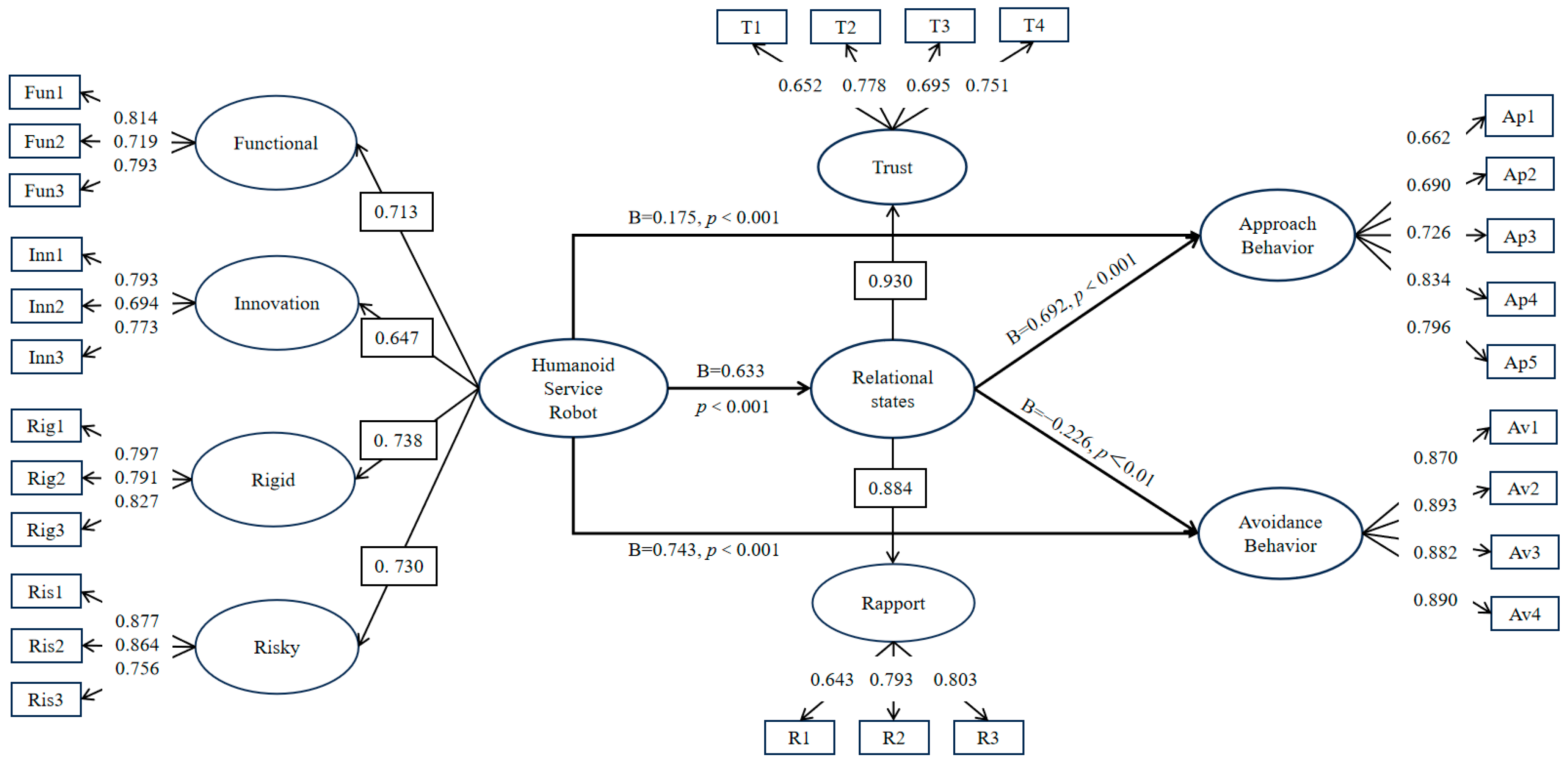
Figure 2 presents the research model and the corresponding metrics. The analysis reveals that humanoid service robot perception positively predicted approach behavior (β = 0.175, p < 0.001) and relational states (β = 0.663, p < 0.001). Contrary to H2, perception also positively predicted avoidance behavior (β = 0.743, p < 0.001); a post hoc theoretical reading of this unanticipated finding is provided in 5.1. The relational states significantly and positively influenced approach behavior (β = 0.692, p < 0.001), but significantly and negatively influenced avoidance behavior (β = −0.226, p < 0.01).
To avoid estimation bias due to covariance among independent variables, this research performed a Variance Inflation Factor (VIF) test in the structural model. All values were below 5, ruling out multicollinearity concerns [68]. Given that PLS focuses on interpreting latent variable paths, the study used Smart-PLS 4.0 software to perform 5000 bootstrap runs to examine the significance of each path coefficient (see Table 5) [69,70]. Additionally, the construct of perception is regarded as a common latent source of lower-order dimensions; therefore, a reflective–reflective higher-order specification was adopted [71]. This specification is appropriate because functionality, innovativeness, rigidity, and perceived risk are conceptualized as complementary manifestations of customers’ overall cognitive evaluation of humanoid service robots rather than as independent causal components [21]. Consistent with the theoretical argument developed in Section 2.2, favorable and unfavorable evaluations may coexist within the same perceptual judgment, making the reflective–reflective specification suitable for representing the multidimensional nature of perception.

4.3. Mediation Analysis

SPSS PROCESS was used to test the mediating effects between humanoid service robot perception (independent variable), relational states (mediating variable), and approach/avoidance behavior (dependent variable). Using SPSS PROCESS v4.1, Model 4, 10,000 bootstrap samples were applied at 95% confidence intervals. In Table 6, the results suggest that most mediating effects were supported. Specifically, trust mediated the relationship between risky and approach, as well as between functional and avoidance. Rapport mediated the relationship between rigid and approach, as well as between functional and avoidance. It should be noted that trust did not mediate the relationship between risky and avoidance; similarly, rapport did not mediate the relationship between rigid and avoidance, nor between risky and avoidance.

5. Discussion and Implications

5.1. Conclusions

In this research, customer response is placed in the context of service interaction, and the relationship evaluation formed in the human–robot interaction is emphatically discussed. By constructing a multidimensional structure containing positive and negative perceptions and incorporating the tendency of approaching and avoiding behavior at the same time, this study reveals the complex psychological reaction mechanism of customers to humanoid service robots. It also provides a more relational explanation framework for understanding the interaction between humans and robot services.
The general evaluation of humanoid service robots by users is an important indicator of trust and rapport development [26,57]. The anthropomorphic robots are capable of capturing the attention of customers in high-contact service settings like hotels, but are unable to entirely eliminate discomfort or hesitation of users [72]. This effect could also be due to the fact that people feel alienated from scientific and technological products or because of lack of human flexibility [73]. The uncanny valley theory suggests that people’s discomfort with humanoid elements mainly depends on whether they have reached a threshold. This is also one of the important reasons why consumers have complex attitudes towards anthropomorphic service robots [26]. Importantly, it reveals that relational state is negatively associated with the avoidance behavior, indicating that the relational state is a significant factor that would mitigate the disturbance in the process of interaction.
The results of intermediary analysis show that trust and rapport serve as key mechanisms linking user perception to behavior. This finding supports the previous studies and confirms that the results of human–robot interaction are influenced by factors similar to those in interpersonal interaction [24]. In addition, trust mediates between risky and approach behaviors, as well as functional and avoidance behaviors. This reveals that individual behavior is not directly driven by the robot’s objective attributes, but rather mediated through the psychological mechanism of trust. Simultaneously, rapport exerts positive influences between functional perception and avoidance behavior. This shows that, although robots may be similar to human partners in some respects, they still play a mixed role between tools and social agents [51].
An unexpected finding is that perception of the humanoid service robot exerted a positive effect on avoidance behavior (β = 0.743, p < 0.001), the opposite of the predicted negative sign (H2 “Not supported”). The observed reversal may also be associated with the multidimensional nature of the perception construct employed in this study. Because perception simultaneously incorporates positive dimensions (functional and innovation) and negative dimensions (rigidity and risk), higher levels of overall perception do not necessarily imply exclusively favorable evaluations. Instead, customers may become more aware of both the advantages and potential concerns associated with humanoid service robots. Consequently, stronger perceptions may activate both approach and avoidance tendencies simultaneously, resulting in the paradoxical relationship observed in the present study.
We can also read this reversal through the uncanny valley [30,36] and approach–avoidance conflict theory [32,74]. Both frameworks predict that humanlike agents simultaneously activate approach and avoidance motivations through a co-present cue complex; an aggregate perception measure that absorbs both cue families should therefore correlate positively with avoidance even when it also correlates positively with approach. Meta-analytic evidence on negativity dominance in service robot research further suggests that avoidance-affording cues (rigidity, risk) carry disproportionate weight relative to approach-affording cues (functionality, innovativeness), which is consistent with the larger magnitude observed for the perception–avoidance path [31]. The mediation results (Table 6) further support a negativity dominance reading. The indirect effects of perception on avoidance via trust and via rapport are positive in sign for the functional and innovative cue paths, indicating that even the cognitive and affective routes do not, in this aggregate model, fully buffer the avoidance branch. This is consistent with Blut et al.’s (2021) finding that anthropomorphic cues elicit affinity but rarely eliminate the underlying eeriness [31].

5.2. Theoretical Implications

This report extends two theories to humanoid service robots in service scenes, thus promoting their development. First, this study contributes to trust theory by showing that an aggregate multidimensional perception of humanoid service robots translates into trust through the joint action of approach- and avoidance-affording cues, with trust serving as the cognitive route through which the resulting ambivalence is resolved. Specifically, this study verifies previous studies, that is, trust is determined both by perceived ability and reliability and by social factors such as personification and innovation [75]. Our results suggest, consistent with prior trust research [44], that the cognitive route via trust may dominate the affective route via rapport when the salient cue family is risk-related; a direct test of this conjecture awaits future moderation analyses. This perfects the trust theory and emphasizes the priority of ability-based judgment in reducing users’ avoidance of humanoid service robots.
Similarly, the research extends the similarity attraction theory to the field of humanoid service robots, demonstrating that perceived similarity works not only through positive alignment, but also through avoiding threatening attributes. It confirms that perceived similarity can foster rapport even in non-interpersonal interactions. The results show that the similarity in human–robot interaction is regulated by the flexible, easy-to-communicate, and more socially oriented interaction mode [50,51]. It underscores the fact that social emotion in man–machine cases is not only an attribute of similarity but also an attribute of interactive form and manner. This finding emulates the similarity attraction theory to non-human objects and considers the flexible and socialized interaction mode as a significant variable that influences similarity perception.
Beyond extending trust theory and similarity attraction theory, the study contributes to the uncanny valley theory in hospitality and tourism research. Prior uncanny valley work has largely lived in stimulus-rating studies [30,31,36]; we extend it to behavioral-choice modeling by treating multidimensional perception as a compound stimulus and examining its joint effect on two opposite-valence outcomes within the same encounter. The H2 reversal (perception positively predicting avoidance) adds to a small but growing body of evidence that ambivalence is a structural rather than residual feature of human–robot interaction [5,39]. Then our relational-mediation results show how that ambivalence is translated into observable behavior.

5.3. Practical Implications

For robot designers, the results imply that lifting affordance cues (response accuracy, conversational fluency, interaction novelty) is necessary but not sufficient; designers must also actively reduce avoidance-affording cues (mechanical rigidity, perceived data risk) because the two branches are independent activations. Two concrete priorities follow: (i) build redundant, visible error-recovery routines that surface to the customer (raising trust); (ii) program micro-variations in greeting, pacing, and humor that signal social adaptivity (raising rapport).
For hotel managers, the relational-mediation logic argues for coordinating staff training with robot deployment rather than treating them as substitutes. Frontline staff should be empowered to take over from the robot when avoidance cues spike (rigidity flagged by visible operator interventions, risk flagged by sensitive transactions). Two concrete measures should be implemented: (i) station a human staffer within line-of-sight of the lobby robot for the first six months of deployment as a “rapport guarantor”; (ii) install a one-tap human-handover button that customers can use without explanation, lowering the perceived cost of switching channels [46,75].
For tourism-policy and platform regulators, the dual-cue structure argues against single-axis disclosures (e.g., is the agent a robot, yes/no); meaningful customer protection requires disclosure of capabilities and risk surface separately. This recommendation aligns with the deployment-economics literature [6,7] by making the customer-side benefits and frictions of robot adoption legible to operators and to passengers.

5.4. Limitations and Future Research

Future research can be based on some limitations of this article. First, all the samples were collected from Chinese Mainland. Although the validity of the data is ensured through analysis, the cultural homogeneity of the sample may limit a broader global perspective. Cultural values influence individuals’ attitudes toward technology, uncertainty, automation, and social interaction, which may in turn affect trust formation, rapport development, and behavioral responses toward humanoid service robots. Consequently, the observed relationships may differ across cultural contexts. Future studies can take a cross-cultural design and apply various situational variables. Second, it was done within a hospitality setting, which limits a deeper interpretation of humanoid service robots in other service environments. The model can also be used in different areas (restaurants, healthcare, and retail) to prove and expand the results in future studies. Humanoid service robots can be perceived differently or with similarity depending on the context of their use by customers. Third, the cross-sectional design captures perception and behavior at a single moment. Although this approach is widely used in human–robot interaction research, it limits the ability to establish causal relationships among the constructs. More importantly, trust and rapport are relational states that may evolve as customers accumulate interaction experiences with humanoid service robots. The present design cannot capture how these relational bonds develop, strengthen, or deteriorate over repeated encounters. Future studies are therefore encouraged to employ longitudinal designs, panel data, or repeated-measure approaches to better understand the dynamic nature of trust and rapport formation in human–robot interactions.
Lastly, this research is based on the customer–robot interactions, yet it gives little consideration to the employees. Future studies should focus on employee–robot relationships, collaboration patterns, and relationship building, as well as their implications for the psychological well-being of employees. Given the issues of job replacement and insecurity, optimization of team structure, delegation of tasks, and collaboration could be considered in future research to leverage the advantages of robots to create more comprehensive and efficient services.

Author Contributions

Conceptualization, X.W. and Z.Z.; methodology, X.W. and Z.Z.; validation, X.W. and Z.Z.; formal analysis, Z.Z.; investigation, Z.Z.; data curation, X.W. and Z.Z.; writing—original draft preparation, Z.Z.; writing—review and editing, X.W.; supervision, X.W.; funding acquisition, X.W. All authors have read and agreed to the published version of the manuscript.

Funding

This research received funding from the National Natural Science Foundation of China (No. 42471261) and the Ministry of Education of China Humanities and Social Sciences Research Project (No. 25YJCZH254).

Institutional Review Board Statement

The study was conducted in accordance with the Declaration of Helsinki, and approved by the Academic Committee of the Joint Institute of Ningbo University and the University of Angers (Approval No. ICUNA-202502-01, 20 February 2025).

Informed Consent Statement

Informed consent was obtained from all subjects involved in the study.

Data Availability Statement

The original contributions presented in this study are included in the article. Further inquiries can be directed to the corresponding author.

Acknowledgments

The authors thank all participants for their contributions to this study.

Conflicts of Interest

The authors declare no conflicts of interest.

References

  1. Rana, N.P.; Begum, N.; Faisal, M.N.; Mishra, A. Customer experiences with service robots in hotels: A review and research agenda. J. Hosp. Mark. Manag. 2025, 34, 145–174. [Google Scholar] [CrossRef]
  2. Ayyildiz, A.Y.; Baykal, M.; Koc, E. Attitudes of hotel customers towards the use of service robots in hospitality service encounters. Technol. Soc. 2022, 70, 101995. [Google Scholar] [CrossRef]
  3. El Halabi, M.; Trendel, O. Just name it: The act of naming humanoid service robots decreases perceived eeriness and increases repurchase intent. J. Serv. Res. 2025, 28, 131–149. [Google Scholar] [CrossRef]
  4. Song, X.; Gu, H.; Ling, X.; Ye, W.; Li, X.; Zhu, Z. Understanding trust and rapport in hotel service encounters: Extending the service robot acceptance model. J. Hosp. Tour. Technol. 2024, 15, 842–861. [Google Scholar] [CrossRef]
  5. Wang, X.; Zhang, Z.; Huang, D.; Li, Z. Consumer resistance to service robots at the hotel front desk: A mixed-methods research. Tour. Manag. Perspect. 2023, 46, 101074. [Google Scholar] [CrossRef]
  6. Ivanov, S.; Seyitoğlu, F.; Webster, C. The economics of service robots in hospitality companies. Tour. Econ. 2026, 32, 782–803. [Google Scholar] [CrossRef]
  7. Webster, C.; Ivanov, S. Robotics, artificial intelligence, and the evolving nature of work. In Digital Transformation in Business and Society: Theory and Cases; George, B., Paul, J., Eds.; Palgrave Macmillan: Cham, Switzerland, 2019; pp. 127–143. [Google Scholar] [CrossRef]
  8. Seyitoğlu, F.; Ivanov, S. Service robots as a tool for physical distancing in tourism. Curr. Issues Tour. 2021, 24, 1631–1634. [Google Scholar] [CrossRef]
  9. Tussyadiah, I. A review of research into automation in tourism: Launching the Annals of Tourism Research curated collection on artificial intelligence and robotics in tourism. Ann. Tour. Res. 2020, 81, 102883. [Google Scholar] [CrossRef]
  10. Byrne, D. Interpersonal attraction and attitude similarity. J. Abnorm. Soc. Psychol. 1961, 62, 713–715. [Google Scholar] [CrossRef] [PubMed]
  11. Mayer, R.C.; Davis, J.H.; Schoorman, F.D. An integrative model of organizational trust. Acad. Manag. Rev. 1995, 20, 709–734. [Google Scholar] [CrossRef]
  12. Ivanov, S.; Webster, C.; Garenko, A. Young Russian adults’ attitudes towards the potential use of robots in hotels. Technol. Soc. 2018, 55, 24–32. [Google Scholar] [CrossRef]
  13. Chan, J.; Chan, I.C.C.; Lam, L.W.; Law, R. Riding on uncertainty: Leveraging human agents and service robots during service delivery. Int. J. Hosp. Manag. 2025, 125, 104000. [Google Scholar] [CrossRef]
  14. Li, M.; Zhang, J.; Guo, F.; Liao, Y.; Hu, X.; Ham, J. Audiovisual affective design of humanoid robot appearance and voice based on Kansei engineering. Int. J. Soc. Robot. 2025, 17, 15–37. [Google Scholar] [CrossRef]
  15. Mahr, D.; Odekerken-Schröder, G.; van Doorn, J. Evolution of service robots in marketing: A relational framework and future research agenda. J. Bus. Res. 2025, 192, 115204. [Google Scholar] [CrossRef]
  16. Li, J.; Ma, F.; Shao, X.; Zhang, X. Unveiling the impact of interpersonal interactions on brand love: Insights from a dual-path framework. J. Travel Res. 2025, 64, 1864–1881. [Google Scholar] [CrossRef]
  17. Hu, F.; Trivedi, R.; Teichert, T. Using hotel reviews to assess hotel frontline employees’ roles and performances. Int. J. Contemp. Hosp. Manag. 2022, 34, 1796–1822. [Google Scholar] [CrossRef]
  18. Shang, X.; Liu, Z.; Gong, C.; He, Z.; Wang, C. From perception to trust: The multidimensional landscape of anthropomorphism in robotics. Int. J. Hum.-Comput. Interact. 2026, 42, 78–100. [Google Scholar] [CrossRef]
  19. Begum, N.; Faisal, M.N.; Sobh, R.; Nunkoo, R.; Rana, N.P. Consumers acceptance of service robots in hotels: A meta-analytic review. Int. J. Hosp. Manag. 2025, 126, 104052. [Google Scholar] [CrossRef]
  20. Han, H.; Kim, S.I.; Lee, J.S.; Jung, I. Understanding the drivers of consumers’ acceptance and use of service robots in the hotel industry. Int. J. Contemp. Hosp. Manag. 2025, 37, 541–559. [Google Scholar] [CrossRef]
  21. Wu, M.; Tse, W.T.S.; Tung, V.W.S. Enhancing intellectual experiences for users: A multidimensional model of humanoid service robots in hospitality and tourism. Int. J. Contemp. Hosp. Manag. 2025, 37, 2003–2022. [Google Scholar] [CrossRef]
  22. Gong, Y.; Guo, Y.P.; Zhang, T.; Zhu, X.; Wang, L. The influence of hotel service robots on customers’ consumption intention: Combination theory of planned behaviour and technology acceptance model. Acta Psychol. 2026, 262, 106121. [Google Scholar] [CrossRef]
  23. Huang, H.; Chen, F.F.; Liu, S.Q.; Xing, Y. How task objectivity shapes customer responses to robot service failure. J. Serv. Manag. 2025, 36, 690–710. [Google Scholar] [CrossRef]
  24. Kim, J.; Kim, S.; Ayalew, Z.A.; Kato, G. Customers’ perceived product creativity and innovativeness in robot-service restaurants, and their impact on customer loyalty. J. Hosp. Tour. Technol. 2025, 17, 354–370. [Google Scholar] [CrossRef]
  25. Wang, J.; Ren, L.; Chen, J.; Su, X. Paying premiums for humanoid service robots in hospitality: What are the key determinants? Int. J. Hosp. Manag. 2026, 134, 104525. [Google Scholar] [CrossRef]
  26. Khan, M.I.; Tarofder, A.K.; Gopinathan, S.; Haque, A. Designing authentic customer-chatbot interactions: A necessary condition analysis of emotional intelligence and anthropomorphic features in human-computer interaction. Int. J. Hum.-Comput. Interact. 2025, 41, 15179–15196. [Google Scholar] [CrossRef]
  27. Yoganathan, V.; Osburg, V.S.; Fronzetti Colladon, A.; Charles, V.; Toporowski, W. Societal attitudes toward service robots: Adore, abhor, ignore, or unsure? J. Serv. Res. 2025, 28, 93–111. [Google Scholar] [CrossRef]
  28. Ma, K.; Duan, X.; Fu, X.; Liu, W.; Zheng, M. Effects of human-robot interaction type on customer tolerance of humanoid robot service failure. J. Hosp. Mark. Manag. 2025, 34, 72–91. [Google Scholar] [CrossRef]
  29. Shehawy, Y.M.; Khan, S.M.F.A.; Khalufi, N.A.M.; Abdullah, R.S. Customer adoption of robot: Synergizing customer acceptance of robot-assisted retail technologies. J. Retail. Consum. Serv. 2025, 82, 104062. [Google Scholar] [CrossRef]
  30. Mori, M.; MacDorman, K.F.; Kageki, N. The uncanny valley [from the field]. IEEE Robot. Autom. Mag. 2012, 19, 98–100. [Google Scholar] [CrossRef]
  31. Blut, M.; Wang, C.; Wünderlich, N.V.; Brock, C. Understanding anthropomorphism in service provision: A meta-analysis of physical robots, chatbots, and other AI. J. Acad. Mark. Sci. 2021, 49, 632–658. [Google Scholar] [CrossRef]
  32. Elliot, A.J. The hierarchical model of approach-avoidance motivation. Motiv. Emot. 2006, 30, 111–116. [Google Scholar] [CrossRef]
  33. Fricke, K.; Vogel, S. How interindividual differences shape approach-avoidance behavior: Relating self-report and diagnostic measures of interindividual differences to behavioral measurements of approach and avoidance. Neurosci. Biobehav. Rev. 2020, 111, 30–56. [Google Scholar] [CrossRef]
  34. Chen, C.F.; Girish, V.G. Investigating the use experience of restaurant service robots: The cognitive-affective-behavioral framework. Int. J. Hosp. Manag. 2023, 111, 103482. [Google Scholar] [CrossRef]
  35. Chen, S.X.; Zhang, Y.; Tse, S.W.T. Untangling the smart tourism technostress enigma: Assessing the effects of smart technology-related stressors on smart tourism avoidance behaviors in senior tourists. J. Travel Tour. Mark. 2024, 41, 1161–1176. [Google Scholar] [CrossRef]
  36. Mathur, M.B.; Reichling, D.B. Navigating a social world with robot partners: A quantitative cartography of the uncanny valley. Cognition 2016, 146, 22–32. [Google Scholar] [CrossRef] [PubMed]
  37. Kim, H.; So, K.K.F.; Wirtz, J. Service robots: Applying social exchange theory to better understand human-robot interactions. Tour. Manag. 2022, 92, 104537. [Google Scholar] [CrossRef]
  38. Wong, J.; Wong, A. Consumer resistance to service robots: A stressor-based perspective on engagement and wellbeing. J. Consum. Mark. 2025, 42, 56–71. [Google Scholar] [CrossRef]
  39. Yan, J.; Luo, B.; Zhang, T. Can cuteness soften my anxiety? The impact of conversational styles of service robots on consumer service acceptance. Int. J. Contemp. Hosp. Manag. 2025, 37, 763–782. [Google Scholar] [CrossRef]
  40. Liu, G.G.; Benckendorff, P.; Walters, G. Human-robot interaction research in hospitality and tourism: Trends and future directions. Tour. Rev. 2025, 80, 847–870. [Google Scholar] [CrossRef]
  41. Hoff, K.A.; Bashir, M. Trust in automation: Integrating empirical evidence on factors that influence trust. Hum. Factors 2015, 57, 407–434. [Google Scholar] [CrossRef]
  42. Lee, J.D.; See, K.A. Trust in automation: Designing for appropriate reliance. Hum. Factors 2004, 46, 50–80. [Google Scholar] [CrossRef]
  43. Park, S. Multifaceted trust in tourism service robots. Ann. Tour. Res. 2020, 81, 102888. [Google Scholar] [CrossRef]
  44. Hancock, P.A.; Billings, D.R.; Schaefer, K.E.; Chen, J.Y.; De Visser, E.J.; Parasuraman, R. A meta-analysis of factors affecting trust in human-robot interaction. Hum. Factors J. Hum. Factors Ergon. Soc. 2011, 53, 517–527. [Google Scholar] [CrossRef] [PubMed]
  45. Ng, S.W.T.; Zhang, R. Trust in AI-driven chatbots: A systematic review. Telemat. Inform. 2025, 97, 102240. [Google Scholar] [CrossRef]
  46. Lin, B.; Lee, W. Service robots and initial trust dynamics: Consumers’ ethical challenges in tourism and hospitality. J. Travel Tour. Mark. 2025, 42, 282–306. [Google Scholar] [CrossRef]
  47. Yao, M.; Li, J.; Wang, Z. Robot transparency and employees’ acceptance: The roles of trust and anthropomorphism. Int. J. Hum.-Comput. Interact. 2025, 41, 11934–11946. [Google Scholar] [CrossRef]
  48. Oh, H.; Parks, S.C. Customer satisfaction and service quality: A critical review of the literature and research implications for the hospitality industry. Hosp. Res. J. 1996, 20, 35–64. [Google Scholar] [CrossRef]
  49. Tversky, A. Features of similarity. Psychol. Rev. 1977, 84, 327–352. [Google Scholar] [CrossRef]
  50. Jiang, Z.; Xu, L. Evolution of human-robot personality similarity: A historical analysis from 1960 to 2019. Int. J. Hum.-Comput. Interact. 2025, 41, 11077–11094. [Google Scholar] [CrossRef]
  51. Menz, M.; Huff, M. Perception of human-robot relationships: Professional, communicative, impersonal and emotionless. Comput. Hum. Behav. Artif. Hum. 2025, 6, 100226. [Google Scholar] [CrossRef]
  52. Ames, D.R. Strategies for social inference: A similarity contingency model of projection and stereotyping in attribute prevalence estimates. J. Pers. Soc. Psychol. 2004, 87, 573–585. [Google Scholar] [CrossRef]
  53. Montoya, R.M.; Horton, R.S. A meta-analytic investigation of the processes underlying the similarity-attraction effect. J. Soc. Pers. Relat. 2013, 30, 64–94. [Google Scholar] [CrossRef]
  54. Tversky, A.; Gati, I. Studies of similarity. In Cognition and Categorization; Rosch, E., Lloyd, B.B., Eds.; Erlbaum: Hillsdale, NJ, USA, 1978; pp. 79–98. [Google Scholar]
  55. Goldstone, R.L.; Son, J.Y. Similarity. In The Oxford Handbook of Thinking and Reasoning; Holyoak, K.J., Morrison, R.G., Eds.; Oxford University Press: Oxford, UK, 2012; pp. 155–176. [Google Scholar] [CrossRef]
  56. Roads, B.D.; Love, B.C. Modeling similarity and psychological space. Annu. Rev. Psychol. 2024, 75, 215–240. [Google Scholar] [CrossRef]
  57. Choubey, V.; Chakraborty, D.; Joshi, Y. Human-robot trust dynamics: Understanding tourist confidence in service robots in tourism and hospitality. Asia Pac. J. Tour. Res. 2025, 30, 1141–1156. [Google Scholar] [CrossRef]
  58. Macintosh, G. Examining the antecedents of trust and rapport in services: Discovering new interrelationships. J. Retail. Consum. Serv. 2009, 16, 298–305. [Google Scholar] [CrossRef]
  59. Qiu, H.; Li, M.; Shu, B.; Bai, B. Enhancing hospitality experience with service robots: The mediating role of rapport building. J. Hosp. Mark. Manag. 2020, 29, 247–268. [Google Scholar] [CrossRef]
  60. Bagozzi, R.P.; Yi, Y. On the Evaluation of Structural Equation Models. J. Acad. Mark. Sci. 1988, 16, 74–94. [Google Scholar] [CrossRef]
  61. Fornell, C.; Larcker, D.F. Evaluating structural equation models with unobservable variables and measurement error. J. Mark. Res. 1981, 18, 39–50. [Google Scholar] [CrossRef]
  62. Franke, G.; Sarstedt, M. Heuristics versus statistics in discriminant validity testing: A comparison of four procedures. Internet Res. 2019, 29, 430–447. [Google Scholar] [CrossRef]
  63. Podsakoff, P.M.; MacKenzie, S.B.; Podsakoff, N.P. Sources of method bias in social science research and recommendations on how to control it. Annu. Rev. Psychol. 2012, 63, 539–569. [Google Scholar] [CrossRef]
  64. McDonald, R.P.; Ho, M.H.R. Principles and Practice in Reporting Structural Equation Analyses. Psychol. Methods 2002, 7, 64–82. [Google Scholar] [CrossRef]
  65. Hu, L.-t.; Bentler, P.M. Cutoff criteria for fit indexes in covariance structure analysis: Conventional criteria versus new alternatives. Struct. Equ. Model. Multidiscip. J. 1999, 6, 1–55. [Google Scholar] [CrossRef]
  66. Browne, M.W.; Cudeck, R. Alternative ways of assessing model fit. Sociol. Methods Res. 1992, 21, 230–258. [Google Scholar] [CrossRef]
  67. Lee, T.H.; Jan, F.H. Can community-based tourism contribute to sustainable development? Evidence from residents’ perceptions of the sustainability. Tour. Manag. 2019, 70, 368–380. [Google Scholar] [CrossRef]
  68. Hair, J.F.; Risher, J.J.; Sarstedt, M.; Ringle, C.M. When to use and how to report the results of PLS-SEM. Eur. Bus. Rev. 2019, 31, 2–24. [Google Scholar] [CrossRef]
  69. Chin, W.W.; Peterson, R.A.; Brown, S.P. Structural equation modeling in marketing: Some practical reminders. J. Mark. Theory Pract. 2008, 16, 287–298. [Google Scholar] [CrossRef]
  70. Sarstedt, M.; Ringle, C.M.; Smith, D.; Reams, R.; Hair, J.F., Jr. Partial least squares structural equation modeling (PLS-SEM): A useful tool for family business researchers. J. Fam. Bus. Strategy 2014, 5, 105–115. [Google Scholar] [CrossRef]
  71. Sarstedt, M.; Hair, J.F., Jr.; Cheah, J.H.; Becker, J.M.; Ringle, C.M. How to specify, estimate, and validate higher-order constructs in PLS-SEM. Australas. Mark. J. 2019, 27, 197–211. [Google Scholar] [CrossRef]
  72. Liu, J.; Zhou, L.; Yang, L.; Liu, D. The dehumanization of service robots influences hospitality consumption emotion. Int. J. Hosp. Manag. 2024, 119, 103707. [Google Scholar] [CrossRef]
  73. Mou, Y.; Wang, J.; Ding, Z.; Huang, J.; Wang, Z. When automation backfires: Exploring the impact of consumer resistance to AI application in hybrid service agents. J. Hosp. Mark. Manag. 2025, 34, 1043–1074. [Google Scholar] [CrossRef]
  74. Lewin, K. A Dynamic Theory of Personality: Selected Papers; McGraw-Hill: New York, NY, USA, 1935. [Google Scholar]
  75. Della Corte, V.; Sepe, F.; Gursoy, D.; Prisco, A. Role of trust in customer attitude and behaviour formation towards social service robots. Int. J. Hosp. Manag. 2023, 114, 103587. [Google Scholar] [CrossRef]
Figure 1. Conceptual model of this study.
Jtaer 21 00180 g001
Figure 2. Result of the proposed hypotheses and model.
Jtaer 21 00180 g002
Table 1. Demographic characteristics.
VariablesCategoriesFrequency (Percentage%)
GenderMale247 (48.7%)
Female260 (51.3%)
Age, years18–24145 (28.6%)
25–34249 (49.1%)
35–4477 (15.2%)
45–5427 (5.3%)
55 and above9 (1.8%)
EducationMiddle school and below5 (1.0%)
Post-Secondary20 (3.9%)
Vocational/College35 (6.9%)
Undergraduate357 (70.4%)
Masters and above90 (17.8%)
Monthly Income (in RMB)Less than 4999151 (29.8%)
5000–9999164 (32.3%)
10,000–14,99995 (18.7%)
15,000–19,99950 (9.9%)
20,000–24,99928 (5.5%)
25,000 and above19 (3.7%)
Table 2. Results of reliability analysis.
DimensionsItemsMeanSt. DevSt. Factor
Loading
Cronbach’s AlphaCRAVE
Functional 0.8180.8920.733
Fun 15.3601.2090. 814
Fun 25.4501.1150.719
Fun 35.4901.2100.793
Innovative 0.7950.8790.709
Inn 16.1001.1350.793
Inn 25.6501.2740.694
Inn 35.9301.0930.773
Rigid 0.8490.9080.767
Rig 14.2401.6370.797
Rig 24.0001.7340.791
Rig 34.5801.5460.827
Risky 0.8700.9200.794
Ris 14.9001.5250.877
Ris 25.1101.5670.864
Ris 34.5001.6050.756
Trust 0.8100.8750.637
T15.6501.0540.652
T25.3101.1410.778
T35.5501.1600.695
T45.1001.3220.751
Rapport 0.7890.8750.700
R15.3201.2590.643
R24.9001.4100.793
R34.6301.5380.803
Approach 0.8610.9000.643
Ap15.7201.0970.662
Ap25.5001.2260.690
Ap35.4201.2380.726
Ap45.2501.3750.834
Ap55.2201.4300.796
Avoidance 0.9350.9530.836
Av14.7901.5280.870
Av25.0801.6060.893
Av35.2701.5790.882
Av45.2001.6250.890
Note: St. Dev stands for standardized deviation; St. Factor Loading stands for standardized factor loading; CR stands for composite reliability; AVE stands for average variance extracted.
Table 3. Results of the discriminant validity test.
ConstructFunctionalInnovativeRigidRiskyTrustRapportApproachAvoidance
Functional0.856
Innovative0.5950.842
Rigid0.2530.1380.876
Risky0.1900.1750.6490.891
Trust0.6970.4890.2790.2960.798
Rapport0.5600.4130.3360.2100.6650.837
Approach0.6310.5800.3000.2530.7340.7350.802
Avoidance0.1610.2180.5870.7000.2480.1990.3460.914
Table 4. Results of the Heterotrait–Monotrait.
ConstructFunctionalInnovativeRigidRiskyTrustRapportApproachAvoidance
Functional
Innovative0.737
Rigid0.3020.165
Risky0.2250.2080.751
Trust0.8560.6040.3330.352
Rapport0.6860.4930.4150.2490.807
Approach0.7520.6980.3500.2920.8780.873
Avoidance0.1850.2550.6540.7720.2850.2150.386
Table 5. Results of the structural model.
Influencing Path Between VariablesPath CoefficientVIFp-ValueSupported
H1: HSR → Approach0.1751.6700.000Yes
H2: HSR → Avoidance0.7431.6700.000No
H3: HSR → Relational states0.6331.0000.000Yes
H4: Relational states → Approach0.6921.6700.000Yes
H5: Relational states → Avoidance−0.2261.6700.001Yes
Note: For H2, the positive coefficient on avoidance is the opposite of the predicted sign and is therefore reported as “Not supported”. We provide a post hoc theoretical reading of this finding in 5.1, drawing on the uncanny valley framework. The reversal is interpreted as a structural feature of human–robot ambivalence rather than as a measurement impact.
Table 6. Results of the mediation analysis.
Dependent VariableFunctionalInnovationRigidRisky
Effect95% CIEffect95% CIEffect95% CIEffect95% CI
Total Effect0.628[0.560, 0.697]0.601[0.526, 0.675]0.214[0.154, 0.273]0.183[0.121, 0.246]
Direct Effect0.231[0.150, 0.312]0.304[0.238, 0.370]0.076[0.032, 0.120]0.029[−0.017, 0.075]
Indirect Effect:
X → Trust → Approach
0.397[0.310, 0.485]0.297[0.217, 0.377]0.137[0.087, 0.188]0.155[0.099, 0.212]
Total Effect0.229[0.107, 0.352]0.322[0.196, 0.448]0.583[0.511, 0.655]0.723[0.657, 0.788]
Direct Effect−0.024[−0.191, 0.144]0.193[0.050, 0.335]0.557[0.483, 0.632]0.709[0.641, 0.777]
Indirect Effect:
X → Trust → Avoidance
0.253[0.142, 0.367]0.129[0.046, 0.208]0.026[0.003, 0.060]0.013[−0.008, 0.042]
Total Effect0.628[0.560, 0.697]0.601[0.526, 0.675]0.214[0.154, 0.273]0.183[0.121, 0.246]
Direct Effect0.338[0.271, 0.405]0.368[0.306, 0.429]0.045[−0.002, 0.091]0.081[0.035, 0.126]
Indirect Effect:
X → Rapport → Approach
0.291[0.228, 0.359]0.233[0.164, 0.300]0.169[0.121, 0.220]0.103[0.050, 0.159]
Total Effect0.229[0.107, 0.352]0.322[0.196, 0.448]0.583[0.511, 0.655]0.723[0.657, 0.788]
Direct Effect0.131[−0.014, 0.277]0.260[0.124, 0.396]0.591[0.514, 0.668]0.715[0.648, 0.781]
Indirect Effect:
X → Rapport → Avoidance
0.098[0.012, 0.178]0.062[0.001, 0.120]−0.008[−0.036, 0.026]0.008[−0.006, 0.029]
Disclaimer/Publisher’s Note: The statements, opinions and data contained in all publications are solely those of the individual author(s) and contributor(s) and not of MDPI and/or the editor(s). MDPI and/or the editor(s) disclaim responsibility for any injury to people or property resulting from any ideas, methods, instructions or products referred to in the content.