
Article

Real vs. Virtual: How the Uncanny Valley Weakens the Persuasive Power of Celebrity AI Avatar Presenters—An Experimental Study Based on Live Streaming E-Commerce

1
School of Management, Shanghai University, Shanghai 200444, China
2
Xianda College of Economics and Humanities, Shanghai International Studies University, Shanghai 200083, China
*
Author to whom correspondence should be addressed.
J. Theor. Appl. Electron. Commer. Res. 2026, 21(5), 141; https://doi.org/10.3390/jtaer21050141
Submission received: 11 January 2026 / Revised: 29 March 2026 / Accepted: 8 April 2026 / Published: 30 April 2026
(This article belongs to the Topic Livestreaming and Influencer Marketing)

Abstract

This study focuses on the transfer of the celebrity effect to live-stream e-commerce. It examines how the effectiveness of persuasion and the underlying mechanisms change when celebrities shift from live human appearances to AI avatars. Integrating Uncanny Valley Theory and Source Credibility Theory, and conducting a PLS-SEM analysis on 391 valid questionnaires collected from October to November 2025, reveals that, compared to live streaming by real celebrities, virtual streamers using celebrity avatars trigger significantly higher levels of perceived eeriness among consumers. This perceived eeriness systematically weakens audience evaluations of the streamer’s credibility, attractiveness, and expertise, ultimately leading to a decline in purchase intention. The findings suggest that, when the celebrity effect relies on an AI avatar, the persuasive pathway is negatively moderated by technological mediation. Among the dimensions of source credibility, trustworthiness is most directly eroded, while expertise remains the core factor driving purchase decisions. From a human-versus-avatar perspective, this study reveals the key psychological mechanisms underlying the digital migration of the celebrity effect. The results have important theoretical implications for understanding the boundaries of source credibility in digital communication and offer practical insights into the development and optimisation of AI avatar endorsement strategies in live-stream e-commerce.

1. Introduction

With the widespread adoption of internet technologies, live commerce has become a major driver of global consumer market growth [1]. According to a report by the China Internet Network Information Center (CNNIC), 45.9% of consumers have made purchases after watching short-video or live-streaming content, and 57.8% of these purchases were unplanned [2]. In this process, streamers serve as key intermediaries connecting products and consumers, exerting substantial influence on consumers’ purchase decisions [3]. Celebrities and influencers with large followings constitute the core participants in the live commerce ecosystem [4]. Relying on consumers’ perceived source credibility, they can effectively reduce perceived purchase risk and decision uncertainty [5]. For example, both Amazon and Walmart have introduced celebrity streamers through the TalkShopLive platform to enhance sales performance [6]. In addition, the gross merchandise volume (GMV) of a single live-streaming session hosted by top Taobao streamers has exceeded 1 billion RMB [7]. These facts clearly indicate that the current live commerce industry relies heavily on celebrity influence to drive traffic and improve conversion rates and performance.
However, business models that depend on celebrities and top streamers have inherent limitations. On the one hand, time resources are extremely scarce. Celebrities often face scheduling conflicts, and top streamers’ live-streaming durations are constrained by physical stamina and mental energy. This makes it difficult to meet the demand for around-the-clock live commerce operations. On the other hand, collaboration costs are high. Appearance fees for some top celebrity streamers can reach hundreds of thousands or even millions of RMB. In addition, real celebrity streamers face uncontrollable risks such as reputation collapse or inappropriate remarks. Once negative events occur, brand image and platform reputation may be directly damaged [8]. These challenges have driven the industry to seek more efficient, controllable alternatives.
In this context, AI-driven avatar virtual streamers have been introduced. This technology leverages deep learning and real-time rendering to create highly realistic, interactive digital representations of real individuals. While preserving celebrities’ reputations and personal styles, this technology overcomes the physical and temporal limitations inherent to human streamers, thereby demonstrating strong operational potential and cost advantages. For example, the AI avatar virtual streamer of JD.com founder Liu Qiangdong attracted more than 20 million viewers in its first live-streaming session, with an average viewing duration 5.6 times the platform’s daily average [9].
However, the mechanisms underlying this emerging model’s impact remain unclear. Virtual streamers [10,11,12] and celebrity effects [4,13] have each attracted scholarly attention, yet research on their combination, namely celebrity avatar virtual streamers, and their influence on consumers remains insufficient. A critical issue in this context is that the credibility of real celebrities may not seamlessly transfer to their digital avatars, which could potentially create a perceived identity gap that influences consumer responses.
To address this issue, the study integrates two key theoretical frameworks. First, based on source credibility theory, prior research has shown that the credibility of real celebrities can effectively influence consumer attitudes and decisions [14]. However, with the introduction of AI technology, it remains unclear whether a celebrity’s credibility is preserved when digitally replicated as a virtual avatar. Second, drawing on the Uncanny Valley theory, existing studies suggest that highly realistic virtual avatars may elicit a sense of eeriness [15], thereby partially diminishing the persuasive power of celebrity endorsements.
This study develops a theoretical model to examine how streamer type (real-life vs. celebrity virtual streamer) influences consumer purchase intentions through perceived eeriness and source credibility (including competence, integrity, and attractiveness). The analysis, based on 391 valid questionnaires, was conducted using SmartPLS 4. software. The study makes three primary contributions. First, it defines the celebrity virtual streamer as a distinct category of digital spokespersons. Its core characteristic is its association with real-life celebrities, a feature that distinguishes it from purely fictional virtual influencers. Second, by integrating the Uncanny Valley Theory and Source Credibility Theory, the study reveals how technological mediation affects the transfer of credibility from real-life celebrities and explains differences in persuasion effects between celebrities and real people. The research demonstrates that, in the context of digital replication, source credibility is not a seamlessly transferable asset but a perceived characteristic that is dynamically reassessed under the influence of technological imperfections. Third, the study provides practical managerial implications for brand managers and professionals in live-streaming e-commerce.
The remainder of this article is organized as follows. Section 2 presents the literature review. Section 3 focuses on hypothesis development. Section 4 describes the research methods and design. Section 5 reports the data analysis results. Section 6 discusses the findings in depth, identifies limitations, and outlines directions for future research.

2. Literature Review

2.1. Live-Streaming Streamer: From Real Celebrities to Virtual Avatars

Within the live commerce ecosystem, streamers are pivotal in fostering consumer interaction, building trust, and facilitating purchase decisions [3]. The deep integration of generative AI and digital human technology has given rise to a novel hybrid form: the celebrity avatar virtual streamer. This study defines this entity as an AI-generated digital replica of a specific real-world celebrity. It is designed to simulate a celebrity’s appearance, voice, and behavioral patterns for application in scenarios such as live commerce streaming. Its core characteristic is that it is not a purely fictional virtual character. Instead, it represents a real individual whose presence is technologically mediated and extended into the digital domain. There is a clear referential connection between the virtual representation and the specific real-life celebrity. It functions as a continuation of the celebrity’s identity. The fundamental purpose of this extension is to transfer the influence and credibility associated with the celebrity from the physical domain into the virtual domain.
Understanding the impact of this emerging format first requires examining the source of the intended transfer. Existing research shows that the influence of real celebrity streamers stems from their authentic social identities and their capacity for emotional engagement [16]. Leveraging high “source credibility,” which encompasses expertise, trustworthiness, and attractiveness, celebrity streamers positively shape consumer attitudes, brand perception, and purchase intentions [17]. The real-time interactivity of live streaming amplifies these effects and contributes to the formation of both cognitive and emotional trust [14,18]. This established pathway underscores that the source credibility of real celebrities is fundamental to their persuasiveness. It also provides a critical baseline for assessing the potential effects of their digital counterparts.
In contrast, research focusing on the virtual medium itself, namely generic virtual streamers, presents a different perspective. Studies generally conclude that the absence of a genuine social identity hinders virtual streamers’ ability to build deep trust [11], often resulting in lower effectiveness than that of human streamers [10,12]. While anthropomorphic design is a key strategy for improving acceptance [19,20], its efficacy depends on the level of realism and may inadvertently trigger the “uncanny valley effect” [21].
Crucially, however, this body of work primarily investigates virtual identities created ex nihilo. The celebrity avatar virtual streamer is fundamentally different. Celebrity virtual avatar streamers are digital recreations of real-world celebrities, with their influence partially derived from the social identity and trust foundations of the original celebrities. This key distinction reveals a significant gap in the literature regarding its impact mechanism. When a celebrity’s influence is transferred from a physical person to a digital avatar, how is the persuasive pathway altered? Furthermore, does the perceived eeriness potentially evoked by the AI technology play a critical role in moderating or diminishing this transferred effect?
Addressing these questions to elucidate the unique impact of celebrity-avatar virtual streamers on consumer decisions requires an integrated theoretical approach. Therefore, this study proposes combining Source Credibility Theory, which explains the effects of the message source, with Uncanny Valley Theory, which explains the risks linked to technological mediation. This integrated framework will enable a systematic investigation of the complex psychological mechanisms underlying the transfer of real-world credibility into the digital space.

2.2. Theoretical Framework

2.2.1. Source Credibility Theory

Source credibility theory, which originates from communication and persuasion research, states that the perceived credibility of an information source is a key factor in persuasion [22]. Ref. [23] defined this concept in terms of three main dimensions: expertise, trustworthiness, and attractiveness. In traditional celebrity endorsement research, real celebrities enhance their credibility through social recognition and reputation. A real celebrity’s expertise usually stems from their achievements or experience in a specific field, while trustworthiness relies more on the public’s perception of their character. As related studies indicate, opinion leaders are considered to possess more professional knowledge than ordinary individuals [24]. Attractiveness includes charm related to appearance, personality, and other factors, all of which directly influence the audience’s evaluation of trust and emotional appeal [17,25].
However, when the information source shifts from a real person to a virtual entity, the traditional three-dimensional source credibility model continues to play a core role in trust formation [26]. Nevertheless, virtualization introduces unique challenges. Research has shown that virtual influencers differ from real influencers in terms of persuasion effects and credibility [27]. When a celebrity is transformed into a virtual avatar, the basis for credibility assessment no longer relies solely on the celebrity’s real-life experience and social reputation, but also on factors such as technological presentation, degree of anthropomorphism, and the audience’s perception of its virtual nature [28]. For instance, in the context of AI digital human livestreaming, factors such as vividness and remote presence are closely linked to credibility and trust, which, in turn, affect consumers’ purchase intentions and behaviors [29]. Further studies have shown that the degree of anthropomorphism of virtual influencers significantly affects their credibility and purchase intentions [30].
For this study, this distinction is particularly important. The focus is not on a completely independent virtual character evaluated from scratch, but rather an AI virtual avatar streamer transformed from a real celebrity. When consumers encounter such streamers, they are not simply evaluating the virtual entity itself, but comparing whether the digital avatar can maintain the existing recognition, familiarity, and trust they hold for the real celebrity. In other words, the real celebrity’s existing credibility does not automatically and seamlessly transfer to their digital avatar, but is reinterpreted and reassessed through technological mediation. Therefore, the theory of source credibility remains applicable in this study. Still, the differences in how credibility is formed for real celebrities versus digital avatars are crucial to understanding persuasion effects between the two types of streamers. This unique evaluation process constitutes a gap in current theoretical research.

2.2.2. Uncanny Valley Theory

Uncanny valley theory describes a non-linear relationship between how human-like an entity appears and how people feel about it [31]. When an entity looks and acts almost human, but has noticeable non-human qualities, people’s positive feelings drop sharply. This dip in affinity is called the “uncanny valley,” and it generates feelings of eeriness, discomfort, or even disgust [32]. This effect has been supported by marketing research (e.g., [33]).
In commercial interactive media, the uncanny valley effect has been confirmed on several levels. First, it can directly reduce commercial effectiveness. For example, Ref. [21] found a U-shaped relationship between the visual realism of virtual influencers and purchase intention. Second, perceived eeriness is a key mechanism that explains this effect [15]. Third, from a social perspective, this eeriness has become a real barrier to technology adoption [34].
For this study, the theory’s application has a specific focus. Consumers are not facing a generic virtual character. They are facing a celebrity avatar virtual streamer. Because consumers already have detailed mental models of the real celebrity, the sources and impact of perceived eeriness may be more complex and stronger. Even small imperfections in the digital version can stand out when compared directly to the real person, triggering feelings of eeriness.

2.2.3. Theory Integration

Based on this analysis, this study identifies perceived eeriness as a central mediating variable. It is first triggered by the type of host (real celebrity vs. celebrity avatar virtual streamer). This eeriness then systematically weakens consumers’ evaluations of the host’s source credibility across its three dimensions: expertise, trustworthiness, and attractiveness. This, in turn, affects purchase decisions. By combining Uncanny Valley theory and source credibility theory, this study aims to identify a key mechanism that obstructs. It shows how technical imperfections in celebrity virtualization lead to negative psychological evaluations, ultimately affecting consumer behavior.

3. Hypotheses

3.1. The Influence of Streamer Type on Perceived Eeriness

Perceived eeriness is a psychological state of discomfort and rejection experienced when encountering entities that possess highly anthropomorphic characteristics but also subtle, unnatural elements. This reaction arises from cognitive dissonance stemming from discrepancies between the entity’s appearance, behavior, or interaction patterns and expected human norms [32]. In this study, it specifically denotes the uncomfortable feeling consumers experience while watching a live stream. The intensity of this perception reflects a consumer’s subjective assessment across multiple dimensions, including the streamer’s appearance, movements, and the naturalness of interaction.
The Uncanny Valley Theory posits that as a virtual character’s resemblance to a real human increases, viewer affinity rises until a point of high similarity is reached, after which the emotional response turns sharply negative. This dip into negative response—the “Uncanny Valley”—occurs when the character is perceptibly close to human but not perfectly so, making its non-human features salient. Research indicates that virtual faces are often perceived as more eerie than real human faces. In marketing contexts, virtual celebrities have also been found to elicit stronger eeriness than their real counterparts, largely because they generate heightened cognitive conflict [35]. These insights suggest that different streamer types may lead to significantly different levels of perceived eeriness.
Virtual streamers often face inherent technical limitations compared to human streamers. These constraints are evident in areas such as facial expression rendering, body movement fluidity, and voice synthesis, leading to subtle yet perceptible inconsistencies. Examples include mismatches between facial expressions and intended emotions, lack of synchronization between movements and speech, and incomplete animation [36]. Such technical imperfections can trigger cognitive dissonance and emotional aversion in viewers [37]. Integrating the above research findings into the context of this study, it becomes evident that celebrity virtual avatar streamers combine these two key characteristics. On the one hand, they are presented as highly anthropomorphized virtual avatars, aligning with the attributes of a virtual endorser.
On the other hand, as livestreaming hosts, they inevitably face technical imperfections. In contrast, real human streamers benefit from authentic facial expressions, natural body language, and genuine emotional conveyance. This authenticity makes the interaction feel more real and coherent, thereby minimizing the viewer’s sense of incongruity.
Based on this reasoning, we hypothesize:
H1. 
Streamer type influences perceived eeriness, such that viewers experience a higher level of perceived eeriness when watching a celebrity avatar virtual streamer compared to a real celebrity streamer.

3.2. Perceived Eeriness and Source Credibility

Perceived eeriness acts not only as an immediate affective response but also initiates a downstream cognitive adjustment process. Exposure to a highly realistic yet subtly flawed celebrity avatar can create a sense of eeriness, which conflicts with the positive expectations typically associated with human celebrities. This conflict induces cognitive dissonance. To resolve this discomfort, individuals often engage in a re-evaluation, systematically downgrading their perception of the source’s credibility [38]. Therefore, when consumers experience a strong sense of eeriness while watching a livestream, they are likely to evaluate the streamer’s source attributes more cautiously or even negatively. This evaluation can not only influence overall source credibility but also. Still, it may also be reflected in the three core dimensions of credibility, attractiveness, and expertise, with the specific mechanisms detailed as follows. This downgrading process negatively impacts the three core dimensions of source credibility: trustworthiness, attractiveness, and expertise. The distinct mechanisms for each are outlined below.

3.2.1. Perceived Eeriness and Trustworthiness

Trustworthiness pertains to the perceived honesty and reliability of a source [23]. Flaws in a digital avatar’s expressions or behavior undermine its anthropomorphic integrity. This inconsistency creates a violation of expectations, prompting consumers to question the avatar’s authenticity and underlying motives. When an avatar feels artificial or lacks coherent internal logic, consumers’ trust in its sincerity erodes, directly impairing perceived trustworthiness [39]. Thus, we hypothesize:
H2a. 
Perceived eeriness negatively affects consumers’ perception of the streamer’s trustworthiness.

3.2.2. Perceived Eeriness and Attractiveness

Attractiveness encompasses both physical appeal and the likability of the interaction [23]. Subtle unnaturalness in an avatar’s expressions or movements disrupts aesthetic harmony, evoking negative sensory evaluations [40,41]. The “almost-human” eeriness fosters emotional distance and hinders parasocial connection, making it difficult for users to feel closeness or affinity [11]. This reduced attraction subsequently diminishes the avatar’s persuasive potential. Therefore, we hypothesize:
H2b. 
Perceived eeriness negatively affects consumers’ perception of the streamer’s attractiveness.

3.2.3. Perceived Eeriness and Expertise

Expertise reflects the perceived expertise, skill, and authority of a source [23], forming the basis for accepting its recommendations [42]. The cognitive load imposed by processing eeriness can distract from message content [43]. More fundamentally, from a social-cognitive standpoint, viewers are likely to attribute an avatar’s unnatural behavior to a lack of genuine competence, understanding, or independent judgment rather than to technical constraints [44]. This negative attribution of ability significantly undermines expertise. Consequently, we hypothesize:
H2c. 
Perceived eeriness negatively affects consumers’ perception of the streamer’s expertise.

3.3. Source Credibility and Purchase Intention

Source Credibility Theory [23] establishes that a source’s trustworthiness, attractiveness, and expertise are key antecedents to consumer attitudes and behaviors, including purchase intention. Trustworthiness lowers perceived risk by enhancing belief in the information’s truthfulness, thereby facilitating purchase decisions [16]. Attractiveness fosters positive affect and preference, which directly and positively influences purchase intention—a relationship supported in studies involving both virtual and human streamers [45,46,47]. expertise, whether demonstrated through the knowledgeable content of a virtual streamer [48] or the adaptable expertise of a human streamer [49], boosts consumer confidence and decision-making efficiency, thereby increasing purchase intention. Accordingly, we propose the following direct relationships:
H3a. 
The streamer’s perceived trustworthiness positively influences consumers’ purchase intention.
H3b. 
The streamer’s perceived attractiveness positively influences consumers’ purchase intention.
H3c. 
The streamer’s perceived expertise positively influences consumers’ purchase intention.

3.4. Serial Mediation Effects

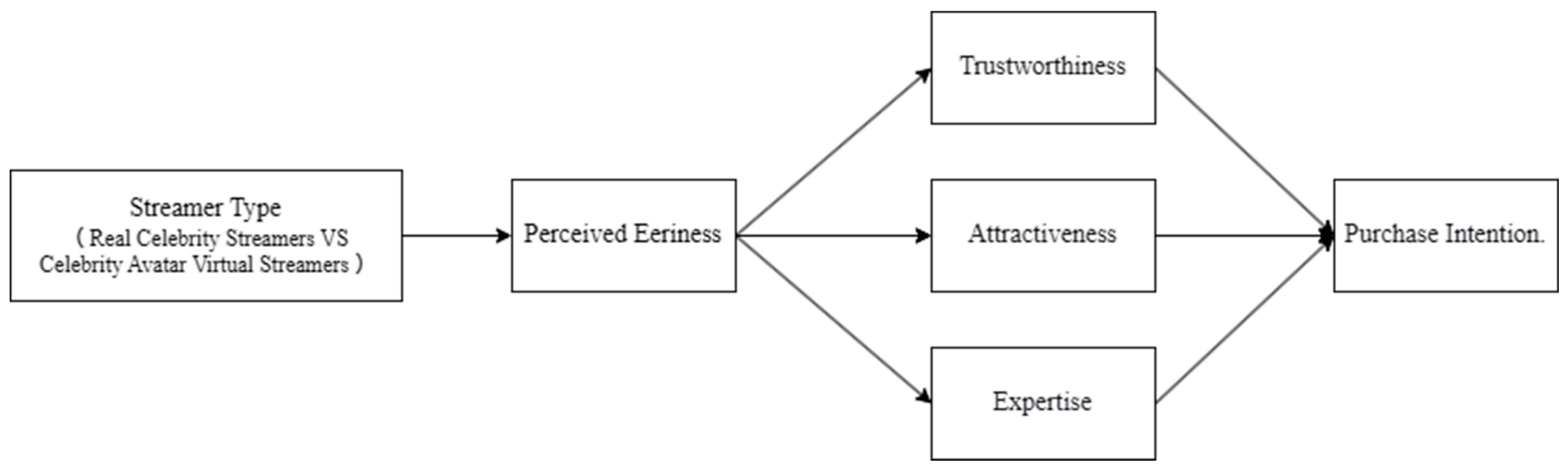
Integrating the hypotheses above leads to the proposed serial mediation model. This model addresses the core research question of how the virtualization of a celebrity streamer alters the influence pathway. The underlying logic is sequential: The AI-based nature of a celebrity avatar virtual streamer first increases perceived eeriness due to schema incongruity. This heightened eeriness then triggers a re-evaluation process that degrades the perceived credibility of the source (i.e., trustworthiness, attractiveness, and expertise). Finally, this diminished source credibility results in lower purchase intention. Thus, we formally propose the following serial mediation hypotheses:
H4a. 
Perceived eeriness and trustworthiness serially mediate the relationship between streamer type and purchase intention.
H4b. 
Perceived eeriness and attractiveness serially mediate the relationship between streamer type and purchase intention.
H4c. 
Perceived eeriness and expertise serially mediate the relationship between streamer type and purchase intention.
The complete research model is presented in Figure 1.

4. Methodology

4.1. Sample

This study employed a between-subjects experimental design. The experiment used a single independent variable: the type of streamer. This variable has two levels: real celebrity streamers and celebrity avatar virtual streamers.
To enhance the ecological validity of the experimental scenario, we selected a well-known celebrity who had conducted livestreaming product sales using both their real image and a digital avatar as the research prototype. This selection enabled participants to clearly distinguish between the two streamer types, thereby improving the validity of the experimental manipulation.
Two sets of experimental materials were developed, and participants were randomly assigned to one of two between-subjects groups: the real celebrity streamer group and the celebrity avatar virtual streamer group. The two sets of experimental materials are highly consistent in various aspects. These aspects include livestream content, product information, communication style, and setting. The only difference between the two materials is the description of the streamer type. The experimental materials are designed based on real livestreaming scenarios. They simulate the celebrity’s iconic personal style. Furthermore, the materials include typical product information such as product parameters, usage scenarios, and drawbacks.

4.2. Measurement

The questionnaire used in this study consists of two main sections. Section 1 measures the core variables. All scales are derived from established academic scales. These scales were appropriately adapted for the context of this study. The measurement uses a 7-point Likert scale, where 1 indicates “strongly disagree,” and 7 indicates “strongly agree.” In total, the measurement of the variables consists of 20 items.
Section 2 covers demographic variables and control variables. First, it collects basic information, including gender, age, education level, and occupation. Second, based on existing research, this study incorporates several variables that may influence consumer decision-making as control variables. These variables include gender, online shopping expenditure, shopping experience, and livestream viewing frequency [50,51,52,53].
Additionally, celebrity familiarity and likability are also key factors. These factors may interfere with the mechanisms of the core variables by enhancing recognition and emotional identification [54]. To avoid endogenous bias and enhance the model’s explanatory power, this study includes both as control variables. This approach ensures the internal validity of the study’s conclusions. The questionnaire item design is shown in Table 1:

4.3. Data Collection and Sample Screening

We collected data from Chinese participants from October to November 2025 through an online survey administered via the Wenjuanxing platform. We distributed the survey link across multiple social media platforms, including Xiaohushu, WeChat, and Weibo. We offered incentives to encourage participation.
A three-tier screening procedure was implemented to ensure sample quality and the validity of the research context, with the specific criteria for each tier as follows:
  • Contextual Relevance Screening: Participants were required to meet two inclusion criteria to ensure they possessed the requisite background to comprehend the experimental scenario: ref. [57] familiarity with the celebrity prototype used in the study; ref. [26] prior experience watching both AI and human streamers on Taobao Live.
  • Data Quality Screening: Attention-check questions were embedded in the questionnaire to assess response reliability, and all responses that failed these checks were excluded from the final analysis.
  • Manipulation Check: To verify the effectiveness of the experimental manipulation, participants were asked to identify the streamer type (real celebrity vs. celebrity AI avatar) presented in the experimental materials; samples with incorrect identifications were excluded.
After these screening steps, 391 valid questionnaires were retained for further analysis.
Following the three-tier screening, a total of 391 valid responses were obtained, with the demographic and behavioral characteristics of the final sample presented in Table 2. The sample exhibited a high level of engagement with live-streaming e-commerce: 91.8% of participants watched live streams more than four times per month, and 84.6% reported a monthly online shopping expenditure of over 500 RMB, with 40.9% spending between 500 and 1000 RMB, 32.2% between 1001 and 2000 RMB, and 11.5% between 2001 and 5000 RMB. This indicates that the sample is highly familiar with and engaged in live-stream shopping, thereby enhancing the data’s authenticity and external validity in the context of live-stream e-commerce.

4.4. Randomization Check

To verify the success of random assignment, chi-square tests (for categorical variables) and independent-samples t-tests (for continuous variables) were conducted to compare the two groups on demographic characteristics and pre-existing attitudes (e.g., celebrity familiarity and likability). As shown in Table 3, the only significant group difference was in gender distribution (χ2 = 4.400, p = 0.036); thus, gender was included as a control variable in the subsequent PLS-SEM model to control for potential bias arising from its uneven distribution across groups.

5. Data Analysis and Results

5.1. Reliability and Validity

To examine the proposed hypotheses, this study first conducted descriptive statistics and correlation analysis to provide an overview of the data characteristics, as shown in Table 4. To ensure the reliability and validity of the data, this study employed SmartPLS for analysis. The results indicate that the Cronbach’s α values for perceived eeriness, expertise, trustworthiness, attractiveness, and consumer purchase intention all exceeded 0.70. The composite reliability (CR) values all surpassed 0.83. Furthermore, the AVE values ranged from 0.662 to 0.727, exceeding the recommended threshold of 0.50. As presented in Table 5. These results demonstrate that all latent constructs possess good internal consistency and convergent validity.
This study further employed the heterotrait–monotrait ratio (HTMT) to assess discriminant validity. As shown in Table 6, the HTMT values for all construct combinations are below the stringent threshold of 0.85, indicating that the model demonstrates good discriminant validity.

5.2. Common Method Bias

Because the data in this study were collected through a questionnaire survey, the potential for common method bias (CMB) may exist. To assess this potential issue, Harman’s single-factor test was employed in this study. The results show that the unrotated single-factor solution explains 42.96% of the total variance, which is below the 50% threshold. Moreover, following [58], we performed a full collinearity test by examining the variance inflation factors (VIFs) for all latent variables in a common model. All VIF values are below the conservative threshold of 3.3, indicating that common method bias is unlikely to contaminate the results. Common method bias was not a critical concern in this study [59].

5.3. Hypothesis Testing

This study employs Partial Least Squares Structural Equation Modeling (PLS-SEM) to test the research hypotheses, using SmartPLS 4.0 software for analysis. Bootstrap sampling with 5000 iterations was conducted to assess the significance of path coefficients and validate the robustness of the hypotheses. The model results show that, according to [60] standards, the values are 0.26 (strong), 0.13 (moderate), and 0.02 (weak). The model explains 60.61% of the variance in the core dependent variable, “purchase intention,” indicating high predictive power. Furthermore, the variance inflation factors (VIFs) for all constructs, following the recommendations of [61], show that VIF values below 3 typically suggest that multicollinearity does not pose a threat.

5.3.1. Direct Effects

All direct paths reached statistical significance, as shown in Table 7. The type of streamer has a significant positive effect on perceived eeriness (β = 0.472, p < 0.001), supporting hypothesis H1. Perceived eeriness has a significant negative impact on all three dimensions of source credibility, with the greatest negative effect on trustworthiness (β = −0.442, p < 0.001), followed by expertise (β = −0.361, p < 0.001), and attractiveness (β = −0.272, p < 0.001), supporting hypotheses H2a–H2c. The three dimensions of source credibility have significant positive effects on purchase intention: expertise (β = 0.416, p < 0.001), trustworthiness (β = 0.233, p < 0.01), and attractiveness (β = 0.236, p < 0.001), supporting hypotheses H3a–H3c.

5.3.2. Chain Mediation Effects

All three chain mediation paths reached statistical significance, as shown in Table 8. Among them, the mediation effect of the path “streamer type → perceived eeriness → expertise → purchase intention” was the strongest (β = −0.071, p < 0.01). This was followed by the path “streamer type → perceived eeriness → trustworthiness → purchase intention” (β = −0.049, p < 0.05) and the path “streamer type → perceived eeriness → attractiveness → purchase intention” (β = −0.030, p < 0.05), supporting hypotheses H4a–H4c. These results indicate that the theoretical mechanism is empirically supported. Specifically, the celebrity avatar virtual streamer reduces consumers’ purchase intention by triggering greater perceived eeriness, which, in turn, systematically weakens evaluations of source credibility.
This study employs Partial Least Squares Structural Equation Modeling (PLS-SEM) for hypothesis testing. To evaluate the significance of path coefficients and mediation effects, we used the Bootstrap resampling method, generating 5000 Bootstrap subsamples and calculating bias-corrected 95% confidence intervals. If the confidence interval does not include zero, the path coefficient or effect is considered statistically significant at the p < 0.05 level.

5.3.3. Summary of Hypothesis Testing Results

This paper aims to explore how the type of host (real celebrity hosts vs. celebrity avatar virtual streamers) influences consumer purchase intention through perceived eeriness and source credibility. The empirical results support all hypotheses, as shown in Table 9. Compared to real celebrity hosts, celebrity avatar virtual streamers evoke significantly higher perceived eeriness (H1 supported). This sense of eeriness, in turn, negatively affects three dimensions of source credibility: trustworthiness, attractiveness, and expertise (H2a–c supported). These dimensions of credibility subsequently have a significant positive impact on purchase intention, with expertise having the strongest effect (H3a–c supported). More importantly, the data confirm the existence of a chain mediation path (H4a–c supported), suggesting that the negative impact of AI avatar virtual streamers on purchase intention is realized through the sequential induction of eeriness and the erosion of source credibility.

6. Discussion

6.1. Discussion of Findings

As AI technologies increasingly integrate into live commerce, the role of streamers as central influencers in consumer decision-making has become increasingly prominent. This study integrates Uncanny Valley Theory and Source Credibility Theory to examine the mechanisms underlying streamer types’ influence on purchase intention. The principal findings are summarized below.
First, streamer type significantly shapes a key consumer perception: perceived eeriness. Specifically, consumers report higher levels of perceived eeriness when watching a celebrity avatar virtual streamer compared to a real celebrity streamer. While prior research has examined general acceptance of virtual personas [33], the specific negative psychological reaction elicited by hyper-realistic digital avatars based on real individuals remains underexplored. By focusing on the emerging phenomenon of the celebrity avatar virtual streamer, this study demonstrates that transferring a celebrity’s influence from a human to a digital carrier activates a distinct, technology-mediated psychological assessment—namely, perceived eeriness. This finding extends our understanding of how virtuality operates within live commerce contexts.
Second, the results indicate that perceived eeriness and source credibility serve as serial mediators in the relationship between streamer type and purchase intention. Perceived eeriness exerts significant negative effects across all three dimensions of source credibility, with the most pronounced impact on perceived trustworthiness. This can be explained through a cognitive psychological lens. The expectation violations and uncertainty cues characteristic of the Uncanny Valley effect likely heighten consumers’ psychological vigilance, leading them to question the endorser’s sincerity and reliability [38]. This technological incongruence may undermine trust and destabilize the foundation of persuasive communication. This interpretation aligns with findings suggesting that audience skepticism toward hyper-realistic AI streamers often stems from their lower perceived credibility [62]. Crucially, the results suggest that technology-induced eeriness is not a terminal response but systematically undermines the core asset of a virtual persuader: its source credibility. This proposed mechanism establishes a meaningful linkage between Uncanny Valley Theory and Source Credibility Theory, offering a novel explanatory pathway for the persuasive challenges faced by highly realistic virtual endorsers.
Finally, this study confirms that, within the examined decision pathway, the expertise dimension of source credibility plays the most critical role in driving purchase intention. This supports prior conclusions by [57,63,64] across various virtual influencer contexts, which identify expertise, trustworthiness, and attractiveness as stable antecedents of consumer behavior. It is also consistent with [65] finding in Taobao live streams, where expertise emerged as the strongest influencing factor. This indicates that delivering in-depth, authoritative, and expert product knowledge remains the cornerstone of consumer persuasion, regardless of whether the streamer is a celebrity avatar, a virtual streamer, or a human streamer. This insight offers valuable guidance for the strategic positioning of celebrity avatar virtual streamers.

6.2. Theoretical Contribution

This study makes several key theoretical contributions. This study makes the following important theoretical contributions:
First, this study enriches the typological framework of virtual streamer research by introducing and empirically validating the distinctive category of the celebrity avatar virtual streamer. Existing studies commonly distinguish between human streamers and general AI virtual streamers. However, the present study demonstrates that virtual representations based on real-world celebrities constitute a hybrid form. The core characteristic of this form is identity continuity. This means that they inherit the pre-existing credibility schema associated with their corresponding real-world celebrities. This feature distinguishes them from purely fictional virtual influencers and offers a new theoretical perspective on the diverse forms of digital communication actors.
Second, it expands the applicability of the source credibility theory in the context of AI-driven communication. Existing studies mainly focus on human communicators or traditional virtual images, with little discussion on whether the original credibility of a real celebrity is retained when the celebrity is replicated by AI technology into a digital avatar. Through empirical analysis, this study finds that consumers reassess the attributes of the information source when faced with celebrity AI avatars. Specifically, the social capital and trust accumulated by the real celebrity do not automatically transfer to their AI-generated image. This suggests that in a digital communication environment, source credibility is no longer merely a simple continuation of identity but a dynamic process influenced by both technological presentation and identity perception. This expands the explanatory scope of source credibility theory within AI communication contexts.
Third, it deepens the application of the Uncanny Valley theory in digital marketing and constructs a chain-like influence mechanism of “perceived eeriness—source credibility—purchase intention.” Although the Uncanny Valley theory has been widely applied in the fields of robotics and human–robot interaction, its role in commercial communication has yet to be explored in depth. This study introduces the Uncanny Valley theory into the live-streaming e-commerce context and finds that the “perceived eeriness” triggered by the degree of technological realism is not merely an emotional reaction. It weakens the evaluation of the virtual streamer’s credibility and further influences consumer purchase decisions. By constructing a chain mediation model of “perceived eeriness—source credibility—purchase intention,” this study reveals how technological characteristics influence consumer decisions through psychological perceptions, offering a new theoretical perspective for future research.

6.3. Managerial Implications

This study offers the following implications for live-streaming e-commerce practice. Firstly, the naturalness of virtual digital humans’ appearance and movements should be enhanced to reduce the Uncanny Valley effect. Research findings indicate that the perception of eeriness is a key precursor to diminished persuasive power among virtual streamers. Therefore, during the design and application of digital humans, particular attention should be given to the naturalness of visual presentation and behavioral expressions. For example, improving facial expression details, enhancing movement smoothness, and increasing synchronization between speech and lip movements can help reduce discordance. At the same time, moderately lowering overly realistic visual effects and adopting stylized designs may also alleviate the Uncanny Valley effect to some extent, thereby improving user acceptance.
Secondly, a cautious assessment of credibility risks is necessary. Research has shown that the negative impact of eeriness on the perceived credibility of the source varies, particularly affecting credibility dimensions. Brands should be aware of potential risks, especially in fields that heavily rely on trust, such as health, finance, and maternity sectors, and establish feedback mechanisms to monitor consumer reactions to issues like “unnaturalness” and “lack of trust.”
Thirdly, AI digital humans should be positioned as professional information providers. The impact of expertise on purchase intent is significantly greater than that of emotional interaction. Operators can use AI digital humans in scenarios that require highly accurate, repeatable information output, such as explaining complex products or demonstrating standardized operations, thereby transforming technological features into a stable, reliable professional image that complements human streamers.
Lastly, a systematic optimization strategy should be adopted. The chain-mediated model provides a continuous influence chain from technological perception to consumer decision-making, helping managers diagnose issues in presentation, content, or expression and take targeted optimization measures to enhance the overall performance of virtual streamers.

6.4. Policy and Regulatory Impacts

Firstly, the regulation of AI-based advertisements and content generation should be prioritized. Research findings suggest that policymakers should regulate AI-driven digital humans and deepfake content in order to protect consumer rights. For instance, enforcing the disclosure of AI-generated materials and implementing content labeling regulations could help mitigate the impact of misleading information on consumer judgment.
Secondly, consumer protection guidelines should be established. Regulatory bodies could create consumer protection guidelines specifically for virtual streamers, including requirements for transparency, verification of content authenticity, and moderation of potentially bias-inducing behaviors. This would not only enhance public trust in AI technology but also provide businesses with clear compliance standards.
Lastly, the promotion of technological standardization and ethical norms should be encouraged. Policies can motivate the industry to adhere to ethical guidelines in the design of AI virtual streamers, such as reducing the Uncanny Valley effect, enhancing credibility and expertise, and promoting measurable technical standards. This would help strike a balance between commercial applications and consumer protection.

6.5. Limitations and Future Research Directions

While this study offers initial insights into the mechanisms underlying the influence of celebrity AI avatars, several limitations must be recognized, and directions for future research are suggested. One key aspect identified is the perceived eeriness, a significant psychological response. However, the underlying mechanism of this eeriness requires further refinement. It is possible that the observed eeriness results from a combination of the general Uncanny Valley effect, which occurs with highly realistic virtual characters, and the specific cognitive conflict that arises when comparing these avatars to real-life celebrity prototypes. To clarify the precise pathways of credibility transfer disruption, future research could include a control group of “original virtual humans” without real-life counterparts, allowing for a more accurate isolation of the effects of celebrity-based identity discontinuity.
Another limitation of this study is that it relied on scenario-based imagination rather than actual live-streaming video stimuli. While this approach enabled controlled experimental manipulation, it also limited ecological validity, potentially reducing the realism of participants’ responses. Additionally, the study focused on a single celebrity and product category, which constrains the generalizability of the findings. To address this, future studies should incorporate a variety of product types, celebrity prototypes, and live video stimuli to enhance external validity and further test the robustness of the observed effects.
The participant sample, predominantly consisting of users familiar with live-streaming platforms and the selected celebrity, was primarily from China. As a result, caution should be exercised when generalizing the findings to other cultural, platform, or demographic contexts. Future research could investigate the model across different age groups, levels of technological familiarity, attitudes toward AI, and diverse cultural settings. Additionally, potential moderating variables, such as product type, celebrity familiarity, and platform-specific features, should be explored further to understand the boundary conditions of the proposed mechanisms.
By acknowledging these limitations, this study clarifies the scope of its findings. It provides a foundation for future research aimed at improving ecological validity, theoretical precision, and the cross-context generalizability of the results.

Author Contributions

Conceptualization, L.X.; methodology, L.X.; formal analysis, D.W.; investigation, L.X.; writing, original draft preparation, L.X.; visualization, D.W.; project administration, L.X.; writing, review and editing, X.L. and D.W.; supervision, X.L. and L.X.; All authors have read and agreed to the published version of the manuscript.

Funding

This research received no external funding.

Institutional Review Board Statement

Not Applicable.

Informed Consent Statement

Not Applicable.

Data Availability Statement

The data presented in this study are available on reasonable request from the corresponding author. The data are not publicly available due to privacy and ethical restrictions.

Conflicts of Interest

The authors declare no conflict of interest.

References

  1. Kao, W.K.; Cui, Y. Buyer or Watcher? Exploring the Role of Customer Type in Live-Streaming Shopping. J. Consum. Behav. 2025, 24, 1711–1728. [Google Scholar] [CrossRef] [Scilit]
  2. China Internet Network Information Center (CNNIC). Online Audio-Visual Development Research Report [2025]. Available online: https://finance.sina.cn/2025-03-28/detail-ineresvt1357091.d.html (accessed on 28 November 2025).
  3. Gao, J.; Zhao, X.; Zhai, M.; Zhang, D.; Li, G. AI or Human? The Effect of Streamer Types on Consumer Purchase Intention in Live Streaming. Int. J. Hum.–Comput. Interact. 2024, 41, 305–317. [Google Scholar] [CrossRef] [Scilit]
  4. Park, H.J.; Lin, L.M. The effects of match-ups on the consumer attitudes toward internet celebrities and their live streaming contents in the context of product endorsement. J. Retail. Consum. Serv. 2020, 52, 101934. [Google Scholar] [CrossRef] [Scilit]
  5. Chung, S.Y.; Cho, H.C. Fostering parasocial relationships with celebrities on social media: Implications for celebrity endorsement. Psychol. Mark. 2017, 34, 481–495. [Google Scholar] [CrossRef] [Scilit]
  6. Niu, B.; Yu, X.; Dong, J. Could AI livestream perform better than KOL in cross-border operations? Transp. Res. Part E Logist. Transp. Rev. 2023, 174, 103130. [Google Scholar] [CrossRef] [Scilit]
  7. Ya, N. On the First Day of 618: Li Jiaqi’s Live Broadcast Room GMV Exceeded 2.5 Billion, and Dong Yuhui’s Single Game Broke 170 Million. Tencent News, 15 May 2025. Available online: https://news.qq.com/rain/a/20250515A00L6S00 (accessed on 2 December 2025).
  8. Till, B.D.; Shimp, T.A. Endorsers in advertising: The case of negative celebrity information. J. Advert. 1998, 27, 67–82. [Google Scholar] [CrossRef] [Scilit]
  9. Dafeng News. The Debut of “Liu Qiangdong” Digital Human in Live-Streaming E-Commerce: Over 20 Million Views, Netizens Say “It Lacks Some Emotions” and Call for the Real Person to do the Live Broadcast. Jinri Toutiao, 17 April 2024. Available online: https://www.toutiao.com/article/7358646210367930915/?upstream_biz=doubao&source=m_redirect (accessed on 12 December 2025).
  10. Liu, Y.; Wang, L.; Yang, S.; Wang, Y. Artificial intelligence-powered digital streamers in online retail: Empirical insights and design strategies from experiments. Inf. Syst. Res. 2025. Epub ahead of printing. [Google Scholar] [CrossRef] [Scilit]
  11. Wang, X.; Zhang, Y. The influence of virtual streamer on purchase intention: The moderated mediating effect of message strategy and live-streaming environment. Electron. Commer. Res. Appl. 2025, 73, 101520. [Google Scholar] [CrossRef] [Scilit]
  12. Gao, W.; Jiang, N.; Guo, Q.Q. How cool virtual streamer influences customer in live-streaming commerce: An explanation of stereotype content model. J. Retail. Consum. Serv. 2025, 82, 104139. [Google Scholar] [CrossRef] [Scilit]
  13. Geng, R.; Wang, S.; Chen, X.; Song, D.; Yu, J. Content marketing in e-commerce platforms in the internet celebrity economy. Ind. Manag. Data Syst. 2020, 120, 464–485. [Google Scholar] [CrossRef] [Scilit]
  14. Zhang, L.; Shi, D.; Huang, Z.; Zhang, A.; Zhang, B. How celebrity endorsement affects travel intention: Evidence from tourism live streaming. J. Hosp. Tour. Res. 2024, 48, 1493–1506. [Google Scholar] [CrossRef] [Scilit]
  15. Sestino, A.; D’Angelo, A. Designing AI-based interactive avatars in healthcare services: The impact of human-like similarity on emotional responses. Manag. Decis. 2025, 12, 1–25. [Google Scholar] [CrossRef] [Scilit]
  16. Wang, K.; Wu, J.; Sun, Y.; Chen, J.; Pu, Y.; Qi, Y. Trust in human and virtual live streamers: The role of integrity and social presence. Int. J. Hum.–Comput. Interact. 2024, 40, 8274–8294. [Google Scholar] [CrossRef] [Scilit]
  17. Till, B.D.; Busler, M. The match-up hypothesis: Physical attractiveness, expertise, and the role of fit on brand attitude, purchase intent and brand beliefs. J. Advert. 2000, 29, 1–13. [Google Scholar] [CrossRef] [Scilit]
  18. Zhang, K.; Ni, Z.; Lu, Z. Does traffic means sales: Evidence from Chinese live streaming commerce market. Asia Pac. J. Mark. Logist. 2024, 36, 899–916. [Google Scholar] [CrossRef] [Scilit]
  19. Sun, Y.; Zhong, Y.T.; Zhang, Z.P.; Wang, Y.G.; Zhu, M.Y. How technical features of virtual live shopping platforms affect purchase intention: Based on the theory of interactive media effects. Decis. Support Syst. 2024, 180, 114189. [Google Scholar] [CrossRef] [Scilit]
  20. Zhou, T.; Li, S.T. Examining consumer impulsive purchase intention in virtual AI streaming: A S-O-R perspective. J. Theor. Appl. Electron. Commer. Res. 2025, 20, 204. [Google Scholar] [CrossRef] [Scilit]
  21. Pan, S.Y.; Qin, Z.Y.; Zhang, Y.W. More realistic, more better? How anthropomorphic images of virtual influencers impact the purchase intentions of consumers. J. Theor. Appl. Electron. Commer. Res. 2024, 19, 3229–3252. [Google Scholar] [CrossRef] [Scilit]
  22. Hovland, C.I.; Janis, I.L.; Kelley, H.H. Communication and Persuasion: Psychological Studies of Opinion Change; Yale University Press: New Haven, CT, USA, 1953. [Google Scholar]
  23. Ohanian, R. Construction and validation of a scale to measure celebrity endorsers’ perceived expertise, trustworthiness, and attractiveness. J. Advert. 1990, 19, 39–52. [Google Scholar] [CrossRef] [Scilit]
  24. van Reijmersdal, E.A.; Walet, M.; Gudmundsdóttir, A. Influencer marketing: Explaining the effects of influencer self-presentation strategies on brand responses through source credibility. Mark. Intell. Plan. 2024, 42, 1214–1233. [Google Scholar] [CrossRef] [Scilit]
  25. Erdogan, B.Z. Celebrity endorsement: A literature review. J. Mark. Manag. 1999, 15, 291–314. [Google Scholar] [CrossRef] [Scilit]
  26. Alboqami, H. Trust me, I’m an influencer!-Causal recipes for customer trust in artificial intelligence influencers in the retail industry. J. Retail. Consum. Serv. 2023, 72, 103242. [Google Scholar] [CrossRef] [Scilit]
  27. Meng, L.; Bie, Y.Y.; Yang, M.Y.; Wang, Y.J. The effect of human versus virtual influencers: The roles of destination types and self-referencing processes. Tour. Manag. 2025, 106, 104978. [Google Scholar] [CrossRef] [Scilit]
  28. Pushparaj, P.; Kushwaha, B.P.; Prashar, S. A systematic literature review of virtual influencers in marketing using bibliometric analysis. Int. Rev. Public Nonprofit Mark. 2025, 22, 631–662. [Google Scholar] [CrossRef] [Scilit]
  29. Wang, S.F.; Qiang, J.M.; Yao, K.B. How does artificial intelligence digital human live streaming increase TikTok consumer repeat purchase? Interaction between vividness, telepresence, credibility and trust. J. Bus. Res. 2025, 201, 115702. [Google Scholar] [CrossRef] [Scilit]
  30. Liu, M.N.; Wu, X.L. From pixels to action: Virtual influencers promoting pro-environmental behavior through anthropomorphism, credibility, and strategic messaging. Comput. Hum. Behav. 2025, 173, 108778. [Google Scholar] [CrossRef] [Scilit]
  31. Mori, M. The uncanny valley. Energy 1970, 7, 33–35. [Google Scholar]
  32. Tinwell, A.; Nabi, D.A.; Charlton, J.P. Perception of psychopathy and the uncanny valley in virtual characters. Comput. Hum. Behav. 2011, 27, 741–749. [Google Scholar] [CrossRef] [Scilit]
  33. Gutuleac, R.; Baima, G.; Rizzo, C.; Bresciani, S. Will virtual influencers overcome the uncanny valley? The moderating role of social cues. Psychol. Mark. 2024, 41, 1419–1431. [Google Scholar] [CrossRef] [Scilit]
  34. Li, S.H.; Chen, J.L. Virtual human on social media: Text mining and sentiment analysis. Technol. Soc. 2024, 78, 102666. [Google Scholar] [CrossRef] [Scilit]
  35. Tang, X.; Hao, Z.; Li, X. The effect of celebrity co-streamer type on consumer behavior in live-streaming: Evidence from event-related potentials. Curr. Psychol. 2025, 44, 15592–15606. [Google Scholar] [CrossRef] [Scilit]
  36. Kullmann, P.; Schell, T.; Menzel, T.; Botsch, M.; Latoschik, M.E. Coverage of Facial Expressions and Its Effects on Avatar Embodiment, Self-Identification, and Uncanniness. IEEE Trans. Vis. Comput. Graph. 2025, 31, 3613–3622. [Google Scholar] [CrossRef] [Scilit]
  37. Dietvorst, B.J.; Simmons, J.P.; Massey, C. Algorithm aversion: People erroneously avoid algorithms after seeing them err. J. Exp. Psychol. Gen. 2015, 144, 114. [Google Scholar] [CrossRef] [Scilit] [PubMed]
  38. Hinojosa, A.S.; Gardner, W.L.; Walker, H.J.; Cogliser, C.; Gullifor, D. A review of cognitive dissonance theory in management research: Opportunities for further development. J. Manag. 2017, 43, 170–199. [Google Scholar] [CrossRef] [Scilit]
  39. Nissen, A.; Conrad, C.; Seeber, I.; Newman, A.J. Why Do We Follow Virtual Influencer Recommendations? Three Theoretical Explanations from Brain Data Tested with Self-Reports. J. Assoc. Inf. Syst. 2025, 26, 1042–1080. [Google Scholar] [CrossRef] [Scilit]
  40. Dal Molin, G.P.; de Andrade Araujo, V.F.; Musse, S.R. Estimating perceived comfort in virtual humans based on spatial and spectral entropy. In Proceedings of the 17th International Joint Conference on Computer Vision, Imaging and Computer Graphics Theory and Applications (VISIGRAPP 2022); Farinella, G.M., Radeva, P., Bouatouch, K., Eds.; SciTePress: Setubal, Portugal, 2022; Volume 4, pp. 436–443. [Google Scholar] [CrossRef] [Scilit]
  41. Enzig, J.; Guerreiro, J.; Loureiro, S. How uncanny are virtual vs. human influencers: A text mining approach. In Marketing in a Multicultural and Vibrant World (AMSWMC 2024); Jeseo, V., Ed.; Springer: Cham, Switzerland, 2024; pp. 45–58. [Google Scholar] [CrossRef] [Scilit]
  42. Hovland, C.I.; Weiss, W. The influence of source credibility on communication effectiveness. Public Opin. Q. 1951, 15, 635–650. [Google Scholar] [CrossRef] [Scilit]
  43. Shin, M.; Kim, S.J.; Biocca, F. The uncanny valley: No need for any further judgments when an avatar looks eerie. Comput. Hum. Behav. 2019, 94, 100–109. [Google Scholar] [CrossRef] [Scilit]
  44. Gray, K.; Wegner, D.M. Feeling robots and human zombies: Mind perception and the uncanny valley. Cognition 2012, 125, 125–130. [Google Scholar] [CrossRef] [Scilit]
  45. Shi, R.; Wang, M.; Qiao, T.; Shang, J. The effects of live streamer’s facial attractiveness and product type on consumer purchase intention: An exploratory study with eye tracking technology. Behav. Sci. 2024, 14, 375. [Google Scholar] [CrossRef] [Scilit]
  46. Yoo, J.W.; Park, J.; Park, H. How can I trust you if you’re fake? Understanding human-like virtual influencer credibility and the role of textual social cues. J. Res. Interact. Mark. 2025, 19, 730–748. [Google Scholar] [CrossRef] [Scilit]
  47. Zhang, Y.; Du, D.; Ge, J. When Virtual Influencers are Used as Endorsers: Will Match-Up and Attractiveness Affect Consumer Purchase Intention? In International Conference on Human-Computer Interaction; Springer Nature: Cham, Switzerland, 2023; pp. 487–496. [Google Scholar]
  48. Kim, E.; Shoenberger, H.; Kim, D.; Thorson, E.; Zihang, E. Novelty vs. trust in virtual influencers: Exploring the effectiveness of human-like virtual influencers and anime-like virtual influencers. Int. J. Advert. 2025, 44, 453–483. [Google Scholar] [CrossRef] [Scilit]
  49. Jiang, Y.; Lee, H.T.; Li, W. The effects of live streamer’s expertise and entertainment on the viewers’ purchase and follow intentions. Front. Psychol. 2024, 15, 1383736. [Google Scholar] [CrossRef] [Scilit]
  50. Cha, J. Exploring the internet as a unique shopping channel to sell both real and virtual items: A comparison of factors affecting purchase intention and consumer characteristics. J. Electron. Commer. Res. 2011, 12, 115. [Google Scholar]
  51. Gutierrez, B.P.B. Determinants of planned and impulse buying: The case of the Philippines. Asia Pac. Manag. Rev. 2004, 9, 1061–1078. [Google Scholar]
  52. Khoi, N.H.; Le, A.N.H. Real-time interactivity and impulsive buying in livestreaming commerce: The focal intermediary role of inspiration. Int. J. Hum.–Comput. Interact. 2024, 40, 2938–2953. [Google Scholar] [CrossRef] [Scilit]
  53. Zhao, K.; Shi, H.; Zhang, Y.Y.; Sheng, J. Fresh produce E-Commerce and online shoppers’ purchase intention. Chin. Econ. 2021, 54, 415–429. [Google Scholar] [CrossRef] [Scilit]
  54. McCracken, G. Who is the celebrity endorser? Cultural foundations of the endorsement process. J. Consum. Res. 1989, 16, 310–321. [Google Scholar] [CrossRef] [Scilit]
  55. Ho, C.C.; MacDorman, K.F. Measuring the uncanny valley effect: Refinements to indices for perceived humanness, attractiveness, and eeriness. Int. J. Soc. Robot. 2017, 9, 129–139. [Google Scholar] [CrossRef] [Scilit]
  56. Tong, X.J.; Chen, Y.G.; Zhou, S.S.; Yang, S.Q. How background visual complexity influences purchase intention in live streaming: The mediating role of emotion and the moderating role of gender. J. Retail. Consum. Serv. 2022, 67, 103031. [Google Scholar] [CrossRef] [Scilit]
  57. Agnihotri, D.; Chaturvedi, P.; Tripathi, V. “Virtual bonds and actual transactions”: Investigating the impact of virtual influencers’ credibility on buying behavior through virtual engagement. J. Commun. Manag. 2025, 29, 35–52. [Google Scholar] [CrossRef] [Scilit]
  58. Kock, N. Common method bias in PLS-SEM: A full collinearity assessment approach. Int. J. e-Collab. (IJeC) 2015, 11, 1–10. [Google Scholar] [CrossRef] [Scilit]
  59. Fuller, C.M.; Simmering, M.J.; Atinc, G.; Atinc, Y.; Babin, B.J. Common methods variance detection in business research. J. Bus. Res. 2016, 69, 3192–3198. [Google Scholar] [CrossRef] [Scilit]
  60. Cohen, J. Statistical Power Analysis for the Behavioral Sciences; Routledge: London, UK, 2013. [Google Scholar]
  61. Hair, J.F.; Risher, J.J.; Sarstedt, M.; Ringle, C.M. When to use and how to report the results of PLS-SEM. Eur. Bus. Rev. 2019, 31, 2–24. [Google Scholar] [CrossRef] [Scilit]
  62. Cao, Y.J.; Wang, F. Generative AI streamers in action: A source credibility perspective. Int. J. Advert. 2025. Early Access. [Google Scholar] [CrossRef] [Scilit]
  63. Kant, R.; Tiwari, A.; Jaiswal, D. How do fashion endorsers’ credibility sources shape young consumers’ attitudes, perceptions, and purchase intents? Decoding fashion influencers using SOR perspective. Young Consum. 2025, 26, 585–605. [Google Scholar] [CrossRef] [Scilit]
  64. Soares, R.; Liu, J.; Zhang, T.; Lu, C.; Zhong, Y. How does credibility matter? Proposing and validating a framework for the credibility of live streamers in the gaming industry. Serv. Mark. Q. 2024, 45, 83–104. [Google Scholar] [CrossRef] [Scilit]
  65. Rungruangjit, W. What drives Taobao live streaming commerce? The role of parasocial relationships, congruence and source credibility in Chinese consumers’ purchase intentions. Heliyon 2022, 8, e09676. [Google Scholar] [CrossRef] [Scilit]
Figure 1. Conceptual research model.
Jtaer 21 00141 g001
Table 1. Questionnaire Item Design.
VariablesItemsReference
Perceived EerinessIn my imagination, I feel that the overall presentation of this livestreaming scenario is somewhat incongruent.[55]
In my imagination, during the viewing process, I experience a sense of “unreality” or “incongruity.”
This streamer makes me feel uneasy or strange.
In my imagination, if I were required to interact with this streamer, I would feel unnatural.
TrustworthinessDuring the livestream, the streamer’s recommendations appear authentic and credible.[23]
I believe the streamer’s recommendations are based on clear and objective facts.
I believe that the streamer presented a consistently credible image throughout the recommendation process.
I consider the streamer to be a reliable product endorser.
ExpertiseThe streamer demonstrates a deep understanding of the product and provides detailed explanations.[23]
The streamer displays authority and is convincing.
The streamer’s recommendation of the power bank is based on actual testing and professional experience.
The streamer’s product knowledge in the relevant field is professional and trustworthy.
AttractivenessI believe that the streamer demonstrates a high level of personal charm during the livestream.[23]
The streamer presents a style in this livestream that can arouse audience interest.
I find the streamer’s manner of expression appealing.
I believe that the streamer can effectively attract my attention and interest.
Purchase IntentionsAfter watching this livestream, I became interested in purchasing the displayed product.[12,56]
After watching this livestream, I am willing to purchase the displayed product.
After watching this livestream, I would consider purchasing the displayed product.
After watching this livestream, I am very likely to purchase the displayed product.
Table 2. Basic Information of the Filtered Sample.
FeatureCategoryCategory CountPercentage of Total Sample (%)
GenderFemale24261.9
GenderMale14938.1
Age18–25 years18046
Age26–30 years13434.3
Age31–40 years6917.6
Age41–50 years41
Age50 and above41
EducationCollege diploma7118.2
EducationBachelor’s degree28773.4
EducationMaster’s degree and above194.9
EducationHigh school/Technical secondary143.6
Frequency1–3 times317.9
FrequencyMore than 10 times10827.6
Frequency4–6 times14136.1
Frequency7–10 times11028.1
FrequencyAlmost never10.3
Payment1000–200012632.2
Payment2001–50004511.5
Payment500–100016040.9
PaymentAbove 500030.8
PaymentBelow 5005714.6
Table 3. Chi-Square Tests for Demographic and Pre-existing Attitudes.
VariableTest Valuep-ValueSignificant Difference?
Genderχ2 = 4.4000.036Yes
Ageχ2 = 5.5400.236No
Educationχ2 = 2.4810.479No
Monthly Paymentχ2 = 6.6870.153No
Viewing Frequencyχ2 = 5.1690.270No
Celebrity Familiarityt = −1.3910.165No
Celebrity Likabilityt = 1.2440.214No
Table 4. Means, Standard Deviations, and Correlations of Core Constructs.
ConstructMeanSDExpeAttractiveBuyTrustWeird
Expe5.4010.967
Attractive5.4680.9370.525
Buy5.5810.9040.7100.593
Trust5.4670.9310.6990.5710.674
Weird2.9161.278−0.361−0.272−0.404−0.442
Table 5. Assessment of Measurement Model.
ConstructMeasurement
Items
Outer
Loadings
Cronbach’s
Alpha
Composite
Reliability (Rho_a)
AVE
ExpertiseExpertise_10.7840.8300.8300.662
Expertise_20.830
Expertise_30.807
Expertise_40.832
Attractivenessattractive_10.7850.8330.8340.667
attractive_20.798
attractive_30.835
attractive_40.848
Purchase Intentionsbuy_10.8170.8510.8520.692
buy_20.832
buy_30.820
buy_40.858
Trustworthinesstrust_10.8550.8490.8520.689
trust_20.815
trust_30.852
trust_40.795
Perceived eerinessweird_10.8190.8760.8910.727
weird_20.875
weird_30.873
weird_40.843
Table 6. Heterotrait–Monotrait Ratio.
ExpertiseAttractivenessPurchase IntentionsTrustworthinessPerceived Eeriness
Expertise
Attractiveness0.634
Purchase Intentions0.8410.702
Trustworthiness0.8300.6770.789
Perceived eeriness0.4140.3100.4630.502
Table 7. Results of the Direct Effects test.
HypothesisPathPath
Coefficient (β)
T-Value95% CIp-Value
H1TYPE → WEIRD0.4725.034[0.284, 0.647]***
H2aWEIRD → TRUST−0.4429.031[−0.531, −0.351]***
H2bWEIRD → ATTRACT−0.2725.544[−0.371, −0.181]***
H2cWEIRD → EXPE−0.3617.205[−0.463, −0.268]***
H3aTRUST → BUY0.2333.341[0.100, 0.373]**
H3bATTRACT → BUY0.2363.802[0.111, 0.354]***
H3cEXPE → BUY0.4166.157[0.282, 0.545]***
Note: ** p < 0.01, *** p < 0.001.
Table 8. Results of the Serial Mediation Test.
HypothesisMediation PathIndirect Effect ValueT-Value95% Confidence Intervalp-Value
Total EffectTYPE → BUY−0.1503.994[−0.233, −0.085]***
Total Indirect EffectTYPE → BUY−0.1503.994[−0.233, −0.085]***
H4aTYPE → WEIRD → TRUST → BUY−0.0492.421[−0.095, −0.017]*
H4bTYPE → WEIRD → ATTRACT → BUY−0.0302.409[−0.059, −0.011]*
H4cTYPE → WEIRD → EXPE → BUY−0.0713.367[−0.119, −0.036]**
Note: * p < 0.05, ** p < 0.01, *** p < 0.001.
Table 9. Summary of Assumed Results.
HypothesisHypothesis ContentResult
H1Streamer type influences perceived eeriness, such that viewers experience a higher level of perceived eeriness when watching a celebrity avatar virtual streamer compared to a real celebrity streamer.Supported
H2aPerceived eeriness negatively affects consumers’ perception of the streamer’s trustworthiness.Supported
H2bPerceived eeriness negatively affects consumers’ perception of the streamer’s attractiveness.Supported
H2cPerceived eeriness negatively affects consumers’ perception of the streamer’s expertise.Supported
H3aThe streamer’s perceived trustworthiness positively influences consumers’ purchase intention.Supported
H3bThe streamer’s perceived attractiveness positively influences consumers’ purchase intention.Supported
H3cThe streamer’s perceived expertise positively influences consumers’ purchase intention.Supported
H4aPerceived eeriness and trustworthiness serially mediate the relationship between streamer type and purchase intention.Supported
H4bPerceived eeriness and attractiveness serially mediate the relationship between streamer type and purchase intention.Supported
H4cPerceived eeriness and expertise serially mediate the relationship between streamer type and purchase intention.Supported
Disclaimer/Publisher’s Note: The statements, opinions and data contained in all publications are solely those of the individual author(s) and contributor(s) and not of MDPI and/or the editor(s). MDPI and/or the editor(s) disclaim responsibility for any injury to people or property resulting from any ideas, methods, instructions or products referred to in the content.