Article

Trust-First Personalization in Fashion E-Commerce: An Association-Based Model Linking Perceived Personalization, Surveillance, Privacy-Violation, and Purchase Intention


1
Research Center in Economics & Business Sciences (CICEE), Universidade Autónoma de Lisboa, 1150-293 Lisboa, Portugal
2
Higher Institute of Business and Tourism Sciences (ISCET), 4050-180 Porto, Portugal
*
Author to whom correspondence should be addressed.
J. Theor. Appl. Electron. Commer. Res. 2026, 21(5), 139; https://doi.org/10.3390/jtaer21050139
Submission received: 28 February 2026 / Revised: 27 April 2026 / Accepted: 28 April 2026 / Published: 30 April 2026

Abstract

This study develops and tests an association-based model explaining how consumers interpret AI-enabled personalization in fashion e-commerce and how these interpretations relate to behavioral intentions. Integrating perspectives from Social Exchange Theory, the Antecedents of Trust Model, Self-Determination Theory, Psychological Contract Breach Theory, and Surveillance Capitalism, we examine the joint associations of perceived personalization, transparency, data control, and privacy concerns with brand trust, perceived surveillance, privacy violation perceptions, and purchase intention. Using PLS-SEM with data from 664 online shoppers, we find that personalization, transparency, and data control are each positively associated with brand trust, while personalization and privacy concerns are positively associated with surveillance perceptions. Brand trust is negatively associated with both surveillance and privacy violation perceptions, and privacy violation is negatively associated with purchase intention. Data control is directly associated with lower surveillance perceptions, whereas transparency operates indirectly through brand trust. Mediation analysis reveals that surveillance is associated with lower purchase intention only indirectly through privacy violation (full mediation), identifying perceived privacy violation as the central psychological pathway in the personalization-privacy paradox. Multi-group analysis identifies segment-level variations by gender and education: personalization is a stronger trust cue for men, while transparency is a stronger trust cue for women; trust buffers violation more strongly for higher-educated consumers. The results highlight a trust-first personalization strategy in which relevance must be paired with meaningful transparency and data-control features to mitigate surveillance and violation appraisals, supporting positive consumer outcomes in fashion e-commerce.

1. Introduction

The fashion industry, long intertwined with identity, aesthetics, and symbolic self-expression, now stands at a decisive digital crossroads. Data-driven marketing technologies promise unprecedented personalization of the consumer experience, yet they are also widely associated with privacy risk, data ethics concerns, and pervasive monitoring. This tension is commonly described as the personalization–privacy paradox [1,2], wherein practices intended to increase relevance and value are simultaneously linked with feelings of intrusion and loss of control. Prior studies indicate that personalization can coincide with greater service attractiveness while not necessarily motivating information disclosure among consumers with strong privacy valuations, underscoring the psychological and relational character of the paradox [3]. Recent works, including a bibliometric analysis by Duralia et al. [4], suggest that this paradox remains central in digital commerce research and continues to evolve alongside advances in data analytics.
Fashion is a particularly salient and comparatively understudied domain in which to examine these dynamics. Relative to utilitarian categories, fashion products often carry symbolic and emotional significance, reinforcing personal identity, social belonging, and lifestyle orientation [5,6]. Personalized brand interactions in fashion are therefore more likely to be psychologically charged, with potential implications not only for perceived relevance but also for relational trust, vulnerability, and perceived autonomy [7]. Empirical work points to strong consumer–brand bonds in this sector, suggesting that personalization may be especially valued while perceived intrusiveness may be considered more consequential [8,9].
Concurrently, the sector’s rapid embrace of AI-enabled tools, from recommendation engines and predictive analytics to social commerce, places fashion at the forefront of algorithmic data practices that many consumers associate with digital surveillance [10,11]. This context aligns with Zuboff’s [12] theory of Surveillance Capitalism, which situates advanced personalization within a broader economic logic that converts user experience into behavioral data for prediction and extraction. In such environments, highly tailored recommendations may be interpreted by consumers as signals of extensive profiling rather than as neutral service optimization.
Regulatory frameworks further shape these perceptions. Under the General Data Protection Regulation (GDPR), brands operating in or serving the EU are expected to meet stringent requirements for transparency, accountability, and consent management. At the same time, research indicates that privacy concerns are context-dependent and psychologically mediated, being shaped by trust, perceived fairness, and implicit expectations of relational integrity [13,14]. Recent work in JTAER shows that internal evaluative tension—specifically cognitive–affective inconsistency and attitudinal ambivalence—can weaken the link from privacy concerns to disclosure, clarifying why privacy attitudes often fail to predict behavior consistently in digital commerce [15]. In emotionally expressive settings such as fashion, these concerns may be amplified, making it important to understand how consumers evaluate data exchanges not only in cost–benefit terms but also through affective responses and perceptions of autonomy and respect.
In digital fashion commerce, stakeholders confront a persistent dilemma: personalization signals relevance and convenience, yet the same cues are often interpreted as surveillance. Results in research social-commerce stream show that privacy policy awareness, perceived control of personal information, and privacy concerns are associated with users’ engagement intentions across cultures, underscoring the salience of transparency and control in data-intensive retail [16]. Managers know that transparency and control are advisable, but it remains unclear how personalization, transparency, and data control are jointly associated with trust, surveillance perceptions, and privacy-violation appraisals, and which pathway links these evaluations to purchase intention. Existing work typically examines isolated links (e.g., privacy concerns → surveillance, or transparency → trust) and often assumes a direct negative association from surveillance to purchase intention. What is missing is an integrated, association-based account that (i) positions brand trust alongside surveillance and violation in the same framework, (ii) tests whether surveillance relates to purchase intention directly or primarily via perceived violation, and (iii) identifies for whom (by gender, education) these associations differ in fashion. As we show, the answer to (ii) is that surveillance relates to purchase intention primarily through perceived privacy violation, which emerges as a central psychological pathway in the personalization-privacy paradox.
To organize these issues, this study integrates several complementary theoretical perspectives. Social Exchange Theory [17,18] provides a relational lens through which the perceived benefits of personalization and the perceived risks linked to data practices can be jointly considered. The Antecedents of Trust Model [19] clarifies how trust is associated with perceptions of ability, integrity, and benevolence—operationalized here through perceived personalization, transparency, and data control. Surveillance Capitalism [12] situates surveillance perceptions within a broader socio-economic system of data extraction. Self-Determination Theory [20] highlights autonomy needs that are pertinent when consumers evaluate whether they can meaningfully control personal data. Finally, Psychological Contract Breach Theory [21,22] frames how perceived overreach in data practices may be interpreted as a relational transgression, with downstream implications for marketplace engagement.
Building on this integrative framing, the study explores how perceived personalization, privacy concerns, and brand trust are jointly associated with perceived surveillance, perceptions of privacy violation, and purchase intention among digital fashion consumers. While prior research has examined individual components of these relationships, comparatively few studies assemble cognitive, relational, emotional, and systemic elements into a single empirical model within the identity-laden context of fashion retail. The present work addresses this gap by focusing on the pattern of associations among these constructs and by examining segment differences across gender and education.
The contributions of this research are twofold. Theoretically, it advances a multidimensional, association-based account of how personalization practices are related to both value-enhancing and risk-related evaluations in fashion e-commerce, positioning brand trust and perceived privacy violation as central relational and emotional pathways within the broader personalization–privacy paradox. Practically, it offers an evidence-informed, trust-oriented perspective for calibrating personalization with transparency and data control in ways that are sensitive to privacy-related perceptions while maintaining strategic relevance for fashion brands.
In doing so, this study contributes to the literature by offering an integrated, association-based explanation of how data-driven personalization relates to trust, surveillance perceptions, privacy-violation responses, and purchase intention in fashion e-commerce. By bringing together cognitive, relational, emotional, and systemic perspectives, the study highlights brand trust and perceived privacy violation as central pathways through which consumers interpret data practices. Without such a mapping, managers risk amplifying surveillance and violation appraisals even as they increase relevance; with it, they can sequence transparency and control before or alongside personalization and target trust cues to segments where the associations are strongest.
The remainder of the article proceeds as follows. Section 2 presents the theoretical framework and develops the hypotheses. Section 3 describes the methodological design, including measurement and analytical procedures. Section 4 reports the empirical findings from the PLS-SEM analyses and the multi-group comparisons. Section 5 discusses the theoretical and managerial implications, and Section 6 concludes with key contributions, theoretical contributions, practical implications, limitations, and directions for future research.

2. Theoretical Framework and Hypotheses Development

2.1. Integrative Theoretical Framework

Understanding how personalization simultaneously generates value and evokes feelings of surveillance requires a theoretical lens that captures cognitive, relational, motivational, emotional, and systemic processes. To achieve this, the present study draws on five complementary perspectives: Social Exchange Theory (SET), the Antecedents of Trust Model, Surveillance Capitalism, Self-Determination Theory (SDT), and Psychological Contract Breach Theory (PCBT). A recent systematic review shows that privacy concerns in B2C e-commerce are inherently multi-dimensional—spanning consumer attributes, vendor practices, trust relations, information-control mechanisms, and macro-environmental factors—highlighting the need for integrative models such as the one we advance here [23].
At the macro level, Surveillance Capitalism [12] frames advanced personalization within a broader economic logic that translates user experience into behavioral data and predictive value. In such environments, consumers may interpret highly tailored recommendations as signals of extensive profiling, which is associated with perceptions of being monitored. This interpretation is especially pertinent in fashion e-commerce, where algorithmic profiling and behavioral tracking are now common [10,11].
At the meso (relational) level, SET [17,18] suggests that consumers weigh perceived benefits (e.g., relevance and convenience) against perceived risks (e.g., data misuse). Within this exchange logic, perceived personalization, transparency, and data control align with value or risk-reducing cues, whereas privacy concerns reflect the perceived costs of data disclosure. Fashion consumption, driven by self-expression, identity, and emotional attachment, heightens sensitivity to these relational evaluations [5,6,8,9].
The micro-level cognitive mechanisms underlying these evaluations are explained by the Antecedents of Trust Model [19]. Trust emerges from perceptions of ability (the brand’s competence), integrity (honesty and transparency), and benevolence (demonstrated concern for consumer interests). In this study, these cues are expected to be positively associated with brand trust, which, in turn, is negatively associated with surveillance and privacy-violation perceptions. From a motivational perspective, SDT [20] highlights the basic need for autonomy. Perceiving control over personal data may therefore be associated with lower surveillance perceptions by reinforcing a sense of agency.
Finally, PCBT [21] provides an affective lens: when data practices are interpreted as exceeding implicit expectations of fairness or respect, consumers may report privacy-violation perceptions. In this view, perceived surveillance is associated with privacy-violation responses, which are in turn associated with lower purchase intention.
These five theories do not operate in isolation. Rather, they jointly explain the personalization-privacy paradox as a multi-stage process. Surveillance Capitalism provides the macro-level context: consumers recognize that their data are being extracted for economic value. Social Exchange Theory and the Antecedents of Trust Model explain how consumers evaluate this extraction: they weigh perceived benefits against perceived risks, relying on trust cues (ability, integrity, benevolence) to reduce uncertainty. Self-Determination Theory explains why control matters: autonomy restoration directly reduces surveillance perceptions. Psychological Contract Breach Theory explains the outcome: when surveillance is interpreted as excessive, it triggers violation appraisals, which in turn reduce purchase intention. Thus, the five theories are not alternatives but complementary lenses on different stages of the same psychological process.
Taken together, these five perspectives are not competing but complementary. We use Social Exchange Theory [17,18] and the Antecedents of Trust Model [19] to explain relational evaluations and trust cues; Surveillance Capitalism [12] to frame the data-extraction context; and Self-Determination Theory [20] and Psychological Contract Breach Theory [21] to add micro-level mechanisms of autonomy and violation. This integrated framework informs the associations examined in our model.
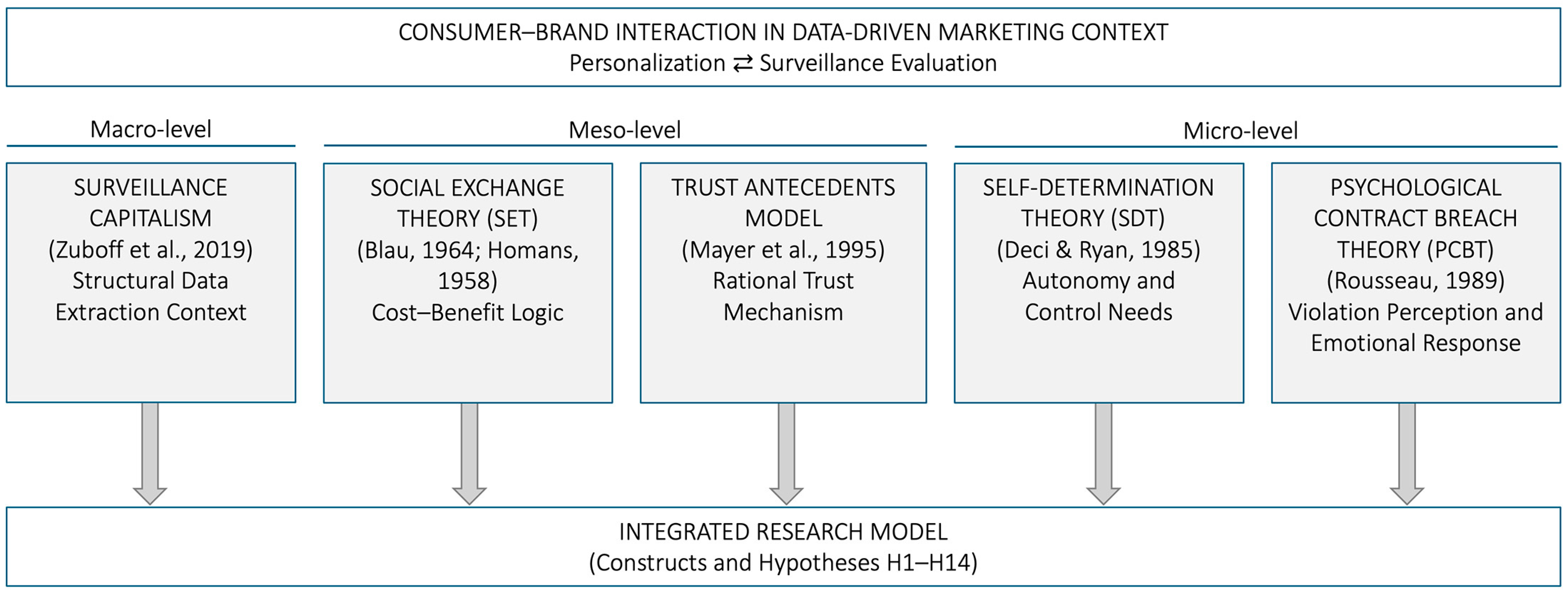
As shown in Figure 1, the framework brings together macro-level (Surveillance Capitalism), meso-level (Social Exchange; trust antecedents), and micro-level (Self-Determination; psychological contract breach) perspectives to depict the linked associations tested in our model.

2.2. Hypotheses Development

2.2.1. Antecedents of Brand Trust

Perceived Personalization (PP) reflects the extent to which consumers feel that brand communications, recommendations, or product offerings are tailored to their preferences [24]. In fashion, where symbolic expression and identity play a central role [5,6], personalization signals that the brand understands the consumer’s individual needs. This signal reduces uncertainty about the brand’s competence: a brand that provides relevant recommendations is perceived as having invested in understanding the consumer, thereby demonstrating ability [19]. Empirical studies consistently show that perceived personalization enhances trust in digital retail contexts [24,25]. Accordingly:
H1: 
Perceived Personalization is positively associated with Brand Trust.
Transparency (TR) denotes the clarity with which brands disclose what data they collect, how they process it, and for what purposes [14,26]. This construct aligns with the integrity dimension of the trust model [19], reducing information asymmetry, a key driver of uncertainty in data-driven environments. Transparency reduces information asymmetry: when consumers understand what data are collected and why, they perceive the brand as having nothing to hide, which signals integrity [19]. In a context shaped by surveillance-oriented data flows [12] and consumers’ heightened sensitivity to opaque tracking practices [13], transparency reassures individuals that the brand adheres to ethical and predictable data use norms. Empirical studies consistently confirm that transparent data practices increase consumer trust in digital retail contexts [3,14,16]. Prior studies show that transparency not only promotes trust but also mitigates negative reactions to personalization by clarifying firm motivations [3]. This is particularly critical in fashion, where algorithmic personalization often requires intensive data profiling [10,11]. Therefore, transparency is expected to show a positive association with brand trust. Consequently, it is hypothesized that:
H2: 
Transparency is positively associated with Brand Trust.
Data Control (DC) refers to consumers’ perceived ability to access, correct, or manage how brands use their personal information [14]. Control functions as a signal of benevolence, indicating that the brand respects consumer autonomy rather than prioritizing unilateral data extraction [19]. Data control signals benevolence: when a brand provides tools for consumers to manage their data, it demonstrates respect for consumer autonomy and a willingness to share power, rather than unilaterally extracting data [19,20]. Empirical evidence confirms that providing data control options, such as consent management, data deletion tools, and privacy dashboards, increases consumer trust in online platforms [14,16,27]. From a motivational perspective, Self-Determination Theory posits that autonomy is a fundamental psychological need; when consumers feel empowered over their data, negative feelings regarding tracking are reduced [20]. In digital fashion contexts, often marked by intensive behavioral tracking, control mechanisms help counterbalance the structural power imbalance inherent in surveillance capitalism [6,12]. Thus, data control is anticipated to be positively associated with trust:
H3: 
Data Control is positively associated with Brand Trust.
Privacy Concerns (PC) capture consumers’ general fear or discomfort regarding the collection and use of their personal information [13]. These concerns represent the perceived costs of the data exchange within SET [17,18], whereby the risk of misuse undermines willingness to trust the firm [28]. The structural opacity of data ecosystems, central to surveillance capitalism [12], further exacerbates these concerns, especially in sectors like fashion, where preference and identity data are constantly collected [11]. Empirical evidence on the privacy concerns–trust relationship is mixed: some studies find a negative association [13,28], while others report null effects when strong institutional assurances (e.g., transparency, control) are present [3,14]. Although empirical findings vary depending on context, the theoretical expectation is that greater privacy concerns reduce trust. As such, it is hypothesized that:
H4: 
Privacy Concerns is negatively associated with Brand Trust.

2.2.2. Antecedents of Perceived Surveillance

Individuals with high privacy concerns tend to be more vigilant and sensitive to the possibility of monitoring [13]. Privacy concerns heighten vigilance: individuals who worry about data misuse are more likely to interpret any data collection as potentially threatening, leading them to infer that they are being monitored [12,13]. Empirical studies in digital retail confirm that consumers with higher privacy concerns report stronger perceptions of being tracked and monitored [1,27,29]. Surveillance Capitalism provides a macro-explanation for this tendency: in environments characterized by algorithmic extraction and predictive analytics, privacy-oriented consumers readily interpret data use as surveillance [12]. Fashion e-commerce exemplifies such environments, as consumers are aware that browsing, purchasing, and stylistic preferences feed advanced profiling systems [10,11]. Thus, privacy concerns are expected to amplify perceptions of being watched:
H5: 
Privacy Concerns is positively associated with Perceived Surveillance (PS).
Although personalization enhances value, it also provides visible cues that extensive data collection and algorithmic inference are occurring. Research on the personalization–privacy paradox shows that highly tailored offers may backfire, triggering discomfort and suspicions of covert monitoring [1,3,27]. However, the empirical evidence on the direction of this association is mixed. Early studies grounded in value-offset logic suggested that personalization benefits could offset surveillance concerns, implying a negative association [1,28]. More recent research finds that highly tailored recommendations make data collection visible, thereby increasing perceptions of being monitored [3,27,29]. In fashion e-commerce, where personalization relies on intimate preference signals (e.g., body size, style preferences), this visibility effect may be particularly pronounced [8,9]. Consistent with the transparency-enhancing logic of Surveillance Capitalism [12] and the accumulating empirical evidence, we hypothesize a positive association:
H6: 
Perceived Personalization is positively associated with Perceived Surveillance.
Transparency may reduce perceptions of surveillance by clarifying data practices and reducing ambiguity. When consumers understand what data is collected and why, uncertainty diminishes, and the ‘fear of the unknown’, central to the experience of surveillance, is mitigated [14,26]. When consumers know how their data is used, the ambiguity that fuels surveillance perceptions is removed [12,14]. Empirical studies support this logic, showing that transparent privacy policies and data use explanations are associated with lower perceived intrusiveness and reduced surveillance concerns [3,16,29]. This mechanism directly counters the hidden, opaque nature of data extraction described by Zuboff [12]. Particularly in fashion, where personalization systems often operate invisibly behind aesthetic interfaces, transparency can make monitoring seem less covert. However, prior research also indicates that the effect of transparency on surveillance may operate indirectly through brand trust rather than directly [19,29]; we therefore test both direct and indirect pathways. Consequently:
H7: 
Transparency is negatively associated with Perceived Surveillance.
Control mechanisms allow users to regulate the flow, scope, and persistence of their data, restoring autonomy and reducing the sense of being passively observed [20]. When consumers can regulate data flows, they perceive themselves as active agents rather than passive subjects of monitoring, directly reducing surveillance perceptions [20]. Empirical evidence confirms that perceived data control is associated with lower surveillance perceptions: consumers who feel they can manage their data (e.g., through privacy dashboards, consent tools, or deletion options) report reduced concerns about being monitored [14,16,27]. In the context of surveillance capitalism, where unilateral data extraction is the norm, giving users agency disrupts the asymmetry of power and reduces perceived intrusiveness [6]. Consequently, consumers who feel they can manage their data are less likely to interpret brand actions as surveillance. Consequently, it is hypothesized that:
H8: 
Control over Data is negatively associated with Perceived Surveillance.
Finally, Brand Trust shapes attributional interpretations of firm behavior. Higher trust tends to be associated with more benevolent attributions and lower suspicion in data-intensive contexts [3,19]. Consumers who trust a brand are more likely to interpret data collection as necessary for service improvement rather than as covert monitoring [19]. Thus, trust is expected to be negatively associated with perceived surveillance. Meta-analytic evidence confirms this logic: across multiple studies, brand trust consistently reduces perceptions of monitoring and intrusive data practices [1,27,29]. Empirical findings in digital marketing show that trust buffers negative reactions to data-intensive personalization [1,29]. As such:
H9: 
Brand Trust is negatively associated with Perceived Surveillance.

2.2.3. Consequences for Purchase Intention

In digital commerce, trust is a central determinant of willingness to transact. Consistent with prior research [19,25], higher brand trust is expected to be positively associated with purchase intention. Trust reduces perceived risk: when consumers trust a brand, they are less concerned about potential negative outcomes (e.g., data misuse), making them more willing to transact [17,18]. Empirical studies consistently confirm this relationship: meta-analytic evidence shows that trust is one of the strongest predictors of purchase intention in online retail contexts [27,29,30]. In fashion, trust is particularly critical because personalized recommendations are associated with identity-linked consumption decisions [5]. Thus, the following hypothesis is advanced:
H10: 
Brand Trust is positively associated with Purchase Intention.
Perceived Surveillance (PS) is discussed in the literature as a psychological and ethical cost that can undermine engagement [1,29]. This pattern aligns with experimental findings showing that privacy cues—such as privacy policy notices—typically do not increase purchase intention directly, but exert their influence indirectly through trust mechanisms, with privacy concerns often remaining dormant until such cues make them relevant [31]. Furthermore, it aligns with evidence that consumers form implicit psychological-contract expectations with online vendors, and that perceived breach of those obligations meaningfully depresses behavioral intentions [30]. However, recent research suggests that the association between perceived surveillance and purchase intention may be primarily indirect, operating through emotional appraisals of privacy violation rather than directly [21,32]. According to Psychological Contract Breach Theory [21], surveillance is likely to reduce purchase intention only when it is interpreted as a relational transgression—i.e., a violation of implicit privacy expectations. We therefore hypothesize a negative direct association while acknowledging that indirect pathways may be more consequential:
H11: 
Perceived Surveillance is negatively associated with Purchase Intention.
Perceived surveillance may further correspond with emotional evaluations of unfairness or intrusion, consistent with Psychological Contract Breach Theory [21]. Surveillance signals overreach: when consumers feel excessively monitored, they infer that the brand has violated implicit expectations of fairness and respect, leading to violation appraisals [21]. Empirical studies confirm that when consumers feel excessively monitored, they interpret this as a relational transgression, leading to perceptions of privacy violation [21,32,33]. These appraisals manifest as Perceived Privacy Violation (PV) [21,33]. Consequently, the following hypothesis is proposed:
H12: 
Perceived Surveillance is positively associated with Perception of Privacy Violation.
Trust, in contrast, acts as a relational buffer: when trust is high, consumers are less likely to interpret ambiguous or intrusive behaviors as violations; consumers who trust a brand are more likely to give the benefit of the doubt, interpreting ambiguous data practices as benign rather than as violations [19,21]. Empirical evidence supports this buffering role: studies show that trusted brands are forgiven more easily for data-related transgressions, and that trust reduces the likelihood that potential privacy breaches are perceived as violations [3,29,33]. Therefore, it is hypothesized that:
H13: 
Brand Trust is negatively associated with Perceived Privacy Violation.
Finally, perceptions of privacy violation strongly reduce purchase intention. Violation evokes negative emotions that prompt individuals to withdraw from the relationship, consistent with PCBT and extensive privacy literature [19,21]. Empirical studies consistently confirm this negative association: perceived privacy violation is associated with lower purchase intention, reduced brand loyalty, and decreased willingness to share personal information [21,32,33]. Consequently, it is proposed:
H14: 
Perceived Privacy Violation is negatively associated with Purchase Intention.
Table 1 summarizes the conceptual definitions and theoretical anchors of all constructs included in the model. The hypotheses, which derive directly from the revised theoretical framework, specify the expected associations between the constructs, outlining the path through which personalization, transparency, control, and concern for privacy ultimately converge to influence consumer purchase intent. Table A1 in Appendix A presents a consolidated summary of the hypotheses, their theoretical foundations, and supporting references.

2.3. Conceptual Research Model

Bringing together the constructs and theoretical relationships developed in Section 2.1 and Section 2.2, this study advances an integrative conceptual model that represents the pattern of associations between value-oriented personalization practices and privacy-related evaluations in fashion e-commerce. The model reflects the multidimensional logic of Social Exchange Theory, the Antecedents of Trust Model, Surveillance Capitalism, Self-Determination Theory, and Psychological Contract Breach Theory, providing a coherent structure for interpreting both favorable (e.g., trust and purchase intention) and unfavorable (e.g., surveillance and privacy-violation) consumer responses.
Within the model, Perceived Personalization, Transparency, and Data Control are specified as trust-relevant cues aligned with perceived ability, integrity, and benevolence, respectively [19]. Privacy Concerns are included as a risk-oriented predisposition that is expected to be associated with higher Perceived Surveillance and with lower Brand Trust, consistent with research on privacy evaluations in data-intensive settings. These associations capture how consumers may interpret brand actions under conditions of algorithmic personalization and information asymmetry.
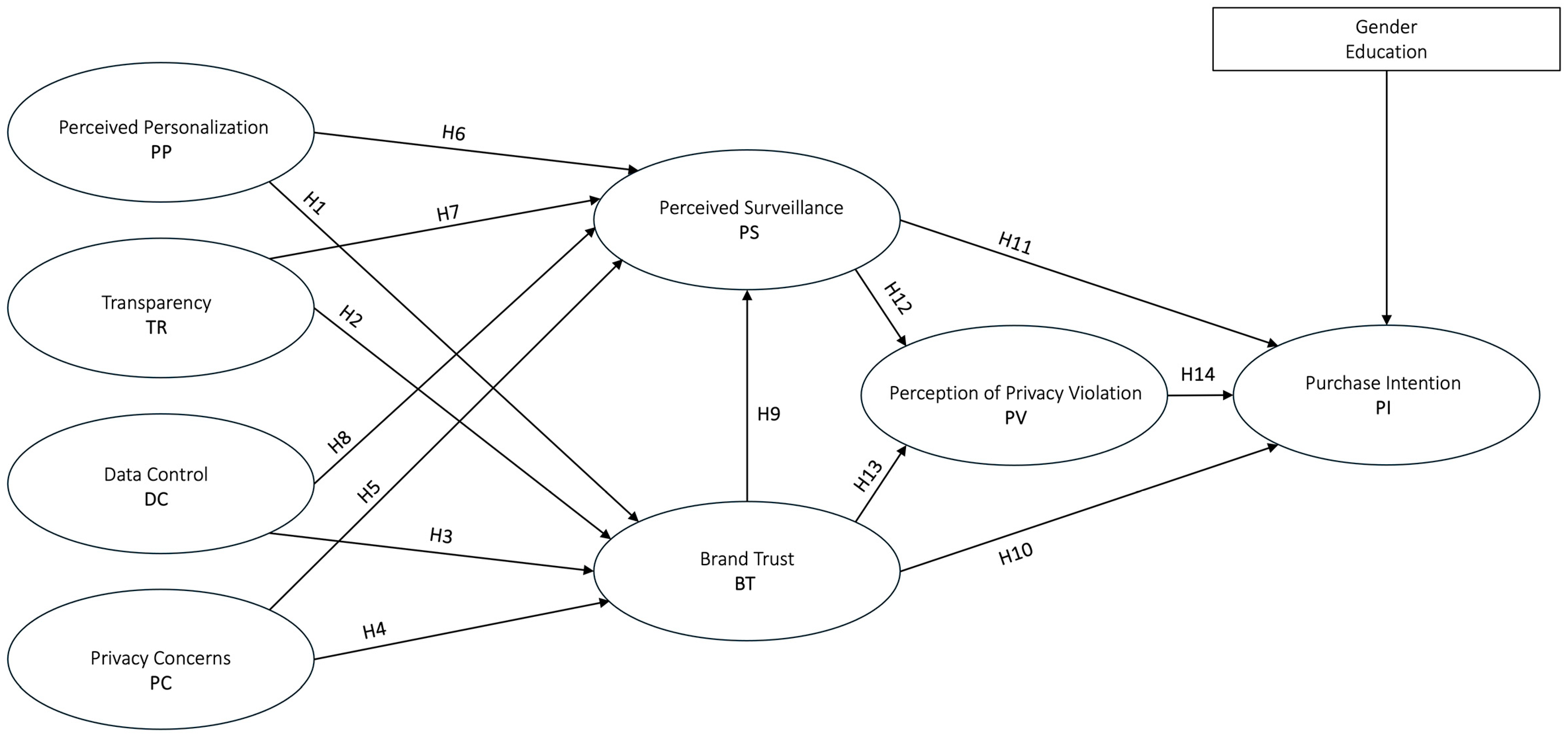
Downstream, Brand Trust and Perceived Surveillance are positioned as intermediate constructs that organize links to affective and behavioral outcomes. In particular, Brand Trust is modeled as being positively associated with Purchase Intention and negatively associated with Perceived Surveillance and Perceived Privacy Violation, whereas Perceived Surveillance is modeled as being positively associated with Perceived Privacy Violation and negatively associated with Purchase Intention. Perceived Privacy Violation is further modeled as being negatively associated with Purchase Intention. In addition, the model specifies direct associations from Perceived Personalization, Transparency, Data Control, and Privacy Concerns to Perceived Surveillance (H5–H8), and from Perceived Personalization, Transparency, and Data Control to Brand Trust (H1–H3). These links are examined as statistical pathways rather than causal effects and are evaluated using PLS-SEM. Figure 2 summarizes the hypothesized associations among constructs in the proposed conceptual model and indicates the direction of each path tested in Section 4.

3. Methods

3.1. Instrument Design and Data Collection

We employed a cross-sectional, online survey. The questionnaire comprised two sections. Section A captured demographics (gender coded 0 = female, 1 = male; age; education coded 0 = basic/secondary, 1 = higher education). Section B included 32 reflective items measuring eight constructs on 7-point Likert scales (1 = “strongly disagree,” 7 = “strongly agree”). Scales were adapted as follows: Perceived Personalization (4 items) from Komiak and Benbasat [24]; Transparency (3 + 1 items) from Martin et al. [26] and Xu et al. [14]; Data Control (4) from Xu et al. [14]; Privacy Concerns (4) from Smith et al. [13]; Brand Trust (4) from Chiu et al. [25]; Perceived Surveillance (4) from Okazaki et al. [29]; Perceived Privacy Violation (4) adapted from Dodds et al. [32]; and Purchase Intention (4) adapted from Bansal and Gefen [34]. Full item wording and descriptive statistics appear in Appendix B (Table A2).
Eligibility required respondents to be at least 18 years old and to have purchased or browsed fashion products online in the previous 12 months. Participation was voluntary and anonymous; respondents indicated informed consent on the first page of the survey. To support content validity and clarity, two independent experts reviewed the English instrument, and minor wording refinements were implemented, followed by a pilot test with 28 students to assess comprehensibility and completion time.
The final questionnaire was distributed via social networks and university channels. Data were collected between 16 November and 7 December 2026. We explicitly label the sampling approach as convenience sampling. To mitigate potential common method variance (CMV), we used several procedural remedies: expert review and pilot testing, randomization of items, and layout separation of independent and dependent variable blocks. We obtained 781 responses; after applying pre-specified exclusion rules—removing incomplete answers, responses indicating random answering (e.g., straight-lining or patterned responding suggesting items were not read), and cases with excessively short completion times—the final sample comprised 664 valid responses. Table A3 in Appendix B summarizes the demographic characteristics of the final sample, including gender, age, education, and online fashion purchase frequency.

3.2. Data Analysis Strategy

Consistent with best-practice recommendations for PLS-SEM [35], we followed a two-stage sequence: (1) assessment of the measurement (outer) model and (2) evaluation of the structural (inner) model. Prior to estimation, data were screened for distributional issues (indicator-level skewness and kurtosis within conventional bounds), and multicollinearity (indicator-level VIF < 5), and responses were verified against the inclusion and quality criteria described in Section 3.1 [36,37]. Structural analyses were conducted in SmartPLS 4 using non-parametric bootstrapping (5000 subsamples) to obtain standard errors for path coefficients (associations) and for specific indirect associations in the mediation analyses [35,38]. Where reported, SRMR is treated as an approximate index in PLS-SEM’s prediction-oriented context, and Stone–Geisser Q2 via PLSPredict is used to gauge predictive relevance of endogenous constructs [35].

3.2.1. Measurement Model Assessment

The measurement model was assessed following the two-step procedure recommended for PLS-SEM [35]. First, the psychometric properties of each reflective scale were examined. All constructs were originally measured with four items each, adapted from validated scales (see Appendix B).
Prior to formal model testing, items with inadequate psychometric properties were identified. Following established guidelines [35], items with standardized factor loadings below 0.40 were considered for removal, provided that content validity could be maintained. This process led to the deletion of three items: DC2 (“I believe I have a significant influence on how this brand uses my data”; loading = 0.31); DC3 (“This brand gives me the option to review and update my personal information”; loading = 0.34); and PS3 (“I feel this brand is competent to make proper use of my data”; loading = 0.36). The removal of DC2 and DC3 was further justified by the fact that both items referred to specific actions (influence, review/update) that may not be equally salient to all consumers, whereas the retained items (DC1: “I feel I have control over the personal information I provide to this brand”; DC4: “Overall, I feel I can manage how my data is used by this brand”) capture the global perception of control. For perceived surveillance, PS3 was removed due to its conceptual ambiguity (competence beliefs are more closely related to trust than to surveillance) and its low loading. After refinement, Data Control was measured with two items (DC1, DC4), and Perceived Surveillance with three items (PS1, PS2, PS4). All remaining items exhibited standardized loadings above 0.68. The refined scales were then validated following standard procedures.
The refined measurement model was then evaluated using confirmatory factor analysis (CFA) to assess unidimensionality, reliability, convergent validity, and discriminant validity. We verified unidimensionality of each reflective scale via single-factor CFA (AMOS) as a diagnostic step, using conventional CB-SEM thresholds (SRMR < 0.08, RMSEA < 0.08, CFI/TLI ≥ 0.95, NFI ≥ 0.90), noting that these indices were applied for scale-level checks rather than as global PLS fit [36,37]. For the PLS measurement model, we examined convergent validity (AVE > 0.50; CR > 0.70) and internal consistency (Cronbach’s α), and we assessed discriminant validity via the Fornell–Larcker criterion and the HTMT ratio with a conservative threshold of HTMT < 0.85 [35,39]. Indicator- and construct-level VIFs were inspected to rule out multicollinearity. Results are reported in Section 4.1.

3.2.2. Structural Model Estimation

The structural model was evaluated using bootstrapped standard errors (5000 subsamples). We report standardized path coefficients as associations, accompanied by p-values [35,38], and we report effect sizes (f2) to evaluate the substantive significance of each relationship, following Cohen’s guidelines [40]. Model quality is summarized with R2 (explanatory power), Q2/PLSPredict (out-of-sample predictive relevance), and SRMR (approximate fit index). Mediation is interpreted as statistical pathways (specific indirect associations) consistent with the integrated theoretical framing, rather than as causal mechanisms [35,38].

3.2.3. Common Method Variance

To mitigate potential common method variance (CMV), we implemented procedural remedies at the design and administration stages: expert review and pilot testing, randomization of items, and layout separation of independent and dependent variable blocks [41]. In addition, we conducted two post hoc statistical diagnostics. First, Harman’s single-factor test was performed by loading all measurement items into an unrotated principal component analysis. The single factor explained 24.0% of the total variance, well below the recommended threshold of 50% [41], indicating that common method bias is not a serious concern.
Second, we examined full collinearity VIFs following the procedure recommended by Kock et al. [42]. All VIF values were below 3.3 (ranging from 1.07 to 2.46), further confirming that common method bias is unlikely to distort the reported associations (Table A2).
Collectively, these procedural remedies and diagnostic checks reduce concern that common method variance materially drives the reported associations.

3.3. Sample and Multi-Group Procedures

The final convenience sample comprised 664 respondents after exclusions reported in Section 3.1. We assessed measurement invariance and group-wise stability using the MICOM procedure (configural, compositional, and equality of means/variances), followed by permutation-based Multi-Group Analysis (MGA) for gender and education [43]. Establishing full or partial compositional invariance permits meaningful comparisons of path coefficients (associations) across subgroups; detailed MICOM statistics and MGA results are reported in Section 4 and the Appendix A and Appendix B.

4. Results

4.1. Measurement Model Assessment

Prior to estimating the structural model, the measurement properties of all constructs were evaluated. For multi-item constructs with three or more indicators, single-construct confirmatory factor analyses (CFAs) were conducted using maximum likelihood estimation with robust standard errors (MLR). For the refined constructs Data Control (DC; 2 items) and Perceived Surveillance (PS; 3 items), a joint CFA was performed, as single-construct models with two or three items are just-identified (df = 0) and do not yield meaningful fit statistics [36,37].
Table 2 presents the fit indices for the single-construct CFAs of Perceived Personalization (PP), Transparency (TR), Privacy Concerns (PC), Brand Trust (BT), Privacy Violation (PV), and Purchase Intention (PI). All models demonstrated acceptable to good fit: CFI values ranged from 0.985 to 0.998, exceeding the 0.95 threshold; RMSEA values ranged from 0.037 to 0.081, with most below 0.06; and SRMR values ranged from 0.022 to 0.040, all below the 0.08 criterion [36,37]. The joint CFA for DC (2 items) and PS (3 items) showed excellent fit: χ2(4) = 6.872, p = 0.143, CFI = 0.998, TLI = 0.994, RMSEA = 0.033 (90% CI [0.000, 0.073]), SRMR = 0.011.
Table 3 summarizes the reliability and validity statistics for all constructs. Composite reliability (CR) exceeded 0.70 for all constructs, while Cronbach’s α values were acceptable: 0.747–0.793 for the six established constructs, 0.872 for PS, and 0.650 for DC, which is considered acceptable in exploratory research [35]. Average variance extracted (AVE) exceeded the 0.50 threshold for all constructs (range: 0.548–0.713), supporting convergent validity [35].
Discriminant validity was assessed using the Fornell–Larcker criterion and the HTMT ratio [35,39]. As shown in Table 3, the square root of AVE for each construct (bolded diagonal) exceeded its correlations with all other constructs. The highest HTMT value was observed between Transparency and Brand Trust (HTMT = 0.894), which remains below the conservative threshold of 0.90 [39], and is theoretically justified given that integrity (transparency) is a direct antecedent of trust [19]. All other HTMT values were below 0.85. Together, these results support the discriminant validity of the constructs.
Global fit and predictive relevance. The model’s SRMR for the estimated PLS-SEM specification was 0.045, within conventional guidelines for approximate model fit. The geodesic discrepancy (d_G) and unweighted least-squares discrepancy (d_ULS) were 0.329 and 0.931, respectively, which are reasonable for a model of this complexity. In terms of out-of-sample prediction, PLSPredict indicated positive cross-validated predictive power (Q2) for all key endogenous constructs: Brand Trust (Q2 = 0.568), Purchase Intention (Q2 = 0.230), Perceived Surveillance (Q2 = 0.121), and Perceived Privacy Violation (Q2 = 0.114). Because all Q2 > 0, the model demonstrates predictive relevance for these constructs (see Table 3).
Together, Table 2 and Table 3 indicate that the reflective measures exhibit adequate reliability and validity, providing a sound basis for evaluating the structural model in Section 4.2, where we report associations (path coefficients) and statistical pathways (indirect associations) consistent with our hypotheses [35].

4.2. Structural Model and Hypotheses: Direct Effects

We estimated the structural model in SmartPLS 4 using non-parametric bootstrapping (5000 subsamples) to obtain inference for all direct and specific indirect paths, in line with recommended PLS-SEM procedures [35]. We report R2 for explanatory power, Stone-Geisser Q2 from PLSPredict (the out-of-sample predictive relevance) and include SRMR as an approximate fit index appropriate for prediction-oriented PLS models [35]. Mediation inferences are based on bias-corrected bootstrapped specific indirect effects [38].
The structural model explained a meaningful proportion of variance in the endogenous constructs: Brand Trust (R2 = 0.578), Perceived Privacy Violation (R2 = 0.408), and Purchase Intention (R2 = 0.329). Perceived Surveillance showed R2 = 0.198 in the final specification. Compared to a model without the Brand Trust → Perceived Surveillance link, the current specification yields higher explained variance for Perceived Surveillance, consistent with the view that trust relates to lower surveillance perceptions; full path estimates and confidence intervals are reported in Table 4.
To assess the substantive significance of each path beyond statistical significance, we examined effect sizes (f2) following Cohen’s [40] guidelines: f2 ≥ 0.02 indicates a small effect, f2 ≥ 0.15 a medium effect, and f2 ≥ 0.35 a large effect. As shown in Table 4, the largest effect was observed for PS → PV (f2 = 0.369, large), indicating that perceived surveillance has a strong substantive association with privacy violation perceptions. BT → PI (f2 = 0.292) approached the large threshold, underscoring the central role of brand trust in shaping purchase intention. TR → BT (f2 = 0.269, medium) and PP → BT (f2 = 0.111, small to medium) also demonstrated meaningful effects. The effects of BT → PV (f2 = 0.128) and PC → PS (f2 = 0.086) were small to medium. Paths that were non-significant (H4, H7, H11) showed negligible f2 values (≤0.003), consistent with their lack of statistical significance. These effect size estimates complement the significance tests and indicate that the meaningful relationships in the model are not merely artifacts of a large sample size.
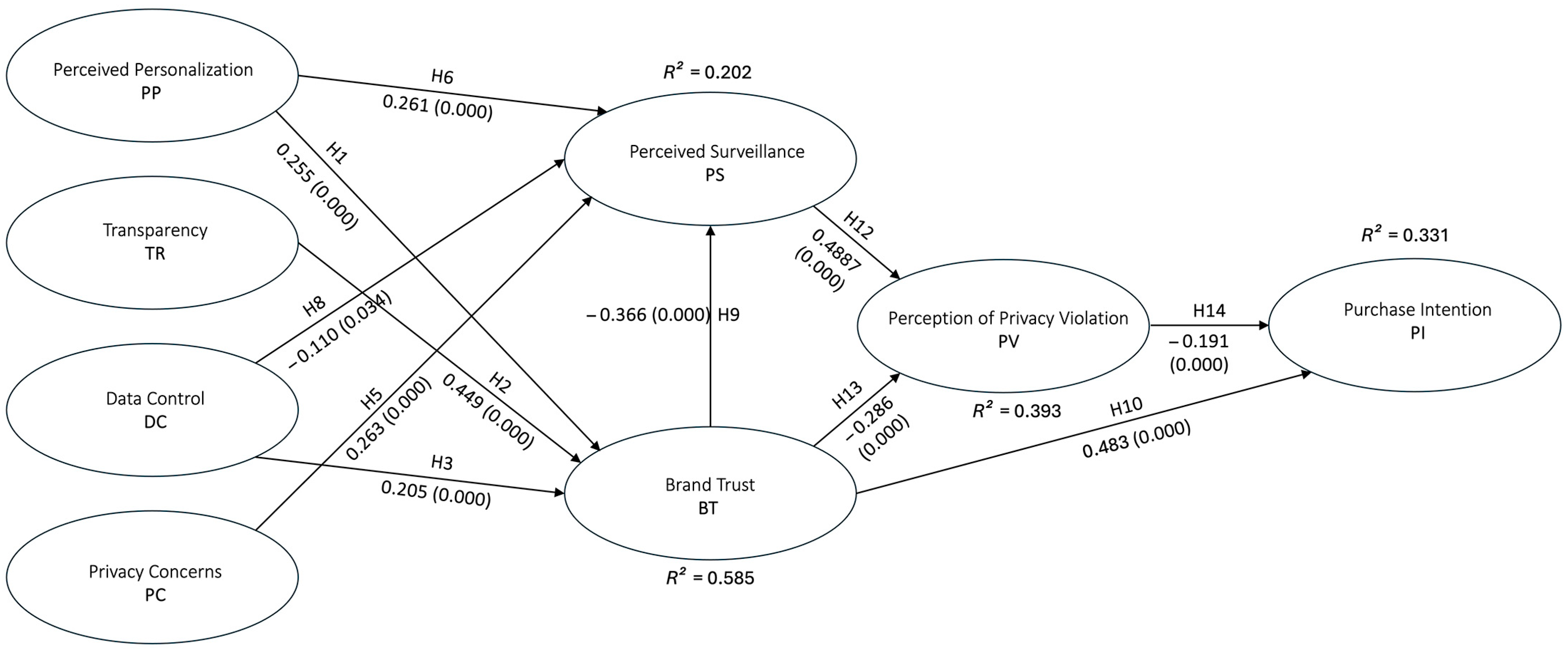
To provide a comprehensive overview of the validated relationships, Figure 3 depicts the final structural model with standardized path coefficients (β) for significant paths (p < 0.05) and the coefficient of determination for endogenous constructs. Non-significant paths are omitted for clarity.
The hypothesized positive drivers of Brand Trust were all strongly supported. Perceived Personalization (PP → BT: β = 0.255, p < 0.001), Transparency (TR → BT: β = 0.449, p < 0.001), and Data Control (DC → BT: β = 0.205, p < 0.001) showed significant positive associations, supporting H1, H2, and H3. This validates that competence (PP), integrity (TR), and benevolence (DC) are foundational to building trust in a data-driven context. Contrary to H4, general Privacy Concerns (PC) did not show a significant association with Brand Trust (PC → BT: β = −0.002, p = 0.952).
The model reveals a more nuanced picture of what influences feelings of surveillance. Supporting H5, Privacy Concerns were positively associated with Perceived Surveillance (PC → PS: β = 0.263, p < 0.001). Contrary to H6, Perceived Personalization was positively associated with Perceived Surveillance (PP → PS: β = 0.261, p < 0.001), aligning with the paradox that visible tailoring may co-occur with stronger surveillance perceptions. The new path in H9 was supported: Brand Trust was negatively associated with Perceived Surveillance (BT → PS: β = −0.366, p < 0.001). Data Control was negatively associated with PS (DC → PS: β = −0.110, p = 0.034; H8 supported). The direct link from Transparency (TR → PS: β = 0.001, p = 0.992; H7 not supported) to PS was not significant, suggesting that transparency may relate to surveillance primarily indirectly via Brand Trust rather than through direct paths.
Brand Trust was positively associated with Purchase Intention (BT → PI: β = 0.483, p < 0.001), supporting H10. The direct association between Perceived Surveillance and Purchase Intention was not significant (PS → PI: β = 0.040, p = 0.254). For Perceived Privacy Violation (PV), the pathway was robust: Perceived Surveillance was positively associated with PV (PS → PV: β = 0.488, p < 0.001; H12 supported), and Brand Trust was negatively associated with PV (BT → PV: β = −0.286, p < 0.001; H13 supported). Finally, PV was negatively associated with Purchase Intention (PV → PI: β = −0.191, p < 0.001), fully supporting H14.

4.3. Mediation Analysis

Mediation was tested using bootstrapped specific indirect effects (5000 subsamples) to obtain bias-corrected confidence intervals and significance tests, an approach widely recommended for indirect-effect inference in PLS-SEM [35,38]. We report specific (not only total) indirect effects to isolate mechanisms (e.g., PS → PV → PI). Table 5 presents the key specific indirect pathways and total associations.
The results indicate several statistically meaningful pathways of association that organize the relationships among the constructs. The association between Perceived Surveillance and Purchase Intention operates primarily through Perceived Privacy Violation (PV). The specific indirect pathway PS → PV → PI is negative and significant (β = −0.093, p < 0.001), whereas the total PS–PI association is not significant (β = −0.053, p = 0.080). Brand Trust shows a strong total association with PI (β = 0.557, p < 0.001). This relationship is transmitted through two routes. The BT → PV → PI pathway is positive and significant (β = 0.055, p < 0.001), suggesting that higher trust is associated with lower violation perceptions, which in turn are associated with higher purchase intention. The BT → PS → PI pathway is not significant (β = −0.015, p = 0.284), reinforcing that trust influences purchase intention primarily through affective (violation) rather than cognitive (surveillance) appraisals.
Transparency (shows a substantial total association with PI (β = 0.250, p < 0.001) that is largely transmitted through BT. The specific indirect TR → BT → PI pathway is significant (β = 0.217, p < 0.001). Importantly, TR is not directly associated with lower PS (direct TR → PS: β = 0.001, p = 0.992; see Table 4). Rather, TR is linked to higher BT, which in turn is negatively associated with PS (TR → BT → PS: β = −0.165, p < 0.001). This trust-mediated reduction in PS further cascades through PV to PI (TR → BT → PS → PV → PI: β = 0.015, p < 0.001), illustrating a multi-step indirect pathway from transparency to purchase intention.
Data Control exhibits a positive total association with PI (β = 0.120, p < 0.001) and a positive indirect association via BT (DC → BT → PI: β = 0.099, p < 0.001). Additionally, DC is negatively associated with PS through BT (DC → BT → PS: β = −0.075, p < 0.001).
Perceived Personalization exhibits a dual pattern that reflects the personalization–privacy paradox. The total association between PP and PI is positive (β = 0.129, p < 0.001). On the one hand, PP is positively associated with PI via BT (PP → BT → PI: β = 0.123, p < 0.001) and, through BT, is negatively associated with PS (PP → BT → PS: β = −0.093, p < 0.001). On the other hand, PP shows a countervailing indirect negative association with PI through the sequence PP → PS → PV → PI (β = −0.024, p = 0.001). This dual pattern indicates that personalization simultaneously supports trust and purchase intention while also triggering surveillance and violation appraisals that partially offset those benefits.
Privacy Concerns show a small indirect negative association with PI through the sequence PC → PS → PV → PI (β = −0.025, p < 0.001), indicating that consumers with higher privacy concerns are more likely to perceive surveillance, which in turn increases violation appraisals and ultimately reduces purchase intention. The total association between PC and PI was non-significant (β = −0.015, p = 0.417).
Taken together, these statistical pathways are consistent with the integrated theoretical account in which Brand Trust and Perceived Privacy Violation serve as central associational conduits linking personalization, transparency, and control with downstream purchase-related responses, while also clarifying how surveillance-related perceptions align with lower purchase intention. Having established the pattern of associations at the aggregate level, we next examine whether these relationships vary across respondent subgroups using measurement-invariance testing and permutation-based multi-group comparisons.

4.4. Multi-Group Analysis

To evaluate subgroup stability, we implemented the MICOM procedure (configural, compositional, equality of means/variances) prior to permutation-based MGA comparisons, following Henseler et al. [43]; establishing full or partial compositional invariance permits meaningful cross-group tests of path differences.

4.4.1. Assessing Gender Invariance

The first analysis was conducted with 5000 permutations, comparing female (n = 451) and male (n = 213) respondents. Step 1 (configural invariance) was established by applying the same model specification and algorithm settings to both groups, indicating that the same constructs and relationships are relevant in each subgroup.
Step 2 (compositional invariance) tested whether composites are formed similarly across groups by comparing the original correlations between composite scores to their permutation distributions. As shown in Table 6, the original correlations were all ≥ 0.973 and not significantly different from the permutation-based values (all p > 0.05). This supports compositional invariance, confirming that the composites are formed similarly across gender groups.
Step 3 (equality of means/variances) examined composite means (Step 3a) and variances (Step 3b). Several mean differences emerged: Brand Trust (BT), Data Control (DC), Purchase Intention (PI), and Transparency (TR) differed significantly across gender (permutation p < 0.05). Descriptively, women reported higher mean levels of BT, PI, PV, and TR, whereas men reported higher mean DC. For variances, only Perceived Surveillance differed significantly between groups (p = 0.033). These mean/variance differences justify proceeding to multi-group comparisons of path coefficients to assess whether the strength of the associations differs beyond level differences.
The key moderated paths reveal meaningful gender differences (Table 7). First, the PP → BT association is stronger for men (β_male = 0.441) than for women (β_female = 0.217, p = 0.003), suggesting that perceived personalization is a more powerful trust cue among male respondents. Second, the TR → BT association is stronger for women (β_female = 0.507) than for men (β_male = 0.292, p = 0.009), indicating that clear, open data practices relate more strongly to women’s trust. Third, the indirect effect of transparency on purchase intention via brand trust (TR → BT → PI) is stronger for women (β_female = 0.245) than for men (β_male = 0.143, p = 0.043), consistent with the moderated TR → BT pathway. Similarly, the indirect effect of personalization on purchase intention via brand trust (PP → BT → PI) is stronger for men (β_male = 0.216) than for women (β_female = 0.105, p = 0.018).
The direct path from perceived surveillance to purchase intention (PS → PI) showed a small positive association for women (β_female = 0.085) and a small negative (non-significant) association for men (β_male = −0.066, p = 0.038). However, given the small magnitude and the non-significant total effect for the full sample, this difference should be interpreted with caution.
Taken together, the MICOM procedure supports that the model is largely invariant across gender, enabling meaningful group comparisons. While mean levels differ on several constructs, the structural pattern of associations is predominantly stable. Managerially, the moderated paths imply nuanced segmentation: transparency-related practices appear especially consequential for women in building trust, whereas personalization functions as a stronger trust cue for men.

4.4.2. Assessing Education Level Invariance

We re-estimated MICOM to test whether the model’s composites are invariant across the Education subgroups, following the three-step procedure with 5000 permutations. The sample comprised n = 243 respondents with basic/secondary education and n = 421 respondents with higher education. Configural invariance was satisfied because the same model structure, indicators, and data treatment were used across groups.
For compositional invariance, we compared the original composite correlations with their permutation distributions. The permutation tests showed no significant differences for any construct (all p > 0.05), supporting full compositional invariance and indicating that the composites are formed similarly across education subgroups (Table 8).
For mean equality (Step 3a), the permutation test indicated significant differences for Data Control (DC, p = 0.018) and Perceived Personalization (PP, p < 0.001). Descriptively, respondents with higher education reported higher mean levels of DC and PP compared to those with basic/secondary education. All other constructs showed non-significant mean differences (p > 0.05). For variance equality (Step 3b), no significant differences were detected for any construct (all p > 0.05), indicating variance invariance across education levels.
Following MICOM, we compared path coefficients and specific indirect associations across education subgroups using permutation-based MGA (5000 permutations). As shown in Table 9, several links differed significantly between basic/secondary and higher education groups.
The key moderated paths reveal meaningful education differences. First, the BT → PV association is significantly stronger (more negative) for respondents with higher education (β = −0.408) compared to those with basic/secondary education (β = −0.116, p < 0.001). This suggests that brand trust plays a more powerful role in reducing privacy violation perceptions among more educated consumers.
Second, the PS → PV association is stronger for respondents with basic/secondary education (β = 0.575) than for those with higher education (β = 0.417, p = 0.036), indicating that perceived surveillance translates more strongly into privacy violation perceptions among less educated consumers.
Third, several indirect pathways involving DC → PV, TR → PV, and PP → PV through BT show stronger associations for the higher education group. Specifically, the negative indirect effects of data control, transparency, and personalization on privacy violation (via brand trust) are more pronounced among consumers with higher education. This pattern suggests that the buffering role of brand trust in mitigating violation perceptions is more salient for more educated consumers.
Overall, the measurement model is largely invariant across education (configural and compositional invariance established, with mean non-invariance only for DC and PP). At the structural level, selected relationships—particularly those involving brand trust, perceived surveillance, and privacy violation—differ across education subgroups. These differences suggest that education may condition how data-related cues are associated with trust and violation appraisals. However, given the exploratory nature of these segment-level comparisons, results should be interpreted with caution and require replication in future studies.

5. Discussion

The digital fashion marketplace sits at the intersection of personalization, identity expression, and pervasive datafication. This study examined how consumers navigate this duality by estimating an integrated model in which value-enhancing cues (perceived personalization, transparency, and data control) and privacy-related concerns (privacy concerns, perceived surveillance, and perceived privacy violation) are statistically associated with brand trust and purchase intention. Using a cross-sectional survey of 664 digital fashion consumers and PLS-SEM, the results offer a nuanced account of the personalization-privacy paradox and position brand trust as a central relational pathway through which consumers interpret data-intensive practices. Consistent with the association-based framing of the study, all reported relationships are statistical associations and should not be interpreted as causal effects.

5.1. Trust Antecedents in Data-Intensive Fashion Commerce

Consistent with the Antecedents of Trust Model [19], Perceived Personalization, Transparency, and Data Control were positively associated with Brand Trust (H1–H3 supported). These associations validate that ability (personalization), integrity (transparency), and benevolence (data control) are foundational trust cues in data-driven fashion e-commerce. The relatively strong association of transparency with trust (β = 0.449, f2 = 0.269) underscores the importance of clear data practices in an environment where consumers are increasingly sensitive to opaque tracking [13,16]. In contrast, general Privacy Concerns showed no significant association with Brand Trust (H4 not supported). This null finding aligns with prior research suggesting that privacy concerns may remain dormant until activated by specific cues [15], and that institutional assurances (transparency, control) can override general privacy worries [3,14].

5.2. The Personalization–Surveillance Paradox: A Deeper Theoretical Interpretation

A notable finding concerns the relationship between personalization and surveillance. Contrary to early value-offset theories that predicted a negative association [1,28], Perceived Personalization was positively associated with Perceived Surveillance (H6 supported, but in the opposite direction originally hypothesized). This result requires careful theoretical interpretation.
Why would personalization increase, rather than decrease, surveillance perceptions? We propose two complementary explanations. First, from a visibility logic grounded in Surveillance Capitalism [12], highly tailored recommendations make data collection visible. When a fashion brand accurately recommends a product that aligns with a consumer’s unstated preference, the consumer may infer, “If the brand knows me this well, they must be tracking me closely.” Personalization thus serves as a signal of data collection, not just a signal of competence. Second, from a psychological reactance perspective [20], consumers may perceive that the brand has access to intimate information (e.g., body size, style preferences, browsing history), triggering discomfort about the extent of profiling. In fashion e-commerce, where personalization relies on such intimate signals [8,9], this effect may be particularly pronounced.
Importantly, however, personalization also demonstrated a positive indirect association with purchase intention through brand trust (PP → BT → PI: β = 0.123). The net positive total association of personalization with purchase intention (β = 0.129) suggests that, on balance, the trust-enhancing pathway outweighs the surveillance-triggering pathway in this sample. This dual pattern—personalization simultaneously associated with higher trust (through ability cues) and higher surveillance (through visibility cues)—captures the essence of the personalization-privacy paradox as a multi-layered statistical association, not a simple trade-off.

5.3. Transparency and Data Control: Direct vs. Indirect Pathways

The results clarify how transparency and data control relate to surveillance perceptions. Transparency was not directly associated with lower perceived surveillance (H7 not supported; β = 0.000, p = 0.992). Rather, its association with lower surveillance was fully mediated by brand trust (TR → BT → PS: β = −0.165). This pattern suggests that transparent data practices alone may be insufficient to alleviate surveillance concerns; consumers must first trust the brand for transparency to be interpreted as a signal of integrity. Statistically, this is a case of full mediation; theoretically, it implies that transparency operates through relational mechanisms (trust) rather than through direct informational reassurance.
In contrast, Data Control was directly and negatively associated with perceived surveillance (H8 supported: β = −0.110, p = 0.034). This direct association aligns with Self-Determination Theory [20]: when consumers perceive they can manage their data (e.g., through consent tools, deletion options, privacy dashboards), their sense of autonomy is restored, directly associated with reduced feelings of being passively monitored. The effect size for DC → PS was small (f2 = 0.011), but significant after measurement refinement. This finding suggests that control mechanisms, unlike transparency, may operate independently of trust to mitigate surveillance perceptions.

5.4. The Central Role of Privacy Violation: Statistical Mediation vs. Theoretical Mechanism

A key insight concerns the pathway from surveillance to purchase intention. The direct association between Perceived Surveillance and Purchase Intention was not significant (H11 not supported; β = 0.040, p = 0.254). This non-significant direct association should not be interpreted as “surveillance has no effect.” Rather, the data indicate that the association between surveillance and purchase intention is fully mediated by perceived privacy violation.
Specifically, Perceived Surveillance was strongly associated with Perceived Privacy Violation (H12 supported: β = 0.488, f2 = 0.369, a large effect); Perceived Privacy Violation was negatively associated with Purchase Intention (H14 supported: β = −0.191, f2 = 0.034); the indirect pathway PS → PV → PI was negative and significant (β = −0.093, p < 0.001); and the direct PS–PI path, controlling for PV, was non-significant.
Statistically, this pattern is consistent with full mediation. Theoretically, it implies that the psychological mechanism linking surveillance to behavioral withdrawal is not the awareness of being watched per se, but the emotional appraisal that the brand has committed a relational transgression. Consistent with Psychological Contract Breach Theory [21], consumers may tolerate some level of monitoring as a normal feature of digital commerce. However, when that monitoring is interpreted as excessive, unfair, or covert—i.e., as a violation of implicit privacy expectations—they withdraw from the relationship.
This finding addresses a theoretical ambiguity in prior literature. Many studies have posited a direct negative effect of surveillance on behavioral intentions without specifying the mediating mechanism [1,27]. By demonstrating that violation is the critical mediator, the study emphasizes the emotional and relational dimensions of privacy evaluations—dimensions often underrepresented in purely cognitive accounts [15,33]. The distinction between statistical mediation (what the data show) and theoretical mechanism (why it happens) is crucial here: the data indicate that PV carries the indirect effect; theory suggests that violation appraisals are the psychological trigger for withdrawal.

5.5. Segment-Level Variations: Gender and Education

The multi-group analyses (MGA) add boundary-condition nuance. For gender, perceived personalization was more strongly associated with trust for men (PP → BT: β_male = 0.441 vs. β_female = 0.217, p = 0.003), whereas transparency was more strongly associated with trust for women (TR → BT: β_female = 0.507 vs. β_male = 0.292, p = 0.009). These differences suggest that men may respond more to competence signals (personalization as ability), while women may place greater weight on integrity signals (transparency as honesty). The indirect associations of transparency with purchase intention (TR → PI) and with privacy violation (TR → PV) were also stronger for women, consistent with the moderated TR → BT pathway.
For education, brand trust played a more powerful role in reducing privacy violation perceptions among higher-educated consumers (BT → PV: β_higher = −0.408 vs. β_basic = −0.116, p < 0.001). Conversely, the direct association from surveillance to violation was stronger for consumers with basic/secondary education (PS → PV: β_basic = 0.575 vs. β_higher = 0.417, p = 0.036). These patterns suggest that more educated consumers may rely more heavily on trust-based heuristics to interpret data practices, whereas less educated consumers may react more directly to surveillance cues. However, given the exploratory nature of these segment-level comparisons, results should be interpreted with caution and require replication in future studies.
Three theoretical insights emerge. First, the personalization-privacy paradox is not a simple trade-off but a multi-layered process in which personalization is simultaneously associated with higher trust (through ability cues) and higher surveillance (through visibility cues). Second, transparency reduces surveillance perceptions only indirectly through brand trust, whereas data control operates directly, suggesting different psychological mechanisms. Third, and most importantly, surveillance is associated with lower purchase intention only through privacy violation (full mediation). This finding clarifies that the emotional appraisal of violation, not the cognitive awareness of monitoring, is the proximal antecedent of behavioral withdrawal.

6. Conclusions

6.1. Key Findings

This study offers a comprehensive account of how consumers in digital fashion retail navigate the tension between personalization and surveillance. Using survey data from 664 respondents and a PLS-SEM approach, five central insights emerge.
First, personalization exhibits a dual character. Perceived Personalization is positively associated with Brand Trust (H1 supported) while also being positively associated with Perceived Surveillance (H6 supported, opposite to early theoretical expectations). This dual pattern—personalization simultaneously signaling competence (building trust) and visibility (triggering surveillance)—captures the essence of the personalization-privacy paradox as a multi-layered statistical association, not a simple trade-off.
Second, Brand Trust operates as a central relational pathway. It is positively associated with cues linked to ability, integrity, and benevolence—operationalized as personalization, transparency, and data control (H1–H3 supported)—and negatively associated with both Perceived Surveillance (H9 supported) and Perceived Privacy Violation (H13 supported). Trust thus organizes how consumers interpret data practices across both cognitive (surveillance) and affective (violation) appraisals.
Third, the relationship between surveillance and purchase intention appears to function primarily through perceived violation. The direct association between Perceived Surveillance and Purchase Intention was not significant (H11 not supported). However, Perceived Surveillance was strongly associated with Perceived Privacy Violation (H12 supported), which in turn was negatively associated with Purchase Intention (H14 supported), yielding a significant negative indirect association (PS → PV → PI: β = −0.093, p < 0.001). This full mediation pattern indicates that surveillance relates to lower purchase intention only when it is interpreted as a relational transgression.
Fourth, transparency and data control operate through different mechanisms. Transparency was not directly associated with lower surveillance (H7 not supported); rather, its association was fully mediated by brand trust (TR → BT → PS: β = −0.165). In contrast, data control was directly and negatively associated with perceived surveillance (H8 supported: β = −0.110), suggesting that autonomy-restoring features can mitigate surveillance concerns even before full trust is established.
Fifth, multi-group analyses indicate meaningful differences across gender and education. For gender, personalization was a stronger trust cue for men, whereas transparency was a stronger trust cue for women. For education, brand trust played a more powerful role in reducing violation perceptions among higher-educated consumers, while the direct surveillance–violation link was stronger for those with basic/secondary education. These segment-level differences suggest that personalization and trust-building practices are not uniform across consumer groups.

6.2. Theoretical Contributions

Theoretically, this research contributes in four ways. First, it provides a multi-level theoretical integration that moves beyond compilation toward synthesis. By organizing five complementary perspectives (Social Exchange Theory, the Antecedents of Trust Model, Surveillance Capitalism, Self-Determination Theory, and Psychological Contract Breach Theory) into macro, meso, and micro levels, the study offers a coherent framework for examining how consumers interpret data-driven personalization. Unlike prior work that often examines isolated links, this framework positions brand trust and perceived privacy violation as central relational and emotional pathways within a single empirical model.
Second, the findings resolve a theoretical ambiguity regarding the personalization-surveillance relationship. Early value-offset theories predicted a negative association (personalization benefits offset surveillance costs). The positive association observed in this study supports an alternative visibility logic: highly tailored recommendations make data collection visible, signaling extensive profiling. This reframing has implications for how researchers conceptualize the paradox, not as a trade-off between value and risk, but as a dual process in which personalization simultaneously triggers trust and surveillance through different mechanisms.
Third, the study clarifies the psychological mechanism linking surveillance to behavioral outcomes. By demonstrating that surveillance is associated with lower purchase intention only through perceived privacy violation (full mediation), the research moves beyond the common assumption of a direct negative effect. This finding distinguishes between statistical mediation (what the data show) and theoretical mechanism (why it happens): consumers may tolerate monitoring as a normal feature of digital commerce, but when that monitoring is interpreted as excessive, unfair, or covert—i.e., as a violation of implicit privacy expectations—they withdraw from the relationship. This emotional and relational dimension of privacy evaluations has been underrepresented in purely cognitive accounts.
Fourth, by applying this integrated model to fashion e-commerce, the study extends privacy and personalization research into a context where personalization is especially symbolic and identity-laden. Fashion products carry emotional and self-expressive significance, making consumers particularly sensitive to how their preference data are used. The finding that surveillance translates into violation (and subsequently into lower purchase intention) may be amplified in such contexts, highlighting boundary conditions for future research.

6.3. Practical Implications

For fashion e-commerce managers, the findings underscore the importance of designing personalization ecosystems that actively cultivate trust. Personalization on its own may not be sufficient to generate positive responses and may even coincide with heightened surveillance perceptions. Embedding personalized experiences within clear, accessible, and consumer-centric data practices is therefore essential.
Transparency and data control require different strategies. Transparency (clarifying what data are collected and why) reduces surveillance perceptions only indirectly through brand trust. This implies that transparency initiatives, such as privacy policies, data use explanations, and consent notices, are most effective when consumers already trust the brand, or when they are introduced alongside trust-building measures. In contrast, data control (providing meaningful options for managing data flows) operates directly on surveillance perceptions, suggesting that control features (e.g., privacy dashboards, consent management tools, data deletion options) may be valuable as immediate interventions to reduce surveillance concerns, even before full trust is established.
Another implication is that one should monitor violation, not just surveillance. The mediation findings offer a diagnostic insight. Managers often track whether consumers feel “watched” (surveillance). However, the data indicate that surveillance only reduces purchase intention when it is interpreted as a violation. Interventions that reduce surveillance perceptions (e.g., explaining why data are collected) may be insufficient if consumers still perceive a relational transgression (e.g., “This feels unfair” or “The brand has betrayed my trust”). Proactive monitoring of violation signals (through customer feedback, sentiment analysis, or privacy-related complaints) may provide earlier warning of behavioral withdrawal.
Finally, the multi-group results suggest that personalization and trust-building practices are not one-size-fits-all. Managers may consider tailoring their emphasis on competence (personalization) versus integrity (transparency) by gender: personalization appears to be a stronger trust cue for men, while transparency resonates more strongly with women. For education, trust-based buffers may be more effective for higher-educated consumers, whereas simpler, more direct privacy assurances may be needed for consumers with basic or secondary education. However, given the exploratory nature of these segment-level findings, they should be tested further before large-scale implementation.

6.4. Limitations

Several limitations should be considered when interpreting these findings. First, the cross-sectional design does not allow for conclusions about temporal dynamics or causality. The associations observed here cannot determine how trust, surveillance perceptions, or violation appraisals might evolve over time, nor can they establish the direction of causality. The term “association-based” is used deliberately throughout the manuscript to reflect this limitation.
Second, the study relies on a convenience sample of fashion consumers from a specific cultural context (Portugal). Although the sample is well-powered (n = 664), generalizability to other populations, markets, or cultural settings may be limited. Privacy attitudes and surveillance perceptions vary across cultures, and the findings may not translate directly to countries with different regulatory environments (e.g., less stringent privacy protections than GDPR) or different cultural values regarding data sharing.
Third, common method bias (CMV) may be a concern given the use of self-reported survey data. Although procedural remedies were implemented (expert review, item randomization, layout separation of independent and dependent variable blocks), and diagnostic checks (indicator-level VIFs, discriminant validity patterns) did not indicate severe CMV, the possibility of consistency motifs, social desirability, or momentary response states cannot be entirely ruled out.
Fourth, the study examines general perceptions of digital fashion brands rather than responses to a specific platform, interface, or real-world personalization experience. This reduces ecological realism and may not capture how consumers react to specific design features (e.g., real-time recommendations, location-based offers, or social commerce integrations).
Fifth, the Data Control construct was measured with only two items (DC1 and DC4) after removing weak indicators (DC2, DC3). While this improved statistical reliability, two-item constructs have limitations in content coverage. Future research should develop and validate a more comprehensive measure of perceived data control in fashion e-commerce contexts.
Finally, the model does not incorporate broader contextual moderators, such as regulatory awareness (e.g., GDPR knowledge), platform type (mobile vs. desktop), privacy literacy, or familiarity with AI personalization, that may influence how consumers interpret data practices and form trust-related judgments. Additionally, the segment-level findings for gender and education are exploratory and require replication before firm conclusions can be drawn.

6.5. Future Research

Future work would benefit from longitudinal, or panel designs to observe how brand trust, surveillance perceptions, and violation appraisals evolve with sustained exposure to personalization systems or shifts in regulatory interpretation (e.g., developments in GDPR guidance). Experimental designs could isolate the influence of specific interface features, such as explainable-AI recommendations, transparency dashboards, and granular opt-in/opt-out flows, to examine how these design elements are associated with surveillance and trust signals in situ.
Qualitative approaches (e.g., interviews, diaries, or ethnography) may further illuminate the lived experience of surveillance and perceived violation in symbolic consumption settings like fashion, helping to surface meanings that are not readily captured by surveys. For example, what does “violation” feel like to consumers? How do they articulate the difference between acceptable monitoring and unacceptable intrusion?
Comparative or cross-cultural research would enrich understanding of how cultural values, digital/privacy literacy, and regulatory environments shape the personalization-privacy dynamic. Extending the integrated framework to adjacent experience-centric sectors (e.g., beauty, travel, luxury, or social commerce) would help assess generalizability and reveal sector-specific boundary conditions—for instance, whether the personalization → surveillance → violation → purchase pathway is similarly patterned when product involvement, conspicuousness, or platform norms differ.
Finally, combining survey-based models with behavioral field data or A/B test evidence (when accessible) could triangulate association patterns and provide a richer view of how trust-oriented design choices correspond with downstream engagement. Replication of the segment-level findings (gender and education) in larger, more diverse samples is also recommended before drawing strong managerial conclusions.

Author Contributions

Conceptualization, J.M. and S.R.; methodology, J.M. and S.R.; formal analysis J.M. and S.R.; writing—original draft preparation, J.M. and S.R.; writing—review and editing, J.M. and S.R.; funding acquisition, J.M. All authors have read and agreed to the published version of the manuscript.

Funding

This research received no external funding.

Institutional Review Board Statement

The study was conducted in accordance with the Declaration of Helsinki and approved by the Ethics Committee of CICEE-UAL (CE10202502, 31 October 2025).

Informed Consent Statement

Informed consent was obtained from all subjects involved in the study.

Data Availability Statement

The data presented in this study are openly available in OSF at https://osf.io/k2x8d/overview?view_only=e98f1221edbb438cb239f00a148ebe0e (accessed on 27 April 2026).

Conflicts of Interest

The authors declare no conflicts of interest.

Appendix A

Table A1. Summary of Research Hypotheses and Their Theoretical Framework.
HypothesisDescriptionSignalUnderlying TheoriesTheoretical InterpretationEmpirical
Support
H1Perceived Personalization → Brand Trust(+)Trust Antecedents ModelPersonalization demonstrates the brand’s ability, fundamental prerequisite for building trust.[24,29]
H2Transparency → Brand Trust(+)Trust Antecedents ModelTransparency signals integrity and honesty, reducing information asymmetry and building trust.[3,14,16]
H3Data Controls → Brand Trust(+)Trust Antecedents ModelGiving control to consumers is an act of benevolence, demonstrating that the brand respects their autonomy and is not opportunistic.[14,16,27]
H4Privacy Concerns → Brand Trust(−)Social Exchange TheoryPrivacy Concerns represent perceived risks in the data exchange. According to Social Exchange Theory, higher perceived risks undermine willingness to be vulnerable, thereby weakening Brand Trust.Mixed: negative [13,27]; null [3,14]
H5Privacy Concerns → Perceived Surveillance(+)Surveillance CapitalismIndividuals with a high predisposition for privacy are more sensitive and vigilant, more easily interpreting data collection practices as surveillance.[1,27,29]
H6Perceived Personalization → Perceived Surveillance(+)Social Exchange Theory; Personalization-Privacy ParadoxHighly tailored recommendations make data collection visible, signaling extensive profiling (positive association).Early: negative [1,28]; recent: positive [3,27,29]
H7Transparency → Perceived Surveillance(−)Surveillance CapitalismTransparency reduces informational uncertainty, counteracting the hidden, opaque monitoring associated with surveillance.[3,16,29]
H8Data Control → Perceived Surveillance(−)Surveillance Capitalism; Self-Determination TheoryControl restores consumer autonomy and agency, actively counteracting the unilateral logic of data extraction that defines surveillance.[14,16,27]
H9Brand Trust → Perceived Surveillance(−)Trust Antecedents Model; Social Exchange TheoryTrust acts as a psychological antidote. If consumers trust the brand, they are less likely to interpret its actions as intrusive surveillance.[1,27,29]
H10Brand Trust → Purchase Intention(+)Social Exchange TheoryTrust reduces perceived risk in the transaction, making consumers more likely to complete the exchange.[27,29,30]
H11Perceived Surveillance → Purchase Intention(−)Social Exchange Theory; Surveillance CapitalismThe feeling of being watched is a psychological and ethical cost that can negate the benefits of personalization, leading to brand rejection.Indirect via PV [21,33]
H12Perceived Surveillance → PVT(+)Psychological Contract Breach Theory; Surveillance CapitalismThe feeling of being watched is interpreted as a breach of the psychological contract and a transgression of privacy boundaries, creating a perception of violation.[21,32,33]
H13Brand Trust → Perception of Privacy Violation(−)Psychological Contract Breach Theory; Trust Antecedents ModelTrust acts as a relational buffer. Even in the face of potentially intrusive practices, trust prevents them from being interpreted as a serious violation.[3,29,33]
H14Perception of Privacy Violation→ Purchase Intention(−)Psychological Contract Breach TheoryThe perception of violation generates intense negative feelings (e.g., anger, betrayal) that directly lead to brand rejection and decreased purchase intent.[21,32,33]

Appendix B

Table A2. Item-Level Descriptive Statistics, Normality, and Collinearity Diagnostics.
ItemItem DescriptionMSDSkKrVIF
PP1The brand provides me with recommendations that suit my tastes.5.481.240−1.1501.3101.89
PP2The brand tailors its content or offers based on my needs.4.941.350−0.575−0.0011.41
PP3The brand makes me feel it understands me.4.931.290−0.4050.1051.40
PP4Overall, the experience I have with this brand is personalized.4.951.360−0.7010.2271.73
TR1This brand provides me with clear information about how my personal data is used.4.681.470−0.493−0.4201.34
TR2This brand explains in an understandable way what happens to my data after I provide it.4.771.420−0.503−0.1221.12
TR3This brand is transparent about who has access to my data.4.491.540−0.430−0.3591.36
TR4I feel informed about this brand’s data use practices4.831.450−0.652−0.2322.20
DC1I feel I have control over the personal information I provide to this brand.4.701.420−0.463−0.2752.07
DC2I believe I have a significant influence on how this brand uses my data.4.151.510−0.294−0.5601.07
DC3This brand gives me the option to review and update my personal information.5.191.400−0.9010.5241.36
DC4Overall, I feel I can manage how my data is used by this brand.4.621.380−0.480−0.1481.88
PC1I am concerned that brands collect too much personal information about me.5.391.440−0.9470.4291.52
PC2It bothers me that brands use my personal information for other purposes without my authorization.5.441.520−1.0200.4271.49
PC3I am concerned that brands do not adequately protect my personal information from unauthorized access.5.041.480−0.656−0.0921.33
PC4Overall, I am concerned about how brands manage my personal information.4.451.750−0.287−0.9251.40
PS1I believe this brand is honest in its interactions with me.3.661.6800.072−0.9391.47
PS2I believe this brand cares about my interests, not just its own.3.511.6800.268−0.8421.53
PS3I feel this brand is competent to make proper use of my data.3.681.6800.156−0.9581.20
PS4Overall, this brand is trustworthy.3.211.5600.434−0.5362.46
BT1I believe this brand is honest in its interactions with me.5.261.120−0.6490.3322.46
BT2I believe this brand cares about my interests, not just its own.4.701.430−0.530−0.1402.20
BT3I feel this brand is competent to make proper use of my data.5.061.260−0.6800.2641.34
BT4Overall, this brand is trustworthy.5.800.989−1.1201.6101.41
PV1I feel that this brand has disrespected my privacy.2.131.3201.5402.1301.54
PV2I feel betrayed by how this brand has used my personal data.2.851.4800.526−0.5311.74
PV3The way this brand handles my personal data is unfair.2.901.4400.594−0.1281.46
PV4Overall, I feel my privacy has been violated by this brand.2.521.4201.0200.5341.85
PI1My likelihood of purchasing products from this brand in the future is high.6.090.927−1.3202.2101.55
PI2I am willing to consider this brand for a future purchase.5.961.090−1.6803.7801.64
PI3I will recommend this brand to friends or family.5.971.020−1.5803.6201.47
PI4If I were planning to buy a fashion product, this brand would be one of my first choices.5.741.220−1.5002.5801.32
Notes: M = Mean; SD = Standard Deviation; Sk = Skewness; Kr = Kurtosis; VIF = Variance Inflation Factor. PP = Perceived Personalization; TR = Transparency; DC = Data Control; PC = Privacy Concerns; PS = Perceived Surveillance; BT = Brand Trust; PV = Privacy Violation; PI = Purchase Intention.
Table A3. Sample Demographic Characteristics.
CharacteristicCategoryFrequency (n)Percentage (%)
GenderFemale45167.9
Male21332.1
Age18–25 years15623.5
26–35 years27841.9
36–50 years16224.4
Over 50 years6810.2
EducationBasic/Secondary education24336.6
Higher education42163.4
Online fashion purchase frequencyWeekly8913.4
Monthly31247.0
Every 2–3 months17826.8
Rarely (less than every 6 months)8512.8
Notes: Age categories and purchase frequency based on self-reported data. Education groups correspond to the multi-group analysis (basic/secondary vs. higher education). Gender groups correspond to the multi-group analysis (female vs. male).

References

  1. Aguirre, E.; Mahr, D.; Grewal, D.; de Ruyter, K.; Wetzels, M. Unraveling the Personalization Paradox: The Effect of Information Collection and Trust-Building Strategies on Online Advertisement Effectiveness. J. Retail. 2015, 91, 34–49. [Google Scholar] [CrossRef]
  2. Awad, N.F.; Krishnan, M.S. The personalization privacy paradox: An empirical evaluation of information transparency and the willingness to be profiled online for personalization. MIS Q. 2006, 30, 13–28. [Google Scholar] [CrossRef]
  3. Karwatzki, S.; Dytynko, O.; Trenz, M.; Veit, D. Beyond the Personalization–Privacy Paradox: Privacy Valuation, Transparency Features, and Service Personalization. J. Manag. Inf. Syst. 2017, 34, 369–400. [Google Scholar] [CrossRef]
  4. Duralia, O.; Ogrean, C.; Țichindelean, M.; Țichindelean, M. Decoding the Personalization-Privacy Paradox: From Thematic Scholarly Clusters to Practical Insights. Stud. Bus. Econ. 2025, 20, 70–97. [Google Scholar] [CrossRef]
  5. Pine, B.J.; Gilmore, J.H. The Experience Economy; Harvard Business Press: Boston, MA, USA, 2011. [Google Scholar]
  6. Garcia-Rivadulla, S. Personalization vs. privacy: An inevitable trade-off? IFLA J. 2016, 42, 227–238. [Google Scholar] [CrossRef]
  7. Guercini, S.; Bernal, P.M.; Prentice, C. New marketing in fashion e-commerce. J. Glob. Fash. Mark. 2018, 9, 1–8. [Google Scholar] [CrossRef]
  8. Bartoli, C.; Nosi, C.; Mattiacci, A.; Bertuccioli, F. Consumer–brand relationship in the phygital age: A study of luxury fashion. Ital. J. Mark. 2023, 2023, 429–450. [Google Scholar] [CrossRef]
  9. Jain, S.; Sundström, M. Toward a conceptualization of personalized services in apparel e-commerce fulfillment. Res. J. Text. Appar. 2021, 25, 414–430. [Google Scholar] [CrossRef]
  10. Bieńkowska, J. The Effects of Artificial Intelligence on the Fashion Industry—Opportunities and Challenges for Sustainable Transformation. Sustain. Dev. 2025, 33, 3774–3790. [Google Scholar] [CrossRef]
  11. Giovanola, B.; Tiribelli, S.; Frontoni, E.; Paolanti, M. Ethical implication of Artificial Intelligence in the Fashion Industry: A comprehensive analysis. Fash. Highlight 2023, 2, 22–28. [Google Scholar] [CrossRef]
  12. Zuboff, S. The age of surveillance capitalism. In Social Theory Re-Wired; Longhofer, W., Winchester, D., Eds.; Routledge: New York, NY, USA, 2023; pp. 203–213. [Google Scholar]
  13. Smith, H.J.; Milberg, S.J.; Burke, S.J. Information privacy: Measuring individuals’ concerns about organizational practices. MIS Q. 1996, 20, 167–196. [Google Scholar] [CrossRef]
  14. Xu, H.; Dinev, T.; Smith, J.; Hart, P. Information privacy concerns: Linking individual perceptions with institutional privacy assurances. J. Assoc. Inf. Syst. 2011, 12, 798–824. [Google Scholar] [CrossRef]
  15. Yu, J. Explaining Inconsistent Privacy Effects: How Cognitive–Affective Inconsistency and Ambivalence Shape Online Information Disclosure. J. Theor. Appl. Electron. Commer. Res. 2026, 21, 58. [Google Scholar] [CrossRef]
  16. Mutambik, I.; Lee, J.; Almuqrin, A.; Zhang, J.Z.; Homadi, A. The growth of social commerce: How it is affected by users’ privacy concerns. J. Theor. Appl. Electron. Commer. Res. 2023, 18, 725–743. [Google Scholar] [CrossRef]
  17. Homans, G.C. Social behavior as exchange. Am. J. Sociol. 1958, 63, 597–606. [Google Scholar] [CrossRef]
  18. Blau, P. Exchange and Power in Social Life, 2nd ed.; Routledge: Oxford, UK, 2017. [Google Scholar]
  19. Mayer, R.C.; Davis, J.H.; Schoorman, F.D. An integrative model of organizational trust. Acad. Manag. Rev. 1995, 20, 709–734. [Google Scholar] [CrossRef]
  20. Deci, E.L.; Ryan, R.M. Intrinsic Motivation and Self-Determination in Human Behavior; Springer Science & Business Media: New York, NY, USA, 1985. [Google Scholar]
  21. Rousseau, D.M. Psychological and implied contracts in organizations. Empl. Responsib. Rights J. 1989, 2, 121–139. [Google Scholar] [CrossRef]
  22. Topa, G.; Aranda-Carmena, M.; De-Maria, B. Psychological contract breach and outcomes: A systematic review of reviews. Int. J. Environ. Res. Public Health 2022, 19, 15527. [Google Scholar] [CrossRef] [PubMed]
  23. Bandara, R.; Fernando, M.; Akter, S. Privacy concerns in E-commerce: A taxonomy and a future research agenda. Electron. Mark. 2020, 30, 629–647. [Google Scholar] [CrossRef]
  24. Komiak, S.Y.; Benbasat, I. The effects of personalization and familiarity on trust and adoption of recommendation agents. MIS Q. 2006, 30, 941–960. [Google Scholar] [CrossRef]
  25. Chiu, C.-M.; Wang, E.T.G.; Fang, Y.-H.; Huang, H.-Y. Understanding customers’ repeat purchase intentions in B2C e-commerce: The roles of utilitarian value, hedonic value and perceived risk. Inf. Syst. J. 2014, 24, 85–114. [Google Scholar] [CrossRef]
  26. Martin, K.D.; Borah, A.; Palmatier, R.W. Data Privacy: Effects on Customer and Firm Performance. J. Mark. 2017, 81, 36–58. [Google Scholar] [CrossRef]
  27. Cloarec, J. The personalization–privacy paradox in the attention economy. Technol. Forecast. Soc. Change 2020, 161, 120299. [Google Scholar] [CrossRef]
  28. Leite, Â.; Vidal, D.G.; Sousa, H.F.; Dinis, M.A.; Magano, J. Portuguese Version of COVID-19 Perceived Risk Scale and COVID-19 Phobia Scale: Psychometric Properties. Eur. J. Investig. Health Psychol. Educ. 2021, 11, 1044–1060. [Google Scholar] [CrossRef] [PubMed]
  29. Okazaki, S.; Eisend, M.; Plangger, K.; de Ruyter, K.; Grewal, D. Understanding the Strategic Consequences of Customer Privacy Concerns: A Meta-Analytic Review. J. Retail. 2020, 96, 458–473. [Google Scholar] [CrossRef]
  30. Sha, W. Examining the influence of psychological contract and affective trust on intentions in B2C e-commerce. Issues Inf. Syst. 2025, 26, 86–95. [Google Scholar] [CrossRef]
  31. Broeder, P. Culture, privacy, and trust in e-commerce. Mark. Inf. Decis. J. 2020, 3, 14–26. [Google Scholar] [CrossRef]
  32. Dodds, W.B.; Monroe, K.B.; Grewal, D. Effects of Price, Brand, and Store Information on Buyers’ Product Evaluations. J. Mark. Res. 1991, 28, 307–319. [Google Scholar] [CrossRef]
  33. Malhotra, N.K.; Kim, S.S.; Agarwal, J. Internet Users’ Information Privacy Concerns (IUIPC): The Construct, the Scale, and a Causal Model. Inf. Syst. Res. 2004, 15, 336–355. [Google Scholar] [CrossRef]
  34. Bansal, G.; Zahedi, F.M.; Gefen, D. The impact of personal dispositions on information sensitivity, privacy concern and trust in disclosing health information online. Decis. Support Syst. 2010, 49, 138–150. [Google Scholar] [CrossRef]
  35. Hair, J.F.; Risher, J.J.; Sarstedt, M.; Ringle, C.M. When to use and how to report the results of PLS-SEM. Eur. Bus. Rev. 2019, 31, 2–24. [Google Scholar] [CrossRef]
  36. Hu, L.t.; Bentler, P.M. Cutoff criteria for fit indexes in covariance structure analysis: Conventional criteria versus new alternatives. Struct. Equ. Model. A Multidiscip. J. 1999, 6, 1–55. [Google Scholar] [CrossRef]
  37. Kline, R.B. Principles and Practice of Structural Equation Modeling; Guilford publications: New York, NY, USA, 2015. [Google Scholar]
  38. Preacher, K.J.; Hayes, A.F. Asymptotic and resampling strategies for assessing and comparing indirect effects in multiple mediator models. Behav. Res. Methods 2008, 40, 879–891. [Google Scholar] [CrossRef]
  39. Henseler, J.; Ringle, C.M.; Sarstedt, M. A new criterion for assessing discriminant validity in variance-based structural equation modeling. J. Acad. Mark. Sci. 2015, 43, 115–135. [Google Scholar] [CrossRef]
  40. Cohen, J. Statistical Power Analysis for the Behavioral Sciences, 2nd ed.; Lawrence Erlbaum Associates: Hillsdale, NJ, USA, 1988. [Google Scholar]
  41. Podsakoff, P.M.; MacKenzie, S.B.; Lee, J.-Y.; Podsakoff, N.P. Common method biases in behavioral research: A critical review of the literature and recommended remedies. J. Appl. Psychol. 2003, 88, 879. [Google Scholar] [CrossRef]
  42. Kock, F.; Berbekova, A.; Assaf, A.G. Understanding and managing the threat of common method bias: Detection, prevention and control. Tour. Manag. 2021, 86, 104330. [Google Scholar] [CrossRef]
  43. Henseler, J.; Hubona, G.; Ray, P.A. Using PLS path modeling in new technology research: Updated guidelines. Ind. Manag. Data Syst. 2016, 116, 2–20. [Google Scholar] [CrossRef]
Figure 1. Integrative Theoretical Framework for the Personalization–Surveillance Paradox: Surveillance Capitalism [12]; Social Exchange Theory [17,18]; Trust Antecedents Model [19]; Self-Determination Theory [20]; and Psychological Contract Breach Theory [21].
Jtaer 21 00139 g001
Figure 2. Conceptual research model.
Jtaer 21 00139 g002
Figure 3. Validated Structural Model with PLS-SEM Results. Notes: Standardized path coefficients (β) are shown for significant paths; non-significant paths are omitted. Values in parentheses next to endogenous constructs represent the R2 (coefficient of determination). PP = Perceived Personalization, TR = Transparency, DC = Data Control, PC = Privacy Concerns, BT = Brand Trust, PS = Perceived Surveillance, PV = Privacy Violation, PI = Purchase Intention.
Jtaer 21 00139 g003
Table 1. Research Model Constructs.
ConstructDefinitionUnderlying
Theories
Reference
Authors
Perceived Personalization
PP
Consumer perception that the recommendations, content, or experiences provided by a brand are relevant, tailored, and useful for their individual tastes and needs.Social Exchange
Theory/Trust
Antecedents Model (Competence)
Pine and Gilmore [5];
Mayer et al. [19]
Transparency
TR
Clarity and openness of the brand about what personal data it collects, how it uses it, with whom it shares it, and for what purpose.Trust Antecedents Model (Integrity)Mayer et al. [19]
Data Control
DC
Consumer perception that they can manage, correct, and decide on the use of their personal data by the brand (e.g., setting preferences, revoking consent).Surveillance Capitalism; Self-determination TheoryZuboff [12]; Deci and Ryan [20]
Privacy Concerns
PC
An individual’s degree of apprehension or general concern about organizations’ personal information management practices and the potential negative consequences of misuse.Trust Antecedents Model; Social Exchange Theory.Mayer et al. [19]; Blau [18].
Brand Trust
BT
The consumer’s belief in the reliability, integrity, and benevolence of the brand, leading them to depend on its actions and promises, particularly in risky situations (such as data sharing).Trust Antecedents Model; Social Exchange TheoryMayer et al. [19]; Homans [17]; Blau [18].
Perceived Surveillance
PS
Consumer’s subjective feeling that their online behavior, preferences, and data are being monitored in an intrusive, continuous manner beyond what is considered acceptable, and without their control.Surveillance Capitalism; Theory of Psychological Contract Violation; Self-Determination TheoryZuboff [12]; Rousseau [21]; Deci and Ryan [20]
Perception of Privacy Violation
PV
The perception that a brand has overstepped implicit privacy boundaries, interpreted as a relational transgression and a breach of fairness expectations.Social Exchange
Theory
Blau [18];
Homans [17]
Purchase Intention
PI
Subjective probability of a consumer purchasing a brand in the near future. It is a key indicator of willingness to engage in a transaction.Social Exchange
Theory/Trust Antecedents Model (Competence)
Pine and Gilmore [5];
Mayer et al. [19]
Table 2. Confirmatory Factor Analysis Fit Indices for Individual Constructs.
Constructχ2dfχ2/dfpSRMRRMSEA95% Confidence IntervalsRMSEA pCFIGFITLINFI
LowerUpper
PP10.6625.3290.0050.0400.0810.0380.1310.1080.9850.9920.9540.981
TR3.8221.9100.1480.0290.0370.0000.0930.5580.9980.9970.9930.995
PC2.6312.6310.1050.0220.0500.0000.1270.3710.9980.9980.9870.997
BT5.0722.5370.0790.0290.0480.0000.1020.4310.9960.9960.9870.993
PV5.2122.6030.0740.0330.0490.0000.1030.4190.9950.9960.9850.992
PI7.5723.7840.0230.0260.0650.0210.1170.2420.9920.9940.9750.989
Notes: PP = Perceived Personalization; TR = Transparency; PC = Privacy Concerns; BT = Brand Trust; PV = Privacy Violation; PI = Purchase Intention. SRMR = Standardized Root Mean Square Residual; RMSEA = Root Mean Square Error of Approximation; CFI = Comparative Fit Index; GFI = Goodness-of-Fit Index; TLI = Tucker–Lewis Index; NFI = Normed Fit Index. Scale-level unidimensionality checks via single-factor CFA; cutoffs for SRMR, RMSEA, CFI/TLI, NFI follow Hu and Bentler [36] and Kline [37]. Diagnostic purpose only; global PLS fit not assessed with CB-SEM indices. Data Control (DC) and Perceived Surveillance (PS) are not included in this table; their joint CFA is reported in the text.
Table 3. Measurement Model Assessment.
ConstructMSDPPTRDCPCPSBTPVPIαCRAVE
PP5.080.990.7530.6550.6120.1910.1380.7370.1620.6350.7470.7680.567
TR4.691.160.522 ***0.7860.8550.1510.1930.8940.3160.4890.7930.8130.618
DC4.661.480.416 ***0.602 ***0.8440.1890.2430.8330.3850.5440.6500.8060.713
PC5.081.180.148 ***0.0850.0850.7400.2510.1440.1950.1220.7610.8990.548
PS3.511.320.044 ***–0.166 ***0.228 ***0.259 ***0.8350.3010.6670.2210.8720.8730.713
BT5.200.930.574 ***0.706 ***0.582 ***0.091 *−0.256 ***0.7770.5170.6820.7790.7900.604
PV2.601.08−0.070–0.251 ***–0.275 ***0.188 ***0.561 ***−0.4100.7610.4540.7560.7830.579
PI5.940.810.490 ***0.395 ***0.379 ***0.046–0.191 ***0.551 ***–0.367 ***0.7630.7600.7950.582
Notes: M = Mean; SD = Standard deviation. PP = Perceived Personalization; TR = Transparency; DC = Data Control; PC = Privacy Concerns; PS = Perceived Surveillance; BT = Brand Trust; PV = Privacy Violation; PI = Purchase Intention. α = Cronbach’s alpha; CR = Composite reliability; AVE = Average variance extracted. * p < 0.05; *** p < 0.001. Diagonal in bold: Square root of AVE. Below the diagonal: correlations between constructs; above the diagonal in italics: HTMT values. Convergent validity (AVE > 0.50; CR > 0.70) and discriminant validity (Fornell–Larcker; HTMT < 0.85) assessed per Hair et al. [35] and Henseler et al. [39].
Table 4. Results of Hypothesis Testing (Direct Effects).
HypothesisPathwayβSDpf2Supported?
H1PP → BT0.2550.0340.0000.111Yes
H2TR → BT0.4490.0400.0000.269Yes
H3DC → BT0.2050.0350.0000.065Yes
H4PC → BT−0.0020.0280.9720.002No
H5PC → PS0.2630.0350.0000.086Yes
H6PP → PS0.2610.0510.0000.056No
H7TR → PS0.0000.0560.9920.002No
H8DC → PS−0.1100.0510.0340.011Yes
H9BT → PS−0.3660.0570.0000.072Yes
H10BT → PI0.4830.0320.0000.292Yes
H11PS → PI0.0400.0340.2540.003No
H12PS → PV0.4880.0360.0000.369Yes
H13BT → PV−0.2860.0410.0000.128Yes
H14PV → PI−0.1910.0330.0000.034Yes
Notes: PP = Perceived Personalization; TR = Transparency; DC = Data Control; PC = Privacy Concerns; PS = Perceived Surveillance; BT = Brand Trust; PV = Privacy Violation; PI = Purchase Intention. β = Standardized path coefficient; SD = Standard deviation; p = p-value; f2 = Effect size [40]. Path significance via bootstrapping (5000 subsamples) in SmartPLS 4; predictive relevance assessed with Stone–Geisser Q2 (blindfolding/PLSPredict) per Hair et al. [35].
Table 5. Key Specific Indirect and Total Associations (bootstrapped).
Type of
Association
PathwayβSDpInterpretation
Specific
Indirect
Association
PS → PV → PI−0.0930.031<0.001Surveillance relates to lower purchase intention only when interpreted as privacy violation.
TR → BT → PI0.2170.024<0.001Transparency is positively associated with purchase intention through brand trust.
TR → BT → PS−0.1650.031<0.001Transparency is linked to lower surveillance perceptions via higher brand trust.
PP → BT → PI0.1230.020<0.001Personalization is positively associated with purchase intention through brand trust.
PP → PS → PV → PI−0.0240.0070.001Personalization triggers surveillance and violation appraisals, which partially offset its positive effects (personalization–privacy paradox).
PP → BT → PS−0.0930.019<0.001Personalization is linked to lower surveillance perceptions via higher brand trust.
DC → BT → PI0.0990.018<0.001Data control is positively associated with purchase intention through brand trust.
PC → PS → PV → PI−0.0250.006<0.001Privacy concerns are associated with lower purchase intention through increased surveillance and violation perceptions.
BT → PV → PI0.0550.013<0.001Brand trust is associated with higher purchase intention by reducing privacy violation perceptions.
Total
Association
TR → PI0.2500.025<0.001Overall positive association of transparency with purchase intention.
PP → PI0.1290.023<0.001Net positive association of personalization with purchase intention, combining opposing pathways (trust-enhancing vs. surveillance-triggering).
PS → PI−0.0530.0310.080Non-significant total association. Surveillance affects purchase intention only indirectly through privacy violation.
BT → PI0.5570.029<0.001Strong total association of brand trust with purchase intention, underscoring trust as a central relational pathway.
DC → PI0.1200.021<0.001Positive total association of data control with purchase intention.
Notes: PP = Perceived Personalization; TR = Transparency; DC = Data Control; PC = Privacy Concerns; PS = Perceived Surveillance; BT = Brand Trust; PV = Privacy Violation; PI = Purchase Intention. β = Standardized path coefficient; SD = Bootstrapped standard deviation; p = p-value. Specific indirect associations were estimated with non-parametric bootstrapping [38].
Table 6. MICOM Procedure Results for Gender: Compositional Invariance and Equality Assessment.
ConstructStep 2: Compositional Invariance (Correlation)Step 3a: Mean DifferenceStep 3b: Variance DifferenceInvariance Conclusion
BT0.998 (p = 0.057)0.019 *0.356Partial (mean diff.)
DC0.997 (p = 0.275)0.002 **0.836Partial (mean diff.)
PC0.973 (p = 0.222)0.8130.589Full
PI0.998 (p = 0.533)0.004 **0.709Partial (mean diff.)
PP0.995 (p = 0.104)0.3120.918Full
PS1.000 (p = 0.670)0.049 *0.033 *Partial (mean and variance diff.)
PV0.999 (p = 0.759)<0.001 ***0.602Partial (mean diff.)
TR0.999 (p = 0.365)0.029 *0.234Partial (mean diff.)
Notes: PP = Perceived Personalization; TR = Transparency; DC = Data Control; PC = Privacy Concerns; PS = Perceived Surveillance; BT = Brand Trust; PV = Privacy Violation; PI = Purchase Intention. p = p-value; * p < 0.05; ** p < 0.01; *** p < 0.001. Mean diff. = Mean difference (male–female). Measurement invariance established via MICOM; path differences tested by permutation-based MGA [43].
Table 7. Significantly Moderated Path Coefficients by Gender (Permutation test).
Pathβ (Female)β (Male)Permutation pInterpretation
PP → BT0.2170.4410.003Stronger for men
TR → BT0.5070.2920.009Stronger for women
PS → PI0.085−0.0660.038Positive for women (though small); non-significant for men
Total Indirect:
TR → PI0.2790.1620.028Stronger positive indirect association for women
TR → PV−0.244−0.0990.041Stronger negative indirect association for women
PP → BT → PI0.1050.2160.018Stronger for men
TR → BT → PI0.2450.1430.043Stronger for women
PC → PS → PI0.024−0.0160.044Positive for women; negative for men (small effects)
Notes: PP = Perceived Personalization; TR = Transparency; BT = Brand Trust; PV = Privacy Violation; PI = Purchase Intention. β = Standardized path coefficient; p = p-value. Measurement invariance established via MICOM; path differences tested by permutation-based MGA [43].
Table 8. MICOM Procedure Results for Education: Compositional Invariance and Equality Assessment.
ConstructStep 2: Compositional Invariance (Correlation)Step 3a: Mean DifferenceStep 3b: Variance DifferenceInvariance Conclusion
BT0.999 (p = 0.238)0.1120.737Full
DC0.995 (p = 0.139)0.018 *0.479Partial (mean diff.)
PC0.984 (p = 0.369)0.2140.785Full
PI0.999 (p = 0.663)0.5790.495Full
PP0.998 (p = 0.380)<0.001 ***0.686Partial (mean diff.)
PS1.000 (p = 0.751)0.5930.700Full
PV0.998 (p = 0.421)0.1480.275Full
TR0.999 (p = 0.483)0.0670.572Full
Notes: PP = Perceived Personalization; TR = Transparency; DC = Data Control; PC = Privacy Concerns; PS = Perceived Surveillance; BT = Brand Trust; PV = Privacy Violation; PI = Purchase Intention. p = p-value; * p < 0.05; *** p < 0.001.
Table 9. Significantly Moderated Path Coefficients by Education (Permutation test).
Pathβ (Basic/Secondary)β (Higher Education)Permutation pInterpretation
Direct Effects
BT → PV−0.116−0.408<0.001Stronger negative association for higher education
PS → PV0.5750.4170.036Stronger positive association for basic/secondary education
Total Indirect Effects
DC → PV−0.073−0.1960.031Stronger negative indirect association for higher education
Specific Indirect Effects
TR → BT → PV0.0070.0420.009Positive for higher education (small); near zero for basic/secondary
DC → BT → PV0.0020.0210.008Stronger positive indirect for higher education
DC → BT → PV−0.018−0.0890.012Stronger negative indirect for higher education (through different pathways)
PP → BT → PV−0.029−0.110.006Stronger negative indirect for higher education
PP → BT → PV0.0040.0260.007Stronger positive indirect for higher education (through different pathways)
TR → BT → PV−0.058−0.1740.010Stronger negative indirect for higher education
BT → PV → PI0.0150.0980.005Stronger positive indirect for higher education
Notes: DC = Data Control; PS = Perceived Surveillance; BT = Brand Trust; PV = Privacy Violation; PI = Purchase Intention. β = Standardized path coefficient; p = p-value. Group labels: Higher education vs. Basic/secondary.
Disclaimer/Publisher’s Note: The statements, opinions and data contained in all publications are solely those of the individual author(s) and contributor(s) and not of MDPI and/or the editor(s). MDPI and/or the editor(s) disclaim responsibility for any injury to people or property resulting from any ideas, methods, instructions or products referred to in the content.