
Article

Identifying Principal Investors in Crowdfunding Initiatives for E-Commerce Entrepreneurship: An Integrated BTS Framework
1
Tan Siu Lin Business School, Quanzhou Normal University, No. 398, Donghai Street, Quanzhou 362000, China
2
Graduate Institute of Global Business and Strategy, National Taiwan Normal University, 31 Shida Road, Daan District, Taipei 106, Taiwan
3
Hospitality Management, Ming Chuan University, No. 250, Section 5, Zhongshan North Rd, Taipei 111, Taiwan
*
Author to whom correspondence should be addressed.
J. Theor. Appl. Electron. Commer. Res. 2026, 21(5), 136; https://doi.org/10.3390/jtaer21050136
Submission received: 12 January 2026 / Revised: 21 April 2026 / Accepted: 23 April 2026 / Published: 27 April 2026
(This article belongs to the Section Entrepreneurship, Innovation, and Digital Business Models)

Abstract

The phenomenon of followership is widely observed in the e-commerce industry. Crowdfunding, as a model of e-commerce entrepreneurship, has attracted many investors. Principal investors function as “leaders” who exert influence on follow-on (subsequent) investors. Accurately identifying principal investors in online entrepreneurial ventures and analyzing their preferences could enhance the success rate of fundraising. Grounded in the BTS (Behavior–Text–Social) framework, this study constructs a multi-dimensional model comprising 15 sub-indicators across three domains: user behavior, textual data, and social connections. A neural network is employed for training and prediction. By integrating the central and peripheral routes elicited from the Elaboration Likelihood Model (ELM), which ranks influence, principal investors are identified. The experiment results indicate that ELM-derived ranking demonstrates the highest consistency (error = 0.15), followed by user behavior (error = 0.30), social metrics (error = 0.71), and textual features (error = 0.95). Weight analysis using SHAP highlights the relative importance of structural holes, out-degree centrality, investment times, and investment moments. Furthermore, principal investors exhibit a preference for local projects and occupy dual roles. This study provides a theoretical foundation and practical guidance for identifying principal investors, thereby improving financing performance and mitigating investment risks for follow-on investors.

1. Introduction

The word-of-mouth effect transmitted through online reviews has a significant influence on users’ intentions. It manifests across domains, including e-commerce, tourism, and hospitality [1,2]. Given the imitative nature of online users, identifying principal investors in advance is significant for entrepreneurial success. Principal investors are defined as the first group of investors; they independently assess the quality of projects and engage in necessary social activities, providing references to subsequent investors and driving the behavior of the follow-up investors with their momentum. Thus, from both an intuitive and empirically quantifiable standpoint, principal investors may enhance either the magnitude of subsequent capital commitments or the velocity at which investments are deployed [3,4,5]. While follow-on investors are the opposite of principal investors, they are influenced by the principal investors and rely on their judgments about the project’s value and risk [6,7,8]. Principal investors often act as opinion leaders; however, such leaders rely more on interpersonal networks such as social media to shape engagement and organizational performance through recommendations or information dissemination, representing a critical form of influence via online word-of-mouth [9]. As a related concept, an early investor indicates a person or entity (such as an angel investor or venture capitalist) who funds an entrepreneur in the formative stages, often during the seed or series A rounds, and the time limit is often set at three years [10]. A high-impact (influential) investor is defined as an individual or institution whose investment decisions, ownership stakes, or strategic guidance substantially shape the direction, governance, performance, or industry standing of a company. The weight of a given node (investor) is typically estimated through network analysis, following which a top-k ranking of investors (e.g., k = 10) is adopted [11,12]. The effective management of principal investors is, therefore, paramount for achieving precision marketing, highlighting the considerable sway held by these figures [13]. In recent years, innovation and entrepreneurship initiatives have experienced exponential growth. To address the challenges of “difficult and expensive financing”, e-commerce has been operationalized in crowdfunding through a “principal investment + follow-on investment” model analogous to the dynamics observed [14,15]. By leveraging their professional capabilities, principal investors lower the expertise of follow-on investors [16]. Consequently, identifying principal investors is of critical importance for less experienced follow-on investors because it enhances the potential for online entrepreneurial ventures to secure necessary funding.
Principal investors diverge from opinion leaders across three primary dimensions: motivation, risk perception, and underlying logic. Firstly, opinion leaders are primarily motivated by the dissemination of information with minimal direct economic interest, whereas principal investors are explicitly driven by investment rewards [17]. Secondly, opinion leaders focus on influencing public opinion, which involves lower risk management demands. In contrast, principal investors must adjust their strategies dynamically in response to risks [18]. Thirdly, opinion leaders typically provide information based on established facts or personal experiences [19], while principal investors conduct comprehensive assessments aimed at forecasting the economic benefit [20]. These distinct characteristics prevent the application of existing conclusions on opinion leaders to the study of principal investors. Thus, identifying principal investors in online entrepreneurial ventures constitutes a critical and timely research imperative.
Existing research predominantly employs social network analysis (SNA) to identify opinion leaders, where social connections are utilized to construct a network, applying metrics such as PageRank, centrality, betweenness, and structural holes to determine the weight of nodes, which serve as a criterion [21]. However, determining node influence within social networks is subject to multiple confounding factors, and reliance on a singular approach presents inherent limitations [22]. Thus, scholars have extended this methodology by incorporating self-reports [23]. Furthermore, users’ online reviews also demonstrate leadership potential [24], particularly within central, influential circles where reviewers are more likely to serve as leaders [25]. This suggests that identifying principal investors from a single data modality is both challenging and prone to inaccuracy, necessitating a multifaceted model that integrates a set of factors.
In response to the distinctive characteristics of online entrepreneurial ventures, this study proposes a comprehensive framework for measuring the influence of principal investors across three dimensions: Behavior, Text, and Social (BTS) factors. It leverages data mining, text mining, and social network analysis to construct a comprehensive model within the BTS framework. Subsequently, deep learning is employed to build and train an artificial neural network model. This model, combined with ELM-based ranking, yields a composite influence score. Then, the preferences distinguishing principal investors from follow-on investors are further analyzed. This study holds practical value for identifying principal investors in online entrepreneurial ecosystems, thereby reducing risk perception for follow-on investors and improving the overall financing success rate.
The main content is arranged in the following manner: Section 2 provides a literature review and summarizes the research gap. Then, Section 3 introduces the research model and data, and Section 4 presents the results. These are followed by Section 5, which describes additional tests, and finally, the conclusion and prospects are presented in Section 6.

2. Literature Review and Research Gap

2.1. Research on Online Entrepreneurship

In recent years, online innovation initiatives have experienced not only quantitative expansion but also qualitative improvement [26,27]. However, the potential for return is intrinsically accompanied by risk, given that projects are invariably exposed to both internal and external uncertainties [28]. These encompass non-systematic risks, such as technical, credit, and management issues, as well as systematic risks, including threats to policy, market, and financing [18,29]. As risks originate from diverse sources, their associated uncertainties circulate within ecosystems and propagate externally [30]. For instance, risks within online finance readily spill over into the banking, insurance, and securities sectors, generating widespread repercussions. Consequently, mitigating investment risk has become a common concern for multiple stakeholders [31]. As experienced institutions or individuals, principal investors are endowed with extensive domain knowledge and sophisticated risk assessment capabilities [32], which, to some extent, have a demonstrative effect on less-experienced investors [33].
While online entrepreneurial ventures aggregate substantial human and material resources, they often fail due to insufficient financial support, which adversely affects both fundraisers and investors. Therefore, predicting financing performance has emerged as a focal point for both scholars and practitioners. Research efforts have proceeded along two primary avenues. On the one hand, machine learning is deployed to predict funding results based on historical data, demonstrating high accuracy [34]. On the other hand, granular analyses of online entrepreneurial ventures are conducted from behavior analysis [35], textual descriptions [36,37,38], and social networks [39,40]. Factors such as the scale of early investment, the creativity of descriptions, and the founder’s social capital result in varied influence. For example, active early investment can lower equity quotes; financing success benefits from titles emphasizing “personal” characteristics; and detailed content descriptions coupled with endorsement network effects exert positive impacts [20,41,42]. This underscores the inherent complexity of predicting financing performance for online entrepreneurial ventures.
A common strategy for mitigating information asymmetry involves releasing more signals, but it may be undermined by information overload [43]. Disclosed information pertaining to autonomy, innovation, or the initiator’s propensity for risk correlates with financing performance [44,45]. However, excessively detailed descriptions may lead to leakage of ideas and attract undue competitive attention, prompting some entrepreneurs to deliberately obscure the project content to protect intellectual property [46]. For ordinary investors who lack both experiential grounding and specialized expertise, the ability to perceive and comprehend creativity becomes notably constrained, thereby leading to a reduced inclination toward market participation [18]. Principal investors, endowed with professional capabilities, leverage their expertise to identify latent risks and assess project quality, thereby guiding the decision-making of follow-on investors.

2.2. Research on Principal Investor Identification

The herding effect is a widely documented phenomenon in online investment [47]. Within investor clusters, opinion leaders influence the attitudes of followers [48]. Generally, opinion leaders are not formally appointed but are individuals who influence others due to attributes such as professional proficiency, social connectivity, or acute informational judgment [49,50]. As communities expand, online textual information has considerable persuasive power, leading some scholars to focus on online reviews [51], where opinion leaders influence followers via word-of-mouth [52]. However, within the online investment and financing domain, few studies have empirically verified the significance of principal investors, and their role remains ambiguous. As the forerunners of investment activities, principal investors are characterized by both professional capability and personal charisma. Professional capability is reflected in the accumulation of knowledge, and charisma manifests through the complexity of social networks, successful funding records, and social influence [18].
The RFM (recency, frequency, monetary) model characterizes user behavior across three dimensions: recency of actions, frequency of behaviors, and monetary value [53,54]. Recency considers the temporal aspect of recent behavior; frequency indicates the frequency of behavior; and monetary value represents the financial amount [55,56]. Extensive research has applied the RFM framework to identify opinion leaders in online word-of-mouth settings. High consistency has been identified between RFM-derived rankings and those based on the centrality of network nodes [57]. However, investment decisions in online entrepreneurial ventures are influenced by multiple factors that the RFM model alone cannot fully encapsulate. Consequently, scholars have extended the RFM model by incorporating other factors [58]. Furthermore, User-Generated Content (UGC) constitutes another vital avenue for assessing user influence, and both the topic and sentiments have been included to promote accuracy [59,60,61].
Core and peripheral groups within online communities, distinguished by differences in tie strength, exhibit differentiated influence on principal investors [57,62]. The Elaboration Likelihood Model (ELM) categorizes the propagation of influence into central and peripheral routes. The former constitutes a causal chain from cognitive involvement to influence via word-of-mouth mechanisms (Involvement → Information Seeking → Information Quality → Influence). In contrast, the latter induces changes in behavior by mediating the effects of opinion leaders and perceived intimacy [63], often modeled as (Information Seeking → Opinion Leader → Information Quality → Influence) or (Information Seeking → Intimacy → Information Quality → Influence) [64].

2.3. Research Gap and Research Questions

While numerous studies identify opinion leaders through social networks and online reviews [65], few incorporate a comprehensive analysis of user behavior. This results in a gap in identifying principal investors, specifically within online entrepreneurial ventures. The literature exhibits several key shortcomings: First, regarding research context, existing approaches primarily focus on online communities and e-commerce, aiming to identify individuals who influence purchase intention. The dynamic relationship between investors and entrepreneurs in online entrepreneurship, such as crowdfunding, differs substantially from that between merchants and consumers in e-commerce. Moreover, identification methodology typically relies on textual data, which is insufficient for the multifaceted context of online entrepreneurship. Second, regarding character, opinion leaders primarily exert their influence through persuasive expression in a textual manner, whereas principal investors guide others through investment actions, simultaneously aiding entrepreneurs in securing capital. Third, from an indicator perspective, most existing models measure individual influence within a single dimension (e.g., social or textual). Incorporating user behavior necessitates the synthesis of relevant metrics to formulate a principal investor identification model.
Addressing the aforementioned gaps, this study proposes the following: (I) a BTS (Behavior–Text–Social) framework for identifying principal investors in crowdfunding initiatives for e-commerce entrepreneurship, with measurements conducted across behavioral, textual, and social dimensions; (II) a neural network model, employing deep learning methodology to train the model and predict influence weights; (III) a method to rank the weights to identify core elements and analyze the preferences of principal investors, thereby providing practical insights for e-commerce entrepreneurs and online entrepreneurial platforms.

3. Data Collection, Measurement, and Research Model

3.1. Data Collection

Kickstarter (www.kickstarter.com), a globally representative online entrepreneurial platform, is employed as a research object. The platform employs an all-or-nothing financing model, wherein entrepreneurs must predefine a funding goal; funds are collected only if this goal is met or exceeded. Kickstarter enables entrepreneurs and investors around the world to collaboratively fund a project; however, constrained by factors such as language, culture, customs, and preferences, the United States market accounts for about 96% of the overall activity [66], and US-based projects comprise around 78% of all campaigns [67]. Therefore, our dataset is centered on the United States. A Python 3.7.3 crawler was developed that continuously tracked the projects and investors, collecting multi-dimensional data encompassing projects, investors, investment behaviors, and textual data to construct a comprehensive corpus. The dataset comprises 4645 technology-related projects, of which 1720 were successfully funded, yielding a success rate of 37.03%. It comprises 1,558,067 investment behaviors from 478,893 unique investors, indicating an average of 3.25 investments per investor. On average, each project raised $37,504.03 from 104 investors on average.

3.2. Research Framework

Behavior, text, and social (BTS) are integrated into a model comprising three dimensions. These dimensions are synthesized as follows:
  • I: User behavior. Assessing data pertaining to investor behaviors—such as the frequency of investments, experience with successful investments, and the amount of capital invested—reflects a user’s behavioral patterns [68,69,70,71].
  • II: Text data. Interactive behaviors in online investment are predominantly grounded in textual data, through which investors share attitudes and opinions—this crucial mechanism guides the behaviors of others. Examples include online reviews, review topics, and textual sentiment [72,73,74,75].
  • III: Social connections. Online crowdfunding investments are conducted within a community, where reciprocal relationships serve as key indicators. For instance, if someone frequently supports a particular entrepreneur, it is highly possible that this entrepreneur will subsequently support the project initiated by the user. Such indicators are commonly measured by structural holes and the degree of centrality [76,77,78].
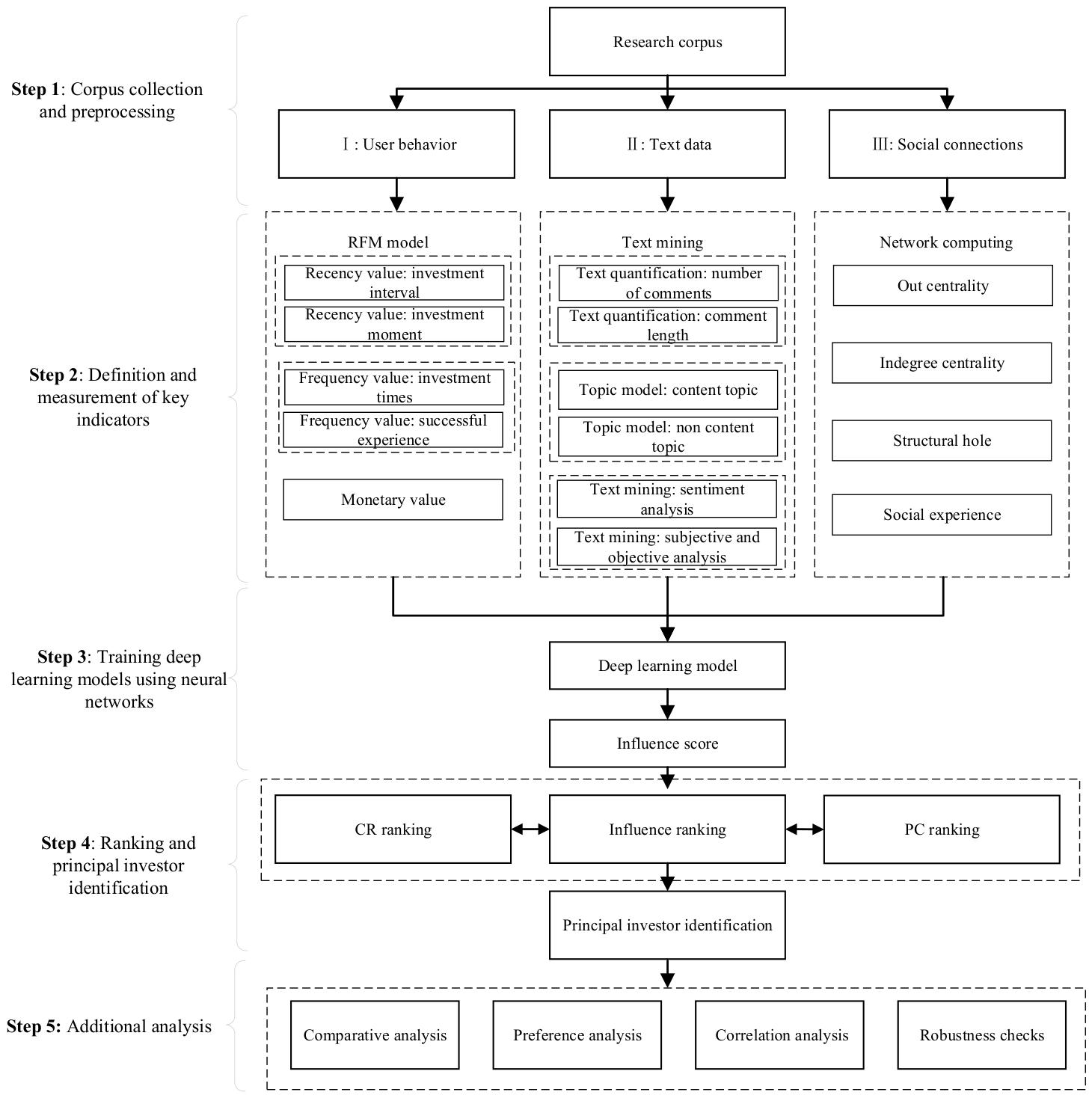
Figure 1 illustrates the research model. Behavioral data are structured according to the RFM framework [55,56], measuring recency, frequency, and monetary value. Textual data include the volume of reviews, topics, sentiment, and subjectivity/objectivity. Social data comprise metrics derived from social network analysis, including social experience, centrality, and structural holes. The above three dimensions serve as the foundation; a deep learning algorithm model is then trained to synthesize these sub-indicators into a composite influence score, upon which users are ranked. The influence score quantifies each user’s degree of influence; users with higher scores serve as principal investors. Furthermore, considering the differential bonding ties among users, principal investors are further delineated based on the central route (CR) and peripheral route (PR) of the ELM. Finally, multiple metrics are employed to validate the accuracy of principal investor identification, including MAPE, recall, NDCG, and precision, among others. Specifically, the methodology of this study consists of 5 steps, as follows:
  • Step 1: Corpus collection and preprocessing. This stage mainly involves the construction of the corpus and data preprocessing.
  • Step 2: Definition and measurement of key indicators. The primary task at this stage is to quantify the 15 indicators related to behavior, text, and social (BTS) dimensions and to output standardized numerical values.
  • Step 3: Training the deep learning model using a neural network. This stage involves the complete construction and training of the model, ensuring high-quality and avoiding overfitting.
  • Step 4: Principal investor identification. Based on the influence score, users are ranked, and principal investors are extracted according to the ranking.
  • Step 5: Additional analysis. The impact on principal investors is examined through comparative analysis, preference analysis, correlation analysis, and robustness tests.
The research model is illustrated in Figure 1 and comprises 15 key variables, which are respectively measured from the dimensions of user behavior, text data, and social connections. Recency represents the degree of user activity and includes two indicators: investment interval and investment moment [54,56]. Frequency denotes the user’s contribution to the platform and encompasses two indicators: investment times and successful experience [18]. Monetary value represents the contribution of capital [79,80]. Text data, meanwhile, are measured across three dimensions—review volume, content topic, and linguistic features—encompassing six sub-dimensions: number of comments [81], comment length [81], content topic [82,83], non-content topic [20], sentiment [84], and subjectivity [85]. Finally, social connections include four network indicators: out-degree centrality [86,87], in-degree centrality [88], structural holes [89], and social experience [90,91]. The calculation of each indicator is detailed in the following sections.
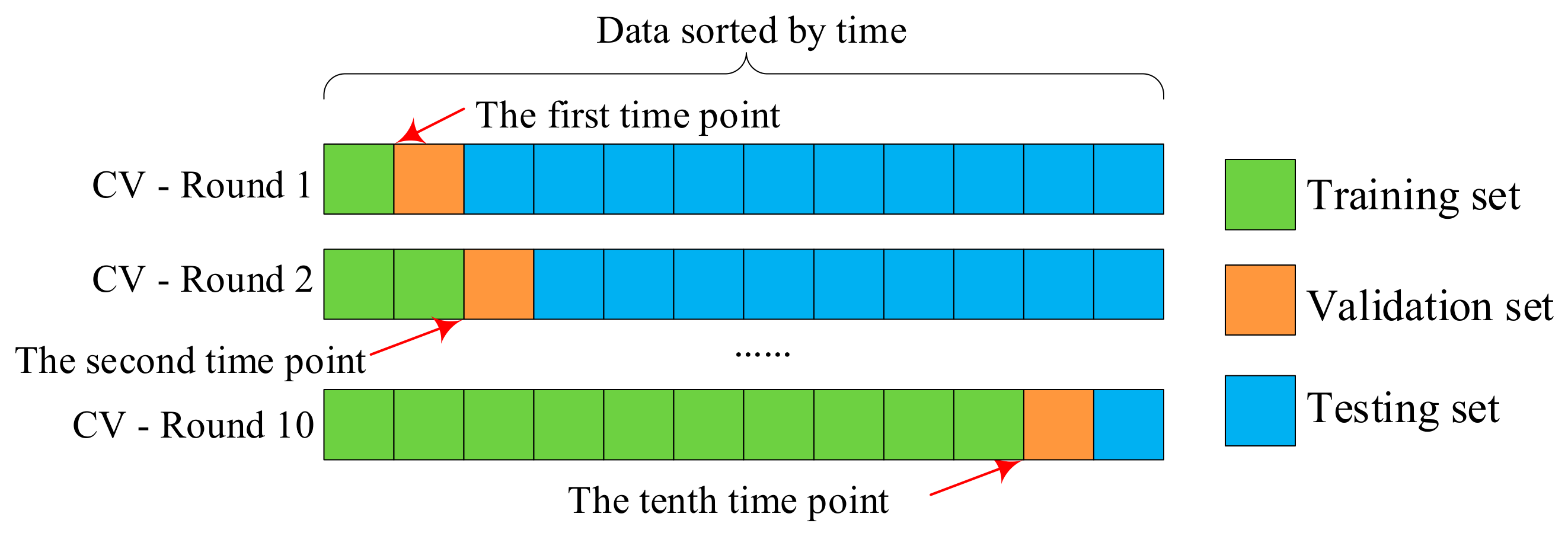
The precise delineation of temporal junctures is critical for identifying principal investors and follow-on investors in online investment, as principal and follow-on investment actions are intrinsically tied to the temporal dimension. If investor-related textual or social network features are derived from information generated at a later stage of the funding, the validity of “early-stage leader identification” becomes questionable. To address this issue, we incorporated the time horizon into the split train/test process. Figure 2 illustrates the time-based train/test split approach.
In detail, to address the potential issue of overfitting, cross-validation was conducted while accounting for temporal factors in the partitioning of the training and test sets. Specifically, user daily behavioral data were chronologically ordered, and the training and test sets were progressively expanded in a forward fashion with 10 rounds (10-fold cross-validation), as illustrated in Figure 2. Additionally, to ensure model accuracy, a set of objective features is selected based on their relevance to the project quality. Regularization is also applied to the feature values.

3.3. RFM Indicators

3.3.1. Behavior Indicators

The RFM framework comprises three components: recency, frequency, and monetary value [54,56]. Recency, pertaining to temporal elements, is estimated with two indicators: (a) investment interval, which is the number of days elapsed since the last investment, and (b) investment moment, represented by the percentile ranking of the investor’s order of investment within a project, as formalized in Equation (1). Here, r i is the ranking of user i ; r max and r min are the maximum and minimum rankings; r min 1 is constant for o p i to avoid being 0 when r i and r min are equal (first place). A larger o p i indicates investment at a later time, and vice versa.
o p i = r i ( r min 1 ) r max ( r min 1 )
Frequency: Investors with extensive investment experience and a history of successful funding possess a higher probability of emerging as principal investors [18]. This dimension is captured as follows: (a) the total number of entrepreneurial ventures in which the investor has participated, and (b) the number of successfully funded projects the investor has previously backed. Both metrics were normalized using Equation (2).
f i = u i u min u max u min
Monetary represents the capital contribution of the investor [79,80]. The average contribution per project was used as a proxy, calculated using Equation (3), where n is the number of reward tiers for the project, and i l e v e l i is the amount of funding levels for project i .
m i = i l e v e l i n

3.3.2. Textual Indicators

Review volume: Frequent posting and the provision of substantive reviews confer a measurable degree of discursive influence [81]. Individuals who frequently post reviews are more likely to become principal investors. Therefore, (a) the number of reviews and (b) the average length of reviews (in characters) serve as proxies.
Content topic: Reviews engage with multiple dimensions of entrepreneurial ventures [82,83]. Some topics are content-oriented (e.g., project creativity, market prospects, technical difficulty, and investment reward), while others focus on non-content aspects such as reputation, war risk, and subjective opinion [20]. Thus, a supervised topic modeling algorithm was employed to classify reviews into two categories: (a) content-related and (b) non-content-related. The following examples illustrate this distinction:
A: This project plans to use real-time trackable chips to monitor the activity trajectories of rare Tibetan antelopes. However, the local climate is extremely harsh. We hope the initiator can test the chip’s performance in inclement environments.
B: Support the project launch! When can I receive the rewards promised by the project team?
As can be seen, review A provides contextual background and offers constructive, professional suggestions, exhibiting leadership potential. By contrast, review B lacks substantive content.
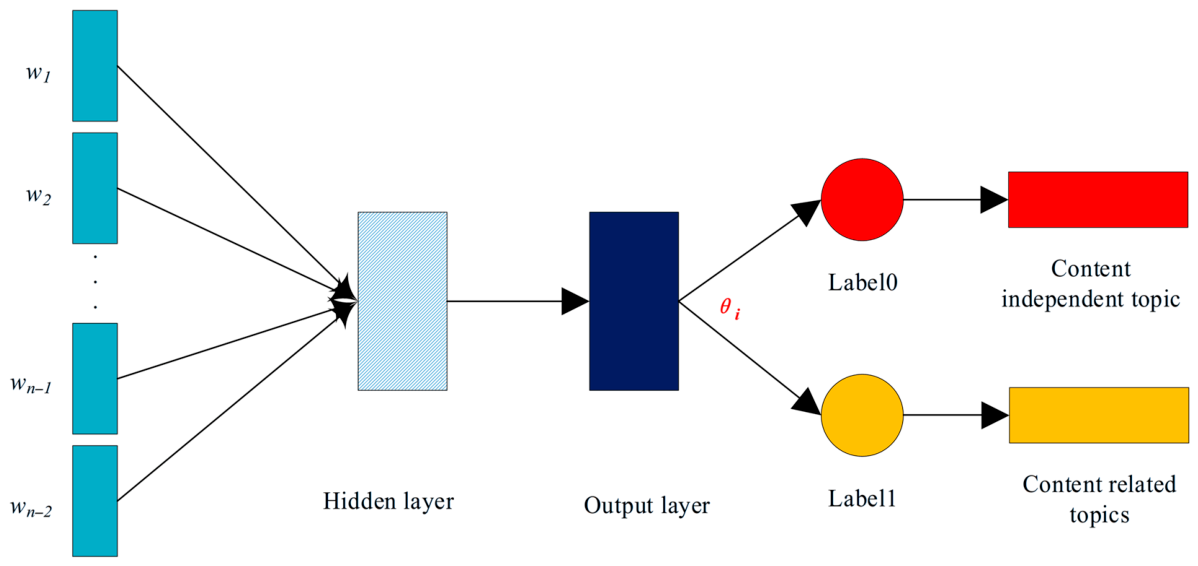
A random sample of 200 review texts was manually annotated. Reviews related to project content were labeled 1, while others were labeled 0. FastText was utilized to build a machine learning model, establishing a classifier based on extracted keywords to predict the topic. Figure 3 depicts the architecture. The loss is defined using a log-likelihood function, as shown in Equation (4), which sums the log probabilities for each label pair and the average.
l = 1 M l a b e l l a b l e s l o g P ( l a b e l | c o n t e x t )
Here, P ( l a b e l | c o n t e x t ) is defined as in Equation (5); d i represents the Huffman code of the i node; δ and θ are parameters.
P ( l a b e l | c o n t e x t ) = i = 0 1 P ( d i | X , θ i 1 ) = i = 0 1 δ ( X T θ i 1 ) ,                       d i = 1 ; i = 0 1 { 1 δ ( X T θ i 1 ) } ,   d i = 0 ;
Treating P ( d i | X , θ i 1 ) as a composite term, the transformation involves exponentiation and logarithmic operations, which yields the function form in Equation (6).
P ( d i | X , θ i 1 ) = [ δ ( X T θ i 1 ) ] d j · [ 1 δ ( X T θ i 1 ) ] 1 d j
Review sentiment and subjectivity analysis. Sentiment reflects the reviewer’s attitude and is commonly employed in opinion mining [84,92]. Sentiment detection typically leverages lexicon-based and machine learning methodologies [93,94]. To uncover latent sentiment, association rule mining was introduced to discover co-occurrence patterns among features [95]. Let I = i 1 , i 2 , , i n represent the itemset, and let i n be an item; D = d 1 , d 2 , , d m is the transaction corpus, and any transaction in D is a subset of itemset I. X I , Y I , and X Y = Φ implement the mapping X Y . The support s of this rule means that at least s % of transactions in D satisfy X Y , and the confidence c means that at least c % of transactions in D support both X and Y [96]. Identifying all rules in D that meet minimum support and confidence thresholds provides a basis for structuring sentimental features. Using the HowNet dictionary and Bayesian estimation [97,98], the sentiment was classified. Objective texts are defined as evaluations grounded in evidence, data, or logical deduction, while subjective texts involve value judgments with tendencies.
This study employs Naïve Bayes to assess sentiment and subjectivity [85], utilizing the frequency of words within a particular category as the criterion. Under the assumptions of feature independence and equal weighting, the classification proceeds based on probability exceeding a predetermined threshold, as formalized in Equation (7), where w i represents words in the text and C represents the category, i.e., positive or negative sentiment (subjective or objective statement), denoted as C = c 1 , c 2 .
P ( C | w 1 , , w n ) = P ( w 1 , , w n | C ) P ( C ) P ( w 1 , , w n | c 1 ) P ( c 1 ) + P ( w 1 , , w n | c 2 ) P ( c 2 )
Based on the assumption of independence, Equation (7) is simplified to Equation (8). The estimation of probability for category c 2 follows an analogous procedure.
P ( c 1 | w 1 , , w n ) = 1 1 + P ( w 1 , , w n | c 2 ) P ( c 2 ) P ( w 1 , , w n | c 1 ) P ( c 1 ) = 1 1 + e x p l o g P ( w 1 , , w n | c 2 ) P ( c 2 ) P ( w 1 , , w n | c 1 ) P ( c 1 ) = 1 1 + e x p l o g P ( w 1 , , w n | c 2 ) P ( c 2 ) l o g P ( w 1 , , w n | c 1 ) P ( c 1 )
However, training corpora cannot exhaustively cover all linguistic content, which is a persistent issue for Naïve Bayes, even with extensive samples [99]. If a semantically meaningful word is absent from the corpus, its probability for a given category would be erroneously assigned as zero. Therefore, Laplace smoothing is applied to correct the calculation [100], as shown in Equation (9), where S represents the number of words in category C , and λ is the Laplace smoothing coefficient. Equation (9) is subject to the standard Bayesian influence only when λ = 0 . This study sets λ = 0.1 .
P ( C | w 1 , , w n ) = p ( C ) i = 1 n p ( w i + λ | C + S λ )

3.3.3. Social Indicators

Out-degree centrality: Entrepreneurs and investors constitute a bipartite graph structure [86,87], the topology of which is similar to that of traditional online social networks. Out-degree centrality measures the number of projects (initiated by others) in which a given node (investor) has invested.
In-degree centrality: Conversely, in-degree centrality reflects the extent to which a node’s initiated projects attract investments from others [88]. Like out-degree centrality, in-degree centrality is normalized. Users who have not initiated any projects are assigned a value of 0.
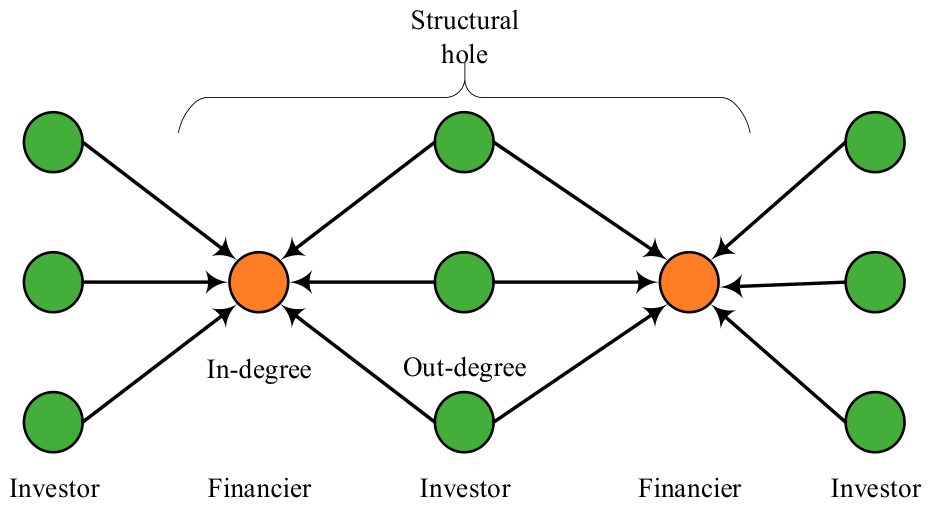
Structural hole: A centrality of zero does not imply the absence of influence, as indirect connections via third parties must be considered, introducing the concept of structural holes. Structural holes function as bridges between otherwise disconnected nodes [89]. The more prominent the position of a structural hole, the greater the propensity of the node to act as a principal investor. Figure 4 provides a schematic for calculating out-degree, in-degree, and structural hole measures.
Social experience: Many scholars confirm the role of user tenure within social networks [90,91]. The date a user joined the platform serves as a proxy for social experience. Longer tenure correlates with greater investment experience.

3.3.4. Indicator Measurements

Based on the above analysis, Table 1 summarizes the definitions, formulas, underlying data fields, and scaling or normalization steps for the 15 indicators employed in this study. These indicators are quantified using distinct data fields, and measurements of all indicators are performed at the user level. Moreover, each indicator undergoes either normalization or standardization, rendering it directly applicable to subsequent modeling and computation.

3.4. Deep Learning Model

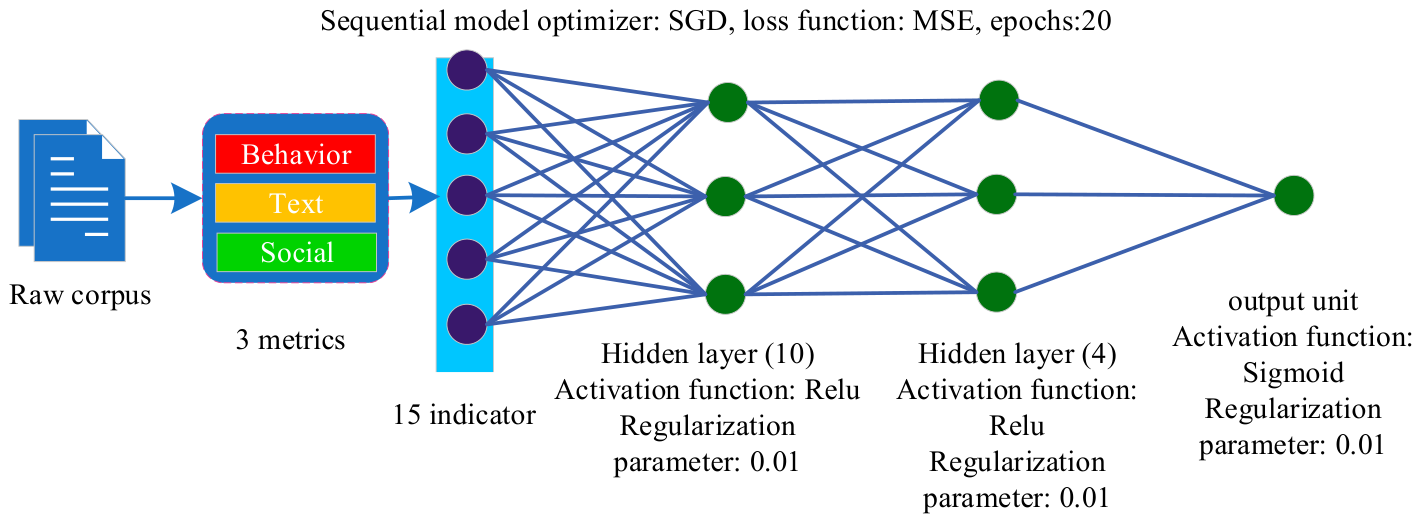
Fifteen indicators from the behavior, text, and social categories served as the input layer for an artificial neural network. The influence values corresponding to the central and peripheral routes of the ELM were calculated separately. Figure 5 depicts the neural network architecture and associated parameters. The model comprises two hidden layers with output dimensions of 10 and 4, respectively. The Mean Squared Error (MSE) function was employed as the loss metric, with lower MSE values indicating a better fit.

3.5. Principal Investor Identification

The ranking is performed by integrating the ELM’s central route (CR) and peripheral route (PR). The CR was operationalized using the follower count, while the PR was measured by node centrality. Equation (10) was employed to calculate the influence coefficients β and 1 β for CR and PC. The dependent variable R i is the financing performance of project i , with ε representing the error term.
R i = α + β × C R i + ( 1 β ) × P C i + ε i
The regression results are presented in Table 2. The parameter coefficients for CR and PR are 0.75 and 0.25, respectively. Consequently, weights of 75% and 25% were assigned to the central and peripheral route components, respectively, in the composite ranking.

4. Results and Discussion

4.1. Model Training

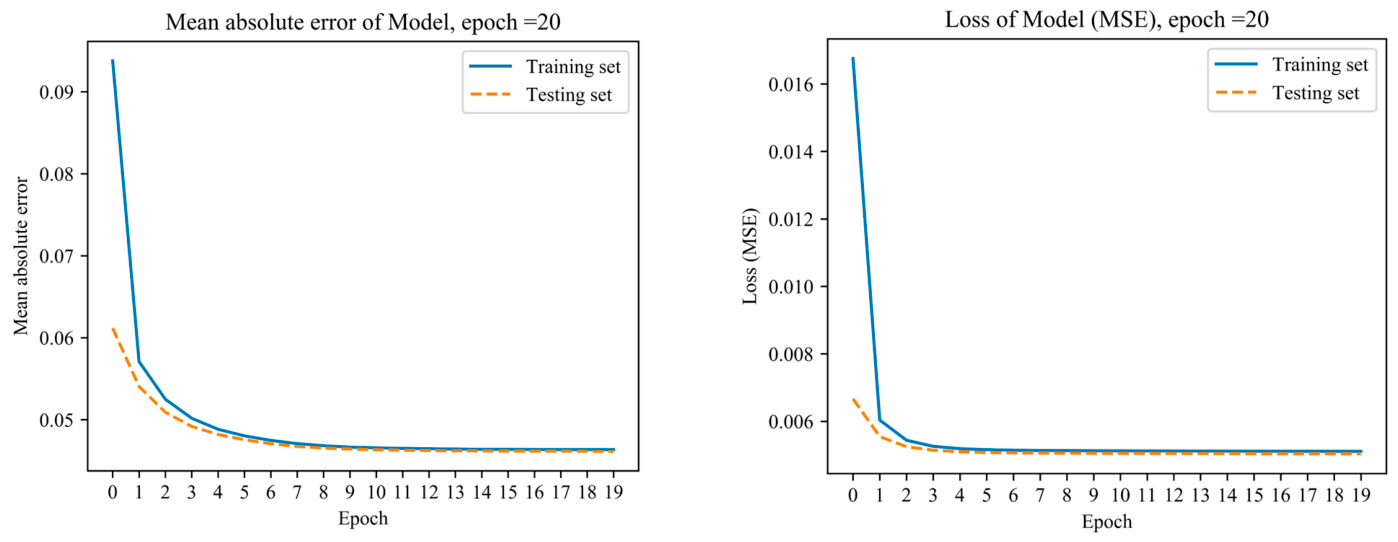
To evaluate the model’s performance and the rationality of the parameter settings, a 10-fold cross-validation was employed [101], as described in Section 3.2. The neural network was trained on an NVIDIA 3090 GPU, and Figure 6 illustrates the training loss. The model converged at approximately 20 epochs, and no significant overfitting was observed.

4.2. Ranking of Influence

Table 3 presents the profile of principal investors (only the top 10 are shown due to space constraints). Principal investors are generally characterized by familiarity with the platform (long registration time) and participation in numerous investments. Moreover, they typically enter projects at an early stage (investment timing ≤50%). Geographically, most principal investors are from the USA, reflecting the US-centric entrepreneur.
Equation (11) was employed to quantify the discrepancy between results, using a neural network (NN) ranking as the benchmark. Here, E L M i represents the ranking calculated via ELM, and M q i represents the ranking derived from the BTS model, where q = 1 , 2 , 3 , 4 sequentially denotes the following four aspects: ELM, B (Behavior), T (Text), and S (Social).
M A P E = 1 n i = 1 n N N i F q i N N i × 100 %
Table 4 presents the results for consistency. ELM-based ranking exhibits only a small discrepancy (0.15) from the neural network benchmark, indicating its high accuracy. The Mean Absolute Percentage Error (MAPE) for the behavior-only ranking (0.30) and social-only ranking (0.71) demonstrates lower accuracy. The text-only ranking yields the largest MAPE (0.95), indicating that it demonstrates the poorest performance.
For the sorting evaluation, recall, NDCG, and precision are also common comparison standards, with their computational formulas presented in Equations (12)–(14). The results shown in Table 3 indicate that ELM demonstrates favorable performance across all metrics. However, it exhibits inferior performance regarding B (Behavior), T (Text), and S (Social) metrics.
R e c a l l = u R u T u u T u
P r e c i s i o n = u R u T u u R u
N D C G = D C G u i D C G u = 1 k i = 1 k 1 log 2 R a n k i u + 1

4.3. Feature Ranking

Based on the neural network, this study introduces the SHAP (SHapley Additive exPlanations) algorithm to conduct a ranking analysis of the model’s output results. The aim of SHAP is to examine the contribution of each feature to the prediction. SHAP is an algorithm for interpreting predictions. It is grounded in the Shapley value from game theory and provides interpretability by calculating the contribution of each feature to the predictions. SHAP not only yields the contribution of each feature but also presents the interpretation of different models in a unified manner. Equation (15) illustrates the method for calculating each variable, where F denotes the set of features, S represents a subset, and f ( S ) is the prediction function of the model.
ϕ i = S F { i } | S | ! ( | F | | S | 1 ) ! | F | ! [ f ( S { i } f ( S ) ) ]
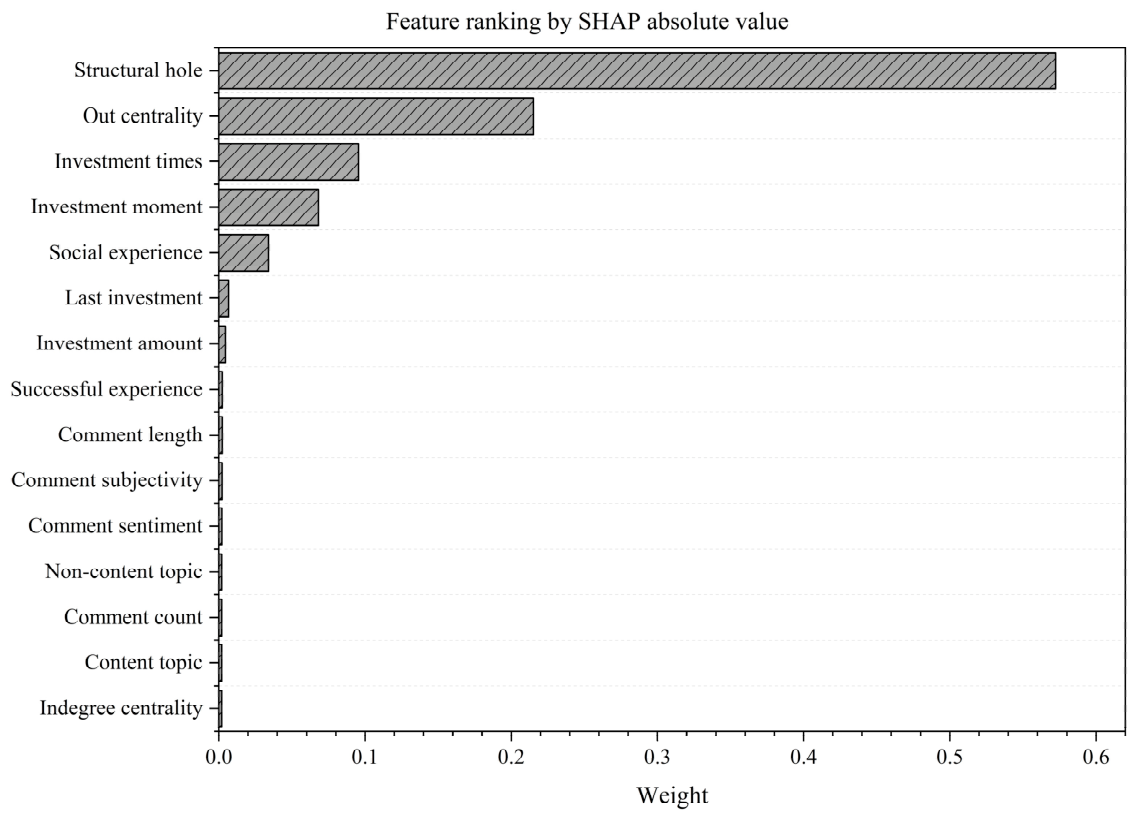
Figure 7 displays the ranking of feature importance using SHAP. Structural holes emerge as the most important element, indicating that nodes occupying “bridge” positions have greater influence. This is followed by out-degree centrality, investment times, investment moment, and social experience. In contrast, textual-related features—including review count, sentiment, and topic—contribute minimally to the identification of principal investors. The weight of structural holes, out-degree centrality, investment times, investment moment, and social experience is affected by the fact that principal investors, as investment “leaders”, derive influence from their strategic behaviors and network position. These metrics reflect investment acumen and decisive execution, which accentuate their influence. Social experience reflects charismatic capital; broader social connections enable the mobilization of resources, reinforcing leadership.
From the perspective of feature importance results, social and behavioral indicators occupy relatively significant positions, whereas textual indicators appear to have considerably lower predictive power. This phenomenon may be attributable to the following reasons: First, for principal investors, their influence derives from community networks [102]; that is, principal investors exert influence as opinion leaders through interpersonal relationships. Consequently, indicators related to social networks are more influential. Second, textual data are not amenable to intuitive presentation because users must comprehend the text before converting it into comparable metrics [103]. In contrast, behavioral indicators provide intuitive numerical values, such as the frequency of a principal investor’s investments and the duration within the community.

5. Additional Analyses

5.1. Comparative Analysis

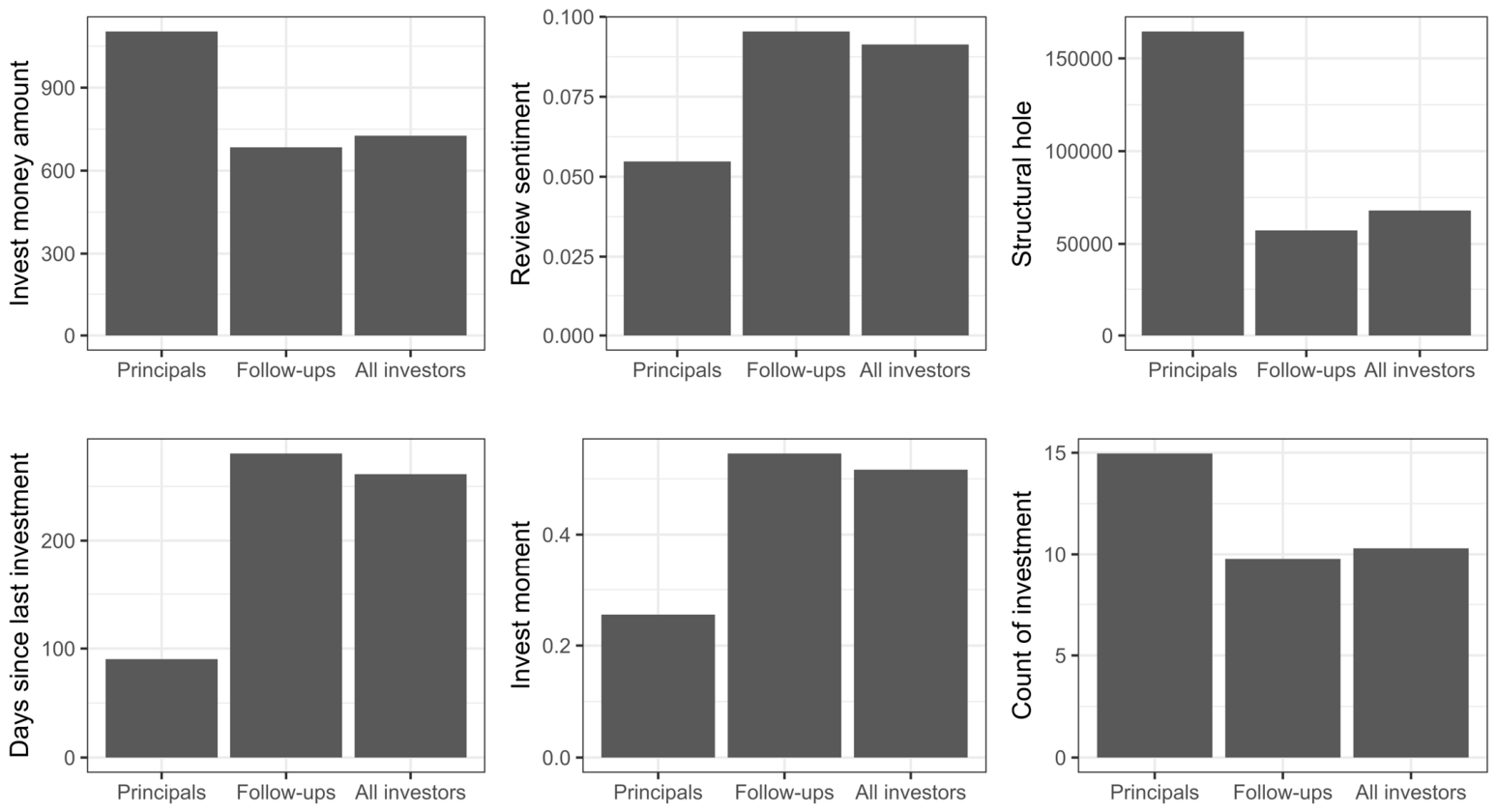
To elucidate the distinctive characteristics of principal investors, the data of the top 10% users were extracted for comparative analysis (47,889 users). Figure 8 highlights six characteristics exhibiting significant divergence between principal and follow-on investors. Compared with the neural network’s ranking (Figure 6), the weights of recency, investment times, structural holes, investment moment, and investment amount for principal investors are corroborated. Notably, while out-degree centrality and social experience are important indicators, they do not exhibit significant differences between the two groups. Specifically, principal investors demonstrate shorter investment cycles and higher frequency (90 days vs. 280 days; 33% higher in frequency); act swiftly (entering projects earlier, at approximately 26% of the funding timeline, with relatively higher investment amounts); and possess stronger “bridging” power (approximately twice that of followers). Regarding the sentiment of online reviews, principal investors exhibit less sentiment (~0.05) compared to followers (~0.1), suggesting that their evaluations, while positive, are presented with greater objectivity.

5.2. Preference Analysis

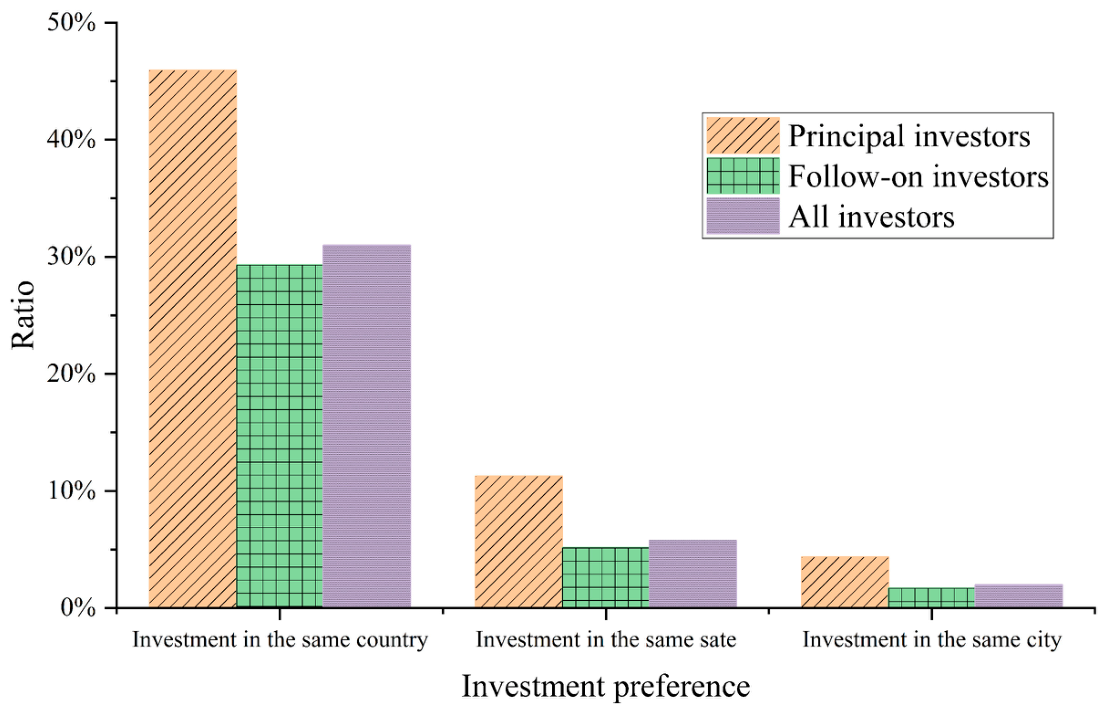
Substantial evidence confirms that investors exhibit decision-making biases, including local, gender, or industry preferences [104]. Online entrepreneurial ventures, such as conceptual blueprints, often entail a temporal lag between the conception of ideas and the delivery of the product/service. It creates an information barrier that exacerbates information asymmetry for remote investors [18]. To mitigate uncertainty, investors tend to favor geographically proximate projects because such proximity facilitates site visits and direct engagement with entrepreneurs [105,106]. Scholars indicated that the average offline distance between financing and investment parties is approximately 70 miles, and approximately 50% of angel investments are made within a half-day’s travel distance [107]. While cultural differences correlate with geographical distance, a substitution effect exists; that is, a 50% increase in geographical distance reduces the cultural differences by 30% [108]. It underscores the salience of geographical proximity in investment decisions. To investigate whether principal investors are similarly influenced, preference analysis was conducted based on location, as shown in Figure 9. Both principal and follow-on investors demonstrate a distance–decay pattern (domestic > state-wide > city-wide). Principal investors exhibit a pronounced local bias (home bias) at all geographical levels.
To further quantify geographical distance preferences, the locations of investors and entrepreneurs were geocoded to longitude and latitude coordinates [109]. The spherical law of cosines, formalized in Equations (16) and (17), was used to calculate the distance between location A and location B. Here, (LatA, LonA) and (LatB, LonB) denote the coordinates of locations A and B, respectively. R represents the earth’s radius (6371.004 km), and π is approximated as 3.14.
c = s i n L a t A s i n L a t B c o s L o n A L o n B + c o s L a t A c o s L a t B
D ( A , B ) = A r c c o s c R π / 180
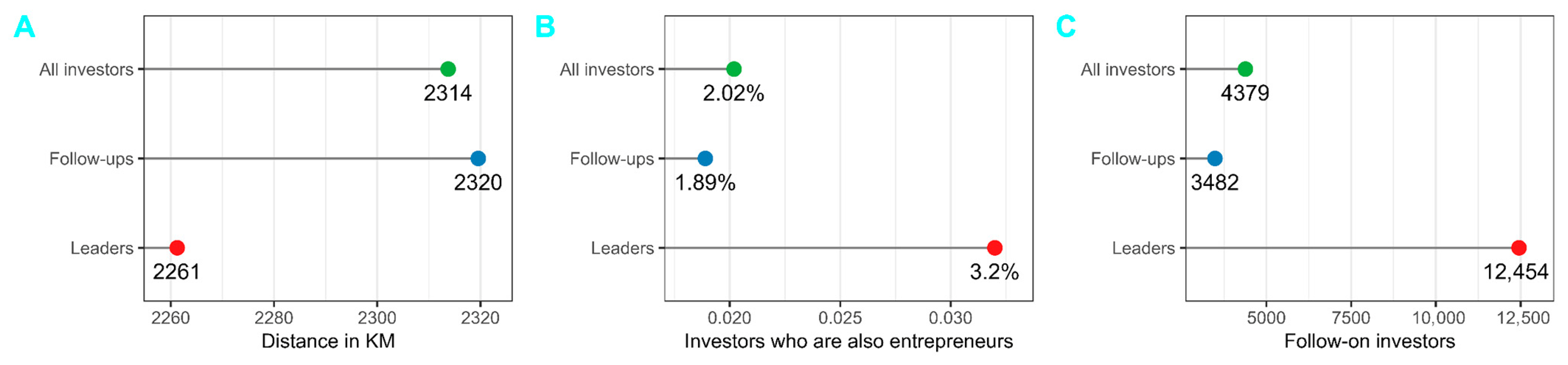
Panel A in Figure 10 illustrates the distance preferences of principal versus follow-on investors. Principal investors engage with projects significantly closer to their location (average distance: 2261 km) compared to follow-on investors (average distance: 2320 km), confirming a stronger local preference among principal investors. Additionally, Figure 9 analyzes identity diversity and follower count (Panels B and C). Among investors with multiple identities (i.e., serving as both investors and creators), the proportion of principal investors is nearly double that of follow-on investors. Follower count, as a proxy of influence, clearly distinguishes principal investors, whose follower numbers substantially exceed those of others, indicating that social butterflies are most likely to be identified as principal investors.

5.3. Correlation Analysis of the Impact of Principal Investors

To examine the correlation between principal investors and financing performance, we specify two models, as shown in Equations (18) and (19); each model measures principal investors from (a) whether a project involves a principal investor (DumLeader), as presented in Equation (18), and (b) the number of principal investors participating in the project (NumLeader), as outlined in Equation (19). For a comprehensive assessment of financing performance, the F u n d i n g R e s u l t encompasses three dimensions: (a) whether the project is successfully funded (DumFundingSuccess); (b) the amount of funds raised (NumMoneyPledged); and (c) funding progress (NumFundingProgress). Given that online entrepreneurial projects are subject to multiple influencing factors, a set of quality-related variables is incorporated, including the number of updates (NumUpdate), number of comments (NumComment), funding goal (NumGoal), funding duration (NumDuration), number of investment levels (NumPledgeLevels), whether a video is included (DumVideo), text length (NumLength), number of images (NumImage), number of hyperlinks (NumHyperlink), and number of social media followers (NumSocialFollowers) [18,20,85,110].
F u n d i n g R e s u l t = α + β 1 D u m L e a d e r + β C + ε i
F u n d i n g R e s u l t = α + β 1 N u m L e a d e r + β C + ε i
Table 5 presents the results for the correlation analysis of principal investors. Across the three models, a consistent effect emerges: the participation of a principal investor significantly correlated with the project’s financing success, funding amount, and funding progress (Model 1, Model 3, and Model 5). The result also holds with respect to the number of principal investors involved in a project (Model 2, Model 4, and Model 6). Therefore, there is a significant correlation between principal investors and financing performance.

5.4. Robustness Checks: Event Comparisons and Alternative Time Windows

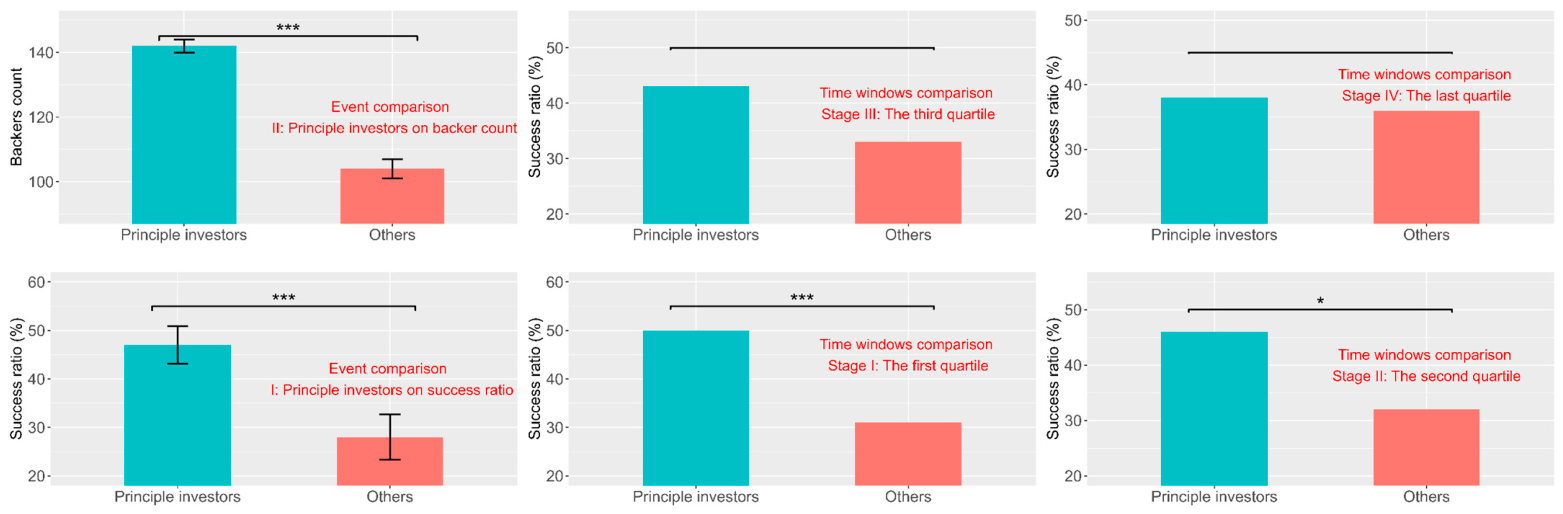
To demonstrate the influence of principal investors on project financing performance, we conducted additional robustness tests on event comparisons and alternative time windows. First, event comparisons were performed based on whether principal investors participated in the investment. The validity of this test stems from the following rationale: if principal investors can encourage others to engage in investment, then the participation of principal investors could significantly increase the probability of financing success. Figure 11 presents the results. Evidently, the results of the event comparisons indicate that principal investors contribute to financing performance (Principal investors promote both the backer count and success ratio).
Regarding the division of alternative time windows, principal investors may participate in investment at any time, with varying degrees of impact on funding success. In this study, the financing period is evenly divided into four stages (Stage I to Stage IV) to analyze which temporal window yields the greatest improvement in financing success when principal investors are involved; that is, the purpose of partitioning the temporal window is to examine whether the influence of principal investors varies over time. Accordingly, the temporal window is evenly divided based on the length of the financing duration. For instance, if the financing duration of a project is 28 days, Stage I represents the first quarter of this period, i.e., the financing performance over the initial seven days (28 × 1/4). By the same logic, Stage II corresponds to the financing performance from day 8 to day 14, and similar partitioning applies to the temporal windows of Stage III and Stage IV.
Figure 11 illustrates the effect of principal investors on financing success across temporal windows. Evidently, the participation of principal investors is most effective during the initial stage (Stage I), followed by the second stage (Stage II); by contrast, involvement in the remaining stages yields comparatively weaker influence (Stage III and Stage IV).

6. Conclusions and Future Directions

E-commerce involves various forms of entrepreneurship, and crowdfunding is one of its representatives. Principal investors, endowed with acute market insight and professional expertise, function as leaders in successful investments. To identify such investors within online communities, this study constructed a model based on a BTS (Behavior–Text–Social) framework, incorporating 15 indicators across three dimensions. By integrating the central and peripheral routes of the ELM, a composite ranking was derived to identify principal investors. The findings indicate that ranking by ELM most closely approximates the benchmark. Within the BTS framework, investor behavior exhibits the highest predictive power, followed by social networks, while textual features have the least. In feature ranking, structural holes carry the greatest weight, whereas textual influence is comparatively weak. Furthermore, principal investors demonstrate a strong local bias, preferring projects that are geographically local. A subset of principal investors also assumes entrepreneurial roles, although this proportion remains small (~3%). These findings provide theoretical insight for principal investor detection and strengthen the development of online entrepreneurship.
While this study investigates the principal investors, it is a preliminary study in this domain, and several limitations warrant acknowledgment. First, the data is sourced exclusively from technology projects on Kickstarter, which creates certain constraints on generalizability. Future work should endeavor to validate the framework across projects with differing categories. Second, while the BTS framework encompasses user behavior, text data, and social connections, it omits project-specific attributes such as quality or rewards, which also influence investment decisions. The incorporation of such variables constitutes a promising direction for future study. Third, while the experimental results reveal divergent conclusions across approaches, the underlying causes of these discrepancies remain insufficiently analyzed, which provides an opportunity for further optimization and refinement. Fourth, for crowdfunding projects that require online investment, numerous project-specific attributes influence investors’ assessments of the project’s quality, thereby shaping the behavioral patterns of principal investors and follow-on investors. Although we incorporated 15 indicators into the model, certain key variables may still be omitted. Finally, the dataset employed entails inherent limitations, namely, the data utilized in this study are derived from Kickstarter. As a prominent platform based in the United States, Kickstarter includes entrepreneurs and investors from around the world. Nevertheless, due to the limitations of culture, language, and supervision, Kickstarter is characterized by a U.S.-centric nature. Consequently, this study is fundamentally grounded in the context of the United States. Divergent conclusions may arise when the framework is applied to alternative national or cultural contexts. Therefore, using data from other countries to conduct comparative studies represents a promising direction.

Author Contributions

This work was conducted in collaboration with all authors. L.G. performed the data collection and data analysis, proposed ideas, constructed the models, and reviewed and edited the manuscript. Y.J.W. reviewed the work, administered the project, and reviewed and edited the manuscript. All authors have read and agreed to the published version of the manuscript.

Funding

This work was partially supported by the National Natural Science Foundation of China Grant (72472053).

Institutional Review Board Statement

Not applicable.

Informed Consent Statement

Not applicable.

Data Availability Statement

Data are available upon request.

Acknowledgments

Special thanks go to Wei Wang for his assistance during the long process of this study.

Conflicts of Interest

The authors declare no conflicts of interest.

References

  1. Sánchez-Franco, M.J.; Rey-Tienda, S. The role of user-generated content in tourism decision-making: An exemplary study of Andalusia, Spain. Manag. Decis. 2024, 62, 2292–2328. [Google Scholar] [CrossRef]
  2. Wang, J.; He, D.; Li, Y.; Jiang, Y. Exploring the impact of inter-text space on consumer reactions in firm-customer communication. J. Bus. Res. 2026, 210, 116111. [Google Scholar] [CrossRef]
  3. Loeffler, K. Breeding Wildlife to Extinction in China. J. Appl. Anim. Welf. Sci. 2013, 16, 387. [Google Scholar] [CrossRef]
  4. Maus, C.; Greven, A.; Kurth, N.; Brettel, M. How do investor characteristics of business angels and venture capitalists predict the occurrence of co-investments? J. Bus. Econ. 2024, 94, 763–811. [Google Scholar] [CrossRef]
  5. Wang, C.-B.; Huang, Z. Econometric Analysis of the Impact of Financial Structure on Innovation Based on the Fixed Effects Panel Model. Math. Probl. Eng. 2021, 2021, 3022421. [Google Scholar] [CrossRef]
  6. Ormiston, J.; Charlton, K.; Donald, M.S.; Seymour, R.G. Overcoming the Challenges of Impact Investing: Insights from Leading Investors. J. Soc. Entrep. 2015, 6, 352–378. [Google Scholar] [CrossRef]
  7. Sass, M.; Antalóczy, K.; Éltető, A. Emerging Multinationals and the Role of Virtual Indirect Investors. East. Eur. Econ. 2012, 50, 41–58. [Google Scholar] [CrossRef]
  8. Xiao, L. How lead investors build trust in the specific context of a campaign: A case study of equity crowdfunding in China. Int. J. Entrep. Behav. Res. 2019, 26, 203–223. [Google Scholar] [CrossRef]
  9. Yuan, B. The Influence of Consumer’s Lay Rationalism on Electronic Entrepreneur-Related Word of Mouth. J. Consum. Behav. 2025, 24, 906–918. [Google Scholar] [CrossRef]
  10. Wang, T.; Qureshi, I.; Deeds, D.; Ren, Y. How do technology ventures signal IPO quality? A configurational approach. J. Bus. Res. 2019, 99, 105–114. [Google Scholar] [CrossRef]
  11. Li, Y.-M.; Hsieh, C.-Y.; Zeng, W.-Z. A social discovery mechanism for endorsing investors in equity crowdfunding. Decis. Support Syst. 2024, 176, 114049. [Google Scholar] [CrossRef]
  12. Zheng, R.; Yang, F. Optimal budget allocation and influencer scheduling for product promotion within multilayer social networks. Expert Syst. Appl. 2026, 317, 131935. [Google Scholar] [CrossRef]
  13. Zhang, M.; Aziz, A.; Sibghatullah, A.; Yarashova, V. Green supply chain practices and leadership factors shaping sustainable entrepreneurship and business advantage through evolving sustainable attitudes. Int. Entrep. Manag. J. 2025, 21, 93. [Google Scholar] [CrossRef]
  14. Aghdam, S.M.; Gharehchopogh, F.S.; Masdari, M. An opinion leader selection in social networks using hybrid amended salp swarm and improved grey wolf optimizer algorithms. Int. J. Data Sci. Anal. 2025, 20, 4901–4926. [Google Scholar] [CrossRef]
  15. Gunduz, H.; Klein, M.; Bayrak Meydanoglu, E.S. Crowdfunding as an E-Commerce Mechanism: A Deep Learning Approach to Predicting Success Using Reduced Generative AI Embeddings. J. Theor. Appl. Electron. Commer. Res. 2026, 21, 28. [Google Scholar] [CrossRef]
  16. Mathew, N.; Javalgi, R.R. Emerging market professional service firms’ market success: Does cultural intelligence matter? J. Bus. Ind. Mark. 2025, 40, 1160–1175. [Google Scholar] [CrossRef]
  17. Zhao, L.; Sun, Z.; Chen, S.; Gugnani, R.; Sahore, N. Social media opinion leaders and information diffusion of crowdfunding projects: Evidence from China. Technol. Forecast. Soc. Change 2024, 200, 123110. [Google Scholar] [CrossRef]
  18. Wang, W.; Li, Y.; Mou, J.; Zhu, K. A comparative analysis of the effect of initiative risk statement versus passive risk disclosure on the financing performance of Kickstarter campaigns. Decis. Support Syst. 2025, 188, 114366. [Google Scholar] [CrossRef]
  19. Fakhreddin, F. What Makes a Social Media User an Opinion Leader? Source Characteristics and Consumers’ Behavioral Intentions. J. Promot. Manag. 2025, 31, 1–38. [Google Scholar] [CrossRef]
  20. Wang, W.; Chen, W.; Zhu, K.; Wang, H. Emphasizing the entrepreneur or the idea? The impact of text content emphasis on investment decisions in crowdfunding. Decis. Support Syst. 2020, 136, 113341. [Google Scholar] [CrossRef]
  21. Camacho, D.; Panizo-LLedot, Á.; Bello-Orgaz, G.; Gonzalez-Pardo, A.; Cambria, E. The four dimensions of social network analysis: An overview of research methods, applications, and software tools. Inf. Fusion 2020, 63, 88–120. [Google Scholar] [CrossRef]
  22. Tiwari, P.; Zhang, L.; Qu, Z.; Muhammad, G. Quantum fuzzy neural network for multimodal sentiment and sarcasm detection. Inf. Fusion 2024, 103, 102085. [Google Scholar] [CrossRef]
  23. Homan, A.C.; Abbaszadeh, Y. Obstacles for marginalized group members in obtaining leadership positions: Threats and opportunities. Curr. Opin. Psychol. 2025, 62, 101971. [Google Scholar] [CrossRef]
  24. Wu, Y.; Ye, H.J.; Jensen, M.L.; Liu, L. Impact of project updates and their social endorsement in online medical crowdfunding. J. Manag. Inf. Syst. 2024, 41, 73–110. [Google Scholar] [CrossRef]
  25. Chen, L.; Pei, X.; Liu, D. Effect of crowd Voting on participation in crowdsourcing contests. J. Manag. Inf. Syst. 2020, 37, 510–535. [Google Scholar] [CrossRef]
  26. Daramola, C.F. Leadership Innovation and Gender Issues in Academic Libraries in Southwest Nigeria. Inf. Knowl. Manag. 2025, 15, 28–40. [Google Scholar]
  27. Luo, Y.; Li, H.; Yang, Z.; Škare, M.; Qin, Y. Configurations of factors driving green entrepreneurship success. Int. Entrep. Manag. J. 2025, 21, 104. [Google Scholar] [CrossRef]
  28. Jalali, A.; Palali, R.; Razzak, M.R.; Al-Kharusi, S. Big data analytics, company innovation and risk-taking: Influence of absorptive capacity. Manag. Decis. 2025, 63, 1473–1497. [Google Scholar] [CrossRef]
  29. Omorede, A.; Prados-Castillo, J.F.; Casas-Jurado, A.C. Researching entrepreneurship using big data: Implementation, benefits, and challenges. Int. Entrep. Manag. J. 2025, 21, 85. [Google Scholar] [CrossRef]
  30. Gu, W.; Pan, H. Research on the influence of financial risk on enterprises’ green performance. Int. Entrep. Manag. J. 2025, 21, 53. [Google Scholar] [CrossRef]
  31. Zhou, C.; Sadowski, B.M.; Fang, C.; Ruan, M. The impact of risk aversion on serial entrepreneurs’ intentions for reentry: A quantitative analysis across 85 countries. Int. Entrep. Manag. J. 2025, 21, 96. [Google Scholar] [CrossRef]
  32. Lee, H.C.B.; Li, X.; Liu, S. The Role of Monitoring Effect in Risk Classification: Evidence from Telematics Adoption. Manag. Sci. 2025, 71, 10122–10143. [Google Scholar] [CrossRef]
  33. Nauman, S.; Tahir, M.Z.; Ali, F.H.; Sumbal, M.S.U.K. The missing link: Knowledge hiding behavior and project performance. Manag. Decis. 2025, 63, 2536–2554. [Google Scholar] [CrossRef]
  34. Liu, Z.; Hu, S. Predicting the fundraising performance of environmental crowdfunding projects: An interpretable machine learning approach. Inf. Process. Manag. 2024, 61, 103587. [Google Scholar] [CrossRef]
  35. Deng, Z.; Xue, J.; Wu, T.; Chen, Z. Sharing information about medical crowdfunding projects on social networking sites: The integration of attribution-affect model of helping and social capital theory. Inf. Technol. People 2024, 38, 1735–1765. [Google Scholar] [CrossRef]
  36. Arroteia, N.; Bhatta, B.; Quinn, M. Do camouflage signals impact performance in reward-based crowdfunding? Int. J. Entrep. Behav. Res. 2025, 31, 1259–1286. [Google Scholar] [CrossRef]
  37. Frimpong, B.; Ayaburi, E.W.Y.; Andoh-Baidoo, F.K. Achieving Reward-Based Crowdfunding Project Success: An Examination of Value Congruence. J. Assoc. Inf. Syst. 2025, 26, 879–908. [Google Scholar] [CrossRef]
  38. Lee, J. Optimizing Distinctiveness in Global E-Commerce: How Textual Marketing Signals Drive Foreign Customer Engagement on Digital Platforms. J. Theor. Appl. Electron. Commer. Res. 2025, 20, 232. [Google Scholar] [CrossRef]
  39. Liu, Y.; Chen, Y.; Fan, Z.-P. Do social network crowds help fundraising campaigns? Effects of social influence on crowdfunding performance. J. Bus. Res. 2021, 122, 97–108. [Google Scholar] [CrossRef]
  40. Nabity-Grover, T.; Matthews, K.D.; Roth, P.L.; Kwon, Y.; Thatcher, J.B. Social Media and Political Affiliation: How Expressing Hot-Button Opinions Affects Raters’ Assessments of Job Applicants. Inf. Syst. Res. 2025, 36, 2375–2390. [Google Scholar] [CrossRef]
  41. Su, L.; Sengupta, J.; Li, Y.; Chen, F. “Want” versus “Need”: How linguistic framing influences responses to crowdfunding appeals. J. Consum. Res. 2024, 50, 923–944. [Google Scholar] [CrossRef]
  42. Esposito, C.D.; Szatmari, B.; Sitruk, J.M.C.; Wijnberg, N.M. Getting off to a good start: Emerging academic fields and early-stage equity financing. Small Bus. Econ. 2024, 62, 1591–1613. [Google Scholar] [CrossRef]
  43. Bao, C.; Lee, M.K.; Zhang, W. Boosting or Undermining? Unveiling the Two-Sided Effect of Updates in Medical Crowdfunding Campaigns. J. Assoc. Inf. Syst. 2025, 26, 668–728. [Google Scholar] [CrossRef]
  44. Calic, G.; Shevchenko, A. How signal intensity of behavioral orientations affects crowdfunding performance: The role of entrepreneurial orientation in crowdfunding business ventures. J. Bus. Res. 2020, 115, 204–220. [Google Scholar] [CrossRef]
  45. Hobbs, J.; Grigore, G.; Molesworth, M. Success in the management of crowdfunding projects In the creative industries. Internet Res. 2016, 26, 146–166. [Google Scholar] [CrossRef]
  46. Massa Saluzzo, F.; Alegre, I. Supporting entrepreneurs: The role of third-party endorsement in crowdfunding platforms. Technol. Forecast. Soc. Change 2021, 162, 120402. [Google Scholar] [CrossRef]
  47. Wang, C.; Li, D.; Li, B. Index policies for campaign promotion strategies in reward-based crowdfunding. Eur. J. Oper. Res. 2025, 327, 515–539. [Google Scholar] [CrossRef]
  48. Légeret, M.; Zehnder, C.; Tur, B. How good can bad leaders be? The opportunity costs of leader selection. Leadersh. Q. 2025, 36, 101856. [Google Scholar] [CrossRef]
  49. Akai, N.; Watanabe, T. Endogenous timing of decentralized leadership with heterogeneous spillovers. Econ. Gov. 2025, 26, 163–183. [Google Scholar] [CrossRef]
  50. Wang, Y.; Xin, Y. What Makes Social Posts Go “Hot”? A Multimodal Analysis of Creator–Content–Timing Signals on a Visual Social Platform. J. Theor. Appl. Electron. Commer. Res. 2026, 21, 24. [Google Scholar] [CrossRef]
  51. Yang, S.; Yao, J.; Qazi, A. Does the review deserve more helpfulness when its title resembles the content? Locating helpful reviews by text mining. Inf. Process. Manag. 2020, 57, 102179. [Google Scholar] [CrossRef]
  52. Jain, L.; Katarya, R.; Sachdeva, S. Opinion leader detection using whale optimization algorithm in online social network. Expert Syst. Appl. 2020, 142, 113016. [Google Scholar] [CrossRef]
  53. Kabasakal, İ. Customer Segmentation Based On Recency Frequency Monetary Model: A Case Study in E-Retailing. J. Inform. Technol. 2020, 13, 47–56. [Google Scholar] [CrossRef]
  54. Zeng, F.; Gan, W.; Lu, H.; Wang, Y.; Wan, S. Towards smart retail by discovering multi-level recency, frequency, and monetary patterns. Inf. Sci. 2026, 732, 122941. [Google Scholar] [CrossRef]
  55. Chen, Y.-L.; Kuo, M.-H.; Wu, S.-Y.; Tang, K. Discovering recency, frequency, and monetary (RFM) sequential patterns from customers’ purchasing data. Electron. Commer. Res. Appl. 2009, 8, 241–251. [Google Scholar] [CrossRef]
  56. Zhang, X.; Chen, G.; Song, L.; Gan, W. Skyline recency–frequency–monetary pattern mining based on different constraint degrees. Eng. Appl. Artif. Intell. 2025, 149, 110529. [Google Scholar] [CrossRef]
  57. Liu, T.; Lu, S.K.; Mao, Y.H. Impact of advice network centrality on innovative work behavior: The moderating role of multiplex network embeddedness. Eur. J. Innov. Manag. 2025, 28, 4604–4627. [Google Scholar] [CrossRef]
  58. Herrero, Á.; Hernández-Ortega, B.; San Martín, H. Potential funders’ motivations in reward-based crowdfunding. The influence of project attachment and business viability. Comput. Hum. Behav. 2020, 106, 106240. [Google Scholar] [CrossRef]
  59. Li, S.; Liu, Z.; Li, Y. Temporal and spatial evolution of online public sentiment on emergencies. Inf. Process. Manag. 2020, 57, 102177. [Google Scholar] [CrossRef]
  60. Gao, J.; Wu, B.; Zheng, K.; Wu, C. Adversarial multimodal user-generated contents generation for anti-user identity linkage. Knowl.-Based Syst. 2026, 333, 114978. [Google Scholar] [CrossRef]
  61. Wei, W.; Hao, C.; Wang, Z. User needs insights from UGC based on large language model. Adv. Eng. Inform. 2025, 65, 103268. [Google Scholar] [CrossRef]
  62. Nezami, M.; Chisam, N.; Palmatier, R.W. Network centrality and firm performance: A meta-analysis. J. Acad. Mark. Sci. 2025, 53, 79–104. [Google Scholar] [CrossRef]
  63. Zhu, L.; Yin, G.; He, W. Is this opinion leader’s review useful? Peripheral cues for online review helpfulness. J. Electron. Commer. Res. 2014, 15, 267–280. [Google Scholar]
  64. Le, T.D.; Robinson, L.J.; Dobele, A.R. Word-of-mouth information processing routes: The mediating role of message and source characteristics. J. Consum. Behav. 2020, 19, 171–181. [Google Scholar] [CrossRef]
  65. Zhu, X.; Zhu, J.; Regan, D.; Huang, X. The data-driven emergence of online opinion leaders: Telecommunication fraud in Northern Myanmar. Data Technol. Appl. 2025, 59, 571–596. [Google Scholar] [CrossRef]
  66. Hu, J.; Hua, X.; Li, H.; Boateng, A. Home region orientation, international intensity, and funding performance of international crowdfunding projects. Technovation 2025, 140, 103164. [Google Scholar] [CrossRef]
  67. Sewaid, A.; Vanacker, T.; Zahra, S.A. Rewards-based crowdfunding as an institutional carrier: The cross-border backing of environmental projects. J. Bus. Ventur. 2026, 41, 106586. [Google Scholar] [CrossRef]
  68. Guo, F.; Li, Q.; Fan, Q.; Zheng, Q. Does too much or too little entrepreneurial experience benefit crowdfunding performance? A social learning theory perspective. J. Bus. Res. 2026, 203, 115830. [Google Scholar] [CrossRef]
  69. Meigounpoory, M.; Rad, P.; Jozani, M.; Zanella, G. The art of attraction: Decoding dynamics of entrepreneurs presentation experience in reward-based crowdfunding. Int. J. Inf. Manag. 2026, 86, 102998. [Google Scholar] [CrossRef]
  70. Toxopeus, H.; Polzin, F.; Cai, W.; Huisman, R. Investor types and campaign dynamics in investment crowdfunding: A herding and collective action perspective. Res. Policy 2025, 54, 105303. [Google Scholar] [CrossRef]
  71. Alam, S.; Butticè, V. When digital meets traditional financial intermediaries: How equity crowdfunding shapes venture capital value added. Int. Rev. Financ. Anal. 2026, 113, 105152. [Google Scholar] [CrossRef]
  72. Raab, M.; Schlauderer, S.; Overhage, S. When emotions become (in-) appropriate: How social-contextual factors moderate the effect of emotional expressions on investment decisions in reward-based crowdfunding. Electron. Commer. Res. Appl. 2026, 76, 101579. [Google Scholar] [CrossRef]
  73. Li, H.; He, W.; Liu, L.; Feng, Y. Does emotional consistency matter? A study of cover image and narrative text in loan-based crowdfunding. Decis. Support Syst. 2026, 202, 114596. [Google Scholar] [CrossRef]
  74. Kirchler, B.; Kollmann, A.; Reichl, J.; Cohen, J.J. Belonging drives investment intentions: Emotional attachment in sustainable crowdfunding for community energy projects. Energy Res. Soc. Sci. 2026, 132, 104532. [Google Scholar] [CrossRef]
  75. Sağlam, M.H. From Delivery Delays to AI-Mediated Escalation Failures: A BERTopic Analysis of Complaints About Risk and Trust in E-Commerce Marketplaces (2019–2025). J. Theor. Appl. Electron. Commer. Res. 2026, 21, 116. [Google Scholar] [CrossRef]
  76. Jiao, H.; Wang, L.; Yang, J. Standing head and shoulders above others? Complementor experience-based design and crowdfunding success on digital platforms. Technovation 2023, 128, 102871. [Google Scholar] [CrossRef]
  77. Xu, Y.; Tatge, L.V.; Yang, X.; Ke, W. Signal startup quality in syndicate equity crowdfunding: The effect of lead investors’ network centrality and reputation. Inf. Manag. 2026, 63, 104335. [Google Scholar] [CrossRef]
  78. Jung, W.; Kim, A.H.; Hung, Y.; Chear, C.; Shah, V.; Ammari, T. Digital pulse of development: Leveraging social media discourse for poverty analysis. Inf. Process. Manag. 2026, 63, 104579. [Google Scholar] [CrossRef]
  79. Kim, S.M.; Uygur, U. Cognitive origins of entrepreneurial action: How venture-specific knowledge drives financial investments. J. Bus. Ventur. 2025, 40, 106527. [Google Scholar] [CrossRef]
  80. Zhang, M.; Zhou, N.; Gao, J.; Jiang, P.; Zhang, Y.; Wang, Y.; Chen, L. The long-term impact of entrepreneurial financing on job creation based on the roles of venture capital and angel investment. Financ. Res. Lett. 2025, 85, 107930. [Google Scholar] [CrossRef]
  81. Spáč, P.; Pastarmadzhieva, D.; Zagrapan, J. Freedom of information and the volume of requested data: An experimental study. Gov. Inf. Q. 2025, 42, 102030. [Google Scholar] [CrossRef]
  82. Huang, Y.H.; Li, M.; Tsung, F.; Chang, X.Y. Mining social media data via supervised topic model: Can social media posts inform customer satisfaction? Decis. Sci. 2025, 56, 423–442. [Google Scholar] [CrossRef]
  83. Suder, M. Determinant or moderator? Exploring the role of the external environment in the relationship between dimensions of entrepreneurial orientation and firm performance. Evidence from the hotel industry. Int. Entrep. Manag. J. 2025, 21, 87. [Google Scholar] [CrossRef]
  84. Liu, Y.T.; Lyu, Z. Changes in Public Perception of ChatGPT: A Text Mining Perspective Based on Social Media. Int. J. Hum.-Comput. Interact. 2025, 41, 8265–8279. [Google Scholar] [CrossRef]
  85. Wang, W.; He, L.; Wu, Y.J.; Goh, M. Signaling persuasion in crowdfunding entrepreneurial narratives: The subjectivity vs objectivity debate. Comput. Hum. Behav. 2021, 114, 106576. [Google Scholar] [CrossRef]
  86. Nevo, S. Crowdfunding with an accent. J. Dev. Entrep. 2025, 30, 25. [Google Scholar] [CrossRef]
  87. Belleflamme, P.; Lambert, T.; Schwienbacher, A. Spillovers in Crowdfunding. J. Econ. Manag. Strategy 2025, 34, 860–888. [Google Scholar] [CrossRef]
  88. Mahini, M.; Beigy, H.; Qadami, S.; Saghafian, M. Simplet-based signatures and approximation in simplicial complexes: Frequency, degree, and centrality. Inf. Sci. 2025, 719, 122425. [Google Scholar] [CrossRef]
  89. Tong, T.; Dong, Q.; Yuan, W.; Sun, J. EISH: Extended identifying technique of influential spreaders for influence maximization using contribution rate based on structural holes and non-structural holes. Inf. Fusion 2026, 126, 103705. [Google Scholar] [CrossRef]
  90. Lim, J.Y.-K.; Busenitz, L.W. Evolving human capital of entrepreneurs in an equity crowdfunding era. J. Small Bus. Manag. 2020, 58, 106–129. [Google Scholar] [CrossRef]
  91. Li, X.; Su, C. The mechanism of transforming entrepreneurial failure experiences into entrepreneurial knowledge: From the perspective of dual social networks. J. Innov. Knowl. 2026, 12, 100891. [Google Scholar] [CrossRef]
  92. Lee, J.-h.; Hyun, E.-j. When Emotions Matter: Emotional-Mission Congruence in Reward-Based Crowdfunding. J. Theor. Appl. Electron. Commer. Res. 2026, 21, 34. [Google Scholar] [CrossRef]
  93. Hill, C.H.; Fresneda, J.E.; Anandarajan, M. The wisdom of the lexicon crowds: Leveraging on decades of lexicon-based sentiment analysis for improved results. J. Big Data 2025, 12, 129. [Google Scholar] [CrossRef]
  94. Bhardwaj, A.; Abulaish, M. EmoFusion: An integrated machine learning model leveraging embeddings and lexicons to improve textual emotion classification. Mach. Learn. Appl. 2025, 21, 100693. [Google Scholar] [CrossRef]
  95. Cheng, Y.F.; Yuan, M.H.; He, F.; Shao, X.; Wu, J.J. Aspect-based sentiment analysis based on multi-granularity graph convolutional network. Neural Netw. 2025, 192, 107864. [Google Scholar] [CrossRef]
  96. Chen, L.; Qi, L.; Wang, F. Comparison of feature-level learning methods for mining online consumer reviews. Expert Syst. Appl. 2012, 39, 9588–9601. [Google Scholar] [CrossRef]
  97. Ma, Y.; Zhang, T.; Zhang, P. The construction of a Chinese fine-grained sentiment dictionary for Chinese domestic investors (CN-FSD) and its application. Expert Syst. Appl. 2025, 264, 125739. [Google Scholar] [CrossRef]
  98. Zhao, C.; Kang, L.; Xi, X.; Du, S.; Li, J. Investor sentiment and stock market volatility: Exploring the relationship using sentiment analysis of stock bar comments. Financ. Res. Open 2025, 1, 100016. [Google Scholar] [CrossRef]
  99. Hussain, N.; Qasim, A.; Mehak, G.; Kolesnikova, O.; Gelbukh, A.; Sidorov, G. ORUD-Detect: A Comprehensive Approach to Offensive Language Detection in Roman Urdu Using Hybrid Machine Learning-Deep Learning Models with Embedding Techniques. Information 2025, 16, 139. [Google Scholar] [CrossRef]
  100. Sakai, T. The probability smoothing problem: Characterizations of the Laplace method. Math. Soc. Sci. 2025, 135, 102409. [Google Scholar] [CrossRef]
  101. Barreiro-Ures, D.; Cao, R.; Francisco-Fernández, M.; Fernández-Casal, R. Bagging cross-validated bandwidth selection in nonparametric regression estimation with applications to large-sized samples. Comput. Stat. Data Anal. 2026, 213, 108257. [Google Scholar] [CrossRef]
  102. Prior, D.D.; Yu, A.H.; Carlini, J.; Marimuthu, M.; Keränen, J. Practicing what you preach: Social enterprise resource utilization and its signalling implications. J. Bus. Res. 2026, 210, 116150. [Google Scholar] [CrossRef]
  103. Ramoglou, S.; Shang, L.; Chandra, Y.; McMullen, J.S. Are language models intelligent enough for entrepreneurial work? A language-centered perspective. J. Bus. Ventur. 2026, 41, 106589. [Google Scholar] [CrossRef]
  104. Bandyopadhyay, A. Affirmative action in recruitment decisions: Do penalties mitigate recruitment bias? J. Behav. Exp. Econ. 2026, 121, 102540. [Google Scholar] [CrossRef]
  105. Ni, J.; Xin, Y.; Yang, F.Z. Financing micro-entrepreneurship in online crowdfunding markets: What drives local bias? J. Econ. Behav. Organ. 2025, 238, 107201. [Google Scholar] [CrossRef]
  106. Coakley, J.; Cumming, D.; Lazos, A.; Vismara, S. Lead Investor Nominee in Equity Crowdfunding. Brit. J. Manag. 2025, 36, 1524–1538. [Google Scholar] [CrossRef]
  107. Wong, A.; Bhatia, M.; Freeman, Z. Angel finance: The other venture capital. Strateg. Change 2009, 18, 221–230. [Google Scholar] [CrossRef]
  108. Burtch, G.; Ghose, A.; Wattal, S. Cultural differences and geography as determinants of online pro-social lending. MIS Q. 2014, 38, 773–794. [Google Scholar] [CrossRef]
  109. Egan, M.E.; Gorman, N.T.; Eichholz, M.W.; Skinner, D.; Schlichting, P.E.; Bastille-Rousseau, G. Accounting for spatiotemporal patterns of long-term recursion in estimating local-scale step selection. Methods Ecol. Evol. 2025, 16, 584–595. [Google Scholar] [CrossRef]
  110. Kim, H.E.; Kim, B.-H.; Cho, Y.; Ko, Y.; Kim, J.-J. Impact of social media use in static and dynamic functional network connectivity of social anxiety disorder. Comput. Hum. Behav. 2026, 181, 108976. [Google Scholar] [CrossRef]
Figure 1. Research model.
Jtaer 21 00136 g001
Figure 2. Time-based split train/test process.
Jtaer 21 00136 g002
Figure 3. FastText structure.
Jtaer 21 00136 g003
Figure 4. Schematic diagram of out-degree centrality, in-degree centrality, and structural holes (Green nodes represent investors, while orange nodes represent financiers).
Jtaer 21 00136 g004
Figure 5. Neural network structure.
Jtaer 21 00136 g005
Figure 6. Changes in loss during neural network training.
Jtaer 21 00136 g006
Figure 7. Ranking of feature importance using SHAP.
Jtaer 21 00136 g007
Figure 8. Characteristics of principal investors.
Jtaer 21 00136 g008
Figure 9. Comparison of home bias between principal investors and followers.
Jtaer 21 00136 g009
Figure 10. Distance preference and identity differences between principal investors and followers ((A) Distance preferences; (B) Investors who are also entrepreneurs; (C) Follow-on investors).
Jtaer 21 00136 g010
Figure 11. Robustness checks for event comparisons and alternative time windows (Note: * p < 0.05, *** p < 0.001).
Jtaer 21 00136 g011
Table 1. Definitions, formulas, data fields, and key steps to measure indicators.
ClassificationIndicatorDefinitionFormulaData FieldsKey Steps
Behavior indicatorsRecency valueInvestment intervalThe number of days elapsed since the investor’s most recent investment [54,56]. I i = d a y c u r r e n t d a y l a s t   i n v e s t m e n t Date of user behavior in units of daysSubtract to obtain the interval between dates
Investment momentThe percentile ranking of the investor’s order of investment within a project [54,56]. o p i = r i ( r min 1 ) r max ( r min 1 ) Serial number in a certain project investmentScaling to percentage form
Frequency valueInvestment timesThe total number of entrepreneurial ventures in which the investor has participated [18,68]. T i = j u i j Frequency of investment activitiesNormalize to the range of [0, 1]
Successful experienceThe number of successfully funded projects the investor has previously backed [18,69]. f i = u i u min u max u min Frequency of successful investmentsNormalize to the range of [0, 1]
Monetary valueCapital contributionThe average contribution per project [79,80]. m i = i l e v e l i n Amount of invested fundsMean processing
Textual indicatorsReview volumeNumber of commentsThe number of reviews contributed [81]. C i = j u i j Number of commentsFrequency calculation
Comment lengthThe average length of reviews (in characters) [81]. L i = i j l e n g t h i j n Text of the commentMean processing
Content topicContent topicComments related to the project content, such as quality [82,83]. i = 0 1 δ ( X T θ i 1 ) ,   d i = 1 Text of the commentFrequency calculation
Non-content topicComments unrelated to the project content, such as market risks [20]. i = 0 1 { 1 δ ( X T θ i 1 ) } ,   d i = 0 Text of the commentFrequency calculation
Linguistic featuresSentiment analysisReviewer’s sentimental evaluation [72,73,84]. S e ( C | w 1 ) = P ( w 1 | C ) P ( C ) P ( w 1 ) Text of the commentNormalize to the range of [0, 1]
Subjectivity analysisReviewer’s subjectivity evaluation [85]. S u ( C | w 1 ) = P ( w 1 | C ) P ( C ) P ( w 1 ) Text of the commentNormalize to the range of [0, 1]
Social indicatorsOut-degree centralityOut-degree centralityThe number of projects (initiated by others) in which a given node (investor) has participated [77,86,87]. O i = j n i j Directed graphFrequency calculation
In-degree centralityIn-degree centralityThe extent to which a node’s initiated projects attract investments from others [77,88]. I i = j n j i Directed graphFrequency calculation
Structural holesStructural holesBridges between otherwise disconnected nodes [76,89]. B i = ( 1 j p j m j ) Directed graphFrequency calculation
Social experienceSocial experienceInvestment experience accumulated by the user [90,91]. S i = d c u r r e n t d j o i n Length of time joined in the communitySubtract to obtain the interval between dates
Table 2. Coefficient determination of central route ranking and peripheral route ranking.
Constrained Condition, DV = Ri
VariableβSEVIF
CR0.75 ***0.001.00
PC0.25 ***0.001.00
Constant0.810.00
N234,807
*** p < 0.01, SE = standard error, VIF = variance inflation factor.
Table 3. List of principal investors (N = 10).
RankUsernameRegistration DateParticipation TimingInvestment CountLocationFollowers
1Tieg Zaharia2010-04-067%2889USA787.65
2Steven Lord2011-10-2124%3264USA170.99
3Joel2009-12-084%1789USA1546.16
4Ed Kowalczewski2012-02-0629%1757USA1316.83
5Eric Damon Walters2012-03-2325%2158USA490.42
6StartUp Genesis2010-12-1717%2092USA270.77
7Yancey Strickler2011-11-0729%1676USA791.75
8Ren2012-09-1441%60USA1454.37
9Gwena l Jacquet2008-10-302%1099USA1757.20
10Anne Toole2013-01-1550%77China201.90
Table 4. Consistency test.
UsernameNNELMB (Behavior)T (Text)S (Social)
Tieg Zaharia11253
Steven Lord22177
Joel34422
Ed Kowalczewski45541
Eric Damon Walters53386
StartUp Genesis67618
Yancey Strickler76835
Ren899109
Gwena l Jacquet98794
Anne Toole101010610
MAPE@10--0.150.300.950.71
Recall@10 1.000.500.000.20
NDCG@10--0.990.980.830.91
Precision@10--0.300.200.200.10
Table 5. Correlation analysis of principal investors.
VariableModel (1)Model (2)Model (3)Model (4)Model (5)Model (6)
DV: DumFundingSuccessDV: NumMoneyPledgedDV: NumFundingProgress
NumUpdate1.5 ***
(0.012)
1.5 ***
(0.012)
0.893 ***
(0.002)
0.895 ***
(0.002)
0.144 ***
(0.001)
0.144 ***
(0.001)
NumComment0.921 ***
(0.011)
0.912 ***
(0.011)
0.472 ***
(0.005)
0.468 ***
(0.005)
0.161 ***
(0.001)
0.158 ***
(0.001)
NumGoal−1.02 ***
(0.009)
−1.03 ***
(0.009)
0.192 ***
(0.004)
0.191 ***
(0.004)
−0.154 ***
(0.001)
−0.155 ***
(0.001)
NumDuration−0.719 ***
(0.023)
−0.717 ***
(0.023)
−0.277 ***
(0.013)
−0.276 ***
(0.013)
−0.0681 ***
(0.003)
−0.0675 ***
(0.003)
NumPledgeLevels0.317 ***
(0.022)
0.319 ***
(0.022)
0.515 ***
(0.012)
0.516 ***
(0.012)
0.0432 ***
(0.002)
0.0436 ***
(0.002)
DumVideo0.415 ***
(0.024)
0.417 ***
(0.024)
0.541 ***
(0.013)
0.543 ***
(0.013)
0.0367 ***
(0.003)
0.0372 ***
(0.003)
NumLength0.0791 ***
(0.016)
0.0816 ***
(0.016)
0.194 ***
(0.009)
0.195 ***
(0.009)
0.0226 ***
(0.002)
0.0236 ***
(0.002)
NumImage−0.138 ***
(0.013)
−0.139 ***
(0.013)
−0.024 ***
(0.007)
−0.024 ***
(0.007)
−0.001
(0.001)
−0.001
(0.001)
NumHyperlink0.021
(0.012)
0.017
(0.012)
0.031 ***
(0.006)
0.030 ***
(0.006)
0.005 ***
(0.001)
0.003 **
(0.001)
NumSocialFollowers0.007 **
(0.003)
0.007 **
(0.003)
0.016 ***
(0.001)
0.016 ***
(0.001)
0.001 *
(0.000)
0.001 *
(0.000)
DumLeader1.14 ***
(0.163)
0.985 ***
(0.057)
0.128 ***
(0.011)
NumLeader 0.501 ***
(0.049)
0.244 ***
(0.017)
0.0995 ***
(0.003)
Project categoriesControlled
Constant8.55 ***
(0.144)
8.55 ***
(0.144)
1.51 ***
(0.093)
1.51 ***
(0.093)
1.4 ***
(0.019)
1.4 ***
(0.019)
Observations126,593126,593126,593126,593126,593126,593
Adj R2/Pseudo R20.6890.4870.5500.5490.5740.577
Note: Standard error in parentheses; * p < 0.05, ** p < 0.01, *** p < 0.001.
Disclaimer/Publisher’s Note: The statements, opinions and data contained in all publications are solely those of the individual author(s) and contributor(s) and not of MDPI and/or the editor(s). MDPI and/or the editor(s) disclaim responsibility for any injury to people or property resulting from any ideas, methods, instructions or products referred to in the content.