Article

Effect of Explainable AI Features on User Satisfaction and Purchase Intention in Saudi Mobile Shopping Apps

1
College of Administration and Finance, Saudi Electronic University, Riyadh 11673, Saudi Arabia
2
Department of Basic Sciences, College of Science and Theoretical Studies, Saudi Electronic University, Riyadh 11673, Saudi Arabia
*
Author to whom correspondence should be addressed.
J. Theor. Appl. Electron. Commer. Res. 2026, 21(4), 120; https://doi.org/10.3390/jtaer21040120
Submission received: 28 January 2026 / Revised: 27 March 2026 / Accepted: 30 March 2026 / Published: 16 April 2026

Abstract

This study examines the impact of explainable artificial intelligence (XAI) features on user satisfaction and purchase intention in Saudi mobile shopping applications, utilising the stimulus–organism–response (S–O–R) framework. With the increasing reliance on AI-driven decision support in e-commerce, enhancing transparency, fairness, trustworthiness, and interpretability has become crucial for shaping consumer perceptions and behavioural responses. The research employed a quantitative methodology using partial least squares structural equation modelling (PLS-SEM) to examine the relationships among stimulus factors, cognitive and affective states, consumer satisfaction, and purchase intention. In a survey of 597 respondents from Jeddah and Makkah, Saudi Arabia, the findings highlight that fairness and bias detection, trustworthiness, and transparency significantly influence consumers’ cognitive and affective states, which in turn enhance satisfaction and intention to purchase. Consumer satisfaction emerged as a critical mediator, reinforcing the role of positive emotional and cognitive experiences in driving purchase behaviours. However, interpretability showed limited impact, suggesting that consumers may prioritise fairness and trustworthiness over technical clarity of explanations. Theoretically, this study contributes to advancing knowledge on the role of XAI in consumer behaviour by integrating fairness, transparency, and affective responses into the S–O–R paradigm. From a managerial perspective, the results underscore the importance for mobile shopping platforms to design AI systems that foster trust, reduce perceived bias, and ensure transparency, thereby improving consumer engagement and purchase outcomes. By addressing gaps in interpretability and transparency, businesses can strengthen user trust and loyalty, ultimately enhancing competitive advantage in Saudi Arabia’s rapidly growing e-commerce sector.

1. Introduction

Over the past decade, the global mobile application market has seen exceptional growth, becoming a cornerstone of digital commerce and communication. Saudi Arabia’s mobile app market is undergoing rapid expansion, underpinned by the country’s push for digital transformation and strong tech adoption. According to Grand View Research, the market earned roughly USD 1.34 billion in 2024 and is expected to reach about USD 2.36 billion by 2030, growing at a CAGR of 10.3 % from 2025 to 2030 [1]. Key drivers include rising smartphone/internet penetration, favourable government policies aligned with Vision 2030, and surging demand in sectors such as e-commerce, fintech, healthcare, and public services. The integration of AI and automation is enabling more personalised, efficient user experiences. Also notable are strong gains in mHealth (with a projected CAGR of about 16 % for mobile-health apps by 2030) and the rapidly growing AI-apps segment, which is forecast to increase from approximately USD 51.6 million in 2024 to USD 703.6 million by 2030 [1]. These trends are helping firms engage users directly, enhance competitiveness, and further the kingdom’s digital ambitions. The features, such as social sharing options and user-generated content, further amplify user engagement by enabling peer influence and community-driven purchasing decisions [2]. However, while the role of individual factors such as app design, branding, personalisation, and social commerce is well-documented, there remains a research gap regarding how these factors collectively influence purchase intentions among Generation Z, particularly in an urban setting like Jeddah and Makkah, which are dynamic and digitally advanced cities with a large concentration of Gen Z consumers. This demographic, particularly those in the Gen Z cohort, represents a high-density market for mobile apps, making it an ideal location for studying the influence of mobile app features on purchase intention.
Explainable artificial intelligence (XAI) has emerged as a critical research domain because traditional “black-box” artificial intelligence models often lack transparency, thereby undermining user acceptance, accountability, and ethical deployment in consumer-oriented digital systems such as recommender platforms, financial applications, and healthcare technologies [3,4]. While conventional AI research largely concentrates on improving predictive accuracy, automation, and system performance, XAI research emphasises the interpretability and transparency of algorithmic decisions. This distinction represents a fundamental theoretical shift: rather than focusing solely on algorithmic efficiency, XAI studies investigate how users cognitively interpret and trust AI-driven outcomes. In particular, characteristics such as transparency, fairness or bias detection, interpretability, and trustworthiness are conceptualised as critical drivers that influence how consumers understand, evaluate, and ultimately adopt AI-based services.
Within digital commerce ecosystems, user retention and continuance intention remain central determinants of long-term service success. Despite extensive studies on mobile banking and e-commerce adoption, relatively limited scholarly attention has been devoted to understanding how explainability-related features influence users’ continuance intentions. To address this gap, the present study extends the stimulus–organism–response (S–O–R) framework by conceptualising explainable AI attributes as external stimuli that shape users’ internal cognitive and affective states, which subsequently determine behavioural responses [5]. Importantly, this study theoretically distinguishes interpretability from broader AI functionality. Where existing AI studies frequently group technological attributes such as personalization, automation, and recommendation systems into generalised technological stimuli, interpretability represents a unique explanatory construct because it directly affects users’ perceived understanding of algorithmic reasoning and reduces uncertainty in technology-mediated decisions. The necessity of separately validating interpretability is particularly evident in AI-driven shopping environments where users interact with algorithmic recommendations without full visibility of underlying processes. Prior research shows that AI experience attributes—such as accuracy, interaction quality, and insight—enhance perceived utility and hedonic value, thereby increasing online purchase intentions [6]. Building on this, the present study integrates explainable AI (XAI) features—transparency, interpretability, fairness, and trustworthiness—within the stimulus–organism–response (S–O–R) framework. Unlike earlier applications, it conceptualises explainability as distinct stimulus factors, offering a clearer theoretical extension by examining how consumers cognitively process and respond to these explanatory mechanisms. This gap is especially relevant in Saudi Arabia, where nearly universal internet penetration and high mobile connectivity have accelerated digital commerce adoption. By integrating explainable AI features into the S–O–R model within the context of Saudi mobile shopping applications, this study contributes theoretically by refining the S–O–R framework for AI-mediated environments and empirically by demonstrating how explainability stimuli (transparency, interpretability, and interactive explanation) influence organismic states such as perceived understanding, trust, and satisfaction, which ultimately shape consumers’ purchase intentions [7]. Through this theoretical extension, the study advances XAI research by highlighting interpretability as a distinct psychological mechanism linking AI transparency to consumer behavioural outcomes. Research question for the proposed study: Examine whether the explanation feature in AI recommender systems increases user satisfaction and purchase intention in Saudi mobile shopping apps. To resolve this question, this research is taken up with the following objectives: (1) To assess whether explanation features in AI recommenders increase perceived transparency; (2) to examine the impact of perceived transparency on user satisfaction; (3) to evaluate whether perceived transparency increases purchase intention; and (4) to test whether user satisfaction mediates the relationship between transparency and purchase intention.

2. Review of Related Literature and Hypothesis

The rapid adoption of mobile shopping applications in Saudi Arabia has intensified the need for intelligent technologies that enhance user experience and influence purchase decisions. Prior studies in digital commerce indicate that transparency and explainability in artificial intelligence systems significantly affect users’ trust, satisfaction, and behavioural intentions [3]. Explainable artificial intelligence (XAI) has therefore emerged as a critical mechanism for improving human–AI interaction by making algorithmic processes understandable and accountable. Conceptually, XAI characteristics can be distinguished into key dimensions: transparency, which reflects the visibility of algorithmic decision processes; interpretability, which denotes the extent to which users can comprehend AI outputs; fairness, referring to the perception that AI decisions are unbiased and equitable; and trustworthiness, which captures users’ confidence in the reliability and ethical functioning of AI systems [8,9].
Building on these conceptual distinctions, the stimulus–organism–response (S-O-R) framework provides a robust theoretical foundation for explaining consumer responses to AI-enabled systems. Within this framework, XAI attributes act as external stimuli that influence internal cognitive and affective evaluations (organism), such as perceived usefulness, trust, and satisfaction, which subsequently shape behavioural responses, including purchase intention and continued application usage [10]. Extending prior consumer behaviour and technology adoption research, this study integrates distinct XAI dimensions into the S-O-R model to systematically examine how explainability features influence consumer decision-making in Saudi Arabia’s evolving mobile commerce environment.

2.1. Stimulus Factor

Within the field of digital commerce, especially in mobile shopping applications, explainable artificial intelligence (XAI) integration is becoming an increasingly popular topic of scholarly interest in its contribution to developing user satisfaction and purchasing intention. Based on the stimulus–organism–response (S-O-R) model, XAI characteristics, such as transparency, interpretability, fairness, and trustworthiness, can be viewed as essential stimuli that drive the cognitive and affective state of users and condition their decision-making and behavioural response. The confidence of the users discussed in the latest literature is increased by transparency since the decision-making processes become transparent and can be seen and interpreted with the help of such tools as interpretable models and feature importance reports. As an example, Ref. [11] points out that transparency enhances accountability and regulatory confidence, but too much detail can bury people. Interpretability also supports transparency because it allows consumers to understand AI-generated results using brief and pertinent explanations. According to [12], interpretability mechanisms like example-based reasoning and the feature attribution process enhance the quality of decisions made by the user and minimise complexity, thus promoting satisfaction in the experiences that users have in AI-mediated shopping.
Another aspect of XAI that has a direct effect on the consumer perceptions of integrity and ethical decision-making is fairness and bias detection. Perceived fairness in AI-based suggestions leads to increased loyalty and increased confidence, as well as systematic methods like counterfactual testing and subgroup analysis, which can reduce the fears of demographic bias, as noted by [13]. This moral confidence is especially essential when dealing with competitive digital platforms where customers lack confidence. Trustworthiness as a more general concept is a result of the interplay of transparency, interpretability, and fairness as a prerequisite of consumer–AI interaction. As [14,15] show, credible and open AI systems promote consumer trust and also encourage more positive purchase intentions, as they help to minimise cognitive uncertainty and improve affective judgments of the platform. In this way, the literature highlights the significance of placing transparency, interpretability, fairness, and trustworthiness at the centre in the context of comprehending user satisfaction and purchase intention in AI-driven mobile commerce systems. It is based on these arguments that the following hypotheses are assumed.
H1. 
Transparency features of XAI have a positive and significant effect on the cognitive and affective states of mind of consumers in shaping purchase intention.
H2. 
Interpretability features of XAI have a positive and significant effect on the cognitive and affective states of mind of the consumer in shaping purchase intention.
H3. 
Fairness and bias detection features of XAI have a positive and significant effect on the cognitive and affective states of mind of consumers in shaping purchase intention.
H4. 
Trustworthiness features of XAI have a positive and significant effect on the cognitive and affective states of mind of consumers in shaping purchase intention.

2.2. Organism

The organism element of the stimulus–organism–response (S-O-R) model is a central factor in the way explainable artificial intelligence (XAI) features can affect consumer satisfaction and the ensuing purchase intention. In this framework, XAI design properties, including transparent explanation, feature-level justifications, personalisation indicators, and interactive affordances, are stimuli, and consumer cognitive and affective states mediate the outcomes [16]. XAI cognitively improves the perceived usefulness, comprehensibility, and accuracy of algorithmic recommendations, which reduces uncertainty and allows consumers to develop more accurate mental representations of product claims [9]. Such advantages in sense-making and perceived diagnosticity increase the satisfaction of consumers with the decision process, which strengthens the perceived value and competence of the brand decision processes
It is also important to affective organismic states. Transparent, timely, and user-centred explanations prompt trust, decrease perceived risk, and raise perceptions of procedural justice, all of which lead to the creation of emotional comfort and hedonic pleasure [17,18]. Such affectionate reactions reduce psychological resistance to a suggestion made by AI and increase susceptibility to persuasion brand messages [8]. Trust and satisfaction, in more specific terms, serve as the key mediators: consumers who will perceive explanations as credible and fair will be more prone to seeing the brand as being reliable and accept algorithmic recommendations [19]. Therefore, affective reassurance and cognitive clarity reinforce consumer satisfaction together, which makes it a key construct that is a central organism, and incorporates both evaluating appraisal and emotional resonance.
This mediated pathway is further reinforced by either empirical research in the field of marketing or in human–computer interaction. Quality of explanation, controllability, and personalisation continuously enhance perceived transparency and fairness, which leads to attitudinal loyalty and intention of behaviour [20,21]. Individualised explanations that are consistent with consumer knowledge and objectives enhance cognitive fit and hedonic satisfaction, which in turn have greater influences on purchase intention compared to generic explanations [22]. Collectively, these findings suggest that consumer satisfaction is not a passive outcome but an active mediator that transforms XAI transparency into commercial value. Satisfied consumers, who simultaneously experience understanding, trust, and enjoyment, are more likely to prefer the brand offering intelligible explanations, demonstrate repeat usage, and engage in positive word-of-mouth [5,23]. These arguments lead to the assumption of the following hypothesis:
H5. 
Cognitive and affective states of mind have a positive and significant effect on consumer purchase intention.
Cognitive and Affective state of mind -> Consumer Satisfaction -> Consumer Purchase Intention.

2.3. Response

Explainable artificial intelligence (XAI) should have a huge impact on consumer decision-making, as it leads to trust, understanding, and fairness. Enhancing consumer trust in AI-based suggestions, especially in the areas of e-commerce and healthcare, the XAI makes the results of algorithms understandable and easy to interpret [24]. Integrating cognitive and affective states of mind provides a comprehensive understanding of consumer satisfaction by capturing both rational evaluations and emotional responses. Cognitive aspects assess product performance and value, while affective states reflect feelings such as pleasure or disappointment. Their combination enhances predictive accuracy and explains post-purchase behaviour more effectively. This holistic approach justifies improved measurement reliability and deeper insights into satisfaction formation [18,25]. Open descriptions cause less uncertainty and cognitive anxiety, enabling the consumer to make better decisions [4]. In addition, XAI addresses the problem of bias of algorithms by revealing hidden aspects of the decision, which makes it easier to have a sense of fairness and moral correctness [8]. This authority allows consumers to question or comment on the bad results, which enhances satisfaction and adoption [26]. In the case of businesses, XAI helps to comply with regulatory frameworks and give information about customer preferences, which improves customer retention and loyalty [27]. Transparency in XAI can be used in high-stakes industries, such as healthcare, to promote professional decision-making and foster confidence in diagnoses and treatment planning. The positive attitude towards XAI-based CDSS as an organisational factor had a significant positive correlation with the stimulus factors of informed action, transparent interaction, and representational fidelity, while the other study [28] reported that XAI responses have a significant effect on the choices of consumers. Explanation format, complexity, and specificity preferences also depend on the context, and users can withstand complexity and prefer specificity when both are associated with cognitive styles, thereby having a direct influence on how algorithmic decisions are accepted [28]. The following hypotheses are based on these arguments:
H6. 
Consumer satisfaction with XAI has a positive effect on consumer purchase intention.
H7. 
Cognitive and affective state of mind have a significant effect on consumer satisfaction.

2.4. Cognitive and Affective State of Mind Toward XAI, Consumer Satisfaction, and Purchase Intention: A Mediation Analysis

Within the context of explainable artificial intelligence (XAI) in digital commerce, consumers’ cognitive and affective states of mind play a pivotal role in shaping satisfaction and purchase intentions. Prior research indicates that cognitive evaluations—such as perceived usefulness, transparency, and interpretability—and affective reactions—such as trust, enjoyment, and emotional engagement—significantly influence consumer responses toward AI-enabled systems [29,30]. Drawing on the stimulus–organism–response (S–O–R) framework, XAI characteristics, including transparency, interpretability, fairness, and trustworthiness, can be conceptualised as environmental stimuli that shape consumers’ internal cognitive and emotional states (organism), ultimately influencing behavioural outcomes such as purchase intention (response). Transparency and interpretability enhance users’ understanding of AI decisions, while fairness and trustworthiness strengthen perceptions of reliability and ethical use, thereby fostering favourable cognitive and affective evaluations. Empirical evidence further suggests that high-quality AI recommendations—characterised by relevance, fairness in pricing, and clarity of explanations—significantly improve consumer satisfaction and buying intentions [31,32]. Similarly, recommender systems not only facilitate decision-making but also shape consumers’ attitudes and emotional engagement with digital platforms [33]. Extending this theoretical foundation, consumer satisfaction is expected to function as a mediating mechanism linking cognitive and affective responses to behavioural outcomes in XAI environments [34]. Accordingly, the following hypothesis is proposed:
H8. 
Consumer satisfaction toward XAI mediates the relationship between the cognitive and affective states of mind and consumer purchase intention.

3. Theoretical Framework of the Study

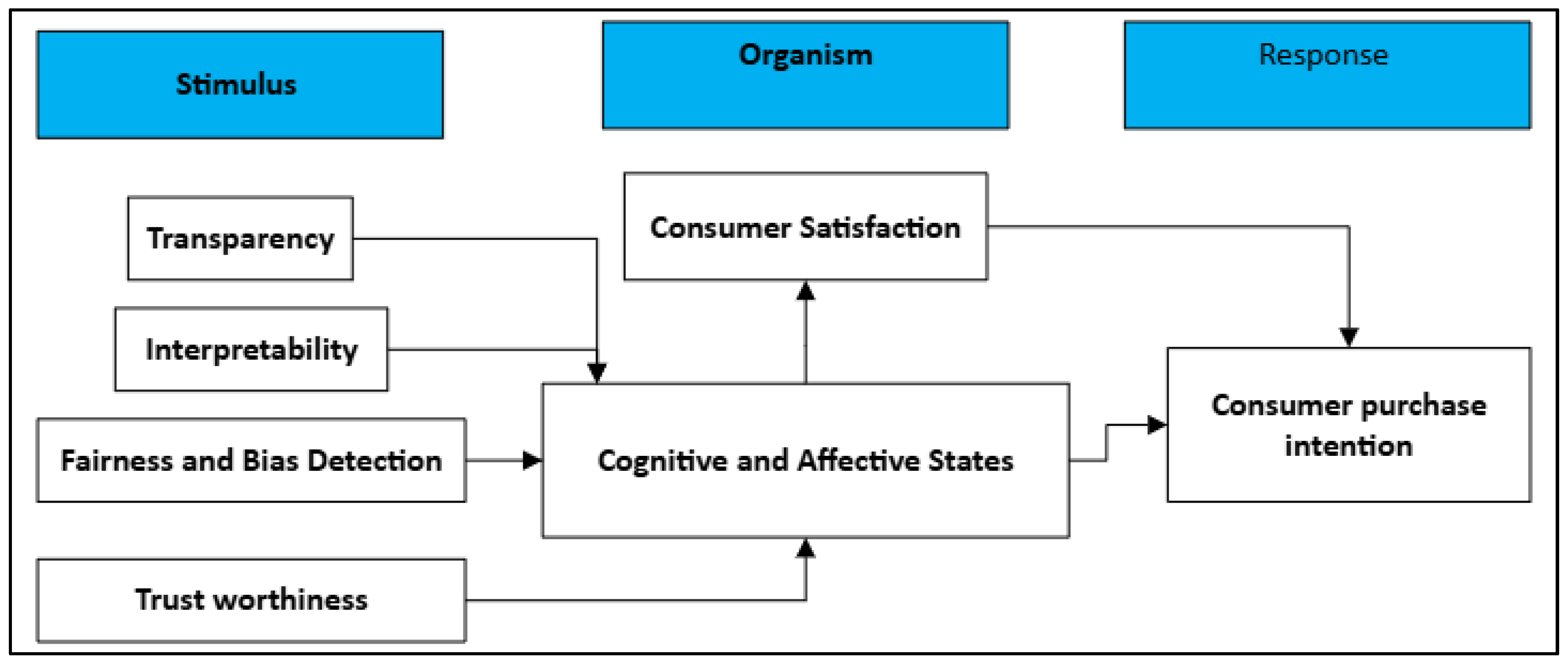
The literature review forms the theoretical background of this research; the stimulus–organism–response (S-O-R) model has a sound theoretical and conceptual basis that helps explain how the characteristics of explainable artificial intelligence (XAI) in the Saudi mobile shopping applications affect user satisfaction and purchase intention. The S-O-R paradigm was initially formulated by [5] and assumes that external stimuli influence internal cognitive and affective attitude (organism) and produce behavioural consequences (response). The application of XAI characteristics, including transparency, interpretability, and trustworthiness in the context of mobile commerce, acts as a stimulus that positively contributes to the user perception of the fairness and reliability of a system. These impressions affect both cognitive evaluations (imagery of usefulness, understanding, and trust) and emotional reactions (satisfaction and confidence) [10]. This assumption of stimulus–organism–response is proven by previous studies that have shown that the combination of XAI leads to a reduction in uncertainty, a lack of ambiguity in decision-making algorithms, and biases perceptions, which positively affect consumer satisfaction and behavioural loyalty [26,35,36]. In the context of the Saudi digital commerce environment, where Vision 2030 initiatives are concerned with digital transformation acceleration, the S-O-R framework presently possesses decisive explanatory capacity in the context of understanding how XAI can be utilised to enhance consumer scepticism, build trust, and deliver positive behavioural consequences [37]. Based on the following model, a suggestion was made in the study (see Figure 1).

4. Research Methodology

This study employs a quantitative, descriptive research design to examine the impact of explainable AI (XAI) features on user satisfaction and purchase intention in Saudi mobile shopping applications, focusing on respondents from the Saudi cities of Jeddah and Makkah. The design facilitates systematic analysis of consumer perceptions and behaviour, ensuring generalizability and real-world relevance. SPSS Statistics version 27 was used in this study. The sample population comprised active users of XAI-enabled shopping apps, and the participants were selected using a convenience and justified sampling method to make them representative. Both online and offline survey techniques were used to gather data and reach a broader scope and inclusiveness. The questionnaire comprised four XAI stimuli hypothesised to affect cognitive and affective states, which, in turn, can lead to consumer satisfaction and purchase intention as the variables of response, which have been proposed to be measured by the stimulus–organism–response framework [5,38]. Construct measures were based on expert face validity refinements of validated scales in the previous literature and transformed into construct measures. A pilot survey (n = 50; 12% of the target sample) was conducted to test item clarity and reliability, yielding Cronbach’s alpha values exceeding 0.70 for all constructs, confirming internal consistency [39]. The full-scale survey achieved 597 valid responses, with construct frequency distributions showing transparency items reported by 98% of respondents, interpretability by 96%, fairness and bias detection by 92%, and trustworthiness by 95%, while cognitive and affective states were reflected in 93% and 90% of responses, respectively, supporting construct adequacy. Data analysis employed SPSS 28.0 for descriptive and reliability testing, while Smart PLS 4.0 was used to perform structural equation modelling (SEM), assessing measurement validity, reliability, and hypothesised relationships between constructs. Harman’s single-factor test was conducted to examine the presence of common method bias in the dataset. The unrotated factor analysis revealed that the first factor accounted for 40.802% of the total variance, which is below the recommended threshold of 50%. Therefore, the results indicate that common method bias is not a serious concern in this study. Convergent and discriminant validity were confirmed using average variance extracted (AVE > 0.50) and the Fornell–Larcker criterion, while model fit indices indicated satisfactory explanatory power (R2 values exceeding 0.60 for endogenous constructs). This methodological approach ensured rigorous construct validity, reliable measurement, and robust statistical inference for testing the influence of XAI features on consumer behaviour in the Saudi mobile shopping context [39,40]. Table 1 indicates the demographic characteristics of respondents.

5. Results

The demographic profile of respondents presented in Table 1 highlights diverse representation across age, gender, education, income, and usage frequency. In terms of age, the majority fell within the 31–40 years category (36.3%, n = 217), followed by 41–50 years (25.1%, n = 150), 21–30 years (17.9%, n = 107), and up to 20 years (16.9%, n = 101), while only a small proportion were above 50 years (3.7%, n = 22). Gender distribution indicates a slight male majority (54.9%, n = 328) compared to females (45.1%, n = 269). Regarding educational attainment, the largest group reported holding technical degrees or diploma certificates (37.2%, n = 222), followed by postgraduates (23.1%, n = 138), professional qualifications (12.1%, n = 72), bachelor’s degrees (15.2%, n = 91), high school (7.7%, n = 46), and other qualifications (4.7%, n = 28). Income distribution reveals that nearly half of the respondents earn up to 5000 SAR (47.4%, n = 283), with 38.2% (n = 228) in the 5001–10,000 SAR range, 10.7% (n = 64) in the 10,001–20,000 SAR range, and only 3.7% (n = 22) earning above 20,000 SAR. Finally, usage frequency indicates that 27.5% (n = 164) of respondents engage occasionally, 26.3% (n = 157) monthly, 18.6% (n = 111) rarely, 14.4% (n = 86) weekly, and 13.2% (n = 79) daily, suggesting a tendency toward moderate-to-occasional engagement.
The multiple response analysis presented in Table 2 provides insights into the distribution of explainable AI (XAI) features across commonly used mobile shopping applications in the Kingdom of Saudi Arabia. A total of 2196 responses were recorded, indicating that participants frequently reported using more than one application, as reflected in the cumulative percentage of cases (367.8%), which exceeds 100% due to multiple selections. Among the applications, Temu registered the highest frequency (n = 408; 18.6% of responses; 68.3% of cases), followed by Shein (n = 373; 17.0%; 62.5%) and Trendyol (n = 333; 15.2%; 55.8%). In contrast, platforms such as Janir Bookstore (n = 189; 8.6%; 31.7%) and Flipchart (n = 191; 8.7%; 32.0%) received the lowest response shares, suggesting comparatively lower user adoption. Mid-range platforms included Amazon.sa (n = 248; 11.3%; 41.5%) and Alixpress (n = 259; 11.8%; 43.4%). These statistical values underscore the dominance of Temu, Shein, and Trendyol in the Saudi e-commerce landscape, while also indicating a fragmented yet diverse shopping ecosystem where multiple apps coexist and overlap in consumer preference patterns.
The descriptive statistics presented in Table 3 provide insights into the stimulus factors influencing cognitive and response behaviour toward explainable artificial intelligence (XAI) and purchase intention. Among the constructs, fairness and bias detection recorded the highest mean score (M = 4.0864, SD = 0.77963, and Var = 0.608), indicating that users strongly value unbiased decision-making and equitable treatment by AI systems. Consumer satisfaction (M = 3.8428, SD = 0.72822, and Var = 0.530) and cognitive and affective states (M = 3.7267, SD = 0.62598, and Var = 0.392) also demonstrated relatively high mean scores, suggesting that satisfaction with AI explanations and positive cognitive–affective experiences enhance consumer trust and decision-making effectiveness. Consumer purchase intention followed closely (M = 3.6463, SD = 0.71145, and Var = 0.506), reflecting that XAI features positively shape users’ willingness to engage in purchase behaviour. Constructs such as interpretability (M = 3.5168, SD = 0.99059, and Var = 0.981) and trustworthiness (M = 3.4845, SD = 0.86060, and Var = 0.741) demonstrated moderate mean values, highlighting that while users appreciate clarity and accountability, these aspects still leave room for improvement. Transparency yielded the lowest mean (M = 3.3388, SD = 0.85277, and Var = 0.727), suggesting that despite its importance, users perceive AI systems as less effective at fully disclosing their processes and reasoning. Overall, the results imply that fairness, satisfaction, and cognitive–affective states are the strongest drivers of favourable consumer responses, while transparency remains a weaker yet critical area for enhancing trust and purchase intentions in mobile shopping contexts.

Stimulus Factors Affecting Cognitive and Response Behaviour Toward Explainable Artificial Intelligence and Purchase Intention: A PLS-SEM

In this study, all constructs were modelled as reflective constructs because their indicators represent observable manifestations of the underlying latent variables related to explainable artificial intelligence features, cognitive evaluation, and behavioural responses. Variations in the latent construct are expected to cause corresponding changes in the indicators; therefore, internal consistency reliability, convergent validity, and discriminant validity assessments were applied to ensure measurement accuracy. The results presented in Table 4 demonstrate that the constructs in the PLS-SEM model exhibit satisfactory reliability and validity based on established threshold criteria. Cronbach’s alpha values for all constructs range between 0.860 and 0.974, exceeding the recommended threshold of 0.70 [39], indicating strong internal consistency. Similarly, composite reliability (rho a and rho c) values for all constructs are above 0.86, surpassing the acceptable cut-off of 0.70, thus confirming construct reliability. The average variance extracted (AVE) values for all constructs fall between 0.700 and 0.867, higher than the minimum threshold of 0.50 [41], which establishes convergent validity. The f-square values indicate varying effect sizes, with consumer purchase intention (0.837) and trustworthiness (0.493) showing large effects, while fairness and bias detection (0.041) and interpretability (0.004) exhibit negligible effects. Furthermore, the Variance Inflation Factor (VIF) values are between 1.000 and 1.308, well below the critical threshold of 5.0, suggesting no multicollinearity issues. Collectively, these findings confirm the model’s reliability, validity, and adequacy for structural model testing.
Table 5 presents the results of discriminant validity testing using the Fornell–Larcker criterion, which compares the square root of the average variance extracted (AVE) for each construct (diagonal values) with the inter-construct correlations (off-diagonal values). According to the threshold suggested by Fornell and Larcker (1981), discriminant validity is established when the square root of AVE for each construct exceeds its correlations with other constructs. In this study, the square roots of AVE values for Consumer Satisfaction (0.859), Cognitive and Affective State of Mind (0.931), Consumer Purchase Intention (0.836), Fairness and Bias Detection (0.848), Interpretability (0.885), Transparency (0.852), and Trustworthiness (0.840) are all greater than their respective inter-construct correlations. For example, Consumer Satisfaction (0.859) shows stronger discriminant validity compared to its correlations with Purchase Intention (0.678) and Transparency (0.424). Similarly, Cognitive and Affective State of Mind (0.931) demonstrates higher discriminant validity over its correlations with Purchase Intention (0.759) and Trustworthiness (0.681). These results indicate that each construct shares more variance with its indicators than with other constructs, thus satisfying the Fornell–Larcker criterion and confirming adequate discriminant validity for the model.
The results of discriminant validity assessment using the Heterotrait–Monotrait ratio (HTMT) presented in Table 6 indicate that the constructs demonstrate satisfactory discriminant validity. According to the established threshold criteria, HTMT values below 0.85 [42] or 0.90 [43] confirm discriminant validity in structural equation modelling. In this study, the HTMT values range between 0.037 and 0.877. While most values, such as between Consumer Satisfaction and Cognitive and Affective State of Mind (0.495), Consumer Satisfaction and Consumer Purchase Intention (0.733), or Transparency and Cognitive and Affective State of Mind (0.648), remain well below the recommended threshold, the association between Trustworthiness and Consumer Purchase Intention (0.877) approaches the upper acceptable limit. Nevertheless, as it does not exceed 0.90, the model maintains adequate discriminant validity, supporting the distinctiveness of the latent constructs and confirming overall model fitness [44].
Table 7 of the correlation analysis shows the relation between transparency, interpretability, fairness and bias detection, trustworthiness, the cognitive and affective state, consumer satisfaction, and consumer purchase intention (N = 597). Transparency has a strong positive relationship with trustworthiness (r = 0.474, p = 0.001), cognitive and affective states (r = 0.599, p = 0.001), consumer satisfaction (r = 0.427, p = 0.001), and purchase intention (r = 0.678, p = 0.001). Cognitive and affective state (r = 0.676, p < 0.001), satisfaction (r = 0.507, p < 0.001), and purchase intention (r = 0.787, p < 0.001) have a close relationship with trustworthiness. Likewise, cognitive and affective states have a significant relationship with satisfaction (r = 0.473, p < 0.001) and purchase intention (r = 0.752, p < 0.001). Conversely, interpretability and fairness have low or insignificant relationships with the majority of constructs. In general, findings indicate that transparency and trustworthiness are important to the development of consumer psychological reactions, satisfaction, and purchase intentions in the XAI context.
The results presented in Table 8 demonstrate the explanatory power, predictive relevance, and model fit of the proposed structural model. The coefficient of determination (R2) indicates that consumer satisfaction is moderately explained by its predictors (R2 = 0.227), while cognitive and affective states of mind (R2 = 0.588) and consumer purchase intention (R2 = 0.706) exhibit substantial explanatory power, surpassing the recommended threshold of 0.50 [39]. The adjusted R2 values are closely aligned, confirming model stability. Predictive accuracy, assessed through RMSE and MAE, shows acceptable error levels, with consumer purchase intention demonstrating the lowest error (RMSE = 0.639, MAE = 0.483). Model fit indices reveal that the Standardised Root Mean Square Residual (SRMR) for the saturated model (0.068) falls below the cut-off of 0.08, indicating good fit, although the estimated model (0.093) slightly exceeds the threshold, suggesting a marginal misfit [45]. The d ULS and d G values are within acceptable ranges, while the Normed Fit Index (NFI) values (0.701 and 0.690) approach the minimum acceptable threshold of 0.70, indicating moderate model fit. Overall, the model demonstrates adequate explanatory power and predictive relevance, with generally acceptable but improvable fit indices.
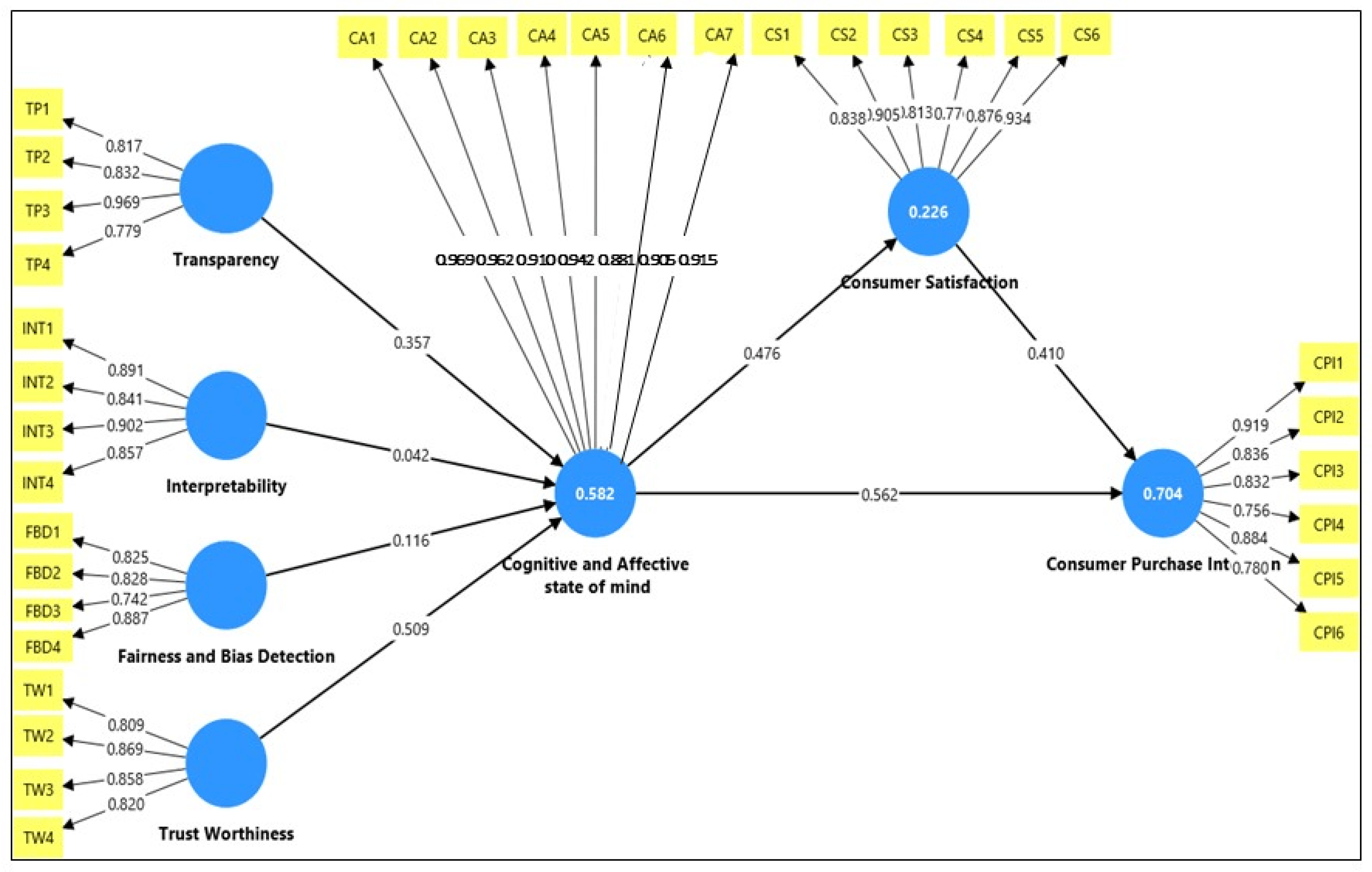
The structural model results presented in Table 9 indicate varying levels of significance among the hypothesised relationships. Transparency exhibits a strong and positive effect on the cognitive and affective state of mind (β = 0.357, t = 10.311, and p < 0.001), supporting the corresponding hypothesis. In contrast, interpretability shows a weak and non-significant effect (β = 0.042, t = 1.316, and p = 0.188), leading to the rejection of its hypothesis. Fairness and bias detection significantly influence the cognitive and affective state of mind (β = 0.129, t = 4.615, and p < 0.001), while trustworthiness emerges as the strongest predictor (β = 0.511, t = 15.702, and p < 0.001), with both hypotheses being accepted. Furthermore, the cognitive and affective state of mind significantly predicts consumer purchase intention (β = 0.562, t = 19.667, and p < 0.001) and consumer satisfaction (β = 0.476, t = 15.323, and p < 0.001), confirming both hypothesised paths. Consumer satisfaction also has a substantial direct effect on consumer purchase intention (β = 0.410, t = 13.540, and p < 0.001). Additionally, the mediating role of consumer satisfaction in the relationship between the cognitive and affective state of mind and purchase intention is statistically significant (β = 0.195, t = 9.055, and p < 0.001). Overall, except for interpretability, all other hypothesised paths are supported, confirming the robustness of the model(see Figure 2).

6. Mediation Analysis

The mediation analysis presented in Table 10 indicates that the cognitive and affective state of mind significantly influences consumer purchase intention both directly and indirectly through consumer satisfaction. The direct path from cognitive and affective state of mind to purchase intention is strong and significant (β = 0.562, t = 19.667, p < 0.001), while the indirect effect via consumer satisfaction is also significant (β = 0.195, t = 9.055, p < 0.001), resulting in a total effect of β = 0.758. This confirms partial mediation, suggesting that consumers’ cognitive and emotional responses not only directly drive purchase intentions but also enhance satisfaction, which subsequently strengthens purchasing behaviour. Furthermore, consumer satisfaction significantly predicts purchase intention (β = 0.410, p < 0.001). Among the antecedents of cognitive and affective state of mind, trustworthiness (β = 0.511) and transparency (β = 0.357) exert the strongest effects, followed by fairness and bias detection (β = 0.129), whereas interpretability shows no significant impact (β = 0.042, p > 0.05). These findings highlight the pivotal mediating role of consumer satisfaction in translating cognitive–affective responses into purchase intentions.

7. Discussion

The results of the current research have valuable implications for explainable artificial intelligence (XAI) features in the consumer satisfaction and purchase intention development in Saudi mobile shopping apps. The findings underpin the stimulus–organism–response (S-O-R) paradigm by showing that XAI elements, including equity, credibility, and disclosure, serve as external stimuli that intervene in the internal assessment of consumers, which ultimately impacts satisfaction and purchase intention [5,46]. As far as the measurement model is concerned, the constructs were considered reflective since the indicators are manifestations of the latent variables and they are likely to covary [39]. Composite reliability and average variance extracted were used to test the reliability and convergent validity, and the Fornell–Larcker criterion, as well as HTMT ratios, were used to test the discriminant validity [44]. Nonetheless, the effect size of interpretability (f2 = 0.004) is extremely small, which indicates that, although interpretability is a source of transparency, the consumers might consider attributes that are related to trust, such as credibility and fairness, when examining AI-helped suggestions, especially in highly uncertain online conditions [26]. Moreover, the structural model showed a marginal fit, as evidenced by the fact that the values of SRMR and NFI are near the recommended values. This means that despite the fact that the model describes the essential explanatory relationships, some contextual or psychological factors can enhance the model’s adequacy and explanatory power in future research [39,47]. The results reveal that fairness and bias detection, transparency, and trustworthiness significantly influence consumers’ cognitive and affective states, which in turn enhance satisfaction and purchase intention. This is consistent with the previous research that suggests that fairness and legal treatment are essential to an efficient building of trust in AI-powered systems, especially in the e-commerce setting, where decision transparency directly influences the credibility and moral accountability views of users [26,48]. Similarly, trustworthiness was found to be the best predictor of cognitive and affective engagement, which supports the claim that trustworthy AI explanations lower consumer uncertainty and enhance behavioural reactions [49,50].
Interestingly, transparency proved to have a significant impact on both the cognitive and affective moods of consumers, which supports its relevance in improving user engagement. This is in agreement with the earlier studies, which emphasise transparency as the basis of developing consumer trust in AI-mediated suggestions [51]. Nevertheless, even though important, transparency was the least significant means of the constructs, which means that users continue to regard AI explanations as not as clear or complete. This is a reflection of the arguments in the literature that existing AI systems tend to lack any explanation on a level that would satisfy consumer expectations of interpretability and actionable comprehension [3,9].
Conversely, interpretability did not exhibit a significant impact, which is contrary to the previous ones, which point to interpretability as one of the primary elements of user trust and decision confidence [8]. It could be because fairness, trustworthiness, and emotional assurance might be more important in mobile shopping scenarios than technical understandability, a result that aligns with cultural views on technology acceptance in collectivist cultures, where relationships and ethical values tend to be more important than purely cognitive ones [52]. Furthermore, the study highlights the mediating role of consumer satisfaction between cognitive–affective states and purchase intention. The findings of this study are very much associated with the stimulus–organism–response (SOR) paradigm [5], which proves that the internal evaluations of consumers, especially satisfaction, are a very important psychological mechanism through which the external technological stimuli are correlated to behavioural response. In line with previous studies on the subject of online consumer behaviour, satisfaction proves to be a core mediator between trust perceptions and purchase intention [53,54]. Following the line of thought, the research demonstrates that explainable artificial intelligence (XAI) characteristics, properly implemented, can increase their cognitive and emotional comfort, which leads to a greater level of satisfaction and further purchasing behaviour [26,55]. Critically, the findings indicate the situational applicability of feeling engagement and perceived ethical guarantees when it comes to consumer reactions, which supports the more recent claims that transparency and fairness in AI systems play an important role in user trust and engagement. In practical terms, the implications of the findings are that organisations ought to focus on the user-centric design of XAI, with an emphasis on interpretability, accountability, and ethical communication, so as to enhance consumer confidence and satisfaction. Altogether, the current research contributes to supporting the available evidence and even further developing the discussion by incorporating XAI-specific properties into the SOR paradigm, which adds an additional layer of theory-related knowledge and management-related relevance to digital marketing scenarios.

8. Theoretical Implications

The research contributes to the development of a theoretical conceptualization of explainable artificial intelligence (XAI) into the framework of stimulus–organism–response (S-O-R) by filling a critical conceptual gap in the previous literature. Although previous research has investigated the issues of algorithmic transparency and trust in the AI-mediated decision-making context, there is a paucity of literature that systematically frames the XAI design properties as the environmental stimulus to influence the inner cognitive and affective judgements in digital commerce scenarios. Based on the concept of the S-O-R paradigm [5], this paper conceptualises equity (fairness), credibility, and disclosure (transparency) as independent external stimuli built into mobile shopping interfaces and the elicitation of the organismic reaction in consumers in terms of cognitive and affective reactions with AI systems. On the conceptual level, the paper separates transparency and interpretability, with the former meaning the availability of system logic and decision-rationality, and the latter indicating that the user can understand the algorithmic processes technically [56]. Likewise, equitable (fairness) is differentiated from trustworthiness, with the equitable implying perceived procedural justice in an algorithmic decision, and trustworthiness implying perceived reliability and integrity of an AI system [26]. The study elaborates on previous S-O-R applications in digital settings by promoting the perceived trustworthiness as a systems attribute of stimulus (including platform design) as opposed to only being an internal mediator. The result also indicates that consumer satisfaction mediates the conversion of cognitive–affective judgment to purchase intention, thus providing a sophisticated conceptualisation of the effect of XAI-driven system cues on consumer behaviour in AI-based trade.

8.1. Managerial Implications

From a managerial perspective, the findings underscore the need for e-commerce firms in Saudi Arabia and beyond to embed fairness, bias detection, and trustworthy communication as core features of their AI systems. Emotional trust can be enhanced by ensuring that consumers feel that the recommendations provided by AI are unbiased and fair, which, in the end, will promote greater levels of consumer satisfaction and purchase intentions. Transparency, less powerful as it is perceived to be in existing systems, turned out to be a major contributor to cognitive–affective engagement. In this way, managers ought to invest in better disclosure systems, which are clearer and easier to understand for consumers, such as simplified visual explanations or personalised reasoning, rather than entirely technical descriptions. In addition, consumer satisfaction mediates the connection between cognitive–affective states and purchase behaviour, so companies need to pay attention to the development of emotional AI experiences and user-centred design. These lessons imply that the cost model of competitive advantage in digital retailing should depend, more and more, on the effectiveness of humanising AI platforms by being fair, transparent, and honest in interactions [4]).

8.2. Policy Implication

From the policy perspective, the findings have a number of policy implications for regulators, digital commerce regulators, and technology-governing agencies. The important issue that policymakers should focus on is the creation of a clear-cut regulatory framework, which can guarantee transparency, fairness, and trustworthiness in AI-enabled consumer platforms, specifically in mobile commerce settings. The study indicated that trustworthiness and transparency are crucial factors determining the cognitive–affective behaviour and eventual buying intentions of consumers. Regulatory principles need to prompt the companies to adopt responsible AI, bias detection mechanisms, and ethical auditing principles. In addition, it is recommended to facilitate the design of AI policies that are consumer-focused to boost satisfaction and accountable communication of AI. By implementing national AI governance principles, consumer protection principles, and algorithmic responsibility principles, we can enhance consumer trust and encourage the sustainable use of explanatory AI in the digital market.

9. Conclusions

The present paper supports the importance of the explainable artificial intelligence (XAI) features for developing consumer satisfaction and purchase intention in mobile shopping applications. In particular, fairness, transparency, and trustworthiness become the key contributors to both the cognitive and affective involvement, which makes them even more significant in the context of technology-mediated consumer behaviour. Even though the interpretability showed no notable effect at the direct level, results indicate the mediating role of the consumer satisfaction, and emotional and evaluative processes play an important role in converting XAI attributes into behavioural outcomes. In addition to these empirical observations, the research also contributes to the literature in a way that contributes to the research about the application of XAI in consumer settings, especially its implementation of cognitive–affective processes in the context of digital commerce. It builds upon the existing literature by showing the different ways that certain XAI dimensions affect consumer responses and, therefore, provides a more detailed view of technology adoption and the formation of trust. Also, the findings are consistent and compatible with the theoretical framework as they empirically confirm the mediations in which XAI characteristics influence behavioural intentions. From a practical perspective, the research has presented practical implications for managers and platform designers, which underlines the importance of focusing on impartiality, transparency, and trust-building systems to promote user experience, build satisfaction, and build consumer loyalty. In general, the study provides a holistic synthesis that not only covers the outlined research goals but also aids in filling the gaps that are still present in the literature, thus providing a platform on which future studies examining XAI-driven consumer behaviour may be conducted.

10. Limitations

The study has limitations in spite of its contribution. To start with, the study was carried out in the Saudi Arabian context, and this could not be generalised to other cultural or regulatory environments where consumers have a different attitude towards AI. Second, the cross-sectional design does not allow causal inference since the perceptions and intentions of the consumers might change over time due to continued exposure to AI. Third, the research used self-reported data, which can also be biased by social desirability or by poor knowledge of technical aspects of AI. The fourth limitation relates to the model fit indices. The Normed Fit Index (NFI ≈ 0.70) is slightly below the recommended threshold, and the SRMR value (0.093) marginally exceeds the acceptable criterion of 0.08. These results indicate moderate model fit; therefore, findings should be interpreted cautiously, and future research should refine the model with improved measurement and larger samples. Lastly, the omission of the moderating variables like demographic differences, previous experience with AI, or cultural values could have missed the key nuances.

11. Future Scope

Future research could adopt longitudinal or experimental designs to capture changes in consumer trust and purchase behaviours over time. Comparative studies across countries or cultural settings would provide deeper insights into the universality or contextual dependence of XAI effects. Scholars may also investigate moderating variables such as consumer technology readiness, privacy concerns, or regulatory frameworks to better explain heterogeneity in responses. Additionally, integrating qualitative approaches such as interviews could enrich the understanding of why consumers prioritise fairness and trust over interpretability. Finally, extending the S–O–R framework to explore post-purchase behaviours, such as loyalty or advocacy, would offer a more comprehensive perspective on the long-term impact of XAI in e-commerce.

Author Contributions

Methodology, A.S.M.A., L.K.N. and N.N.H.; Software, S.H.; Validation, A.S.M.A. and L.K.N.; Formal analysis, S.H. and L.K.N.; Investigation, N.N.H.; Resources, S.H.; Data curation, N.N.H.; Writing—original draft, A.S.M.A., S.H., L.K.N. and N.N.H.; Writing—review & editing, S.H., L.K.N. and N.N.H.; Supervision, A.S.M.A. and N.N.H.; Funding acquisition, A.S.M.A., L.K.N., S.H. and N.N.H. All authors have read and agreed to the published version of the manuscript.

Funding

This research received no external funding.

Institutional Review Board Statement

Not applicable.

Informed Consent Statement

Not applicable.

Data Availability Statement

The data presented in this study are available on request from the corresponding author due to privacy.

Conflicts of Interest

The authors declare no conflicts of interest.

References

  1. Grand View Research. mHealth Apps Market Size, Share & Trends Analysis Report by App Type, by Platform, by Region, and Segment Forecasts 2024, 2024–2030; Grand View Research: San Francisco, CA, USA, 2024; Available online: https://www.grandviewresearch.com/industry-analysis/mhealth-apps-market (accessed on 2 March 2025).
  2. Chaffey, D.; Ellis-Chadwick, F. Digital Marketing; Pearson UK: London, UK, 2019. [Google Scholar]
  3. Adadi, A.; Berrada, M. Peeking inside the black-box: A survey on Explainable Artificial Intelligence (XAI). IEEE Access 2018, 6, 52138–52160. [Google Scholar] [CrossRef]
  4. Arrieta, A.B.; Díaz-Rodríguez, N.; Del Ser, J.; Bennetot, A.; Tabik, S.; Barbado, A.; García, S.; Gil-López, S.; Molina, D.; Benjamins, R. Explainable Artificial Intelligence (XAI): Concepts, taxonomies, opportunities and challenges toward responsible AI. Inf. Fusion 2020, 58, 82–115. [Google Scholar] [CrossRef]
  5. Mehrabian, A.; Russell, J.A. An Approach to Environmental Psychology; MIT Press: Cambridge, MA, USA, 1974. [Google Scholar]
  6. Yin, J.; Qiu, X. AI Technology and Online Purchase Intention: Structural Equation Model Based on Perceived Value. Sustainability 2021, 13, 5671. [Google Scholar] [CrossRef]
  7. Erliana, S. A Systematic Literature Review on Artificial Intelligence Features Driving Purchase Intention on Web Commerce: Insights into Customer Experience and Trust Using Python-Based Analysis. J. Digit. Bus. Innov. Manag. 2025, 4. [Google Scholar]
  8. Doshi-Velez, F.; Kim, B. Towards a rigorous science of interpretable machine learning. arXiv 2017, arXiv:1702.08608. [Google Scholar] [CrossRef]
  9. Miller, T. Explanation in artificial intelligence: Insights from the social sciences. Artif. Intell. 2019, 267, 1–38. [Google Scholar] [CrossRef]
  10. Eroglu, S.A.; Machleit, K.A.; Davis, L.M. Atmospheric qualities of online retailing: A conceptual model and implications. J. Bus. Res. 2001, 54, 177–184. [Google Scholar] [CrossRef]
  11. Muslim, S.N. Promotion of Accountability in Bangladesh: Civil Service Problems and Strategies; University of Dhaka: Dhaka, Bangladesh, 2024. [Google Scholar]
  12. Mumtaz, F.; Qaisar, M.N.; Zahid, A.; Ahmed, N. The Impact of Artificial Intelligence on Consumer Decision-Making in Digital Marketing. J. Asian Dev. Stud. 2025, 14, 372–387. [Google Scholar] [CrossRef]
  13. Khan, S.M.F.A.; Shehawy, Y.M. Perceived AI Consumer-Driven Decision Integrity: Assessing Mediating Effect of Cognitive Load and Response Bias. Technologies 2025, 13, 374. [Google Scholar] [CrossRef]
  14. Zhang, S. The Role of Artificial Intelligence in Enhancing Online Sales and the Customer Experience. 2024. Available online: https://www.theseus.fi/handle/10024/858780 (accessed on 2 March 2025).
  15. Khrais, L.T. Role of artificial intelligence in shaping consumer demand in E-commerce. Future Internet 2020, 12, 226. [Google Scholar] [CrossRef]
  16. Qiu, H.; Wang, X.; Wu, M.Y.; Wei, W.; Morrison, A.M.; Kelly, C. The effect of destination source credibility on tourist environmentally responsible behavior: An application of stimulus-organism-response theory. J. Sustain. Tour. 2023, 31, 1797–1817. [Google Scholar] [CrossRef]
  17. Lipton, Z.C. The mythos of model interpretability: In machine learning, the concept of interpretability is both important and slippery. Queue 2018, 16, 31–57. [Google Scholar] [CrossRef]
  18. Oliver, R.L. Satisfaction: A Behavioral Perspective on the Consumer: A Behavioral Perspective on the Consumer; Routledge: London, UK, 2014. [Google Scholar]
  19. Pavlou, P.A. Consumer acceptance of electronic commerce: Integrating trust and risk with the technology acceptance model. Int. J. Electron. Commer. 2003, 7, 101–134. [Google Scholar] [CrossRef]
  20. Wiratsin, I.-O.; Ragkhitwetsagul, C. Effectiveness of explainable artificial intelligence (XAI) techniques for improving human trust in machine learning models: A systematic literature review. IEEE Access 2025. [Google Scholar] [CrossRef]
  21. Mary, R.; Esther, P.; Bens, W.; Ikhmat, A.; Lanre, A. Explainable AI in Personalized Marketing: Implications for Trust and Transparency in the Tech Industry. Procedia Comput. Sci. 2026, 270, 5625–5633. [Google Scholar]
  22. Yoon, S.; Shin, H.; Choi, J. Regulatory Fit in Explainable AI-Based Recommendations: A Comparative Study of Personalized Explanation Strategies on User Experience and Persuasion. Int. J. Hum.–Comput. Interact. 2026, 1–35. [Google Scholar] [CrossRef]
  23. Donovan, R.J.; Rossiter, J.R. Store Atmosphere: An Environmental Psychology. Available online: https://www.researchgate.net/publication/248766608_Store_Atmosphere_An_Environmental_Psychology_Approach (accessed on 2 March 2017).
  24. Gunning, D.; Aha, D. DARPA’s explainable artificial intelligence (XAI) program. AI Mag. 2019, 40, 44–58. [Google Scholar]
  25. Bagozzi, R.P.; Gopinath, M.; Nyer, P.U. The role of emotions in marketing. JAMS 1999, 27, 184–206. [Google Scholar] [CrossRef]
  26. Shin, D. The effects of explainability and causability on perception, trust, and acceptance: Implications for explainable AI. Int. J. Hum.–Comput. Stud. 2021, 146, 102551. [Google Scholar] [CrossRef]
  27. Samek, W.; Montavon, G.; Vedaldi, A.; Hansen, L.K.; Müller, K.-R. Explainable AI: Interpreting, Explaining and Visualizing Deep Learning; Springer Nature: Berlin/Heidelberg, Germany, 2019. [Google Scholar]
  28. Ramon, Y.; Vermeire, T.; Toubia, O.; Martens, D.; Evgeniou, T. Understanding consumer preferences for explanations generated by XAI algorithms. arXiv 2021, arXiv:2107.02624. [Google Scholar] [CrossRef]
  29. Mohanna, S.; Basiouni, A. Consumer’s cognitive and affective perceptions of artificial intelligence (AI) in social media: Topic modelling approach. J. Electr. Syst. 2024, 20, 1317–1326. [Google Scholar] [CrossRef]
  30. Palací, F.; Salcedo, A.; Topa, G. Cognitive and affective antecedents of consumers’ satisfaction: A systematic review of two research approaches. Sustainability 2019, 11, 431. [Google Scholar] [CrossRef]
  31. Bernardo, E.; Seva, R. Affective design analysis of explainable artificial intelligence (XAI): A user-centric perspective. Informatics 2023, 10, 32. [Google Scholar] [CrossRef]
  32. Shan, Y.; Li, R.Y.M. The impact of AI recommendation’s price and product accuracy on customer satisfaction: SEM-SOR theoretical approach. Curr. Psychol. 2025, 44, 6978–6988. [Google Scholar] [CrossRef]
  33. Domingos, M.I.R.V.V. Impact of Recommender Agents Used in Online Retail on Customer Satisfaction and Purchase Intention. Ph.D. Thesis, Universidade NOVA de Lisboa, Lisboa, Portugal, 2024. [Google Scholar]
  34. Chang, S.-H.; Chih, W.-H.; Liou, D.-K.; Yang, Y.-T. The mediation of cognitive attitude for online shopping. Inf. Technol. People 2016, 29, 618–646. [Google Scholar] [CrossRef]
  35. Abdul, A.; Vermeulen, J.; Wang, D.; Lim, B.Y.; Kankanhalli, M. Trends and trajectories for explainable, accountable and intelligible systems: An hci research agenda. In Proceedings of the 2018 CHI Conference on Human Factors in Computing Systems, Montreal, QC, Canada, 21–26 April 2018; pp. 1–18. [Google Scholar]
  36. Ribeiro, M.T.; Singh, S.; Guestrin, C. “Why should i trust you?” Explaining the predictions of any classifier. In Proceedings of the 22nd ACM SIGKDD International Conference on Knowledge Discovery and Data Mining, San Francisco, CA, USA, 13–17 August 2016; pp. 1135–1144. [Google Scholar]
  37. Wasiq, M.; Johri, A.; Singh, P. Factors affecting adoption and use of M-commerce services among the customers in Saudi Arabia. Heliyon 2022, 8, e12532. [Google Scholar] [CrossRef] [PubMed]
  38. Jacovi, A.; Marasović, A.; Miller, T.; Goldberg, Y. Formalizing trust in artificial intelligence: Prerequisites, causes and goals of human trust in AI. In Proceedings of the 2021 ACM Conference on Fairness, Accountability, and Transparency, Online, 3–10 March 2021; pp. 624–635. [Google Scholar]
  39. Hair, J.F.; Hult, G.T.M.; Ringle, C.M.; Sarstedt, M.; Danks, N.P.; Ray, S. Partial Least Squares Structural Equation Modeling (PLS-SEM) Using R: A Workbook; Springer: Berlin/Heidelberg, Germany, 2021. [Google Scholar]
  40. Gefen, D.; Straub, D.; Boudreau, M.-C. Structural equation modeling and regression: Guidelines for research practice. Commun. Assoc. Inf. Syst. 2000, 4, 7. [Google Scholar] [CrossRef]
  41. Fornell, C.; Larcker, D.F. Evaluating structural equation models with unobservable variables and measurement error. J. Mark. Res. 1981, 18, 39–50. [Google Scholar] [CrossRef]
  42. Kline, R.B. Principles and Practice of Structural Equation Modeling, 5th ed.; Guilford Publications: New York, NY, USA, 2023. [Google Scholar]
  43. Gold, A.H.; Malhotra, A.; Segars, A.H. Knowledge management: An organizational capabilities perspective. JIMS 2001, 18, 185–214. [Google Scholar] [CrossRef]
  44. Henseler, J.; Ringle, C.M.; Sarstedt, M. A new criterion for assessing discriminant validity in variance-based structural equation modeling. J. Acad. Mark. Sci. 2015, 43, 115–135. [Google Scholar] [CrossRef]
  45. Hu, L.T.; Bentler, P.M. Cutoff criteria for fit indexes in covariance structure analysis: Conventional criteria versus new alternatives. Struct. Equ. Model. Multidiscip. J. 1999, 6, 1–55. [Google Scholar] [CrossRef]
  46. Kim, J.; Lennon, S.J. Effects of reputation and website quality on online consumers’ emotion, perceived risk and purchase intention: Based on the stimulus-organism-response model. J. Res. Interact. Mark. 2013, 7, 33–56. [Google Scholar] [CrossRef]
  47. Sarstedt, M.; Ringle, C.M.; Hair, J.F. Partial least squares structural equation modeling. In Handbook of Market Research; Springer: Berlin/Heidelberg, Germany, 2021; pp. 587–632. [Google Scholar]
  48. Awad, N.F.; Krishnan, M.S. The Personalization Privacy Paradox: An Empirical Evaluation of Information Transparency and the Willingness to be Profiled Online for Personalization1. MIS Q. 2006, 30, 13–28. [Google Scholar] [CrossRef]
  49. Kizilcec, R.F. How much information? Effects of transparency on trust in an algorithmic interface. In Proceedings of the 2016 CHI Conference on Human Factors in Computing Systems, San Jose, CA, USA, 7–12 May 2016; pp. 2390–2395. [Google Scholar]
  50. Langer, M.; Oster, D.; Speith, T.; Hermanns, H.; Kästner, L.; Schmidt, E.; Sesing, A.; Baum, K. What do we want from Explainable Artificial Intelligence (XAI)?—A stakeholder perspective on XAI and a conceptual model guiding interdisciplinary XAI research. Artif. Intell. 2021, 296, 103473. [Google Scholar] [CrossRef]
  51. Wang, W.; Siau, K. Artificial intelligence, machine learning, automation, robotics, future of work and future of humanity: A review and research agenda. J. Database Manag. (JDM) 2019, 30, 61–79. [Google Scholar] [CrossRef]
  52. Alalwan, A.A. Investigating the impact of social media advertising features on customer purchase intention. Int. J. Inf. Manag. 2018, 42, 65–77. [Google Scholar] [CrossRef]
  53. Lim, W.M.; Yap, S.-F.; Makkar, M. Home sharing in marketing and tourism at a tipping point: What do we know, how do we know, and where should we be heading? J. Bus. Res. 2021, 122, 534–566. [Google Scholar] [CrossRef]
  54. Pappas, I.O. User experience in personalized online shopping: A fuzzy-set analysis. Eur. J. Mark. 2018, 52, 1679–1703. [Google Scholar] [CrossRef]
  55. Dwivedi, Y.K.; Hughes, L.; Wang, Y.; Alalwan, A.A.; Ahn, S.J.; Balakrishnan, J.; Barta, S.; Belk, R.; Buhalis, D.; Dutot, V. Metaverse marketing: How the metaverse will shape the future of consumer research and practice. Psychol. Mark. 2023, 40, 750–776. [Google Scholar] [CrossRef]
  56. Bhatt, U.; Xiang, A.; Sharma, S.; Weller, A.; Taly, A.; Jia, Y.; Ghosh, J.; Puri, R.; Moura, J.M.; Eckersley, P. Explainable machine learning in deployment. In Proceedings of the 2020 Conference on Fairness, Accountability, and Transparency, Barcelona, Spain, 27–30 January 2020; pp. 648–657. [Google Scholar]
Figure 1. Proposed model.
Jtaer 21 00120 g001
Figure 2. Structural model and path coefficients.
Jtaer 21 00120 g002
Table 1. Demographic characteristics of respondents (N = 597).
CharacteristicsDescriptionFrequencyPercentage
AgeUp to 20 Years10116.9
21–30 Years10717.9
31–40 Years21736.3
41 to 50 Years15025.1
Above 50 years223.7
GenderMale32854.9
Female26945.1
Education LevelHigh school467.7
Bachelor’s9115.2
Post graduation13823.1
Technical degree/diploma certificates22237.2
Professional qualifications7212.1
Other qualifications284.7
Income levelUp to 5000 SAR28347.4
From 5001 to 10,000 SAR22838.2
From 10,001 to 20,000 SAR6410.7
More than 20,000 SAR223.7
Uses FrequencyRarely11118.6
Occasionally16427.5
Monthly15726.3
Weekly8614.4
Daily7913.2
Table 2. Explainable AI features and commonly used shopping apps.
Shopping AppsResponsesPercent of Cases
NPercent
Temu40818.6%68.3%
Trendyol33315.2%55.8%
Noon1958.9%32.7%
Shein37317.0%62.5%
Flipchart1918.7%32.0%
Amazon.sa24811.3%41.5%
Janir Bookstore1898.6%31.7%
Alixpress25911.8%43.4%
Total2196100.0%367.8%
Table 3. Stimulus factors affecting cognitive and response behaviour toward explainable artificial intelligence and purchase intention: Descriptive statistics (N = 597).
MeanStd. Variance
Transparency 3.3390.8530.727
Transparency in AI processes helps me understand how decisions are made.0.8173.5561.0261.053
Clear communication of AI algorithms builds my confidence in AI-based recommendations.0.8323.6081.0461.094
I am more likely to use AI systems that disclose their methods and limitations.0.9693.4090.8710.759
A well-reasoned recommendation links findings to actionable steps0.7792.7821.0961.201
Interpretability 3.5170.9910.981
I find the AI system’s outputs easy to understand.0.8803.4521.1571.339
The AI provides explanations that make its decisions clear.0.8653.3551.1931.424
I can interpret the reasoning behind the AI’s results without difficulty.0.9203.5141.0801.166
The AI’s outputs are presented in a way that is simple and transparent.0.8753.7451.0211.042
The AI system provides fair recommendations without discrimination.0.8803.9301.0801.166
Fairness and Bias Detection 4.0860.7800.608
The AI system avoids bias in decision-making.0.8684.3500.6650.443
I believe the AI system treats all users equally, regardless of their background.0.8244.0690.8900.792
The AI system ensures fairness when generating outputs.0.7143.9460.9000.809
The AI system is effective in detecting and correcting bias.0.9684.1370.9170.840
Trustworthiness 3.4850.8610.741
I trust AI systems more when accountability is clearly defined.0.8103.3001.1241.264
Trustworthy AI explanations increase my willingness to rely on AI in decision-making.0.8693.2951.0401.081
The “black-box” nature of AI makes it difficult for me to trust its decisions.0.8583.5430.9710.943
I prefer AI systems that explain their decisions rather than those that work opaquely.0.8203.8010.9670.935
Cognitive and Affective States 3.7270.6260.392
The explainable AI features in this shopping app enhance the effectiveness of my purchase decisions.0.9693.6520.6600.435
Using explainable AI helps me make more informed choices while shopping on the app.0.9633.6480.6430.413
The explainable AI features improve the overall value I get from using the app.0.9403.7710.6730.452
Interacting with explainable AI features in this app is clear and understandable.0.9423.6550.6940.481
It is easy for me to learn how to use the explainable AI features provided in the app.0.8813.6920.6920.479
Using explainable AI features requires little effort on my part.0.9063.8110.6730.452
I believe the explainable AI features in this app provide unbiased recommendations.0.9153.8590.6760.457
Consumer Satisfaction 3.8430.7280.530
I am satisfied with the way the AI system explains its recommendations during my decision-making process.0.8383.7520.8950.801
The explanations provided by the AI increase my confidence in making purchase decisions.0.9053.8140.8830.779
I feel that the AI’s explanations are clear, transparent, and easy to understand.0.8133.8410.7940.631
The AI’s ability to justify its recommendations makes me trust its suggestions more.0.7763.7540.9260.857
I am satisfied with how the AI addresses my individual needs and preferences through its explanations.0.8763.9510.7720.597
The AI explanations reduce my doubts and uncertainty when choosing a product or service.0.9343.9450.8350.697
Consumer Purchase Intention 3.6460.7110.506
Explainable AI (XAI) features in mobile shopping apps have helped me to understand why a product is suggested.0.9183.7370.7880.620
My dependency on explainable AI (XAI) Features in Mobile Shopping Apps has increased in exploring information and in building purchase intention towards the product.0.8363.8090.8880.789
The AI explanations increase my trust in the mobile shopping app’s product recommendations.0.8333.4490.9410.885
I feel more confident in my purchase decisions when the app provides clear reasons for its recommendations.0.7563.7740.7380.544
The explainable AI features make me believe that the app is reliable and customer-centric. I am more likely to purchase products suggested by the app.0.8843.5310.8730.763
I intend to continue using mobile shopping apps that provide explainable AI recommendations for my future purchases.0.7803.5780.8820.778
Valid N (listwise)
Table 4. Construct reliability and validity.
Cronbach’s AlphaComposite Reliability (rho a)Composite Reliability (rho c)Average Variance Extracted (AVE)f-SquareVIF
Consumer Satisfaction0.9280.9290.9440.7370.4401.293
Cognitive and Affective state of mind0.9740.9770.9790.8670.2931.000
Consumer Purchase Intention0.9130.9210.9330.7000.8371.293
Fairness and Bias Detection0.9141.0240.9270.7190.0411.006
Interpretability0.9131.0200.9350.7830.0041.009
Transparency0.8720.8900.9130.7260.2341.308
Trustworthiness0.8600.8640.9050.7050.493VIF
Table 5. Discriminant validity: Fornell–Larcker criterion.
Consumer SatisfactionCognitive and Affective State of MindConsumer Purchase IntentionFairness and Bias DetectionInterpretabilityTransparencyTrustworthiness
Consumer Satisfaction0.859
Cognitive and Affective state of mind0.4760.931
Consumer Purchase Intention0.6780.7590.836
Fairness and Bias Detection−0.0740.141−0.0080.848
Interpretability0.0860.0480.042−0.0370.885
Transparency0.4240.6100.6760.0510.0610.852
Trustworthiness0.5080.6810.787−0.011−0.0220.4770.840
Table 6. Discriminant validity: Heterotrait-monotrait ratio (HTMT)—Matrix.
Consumer SatisfactionCognitive and Affective State of MindConsumer Purchase IntentionFairness and Bias DetectionInterpretabilityTransparencyTrustworthiness
Consumer Satisfaction
Cognitive and Affective state of mind0.495
Consumer Purchase Intention0.7330.789
Fairness and Bias Detection0.0910.1260.061
Interpretability0.0910.0460.0480.042
Transparency0.4710.6480.7570.0620.066
Trustworthiness0.5690.7380.8770.0580.0370.547
Table 7. Construct correlation analysis.
TransparencyInterpretabilityFairness and Bias DetectionTrustworthinessCognitive and Affective StatesConsumer SatisfactionConsumer Purchase Intention
TransparencyPearson Correlation10.0560.0610.4740.5990.4270.678
Sig. (2-tailed) 0.1750.1380.0000.0000.0000.000
InterpretabilityPearson Correlation0.0561−0.053−0.0320.0390.0850.037
Sig. (2-tailed)0.175 0.1990.4290.3440.0380.365
Fairness and Bias Detection Pearson Correlation0.061−0.0531−0.0170.117−0.069−0.010
Sig. (2-tailed)0.1380.199 0.6730.0040.0940.810
TrustworthinessPearson Correlation0.474−0.032−0.01710.6760.5070.787
Sig. (2-tailed)0.0000.4290.673 0.0000.0000.000
Cognitive and Affective States Pearson Correlation0.5990.0390.1170.67610.4730.752
Sig. (2-tailed)0.0000.3440.0040.000 0.0000.000
Consumer SatisfactionPearson Correlation0.4270.085−0.0690.5070.47310.678
Sig. (2-tailed)0.0000.0380.0940.0000.000 0.000
Consumer Purchase IntentionPearson Correlation0.6780.037−0.0100.7870.7520.6781
Sig. (2-tailed)0.0000.3650.8100.0000.0000.000
a. Listwise N = 597
Table 8. R-square, Q2 predict, and model fit summary.
R-SquareR-Square Adjusted RMSEMAE
Consumer satisfaction0.2270.2250.2590.8640.694
Cognitive and affective state of mind0.5880.5850.5800.6510.519
Consumer purchase intention0.7060.7050.6390.6030.483
Model fit summary
Saturated modelEstimated model
SRMR0.0680.093
d ULS3.0465.723
d G3.0163.183
Chi-square8083.5068387.238
NFI0.7010.690
Table 9. Structural model and path coefficients: Mean, STDEV, T values, and p-values.
Path Coefficient (β)Standard Deviation (STDEV)T Statistics (|O/STDEV|)p-Values
Transparency -> cognitive and affective state of mind0.3570.03510.3110.000
Interpretability -> cognitive and affective state of mind0.0420.0321.3160.188
Fairness and bias detection -> cognitive and affective state of mind0.1290.0284.6150.000
Trustworthiness -> cognitive and affective state of mind0.5110.03315.7020.000
Cognitive and affective state of mind -> consumer purchase intention0.5620.02919.6670.000
Cognitive and affective state of mind -> consumer satisfaction0.4760.03115.3230.000
Consumer satisfaction -> consumer purchase intention0.4100.03013.5400.000
Cognitive and affective state of mind -> consumer satisfaction -> consumer purchase intention0.1950.0229.0550.000
Table 10. Mediation Results (PLS-SEM-Model).
RelationshipDirect Effect (β)Indirect Effect (β)Total Effect (β)T-Valuep-ValueMediation Type
Cognitive & Affective State of Mind → Consumer Purchase Intention0.5620.1950.75819.6670.000Partial mediation
Cognitive & Affective State of Mind → Consumer Satisfaction0.4760.47615.3230.000Direct effect
Consumer Satisfaction → Consumer Purchase Intention0.4100.41013.5400.000Direct effect
Transparency → Cognitive & Affective State of Mind0.3570.35710.3110.000Significant
Fairness & Bias Detection → Cognitive & Affective State of Mind0.1290.1294.6150.000Significant
Trustworthiness → Cognitive & Affective State of Mind0.5110.51115.7020.000Significant
Interpretability → Cognitive & Affective State of Mind0.0420.0421.3160.188Not significant
Disclaimer/Publisher’s Note: The statements, opinions and data contained in all publications are solely those of the individual author(s) and contributor(s) and not of MDPI and/or the editor(s). MDPI and/or the editor(s) disclaim responsibility for any injury to people or property resulting from any ideas, methods, instructions or products referred to in the content.