
Research on the Impact and Mechanism of Rural E-Commerce on Market-Oriented Allocation of County-Level Urban–Rural Factors from the Perspective of Digital Empowerment


Abstract
1. Introduction
1.1. Theoretical Link Between Rural E-Commerce Development and Urban–Rural Factor Allocation
1.2. Mechanism Through Which Digital Empowerment Affects Market-Oriented Factor Allocation
1.3. Limitations of the Existing Literature and the Contributions of This Study
2. Policy Background and Theoretical Hypotheses
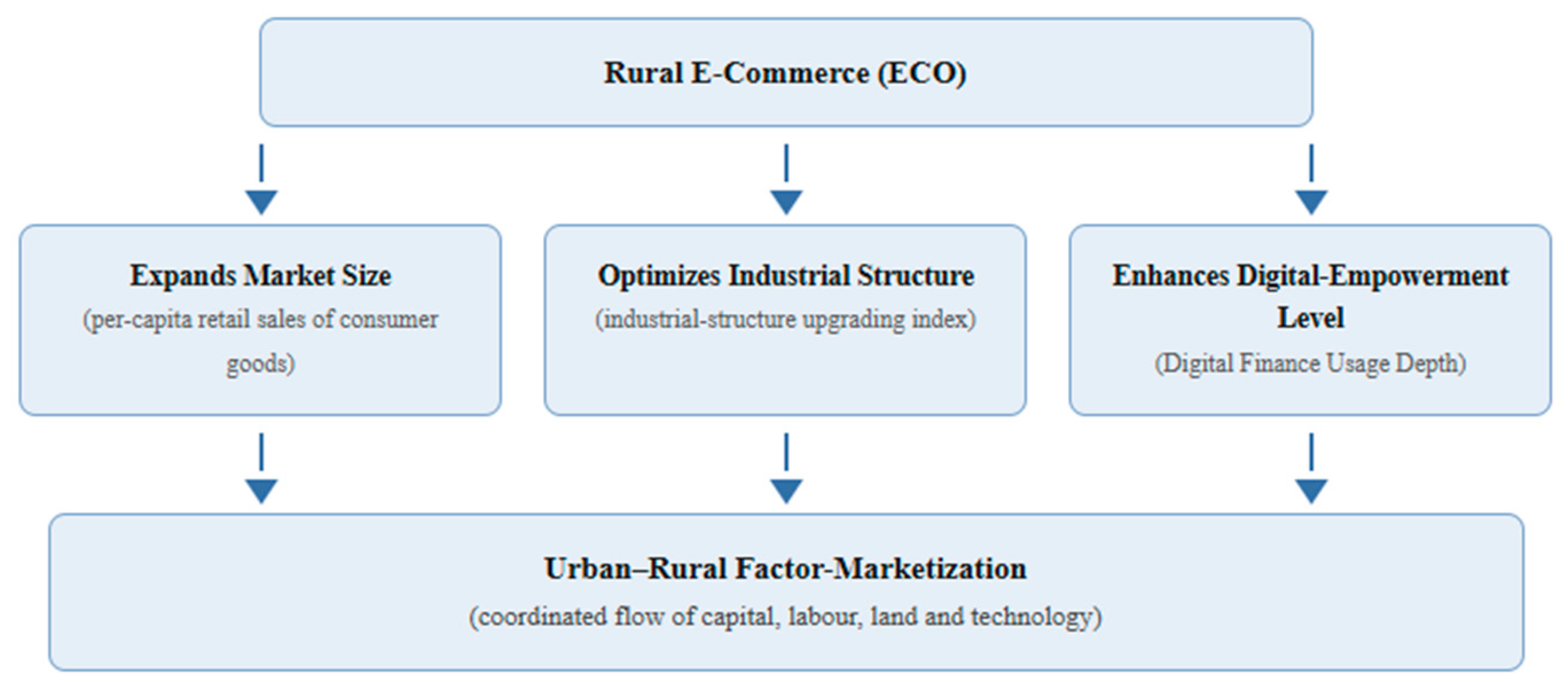
3. Theoretical Analysis
3.1. Lower Transaction Costs and Higher Factor-Mobility Efficiency
3.2. Industrial-Structure Upgrading and Factor-Demand Restructuring
3.3. Digital Infrastructure as the Hinge of Factor Allocation
4. Research Hypotheses
5. Model Specification and Data
5.1. Model Specification
5.1.1. Moderating-Effect Model
5.1.2. Mediation-Effect Model
5.2. Variable Definitions
5.2.1. Dependent Variable
- (1)
- Indicator System
- (2)
- Weight Assignment–Entropy Method
5.2.2. Core Explanatory Variable
5.2.3. Moderator and Mediators
5.2.4. Control Variables
5.3. Data Sources and Variable Description
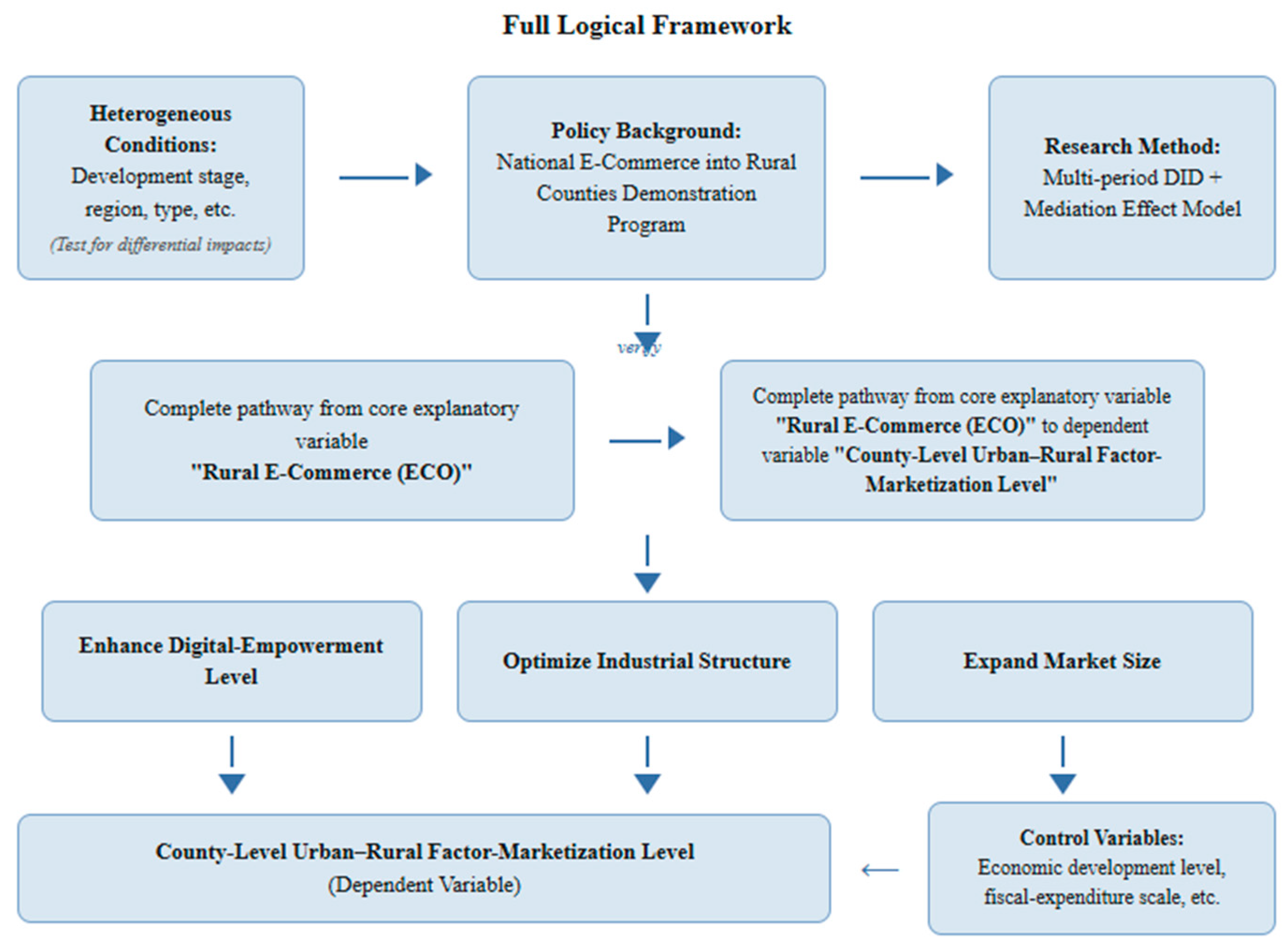
5.4. Overall Logical Framework
6. Empirical Results and Analysis
6.1. Baseline Regression Results
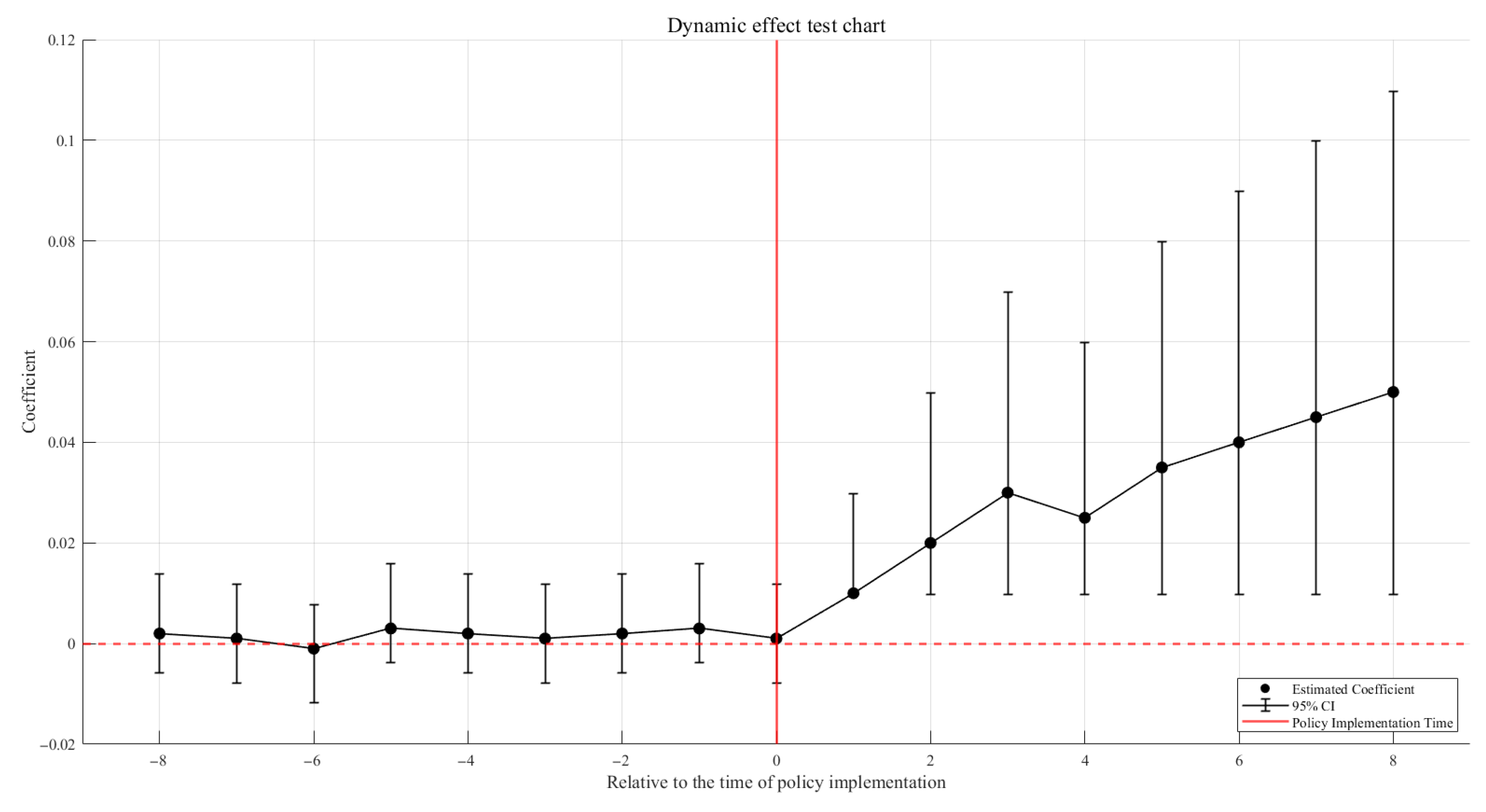
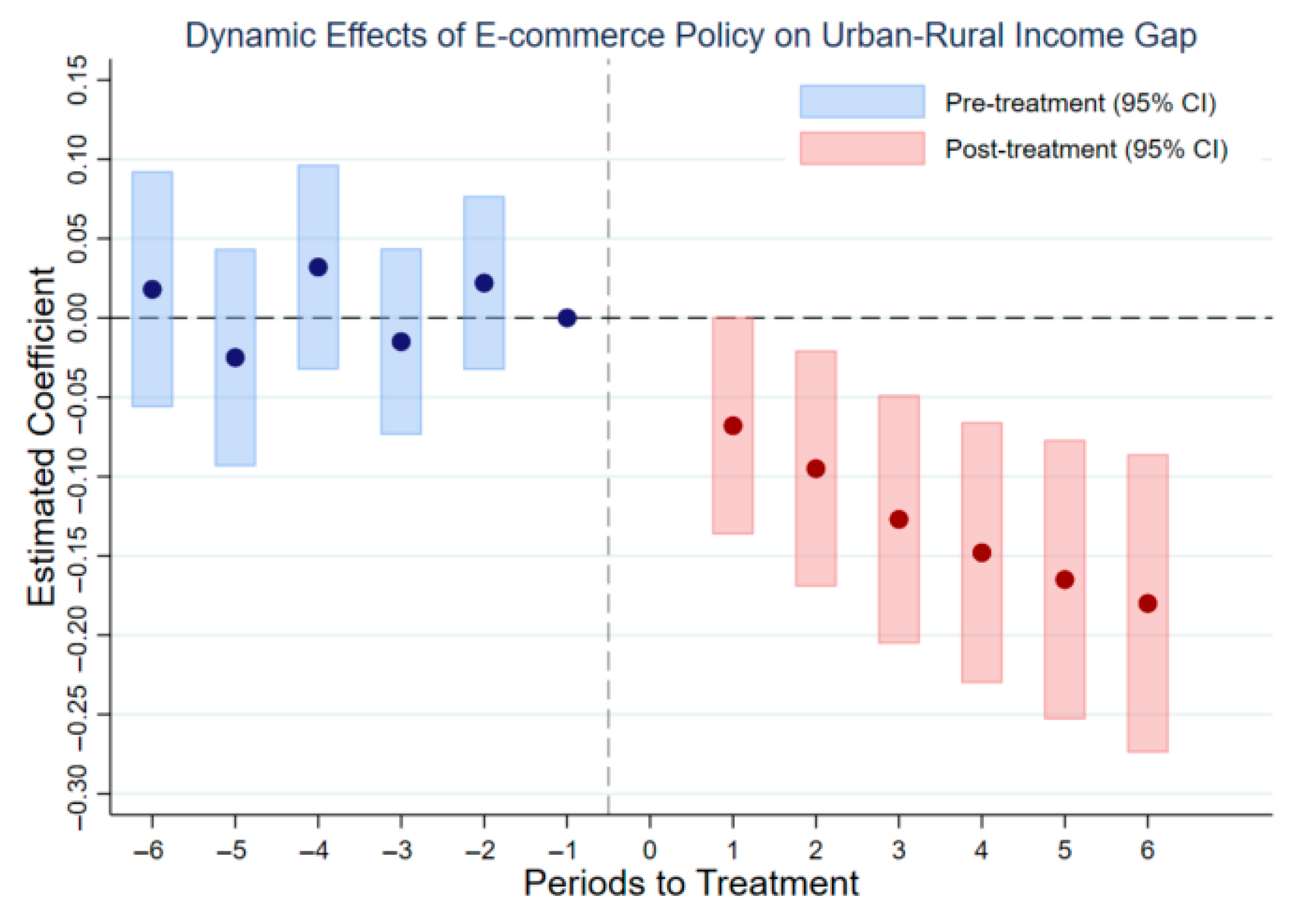
6.2. Parallel-Trend Test and Dynamic Policy Effects
6.2.1. Parallel-Trend Test
6.2.2. Dynamic Policy Effects
6.3. Robustness Checks
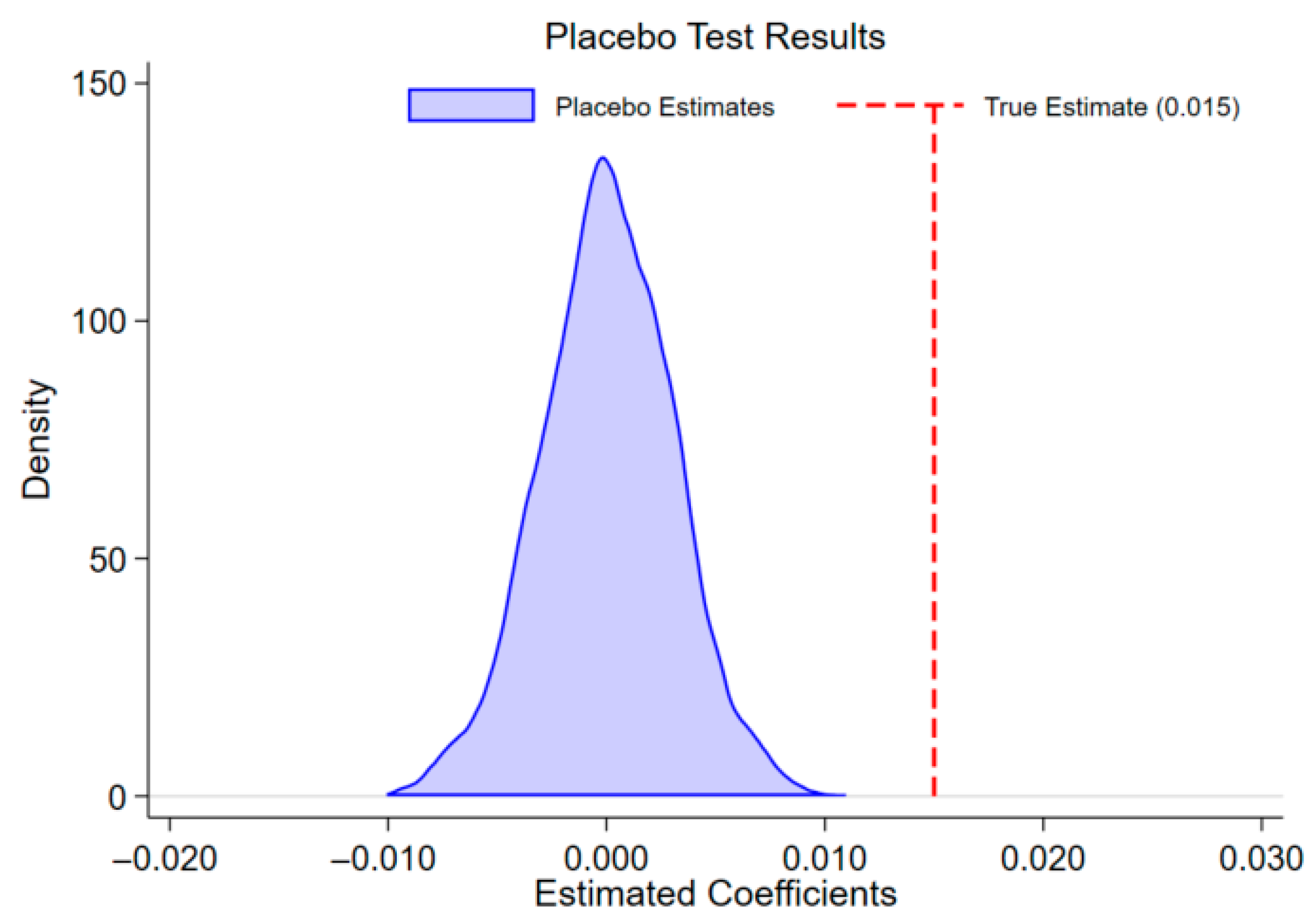
6.3.1. Placebo Test
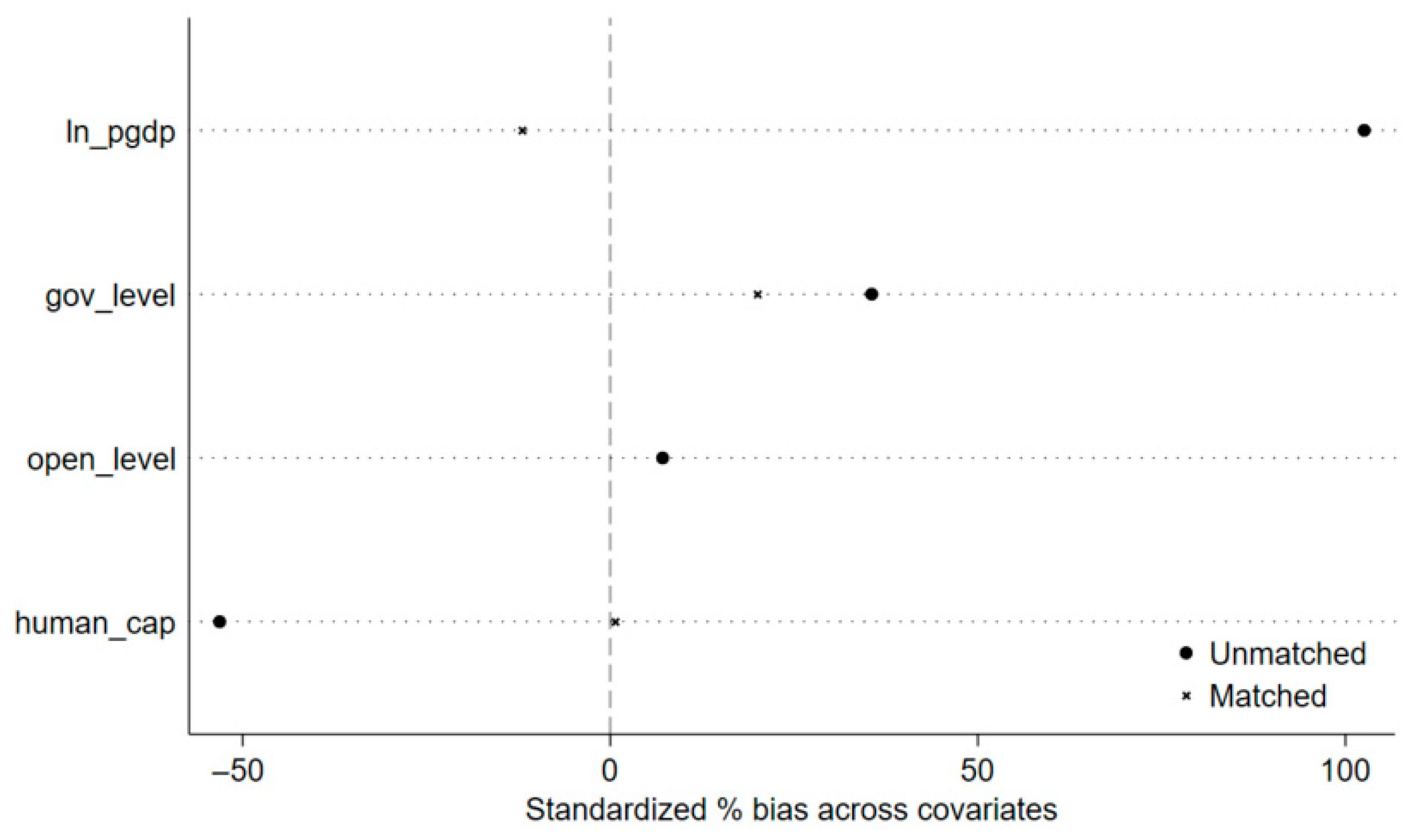
6.3.2. PSM-DID Test
6.3.3. Removing Confounding Policies
6.3.4. Alternative Dependent Variable
6.3.5. Alternative Core Explanatory Variables
6.3.6. Heterogeneity Analysis Results
- (1)
- E-commerce Development Stage
- (2)
- Industrial Structure Heterogeneity
- (3)
- Poverty Status Heterogeneity
- (4)
- Geographic Location Heterogeneity
6.3.7. Robustness Check with CSDID Method and Alternative Dependent Variable
- (1)
- Average Treatment Effect (ATT): The CSDID estimation reveals a statistically significant negative average treatment effect on the treated (ATT) of −0.064 (z = −2.27, p = 0.024). This indicates that, after accounting for potential biases from heterogeneous treatment effects, the e-commerce demonstration policy led to an approximate 6.4% reduction in the urban–rural income gap (as measured by the Theil Index) in the treated counties.
- (2)
- Dynamic Effects: The policy’s impact becomes significantly negative around Tp0 (the year of treatment), and this gap-narrowing effect generally persists and strengthens in the post-treatment periods. This pattern suggests a sustained reduction in inequality driven by the e-commerce demonstration policy.
6.4. Mechanism Analysis: The Digital Finance Channel
- (1)
- Expansion of Digital Access (Path a): As shown in Column 1, the policy has a significantly positive effect on coverage breadth (). This confirms that the e-commerce demonstration zones have successfully built the digital infrastructure, effectively bringing rural residents into the financial network. This validates the precondition of H3 regarding “deepening usage” in terms of the extensive margin.
- (2)
- Activation of Factor Mobility (Path b): Column 2 shows that the expanded digital coverage significantly impacts the local economy (). While the coefficient is negative (indicating a “siphoning effect” or consumption leakage in the early stage), statistically, it proves that digital finance is an active channel for factor allocation. The digital channel effectively facilitates the flow of capital, validating the “marketization” aspect of H3.
- (3)
- Robustness of the Channel: The Bootstrap test (Panel B) reveals a significant indirect effect of −19,554.1, with a 95% confidence interval [−24,798, −14,310] that excludes zero. These findings support Hypothesis 3. The results demonstrate that rural e-commerce does not operate in isolation but significantly influences factor allocation by activating the digital finance channel. The policy successfully expands market access (breadth), creating a conduit for capital flows, which is a critical mechanism of urban–rural factor-marketization.
7. Conclusions and Policy Implications
7.1. Research Conclusions
7.2. Policy Recommendations
7.2.1. Build County-Level Digital Hubs
7.2.2. Introduce a Differentiated Rural E-Commerce Policy Package
7.2.3. Modernize the Institutional Environment for Urban–Rural Factor Markets
7.2.4. Upgrade County-Level Digital Empowerment and Factor-Allocation Capacity
Author Contributions
Funding
Institutional Review Board Statement
Informed Consent Statement
Data Availability Statement
Conflicts of Interest
References
- Zhang, B.; Dong, W.; Yao, J.; Cheng, X. Digital Economy, Factor Allocation Efficiency of Dual-Economy and Urban-Rural Income Gap. Sustainability 2023, 15, 13514. [Google Scholar] [CrossRef]
- Chen, X.; Tang, L.; Tang, Y. Does the Rural E-commerce Policy Help to Narrow the Urban-rural Income Gap: From the Perspective of Factor Flow and Expenditure Structure. J. Agrotech. Econ. 2023, 89–103. [Google Scholar] [CrossRef]
- Tang, Y.; Yang, Q.; Li, Q.; Zhu, B. The Development of E-commerce and the Increase of Farmers’ Income: An Examination Based on the Policies of E-commerce into Rural Areas. Chin. Rural Econ. 2020, 75–94. Available online: https://kns.cnki.net/KCMS/detail/detail.aspx?dbcode=CJFQ&dbname=CJFDLAST2020&filename=ZNJJ202006010 (accessed on 1 March 2026).
- Bai, Q.; Zang, D.; Zhang, J.; Zhang, K.; Chen, H.; Pan, Y.; Shen, Q. “Bridging the Urban-Rural Divide”: Evaluating the Impact of e-Commerce Pilots on Urban-Rural Integration—Evidence from a Quasi-Natural Experiment in China’s Rural e-Commerce Construction Policy. Electron. Commer. Res. 2025, 1–33. [Google Scholar] [CrossRef]
- Li, F.; Gan, Y. Research on the Sustainable Development Capability of Chinese Rural E-Commerce Based on Multidimensional Perspective. Sci. Rep. 2025, 15, 11547. [Google Scholar] [CrossRef] [PubMed]
- Lu, Y.; Zhuang, J.; Yang, C.; Li, L.; Kong, M. How the Digital Economy Promotes Urban-Rural Integration through Optimizing Factor Allocation: Theoretical Mechanisms and Evidence from China. Front. Sustain. Food Syst. 2025, 9, 1494247. [Google Scholar] [CrossRef]
- Zhang, X.; Wang, T. Understanding Purchase Intention in O2O E-Commerce: The Effects of Trust Transfer and Online Contents. J. Theor. Appl. Electron. Commer. Res. 2021, 16, 101–115. [Google Scholar] [CrossRef]
- Vercher, N.; Bosworth, G.; Esparcia, J. Developing a Framework for Radical and Incremental Social Innovation in Rural Areas. J. Rural Stud. 2023, 99, 233–242. [Google Scholar] [CrossRef]
- Wang, H.; Leng, H.; Yuan, M. From Opportunity to Inequality: How the Rural Digital Economy Shapes Intra-Rural Income Distribution. Hum. Soc. Sci. Commun. 2025, 12, 534. [Google Scholar] [CrossRef]
- Yu, Y.; Tu, H.; Tian, Q. The Impacts of Rural E-Commerce on County Economic Development: Evidence from National Rural E-Commerce Comprehensive Demonstration Policy in China. J. Theor. Appl. Electron. Commer. Res. 2025, 20, 235. [Google Scholar] [CrossRef]
- Wu, C.; Bai, Y. Research on the Mechanism of Digital Technology Empowering Urban-rural Integration Development: From the Perspective of Marx’s Social Reproduction Theory. Mod. Econ. Sci. 2023, 45, 123–134. [Google Scholar]
- Zhu, Y.; Hu, N.; Ma, P. Coordinated Promotion of Integrated Urban-rural Development at County Level:Theoretical Connotation, Practical Path and Policy Suggestions. Issues Agric. Econ. 2024, 98–108. [Google Scholar] [CrossRef]
- Chen, Y.; Wang, Y.; Mei, D.; Wang, L. Coupling Coordination and Influencing Factors Between Digital Economy and Urban-Rural Integration in China. Sustainability 2025, 17, 7828. [Google Scholar] [CrossRef]
- Khan, S. Issues, Challenges and Opportunities in the Digitalization of Rural Markets. Hum. Syst. Manag. 2023, 42, 73–87. [Google Scholar] [CrossRef]
- Lv, L.; Dai, F. How Agricultural Innovation Talents Influence County-Level Industrial Structure Upgrading: A Knowledge-Empowerment Perspective. Agriculture 2025, 15, 1500. [Google Scholar] [CrossRef]
- Guidotti, V.; de Barros Ferraz, S.F.; Guedes Pinto, L.F.; Sparovek, G.; Taniwaki, R.H.; Garcia, L.G.; Brancalion, P.H.S. Changes in Brazil’s Forest Code Can Erode the Potential of Riparian Buffers to Supply Watershed Services. Land Use Policy 2020, 94, 104511. [Google Scholar] [CrossRef]
- Xu, X.; Yang, W.; Wu, B. Multiple Pathways for Rural Digital Economy Empowering Agricultural Total Factor Productivity: A Configuration Analysis Based on County-Level Data from Zhejiang Province. Chin. Rural Econ. 2024, 84–103. [Google Scholar] [CrossRef]
- Yuan, F.; Dong, D.; Jin, Y. Brand Equity Co-creation Path Model in the Digital Network Era: An Exploratory Case Study Based on Taobao. J. Manag. Case Stud. 2023, 16, 323–336. [Google Scholar]
- Liu, X.; He, M. Can Digital Retail Narrow Urban-Rural Consumption Inequality: An Empirical Study Based on Typical Platform Data. Chin. Rural Econ. 2025, 60–80. [Google Scholar] [CrossRef]
- Wang, C.; Liu, T.; Wen, D.; Li, D.; Vladislav, G.; Zhu, Y. The Impact of International Electronic Commerce on Export Trade: Evidence from China. J. Theor. Appl. Electron. Commer. Res. 2021, 16, 2579–2593. [Google Scholar] [CrossRef]
- Wei, B.; Luo, M.; Zeng, C. Returning Laborers’ Entrepreneurship and County-Level Industrial Structure Upgrading: Theoretical Insights and Empirical Evidence. Chin. Rural Econ. 2023, 26–48. [Google Scholar]
- Ding, S.; Liu, C.; Bao, W. The Impact of E-Commerce in Rural Areas Comprehensive Demonstration Project on Residents’ Well-Being. Chin. J. Popul. Sci. 2024, 38, 98–113. [Google Scholar]
- Williamson Oliver, E. The Economic Institutions of Capitalism: Firms, Markets, Relational Contracting; Free Press: New York, NY, USA, 1985. [Google Scholar]
- Couture, V.; Faber, B.; Gu, Y.; Liu, L. Connecting the Countryside via E-Commerce: Evidence from China. Am. Econ. Rev. Insights 2021, 3, 35–50. [Google Scholar] [CrossRef]
- Fan, J.; Tang, L.; Zhu, W.; Zou, B. The Alibaba Effect: Spatial Consumption Inequality and the Welfare Gains from e-Commerce. J. Int. Econ. 2018, 114, 203–220. [Google Scholar] [CrossRef]
- Peng, J.; Zhao, Z. Will rural e-commerce promote the integrated urban-rural development at county level? J. China Agric. Univ. 2025, 30, 321–332. [Google Scholar]
- Steinmueller, W.E. ICTs and the Possibilities for Leapfrogging by Developing Countries. Int. Labour Rev. 2001, 140, 193–210. [Google Scholar] [CrossRef]
- McKinnon, R.I. Money and Capital in Economic Development; Brookings Institution: Washington, DC, USA, 1973. [Google Scholar]
- Shaw, E.S. Financial Deepening in Economic Development; Oxford University Press: New York, NY, USA, 1973. [Google Scholar]
- National Bureau of Statistics of China. China County Statistical Yearbook; China Statistics Press: Beijing, China, 2025.
- National Bureau of Statistics of China. China County Economic Statistical Yearbook; China Statistics Press: Beijing, China, 2025.
- National Bureau of Statistics of China. China Urban Statistical Yearbook; China Statistics Press: Beijing, China, 2025.
- Ministry of Commerce of the People’s Republic of China. National “E-Commerce into Rural Counties” Demonstration Program Roster 2014–2022; Ministry of Commerce of the People’s Republic of China: Beijing, China, [Applicable Year(s)].
- Goodman-Bacon, A. Difference-in-Differences with Variation in Treatment Timing. J. Econom. 2021, 225, 254–277. [Google Scholar] [CrossRef]
- Callaway, B.; Sant’Anna, P.H.C. Difference-in-Differences with Multiple Time Periods. J. Econom. 2021, 225, 200–230. [Google Scholar] [CrossRef]



| No. | Control Variable | Description |
|---|---|---|
| 1 | Economic development level | Per capita GDP (10,000 yuan/person), indicating the county’s economic base |
| 2 | Fiscal expenditure scale | Share of local fiscal budget expenditure in GDP (%), measuring government intervention |
| 3 | Openness level | Share of actual utilized foreign capital in GDP (%), reflecting the external environment for factor mobility |
| 4 | Human capital level | Ratio of students in secondary schools to the total population (%), reflecting regional labor quality |
| No. | Data Source |
|---|---|
| 1 | List of e-commerce demonstration counties: Ministry of Commerce, National E-Commerce into Rural Counties Demonstration Program Roster |
| 2 | Digital-empowerment variables (mobile-phone subscribers, internet penetration): “China County Statistical Yearbook” and “China Urban Statistical Yearbook” |
| 3 | Factor-allocation variables (financial deposits and loans, employment structure, land transfer, patents): annual “China Rural Statistical Yearbook” and official websites of provincial statistical bureaus |
| 4 | Control variables: “China County Economic Statistical Yearbook” |
| Variable Name | Definition | Unit | Mean | S.D. |
|---|---|---|---|---|
| Rural e-commerce (ECO) | Demonstration-county policy dummy | — | 0.14 | 0.347 |
| Digital finance usage | Usage depth index of digital finance | Index | 122.527 | 35.509 |
| Per capita GDP | GDP/total population | Log value | 0.639 | 0.978 |
| Human capital level | Students in secondary schools | Ratio | 0.184 | 0.125 |
| Openness level | Utilized FDI/GDP | Ratio | 0.004 | 0.005 |
| Human capital level | Secondary students ratio | Ratio | 0.056 | 0.023 |
| Industrial-structure level | Upgrading index (formula-based) | — | 0.765 | 0.079 |
| Market size | Per capita retail sales of consumer goods | 10 000 yuan/person | 0.920 | 0.894 |
| Variable | Model 1 (Clustered SE) | Model 2 (Clustered SE) | Model 3 (Bootstrap) |
|---|---|---|---|
| ECO | 0.015 *** (0.003) | 0.015 *** (0.003) | 0.015 *** (0.002) |
| Per capita GDP | — | 0.008 *** (0.003) | 0.008 *** (0.001) |
| Fiscal-expenditure scale | — | 0.017 *** (0.003) | 0.017 *** (0.002) |
| Openness level | — | 0.001 (0.002) | 0.001 (0.001) |
| Human capital level | — | 0.001 (0.003) | 0.001 (0.001) |
| Year FE | control | control | control |
| County FE | control | control | control |
| Constant | 0.327 *** (0.000) | 0.112 *** (0.063) | 0.175 *** (0.028) |
| R2 | 0.501 | 0.525 | 0.512 |
| Observations | 43,654 | 43,654 | 43,654 |
| Variable | PSM-DID | Exclude Other Policy | Replace DV | Taobao Villages | Delivery Volume | First Stage | Second Stage |
|---|---|---|---|---|---|---|---|
| ECO | −0.127 *** (0.027) | 0.018 *** (0.003) | 0.041 *** (0.013) | 0.016 *** (0.001) | 0.018 *** (0.005) | −0.018 *** (0.004) | 0.395 ** (0.174) |
| Controls | Yes | Yes | Yes | Yes | Yes | Yes | Yes |
| Constant | 4.452 * | 0.063 | 0.710 *** | −0.275 | −0.313 *** | 0.335 *** | 0.881 *** |
| R2 | 0.185 | 0.595 | 0.590 | 0.600 | 0.594 | 0.575 | 0.807 |
| Obs. | 1636 | 28,773 | 43,654 | 4455 | 22,776 | 41,756 | 39,675 |
| Variable | Start-Up Stage | Rapid-Expansion Stage | Agriculture-Oriented E-Commerce | Industry-Oriented E-Commerce | Poverty Counties | Non-Poverty-Stricken Counties | Eastern Region | Central Region | Western Region |
|---|---|---|---|---|---|---|---|---|---|
| ECO | −0.042 (0.035) | −0.145 *** (0.041) | −0.138 *** (0.038) | −0.051 * (0.029) | −0.162 *** (0.045) | −0.084 ** (0.036) | −0.035 (0.028) | −0.121 *** (0.032) | −0.155 *** (0.040) |
| Controls | Yes | Yes | Yes | Yes | Yes | Yes | Yes | Yes | Yes |
| Constant | 4.120 *** | 3.980 *** | 4.560 *** | 4.230 *** | 3.850 *** | 4.610 *** | 5.100 *** | 4.400 *** | 3.750 *** |
| 0.152 | 0.198 | 0.205 | 0.165 | 0.190 | 0.175 | 0.140 | 0.188 | 0.210 | |
| Obs. | 1090 | 546 | 818 | 818 | 580 | 1056 | 560 | 510 | 566 |
| Variables | (1) | (2) | (3) |
|---|---|---|---|
| Dependent Variable | Coverage Breadth (Mediator) | GDP (Outcome) | GDP (Total Effect) |
| Panel A: Stepwise Regression | |||
| Policy (did_final) | 3.682 *** | −68,847.4 *** | −88,401.5 *** |
| (0.389) | (18,092.8) | (18,427.7) | |
| Coverage Breadth | −4.979.7 *** | ||
| (742.6) | data | ||
| Controls | Yes | Yes | Yes |
| County FE | Yes | Yes | Yes |
| Year FE | Yes | Yes | Yes |
| Observations | 12,035 | 12,035 | 12,035 |
| R-squared (Within) | 0.783 | 0.458 | 0.450 |
| Panel B: Bootstrap Test | Coef. | S.E. | 95% Conf.Interval |
| Indirect Effect (Path a × b) | −19,554.1 *** | 2675.5 | [−24,798, −14,310] |
| Direct Effect (Path c’) | −68,847.4 ***** | 18,092.8 | [−104,333, −33,362] |
| Mediation | 22.12% |
Disclaimer/Publisher’s Note: The statements, opinions and data contained in all publications are solely those of the individual author(s) and contributor(s) and not of MDPI and/or the editor(s). MDPI and/or the editor(s) disclaim responsibility for any injury to people or property resulting from any ideas, methods, instructions or products referred to in the content. |
© 2026 by the authors. Licensee MDPI, Basel, Switzerland. This article is an open access article distributed under the terms and conditions of the Creative Commons Attribution (CC BY) license.
Share and Cite
Niu, X.; Zheng, D.; Ding, Y. Research on the Impact and Mechanism of Rural E-Commerce on Market-Oriented Allocation of County-Level Urban–Rural Factors from the Perspective of Digital Empowerment. J. Theor. Appl. Electron. Commer. Res. 2026, 21, 87. https://doi.org/10.3390/jtaer21030087
Niu X, Zheng D, Ding Y. Research on the Impact and Mechanism of Rural E-Commerce on Market-Oriented Allocation of County-Level Urban–Rural Factors from the Perspective of Digital Empowerment. Journal of Theoretical and Applied Electronic Commerce Research. 2026; 21(3):87. https://doi.org/10.3390/jtaer21030087
Chicago/Turabian StyleNiu, Xiaoyu, Dequan Zheng, and Yuemei Ding. 2026. "Research on the Impact and Mechanism of Rural E-Commerce on Market-Oriented Allocation of County-Level Urban–Rural Factors from the Perspective of Digital Empowerment" Journal of Theoretical and Applied Electronic Commerce Research 21, no. 3: 87. https://doi.org/10.3390/jtaer21030087
APA StyleNiu, X., Zheng, D., & Ding, Y. (2026). Research on the Impact and Mechanism of Rural E-Commerce on Market-Oriented Allocation of County-Level Urban–Rural Factors from the Perspective of Digital Empowerment. Journal of Theoretical and Applied Electronic Commerce Research, 21(3), 87. https://doi.org/10.3390/jtaer21030087