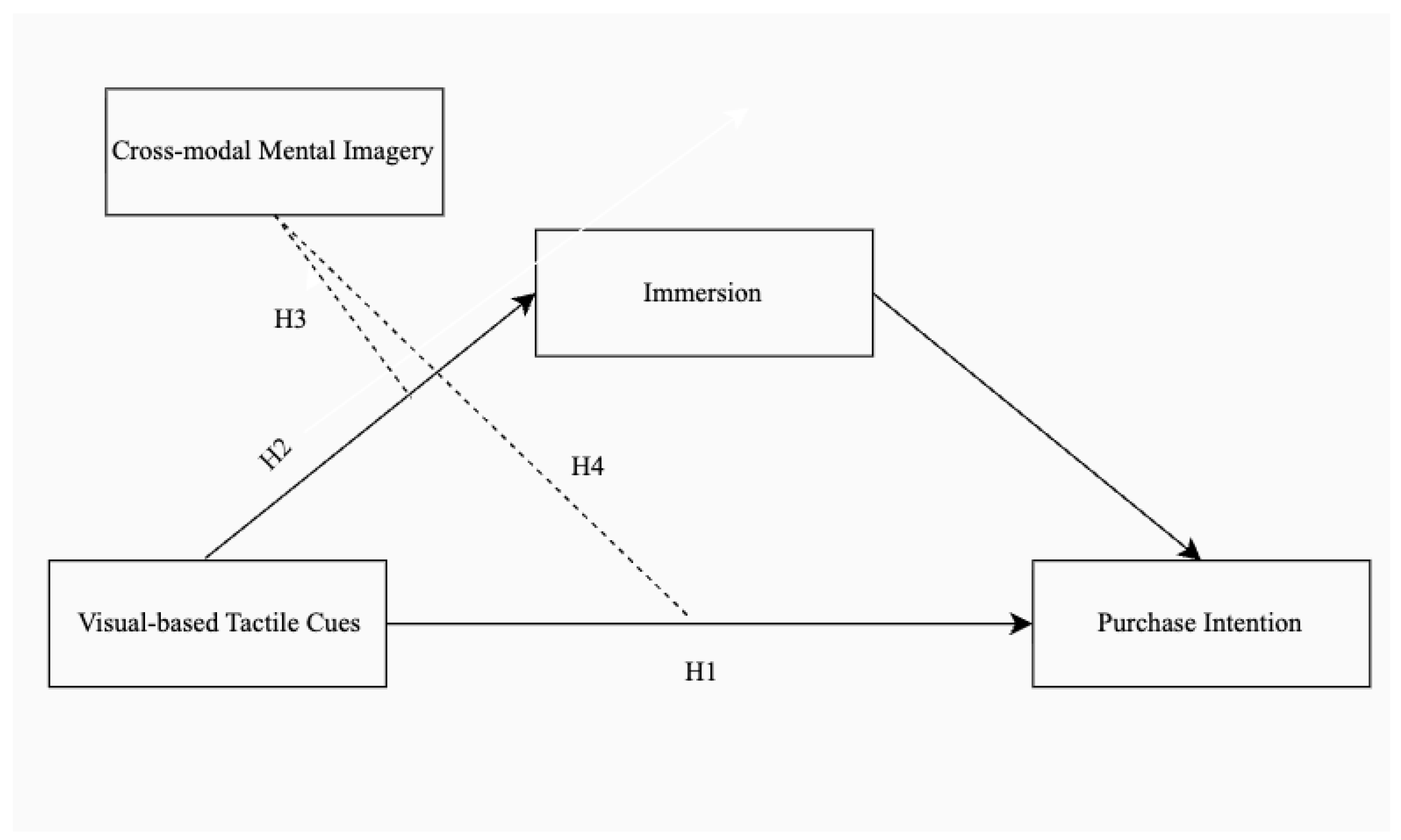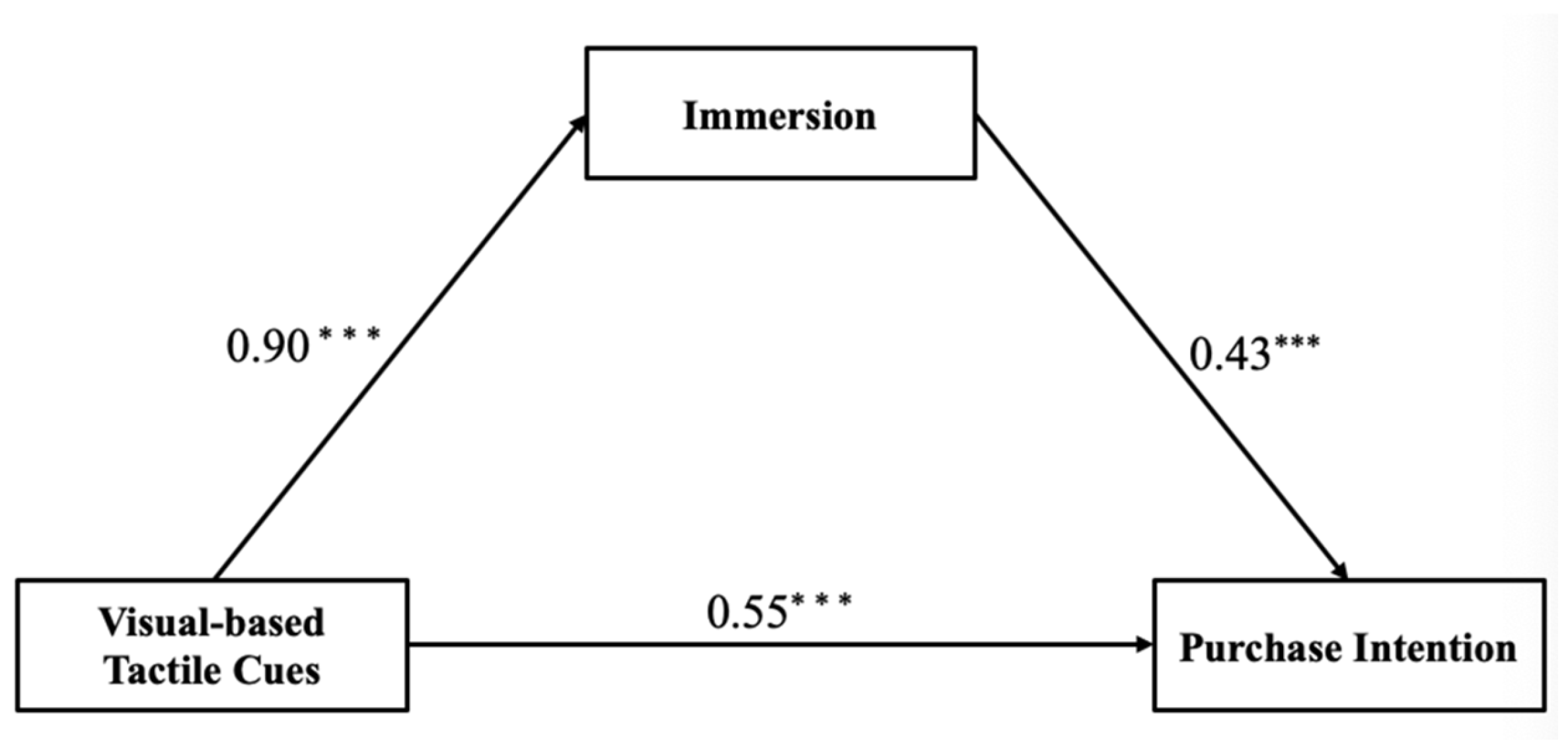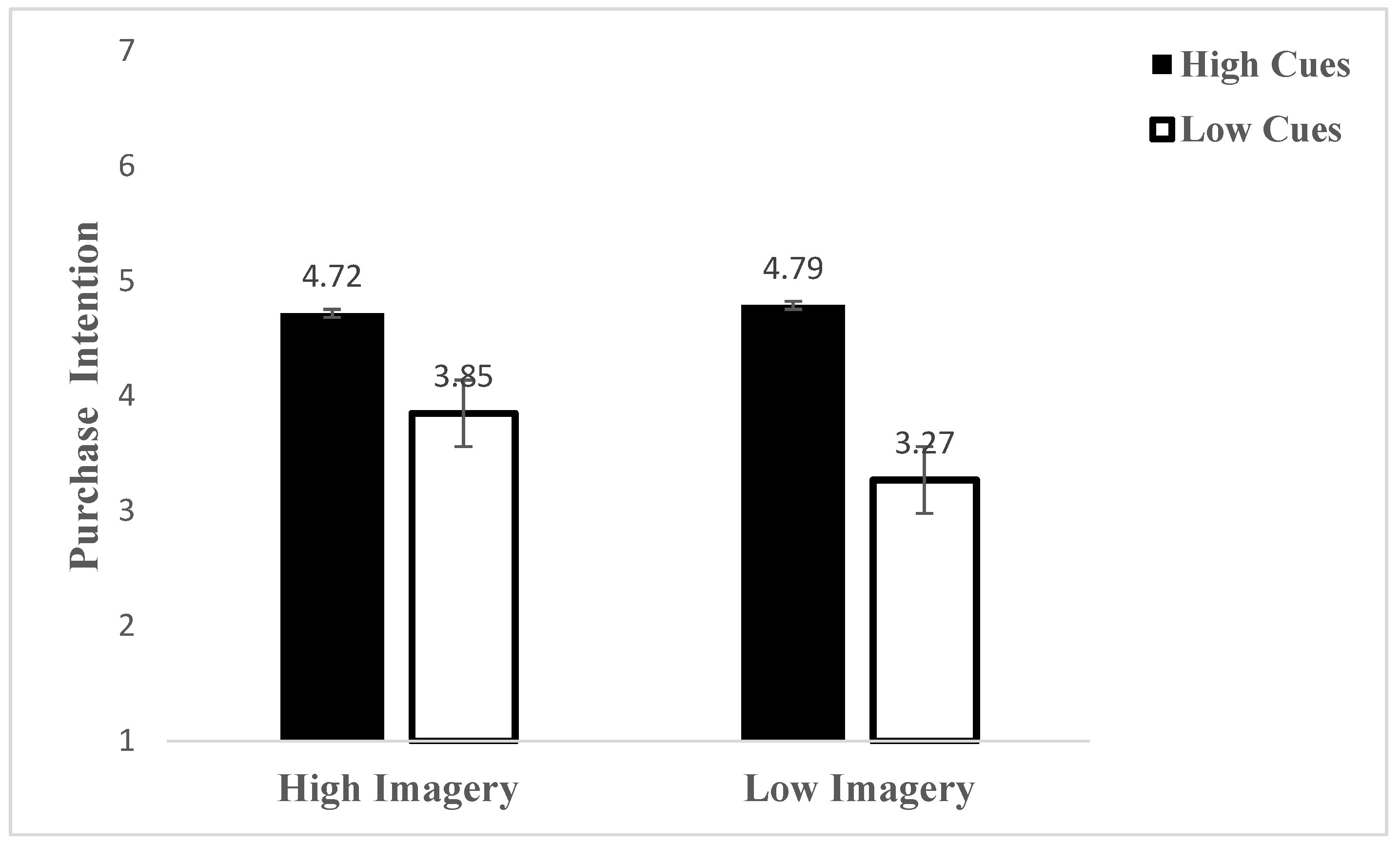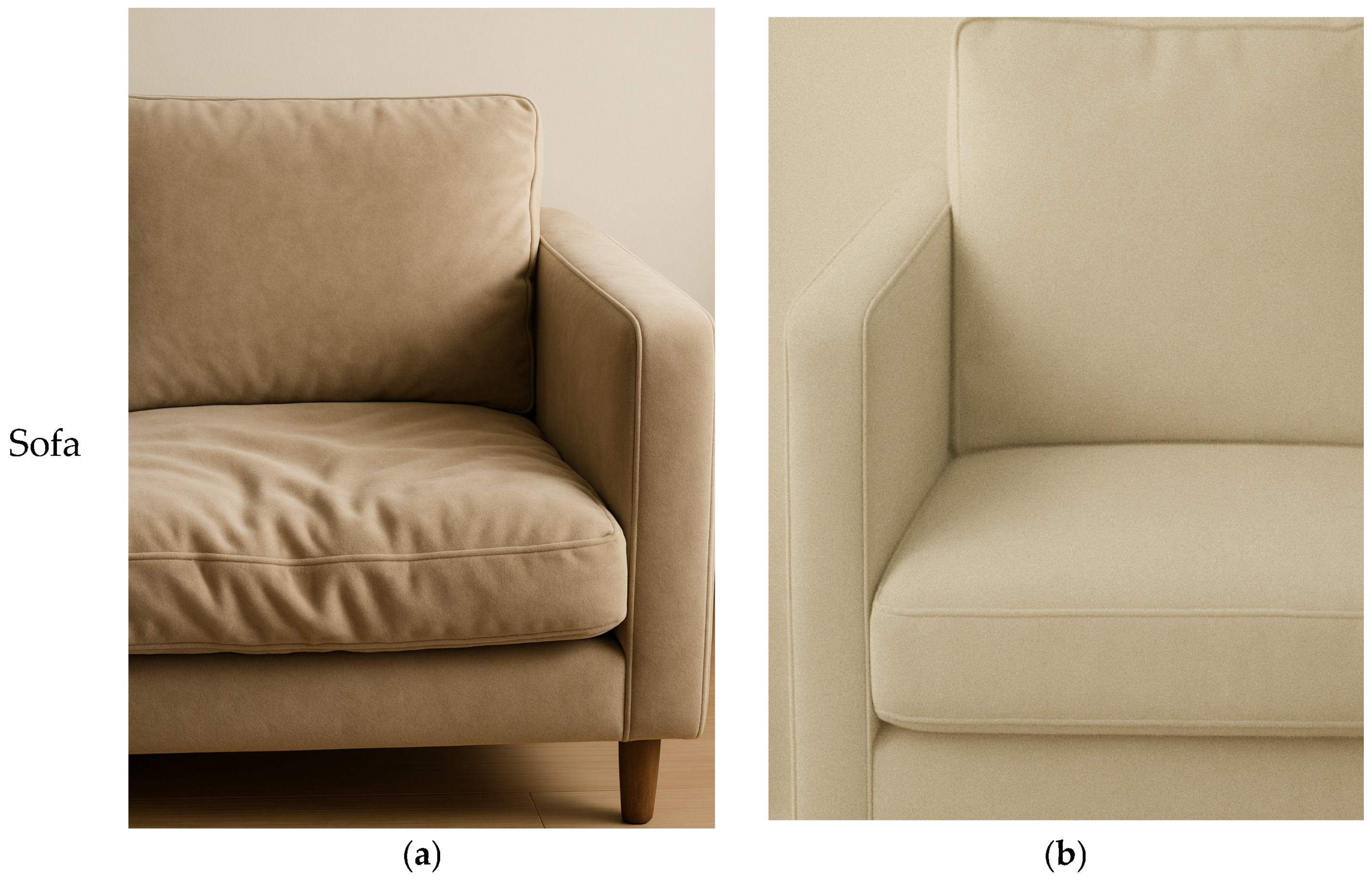


Seeing the Feel, Willing to Buy: How Visual–Tactile Cues Shape Consumer Purchase Intention in E-Commerce Platforms

Abstract
1. Introduction
2. Theoretical Framework and Hypothesis Development
2.1. Embodied Cognition Theory
2.2. Hypothesis Development
3. Overview of Studies
4. Pilot Study
4.1. Pilot Study Method
4.2. Results and Discussion
5. Study 1
5.1. Study 1 Method
5.2. Results of Study 1
5.2.1. Manipulation Check
5.2.2. Main Effect in Study 1
5.2.3. Mediation Effect
5.3. Discussion
6. Study 2
6.1. Study 2 Method
6.2. Results of Study 2
6.2.1. Manipulation Checks
6.2.2. Main Effect in Study 2
6.2.3. Mediation Analysis
6.3. Discussion
7. General Discussion
7.1. Summary of Findings
7.2. Theoretical Implications
7.3. Managerial Implications
8. Limitation and Future Research
Author Contributions
Funding
Institutional Review Board Statement
Informed Consent Statement
Data Availability Statement
Acknowledgments
Conflicts of Interest
Appendix A


Appendix B

| Research Purpose | Conclusion | Resource |
|---|---|---|
| To determine whether altering the surface texture of fast-moving consumer goods (FMCGs) packaging can influence consumers’ tactile perception and product evaluations, even for products typically touched only briefly. | Consumers’ evaluations of FMCG packaging are driven more by visual than by tactile cues, suggesting that tactile interaction has a limited role compared to visual design in shaping product appeal. | [30] |
| To examine how visual and haptic packaging design characteristics, both individually and jointly, influence consumers’ brand impressions through the lens of congruence and processing fluency theories. | Consumers form more positive brand evaluations when visual and haptic package cues are semantically congruent, highlighting the importance of cross-modal consistency in brand design. | [23] |
| To explore how 3D virtual advertising influences online shopping effectiveness, examining mental imagery vividness as a mediator and consumers’ need for touch (NFT) and product type as moderators. | 3D advertising outperforms 2D formats by enhancing vivid mental imagery, which mediates positive attitudes and intentions; however, this effect depends on product type and consumers’ need for touch—being stronger for geometric products and for low-NFT consumers when evaluating material products. | [55] |
| To investigate whether tactile sexual cues, rather than visual ones, can influence women’s economic decision-making. | Tactile sexual cues—such as touching boxer shorts—significantly increase women’s craving for monetary rewards, reduce loss aversion, and raise willingness to pay, whereas visual cues do not, suggesting that touch triggers stronger Pavlovian reward responses than vision. | [67] |
| This study investigates how sensory-enabling presentations—specifically image zooming and rotation videos—affect consumers’ cognitive and affective neural responses during online product evaluation and purchase decisions. | Image zooming primarily enhances visual perception during evaluation, whereas rotation videos elicit stronger mental imagery, pleasure, and reward anticipation during purchase decisions, suggesting that dynamic visual cues can simulate tactile experiences and enhance shopping enjoyment. | [29] |
| To examine whether interactive visual stimuli that simulate touch can evoke tactile sensations and enhance consumers’ perceived diagnosticity of product attributes in online shopping environments. | Interactive interfaces that simulate stroking gestures increase perceived diagnosticity for experience attributes by inducing visually driven tactile sensations—particularly when users have control over the product interaction—highlighting the critical role of simulated touch in online product evaluation. | [25] |
| To investigate how multiple sensory cues—specifically visual form plausibility, visual–tactile synchrony, and visual–proprioceptive spatial offset—jointly and differentially shape the three core components of self-representation: embodiment, agency, and presence, within a unified virtual reality (VR) context. | Results demonstrate that these sensory cues independently and non-hierarchically influence embodiment, agency, and presence, indicating that self-representation arises from flexible, multi-sensory integration rather than a strictly ordered or interdependent cue hierarchy. | [36] |
| This study aims to examine how physically touching one product influences consumers’ perception and choice of other visually presented products that share similar haptic features. | Touching a product enhances the visual fluency and choice likelihood of haptically similar products—particularly in visually crowded displays—and that this effect is further moderated by consumers’ instrumental need for touch, suggesting that mimicking haptic features can strategically guide product selection. | [68] |
| To develop a comprehensive conceptual framework illustrating how visual–tactile interplay influences consumer responses across brand, product, and service scape contexts. | The study identifies that visual–tactile interplay elicits distinct cognitive, emotional, and behavioral responses depending on the consumption context, and proposes an integrated conceptual model explaining how these sensory cues jointly shape consumer perception and behavior. | [24] |
| This paper investigates how the visual property of glossiness influences haptic perception, consumers’ internal reactions, and behavioral intentions through cross-modal correspondence between vision and touch. | Glossy (vs. matte) packaging significantly alters consumers perceived tactile attributes (roughness, thickness, and lightness), enhancing perceived quality, attractiveness, and purchase intention—validating a conceptual framework that integrates the SOR model with cross-modal correspondence theory. | [69] |
| To investigate how the multisensory techniques (visual, auditory, and tactile stimulation) influence customer evaluations. | Consumer brand evaluations are positively affected by sensory stimulation through congruent sensory cues. | [70] |
| To explain consumers’ hesitance in online purchasing context. | High-NFT (need for touch) consumers concern about high quality and pay less attention on affective response to online offered produce. | [63] |
| To explore the compensatory effect of visual language on purchase intention in online retail. | Visual language has a compensatory effect on purchase intention via mental simulation. | [26] |
| To examine how oddly satisfying videos explain ambiguities in children’s YouTube context. | The study finds that “oddly satisfying” videos constitute a sensory genre centered on visual tactility, evoking a synesthetic sense of touch through visual stimuli and blurring the boundaries between children’s content and adult-oriented ASMR videos. | [71] |
| To investigate the effect of tactile cues on consumers’ emotional experiences in online furniture shopping context. | The study reveals that combined “sight + touch” stimuli enhance positive emotional responses, with skin conductance linked to arousal and heart rate linked to valence. | [72] |
| To examine how visual information compensates for the lack of tactile experience in online shopping through visual–tactile mechanisms based on mental imagery and personal goals theories. | Visually compensated tactile diagnosticity enhances mental imagery and sensory similarity, thereby increasing consumers’ purchase intention. | [12] |
| To investigate how the visual shape and tactile texture of teacups influence the perceived taste and aroma of tea. | Teacup dimensions and surface smoothness affect tea flavor perception, with teacup preference mediating the relationship between cup design and taste experience. | [73] |
| To examine how product surface roughness influences consumer perceptions and purchase decisions. | Rough surfaces increase perceived durability while smooth surfaces enhance perceived user-friendliness, with perceived heaviness mediating this effect and lightweight claims moderating it. | [11] |
| Measurements | Items | Reference |
|---|---|---|
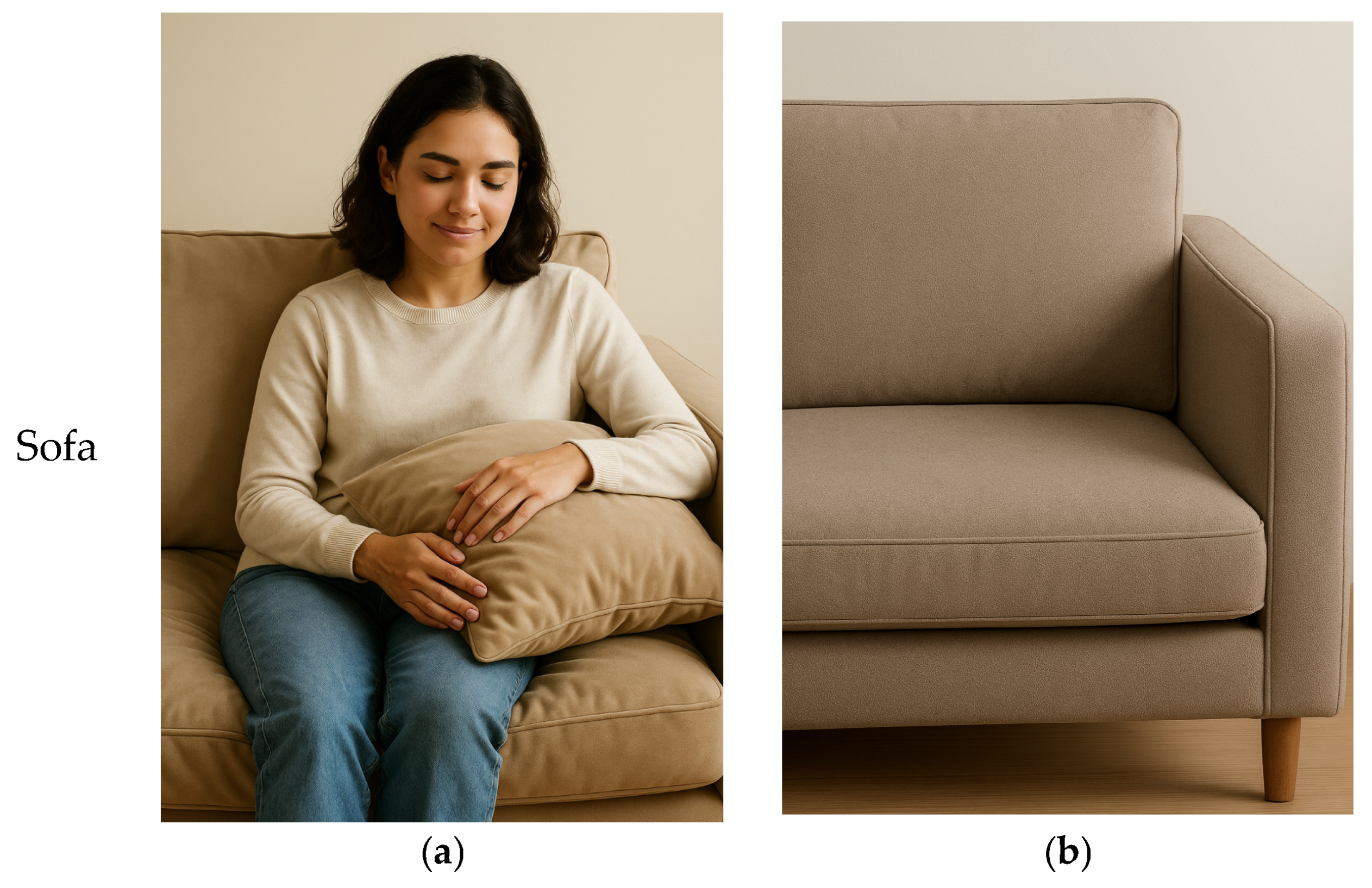
| Visual-based Tactile Cues | The picture demonstrating the feel or texture of the furniture helped me evaluate the tactile attributes of the product. | [12,43] |
| The picture demonstrating the feel or texture of the furniture helped familiarize me with the product. | ||
| The picture demonstrating the feel or texture of the furniture is helpful for me to understand the product’s tactile attributes. | ||
| The picture demonstrating the feel or texture of the furniture is helpful for me to imagine the product’s tactile attributes. | ||
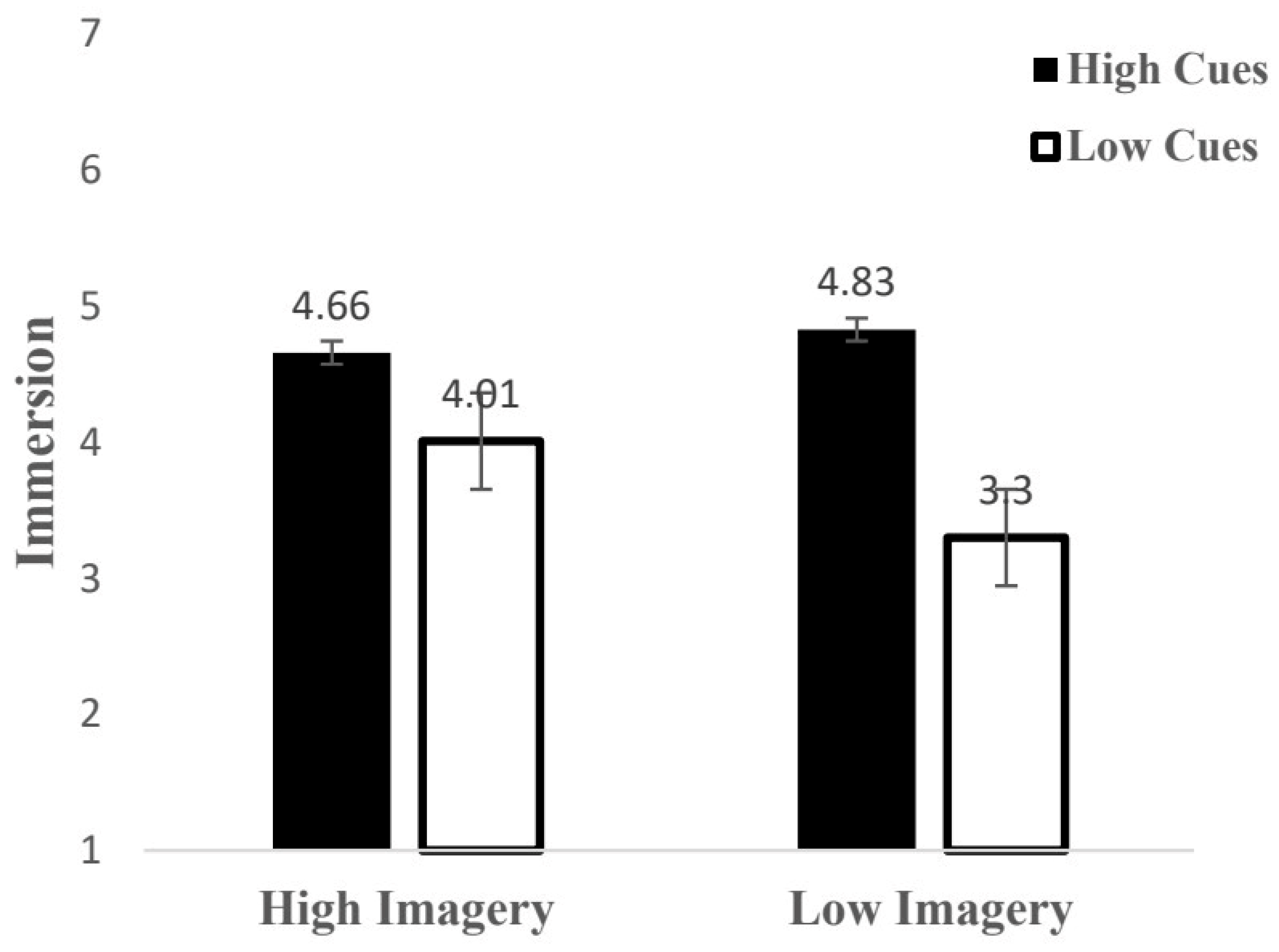
| Immersion | I felt completely absorbed in the experience. | [46] |
| I lost awareness of time while engaging with the experience. | ||
| I felt like I was “in” the experience rather than just observing it. | ||
| The experience captured my full attention. | ||
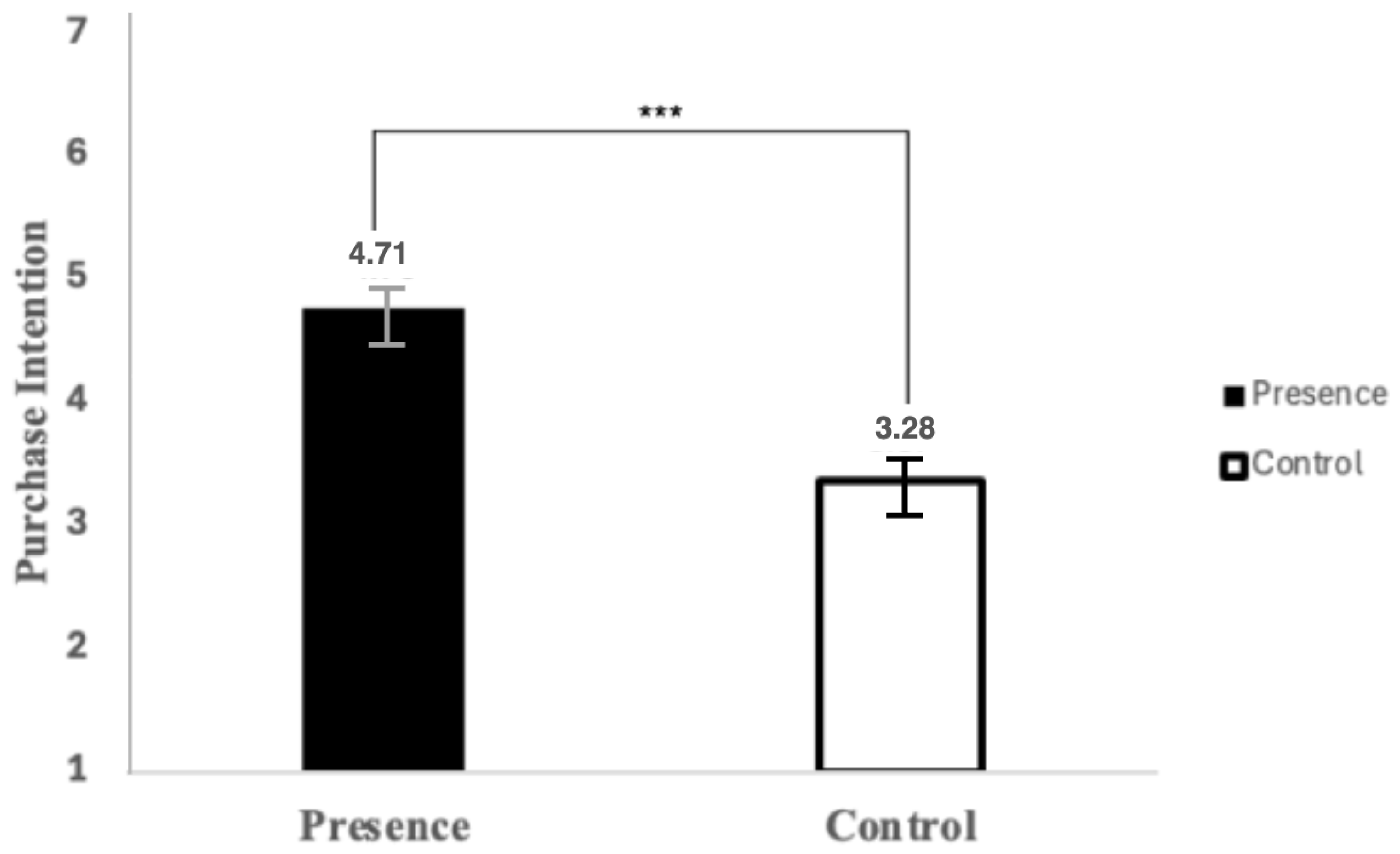
| Purchase Intention | After viewing this picture, I am willing to purchase the product being presented. | [47] |
| After viewing this picture, I would consider purchasing the presented product. | ||
| After viewing this picture, I will likely buy this product. | ||
| Cross-modal Mental Imagery | During the picture-viewing task, I imagined what it would be like to use this furniture. | [50] |
| During the picture-viewing task, I fantasized about using the furniture. | ||
| During the picture-viewing task, I thought about what the feeling would be like when using the furniture. | ||
| During the picture-viewing task, I can easily imagine that I use the furniture. |
References
- Joo, E.; Yang, J.; Figueiredo, N.; Ferreira, B.M.; Abrantes, J.L.; Martinez, L.F. The Role of Digital Marketing in Online Shopping: A Bibliometric Analysis for Decoding Consumer Behavior. J. Theor. Appl. Electron. Commer. Res. 2025, 20, 25. [Google Scholar] [CrossRef]
- Li, H.; Pan, Y. Impact of Interaction Effects between Visual and Auditory Signs on Consumer Purchasing Behavior Based on the AISAS Model. J. Theor. Appl. Electron. Commer. Res. 2023, 18, 1548–1559. [Google Scholar] [CrossRef]
- Silva, S.C.; Rocha, T.V.; De Cicco, R.; Galhanone, R.F.; Manzini Ferreira Mattos, L.T. Need for Touch and Haptic Imagery: An Investigation in Online Fashion Shopping. J. Retail. Consum. Serv. 2021, 59, 102378. [Google Scholar] [CrossRef]
- Velasco, C.; Woods, A.T.; Petit, O.; Cheok, A.D.; Spence, C. Crossmodal Correspondences between Taste and Shape, and Their Implications for Product Packaging: A Review. Food Qual. Prefer. 2016, 52, 17–26. [Google Scholar] [CrossRef]
- Pino, G.; Amatulli, C.; Nataraajan, R.; De Angelis, M.; Peluso, A.M.; Guido, G. Product Touch in the Real and Digital World: How Do Consumers React? J. Bus. Res. 2020, 112, 492–501. [Google Scholar] [CrossRef]
- Luangrath, A.W.; Peck, J.; Hedgcock, W.; Xu, Y. Observing Product Touch: The Vicarious Haptic Effect in Digital Marketing and Virtual Reality. J. Mark. Res. 2022, 59, 306–326. [Google Scholar] [CrossRef]
- Wijntjes, M.W.A.; Volcic, R. Online Shopping and the Visual Perception of Fabric Qualities. J. Vis. 2019, 19, 243c. [Google Scholar] [CrossRef]
- Zhang, Y.; Shao, Z.; Zhang, J.; Wu, B.; Zhou, L. The Effect of Image Enhancement on Influencer’s Product Recommendation Effectiveness: The Roles of Perceived Influencer Authenticity and Post Type. J. Res. Interact. Mark. 2024, 18, 166–181. [Google Scholar] [CrossRef]
- Ryu, S. From Pixels to Engagement: Examining the Impact of Image Resolution in Cause-Related Marketing on Instagram. J. Res. Interact. Mark. 2024, 18, 709–730. [Google Scholar] [CrossRef]
- Jang, S.Y.; Ha, J. Fabric Perceptions in Digital Contexts: Exploring the Correlation between Certainty and Accuracy. Fash Text 2024, 11, 20. [Google Scholar] [CrossRef]
- Chen, J.; Wu, P.; Jiang, Y.; Lv, L. Rough Is Durable, Smooth Is User-Friendly: Effects of Surface Visual Roughness on Consumers’ Perception and Product Preference. J. Retail. Consum. Serv. 2025, 84, 104196. [Google Scholar] [CrossRef]
- Jiang, K.; Luo, S.; Zheng, J. Seeing as Feeling? The Impact of Tactile Compensation Videos on Consumer Purchase Intention. Behav. Sci. 2024, 14, 50. [Google Scholar] [CrossRef]
- Zhang, G.; Cao, J.; Liu, D. Examining the Influence of Information Overload on Consumers’ Purchase in Live Streaming: A Heuristic-Systematic Model Perspective. PLoS ONE 2023, 18, e0284466. [Google Scholar] [CrossRef]
- Dzyabura, D.; El Kihal, S.; Ibragimov, M. Leveraging the Power of Images in Predicting Product Return Rates. SSRN J. 2017, 1–33. [Google Scholar] [CrossRef]
- Chen, C.; Zhang, D. How Source of Product Acquisition Affects Consumers’ Reliance on Positive Word-of-Mouth: A Mental Imagery Perspective. J. Res. Interact. Mark. 2024, 18, 315–330. [Google Scholar] [CrossRef]
- Jeong, J.E.; Yeu, M. Can Mental Imagery Enhance Review Helpfulness and Product Evaluation? The Role of Contextual Background and Mental Simulation. J. Res. Interact. Mark. 2023, 17, 959–974. [Google Scholar] [CrossRef]
- Krishna, A. An Integrative Review of Sensory Marketing: Engaging the Senses to Affect Perception, Judgment and Behavior. J. Consum. Psychol. 2012, 22, 332–351. [Google Scholar] [CrossRef]
- Peng, M.; Xu, Z.; Huang, H. How Does Information Overload Affect Consumers’ Online Decision Process? An Event-Related Potentials Study. Front. Neurosci. 2021, 15, 695852. [Google Scholar] [CrossRef]
- Naderer, B.; Hohner, J.; Wulf, T.; Olbermann, Z.; Sathian, K.; Lacey, S. Cross-Modal Interactions of the Tactile System. Curr. Dir. Psychol. Sci. 2022, 31, 411–418. [Google Scholar] [CrossRef]
- Varela, F.J.; Thompson, E.; Rosch, E. The Embodied Mind, Revised Edition: Cognitive Science and Human Experience; MIT Press: Cambridge, MA, USA, 2017; ISBN 978-0-262-52936-5. [Google Scholar]
- Wilson, A.D.; Golonka, S. Embodied Cognition Is Not What You Think It Is. Front. Psychol. 2013, 4, 58. [Google Scholar] [CrossRef]
- Delwiche, J.F.; Zhou, L.; Niu, L.; Zhao, T.; Auvray, M.; Spence, C. The Multisensory Perception of Flavor. Conscious. Cogn. 2008, 17, 1016–1031. [Google Scholar] [CrossRef] [PubMed]
- Littel, S.; Orth, U.R. Effects of Package Visuals and Haptics on Brand Evaluations. Eur. J. Mark. 2013, 47, 198–217. [Google Scholar] [CrossRef]
- Eklund, A.A.; Helmefalk, M. Seeing through Touch: A Conceptual Framework of Visual-Tactile Interplay. J. Prod. Brand Manag. 2018, 27, 498–513. [Google Scholar] [CrossRef]
- Overmars, S.; Poels, K. Online Product Experiences: The Effect of Simulating Stroking Gestures on Product Understanding and the Critical Role of User Control. Comput. Hum. Behav. 2015, 51, 272–284. [Google Scholar] [CrossRef]
- Leng, X.; Zhou, X.; Wang, S.; Xiang, Y. Can Visual Language Convey Tactile Experience? A Study of the Tactile Compensation Effect of Visual Language for Online Products. Front. Psychol. 2022, 13, 1034872. [Google Scholar] [CrossRef]
- Jacob, B.M.; Thomas, S.; Joseph, J. Over Two Decades of Research on Choice Overload: An Overview and Research Agenda. Int. J. Consum. Stud. 2024, 48, e13029. [Google Scholar] [CrossRef]
- Kamal Basha, N.; Aw, E.C.-X.; Chuah, S.H.-W. Are We so over Smartwatches? Or Can Technology, Fashion, and Psychographic Attributes Sustain Smartwatch Usage? Technol. Soc. 2022, 69, 101952. [Google Scholar] [CrossRef]
- Jai, T.-M.; O’Boyle, M.W.; Fang, D. Neural Correlates of Sensory-enabling Presentation: An fMRI Study of Image Zooming and Rotation Video Effects on Online Apparel Shopping. J. Consum. Behav. 2014, 13, 342–350. [Google Scholar] [CrossRef]
- Marlow, N.; Jansson-Boyd, C.V. To Touch or Not to Touch; That Is the Question. Should Consumers Always Be Encouraged to Touch Products, and Does It Always Alter Product Perception? Psychol. Mark. 2011, 28, 256–266. [Google Scholar] [CrossRef]
- Petit, O.; Velasco, C.; Spence, C. Digital Sensory Marketing: Integrating New Technologies into Multisensory Online Experience. J. Interact. Mark. 2019, 45, 42–61. [Google Scholar] [CrossRef]
- Krishna, A. Customer Sense: How the 5 Senses Influence Buying Behavior; Palgrave Macmillan: New York, NY, USA, 2013. [Google Scholar]
- Fenko, A.; Kersten, L.; Bialkova, S. Overcoming Consumer Scepticism toward Food Labels: The Role of Multisensory Experience. Food Qual. Prefer. 2016, 48, 81–92. [Google Scholar] [CrossRef]
- Hanson, P.P. Computation and CognitionZenon W. Pylyshyn Cambridge, MA: Bradford Books, MIT Press, 1984. Pp. Xxiii, 292. J. Advert. 1986, 25, 811–814. [Google Scholar] [CrossRef]
- Wedel, M.; Bigné, E.; Zhang, J. Virtual and Augmented Reality: Advancing Research in Consumer Marketing. Int. J. Res. Mark. 2020, 37, 443–465. [Google Scholar] [CrossRef]
- Pritchard, S.C.; Zopf, R.; Polito, V.; Kaplan, D.M.; Williams, M.A. Non-Hierarchical Influence of Visual Form, Touch, and Position Cues on Embodiment, Agency, and Presence in Virtual Reality. Front. Psychol. 2016, 7, 1649. [Google Scholar] [CrossRef]
- Hansen, A.H.; Mossberg, L. Tour Guides’ Performance and Tourists’ Immersion: Facilitating Consumer Immersion by Performing a Guide plus Role. Scand. J. Hosp. Tour. 2017, 17, 259–278. [Google Scholar] [CrossRef]
- Li, O.; Shi, Y.; Qian, D. Immersive Stays in Virtual Hotels: The Effect of Experiences in Metaverse Hotels on Customer Responses. Int. J. Hosp. Manag. 2025, 130, 104247. [Google Scholar] [CrossRef]
- Spence, C.; Deroy, O. Crossmodal Mental Imagery. In Multisensory Imagery; Lacey, S., Lawson, R., Eds.; Springer: New York, NY, USA, 2013; pp. 157–183. ISBN 978-1-4614-5879-1. [Google Scholar]
- Johanson, G.A.; Brooks, G.P. Initial Scale Development: Sample Size for Pilot Studies. Educ. Psychol. Meas. 2010, 70, 394–400. [Google Scholar] [CrossRef]
- Peck, J.; Childers, T.L. To Have and to Hold: The Influence of Haptic Information on Product Judgments. J. Mark. 2003, 67, 35–48. [Google Scholar] [CrossRef]
- Wayfair Inc. Wayfair Announces Fourth Quarter and Full Year 2025 Results. Available online: https://investor.wayfair.com/news/news-details/2026/Wayfair-Announces-Fourth-Quarter-and-Full-Year-2025-Results-Reports-Further-Share-Capture-and-Strong-Profitability/default.aspx (accessed on 5 October 2025).
- Fang, Y.-H. Does Online Interactivity Matter? Exploring the Role of Interactivity Strategies in Consumer Decision Making. Comput. Hum. Behav. 2012, 28, 1791–1804. [Google Scholar] [CrossRef]
- Faul, F.; Erdfelder, E.; Lang, A.-G.; Buchner, A. G*Power 3: A Flexible Statistical Power Analysis Program for the Social, Behavioral, and Biomedical Sciences. Behav. Res. Methods 2007, 39, 175–191. [Google Scholar] [CrossRef]
- Hayes, A.F. Introduction to Mediation, Moderation, and Conditional Process Analysis, Second Edition: A Regression-Based Approach; Guilford Publications: New York, NY, USA, 2017; ISBN 978-1-4625-3466-1. [Google Scholar]
- Ahmed, S.; Sharif, T.; Ting, D.H.; Sharif, S.J. Crafting Emotional Engagement and Immersive Experiences: Comprehensive Scale Development for and Validation of Hospitality Marketing Storytelling Involvement. Psychol. Mark. 2024, 41, 1514–1529. [Google Scholar] [CrossRef]
- Laroche, M.; Li, R.; Richard, M.-O.; Zhou, M. An Investigation into Online Atmospherics: The Effect of Animated Images on Emotions, Cognition, and Purchase Intentions. J. Retail. Consum. Serv. 2022, 64, 102845. [Google Scholar] [CrossRef]
- Maxwell, S.E.; Kelley, K.; Rausch, J.R. Sample Size Planning for Statistical Power and Accuracy in Parameter Estimation. Annu. Rev. Psychol. 2008, 59, 537–563. [Google Scholar] [CrossRef] [PubMed]
- Cohen, J. Statistical Power Analysis for the Behavioral Sciences, 2nd ed.; Routledge: New York, NY, USA, 2013; ISBN 978-0-203-77158-7. [Google Scholar]
- Liu, Y. How and Why a Touchscreen Interface Impacts Psychological Ownership and Its Downstream Consequences. J. Retail. Consum. Serv. 2023, 70, 103182. [Google Scholar] [CrossRef]
- Yoo, J.; Kim, J.-H.; Kim, M.; Park, M. Imagery Evoking Visual and Verbal Information Presentations in Mobile Commerce: The Roles of Augmented Reality and Product Review. J. Res. Interact. Mark. 2023, 18, 182–197. [Google Scholar] [CrossRef]
- Spence, C.; Gallace, A. Multisensory Design: Reaching out to Touch the Consumer. Psychol. Mark. 2011, 28, 267–308. [Google Scholar] [CrossRef]
- Racat, M.; Plotkina, D. Sensory-Enabling Technology in M-Commerce: The Effect of Haptic Stimulation on Consumer Purchasing Behavior. Int. J. Electron. Commer. 2023, 27, 354–384. [Google Scholar] [CrossRef]
- Fan, C.; Jiang, F.; Yu, M.; Tao, X.; Pyrah, B.; Galoni, C.; Wang, J.; Park, J.; Ahn, S. Affect-Gating. J. Consum. Res. 2011, 38, 697–711. [Google Scholar] [CrossRef]
- Choi, Y.K.; Taylor, C.R. How Do 3-Dimensional Images Promote Products on the Internet? J. Bus. Res. 2014, 67, 2164–2170. [Google Scholar] [CrossRef]
- Malhotra, N.K. Information Load and Consumer Decision Making. J. Consum. Res. 1982, 8, 419–430. [Google Scholar] [CrossRef]
- Tom Dieck, M.C.; Cranmer, E.; Prim, A.L.; Bamford, D. The Effects of Augmented Reality Shopping Experiences: Immersion, Presence and Satisfaction. J. Res. Interact. Mark. 2023, 17, 940–958. [Google Scholar] [CrossRef]
- Hao, X.; Valayakkad Manikandan, S.; Demir, E.; Eyers, D. Visual Narratives and Audience Engagement: Edutainment Interactive Strategies with Computer Vision and Natural Language Processing. J. Res. Interact. Mark. 2026, 20, 68–90. [Google Scholar] [CrossRef]
- Liao, J.; Chen, K.; Qi, J.; Li, J.; Yu, I.Y. Creating Immersive and Parasocial Live Shopping Experience for Viewers: The Role of Streamers’ Interactional Communication Style. J. Res. Interact. Mark. 2023, 17, 141–155. [Google Scholar] [CrossRef]
- Joo, E.; Yang, J. How Perceived Interactivity Affects Consumers’ Shopping Intentions in Live Stream Commerce: Roles of Immersion, User Gratification and Product Involvement. J. Res. Interact. Mark. 2023, 17, 754–772. [Google Scholar] [CrossRef]
- Wang, C. Basic but Frequently Overlooked Issues in Manuscript Submissions: Tips from an Editor’s Perspective. J. Appl. Bus. Behav. Sci. 2025, 1, 141–144. [Google Scholar] [CrossRef]
- Shao, Z. Revealing Consumers’ Hedonic Buying in Social Media: The Roles of Social Status Recognition, Perceived Value, Immersive Engagement and Gamified Incentives. J. Res. Interact. Mark. 2025, 19, 787–802. [Google Scholar] [CrossRef]
- Kühn, F.; Lichters, M.; Krey, N. The Touchy Issue of Produce: Need for Touch in Online Grocery Retailing. J. Bus. Res. 2020, 117, 244–255. [Google Scholar] [CrossRef]
- Wang, C.L. Editorial: Demonstrating Contributions through Storytelling. J. Res. Interact. Mark. 2025, 19, 1–4. [Google Scholar] [CrossRef]
- Baumgartner, H.; Steenkamp, J.-B.E.M. Response Styles in Marketing Research: A Cross-National Investigation. J. Mark. Res. 2001, 38, 143–156. [Google Scholar] [CrossRef]
- Cook, T.D.; Campbell, D.T.; Shadish, W. Experimental and Quasi-Experimental Designs for Generalized Causal Inference; Houghton Mifflin: Boston, MA, USA, 2002. [Google Scholar]
- Festjens, A.; Bruyneel, S.; Dewitte, S. What a Feeling! Touching Sexually Laden Stimuli Makes Women Seek Rewards. J. Consum. Psychol. 2014, 24, 387–393. [Google Scholar] [CrossRef]
- Streicher, M.C.; Estes, Z. Multisensory Interaction in Product Choice: Grasping a Product Affects Choice of Other Seen Products. J. Consum. Psychol. 2016, 26, 558–565. [Google Scholar] [CrossRef]
- Briand Decré, G.; Cloonan, C. A Touch of Gloss: Haptic Perception of Packaging and Consumers’ Reactions. J. Prod. Brand Manag. 2019, 28, 117–132. [Google Scholar] [CrossRef]
- Yoganathan, V.; Osburg, V.-S.; Akhtar, P. Sensory Stimulation for Sensible Consumption: Multisensory Marketing for e-Tailing of Ethical Brands. J. Bus. Res. 2018, 96, 386–396. [Google Scholar] [CrossRef]
- Nansen, B.; Balanzategui, J. Visual Tactility: ‘Oddly Satisfying’ Videos, Sensory Genres and Ambiguities in Children’s YouTube. Convergence 2022, 28, 1555–1576. [Google Scholar] [CrossRef]
- Mo, X.; Luh, D.-B. Consumer Emotional Experience Research on Online Clothing Tactile Attributes: Evidence from Physiological Polygraph. J. Fash. Mark. Manag. 2023, 27, 648–664. [Google Scholar] [CrossRef]
- Yang, S.-C.; Hsu, L.-C. Is the Tea or Teacup Good? The Effect of Visual and Haptic Sensory Processing of Teacups on the Perception of Tea Flavor. Front. Psychol. 2024, 15, 1427665. [Google Scholar] [CrossRef] [PubMed]



Disclaimer/Publisher’s Note: The statements, opinions and data contained in all publications are solely those of the individual author(s) and contributor(s) and not of MDPI and/or the editor(s). MDPI and/or the editor(s) disclaim responsibility for any injury to people or property resulting from any ideas, methods, instructions or products referred to in the content. |
© 2026 by the authors. Licensee MDPI, Basel, Switzerland. This article is an open access article distributed under the terms and conditions of the Creative Commons Attribution (CC BY) license.
Share and Cite
Yang, Y.; Yang, Q.; Liu, X. Seeing the Feel, Willing to Buy: How Visual–Tactile Cues Shape Consumer Purchase Intention in E-Commerce Platforms. J. Theor. Appl. Electron. Commer. Res. 2026, 21, 84. https://doi.org/10.3390/jtaer21030084
Yang Y, Yang Q, Liu X. Seeing the Feel, Willing to Buy: How Visual–Tactile Cues Shape Consumer Purchase Intention in E-Commerce Platforms. Journal of Theoretical and Applied Electronic Commerce Research. 2026; 21(3):84. https://doi.org/10.3390/jtaer21030084
Chicago/Turabian StyleYang, Yawen, Qiang Yang, and Xiaochen Liu. 2026. "Seeing the Feel, Willing to Buy: How Visual–Tactile Cues Shape Consumer Purchase Intention in E-Commerce Platforms" Journal of Theoretical and Applied Electronic Commerce Research 21, no. 3: 84. https://doi.org/10.3390/jtaer21030084
APA StyleYang, Y., Yang, Q., & Liu, X. (2026). Seeing the Feel, Willing to Buy: How Visual–Tactile Cues Shape Consumer Purchase Intention in E-Commerce Platforms. Journal of Theoretical and Applied Electronic Commerce Research, 21(3), 84. https://doi.org/10.3390/jtaer21030084