
Unpacking Dimensions of Metaverse Platforms to Enhance Immersive Experience and Brand Engagement Among Consumers

Abstract
1. Introduction
2. Methodology
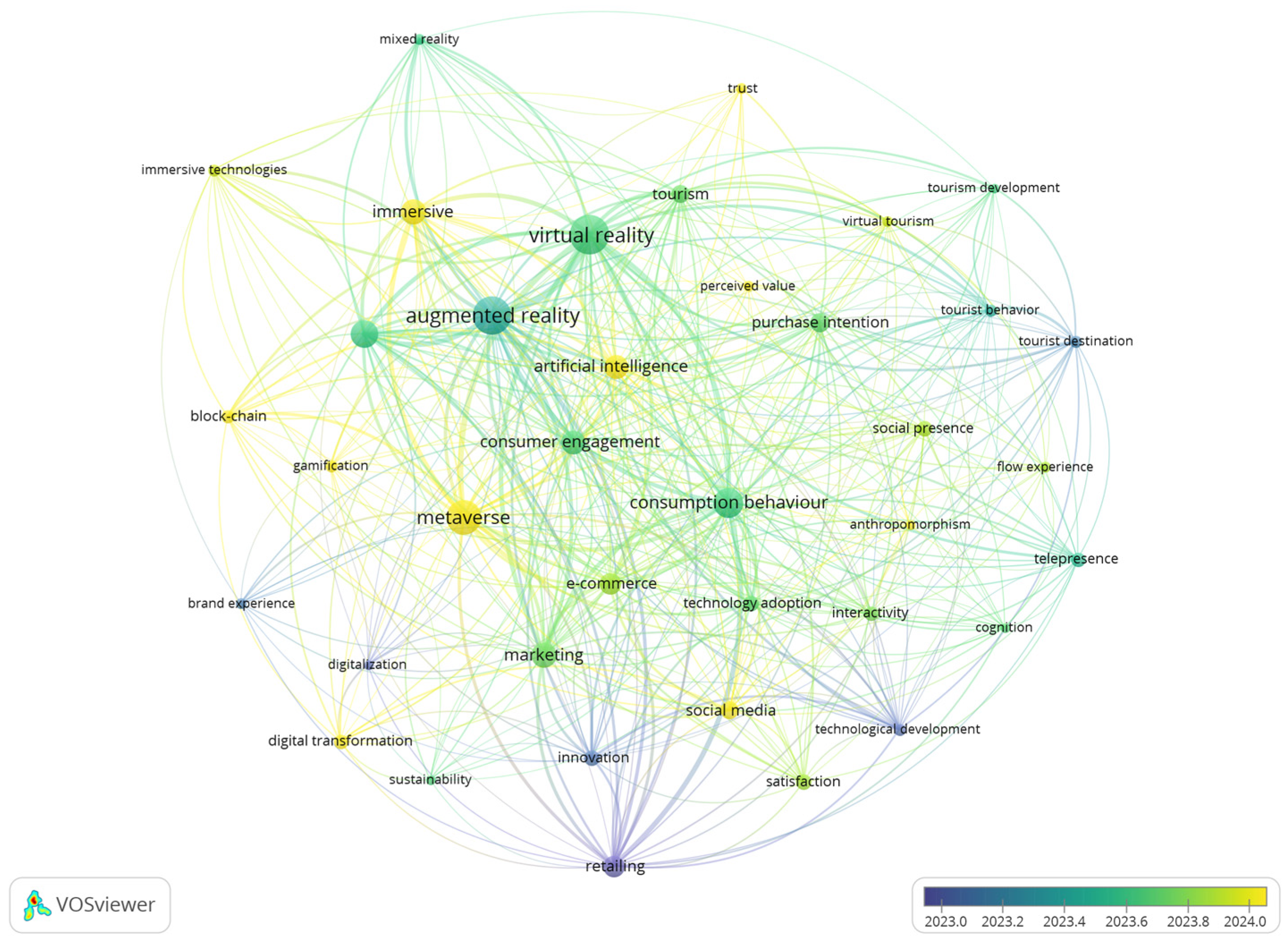
3. Results Gathered from Bibliometric Analysis
4. Theoretical Integration of Metaverse Advertising to Enhance Brand Engagement
5. Key Opportunities and Challenges Associated with Metaverse Advertising
6. Conclusions, Limitations and Future Research Directions
Funding
Institutional Review Board Statement
Informed Consent Statement
Data Availability Statement
Conflicts of Interest
References
- Shankar, A.; Gupta, R.; Kumar, A.; Biswas, B.; Rathore, B. Exploring the adoption of enterprise metaverse in business-to-business (B2B) organisations. Ind. Mark. Manag. 2025, 124, 224–238. [Google Scholar] [CrossRef] [Scilit]
- Bamberger, B.; Reinartz, W.; Ulaga, W. Navigating the future of B2B marketing: The transformative impact of the industrial metaverse. J. Bus. Res. 2025, 188, 115057. [Google Scholar] [CrossRef] [Scilit]
- Bakeshloo, K.A.; Agnihotri, R.; Mohammadzadeh, M. Metaverse and B2B marketing: Untapped research opportunities. J. Bus. Res. 2025, 200, 115592. [Google Scholar] [CrossRef] [Scilit]
- Arya, V.; Sambyal, R.; Sharma, A.; Dwivedi, Y.K. Brands are calling your AVATAR in Metaverse–A study to explore XR-based gamification marketing activities & consumer-based brand equity in virtual world. J. Consum. Behav. 2024, 23, 556–585. [Google Scholar]
- Sharma, A.; Sharma, L.; Krezel, J. Bridging Theory into Practice: An Investigation of the Opportunities and Challenges to the Implementation of Metaverse-Based Teaching in Higher Education Institutions. In Proceedings of the International Conference on Human-Computer Interaction, Washington, DC, USA, 29 June–4 July 2024; pp. 173–189. [Google Scholar]
- Sharma, A.; Sharma, L.; Krezel, J. Exploring the Use of Metaverse for Collaborative Learning in Higher Education: A Scoping Review. In Proceedings of the International Conference on Human-Computer Interaction, Copenhagen, Denmark, 23–28 July 2023; pp. 240–251. [Google Scholar]
- Al-Adwan, A.S.; Yaseen, H.; Alkhwaldi, A.F.; Jafar, R.M.S.; Fauzi, M.A.; Abdullah, A. Treasure hunting for brands: Metaverse marketing gamification effects on purchase intention, WOM, and loyalty. J. Glob. Mark. 2025, 38, 392–416. [Google Scholar] [CrossRef] [Scilit]
- Wanick, V.; Stallwood, J. Brand storytelling, gamification and social media marketing in the “Metaverse”: A case study of the Ralph Lauren winter escape. In Reinventing Fashion Retailing: Digitalising, Gamifying, Entrepreneuring; Springer: Berlin/Heidelberg, Germany, 2023; pp. 35–54. [Google Scholar] [CrossRef] [Scilit]
- Hesselbein, C.; Bory, P. Metaverse Spaces. In Infrastructures of Reality: Metaverse Stories, Spaces, Bodies; Springer: Berlin/Heidelberg, Germany, 2025; pp. 43–73. [Google Scholar]
- Brenk, K.; Tomini, N.; Kanbach, D.K.; Stubner, S.; Pinelli, M. From virtual vision to business reality: Embracing the metaverse revolution. Rev. Manag. Sci. 2025, 20, 81–107. [Google Scholar] [CrossRef] [Scilit]
- Marrone, T.; Cantone, G.F.; Caputo, F.; Cantone, L.; Aria, M. Unpacking dimensions of Brand Humanization in the Metaverse Era. Technol. Soc. 2025, 83, 103037. [Google Scholar] [CrossRef] [Scilit]
- Arya, V.; Sethi, D.; Hollebeek, L.D. Using augmented reality to strengthen consumer/brand relationships: The case of luxury brands. J. Consum. Behav. 2025, 24, 545–561. [Google Scholar] [CrossRef] [Scilit]
- Ambika, A.; Shin, H.; Jain, V. Immersive technologies and consumer behavior: A systematic review of two decades of research. Aust. J. Manag. 2025, 50, 55–79. [Google Scholar] [CrossRef] [Scilit]
- Blakeman, R. Nontraditional Media in Marketing and Advertising; Sage Publications: Thousand Oaks, CA, USA, 2013. [Google Scholar]
- Ogidi, O.; Anthony, U. Is the new media superior to the traditional media for advertising. Asian J. Econ. Model. 2016, 4, 57–69. [Google Scholar] [CrossRef] [Scilit]
- Agarwal, R.; Badghish, S.; Yaqub, M.Z.; Pandey, R. Customer engagement through metaverse-empowered retail channels: Role of personalization. Int. J. Retail. Distrib. Manag. 2025, 53, 467–484. [Google Scholar] [CrossRef] [Scilit]
- Mo, T.; Wang, W. The virtual new or the real old? The effect of temporal alignment between influencer virtuality and brand heritage narration on consumers’ luxury consumption. Psychol. Mark. 2025, 42, 470–492. [Google Scholar] [CrossRef] [Scilit]
- Belanche, D.; Casaló, L.V.; Flavián, M. Human versus virtual influences, a comparative study. J. Bus. Res. 2024, 173, 114493. [Google Scholar] [CrossRef] [Scilit]
- Dwivedi, Y.K.; Hughes, L.; Baabdullah, A.M.; Ribeiro-Navarrete, S.; Giannakis, M.; Al-Debei, M.M.; Dennehy, D.; Metri, B.; Buhalis, D.; Cheung, C.M. Metaverse beyond the hype: Multidisciplinary perspectives on emerging challenges, opportunities, and agenda for research, practice and policy. Int. J. Inf. Manag. 2022, 66, 102542. [Google Scholar] [CrossRef] [Scilit]
- Mystakidis, S. Metaverse. Encyclopedia 2022, 2, 486–497. [Google Scholar] [CrossRef] [Scilit]
- Cheng, R.; Wu, N.; Chen, S.; Han, B. Will metaverse be nextg internet? vision, hype, and reality. IEEE Netw. 2022, 36, 197–204. [Google Scholar] [CrossRef] [Scilit]
- Statista. Metaverse—Worldwide. 2025. Available online: https://www.statista.com/outlook/amo/metaverse/worldwide?srsltid=AfmBOopdWqRuoEXzESoq5deDrO7LArRIRu4zd2buoRIfzsrN-qXYzeuc#market-size (accessed on 1 October 2025).
- McKinsey. Value Creation in the Metaverse—The Real Business of the Virtual World; McKinsey & Company: New York, NY, USA, 2022; Available online: https://www.mckinsey.com/capabilities/growth-marketing-and-sales/our-insights/value-creation-in-the-metaverse (accessed on 1 October 2025).
- Kumar, R.; Mukherjee, S.; Bose, I. Metaverse advertising and promotional effectiveness: The route from immersion to joy. Decis. Support Syst. 2025, 189, 114386. [Google Scholar] [CrossRef] [Scilit]
- Tabeck, P.S. Gamified Brand Engagement in the Metaverse Strategies for Customer Loyalty. In Addressing Practical Problems Through the Metaverse and Game-Inspired Mechanics; IGI Global Scientific Publishing: Hershey, PA, USA, 2025; pp. 31–46. [Google Scholar]
- Hsu, C.-L.; Chen, M.-C. How does gamification improve user experience? An empirical investigation on the antecedences and consequences of user experience and its mediating role. Technol. Forecast. Soc. Change 2018, 132, 118–129. [Google Scholar] [CrossRef] [Scilit]
- Hsu, C.-L.; Chen, M.-C. How gamification marketing activities motivate desirable consumer behaviors: Focusing on the role of brand love. Comput. Hum. Behav. 2018, 88, 121–133. [Google Scholar] [CrossRef] [Scilit]
- Ahmad, W.; Yanping, Z.; Abbasi, A.Z.; Khan, M.T.; Waheed, A.; Qayyum, M. Metaverse Purchase Intention: Determinants of Metaverse and Mediating Role of Consumer Flow Experience. Sustain. Futures 2025, 10, 101023. [Google Scholar] [CrossRef] [Scilit]
- Wright, M.; Ekeus, H.; Coyne, R.; Stewart, J.; Travlou, P.; Williams, R. Augmented duality: Overlapping a metaverse with the real world. In Proceedings of the 2008 International Conference on Advances in Computer Entertainment Technology, Yokohama, Japan, 3–5 December 2008; pp. 263–266. [Google Scholar]
- Sprott, D.E.; Hollebeek, L.D.; Sigurdsson, V.; Clark, M.K.; Urbonavicius, S. Avatars’ phygital social presence in the metaverse: An engaged theory perspective. Psychol. Mark. 2025, 42, 1528–1540. [Google Scholar] [CrossRef] [Scilit]
- Ye, X.; Ruan, Y.; Xia, S.; Gu, L. Adoption of digital intangible cultural heritage: A configurational study integrating UTAUT2 and immersion theory. Humanit. Soc. Sci. Commun. 2025, 12, 23. [Google Scholar] [CrossRef] [Scilit]
- Cavalcante, W.Q.d.F.; Coelho, A.; Bairrada, C.M. Sustainability and tourism marketing: A bibliometric analysis of publications between 1997 and 2020 using vosviewer software. Sustainability 2021, 13, 4987. [Google Scholar] [CrossRef] [Scilit]
- Kirby, A. Exploratory bibliometrics: Using VOSviewer as a preliminary research tool. Publications 2023, 11, 10. [Google Scholar] [CrossRef] [Scilit]
- Sokolova, K.; Perez, C. Avatar anthropomorphism continuum: A blockchain-based data analysis of avatar skin purchases in the metaverse. Technol. Forecast. Soc. Change 2025, 221, 124341. [Google Scholar] [CrossRef] [Scilit]
- Dang, T.-Q.; Nguyen, T.-M.; Tran, P.-T.; Phan, T.-T.C.; Huynh, T.-B.; Nguyen, L.-T. From reality to virtuality: Unveiling Gen Z’s purchasing behavior through virtual influencers in the metaverse. Digit. Bus. 2025, 5, 100141. [Google Scholar] [CrossRef] [Scilit]
- Li, O.; Shi, Y.; Qian, D. Immersive stays in virtual hotels: The effect of experiences in metaverse hotels on customer responses. Int. J. Hosp. Manag. 2025, 130, 104247. [Google Scholar] [CrossRef] [Scilit]
- Gucci. Welcome to Gucci Town. Available online: https://www.gucci.com/au/en_au/st/stories/article/gucci-town-on-roblox?srsltid=AfmBOoo8U2C1CTBxm51CzPQteZYQOtSmNyV2tbWhTjULxRnSH42ihTtI (accessed on 1 October 2025).
- Quinn, B. Fashion in the Metaverse: Designs and Technologies Shaping the Future; Hachette: London, UK, 2025. [Google Scholar]
- Bellary, S.; Raghavendra, A.H. The Metaverse Chronicles: Success Stories in Virtual Retail. In The AI Metaverse Revolution: Transforming Multi-Business Scenarios (Volume 2); Emerald Publishing Limited: Leeds, UK, 2025; pp. 33–43. [Google Scholar]
- Correia, P.Á.P. Digital Marketing Strategies in Sustainable Tourism: The Role of the Metaverse. In Cases on Effective Digital Marketing for Competitive Organizations; IGI Global Scientific Publishing: Hershey, PA, USA, 2025; pp. 129–164. [Google Scholar]
- Lu, S.; Mintz, O. Marketing on the metaverse: Research opportunities and challenges. AMS Rev. 2023, 13, 151–166. [Google Scholar] [CrossRef] [Scilit]
- D’Arco, M.; Marino, V. From shelves to screens: Redefining packaging strategies in the metaverse. Eur. J. Innov. Manag. 2025. ahead-of-print. [Google Scholar] [CrossRef] [Scilit]
- Henry, C.D. Six strategies to building successful communities in the Metaverse. J. Brand Strategy 2023, 12, 40–48. [Google Scholar] [CrossRef] [Scilit]
- Saraswat, B.; Kothari, J.; Annirudh, G.; Ganguly, S. Application of Metaverse in the Automobile Industry. In The Business of the Metaverse; Productivity Press: New York, NY, USA, 2023; pp. 267–279. [Google Scholar]
- Coleman, T. Fiat and Kia Are Using ChatGPT to Sell Cars in the Metaverse. Available online: https://theweek.com/meta/1021377/fiat-and-kia-are-using-chatgpt-to-sell-cars-in-the-metaverse (accessed on 1 October 2025).
- Kulkarni, K.; Adithya, V.V.; Hitesh, K.; Kumari, N. Brand management in the metaverse. In The Business of the Metaverse; Productivity Press: New York, NY, USA, 2023; pp. 95–112. [Google Scholar]
- Van Eck, N.J.; Waltman, L. Citation-based clustering of publications using CitNetExplorer and VOSviewer. Scientometrics 2017, 111, 1053–1070. [Google Scholar] [CrossRef] [Scilit]
- Hudha, M.N.; Hamidah, I.; Permanasari, A.; Abdullah, A.G.; Rachman, I.; Matsumoto, T. Low Carbon Education: A Review and Bibliometric Analysis. Eur. J. Educ. Res. 2020, 9, 319–329. [Google Scholar] [CrossRef] [Scilit]
- Van Eck, N.J.; Waltman, L. VOSviewer Manual; Leiden University: Leiden, The Netherlands, 2020. [Google Scholar]
- Gandasari, D.; Tjahjana, D.; Dwidienawati, D.; Sugiarto, M. Bibliometric and visualized analysis of social network analysis research on Scopus databases and VOSviewer. Cogent Bus. Manag. 2024, 11, 2376899. [Google Scholar] [CrossRef] [Scilit]
- Alexander, B.; Blazquez, M.; Chrimes, C.; Boardman, R. The role of immersive spaces on the customer experience: An exploration of fashion metaverses. Psychol. Mark. 2025, 42, 539–553. [Google Scholar] [CrossRef] [Scilit]
- Loureiro, S.M.C.; Hollebeek, L.; Rather, R.A.; Ruivo, L.; Kaljund, K.; Guerreiro, J. Engaging with (vs. avoiding) personalized advertising on social media. J. Mark. Commun. 2023, 31, 764–785. [Google Scholar] [CrossRef] [Scilit]
- Brinson, N.H.; Eastin, M.S.; Bright, L.F. Advertising in a Quantified World: A Proposed Model of Consumer Trust, Attitude Toward Personalized Advertising And Outcome Expectancies. J. Curr. Issues Res. Advert. 2019, 40, 54–72. [Google Scholar] [CrossRef] [Scilit]
- Ciuchita, R.; Gummerus, J.K.; Holmlund, M.; Linhart, E.L. Programmatic advertising in online retailing: Consumer perceptions and future avenues. J. Serv. Manag. 2023, 34, 231–255. [Google Scholar] [CrossRef] [Scilit]
- Deng, S.; Tan, C.-W.; Wang, W.; Pan, Y. Smart Generation System of Personalized Advertising Copy and Its Application to Advertising Practice and Research. J. Advert. 2019, 48, 356–365. [Google Scholar] [CrossRef] [Scilit]
- Periyasami, S.; Periyasamy, A.P. Metaverse as future promising platform business model: Case study on fashion value chain. Businesses 2022, 2, 527–545. [Google Scholar] [CrossRef] [Scilit]
- Alawadh, M.; Barnawi, A. Empowering Retail in the Metaverse by Leveraging Consumer Behavior Analysis for Personalized Shopping: A Pilot Study in the Saudi Market. J. Theor. Appl. Electron. Commer. Res. 2025, 20, 63. [Google Scholar] [CrossRef] [Scilit]
- Hwang, G.-J.; Chien, S.-Y. Definition, roles, and potential research issues of the metaverse in education: An artificial intelligence perspective. Comput. Educ. Artif. Intell. 2022, 3, 100082. [Google Scholar] [CrossRef] [Scilit]
- Tlili, A.; Huang, R.; Shehata, B.; Liu, D.; Zhao, J.; Metwally, A.H.S.; Wang, H.; Denden, M.; Bozkurt, A.; Lee, L.-H. Is Metaverse in education a blessing or a curse: A combined content and bibliometric analysis. Smart Learn. Environ. 2022, 9, 24. [Google Scholar] [CrossRef] [Scilit]
- De Felice, F.; Petrillo, A.; Iovine, G.; Salzano, C.; Baffo, I. How Does the Metaverse Shape Education? A Systematic Literature Review. Appl. Sci. 2023, 13, 5682. [Google Scholar] [CrossRef] [Scilit]
- Gao, H.; Chong, A.Y.L.; Bao, H. Metaverse: Literature Review, Synthesis and Future Research Agenda. J. Comput. Inf. Syst. 2023, 64, 533–553. [Google Scholar] [CrossRef] [Scilit]
- Gulan, M.; Feng, Y.; Mvondo, G.F.N.; Niu, B. How Do Virtual Influencers Affect Consumer Brand Evangelism in the Metaverse? The Effects of Virtual Influencers’ Marketing Efforts, Perceived Coolness, and Anthropomorphism. J. Theor. Appl. Electron. Commer. Res. 2025, 20, 36. [Google Scholar] [CrossRef] [Scilit]
- Boccalini, S.; Patrizi, M.; Vernuccio, M.; Pastore, A. Enhancing eudaimonic well-being through brand experiences in the VR-based metaverse: Implications for brand-self connection and brand love. J. Prod. Brand Manag. 2025, 34, 817–831. [Google Scholar] [CrossRef] [Scilit]
- Kim, M.; Oh, H.J.; Choi, J.H.; Jung, Y. Decoding millennials and generation Z consumers’ brand behaviors in the Metaverse: The relationships among avatar identification, self-presence, and psychological dynamics. J. Consum. Behav. 2025, 24, 44–57. [Google Scholar] [CrossRef] [Scilit]
- Balakrishnan, J.; Das, R.; Alalwan, A.A.; Raman, R.; Dwivedi, Y.K. Informative and peripheral metaverse: Which leads to experience? An investigation from the viewpoint of self-concept. Comput. Hum. Behav. 2024, 156, 108223. [Google Scholar] [CrossRef] [Scilit]
- Kaman, K.; Deshmukh, A.K. Navigating the digital frontier: Understanding shopping behavior in the metaverse through an SLR lens. Span. J. Mark.-ESIC 2025. ahead-of-print. [Google Scholar] [CrossRef] [Scilit]
- Bai, K.; Liu, Y. Scarcity, symbolism, and social identity (3S): Unpacking drivers of conspicuous consumption of virtual gear in the metaverse. J. Retail. Consum. Serv. 2025, 87, 104396. [Google Scholar] [CrossRef] [Scilit]
- Ramanathan, K.; Pramod, D.; Patil, K. Exploring the Metaverse Luxury Product Purchase Intention Though the Lens of Hedonic Motivation and Consumption Value. In Proceedings of the 2024 IEEE 8th International Conference on Information and Communication Technology (CICT), Prayagraj, India, 6–8 December 2024; pp. 1–6. [Google Scholar]
- Cho, M.; Cho, E. Digital Luxury in the Metaverse: How Non-fungible Tokens Shape Resistance to Negative Information and Brand Purchase Intention. J. Consum. Behav. 2025, 24, 2384–2401. [Google Scholar] [CrossRef] [Scilit]
- Ghali, Z.; Rather, R.A.; Khan, I. Investigating metaverse marketing-enabled consumers’ social presence, attachment, engagement and (re) visit intentions. J. Retail. Consum. Serv. 2024, 77, 103671. [Google Scholar] [CrossRef] [Scilit]
- Sritong, C.; Sawangproh, W.; Teangsompong, T. Unveiling the adoption of metaverse technology in Bangkok metropolitan areas: A UTAUT2 perspective with social media marketing and consumer engagement. PLoS ONE 2024, 19, e0304496. [Google Scholar] [CrossRef] [Scilit]
- Teng, C.-I.; Dennis, A.R.; Dennis, A.S. Avatar-mediated communication and social identification. J. Manag. Inf. Syst. 2023, 40, 1171–1201. [Google Scholar] [CrossRef] [Scilit]
- Agnihotri, D.; Chaturvedi, P.; Swarup, K.; Mathur, A.; Tripathi, V.; Singh, N. Does social presence drive customer brand engagement and purchase intention in the fashion retail metaverse? The moderating role of self-efficacy. Internet Res. 2024, 35, 2342–2365. [Google Scholar] [CrossRef] [Scilit]
- Attri, R.; Korayim, D.; Alshaghdali, N.O.; Galgotia, D.; Walsh, S.T. Unveiling customer service experience knowledge in metaverse platforms: An application of embodied social presence theory approach. J. Enterp. Inf. Manag. 2025, 1–21, ahead-of-print. [Google Scholar] [CrossRef]
- Javornik, A.; Marder, B.; Pizzetti, M.; Warlop, L. Augmented self-The effects of virtual face augmentation on consumers’ self-concept. J. Bus. Res. 2021, 130, 170–187. [Google Scholar] [CrossRef] [Scilit]
- Kumar, A.; Shankar, A.; Behl, A.; Vrontis, D. Feeling the heat? metaverse as a platform for motivating pro-environmental behaviour through consumers’ climate (change) engagement. Technovation 2026, 149, 103369. [Google Scholar] [CrossRef] [Scilit]
- Aslam, S.; Majeed, M.U.; Hussain, Z. The Effect of NFTs Metaverse Engagement and Digital Personalization on Brand Accessibility: The Mediating Role of Inclusive Brand Strategies. In Metaverse and Sustainable Business Models in SMEs; IGI Global Scientific Publishing: Hershey, PA, USA, 2025; pp. 291–316. [Google Scholar]
- Naveen Kumar, R.; Janani, M.; Ramadevi, V.; Pavithra, R. How the metaverse and virtual worlds are redefining fashion marketing and brand engagement. Digit. Transform. Soc. 2025, 4, 312–328. [Google Scholar] [CrossRef] [Scilit]
- Payal, R.; Sharma, N.; Dwivedi, Y.K. Unlocking the impact of brand engagement in the metaverse on Real-World purchase intentions: Analyzing Pre-Adoption behavior in a futuristic technology platform. Electron. Commer. Res. Appl. 2024, 65, 101381. [Google Scholar] [CrossRef] [Scilit]
- Muhammad Sohail Jafar, R.; Ahmad, W.; Chen, Y. Metaverse in human behavior: The role of telepresence and flow experience on consumers’ shopping behavior in the metaverse. Sage Open 2024, 14, 21582440241261256. [Google Scholar] [CrossRef] [Scilit]
- Roh, T.; Xiao, S.; Park, B.I. What makes metaverse users immersed in the flow state in an emerging market? An application of affordance theory and ISSM. J. Retail. Consum. Serv. 2024, 81, 104012. [Google Scholar] [CrossRef] [Scilit]
- Wang, J.; Lian, X.; Qi, X. Understanding consumers’ willingness to accept digital exhibitions in the metaverse: Evidence from China. Humanit. Soc. Sci. Commun. 2025, 12, 1427. [Google Scholar] [CrossRef] [Scilit]
- Kim, J.; Cho, A.; Baek, T.H.; Park, J.; Bae, J. The effect of NFT visual quality on consumer evaluations of luxury goods in the metaverse. J. Retail. Consum. Serv. 2025, 87, 104346. [Google Scholar] [CrossRef] [Scilit]
- Zhong, L.; Zhu, M.; Li, M.; Morrison, A.M.; Yang, L. Play alone or play together? A comparative study of single-and multi-person interactions in virtual tourism. J. Hosp. Tour. Technol. 2025, 16, 346–368. [Google Scholar] [CrossRef] [Scilit]
- Hanneke, B.; Heß, M.; Hinz, O. Foundations of decentralized Metaverse economies: Converging physical and virtual realities. J. Manag. Inf. Syst. 2025, 42, 238–272. [Google Scholar] [CrossRef] [Scilit]
- Kumar, S.; Malhotra, D.; Kathuria, G. Unrestrained buying behavior in the metaverse: Exploring the moderating role of technostress and self-control. Span. J. Mark.-ESIC 2025. ahead-of-print. [Google Scholar] [CrossRef] [Scilit]
- Xu, L.; Xu, H.; Luo, J.; Zhang, R.; Pan, Y.; Xu, J. Immersive Digital Imaging Experience: An Empirical Study on Audiences’ Switching Intention to Metaverse Online Art Museum. IEEE Access 2025, 13, 51355–51372. [Google Scholar] [CrossRef] [Scilit]
- Zhan, W.; Shi, Y.; Lin, C. The impact of IRT and IDT on metaverse adoption in tourism: The moderating role of personal innovativeness among China’s generation Z. PLoS ONE 2025, 20, e0327239. [Google Scholar] [CrossRef] [Scilit] [PubMed]
- Oberoi, S.S.; Chakraborty, D.; Singh, A.N.; Dabholkar, S.S. Real vs. Perceived Use: Understanding Their Divergent Effects on Matchmaking Intentions in Metaverse. J. Glob. Inf. Manag. (JGIM) 2025, 33, 1–24. [Google Scholar] [CrossRef] [Scilit]
- Sung, E.; Kwon, O.; Sohn, K. NFT luxury brand marketing in the metaverse: Leveraging blockchain-certified NFTs to drive consumer behavior. Psychol. Mark. 2023, 40, 2306–2325. [Google Scholar] [CrossRef] [Scilit]
- Di Porto, F.; Stazi, A. Metaverse and Virtual Worlds: Definitions, Regulatory Issues and the Option of Responsible Self-Governance. Comp. L. Rev. 2025, 16, 48. [Google Scholar]
- Bartoli, C.; Fasano, F.; Cappa, F.; Boccardelli, P. Opportunities and challenges in the metaverse and NFTs for business model innovation: A managerial point of view. IEEE Trans. Eng. Manag. 2025, 72, 1685–1698. [Google Scholar] [CrossRef] [Scilit]
- Singh, J.; Singh, P.; Kaur, R.; Kaur, A.; Hedabou, M. Privacy and Security in the Metaverse: Trends, Challenges, and Future Directions. IEEE Access 2025, 13, 120209–120243. [Google Scholar] [CrossRef] [Scilit]
- Ivanov, S.; Seyitoğlu, F.; Webster, C. Metaverse economics for tourism and hospitality: Economic fundamentals in a semi-imaginary world. Tour. Econ. 2025, 32. [Google Scholar] [CrossRef] [Scilit]
- Gupta, A.; Patel, P.; Darji, K.; Ramoliya, F.; Gupta, R.; Tanwar, S.; Khajuria, K.; Garg, D. MetaPrism: Intelligent Personalized Engagement Policy for User’s Security and Privacy in Metaverse Environment. Secur. Priv. 2025, 8, e70009. [Google Scholar] [CrossRef] [Scilit]
- Koo, C.; Kwon, J.; Chung, N.; Kim, J. Metaverse tourism: Conceptual framework and research propositions. Curr. Issues Tour. 2023, 26, 3268–3274. [Google Scholar] [CrossRef] [Scilit]
- Mosharraf, M. Data governance in metaverse: Addressing security threats and countermeasures across the data lifecycle. Technol. Soc. 2025, 82, 102910. [Google Scholar] [CrossRef] [Scilit]
- Bovenzi, G.M. Content moderation in (decentralized) metaverses. Interact. Entertain. Law Rev. 2025, 8, 145–156. [Google Scholar] [CrossRef] [Scilit]
- Kou, Y.; Gui, X. Harmful design in the metaverse and how to mitigate it: A case study of user-generated virtual worlds on roblox. In Proceedings of the 2023 ACM Designing Interactive Systems Conference, Pittsburgh, PA, USA, 10–14 July 2023; pp. 175–188. [Google Scholar]
- Almomani, A.; Alâăśqerem, A.; Alauthman, M.; Aldweesh, A.; Aoudi, S.; Salloum, S.A. Ethical Foundations of AI-Driven Avatars in the Metaverse for Innovation and User Privacy. IEEE Access 2025, 13, 130610–130628. [Google Scholar] [CrossRef] [Scilit]
- Eltanbouly, S.; Halabi, O.; Qadir, J. Avatar privacy challenges in the metaverse: A comprehensive review and future directions. Int. J. Hum.–Comput. Interact. 2025, 41, 1967–1984. [Google Scholar] [CrossRef] [Scilit]
- Al-Kfairy, M.; Alfandi, O.; Khaddaj, S. Psychological barriers to metaverse-based education: Examining the impact of technophobia and digital fatigue. J. Inf. Commun. Ethics Soc. 2025, 23, 550–566. [Google Scholar] [CrossRef] [Scilit]
- Stangl, F.J.; Riedl, R.; Weitzl, W.J.; Martin, S. Fatigue and stress levels in digital collaboration: A pilot study with video conferencing and the metaverse. In NeuroIS Retreat; Springer: Berlin/Heidelberg, Germany, 2023; pp. 89–103. [Google Scholar]
- Dhiman, V.; Arora, M. The Dark Side of the Metaverse: Privacy, Security, and Safety Concerns. In The AI Metaverse Revolution: Transforming Multi-Business Scenarios (Volume 1); Emerald Publishing Limited: Leeds, UK, 2025; pp. 241–254. [Google Scholar]
- Kaur, P.; Jasrai, L.; Divyam, A.K. Metaverse Regulation for Artificial Intelligence: Conceptual Approach for Marketing Domain. In The AI Metaverse Revolution: Transforming Multi-Business Scenarios (Volume 1); Emerald Publishing Limited: Leeds, UK, 2025; pp. 39–58. [Google Scholar]



| Keywords | Scopus | ProQuest | EBSCOhost |
|---|---|---|---|
| (“Metaverse” OR “Virtual reality” OR “Augmented reality” OR “Mixed reality” OR “Virtual Worlds”) AND (Immersive marketing OR “virtual store *” OR “virtual retail” OR “virtual event” OR “virtual showroom” OR “co-creation”) AND (“Brand engagement” OR “Brand involvement” OR “Customer brand engagement” OR “consumer engagement” OR “customer engagement” OR “brand relationship”) AND PUBYEAR > 2019 AND PUBYEAR < 2026 AND (LIMIT-TO (LANGUAGE, “English”)) AND (LIMIT-TO (SUBJAREA, “BUSI”)) | 1548 | 19 | 48 |
| Theoretical Framework | Theoretical Explanation | Key Factors Investigated | Linkages with Brand Engagement/User Experience | Relevant Studies |
|---|---|---|---|---|
| Psychological Identity Perspectives of Brand Engagement Through Metaverse Platforms | ||||
| Elaboration Likelihood Theory | The elaboration likelihood theory states that consumers can engage with brand experiences via the Central and Peripheral routes of persuasion, which shape their purchase intentions and attitudes towards a brand. | Central route (information & accuracy). Peripheral route (Vividness), Actual self-congruence, Idea Self-congruence, Metaverse experience, Buying intention, Continuing intention. | Metaverse brand engagement/experience via central and peripheral routes of persuasion and its influence on buying and continuing consumer attention. | Balakrishnan, Das, Alalwan, Raman and Dwivedi [65] |
| Self-Concept Theory | Based on the self-concept theory, a user tends to represent themselves in two ways (i.e., actual self and ideal self) across Metaverse platforms via Avatars (i.e., Similarity & Wishful identification) | Similarity identification, Wishful identification, Self-presence, Emotional closeness, Perceived appropriateness, Purchase intention. | Consumer interaction on Metaverse platforms via avatar customisation to showcase their digital identities, which develops emotional closeness among consumers and enriches their brand experiences. | Kim, Oh, Choi and Jung [64], Javornik et al. [75] |
| Luxury Consumption Theory | The luxury consumption theory states the reasoning behind a consumer’s purchase intention and ownership of luxury brands. | Brand warmth, brand competence, cognitive engagement, affective engagement, behavioural engagement, consumer engagement, social value, and luxury brand attachment. | Consumer engagement with Luxury brands on Immersive Platforms and its influence on Brand attachment. | Arya, Sethi and Hollebeek [12] |
| Value-Based Perspectives of Brand Engagement Through Metaverse Platforms | ||||
| User & Gratification Theory | The theory states how individuals visualise themselves as per social and psychological needs and then gauge differently on Metaverse platforms based on their preferred choice. | Usability (Ease of Navigation, Comfort level, Intuitive interface, Accessibility features), Interactivity (Meaningful Interactions, Sense of Presence, Level of Control, Real-time Interaction), Personalisation (Avatar customisation, Sense of ownership, Content customisation) | Metaverse Experiences & Brand Engagement | Kumar et al. [76] |
| Self-Determination Theory | Self-determination theory explains how intrinsic motivation and psychological needs (i.e., autonomy, competence and relatedness) drive higher engagement among consumers. | Perceived immersion, Brand self-connection and Brand love | Perceived immersion (i.e., Metaverse platforms) positively enhances brand self-connection and brand love. | Ahmad, Yanping, Abbasi, Khan, Waheed and Qayyum [28], Boccalini, Patrizi, Vernuccio and Pastore [63], Kaman and Deshmukh [66], Bai and Liu [67], Aslam et al. [77], Naveen Kumar et al. [78] |
| Hedonic Motivation Model & Consumption Value Theory | Drawn from a psychological perspective, the Hedonic Motivation Model showcases how curiosity, joy and perceived usefulness can create a flow experience and encourage consumers to purchase luxury products through Metaverse platforms. | Joy, Curiosity, Perceived usefulness, Flow Experience, Functional, Social Consumption, Willingness to pay. | Unlike Utilitarian Motives, consumers seek hedonic motivations that drive them towards an enriched user experience and lead towards their willingness to pay on Metaverse platforms. | Ramanathan, Pramod and Patil [68] |
| Value Attitude Behaviour Theory | The theory states how consumers understand luxury NFTs and engage with brands on Metaverse platforms. In turn, these perceived values are supposed to influence not only their attitudes but also their behavioural outcomes. | Authentic, Scarcity, functional value, hedonic value, social value, Epistemic value, Brand attitude, Resistance to negative information, Brand purchase intention. | Use of non-fungible tokens (NFTs) in Metaverse platforms to influence consumer attitudes, behaviours and brand purchase intentions. | Cho and Cho [69] |
| Technology/Innovation Perspectives Related to Metaverse Platforms & Consumer Engagement | ||||
| Stimulus Organism Response framework (SOR) | The SOR framework states how external/environmental stimuli, along with psychological mechanisms and behavioural factors, enhance consumer engagement. | Entertainment, trendiness, intimacy, trendiness, interactivity, Brand satisfaction, brand hedonic value, brand utilitarian value, word of mouth, purchase intention, brand loyalty, brand engagement. | Studies showcase how various aspects of marketing stimuli influence organism factors, which leads to brand loyalty and higher purchase intention. | Al-Adwan, Yaseen, Alkhwaldi, Jafar, Fauzi and Abdullah [7], Ghali, Rather and Khan [70], Payal et al. [79], Muhammad Sohail Jafar et al. [80], Roh et al. [81] |
| Unified Theory of Acceptance & Use of Technology 2 (UTAUT2) Framework | Building upon the key concepts of UTAUT (i.e., performance expectancy, effort expectancy, social influence and facilitating conditions), the theory also captures the role of hedonic motivation, price value, and habit in understanding the key drivers behind Metaverse platforms. | Performance expectancy, effort expectancy, social influence, facilitating conditions, hedonic motivation, price value, and habit. | Integration of the UTAUT2 framework with demographic variables to understand intentions to use Metaverse platforms and derive consumer engagement across these platforms. | Sritong, Sawangproh and Teangsompong [71], Wang et al. [82] |
| Media Richness Theory | Based on media richness theory, consumers can interact across media depending on the ability to provide a sense of realness and feedback in these platforms. | Consumer engagement, consumer satisfaction, consumer experience, social presence, consumer orientation, communication and visualisation. | Sense of realness, along with immersion, enhances Brand Engagement & experience levels among consumers. | Bakeshloo, Agnihotri and Mohammadzadeh [3], Kim et al. [83], Zhong et al. [84] |
| Token Adoption & Valuation Theory | To build a sustainable economic model, this theory states how economic transactions in a decentralised metaverse economy can create value for virtual goods across digital platforms. | Exchange markets, economic actors, assets, scarce resources, Metaverse government | The development of a sustainable economic model through the Metaverse government, whereby the interplay between economic actors and the exchange rate allows for the design of a Metaverse economy. | Hanneke et al. [85] |
| Innovation Diffusion & Flow Theory | The innovation diffusion theory explains how consumers adopt a certain innovative platform (Metaverse platform) for consumer engagement by integrating with the characteristics of innovation. Besides this, the flow experience states that consumers are fully engaged with focused attention, intrinsic enjoyment and higher engagement across virtual platforms with reduced distractions. | Characteristics of Innovation (Relative advantage, compatibility, complexity), Self-control, Technostress, flow, impulsive buying and compulsive buying | Integration of perceived characteristics of innovation to Metaverse platforms and their influences on how consumers experience via flow, which in turn drives impulsive and compulsive purchases. | Kumar et al. [86], Xu et al. [87], Zhan et al. [88] |
| Social Interaction Perspectives Related to Metaverse Platforms & Consumer Engagement | ||||
| Social Identity Theory (SIT) | The social identity theory states that consumers are more likely to link themselves to groups they favour the most (In-group discrimination) and would distance themselves from the ones they dislike (Out-group discrimination). | Social presence dimension (autonomy, brand community, haptic effect, immersion, interactivity, personalisation). Customer brand engagement, purchase intention, User-avatar identification, User loyalty | Social presence dimensions not only influence a consumer’s level of brand engagement but also impact their purchase intentions across Metaverse platforms. | Teng, Dennis and Dennis [72], Agnihotri, Chaturvedi, Swarup, Mathur, Tripathi and Singh [73], Attri, Korayim, Alshaghdali, Galgotia and Walsh [74] |
| Social Presence Theory | The social presence theory states that individuals can develop interaction and connect with each other in social environments. | Gamification in Metaverse, Entertainment, Interaction, Trendiness, Intimacy, Novelty, Brand Love, Brand Engagement in Metaverse Platforms | Users are able to immerse themselves in Metaverse platforms and develop brand value meaningfully. | Arya, Sambyal, Sharma and Dwivedi [4], Arya, Sethi and Hollebeek [12], Oberoi et al. [89] |
| Game Theory & Prospect Theory | Based on the combined perspective of Game theory & prospect theory, it is stated how an individual tends to assess their decision in making product purchases through NFT Luxury brand fashion products. | Metaverse Appearance importance, social values of NFTs, Economic values of NFTs, Luxury brand NFT Authenticity, Luxury brand NFT Scarcity, Anticipated Gains/Losses in Buying/Not Buying Luxury NFTs, Luxury brand purchase intentions in Reality/Metaverse, Self-image congruence in Metaverse | Psychological estimations are done by a consumer to purchase a luxury brand NFT on Metaverse platforms based on associated gains/losses and its convergence with their self-image on reality/Metaverse platforms. | Kim, Oh, Choi and Jung [64], Sung et al. [90] |
| Challenges Associated with Metaverse Advertising | Related Studies |
|---|---|
| Metaverse Design & Architecture—Lack of Governance & Standardised Regulations | [91,92,93] |
| Issues with Interoperability Across Cross-Platforms | [91,94] |
| Regulatory Concerns—Transparency on Ownerships of Virtual Assets and Payment Through NFTs | [42,77,85,95,96] |
| Lack of Data Privacy and Content Moderation over Metaverse Platforms | [97,98,99] |
| Avatar Authentication & Identity Theft | [95,100,101] |
| Risks of Digital Fatigue | [102,103] |
| User Safety—Cyberbullying, Harassment & Phishing Attacks, Ethics of Personalisation | [93,101,104] |
| Issues with Infrastructure Requirements | [92,93] |
| Lack of Regulatory Compliance with Various Legal Frameworks across different countries | [92,93,105] |
Disclaimer/Publisher’s Note: The statements, opinions and data contained in all publications are solely those of the individual author(s) and contributor(s) and not of MDPI and/or the editor(s). MDPI and/or the editor(s) disclaim responsibility for any injury to people or property resulting from any ideas, methods, instructions or products referred to in the content. |
© 2026 by the author. Licensee MDPI, Basel, Switzerland. This article is an open access article distributed under the terms and conditions of the Creative Commons Attribution (CC BY) license.
Share and Cite
Sharma, A. Unpacking Dimensions of Metaverse Platforms to Enhance Immersive Experience and Brand Engagement Among Consumers. J. Theor. Appl. Electron. Commer. Res. 2026, 21, 83. https://doi.org/10.3390/jtaer21030083
Sharma A. Unpacking Dimensions of Metaverse Platforms to Enhance Immersive Experience and Brand Engagement Among Consumers. Journal of Theoretical and Applied Electronic Commerce Research. 2026; 21(3):83. https://doi.org/10.3390/jtaer21030083
Chicago/Turabian StyleSharma, Abhishek. 2026. "Unpacking Dimensions of Metaverse Platforms to Enhance Immersive Experience and Brand Engagement Among Consumers" Journal of Theoretical and Applied Electronic Commerce Research 21, no. 3: 83. https://doi.org/10.3390/jtaer21030083
APA StyleSharma, A. (2026). Unpacking Dimensions of Metaverse Platforms to Enhance Immersive Experience and Brand Engagement Among Consumers. Journal of Theoretical and Applied Electronic Commerce Research, 21(3), 83. https://doi.org/10.3390/jtaer21030083