
Effects of Technology, Content, and Social Relationship on Customer Continuance Intention in the Metaverse


Abstract
1. Introduction
2. Background and Hypotheses
2.1. A Review of Research on the Metaverse and Immersive Engagement
2.2. Theoretical Foundations
2.3. Hypotheses Development
2.3.1. Technological Sophistication
2.3.2. Security
2.3.3. Content Creativity
2.3.4. Content Richness
2.3.5. Social Interaction
2.3.6. Social Presence
2.3.7. Immersiveness
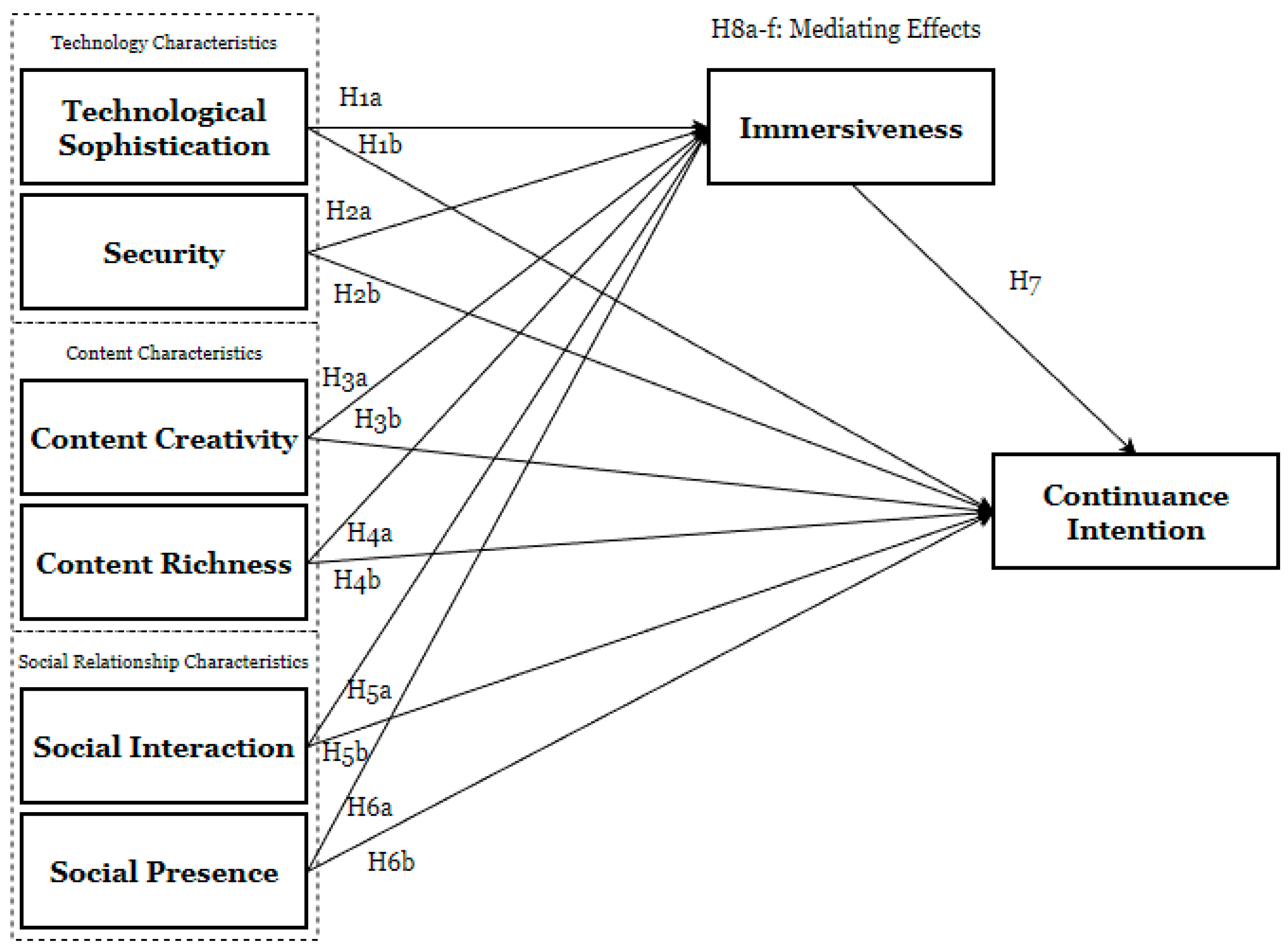
2.4. Research Model
3. Empirical Study
3.1. Method
3.1.1. Measurement
3.1.2. Data Collection
3.1.3. Reliability and Validity
3.1.4. Common Method Bias
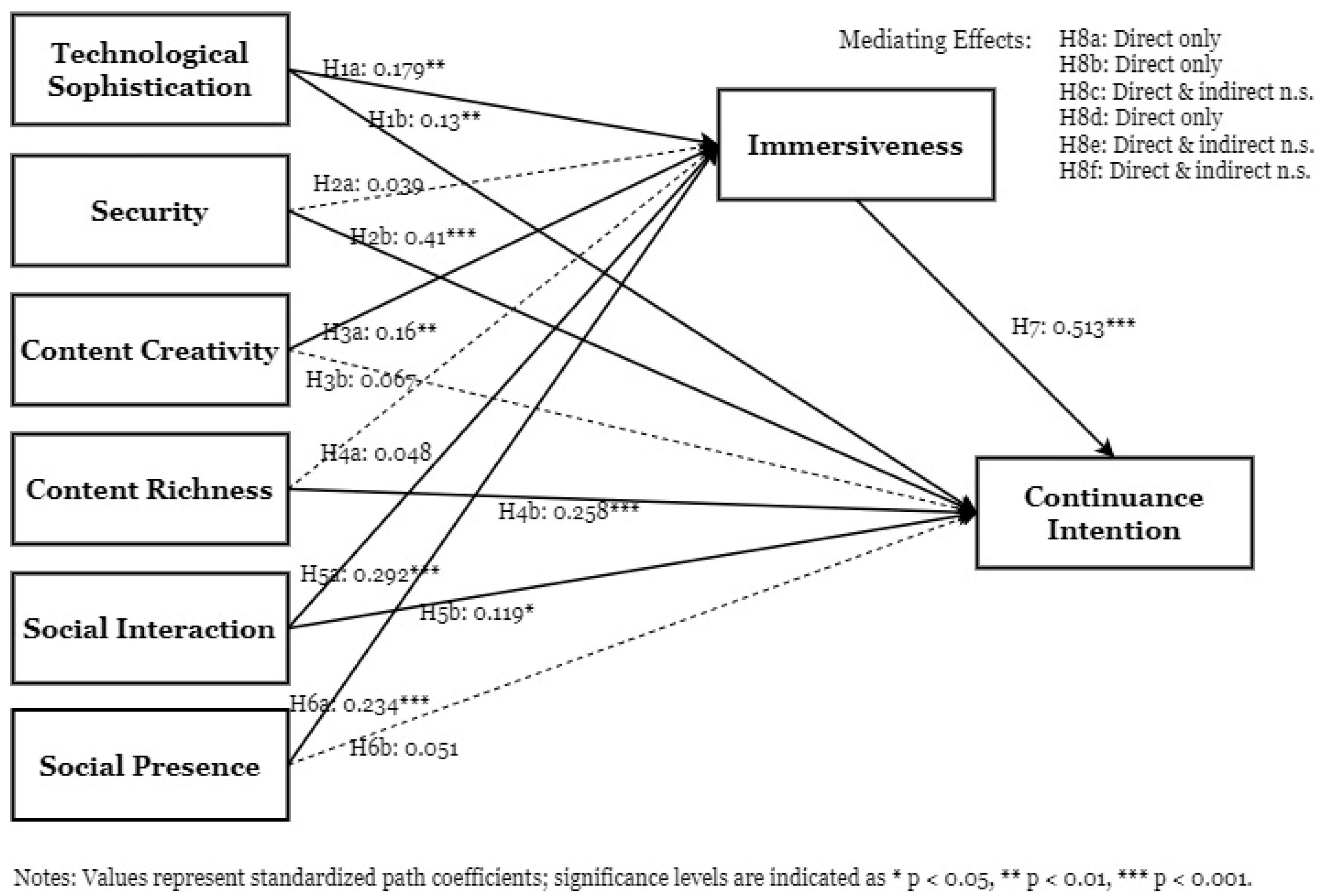
3.2. Hypothesis Test
3.3. Mediating Effect
4. Discussion and Conclusions
4.1. Summary and Theoretical Implications
4.2. Practical Implications
4.3. Limitations and Future Research
Author Contributions
Funding
Institutional Review Board Statement
Informed Consent Statement
Data Availability Statement
Acknowledgments
Conflicts of Interest
References
- Dwivedi, Y.K.; Hughes, L.; Wang, Y.; Alalwan, A.A.; Ahn, S.J.; Balakrishnan, J.; Barta, S.; Belk, R.; Buhalis, D.; Dutot, V.; et al. Metaverse marketing: How the metaverse will shape the future of consumer research and practice. Psychol. Mark. 2023, 40, 750–776. [Google Scholar] [CrossRef]
- Marabelli, M.; Newell, S. Responsibly strategizing with the metaverse: Business implications and DEI opportunities and challenges. J. Strateg. Inf. Syst. 2023, 32, 101774. [Google Scholar] [CrossRef]
- Krüger, K.; Weking, J.; Fielt, E.; Böttcher, T.; Kowalkiewicz, M.; Krcmar, H. Value drivers for metaverse business models: A complementor perspective. J. Manag. Inf. Syst. 2025, 42, 143–173. [Google Scholar] [CrossRef]
- Yoon, S.; Nam, Y. Metaverse engagement and Korea travel intentions: Understanding affordances, presence, and place attachment among Brazilian ZEPETO users. J. Destin. Mark. Manag. 2024, 31, 100865. [Google Scholar] [CrossRef]
- Roh, T.; Xiao, S.; Park, B.I. What makes metaverse users immersed in the flow state in an emerging market? An applica-tion of affordance theory and ISSM. J. Retail. Consum. Serv. 2024, 81, 104012. [Google Scholar] [CrossRef]
- Tao, M.; Khan, J.; Abbass, A.; Mehmood, K. Metaverse characteristics: The role of consumer experience shaping consumer behavior in the metaverse. J. Theor. Appl. Electron. Commer. Res. 2025, 20, 166. [Google Scholar] [CrossRef]
- Koohang, A.; Nord, J.H.; Ooi, K.-B.; Tan, G.W.-H.; Al-Emran, M.; Aw, E.C.X.; Baabdullah, A.M.; Buhalis, D.; Cham, T.-H.; Dennis, C.; et al. Shaping the metaverse into reality: A holistic multidisciplinary understanding of opportunities, challenges, and avenues for future investigation. J. Comput. Inf. Syst. 2023, 63, 735–765. [Google Scholar] [CrossRef]
- Di Pietro, R.; Cresci, S. Metaverse: Security and privacy issues. In Proceedings of the 2021 Third IEEE International Conference on Trust, Privacy and Security in Intelligent Systems and Applications (TPS-ISA), Atlanta, GA, USA, 13–15 December 2021; IEEE: Piscataway, NJ, USA, 2021; pp. 281–288. [Google Scholar] [CrossRef]
- Dwivedi, Y.K.; Hughes, L.; Baabdullah, A.M.; Ribeiro-Navarrete, S.; Giannakis, M.; Al-Debei, M.M.; Dennehy, D.; Metri, B.; Buhalis, D.; Cheung, C.M.K.; et al. Metaverse beyond the hype: Multidisciplinary perspectives on emerging challenges, opportunities, and agenda for research, practice and policy. Int. J. Inf. Manag. 2022, 66, 102542. [Google Scholar] [CrossRef]
- Wang, Y.; Su, Z.; Zhang, N.; Xing, R.; Liu, D.; Luan, T.H.; Shen, X. A survey on metaverse: Fundamentals, security, and privacy. IEEE Commun. Surv. Tutor. 2023, 25, 319–352. [Google Scholar] [CrossRef]
- Ball, M. Framework for the Metaverse. MatthewBall.co. 29 June 2021. Available online: https://www.matthewball.co/all/forwardtothemetaverseprimer (accessed on 14 January 2026).
- Yang, Q.; Zhao, Y.; Huang, H.; Xiong, Z.; Kang, J.; Zheng, Z. Fusing blockchain and AI with metaverse: A survey. IEEE Open J. Comput. Soc. 2022, 3, 122–136. [Google Scholar] [CrossRef]
- Bhattacherjee, A. Understanding information systems continuance: An expectation-confirmation model. MIS Q. 2001, 25, 351–370. [Google Scholar] [CrossRef]
- Xiang, N. Baidu Wants Its XiRang Platform to Be the Enabler of the Metaverse. Forbes. 2022. Available online: https://www.forbes.com/sites/ninaxiang/2022/05/12/baidu-wants-its-xirang-platform-to-be-the-enabler-of-the-metaverse/ (accessed on 10 January 2026).
- Soliman, M.M.; Ahmed, E.; Darwish, A.; Hassanien, A.E. Artificial intelligence powered metaverse: Analysis, challenges and future perspectives. Artif. Intell. Rev. 2024, 57, 36. [Google Scholar] [CrossRef]
- Yoo, K.; Welden, R.; Hewett, K.; Haenlein, M. The merchants of meta: A research agenda to understand the future of retailing in the metaverse. J. Retail. 2023, 99, 173–192. [Google Scholar] [CrossRef]
- Zhang, X.; Chen, Y.; Hu, L.; Wang, Y. The metaverse in education: Definition, framework, features, potential applications, challenges, and future research topics. Front. Psychol. 2022, 13, 1016300. [Google Scholar] [CrossRef]
- Gursoy, D.; Malodia, S.; Dhir, A. The metaverse in the hospitality and tourism industry: An overview of current trends and future research directions. J. Hosp. Mark. Manag. 2022, 31, 527–534. [Google Scholar] [CrossRef]
- Basu, B.; Kar, A.K.; Sen, S. Antecedents of user experience in the immersive metaverse ecosystem: Insights from mining user reviews. Commun. Assoc. Inf. Syst. 2024, 55, 13. [Google Scholar] [CrossRef]
- Soni, S.; Arora, P.; Kasilingam, D.; Jain, V. Digital daydreams: Exploring consumer motivations for engaging with the metaverse. J. Retail. Consum. Serv. 2025, 85, 104294. [Google Scholar] [CrossRef]
- Oh, H.J.; Kim, J.; Chang, J.J.; Park, N.; Lee, S. Social benefits of living in the metaverse: The relationships among social presence, supportive interaction, social self-efficacy, and feelings of loneliness. Comput. Hum. Behav. 2023, 139, 107498. [Google Scholar] [CrossRef]
- Ghali, Z.; Rather, R.A.; Khan, I. Investigating metaverse marketing-enabled consumers’ social presence, attachment, engagement and (re)visit intentions. J. Retail. Consum. Serv. 2024, 77, 103671. [Google Scholar] [CrossRef]
- Chi, M.; Ren, S.; Xu, Y.; Chen, Y.; Wu, Y. Critical success factors for metaverse implementation in the service industry: A hybrid ISM–DEMATEL approach. J. Retail. Consum. Serv. 2025, 87, 104424. [Google Scholar] [CrossRef]
- DeLone, W.H.; McLean, E.R. Information systems success: The quest for the dependent variable. Inf. Syst. Res. 1992, 3, 60–95. [Google Scholar] [CrossRef]
- DeLone, W.H.; McLean, E.R. The DeLone and McLean model of information systems success: A ten-year update. J. Manag. Inf. Syst. 2003, 19, 9–30. [Google Scholar] [CrossRef]
- Davis, F.D. Perceived usefulness, perceived ease of use, and user acceptance of information technology. MIS Q. 1989, 13, 319–340. [Google Scholar] [CrossRef]
- Csikszentmihalyi, M. Flow: The Psychology of Optimal Experience; Harper & Row: New York, NY, USA, 1990. [Google Scholar]
- Hoffman, D.L.; Novak, T.P. Marketing in hypermedia computer-mediated environments: Conceptual foundations. J. Mark. 1996, 60, 50–68. [Google Scholar] [CrossRef]
- Rogers, R.W. A protection motivation theory of fear appeals and attitude change. J. Psychol. 1975, 91, 93–114. [Google Scholar] [CrossRef]
- Rogers, R.W. Cognitive and physiological processes in fear appeals and attitude change: A revised theory of protection motivation. In Social Psychophysiology: A Sourcebook; Cacioppo, J.T., Petty, R.E., Eds.; Guilford Press: New York, NY, USA, 1983; pp. 153–176. [Google Scholar]
- Short, J.; Williams, E.; Christie, B. The Social Psychology of Telecommunications; Wiley: New York, NY, USA, 1976. [Google Scholar]
- Mennecke, B.E.; Triplett, J.L.; Hassall, L.M.; Jordán-Conde, Z. Embodied social presence theory. In Proceedings of the 43rd Hawaii International Conference on System Sciences (HICSS-43), Koloa, HI, USA, 5–8 January 2010; IEEE: Piscataway, NJ, USA, 2010; pp. 1–10. [Google Scholar] [CrossRef]
- Agarwal, R.; Karahanna, E. Time flies when you’re having fun: Cognitive absorption and beliefs about information technology usage. MIS Q. 2000, 24, 665–694. [Google Scholar] [CrossRef]
- Dincelli, E.; Yayla, A. Immersive virtual reality in the age of the Metaverse: A hybrid-narrative review based on the technology affordance perspective. J. Strateg. Inf. Syst. 2022, 31, 101717. [Google Scholar] [CrossRef]
- Jang, Y.; Park, E. An adoption model for virtual reality games: The roles of presence and enjoyment. Telemat. Inform. 2019, 42, 101239. [Google Scholar] [CrossRef]
- Yildirim, C. Cybersickness during VR gaming undermines game enjoyment: A mediation model. Displays 2019, 59, 35–43. [Google Scholar] [CrossRef]
- Zhu, R.; Yi, C. Avatar design in metaverse: The effect of avatar–user similarity in procedural and creative tasks. Internet Res. 2024, 34, 39–57. [Google Scholar] [CrossRef]
- Freeman, G.; Maloney, D. Body, avatar, and me: The presentation and perception of self in social virtual reality. Proc. ACM Hum.-Comput. Interact. 2021, 4, 239. [Google Scholar] [CrossRef]
- Hooi, R.; Cho, H. Being immersed: Avatar similarity and self-awareness. In Proceedings of the 24th Australian Computer-Human Interaction Conference (OzCHI ‘12), Melbourne, Australia, 26–30 November 2012; ACM: New York, NY, USA, 2012; pp. 232–240. [Google Scholar] [CrossRef]
- Kohler, T.; Füller, J.; Matzler, K.; Stieger, D.; Füller, J. Co-creation in virtual worlds: The design of the user experience. MIS Q. 2011, 35, 773–788. [Google Scholar] [CrossRef]
- Jo, H.; Park, D.-H. Affordance, usefulness, enjoyment, and aesthetics in sustaining virtual reality engagement. Sci. Rep. 2023, 13, 15097. [Google Scholar] [CrossRef] [PubMed]
- Jung, T.; Cho, J.; Han, D.-I.D.; Ahn, S.J.G.; Gupta, M.; Das, G.; Heo, C.Y.; Loureiro, S.M.C.; Sigala, M.; Trunfio, M.; et al. Metaverse for service industries: Future applications, opportunities, challenges and research directions. Comput. Hum. Behav. 2024, 151, 108039. [Google Scholar] [CrossRef]
- Lowry, P.B.; Boh, W.F.; Petter, S.; Leimeister, J.M. Long live the metaverse: Identifying the potential for market disruption and future research. J. Manag. Inf. Syst. 2025, 42, 3–38. [Google Scholar] [CrossRef]
- Yoon, N.; Lee, H. Exploring media richness in the metaverse shopping platform: The role of rendering quality and avatar realism. J. Korean Soc. Cloth. Text. 2024, 48, 1024–1038. [Google Scholar] [CrossRef]
- Shin, D.; Jo, H. Adoption and continuance in the metaverse. Electronics 2024, 13, 3917. [Google Scholar] [CrossRef]
- Jung, J.-H.; Shin, J.-I. Effects of metaverse experience factors (4Es) on perceived value and intention to continue use. J. Korea Soc. Comput. Inf. 2023, 28, 187–194. [Google Scholar] [CrossRef]
- Cole, H.; Griffiths, M.D. Social interactions in massively multiplayer online role-playing gamers. Cyberpsychol. Behav. 2007, 10, 575–583. [Google Scholar] [CrossRef]
- Oh, H.J.; Ozkaya, E.; LaRose, R. How does online social networking enhance life satisfaction? The relationships among online supportive interaction, affect, perceived social support, sense of community, and life satisfaction. Comput. Hum. Behav. 2014, 30, 69–78. [Google Scholar] [CrossRef]
- Zhou, Z.; Fang, Y.; Vogel, D.R.; Jin, X.-L.; Zhang, X. Attracted to or locked in? Predicting continuance intention in social virtual world services. J. Manag. Inf. Syst. 2012, 29, 273–306. [Google Scholar] [CrossRef]
- House, J.S. Work Stress and Social Support; Addison-Wesley: Reading, MA, USA, 1981. [Google Scholar]
- McMillan, D.W.; Chavis, D.M. Sense of community: A definition and theory. J. Community Psychol. 1986, 14, 6–23. [Google Scholar] [CrossRef]
- van Brakel, V.; Barreda-Ángeles, M.; Hartmann, T. Feelings of presence and perceived social support in social virtual reality platforms. Comput. Hum. Behav. 2023, 139, 107523. [Google Scholar] [CrossRef]
- Biocca, F.; Harms, C.; Burgoon, J.K. Toward a more robust theory and measure of social presence: Review and suggested criteria. Presence Teleoper. Virtual Environ. 2003, 12, 456–480. [Google Scholar] [CrossRef]
- Steuer, J. Defining virtual reality: Dimensions determining telepresence. J. Commun. 1992, 42, 73–93. [Google Scholar] [CrossRef]
- Slater, M.; Wilbur, S. A framework for immersive virtual environments (FIVE): Speculations on the role of presence in virtual environments. Presence Teleoper. Virtual Environ. 1997, 6, 603–616. [Google Scholar] [CrossRef]
- Lombard, M.; Ditton, T. At the heart of it all: The concept of presence. J. Comput.-Mediat. Commun. 1997, 3, JCMC321. [Google Scholar] [CrossRef]
- Witmer, B.G.; Singer, M.J. Measuring presence in virtual environments: A presence questionnaire. Presence Teleoper. Virtual Environ. 1998, 7, 225–240. [Google Scholar] [CrossRef]
- McKnight, D.H.; Choudhury, V.; Kacmar, C. The impact of initial consumer trust on intentions to transact with a web site: A trust building model. J. Strateg. Inf. Syst. 2002, 11, 297–323. [Google Scholar] [CrossRef]
- Pavlou, P.A. Consumer acceptance of electronic commerce: Integrating trust and risk with the technology acceptance model. Int. J. Electron. Commer. 2003, 7, 101–134. [Google Scholar] [CrossRef]
- Podsakoff, P.M.; MacKenzie, S.B.; Lee, J.-Y.; Podsakoff, N.P. Common method biases in behavioral research: A critical review of the literature and recommended remedies. J. Appl. Psychol. 2003, 88, 879–903. [Google Scholar] [CrossRef] [PubMed]
- Podsakoff, P.M.; Podsakoff, N.P.; Williams, L.J.; Huang, C.; Yang, J. Common method bias: It’s bad, it’s complex, it’s widespread, and it’s not easy to fix. Annu. Rev. Organ. Psychol. Organ. Behav. 2024, 11, 17–61. [Google Scholar] [CrossRef]
- Cronbach, L.J. Coefficient alpha and the internal structure of tests. Psychometrika 1951, 16, 297–334. [Google Scholar] [CrossRef]
- Kaiser, H.F. An index of factorial simplicity. Psychometrika 1974, 39, 31–36. [Google Scholar] [CrossRef]
- Bartlett, M.S. Tests of significance in factor analysis. Br. J. Stat. Psychol. 1950, 3, 77–85. [Google Scholar] [CrossRef]
- Howard, M.C. A systematic literature review of exploratory factor analyses in management. J. Bus. Res. 2023, 164, 113969. [Google Scholar] [CrossRef]
- O’Brien, R.M. A caution regarding rules of thumb for variance inflation factors. Qual. Quant. 2007, 41, 673–690. [Google Scholar] [CrossRef]
- Harman, H.H. Modern Factor Analysis, 3rd ed.; University of Chicago Press: Chicago, IL, USA, 1976. [Google Scholar]
- Hayes, A.F. Introduction to Mediation, Moderation, and Conditional Process Analysis: A Regression-Based Approach, 2nd ed.; Guilford Press: New York, NY, USA, 2018. [Google Scholar]
- Preacher, K.J.; Hayes, A.F. Asymptotic and resampling strategies for assessing and comparing indirect effects in multiple mediator models. Behav. Res. Methods 2008, 40, 879–891. [Google Scholar] [CrossRef]
- Chakraborty, D.; Mehta, P.; Khorana, S. Metaverse technologies in hospitality: Using the theory of consumption values to reveal consumer attitudes and trust factors. Int. J. Contemp. Hosp. Manag. 2025, 37, 1276–1308. [Google Scholar] [CrossRef]
- Park, Y.; Ko, E.; Do, B. The perceived value of digital fashion product and purchase intention: The mediating role of the flow experience in metaverse platforms. Asia Pac. J. Mark. Logist. 2023, 35, 2645–2665. [Google Scholar] [CrossRef]
- Chang, J.Y.S.; Cheah, J.-H.; Lim, X.J.; Lim, W.M.; Luo, X. Authentic experience in the metaverse: A situated cognition perspective of metaverse food festivals. Int. J. Contemp. Hosp. Manag. 2025, 37, 2961–2979. [Google Scholar] [CrossRef]
- Jo, H.; Lee, J.K. A comprehensive analysis of presence, seamlessness, and player responses in metaverse gaming. Comput. Hum. Behav. 2024, 159, 108345. [Google Scholar] [CrossRef]
- Kumar, H.; Sharma, V.K. Creating an immersive environment of metaverse for businesses. Australas. J. Inf. Syst. 2024, 28. [Google Scholar] [CrossRef]
- Sama, R.R.; Pande, T.; Sharma, K.; Das, K. Plugged into the future: How immersive technologies are changing service experiences? J. Serv. Theory Pract. 2025, 35, 776–804. [Google Scholar] [CrossRef]
- Zuboff, S. The Age of Surveillance Capitalism: The Fight for a Human Future at the New Frontier of Power; PublicAffairs: New York, NY, USA, 2019. [Google Scholar]
- Regulation (EU) 2024/1689 Laying Down Harmonised Rules on Artificial Intelligence (Artificial Intelligence Act). EUR-Lex. Available online: https://eur-lex.europa.eu/eli/reg/2024/1689/oj (accessed on 10 January 2026).
- Woodside, A.G. Embrace•perform•model: Complexity theory, contrarian case analysis, and multiple realities. J. Bus. Res. 2014, 67, 2495–2503. [Google Scholar] [CrossRef]
- Ragin, C.C. Fuzzy-Set Social Science; University of Chicago Press: Chicago, IL, USA, 2000. [Google Scholar]
- Fiss, P.C. Building better causal theories: A fuzzy set approach to typologies in organization research. Acad. Manag. J. 2011, 54, 393–420. [Google Scholar] [CrossRef]


| Source | Key Theory | Key Constructs | Relevance to This Study |
|---|---|---|---|
| Yoon & Nam [4] | Affordance-based view; presence; place attachment | affordance; presence (co-presence; social realism; cybersickness; spatial presence); immersion; place attachment; usage intention; visit intention | Links affordances to presence and place attachment; immersion predicts use intention. |
| Roh et al. [5] | Affordance theory; IS Success Model; Stimulus–Organism–Response (SOR) | autonomy; interactivity; enjoyment; competition; system/information/service quality; flow; satisfaction; continued use | Links psychological and technological stimuli to flow, satisfaction, and continuance. |
| Tao et al. [6] | Experience-dominant logic; value co-creation | sociability; immersiveness; environmental fidelity; consumer experience; continuance intention | Tests metaverse characteristics and consumer experience as a mediator of continuance. |
| Basu et al. [19] | Cognitive Load Theory (CLT); Cognitive Absorption Theory (CAT) | CLT factors (interactivity; sociability; density; stability; telepresence; social presence); CAT factors (temporal dissociation; focused immersion; heightened enjoyment; curiosity; playfulness); user experience | Tests CLT/CAT-based antecedents of metaverse experience using mined user reviews. |
| Soni et al. [20] | Behavioral Reasoning Theory; Technology Readiness | technology readiness; reasons-for/against (privacy, risk); attitude; intention | Shows privacy and risk as key reasons-against shaping intention; supports security as retention-relevant. |
| Oh et al. [21] | Social presence perspective; social support/self-efficacy | time spent; number of friends; social presence; supportive interaction; social self-efficacy; loneliness | Shows social presence driving supportive interaction, which relates to self-efficacy and loneliness. |
| Ghali et al. [22] | SOR framework | amount-of-time spent; number of friends; use of social virtual places; social presence; attachment; engagement; (re)visit intentions | Uses SOR to link time/friends/virtual-place use to social presence and attachment, predicting (re)visit intention. |
| Chi et al. [23] | Critical success factors (CSF) perspective on metaverse implementation | technology maturity; cyber/user security; employee training; top management support | Structures implementation CSFs; identifies technology maturity as a root driver. |
| This study | Technological–content–social-relational perspective; immersiveness | technological sophistication; security; content creativity/richness; social interaction/presence; immersiveness; continuance intention | Tests technology/content/social-relational factors for immersiveness and continuance; examines immersiveness’ role. |
| Constructs | Definition of Constructs | Sources of Construct Development |
|---|---|---|
| Technological sophistication | Advanced, innovative service technology that supports enjoyable use. | [24,25,26,35,36] |
| Security | Safety, reliability, and protection of data/privacy and transactions. | [9,58,59] |
| Content creativity | Support for creating and customizing avatars, interfaces, and content. | Newly developed for this study |
| Content richness | Breadth and cross-domain coverage of activities and content in the metaverse. | Newly developed for this study |
| Social interaction | Information sharing and socioemotional exchange enabled by the service. | [47,50,51] |
| Social presence | Others feel socially real and communication feels interpersonal and immediate. | [31,32,53] |
| Immersiveness | Absorptive involvement and experiential realism with minimal distraction. | [54,55,56,57] |
| Continuance intention | Intention to keep using, prioritize, and recommend the service. | [13] |
| Descriptive Index | Frequency | Percentage (%) |
|---|---|---|
| Gender | ||
| Male | 136 | 58.9 |
| Female | 95 | 41.1 |
| Age | ||
| <20 | 7 | 3.0 |
| 20~29 | 163 | 70.6 |
| 30~39 | 60 | 26.0 |
| 40< | 1 | 0.4 |
| Education | ||
| High school graduate or below | 2 | 0.9 |
| Be at college | 23 | 10.0 |
| College graduates | 168 | 72.7 |
| Master’s degree or above | 38 | 16.5 |
| Occupation | ||
| Student | 44 | 19.0 |
| Company employee | 154 | 66.7 |
| Civil servant | 23 | 10.0 |
| Self-employed | 9 | 3.9 |
| Homemaker | 1 | 0.4 |
| Experience | ||
| Less than 3 months | 29 | 12.6 |
| 3–6 months | 61 | 26.4 |
| 6 months–1 year | 70 | 30.3 |
| More than 1 year | 71 | 30.7 |
| Total | 231 | 100 |
| Items | Factor Loading | Cronbach’s α |
|---|---|---|
| <Technological sophistication> | 0.657 | |
| · The service’s technology makes it enjoyable to use. | 0.751 | |
| · The service integrates innovative technologies. | 0.666 | |
| · The service uses advanced technologies. | 0.815 | |
| <Security> | 0.754 | |
| · The system is safe and reliable. | 0.739 | |
| · The system protects data and privacy. | 0.800 | |
| · The system ensures secure financial transactions. | 0.811 | |
| <Content creativity> | 0.690 | |
| · The service supports creating a personalized interface. | 0.835 | |
| · The service provides a variety of tools for content creation. | 0.669 | |
| · The service supports freely creating an avatar that represents oneself. | 0.801 | |
| <Content richness> | 0.649 | |
| · The service provides rich content. | 0.712 | |
| · The content provided by the service covers a wide range of industries. | 0.759 | |
| · The service provides different types of task content. | 0.758 | |
| <Social interaction> | 0.686 | |
| · The service supports diverse forms of social interaction. | 0.647 | |
| · The service enables users to gain benefits through interaction. | 0.788 | |
| · The service helps users gain acceptance and respect through interaction. | 0.705 | |
| <Social presence> | 0.777 | |
| · Other users in the service are real people, not machines. | 0.770 | |
| · The service helps users feel a sense of community belonging through interaction. | 0.770 | |
| · Other users in the service perceive me as a real presence. | 0.836 | |
| · In the service, communication feels like “face-to-face” interaction among users. | 0.701 | |
| <Immersiveness> | 0.780 | |
| When using this service, | ||
| · It feels like being in the real world. | 0.862 | |
| · The sensory experience is realistic and natural. | 0.798 | |
| · External distractions are minimized. | 0.740 | |
| · I can experience continuous, uninterrupted immersion. | 0.685 | |
| <Continuance intention> | 0.856 | |
| · This service is worth using. | 0.834 | |
| · I plan to use this service in the long term. | 0.770 | |
| · I intend to recommend this service to others. | 0.715 | |
| · If similar services are available, I would give priority to this one. | 0.792 | |
| · I will continue to use this service in the future. | 0.869 |
| Constructs | Mean | S.D. | 1 | 2 | 3 | 4 | 5 | 6 | 7 | 8 |
|---|---|---|---|---|---|---|---|---|---|---|
| 1. Technological sophistication | 4.34 | 0.58 | 1 | |||||||
| 2. Security | 3.93 | 0.70 | 0.28 ** | 1 | ||||||
| 3. Content creativity | 4.14 | 0.64 | 0.38 ** | 0.27 ** | 1 | |||||
| 4. Content richness | 4.11 | 0.59 | 0.34 ** | 0.47 ** | 0.31 ** | 1 | ||||
| 5. Social interaction | 3.93 | 0.68 | 0.43 ** | 0.52 ** | 0.41 ** | 0.36 ** | 1 | |||
| 6. Social presence | 3.85 | 0.70 | 0.29 ** | 0.40 ** | 0.46 ** | 0.43 ** | 0.43 ** | 1 | ||
| 7. Immersiveness | 3.82 | 0.72 | 0.46 ** | 0.40 ** | 0.48 ** | 0.38 ** | 0.57 ** | 0.52 ** | 1 | |
| 8. Continuance intention | 4.06 | 0.69 | 0.42 ** | 0.67 ** | 0.38 ** | 0.58 ** | 0.53 ** | 0.44 ** | 0.51 ** | 1 |
| Hypothesis | Standard β | T Value | Test Result | |||
|---|---|---|---|---|---|---|
| H1a | Technological sophistication | → a | Immersiveness | 0.179 | 3.214 ** | Supported |
| H2a | Security | 0.039 | 0.651 | Not supported | ||
| H3a | Content creativity | 0.16 | 2.774 ** | Supported | ||
| H4a | Content richness | 0.048 | 0.822 | Not supported | ||
| H5a | Social interaction | 0.292 | 4.647 *** | Supported | ||
| H6a | Social presence | 0.234 | 3.932 *** | Supported | ||
| H7 | Immersiveness | → b | Continuance intention | 0.513 | 9.033 *** | Supported |
| H1b | Technological sophistication | → c | Continuance intention | 0.13 | 2.611 ** | Supported |
| H2b | Security | 0.41 | 7.577 *** | Supported | ||
| H3b | Content creativity | 0.067 | 1.303 | Not supported | ||
| H4b | Content richness | 0.258 | 4.966 *** | Supported | ||
| H5b | Social interaction | 0.119 | 2.134 * | Supported | ||
| H6b | Social presence | 0.051 | 0.964 | Not supported | ||
| Path a: R2 = 0.483, adj R2 = 0.469, F = 34.85 (p < 0.001), VIF = 1.348~1.704, Durbin-Watson = 2.004 Path b: R2 = 0.263, adj R2 = 0.259, F = 81.60 (p < 0.001), VIF = 1, Durbin-Watson = 2.115 Path c: R2 = 0.589, adj R2 = 0.578, F = 53.54 (p < 0.001), VIF = 1.348~1.704, Durbin-Watson = 1.937 | ||||||
| Constructs | Direct Effect (c′), B (95% CI) | Indirect Effect (ab), Boot 95% CI | Test Result |
|---|---|---|---|
| H8a: Technological sophistication | B = 0.129, [0.010, 0.247] | ab = 0.026, [−0.015, 0.077] | Direct only |
| H8b: Security | B = 0.399, [0.295, 0.504] | ab = 0.005, [−0.010, 0.076] | Direct only |
| H8c: Content creativity | B = 0.051, [−0.059, 0.160] | ab = 0.021, [−0.010, 0.075] | Direct & indirect n.s. |
| H8d: Content richness | B = 0.292, [0.174, 0.409] | ab = 0.007, [−0.024, 0.069] | Direct only |
| H8e: Social interaction | B = 0.084, [−0.031, 0.200] | ab = 0.036, [−0.016, 0.134] | Direct & indirect n.s. |
| H8f: Social presence | B = 0.022, [−0.083, 0.127] | ab = 0.028, [−0.012, 0.093] | Direct & indirect n.s. |
Disclaimer/Publisher’s Note: The statements, opinions and data contained in all publications are solely those of the individual author(s) and contributor(s) and not of MDPI and/or the editor(s). MDPI and/or the editor(s) disclaim responsibility for any injury to people or property resulting from any ideas, methods, instructions or products referred to in the content. |
© 2026 by the authors. Licensee MDPI, Basel, Switzerland. This article is an open access article distributed under the terms and conditions of the Creative Commons Attribution (CC BY) license.
Share and Cite
Feng, J.-Q.; Xu, C.; Cho, S.-E. Effects of Technology, Content, and Social Relationship on Customer Continuance Intention in the Metaverse. J. Theor. Appl. Electron. Commer. Res. 2026, 21, 75. https://doi.org/10.3390/jtaer21030075
Feng J-Q, Xu C, Cho S-E. Effects of Technology, Content, and Social Relationship on Customer Continuance Intention in the Metaverse. Journal of Theoretical and Applied Electronic Commerce Research. 2026; 21(3):75. https://doi.org/10.3390/jtaer21030075
Chicago/Turabian StyleFeng, Jia-Qi, Chao Xu, and Sung-Eui Cho. 2026. "Effects of Technology, Content, and Social Relationship on Customer Continuance Intention in the Metaverse" Journal of Theoretical and Applied Electronic Commerce Research 21, no. 3: 75. https://doi.org/10.3390/jtaer21030075
APA StyleFeng, J.-Q., Xu, C., & Cho, S.-E. (2026). Effects of Technology, Content, and Social Relationship on Customer Continuance Intention in the Metaverse. Journal of Theoretical and Applied Electronic Commerce Research, 21(3), 75. https://doi.org/10.3390/jtaer21030075