1. Introduction
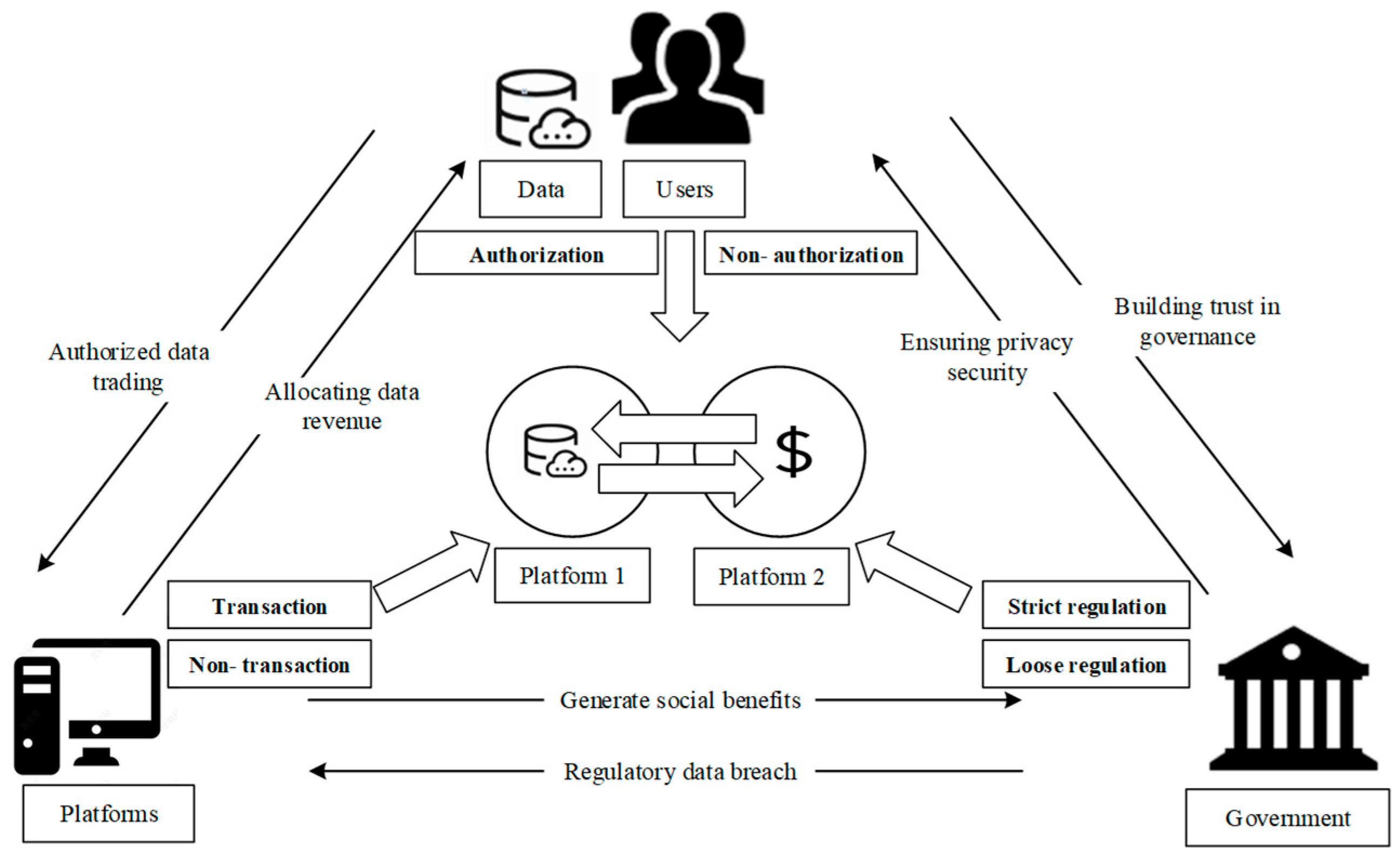
As with most two-sided markets, platforms continuously accumulate data resources by connecting different user groups. These data resources help platforms gain deep insights into users’ needs and accurately predict market trends, as well as driving service optimization and product iteration. Currently, more and more platforms’ development strategies are evolving from “economies of scale” to “economies of scope”, with expanding into peripheral areas while consolidating their core markets. The demand for business diversification has directly led to an increase in platform data transactions. Data transactions refer to platforms exchanging or acquiring each other’s market user data based on data sharing or trading mechanisms. For example, Meituan and Baidu Maps, two leading Chinese enterprises in the local lifestyle services and online map services markets, respectively, are achieving mutual benefits through data transactions and sharing. Specifically, Meituan provides Baidu Maps with comprehensive data on local lifestyle service providers, including restaurants and entertainment venues, as well as user review data. This significantly enriches the map information and service content of Baidu Maps, enhancing its service quality and user experience. In return, Baidu Maps provides Meituan with precise geographical location and traffic flow data, which are crucial for optimizing logistics delivery routes and improving the accuracy of merchant recommendation algorithms. This model of platform data transactions enables the mutual exchange of resources among platforms, promoting the efficient utilization of data resources and fostering the synergistic development of inter-platform businesses. This injects new vitality into the prosperity of the digital economy.
However, obtaining user authorization for personal data is crucial during platform data transactions. As users’ awareness of data privacy protection has increased significantly, they are demanding greater control over their personal data and expecting transparency and informed consent during the collection and use of their data. China has recently issued several policy documents on data management, including the “Data Security Law of the People’s Republic of China”, the “Personal Information Protection Law of the People’s Republic of China”, and the “Electronic Commerce Law of the People’s Republic of China”. These regulations establish a normative framework for the collection, storage and transactions of data. They require platforms to strictly comply with legal provisions when conducting data transactions, strengthen user privacy protection and ensure the legality of data. Against this backdrop, platforms typically require users to read and agree to the data usage terms and conditions during registration, clarifying the scope of data use and potential sharing with third parties. Particularly, platforms commonly implement personal data authorization mechanisms, enabling users to access privacy settings and specify who can access their personal information. These privacy settings balance user authorization and data utilization, enabling users to control and manage their personal data. Under these mechanisms, platforms must obtain prior authorization from users when intending to trade or share their personal data.
While these mechanisms are effective in protecting user privacy and data security, they can also constrain platforms’ operational flexibility and limit their commercial potential, thereby undermining their capacity for service innovation and market expansion. In this context, exploring how user authorization impacts platform data transactions, thereby enriching data products and services and attracting more entities to participate in data transactions, is of great significance for promoting the development of the data transaction market. However, despite the growing discussion of data rights, existing research lacks a systematic theoretical framework with which to analyze the interactive mechanisms between the micro-level behaviors of users authorizing transactions and the transactions themselves. This hinders the provision of accurate assessments of the practical utility of user data ownership in market-based data allocation. At the regulatory policy level, an effective link between data ownership classification and differentiated regulatory strategies has yet to be established. Existing regulatory theories appear to be insufficiently adaptive when addressing complex ownership forms, such as the integration of personal and behavioral data. Additionally, similar studies on topics such as information/data protection policies and their impact on data transactions have primarily relied on static models, such as the Hotelling model, for analysis [
1]. These models have yet to fully unravel the complex interactions and evolutionary equilibrium strategies among the parties involved. This study therefore examines users, platforms and the government operating under bounded rationality, whose strategic choices involve balancing dynamic data value against costs. The study focuses on two primary questions: (1) Under what specific conditions does user authorization facilitate or hinder platform data transactions? (2) How should government regulatory strategies be dynamically adjusted in response to the interplay of user authorization and platform decision? This study contributes by applying an evolutionary game framework to construct a tripartite model involving users, platforms, and the government in the context of data transactions. It analyses the dynamic evolution of user personal data authorization strategy, platform data transaction strategy and government regulatory strategy, exploring the evolutionary logic of tripartite strategy selection under user authorization mechanisms.
4. Solving the Evolutionary Stabilization Strategy
4.1. Expected Payoff of Users
The expected payoff for users choosing the authorization strategy is
, and the expected payoff for users choosing the non-authorization strategy is
. Users’ expected payoff is
. Therefore,
The replication dynamic equation of users is:
The first derivative of the replication dynamic equation is:
According to the stability theorem of the replicator dynamics equation, to achieve policy stability, conditions and must be satisfied. The corresponding point is then the stable point of the evolutionary game.
Letting yields:
Therefore, when , there is
,
, and
represents a stable point in the evolutionary game, at which users choose the authorization strategy; when
, there is
,
, and
represents a stable point in the evolutionary game, at which users choose the non-authorization strategy; when
, there is
, it indicates that all points on
are in a stable state, meaning users’ strategy does not change over time. This leads to the following proposition:
Proposition 1. When , is users’ evolutionarily stable strategy; when , is users’ evolutionarily stable strategy; when , the stable strategy cannot be determined.
Proposition 1 indicates that, with other parameters constant, users’ strategy is influenced to some extent by platforms’ initial strategy probability. As platforms’ transaction probability increases, the probability of users’ authorization strategy decreases.
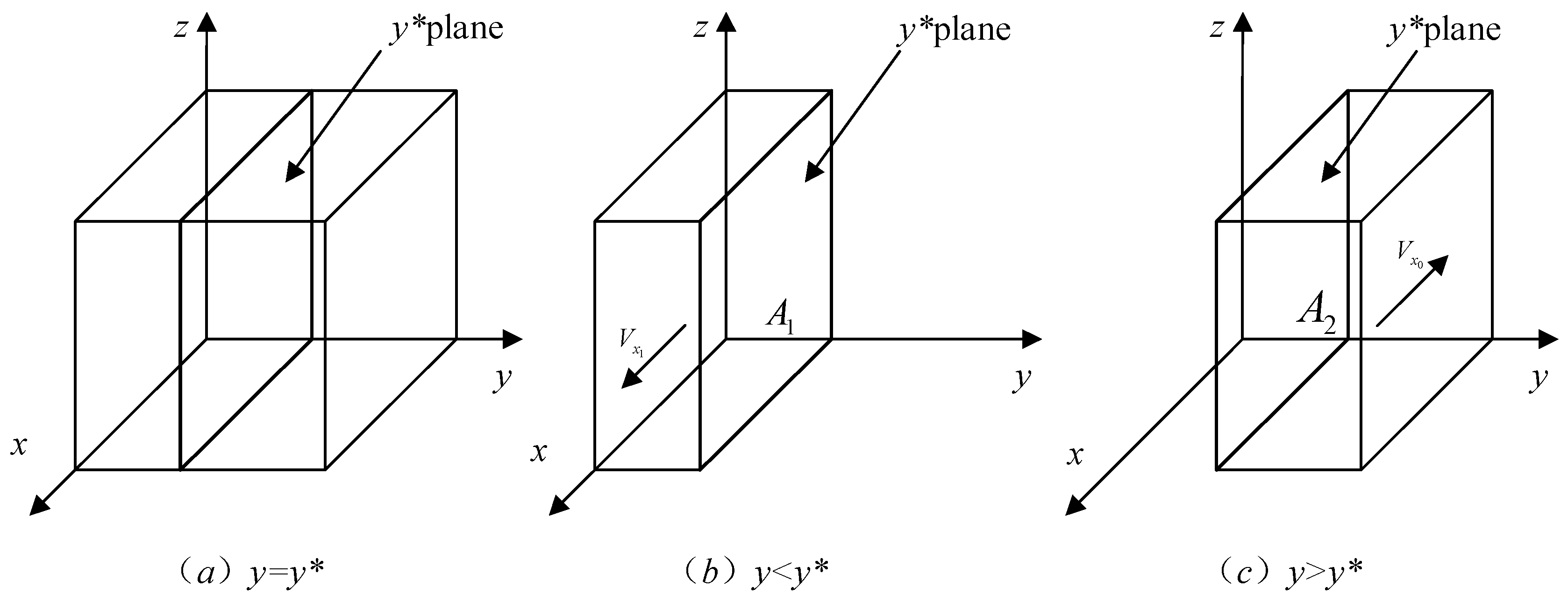
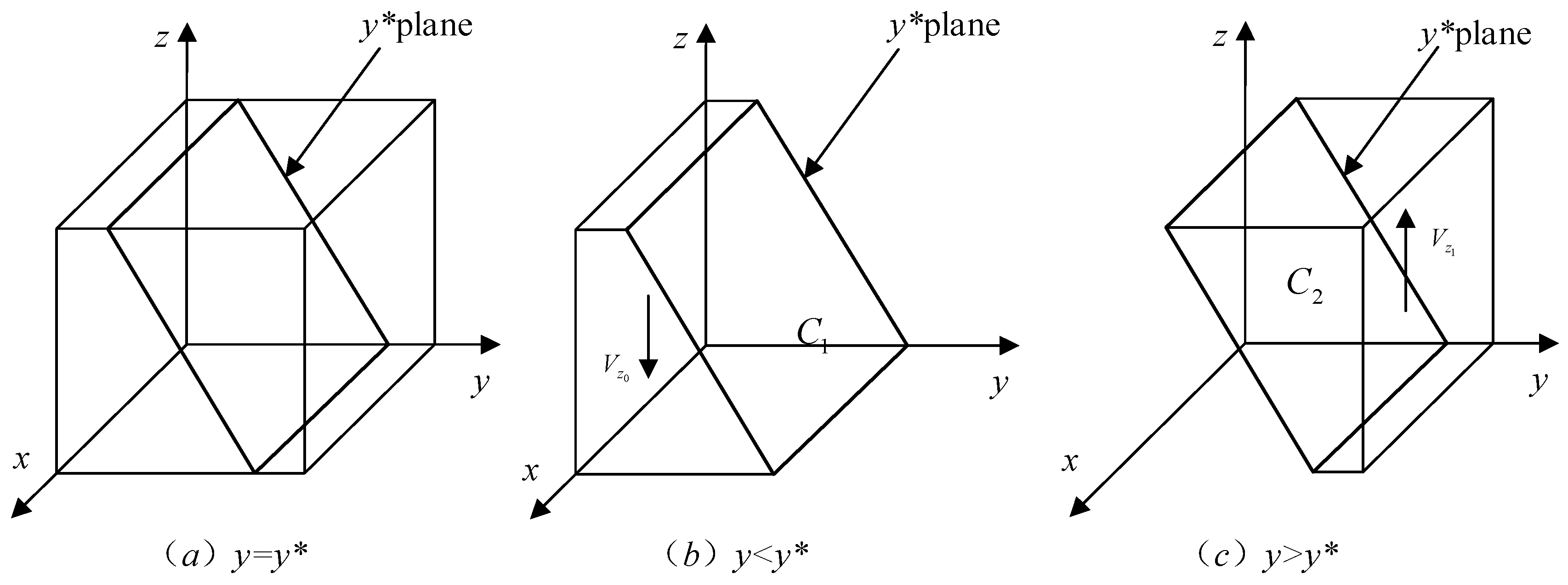
Figure 2 shows the phase diagram of users’ strategy evolution dynamics.
The first-order partial derivatives of each parameter yield the following results. When , there is , indicating that increases as increases; the plane moves along the positive direction of the axis. As a result, the volume of , which is the probability of user authorization, increases. When , there is , indicating that decreases as increases; the volume of decreases, indicating a reduced probability of authorization. Similarly, when , there is ; when , there is ; and , , , , . This leads to the following proposition:
Proposition 2. Regarding the probability of users selecting the authorization strategy, when , it is positively correlated with ; when , it is positively correlated with . Additionally, it is positively correlated with , , and , but is negatively correlated with and .
Proposition 2 illustrates that users’ authorization decisions involve a trade-off between benefits and risks. Specifically, the greater the benefit coefficient users derive from data value, or the higher the price coefficient of data transactions, the greater their potential gains—thereby increasing their inclination to authorize. Conversely, the lower the probability of data leakage when not authorizing, or the higher the probability of leakage when authorizing coupled with greater losses to user benefits from such leakage, the greater the risks of authorization—thereby increasing users’ inclination to not authorize. Furthermore, only when the behavioral data value is high will users increasingly favor authorizing their personal data, since authorization allows them to gain more from platforms’ data transactions. However, when the data transaction price is high, users will increasingly favor not authorizing their personal data as the value of their behavioral data increases. This is because they can already obtain sufficient benefits from platforms’ behavioral data transactions, making them more inclined to not authorize.
4.2. Expected Payoff of Platforms
The expected payoff when platforms choose to engage in data transaction is
, the expected payoff when platforms choose not to engage in data transaction is
, and platforms’ expected payoff is
. Therefore,
The replication dynamic equation of platforms is:
The first derivative of the replication dynamic equation is:
Letting yields:
Therefore, when , there is , , and is the equilibrium point of the evolutionary game, platforms adopt the non-transaction strategy at this point; when , there is , , and is the equilibrium point of the evolutionary game, at which platforms choose the transaction strategy; when , there is , it indicates that all points on are in a stable state, meaning platforms’ strategy does not change over time. This leads to the following proposition:
Proposition 3. When , is platforms’ evolutionarily stable strategy; when , is platforms’ evolutionarily stable strategy; when , the stable strategy cannot be determined.
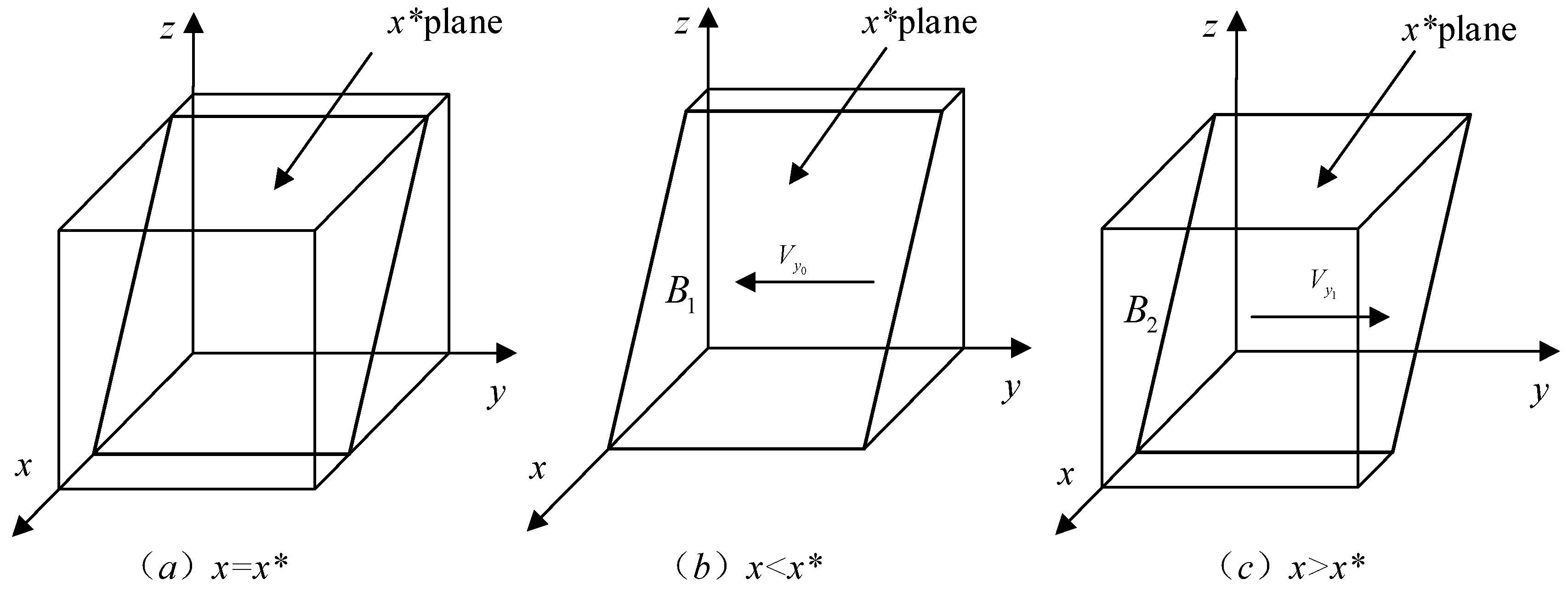
Proposition 3 indicates that, holding other parameters constant, platforms’ strategy is influenced to some extent by the probability of users’ initial strategy. The higher the initial probability of users’ authorization, the greater the probability that platforms will choose the transaction strategy. The phase diagram of platforms’ strategy evolutionary dynamics is shown in
Figure 3.
Further analysis reveals that when , there is . It means that decreases as increases, and plane moves along the negative direction of axis . As a result, the volume of , which represents the probability of platforms selecting a transaction strategy, increases. Similarly, when , there is ; when and , there is ; when , there is ; when , there is ; when , there is ; when and , there is . The following proposition is thus summarized:
Proposition 4. Regarding the probability of platforms selecting the transaction strategy, when , it is positively correlated with and negatively correlated with ; When , it is positively correlated with ; When and , it is positively correlated with ; when , it is positively correlated with ; when , it is negatively correlated with ; when and , it is negatively correlated with .
Proposition 4 indicates that while the probability of platforms’ data transaction strategy is primarily determined by the relative strength of potential gains versus potential risks, it does not strictly increase with the growth of potential gains such as data value, benefit coefficient, or transaction price coefficient. Nor does it strictly decrease with the growth of potential risks such as data leakage probability or government fines. These factors mutually constrain each other, collectively influencing the probability of platforms’ data transaction strategy, resulting in a highly complex pattern of strategy selection.
4.3. Expected Payoff of Government
The expected payoff when the government chooses a strict regulation strategy is , the expected payoff when the government chooses a loose regulation strategy is , and the expected payoff of the government is . Therefore,
The replication dynamic equation of the government is:
The first derivative of the replication dynamic equation is:
Letting yields:
Therefore, when , there is , , and is the equilibrium point of the evolutionary game, at which the government chooses the loose regulation strategy; when , there is , , and is the equilibrium point of the evolutionary game, at which the government chooses the strict regulatory strategy; when , there is , it indicates that all points on are in a stable state, meaning the government’s strategy does not change over time. This leads to the following proposition:
Proposition 5. When , is the government’s evolutionarily stable strategy; when , is the government’s evolutionarily stable strategy; when , the stable strategy cannot be determined.
Proposition 5 indicates that, holding other parameters constant, the probability of the government choosing strict regulation is to some extent related to the probability of platforms’ initial strategy. The higher the probability that platforms choose the transaction strategy, the greater the probability that the government will opt for strict regulation. The phase diagram of the government’s strategy evolution dynamics is shown in
Figure 4.
Computing the first-order partial derivatives of each parameter with respect to , yields , , and . That is to say, as , , , increases, decreases, the plane moves toward the negative direction of axis , and increases in volume—meaning the probability of the government choosing the strict regulatory strategy increases. Additionally, suggests that increases as increases, the plane moves toward the positive direction of axis , and decreases in volume—meaning the probability of the government choosing the strict regulation decreases. Based on the above, the following proposition is summarized:
Proposition 6. Regarding the probability of the government selecting the strict regulatory strategy, it is positively correlated with , , and , but is negatively correlated with .
Proposition 6 indicates that government regulatory strategy is primarily based on a comparison between the benefits of strict regulation and the associated costs. When the fines imposed on platforms following data breaches, the probability of data leaks, and reputational damage are greater, the government tends to favor stricter regulation; conversely, when the costs of strict regulation are higher, it leans toward loose regulation.
4.4. Analysis of the Evolutionary Stabilization Strategy
Based on the above tripartite evolutionary game model and their respective expected payoffs, the three-dimensional replicating dynamical system equation is derived as follows:
Based on the three-dimensional replicating dynamic system model, the Jacobian matrix is obtained as follows:
Based on Lyapunov stability theory, the evolutionary game equilibrium in asymmetric games is a pure strategy equilibrium. Therefore, this study only investigates the pure strategy equilibrium points under conditions
,
,
. The system equilibrium points can be determined as
,
,
,
,
,
,
and
. The system equilibrium points and eigenvalues are shown in
Table 3.
4.5. Analysis of Stabilization Conditions
The equilibrium point is an evolutionarily stable strategy (ESS) if and only if the eigenvalues of its Jacobian matrix simultaneously meet
,
, and
. Based on the model assumptions, we have:
,
. Therefore, the only possible stable points are
,
,
,
, and
. Analyzing the eigenvalue conditions in
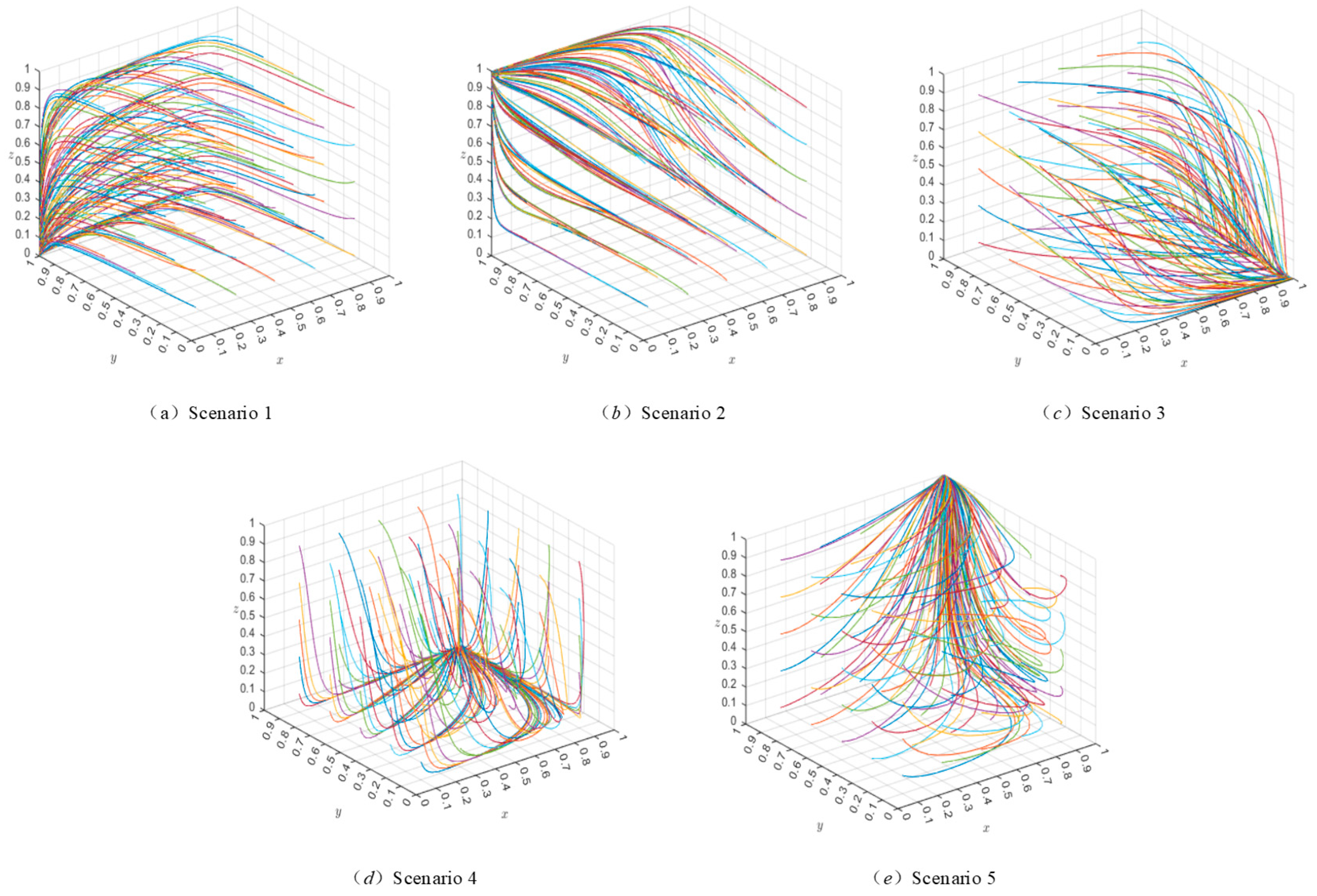
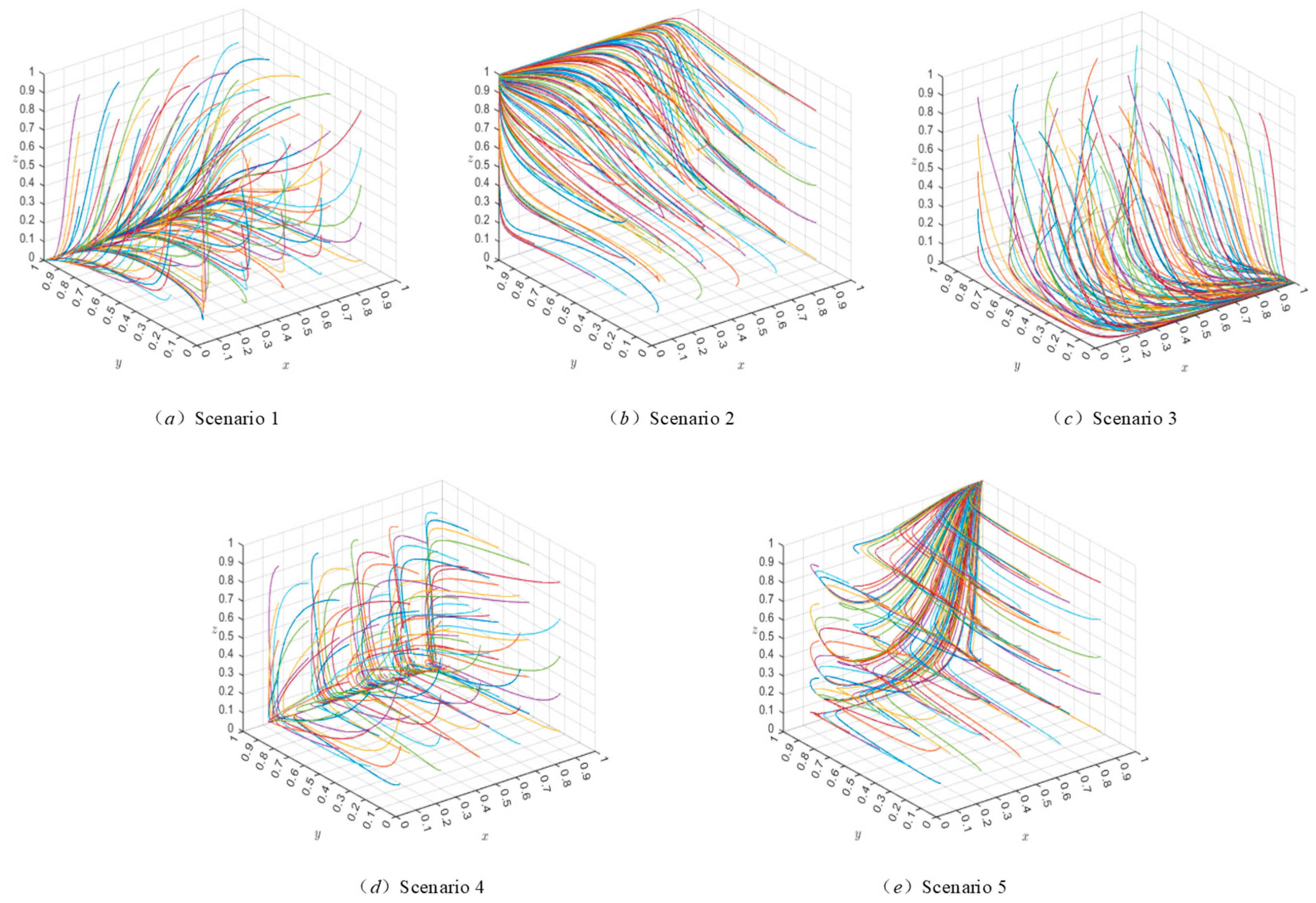
Table 3 yields the following five scenarios.
Scenario 1. In this scenario, the evolutionary game’s stable point is
, indicating the strategy combination of the three parties is (non-authorization, transaction, loose regulation). Specifically, users choose not to authorize, platforms opt for behavioral data transaction, and the government selects loose regulation. The conditions required for this stable point are in
Table 4.
This condition indicates that when the data transaction price is low and behavioral data value falls within a certain range, or when the data price is high and behavioral data value exceeds a specific threshold, users choose not to authorize the use of their personal data in exchange for greater benefits. Meanwhile, the profits generated by platforms trading behavioral data outweigh the costs of data transactions, prompting them to opt for data transaction. Simultaneously, the high costs of strict regulation render it unaffordable for government, leading it to choose loose regulation.
Scenario 2. In this scenario, the evolutionary game stabilizes at point
, indicating the strategy combination of the three parties is (non-authorization, transaction, strict regulation). Specifically, users choose not to authorize, platforms opt for behavioral data transaction, and the government opts for strict regulation. The conditions required for this stable point are in
Table 5.
The conditions for this scenario are similar to those in Scenario 1. When behavioral data is valued within a certain range at a lower transaction price, or when its value exceeds a specific threshold at a higher transaction price, users choose not to authorize while platforms opt to transact. The key difference lies in the lower strict regulatory costs, which enable the government to achieve a balanced budget through revenues such as fines and enhanced reputation. This creates a stronger incentive for the government to adopt stricter regulatory measures.
Scenario 3. In this scenario, the evolutionary game’s stable point is , indicating the strategy combination of the three parties is (authorization, non-transaction, loose regulation). Specifically, users choose to authorize, platforms choose not to transact, and the government chooses loose regulation. The conditions required for this stable point are . In this scenario, the value of user behavioral data is relatively low. Users have an incentive to authorize platforms to use their personal data in exchange for greater benefits, leading them to choose authorization. However, the low value of behavioral data means platforms’ revenue from data transactions is less than the cost of conducting such transactions, prompting platforms to choose not to trade. Platforms’ non-trading strategy reduces the government’s incentive for strict regulation, leading it to opt for loose regulation.
Scenario 4. In this scenario, the evolutionary game theory stable point is
. This stable point represents the strategy combination of the three parties: (authorization, transaction, loose regulation). Specifically, users choose authorization, platforms choose transaction, and the government chooses loose regulation. The conditions required for this stable point are in
Table 6.
This condition indicates that when the data transaction price is low and the value of user behavioral data exceeds a certain threshold, or when the data transaction price is high and the value of user behavioral data falls within a specific range, users can gain additional benefits by granting authorization, leading them to choose authorization. Simultaneously, platforms’ revenue from trading personal data and behavioral data exceeds the transaction costs, prompting platforms to engage in data transaction. Significant strict regulatory costs diminish platforms’ willingness to enforce strict regulation, compelling the government to adopt a more lenient regulatory strategy instead.
Scenario 5. In this scenario, the evolutionary game theory stable point is
. This stable point represents the strategy combination of the three parties: (authorization, transaction, strict regulation). Specifically, users choose authorization, platforms choose transaction, and the government chooses strict regulation. The conditions required for this stable point are in
Table 7.
In this scenario, the strategy of users and platforms resembles that of Scenario 4. Users choose to authorize and platforms choose to engage in data transactions when behavioral data value exceeds a certain threshold under a lower data transaction price, or when behavioral data value falls within a specific range under a higher data transaction price. The difference lies in the fact that larger fines and reputational gains enable the government to bear the costs of strict regulation, thereby incentivizing it to opt for strict regulation.
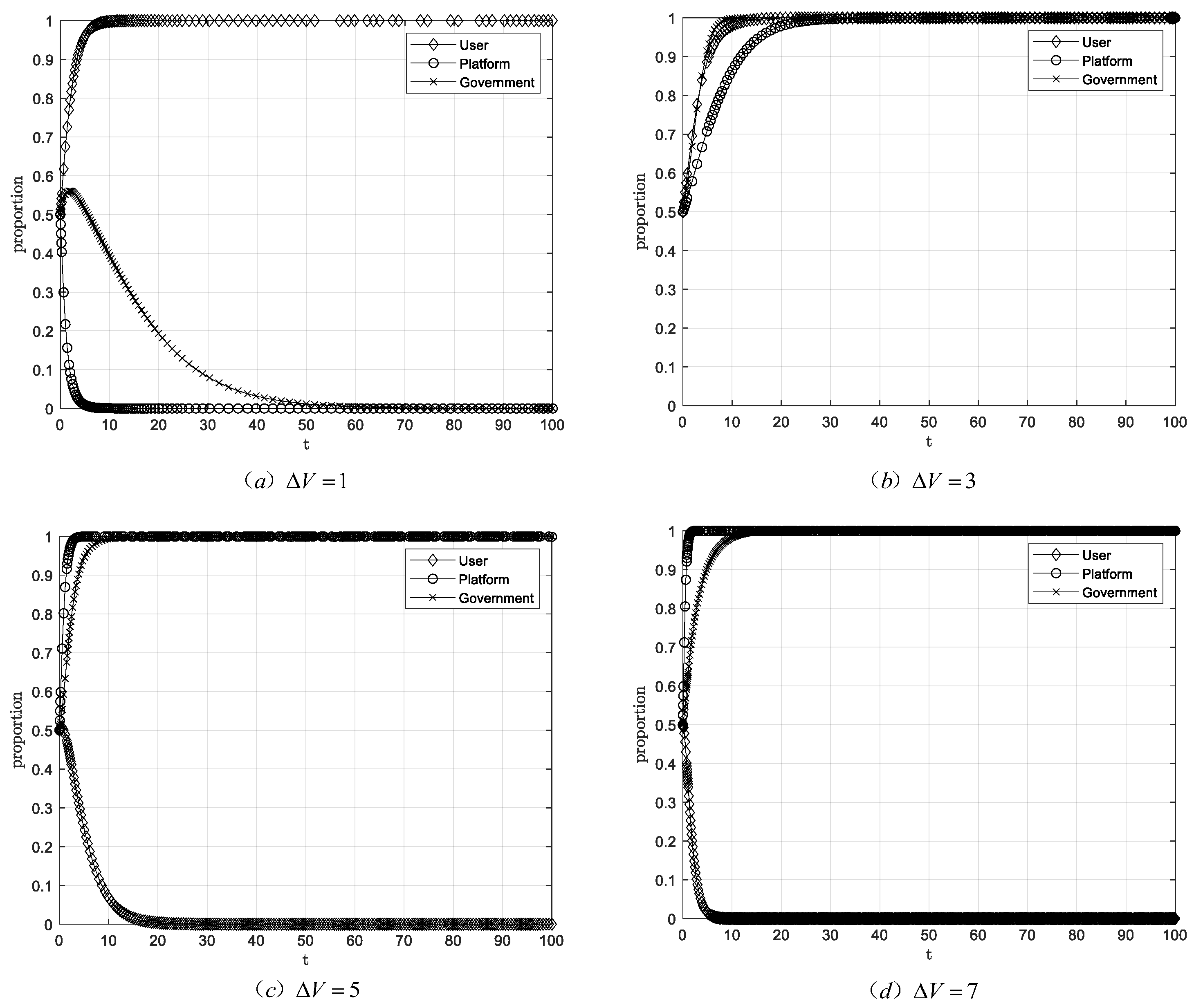
As demonstrated in Scenarios 1 and 2, platforms may trade user behavioral data even without user authorization. Scenario 3 shows that even with user authorization, platforms may refrain from any data transactions despite being able to trade personal and behavioral data. Thus, user authorization does not invariably promote platform data transactions. In summary, under the user authorization mechanism, platforms’ choice of data transaction strategy is closely tied to the transaction price and the value of user behavioral data. As demonstrated by Scenarios 4 and 5, platforms will choose to trade both personal and behavioral data when the transaction price is low and the value of behavioral data exceeds a certain threshold, or when the transaction price is high and the value of behavioral data falls within a specific range. Therefore, only under these conditions can user authorization effectively promote platform data transactions.
As demonstrated in Scenario 2, even without user authorization, the government may still impose strict regulation on the trading of user behavioral data by platforms. As shown in Scenario 4, even with user authorization, the government may still implement loose regulation on the trading of both personal and behavioral user data by platforms. This indicates that user authorization alone is not a sufficient condition for the government to adopt a strict regulatory strategy toward platform data transactions. In summary, under the user authorization mechanism, the government’s regulatory strategy for platform data transactions is closely tied to the transaction price, the value of user behavioral data, and regulatory costs. Scenario 5 indicates that a three-party equilibrium where the government imposes strict regulation on platform data transactions under user authorization only emerges when either the transaction price is low, the value of user behavioral data is high, and regulatory costs are low, or the transaction price is high, the value of user behavioral data is moderate, and regulatory costs are low.
6. Conclusions
6.1. Findings
This study builds a tripartite evolutionary game model involving users, platforms, and the government to explore the interactions and evolutionary equilibrium among users’ data authorization strategy, platforms’ data transaction strategy, and the government’s regulation strategy under a user-authorized personal data mechanism. The key findings are as follows:
(1) Under the personal data authorization mechanism, the promotional effect of user authorization on platform data transactions is conditional. The study finds that user authorization does not necessarily enhance the activity of platform data transactions; its effectiveness primarily depends on the data transaction price and the value of user behavioral data. Specifically, user authorization can effectively promote platform data transactions only when the data transaction price is low and the value of user behavioral data exceeds a certain threshold, or when the data transaction price is high and the value of user behavioral data falls within a moderate range. Conversely, user authorization has limited promotional effects on platform data transactions and may even suppress such activities due to data leakage risks. This conclusion indicates that relying solely on user authorization mechanisms cannot fully resolve efficiency issues in data trading markets; synergistic optimization involving both data market supply–demand dynamics and data value assessment is necessary.
(2) Under the personal data authorization mechanism, government regulation of platform data transactions depends on multidimensional factors, with user authorization not constituting a sufficient condition for strict regulatory strategies. Research indicates that whether the government imposes stringent regulation on platform data transactions is influenced not only by user authorization behavior but more critically by the dynamic interplay of regulatory costs, data transaction prices, and the value of user behavioral data. Specifically, when regulatory costs are low, the government tends to impose strict regulation on platform data transactions under two conditions: when the data price is low and behavioral data value is moderate, or when the data price is high and behavioral data value is high—even without user authorization. Conversely, when user authorization exists, the government leans toward strict regulation under two conditions: when the data price is low and behavioral data value is high, or when the data price is high and behavioral data value is moderate. This indicates that the government’s regulatory logic is significantly guided by a “cost–benefit” approach, where user authorization serves only as one of the reference factors in regulatory decision-making, rather than a decisive condition.
6.2. Recommendations
The evolutionary equilibrium of options made by users, platforms, and government policies must foster a virtuous ecosystem characterized by user authorization, platform transactions, and strict government regulation. From the perspective of factors influencing behavioral strategies, the following policy recommendations are proposed:
(1) A standardized data trading market system should be established so that data transaction price reflects actual supply–demand dynamics. It is suggested to create a unified data exchange platform with tiered classification standards—categorizing data as foundational, critical, core, etc.—accompanied by differentiated pricing guidelines. Simultaneously, supporting mechanisms for data rights confirmation, registration, and settlement should be refined to effectively evaluate and adjust pricing standards, ensuring alignment with market value.
(2) A scientific data valuation mechanism should be developed to quantify the value of user personal data and behavioral data . It is suggested to establish national standards for data valuation, creating multidimensional quantitative models that incorporate factors like data quality and application scenarios. Professional third-party assessment agencies should be cultivated to provide objective value references for data transactions. Simultaneously, platform enterprises should be encouraged to implement dynamic pricing based on assessment results and enhance data transparency by clearly disclosing data flow and usage to users.
(3) Data breach prevention and control should be strengthened by optimizing penalty and regulatory costs . Tiered fines linked to data value and harm severity should be implemented to impose strict penalties for high-value data breaches or major violations. Blacklist and credit punishment mechanisms should be refined to conduct regular security inspections, and data trading parties should be urged to implement protective measures like encryption and access controls to enhance overall security standards.
6.3. Limitations and Future Research
This study presents a tripartite evolutionary game model focusing on the interactions between users, platforms and the government under a user data authorization mechanism, and examines their strategies and evolutionary equilibrium. However, the model is primarily based on the characteristics of China’s data trading market and involves certain contextual simplifications. The universality of its conclusions across different institutional environments therefore warrants careful scrutiny. Specifically, the model framework may have limitations when applied to different data governance systems, such as the General Data Protection Regulation (GDPR). Additionally, elements unique to digital markets, including multiple user groups and network effects, remain outside the analytical scope of the current model. Therefore, future research could test the model within broader institutional and market contexts. Particular emphasis should be placed on validating and expanding the theoretical findings of this study in real-world scenarios involving cross-border data flows and the interaction of multiple governance frameworks.