1. Introduction
The digital business ecosystem, manifested through diverse forms including e-commerce, digital entrepreneurship, and smart manufacturing, is growing in strategic relevance. This system acts as more than just an impetus for business innovation but also as a crucial force driving sustainable economic development and social transformation [
1]. Powered by the thorough merging of digital technologies and commercial activities, this ecosystem has substantially restructured, enhanced operational efficiency, and created new market opportunities [
2,
3]. Its substantial contributions to fostering ethical consumer markets and advancing sustainable business practices are particularly noteworthy. Recognizing this strategic value, the Chinese government has prioritized cultivating a high-quality digital business environment since 2019, setting a clear policy priority for transforming the nation’s economic development paradigm [
4]. Owing to its central importance for industrial modernization, economic growth stimulation, and national competitiveness enhancement, the effective development of the digital business ecosystem has become essential for achieving advanced economic development. However, the inherent complexity and configurational characteristics of this ecosystem pose formidable tasks for both policymakers and researchers, necessitating innovative analytical approaches.
Current digital business development research remains narrowly focused on dissecting the discrete influences of individual factors. Numerous studies have discretely explored the immediate consequences of elements, including digital infrastructure [
5], human capital [
6], government policies [
7], market size [
8], and financial capital [
9] on digital business growth. Such research commonly applies econometric frameworks designed to quantify the average effects of changes in specific variables on digital business development. Yet this single-factor net effect analytical paradigm falls short in characterizing the intricate interplay and configurational effects among various elements within business ecosystems. In reality, digital business advancement stems not from discrete elements but from the concerted action of multiple system components [
2]. For instance, the effectiveness of government initiatives in promoting digital business often hinges on coordinated inputs from high-quality human capital and well-developed financial systems. The absence of any critical component may significantly undermine policy outcomes. Nevertheless, the existing literature remains underdeveloped in exploring these interdependent effects. Since digital business constitutes a complex ecosystem shaped by multiple interdependent factors, examining the synergistic effects of these heterogeneous elements from a systemic perspective has become an intellectual imperative [
10].
The Socio-Technical Systems (STS) framework stresses the interdependence and co-optimization of technological and social subsystems [
11]. This theoretical perspective holds that within complex business ecosystems, these subsystems do not function in isolation but engage in ongoing interaction to collectively determine overall system performance, adaptability, and evolutionary trajectory [
12,
13]. The STS framework furnishes an integrative framework for integrating key variables, including digital technology capability, digital infrastructure, governmental influence, human capital, market size, and financial capital. Furthermore, the QCA method, rooted in a configurational perspective, presents clear benefits over traditional analytical approaches that concentrate solely on the isolated net effects of individual variables when examining complex causal relationships in urban digital business development [
14]. QCA allows for methodical analysis of configurational effects among multiple elements, with particular applicability to multiple conjunctural causality and causal asymmetry.
This study utilizes fsQCA to examine the connections between key conditioning factors and both qualitative and quantitative dimensions of urban digital business development. We broaden the application of fsQCA to 69 representative Chinese cities, seeking to uncover the intricate causal pathways through which multiple factors collectively influence the development of urban digital business ecosystems. The research addresses these core questions: What combination of factors leads to superior urban digital business performance in both quality and scale? What elements impede the development of high-quality, large-scale urban digital business ecosystems? Are there any essential prerequisites for fostering high-quality, large-scale digital business ecosystems? Is there significant asymmetry in the driving mechanisms for urban digital business ecosystem quality versus scale?
2. Theory
2.1. Socio-Technical System Theory
Socio-technical systems (STS) theory lays the groundwork for examining the complex interconnections between human and technological dimensions within digital business environments [
11]. A core tenet of this framework is that work systems comprise two mutually constitutive subsystems: the technical subsystem, which comprises tools, methodologies, and operational processes, and the social subsystem, which involves interpersonal dynamics, organizational arrangements, and cultural contexts [
15]. System optimization arises not from maximizing either subsystem independently, but from their mutual adjustment and coordinated evolution [
16,
17]. Historically, STS theory was applied mainly to industrial work design, where foundational research in sectors like coal mining demonstrated that technological implementations must consider their consequences for workforce relationships and social organization, rather than pursuing technical efficiency in isolation [
18].
The scope of STS theory has greatly expanded, moving beyond its original industrial focus to include information technology infrastructures, service industries, urban governance mechanisms, and comprehensive socio-economic networks [
19]. In the digital era, the pervasive impact of Information and Communication Technologies (ICT) on work systems has established STS as an essential framework for understanding how digital innovations reshape organizational structures and patterns of human interaction [
20]. Recent studies more frequently adopt this perspective to explore advanced phenomena such as artificial intelligence systems, e-commerce platforms, Industry 4.0 transformations, and comprehensive digitalization processes [
11].
2.2. Conceptual Model
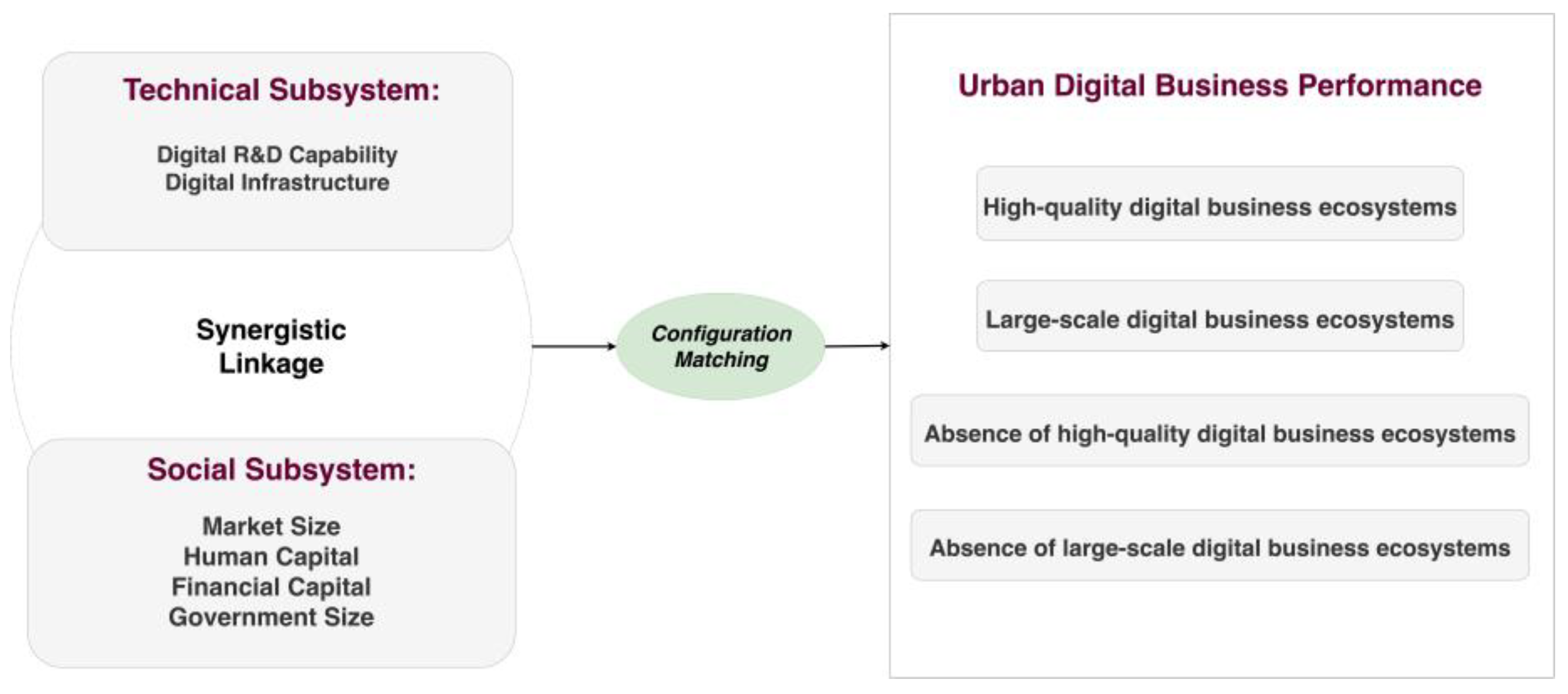
STS theory provides a coherent framework for analyzing how multiple elements jointly determine the development paths of digital business ecosystems. In this theoretical structure, the technical subsystem integrates essential components, including digital research and development capabilities and digital infrastructure [
17], which supply direct functional support for digital business activities. Correspondingly, the social subsystem brings together human capital, market conditions, government policies, regulatory frameworks, and financial mechanisms. Together, these elements create the institutional and economic foundations required for digital business operations.
A core premise of STS theory stresses the inherent interconnectedness and necessary co-adaptation of social and technological aspects, opposing analyses that treat them as separate entities [
15]. This viewpoint brings into focus the complex two-way influences between these subsystems and reveals how their effective alignment strengthens the overall resilience and long-term growth of urban digital business ecosystems. Such a holistic approach offers valuable insight into how cities build competitive digital business environments by fostering parallel development of technical and social structures.
2.2.1. Technical Subsystem
In modern digital settings, the technical subsystem consists of the essential components and operational capabilities that support and sustain digital business activities. In the context of urban digital business ecosystems, this subsystem is represented by two key elements: digital R&D capability and well-developed digital infrastructure [
17].
Digital R&D capability functions as the main force behind technological progress and lasting market advantage in digital business sectors [
21,
22]. This competence fuels the development of innovative digital offerings, services, and business models. Areas with strong digital R&D foundations speed up the digital transition of existing companies, support the growth of new digital ventures, and facilitate strategic business restructuring, thereby enhancing the maturity and resilience of the digital business landscape [
23].
Digital infrastructure comprises the core technologies, organizational structures, and services that support business and industrial operations. This includes physical components like computing devices and platforms, software systems, and the governance norms of digital communities [
5]. Well-developed digital infrastructure enables the digitalization and intelligent transformation of the real economy, providing essential support for digital business advancement [
24].
2.2.2. Social Subsystem
The social subsystem forms the complex structure of human, institutional, and economic conditions that either drive or limit the technical subsystem’s evolution. This subsystem provides essential resources, regulatory systems, and market dynamics that allow digital business ventures to succeed, with four key elements: human capital, financial capital, market size, and government influence.
Human capital serves as a critical element by supplying specialist knowledge in areas such as data science, software engineering, and digital marketing-expertise necessary for establishing and running digital businesses [
25]. In addition to supporting technology development, it also generates demand for digital solutions, creating a sustaining cycle in the skills market. Digital learning tools strengthen this process through ongoing skill development and knowledge refreshment, thereby improving the talent base. Studies of Chinese cities show that the digital economy increases regional innovation by recruiting skilled workers and providing technical training [
26]. Moreover, human capital establishes a beneficial cycle where business ventures convert technological advances into practical results, supporting continued development.
Financial capital provides essential funding and risk absorption capacity for digital business innovation and growth. Funding sources such as venture capital, private equity, and digital inclusive finance address the financing difficulties typical of technology startups and digital transformation projects. Studies indicate that digital economic development strengthens cities’ positions in venture capital networks, demonstrating their strong ability to attract capital resources [
6]. Meanwhile, digital financial services, including mobile payments and automated advisory systems, broaden access to financial services and support the digital transition of conventional industries.
Market size largely determines the growth prospects and expansion possibilities for digital business activities. A large and varied base of consumers and businesses that actively use digital tools creates diverse application environments for digital products, drawing in more investment. The platform economy specifically uses network effects to overcome traditional geographic boundaries, allowing for effective matching of supply with demand and producing significant economies of scale that support digital business frameworks [
9].
Government presence forms the institutional basis of the social subsystem. Government bodies act not only as funders of public digital infrastructure but also as regulators, standard-setters, and strategic planners for the digital business environment. Studies show a positive connection between government emphasis on the digital economy and its growth results [
27]. Through industry policies, data governance systems, and financial supports, governments establish market rules, reduce unpredictability, and can actively guide the ecosystem toward chosen goals. Particularly in green technology innovation, governments encourage digital transformation and low-carbon investments using research grants, tax benefits, and environmental performance systems [
28]. Therefore, the government serves not just as a public service provider but also as an ecosystem designer and coordinator.
By integrating these elements, this study moves past examining factors in isolation and adopts a combinatorial perspective to understand digital business ecosystems. This theoretical position is vital for investigating how interactions and combined effects among multiple socio-technical elements create the conditions for ecosystem vitality. The research aims to clarify the complex causal relationships, including cases where different conditions produce similar outcomes and where causes and effects are not symmetrical, that shape developmental results [
29]. Building on STS theory, this investigation uses fsQCA to identify the intricate combinations of conditions that produce dynamic urban digital business ecosystems across China. As shown in
Figure 1, the conceptual framework suggests that the combined influence of six key elements, namely digital R&D capability (RDC), digital infrastructure (DI), human capital (HC), financial capital (FC), government size (GS), and market size (MS), jointly determines both the quantitative expansion and qualitative aspects of digital business ecosystems.
3. Materials and Methods
3.1. fsQCA
As a set-theoretic approach, fsQCA analyzes causal complexity by studying how particular combinations of factors lead to outcomes, viewing individual cases as sets of causal conditions. This method starts from the basic understanding that elements affecting social phenomena seldom function independently but rather show significant interconnectedness [
29]. By integrating the advantages of both qualitative and quantitative research traditions, fsQCA offers an adaptable examination framework suitable for datasets of varying scales [
30]. This study investigates the mechanisms and causal relationships among socio-technical factors within urban digital business ecosystems across mainland China, with a particular focus on the multiple conjunctural causations and asymmetric relationships that influence both the qualitative and quantitative dimensions of digital business development. Our examination method relies on carefully gathered data from 69 cities, a sample that achieves a suitable balance between detailed case understanding and broader generalizable knowledge. The choice of six condition factors for this medium-scale sample aligns with the suggested range of four to seven variables for reliable fsQCA implementation [
31]. Additionally, considering its established effectiveness in dealing with interrelated variables, we employed fsQCA as our main analysis method.
3.2. Sample and Data Collection
This research chose representative cities from China’s top 100 digital economy development rankings to ensure wide representation across major administrative regions. The sample includes prefecture-level and higher-tier cities that show differences in digital economic performance while maintaining case consistency. In terms of location, the 69 case cities cover 30 provincial-level areas throughout mainland China, capturing varied conditions and results. A one-year interval was applied to the explanatory and outcome variables: the dependent measures (digital business ecosystem quality and scale) use 2019 figures, while the six conditioning variables employ 2018 data, accounting for COVID-19 impacts and data accessibility. Variable descriptions and sources are provided in
Table 1.
3.3. Variables
3.3.1. Digital Business Performance
Digital business ecosystem quality (DBEQ) serves as a key measurement for evaluating regional abilities to maintain and develop digital business and innovation. The comprehensive external manifestation of a healthy digital business ecosystem is precisely reflected in the level of digital economy development in the region. Internationally acknowledged assessment systems, including the European Commission’s IDESI, use multiple dimensions to gauge digital economy advancement as the basis for resilient business environments [
31]. Following this approach, the China Academy of Information and Communications Technology (CAICT) has created unified indicator systems for measuring urban digital economy performance [
32]. These assessment tools generally include aspects such as digital infrastructure, industrial digitization, and innovation capability, which together reflect the vitality and growth potential of digital business ecosystems. To maintain methodological consistency and enable comparison across studies, this research uses city-level digital economy indices from the 2019 China Urban Digital Economy Index White Paper as standard measures for evaluating urban digital business ecosystem quality.
Digital business ecosystem scale (DBES) measures the total volume and business activity of digital economic operations within geographic areas. The vigorous development of the digital industry serves as a key indicator for measuring the prosperity of the digital economy, while its evolutionary process maintains a symbiotic relationship with the enhancement of telecommunications service capabilities. As the fundamental channel supporting the entire digital ecosystem, telecommunications networks carry the data flows of all digital business activities. Total telecommunications revenue accurately reflects the overall scale, vitality, and commercialization level of the digital industrialization process [
33]. This quantitative indicator provides a window for observing the operational efficiency of the digital ecosystem. Consequently, total telecommunications revenue constitutes a critical and empirically validated metric for assessing the development level of digital commerce.
3.3.2. Human Capital
In studies of digital business growth, human capital is commonly measured using education level indicators [
34]. A labor force with advanced technical skills remains essential for fostering innovation and sustaining competitive advantage in digital markets. Following current research practices [
35], though data on average years of schooling is limited, this study uses higher education enrollment numbers as indicators of the available human capital for digital business sectors. Strong empirical evidence supports this measurement choice, given the documented relationship between cities with large, highly educated populations and the quality of specialized digital talent that forms crucial resources for digital firms and new enterprises.
3.3.3. Financial Capital
Financial capital acts as a key enabler for digital business innovation, new venture creation, and business expansion. Following established research methods [
30], this study measures financial capital using per capita financial institutions’ deposits, calculated by dividing total city deposits by resident population. This measure reflects the regional financial resources potentially available through various funding channels, including venture capital, credit arrangements, and private equity investments. These resources collectively support digital startup projects, enable growth plans of established digital companies, and assist digital transition efforts among traditional businesses moving into digital fields.
3.3.4. Digital R&D Capability
Digital R&D capability serves as a key driver of innovation and a foundation for competitive edge in digital business ecosystems. Patent applications offer measurable proof of R&D output and a region’s potential for innovation [
36]. Building on this established approach and considering differences in population size, this study uses the number of digital technology patents per capita to gauge a city’s ability to create new technologies and solutions that support emerging digital products, services, and business models, following methods from earlier research [
37]. A strong result in this area indicates conditions that support technological advancement and speed up the growth of digital business.
3.3.5. Digital Infrastructure
Digital infrastructure constitutes the core technical base that supports digital commerce and online business activities, including 5G networks, Internet bandwidth, and data centers. Given the broad scope of these facilities, and in line with previous academic work [
38], this research uses Internet broadband subscription data as proxy measures for assessing the spread and development of this crucial technological platform. Widespread availability of reliable Internet connections represents a necessary condition for effective business engagement with e-commerce platforms, cloud computing services, digital supply chain management, and online customer interaction, thus making it a vital component of the digital business environment.
3.3.6. Government Size
Government fiscal footprint represents core elements of the institutional structure that shape digital business activities. Standard measurement generally follows one of two approaches: the proportion of public sector workers in total employment, or government spending as a share of gross domestic product [
39]. This study applies the second method, following Thornton’s (2010) analytical approach [
40], by using ratios of city government budget expenditures to regional GDP. This fiscal measure indicates the extent of government involvement in local economies, which then affects digital business ecosystems through public investments in digital infrastructure, funding for innovation programs, development of regulatory systems, and general improvement of business conditions.
3.3.7. Market Size
Market size largely determines the scope of opportunities and potential for customer reach in digital businesses. A substantial and active local market offers a testing environment and early adopters for digital products and services. Although prior research has often assessed local market size through industrial production figures [
26], this investigation adopts the method of Xie et al. (2021) [
30] and uses regional GDP as a measure. GDP presents a broader economic picture that encompasses services and other sectors, which helps to better reflect the general economic activity and purchasing power available to digital businesses. These factors are important for gaining scale advantages and network benefits.
3.4. Coding Cases’ Set Memberships
Converting original data into fuzzy-set membership scores suitable for analysis requires a calibration step before applying QCA. This procedure involves setting three qualitative thresholds: full membership, crossover point, and full non-membership, based on theoretical considerations and empirical evidence following Ragin’s (2008) methodological guidelines [
41]. Our study uses direct calibration methods. Because our city sample shows strong representation, these key thresholds were determined using distribution percentiles according to Fiss’s (2007) established calibration method [
42], where the 75th percentile indicates full membership, the 50th percentile represents the crossover point, and the 25th percentile shows full non-membership. Detailed calibration settings for all variables, covering both conditions and outcomes, appear in
Table 2.
3.5. Analytical Technique
3.5.1. Necessity Analyses
A condition is considered necessary when it appears in every case where the outcome is present [
43]. The consistency measure evaluates this feature by calculating the percentage of cases exhibiting a given condition that also show the outcome. Following accepted methodological conventions [
29,
30], we applied a 0.9 consistency cutoff for testing necessity. To determine the necessary conditions for excellence in digital business development, particularly in both quality and scale aspects, we conducted necessary condition tests with fsQCA 3.0 software.
Table 3 shows that no condition exceeded the 0.9 consistency threshold for the outcome, meaning no single condition satisfies the requirements for necessity in successful digital business ecosystems. These results suggest that effective digital business settings result from combinations of conditions instead of depending on single factors, which we investigate further in our following analysis of configurations.
3.5.2. Sufficiency Analyses
Sufficiency analysis identifies combinations of conditions that ensure an outcome will occur. In line with the methodological guidelines from Fiss (2007) [
42], we used a minimum consistency level of 0.8, a PRI consistency score of 0.7, and required at least one case for each configuration.
3.5.3. Supplemental Analyses
To study causal asymmetry, a core QCA principle indicating that the presence and absence of an outcome might have different causes, we conducted two further examinations. First, we analyzed the combinations of conditions that hinder digital business development from achieving high performance. Second, we compared the causal combinations leading to high-quality digital business ecosystems with those producing large-scale digital business operations.
4. Discussion
4.1. Configurations Sufficient for High Digital Business Performance
When running the analysis, the fsQCA results include three different solution types: complex, parsimonious, and intermediate. Following Hernández-Perlines (2016) [
44], this study relies on the intermediate solutions to interpret the findings and uses the parsimonious solutions to separate core conditions (present in both solution types) from peripheral ones (found only in the intermediate solutions).
4.1.1. Configurations Sufficient for High-Quality Digital Business Ecosystems
This research carried out a sufficiency analysis to determine which combinations of conditions produce high-performing digital business ecosystems. Following accepted methodological standards [
45], we used a 0.8 consistency level for sufficiency, a 0.7 PRI consistency level, and required at least one case per configuration. The analysis revealed three different sufficient configurations that lead to high-quality digital business ecosystems, with full details available in
Table 4.
Configuration HQ1 shows that combining strong financial resources with well-developed digital infrastructure can create high-quality digital business ecosystems. This combination demonstrates how these elements work together: sufficient funding supports investment in advanced digital infrastructure, which then supports complex e-commerce platforms, smooth digital transactions, and effective database business operations. Major cities such as Shenzhen and Hangzhou demonstrate this approach, having built high-level digital infrastructure alongside active financial systems that together draw in and develop top digital companies and e-commerce platforms.
Configuration HQ2 demonstrates that strong human capital, considerable government support, and large market size together form another effective path to high-quality digital business development. This configuration works through supportive relationships among these three elements: skilled human resources provide the technical knowledge and innovative ability needed for digital business growth; strong government assistance establishes favorable regulatory settings and policy support for digital business; while extensive market size provides varied customer needs and scaling potential for digital business models. Cities like Guangzhou and Wuhan illustrate this pattern, where their concentrations of university students, highly rated business conditions, and sizable regional markets combine to create self-sustaining ecosystems that speed up digital business integration and attract investment in digital business projects [
45].
Configurations HQ3a, HQ3b, and HQ3c together show how the interaction between digital research and development capacity and large market size supports high-quality digital business ecosystem growth. This relationship creates a positive cycle where strong R&D capabilities provide the technical base for business innovation [
46], while substantial markets support the market entry and expansion of digital business solutions. Beijing and Shanghai demonstrate this pattern, showing how advanced digital R&D abilities combined with large consumer bases speed up the use of digital business models and e-commerce platforms. Their achievements stem from fostering innovation environments while implementing digital business solutions that respond to market forces.
4.1.2. Configurations Sufficient for Large-Scale Digital Business Ecosystems
Table 5 presents four different configuration patterns that can achieve large-scale digital business ecosystems. Configurations HS1a and HS1b demonstrate how the supportive relationship between human capital and digital R&D capability drives the growth of urban digital business. Aligning with existing research [
46], digital R&D remains essential for expanding technology-based business models. Guangzhou’s case clearly shows this pattern, where its cluster of higher education institutions develops specialized digital talent, generating significant R&D results that directly promote the growth of digital business transactions and e-commerce platforms through continuous technological innovation.
Configuration LS2 illustrates how human capital, combined with developed digital infrastructure, supports the expansion of digital business operations. Consistent with existing research [
24], digital infrastructure forms the basic operational structure for digital business, whose scale directly affects business transaction volumes. Building and maintaining these technological systems relies heavily on specialized human resources, where sufficient human capital maintains smooth operations while creating significant economic value through improved digital service provision. This relationship appears clearly in Chongqing, which has China’s largest broadband user network and complete digital systems, consequently enabling substantial digital business transaction levels.
Configuration LS3 shows how human capital and market size work together to support digital business expansion. This pairing creates a positive cycle where large markets lower the cost of gaining customers while creating jobs that draw in more skilled workers, which in turn increases market potential [
8]. Chengdu clearly demonstrates this pattern. As the leading digital business center in southwestern China, it has the area’s biggest consumer base and has become a top choice for technology specialists. This active setting encourages digital business innovation and speeds up industry growth by constantly strengthening the connection between the supply of skilled people and what the market requires.
Configurations LS4a and LS4b demonstrate how strong R&D capacity, combined with a large market size, supports the growth of digital business ecosystems featuring varied digital products and services. This interaction sustains urban digital business development through technological advances [
21,
47], while sizable markets help bring digital business models to market and expand their reach. Beijing and Shanghai exemplify this pattern, where their strong digital R&D capabilities help transform traditional industries digitally, along with large consumer markets that draw in substantial user numbers and create production scale benefits for digital companies.
4.2. Configurations Sufficient for the Absence of High Digital Business Ecosystem Performance
This research uses fsQCA to study different causal pathways that follow the principle of causal asymmetry. The study first seeks a thorough grasp of the factors that influence digital business ecosystem development. Next, it identifies particular conditions and their combinations that result in the lack of both high quality and large scale in digital business ecosystems. Following established methodological practices [
29], the calibration method for outcome absence differs significantly from that used for outcome presence, with full sufficiency analysis results shown systematically in
Table 6 and
Table 7.
4.2.1. Configurations Sufficient for the Absence of High-Quality Digital Business Ecosystems
Table 6 presents two configuration patterns that lead to low quality in digital business ecosystems. Configuration AHQ1 shows that underdeveloped digital infrastructure and limited market size form the main deficiency conditions, indicating these weaknesses fundamentally weaken digital business performance. Inadequate digital infrastructure creates unstable technical foundations for e-commerce platforms and digital services, while a small market size produces slow-growing demand for digital business solutions. As a result, digital business ecosystems that depend heavily on network effects and scale advantages show reduced vitality. Furthermore, insufficient digital technology innovation capability hinders local digital business transformation, disturbs digital resource distribution, and limits economies of scale, ultimately blocking the development of high-quality digital business environments [
24,
48]. Cities such as Yinchuan and Lanzhou demonstrate this situation; located in less developed western areas, they display limited digital infrastructure and market size that fundamentally restrict the growth of strong digital businesses.
The AHQ2 configuration group, which includes versions AHQ2a to AHQ2c, shows the main features of weak financial resources combined with underdeveloped digital R&D capacity. These limitations together hinder the development of high-quality digital business ecosystems. While well-developed digital R&D capacity plays a vital role in revitalizing business models and enhancing digital services, its absence hampers technological progress and postpones the transition to digital operations [
21]. At the same time, insufficient funding creates additional barriers to innovation efforts and business modernization, thereby limiting digital business growth [
47]. Shijiazhuang serves as an example of this situation: located in the Beijing–Tianjin–Hebei economic zone, it experiences noticeable resource drainage to Beijing and Tianjin, weakening local financial strength and innovation potential, which ultimately hinders the establishment of high-quality digital business ecosystems.
4.2.2. Configurations Sufficient for the Absence of Large-Scale Digital Business Ecosystems
Table 7 outlines three configuration patterns associated with limited scale in digital business ecosystems. The main feature of configuration ALS1, covering subtypes AHS1a to AHS1d, lies in the combined shortage of financial resources and digital infrastructure. This pattern demonstrates that inadequate funding, together with underdeveloped digital foundations, consistently weakens digital business performance. Without a strong digital R&D capacity, digital business growth remains limited due to its important role in driving business innovation. Similarly, insufficient financial resources discourage new business ventures and narrow the operational scope of digital business activities. Dongying represents this situation. Located in the Shandong Peninsula area, this city shows relatively limited financial capacity and technological innovation ability, resulting in a restricted digital business ecosystem scale.
Configuration ALS2, which includes subtypes ALS2a and ALS2b, shows underdeveloped digital infrastructure as its main feature, forming the primary barrier to achieving scale in digital business operations. This technological base acts as the necessary platform that supports digital technologies, enables continuous data exchange, and creates the foundation for all digital business activities. These infrastructure shortcomings lead to unstable network connections, slow data transfer, and reduced operational effectiveness, ultimately limiting digital business growth. Lanzhou clearly illustrates this situation: located in a less-developed region of China, its insufficient network infrastructure significantly hinders the development of digital business scale.
Configuration ALS3 highlights the combined limitations in digital infrastructure and market size. Lacking both strong digital foundations and substantial market demand prevents digital business ecosystems from reaching significant expansion. Limited infrastructure, together with constrained demand, hinders business innovation and slows regional digital transformation, thus preventing the achievement of network effects or considerable digital business output [
8,
24]. This pattern demonstrates how the absence of sufficient development in both technological and market areas blocks the formation of dynamic digital business ecosystems.
4.3. Robust Test
This study adheres to recognized research procedures by raising the consistency threshold to check the reliability of results regarding digital business ecosystem development [
49,
50]. Specifically, the consistency requirement was increased from 0.8 to 0.85 while keeping all other analysis settings unchanged. Comparison reveals that total solution consistency improved for both high-quality and large-scale digital business ecosystems, rising from 0.90 to 0.95 and from 0.86 to 0.94, respectively. Although small differences appeared in secondary conditions, the main configuration combinations producing successful digital business ecosystems remained largely consistent. These differences have little effect on the key findings or their theoretical conclusions, thus confirming the reliability of the analysis. Complete results are fully presented in
Table 8 and
Table 9.
4.4. Comparative Analysis
Comparison of configurations that produce high-quality and large-scale digital business ecosystems shows several core processes. Human capital has a stronger effect on ecosystem scale than on quality aspects. It appears in three configurations for large-scale results compared to only one for high-quality ecosystems, implying that human capital needs supporting factors to reach business scale. This pattern demonstrates how human resources act as the main force behind business innovation, where sufficient digital talent meets the skilled workforce requirements of digital transformation, thereby increasing digital business transaction levels.
Financial resources show a stronger effect on digital business ecosystem quality than on operational scale. Functioning as a key market factor for efficient resource distribution, it acts as a central requirement for high-quality ecosystem development while being less important for achieving large transaction volumes. Government scale affects ecosystem quality in distinct ways. Moderate government involvement can support high-quality development, especially in growing digital industries, by creating flexible institutional settings. However, a larger government scale does not meaningfully limit digital business ecosystem quality. Furthermore, government dimensions show minimal impact on digital business ecosystem size.
Digital research and development capability and market size function as fundamental factors for both quality and scale aspects. Their deliberate combination creates patterns that simultaneously develop high-quality ecosystems and large-scale operations. Since digital business represents a technologically oriented model, R&D supports both technological and business model innovation, while sizable markets enable technology commercialization and expansion. This collaborative interaction promotes balanced progress in ecosystem refinement and market coverage [
46].
Considerable commonality appears between configurations that lack high quality and those missing large scale, pointing to shared underlying causes for both types of performance shortcomings. The frequent simultaneous lack of high quality and large scale further confirms the importance of network effects and scale advantages in digital business ecosystems, where ecosystem quality and business size support and strengthen each other within thriving digital business contexts.
Government size asymmetrically impacts digital commerce development. Research shows that limited government intervention promotes advanced digital business ecosystems, particularly when combined with robust human capital and large markets. Conversely, scant evidence indicates that larger governments substantially inhibit ecosystem development. This occurs because limited intervention promotes regulatory flexibility and innovation, creating favorable conditions for digital economy growth. Meanwhile, larger governments leverage advantages in infrastructure, planning, and institutional maintenance to provide crucial long-term support for digital business integration and maturation without hindering progress [
7].
5. Conclusions
Three main conclusions arise from the analytical findings. First, achieving strong performance in both digital business ecosystem quality and scale depends on the combined effects of multiple elements rather than separate factors, with several different paths leading to successful results. Second, while single elements such as human capital, financial capital, digital R&D capability, digital infrastructure, government role, and market size are not enough on their own to ensure high performance, their roles vary significantly: financial capital and government backing mainly affect ecosystem quality, while human capital, R&D capability, digital infrastructure, and market size meaningfully impact both quality aspects and business scale. Finally, the research reveals a clear asymmetric relationship between government size and digital business growth. Moderate government involvement, particularly when joined with solid human capital and a large market size, helps create better-quality digital business ecosystems. In contrast, little evidence indicates that larger government size meaningfully hinders digital business ecosystem development.
6. Contributions
This study enhances current digital business research through three significant contributions. First, it applies socio-technical systems theory to urban digital business environments, examining how different factors work together to shape both quality and scale aspects of digital business operations. Next, based on this theoretical application, it develops a combinatorial analysis framework that represents the complex interconnections among key components in digital business settings while directly considering the combined causation and uneven causal relationships characteristic of digital business growth. Finally, it shows how fsQCA can be effectively used at the city level to study digital business patterns, moving beyond its traditional use in individual and organizational research [
51]. This methodological development successfully reveals several different paths that lead to successful digital business outcomes, providing useful insights for both policy development and digital business implementation.
7. Implications
This research provides city governments with two practical recommendations for building vibrant urban digital business ecosystems. First, policymakers should adopt coordinated resource planning by systematically developing core ecosystem components. Given the multiple development paths identified, governing institutions need to conduct thorough assessments of local resource strengths to design customized approaches. By leveraging comparative advantages and choosing suitable development routes, governments can create tailored education programs, financial tools, industry policies, and public initiatives. This approach helps policymakers utilize policy coordination while focusing on key resource areas to effectively drive digital business growth.
Second, to support thriving digital business ecosystems, city governments should shift from traditional regulatory roles to coordinated governance systems. This balanced method is crucial for addressing core tensions between innovation and competition, efficiency and fairness, and security with openness. While keeping flexible and inclusive regulatory approaches to encourage digital business innovation, they need to prevent such flexibility from leading to oversight gaps. Key areas needing stronger supervision include: creating clear data ownership frameworks to define rights and responsibilities; strengthening personal information protection through systems that combine government monitoring with industry accountability; improving antitrust review mechanisms for digital platform mergers with clear industry-specific guidelines; and establishing cross-border data governance rules that maintain security while allowing data flows, including clear data localization requirements and mandatory disclosure of data processing activities. These measures will help build reliable settings that support sustainable digital business growth while responding to new challenges in digital business and information management.
8. Limitations
This study acknowledges several limitations that point to productive avenues for future research on digital business ecosystems. The analytical approach included six key factors but left out other relevant elements like digital platform regulation and consumer behavior due to scope limitations. Methodologically, relying on single-year data from 69 cities without tracking changes over time limits understanding of how digital business evolves. Moreover, while policy heterogeneity across different configurations and cities has been acknowledged, its discussion remains underexplored in depth. Future studies would gain significant insights from research designs that follow ecosystem development across multiple years, particularly examining how systems respond to new technologies and policy changes. Additionally, measuring some variables was challenging due to data availability issues, highlighting the need for more complete datasets that cover emerging digital business areas such as platform transactions and service innovations. These limitations nevertheless present valuable opportunities to deepen our understanding of how urban digital business ecosystems develop and change.









 ) circles represent the presence and absence of core conditions, respectively; small circles of analogous forms indicate peripheral conditions.


 ) circles represent the presence and absence of core conditions, respectively; small circles of analogous forms indicate peripheral conditions.


 ) circles represent the presence and absence of core conditions, respectively; small circles of analogous forms indicate peripheral conditions.


 ) circles represent the presence and absence of core conditions, respectively; small circles of analogous forms indicate peripheral conditions.


 ) circles represent the presence and absence of core conditions, respectively; small circles of analogous forms indicate peripheral conditions.


 ) circles represent the presence and absence of core conditions, respectively; small circles of analogous forms indicate peripheral conditions.