

CASA in Action: Dual Trust Pathways from Technical–Social Features of AI Agents to Users’ Active Engagement Through Cognitive–Emotional Trust

Abstract
1. Introduction
2. Background Literature
2.1. AI Agents in E-Commerce
2.2. Computers Are Social Actors (CASA)
2.3. Cognitive and Emotional Trust in AI Agents
3. Methodology
4. Study 1: Text Mining
5. Study 2: Research Model and Hypotheses
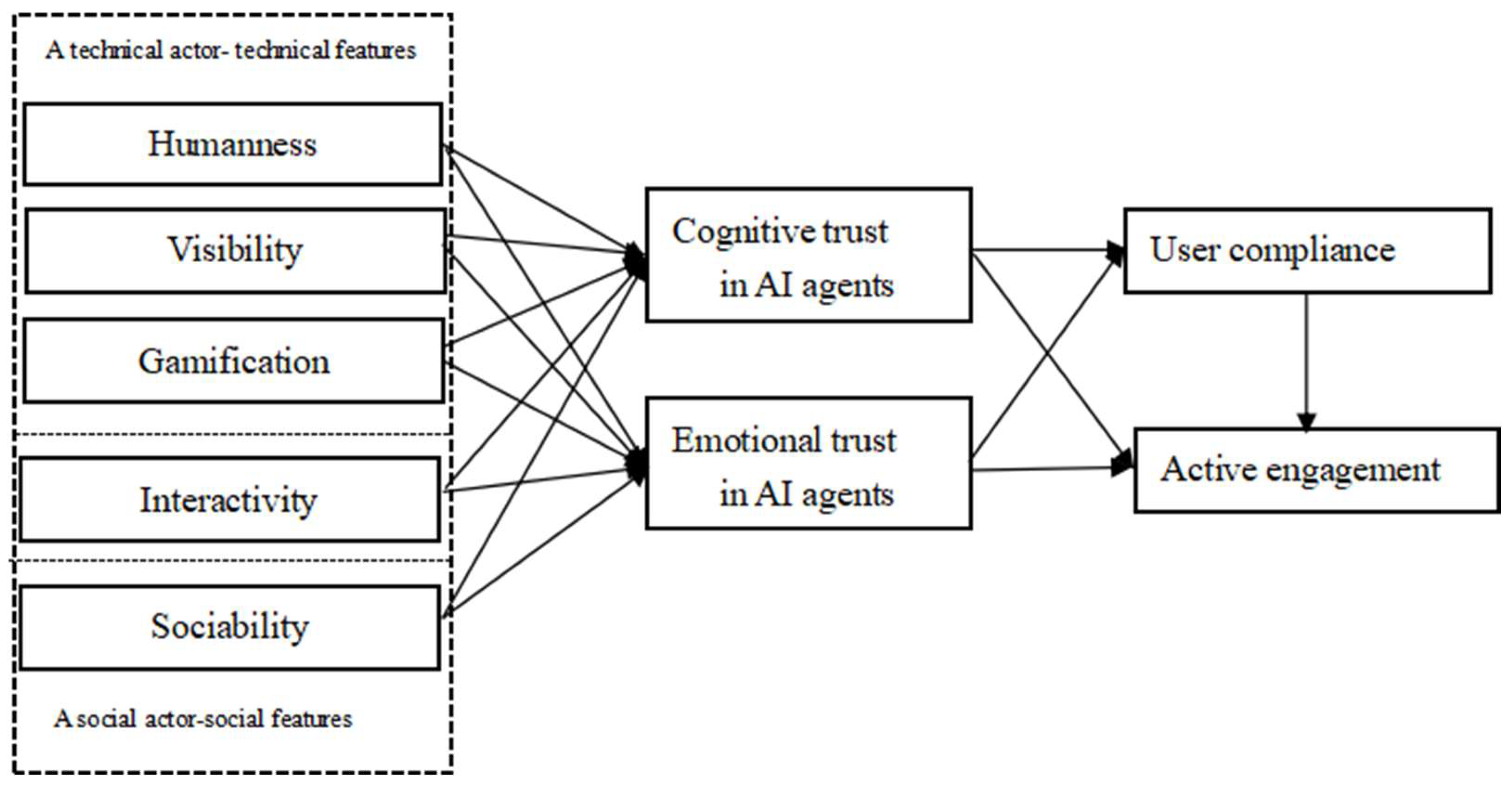
5.1. The Conceptual Model
5.2. Hypothesis Development
5.2.1. Humanness and Trust in AI Agents
5.2.2. Visibility and Trust in AI Agents
5.2.3. Gamification and Trust in AI Agents
5.2.4. Interactivity and Trust in AI Agents
5.2.5. Sociability and Trust in AI Agents
5.2.6. Trust in AI Agents and Compliance
5.2.7. Trust in AI Agents and Active Engagement
5.2.8. User Compliance and Active Engagement
5.3. Measurement
5.4. Data Collection and Analysis
5.5. Results
5.5.1. Participants’ Demographic Characteristics
5.5.2. Common-Method Variance Bias Test (CMV)
5.5.3. Measurement Model
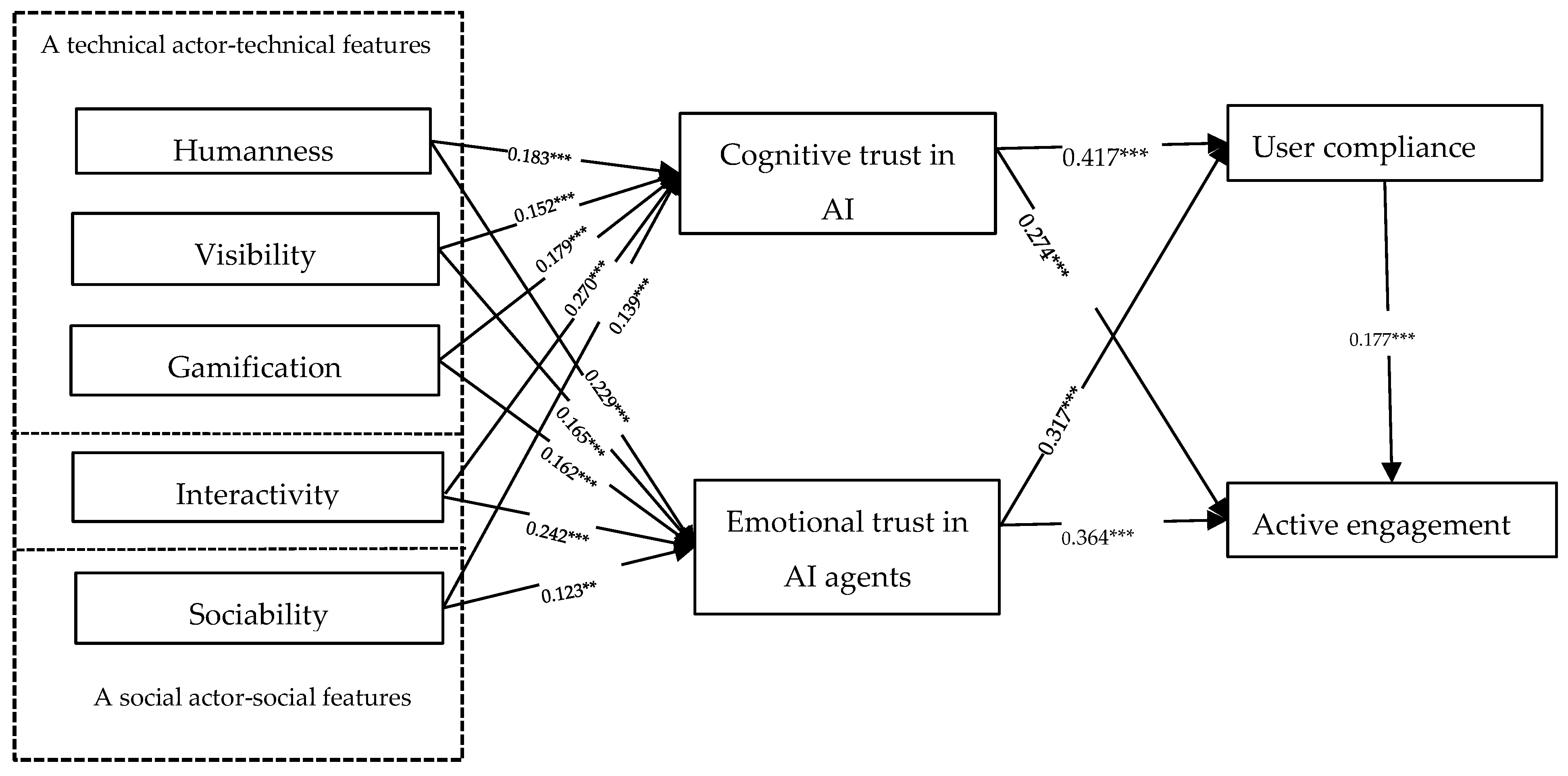
5.5.4. Structural Model
5.5.5. Mediation Analysis
6. Discussion and Conclusions
6.1. Conclusions
6.2. Theoretical Contribution
6.3. Practical Implications
6.4. Limitations and Further Research
Author Contributions
Funding
Institutional Review Board Statement
Informed Consent Statement
Data Availability Statement
Acknowledgments
Conflicts of Interest
References
- Singh, A. Smart Fitness Mirrors Market—By Type, By Frame Material, By Price Range, By Shape, By Screen Size, By End-Use, By Distribution Channel, Forecast 2025–2034; Global Market Insights Inc.: Pune, MH, India, 2024; Available online: https://www.gminsights.com/zh/industry-analysis/smart-fitness-mirror-market (accessed on 2 May 2025).
- Bocean, C.G.; Popescu, L.; Simion, D.; Sperdea, N.M.; Puiu, C.; Marinescu, R.C.; Maria, E. The Role of AI Technologies in E-Commerce Development: A European Comparative Study. J. Theor. Appl. Electron. Commer. Res. 2025, 20, 225. [Google Scholar] [CrossRef]
- Qi, Y.; Sajadi, S.M.; Baghaei, S.; Rezaei, R.; Li, W. Digital Technologies in Sports: Opportunities, Challenges, and Strategies for Safeguarding Athlete Wellbeing and Competitive Integrity in the Digital Era. Technol. Soc. 2024, 77, 102496. [Google Scholar] [CrossRef]
- Khasentino, J.; Belyaeva, A.; Liu, X.; Yang, Z.; Furlotte, N.A.; Lee, C.; Schenck, E.; Patel, Y.; Cui, J.; Schneider, L.D.; et al. A Personal Health Large Language Model for Sleep and Fitness Coaching. Nat. Med. 2025, 31, 3394–3403. [Google Scholar] [CrossRef] [PubMed]
- Wang, L.; Xue, Q.; Xue, J. My Fitness Coach Is AI: Unraveling the Influential Mechanisms of AI Coach-User-Human Coach Interactions on Users’ Behavioral Intention. In Proceedings of the International Conference on Computer Vision, Robotics, and Automation Engineering (CRAE 2024), Kunming, China, 21–23 June 2024; Cheng, Q., Chen, L., Eds.; SPIE: Bellingham, WA, USA, 2024; p. 44. [Google Scholar]
- Joshitha, K.L.; Madhanraj, P.; Rithick Roshan, B.; Prakash, G.; Monish Ram, V.S. AI-FIT COACH—Revolutionizing Personal Fitness With Pose Detection, Correction and Smart Guidance. In Proceedings of the 2024 International Conference on Communication, Computing and Internet of Things (IC3IoT), Chennai, India, 17–18 April 2024; IEEE: New York, NY, USA, 2024; pp. 1–5. [Google Scholar]
- Gao, Y.; Liu, H. Artificial intelligence-enabled personalization in interactive marketing: A customer journey perspective. J. Res. Interact. Mark. 2023, 17, 663–680. [Google Scholar] [CrossRef]
- Zhang, D.; Tao, X. How Do Technology and Gamification Influence Continued Usage Intention of AI-Based Wearable Devices? Evidence from SEM-ANN. Asia Pac. J. Mark. Logist. 2025; ahead-of-print, 1–22. [Google Scholar] [CrossRef]
- Ahmad, A.; Ghani, N.A.; Hamid, S. Examining the Predictors of Consumer Trust and Social Commerce Engagement: A Systematic Literature Review. J. Theor. Appl. Electron. Commer. Res. 2025, 20, 247. [Google Scholar] [CrossRef]
- Zhao, X.; You, W.; Zheng, Z.; Shi, S.; Lu, Y.; Sun, L. How Do Consumers Trust and Accept AI Agents? An Extended Theoretical Framework and Empirical Evidence. Behav. Sci. 2025, 15, 337. [Google Scholar] [CrossRef]
- Wang, C.L. Editorial—What is an interactive marketing perspective and what are emerging research areas? J. Res. Interact. Mark. 2024, 18, 161–165. [Google Scholar] [CrossRef]
- Nass, C.; Moon, Y. Machines and Mindlessness: Social Responses to Computers. J. Soc. Issues 2000, 56, 81–103. [Google Scholar] [CrossRef]
- De Kervenoael, R.; Schwob, A.; Hasan, R.; Psylla, E. SIoT Robots and Consumer Experiences in Retail: Unpacking Repeat Purchase Intention Drivers Leveraging Computers Are Social Actors (CASA) Paradigm. J. Retail. Consum. Serv. 2024, 76, 103589. [Google Scholar] [CrossRef]
- Lee, H.; Yi, Y. Humans vs. Service Robots as Social Actors in Persuasion Settings. J. Serv. Res. 2024, 28, 150–167. [Google Scholar] [CrossRef]
- Epley, N.; Waytz, A.; Cacioppo, J.T. On Seeing Human: A Three-Factor Theory of Anthropomorphism. Psychol. Rev. 2007, 114, 864–886. [Google Scholar] [CrossRef] [PubMed]
- Patrizi, M.; Šerić, M.; Vernuccio, M. Hey Google, I Trust You! The Consequences of Brand Anthropomorphism in Voice-Based Artificial Intelligence Contexts. J. Retail. Consum. Serv. 2024, 77, 103659. [Google Scholar] [CrossRef]
- Pang, H.; Ruan, Y.; Zhang, K. Deciphering Technological Contributions of Visibility and Interactivity to Website Atmospheric and Customer Stickiness in AI-Driven Websites: The Pivotal Function of Online Flow State. J. Retail. Consum. Serv. 2024, 78, 103795. [Google Scholar] [CrossRef]
- Bitrián, P.; Buil, I.; Catalán, S. Enhancing User Engagement: The Role of Gamification in Mobile Apps. J. Bus. Res. 2021, 132, 170–185. [Google Scholar] [CrossRef]
- Sun, Y.; Chen, J.; Sundar, S.S. Chatbot Ads with a Human Touch: A Test of Anthropomorphism, Interactivity, and Narrativity. J. Bus. Res. 2024, 172, 114403. [Google Scholar] [CrossRef]
- Zhang, M.; Liu, Y.; Wang, Y.; Zhao, L. How to Retain Customers: Understanding the Role of Trust in Live Streaming Commerce with a Socio-Technical Perspective. Comput. Hum. Behav. 2022, 127, 107052. [Google Scholar] [CrossRef]
- Pitardi, V.; Marriott, H.R. Alexa, She’s Not Human But… Unveiling the Drivers of Consumers’ Trust in Voice-based Artificial Intelligence. Psychol. Mark. 2021, 38, 626–642. [Google Scholar] [CrossRef]
- Edwards, O.V.; Taasoobshirazi, G. Social Presence and Teacher Involvement: The Link with Expectancy, Task Value, and Engagement. Internet High. Educ. 2022, 55, 100869. [Google Scholar] [CrossRef]
- Li, Y.; Lee, S.O. Navigating the Generative AI Travel Landscape: The Influence of ChatGPT on the Evolution from New Users to Loyal Adopters. IJCHM 2024, 37, 1421–1447. [Google Scholar] [CrossRef]
- Chen, Q.Q.; Park, H.J. How Anthropomorphism Affects Trust in Intelligent Personal Assistants. IMDS 2021, 121, 2722–2737. [Google Scholar] [CrossRef]
- Glikson, E.; Woolley, A.W. Human Trust in Artificial Intelligence: Review of Empirical Research. Acad. Manag. Ann. 2020, 14, 627–660. [Google Scholar] [CrossRef]
- Kaplan, A.D.; Kessler, T.T.; Brill, J.C.; Hancock, P.A. Trust in Artificial Intelligence: Meta-Analytic Findings. Hum. Factors 2023, 65, 337–359. [Google Scholar] [CrossRef] [PubMed]
- Duenas, N.; Mangen, C. Trust in International Cooperation: Emotional and Cognitive Trust Complement Each Other over Time. Crit. Perspect. Account. 2023, 92, 102328. [Google Scholar] [CrossRef]
- Ngo, T.T.A.; Bui, C.T.; Chau, H.K.L.; Tran, N.P.N. Electronic Word-of-Mouth (eWOM) on Social Networking Sites (SNS): Roles of Information Credibility in Shaping Online Purchase Intention. Heliyon 2024, 10, e32168. [Google Scholar] [CrossRef]
- Wu, W.; Wang, S.; Ding, G.; Mo, J. Elucidating Trust-Building Sources in Social Shopping: A Consumer Cognitive and Emotional Trust Perspective. J. Retail. Consum. Serv. 2023, 71, 103217. [Google Scholar] [CrossRef]
- Liu, B.; Li, X.; Zhang, J.; Wang, J.; He, T.; Hong, S.; Liu, H.; Zhang, S.; Song, K.; Zhu, K.; et al. Advances and Challenges in Foundation Agents: From Brain-Inspired Intelligence to Evolutionary. arXiv 2025, arXiv:2504.01990. [Google Scholar] [CrossRef]
- Xie, J.; Chen, Z.; Zhang, R.; Wan, X.; Li, G. Large multimodal agents: A survey. arXiv 2024, arXiv:2402.15116. [Google Scholar] [CrossRef]
- Zhang, H.; Du, W.; Shan, J.; Zhou, Q.; Du, Y.; Tenenbaum, J.B.; Shu, T.; Gan, C. Building cooperative embodied agents modularly with large language models. arXiv 2023, arXiv:2307.02485. [Google Scholar]
- Li, Y.; Liu, Z.; Li, Z.; Zhang, X.; Xu, Z.; Chen, X.; Shi, H.; Jiang, S.; Wang, X.; Wang, J. Perception, reason, think, and plan: A survey on large multimodal reasoning models. arXiv 2025, arXiv:2505.04921. [Google Scholar] [CrossRef]
- Zheng, J.; Shi, C.; Cai, X.; Li, Q.; Zhang, D.; Li, C.; Yu, D.; Ma, Q. Lifelong learning of large language model based agents: A roadmap. arXiv 2025, arXiv:2501.07278. [Google Scholar] [CrossRef]
- Azam, M.; Rafiq, T.; Naz, F.G.; Ghafoor, M.; Nisa, M.U.; Malik, H. A novel model of narrative memory for conscious agents. Int. J. Inf. Syst. Comput. Technol. 2024, 3, 12–22. [Google Scholar] [CrossRef]
- Hu, Q.; Lu, Y.; Pan, Z.; Gong, Y.; Yang, Z. Can ai artifacts influence human cognition? The effects of artificial autonomy in intelligent personal assistants. Int. J. Inf. Manag. 2021, 56, 102250. [Google Scholar] [CrossRef]
- Hughes, L.; Dwivedi, Y.K.; Li, K.; Appanderanda, M.; Al-Bashrawi, M.A.; Chae, I. AI Agents and Agentic Systems: Redefining Global it Management. J. Glob. Inf. Technol. Manag. 2025, 3, 175–185. [Google Scholar] [CrossRef]
- Nass, C.; Steuer, J.; Tauber, E.R. Computers Are Social Actors. In Proceedings of the Conference Companion on Human Factors in Computing Systems—CHI ’94, Boston, MA, USA, 24–28 April 1994; ACM Press: New York, NY, USA, 1994; p. 204. [Google Scholar]
- Zhan, Y.; Xiong, Y.; Han, R.; Lam, H.K.S.; Blome, C. The Impact of Artificial Intelligence Adoption for Business-to-Business Marketing on Shareholder Reaction: A Social Actor Perspective. Int. J. Inf. Manag. 2024, 76, 102768. [Google Scholar] [CrossRef]
- Xu, K.; Chen, X.; Huang, L. Deep Mind in Social Responses to Technologies: A New Approach to Explaining the Computers Are Social Actors Phenomena. Comput. Hum. Behav. 2022, 134, 107321. [Google Scholar] [CrossRef]
- Ham, J.; Li, S.; Looi, J.; Eastin, M.S. Virtual Humans as Social Actors: Investigating User Perceptions of Virtual Humans’ Emotional Expression on Social Media. Comput. Hum. Behav. 2024, 155, 108161. [Google Scholar] [CrossRef]
- Wang, C.L. Editorial: Demonstrating contributions through storytelling. J. Res. Interact. Mark. 2025, 19, 1–4. [Google Scholar] [CrossRef]
- Mou, J.; Benyoucef, M. Consumer Behavior in Social Commerce: Results from a Meta-Analysis. Technol. Forecast. Soc. Chang. 2021, 167, 120734. [Google Scholar] [CrossRef]
- Afroogh, S.; Akbari, A.; Malone, E.; Kargar, M.; Alambeigi, H. Trust in AI: Progress, Challenges, and Future Directions. Humanit. Soc. Sci. Commun. 2024, 11, 1568. [Google Scholar] [CrossRef]
- Ho, S.S.; Cheung, J.C. Trust in Artificial Intelligence, Trust in Engineers, and News Media: Factors Shaping Public Perceptions of Autonomous Drones through UTAUT2. Technol. Soc. 2024, 77, 102533. [Google Scholar] [CrossRef]
- Liu, X.S.; Yi, X.S.; Wan, L.C. Friendly or Competent? The Effects of Perception of Robot Appearance and Service Context on Usage Intention. Ann. Tour. Res. 2022, 92, 103324. [Google Scholar] [CrossRef]
- Jiang, Y.; Yang, X.; Zheng, T. Make Chatbots More Adaptive: Dual Pathways Linking Human-like Cues and Tailored Response to Trust in Interactions with Chatbots. Comput. Hum. Behav. 2023, 138, 107485. [Google Scholar] [CrossRef]
- Chai, J.C.Y.; Malhotra, N.K.; Alpert, F. A Two-Dimensional Model of Trust–Value–Loyalty in Service Relationships. J. Retail. Consum. Serv. 2015, 26, 23–31. [Google Scholar] [CrossRef]
- Ihsan, F.; Nasrulloh, A.; Nugroho, S.; Yuniana, R. A Review of the Use of Technology in Sport. Coaching: Current Trends and Future Directions. Health Sport Rehabil. 2025, 11, 85–101. [Google Scholar] [CrossRef]
- Hu, T.; Geng, J. Research on the Perception of the Terrain Image of the Tourism Destination Based on Multimodal User-Generated Content Data. PeerJ Comput. Sci. 2024, 10, e1801. [Google Scholar] [CrossRef]
- Kusuma, A.A.; Afiff, A.Z.; Gayatri, G.; Hati, S.R.H. Is Visual Content Modality a Limiting Factor for Social Capital? Examining User Engagement within Instagram-Based Brand Communities. Humanit. Soc. Sci. Commun. 2024, 11, 9. [Google Scholar] [CrossRef]
- Liu, K.; Tao, D. The Roles of Trust, Personalization, Loss of Privacy, and Anthropomorphism in Public Acceptance of Smart Healthcare Services. Comput. Hum. Behav. 2022, 127, 107026. [Google Scholar] [CrossRef]
- Yim, A.; Cui, A.P.; Walsh, M. The role of cuteness on consumer attachment to artificial intelligence agents. J. Res. Interact. Mark. 2024, 18, 127–141. [Google Scholar] [CrossRef]
- Qu, Y.; Baek, E. Let virtual creatures stay virtual: Tactics to increase trust in virtual influencers. J. Res. Interact. Mark. 2024, 18, 91–108. [Google Scholar] [CrossRef]
- Lu, L.; McDonald, C.; Kelleher, T.; Lee, S.; Chung, Y.J.; Mueller, S.; Vielledent, M.; Yue, C.A. Measuring Consumer-Perceived Humanness of Online Organizational Agents. Comput. Hum. Behav. 2022, 128, 107092. [Google Scholar] [CrossRef]
- Calahorra-Candao, G.; Martín-de Hoyos, M.J. The Effect of Anthropomorphism of Virtual Voice Assistants on Perceived Safety as an Antecedent to Voice Shopping. Comput. Hum. Behav. 2024, 153, 108124. [Google Scholar] [CrossRef]
- Wen, J.; Li, X. AI Digital Human Responsiveness and Consumer Purchase Intention: The Mediating Role of Trust. J. Theor. Appl. Electron. Commer. Res. 2025, 20, 246. [Google Scholar] [CrossRef]
- Sun, Y.; Shao, X.; Li, X.; Guo, Y.; Nie, K. How Live Streaming Influences Purchase Intentions in Social Commerce: An IT Affordance Perspective. Electron. Commer. Res. Appl. 2019, 37, 100886. [Google Scholar] [CrossRef]
- Jin, H.; Chen, T.; Shi, H. Beyond the Fitness: A Big Data Analysis of Home Exercisers Demand. Sage Open 2024, 14, 21582440241274533. [Google Scholar] [CrossRef]
- Noh, E.; Won, J.; Jo, S.; Hahm, D.-H.; Lee, H. Conversational Agents for Body Weight Management: Systematic Review. J. Med. Internet Res. 2023, 25, e42238. [Google Scholar] [CrossRef]
- Deterding, S.; Dixon, D.; Khaled, R.; Nacke, L. From Game Design Elements to Gamefulness: Defining “Gamification”. In Proceedings of the 15th International Academic MindTrek Conference: Envisioning Future Media Environments, Tampere, Finland, 28–30 September 2011; ACM: New York, NY, USA, 2011; pp. 9–15. [Google Scholar]
- Li, N.; Aumeboonsuke, V. How Gamification Features Drive Brand Loyalty: The Mediating Roles of Consumer Experience and Brand Engagement. J. Theor. Appl. Electron. Commer. Res. 2025, 20, 113. [Google Scholar] [CrossRef]
- Eppmann, R.; Bekk, M.; Klein, K. Gameful Experience in Gamification: Construction and Validation of a Gameful Experience Scale [GAMEX]. J. Interact. Mark. 2018, 43, 98–115. [Google Scholar] [CrossRef]
- Liao, C.H.; Hsieh, J.-K.; Kumar, S. Does the verified badge of social media matter? The perspective of trust transfer theory. J. Res. Interact. Mark. 2024, 18, 1017–1033. [Google Scholar] [CrossRef]
- Singh, Y.; Milan, R. Utilitarian and Hedonic Values of Gamification and Their Influence on Brand Engagement, Loyalty, Trust and WoM. Entertain. Comput. 2025, 52, 100868. [Google Scholar] [CrossRef]
- Elmashhara, M.G.; De Cicco, R.; Silva, S.C.; Hammerschmidt, M.; Silva, M.L. How Gamifying AI Shapes Customer Motivation, Engagement, and Purchase Behavior. Psychol. Mark. 2024, 41, 134–150. [Google Scholar] [CrossRef]
- Wirani, Y.; Nabarian, T.; Romadhon, M.S. Evaluation of Continued Use on Kahoot! As a Gamification-Based Learning Platform from the Perspective of Indonesia Students. Procedia Comput. Sci. 2022, 197, 545–556. [Google Scholar] [CrossRef]
- To, A.T.; Trinh, T.H.M. Understanding Behavioral Intention to Use Mobile Wallets in Vietnam: Extending the Tam Model with Trust and Enjoyment. Cogent Bus. Manag. 2021, 8, 1891661. [Google Scholar] [CrossRef]
- Ma, C.; Shao, J. Modeling Mobile Game Design Features Through Grounded Theory: Key Factors Influencing User Behavior. J. Theor. Appl. Electron. Commer. Res. 2025, 20, 132. [Google Scholar] [CrossRef]
- Samarah, T.; Bayram, P.; Aljuhmani, H.Y.; Elrehail, H. The role of brand interactivity and involvement in driving social media consumer brand engagement and brand loyalty: The mediating effect of brand trust. J. Res. Interact. Mark. 2022, 16, 648–664. [Google Scholar] [CrossRef]
- Zhao, H.; Furuoka, F. Linking Social Capital to Green Purchasing Intentions in Livestreaming Sessions: The Moderating Role of Perceived Visible Heterogeneity. Humanit. Soc. Sci. Commun. 2025, 12, 492. [Google Scholar] [CrossRef]
- Shin, D. The Actualization of Meta Affordances: Conceptualizing Affordance Actualization in the Metaverse Games. Comput. Hum. Behav. 2022, 133, 107292. [Google Scholar] [CrossRef]
- Wang, J.; Shahzad, F.; Ashraf, S.F. Elements of Information Ecosystems Stimulating the Online Consumer Behavior: A Mediating Role of Cognitive and Affective Trust. Telemat. Inform. 2023, 80, 101970. [Google Scholar] [CrossRef]
- Fan, J.; Zhou, W.; Yang, X.; Li, B.; Xiang, Y. Impact of Social Support and Presence on Swift Guanxi and Trust in Social Commerce. IMDS 2019, 119, 2033–2054. [Google Scholar] [CrossRef]
- Leung, W.K.S.; Chang, M.K.; Cheung, M.L.; Shi, S. Swift Trust Development and Prosocial Behavior in Time Banking: A Trust Transfer and Social Support Theory Perspective. Comput. Hum. Behav. 2022, 129, 107137. [Google Scholar] [CrossRef]
- Monfared, A.R.K.; Ghaffari, M.; Barootkoob, M.; Malmiri, M.M. The Role of Social Commerce in Online Purchase Intention: Mediating Role of Social Interactions, Trust, and Electronic Word of Mouth. J. Int. Bus. Entrep. Dev. 2021, 13, 22. [Google Scholar] [CrossRef]
- Gurney, N.; Pynadath, D.V.; Wang, N. Comparing Psychometric and Behavioral Predictors of Compliance During Human-AI Interactions. In Persuasive Technology; Meschtscherjakov, A., Midden, C., Ham, J., Eds.; Lecture Notes in Computer Science; Springer Nature: Cham, Switzerland, 2023; Volume 13832, pp. 175–197. ISBN 978-3-031-30932-8. [Google Scholar]
- Jingchuan, J.; Wu, S. How Trust in Human-like AI-Based Service on Social Media Will Influence Customer Engagement: Exploratory Research to Develop the Scale of Trust in Human-like AI-Based Service. Asia Mark. J. 2024, 26, 129–144. [Google Scholar] [CrossRef]
- Kosiba, J.P.; Boateng, H.; Okoe, A.F.; Hinson, R. Trust and Customer Engagement in the Banking Sector in Ghana. Serv. Ind. J. 2020, 40, 960–973. [Google Scholar] [CrossRef]
- Fatima, S.; Augusto, J.C.; Moseley, R.; Urbonas, P.; Elliott, A.; Payne, N. Applying Motivational Techniques for User Adherence to Adopt a Healthy Lifestyle in a Gamified Application. Entertain. Comput. 2023, 46, 100571. [Google Scholar] [CrossRef]
- White, J.S.; Toussaert, S.; Raiff, B.R.; Salem, M.K.; Chiang, A.Y.; Crane, D.; Warrender, E.; Lyles, C.R.; Abroms, L.C.; Westmaas, J.L.; et al. Evaluating the Impact of a Game (Inner Dragon) on User Engagement Within a Leading Smartphone App for Smoking Cessation: Randomized Controlled Trial. J. Med. Internet Res. 2024, 26, e57839. [Google Scholar] [CrossRef]
- Adam, M.; Wessel, M.; Benlian, A. AI-Based Chatbots in Customer Service and Their Effects on User Compliance. Electron. Mark. 2021, 31, 427–445. [Google Scholar] [CrossRef]
- Li, X.; Sung, Y. Anthropomorphism Brings Us Closer: The Mediating Role of Psychological Distance in User–AI Assistant Interactions. Comput. Hum. Behav. 2021, 118, 106680. [Google Scholar] [CrossRef]
- Liu, R.; Benitez, J.; Zhang, L.; Shao, Z.; Mi, J. Exploring the Influence of Gamification-Enabled Customer Experience on Continuance Intention towards Digital Platforms for e-Government: An Empirical Investigation. Inf. Manag. 2024, 61, 103986. [Google Scholar] [CrossRef]
- Shi, X.; Evans, R.; Shan, W. Solver Engagement in Online Crowdsourcing Communities: The Roles of Perceived Interactivity, Relationship Quality and Psychological Ownership. Technol. Forecast. Soc. Chang. 2022, 175, 121389. [Google Scholar] [CrossRef]
- Rupp, M.A.; Michaelis, J.R.; McConnell, D.S.; Smither, J.A. The Role of Individual Differences on Perceptions of Wearable Fitness Device Trust, Usability, and Motivational Impact. Appl. Ergon. 2018, 70, 77–87. [Google Scholar] [CrossRef]
- Kim, J.; Im, I. Anthropomorphic Response: Understanding Interactions between Humans and Artificial Intelligence Agents. Comput. Hum. Behav. 2023, 139, 107512. [Google Scholar] [CrossRef]
- Xue, J.; Liang, X.; Xie, T.; Wang, H. See Now, Act Now: How to Interact with Customers to Enhance Social Commerce Engagement? Inf. Manag. 2020, 57, 103324. [Google Scholar] [CrossRef]
- Liang, H.; Saraf, N.; Hu, Q.; Xue, Y. Assimilation of enterprise systems: The effect of institutional pressures and the mediating role of top management. MIS Q. 2007, 31, 59–87. [Google Scholar] [CrossRef]
- Ringle, C.M.; Sarstedt, M. Gain more insight from your PLS-SEM results: The importance-performance map analysis. Ind. Manag. Data Syst. 2016, 116, 1865–1886. [Google Scholar] [CrossRef]
- Zhou, L.; Wang, V.L. “What’s in a Name?”: The Effect of AI Agent Naming on Psychological Ownership and Responsible Behaviors in the Shared Economy. J. Appl. Bus. Behav. Sci. 2025, 1, 144–162. [Google Scholar] [CrossRef]
- Yoo, J.W.; Park, J.; Park, H. How can I trust you if you’re fake? Understanding human-like virtual influencer credibility and the role of textual social cues. J. Res. Interact. Mark. 2025, 19, 730–748. [Google Scholar] [CrossRef]
- Westphal, M.; Vössing, M.; Satzger, G.; Yom-Tov, G.B.; Rafaeli, A. Decision Control and Explanations in Human-AI Collaboration: Improving User Perceptions and Compliance. Comput. Hum. Behav. 2023, 144, 107714. [Google Scholar] [CrossRef]
- Xie, G.; Wang, X. Exploring the Impact of AI Enhancement on the Sports App Community: Analyzing Human-Computer Interaction and Social Factors Using a Hybrid SEM-ANN Approach. Int. J. Hum.-Comput. Interact. 2024, 41, 8734–8755. [Google Scholar] [CrossRef]
- Gao, L.; Li, G.; Tsai, F.; Gao, C.; Zhu, M.; Qu, X. The impact of artificial intelligence stimuli on customer engagement and value co-creation: The moderating role of customer ability readiness. J. Res. Interact. Mark. 2023, 17, 317–333. [Google Scholar] [CrossRef]
- Richter, C.; O’Reilly, M.; Delahunt, E. Machine Learning in Sports Science: Challenges and Opportunities. Sports Biomech. 2024, 23, 961–967. [Google Scholar] [CrossRef]
- Su, Z.; Ge, S.; Li, L.; Su, Y. Review Study Of Integrating Ai Technology Into Sports Training System. Kuey 2024, 30, 5. [Google Scholar] [CrossRef]
- Peltier, J.W.; Dahl, A.J.; Schibrowsky, J.A. Artificial intelligence in interactive marketing: A conceptual framework and research agenda. J. Res. Interact. Mark. 2024, 18, 54–90. [Google Scholar] [CrossRef]
- Riley, B.K.; Dixon, A. Emotional and Cognitive Trust in Artificial Intelligence: A Framework for Identifying Research Opportunities. Curr. Opin. Psychol. 2024, 58, 101833. [Google Scholar] [CrossRef]
- Gong, L. How social is social responses to computers? The function of the degree of anthropomorphism in computer representations. Comput. Hum. Behav. 2008, 24, 1494–1509. [Google Scholar] [CrossRef]
- Hassanein, K.; Head, M. The impact of infusing social presence in the web interface: An investigation on online shopping experience. Interact. Comput. 2005, 17, 384–396. [Google Scholar] [CrossRef]
- Kristine, L.; Nowak, F.B. The Effect of the Agency and Anthropomorphism on Users’ Sense of Telepresence, Copresence, and Social Presence in Virtual Environments. Presence Teleoperators Virtual Environ. 2003, 12, 481–494. [Google Scholar] [CrossRef]



| Items | LLMs | AI Agents |
|---|---|---|
| Concept | LLM is a subclass of AI, falling under natural language processing (NLP) models. It is trained on large-scale data and uses deep learning (typically Transformer architecture) to generate and understand natural language. | An AI Agent is a system capable of perceiving its environment, setting goals, making decisions, and taking actions. It often uses LLMs or other AI models as its “thinking/reasoning engine.” |
| Type | A model (Tool) | A system (System) |
| Core modules | Natural language understanding and generation. | Perception, memory, planning, and action. |
| Initiative | No, requires external instructions. | Yes, can autonomously use tools and execute actions. |
| Memory | Usually lacks long-term memory. | Usually has long-term memory. |
| Role positioning in AI fitness | Serving as fitness advisors, Large Language Models leverage vast datasets to process and generate human-like text, enabling personalized fitness guidance and powering modern e-commerce recommendations. | AI personal fitness agents can act as personalized trainers and savvy shopping assistants, seamlessly integrating fitness planning with e-commerce recommendation. By understanding a user’s unique goals, progress, and habits, the AI coach can craft effective workout regimens and suggest relevant products to enhance the entire fitness journey. |
| Core strength in smart home-based e-commerce context | The LLM’s core strength lies in understanding nuanced intent and generating contextually relevant, personalized text responses, and LLMs can generate tailored fitness plans and drive fitness product recommendations. | An AI fitness agent can perceive, act, and create dynamic workout plans. It memorizes and assesses user data while leveraging real-time training performance to recommend relevant products, thereby achieving a seamless integration of personalized fitness and e-commerce. |
| Modules | Perception | Memory | Planning | Action | |
|---|---|---|---|---|---|
| Features | |||||
| Visibility (Making the agent’s intelligence and value apparent) | Demonstrates awareness by recognizing user state (e.g., heart rate, form) and commenting on it (“I notice…”). | Proves it “knows” the user by recalling personal details and history, making the agent seem knowledgeable. | Makes strategic thinking transparent by explaining the “why” behind a new training plan. | Turning internal decisions into tangible outputs like real-time feedback and updated plans. | |
| Gamification (Using game-like elements for motivation) | Tracks and validates achievements (e.g., counting reps, judging perfect form) as the basis for rewards. | Stores progress and history to unlock badges and level up the user, building a persistent growth system. | Acts as the game designer, structuring challenges, quests, and milestones scaled to the user’s ability. | Delivers the game elements, such as instant achievement notifications and progress bars, providing immediate satisfaction. | |
| Interactivity (Enabling a dynamic, two-way dialogue) | Serves as the primary channel for interaction, using NLP to understand user commands and questions. | Ensures contextual continuity, remembering previous conversations to make exchanges fluid and natural. | Enables real-time adaptation and replanning based on user input (e.g., modifying a workout after a user complaint). | Serves as the agent’s side of the dialogue, providing responses that are direct consequences of the user’s input. | |
| Humanness (Being relatable, empathetic, and personable) | Detects user’s emotional state (e.g., frustration from tone) to form the basis for an empathetic response. | Builds a “relationship” by remembering personal events (birthdays) and past struggles, showing “care.” | Demonstrates understanding and flexibility, like replanning a workout after a user has a stressful day. | Communicates with a “human touch”—using conversational language, humor, and empathetic encouragement. | |
| Sociability (Extending interaction to a community or social dimension) | Scales to perceive group dynamics, tracking multiple users’ performance in a team challenge. | Remembers group interactions and relationships, storing team contributions for meaningful social engagement. | Creates socially driven plans, like generating friendly competitions or cooperative challenges for a group of friends. | Facilitates social connections by sharing achievements to a feed, sending team messages, or matching users for sessions. | |
| Sources | Xie et al. [32]; Zhang et al. [33]; Li et al. [34]; Zheng et al. [35]. | Xie et al. [32]; Zhang et al. [33]; Zheng et al. [35]; Azam et al. [36]. | Xie et al. [32]; Li et al. [34]; Azam et al. [36]. | Xie et al. [32]; Zhang et al. [33]; Zheng et al. [35]; Azam et al. [36]. | |
| Construct | Definition | Text Mining Keywords and Frequency |
|---|---|---|
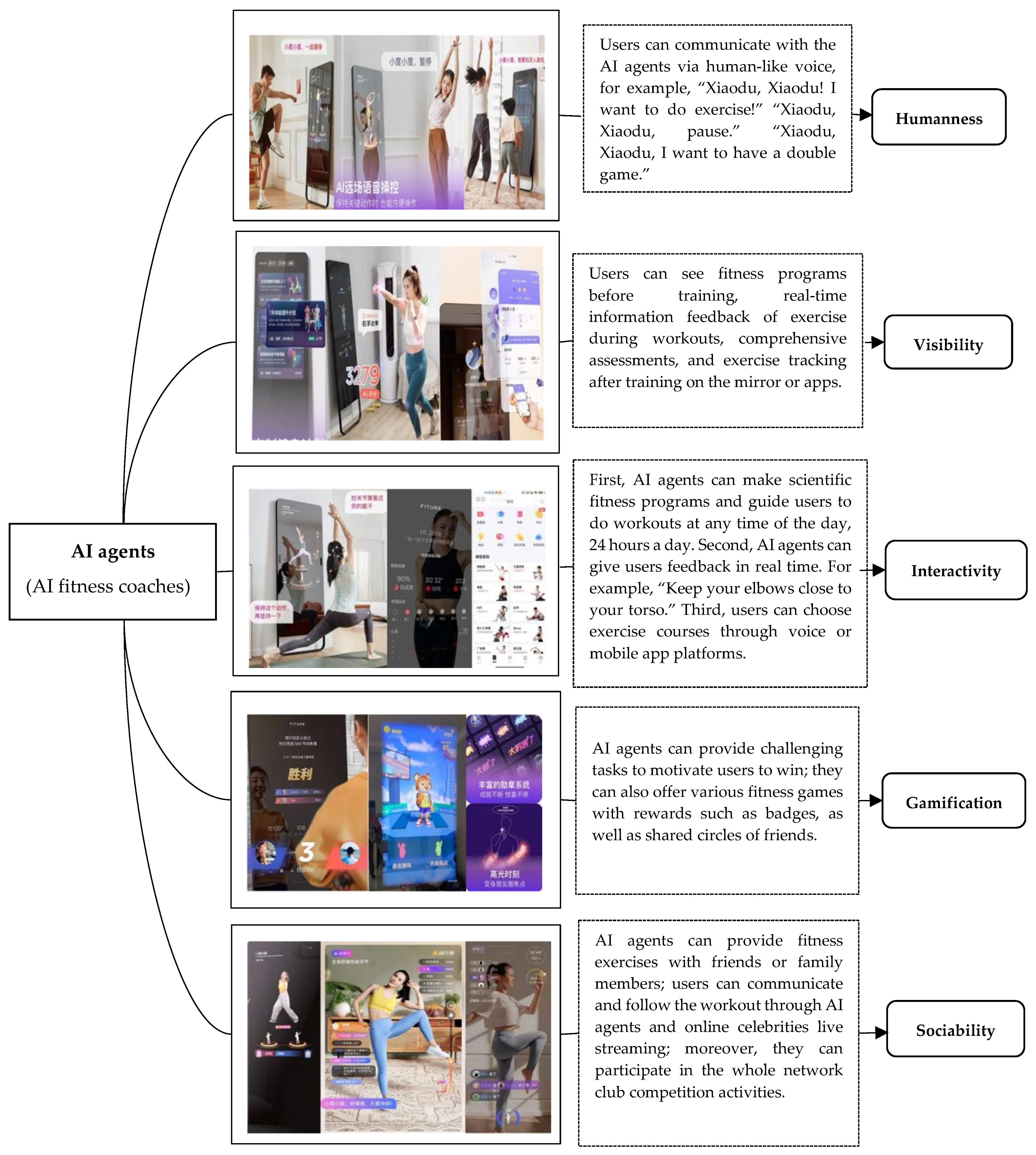
| Humanness | The tendency to imbue real or imagined behavior of AI agents with human-like characteristics, intentions or emotions, focusing on its static attributes that mimic human forms, such as a human-like name, or voice tone. | Stick Figure (257) Sports Partner (986) Conversational AI (1513) AI-Enabled Companionship (182) |
| Interactivity | The dynamic, bidirectional exchange of information between humans and AI agents, orchestrated through sequential voice controls and instantaneous responsiveness to deliver personalized guidance. | Interaction (1321) Personalization (10,574) Voice Control (3403) Responsiveness (3697) |
| Visibility | The property that enables users to clearly see the system interface, operational processes, and displayed information. | Vision (687) HD Viewing (267) Data-Driven Insights (1189) |
| Sociability | The degree to which the AI agent facilitates a perceived connection to a social environment, often by enabling social comparisons or social interactions among users to satisfy the innate need for connection with others (e.g., friends and family members) and receive social support. | Fun for All Ages (10,945) Two-player Mode (1788) Virtual Communities (521) Gather and exercise (517) In-person Gatherings (152) |
| Gamification | The process of applying game design elements of AI agents to non-game contexts in order to create an enjoyable experience for users. | Game (8363) Play-to-Train (5702) Badges & Rankings (437) PK (1763) Happy (3932) |
| Variables | Frequency (N) | Percentage (%) | |
|---|---|---|---|
| Gender | Male | 253 | 42.2 |
| Female | 346 | 57.8 | |
| Age | ≥18–25 years | 92 | 15.4 |
| ≥26–30 years | 128 | 21.4 | |
| ≥31–35 years | 249 | 41.6 | |
| ≥36–40 years | 88 | 14.7 | |
| ≥41–45 years | 21 | 3.5 | |
| ≥46–50 years | 8 | 1.3 | |
| ≥51 years | 13 | 2.2 | |
| Education degree | High education school or below | 8 | 1.3 |
| College | 32 | 5.3 | |
| Bachelor | 368 | 61.4 | |
| Master | 191 | 31.9 | |
| Monthly disposable incomes (RMB) | 1000 or below | 12 | 2.0 |
| 1001–3000 | 150 | 25.0 | |
| 3001–5000 | 39 | 6.5 | |
| 5001–8000 | 144 | 24.0 | |
| 8001–10,000 | 44 | 7.3 | |
| 10,001–15,000 | 97 | 16.2 | |
| 15,001 and over | 113 | 18.9 | |
| Marital status | Single | 144 | 24.1 |
| Married without child | 35 | 5.8 | |
| Married with child | 420 | 70.1 | |
| Exercise frequency | No exercise | 9 | 1.5 |
| 1–2 times a week | 175 | 29.2 | |
| 3–4 times a week | 257 | 42.9 | |
| 5–6 times a week | 82 | 13.7 | |
| Exercise every day | 76 | 12.7 |
| Construct | Indicator | R12 | R1 | R22 | R2 |
|---|---|---|---|---|---|
| HU | HU → HU1 | 0.630 | 0.794 *** | 0.003 | 0.055 |
| HU → HU2 | 0.690 | 0.831 *** | 0.002 | −0.039 | |
| HU → HU3 | 0.682 | 0.826 *** | 0.000 | −0.020 | |
| VI | VI → VI1 | 0.672 | 0.820 *** | 0.000 | 0.013 |
| VI → VI2 | 0.619 | 0.787 *** | 0.000 | −0.002 | |
| VI → VI3 | 0.683 | 0.826 *** | 0.000 | −0.012 | |
| GA | GA → GA1 | 0.765 | 0.875 *** | 0.003 | −0.054 |
| GA → GA2 | 0.501 | 0.708 *** | 0.011 | 0.105 ** | |
| GA → GA3 | 0.765 | 0.875 *** | 0.002 | −0.047 | |
| IN | IN → IN1 | 0.718 | 0.847 *** | 0.001 | −0.026 |
| IN → IN2 | 0.468 | 0.684 *** | 0.009 | 0.092 | |
| IN → IN3 | 0.656 | 0.810 *** | 0.000 | 0.014 | |
| IN → IN4 | 0.483 | 0.695 *** | 0.011 | 0.105 * | |
| IN → IN5 | 0.894 | 0.945 *** | 0.034 | −0.184 *** | |
| SO | SO → SO1 | 0.747 | 0.864 *** | 0.004 | −0.064 * |
| SO → SO2 | 0.504 | 0.710 *** | 0.007 | 0.084 * | |
| SO → SO3 | 0.698 | 0.835 *** | 0.000 | −0.016 | |
| CT | CT → CT1 | 0.663 | 0.814 *** | 0.000 | 0.007 |
| CT → CT2 | 0.566 | 0.752 *** | 0.001 | 0.029 | |
| CT → CT3 | 0.695 | 0.834 *** | 0.001 | −0.035 | |
| ET | ET → ET1 | 0.658 | 0.811 *** | 0.001 | 0.032 |
| ET → ET2 | 0.637 | 0.798 *** | 0.000 | −0.013 | |
| ET → ET3 | 0.674 | 0.821 *** | 0.000 | −0.021 | |
| UC | UC → UC1 | 0.521 | 0.722 *** | 0.010 | 0.102 ** |
| UC → UC2 | 0.558 | 0.747 *** | 0.000 | 0.005 | |
| UC → UC3 | 0.864 | 0.930 *** | 0.011 | −0.105 ** | |
| AE | AE → AE1 | 0.686 | 0.828 *** | 0.006 | −0.075 |
| AE → AE2 | 0.520 | 0.721 *** | 0.003 | 0.056 | |
| AE → AE3 | 0.536 | 0.732 *** | 0.000 | 0.000 | |
| AE → AE4 | 0.593 | 0.770 *** | 0.000 | 0.017 | |
| Average | - | 0.645 | 0.004 |
| Constructs | Items | Loading | CA | CR | AVE |
|---|---|---|---|---|---|
| HU | HU1 | 0.847 | 0.749 | 0.856 | 0.665 |
| HU2 | 0.796 | ||||
| HU3 | 0.803 | ||||
| VI | VI1 | 0.833 | 0.740 | 0.852 | 0.658 |
| VI2 | 0.786 | ||||
| VI3 | 0.814 | ||||
| GA | GA1 | 0.829 | 0.757 | 0.860 | 0.673 |
| GA2 | 0.800 | ||||
| GA3 | 0.831 | ||||
| IN | IN1 | 0.822 | 0.856 | 0.897 | 0.634 |
| IN2 | 0.766 | ||||
| IN3 | 0.820 | ||||
| IN4 | 0.790 | ||||
| IN5 | 0.784 | ||||
| SO | SO1 | 0.817 | 0.727 | 0.846 | 0.647 |
| SO2 | 0.780 | ||||
| SO3 | 0.816 | ||||
| CT | CT1 | 0.819 | 0.719 | 0.842 | 0.640 |
| CT2 | 0.779 | ||||
| CT3 | 0.802 | ||||
| ET | ET1 | 0.843 | 0.737 | 0.851 | 0.655 |
| ET2 | 0.787 | ||||
| ET3 | 0.797 | ||||
| UC | UC1 | 0.815 | 0.720 | 0.843 | 0.641 |
| UC2 | 0.746 | ||||
| UC3 | 0.839 | ||||
| AE | AE1 | 0.766 | 0.761 | 0.848 | 0.582 |
| AE2 | 0.776 | ||||
| AE3 | 0.726 | ||||
| AE4 | 0.782 |
| HU | VI | GA | IN | SO | CT | ET | UC | AE | |
|---|---|---|---|---|---|---|---|---|---|
| HU | 0.553 | ||||||||
| VI | 0.475 | 0.811 | |||||||
| GA | 0.459 | 0.473 | 0.820 | ||||||
| IN | 0.536 | 0.433 | 0.478 | 0.797 | |||||
| SO | 0.509 | 0.338 | 0.390 | 0.520 | 0.804 | ||||
| CT | 0.553 | 0.487 | 0.518 | 0.592 | 0.494 | 0.800 | |||
| ET | 0.574 | 0.496 | 0.509 | 0.577 | 0.484 | 0.581 | 0.809 | ||
| UC | 0.526 | 0.437 | 0.492 | 0.561 | 0.515 | 0.602 | 0.559 | 0.801 | |
| AE | 0.525 | 0.406 | 0.448 | 0.506 | 0.518 | 0.592 | 0.622 | 0.546 | 0.763 |
| Competing Models | Paths | SRMR | d_ULS | Chi-Square | d_G | NFI |
|---|---|---|---|---|---|---|
| Nine-factor model (the hypothesized model) | HU, VI, GA, IN, SO → (CT, ET) → UC → AE | 0.063 | 1.840 | 1815.375 | 0.529 | 0.763 |
| Five-factor model | TSF (HU + VI + GA + IN + SO) → (CT, ET) → UC → AE | 0.070 | 2.310 | 2048.289 | 0.612 | 0.733 |
| Four-factor model | TSF (HU + VI + GA + IN + SO) → CT + ET → UC → AE | 0.071 | 2.314 | 1947.436 | 0.586 | 0.746 |
| Hypothesis | Paths | β | T-Value | Results |
|---|---|---|---|---|
| H1a | HU → CT | 0.183 *** | 4.196 | Accepted |
| H1b | VI → CT | 0.152 *** | 4.051 | Accepted |
| H1c | GA → CT | 0.179 *** | 4.639 | Accepted |
| H1d | IN → CT | 0.270 *** | 5.364 | Accepted |
| H1e | SO → CT | 0.139 *** | 3.705 | Accepted |
| H2a | HU → ET | 0.229 *** | 5.498 | Accepted |
| H2b | VI → ET | 0.165 *** | 4.474 | Accepted |
| H2c | GA → ET | 0.162 *** | 4.155 | Accepted |
| H2d | IN → ET | 0.242 *** | 4.856 | Accepted |
| H2e | SO → ET | 0.123 ** | 3.166 | Accepted |
| H3a | CT → UC | 0.417 *** | 10.999 | Accepted |
| H3b | ET → UC | 0.317 *** | 8.192 | Accepted |
| H4a | CT → AE | 0.274 *** | 5.604 | Accepted |
| H4b | ET → AE | 0.364 *** | 9.147 | Accepted |
| H5 | UC → AE | 0.177 *** | 3.852 | Accepted |
| Paths | β | T-Value |
|---|---|---|
| HU → CT → UC | 0.076 *** | 3.935 |
| VI → CT → UC | 0.063 *** | 3.823 |
| GA → CT → UC | 0.075 *** | 4.130 |
| IN → CT → UC | 0.113 *** | 4.738 |
| SO → CT → UC | 0.058 ** | 3.390 |
| HU → ET → UC | 0.072 *** | 4.308 |
| VI → ET → UC | 0.052 *** | 3.693 |
| GA → ET → UC | 0.051 *** | 3.696 |
| IN → ET → UC | 0.077 *** | 4.390 |
| SO → ET → UC | 0.039 ** | 2.774 |
| HU → CT → AE | 0.050 ** | 3.293 |
| VI → CT → AE | 0.042 ** | 3.384 |
| GA → CT → AE | 0.049 ** | 3.948 |
| IN → CT → AE | 0.074 *** | 3.812 |
| SO → CT → AE | 0.038 ** | 2.975 |
| HU → ET → AE | 0.083 *** | 4.676 |
| VI → ET → AE | 0.060 *** | 3.969 |
| GA → ET → AE | 0.059 *** | 3.623 |
| IN → ET → AE | 0.088 *** | 4.384 |
| SO → ET → AE | 0.045 ** | 2.910 |
| CT → UC → AE | 0.074 *** | 3.527 |
| ET → UC → AE | 0.056 *** | 3.561 |
Disclaimer/Publisher’s Note: The statements, opinions and data contained in all publications are solely those of the individual author(s) and contributor(s) and not of MDPI and/or the editor(s). MDPI and/or the editor(s) disclaim responsibility for any injury to people or property resulting from any ideas, methods, instructions or products referred to in the content. |
© 2026 by the authors. Licensee MDPI, Basel, Switzerland. This article is an open access article distributed under the terms and conditions of the Creative Commons Attribution (CC BY) license (https://creativecommons.org/licenses/by/4.0/).
Share and Cite
Xue, Q.; Dzitkowska-Zabielska, M.; Wang, L.; Xue, J. CASA in Action: Dual Trust Pathways from Technical–Social Features of AI Agents to Users’ Active Engagement Through Cognitive–Emotional Trust. J. Theor. Appl. Electron. Commer. Res. 2026, 21, 11. https://doi.org/10.3390/jtaer21010011
Xue Q, Dzitkowska-Zabielska M, Wang L, Xue J. CASA in Action: Dual Trust Pathways from Technical–Social Features of AI Agents to Users’ Active Engagement Through Cognitive–Emotional Trust. Journal of Theoretical and Applied Electronic Commerce Research. 2026; 21(1):11. https://doi.org/10.3390/jtaer21010011
Chicago/Turabian StyleXue, Qinbo, Magdalena Dzitkowska-Zabielska, Liguo Wang, and Jiaolong Xue. 2026. "CASA in Action: Dual Trust Pathways from Technical–Social Features of AI Agents to Users’ Active Engagement Through Cognitive–Emotional Trust" Journal of Theoretical and Applied Electronic Commerce Research 21, no. 1: 11. https://doi.org/10.3390/jtaer21010011
APA StyleXue, Q., Dzitkowska-Zabielska, M., Wang, L., & Xue, J. (2026). CASA in Action: Dual Trust Pathways from Technical–Social Features of AI Agents to Users’ Active Engagement Through Cognitive–Emotional Trust. Journal of Theoretical and Applied Electronic Commerce Research, 21(1), 11. https://doi.org/10.3390/jtaer21010011