Article

The Alchemy of Digital Transformation: How Computing Power Investment Fuels New Quality Productivity

1
School of Management, Wuhan University of Technology, Wuhan 430070, China
2
Research Institute of Digital Governance and Management Decision Innovation, Wuhan University of Technology, Wuhan 430070, China
*
Author to whom correspondence should be addressed.
J. Theor. Appl. Electron. Commer. Res. 2025, 20(4), 354; https://doi.org/10.3390/jtaer20040354 (registering DOI)
Submission received: 8 October 2025 / Revised: 29 November 2025 / Accepted: 2 December 2025 / Published: 5 December 2025

Abstract

Against the backdrop of China’s “East-West Computing Resource Transfer” and “Digital-Real Integration” national strategies, computing power has emerged as a core engine driving the digital economy. However, existing research lacks in-depth exploration of the micro-level mechanisms through which computing power operates as a strategic digital resource at the firm level and transforms into competitive advantages. This study examines a sample of manufacturing firms listed on China’s A-share markets from 2011 to 2022, treating the establishment of intelligent computing centers by firms as a quasi-natural experiment. Employing a staggered difference-in-differences model combined with causal inference strategies such as double machine learning, we empirically test the impact of computing power investment on firms’ new quality productivity. The findings reveal that computing power investment significantly enhances new quality productivity, primarily through enabling dynamic capabilities: it strengthens risk perception capabilities by improving information environments, enabling intelligent risk monitoring, and enhancing decision-making resilience; it elevates innovation opportunity-capturing capabilities by expanding the scope of innovation search, accelerating innovation iteration, and facilitating cross-domain knowledge integration; and it achieves data element reconstruction through constructing data infrastructure capabilities, improving data operational efficiency, and optimizing data ecosystem collaboration. Further analysis demonstrates that this promotional effect is more pronounced in firms with strong executive digital cognition and intense market competition, and is more significant among non-heavily polluting, high-tech firms with high absorptive capacity, those located in eastern regions, and those with superior digital endowments. Extended analysis also reveals that the new quality productivity gains from computing power investment drive optimal allocation of human capital while potentially inducing strategic information concealment behaviors as firms seek to protect competitive advantages. By conceptualizing computing power as a contestable strategic resource at the micro level, this study unveils the micro-mechanisms of digital transformation through a dynamic capability framework, offering important implications for firms and governments in optimizing digital strategies.

1. Introduction

In the era of digital economy, computing power has emerged alongside data and algorithms as a fundamental factor driving economic growth and qualitative productivity improvements [1]. The deep integration of digital and real economies serves as the core engine for high-quality economic development [2]. Computing power, acting as the “engine” of the digital age, has become a strategic resource underpinning the new wave of scientific and technological revolution and industrial transformation. To solidify this digital foundation, China has initiated the monumental “East Data, West Computing” project, aiming to build an integrated national computing network. This initiative is not only a crucial step in driving digital transformation and building an innovation-oriented nation but also pivotal for China to secure a proactive position in the future global competitive landscape. Strengthening the computing power base is essential to provide sustained momentum for the digital-real economy integration, ultimately empowering the real economy to achieve qualitative enhancement and reasonable quantitative growth.
However, while macro-level policies and infrastructure advancements are vigorously promoted, a critical micro-level mechanism remains inadequately addressed: our systematic understanding of how firms can acquire and effectively utilize computing power as a strategic resource to achieve qualitative changes in productivity at the micro level is still lacking. Existing literature often treats computing power as a homogeneous public infrastructure [3], overlooking its nature as a heterogeneous digital strategic resource for firms and the complex intermediate mechanisms through which it is translated into competitive advantage [4].
The core of this transformation process lies in how computing power resources empower a firm’s dynamic capabilities—the higher-order organizational abilities to sense market changes, seize innovation opportunities, and reconfigure resource bases [5,6]. Particularly in e-commerce and digital business environments characterized by rapidly evolving competitive landscapes, dynamic capabilities are fundamental for firms to maintain agility and innovativeness [7]. Consequently, a key research question emerges: Does and how does the acquisition of computing power resources (e.g., obtaining an Internet Data Center (IDC) license) drive the leap in new quality productivity by reshaping a firm’s dynamic capabilities? Unraveling this “black box” holds significant theoretical value and provides critical guidance for firms making digital investment decisions.
Based on this, our study utilizes a sample of China’s Shanghai and Shenzhen A-share listed manufacturing firms from 2011 to 2022. For the first time, we employ hand-collected firm-level IDC license data, treating a firm’s acquisition of an IDC license as a critical injection of “digital strategic resource,” to empirically examine its impact on new quality productivity. Our findings indicate that computing power investment significantly enhances firm-level new quality productivity. Mechanism analysis reveals that this process operates primarily through three pathways: First, enhanced risk perception, whereby computing power improves the firm’s adaptability to uncertain environments by improving the information environment, enabling intelligent risk monitoring, and enhancing decision-making resilience. Second, innovation opportunity seizure, whereby computing power reshapes the firm’s R&D paradigm by expanding innovation search space, accelerating innovation iteration, and facilitating cross-domain knowledge integration. Third, data factor reconfiguration, whereby computing power activates data as a core production factor by building data foundation capabilities, improving data operational efficiency, and optimizing data ecosystem synergy.
Further research reveals the boundary conditions of the computing power empowerment effect. Top management’s digital perception capability and intense market competition significantly strengthen the effect of computing power investment. Simultaneously, this effect is more pronounced in high-tech industries, firms with high organizational absorption capacity, and regions with superior eastern digital endowment, reflecting the “technology-organization-environment” fit. An expansive analysis also discovers that while computing power enhances labor productivity, it may also trigger strategic information hiding behavior by firms seeking to protect core algorithmic competitive advantages. This provides a fresh perspective for understanding the complex consequences of digital transformation.
The marginal contributions of this study are threefold: First, it micro-levels the concept of computing power from macro-infrastructure to a contestable strategic digital resource for firms, enriching the digital resource-based view. Second, it systematically unveils the intermediate mechanism through which computing power drives new quality productivity from the three dimensions of dynamic capability theory—sensing, seizing, and reconfiguring—thereby opening the “black box” of the “resource-capability-performance” relationship. Third, it identifies the unintended impact of computing power investment on the capital market information environment while empowering the real economy, providing important insights for a comprehensive assessment of the economic consequences of digitalization. The conclusions of this research hold significant reference value for firms and policymakers striving to achieve high-quality development through “digital empowerment.”

2. Materials

2.1. The Evolution of Computing Power Investment

China’s computing power infrastructure is undergoing rapid expansion and institutional restructuring. As of June 2025, the number of standard racks in operational data centers nationwide exceeded 10.85 million, placing China second globally in overall computing power. Within this, intelligent computing power reached 788 EFLOPS (FP16), supported by more than 35,000 high-quality datasets.
At present, China’s computing power market exhibits a coexistence of “surplus” and “shortage.” On the one hand, the intensive commissioning of large-scale infrastructure has significantly intensified competition, driving a continuous decline in computing power prices. Since the first half of 2025, the monthly rental cost of high-end GPUs (such as the H100) has fallen below ¥50,000, and computing power has become increasingly homogeneous and widely accessible. On the other hand, the rapid iteration of artificial intelligence applications has sharply increased demand for high-quality computing resources. For example, training GPT-4, with 1.8 trillion parameters, requires approximately 68 times the computing power of its predecessor and about 25,000 NVIDIA A100 GPUs running continuously for 90–100 days. As a result, high-performance, scalable, and reliable intelligent computing power has emerged as a new strategic scarce resource.
Against this backdrop, the institutional role of the Internet Data Center (IDC) license has shifted from a mere permit for data center construction and operation to a critical access threshold for enterprises to legally obtain and operate large-scale intelligent computing resources. Acquiring an IDC license no longer simply denotes regulatory compliance; it signifies a firm’s capability to embed itself in the core network of national digital infrastructure and to secure key digital production factors. Accordingly, treating the acquisition of an IDC license as a discrete moment of digital strategic resource injection provides an almost ideal quasi-experimental setting for identifying how computing power investment reshapes corporate capabilities and fosters new, quality productive forces.

2.2. Direct Impact of Computing Power Investment on New Quality Productivity

Building on the view of computing power as a strategic digital resource, new quality productivity (NQP) can be understood as productivity gains that arise not from simply increasing input quantities, but from the qualitative upgrading of production factors and the reorganization of production processes enabled by digital technologies [4]. As an advanced productive force driven by technological innovation, NQP thus reflects deeper restructuring and efficiency release at both the factor and organizational levels.
From the perspective of the resource-based view, firms gain a competitive advantage by acquiring scarce and strategic resources [8]. Recent research in digital economics extends this argument by showing that digital technologies—especially data, algorithms, and computing power—do not merely enter existing production functions as additional inputs, but reshape the structure and complementarities of the production function itself [9]. In this sense, computing power emerges as a new type of intangible production factor: it raises the marginal productivity of traditional inputs such as labor and capital, and facilitates the upgrading of the production function toward a more computation-intensive form [10].
This transformation is consistent with the general-purpose technology (GPT) nature of computing power. Analogous to the historical diffusion of electricity or information technology, computing power is characterized by wide applicability, continuous performance improvement, and strong complementarities with other technologies and organizational practices [11]. By enabling large-scale data processing, complex algorithmic optimization, and rapid simulation-based experimentation, computing power expands firms’ feasible production sets and unlocks new combinations of labor, capital, and data. Investments in intelligent computing centers, therefore, do not simply scale up computational capacity; they shift firms toward a computation-augmented production function, laying the micro-foundation for quality-oriented productivity gains.
Within this theoretical logic, computing power is precisely the type of strategic digital resource that activates NQP. It improves information-processing efficiency [12], accelerates knowledge creation and recombination, supports data-driven intra- and inter-firm coordination, and enables firms to internalize the benefits of embedding digital factors into core business processes. In other words, computing power transforms how firms sense, process, and act upon information, rather than merely “speeding up” existing routines.
Moreover, the productivity-enhancing effects of computing power depend critically on firms’ capability to convert technological potential into actual performance [13]. This aligns with the dynamic capability framework, which emphasizes sensing, seizing, and reconfiguring as key higher-order processes that allow organizations to respond to and shape technological change. Computing power strengthens these dynamic capabilities by: enhancing sensing through real-time integration of heterogeneous information sources; enabling more efficient opportunity seizing through faster innovation iteration and experimentation; and supporting reconfiguration through data-driven value-chain optimization and organizational redesign.
Taken together, computing power investment simultaneously triggers production function upgrading at the factor level and capability upgrading at the organizational level, making it a structural driver of NQP rather than a simple cost input.
H1. 
Computing power investment enhances the enterprise’s new quality productivity.

2.3. The Mechanism Through Which Computing Power Investment Affects Enterprise New Quality Productivity

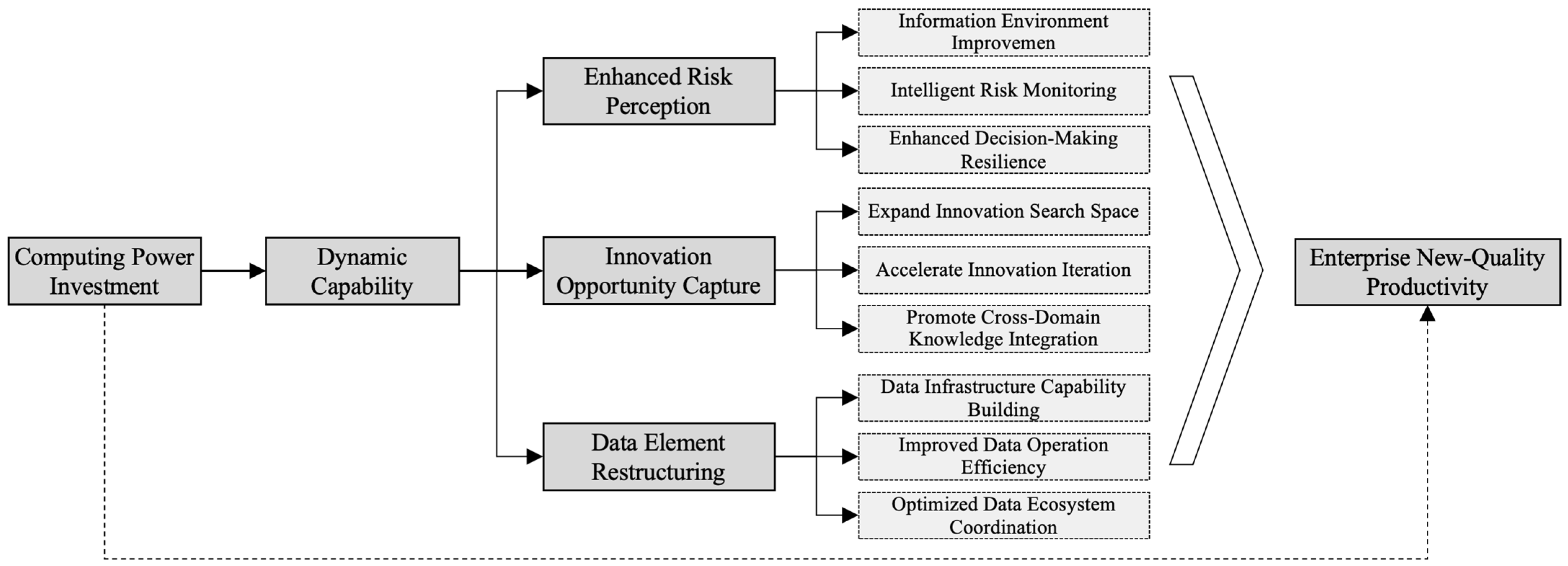
The underlying mechanism through which computing power investment enhances enterprise new quality productivity can be systematically interpreted through the lens of dynamic capability theory. Dynamic capabilities refer to a firm’s ability to sense opportunities and threats, seize opportunities, and reconfigure resources and competencies. This theory posits that firms integrate, build, and reorganize internal and external resources through three core processes—sensing, seizing, and reconfiguring—to adapt to rapidly changing environments [5]. In the context of the digital economy, computing power investment reshapes firms’ information-processing architectures and decision-making processes, thereby upgrading these three dimensions of dynamic capabilities. Accordingly, the mechanism can be analytically decomposed into the following three aspects (Figure 1).

2.3.1. Sensing Mechanism: From Information Processing to Opportunity and Risk Insight

In dynamic competitive environments where uncertainty and complexity have become the norm, enterprises face compounded and concealed risks. Traditional risk management models relying on historical experience and reactive responses struggle to address new risks arising from rapidly changing market conditions and technological iterations. According to dynamic capability theory, sensing capability forms the foundation for identifying opportunities and threats, with computing power serving as a crucial enabler for enhancing this capability.
Computing power investment transforms risk perception from passive response into proactive identification and mitigation of potential threats by empowering information processing and intelligent analysis. First, it significantly improves the corporate information environment. Robust computing support enables firms to establish comprehensive data collection, processing, and disclosure systems, integrating internal and external information in (near) real time and breaking down information silos. This enhances operational transparency and performance predictability, laying the informational foundation for risk identification [14]. Second, computing power enables intelligent risk monitoring. Through big data analytics and machine learning technologies, enterprises can construct dynamic risk monitoring systems that utilize pattern recognition and anomaly detection to achieve real-time surveillance and early warning of multidimensional risks—including market, technological, and compliance risks—thus shifting risk management from post hoc remediation to ex ante prevention. Finally, computing power empowers scenario analysis, stress testing, and simulation modeling, allowing enterprises to simulate extreme conditions in virtual environments and evaluate risk-return tradeoffs across different strategic options. This supports more robust and flexible strategic choices and enhances organizational adaptability and resilience in uncertain environments [15]. Thus, by improving the information environment, strengthening intelligent risk monitoring, and supporting resilient decision-making, computing power investment not only enhances firms’ ability to accurately sense and assess risks but also enables them to maintain strategic focus while flexibly adapting to uncertainty, thereby safeguarding the stable development of new quality productivity.
H2. 
Computing power investment enhances enterprise risk perception capability through improved information environments, intelligent risk monitoring, and enhanced decision-making resilience, thereby driving the improvement of new quality productivity.

2.3.2. Seizing Mechanism: Reshaping Innovation Paradigms

Innovation serves as the core driver of new quality productivity, with computing power fundamentally reshaping corporate R&D paradigms and innovation models. From a dynamic capability’s perspective, innovation opportunity seizing refers to an organization’s critical capacity to transform identified opportunities into tangible innovation outcomes [16]. However, traditional innovation models face significant constraints, including limited search scope, prohibitive trial-and-error costs, and knowledge integration barriers, which collectively inhibit substantial improvement in innovation capabilities. Computing power investment provides key technological support for overcoming these constraints and upgrading innovation opportunity-seizing capabilities.
The enabling effect of computing power on innovation opportunity seizing operates through three distinct dimensions. First, in the innovation search dimension, substantial computing capacity allows firms to process and analyze massive volumes of technological information and market data. Through machine learning and pattern recognition technologies, organizations can identify latent innovation opportunities, thereby expanding innovation search from localized exploration to global optimization. For example, firms can conduct comprehensive optimization based on large-scale datasets such as patent databases, scientific publications, and user behavior data, significantly broadening the scope and depth of innovation search.
Second, in the innovation experimentation dimension, computing power enables technologies such as digital twins and simulation modeling, allowing firms to conduct large-scale innovation trials in virtual environments. These technologies substantially reduce experimentation costs while accelerating innovation iteration cycles [17]. This computational advantage not only enables firms to address previously intractable complex system problems, thereby advancing the technological frontier of innovation, but more importantly, enhances the output efficiency per unit of R&D investment through accelerated iteration processes.
Third, in the knowledge integration dimension, computing power relaxes traditional computational bottlenecks in knowledge processing. Organizations can leverage artificial intelligence technologies to construct knowledge graphs and achieve deep integration of cross-disciplinary knowledge, consequently generating combinatorial innovations and disruptive breakthroughs [18]. Existing evidence suggests that computing power investment thus transforms innovation from experience-dependent models to new paradigms centered on data-driven analysis and intelligent computing [19]. This multi-level capability enhancement signifies a fundamental transition in corporate innovation paradigms—from traditional experience-based approaches to innovation driven by data analytics and computational intelligence—thereby establishing a solid foundation for developing new quality productivity.
H3. 
Computing power investment enhances firms’ innovation opportunity seizing capability by expanding innovation search scope, accelerating innovation iteration, and promoting cross-domain knowledge integration, thereby driving substantial improvement in new quality productivity.

2.3.3. Reconfiguration Mechanism: Unleashing Data Factor Value and Reshaping the Value Chain

In the digital economy era, data has become a key production factor, whose massive value realization requires substantial technical support. The core value of computing power investment lies in its ability to transform data from a cost burden into a value source. When enterprises possess sufficient computing resources, previously isolated data silos across business segments can be interconnected, fragmented information can be integrated, and static historical records can be dynamically analyzed, thereby achieving systematic reconfiguration of data factors.
Computing power investment enables intelligent reconfiguration of the enterprise value chain by activating data factors. First, computing power investment facilitates the construction of fundamental data capabilities. By deploying key technologies such as big data analytics and cloud computing, enterprises can elevate their data factor utilization levels, transforming dormant data resources into new production factors. This supports digital transformation and helps convert massive unstructured data into analyzable and utilizable digital assets, laying a solid foundation for data value realization [20].
Second, computing power investment enhances data-driven operational efficiency. Through in-depth mining of data assets, computing power supports enterprises in achieving the intelligent transformation of entire processes. From simulation in R&D design and flexible scheduling in production manufacturing to precise positioning in marketing, data insights permeate all value chain segments. This drives the transition from experience-based decision-making to data-driven decision-making, significantly reducing operational costs and improving resource utilization efficiency [21,22].
Furthermore, computing power investment optimizes data ecosystem collaboration. Enhanced information processing and transmission capabilities through computing power improve information transparency via data sharing. This reduces information asymmetry between enterprises and their upstream and downstream partners, investors, and other stakeholders, optimizing resource allocation efficiency both within and outside the enterprise and lowering transaction costs and financing constraints [22,23].
Through these three dimensions of data factor reconfiguration, enterprises not only achieve internal operational efficiency improvements but, more importantly, gain new data-based competitive advantages and develop novel production modes adapted to the digital economy era [24]. Because the ultimate manifestation of dynamic capabilities is the reconfiguration of the resource base, computing power enables enterprises to reintegrate resources around data and to form entirely new competitive advantages in production modes.
H4. 
Computing power investment achieves data factor reconfiguration through building data foundation capabilities, enhancing data operation efficiency, and optimizing data ecosystem collaboration, thereby driving the improvement of enterprise new quality productivity.

3. Methods

3.1. Data Source

This study utilizes a sample of A-share manufacturing listed companies from the Shanghai and Shenzhen stock exchanges spanning the period 2011–2022. The identification of corporate computing power investment is based on manually collected approval data for Internet Data Center (IDC) operating licenses, as published by the Ministry of Industry and Information Technology’s Telecommunication Service Market Comprehensive Management Information System. Within the sample period, 67 manufacturing listed companies obtained IDC operating licenses and are defined as the treatment group, while the remaining manufacturing listed companies serve as the control group.
To ensure sample quality and representativeness, we implement the following screening procedures: (1) exclude financial firms and companies with IPOs in the current year; (2) remove firms with abnormal operations or special treatment (ST/*ST) status; (3) drop observations with missing key variables; and (4) winsorize all continuous variables at the 1st and 99th percentiles to mitigate extreme value effects. The final sample comprises 2739 manufacturing listed companies over the period, yielding 20,418 firm-year observations. Corporate patent data are sourced from the Wind database, and all other data are obtained from the CSMAR database.

3.2. Identification Strategy

3.2.1. Baseline Regression

To test Hypothesis 1, we employ a staggered difference-in-differences (DID) approach that exploits the temporal variation in firms’ establishment of intelligent computing centers. Given that firms obtained IDC licenses and established computing facilities at different points in time between 2011 and 2022, the staggered DID design is appropriate for our quasi-experimental setting. We construct the following baseline specification:
NP i , t   =   α   +   β DID i , t   +   γ Control i , t   +   μ i   + λ t   +   ε i , t
where NP i , t represents the level of new quality productivity of firm i in year t . DID i , t is the core explanatory variable of interest, and its estimated coefficient β captures the impact of intelligent computing centers on firms’ new quality productivity. We expect β to be significantly positive. Control i , t denotes a set of control variables. μ i represents firm fixed effects, λ t denotes year fixed effects, and ε i , t is the idiosyncratic error term. All standard errors are clustered at the firm level.

3.2.2. Mechanism Testing

To test Hypotheses 2–4, we construct the following model with reference to Jiang (2022) [25]:
Med i , t   =   α   +   β DID i , t   +   δ Control i , t   + μ i   +   λ t   +   ε i , t
In the model, Med represents the mechanism variables, which capture three key capabilities. Risk perception capability is characterized by earnings forecast divergence, supply chain risk perception, default risk, and risk-taking level. Innovation seizure capability is characterized by patent knowledge breadth, exploratory innovation, innovation efficiency, AI application, and digital innovation. Data value reconfiguration capability is characterized by data element level, big data technology, cloud computing technology, digital transformation index, sales expense ratio, and financing constraints. All other settings remain consistent with Model (1).

3.2.3. Moderating Effect Test

To examine the Moderating Effect, the following model is constructed:
N P i , t   =   α   +   β DID i , t   +   δ 1 M od i , t   +   δ 2 M od i , t   ×   DID i , t   +   γ Control i , t   + μ i   +   λ t   +   ε i , t
In the model, Mod represents the moderating variable. The coefficients β and δ 2 are the primary focus of this study. If both β and δ 2 are significantly positive, it indicates that the moderating variable exerts a positive moderating effect on the relationship between intelligent computing centers and firms’ new quality productivity. Conversely, if β and δ 2 are significant but carry opposite signs, it suggests a negative moderating effect.

3.2.4. Test of Economic Consequences

To examine the economic consequences of enhanced computing power on firms’ new quality productivity, we construct the following model with reference to Wang Maobin et al. (2024) [26]:
Eco i , t   =   α 0   +   α 1 ( γ NP i , t )   +   α 2 Control i , t   +   μ i   +   λ t   +   ε i , t
Eco i , t represents the economic consequence measurement indicator. Variable γ N P (derived from the coefficient estimates in the baseline regression) captures the improvement in firms’ new quality productivity induced by computing power investment.

3.3. Variable Definitions and Descriptive Statistics

3.3.1. Dependent Variable

Enterprise New Quality Productivity Level (NP). Following the methodology of Song et al. (2024) and based on the two-factor theory of productivity [27], while considering the role and value of labor objects in the production process, the entropy method is adopted to measure new quality productivity. In robustness tests, the New Quality Productivity Database from CNRDS is used to measure enterprise new quality productivity (NPro).

3.3.2. Core Explanatory Variable

Establishment of Intelligent Computing Centers (DID). This study uses the construction of enterprise intelligent computing centers as the core explanatory variable and operationalizes firms’ computing-power investment through the acquisition of an Internet Data Center (IDC) operating license. Under China’s regulatory framework, firms are permitted to build and operate large-scale computing infrastructure only after meeting specific facility requirements and technical standards. Consequently, the issuance of an IDC license serves as a clear and objective time-stamped event that signals the initiation of substantive investment in computing infrastructure.
To make this treatment observable at the level of publicly listed firms, we further match licensed entities to listed companies via equity ownership chains. Following the long-term equity investment method, we adopt the commonly used 20% ownership threshold, requiring each tier in the chain to hold at least 20%. According to IAS 28 and China’s Accounting Standards for Business Enterprises No. 2, this threshold typically indicates “significant influence,” thereby allowing us to identify listed firms that have effective control over the relevant computing resources. This procedure is consistent with the approach in Xu et al. (2025) [14].
Based on this linkage, we construct the variable D I D i , t as follows: if a listed firm itself or any entity within its ownership chain obtains an IDC operating license in year t, then D I D i , t is coded as 1 from year t onward and 0 otherwise. The variable relies on the official issuance date recorded in regulatory filings, ensuring precise timing and benefiting from the exogeneity introduced by the rigorous approval process. It should be noted, however, that this measure does not capture heterogeneity in investment scale; we address this limitation through a series of robustness checks in Section 4.3.

3.3.3. Control Variables

Drawing on existing research [1,14], the following control variables are selected: Enterprise Characteristics: Includes listing age (ListAge) and firm size (Size); Financial Condition: Considers financial leverage (Lev), profitability (ROE), and solvency (Liquid); Governance Structure: Incorporates governance level (Board), asset structure (Tangible), and capital intensity (Cap); Market Performance: Includes market valuation (TobinQ) and operational efficiency (ATO).
Table 1 reports the descriptive statistics of the main variables. The mean of the dependent variable, new quality productivity, is 5.042, with the median close to the mean, indicating an approximately normal distribution. However, its standard deviation of 2.092 reflects significant variation across firms. The means and fluctuations of the control variables all fall within reasonable ranges, with no anomalies observed. Overall, the data align well with real-world conditions.
To assess potential multicollinearity, we calculated the Variance Inflation Factors (VIFs) for all variables included in our baseline specification. The mean VIF was 1.31, and all individual VIFs were below 2, remaining well under the conventional concern threshold of 10. This indicates that multicollinearity does not pose a significant threat to our estimation results.

4. Results

4.1. Baseline Regression

Table 2 reports the baseline regression results. Column (1) presents the results without control variables, while Column (2) further incorporates firm-level control variables while controlling for year and firm fixed effects. The results show that the regression coefficient for the Intelligent Computing Center (DID) is significantly positive at least at the 5% level, indicating that intelligent computing centers significantly enhance the level of enterprise new quality productivity.
In terms of economic significance, when an enterprise establishes an intelligent computing center (i.e., DID changes from 0 to 1), new quality productivity increases by an average of 0.6018 units. Given that the mean value of new quality productivity during the sample period is 5.042, this improvement accounts for approximately 11.9% of the mean value, demonstrating considerable economic significance. These findings validate Hypothesis 1, confirming that investments in intelligent computing centers effectively drive the development of enterprise new quality productivity.

4.2. Validity Tests of the Estimates

4.2.1. Parallel Trends Test

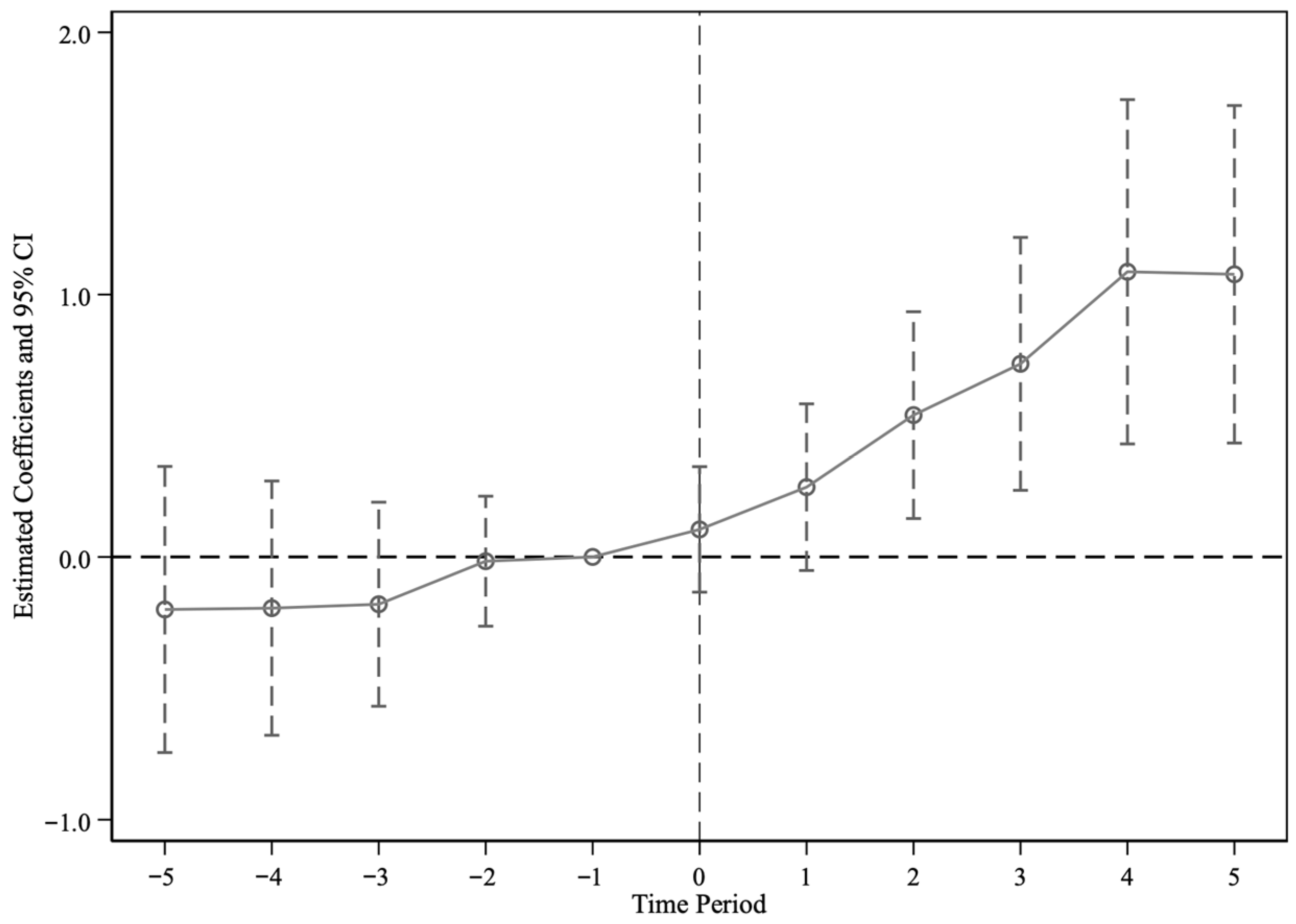
The validity of the difference-in-differences (DID) approach relies on the fulfillment of the parallel trends assumption, which requires that the treatment and control group firms exhibit similar trends in new quality productivity before the establishment of intelligent computing centers. To test this assumption, we employ an event study methodology and construct a test model, using the period immediately preceding the establishment of the intelligent computing center as the baseline. By estimating the dynamic treatment effects in the periods before and after the establishment, we examine whether the parallel trends assumption holds. If the assumption is satisfied, the estimated coefficients for the periods prior to the establishment should be statistically indistinguishable from zero.
Figure 2 presents the test results. As shown, the estimated coefficients for the periods before the establishment of the intelligent computing center fluctuate slightly around zero, with 95% confidence intervals encompassing zero and not reaching statistical significance. This indicates that there were no significant differences in the development trajectories of new quality productivity between the treatment and control groups before the establishment of the intelligent computing center, and the parallel trends assumption is generally satisfied. These results demonstrate the relative effectiveness of the DID specification in this study and support the robustness of the baseline conclusions.

4.2.2. Estimation Bias Diagnostics

Given the heterogeneity in the timing of intelligent computing center establishment, traditional Two-Way Fixed Effects (TWFE) estimators may suffer from bias due to heterogeneous treatment effects [28,29]. To address potential estimation bias, this study conducts further diagnostic tests. First, Bacon decomposition is employed to analyze the weight contributions of different comparison groups to the overall estimate. Results show that the most reliable “treated vs. never-treated” group accounts for 98.5% of the weight, while the most problematic “late-treated vs. early-treated” group contributes only 0.5%, indicating limited bias. Second, the bidirectional fixed effects weight decomposition method proposed by de Chaisemartin and D’Haultfœuille (2020) is applied to examine negative weight issues [29]. The results reveal that 88.1% of the 295 average treatment effects receive positive weights, with the sum of negative weights accounting for merely 0.32%, further confirming the robustness of our identification strategy.

4.2.3. Robust Estimation with Heterogeneous Treatment Effects

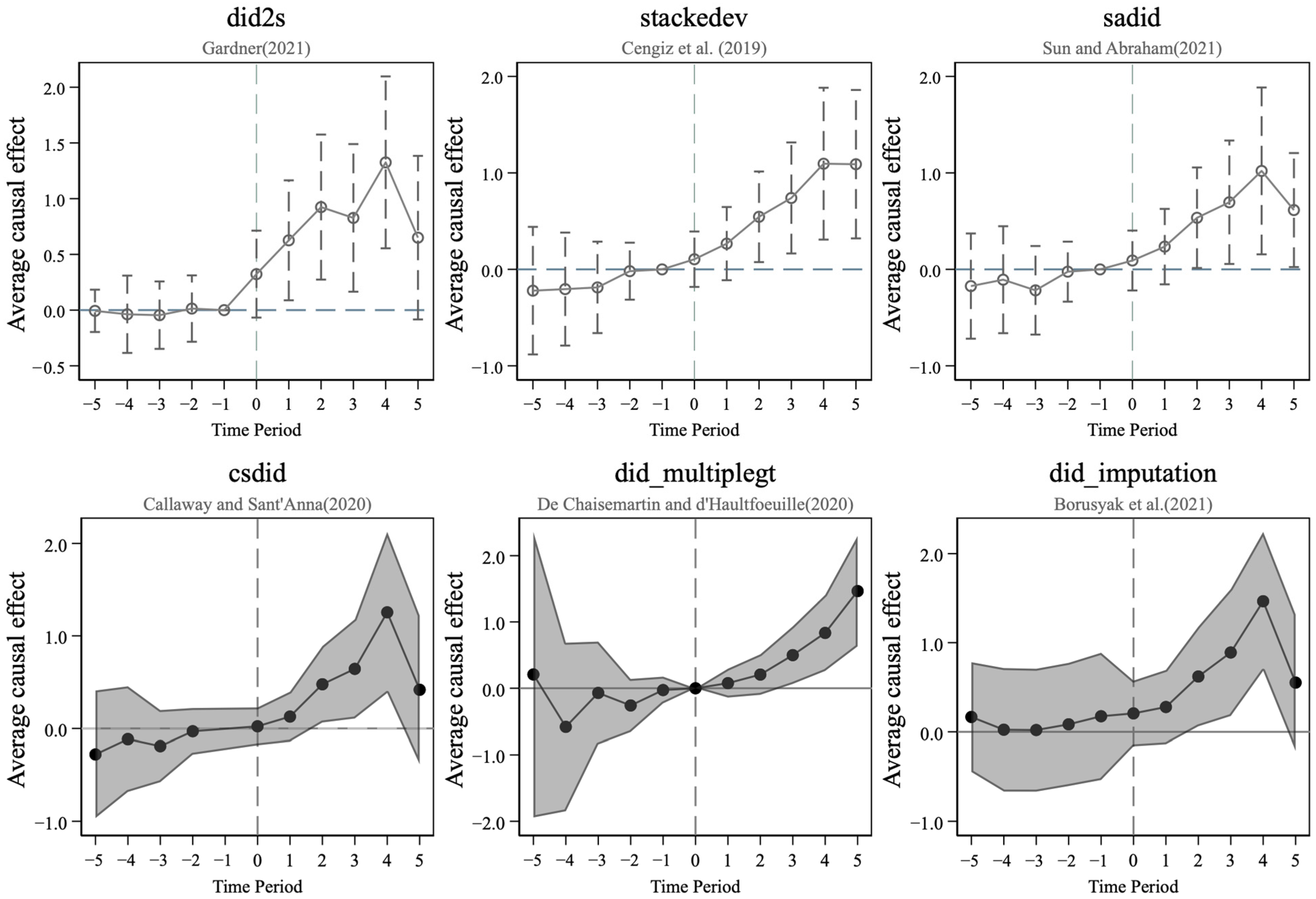
To further ensure the reliability of the estimated impact of intelligent computing centers on enterprise new quality productivity, this study employs multiple robust estimation methods accounting for heterogeneous treatment effects. These include: the two-stage estimator proposed by Gardner (2021) [30], which separates fixed effects and treatment effects to eliminate negative weights; the stacked estimator by Cengiz et al. (2019) [31], which decomposes staggered designs into multiple clean subsamples for stacked estimation; the cohort-period interaction estimator by Sun and Abraham (2021) [32], which avoids bias and provides unbiased estimates; the inverse probability weighting estimator by Callaway and Sant’Anna (2021) [33], used to estimate average treatment effects for different cohorts; the reweighting estimator by de Chaisemartin and D’Haultfœuille (2020) [29], applied to eliminate negative weight issues; and the imputation estimator by Borusyak et al. (2021) [34], which constructs counterfactual outcomes based on untreated observations.
Figure 3 reports the results of the six robust estimation methods. Regardless of the method used, the coefficients for periods before the establishment of intelligent computing centers fluctuate around zero and remain statistically insignificant, further confirming the validity of the parallel trend’s assumption. After establishment, the dynamic effects consistently show that intelligent computing centers significantly enhance enterprise new quality productivity, with evident time-varying characteristics: the initial effect is relatively moderate, gradually strengthens, peaks in periods 2–4, and slightly converges thereafter while remaining significantly positive overall. This trajectory aligns with the practical logic of how intelligent computing centers empower enterprise productivity development. The high consistency in effect direction, significance, and dynamic evolution patterns across methods demonstrates the robustness of our identification strategy.

4.2.4. Sensitivity Analysis of Parallel Trends

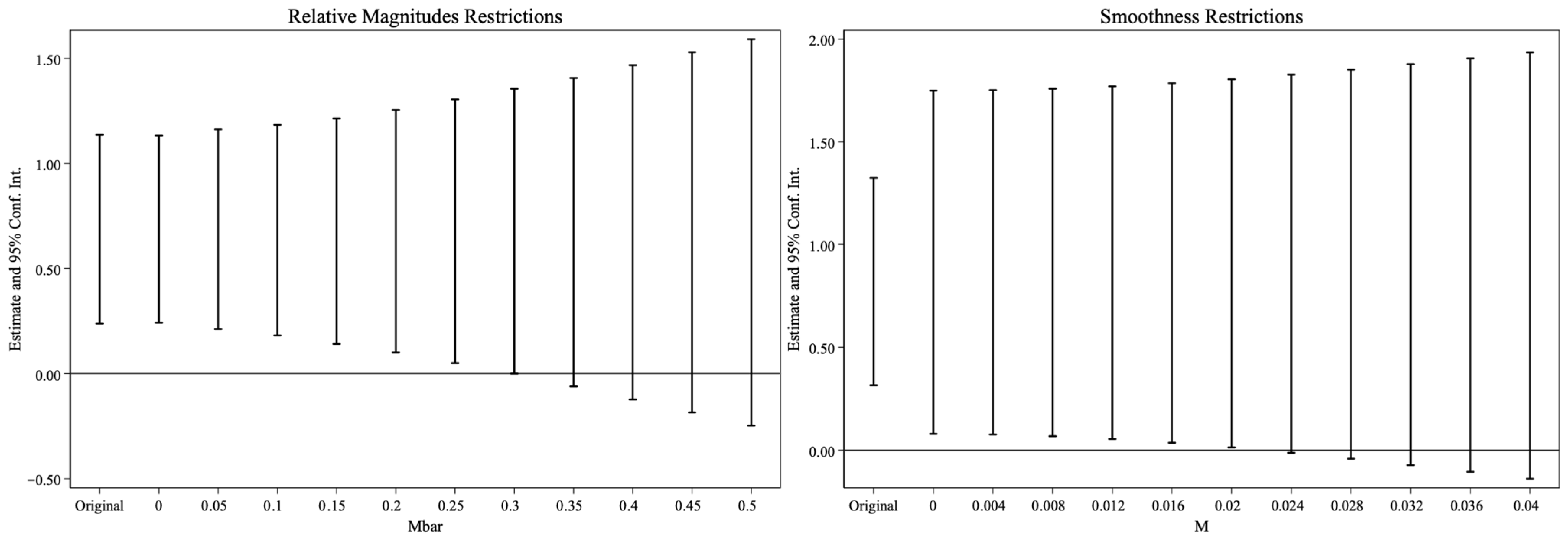
Considering recent research highlighting the limitations of relying solely on pre-treatment trend tests in traditional difference-in-differences (DID) methods to provide sufficient evidence for the parallel trends assumption [35], this study further employs the Honest DID approach proposed by Rambachan and Roth (2022) to conduct sensitivity analysis [36]. This method evaluates the robustness of research findings under moderate violations of the parallel trends assumption by setting reasonable bounds on the degree of deviation from parallel trends and constructing robust confidence intervals under different violation scenarios, thereby providing more conservative and reliable statistical foundations for causal inference.
Specifically, this study considers two settings (Figure 4): First, under the relative deviation constraint, which assumes that the post-establishment trend deviation is bounded by a multiple of the pre-establishment deviation, results show that when this multiple does not exceed 0.3, the positive effect of intelligent computing centers on enterprise new quality productivity remains statistically significant at the 5% level. Second, under the smoothness constraint, which sets an absolute deviation bound based on the standard deviation of pre-establishment residuals, results indicate that when the deviation is controlled within 0.02 standard deviations, the treatment effect remains robust. In summary, the sensitivity analysis results demonstrate that the core findings of this study exhibit strong robustness to moderate violations of the parallel trends assumption.

4.2.5. Placebo Tests

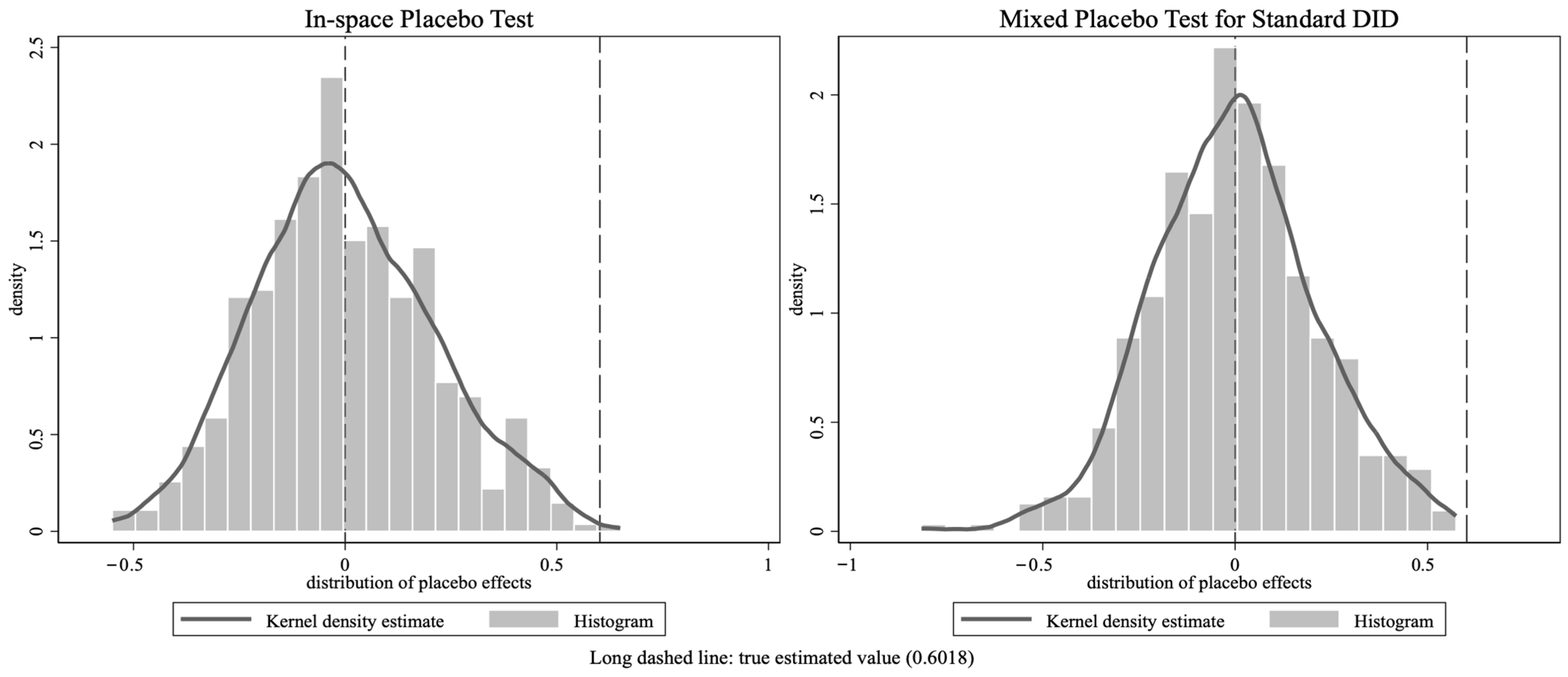
This study further conducts placebo tests to verify whether the policy effect indeed originates from the establishment of intelligent computing centers. Figure 5 reports the results of spatial placebo and mixed placebo tests. When the establishment status of intelligent computing centers is randomly assigned to firms in different regions with 1000 replications, the distribution of placebo effects generally follows a normal distribution centered around zero, while the actual estimated treatment effect falls significantly in the far-right tail of the distribution. Furthermore, when both spatial and temporal dimensions are randomized to construct a more stringent control benchmark, the actual treatment effect still resides in the extreme right tail of the placebo distribution, with an occurrence probability approaching zero. The test results consistently indicate that the promoting effect of intelligent computing center establishment on enterprise new quality productivity is not driven by random factors or confounding variables such as regional characteristics, confirming the robustness of the core conclusions.

4.3. Addressing Endogeneity Concerns

4.3.1. Instrumental Variable Analysis

To mitigate potential endogeneity issues, this study employs an instrumental variable (IV) approach and constructs two instruments: (1) the interaction between the number of post offices per million people in a firm’s city and the timing of intelligent computing center establishment. The distribution of post offices, influenced by historical courier route density and other factors, was largely fixed before 2010, making it unrelated to contemporary digital demands. It affects intelligent computing center location selection only through path dependence, without directly influencing firm innovation. (2) Following Xu et al. (2025) [14], the proportion of other firms in the same industry that established intelligent computing centers lagged by one period. Due to peer effects, decisions of industry peers may influence a firm’s own establishment decision through information diffusion and competitive pressure, without directly affecting its new quality productivity.
The two-stage least squares (2SLS) estimation results show that the first-stage F-statistics for both instruments exceed 10, rejecting the weak instrument hypothesis (Table 3). The second-stage results indicate that, after controlling for endogeneity, the promoting effect of intelligent computing center establishment on firms’ new quality productivity remains significant and robust.

4.3.2. PSM-DID and Entropy Balancing

To further address potential selection bias, this study employs Propensity Score Matching Difference-in-Differences (PSM-DID) and entropy balancing. Given the limited number of manufacturing firms that established intelligent computing centers, 1:5 nearest neighbor matching is used. Kernel matching and entropy balancing are also applied to construct counterfactual control groups, ensuring robust results. Table 4 reports the post-matching estimation results, showing that the promoting effect remains significant after controlling for observable characteristic differences.

4.3.3. Double Machine Learning

This study further applies the Double Machine Learning (DML) method to verify the credibility of the causal relationship. This approach combines regularization techniques and multiple machine learning algorithms to automatically select effective control variable combinations [37]. Following Sun Chuanwang et al. (2024) [38], a partially linear model is adopted with a sample splitting ratio of 1:4. Lasso regression, ridge regression, elastic net, and stacked DML algorithms are used for estimation. The results in Table 5 again support the baseline conclusion.

4.4. Additional Robustness Tests

4.4.1. Omitted Variables Test

To rule out potential omitted variable bias, the Oster (2019) method was employed to assess the influence of unobserved variables [39]. The underlying logic of this approach is that if significant omitted variables are influencing the regression results, the treatment effect coefficient and model goodness-of-fit should exhibit systematic changes as control variables are progressively introduced. The Oster method uses the parameter δ to measure the influence of omitted variables relative to observed variables, and R_max represents the maximum R2 when all variables are included.
The test results indicate that: First, under the assumptions of δ = 1 and R _ m a x = 1.3 times the current R2, the adjusted treatment effect is 0.5119 and falls within the confidence interval [0.1611, 1.0424]. This suggests that even if omitted variables as important as the observed variables exist, the promoting effect of intelligent computing centers remains valid. Second, the critical δ value that would drive the treatment effect to zero is 6.634, meaning that omitted variables would need to be 6.63 times more influential than the observed variables to completely offset the effect of intelligent computing centers—a scenario highly unlikely. The Oster test results further confirm the robustness of the baseline regression and rule out substantial bias from omitted variables.

4.4.2. Exclusion of Other Policy Interferences

The establishment of intelligent computing centers often coincides with the implementation of other digitalization-related policies, creating potential policy mix effects. To isolate the effect of intelligent computing centers from other policy interferences, this study controlled for concurrent policies that might affect enterprise new quality productivity, including government digital governance pilots, smart city pilots, sci-tech finance city pilots, cross-border e-commerce pilots, and green credit pilot policies.
Table 6 reports the estimation results after excluding other policy interferences. The results show that after separately controlling for each of the policies, the conclusions remain statistically significant, confirming the robust promoting effect of intelligent computing centers on enterprise new quality productivity.

4.4.3. Alternative Robustness Tests

This study also conducted the following robustness tests: (1) Re-estimated the model using the New Quality Productivity Database (NPro) from CNRDS as an alternative measure for the core dependent variable; (2) Following the approach of Xu et al. (2025) [14], excluded cloud service provider samples; (3) Incorporated industry-year and province-year interaction terms into the model to control for more granular time-varying heterogeneity; (4) Applied two-way clustering at the firm and year levels to address cross-sectional and temporal correlation issues. The results presented in Table 7 demonstrate that the core findings remain robust across all these alternative specifications.

5. Mechanism Tests and Heterogeneity Analysis

5.1. Mechanism Tests

5.1.1. Risk Perception Enhancement Mechanism

The computing power-driven risk perception enhancement mechanism reflects environmental adaptation capability. As proposed earlier, computing power enhances firms’ environmental adaptability by strengthening their perception of uncertainty, enabling real-time monitoring, intelligent early warning, and flexible adjustment to cope with complex and changing environments. This manifests as computing power’s ability to improve the information environment, accurately identify risks, and enhance risk management capabilities, thereby strengthening new quality productivity. To verify this mechanism, this study uses three dimensions to proxy for firms’ environmental adaptation capability: information environment improvement, risk identification accuracy, and risk management capability enhancement.
For information environment improvement, we use one-period-lagged analyst earnings forecast divergence, scaled by the beginning-of-period stock price, as a proxy [40]. Reduced earnings forecast divergence reflects improved corporate information transparency and enhanced market consensus. For risk identification accuracy, we quantify firms’ ability to identify potential supply chain threats through the co-occurrence frequency of supply chain-related vocabulary and risk vocabulary in annual report texts [41]. Additionally, we use distance to default to measure firms’ default risk prevention capability [42]. For risk management capability enhancement, we use the volatility of firm ROA to characterize risk-taking level, measured by the standard deviation and range over a 5-year window [43]. A moderate increase in risk-taking level reflects rational risk-taking capability based on full risk identification and assessment.
Table 8 reports the relevant test results. The results show that intelligent computing centers significantly reduce analyst earnings forecast divergence, supply chain perceived risk, and corporate default risk, while significantly increasing corporate risk-taking level. This indicates that computing power investment enhances firms’ risk perception capability: reducing market cognitive bias through improved information transparency, lowering risk exposure through accurate identification of potential threats, and enabling active exploration within controllable ranges through enhanced risk management capability. For example, a consumer goods firm can leverage its computing power to run real-time sentiment analysis models on massive social media datasets, enabling it to ‘sense’ potential supply chain disruptions or sudden shifts in consumer preferences weeks in advance, a feat impossible with traditional market research. Thus, firms develop a “smart radar”-like perception system that can discover environmental changes, scientifically assess risk opportunities, and flexibly adjust strategic positioning, providing important safeguards for the steady improvement of new quality productivity, thereby validating Hypothesis 2.

5.1.2. Innovation Opportunity Seizure Mechanism

The computing power-driven innovation opportunity seizure mechanism represents future-oriented value creation capability. Based on previous analysis, computing power reconstructs corporate R&D paradigms, shifting innovation from traditional experience-driven approaches to data-driven, intelligent computing-centered models. This manifests as computing power’s ability to expand innovation search space, accelerate innovation iteration and verification, and promote cross-domain knowledge integration, thereby driving leaps in new quality productivity. To verify this mechanism, this study uses three dimensions to proxy for firms’ innovation opportunity seizure capability: innovation search expansion, innovation iteration acceleration, and knowledge integration deepening.
In terms of innovation search expansion, two indicators are employed for measurement: patent knowledge breadth and exploratory innovation. Patent knowledge breadth is calculated at the International Patent Classification (IPC) subclass level for individual patents and aggregated to the firm level using the median method [44]. Exploratory innovation is identified based on IPC codes and a five-year rolling window to distinguish between exploratory and exploitative innovation, with the proportion of exploratory innovation among invention patents further calculated [45]. Regarding innovation iteration acceleration, an innovation efficiency indicator is constructed and measured as the ratio of granted invention patents to R&D investment, which captures the output efficiency per unit of innovation resources and reflects the compressive effect of computing power on R&D cycles [46]. For knowledge integration deepening, two indicators are selected: artificial intelligence application and digital innovation. Artificial intelligence application is measured by the number of AI-related invention patents granted in the current year [47], while the level of digital innovation is measured by the logarithm of the total word frequency related to digital innovation [48].
Table 9 reports the test results. The results show that intelligent computing centers significantly enhance patent knowledge breadth, exploratory innovation, innovation efficiency, AI application, and digital innovation level. This indicates that computing power investment not only expands firms’ innovation search space, thereby increasing the breadth and depth of innovation, but also improves innovation efficiency through accelerated iteration, and promotes innovation paradigm shift through knowledge integration. Practically, this means a biopharmaceutical firm can use its computing power to run thousands of complex molecular simulations (digital twins) in parallel to ‘seize’ new drug discovery opportunities, drastically accelerating the R&D iteration cycle from years to months. Consequently, firms are no longer limited to incremental improvements but can address complex system problems and achieve disruptive technological breakthroughs, forming a true “intelligent brain” that becomes a key mechanism driving leaps in new quality productivity, thereby validating Hypothesis 3.

5.1.3. Data Factor Reconfiguration Mechanism

The computing power-driven data factor reconfiguration mechanism represents data value realization capability. As proposed earlier, computing power reconstructs corporate production modes by activating data factors, releasing data factor value through data empowerment, intelligent application, and collaborative optimization. This manifests as computing power’s ability to build data foundation capabilities, improve operational efficiency, and optimize ecosystem collaboration, thereby driving new quality productivity. To verify this mechanism, this study uses three dimensions to proxy for firms’ digital transformation capability: data foundation capability construction, data operation efficiency improvement, and data ecosystem collaborative optimization.
In terms of data infrastructure capability construction, the level of enterprise data elements is characterized by the word frequency statistics of six keywords: data elements, big data, computing power, information, digitization, and algorithms, which measure the degree of enterprise data resource accumulation [49]. Enterprise data processing capability is depicted by counting the disclosure frequency of indicators related to cloud computing technology, big data technology, and their applications in annual reports [50]. An enterprise digital transformation dictionary is constructed, and the enterprise digital transformation index is measured using the TF-IDF method [51]. Regarding data operational efficiency improvement, the selling expense ratio is employed as a reverse indicator, with its decline reflecting the effects of precision marketing, customer insights, and channel optimization brought about by data intelligence applications. For data ecosystem collaborative optimization, the degree of financing constraints (SA) is used to measure information friction in enterprises’ external resource acquisition, with the alleviation of financing constraints indicating that computing power has enhanced information transparency and resource allocation efficiency between enterprises and external stakeholders.
Table 10 reports the relevant test results. The results show that intelligent computing centers significantly enhance the data element level, big data technology application, cloud computing technology level, and degree of digital transformation, while significantly reducing the selling expense ratio and financing constraint level. This indicates that computing power investment drives the reconstruction of enterprise data elements: by constructing a comprehensive data infrastructure to form the technological foundation for digital transformation, by implementing data intelligence applications to achieve cost reduction and efficiency improvement in operational processes, and by enhancing information transparency to optimize collaborative relationships with external ecosystems. A concrete example is a manufacturing firm using its centralized computing resources (IDC) to ‘reconfigure’ its value chain by integrating real-time sales data, production line sensors, and logistics information. This data integration enables a fully automated ‘just-in-time’ (JIT) inventory and production system, minimizing waste and maximizing efficiency. Enterprises thereby establish a new production system centered on data, forming a “data engine” capable of continuously mining data value, optimizing resource allocation, and innovating business models, which provides crucial impetus for the leap in new quality productivity, thus validating Hypothesis 4.
Taken together, the mechanism tests provide strong empirical support for our theoretical framework. The three pathways we identify—risk perception enhancement, innovation opportunity seizure, and data factor reconfiguration—map directly onto the sensing–seizing–reconfiguring triad in dynamic capability theory. Computing power investment does not simply increase the quantity of digital inputs; it restructures how firms collect, process, and act upon information. In digitally mediated commerce environments, this means that firms with access to intelligent computing centers can more accurately sense demand fluctuations and operational risks, more effectively seize innovation opportunities such as new digital services or data-driven business models, and more efficiently reconfigure data resources across channels and partners. In this sense, computing power becomes a foundational enabler of the dynamic capabilities required for sustainable new quality productivity in e-commerce and other technology-intensive business contexts.

5.2. The Efficiency of Computing Power Empowerment: The Moderating Effects of Executive Cognition and Market Competition

As an important digital infrastructure for enterprises, intelligent computing centers may be constrained by internal and external contextual factors. The following examines how executive cognition and market competition dimensions affect the empowerment efficiency of computing power investment.

5.2.1. Executive Digital Cognition

According to the upper echelons theory, executives’ cognitive structures and personal traits are key drivers of corporate strategy and performance. In the digital era, the IT background of the executive team not only reflects their professional expertise but also their understanding and cognitive depth of the strategic value of digital technologies. Executives with IT backgrounds typically possess stronger technological foresight, enabling them to promote the deep integration of computing power investment with corporate strategy. Through optimizing resource allocation, promoting cross-departmental collaboration, and fostering a data-driven culture, they enhance the firm’s ability to absorb and transform emerging technologies. To test this logic, we examine the moderating effects of the CEO’s, chairmen’s, and executive team’s IT backgrounds on the effect of intelligent computing centers [52]. As shown in columns (1) to (4) of Table 11, the interaction terms between DID and CEO IT background (Ceo_IT), chairman IT background (Cman_IT), proportion of executives with IT education background (DIT_ratio), and proportion of executives with IT work background (IT_ratio) are all significantly positive. This indicates that the digital cognition of the executive team is an important internal governance mechanism for unlocking the value potential of intelligent computing centers. Management with IT backgrounds acts as “digital navigators,” enabling more precise direction of computing power investments and fully releasing the technological potential of intelligent computing centers.

5.2.2. Market Competition Environment

The efficiency of corporate strategic investment decisions is also deeply influenced by the external market environment. Intense competition, as an external governance mechanism, creates a “disciplinary effect” on management, forcing firms to improve resource allocation efficiency for survival and development. Under high-intensity competition, firms have stronger incentives to use advanced technologies like intelligent computing centers to optimize production processes, accelerate product iteration, and enhance market responsiveness. In contrast, firms in monopolistic positions, due to insufficient external pressure, are prone to organizational inertia and managerial slack; even if equipped with advanced computing resources, they struggle to effectively translate them into competitive advantages. Accordingly, this paper uses the inverse of the Herfindahl-Hirschman Index (HHI) to measure industry competition intensity and tests its interaction effect. Column (5) of Table 11 shows that the interaction term between DID and HHI is significantly negative at the 5% level, indicating that as industry monopoly increases (competition decreases), the promoting effect of intelligent computing centers on new quality productivity is significantly weakened. This result verifies that market competition is an important external catalyst for transforming computing power investment into core corporate competitiveness.
These moderating effects have important implications for digital business and platform-based competition. In highly competitive e-commerce markets, computing power investment becomes a key lever for sustaining differentiation through superior analytics, personalization, and operational responsiveness. However, its effectiveness critically depends on whether top managers possess sufficient digital cognition to recognize and act upon the strategic value of computing power. Firms and platform complementors whose executives lack such digital vision may underinvest in computing power or treat it as a routine IT expense, thereby failing to translate it into sensing–seizing–reconfiguring capabilities. By contrast, digitally savvy leadership teams are more likely to design complementary changes in organizational structure, data governance, and algorithm development, allowing computing power to fully support value creation in online marketplaces and platform ecosystems.

5.3. Conditional Dependence of Computing Power Empowerment: Industrial Attributes, Organizational Capabilities, and Regional Strategy

5.3.1. Industrial Attributes

As a general-purpose technology, the application effectiveness of computing power highly depends on its fit with the core business processes of specific industries, i.e., “technology-organization fit.” When an industry possesses stronger digital genes, its data-intensive or knowledge-intensive characteristics not only provide rich scenarios for computing power application but also constitute key complementary assets, thereby significantly enhancing the value of computing power investment. For example, R&D design in high-tech industries and intelligent scheduling and supply chain optimization in non-heavy pollution advanced manufacturing are typical areas where computing power can fully exert its effects. In contrast, traditional industries like heavy pollution often exhibit lower fit due to strong asset specificity and difficulty in process transformation. To verify this, we conduct grouped tests based on whether firms belong to heavy pollution industries or high-tech industries. Columns (1) to (4) of Table 12 show that the positive effect of intelligent computing centers is significantly positive only in non-heavy pollution and high-tech enterprise samples, but not significant in heavy pollution and non-high-tech enterprise samples. Further between-group coefficient difference tests (Bdiff) confirm that these differences are statistically significant. This indicates significant industrial selectivity in computing power empowerment, with its value more easily released in industries with inherent digital advantages and higher fit.

5.3.2. Organizational Capabilities

The ability of firms to effectively transform externally acquired new technologies or knowledge into competitive advantages crucially depends on their capacity to identify, digest, integrate, and apply new knowledge. As a complex technological resource, for computing power to truly release value, firms must bridge the gap from “acquisition” to “effective use.” Firms with high absorption capacity typically possess well-established knowledge management systems, an open learning culture, and strong technological integration capabilities, enabling them to more quickly align the potential of computing power with their own business pain points, explore innovative applications, and thus build a bridge connecting external technology with internal performance. Also, we measure corporate absorption capacity as the ratio of R&D expenditure to operating revenue and conduct grouped tests [53]. Columns (5) to (6) of Table 12 show that the promoting effect of intelligent computing centers on new quality productivity is significantly positive only in the high absorption capacity group, but not significant in the low absorption capacity group. This indicates that firms’ learning and transformation capabilities are important factors in releasing the potential of computing power investment.

5.3.3. Regional Strategy and Digital Endowment

Guided by the national “East Data, West Computing” strategy, computing power infrastructure construction exhibits differentiated characteristics across regions. Eastern regions, with their well-developed digital infrastructure, dense talent pools, and mature industrial ecosystems, can rapidly transform computing power investment into actual productivity. Although central and western regions are accelerating computing hub construction with policy support, supporting facilities and application scenarios are still under development. Additionally, firms’ existing digital foundation may affect their ability to absorb and utilize computing resources. Firms with higher digitalization levels possess stronger computing power integration capabilities, while those with weak digital foundations may face capability bottlenecks. To examine these differences, we analyze them from two dimensions: regional distribution and digital endowment. Digital endowment is measured from three aspects: digital information infrastructure, digital integration infrastructure, and digital innovation infrastructure, based on which group tests are conducted accordingly [54].
Table 13 reports the relevant results. From the regional dimension, intelligent computing centers have a significant enhancing effect on new quality productivity for firms in eastern regions. Although the coefficient for central regions is slightly larger, it is statistically insignificant, while the coefficient for western regions is negative and insignificant. This difference confirms the ecological dependence of computing power value release. The complete industrial support, rich application scenarios, and mature market mechanisms in eastern regions provide fertile ground for computing power empowerment. Although computing infrastructure in central regions is rapidly developing, deep integration with industries requires time to cultivate. Western regions, as national computing power supply bases, primarily serve the computing demands of eastern regions, with limited direct benefits for local firms.
From the digital endowment dimension, intelligent computing centers significantly promote firms with higher digital endowment levels but have no significant effect on firms with lower digital endowment levels. This indicates that firms need a certain digital foundation to effectively absorb and transform computing resources. Highly digitalized firms, with their data accumulation, technical talent, and application experience, can quickly integrate computing power into business processes to achieve synergistic effects. In contrast, firms with weak digital foundations may struggle to fully utilize computing power value even with support, due to a lack of complementary capabilities. Computing power investment is not a “one-click upgrade” panacea but needs to be coordinated with the firm’s overall digital transformation strategy.
From a broader perspective, the heterogeneous patterns documented in this section further contextualize the role of computing power in the digital economy. The stronger effects observed in digitally intensive industries, firms with higher organizational capabilities, and regions with better digital endowment suggest that computing power investment yields the greatest returns where data flows are rich, business processes are highly codified, and platform-based interactions are prevalent. This is precisely the case in many e-commerce and online platform settings, where value creation depends on processing large-scale user, transaction, and logistics data in real time. Our findings, therefore, imply that computing power is not a uniformly effective input, but a context-dependent enabler whose productivity-enhancing potential is amplified in digital commerce ecosystems and may remain dormant in less digitally developed environments.

6. Extended Analysis

6.1. Empowering the Real Economy: Labor Productivity and Human Capital Structure

The most immediate economic consequence of computing power investment manifests in its restructuring of corporate value creation models. By optimizing production processes, empowering R&D innovation, and enhancing management efficiency, computing power directly drives improvements in corporate labor productivity. We measure labor productivity as the logarithm of output per employee, following the established approach in productivity research [55]. As shown in Column (1) of Table 14, the coefficient of intelligent computing center construction (γNP) on labor productivity is 0.0197 and significant at the 5% level, providing direct evidence of computing power’s tangible economic benefits.
Beyond mere productivity numbers lies a profound transformation of human capital, the core production factor. Skill-biased technological change theory predicts that technological progress widens demand disparities between high- and low-skilled labor [56], and computing power investment accelerates this divergence. While algorithms and automation systems replace standardized, procedural jobs, the value of creative and analytical work becomes increasingly prominent, driving up demand for high-skilled talent. Drawing on established human capital measurement frameworks, we examine changes from both occupational and educational perspectives [57]. Columns (2) and (3) of Table 14 show that intelligent computing center construction (γNP) significantly increases the proportion of technical personnel and employees with bachelor’s degrees or higher. This indicates that the formation of new quality productivity is not only the result of technological upgrading but also reciprocally promotes the optimal allocation of human capital. From a broader perspective, this micro-level talent restructuring is reshaping the skill distribution across labor markets, becoming a crucial driver in the evolution of employment patterns in the digital economy era. For digital-intensive enterprises and online retailers, these patterns indicate that computing power investment not only raises labor productivity in a narrow sense, but also facilitates the reallocation of human capital toward data analytics, algorithm development, and digital operations, which are central to competing effectively in contemporary e-commerce environments.

6.2. Impact on Capital Market Communication: Strategic Hiding of Information Disclosure

Computing power investment presents two competing expectations for corporate information disclosure behavior. Information processing theory suggests that computing power enhances data governance capabilities and should improve disclosure quality, whereas proprietary cost theory proposes the opposite—that management has incentives to reduce disclosure levels when transparency might harm competitive position [58]. In the digital economy context, the latter logic is particularly salient: core computing-powered capabilities like predictive models and optimized pricing algorithms constitute algorithmic black boxes difficult to patent but easily reverse-engineered through operational data. Simultaneously, the “winner-takes-all” nature of digital markets amplifies potential losses from information leakage [59]. Consequently, firms possessing intelligent computing centers may tend to adopt more cautious disclosure strategies.
The result in Column (4) of Table 14 supports the proprietary cost inference: intelligent computing center construction significantly reduces corporate information disclosure quality. This finding reveals strategic information hiding behavior after firms gain new competitive advantages. Excessively transparent disclosure may expose the operational logic of strategic assets, weakening first-mover advantages. Thus, rational management weighs the costs and benefits of disclosure, selectively controlling granularity to protect core business secrets while meeting regulatory requirements. This demonstrates that computing power not only transforms how firms create value but also reshapes their informational dynamics with external stakeholders, providing new empirical evidence for understanding disclosure behavior in the digital age. For platform operators and technology-driven firms, this highlights a subtle trade-off: while computing power can support richer data analytics and more credible ESG communication, firms must also design disclosure strategies that manage proprietary risks without undermining transparency in digital marketplaces.

7. Conclusions and Implications

7.1. Main Research Findings

Based on data from China’s A-share manufacturing listed companies from 2011 to 2022, this study treats the establishment of intelligent computing centers (proxied by firms’ acquisition of IDC licenses) as a quasi-natural experiment. Employing a staggered difference-in-differences model combined with causal inference strategies including propensity score matching, DID, instrumental variable approach, and double machine learning, we empirically examine the impact of computing power investment on corporate new quality productivity.
The findings reveal that: (1) computing power investment significantly enhances new quality productivity, with this conclusion remaining robust across various tests. (2) Mechanism analysis shows that this effect operates through three dynamic capability pathways: enhancing risk perception capability by improving information environments, enabling intelligent risk monitoring, and strengthening decision-making resilience; strengthening innovation opportunity seizure capability by expanding innovation search space, accelerating innovation iteration, and facilitating cross-domain knowledge integration; achieving data element reconstruction by building data infrastructure capabilities, improving data operational efficiency, and optimizing data ecosystem collaboration. (3) Heterogeneity analysis indicates that the promoting effect is more pronounced in firms with strong executive digital cognition, intense market competition, non-heavy pollution industries, high-tech sectors, high absorptive capacity, eastern regions, and superior digital endowments. (4) Extended analysis reveals that computing power investment drives optimal human capital allocation while potentially inducing strategic information concealment behaviors as firms seek to protect competitive advantages.

7.2. Managerial and Policy Implications

For enterprises, computing power investment should be regarded as a strategic initiative to build long-term digital competitive advantage, rather than merely a technical upgrade. Corporate management needs to integrate computing power resources into the strategic planning system, and while acquiring key resources such as IDC licenses, focus on cultivating matching data governance capabilities and organizational change capabilities to achieve synergistic development of computing power resources and dynamic capabilities. Regarding information disclosure, firms should establish differentiated disclosure strategies on a compliant basis, balancing transparent operation with the protection of core digital assets.
For enterprise-level decision-makers, our findings offer several actionable insights. First, computing power investment should be regarded as a core strategic initiative to build long-term digital competitive advantage, not merely a technical IT upgrade. Management must integrate computing power into the firm’s strategic planning system. Specifically, managers must strategically allocate resources, balancing the security and control of private IDC investments against the flexibility and scalability of public cloud services. Second, acquiring hardware is insufficient. Firms must simultaneously invest in workforce digital training and cultivate organizational absorptive capacity. This ensures that employees have the skills to leverage new computing resources for sensing, seizing, and reconfiguring data. Third, while acquiring key resources such as IDC licenses, firms must focus on cultivating matching data governance capabilities and organizational agility to achieve synergistic development. Finally, regarding information disclosure, firms should establish differentiated strategies on a compliant basis, balancing transparent operation with the protection of core digital assets and algorithms, as our extended analysis (Section 6.2) suggests.
For policymakers, it is essential to further improve the market-oriented allocation mechanism of computing power infrastructure. Measures such as establishing regional computing power trading platforms and reducing computing power usage costs for SMEs can enhance the inclusiveness of national strategies like “East Data, West Computing.” Second, differentiated industrial support policies are needed: high-tech industries should be encouraged to explore cutting-edge computing power applications, while traditional industries should be supported in completing digital transformation to improve their absorption capacity for computing resources. Additionally, regulatory authorities should closely monitor the impact of computing power proliferation on market competition dynamics and promptly improve disclosure standards related to digital assets and algorithmic models, seeking a balance between promoting innovation and maintaining market fairness. Finally, it is recommended that government departments incorporate computing power efficiency indicators into regional digital economy evaluation systems, guide different countries to formulate computing power development strategies aligned with local industrial characteristics and resource endowments, avoid redundant construction and resource mismatch, and promote the formation of a new development pattern for a nationally integrated computing power network. These implications are particularly salient for digital business practitioners, online platforms, and other technology-driven firms, for whom computing power functions as critical infrastructure for real-time analytics, personalized service, and scalable experimentation in electronic commerce.

7.3. Limitations and Future Research

This study, despite its robust findings, has limitations that open avenues for future research. First, our 2011–2022 study period captures short- to medium-term effects; the long-term trajectory of this impact remains an open question for future work to explore, specifically whether productivity gains accelerate (due to AI’s scaling returns), plateau, or diminish. Second, the generalizability of our findings, derived from China’s unique national strategy context, warrants further investigation. While the core mechanism is likely universal, its manifestation in other market economies may differ based on boundary conditions like stricter data regulations (e.g., GDPR) or the dominance of public cloud providers as substitutes. Finally, our proxy (IDC license) measures access to strategic resources, not the intensity or quality (e.g., AI-specific computing) of their use. Future research using more granular data on IT expenditures or AI-specific computing could disentangle these important nuances.


Author Contributions

Conceptualization, Y.H. and K.Z.; methodology, K.Z.; software, K.Z.; formal analysis, K.Z.; data curation, K.Z.; writing—original draft preparation, Y.H. and K.Z.; writing—review and editing, Y.H. and K.Z.; supervision, X.C.; project administration, X.C.; funding acquisition, X.C. All authors have read and agreed to the published version of the manuscript.

Funding

This research was funded by the National Natural Science Foundation of China General Project (Project No. 72172113).

Institutional Review Board Statement

Not applicable.

Informed Consent Statement

Not applicable.

Data Availability Statement

The data supporting the findings of this study are available from the corresponding author upon request.

Acknowledgments

The authors thank all the participants in this study for their time and willingness to share their experiences and feelings.

Conflicts of Interest

The authors declare no conflicts of interest concerning the research, authorship, and publication of this article.

References

  1. Li, S.; Zhu, Y.; Xu, N. Computing Resources and Trade Credit Financing: Evidence from China. Int. Rev. Econ. Financ. 2025, 97, 103780. [Google Scholar] [CrossRef]
  2. Chen, Y.; Xu, S.; Lyulyov, O.; Pimonenko, T. China’s Digital Economy Development: Incentives and Challenges. Technol. Econ. Dev. Econ. 2022, 29, 518–538. [Google Scholar] [CrossRef]
  3. Yang, H.; Liu, L.; Wang, G. Does Large-Scale Research Infrastructure Affect Regional Knowledge Innovation, and How? A Case Study of the National Supercomputing Center in China. Humanit. Soc. Sci. Commun. 2024, 11, 338. [Google Scholar] [CrossRef]
  4. Goldfarb, A.; Tucker, C. Digital Economics. J. Econ. Lit. 2019, 57, 3–43. [Google Scholar] [CrossRef]
  5. Teece, D.J.; Pisano, G.; Shuen, A. Dynamic Capabilities and Strategic Management. Strateg. Manag. J. 1997, 18, 509–533. [Google Scholar] [CrossRef]
  6. Teece, D.J. Explicating Dynamic Capabilities: The Nature and Microfoundations of (Sustainable) Enterprise Performance. Strateg. Manag. J. 2007, 28, 1319–1350. [Google Scholar] [CrossRef]
  7. Ellström, D.; Holtström, J.; Berg, E.; Josefsson, C. Dynamic Capabilities for Digital Transformation. J. Strategy Manag. 2021, 15, 272–286. [Google Scholar] [CrossRef]
  8. Newbert, S.L. Value, Rareness, Competitive Advantage, and Performance: A Conceptual-Level Empirical Investigation of the Resource-Based View of the Firm. Strateg. Manag. J. 2008, 29, 745–768. [Google Scholar] [CrossRef]
  9. Jiang, H. How Does Computing Infrastructure Deployment Drive Corporate Digital Technology Innovation? Financ. Res. Lett. 2025, 86, 108659. [Google Scholar] [CrossRef]
  10. Jones, C.I.; Tonetti, C. Nonrivalry and the Economics of Data. Am. Econ. Rev. 2020, 110, 2819–2858. [Google Scholar] [CrossRef]
  11. Xu, Y.; Liu, X.; Cao, X.; Huang, C.; Liu, E.; Qian, S.; Liu, X.; Wu, Y.; Dong, F.; Qiu, C.-W.; et al. Artificial Intelligence: A Powerful Paradigm for Scientific Research. Innovation 2021, 2, 100179. [Google Scholar] [CrossRef]
  12. Chen, H.; Chiang, R.H.; Storey, V.C. Business Intelligence and Analytics: From Big Data to Big Impact. MIS Q. 2012, 36, 1165–1188. [Google Scholar] [CrossRef]
  13. Aghion, P.; Jones, B.F.; Jones, C.I. Artificial Intelligence and Economic Growth. In The Economics of Artificial Intelligence: An Agenda; University of Chicago Press: Chicago, IL, USA, 2018; pp. 237–282. [Google Scholar]
  14. Xu, N.; Mao, J.; Mao, X.; Wang, Y. Computility Deployment, Cross-Domain Data Flow and Enterprise Total Factor Productivity: Evidence from Intelligent Computing Centers. China Ind. Econ. 2025, 61–79, (In Chinese with English Abstract). [Google Scholar] [CrossRef]
  15. Trieu, H.D.X.; Van Nguyen, P.; Nguyen, T.T.M.; Vu, H.M.; Tran, K. Information Technology Capabilities and Organizational Ambidexterity Facilitating Organizational Resilience and Firm Performance of SMEs. Asia Pac. Manag. Rev. 2023, 28, 544–555. [Google Scholar] [CrossRef]
  16. Posen, H.E.; Ross, J.-M.; Wu, B.; Benigni, S.; Cao, Z. Reconceptualizing Imitation: Implications for Dynamic Capabilities, Innovation, and Competitive Advantage. Acad. Manag. Ann. 2023, 17, 74–112. [Google Scholar] [CrossRef]
  17. Babina, T.; Fedyk, A.; He, A.; Hodson, J. Artificial Intelligence, Firm Growth, and Product Innovation. J. Financ. Econ. 2024, 151, 103745. [Google Scholar] [CrossRef]
  18. Peng, C.; Xia, F.; Naseriparsa, M.; Osborne, F. Knowledge Graphs: Opportunities and Challenges. Artif. Intell. Rev. 2023, 56, 13071–13102. [Google Scholar] [CrossRef]
  19. Luo, J. Data-Driven Innovation: What Is It? IEEE Trans. Eng. Manag. 2023, 70, 784–790. [Google Scholar] [CrossRef]
  20. Grover, V.; Chiang, R.H.L.; Liang, T.-P.; Zhang, D. Creating Strategic Business Value from Big Data Analytics: A Research Framework. J. Manag. Inf. Syst. 2018, 35, 388–423. [Google Scholar] [CrossRef]
  21. Wamba, S.F.; Gunasekaran, A.; Akter, S.; Ren, S.J.; Dubey, R.; Childe, S.J. Big Data Analytics and Firm Performance: Effects of Dynamic Capabilities. J. Bus. Res. 2017, 70, 356–365. [Google Scholar] [CrossRef]
  22. Chi, F.; Hwang, B.-H.; Zheng, Y. The Use and Usefulness of Big Data in Finance: Evidence from Financial Analysts. Manag. Sci. 2025, 71, 4599–4621. [Google Scholar] [CrossRef]
  23. Chen, P.; Chu, Z.; Zhao, M. The Road to Corporate Sustainability: The Importance of Artificial Intelligence. Technol. Soc. 2024, 76, 102440. [Google Scholar] [CrossRef]
  24. Li, Z.; Liu, C.; Li, W.; Chen, J.; Kang, Y. The Impact of Digital Economy Industry Development on Manufacturing Innovation Path Driven by Big Data. IEEE Trans. Eng. Manag. 2024, 71, 5523–5535. [Google Scholar] [CrossRef]
  25. Jiang, T. Mediating Effects and Moderating Effects in Causal Inference. China Ind. Econ. 2022, 100–120, (In Chinese with English Abstract). [Google Scholar] [CrossRef]
  26. Wang, M.; Ye, T.; Kong, D. Green Manufacturing and Corporate Environmental Information Disclosure: Evidence from the Policy Experiment of “Creation of Green Factories” in China. J. Econ. Res. 2024, 59, 116–134. [Google Scholar]
  27. Song, J.; Zhang, J.; Pan, Y. Research on the Impact of ESG Development on New Quality Productive Forces of Enterprises—Empirical Evidence from Chinese A-Share Listed Companies. Contemp. Econ. Manag. 2024, 46, 1–11, (In Chinese with English Abstract). [Google Scholar] [CrossRef]
  28. Goodman-Bacon, A. Difference-in-Differences with Variation in Treatment Timing. J. Econom. 2021, 225, 254–277. [Google Scholar] [CrossRef]
  29. de Chaisemartin, C.; D’Haultfœuille, X. Two-Way Fixed Effects Estimators with Heterogeneous Treatment Effects. Am. Econ. Rev. 2020, 110, 2964–2996. [Google Scholar] [CrossRef]
  30. Gardner, J. Two-Stage Differences in Differences. arXiv 2022. [Google Scholar] [CrossRef]
  31. Cengiz, D.; Dube, A.; Lindner, A.; Zipperer, B. The Effect of Minimum Wages on Low-Wage Jobs. Q. J. Econ. 2019, 134, 1405–1454. [Google Scholar] [CrossRef]
  32. Sun, L.; Abraham, S. Estimating Dynamic Treatment Effects in Event Studies with Heterogeneous Treatment Effects. J. Econom. 2021, 225, 175–199. [Google Scholar] [CrossRef]
  33. Callaway, B.; Sant’Anna, P.H.C. Difference-in-Differences with Multiple Time Periods. J. Econom. 2021, 225, 200–230. [Google Scholar] [CrossRef]
  34. Borusyak, K.; Jaravel, X.; Spiess, J. Revisiting Event-Study Designs: Robust and Efficient Estimation. Rev. Econ. Stud. 2024, 91, 3253–3285. [Google Scholar] [CrossRef]
  35. Roth, J.; Sant’Anna, P.H.C.; Bilinski, A.; Poe, J. What’s Trending in Difference-in-Differences? A Synthesis of the Recent Econometrics Literature. J. Econom. 2023, 235, 2218–2244. [Google Scholar] [CrossRef]
  36. Rambachan, A.; Roth, J. A More Credible Approach to Parallel Trends. Rev. Econom. Stud. 2023, 90, 2555–2591. [Google Scholar] [CrossRef]
  37. Chernozhukov, V.; Chetverikov, D.; Demirer, M.; Duflo, E.; Hansen, C.; Newey, W.; Robins, J. Double/Debiased Machine Learning for Treatment and Structural Parameters. Econom. J. 2018, 21, C1–C68. [Google Scholar] [CrossRef]
  38. Sun, C.; Zhan, Y.; Xu, M. Electricity Demand Response Signals and the Performance of New Energy Manufacturing Enterprises. J. Manag. World 2024, 40, 185–203, (In Chinese with English Abstract). [Google Scholar] [CrossRef]
  39. Oster, E. Unobservable Selection and Coefficient Stability: Theory and Evidence. J. Bus. Econom. Statist. 2019, 37, 187–204. [Google Scholar] [CrossRef]
  40. Hou, D.; Meng, Q.; Chan, K.C. Does Short Selling Reduce Analysts’ Optimism Bias in Earnings Forecasts? Res. Int. Bus. Financ. 2021, 56, 101356. [Google Scholar] [CrossRef]
  41. Wu, D. Text-Based Measure of Supply Chain Risk Exposure. Manag. Sci. 2024, 70, 4781–4801. [Google Scholar] [CrossRef]
  42. Milne, A. Distance to Default and the Financial Crisis. J. Financ. Stab. 2014, 12, 26–36. [Google Scholar] [CrossRef]
  43. Mohsni, S.; Otchere, I. Risk Taking Behavior of Privatized Banks. J. Corp. Financ. 2014, 29, 122–142. [Google Scholar] [CrossRef]
  44. Wang, W.; Yin, X.; Coles, R.; Chen, J. More Knowledge, Better Innovation? Role of Knowledge Breadth and Depth. Manag. Decis. 2024, 62, 1576–1597. [Google Scholar] [CrossRef]
  45. Xiao, J.; Bao, Y.; Wang, J. Which Neighbor Is More Conducive to Innovation? The Moderating Effect of Partners’ Innovation. J. Technol. Transf. 2023, 48, 33–67. [Google Scholar] [CrossRef]
  46. Xu, Y.; Yuan, L.; Lee, H.; Baire, S.; Nakonieczny, J.; Zhao, X. Fintech Development and Firm Technological Innovation Efficiency: Empirical Findings in China. IEEE Trans. Eng. Manag. 2024, 71, 3881–3891. [Google Scholar] [CrossRef]
  47. Wu, Y.; Lin, Z.; Zhang, Q.; Wang, W. Artificial Intelligence, Wage Dynamics, and Inequality: Empirical Evidence from Chinese Listed Firms. Int. Rev. Econ. Financ. 2024, 96, 103739. [Google Scholar] [CrossRef]
  48. Duan, Y.; Yang, M.; Liu, H.; Chin, T. How Does Digital Transformation Affect Innovation in Knowledge-Intensive Business Services Firms? The Moderating Effect of R&D Collaboration Portfolio. J. Knowl. Manag. 2024, 28, 994–1019. [Google Scholar] [CrossRef]
  49. Ouyang, Y.; Hu, M. The Impact of Data Elements Marketization on Corporate Financing Constraints: Quasi-Experimental Evidence from the Establishment of Data Trading Platforms in China. Financ. Res. Lett. 2024, 69, 106132. [Google Scholar] [CrossRef]
  50. Guo, J.; Yang, L.; Zhou, X.; Jiang, G. The Impact of Big Data Technology Application on the Technical Efficiency of Insurance Firms: Empirical Evidence from Chinese Insurers. Financ. Res. Lett. 2025, 86, 108828. [Google Scholar] [CrossRef]
  51. Li, C.; Huo, P.; Wang, Z.; Zhang, W.; Liang, F.; Mardani, A. Digitalization Generates Equality? Enterprises’ Digital Transformation, Financing Constraints, and Labor Share in China. J. Bus. Res. 2023, 163, 113924. [Google Scholar] [CrossRef]
  52. Liu, Z.; Huang, Y. Skill Is Power: Does the Executive’s IT Background Affect the Audit Opinion? Manag. Audit. J. 2025, 40, 1060–1099. [Google Scholar] [CrossRef]
  53. Campos-Climent, V.; Sanchis-Palacio, J.R. The Influence of Knowledge Absorptive Capacity on Shared Value Creation in Social Enterprises. J. Knowl. Manag. 2017, 21, 1163–1182. [Google Scholar] [CrossRef]
  54. Du, Z.-Y.; Wang, Q. Digital Infrastructure and Innovation: Digital Divide or Digital Dividend? J. Innov. Knowl. 2024, 9, 100542. [Google Scholar] [CrossRef]
  55. Xing, M.; Gong, C.; Moon, G.-H.; Ge, X. Digital Economy, Dual Innovation Capability and Enterprise Labor Productivity. Int. Rev. Financ. Anal. 2025, 101, 104005. [Google Scholar] [CrossRef]
  56. Acemoglu, D.; Autor, D. Skills, Tasks and Technologies: Implications for Employment and Earnings. In Handbook of Labor Economics; Card, D., Ashenfelter, O., Eds.; Elsevier: Amsterdam, The Netherlands, 2011; Volume 4, pp. 1043–1171. [Google Scholar]
  57. Ling, H.; Ding, X.; Tao, C. Digital Innovation, Human Capital Allocation, and Labour Share: Empirical Evidence from Listed Companies in China. J. Innov. Knowl. 2025, 10, 100705. [Google Scholar] [CrossRef]
  58. Barth, M.E.; Cahan, S.F.; Chen, L.; Venter, E.R.; Wang, R. Textual Dimensions of Sustainability Information, Stock Price Informativeness, and Proprietary Costs: Evidence from Integrated Reports. Br. Account. Rev. 2025, 57, 101512. [Google Scholar] [CrossRef]
  59. Kuchinke, B.A.; Vidal, M. Exclusionary Strategies and the Rise of Winner-Takes-It-All Markets on the Internet. Telecommun. Policy 2016, 40, 582–592. [Google Scholar] [CrossRef]
Figure 1. Theoretical Framework.
Jtaer 20 00354 g001
Figure 2. Parallel Trend Test Graph.
Jtaer 20 00354 g002
Figure 3. Heterogeneity-Robust DID Estimation Results. Note. Points denote estimates; vertical bars or shaded areas indicate 95% confidence intervals. Estimates are based on did2s (Gardner, 2021) [33], stackeddev (Cengiz et al., 2019) [34], sadid (Sun and Abraham, 2021) [35], csdid (Callaway and Sant’Anna, 2020) [36], did_multiplegt (De Chaisemartin and d’Haultfoeuille, 2020) [32], and did_imputation (Borusyak et al., 2021) [37].
Jtaer 20 00354 g003
Figure 4. Parallel Trends Sensitivity Analysis Results.
Jtaer 20 00354 g004
Figure 5. Placebo Test Results.
Jtaer 20 00354 g005
Table 1. Descriptive Statistics of Main Variables.
Variable NameVariable SymbolObsMeanStd. Dev.MinMedianMax
New Quality ProductivityNP20,4185.0422.0921.3354.76313.24
Intelligent Computing CenterDID20,4180.0140.1190.0000.0001.000
Listing AgeListAge20,4182.0800.7550.6932.1973.497
Firm SizeSize20,41822.071.17417.6421.9227.62
Financial LeverageLev20,4180.3970.1930.0070.3900.995
ProfitabilityROE20,4180.0380.074−1.1990.0380.786
Governance LevelBoard20,4182.1100.1921.3862.1972.890
Market ValuationTobinQ20,4182.1722.1360.6811.691122.2
Asset StructureTangible20,4180.9280.0780.1100.9541.000
Capital IntensityCap20,4182.1371.4690.3791.79719.48
SolvencyLiquid20,4182.7144.0560.0261.766204.7
Operational EfficiencyATO20,4180.6330.3920.0030.5577.609
Table 2. Baseline Regression Results.
Variable(1)(2)
NPNP
DID0.5049 **0.6018 ***
(0.2197)(0.2247)
Obs20,41820,418
ControlsNY
Year FEYY
Firm FEYY
Adj. R20.76150.7776
Note: Standard errors in parentheses; *** p < 0.01, ** p < 0.05.
Table 3. Instrumental Variable Estimation Results.
Variable(1)(2)(3)(4)
First StageSecond Stage
IV10.0115 ***
(0.0007)
IV2 0.0100 ***
(0.0024)
DID 0.6427 **4.3727 ***
(0.2538)(1.4952)
Obs18,82520,38218,82520,382
Weak IV F-stat237.7716.84
{16.38}{16.38}
ControlsYYYY
Fixed EffectsYYYY
Adj. R2 0.0665−0.0138
Note: The values in {} represent the critical values for the Stock-Yogo weak identification test at the 10% significance level. *** p < 0.01, ** p < 0.05.
Table 4. PSM-DID Estimation Results.
Variable(1)(2)(3)
Nearest Neighbor MatchingKernel Density MatchingEntropy
Balancing
DID0.3503 *0.6111 ***0.3336 *
(0.2079)(0.2231)(0.1831)
Obs372920,33420,418
ControlsYYY
Fixed EffectsYYY
R20.30610.30250.7690
Note: Standard errors in parentheses; *** p < 0.01, * p < 0.10.
Table 5. Double Machine Learning Identification Results.
Variable(1)(2)(3)(4)
Lasso RegressionRidge RegressionElastic NetStacked DML
DID0.725 ***0.736 ***0.461 ***0.726 ***
(0.153)(0.162)(0.133)(0.154)
Obs20,41820,41820,41820,418
Controls YYYY
Fixed EffectsYYYY
Note: Standard errors in parentheses; *** p < 0.01.
Table 6. Ruling Out Interference from Other Policies.
Variable(1)(2)(3)(4)(5)
Digital GovernanceSmart CityFinTechCross-Border E-CommerceGreen Credit
DID0.5953 ***0.5995 ***0.6131 **0.5920 ***0.6044 ***
(0.2243)(0.2241)(0.2606)(0.2227)(0.2249)
Digital_Gov0.1096 *
(0.0642)
Smart_City −0.0301
(0.0748)
Fin_tech −0.0905
(0.3167)
Ecommerce 0.1322 ***
(0.0403)
Green_Credit 1.7239 ***
(0.2565)
Obs20,34519,66217,39619,66220,417
ControlsYYYYY
FEYYYYY
Adj. R20.77800.77550.77410.77580.7779
Note: Standard errors in parentheses; *** p < 0.01, ** p < 0.05, * p < 0.10.
Table 7. Alternative Robustness Checks.
Variable(1)(2)(3)(4)(5)
NProSample ExclusionIndustry FEProvince FETwo-Way Clustering
DID1.9354 ***0.5323 ***0.5971 ***0.6069 ***0.6018 **
(0.5120)(0.2017)(0.2240)(0.2249)(0.2543)
Obs15,19820,41120,41720,41820,418
ControlsYYYYY
FEYYYYY
Adj. R20.69010.77530.77950.77760.7776
Note: Standard errors in parentheses; *** p < 0.01, ** p < 0.05.
Table 8. Risk Perception Enhancement Mechanism Test.
Variable(1)(2)(3)(4)(5)
Earnings Forecast DivergenceSupply Chain Perception RiskDefault RiskRisk-Taking Level
DID−0.0022 **−0.0363 **−3.1026 **0.0077 *0.0182 *
(0.0011)(0.0169)(1.2785)(0.0041)(0.0099)
Obs11,12420,41816,31820,39820,398
ControlsYYYYY
FEYYYYY
Adj. R20.19120.49960.59940.45620.4524
Note: Standard errors in parentheses; ** p < 0.05, * p < 0.10.
Table 9. Innovation Opportunity Seizure Mechanism Test.
Variable(1)(2)(3)(4)(5)
Patent Knowledge BreadthExploratory InnovationInnovation EfficiencyAI ApplicationDigital Innovation
DID0.0698 **0.1420 **0.0115 **0.2743 ***0.4484 ***
(0.0313)(0.0693)(0.0055)(0.0848)(0.1395)
Obs16,15111,89219,88017,52619,506
ControlsYYYYY
FEYYYYY
Adj. R20.44940.34520.67370.79680.6760
Note: Standard errors in parentheses; *** p < 0.01, ** p < 0.05.
Table 10. Data Factor Reconfiguration Mechanism Test.
Variable(1)(2)(3)(4)(5)(6)
Data Factor LevelBig Data TechnologyCloud Computing TechnologyDigital TransformationSales ExpensesFinancing Constraints
DID0.2903 ***0.5658 ***0.5329 ***0.5329 ***−0.0114 ***−0.0395 ***
(0.1110)(0.1064)(0.1531)(0.1531)(0.0034)(0.0126)
Obs20,40820,39220,39220,39220,41820,418
ControlsYYYYYY
FEYYYYYY
Adj. R20.75740.60170.73320.84030.86640.9747
Note: Standard errors in parentheses; *** p < 0.01.
Table 11. Computing Power Empowerment Efficiency: Moderating Effects of Executive Cognition and Market Competition.
Variable(1)(2)(3)(4)(5)
Executive Digital AwarenessIndustry Concentration
DID0.6246 ***0.6089 ***0.5340 **0.5695 **0.5154 ***
(0.2245)(0.2247)(0.2298)(0.2228)(0.2054)
DID × Ceo_IT0.0354 **
(0.0155)
DID × Cman_IT 0.0586 ***
(0.0193)
DID × DIT_ratio 0.1831 **
(0.0837)
DID × IT_ratio 0.2833 ***
(0.0562)
DID × HHI −0.5063 **
(0.1974)
Obs20,41820,41820,41820,41820,408
ControlsYYYYY
Fixed EffectsYYYYY
Adj. R20.77530.77530.77540.77560.7762
Note: Standard errors in parentheses; *** p < 0.01, ** p < 0.05.
Table 12. Conditional Dependence of Computing Power Empowerment: Industrial Attributes and Organizational Capabilities.
Variable(1)(2)(3)(4)(5)(6)
Heavy PollutionNon-Heavy PollutionHigh-TechNon-High-TechHigh AbsorptivityLow Absorptivity
DID−0.11740.7859 ***0.5897 **0.24740.7013 **0.2203
(0.2832)(0.2532)(0.2509)(0.3364)(0.3006)(0.2412)
Obs584814,93916,498426412,7517644
Bdiff0.862 ***−0.421 *−0.504 **
ControlsYYYYYY
FEYYYYYY
Adj. R20.70810.80030.78390.73910.81040.8044
Note: Standard errors in parentheses; *** p < 0.01, ** p < 0.05, * p < 0.10.
Table 13. Conditional Dependence of Computing Power Empowerment: Regional Strategy and Digital Endowment.
Variable(1)(2)(3)(4)(5)
Eastern RegionCentral RegionWestern RegionHigh Digital EndowmentLow Digital Endowment
DID0.6353 ***1.4410−0.35570.5089 **0.1659
(0.2294)(1.0050)(0.3644)(0.2379)(0.3622)
Obs14,5103615226510,16510,005
ControlsYYYYY
FEYYYYY
Adj. R20.77840.77150.76830.86710.7590
Note: Standard errors in parentheses; *** p < 0.01, ** p < 0.05.
Table 14. Further Analysis: Value Creation Effects and Information Strategy Choices.
Variable(1)(2)(3)(4)
Labor ProductivityHuman Capital UpgradingHuman Capital UpgradingInformation Disclosure Quality
γNP0.0197 **0.0256 ***0.0344 ***−0.0055 ***
(0.0099)(0.0041)(0.0112)(0.0019)
Obs20,41820,16520,16520,390
ControlsYYYY
FEYYYY
Adj. R20.86870.70310.66490.5969
Note: Standard errors in parentheses; *** p < 0.01, ** p < 0.05.
Disclaimer/Publisher’s Note: The statements, opinions and data contained in all publications are solely those of the individual author(s) and contributor(s) and not of MDPI and/or the editor(s). MDPI and/or the editor(s) disclaim responsibility for any injury to people or property resulting from any ideas, methods, instructions or products referred to in the content.