1. Introduction
Digital technologies, particularly e-commerce, are profoundly reshaping the global distribution landscape for agricultural products [
1]. By transcending geographical and temporal constraints and efficiently integrating information, e-commerce not only facilitates online matching of supply and demand and shortens distribution chains [
2] but also drives digital upgrading across all stages of the agri-food value chain. The adoption of Information and Communication Technologies (ICTs) can significantly reduce search costs for smallholder farmers seeking market access [
3]. Furthermore, the efficiency gains from e-commerce platforms, which integrate supply and demand, are particularly pronounced when combined with integrated cold chains and warehousing-distribution systems [
4,
5]. The application of big data, standardization, and branding strategies further expands market reach and enhances the bargaining power of smallholders, especially those in less developed regions [
6]. Consequently, promoting the adoption of agricultural e-commerce among smallholders is widely regarded as a vital strategy for connecting them with broader markets, reducing poverty, and fostering rural economic transformation.
Despite its significant potential, the actual participation rate of smallholders in agricultural e-commerce remains generally low worldwide [
7,
8], creating a “participation paradox.” This phenomenon reflects profound theoretical dilemmas smallholders face in their adoption decisions. First, there is the issue of high-risk perception and risk aversion. For smallholders, agricultural e-commerce represents a highly uncertain innovation. The risks stem not only from traditional agricultural production but also from market fluctuations, the complexity of platform rules, substantial upfront investments, and uncertain short-term returns [
7,
8]. Extensive research confirms that risk attitude is a key psychological factor influencing farmers’ behavioral decisions [
9,
10]. Faced with the complexity of e-commerce operations and the potential risk of cash flow disruption, risk-averse smallholders—who constitute the majority of the farming population—often prefer to stick with existing, lower-return but more secure traditional sales channels [
10,
11].
Second, a persistent “digital divide” poses a significant barrier. The obstacles for smallholders extend beyond a mere lack of digital devices or internet connectivity to include a deficiency in digital literacy and application skills. This gap in both material access and skills is emerging as a new form of digital divide [
12]. Successful participation requires farmers to acquire timely market information, specialized operational knowledge, and technical skills [
13]. Additionally, the accessibility and affordability of logistics infrastructure, particularly cold chains, constitute a critical “last-mile” hardware constraint, determining whether online orders can be converted into actual revenue for smallholders [
3,
5].
These challenges manifest differently across developing regions. In Africa, countries like Ethiopia are attempting to leverage mobile technologies to improve farmers’ market decisions [
14]. However, the pervasive challenges for smallholder e-commerce adoption remain weak logistics infrastructure, generally low digital literacy, and highly fragmented informal markets. While mobile payment tools facilitate transactions, the link converting digital information into physical goods exchange remains fragile.
In Latin America, despite a relatively more mature e-commerce ecosystem and logistics network, the challenges for smallholder integration are more related to structural market exclusion and untapped digital potential. Scholars note that smallholders face inherent entry barriers and transaction costs when participating in commercial markets. Whether digital platforms yield benefits depends heavily on market structure, transaction costs, and the degree of farmer collective organization [
15]. The high standards, commissions, and preference for large-scale supply on major e-commerce platforms often exclude Latin American smallholders from mainstream channels. In summary, the primary obstacle in Africa is a lack of foundational capacity (infrastructure and literacy), whereas in Latin America, it is a lack of market inclusivity (structure and access). This suggests that merely providing technology or platforms is insufficient to ensure effective smallholder participation.
Existing literature on farmers’ e-commerce adoption behavior has predominantly focused on external factors or individual endowment. There is limited research on how farmers overcome the aforementioned risk and capacity barriers. Specifically, while scholars have separately examined the influence of social learning and risk attitudes on farmer behavior [
16,
17], few studies have integrated both into a unified framework to systematically investigate the complete pathway—how external social learning influences e-commerce participation by reshaping internal risk attitudes. Smallholders often update their perceptions of risk and reward by observing the successes and failures of neighbors, relatives, and friends [
18,
19]. This informal social learning process could be a key mechanism for bridging the digital divide and reshaping risk perceptions [
20,
21], yet its mediating role has not been sufficiently empirically tested. Therefore, this study attempts to answer the following three research questions (RQs):
- RQ1:
Does social learning significantly promote farmers’ decision and extent of participation in agricultural e-commerce?
- RQ2:
Does risk attitude play a mediating role in the relationship between social learning and e-commerce participation behavior?
- RQ3:
Does this influence mechanism exhibit heterogeneity after controlling for individual and contextual factors?
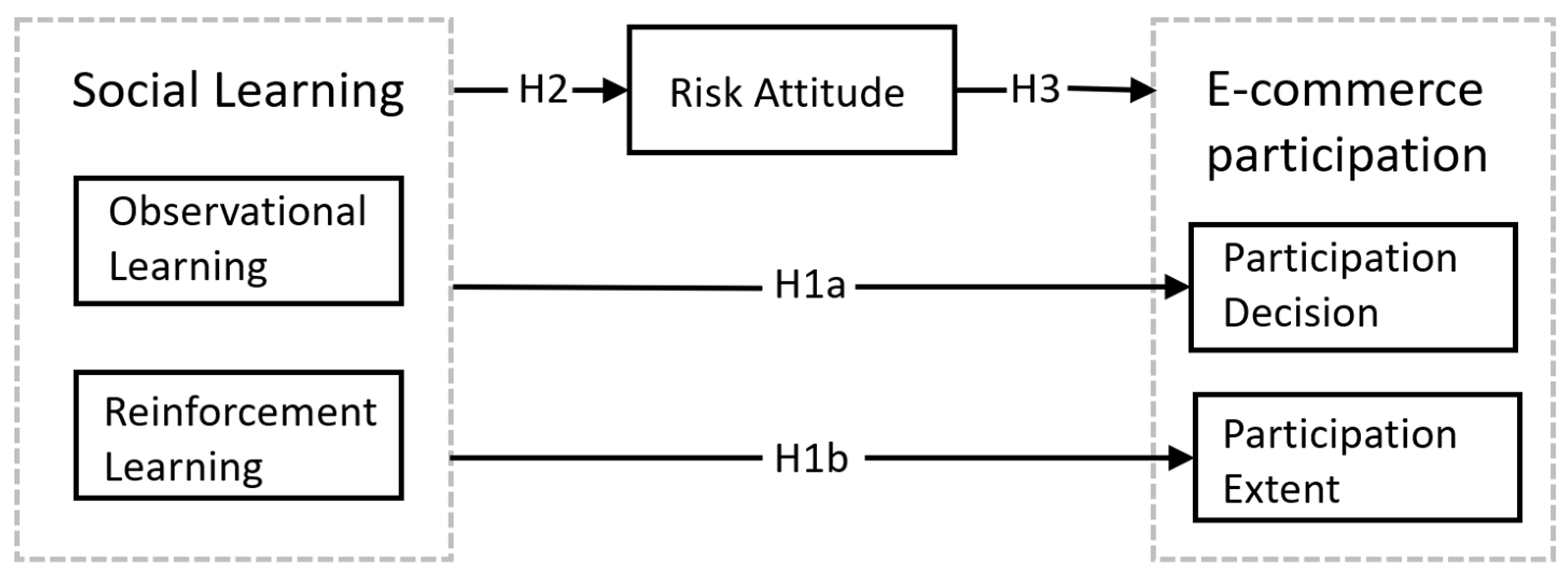
To address these questions, this study constructs an integrated “social learning—risk attitude—e-commerce participation” analytical framework. It specifically investigates the impact of social learning on smallholders’ participation in agricultural e-commerce, testing the mediating role of risk attitude. Empirically, we utilize survey data from 327 peach farmers in Qingdao, Shandong Province, China. This sample provides a representative context for two primary reasons: First, as a highly perishable fresh fruit, peach production places a premium on cold-chain logistics, making logistics conditions and risk perception particularly salient in farmers’ e-commerce decisions. Second, China’s rapidly evolving agricultural e-commerce landscape, coupled with the distinct characteristics of information dissemination and social networks within its rural communities, offers a suitable setting for examining social learning mechanisms.
The main contributions of this study are threefold: First, by integrating external social learning mechanisms with internal risk attitude changes within a single framework, this study moves beyond single-factor analyses. It illuminates the “black box” of how “social interaction (learning)” translates into “individual psychology (attitude)” and ultimately drives “economic behavior (participation),” providing a more refined micro-level mechanism for understanding smallholder technology adoption. Second, empirical contribution: using micro-level survey data on high-value, high-risk (perishable) agricultural products in China, this research empirically tests the mediating pathway of social learning through risk attitude, contributing new evidence from a transitioning economy to the relevant literature. Third, the findings suggest that promoting rural e-commerce development requires not only “hard investments” (e.g., logistics infrastructure) but also “soft guidance” (e.g., fostering social learning networks, providing risk education). This offers practical insights for designing more targeted rural e-commerce training and risk management interventions.
The remainder of this paper is organized as follows:
Section 2 provides a literature review and develops the hypotheses, detailing the theoretical linkages between social learning, risk attitude, and e-commerce participation.
Section 3 describes the research methodology, including the model specification, variable definitions, and data sources.
Section 4 presents the empirical results and robustness checks.
Section 5 discusses the findings.
Section 6 concludes the paper, proposes policy recommendations, and outlines research limitations and future directions.
3. Methodology
3.1. Model Specification
Generally speaking, rural households’ e-commerce participation behavior in agricultural products can be divided into two stages: the participation decision and the participation extent. Therefore, this study first incorporates the participation decision into the analytical framework of the level of social learning, and specifies the probability estimation model (Equation (1)) as follows:
Among them, α0 is the intercept term, and i denotes the identification number of valid survey respondents. The explained variable, part_di represents the e-commerce participation decision of respondent i. The core explanatory variable, Sociali, indicates the level of social learning of respondent i. Xᵢ refers to a set of control variables at the individual level that may influence the participation decision, including gender, age (ageᵢ), education level (educᵢ), number of household members (fnumᵢ), logistics accessibility in the region (convᵢ), and income level (incomeᵢ). α1 is the coefficient representing the impact of social learning level on e-commerce participation decisions, with the magnitude and sign of the coefficient reflecting the degree and direction of the influence. εᵢ represents unobservable random effects at the individual level for respondent i, and is thus included as the random disturbance term.
Considering potential endogeneity issues such as bidirectional causality between social learning and farmers’ e-commerce participation behavior, measurement errors, and omitted variables, this study employs an instrumental variable (IV) approach in conjunction with the above model. The analysis is conducted using an IV-Probit model, with the highest education level of parents (
Parent_educᵢ) selected as the instrumental variable for social learning. The regression model (Equation (2)) is specified as follows:
Building upon the e-commerce participation decision, this study further examines the impact of the level of social learning on the extent of e-commerce participation. To mitigate potential sample selection bias, the Heckman two-stage method is employed. The sample selection model (Equation (3)) is specified as follows:
Among them, b0 represents the intercept term, and the explained variable part_lᵢ denotes the extent of e-commerce participation of respondent i. b1 is the coefficient capturing the effect of the level of social learning on the extent of e-commerce participation, with its magnitude and sign indicating the degree and direction of the influence, respectively. Model (3) is employed to estimate the linear regression results regarding the impact of social learning on the extent of e-commerce participation. Meanwhile, the instrumental variable Parent_educᵢ is also incorporated into the second-stage regression to control for endogeneity issues.
Based on the theoretical analysis presented earlier, social learning may influence e-commerce participation through the mediating role of risk attitudes. To examine the plausibility of this mediating mechanism, this study constructed a mediation effect model with a mediation effect testing procedure. On the basis of the fundamental econometric model, risk attitude (
Risk) is incorporated as a mediating variable into the same analytical framework alongside social learning and rural households’ e-commerce participation in agricultural products. The regression equations are established as follows:
Among these, Riskᵢ represents the mediating variable, risk attitude, and δ1 denotes the coefficient of the mediating effect. The definitions of all other variables and coefficients remain consistent with those specified in Model (1).
3.2. Variable Definitions
The e-commerce participation behavior of rural households in agricultural products serves as the explained variable in this study, which comprises two sequential processes: the decision to participate in e-commerce and the extent of e-commerce participation. The decision to participate is a binary variable, reflecting whether a household engages in agricultural product e-commerce (coded as 1) or not (coded as 0). The extent of participation is a continuous variable, measured by the ratio of e-commerce sales volume to total sales volume. This study utilizes survey-based indicators to assess these variables, including part_d for e-commerce participation decision and part_l for e-commerce participation extent. part_d is a binary variable where a value of 0 indicates that the respondent does not engage in e-commerce sales, while a value of 1 indicates participation. When the participation decision equals 1, part_l represents the proportion of sales generated through e-commerce relative to the household’s total sales volume.
As shown in
Table 1,The core explanatory variable in this study is social learning, which is operationalized through two dimensions—observational learning and reinforcement learning—using five measurement items designed and selected for this purpose (response options: “1 = Very infrequent; 2 = Relatively infrequent; 3 = Neutral; 4 = Relatively frequent; 5 = Very frequent”).
Level of Social Learning (Social): This study employs survey-based data to calculate respondents’ social learning indicators using the entropy method across two dimensions. The resulting value reflects the extent of the respondent’s social learning, with higher values indicating a greater extent. As the indicators obtained from both dimensions are positive, they were standardized using the following method:
Xin represents the learning extent of individual i in the n-th dimension, where n takes values of 1 and 2, denoting observational learning and reinforcement learning, respectively. XMAXn and XMINn indicate the maximum and minimum values of the indicators in the n-th dimension. After standardization, the weights are derived by calculating the coefficient of variation to integrate the four indicators of the observational learning dimension. Finally, the computational weights for both dimensions are set equally to 1/2 and a weighted aggregation is performed to obtain the social learning index.
The entropy method was chosen to weight the five observed indicators of social learning for two main reasons. First, the five indicators are not fully homogeneous in their sources: some come from interpersonal communication and demonstration households and are more dispersed, while others come from media acquisition and are more concentrated, so their variances differ noticeably. The entropy method can automatically assign higher weights to indicators that carry more information, thus capturing the real variation in social learning more accurately than simple averaging. Second, compared with more common approaches such as principal component analysis (PCA) or factor analysis, the entropy method imposes fewer requirements on sample size, variable distribution, and the stability of the latent factor structure. Given that our data consist of 327 observations from a single region, using the entropy method helps avoid potential biases caused by strong factor-structure assumptions, and is therefore more appropriate for this study.
The mediating variable in this study is risk attitude. Regarding the measurement of risk attitude, this study employed a single-dimension risk-preference item set based on a money/return choice scenario, with wording localized according to the pilot test. This setting allows the variable to capture farmers’ risk orientation in the context of e-commerce participation with reasonable accuracy. The following question was included in the survey questionnaire: “Which of the following five scenarios would you be willing to choose?” Specific measurement items and their corresponding value assignments are presented in
Table 2: Risk Attitude Measurement Items.
This study selected the following control variables to mitigate potential confounding effects on rural households’ participation in agricultural product e-commerce: gender, age, education level (educ), number of family members (fnum), logistics accessibility (conv), and income level (Income).
3.3. Sample Selection and Data Sources
This study collected the data required for empirical analysis through a questionnaire survey. During the questionnaire design phase, based on the core variables and research hypotheses derived from the theoretical framework established earlier, and drawing on key references, the scale items were rigorously developed and refined. After multiple rounds of careful revision, the final version of the questionnaire was completed.
To enhance the reliability of the research data, a preliminary online survey was conducted during the early stage of the study. Based on the findings from this pilot survey, the questionnaire was subsequently revised and refined. The primary data were collected between February and March 2025 in the main fresh-peach producing areas of Qingdao, Shandong Province.
To enhance data quality, a small-scale online pilot survey was first conducted. The feedback from this pilot was subsequently used to refine the item wording, option design, and question sequencing. The target respondents were peach farmers, and to broaden the survey coverage, a hybrid data-collection strategy, combining both online and offline methods, was employed. For the offline component, a sampling frame was first constructed from farmer lists provided by township agricultural departments and village committees. Enumerators then conducted face-to-face interviews in orchards and at farmers’ homes. A total of 210 paper questionnaires were distributed and 192 valid responses were obtained, accounting for 58.7% of all valid cases. For the online component, questionnaires were disseminated through WeChat mini-programs, Wenjuanxing, and WeChat official accounts, and further circulated in peach-farmer WeChat groups, fresh-peach trading groups, and fan groups of leading bloggers in the sector. This yielded 135 valid online questionnaires, representing 41.3% of the total valid sample.
This study employed a quasi-purposive sampling approach targeting actually accessible peach growers, while seeking basic balance across townships, farm scales, and farmers’ organizational participation (e.g., cooperatives), so as to enhance the representativeness of the sample for peach-farming e-commerce operators in the study area. To encourage careful completion and reduce invalid responses, a modest incentive scheme was introduced for respondents who finished the questionnaire. In total, 379 questionnaires were distributed and 327 valid questionnaires were obtained, yielding an effective response rate of 86.27%.
4. Analysis and Results
4.1. Empirical Results on Social Learning and E-Commerce Adoption
As reported in
Table 3, the Cronbach’s alpha for the five-item social learning dimension is 0.851, which exceeds the commonly accepted 0.70 threshold in social science research. This indicates good internal consistency and satisfactory reliability of the construct, thereby supporting its use in subsequent empirical analyses.
Table 4 presents the benchmark regression results examining the impact of Social Learning on rural households’ participation in agricultural e-commerce. Specifically, Model (1) reports the effect of Social Learning on the decision to participate in e-commerce activities. Model (2) presents the results of the impact of Social Learning on participation decisions, accounting for potential endogeneity through the use of instrumental variables. Models (3) and (4), respectively, display the effects of Social Learning on the intensity of participation in e-commerce activities, estimated using the Heckman two-stage model—which incorporates instrumental variables while addressing selection bias—and the ordinary least squares (OLS) model.
Based on the regression results of Probit Model (1), Social Learning exerts a significant positive effect on the decision to participate in e-commerce activities. The estimated coefficient is positive and statistically significant at the 1% level. Ceteris paribus, a 1% increase in the level of Social Learning corresponds to a 13.27% increase in the probability of deciding to participate in e-commerce activities. In Model (2), which employs the IV-Probit model with instrumental variables, the regression results for the fitted values of Social Learning on participation decisions remain largely consistent. Moreover, the Wald test statistic for the instrumental variable (parental education) is 438.96, with a p-value below 0.01, indicating strong exogeneity. Ceteris paribus, a 1% increase in Social Learning is associated with a 10.30% increase in the probability of deciding to participate in e-commerce activities. The smaller coefficient relative to Model (1) suggests that, after addressing endogeneity, the effect of Social Learning on participation decision-making may have been previously overestimated. Considering that Probit coefficients are expressed on the latent-variable scale, average marginal effects were additionally computed at the sample means. The estimates indicate that, ceteris paribus, a one–standard deviation increase in the social learning index is associated with an increase of about 0.10–0.12 in the probability of participating in agricultural e-commerce, which confirms the economic relevance of the effect.
According to the regression results of the Heckman two-step model (3), Social Learning also exerts a significant positive impact on the degree of Participation in E-Commerce Activities, which has passed the 1% significance level test. The regression coefficient of the instrumental variable is positive and significant, indicating that the instrumental variable has a certain degree of correlation. The IMR (Inverse Mills Ratio) value and Rho value of the model are significantly positive, suggesting the existence of certain selection bias. Therefore, it is reasonable to use the Heckman two-step model to eliminate such selection bias. Ceteris paribus, for every 1% increase in the level of Social Learning, the degree of Participation in E-Commerce Activities increases by 0.49% accordingly. After excluding non-decision samples, the OLS model was used for processing, and the main regression results remained largely consistent. This indicates that the result analysis of Model (3) has a certain degree of rationality.
In addition, the regression results of the control variables in Models (1) and (3) show that gender has a significant impact on the behavior of Participation in E-Commerce Activities. Specifically, before making the decision, female respondents are more negative than male respondents towards the behavior of Participation in E-Commerce Activities; however, after respondents have decided to engage in e-commerce, females exert a more positive impact on the degree of Participation in E-Commerce Activities. This may be because females’ risk preference is generally weaker than that of males, making them more passive in the decision-making of Participation in E-Commerce Activities. When engaging in e-commerce brings benefits, their risk preference will increase, prompting them to enhance the degree of Participation in E-Commerce Activities. Age also follows a similar path of influence: the older the respondents are, the more conservative their Risk Attitudes tend to be. Thus, in Model (1), age has a significantly negative effect on the decision-making of Participation in E-Commerce Activities. Regarding the decision-making behavior, neither the respondents’ educational level nor the number of family members has a significant impact; whereas for the degree of participation, an increase in the number of family members significantly inhibits the degree of Participation in E-Commerce Activities.
As indicated by the regression results, income level and logistics convenience, as indicators for examining physical capital and infrastructure, have exerted a significant positive impact on overall Participation in E-Commerce Activities, which confirms the findings of previous studies and the theoretical analysis in this paper. Specifically, an increase in physical capital enhances rural households’ level of investment in e-commerce and their risk resistance capacity, thereby leading to an improvement in their comprehensive income. Moreover, the improvement of infrastructure level can generally enhance the cognitive level and practical ability of rural households in the region from dimensions such as logistics development, network coverage, and knowledge popularization, thus exerting a positive impact on their behavior of Participation in E-Commerce Activities.
Subsequent research further conducted regression analyses on the four dimensions under the theoretical framework of Social Learning, namely role model demonstration, interpersonal communication, mass media, and reinforcement learning, to systematically examine their impact intensity on the decision-making of Participation in E-Commerce Activities (a dichotomous variable) and the degree of participation (a continuous variable). The results show that the explanatory power of mass media and interpersonal communication for the two types of dependent variables is significantly higher than that of role model demonstration and reinforcement learning. This finding provides quantitative evidence for clarifying the mechanism path of Social Learning in the behavior of Participation in E-Commerce Activities.
Table 5 presents the results of the binary logit regression (with the dependent variable part_d) and the linear regression (with the dependent variable part_l). Interpersonal communication (5.578 *) and mass media (6.768 **) have a significantly positive impact on part_d, and the coefficient of the latter is larger; their impacts on part_l are 0.073 ** and 0.074 **, respectively, with similar degrees. Role model demonstration and reinforcement learning have mostly no significant impact on the two dependent variables. Among the control variables, logistics convenience (conv) has a highly significant impact on the two dependent variables (9.361 ** and 0.107 **); the number of family members (fnum) has a marginally significant negative impact on part_l (−0.016 *); and gender has a marginally significant positive impact on part_d (4.083 *). It can be concluded that among the four dimensions of Social Learning, mass media and interpersonal communication have the greatest impact on the decision-making of Participation in E-Commerce Activities, with mass media having a stronger impact; among the four dimensions of Social Learning, mass media and interpersonal communication also have the greatest impact on the degree of Participation in E-Commerce Activities, and their impacts are almost equivalent.
4.2. Robustness Test
To enhance the robustness of the aforementioned conclusions, this paper conducts robustness tests by means of replacing regression models, performing winsorization on variables, and adding potentially omitted control variables, among other methods.
In this study, the Probit model was adopted as the benchmark model for the decision-making of Participation in E-Commerce Activities. When dealing with binary dependent variables, this model exhibits good fitting effect and strong explanatory power. To verify the robustness of the regression results, this paper further employs the Logit model for robustness testing. If the regression results are consistent with those of the benchmark model, the robustness of the empirical results can be further confirmed.
Since economic data often contain outliers, and, in particular, the distribution of variables such as income level may show a significant right-skewed feature, this paper performs winsorization on continuous variables to reduce the potential impact of extreme values on the regression results and mitigate the interference of outliers on parameter estimation. Specifically, this paper conducts winsorization on the data at the 5% upper and lower quantiles of the variables.
In the above analysis, the regression model of this paper has already included control variables such as individual gender and age. However, for the behavior of Rural Households’ Participation in E-Commerce of Agricultural Products, the years of farming in the planting industry and the planting area of crops of the research subjects are also potential influencing factors. This is because as the years of farming in the industry increase and the planting area expands, the research subjects’ perception of Risk Attitudes will also change. Therefore, this paper adds two variables, namely years of farming and planting area, to the research model for regression analysis.
As can be seen from the robustness test results in
Table 6, after replacing the regression model, performing winsorization, and supplementing variables, the level of Social Learning still has a significant positive impact on Rural Households’ Participation in E-Commerce of Agricultural Products. This proves that the previous empirical results are relatively reliable, and the research conclusions remain unchanged.
4.3. Heterogeneity Test
Due to differences in rural households’ organizational participation, there are variations in their mastery of information resources and other aspects, which affect their information decision-making and Risk Attitudes, and further influence their behavior of Participation in E-Commerce Activities. Therefore, this paper classifies organizational participation into two categories based on whether rural households have joined cooperatives or industry associations, so as to examine the heterogeneous impact. From the regression results of groupings by organizational participation, among the research subjects who have joined cooperatives or industry associations, the impact effect and significance of Social Learning on Participation in E-Commerce Activities are different from those of the research subjects who have not joined. For the research subjects who have not joined cooperatives or industry associations, an improvement in the level of Social Learning leads to a stronger and more significant promotion in the decision-making of Participation in E-Commerce Activities and a deepening of the degree of Participation in E-Commerce Activities. However, in terms of the explanatory power of the model, for the research subjects with organizational participation (i.e., participants), the goodness-of-fit R2 of the regression model is 0.746, which is higher than the R2 value of 0.643 for non-participants. A plausible explanation is that rural households participating in cooperatives or industry associations tend to form a strong path dependence on existing planting and sales models. This dependence mainly stems from the fact that agricultural cooperatives and industry associations in China usually have mature supply and marketing networks and stable cooperation models, which can provide rural households with relatively reliable market channels and risk guarantee mechanisms. In this context, although e-commerce platforms, as an emerging sales channel, have advantages such as wide market coverage and high transaction efficiency, their attractiveness to rural households is relatively limited. Even if Social Learning improves rural households’ cognition and willingness to participate in e-commerce, its actual impact on rural households’ behavior may still be weaker than the effect of traditional channels.
This phenomenon is consistent with the path dependence theory, which states that inertial behavioral patterns formed by individuals or organizations in long-term practice will have a significant impact on their subsequent decision-making. In addition, the collective action characteristics of cooperatives and industry associations may also, to a certain extent, inhibit individual rural households’ independent exploration and willingness to participate in e-commerce platforms. Therefore, in the process of promoting the development of E-Commerce of Agricultural Products in the future, attention should be paid to collaborative cooperation with traditional cooperatives and industry associations. By integrating resources and optimizing the benefit distribution mechanism, rural households should be gradually guided to transition from traditional channels to e-commerce platforms, thereby enhancing the sustainability and effectiveness of Participation in E-Commerce Activities.
Based on the regression results by geographic location in
Table 7, social learning exerts a significant positive impact on farmers’ participation in agricultural e-commerce in all three regions—Laixi, Pingdu, and Chengyang—and the corresponding coefficients are all significant at the 1% level. The estimated coefficients differ noticeably across regions, with the magnitude of the effect ordered as Laixi > Pingdu > Chengyang, indicating clear spatial heterogeneity in the impact of social learning arising from geographic differences.
In terms of regional development levels, the ranking of actual GDP is: Chengyang > Laixi > Pingdu. Taken together, these findings suggest that in more economically developed areas, farmers’ participation in agricultural e-commerce may have approached a saturation point, such that the development stage has gradually entered a zone of diminishing marginal effects. As a result, the marginal contribution of social learning to farmers’ e-commerce participation decisions and participation intensity becomes relatively limited. This is highly consistent with the economic law of diminishing marginal utility, which posits that once the adoption or diffusion of a given economic behavior or technology surpasses a certain threshold, its incremental effect tends to weaken over time. In regions with well-developed e-commerce infrastructure and a high degree of market maturity, the marginal benefits that farmers can obtain through social learning are substantially reduced; the “additional push” of social learning on their e-commerce participation is therefore more constrained. This observation broadly aligns with the conclusions of Foster (2010) on the marginal effects of technology adoption [
34].
It should be noted that, due to data availability constraints, the sample distribution across geographic locations in this study is not fully balanced, with pronounced differences in sample size between more developed and less developed regions. This may, to some extent, weaken the generalizability and representativeness of the empirical findings. Future research would benefit from improvements in at least two respects. First, expanding sample coverage and adopting stratified sampling or random sampling strategies to optimize the sample structure. Second, incorporating more refined geographical indicators (such as county-level economic development indices and e-commerce penetration rates) to more accurately capture regional development disparities, thereby enhancing the scientific rigor and robustness of the conclusions.
4.4. Empirical Test of the Mediating Effect of Risk Attitudes
Based on the established mediation effect model, this paper conducts a mechanism test on the path through which Social Learning affects Rural Households’ Participation in E-Commerce of Agricultural Products via Risk Attitudes. Meanwhile, due to model constraints, this paper only uses the decision-making of Participation in E-Commerce Activities to characterize e-commerce participation. Among them, Model (1) is an OLS regression model examining the impact of Social Learning on e-commerce participation; Model (2) is an OLS regression model investigating the impact of Social Learning on Risk Attitudes; and Model (3) is a regression model incorporating the Risk Attitudes variable (Risk) on the basis of Model (1). The test results are presented in
Table 8.
In Model (2), the impact of the level of Social Learning on Risk Attitudes is positive and significant at the 1% level. This indicates that an improvement in the level of Social Learning can correspondingly enhance the research subjects’ level of risk preference. This finding is consistent with the social learning theory: rural households, through Social Learning, understand and assess the risks in Participation in E-Commerce Activities, enhance their risk-bearing capacity, and thus improve their level of risk preference. Through the mechanisms of interaction and information sharing within social networks, rural households can more comprehensively acquire and integrate risk information related to E-Commerce of Agricultural Products, thereby optimizing their cognitive and evaluative abilities regarding risk factors. The Social Learning process not only provides rural households with diversified risk response strategies and experience reference but also, through the group demonstration effect and knowledge spillover effect, reduces their perception of uncertainty in e-commerce participation, thereby further enhancing their risk-bearing capacity and improving their level of risk preference. This improvement in risk perception and transformation of Risk Attitudes directly promote the enhancement of rural households’ level of risk preference, making them more inclined to accept and participate in E-Commerce of Agricultural Products. This conclusion is supported by recent studies on social learning and risk preference [
49].
In Model (3), the impact of Risk Attitudes on the degree of Participation in E-Commerce Activities is also positive and significant at the 1% level, indicating that an increase in the level of risk preference can significantly promote rural households to engage more deeply in E-Commerce of Agricultural Products. This result is consistent with the risk decision-making theory: rural households with a preference for risk are more inclined to try new sales channels and technologies, thus participating more actively in e-commerce activities. In Model (3), which incorporates both the independent and dependent variables, the regression coefficient of the level of Social Learning is lower than that in Model (1). Meanwhile, the regression coefficient of Risk Attitudes is positive and significant, indicating the existence of a partial mediation effect. The results of the mechanism test in
Table 9 verify the aforementioned theoretical analysis.
5. Discussion
Based on the combination of theoretical and empirical analyses, this paper explores and examines the impacts of Social Learning and Risk Attitudes on Rural Households’ behavior of Participation in E-Commerce of Agricultural Products. The specific research conclusions are as follows:
Social learning substantially increases both the likelihood and the depth of farmers’ participation in agricultural e-commerce. In concrete terms, everyday information exchanges with neighbors and relatives, exposure to e-commerce cases through mass media, and attendance at e-commerce training sessions all help farmers to understand how e-commerce works and what benefits it can bring, and this, in turn, makes them more inclined to participate. Our finding that social learning significantly promotes farmers’ participation in e-commerce is consistent with classic work on agricultural technology diffusion. Conley and Udry [
18] showed for Ghanaian pineapple farmers that decisions are revised in light of neighbors’ success, and Munshi [
19] argued that acquaintance-based networks continuously shape adoption trajectories. Our results suggest that such “observable peer demonstration” is not confined to production technologies but can be extended to market-oriented, rule-intensive settings such as e-commerce.
On the observational side, farmers tend to observe which peers are already selling online and how well they are doing, and this “if they can do it, so can I” effect encourages them to follow. They also pay attention to the business routines shared by leading e-commerce households and to the explanations of policies and platform rules provided by extension staff, both of which reduce unfamiliarity and concern. The multi-level learning network generated by mass media allows farmers to access market trends and success stories without physically traveling, thereby improving their learning efficiency. Regarding reinforcement learning, structured training packages dispersed knowledge and skills into a coherent system. After farmers learn, apply, and receive positive feedback, they form a stable and sustainable expectation about running e-commerce, and this positive cycle is reflected in higher levels of participation.
Moreover, the analysis indicates a statistically significant positive link between a farmer’s risk attitude and their decision to participate in e-commerce. Specifically, individuals with stronger risk preferences are typically more receptive to novelties and more resilient to income instability. E-commerce, being subject to multiple uncertainties like market fluctuations, technical complexities, and operational challenges, appears more attractive to such farmers. Therefore, a greater risk tolerance corresponds to a pronounced increase in the probability of e-commerce adoption.
More importantly, social learning and risk attitude do not operate in isolation. By repeatedly observing successful cases in their vicinity, listening to policy explanations tailored to them, and receiving hands-on guidance from training, farmers develop a more realistic view of the risks and returns of e-commerce—what risks are real but manageable, what costs are one-off, and what gains can be maintained over time. This cognitive adjustment makes previously risk-averse farmers less defensive, moderately raises their risk preference, and in turn gives them stronger motivation to try e-commerce. At the same time, the social-learning process itself improves farmers’ operational and market-handling capabilities in e-commerce. Better capabilities generate higher confidence, and higher confidence further dampens risk concerns, eventually translating into greater willingness and intensity of participation.
Finally, our sample is drawn from peach-producing areas with comparatively good cold-chain and delivery conditions, which is not fully comparable to studies conducted in regions with tighter logistical constraints [
4,
18]. In those settings, the fact that a farmer observes others’ success does not automatically translate into “I can succeed as well”, because actual distribution and preservation capacity remains a hard constraint. This cautions that promotion strategies should attend to both the availability of information and the feasibility of action.
6. Conclusions
6.1. Suggestions
Drawing on the findings, this study proposes strategic recommendations for key stakeholders, including farmers, platform operators, and policymakers. To that end, the proposed measures seek to boost engagement, elevate adoption levels, and unleash the developmental prospects of rural e-commerce.
Activate village-level learning mechanisms: Village committees, cooperatives, or township agricultural stations can organize regular e-commerce sharing sessions led by local demonstration households, so that farmers see concrete, comparable cases. This anchors social learning in a stable, low-cost channel and matches the pathway identified in this study.
Embed risk education into existing training: On the basis of current vocational or e-commerce skills training, add short modules on platform rules, common contract/logistics risks, and fraud prevention, so that learning does not only tell farmers “what to do” but also “what to watch out for.” This directly corresponds to the finding that social learning reduces excessive risk aversion.
Improve digital and logistics infrastructure in tandem: Local governments should prioritize expanding broadband coverage, cold-chain facilities, and last-mile delivery services in major production villages. Where practicable, these infrastructures should be integrated with existing e-commerce service stations. Such improvements lower the effective cost of market entry, thereby creating the necessary external conditions for social learning to occur and thus facilitating wider adoption.
Encourage platforms to offer localized, tiered support: E-commerce platforms can provide “agriculture-oriented” versions of their training and simple store templates for low–digital literacy farmers, and give traffic or service incentives to active rural opinion leaders, so that platform resources reinforce local social learning.
Explore data-linked financing tools: Where transaction data are available, governments can pilot small credit lines tied to real e-commerce sales to ease short-term liquidity constraints during farmers’ transition to online sales.
6.2. Limitations and Future Directions
Although the proposed idea of embedding “rural e-commerce risk-education programs” into social-learning channels is of practical value, it should be acknowledged that the empirical scope of this study limits external validity. Our sample—peach growers in Qingdao, Shandong—benefits from relatively developed cold-chain and delivery services, active local training, and supportive policies, and peaches themselves are highly perishable and logistics-sensitive. Therefore, the generalizability of the proposed mechanism that social learning enhances e-commerce participation by positively influencing risk attitude, may be limited. Its effect is likely less pronounced for other agricultural products (e.g., storable grains or large-scale livestock) and in contexts where logistics or digital infrastructure is underdeveloped.
The findings of this paper hold significant implications for other developing regions worldwide, particularly those characterized by progressing digitalization and uneven rural infrastructure. This describes settings comparable to mobile market-information programs in Africa and community-based information services in Latin America [
3,
6], thereby extending the relevance of our findings to these analogous contexts. However, unlike those studies that emphasize exogenous information provision, our results highlight the initiating role of intra-village social networks. Therefore, to make the results transferable internationally, future research should conduct cross-regional, multi-product, and cross-institutional comparisons to test whether social learning still operates through the risk-attitude channel in environments where social ties are less dense than in Chinese villages.
In terms of method and measurement, the social-learning construct in this paper is mainly built on offline interpersonal transmission, demonstration, and training, which match current learning practices of most farmers but do not fully capture rapidly emerging digital learning channels (e.g., short video, livestreaming tutorials, and platform-based training modules). This may lead to a conservative estimate of the role of social learning. Future work could explicitly incorporate “frequency of digital-media learning” and “operability of livestream/short-video content” into the questionnaire and apply multi-dimensional measurement models or CFA to improve the precision of the construct.
Finally, because survey data are limited in capturing the subtleties of information uptake, intra-household negotiation, and risk trade-offs, subsequent studies could complement quantitative analysis with follow-up interviews, village-level case studies, or embedded fieldwork to obtain richer first-hand evidence and to test the applicability of social-learning mechanisms under different cultural and social-capital configurations.