

Points Accumulation Framework and Spending Behavior—Accelerating vs. Linear Points: The Impact of Loyalty Framework on Consumer Spending

Abstract
1. Introduction
2. Literature Review
2.1. Theory
2.2. Points Accumulation Framework (Linear vs. Accelerating)
2.3. Perceived Value of Rewards
3. Hypotheses Development
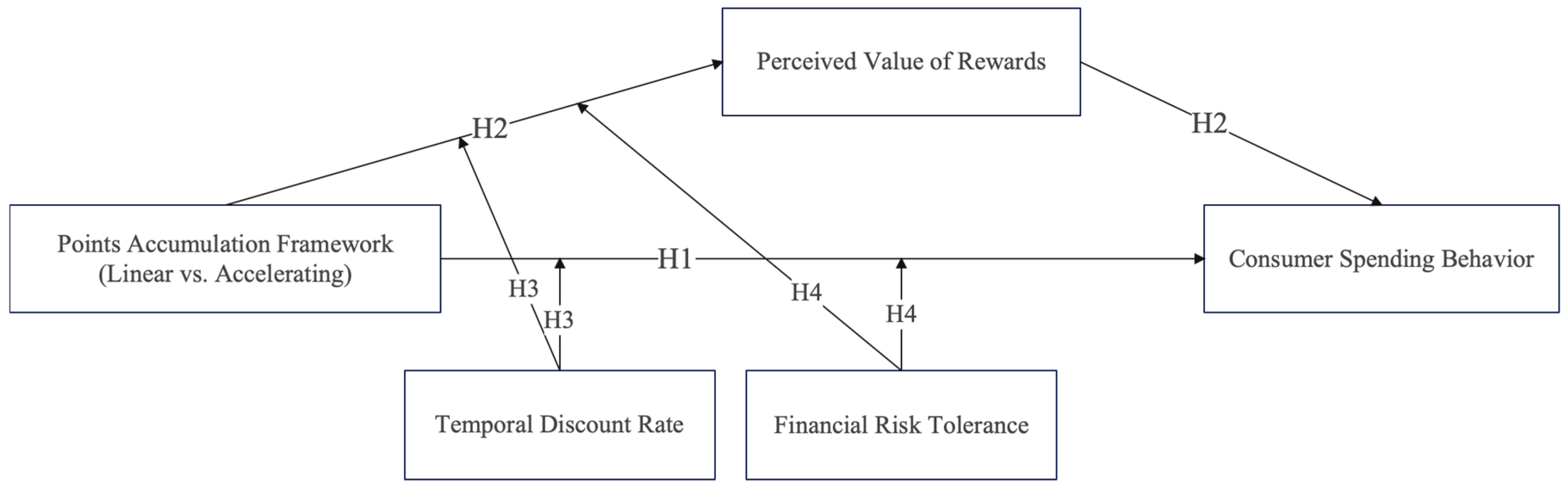
3.1. Points Accumulation Framework, Perceived Value of Rewards and Spending Behavior
3.2. Temporal Discount Rate
3.3. Financial Risk Tolerance
4. Methodology
4.1. Research Design and Methodology
4.2. Stage 1: Main Effect of Loyalty Program
4.2.1. Purpose
4.2.2. Stimuli and Pretest
4.2.3. Procedure
4.2.4. Results
4.2.5. Discussion
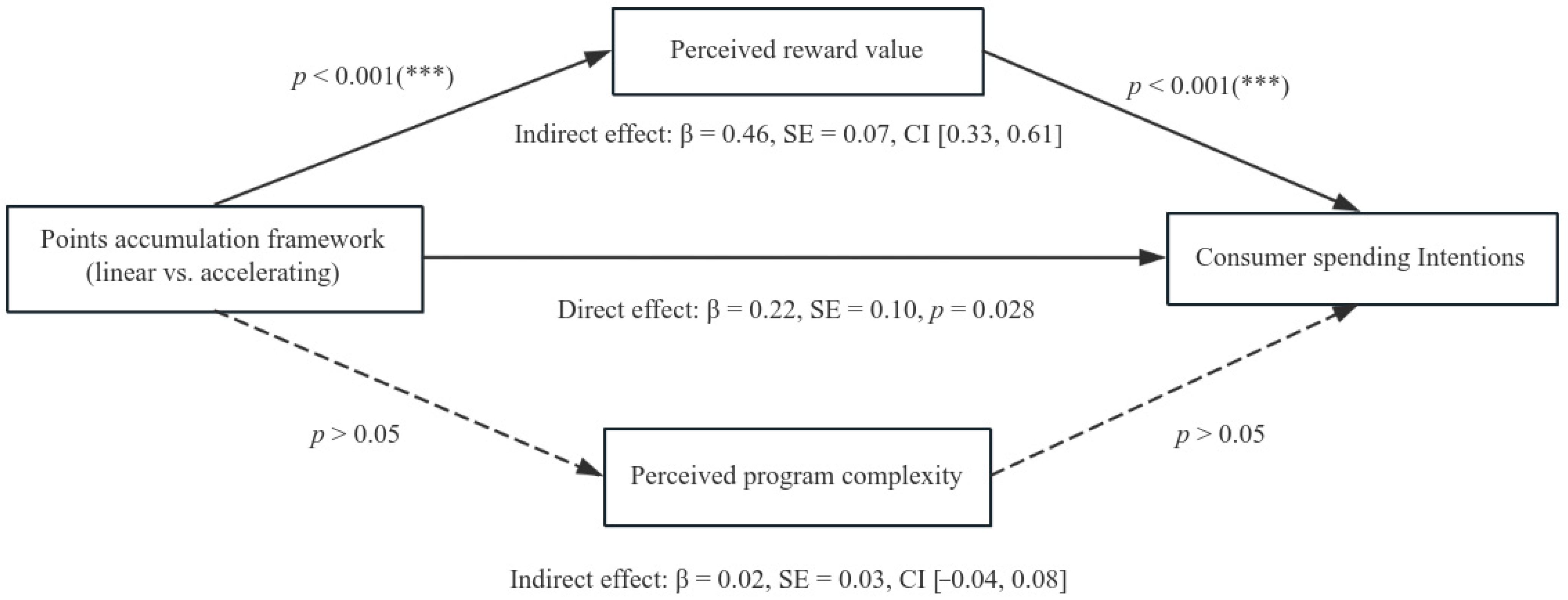
4.3. Stage 2: Mediating Role of Perceived Value of Reward
4.3.1. Purpose
4.3.2. Stimuli and Pretest
4.3.3. Procedure
4.3.4. Results
4.3.5. Discussion
4.4. Stage 3: Moderating Role of Temporal Discount Rate
4.4.1. Purpose
4.4.2. Stimuli and Pretest
4.4.3. Procedure
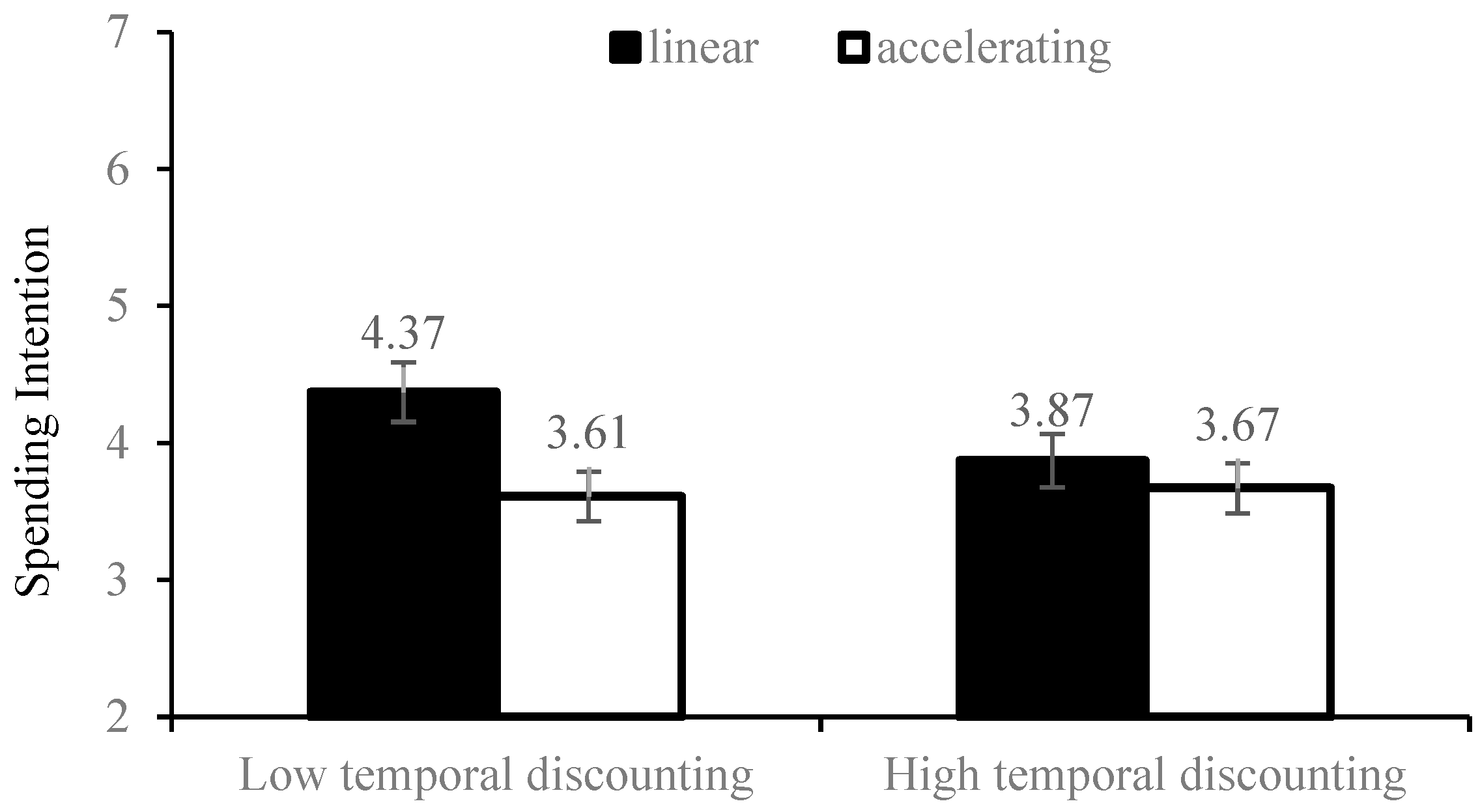
4.4.4. Results
4.4.5. Discussion
4.5. Stage 4: Moderating Role of Financial Risk Tolerance
4.5.1. Purpose
4.5.2. Stimuli and Pretest
4.5.3. Procedure
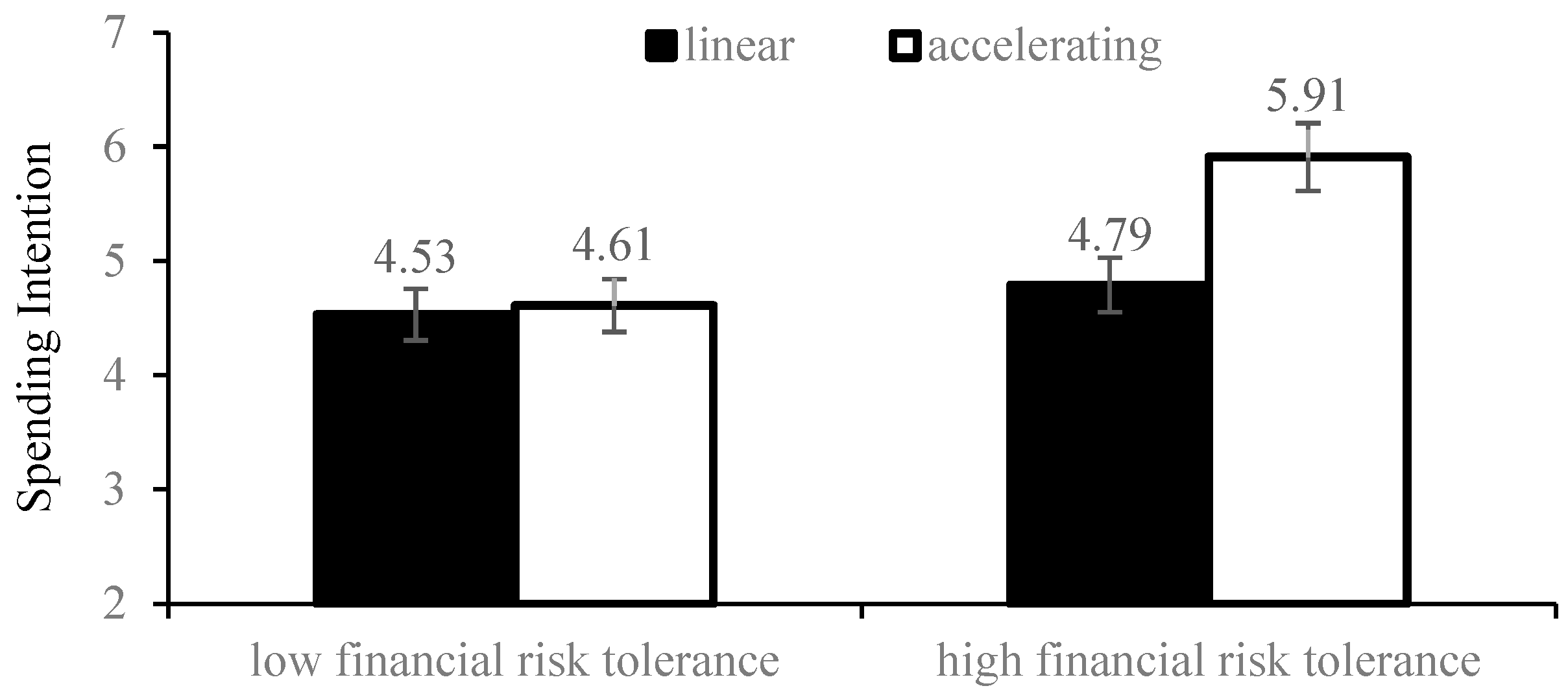
4.5.4. Results
4.5.5. Discussion
5. General Discussion
5.1. Theoretical Contribution
5.2. Practical Contribution
5.3. Limitation
Author Contributions
Funding
Institutional Review Board Statement
Informed Consent Statement
Data Availability Statement
Conflicts of Interest
Appendix A. Stimuli Used in Study 1
| Present Gamification Elements in Sustainability Apps | Absent Gamification Elements in Sustainability Apps |
 |  |
Appendix B. Stimuli Used in Study 2
| Present Gamification Elements in Sustainability Apps | Absent Gamification Elements in Sustainability Apps |
 |  |
Appendix C. Stimuli Used in Study 3
| Present Gamification Elements in Sustainability Apps | Absent Gamification Elements in Sustainability Apps |
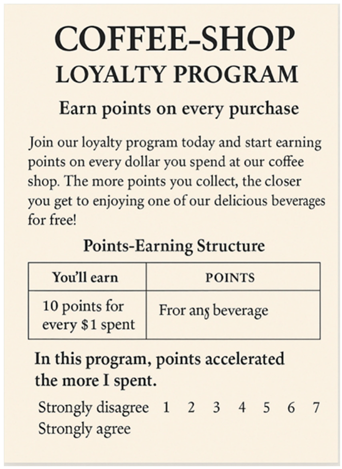 | 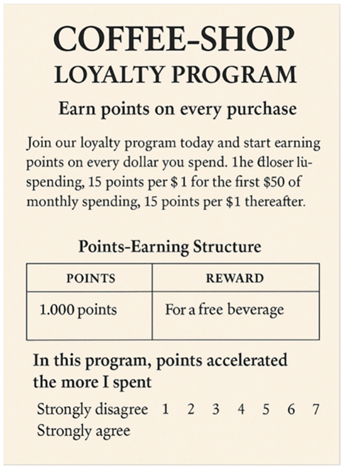 |
References
- Loyalty Program Statistics—2024 Data and Reports. Available online: https://www.couponbirds.com/research/loyalty-program-statistics (accessed on 10 October 2025).
- Do Loyalty Programs Really Work? What the Research Says. Available online: https://www.tremendous.com/blog/how-loyalty-programs-work/ (accessed on 11 October 2025).
- Nishio, K.; Hoshino, T. Joint Modeling of Effects of Customer Tier Program on Customer Purchase Duration and Purchase Amount. J. Retail. Consum. Serv. 2022, 66, 102906. [Google Scholar] [CrossRef]
- Yang, M.X.; Irina, Y.Y.; Chan, H.; Zeng, K.J. Retain or Upgrade: The Progress-Framing Effect in Hierarchical Loyalty Programs. Int. J. Hosp. Manag. 2020, 89, 102562. [Google Scholar] [CrossRef]
- Stourm, V.; Bradlow, E.T.; Fader, P.S. Stockpiling Points in Linear Loyalty Programs. J. Mark. Res. 2015, 52, 253–267. [Google Scholar] [CrossRef]
- Ko, W.L.; Song, T.H. Nonlinear Reward Gradient Behavior in Customer Reward and Loyalty Programs: Evidence from the Restaurant Industry. J. Hosp. Tour. Res. 2025, 49, 816–826. [Google Scholar] [CrossRef]
- Ahmed, G.; Alzoubi, H. Loyalty Program Effectiveness: Theoretical Reviews and Practical Proofs. Uncertain Supply Chain Manag. 2020, 8, 599–612. [Google Scholar] [CrossRef]
- Carluccio, J.; Eizenman, O.; Rothschild, P. Next in Loyalty: Eight Levers to Turn Customers into Fans; McKinsey & Company: New York City, NY, USA, 2021; Volume 1. [Google Scholar]
- Melancon, J.P.; Noble, S.M.; Noble, C.H. Managing Rewards to Enhance Relational Worth. J. Acad. Mark. Sci. 2011, 39, 341–362. [Google Scholar] [CrossRef]
- Daryanto, A.; de Ruyter, K.; Wetzels, M.; Patterson, P.G. Service Firms and Customer Loyalty Programs: A Regulatory Fit Perspective of Reward Preferences in a Health Club Setting. J. Acad. Mark. Sci. 2010, 38, 604–616. [Google Scholar] [CrossRef]
- Whittaker, L.; Russell-Bennett, R.; Mulcahy, R. Reward-Based or Meaningful Gaming? A Field Study on Game Mechanics and Serious Games for Sustainability. Psychol. Mark. 2021, 38, 981–1000. [Google Scholar] [CrossRef]
- Yi, Y.; Jeon, H.; Choi, B. Segregation vs. Aggregation in the Loyalty Program: The Role of Perceived Uncertainty. Eur. J. Mark. 2013, 47, 1238–1255. [Google Scholar] [CrossRef]
- Lee, K.; Malerba, F. Catch-up Cycles and Changes in Industrial Leadership: Windows of Opportunity and Responses of Firms and Countries in the Evolution of Sectoral Systems. Res. Policy 2017, 46, 338–351. [Google Scholar] [CrossRef]
- Kahneman, T. Prospect Theory: An Analysis of Decisions Under Risk; University of Rochester, Graduate School of Management, Managerial Economics Research Center: Rochester, NY, USA, 1979; pp. 263–291. [Google Scholar]
- Locke, E.A.; Latham, G.P. A Theory of Goal Setting & Task Performance; Prentice-Hall, Inc.: Upper Saddle River, NJ, USA, 1990. [Google Scholar]
- Dowling, K.; Guhl, D.; Klapper, D.; Spann, M.; Stich, L.; Yegoryan, N. Behavioral Biases in Marketing. J. Acad. Mark. Sci. 2020, 48, 449–477. [Google Scholar] [CrossRef]
- Chen, Y.; Mandler, T.; Meyer-Waarden, L. Three Decades of Research on Loyalty Programs: A Literature Review and Future Research Agenda. J. Bus. Res. 2021, 124, 179–197. [Google Scholar] [CrossRef]
- Kivetz, R. Promotion Reactance: The Role of Effort-reward Congruity. J. Consum. Res. 2005, 31, 725–736. [Google Scholar] [CrossRef]
- Zhang, Y.; Xu, J.; Jiang, Z.; Huang, S.-C. Been There, Done That: The Impact of Effort Investment on Goal Value and Consumer Motivation. J. Consum. Res. 2011, 38, 78–93. [Google Scholar] [CrossRef]
- Fergus, L.; Holston, D.; Long, A. Modeling Behavioral Economic Strategies in Social Marketing Messages to Promote Vegetable Consumption to Low-Resource Louisiana Residents: A Conjoint Analysis. J. Acad. Nutr. Diet. 2022, 122, A21. [Google Scholar] [CrossRef]
- Nagengast, L.; Evanschitzky, H.; Blut, M.; Rudolph, T. New Insights in the Moderating Effect of Switching Costs on the Satisfaction–Repurchase Behavior Link. J. Retail. 2014, 90, 408–427. [Google Scholar] [CrossRef]
- Saqib, N.U.; Frohlich, N.; Bruning, E. The Influence of Involvement on the Endowment Effect: The Moveable Value Function. J. Consum. Psychol. 2010, 20, 355–368. [Google Scholar] [CrossRef]
- Zushi, N.; Curlo, E.; Thomas, G.P. The Reflection Effect in Time-Related Decisions. Psychol. Mark. 2009, 26, 793–812. [Google Scholar] [CrossRef]
- Grewal, D.; Lindsey-Mullikin, J. The Moderating Role of the Price Frame on the Effects of Price Range and the Number of Competitors on Consumers’ Search Intentions. J. Acad. Mark. Sci. 2006, 34, 55–62. [Google Scholar] [CrossRef]
- Belli, A.; O’Rourke, A.-M.; Carrillat, F.A.; Pupovac, L.; Melnyk, V.; Napolova, E. 40 Years of Loyalty Programs: How Effective Are They? Generalizations from a Meta-Analysis. J. Acad. Mark. Sci. 2022, 50, 147–173. [Google Scholar] [CrossRef]
- Kunkel, T.; Hayduk, T.; Lock, D. Push It Real Good: The Effects of Push Notifications Promoting Motivational Affordances on Consumer Behavior in a Gamified Mobile App. Eur. J. Mark. 2023, 57, 2592–2618. [Google Scholar] [CrossRef]
- Palmeira, M.; Pontes, N.; Thomas, D.; Krishnan, S. Framing as Status or Benefits? Consumers’ Reactions to Hierarchical Loyalty Program Communication. Eur. J. Mark. 2016, 50, 488–508. [Google Scholar] [CrossRef]
- Wright, D. The State of the Art in Privacy Impact Assessment. Comput. Law Secur. Rev. 2012, 28, 54–61. [Google Scholar] [CrossRef]
- Vesel, P.; Zabkar, V. Relationship Quality Evaluation in Retailers’ Relationships with Consumers. Eur. J. Mark. 2010, 44, 1334–1365. [Google Scholar] [CrossRef]
- Maddodi, C.B.; Upadhyaya, P. Are Animated In-App Banner Ads Intrusive? Examining the Interplay of Structural and Semantic Ad Factors. J. Res. Interact. Mark. 2025. [Google Scholar] [CrossRef]
- Keeling, D.I.; Daryanto, A.; de Ruyter, K.; Wetzels, M. Take It or Leave It: Using Regulatory Fit Theory to Understand Reward Redemption in Channel Reward Programs. Ind. Mark. Manag. 2013, 42, 1345–1356. [Google Scholar] [CrossRef]
- Chang, E.-C.; Tseng, Y.-F. Research Note: E-Store Image, Perceived Value and Perceived Risk. J. Bus. Res. 2013, 66, 864–870. [Google Scholar] [CrossRef]
- Ku, H.-H.; Yang, P.-H.; Chang, C.-L. Reminding Customers to Be Loyal: Does Message Framing Matter? Eur. J. Mark. 2018, 52, 783–810. [Google Scholar] [CrossRef]
- Arslanagic-Kalajdzic, M.; Zabkar, V. Is Perceived Value More than Value for Money in Professional Business Services? Ind. Mark. Manag. 2017, 65, 47–58. [Google Scholar] [CrossRef]
- Ming, Y.; Li, C.; Peng, S. The Effect of Matching Strategies and Advertising Performance: The Roles of Perceived Goal Progress and Customer Search Behaviors. J. Res. Interact. Mark. 2025. [Google Scholar] [CrossRef]
- Tsukayama, E.; Duckworth, A.L. Domain-Specific Temporal Discounting and Temptation. Judgm. Decis. Mak. 2010, 5, 72–82. [Google Scholar] [CrossRef]
- Chapman, G.B. Temporal Discounting and Utility for Health and Money. J. Exp. Psychol. Learn. Mem. Cogn. 1996, 22, 771. [Google Scholar] [CrossRef]
- Trope, Y.; Liberman, N. Construal-Level Theory of Psychological Distance. Psychol. Rev. 2010, 117, 440. [Google Scholar] [CrossRef] [PubMed]
- Hardisty, D.J.; Weber, E.U. Discounting Future Green: Money versus the Environment. J. Exp. Psychol. Gen. 2009, 138, 329. [Google Scholar] [CrossRef]
- Macaskill, A.C.; Hunt, M.J.; Milfont, T.L. On the Associations between Delay Discounting and Temporal Thinking. Personal. Individ. Differ. 2019, 141, 166–172. [Google Scholar] [CrossRef]
- Rolison, J.J.; Shenton, J. How Much Risk Can You Stomach? Individual Differences in the Tolerance of Perceived Risk across Gender and Risk Domain. J. Behav. Decis. Mak. 2020, 33, 63–85. [Google Scholar] [CrossRef]
- Li, Z.; Sang, Z.; Zhang, Z. Expressive Suppression and Financial Risk Taking: A Mediated Moderation Model. Personal. Individ. Differ. 2015, 72, 35–40. [Google Scholar] [CrossRef]
- Bechler, C.J.; Lutfeali, S.; Huang, S.; Morris, J.I. Working Hard for Money Decreases Risk Tolerance. J. Consum. Psychol. 2024, 34, 110–118. [Google Scholar] [CrossRef]
- Wang, C. Basic but Frequently Overlooked Issues in Manuscript Submissions: Tips from an Editor’s Perspective. J. Appl. Bus. Behav. Sci. 2025, 1, 140–144. [Google Scholar] [CrossRef]
- Faul, F.; Erdfelder, E.; Buchner, A.; Lang, A.-G. Statistical Power Analyses Using G* Power 3.1: Tests for Correlation and Regression Analyses. Behav. Res. Methods 2009, 41, 1149–1160. [Google Scholar] [CrossRef]
- Otterbring, T.; Wu, F.; Kristensson, P. Too Close for Comfort? The Impact of Salesperson-Customer Proximity on Consumers’ Purchase Behavior. Psychol. Mark. 2021, 38, 1576–1590. [Google Scholar] [CrossRef]
- Dose, D.B.; Walsh, G.; Beatty, S.E.; Elsner, R. Unintended Reward Costs: The Effectiveness of Customer Referral Reward Programs for Innovative Products and Services. J. Acad. Mark. Sci. 2019, 47, 438–459. [Google Scholar] [CrossRef]
- Kirgios, E.L.; Chang, E.H.; Levine, E.E.; Milkman, K.L.; Kessler, J.B. Forgoing Earned Incentives to Signal Pure Motives. Proc. Natl. Acad. Sci. USA 2020, 117, 16891–16897. [Google Scholar] [CrossRef]
- Lisjak, M.; Bonezzi, A.; Rucker, D.D. How Marketing Perks Influence Word of Mouth. J. Mark. 2021, 85, 128–144. [Google Scholar] [CrossRef]
- Esmark, C.L.; Noble, S.M.; Bell, J.E. Open versus Selective Customer Loyalty Programmes. Eur. J. Mark. 2016, 50, 770–795. [Google Scholar] [CrossRef]
- Banik, S.; Gao, Y.; Rabbanee, F.K. Status Demotion in Hierarchical Loyalty Programs and Customers’ Revenge and Avoidance Intentions. Eur. J. Mark. 2022, 56, 1–30. [Google Scholar] [CrossRef]
- Kahneman, D.; Tversky, A. Prospect Theory: An Analysis of Decision Under Risk. Econometrica 1979, 47, 363–391. [Google Scholar] [CrossRef]
- Wang, C.L. Editorial–What Is an Interactive Marketing Perspective and What Are Emerging Research Areas? J. Res. Interact. Mark. 2024, 18, 161–165. [Google Scholar] [CrossRef]
- Wang, C.L. Demonstrating Contributions through Storytelling. J. Res. Interact. Mark. 2025, 19, 1–4. [Google Scholar] [CrossRef]
- Zhu, Y.; Wang, Y.; Wei, J.; Hao, A. Effects of Vividness, Information and Aesthetic Design on the Appeal of Pay-per-Click Ads. J. Res. Interact. Mark. 2023, 17, 848–864. [Google Scholar] [CrossRef]
- Zhou, L.; Xue, F.; Barton, M.H. Visual Attention, Brand Personality and Mental Imagery: An Eye-Tracking Study of Virtual Reality (VR) Advertising Design. J. Res. Interact. Mark. 2025. [Google Scholar] [CrossRef]
- Kou, S.; Duan, S.; Zhang, Y.; Wang, Z.; Meng, L. The Impact of Visual Perspectives in Advertisements on Access-Based Products. Psychol. Mark. 2024, 41, 958–971. [Google Scholar] [CrossRef]
- Meng, L.; Kou, S.; Duan, S.; Jiang, Y.; Lü, K. How a Blurry Background in Product Presentation Influences Product Size Perception. Psychol. Mark. 2022, 39, 1633–1645. [Google Scholar] [CrossRef]
- Hutchinson, K.; Donnell, L.V.; Gilmore, A.; Reid, A. Loyalty Card Adoption in SME Retailers: The Impact upon Marketing Management. Eur. J. Mark. 2015, 49, 467–490. [Google Scholar] [CrossRef]
- Allaway, A.W.; Gooner, R.M.; Berkowitz, D.; Davis, L. Deriving and Exploring Behavior Segments within a Retail Loyalty Card Program. Eur. J. Mark. 2006, 40, 1317–1339. [Google Scholar] [CrossRef]
- Marshall, R.; Huan, T.-C.T.; Xu, Y.; Nam, I. Extending Prospect Theory Cross-Culturally by Examining Switching Behavior in Consumer and Business-to-Business Contexts. J. Bus. Res. 2011, 64, 871–878. [Google Scholar] [CrossRef]



| Study | Sample Size (N) | Design | Study Purpose | Key Findings |
|---|---|---|---|---|
| Study 1 | 200 (MTurk) | 2 (Linear vs. Accelerating Points Framework) | Investigate how the structure of a loyalty program’s points accumulation framework affects consumer spending intentions (H1) | Accelerating points accumulation led to higher spending intentions (M = 5.35) compared to linear accumulation (M = 4.67). |
| Study 2 | 400 (Prolific) | 2 (Linear vs. Accelerating Points Framework) | Explore the mediating role of perceived reward value in the relationship between points framework and spending intentions (H2) | Accelerating frameworks increased perceived reward value, which in turn enhanced spending intentions. |
| Study 3 | 400 (Prolific) | 2 (Linear vs. Accelerating Points Framework) × 2 (High vs. Low Temporal Discounting) | Examine how temporal discounting moderates the effect of points framework on spending intentions (H3) | Lower temporal discounting consumers showed higher spending intentions under the accelerating framework. |
| Study 4 | 400 (Prolific) | 2 (Linear vs. Accelerating Points Framework) × 2 (High vs. Low Financial Risk Tolerance) | Investigate how financial risk tolerance moderates the impact of points accumulation framework on spending intentions (H4) | High-risk tolerant consumers showed higher spending intentions in the accelerating points condition, while low-risk tolerant consumers showed no significant difference. |
Disclaimer/Publisher’s Note: The statements, opinions and data contained in all publications are solely those of the individual author(s) and contributor(s) and not of MDPI and/or the editor(s). MDPI and/or the editor(s) disclaim responsibility for any injury to people or property resulting from any ideas, methods, instructions or products referred to in the content. |
© 2025 by the authors. Licensee MDPI, Basel, Switzerland. This article is an open access article distributed under the terms and conditions of the Creative Commons Attribution (CC BY) license (https://creativecommons.org/licenses/by/4.0/).
Share and Cite
Li, S.; Zhang, H.; Ullah, A.; Feng, J. Points Accumulation Framework and Spending Behavior—Accelerating vs. Linear Points: The Impact of Loyalty Framework on Consumer Spending. J. Theor. Appl. Electron. Commer. Res. 2025, 20, 308. https://doi.org/10.3390/jtaer20040308
Li S, Zhang H, Ullah A, Feng J. Points Accumulation Framework and Spending Behavior—Accelerating vs. Linear Points: The Impact of Loyalty Framework on Consumer Spending. Journal of Theoretical and Applied Electronic Commerce Research. 2025; 20(4):308. https://doi.org/10.3390/jtaer20040308
Chicago/Turabian StyleLi, Song, Hongyu Zhang, Atif Ullah, and Jiao Feng. 2025. "Points Accumulation Framework and Spending Behavior—Accelerating vs. Linear Points: The Impact of Loyalty Framework on Consumer Spending" Journal of Theoretical and Applied Electronic Commerce Research 20, no. 4: 308. https://doi.org/10.3390/jtaer20040308
APA StyleLi, S., Zhang, H., Ullah, A., & Feng, J. (2025). Points Accumulation Framework and Spending Behavior—Accelerating vs. Linear Points: The Impact of Loyalty Framework on Consumer Spending. Journal of Theoretical and Applied Electronic Commerce Research, 20(4), 308. https://doi.org/10.3390/jtaer20040308