Bots’ Activity on COVID-19 Pro and Anti-Vaccination Networks: Analysis of Spanish-Written Messages on Twitter
 , , , ,
  and
and 
Abstract
:1. Introduction
2. Materials and Methods
2.1. Study Design and Ethics
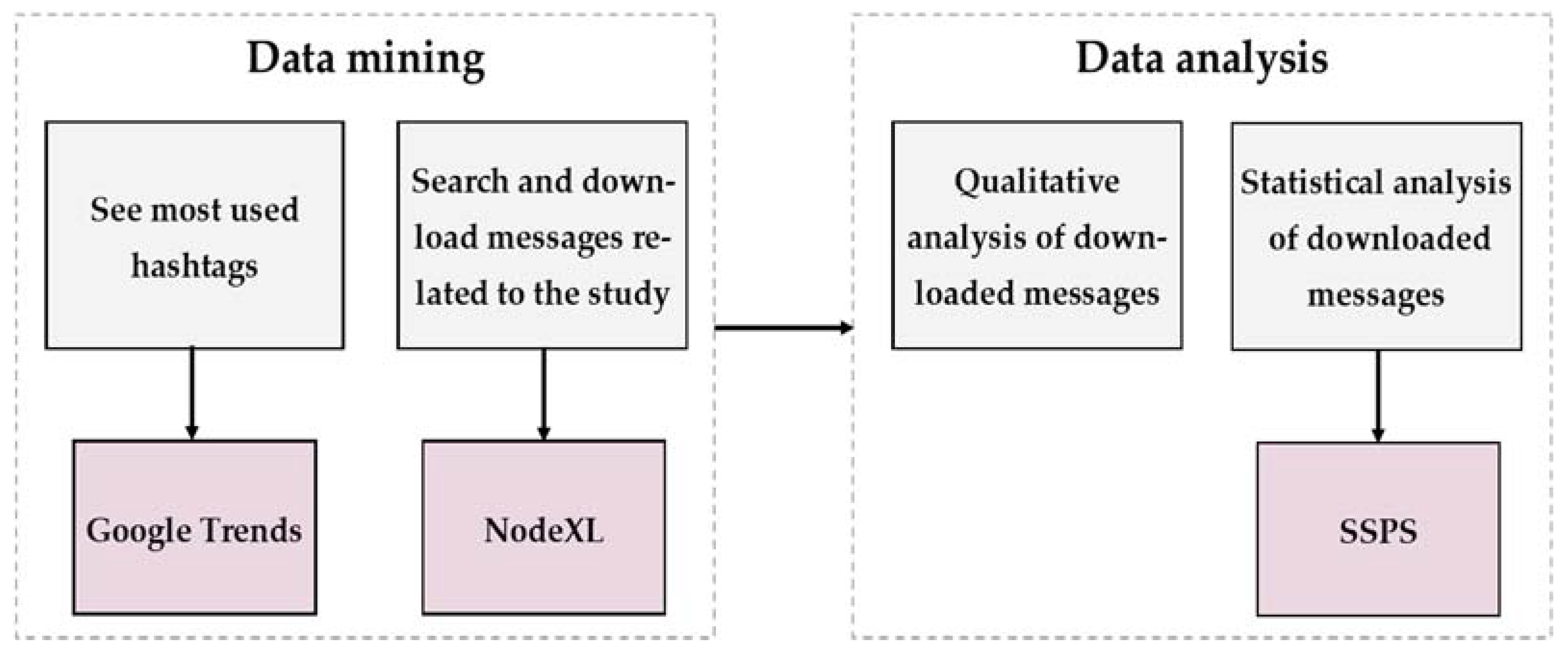
2.2. Data Collection
2.3. Data Analysis
3. Results
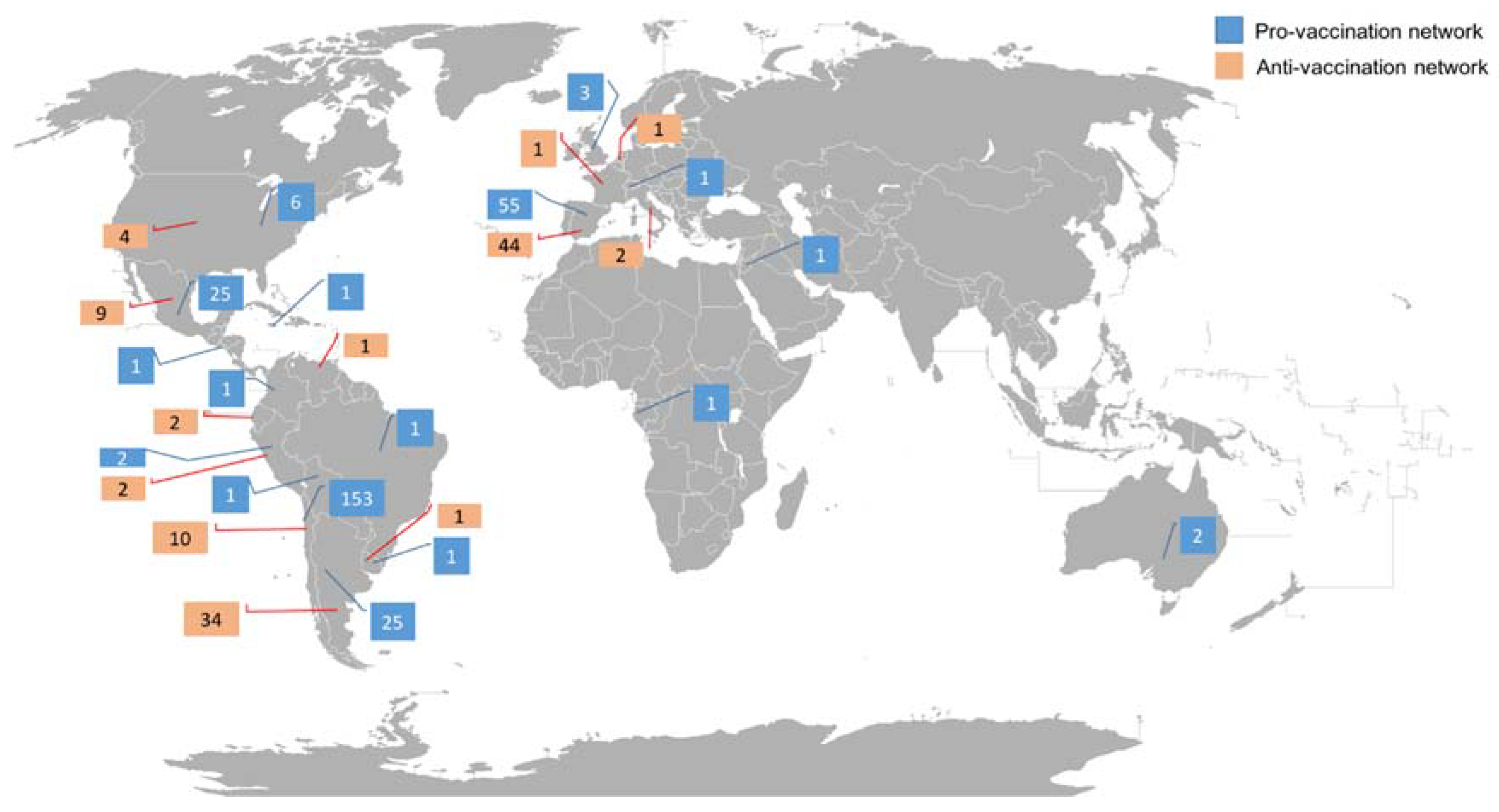
3.1. User Analysis of Pro and Anti-Vaccination Networks
3.2. Behavior of Pro-Vaccination and Anti-Vaccination Networks
3.3. Influence of Bots and Content Analysis
4. Discussion
5. Conclusions
Author Contributions
Funding
Institutional Review Board Statement
Informed Consent Statement
Data Availability Statement
Conflicts of Interest
References
- Coelho, C.M.; Suttiwan, P.; Arato, N.; Zsido, A.D.N. On the nature of fear and anxiety triggered by COVID-19. Front. Psychol. 2020, 11, 581314. [Google Scholar] [CrossRef] [PubMed]
- Secosan, I.; Virga, D.; Crainiceanu, Z.P.; Bratu, L.M.; Bratu, T. Infodemia: Another Enemy for Romanian Frontline Healthcare Workers to Fight during the COVID-19 Outbreak. Medicina 2020, 56, 679. [Google Scholar] [CrossRef] [PubMed]
- Mano, R.S. Social media and online health services: A health empowerment perspective to online health information. Comp. Human Behav. 2014, 39, 404–412. [Google Scholar] [CrossRef]
- Zaracostas, J. How to fight an infodemic. World Rep. 2020, 395, 676. [Google Scholar] [CrossRef]
- Greenberg, N.; Docherty, M.; Gnanapragasam, S.; Wesseley, S. Managing mental health challenges faced by healthcare workers during COVID-19 pandemic. BMJ 2020, 368, m1211. [Google Scholar] [CrossRef] [PubMed] [Green Version]
- Scott, R.E.; Mars, M. Behaviour change and e-health-looking broadly: A scoping narrative review. Stud. Health Technol. Inform. 2020, 268, 123–138. [Google Scholar] [PubMed]
- Rovetta, A.; Bhagavathula, A.S. COVID-19-Related Web Search Behaviors and Infodemic Attitudes in Italy: Infodemiological Study. JMIR Public Health Surveill. 2020, 6, e19374. [Google Scholar] [CrossRef] [PubMed]
- Himelein-Wachowiak, M.K.; Giorgi, S.; Devoto, A.; Rahman, M.; Ungar, L.; Schwartz, A.; Epstein, D.H.; Leggio, L.; Curtis, B. Bots and misinformation spread on social media: Implicatons for COVID-19. J. Med. Internet Res. 2021, 5, e269331. [Google Scholar] [CrossRef]
- Ahmed, F.; Abulaish, M. A generic statistical approach for spam detection in Online Social Networks. Comput. Commun. 2013, 36, 1120–1129. [Google Scholar] [CrossRef]
- Subrahmanian, V.; Azaria, A.; Durst, S.; Kagan, V.; Galstyan, A.; Lerman, K.; Zhu, L.; Ferrara, E.; Flammini, A.; Menczer, F. The DARPA Twitter Bot Challenge. Computer 2016, 49, 38–46. [Google Scholar] [CrossRef] [Green Version]
- Xu, W.; Sasahara, K. Characterizing the roles of bots on Twitter during the COVID-19 infodemic. J. Comp. Soc. Sci. 2022, 5, 591–609. [Google Scholar] [CrossRef] [PubMed]
- Broniatowski, D.A.; Jamison, A.M.; Qi, S.; AlKulaib, L.; Chen, T.; Benton, A.; Quinn, S.C.; Dredze, M. Weaponized health communication: Twitter bots and Russian trolls amplify the vaccine debate. Am. J. Public Health 2018, 108, 1378–1384. [Google Scholar] [CrossRef] [PubMed]
- Dunn, A.G.; Surian, D.; Dalmazzo, J.; Rezazadegan, D.; Steffens, M.; Dyda, A.; Leask, J.; Coiera, E.; Dey, A.; Mandl, K.D. Limited role of bots in spreading vaccine-critical information among active twitter users in the United States:2017–2019. Am. J. Public Health 2020, 110, S319–S325. [Google Scholar] [CrossRef] [PubMed]
- Rauchfleisch, A.; Kaiser, J. The false positive problem of atomatic bot detection in social science research. PLoS ONE 2020, 15, e0241045. [Google Scholar] [CrossRef]
- Blankenship, E.B.; Goff, M.E.; Yin, J.; Tse, Z.T.H.; Fu, K.-W.; Liang, H.; Saroha, N.; Fung, I.C.-H. Sentiment, contents, and retweets: A study of two vaccine-related twitter datasets. Perm. J. 2018, 22, 17–138. [Google Scholar] [CrossRef] [Green Version]
- Swire-Thompson, B.; Lazer, D. Public Health and online misinformation: Challenges and recommendations. Annu. Rev. Public Health 2020, 41, 413–451. [Google Scholar] [CrossRef] [Green Version]
- Ferrara, E.; Varol, O.; Davis, C.; Menczer, F.; Flammini, A. The rise of social bots. Commun. ACM 2016, 59, 96–104. [Google Scholar] [CrossRef] [Green Version]
- Zhang, J.; Zhang, R.; Zhang, Y.; Yan, G. The Rise of Social Botnets: Attacks and Countermeasures. IEEE Trans. Dependable Secur. Comput. 2018, 15, 1068–1082. [Google Scholar] [CrossRef] [Green Version]
- Starbird, K. Disinfrmation’s spread: Bots, trolls and all of us. Nature 2019, 571, 449. [Google Scholar] [CrossRef] [PubMed]
- Ahmed, W.; Bath, P.; Demartini, G. Using Twitter as a data source: An overview of ethical, legal, and methodological challenge. Adv. Res. Ethics Integr. 2017, 2, 79–107. [Google Scholar] [CrossRef] [Green Version]
- Shi, W.; Yang, J.; Zhang, J.; Wen, S.; Su, J. Social bots’ sentiment engagement in health emergencies: A topic-based analysis of the COVID-19 pandemic discussions on Twitter. Int. J. Environ. Res. Public Health 2020, 17, 8701. [Google Scholar] [CrossRef] [PubMed]
- Jemielniak, D.; Krempovich, Y. An analysis of AstraZeneca COVID-19 vaccine misinformation and fear mongering on Twitter. Public Health 2021, 200, 4–6. [Google Scholar] [CrossRef]
- Sayyadiharikandeh, M.; Onur, V.; Kai-Cheng, Y.; Flammini, A.; Menczer, F. Detection of novel social bots by ensembles of specialized classifiers. In Proceedings of the 29th ACM International Conference on Information & Knowledge Management, 19 October 2020; pp. 2725–2732. [Google Scholar] [CrossRef]
- Clauset, A.; Newman, M.; Moore, C. Finding community structure in very large networks. Phys. Rev. E 2004, 70 (6 Pt 2), 066111. [Google Scholar] [CrossRef] [PubMed] [Green Version]
- Saha, K.; Torous, J.; Ernala, S.K.; Rizuto, C.; Staffordm, A.; De Choudhury, M. A computational study of mental health awareness campaigns on social media. Transl. Behav. Med. 2019, 9, 1197–1207. [Google Scholar] [CrossRef] [PubMed]
- Shao, C.; Ciampaglia, G.L.; Varol, O.; Yang, K.C.; Flammini, A.; Menczer, F. The spread of low-credibiity content by social–bots. Nat. Commun. 2018, 9, 4787. [Google Scholar] [CrossRef] [PubMed] [Green Version]
- Varol, O.; Ferrara, E.; Davos, C.A.; Menczer, F.; Flammini, A. Online Human-Bot interactions: Detection, estimation and characterization. In Proceedings of the Eleventh International AAAI Conference, Montréal, QC, Canada, 15–18 May 2017; pp. 280–290. [Google Scholar]
- Hoffman, B.L.; Colditz, J.B.; Shensa, A.; Wolynn, R.; Tanjea, S.B.; Felter, E.M.; Wolynn, T.; Sidani, J.E. #DoctorSpeakUp: Lessons learned from a pro-vaccine Twitter event. Vaccine 2021, 39, 2684–2691. [Google Scholar] [CrossRef] [PubMed]
- Herrera-Peco, I.; Jiménez-Gómez, B.; Romero Magdalena, C.S.; Deudero, J.J.; García-Puente, M.; Benítez De Gracia, E.; Ruiz Núñez, C. Antivaccine Movement and COVID-19 Negationism: A Content Analysis of Spanish-Written Messages on Twitter. Vaccines 2021, 9, 656. [Google Scholar] [CrossRef]
- Lanius, C.; Weber, R.; MacKenzie, W.I., Jr. Use of bot and content flags to limit the spread of misinformation among social networks: A behaviour and attitude survey. Soc. Netw. Anal. Min. 2020, 11, 32. [Google Scholar] [CrossRef] [PubMed]
- Vosoughi, S.; Roy, D.; Aral, S. The spread of true and false news online. Science 2018, 359, 1146–1151. [Google Scholar] [CrossRef] [PubMed]
- Scannel, D.; Desens, L.; Guadagno, M.; Tra, Y.; Acker, E.; Sheridan, K.; Rosner, M.; Mathieu, J.; Fulk, M. COVID-19 vaccine discourse on Twitter: A content analysis of persuasion techniques, sentiment and mis/disinformation. J. Health Commun. 2021, 26, 443–459. [Google Scholar] [CrossRef]
- Di Gennaro, F.; Murri, R.; Segala, F.V.; Cerruti, L.; Abdulle, A.; Saracino, A.; Bavaro, D.F.; Fantoni, M. Attitudes towards Anti-SARS-CoV2 Vaccination among Healthcare Workers: Results from a National Survey in Italy. Viruses 2021, 13, 371. [Google Scholar] [CrossRef]



| Pro-Vaccination Network | ||||||
|---|---|---|---|---|---|---|
| N | % | Ratio (I/m) | Mean | Comparison Humans-Bots-t Student (p-Value) | ||
| Users | Human | 2421 | 93.73 | |||
| Bots | 162 | 6.27 | ||||
| Total | 2583 | 100 | ||||
| Messages | Human | 4840 | 94 | |||
| Bots | 309 | 6 | ||||
| Total | 5149 | 100 | ||||
| Users’ Interactions | Human | 937,283 | 95.7 | 193.65 | 387.15 | 3.44 (0.04) ** |
| Bots | 42,135 | 4.3 | 136.36 | 260.09 | ||
| Total | 979,418 | 100 | 190.21 | |||
| Users’ impressions | Human | 96,811,449 | 95 | 20,0002.37 | 39,988.207 | 0.323 (0.746) |
| Bots | 4,569,946 | 5 | 15,718.27 | 28,209.543 | ||
| Total | 101,668,395 | 100 | 19,745.27 | |||
| Anti-vaccination network | ||||||
| n | % | Ratio (I/m) | Mean | Comparison Humans-bots-t Student (p-value) | ||
| Users | Human | 4243 | 91 | |||
| Bots | 420 | 9 | ||||
| Total | 4663 | 100 | ||||
| Messages | Human | 70,263 | 90.61 | |||
| Bots | 7280 | 9.39 | ||||
| Total | 77,543 | 100 | ||||
| Users’ Interactions | Human | 93,151 | 95.17 | 1.33 | 21.95 | 4.198 (0.001) ** |
| Bots | 4724 | 4.83 | 0,65 | 11.24 | ||
| Total | 97,875 | 100 | 1.26 | |||
| User’s impressions | Human | 5,571,594,549 | 92.37 | 79,296.28 | 1,313,126.22 | 0.22 (0.826) |
| Bots | 460,521,238 | 7.63 | 63,258.41 | 1,096,479.14 | ||
| Total | 6,032,115,787 | 100 | ||||
| Network | User Code | Description | Bot Score | BSC | Network Activity |
|---|---|---|---|---|---|
| Anti-vaccination | AV1 | Citizen | 0.78 | 16,444.45 | Criticism to government |
| AV2 | Citizen | 0.8 | 16,008.92 | Conspiration: the vaccine as a means to foster genocide | |
| AV3 | Citizen | 0.78 | 15,228.38 | Support to vaccine against COVID-19 | |
| AV4 | Citizen, nonconformist | 0.78 | 14,001.76 | Negationist: neither the virus nor the pandemic does exist | |
| AV5 | Citizen | 0.76 | 13,453.91 | Criticism to government | |
| Pro-vaccination | PV1 | Political activist | 0.84 | 91,7876.41 | Spread of news about vaccines approvals |
| PV2 | Citizen | 0.84 | 160,118.69 | Information about vaccination set-off | |
| PV3 | Political activist | 0.88 | 76,177.66 | Information about vaccination set-off | |
| PV4 | Citizen | 0.8 | 45,713.95 | Approval of vaccines by the European Medication Agency | |
| PV5 | Citizen | 0.78 | 24,801.58 | Spread of positive information on vaccines availability |
| Category | Pro-Vaccination Network | Anti-Vaccination Network |
|---|---|---|
| Political content | 51.85% (84) | 18.6% (78) |
| Vaccine awareness | 11.11% (18) | |
| General tweets not expressing a view or opinion | 29.63% (48) | 33.02% (139) |
| Conspiracy theories | 13.48% (57) | |
| Pandemic negationism | 3.72% (16) | |
| Anti-vaccine tweets | 26.97% (113) | |
| Opposed to main subject of the network | 7.41% (12) | 4.21% (17) |
Publisher’s Note: MDPI stays neutral with regard to jurisdictional claims in published maps and institutional affiliations. |
© 2022 by the authors. Licensee MDPI, Basel, Switzerland. This article is an open access article distributed under the terms and conditions of the Creative Commons Attribution (CC BY) license (https://creativecommons.org/licenses/by/4.0/).
Share and Cite
Ruiz-Núñez, C.; Segado-Fernández, S.; Jiménez-Gómez, B.; Hidalgo, P.J.J.; Magdalena, C.S.R.; Pollo, M.d.C.Á.; Santillán-Garcia, A.; Herrera-Peco, I. Bots’ Activity on COVID-19 Pro and Anti-Vaccination Networks: Analysis of Spanish-Written Messages on Twitter. Vaccines 2022, 10, 1240. https://doi.org/10.3390/vaccines10081240
Ruiz-Núñez C, Segado-Fernández S, Jiménez-Gómez B, Hidalgo PJJ, Magdalena CSR, Pollo MdCÁ, Santillán-Garcia A, Herrera-Peco I. Bots’ Activity on COVID-19 Pro and Anti-Vaccination Networks: Analysis of Spanish-Written Messages on Twitter. Vaccines. 2022; 10(8):1240. https://doi.org/10.3390/vaccines10081240
Chicago/Turabian StyleRuiz-Núñez, Carlos, Sergio Segado-Fernández, Beatriz Jiménez-Gómez, Pedro Jesús Jiménez Hidalgo, Carlos Santiago Romero Magdalena, María del Carmen Águila Pollo, Azucena Santillán-Garcia, and Ivan Herrera-Peco. 2022. "Bots’ Activity on COVID-19 Pro and Anti-Vaccination Networks: Analysis of Spanish-Written Messages on Twitter" Vaccines 10, no. 8: 1240. https://doi.org/10.3390/vaccines10081240
APA StyleRuiz-Núñez, C., Segado-Fernández, S., Jiménez-Gómez, B., Hidalgo, P. J. J., Magdalena, C. S. R., Pollo, M. d. C. Á., Santillán-Garcia, A., & Herrera-Peco, I. (2022). Bots’ Activity on COVID-19 Pro and Anti-Vaccination Networks: Analysis of Spanish-Written Messages on Twitter. Vaccines, 10(8), 1240. https://doi.org/10.3390/vaccines10081240