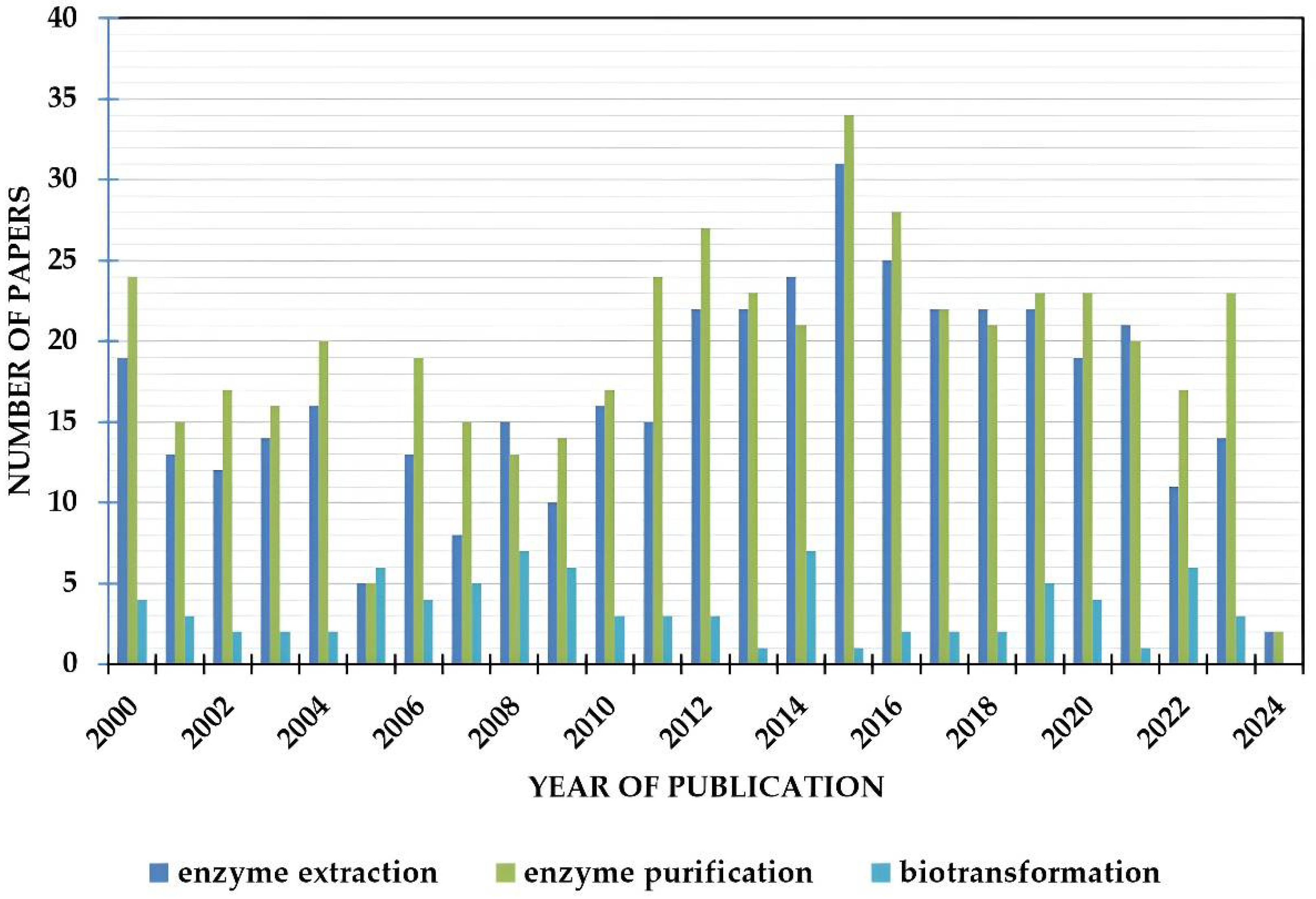
Advancements in Aqueous Two-Phase Systems for Enzyme Extraction, Purification, and Biotransformation


 , ,
, ,  ,
,  ,
,  and
and 
Abstract
1. Introduction
2. Principles of Liquid–Liquid Enzyme Extraction
- (i)
- Enzyme properties such as hydrophobicity, charge, molecular weight, bio-specific affinity, and conformation.
- (ii)
- Phase partitioning system properties such as the polymer molecular weight and concentration, salt types and concentration, system pH, NaCl addition, temperature, and the number of cycles in partitioning [33].
3. Thermodynamics and Equilibrium of ATPS
- (i)
- Polymer/polymer ATPS that can be formed by mixing of (a) two nonionic polymers, (b) one nonionic and an ionic polymer, and (c) two charged polyelectrolytesnate (PSS);
- (ii)
- Polymer/salt ATPS formed by the dissolution of a water-soluble polymer and inorganic (or organic) salt above critical concentrations;
- (iii)
- Salt/salt ATPS;
- (iv)
- Aqueous micellar two-phase systems (AMTPS);
- (v)
- Ionic liquid-based ATPS with polymers, carbohydrates, amino acids;
- (vi)
- Carbohydrate-based ATPS;
- (vii)
- Copolymer-based ATPS;
- (viii)
- ATPS composed of deep eutectic solvents;
- (ix)
- ATPS composed of hydrophilic organic solvents [66].
- (1)
- Substances possessing both donor and acceptor properties, such as molecules with hydroxyl groups (water, alcohols, phenols), amines, and carboxylic acids [84];
- (2)
- Molecules possessing exclusively acceptor properties, such as ethers, ketones, aldehydes, and esters [85];
- (3)
- Substances with donor molecules, such as chloroform, methyl chlorides, and ethylene chlorides [86];
- (4)
- Substances that do not form hydrogen bonds, such as hydrocarbons, chloroform, ethylene chloride, and carbon tetrachloride [87].
4. Enzyme Transfer in ATPS
5. Biotransformations
6. Potential
- (i)
- Strengths: selectivity and efficiency, mild operating conditions, scalability, eco-friendly, cost-effectiveness;
- (ii)
- Weakness: optimization requirements, challenging phase components recovery, limited solvent options, phase separation time;
- (iii)
- Opportunities: Integration with other technologies, applications of ATPS in biotransformations, development of novel phase-forming systems like deep eutectic solvents, tailoring of ATPS for specific industrial application;
- (iv)
- Threats: competition with other purification technologies, economic viability, and disposal of large volumes of phase-forming components still represents environmental concern.
7. Conclusions
Author Contributions
Funding
Institutional Review Board Statement
Informed Consent Statement
Data Availability Statement
Conflicts of Interest
References
- Wang, J.; Fu, G.; Yan, M. Investigation and Analysis of a Hazardous Chemical Accident in the Process Industry: Triggers, Roots, and Lessons Learned. Processes 2020, 8, 477. [Google Scholar] [CrossRef]
- Mandeep; Gupta, G.K.; Liu, H.; Shukla, P. Pulp and Paper Industry–Based Pollutants, Their Health Hazards and Environmental Risks. Curr. Opin. Environ. Sci. Health 2019, 12, 48–56. [Google Scholar] [CrossRef]
- Hill, A.M.; Barber, M.J.; Gotham, D. Estimated Costs of Production and Potential Prices for the WHO Essential Medicines List. BMJ Glob. Health 2018, 3, e000571. [Google Scholar] [CrossRef] [PubMed]
- Zhang, J.; Hu, B. Liquid-Liquid Extraction (LLE). In Separation and Purification Technologies in Biorefineries; Ramaswamy, S., Huang, H., Ramarao, B.V., Eds.; Wiley: New York, NY, USA, 2013; pp. 61–78. ISBN 978-0-470-97796-5. [Google Scholar]
- Janicka, P.; Płotka-Wasylka, J.; Jatkowska, N.; Chabowska, A.; Fares, M.Y.; Andruch, V.; Kaykhaii, M.; Gębicki, J. Trends in the New Generation of Green Solvents in Extraction Processes. Curr. Opin. Green Sustain. Chem. 2022, 37, 100670. [Google Scholar] [CrossRef]
- More, P.R.; Jambrak, A.R.; Arya, S.S. Green, Environment-Friendly and Sustainable Techniques for Extraction of Food Bioactive Compounds and Waste Valorization. Trends Food Sci. Technol. 2022, 128, 296–315. [Google Scholar] [CrossRef]
- Usman, M.; Nakagawa, M.; Cheng, S. Emerging Trends in Green Extraction Techniques for Bioactive Natural Products. Processes 2023, 11, 3444. [Google Scholar] [CrossRef]
- Chemat, F.; Vian, M.A.; Cravotto, G. Green Extraction of Natural Products: Concept and Principles. Int. J. Mol. Sci. 2012, 13, 8615–8627. [Google Scholar] [CrossRef] [PubMed]
- Picot-Allain, C.; Mahomoodally, M.F.; Ak, G.; Zengin, G. Conventional versus Green Extraction Techniques—A Comparative Perspective. Curr. Opin. Food Sci. 2021, 40, 144–156. [Google Scholar] [CrossRef]
- Armenta, S.; Esteve-Turrillas, F.A.; Garrigues, S.; De La Guardia, M. Alternative Green Solvents in Sample Preparation. Green Anal. Chem. 2022, 1, 100007. [Google Scholar] [CrossRef]
- New, E.K.; Tnah, S.K.; Voon, K.S.; Yong, K.J.; Procentese, A.; Yee Shak, K.P.; Subramonian, W.; Cheng, C.K.; Wu, T.Y. The Application of Green Solvent in a Biorefinery Using Lignocellulosic Biomass as a Feedstock. J. Environ. Manag. 2022, 307, 114385. [Google Scholar] [CrossRef]
- Häckl, K.; Kunz, W. Some Aspects of Green Solvents. Comptes Rendus Chim. 2018, 21, 572–580. [Google Scholar] [CrossRef]
- Winterton, N. The Green Solvent: A Critical Perspective. Clean Technol. Environ. Policy 2021, 23, 2499–2522. [Google Scholar] [CrossRef] [PubMed]
- Klotz, M.; Oberschelp, C.; Salah, C.; Subal, L.; Hellweg, S. The Role of Chemical and Solvent-Based Recycling within a Sustainable Circular Economy for Plastics. Sci. Total. Environ. 2024, 906, 167586. [Google Scholar] [CrossRef]
- Clarke, C.J.; Tu, W.-C.; Levers, O.; Bröhl, A.; Hallett, J.P. Green and Sustainable Solvents in Chemical Processes. Chem. Rev. 2018, 118, 747–800. [Google Scholar] [CrossRef] [PubMed]
- Ratti, R. Industrial Applications of Green Chemistry: Status, Challenges and Prospects. SN Appl. Sci. 2020, 2, 263. [Google Scholar] [CrossRef]
- Sampaio, V.S.; Alves, A.N.; De Souza Júnior, E.C.; Veríssimo, L.A.A.; De Souza Castro, S.; Da Costa Ilhéu Fontan, R.; Veloso, C.M.; Ferrão, S.P.B.; Bonomo, R.C.F. Thermodynamic Modeling of Aqueous Two-Phase Systems Composed of Macromolecules and Sulfate Salts at pH 2.0. J. Chem. Eng. Data 2020, 65, 9–18. [Google Scholar] [CrossRef]
- Khan, B.M.; Cheong, K.-L.; Liu, Y. ATPS: “Aqueous Two-Phase System” as the “Answer to Protein Separation” for Protein-Processing Food Industry. Crit. Rev. Food Sci. Nutr. 2019, 59, 3165–3178. [Google Scholar] [CrossRef] [PubMed]
- Al-Sulaimi, S.; Kushwah, R.; Abdullah Alsibani, M.; El Jery, A.; Aldrdery, M.; Ashraf, G.A. Emerging Developments in Separation Techniques and Analysis of Chiral Pharmaceuticals. Molecules 2023, 28, 6175. [Google Scholar] [CrossRef] [PubMed]
- Vijayaraghavan, P.; Raj, S.R.F.; Vincent, S.G.P. Industrial Enzymes. In Agro-Industrial Wastes as Feedstock for Enzyme Production; Elsevier: Amsterdam, The Netherlands, 2016; pp. 95–110. ISBN 978-0-12-802392-1. [Google Scholar]
- Geow, C.H.; Tan, M.C.; Yeap, S.P.; Chin, N.L. A Review on Extraction Techniques and Its Future Applications in Industry. Eur. J. Lipid Sci. Technol. 2021, 123, 2000302. [Google Scholar] [CrossRef]
- Marappan, S.; Kamaruddin, A.H.; Gonawan, F.N. Formation of Aqueous Two-Phase Systems Using Potassium Salt and Deep Eutectic Mixtures for Extraction of Proteins. Chem. Eng. Technol. 2023, 46, 2497–2503. [Google Scholar] [CrossRef]
- Dumas, F.; Roger, E.; Rodriguez, J.; Benyahia, L.; Benoit, J.-P. Aqueous Two-Phase Systems: Simple One-Step Process Formulation and Phase Diagram for Characterisation. Colloid Polym. Sci. 2020, 298, 1629–1636. [Google Scholar] [CrossRef]
- Singla, M.; Sit, N. Theoretical Aspects and Applications of Aqueous Two-Phase Systems. Chem. Bio. Eng. Rev. 2023, 10, 65–80. [Google Scholar] [CrossRef]
- Wessner, M.; Meier, M.; Bommarius, B.; Bommarius, A.S.; Brandenbusch, C. Intensifying Aqueous Two-Phase Extraction by Adding Decisive Excipients for Enhancement of Stability and Solubility of Biomolecules. Chem. Eng. Process.-Process Intensif. 2021, 167, 108534. [Google Scholar] [CrossRef]
- Chao, Y.; Shum, H.C. Emerging Aqueous Two-Phase Systems: From Fundamentals of Interfaces to Biomedical Applications. Chem. Soc. Rev. 2020, 49, 114–142. [Google Scholar] [CrossRef] [PubMed]
- Yau, Y.K.; Ooi, C.W.; Ng, E.-P.; Lan, J.C.-W.; Ling, T.C.; Show, P.L. Current Applications of Different Type of Aqueous Two-Phase Systems. Bioresour. Bioprocess. 2015, 2, 49. [Google Scholar] [CrossRef]
- Singh, S.; Tavana, H. Collagen Partition in Polymeric Aqueous Two-Phase Systems for Tissue Engineering. Front. Chem. 2018, 6, 379. [Google Scholar] [CrossRef] [PubMed]
- Mahdi, H.A.; Hameed, K.W.; Ali, A.-J.A. Application of Aqueous Two-Phase Systems in the Extraction of Bovine Serum Albumin. J. Polym. Compos. 2023, 11, 55–65. [Google Scholar] [CrossRef]
- Buarque, F.; Gautério, G.; Coelho, M.; Lemes, A.; Ribeiro, B. Aqueous Two-Phase Systems Based on Ionic Liquids and Deep Eutectic Solvents as a Tool for the Recovery of Non-Protein Bioactive Compounds—A Review. Processes 2022, 11, 31. [Google Scholar] [CrossRef]
- Urkude, R.; Dhurvey, V.; Kochhar, S. Pesticide Residues in Beverages. In Quality Control in the Beverage Industry; Elsevier: Amsterdam, The Netherlands, 2019; pp. 529–560. ISBN 978-0-12-816681-9. [Google Scholar]
- Kula, M.-R.; Kroner, K.H.; Hustedt, H. Purification of Enzymes by Liquid-Liquid Extraction. In Reaction Engineering; Advances in Biochemical Engineering/Biotechnology; Springer: Berlin/Heidelberg, Germany, 1982; Volume 24, pp. 73–118. ISBN 978-3-540-11699-8. [Google Scholar]
- Ketnawa, S.; Rungraeng, N.; Rawdkuen, S. Phase partitioning for enzyme separation: An overview and recent applications. Int. Food Res. J. 2017, 24, 1–24. [Google Scholar]
- Yousefi, N.; Abbasi, S. Food Proteins: Solubility & Thermal Stability Improvement Techniques. Food Chem. Adv. 2022, 1, 100090. [Google Scholar] [CrossRef]
- De Pinho, G.P.; Neves, A.A.; De Queiroz, M.E.L.R.; Silvério, F.O. Optimization of the Liquid–Liquid Extraction Method and Low Temperature Purification (LLE–LTP) for Pesticide Residue Analysis in Honey Samples by Gas Chromatography. Food Control 2010, 21, 1307–1311. [Google Scholar] [CrossRef]
- Yusree, F.I.F.M.; Peter, A.P.; Mohd Nor, M.Z.; Show, P.L.; Mokhtar, M.N. Latest Advances in Protein-Recovery Technologies from Agricultural Waste. Foods 2021, 10, 2748. [Google Scholar] [CrossRef] [PubMed]
- Maurice, A.; Theisen, J.; Gabriel, J.-C.P. Microfluidic Lab-on-Chip Advances for Liquid–Liquid Extraction Process Studies. Curr. Opin. Colloid Interface Sci. 2020, 46, 20–35. [Google Scholar] [CrossRef]
- Yu, S.; Zhang, J.; Li, S.; Chen, Z.; Wang, Y. Mass Transfer and Droplet Behaviors in Liquid-Liquid Extraction Process Based on Multi-Scale Perspective: A Review. Separations 2023, 10, 264. [Google Scholar] [CrossRef]
- Yu, T.; Olsson, E.; Lian, G.; Liu, L.; Huo, F.; Zhang, X.; Cai, Q. Prediction of the Liquid–Liquid Extraction Properties of Imidazolium-Based Ionic Liquids for the Extraction of Aromatics from Aliphatics. J. Chem. Inf. Model. 2021, 61, 3376–3385. [Google Scholar] [CrossRef] [PubMed]
- Mazzola, P.G.; Lopes, A.M.; Hasmann, F.A.; Jozala, A.F.; Penna, T.C.; Magalhaes, P.O.; Rangel-Yagui, C.O.; Pessoa Jr, A. Liquid–Liquid Extraction of Biomolecules: An Overview and Update of the Main Techniques. J. Chem. Technol. Biotechnol. 2008, 83, 143–157. [Google Scholar] [CrossRef]
- Suleman, H.; Maulud, A.S.; Shah, S.N.; Man, Z.; Mutalib, M.I.A. Thermodynamic Modelling of Liquid-Liquid Extraction Systems Involving Ionic Liquids: A New Approach. J. Mol. Liq. 2018, 252, 18–23. [Google Scholar] [CrossRef]
- Kee, P.E.; Ng, T.-C.; Lan, J.C.-W.; Ng, H.-S. Recent development of unconventional aqueous biphasic system: Characteristics, mechanisms and applications. Crit. Rev. Biotechnol. 2020, 40, 555–569. [Google Scholar] [CrossRef]
- Torres-Acosta, M.A.; Pereira, J.F.B.; Freire, M.G.; Aguilar-Yáñez, J.M.; Coutinho, J.A.P.; Titchener-Hooker, N.J.; Rito-Palomares, M. Economic Evaluation of the Primary Recovery of Tetracycline with Traditional and Novel Aqueous Two-Phase Systems. Sep. Purif. Technol. 2018, 203, 178–184. [Google Scholar] [CrossRef]
- Iqbal, M.; Tao, Y.; Xie, S.; Zhu, Y.; Chen, D.; Wang, X.; Huang, L.; Peng, D.; Sattar, A.; Shabbir, M.A.B.; et al. Aqueous Two-Phase System (ATPS): An Overview and Advances in Its Applications. Biol. Proced. Online 2016, 18, 18. [Google Scholar] [CrossRef]
- Wang, C.; Zhang, Z.; Wang, Q.; Wang, J.; Shang, L. Aqueous Two-Phase Emulsions toward Biologically Relevant Applications. Trends Chem. 2023, 5, 61–75. [Google Scholar] [CrossRef]
- Zafarani-Moattar, M.T.; Hamzehzadeh, S. Salting-Out Effect, Preferential Exclusion, and Phase Separation in Aqueous Solutions of Chaotropic Water-Miscible Ionic Liquids and Kosmotropic Salts: Effects of Temperature, Anions, and Cations. J. Chem. Eng. Data 2010, 55, 1598–1610. [Google Scholar] [CrossRef]
- Berton, P.; Kelley, S.P.; Bridges, N.J.; Klingshirn, M.A.; Huddleston, J.G.; Willauer, H.D.; Baldwin, J.W.; Moody, M.L.; Rogers, R.D. Water in Solutions of Chaotropic and Kosmotropic Salts: A Differential Scanning Calorimetry Investigation. J. Chem. Eng. Data 2019, 64, 4781–4792. [Google Scholar] [CrossRef]
- Söğütlü, İ.; Saeed, S.M.; Adil, M.; Yadav, A.; Abdulkareem Mahmood, E.; Saadh, M.J. Extraction of Some Essential Amino Acids Using Aqueous Two-Phase Systems Made by Sugar-Based Deep Eutectic Solvents. RSC Adv. 2023, 13, 19674–19681. [Google Scholar] [CrossRef] [PubMed]
- Raja, S.; Murty, V.R.; Thivaharan, V.; Rajasekar, V.; Ramesh, V. Aqueous Two Phase Systems for the Recovery of Biomolecules –A Review. Sci. Technol. 2012, 1, 7–16. [Google Scholar] [CrossRef]
- Vicente, F.A.; Plazl, I.; Ventura, S.P.M.; Žnidaršič-Plazl, P. Separation and Purification of Biomacromolecules Based on Microfluidics. Green Chem. 2020, 22, 4391–4410. [Google Scholar] [CrossRef]
- Yan, X.; Souza, M.A.; Pontes, M.Z.R.; Vitolo, M.; Pessoa Júnior, A. Liquid-Liquid Extraction of Enzymes by Affinity Aqueous Two-Phase Systems. Braz. Arch. Biol. Technol. 2003, 46, 741–750. [Google Scholar] [CrossRef]
- Rosa, P.A.J.; Azevedo, A.M.; Sommerfeld, S.; Mutter, M.; Aires-Barros, M.R.; Bäcker, W. Application of Aqueous Two-Phase Systems to Antibody Purification: A Multi-Stage Approach. J. Biotechnol. 2009, 139, 306–313. [Google Scholar] [CrossRef] [PubMed]
- Hamta, A.; Dehghani, M.R. Application of Polyethylene Glycol Based Aqueous Two-Phase Systems for Extraction of Heavy Metals. J. Mol. Liq. 2017, 231, 20–24. [Google Scholar] [CrossRef]
- Murari, G.F.; Penido, J.A.; Machado, P.A.L.; Lemos, L.R.D.; Lemes, N.H.T.; Virtuoso, L.S.; Rodrigues, G.D.; Mageste, A.B. Phase Diagrams of Aqueous Two-Phase Systems Formed by Polyethylene Glycol+ammonium Sulfate+water: Equilibrium Data and Thermodynamic Modeling. Fluid Phase Equilibria 2015, 406, 61–69. [Google Scholar] [CrossRef]
- Valavi, M.; Shirazian, S.; Pour, A.F.; Ziary, M. Calculation of the Density and Activity of Water in ATPS Systems for Separation of Biomolecules. J. Solut. Chem. 2013, 42, 1423–1437. [Google Scholar] [CrossRef]
- Andrews, B.A.; Asenjo, J.A. Theoretical and Experimental Evaluation of Hydrophobicity of Proteins to Predict Their Partitioning Behavior in Aqueous Two Phase Systems: A Review. Sep. Sci. Technol. 2010, 45, 2165–2170. [Google Scholar] [CrossRef]
- Lu, Y.; Lu, W.; Wang, W.; Guo, Q.; Yang, Y. Thermodynamic Studies of Partitioning Behavior of Cytochrome c in Ionic Liquid-Based Aqueous Two-Phase System. Talanta 2011, 85, 1621–1626. [Google Scholar] [CrossRef] [PubMed]
- Pessôa Filho, P.A.; Mohamed, R.S. Thermodynamic Modeling of the Partitioning of Biomolecules in Aqueous Two-Phase Systems Using a Modified Flory–Huggins Equation. Process Biochem. 2004, 39, 2075–2083. [Google Scholar] [CrossRef]
- Brígida, A.I.S.; Buarque, F.S.; Nogueira, V.L.R.; Melo, V.M.M.; Guisán, J.M.; Ribeiro, B.D.; Gonçalves, L.R.B.; Coelho, M.A.Z. Partial Purification of Crude Lipase Extract from Yarrowia Lipolytica: Precipitation, Aqueous Two-Phase Systems (ATPS), and Immobilization Methods. Clean. Chem. Eng. 2023, 6, 100105. [Google Scholar] [CrossRef]
- Kim, J.; Shin, H.; Kim, J.; Kim, J.; Park, J. Isolation of High-Purity Extracellular Vesicles by Extracting Proteins Using Aqueous Two-Phase System. PLoS ONE 2015, 10, e0129760. [Google Scholar] [CrossRef] [PubMed]
- Dumas, F.; Benoit, J.-P.; Saulnier, P.; Roger, E. A New Method to Prepare Microparticles Based on an Aqueous Two-Phase System (ATPS), Without Organic Solvents. J. Colloid Interface Sci. 2021, 599, 642–649. [Google Scholar] [CrossRef] [PubMed]
- Buarque, F.S.; Carniel, A.; Ribeiro, B.D.; Coelho, M.A.Z. Selective Enzymes Separation from the Fermentation Broth of Yarrowia Lipolytica Using Aqueous Two-Phase System Based on Quaternary Ammonium Compounds. Sep. Purif. Technol. 2023, 324, 124539. [Google Scholar] [CrossRef]
- Yee, M.F.; Emmel, G.N.; Yang, E.J.; Lee, E.; Paek, J.H.; Wu, B.M.; Kamei, D.T. Ionic Liquid Aqueous Two-Phase Systems for the Enhanced Paper-Based Detection of Transferrin and Escherichia coli. Front. Chem. 2018, 6, 486. [Google Scholar] [CrossRef]
- Reschke, T.; Brandenbusch, C.; Sadowski, G. Modeling Aqueous Two-Phase Systems: III. Polymers and Organic Salts as ATPS Former. Fluid Phase Equilibria 2015, 387, 178–189. [Google Scholar] [CrossRef]
- Velho, P.; Requejo, P.F.; Gómez, E.; Macedo, E.A. Thermodynamic Study of ATPS Involving Ethyl Lactate and Different Inorganic Salts. Sep. Purif. Technol. 2021, 275, 119155. [Google Scholar] [CrossRef]
- Chen, Y.; Liang, X.; Kontogeorgis, G.M. Optimal Design of Aqueous Two-Phase Systems for Biomolecule Partitioning. Ind. Eng. Chem. Res. 2023, 62, 11165–11177. [Google Scholar] [CrossRef]
- Dignon, G.L.; Best, R.B.; Mittal, J. Biomolecular Phase Separation: From Molecular Driving Forces to Macroscopic Properties. Annu. Rev. Phys. Chem. 2020, 71, 53–75. [Google Scholar] [CrossRef] [PubMed]
- Sun, P.; Huang, K.; Lin, J.; Liu, H. Role of Hydrophobic Interaction in Driving the Partitioning of Metal Ions in a PEG-Based Aqueous Two-Phase System. Ind. Eng. Chem. Res. 2018, 57, 11390–11398. [Google Scholar] [CrossRef]
- Dreyer, S.; Salim, P.; Kragl, U. Driving Forces of Protein Partitioning in an Ionic Liquid-Based Aqueous Two-Phase System. Biochem. Eng. J. 2009, 46, 176–185. [Google Scholar] [CrossRef]
- Castrillon, E.D.C.; Coelho, Y.L.; Agudelo, Á.J.P.; Marques, I.A.; Hudson, E.A.; Pires, A.C.S.; Da Silva, L.H.M. Contribution of Different Chemical Groups to the Driving Forces for the Partition of Phenylmethane Dyes in the PEO1500 + MgSO4 + H2O Aqueous Two-Phase System. Fluid Phase Equilibria 2020, 508, 112451. [Google Scholar] [CrossRef]
- Johansson, H.-O.; Karlström, G.; Tjerneld, F.; Haynes, C.A. Driving Forces for Phase Separation and Partitioning in Aqueous Two-Phase Systems. J. Chromatogr. B Biomed. Sci. Appl. 1998, 711, 3–17. [Google Scholar] [CrossRef] [PubMed]
- Pereira, J.F.B.; Coutinho, J.A.P. Aqueous Two-Phase Systems. In Liquid-Phase Extraction; Elsevier: Amsterdam, The Netherlands, 2020; pp. 157–182. ISBN 978-0-12-816911-7. [Google Scholar]
- Bonnassieux, S.; Pandya, R.; Adan Skiba, D.; Degoulange, D.; Petit, D.; Seem, P.; Cowburn, R.; Gallant, B.M.; Grimaud, A.J.L. Revisiting the Driving Force Inducing Phase Separation in PEG-Phosphate Aqueous Biphasic Systems. Faraday Discuss. 2024, in press. [Google Scholar] [CrossRef] [PubMed]
- Da Cruz Silva, K.; Abreu, C.S.; Vieira, A.W.; Mageste, A.B.; Rodrigues, G.D.; De Lemos, L.R. Aqueous Two-Phase Systems Formed by Different Phase-Forming Components: Equilibrium Diagrams and Dye Partitioning Study. Fluid Phase Equilibria 2020, 520, 112664. [Google Scholar] [CrossRef]
- Ng, H.S.; Kee, P.E.; Yim, H.S.; Tan, J.S.; Chow, Y.H.; Lan, J.C.-W. Characterization of Alcohol/Salt Aqueous Two-Phase System for Optimal Separation of Gallic Acids. J. Biosci. Bioeng. 2021, 131, 537–542. [Google Scholar] [CrossRef] [PubMed]
- Zhang, X.-H.; Cui, H.-N.; Zheng, J.-J.; Qing, X.-D.; Yang, K.-L.; Zhang, Y.-Q.; Ren, L.-M.; Pan, L.-Y.; Yin, X.-L. Discrimination of the Harvesting Season of Green Tea by Alcohol/Salt-Based Aqueous Two-Phase Systems Combined with Chemometric Analysis. Food Res. Int. 2023, 163, 112278. [Google Scholar] [CrossRef]
- McQueen, L.; Lai, D. Ionic Liquid Aqueous Two-Phase Systems From a Pharmaceutical Perspective. Front. Chem. 2019, 7, 135. [Google Scholar] [CrossRef] [PubMed]
- Kaplanow, I.; Goerzgen, F.; Merz, J.; Schembecker, G. Mass Transfer of Proteins in Aqueous Two-Phase Systems. Sci. Rep. 2019, 9, 3692. [Google Scholar] [CrossRef] [PubMed]
- Ventura, S.P.M.; Sousa, S.G.; Freire, M.G.; Serafim, L.S.; Lima, Á.S.; Coutinho, J.A.P. Design of Ionic Liquids for Lipase Purification. J. Chromatogr. B 2011, 879, 2679–2687. [Google Scholar] [CrossRef] [PubMed]
- Freire, M.G.; Cláudio, A.F.M.; Araújo, J.M.M.; Coutinho, J.A.P.; Marrucho, I.M.; Lopes, J.N.C.; Rebelo, L.P.N. Aqueous Biphasic Systems: A Boost Brought about by Using Ionic Liquids. Chem. Soc. Rev. 2012, 41, 4966. [Google Scholar] [CrossRef] [PubMed]
- e Silva, F.A.; Carmo, R.M.C.; Fernandes, A.P.M.; Kholany, M.; Coutinho, J.A.P.; Ventura, S.P.M. Using Ionic Liquids To Tune the Performance of Aqueous Biphasic Systems Based on Pluronic L-35 for the Purification of Naringin and Rutin. ACS Sustain. Chem. Eng. 2017, 5, 6409–6419. [Google Scholar] [CrossRef]
- Zhao, H. What Do We Learn from Enzyme Behaviors in Organic Solvents Structural? Functionalization of Ionic Liquids for Enzyme Activation and Stabilization. Biotechnol. Adv. 2020, 45, 107638. [Google Scholar] [CrossRef]
- Rente, D.; Paiva, A.; Duarte, A.R. The Role of Hydrogen Bond Donor on the Extraction of Phenolic Compounds from Natural Matrices Using Deep Eutectic Systems. Molecules 2021, 26, 2336. [Google Scholar] [CrossRef] [PubMed]
- Wang, H.; Zhao, Y.; Zhang, F.; Ke, Z.; Han, B.; Xiang, J.; Wang, Z.; Liu, Z. Hydrogen-Bond Donor and Acceptor Cooperative Catalysis Strategy for Cyclic Dehydration of Diols to Access O-Heterocycles. Sci. Adv. 2021, 7, eabg0396. [Google Scholar] [CrossRef]
- Xiao, Z.; Liu, M.; Bi, W.; Chen, D.D.Y. Ionic Liquid as Hydrogen Bond Acceptor in the Extraction of Nutritional Natural Products. Food Chem. 2023, 412, 135589. [Google Scholar] [CrossRef] [PubMed]
- Rakipov, I.T.; Semenov, K.N.; Petrov, A.A.; Akhmadiyarov, A.A.; Khachatrian, A.A.; Gainutdinova, A.Z.; Varfolomeev, M.A. Thermochemistry of Hydrogen Bonding of Ethers with Aliphatic Alcohols. Thermochim. Acta 2022, 711, 179203. [Google Scholar] [CrossRef]
- López De La Paz, M.; Ellis, G.; Pérez, M.; Perkins, J.; Jiménez-Barbero, J.; Vicent, C. Carbohydrate Hydrogen-Bonding Cooperativity—Intramolecular Hydrogen Bonds and Their Cooperative Effect on Intermolecular Processes−Binding to a Hydrogen-Bond Acceptor Molecule. Eur. J. Org. Chem. 2002, 2002, 840–855. [Google Scholar] [CrossRef]
- Klecker, C.; Nair, L.S. Matrix Chemistry Controlling Stem Cell Behavior. In Biology and Engineering of Stem Cell Niches; Elsevier: Amsterdam, The Netherlands, 2017; pp. 195–213. ISBN 978-0-12-802734-9. [Google Scholar]
- Choi, Y.H.; Verpoorte, R. Green Solvents for the Extraction of Bioactive Compounds from Natural Products Using Ionic Liquids and Deep Eutectic Solvents. Curr. Opin. Food Sci. 2019, 26, 87–93. [Google Scholar] [CrossRef]
- Moody, M.L.; Huddleston, J.G.; Berton, P.; Zhang, J.; Rogers, R.D. The Effects of pH on the Partitioning of Aromatic Acids in a Polyethylene Glycol/Dextran Aqueous Biphasic System. Sep. Sci. Technol. 2017, 52, 843–851. [Google Scholar] [CrossRef]
- Sarubbo, L.A.; Oliveira, L.A.D.; Porto, A.L.F.; Campos-Takaki, G.M.D.; Tambourgi, E.B. Partition of Proteins in Aqueous Two-Phase Systems Based on Cashew-Nut Tree Gum and Poly(Ethylene Glycol). Braz. Arch. Biol. Technol. 2004, 47, 685–691. [Google Scholar] [CrossRef]
- Ma, L.; Tong, W.; Du, L.; Huang, S.; Wei, J.; Xiao, D. Optimization of an Aqueous Two-Phase System for the Determination of Trace Ethyl Carbamate in Red Wine. J. Food Prot. 2019, 82, 1377–1383. [Google Scholar] [CrossRef] [PubMed]
- Ketnawa, S.; Chaiwut, P.; Rawdkuen, S. Aqueous Two-Phase Extraction of Bromelain from Pineapple Peels (‘Phu Lae’ Cultv.) and Its Biochemical Properties. Food Sci. Biotechnol. 2011, 20, 1219–1226. [Google Scholar] [CrossRef]
- Guo, J.; Xu, S.; Qin, Y.; Li, Y.; Lin, X.; He, C.; Dai, S. The Temperature Influence on the Phase Behavior of Ionic Liquid Based Aqueous Two-Phase Systems and Its Extraction Efficiency of 2-Chlorophenol. Fluid Phase Equilibria 2020, 506, 112394. [Google Scholar] [CrossRef]
- Dobreva, V.; Zhekova, B.; Dobrev, G. Use of Aqueous Two-Phase and Three-Phase Partitioning Systems for Purification of Lipase Obtained in Solid-State Fermentation by Rhizopus arrhizus. Open Biotechnol. J. 2019, 13, 27–36. [Google Scholar] [CrossRef]
- Raja, S.; Murty, V.R. Optimization of Aqueous Two-Phase Systems for the Recovery of Soluble Proteins from Tannery Wastewater Using Response Surface Methodology. J. Eng. 2013, 2013, 217483. [Google Scholar] [CrossRef]
- Fick, C.; Khan, Z.; Srivastava, S. Interfacial Stabilization of Aqueous Two-Phase Systems: A Review. Mater. Adv. 2023, 4, 4665–4678. [Google Scholar] [CrossRef]
- Vishnoi, N.; Dixit, S.; Mishra, J. Microbial Lipases and Their Versatile Applications. In Microbial Enzymes: Roles and Applications in Industries; Arora, N.K., Mishra, J., Mishra, V., Eds.; Microorganisms for Sustainability; Springer: Singapore, 2020; Volume 11, pp. 207–230. ISBN 9789811517099. [Google Scholar]
- Elgharbawy, A.A.; Riyadi, F.A.; Alam, M.Z.; Moniruzzaman, M. Ionic Liquids as a Potential Solvent for Lipase-Catalysed Reactions: A Review. J. Mol. Liq. 2018, 251, 150–166. [Google Scholar] [CrossRef]
- Ventura, S.P.M.; e Silva, F.A.; Quental, M.V.; Mondal, D.; Freire, M.G.; Coutinho, J.A.P. Ionic-Liquid-Mediated Extraction and Separation Processes for Bioactive Compounds: Past, Present, and Future Trends. Chem. Rev. 2017, 117, 6984–7052. [Google Scholar] [CrossRef] [PubMed]
- Souza, R.L.; Lima, R.A.; Coutinho, J.A.P.; Soares, C.M.F.; Lima, A.S. Novel aqueous two-phase systems based on tetrahydrofuran and potassium phosphate buffer for purification of lipase. Process Biochem. 2015, 50, 1459–1467. [Google Scholar] [CrossRef]
- Santos, J.H.; Flores-Santos, J.C.; Meneguetti, G.P.; Rangel-Yagui, C.O.; Coutinho, J.A.; Vitolo, M.; Ventura, S.P.; Pessoa, A. In Situ Purification of Periplasmatic L-asparaginase by Aqueous Two Phase Systems with Ionic Liquids (ILs) as Adjuvants. Biotechnol. Chem. Technol. 2018, 93, 1871–1880. [Google Scholar] [CrossRef]
- Sharma, V.; Joo, J.-U.; Mottafegh, A.; Kim, D.-P. Continuous and Autonomous-Flow Separation of Laccase Enzyme Utilizing Functionalized Aqueous Two-Phase System with Computer Vision Control. Bioresour. Technol. 2024, 403, 130888. [Google Scholar] [CrossRef] [PubMed]
- Jiang, B.; Yue, H.; Fu, X.; Wang, J.; Feng, Y.; Li, D.; Liu, C.; Feng, Z. One-Step High Efficiency Separation of Prolyl Endopeptidase from Aspergillus Niger and Its Application. Int. J. Biol. Macromol. 2024, 271, 132582. [Google Scholar] [CrossRef] [PubMed]
- De Carvalho Batista Muniz, I.; De Oliveira, R.M.; Alves, A.N.; Da Silva, E.C.; Santos, B.S.; De Souza Junior, E.C.; Sampaio, V.S.; Da Costa, A.R.; Bonomo, R.C.F. Partition of Porcine Pancreatic Lipase in ATPS Composed of PEG/Salt and Alcohol/Salt: A Thermodynamic Study. Braz. J. Chem. Eng. 2023, 40, 873–883. [Google Scholar] [CrossRef]
- Baloch, K.A.; Patil, U.; Yesilsu, A.F.; Benjakul, S. Characteristics and Application of Lipase from Asian Seabass Liver Fractionated Using Aqueous Two-Phase Partition Technique for Defatting Fish Skin before Collagen Extraction. Turk. J. Fish. Aquat. Sci. 2023, 23, 1–15. [Google Scholar] [CrossRef]
- Alves, A.N.; Nascimento, P.A.; Fontan, R.D.C.I.; Sousa Júnior, E.C.; Bonomo, P.; Veloso, C.M.; Bonomo, R.C.F. Extraction of Protease from Ora-pro-nobis (Pereskia aculeata Miller) and Partial Purification in Polyethylene Glycol + Sodium Phosphate Aqueous Two-phase System. J. Food Process. Preserv. 2022, 46, e16266. [Google Scholar] [CrossRef]
- Singla, M.; Sit, N. Isolation of Papain from Ripe Papaya Peel Using Aqueous Two-Phase Extraction. Food Meas. Charact. 2023, 17, 1685–1692. [Google Scholar] [CrossRef]
- Akhter, K.; Sadaf, E.; Bibi, A.; Ayyub, J.; Ghous, T.; Akhtar, T. Effective Lipase Purification from Bacillus Cereus NC7401: A Novel Approach Using an Alcohol-/Salt-Based Aqueous Two-Phase System. Chem. Pap. 2023, 78, 963–971. [Google Scholar] [CrossRef]
- Nontawong, B.; Bunchoen, P.; Ratanapongleka, K. Factors Affecting the Partitioning of Peroxidase from Aqueous Two-Phase Extraction. Eng. Technol. Horiz. 2023, 403, 400306. [Google Scholar] [CrossRef]
- Matsumoto, M.; Shinji, F.; Tahara, Y. Extraction of Proteins with Aqueous Two-Phase Systems Formed by Protic Ionic Liquids and Inorganic Salts. Solvent Extr. Res. Dev. Jpn. 2021, 28, 141–148. [Google Scholar] [CrossRef]
- Mendes, M.S.M.; Rosa, M.E.; Coutinho, J.A.P.; Freire, M.G.; e Silva, F.A. Improved Accuracy in Pentraxin-3 Quantification Assisted by Aqueous Biphasic Systems as Serum Pretreatment Strategies. Int. J. Biol. Macromol. 2023, 253, 127540. [Google Scholar] [CrossRef] [PubMed]
- González-Martín, R.; e Silva, F.A.; Trujillo-Rodríguez, M.J.; Díaz Díaz, D.; Lorenzo-Morales, J.; Freire, M.G.; Pino, V. Ionic Liquid-Based Aqueous Biphasic Systems as One-Step Clean-up, Microextraction and Preconcentration Platforms for the Improved Determination of Salivary Biomarkers. Green Chem. 2023, 25, 8544–8557. [Google Scholar] [CrossRef]
- Mahdi, H.A.; Hameed, K.W.; Ali, A.-J.A. Extraction of Bovine Serum Albumin by Aqueous Two-Phase System Using PEG4000/Sodium Citrate and PEG8000/Sodium Phosphate. Alkej 2023, 19, 39–51. [Google Scholar] [CrossRef]
- Patchimpet, J.; Sangkharak, K.; Eiad-ua, A.; Klomklao, S. Thermoseparating Aqueous Two-Phase System for Lipase Recovery and Partitioning from Nile Tilapia Viscera: Biochemical Properties and Effect of Ultrasound. J. Mol. Liq. 2021, 331, 115721. [Google Scholar] [CrossRef]
- Ng, H.S.; Chai, C.X.Y.; Chow, Y.H.; Loh, W.L.C.; Yim, H.S.; Tan, J.S.; Lan, J.C.-W. Direct Recovery of Bacillus Subtilis Xylanase from Fermentation Broth with an Alcohol/Salt Aqueous Biphasic System. J. Biosci. Bioeng. 2018, 125, 585–589. [Google Scholar] [CrossRef]
- Moteshafi, H.; Jabbari, L.; Hashemi, M. Performance of Bacillus Subtilis D3d Xylanase Separated through Optimized Aqueous Two-Phase System in Bio-Bleaching of Sugar Beet Pulp. Process. Saf. Environ. Prot. 2022, 159, 749–756. [Google Scholar] [CrossRef]
- Menegotto, A.L.L.; Fernandes, I.A.; Bucior, D.; Balestieri, B.P.; Colla, L.M.; Abirached, C.; Franceschi, E.; Steffens, J.; Valduga, E. Purification of Protein from Arthrospira Platensis Using Aqueous Two-Phase System Associate with Membrane Separation Process and Evaluation of Functional Properties. J. Appl. Phycol. 2021, 33, 2967–2982. [Google Scholar] [CrossRef]
- Trentini, M.M.S.; Menegotto, A.L.L.; Steffens, J.; Zeni, J.; Backes, G.T.; Dallago, R.M.; Luccio, M.D.; Valduga, E. Recovery of Pectinases from Aspergillus Niger Using Aqueous Two-Phase Systems. Braz. J. Dev. 2020, 6, 47791–47806. [Google Scholar] [CrossRef]
- Solhtalab, M.; Karbalaei-Heidari, H.R.; Absalan, G. Tuning of Hydrophilic Ionic Liquids Concentration: A Way to Prevent Enzyme Instability. J. Mol. Catal. B Enzym. 2015, 122, 125–130. [Google Scholar] [CrossRef]
- Wu, X.; Liu, Y.; Zhao, Y.; Cheong, K.-L. Effect of Salt Type and Alkyl Chain Length on the Binodal Curve of an Aqueous Two-Phase System Composed of Imidazolium Ionic Liquids. J. Chem. Eng. Data 2018, 63, 3297–3304. [Google Scholar] [CrossRef]
- Nunes, J.C.F.; Almeida, M.R.; Faria, J.L.; Silva, C.G.; Neves, M.C.; Freire, M.G.; Tavares, A.P.M. Overview on Protein Extraction and Purification Using Ionic-Liquid-Based Processes. J. Solut. Chem. 2022, 51, 243–278. [Google Scholar] [CrossRef]
- Castro, L.S.; Pereira, P.; Passarinha, L.A.; Freire, M.G.; Pedro, A.Q. Enhanced Performance of Polymer-Polymer Aqueous Two-Phase Systems Using Ionic Liquids as Adjuvants towards the Purification of Recombinant Proteins. Sep. Purif. Technol. 2020, 248, 117051. [Google Scholar] [CrossRef]
- Lee, S.Y.; Khoiroh, I.; Ling, T.C.; Show, P.L. Enhanced Recovery of Lipase Derived from Burkholderia Cepacia from Fermentation Broth Using Recyclable Ionic Liquid/Polymer-Based Aqueous Two-Phase Systems. Sep. Purif. Technol. 2017, 179, 152–160. [Google Scholar] [CrossRef]
- Ventura, S.P.M.; De Barros, R.L.F.; De Pinho Barbosa, J.M.; Soares, C.M.F.; Lima, Á.S.; Coutinho, J.A.P. Production and Purification of an Extracellular Lipolytic Enzyme Using Ionic Liquid-Based Aqueous Two-Phase Systems. Green Chem. 2012, 14, 734. [Google Scholar] [CrossRef]
- Pereira, M.M.; Pedro, S.N.; Quental, M.V.; Lima, Á.S.; Coutinho, J.A.P.; Freire, M.G. Enhanced Extraction of Bovine Serum Albumin with Aqueous Biphasic Systems of Phosphonium- and Ammonium-Based Ionic Liquids. J. Biotechnol. 2015, 206, 17–25. [Google Scholar] [CrossRef]
- Papadopoulou, A.A.; Tzani, A.; Alivertis, D.; Katsoura, M.H.; Polydera, A.C.; Detsi, A.; Stamatis, H. Hydroxyl Ammonium Ionic Liquids as Media for Biocatalytic Oxidations. Green Chem. 2016, 18, 1147–1158. [Google Scholar] [CrossRef]
- Nascimento, M.B.D.; Castro, S.D.S.; Veloso, C.M.; Fontan, R.D.C.I.; Nascimento, D.J.S.D.; Gandolfi, O.R.R.; Sampaio, V.S.; Veríssimo, L.A.A.; Bonomo, R.C.F. Equilibrium Data and Thermodynamic Studies of α-Amylase Partition in Aqueous Two-Phase Systems. Fluid Phase Equilibria 2018, 463, 69–79. [Google Scholar] [CrossRef]
- Phong, W.N.; Le, C.F.; Show, P.L.; Chang, J.; Ling, T.C. Extractive Disruption Process Integration Using Ultrasonication and an Aqueous Two-phase System for Protein Recovery from Chlorella sorokiniana. Eng. Life Sci. 2017, 17, 357–369. [Google Scholar] [CrossRef] [PubMed]
- Mehrnoush, A.; Mustafa, S.; Sarker, M.Z.I.; Yazid, A.M.M. Optimization of Serine Protease Purification from Mango (Mangifera indica Cv. Chokanan) Peel in Polyethylene Glycol/Dextran Aqueous Two Phase System. Int. J. Mol. Sci. 2012, 13, 3636–3649. [Google Scholar] [CrossRef] [PubMed]
- Dong, L.; Wan, J.; Cao, X. Separation of Transglutaminase Using Aqueous Two-Phase Systems Composed of Two pH-Response Polymers. J. Chromatogr. A 2018, 1555, 106–112. [Google Scholar] [CrossRef] [PubMed]
- Tapadar, R.; Nandi, M.; Chatterjee, R.; Mukherjee, K.; Majumder, K. Aqueous two phase system based downstream processing of endo-1, 4 b-d-xylanse from culture filtrate of aspergillus niger. Glob. J. Biochem. Biotechnol. 2019, 8, 168–173. [Google Scholar]
- Mutalib, F.A.A.; Jahim, J.M.; Bakar, F.D.A.; Mohammad, A.W.; Hassan, O. Characterisation of New Aqueous Two-Phase Systems Comprising of Dehypon® LS54 and K4484® Dextrin for Potential Cutinase Recovery. Sep. Purif. Technol. 2014, 123, 183–189. [Google Scholar] [CrossRef]
- Cardoso, S.L.; De Freitas, M.M.; De Souza, P.M.; Homem-de-Mello, M.; Silveira, D.; Fonseca-Bazzo, Y.M.; Filho, E.X.; Junior, A.P.; Magalhães, P.O. Optimization of Aqueous Two-Phase Micellar System for Partial Purification of L-Asparaginase from Penicillium Sp. Grown in Wheat Bran as Agro-Industrial Residue. Braz. J. Microbiol. 2020, 51, 979–988. [Google Scholar] [CrossRef] [PubMed]
- Temkov, M.; Strinska, H.; Dobrev, G.; Velickova, E.; Muresan, V.; Krastanov, A. Purification of Bacterial Inulinase in Aqueous Two-phase Systems. Eng. Life Sci. 2018, 18, 840–850. [Google Scholar] [CrossRef] [PubMed]
- Passos, H.; Tavares, D.J.P.; Ferreira, A.M.; Freire, M.G.; Coutinho, J.A.P. Are Aqueous Biphasic Systems Composed of Deep Eutectic Solvents Ternary or Quaternary Systems? ACS Sustain. Chem. Eng. 2016, 4, 2881–2886. [Google Scholar] [CrossRef]
- Farias, F.O.; Sosa, F.H.B.; Igarashi-Mafra, L.; Coutinho, J.A.P.; Mafra, M.R. Study of the Pseudo-Ternary Aqueous Two-Phase Systems of Deep Eutectic Solvent (Choline Chloride:Sugars) + K2HPO4 + Water. Fluid Phase Equilibria 2017, 448, 143–151. [Google Scholar] [CrossRef]
- Bowen, H.; Durrani, R.; Delavault, A.; Durand, E.; Chenyu, J.; Yiyang, L.; Lili, S.; Jian, S.; Weiwei, H.; Fei, G. Application of Deep Eutectic Solvents in Protein Extraction and Purification. Front. Chem. 2022, 10, 912411. [Google Scholar] [CrossRef] [PubMed]
- Domínguez De María, P.; Guajardo, N.; Kara, S. Enzyme Catalysis: In DES, with DES, and in the Presence of DES. In Deep Eutectic Solvents; Ramón, D.J., Guillena, G., Eds.; Wiley: New York, NY, USA, 2019; pp. 257–271. ISBN 978-3-527-34518-2. [Google Scholar]
- Xu, P.; Wang, Y.; Chen, J.; Wei, X.; Xu, W.; Ni, R.; Meng, J.; Zhou, Y. Development of Deep Eutectic Solvent-Based Aqueous Biphasic System for the Extraction of Lysozyme. Talanta 2019, 202, 1–10. [Google Scholar] [CrossRef] [PubMed]
- Cai, C.; Ma, S.; Li, F.; Tan, Z. Aqueous Two-Phase System Based on pH-Responsive Polymeric Deep Eutectic Solvent for Efficient Extraction of Aromatic Amino Acids. Food Chem. 2024, 430, 137029. [Google Scholar] [CrossRef] [PubMed]
- Zhuang, D.; Chew, K.W.; Teoh, W.Y.; Al-Maari, M.A.S.; Hizaddin, H.F.; Alharthi, S.; Show, P.L.; Ling, T.C. Extraction of Phycocyanin from Spirulina Using Deep Eutectic Solvent Liquid Biphasic System. J. Taiwan Inst. Chem. Eng. 2023, 151, 105125. [Google Scholar] [CrossRef]
- Pereira, B.A.; Matos, C.T.; Costa, L.; Ferreira, L.M.; Crespo, J.G.; Brazinha, C. Sustainable Processing of Microalgae Protein: Design of Biphasic Partitioning Systems Based on Natural Deep Eutectic Solvents for C-Phycocyanin Recovery from Model Aqueous Solutions. Sep. Purif. Technol. 2025, 353, 128510. [Google Scholar] [CrossRef]
- Han, X.; Li, W.; Ma, X.; Fan, D. Enzymatic Hydrolysis and Extraction of Ginsenoside Recovered from Deep Eutectic Solvent-Salt Aqueous Two-Phase System. J. Biosci. Bioeng. 2020, 130, 390–396. [Google Scholar] [CrossRef]
- Dimitrijević, D.; Bösenhofer, M.; Harasek, M. Liquid–Liquid Phase Separation of Two Non-Dissolving Liquids—A Mini Review. Processes 2023, 11, 1145. [Google Scholar] [CrossRef]
- Sankaran, R.; Show, P.L.; Yap, Y.J.; Lam, H.L.; Ling, T.C.; Pan, G.-T.; Yang, T.C.-K. Sustainable Approach in Recycling of Phase Components of Large Scale Aqueous Two-Phase Flotation for Lipase Recovery. J. Clean. Prod. 2018, 184, 938–948. [Google Scholar] [CrossRef]
- Ventura, S.P.M.; Coutinho, J.A.P. Toward the Recovery and Reuse of the ABS Phase-Forming Components. In Ionic-Liquid-Based Aqueous Biphasic Systems; Freire, M.G., Ed.; Green Chemistry and Sustainable Technology; Springer: Berlin/Heidelberg, Germany, 2016; pp. 285–315. ISBN 978-3-662-52873-0. [Google Scholar]
- Han, J.; Fang, S.; He, X.; Wang, L.; Li, C.; Wu, J.; Cai, Y.; Wang, Y. Combination of Aqueous Two-Phase Flotation and Inverse Transition Cycling: Strategies for Separation and Purification of Recombinant β-Glucosidase from Cell Lysis Solution. Food Chem. 2022, 373, 131543. [Google Scholar] [CrossRef] [PubMed]
- Amid, M.; Manap, M.; Hussin, M.; Mustafa, S. A Novel Aqueous Two Phase System Composed of Surfactant and Xylitol for the Purification of Lipase from Pumpkin (Cucurbita moschata) Seeds and Recycling of Phase Components. Molecules 2015, 20, 11184–11201. [Google Scholar] [CrossRef]
- Lohfink, K.C.; Baumgärtner, K.; Kirsch, M.; Rhein, F.; Diehl, M.; Nirschl, H. Online Monitoring of Continuous Aqueous Two-Phase Flotation (ATPF) for the Development of an Autonomous Control Strategy. Chem. Eng. Sci. 2024, 297, 120287. [Google Scholar] [CrossRef]
- Cutshaw, A.; Frost, H.; Uludag-Demirer, S.; Liu, Y.; Liao, W. Protein Extraction, Precipitation, and Recovery from Chlorella Sorokiniana Using Mechanochemical Methods. Energies 2023, 16, 4809. [Google Scholar] [CrossRef]
- Saddique, H.; Aasim, M.; Nawab, S.; Bibi, N.S.; Muhammad, N.; Qasim, M. Aqueous Two-Phase Systems for the Isolation and Partial Purification of Lipases from Soil Bacteria. Iran. J. Chem. Chem. Eng. 2020, 39, 281–292. [Google Scholar] [CrossRef]
- Kurkal, V.; Daniel, R.M.; Finney, J.L.; Tehei, M.; Dunn, R.V.; Smith, J.C. Enzyme Activity and Flexibility at Very Low Hydration. Biophys. J. 2005, 89, 1282–1287. [Google Scholar] [CrossRef]
- Pavlovic, M.; Plucinski, A.; Zhang, J.; Antonietti, M.; Zeininger, L.; Schmidt, B.V.K.J. Cascade Kinetics in an Enzyme-Loaded Aqueous Two-Phase System. Langmuir 2020, 36, 1401–1408. [Google Scholar] [CrossRef]
- Mendonça, C.M.N.; Veríssimo, N.V.; Pereira, W.A.; Cunha, P.M.; Vitolo, M.; Converti, A.; Kurnia, K.A.; Segato, F.; De Azevedo, P.O.S.; Freire, M.G.; et al. Use of Tunable Copolymers in Aqueous Biphasic Systems for Extractive Bioconversion Aimed at Continuous Fructooligosaccharide Production. ACS Sustain. Chem. Eng. 2023, 11, 880–893. [Google Scholar] [CrossRef]
- Muñiz-Mouro, A.; Ferreira, A.M.; Coutinho, J.A.P.; Freire, M.G.; Tavares, A.P.M.; Gullón, P.; González-García, S.; Eibes, G. Integrated Biocatalytic Platform Based on Aqueous Biphasic Systems for the Sustainable Oligomerization of Rutin. ACS Sustain. Chem. Eng. 2021, 9, 9941–9950. [Google Scholar] [CrossRef]
- Jin, S.; Yang, B.; Cheng, Y.; Tan, J.; Kuang, H.; Fu, Y.; Bai, X.; Xie, H.; Gao, Y.; Lv, C.; et al. Improvement of Resveratrol Production from Waste Residue of Grape Seed by Biotransformation of Edible Immobilized Aspergillus Oryzae Cells and Negative Pressure Cavitation Bioreactor Using Biphasic Ionic Liquid Aqueous System Pretreatment. Food Bioprod. Process. 2017, 102, 177–185. [Google Scholar] [CrossRef]
- Tanimura, K.; Suga, K.; Okamoto, Y.; Umakoshi, H. Enzymatic Hydrolysis of Cellulose Recovered from Ionic Liquid-Salt Aqueous Two-Phase System. J. Biosci. Bioeng. 2020, 129, 624–631. [Google Scholar] [CrossRef]
- Xie, K.; Wan, J.; Cao, X. Enzymatic Synthesis of Cefprozil Based on an EO20PO80/Water Aqueous Two-Phase System and Its Purification. Process Biochem. 2024, 136, 81–89. [Google Scholar] [CrossRef]
- Lukito, B.R.; Wang, Z.; Sundara Sekar, B.; Li, Z. Production of (R)-Mandelic Acid from Styrene, L-Phenylalanine, Glycerol, or Glucose via Cascade Biotransformations. Bioresour. Bioprocess. 2021, 8, 22. [Google Scholar] [CrossRef] [PubMed]
- Zhang, Y.; Luo, Y.; Zhao, J.; Zheng, W.; Zhan, J.; Zheng, H.; Luo, F. Emerging Delivery Systems Based on Aqueous Two-Phase Systems: A Review. Acta Pharm. Sin. B 2024, 14, 110–132. [Google Scholar] [CrossRef] [PubMed]
- Asenjo, J.A.; Andrews, B.A. Aqueous Two-Phase Systems for Protein Separation: A Perspective. J. Chromatogr. A 2011, 1218, 8826–8835. [Google Scholar] [CrossRef] [PubMed]
- Dreyer, S.E. Aqueous Two-Phase Extraction of Proteins and Enzymes Using Tetraalkylammonium-Based Ionic Liquids. Ph.D. Thesis, Rostock University, Rostock, Germany, 2009. [Google Scholar] [CrossRef]
- Vobecká, L.; Romanov, A.; Slouka, Z.; Hasal, P.; Přibyl, M. Optimization of Aqueous Two-Phase Systems for the Production of 6-Aminopenicillanic Acid in Integrated Microfluidic Reactors-Separators. New Biotechnol. 2018, 47, 73–79. [Google Scholar] [CrossRef] [PubMed]
- Glyk, A.; Solle, D.; Scheper, T.; Beutel, S. Optimization of PEG–Salt Aqueous Two-Phase Systems by Design of Experiments. Chemom. Intell. Lab. Syst. 2015, 149, 12–21. [Google Scholar] [CrossRef]
- Torres-Acosta, M.A.; Mayolo-Deloisa, K.; González-Valdez, J.; Rito-Palomares, M. Aqueous Two-Phase Systems Scale: Challenges and Opportunities. Biotechnol. J. 2019, 14, 1800117. [Google Scholar] [CrossRef] [PubMed]
- Li, M.; Kim, J.-W.; Peeples, T.L. Amylase Partitioning and Extractive Bioconversion of Starch Using Thermoseparating Aqueous Two-Phase Systems. J. Biotechnol. 2002, 93, 15–26. [Google Scholar] [CrossRef] [PubMed]
- Chen, J.; Ding, Z.; Pan, H.; Cao, X. Development of pH-Responsive Polymer and Citrate Aqueous Two-Phase System for Extractive Bioconversion of Cefprozil. Talanta 2017, 174, 256–264. [Google Scholar] [CrossRef]
- Ng, H.S.; Ooi, C.W.; Mokhtar, M.N.; Show, P.L.; Ariff, A.; Tan, J.S.; Ng, E.-P.; Ling, T.C. Extractive Bioconversion of Cyclodextrins by Bacillus Cereus Cyclodextrin Glycosyltransferase in Aqueous Two-Phase System. Bioresour. Technol. 2013, 142, 723–726. [Google Scholar] [CrossRef][Green Version]
- Lin, Y.K.; Show, P.L.; Yap, Y.J.; Ariff, A.B.; Mohammad Annuar, M.S.; Lai, O.M.; Tang, T.K.; Juan, J.C.; Ling, T.C. Production of γ-Cyclodextrin by Bacillus Cereus Cyclodextrin Glycosyltransferase Using Extractive Bioconversion in Polymer-Salt Aqueous Two-Phase System. J. Biosci. Bioeng. 2016, 121, 692–696. [Google Scholar] [CrossRef]
- Chew, P.L.; Annuar, M.S.M.; Show, P.L.; Ling, T.C. Extractive Bioconversion of Poly-ϵ-Caprolactone by Burkholderia Cepacia Lipase in an Aqueous Two-Phase System. Biochem. Eng. J. 2015, 101, 9–17. [Google Scholar] [CrossRef]
- Li, X.; Lian, Z.; Dong, B.; Xu, Y.; Yong, Q.; Yu, S. Extractive Bioconversion of Xylan for Production of Xylobiose and Xylotriose Using a PEG6000/Sodium Citrate Aqueous Two-Phase System. Korean J. Chem. Eng. 2011, 28, 1897–1901. [Google Scholar] [CrossRef]
- Bussamra, B.C.; Meerman, P.; Viswanathan, V.; Mussatto, S.I.; Carvalho Da Costa, A.; Van Der Wielen, L.; Ottens, M. Enzymatic Hydrolysis of Sugarcane Bagasse in Aqueous Two-Phase Systems (ATPS): Exploration and Conceptual Process Design. Front. Chem. 2020, 8, 587. [Google Scholar] [CrossRef] [PubMed]
- Selber, K.; Tjerneld, F.; Collén, A.; Hyytiä, T.; Nakari-Setälä, T.; Bailey, M.; Fagerström, R.; Kan, J.; Van Der Laan, J.; Penttilä, M.; et al. Large-Scale Separation and Production of Engineered Proteins, Designed for Facilitated Recovery in Detergent-Based Aqueous Two-Phase Extraction Systems. Process Biochem. 2004, 39, 889–896. [Google Scholar] [CrossRef]
- Ruiz-Ruiz, F.; Benavides, J.; Rito-Palomares, M. Scaling-up of a B-Phycoerythrin Production and Purification Bioprocess Involving Aqueous Two-Phase Systems: Practical Experiences. Process Biochem. 2013, 48, 738–745. [Google Scholar] [CrossRef]
- Mathiazakan, P.; Shing, S.Y.; Ying, S.S.; Kek, H.K.; Tang, M.S.Y.; Show, P.L.; Ooi, C.-W.; Ling, T.C. Pilot-Scale Aqueous Two-Phase Floatation for Direct Recovery of Lipase Derived from Burkholderia Cepacia Strain ST8. Sep. Purif. Technol. 2016, 171, 206–213. [Google Scholar] [CrossRef]
- Espitia-Saloma, E.; Vâzquez-Villegas, P.; Rito-Palomares, M.; Aguilar, O. An Integrated Practical Implementation of Continuous Aqueous Two-phase Systems for the Recovery of Human IgG: From the Microdevice to a Multistage Bench-scale Mixer-settler Device. Biotechnol. J. 2016, 11, 708–716. [Google Scholar] [CrossRef]
- Mashhaditafreshi, S.; Haghtalab, A. Study on Drug Separation in Two-Phase Aqueous Systems Using Deep Eutectic Solvent Consisting of Choline Chloride and 1,2 Propanediol. J. Mol. Liq. 2024, 393, 123603. [Google Scholar] [CrossRef]
- Magalhães, F.F.; Tavares, A.P.M.; Freire, M.G. Advances in Aqueous Biphasic Systems for Biotechnology Applications. Curr. Opin. Green Sustain. Chem. 2021, 27, 100417. [Google Scholar] [CrossRef]
- Šalić, A.; Ljubić, A.; Marčinko, T.; Jurinjak Tušek, A.; Cvjetko Bubalo, M.; Tišma, M.; Zelić, B. Shifting the Natural Deep Eutectic Solvent Based Liquid Lipase Extraction from Batch to Continuous for More Efficient Process Performance. J. Clean. Prod. 2023, 405, 136899. [Google Scholar] [CrossRef]
- Božinović, M.; Vičević, R.; Zekić, N.; Šalić, A.; Jurinjak Tušek, A.; Zelić, B. Intensification of Endo-1,4-Xylanase Extraction by Coupling Microextractors and Aqueous Two-Phase System. Processes 2023, 11, 447. [Google Scholar] [CrossRef]
- Raji, F.; Shayesteh, H.; Rahbar-Kelishami, A. YY Microfluidic Polymer/Salt Aqueous Two-Phase System for Optimization of Dye Extraction: Evaluation of Channel Geometry. Sep. Sci. Technol. 2022, 57, 2471–2481. [Google Scholar] [CrossRef]
- Ahmed, T.; Yamanishi, C.; Kojima, T.; Takayama, S. Aqueous Two-Phase Systems and Microfluidics for Microscale Assays and Analytical Measurements. Annual Rev. Anal. Chem. 2021, 14, 231–255. [Google Scholar] [CrossRef]
- Flora, F.C.; Relvas, S.B.; Silva, F.A.E.; Freire, M.G.; Chu, V.; Conde, J.P. Combined Use of Ionic Liquid-Based Aqueous Biphasic Systems and Microfluidic Devices for the Detection of Prostate-Specific Antigen. Biosensors 2023, 13, 334. [Google Scholar] [CrossRef] [PubMed]
- Oliva, R.; Banerjee, S.; Cinar, H.; Winter, R. Modulation of Enzymatic Activity by Aqueous Two-Phase Systems and Pressure–Rivalry between Kinetic Constants. Chem. Commun. 2020, 56, 395–398. [Google Scholar] [CrossRef] [PubMed]
- Mastiani, M.; Firoozi, N.; Petrozzi, N.; Seo, S.; Kim, M. Polymer-Salt Aqueous Two-Phase System (ATPS) Micro-Droplets for Cell Encapsulation. Sci. Rep. 2019, 9, 15561. [Google Scholar] [CrossRef]
- Daradmare, S.; Kim, J.S.; Ganguly, R.; Lee, C.-S. One-Step on-Chip Microfluidic Synthesis of the Hybrid Capsules Using Aqueous Two-Phase System. Front. Sens. 2022, 3, 1040542. [Google Scholar] [CrossRef]
- Puthirasigamany, M.; Hamm, I.; Van Winssen, F.A.; Nikbin, N.; Kreis, P.; Gorak, A.; Zeiner, T. Purification of Biomolecules Combining ATPS and Membrane Chromatography. Food Bioprod. Process. 2014, 92, 152–160. [Google Scholar] [CrossRef]
- Aguilar, O.; Albiter, V.; Serrano-Carreón, L.; Rito-Palomares, M. Direct Comparison between Ion-Exchange Chromatography and Aqueous Two-Phase Processes for the Partial Purification of Penicillin Acylase Produced by E. coli. J. Chromatogr. B 2006, 835, 77–83. [Google Scholar] [CrossRef]
- Vobecká, L.; Tichá, L.; Atanasova, A.; Slouka, Z.; Hasal, P.; Přibyl, M. Enzyme Synthesis of Cephalexin in Continuous-Flow Microfluidic Device in ATPS Environment. Chem. Eng. J. 2020, 396, 125236. [Google Scholar] [CrossRef]
- Meng, S.-X.; Xue, L.-H.; Xie, C.-Y.; Bai, R.-X.; Yang, X.; Qiu, Z.-P.; Guo, T.; Wang, Y.-L.; Meng, T. Enhanced Enzymatic Reaction by Aqueous Two-Phase Systems Using Parallel-Laminar Flow in a Double Y-Branched Microfluidic Device. Chem. Eng. J. 2018, 335, 392–400. [Google Scholar] [CrossRef]
- Jakob, L.; Baust, H.K.; Griesinger, L.; Nirschl, H. Optimized Apparatus Design for Continuous Aqueous Two-Phase Flotation (ATPF). Separations 2023, 10, 511. [Google Scholar] [CrossRef]

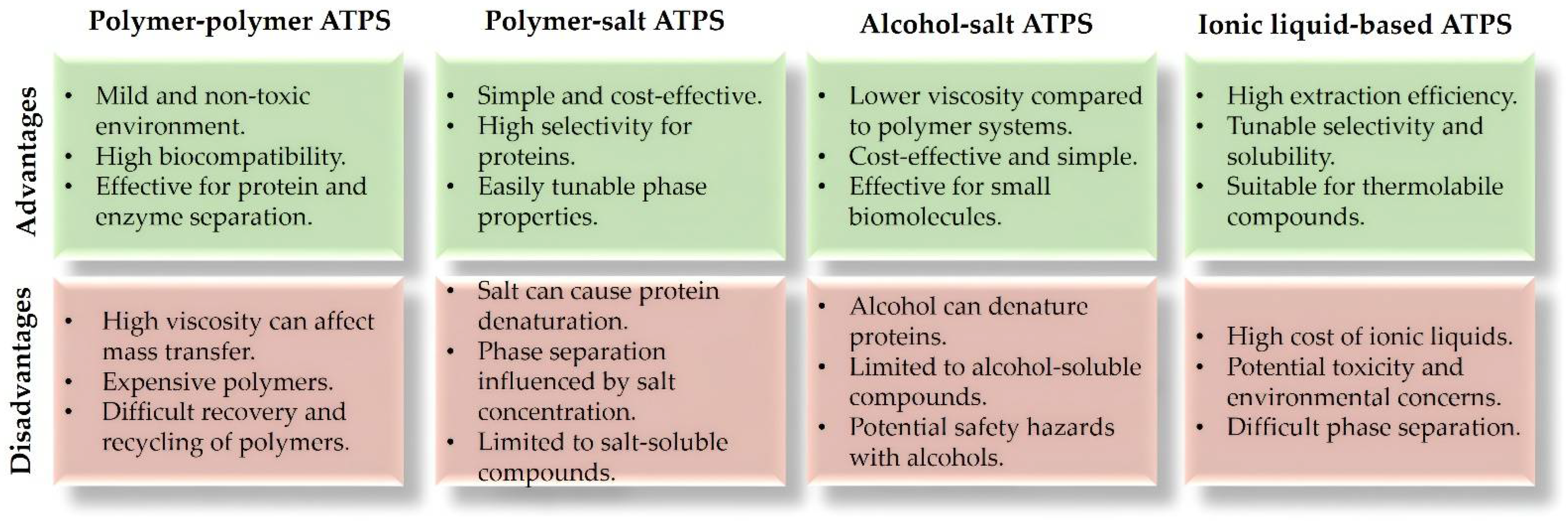
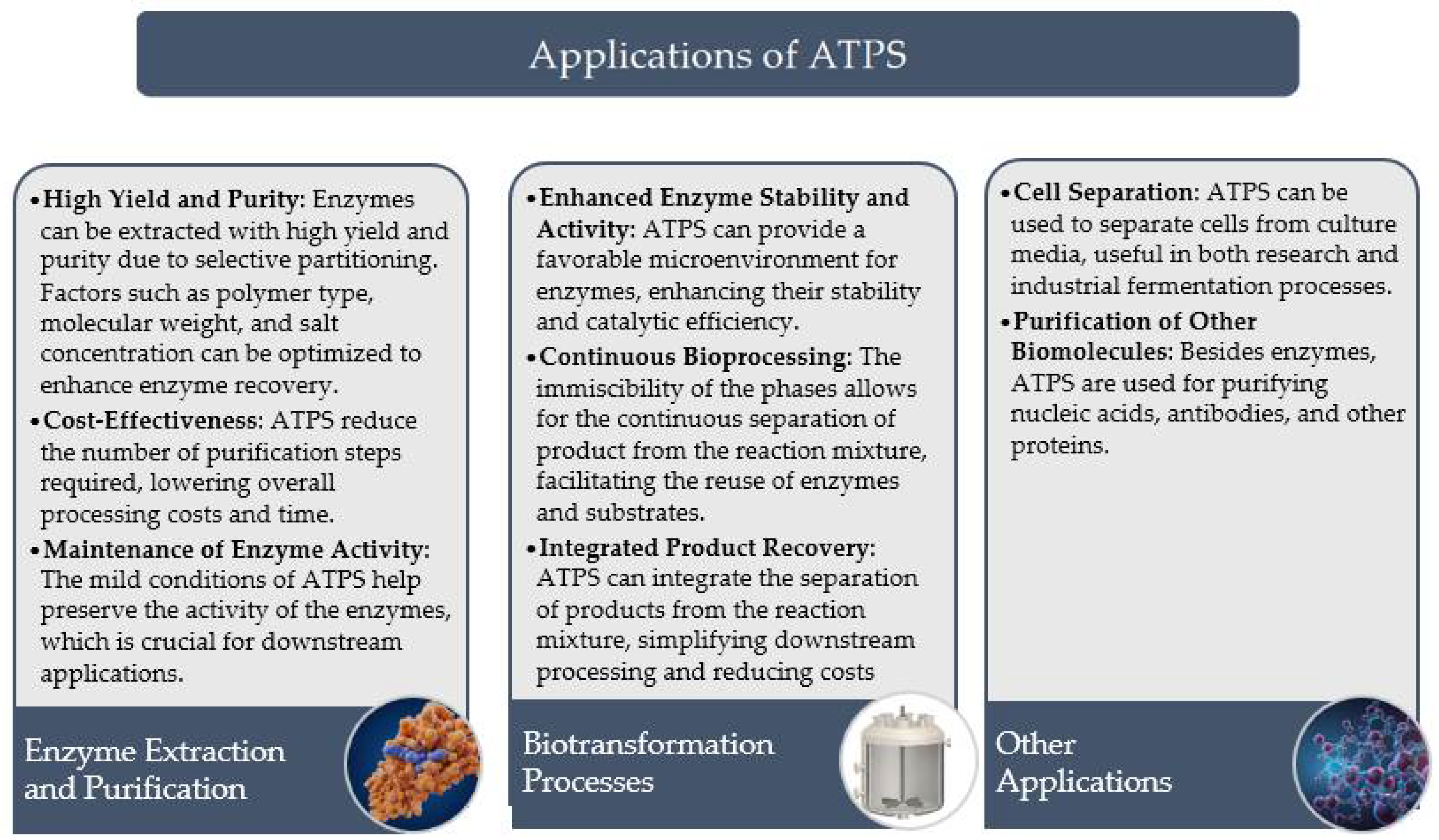
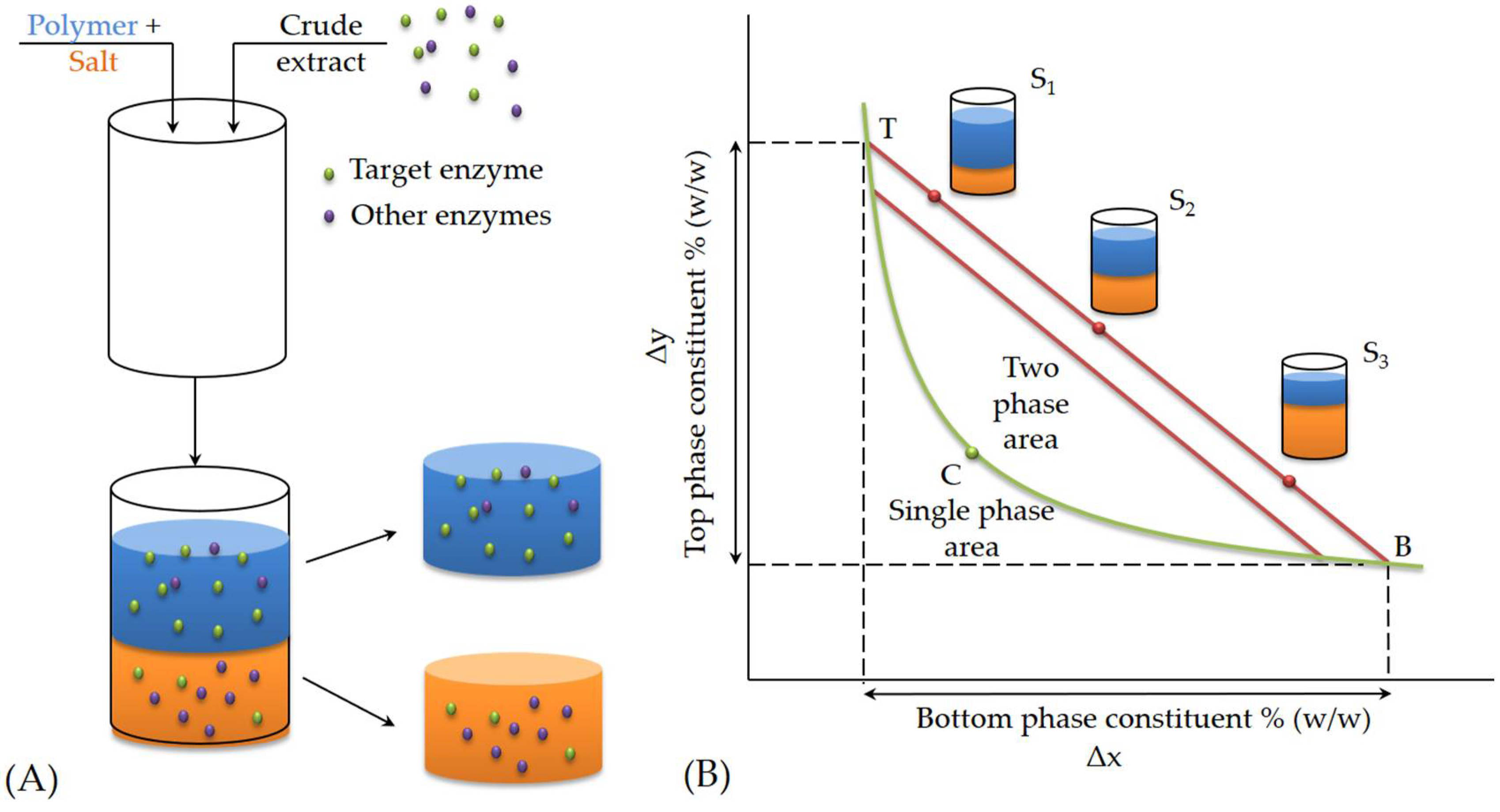
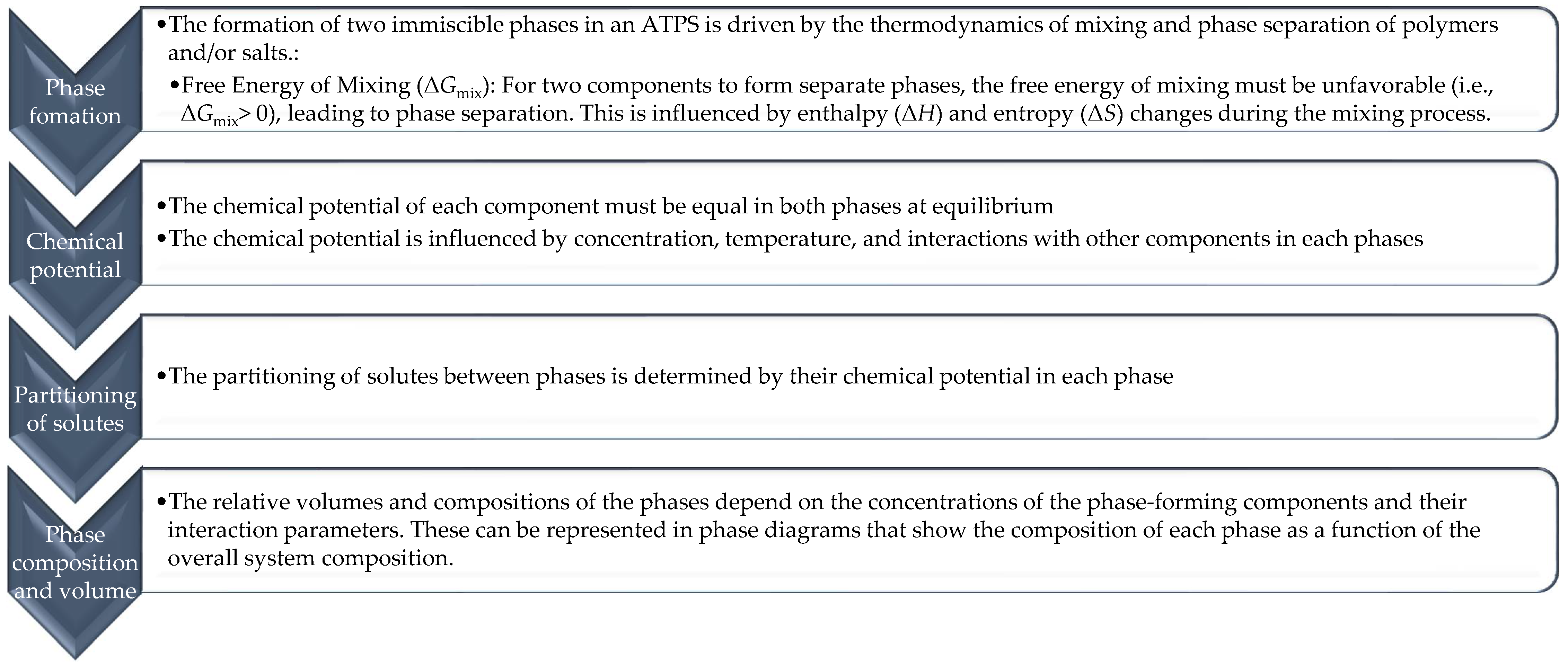
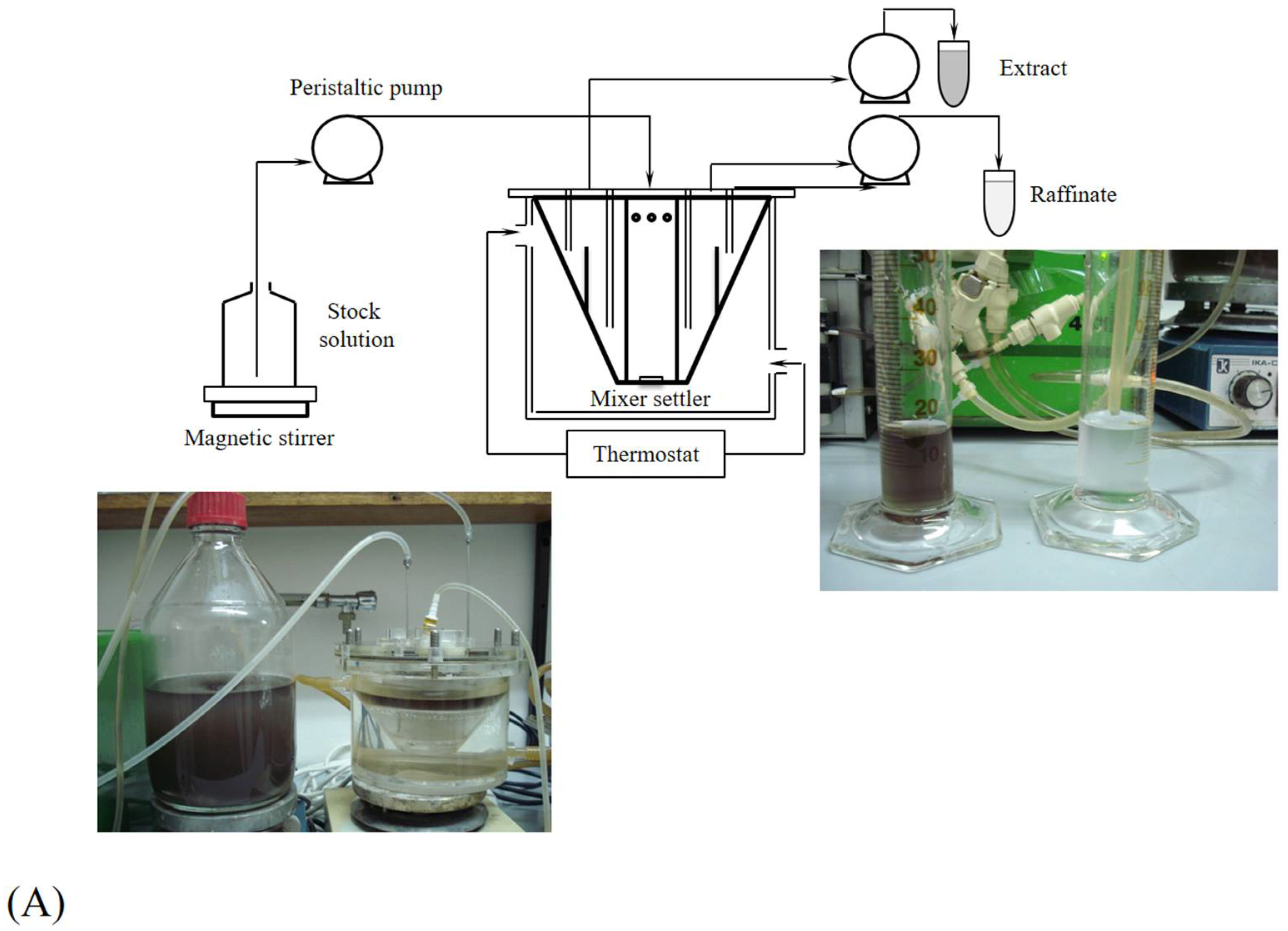
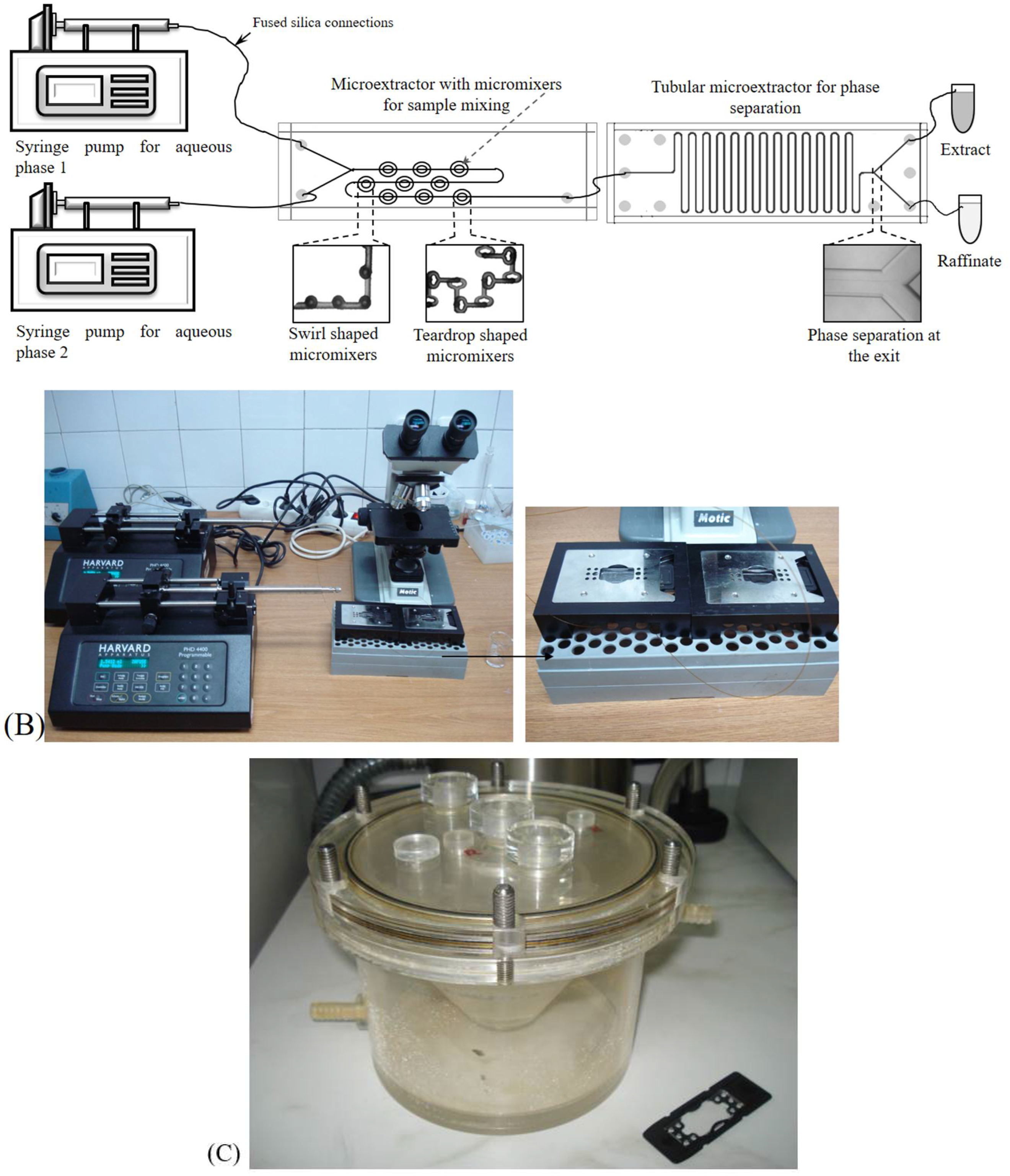

| Aspect | Findings |
|---|---|
| Reduction technique |
|
| Environmental benefits |
|
| Health and safety benefits |
|
| Economic benefits |
|
| Industrial applications |
|
| Key Principle | Key Factor |
|---|---|
| Partition Coefficient | Hydrophobicity/Hydrophilicity: Enzymes with hydrophobic regions may preferentially partition into a phase containing a higher concentration of hydrophobic components (e.g., organic solvents or polymers). Charge: Enzymes with charged amino acid residues can interact with ions in the aqueous phase, influencing their partitioning behavior. Molecular Size and Shape: Larger enzymes or those with specific structural features may exhibit different partitioning behavior due to steric hindrance or interactions with phase components. |
| Phase Composition | Type and Concentration of Solutes: Salts, polymers, or organic solvents in the phase influence the solvation environment and interactions with enzymes. pH and Ionic Strength: pH affects enzyme stability and ionization state, which in turn affects partitioning behavior. |
| Operating Conditions | Temperature: Extraction temperature can influence enzyme stability and phase equilibrium. Generally, milder temperatures are preferred to maintain enzyme activity. Agitation and Mixing: Ensures effective contact between the two phases, promoting mass transfer and equilibration of enzyme distribution. Extraction Time: The duration of extraction affects the extent of partitioning and should be optimized to achieve maximum yield and purity. |
| Selectivity and Specificity | Selective Solubility: Different enzymes have varying affinities for organic solvents, polymers, or aqueous phases based on their structural and chemical properties. Affinity Ligands: In some cases, ligands or affinity agents specific to the enzyme can be incorporated into one phase to enhance selectivity. |
| Recovery and Purification | Separation Techniques: After extraction, methods such as phase separation, centrifugation, or filtration are employed to separate the phases and recover the enzyme. Purity Enhancement: Multiple extraction cycles or additional purification steps may be required to achieve the desired level of purity for specific applications. |
| Type of ATPS | Driving Forces | Reference |
|---|---|---|
| Polymer–polymer | Hydrophobic interactions: Differences in the hydrophobicity of solutes and polymers drive partitioning. Steric exclusion: Larger molecules may preferentially partition into one phase due to steric hindrance. Affinity and solubility: Specific affinity of solutes for one of the polymers influences partitioning. | [71,72] |
| Polymer–salt | Electrostatic interactions: Charge interactions between solutes and salt ions can drive partitioning. Hydration and solubility: Differences in solute hydration and solubility in the polymer and salt-rich phases. Salting out effect: Salts can cause phase separation by reducing solubility of polymers and solutes. | [73,74] |
| Alcohol–salt | Hydrophobic and hydrophilic balance: Partitioning influenced by solute hydrophobicity and alcohol properties. Electrostatic interactions: Interaction of solutes with salt ions. Solvent solubility: Solubility of solutes in alcohol versus salt-rich aqueous phase. | [75,76] |
| Ionic liquid–salt | Electrostatic and ionic Interactions: Strong electrostatic interactions between solutes and ionic liquids or salts. Hydrophobic and hydrophilic balance: Partitioning influenced by solute hydrophobicity and ionic liquid properties. Complex formation: Ionic liquids can form complexes with solutes, affecting partitioning. | [69,77,78] |
| Ionic liquid–polymer | Combination of polymer and ionic liquid interactions: Both hydrophobic and electrostatic interactions play roles. Hydrogen bonding: Interaction of solutes with hydrogen bonding sites in polymers and ionic liquids. Solubility and affinity: Specific solubility and affinity of solutes for either phase. | [69,77,78,79,80,81] |
| Key Variables | Impact | Optimization Strategies | Reference |
|---|---|---|---|
| pH | The pH affects the charge and solubility of both the enzyme and the phase-forming polymers or salts. | Determine the isoelectric point (pI) of the enzyme and adjust the pH to enhance partitioning into the desired phase. Maintain a pH that ensures the enzyme remains in its active and stable form. Perform pH titrations to find the optimal range for maximal partitioning and stability. | [90,91,92] |
| Temperature | Temperature influences enzyme activity, stability, and the phase behavior of the ATPS. | Identify the temperature range where the enzyme is most stable and active. Adjust the temperature to balance enzyme stability with the thermodynamics of phase separation. | [91,92,93,94,95] |
| Concentration of phase-forming components | The concentration of phase-forming components determines the phase separation characteristics and the volume ratio of the phases. | Vary the concentrations of the polymers or salts to achieve a sharp phase separation with a high partition coefficient for the enzyme. Optimize the concentration to minimize enzyme denaturation or inactivation. Use response surface methodology (RSM) to systematically vary concentrations and analyze the effects on enzyme partitioning and stability. | [91,92,95,96] |
| Ionic strength | Ionic strength can affect enzyme solubility, charge interactions, and phase behavior | Adjust the ionic strength to enhance enzyme partitioning into the preferred phase without compromising stability. Use salts that promote phase separation and increase enzyme stability. Conduct experiments to determine the optimal ionic strength for the specific enzyme and ATPS used. | [49,97] |
| Additives and co-solvents | Additives such as stabilizers, detergents, or co-solvents can enhance enzyme stability and influence partitioning behavior. | Identify additives that protect the enzyme from denaturation and enhance partitioning. Optimize the concentration of additives to achieve the desired balance between stability and partitioning efficiency. Test different additives and co-solvents in small-scale experiments to identify the most effective ones. | [95,96] |
| ATPS | Enzyme/Protein | Source | Extraction Efficiency | Reference |
|---|---|---|---|---|
| polyethylene glycol (PEG 4000, 6000, and 10,000) and ammonium sulfate (6.60%, 7.26%, 7.92%, and 8.26%) | lipase | Bacillus strain isolated from soil | Optimal extraction conditions to ensure maximum efficiency were 12.5% PEG 10,000 and 7.92% ammonium sulfate. In the top phase (rich in PEG), 78.3% of the lipase was recovered. | [101] |
| ATPS based on polyethylene glycol and citrate buffer, with ionic liquids (ILs) as adjuvants | L-asparaginase | Escherichia coli | 5% of 1-butyl-3-methylimidazolium methanesulfonate [C4mim][CH3SO3] as adjuvant lead to 87.94 ± 0.03% recovery and specific activity of 3.61 ± 0.38 U/mg protein | [102] |
| ATPS based on tetrabutylammonium bromide, tetrabutylammonium chloride, choline chloride, and betaine + potassium phosphate buffer | lipase and protease | fermentation broth of Yarrowia lipolytica | Extraction efficiencies of 100% for lipase and 96.87% for protease were achieved in a single step using tetrabutylammonium chloride based ATPS. | [62] |
| ATPS based on polyethylene glycol and potassium phosphate functionalized with cysteine | laccase | model solution | 88% extraction efficiency | [103] |
| ATPS containing 16% (w/w) PEG2000 and 15% (w/w) (NH4)2SO4 at pH 6.0 | prolyl endopeptidase | fermentation broth | Enzyme recovery of 79.74% and purification coefficient of 7.64 | [104] |
| PEG (4000 and 6000) + K2HPO4/H3PO4 + water and 2-propanol + K2HPO4/H3PO4 + water in pH 7.0 | lipase | porcine pancreas | The best ATPS for porcine pancreatic lipase partition was composed of 13% of PEG 4000 and 9% of K2HPO4/H3PO4. Described system ensured enzymatic activity of 0.056, theoretical recovery index of 94.655% and purification factor of 4.357. | [105] |
| ammonium sulfate, sodium citrate, sodium sulfate, and magnesium sulfate (10%, 15%, 20%, and 25% w/v) + 15% (w/w) PEG 4000 | lipase | Asian seabass liver | 20% ammonium sulfate (w/v) and 50% PEG-6000 (w/w) ensured 48% lipase yield | [106] |
| PEG 1500 or 4000 and phosphate | protease | ora-pro-nobis | [107] | |
| PEG 6000 + ammonium sulphate and sodium sulphate | papain enzyme (cysteine protease) | papaya peel | PEG 6000 + 18% (w/w) Na2SO4 at pH 9 ensured extraction yield of 26.38% | [108] |
| alcohol-/salt-based aqueous two-phase system | lipase | Bacillus cereus strains isolated from Tagetes minuta root soil | ATPS with xylitol (45% (w/w)) and potassium phosphate (90% (w/w)) ensured the purification factor of 24.14 and yield of 87.71% | [109] |
| PEG (1500 and 6000) + ammonium sulfate, sodium sulfate, dipotassium hydrogen phosphate, and disodium hydrogen phosphate | peroxidase | cabbage | The partition coefficient of the enzyme 15.75 ± 4.07, the percent yield of 97.06 ± 0.71, and the purification factor of 4.86 ± 0.70 times were obtained using of 16% (w/v) ammonium sulfate salt and 25% (w/v) of PEG 1500 | [110] |
| pyrrolidinium formate and propionate + K3PO4 and K2HPO4 | hemoglobin, cytochrome C, α-chymotrypsin and albumin | model solution | ATPS composed of pyrrolidinium formate and K2HPO4 was selected for the protein extraction and distribution rate of proteins was the highest in hemoglobin | [111] |
| PEG (400, 600, 1000, and 2000) or polypropylene glycol (400) or the copolymers (Pluronic PE6200, PE6400 Pluronic L35,UCON (PEG-ran-PPG)+ citrate buffered salt | pentraxin-3 holds | human serum | ABS-TPP formed by PEG 1000 and K3C6H5O7/C6H8O7 allows to simultaneously deplete high abundance serum proteins and completely extract PTX-3 in the polymer-rich top phase | [112] |
| low cytotoxic butylguanidinium chloride ionic liquid and different salts (KH2PO4, K2HPO4, K3PO4) | biomarkers in saliva | human saliva | butylguanidinium chloride and K2HPO4 ATPS ensured extraction efficiencies higher than 80.5% and reduced the limits of detection down to 0.40 ng/mL | [113] |
| PEG 4000 + sodium citrate, and polyethylene glycol 8000 + sodium phosphate | bovine serum albumin | model solution | the maximum recovery percentage and partition coefficient were 98.99% and 97.69, using PEG4000 concentration 1.5 g/10 mL and sodium citrate concentration 2.7 g/10 mL | [114] |
| poly(ethylene glycol-ran-propylene glycol) monobutyl ether (EOPO) + magnesium sulfate, sodium citrate, or potassium phosphate | lipase | Nile tilapia (Oreochromis niloticus) | 20% crude enzyme, 40% EOPO 3900, 10% (NH4)2SO4 and 4% NaCl system ensured the total yield of 93.59% at pH 8.5 and 40 °C | [115] |
| Alcohol (ethanol, 2-propanol and, 1-propanol) + salts (sulphate, phosphate, and citrate) | xylanase | Bacillus subtilis | Highest coefficient of partition of 6.58 and selectivity of 4.84 were obtained of ATPS composed of 26% (w/w) 1-propanol, 18% (w/w) ammonium sulphate. | [116] |
| PEG/trisodium citrate dehydrate (NaCit) ATPS | xylanase | Bacillus subtilis fermentation broth | The 96% of xylanase recovery in the PEG phase with the maximum purification factor of 2.17 and partition coefficient of 69.87 were obtained | [117] |
| ATPSs composed of (i) potassium phosphate and ethanol and (ii) sodium citrate and ethanol | total proteins | Arthrospira platensis | ATPS including 19% potassium phosphate and 30% ethanol resulted in 1.27 and 77.45% recovery, while ATPS based on 19.5% sodium citrate and 29% ethanol resulted in 1.31 purity and 78% recovery | [118] |
| PEG and potassium phosphate and sodium citrate, alcohol (ethanol, n-propanoland isopropanol), and salt (ammonium sulfate, potassium phosphate, and sodium citrate) | pectinases (exo-polygalacturonase, pectinmethylesterase, and pectin lyase) | Aspergilus niger ATCC 9642 | The crucial parameters for the purification of pectinases, namely pH, PEG molecular weight, and salt content, determine the effectiveness of aqueous two-phase systems. | [119] |
| ATPS | Reaction | Efficiency | Reference |
|---|---|---|---|
| 10 % (w/v) PEG 3000 + 15 w/v % dextran | Enzymatic oxidation of uric acid by urate-oxidase, which produced peroxide that was subsequently converted in a horseradish peroxidase-mediated oxidation of guaiacol and ABTS. | strong influence of the substrate–polymer interactions on the diffusion rates and enzyme kinetics | [154] |
| sodium polyacrylate (NaPA), ethylene oxide/propylene oxide (EO/PO) polymers, and (EO)x-(PO)y-(EO)x triblock copolymers composed ATPS | Enzymatic (levansucrase) production of fructooligosaccharide | fructooligosaccharide was purified with high yields (72.94–100%) depending on different triblock copolymers | [155] |
| ionic liquid cholinium dihydrogen phosphate and the polymer PEG 600 | Laccase-catalyzed rutine oligomerisation | rutin oligomerization yields: 95% in the first cycle, 91% in the second cycle, and 89% in the last cycle | [156] |
| ATPS including 1-butyl-3-methylimidazolium ionic liquids with five kinds of different anions (Cl−, H2PO4−, Br−, BF4−, and HSO4−) + buffer | Biotransformation from pieced to resveratrol using immobilized edible A. oryzae cells | the conversion rate of pieced reached 85.21% | [157] |
| 1-allyl-3-methylimidazolium chloride + NaH2PO4/Na2HPO4 | Enzymatic saccharification of crystalline cellulose | the final yield of glucose was about 70% | [158] |
| 20% ethylene oxide/80% propylene oxide (v/v) random copolymer (EO20PO80) ATPS | Enzymatic synthesis of cefprozil | the yield of the enzyme reaction was 93.1% | [159] |
| n-hexadecane-ATPS | Enzymatic production(R)-mandelic acid from styrene biobased L-phenylalanine, glycerol, and glucose | (R)-mandelic acid at 1.52 g/L was produced from styrene in >99% enantiomeric excess | [160] |
| Common Challenge | Challenge Description | Proposed Solution | Reference |
|---|---|---|---|
| Enzyme stability | Thermal stability: ATPS can be sensitive to temperature variations, which may lead to denaturation or loss of activity. pH sensitivity: The activity of ATPS is highly dependent on the pH of the environment. Oxidative damage: ATPS can be prone to oxidative damage, which affects its functionality. | Protein engineering: Modifying the enzyme through site-directed mutagenesis to enhance thermal and pH stability. Chemical stabilizers: Using additives that protect ATPS from denaturation and oxidative damage. Immobilization: Attaching ATPS to solid supports to improve stability and reusability. | [97,161,162,163] |
| Process optimization | Substrate availability: Ensuring a continuous and optimal supply of substrates (ADP and inorganic phosphate) is crucial. Product inhibition: Accumulation of ATP can inhibit ATPS activity, creating a feedback loop that reduces efficiency. Membrane integrity: Maintaining the integrity of the lipid bilayer in membrane-bound ATPS systems is critical for their function. Energy efficiency: Efficient conversion of energy sources (e.g., proton gradient) to ATP is necessary for the system’s overall effectiveness. | Optimizing conditions: Fine-tuning pH, temperature, and substrate concentrations to maximize ATPS activity. Feedback control systems: Implementing systems that monitor ATP levels and adjust inputs to prevent product inhibition. Synthetic membranes: Developing robust synthetic membranes that can withstand industrial conditions while maintaining ATPS functionality. Co-factor recycling: Using co-factor regeneration systems to maintain a consistent supply of substrates and remove inhibitory products. | [96,97,164,165] |
| Scalability | Economic viability: Scaling up ATPS systems for industrial applications can be cost-prohibitive. System integration: Integrating ATPS into larger biotechnological processes can be complex and require precise control. | Cost-effective production: Developing methods for the economical production and purification of ATPS. Modular system design: Creating modular ATPS units that can be easily integrated and scaled within various biotechnological processes. Process automation: Implementing advanced control systems to automate and optimize the operation of ATPS systems at scale. | [166] |
| Used ATPS | Process | Process Efficiency | Reference |
|---|---|---|---|
| Detergent (Agrimul NRE 1205) and (NH4)H2PO4 based ATPS | Separation of the proteins (EGIcore-HFBI and the small protein hydrophobin I, expressed in Trichoderma reesei) from culture broth on the 1200 L scale | The partition coefficient and the concentration factor were equal in the 10 mL and 1200 L scale separation. Used ATPS ensured recovery of 62% and a purification factor of 3.5. | [174] |
| PEG–potassium phosphate ATPS | Recovery of B-phycoerythrin, a natural high-value pigment from Porphyridium cruentum on pilot plant scale of 8.55 kg. | 29% (w/w) PEG 1000 g/mol and 9% (w/w) potassium phosphate based ATPS rendered a recovery yield of 84% and a 2.3 purification fold | [175] |
| 1-propanol-ammonium sulphate-based ATPS | Recovering lipase from the fermentation broth of Burkholderia cepacia on pilot plant scale of 5 L | Purification factor of 12.2, a separation efficiency of 93% and a selectivity of 40 | [176] |
| polyethylene glycol 3350-potassium phosphate ATPS | Recovery of human immunoglobulin G in continuously operated mixer-settler device | Average IgG recovery of 65 ± 17%. Continuous operation processed 1 kg of ATPS in a 12 min run | [177] |
Disclaimer/Publisher’s Note: The statements, opinions and data contained in all publications are solely those of the individual author(s) and contributor(s) and not of MDPI and/or the editor(s). MDPI and/or the editor(s) disclaim responsibility for any injury to people or property resulting from any ideas, methods, instructions or products referred to in the content. |
© 2024 by the authors. Licensee MDPI, Basel, Switzerland. This article is an open access article distributed under the terms and conditions of the Creative Commons Attribution (CC BY) license (https://creativecommons.org/licenses/by/4.0/).
Share and Cite
Bekavac, N.; Benković, M.; Jurina, T.; Valinger, D.; Gajdoš Kljusurić, J.; Jurinjak Tušek, A.; Šalić, A. Advancements in Aqueous Two-Phase Systems for Enzyme Extraction, Purification, and Biotransformation. Molecules 2024, 29, 3776. https://doi.org/10.3390/molecules29163776
Bekavac N, Benković M, Jurina T, Valinger D, Gajdoš Kljusurić J, Jurinjak Tušek A, Šalić A. Advancements in Aqueous Two-Phase Systems for Enzyme Extraction, Purification, and Biotransformation. Molecules. 2024; 29(16):3776. https://doi.org/10.3390/molecules29163776
Chicago/Turabian StyleBekavac, Nikša, Maja Benković, Tamara Jurina, Davor Valinger, Jasenka Gajdoš Kljusurić, Ana Jurinjak Tušek, and Anita Šalić. 2024. "Advancements in Aqueous Two-Phase Systems for Enzyme Extraction, Purification, and Biotransformation" Molecules 29, no. 16: 3776. https://doi.org/10.3390/molecules29163776
APA StyleBekavac, N., Benković, M., Jurina, T., Valinger, D., Gajdoš Kljusurić, J., Jurinjak Tušek, A., & Šalić, A. (2024). Advancements in Aqueous Two-Phase Systems for Enzyme Extraction, Purification, and Biotransformation. Molecules, 29(16), 3776. https://doi.org/10.3390/molecules29163776