
Impact of Corticosteroids in Suprascapular Nerve Block on Pain and Function in Chronic Rotator Cuff Disease: A Retrospective, Observational, Longitudinal, Analytical Cohort Study

 ,
,  , ,
, ,  ,
,  and
and
Abstract
1. Introduction
1.1. Background and Justification
1.2. Initial Hypothesis
1.3. Objectives
- -
- To establish differences in range of motion (ROM) between the two treatment groups.
- -
- To assess the impact of both treatments on LI scores and oral analgesic use.
2. Materials and Methods
2.1. Study Design—Setting
2.2. Participants—Selection Criteria
- Inclusion Criteria:
- -
- Age ≥ 50 and ≤80 years.
- -
- Shoulder pain lasting more than 6 months.
- -
- Resistance to first-line treatments (oral medication, physical therapy, or injections).
- -
- The following data must be completed: VAS, DASH, ROM, Lattinen Index (LI), Patient Global Impression of Improvement (PGI-I) and Clinician Global Impression of Improvement (CGI-GI) scales.
- Exclusion Criteria:
- -
- Missing data of the patient when data were collected in the database.
- -
- Failure to complete the appropriate informed consent form for joint or periarticular injections.
2.3. Data Sources/Measurement
- Pain intensity.
- Pain frequency.
- Painkiller use.
- ○
- Does not take (0 points)
- ○
- Occasionally (1 point)
- ○
- A few regularly (2 points)
- ○
- Many regularly (3 points)
- ○
- Many very frequently (4 points)
- Degree of disability.
- Hours of sleep.
- PGI-I [41]
- CGI-GI [41].
2.4. Bias
2.5. Sample Size
2.6. Statistical Methods
- -
- Quantitative variables: median measurement [IQR].
- -
- Qualitative variables-n (%) measurement.
- -
- Variables with significant differences: median measurement [IQR] (statistic; significance).
3. Results
3.1. Descriptive Data
3.2. Main Results
- VAS
- -
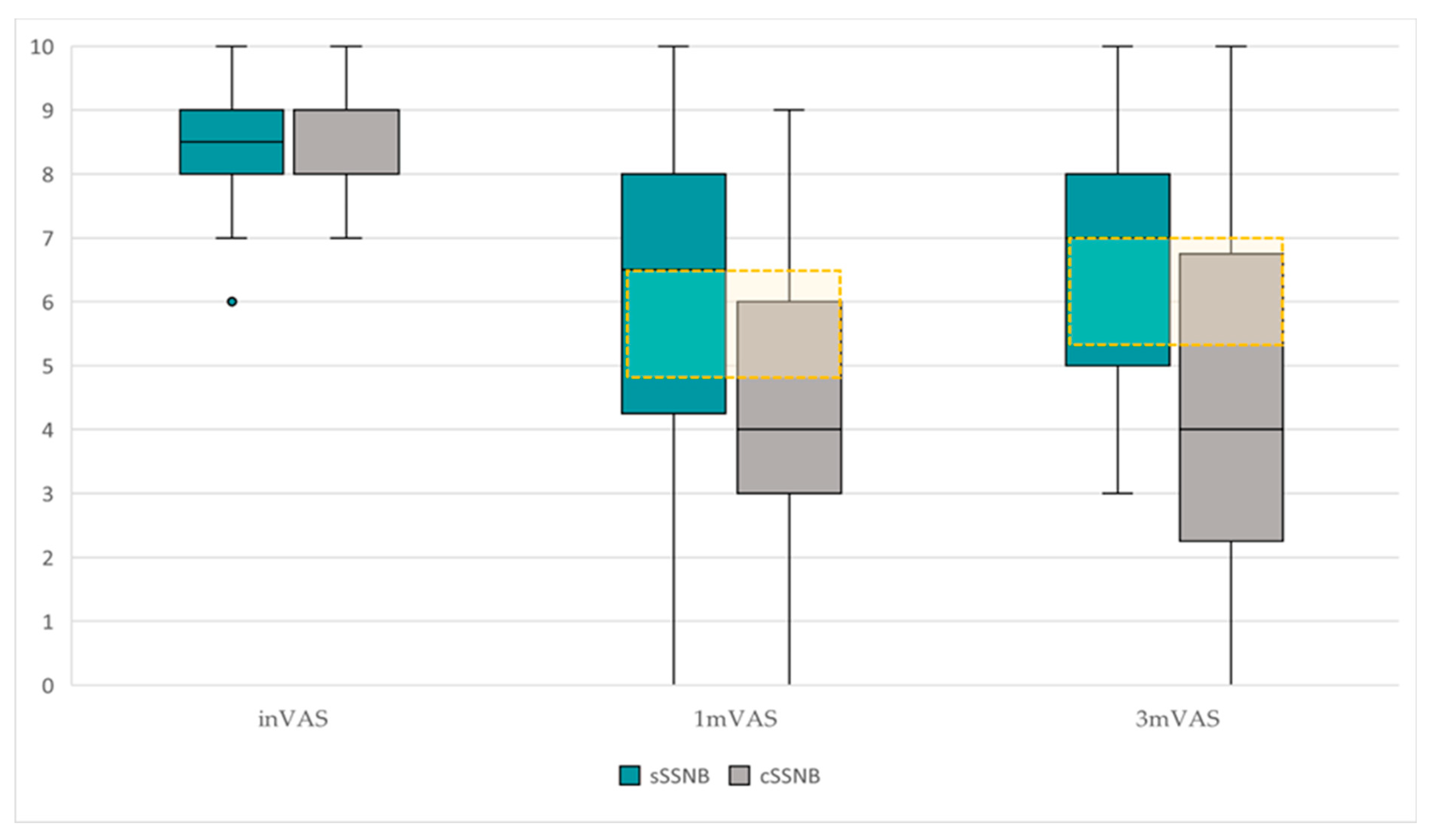
- In the sSSNB group, significant differences were found over time (χ2 = 14.80, p = 0.001). Post hoc studies demonstrated that the differences were between inVAS vs. 1mVAS (8.50 points [7.75–9.25] vs. 6.50 points [3.75–8.00]) (Z = −2.95; p = 0.003) and between inVAS vs. 3mVAS (8.50 points [7.75–9.25] vs. 7.00 points [5.00–8.25]) (Z = −2.85; p = 0.004). There were no significant differences in 1mVAS vs. 3mVAS.
- -
- Significant differences were also found over time in the cSSNB group (χ2 19.96; p = 0.001). Post hoc studies showed that the differences were between inVAS vs. 1mVAS (8.00 points [7.75–9.25] vs. 4.00 points [2.75–6.25]) (Z = −3.19; p = 0.001) and between inVAS vs. 3mVAS (8.00 points [7.75–9.25] vs. 4.00 points [2.00–7.00]) (Z = −3.07; p = 0.002). There were no significant differences in 1mVAS vs. 3mVAS.
- -
- The cSSNB group obtained significantly lower VAS scores than the sSSNB group in 3mVAS (7.00 points [5.00–8.25] vs. 4.00 points [2.00–7.00]) (U = 53.50; p = 0.04). In 1mVAS, no differences were found between groups.
- DASH
- -
- No significant differences were found over time in the sSSNB group.
- -
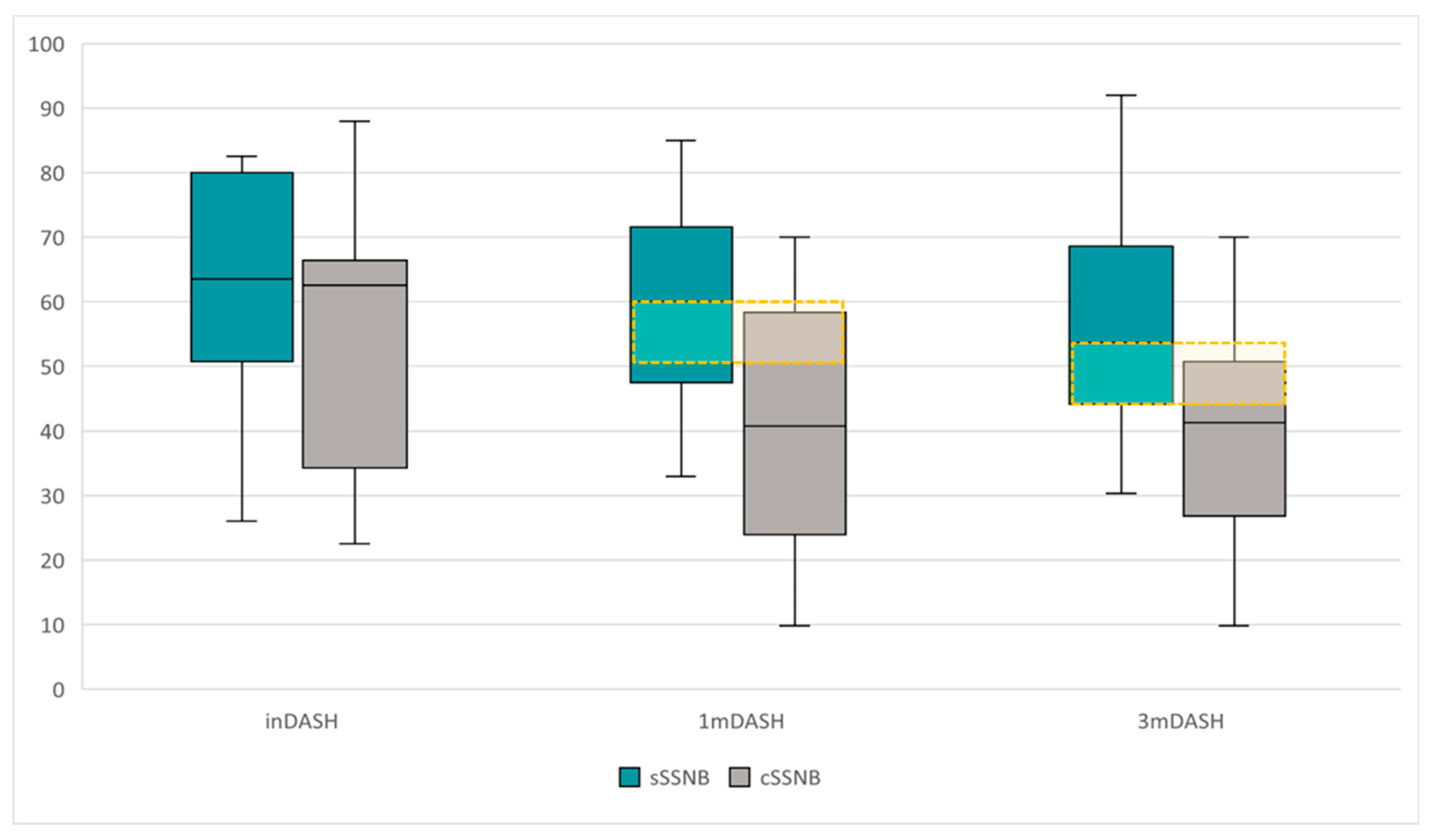
- Significant differences were found over time in the cSSNB group (χ2 19.74; p < 0.001). Post hoc studies showed that the differences were between inDASH vs. 1mDASH (62.6 points [34.25–66.43] vs. 40.80 points [23.95–58.33]) (Z = −3.30; p = 0.001) and between inVAS vs. 3mVAS (62.6 points [34.25–66.43] vs. 41.25 points [26.83–50.71]) (Z = −3.01; p = 0.003). There were no significant differences in 1mDASH vs. 3mDASH.
- -
- The cSSNB group obtained significantly lower scores than the sSSNB group both in 1mDASH (60.00 points [47.50–71.56] vs. 40.80 points [23.95–58.33]) (U = 46.00, p = 0.017) and in 3mDASH (53.80 points [44.18–68.58] vs. 41.25 points [26.83–50.71]) (U = 43.50; p = 0.012).
3.3. Analisis Secundarios
- ROM
- LI and oral analgesia use.
- −
- In patients treated with sSSNB (χ2 = 7.58, p = 0.023), there were differences between inLI -1mLI (13.50 points [8.75–15.25] vs. 10.50 points [7.75–14.25]) (Z = −1.99; p = 0.046) and between inLI -3mLi (13.50 points [8.75–15.25] vs. 6.50 points [10.00–13.00] (Z = −2.51; p = 0.012).
- −
- In patients treated with cSSNB (χ2 = 18.68, p < 0.001), there were differences between inLI -1mLI (12.00 points [10.50–14.25] vs. 6.00 points [3.00–11.25]) (Z = −3.25; p = 0.001) and between inLI -3mLI (12.00 points [10.50–14.25] vs. 9.00 points [4.00–11.25]) (Z = −3.07; p = 0.002).
4. Discussion
Limitations
5. Conclusions
Author Contributions
Funding
Institutional Review Board Statement
Informed Consent Statement
Data Availability Statement
Conflicts of Interest
Abbreviations
| ROM | Range of Motion |
| SSNB | Suprascapular Nerve Block |
| US | Ultrasound |
| DASH | Disabilities of the Arm, Shoulder and Hand |
| VAS | Visual Analog Scale |
| LI | Lattinen Index |
| PGI-I | Patient Global Impression of Improvement |
| CGI-GI | Clinical Global Impression of Global Improvement |
| FLEX | Flexion |
| ABD | Abduction |
| ER | External Rotation |
| IR | Internal Rotation |
| PT | Physical Therapy |
| PRP | Platelet-Rich Plasma |
| SS | Supraspinatus |
| HURS | Hospital Universitario Reina Sofia of Cordoba |
| PM&R | Physical Medicine and Rehabilitation |
| MCID | Minimal Clinically Important Difference |
| DAG | Directed Acyclic Graph |
References
- Gill, T.K.; Shanahan, E.M.; Tucker, G.R.; Buchbinder, R.; Hill, C.L. Shoulder Range of Movement in the General Population: Age and Gender Stratified Normative Data Using a Community-Based Cohort. BMC Musculoskelet. Disord. 2020, 21, 676. [Google Scholar] [CrossRef]
- Lucas, J.; Van Doorn, P.; Hegedus, E.; Lewis, J.; Van Der Windt, D. A Systematic Review of the Global Prevalence and Incidence of Shoulder Pain. BMC Musculoskelet. Disord. 2022, 23, 1073. [Google Scholar] [CrossRef]
- Gallardo Vidal, M.I.; Calleja Delgado, L.; Tenezaca Marcatoma, J.C.; Calleja Guadix, I.; Daimiel Yllera, A.; Morales Tejera, D. Protocolo de fisioterapia y educación para la salud en dolor crónico de hombro de origen musculoesquelético. Experiencia en atención primaria. Atención Primaria 2022, 54, 102284. [Google Scholar] [CrossRef]
- Rotator Cuff Tendinopathy—UpToDate. Available online: https://www.uptodate.com/contents/rotator-cuff-tendinopathy?search=rotator%20cuff%20tendinopathy&source=search_result&selectedTitle=1~46&usage_type=default&display_rank=1#H17 (accessed on 8 July 2025).
- Hodgetts, C.J.; Leboeuf-Yde, C.; Beynon, A.; Walker, B.F. Shoulder Pain Prevalence by Age and within Occupational Groups: A Systematic Review. Arch. Physiother. 2021, 11, 24. [Google Scholar] [CrossRef]
- Garzón, M.; Balasch-Bernat, M.; Cook, C.; Ezzatvar, Y.; Álvarez-Lliso, Ó.; Dueñas, L.; Lluch, E. How Long Does Tendinopathy Last If Left Untreated? Natural History of the Main Tendinopathies Affecting the Upper and Lower Limb: A Systematic Review and Meta-Analysis of Randomized Controlled Trials. Musculoskelet. Sci. Pract. 2024, 72, 103103. [Google Scholar] [CrossRef]
- Iriarte, Í.; Pedret, C.; Balius, R.; Cerezal, L. Patología del manguito de los rotadores. In Ecografía Musculoesquelética: Exploración Anatómica y Patología, 1st ed.; Editorial Médica Panamericana: Buenos Aires, Argentina, 2020; pp. 40–54. [Google Scholar]
- Myers, H.; Keefe, F.J.; George, S.Z.; Kennedy, J.; Lake, A.D.; Martinez, C.; Cook, C.E. Effect of a Patient Engagement, Education and Restructuring of Cognitions (PEERC) Approach on Conservative Care in Rotator Cuff Related Shoulder Pain Treatment: A Randomized Control Trial. BMC Musculoskelet. Disord. 2023, 24, 930. [Google Scholar] [CrossRef]
- Suprascapular Nerve Injury. Available online: https://www.ncbi.nlm.nih.gov/books/NBK559151/ (accessed on 18 July 2025).
- Yoon, J.P.; Park, S.-J.; Choi, Y.S.; Kim, D.-H.; Lee, H.J.; Park, E.J.J.; Chung, S.W. Current Research Trends on the Effect of Diabetes Mellitus on Rotator Cuff Tendon Healing/Tendinopathy. Arch. Orthop. Trauma. Surg. 2024, 144, 2491–2500. [Google Scholar] [CrossRef]
- Giri, A.; O’Hanlon, D.; Jain, N.B. Risk Factors for Rotator Cuff Disease: A Systematic Review and Meta-Analysis of Diabetes, Hypertension and Hyperlipidemia. Ann. Phys. Rehabil. Med. 2023, 66, 101631. [Google Scholar] [CrossRef]
- Ortigosa, E. Bloqueo ecoguiado del nervio supraescapular. In Ecografía en el Tratamiento del Dolor Crónico, 1st ed.; Aelor: Madrid, Spain, 2018; pp. 415–427. [Google Scholar]
- Saglam, G.; Alisar, D.Ç. A Comparison of the Effectiveness of Ultrasound-Guided Versus Landmark-Guided Suprascapular Nerve Block in Chronic Shoulder Pain: A Prospective Randomized Study. Pain Physician 2020, 23, 581–588. [Google Scholar]
- Challoumas, D.; Biddle, M.; McLean, M.; Millar, N.L. Comparison of Treatments for Frozen Shoulder: A Systematic Review and Meta-Analysis. JAMA Netw. Open 2020, 3, e2029581. [Google Scholar] [CrossRef]
- Chang, K.-V.; Wu, W.-T.; Hung, C.-Y.; Han, D.-S.; Yang, R.-S.; Chang, C.-H.; Lin, C.-P. Comparative Effectiveness of Suprascapular Nerve Block in the Relief of Acute Post-Operative Shoulder Pain: A Systematic Review and Meta-Analysis. Pain Physician 2016, 19, 445–456. [Google Scholar] [CrossRef]
- Ori, A.; Jindal, A.; Nwazota, N.; Pearson, A.C.S.; Yalamuru, B. Peripheral Nerve Injections. Phys. Med. Rehabil. Clin. N. Am. 2022, 33, 489–517. [Google Scholar] [CrossRef]
- Tran, J.; Peng, P.W.H.; Agur, A.M.R. Anatomical Study of the Innervation of Glenohumeral and Acromioclavicular Joint Capsules: Implications for Image-Guided Intervention. Reg. Anesth. Pain Med. 2019, 44, 452–458. [Google Scholar] [CrossRef]
- Suprascapular Nerve Block. Available online: https://www.ncbi.nlm.nih.gov/books/NBK580556/ (accessed on 14 July 2025).
- Mardani-Kivi, M.; Nabi, B.N.; Mousavi, M.-H.; Shirangi, A.; Leili, E.K.; Ghadim-Limudahi, Z.H. Role of Suprascapular Nerve Block in Idiopathic Frozen Shoulder Treatment: A Clinical Trial Survey. Clin. Shoulder Elb. 2022, 25, 129–139. [Google Scholar] [CrossRef]
- Hou, Y.; Wang, Y.; Sun, X.; Lou, Y.; Yu, Y.; Zhang, T. Effectiveness of Suprascapular Nerve Block in the Treatment of Hemiplegic Shoulder Pain: A Systematic Review and Meta-Analysis. Front. Neurol. 2021, 12, 723664. [Google Scholar] [CrossRef]
- Anestésicos Locales. Available online: https://arydol.com/temas/neuroestimulacion/generalidades/anestesicos-locales/ (accessed on 18 July 2025).
- Analgesic Adjuvants in the Peripheral Nervous System. Available online: https://www.nysora.com/es/temas/farmacolog%C3%ADa/adyuvantes-analg%C3%A9sicos-sistema-nervioso-perif%C3%A9rico/?utm_source=chatgpt.com (accessed on 20 July 2025).
- Corticoides Como Adyuvantes en los Bloqueos Nerviosos Periféricos. Available online: https://dolopedia.com/categoria/corticoides-como-adyuvantes-en-los-bloqueos-nerviosos-perifericos (accessed on 18 July 2025).
- Matsuda, K.; Sasaki, M.; Baba, H.; Kamiya, Y. Neuronal Nitric Oxide Synthase Suppression Confers the Prolonged Analgesic Effect of Sciatic Nerve Block with Perineural Dexamethasone in Postoperative Pain Model Mice. J. Pain 2022, 23, 1765–1778. [Google Scholar] [CrossRef]
- Pehora, C.; Pearson, A.M.; Kaushal, A.; Crawford, M.W.; Johnston, B. Dexamethasone as an Adjuvant to Peripheral Nerve Block. Cochrane Database Syst. Rev. 2017, 11, CD011770. [Google Scholar] [CrossRef]
- Tan, E.S.J.; Tan, Y.R.; Liu, C.W.Y. Efficacy of Perineural versus Intravenous Dexamethasone in Prolonging the Duration of Analgesia When Administered with Peripheral Nerve Blocks: A Systematic Review and Meta-Analysis. Korean J. Anesthesiol. 2022, 75, 255–265. [Google Scholar] [CrossRef]
- Kamel, S.I.; Rosas, H.G.; Gorbachova, T. Local and Systemic Side Effects of Corticosteroid Injections for Musculoskeletal Indications. AJR Am. J. Roentgenol. 2024, 222, e2330458. [Google Scholar] [CrossRef]
- Grossman, E.; Messerli, F.H. Drug-Induced Hypertension: An Unappreciated Cause of Secondary Hypertension. Am. J. Med. 2012, 125, 14–22. [Google Scholar] [CrossRef]
- Safran, O.; Fraind-Maya, G.; Kandel, L.; Leibowitz, G.; Beyth, S. The Effect of Steroid Injection into the Shoulder on Glycemia in Patients with Type 2 Diabetes. JSES Int. 2022, 6, 843–848. [Google Scholar] [CrossRef]
- Local Anesthetic Toxicity. Available online: https://www.ncbi.nlm.nih.gov/books/NBK499964/ (accessed on 6 August 2025).
- Byrne, K.; Engelbrecht, C. Toxicity of Local Anaesthetic Agents. Trends Anaesth. Crit. Care 2013, 3, 25–30. [Google Scholar] [CrossRef]
- Vandenbroucke, J.P.; Von Elm, E.; Altman, D.G.; Gøtzsche, P.C.; Mulrow, C.D.; Pocock, S.J.; Poole, C.; Schlesselman, J.J.; Egger, M. Mejorar la comunicación de estudios observacionales en epidemiología (STROBE): Explicación y elaboración. Gac. Sanit. 2009, 23, 158.e1–158.e28. [Google Scholar] [CrossRef]
- Wang, L.; Yu, G.; Zhang, R.; Wu, G.; He, L.; Chen, Y. Positive Effects of Neuromuscular Exercises on Pain and Active Range of Motion in Idiopathic Frozen Shoulder: A Randomized Controlled Trial. BMC Musculoskelet. Disord. 2023, 24, 50. [Google Scholar] [CrossRef]
- Salas Apaza, J.A.; Ariel Franco, J.V.; Meza, N.; Madrid, E.; Loézar, C.; Garegnani, L. Minimal Clinically Important Difference: The Basics. Medwave 2021, 21, e8149. [Google Scholar] [CrossRef]
- Donado Gómez, J.H.; Jiménez Cotes, E.A.; Cardona, L.M. Diferencia mínima clínicamente importante en algunas escalas de medición utilizadas en enfermedades musculoesqueléticas. Rev. Colomb. Reumatol 2014, 21, 125–132. [Google Scholar] [CrossRef]
- Teresa Hervás, M.; Navarro Collado, M.J.; Peiró, S.; Rodrigo Pérez, J.L.; López Matéu, P.; Martínez Tello, I. Versión española del cuestionario DASH. Adaptación transcultural, fiabilidad, validez y sensibilidad a los cambios. Med. Clin. 2006, 127, 441–447. [Google Scholar] [CrossRef]
- Dadgostar, H.; Fahimipour, F.; Pahlevan Sabagh, A.; Arasteh, P.; Razi, M. Corticosteroids or Platelet-Rich Plasma Injections for Rotator Cuff Tendinopathy: A Randomized Clinical Trial Study. J. Orthop. Surg. Res. 2021, 16, 333. [Google Scholar] [CrossRef]
- Measurements of the Shoulder Girdle—Shoulder. In Joint Motion: Method of Measuring and Recording; Reprinted; Churchill Livingstone: New York, NY, USA, 1966; pp. 36–37.
- González, J.R.; Camba, A.; Muriel, C.; Rodríguez, M.; Contreras, D.; Barutell, C. Validación del índice de Lattinen para la evaluación del paciente con dolor crónico. Rev. Soc. Esp. Dolor 2012, 19, 181–188. [Google Scholar]
- Vicente, M.T.; Delgado, S.; Bandrés, F.; Ramírez, M.V.; Capdevilla, L. Valoración del dolor. Revisión comparativa de escalas y cuestionarios. Rev. Soc. Esp. Dolor 2018, 25, 228–236. [Google Scholar] [CrossRef]
- Sánchez, J.; Tejedor, A.; Carrascal, R. Herramientas Útiles: Escalas y Cuestionarios. In La Atención al Paciente con Dolor Crónico no Oncológico (DCNO) en Atención Primaria (AP); Sociedad Española de Médicos Generales y de Familia (SEMG): Madrid, Spain, 2023; pp. 69–70. [Google Scholar]
- GRANMO. Available online: https://www.datarus.eu/aplicaciones/granmo/ (accessed on 14 August 2024).
- Arrogante, O. Técnicas de muestreo y cálculo del tamaño muestral: Cómo y cuántos participantes debo seleccionar para mi investigación. Enfermería Intensiv. 2022, 33, 44–47. [Google Scholar] [CrossRef]
- Cálculo Del Tamaño Muestral. Available online: https://www.uclm.es/en/misiones/investigacion/serviciosinvestigacion/portaleticacientifica/ceea/calculo-del-tamano-muestral (accessed on 26 August 2025).
- Recursos Para La Investigación. Available online: https://apisal.es/Investigacion/recursos.htm (accessed on 26 August 2025).
- Mills, S.E.E.; Nicolson, K.P.; Smith, B.H. Chronic Pain: A Review of Its Epidemiology and Associated Factors in Population-Based Studies. Hno. J. Anaesth. 2019, 123, e273–e283. [Google Scholar] [CrossRef]
- Zhi, Y.; Zhang, Y.; Zhang, Y.; Zhang, M.; Kong, Y. Age-Associated Changes in Multimodal Pain Perception. Age Ageing 2024, 53, afae107. [Google Scholar] [CrossRef] [PubMed]
- Lin, Y.-T.; Kuo, Y.-C.; Wu, X.-N.; Liu, Y.-F.; Hsieh, L.-F. Comparison of the Efficacy of Ultrasound-Guided Suprascapular Nerve Blocks and Intraarticular Corticosteroid Injections for Frozen Shoulder: A Randomized Controlled Trial. Pain Physician 2024, 27, 415–424. [Google Scholar] [CrossRef]
- Smith, N.; Liew, Z.; Johnson, S.; Ellard, D.R.; Underwood, M.; Kearney, R. A Systematic Review of the Methods and Drugs Used for Performing Suprascapular Nerve Block Injections for the Non-Surgical Management of Chronic Shoulder Pain. Br. J. Pain 2021, 15, 460–473. [Google Scholar] [CrossRef]
- Scattergood, S.D.; Hassan, A.; Williams, M. Does a Suprascapular Nerve Block Reduce Chronic Shoulder Pain at 3 Months Compared to Standard Non-Operative Care? A Systematic Review. Eur. J. Orthop. Surg. Traumatol. 2025, 35, 162. [Google Scholar] [CrossRef]
- Huynh, T.M.; Marret, E.; Bonnet, F. Combination of Dexamethasone and Local Anaesthetic Solution in Peripheral Nerve Blocks: A Meta-Analysis of Randomised Controlled Trials. Eur. J. Anaesthesiol. 2015, 32, 751–758. [Google Scholar] [CrossRef]
- Rafiei, M.-R.; Khani, A.K.; Kheradmand, B.; Abosaoda, M.K.; Rasulova, I.; Khordad, O.; Moayer, A.; Kazemi Haki, B.; Namazi, M. Effectiveness of Adding Dexamethasone to Lidocaine in Upper Limbs Nerve Blocks: A Systematic Review. J. Perianesth. Nurs. 2025, 40, 140–149. [Google Scholar] [CrossRef] [PubMed]
- Malhotra, N.; Anand, R.; Kumar, A.; Sinha, N.; Phogat, V.; Charan, N. Comparison of Efficacy of Suprascapular Nerve Block Using Local Anaesthetic and Two Different Doses of Steroid in Cervical Radicular Pain. J. Anaesthesiol. Clin. Pharmacol. 2025, 41, 491–495. [Google Scholar] [CrossRef]
- Shanahan, E.M.; Ahern, M.; Smith, M.; Wetherall, M.; Bresnihan, B.; FitzGerald, O. Suprascapular Nerve Block (Using Bupivacaine and Methylprednisolone Acetate) in Chronic Shoulder Pain. Ann. Rheum. Dis. 2003, 62, 400–406. [Google Scholar] [CrossRef]
- Sá Malheiro, N.; Afonso, N.R.; Pereira, D.; Oliveira, B.; Ferreira, C.; Cunha, A.C. Efficacy of Ultrasound Guided Suprascapular Block in Patients with Chronic Shoulder Pain: Observational, Retrospective Study. Braz. J. Anestesiol. 2020, 70, 15–21. [Google Scholar] [CrossRef]
- Yilmaz, E. A Prospective, Comparative Study of Subacromial Corticosteroid Injection and Subacromial Corticosteroid Injection plus Suprascapular Nerve Block in Patients with Shoulder Impingement Syndrome. Arch. Orthop. Trauma Surg. 2021, 141, 733–774. [Google Scholar] [CrossRef]
- Pinto-Ribeiro, F.; Moreira, V.; Pěgo, J.M.; Leão, P.; Almeida, A.; Sousa, N. Antinociception Induced by Chronic Glucocorticoid Treatment Is Correlated to Local Modulation of Spinal Neurotransmitter Content. Mol. Pain 2009, 5, 41. [Google Scholar] [CrossRef]
- Galardini, L.; Coppari, A.; Pellicciari, L.; Ugolini, A.; Piscitelli, D.; La Porta, F.; Bravini, E.; Vercelli, S. Minimal Clinically Important Difference of the Disabilities of the Arm, Shoulder and Hand (DASH) and the Shortened Version of the DASH (QuickDASH) in People with Musculoskeletal Disorders: A Systematic Review and Meta-Analysis. Phys. Ther. 2024, 104, pzae033. [Google Scholar] [CrossRef]
- Benzon, H.T.; Elmofty, D.; Shankar, H.; Rana, M.; Chadwick, A.L.; Shah, S.; Souza, D.; Nagpal, A.S.; Abdi, S.; Rafla, C.; et al. Use of Corticosteroids for Adult Chronic Pain Interventions: Sympathetic and Peripheral Nerve Blocks, Trigger Point Injections—Guidelines from the American Society of Regional Anesthesia and Pain Medicine, the American Academy of Pain Medicine, the American Society of Interventional Pain Physicians and the International Pain and Spine Intervention Society. Reg. Anesth. Pain Med. 2024. rapm-2024-105593. [Google Scholar]
- Batten, T.; Evans, J.; Burden, E.; Mak, W.; White, W.; Smith, C. Suprascapular Nerve Blockage for Painful Shoulder Pathology—A Systematic Review and Meta-Analysis of Treatment Techniques. Annals 2023, 105, 589–598. [Google Scholar] [CrossRef]
- Spargoli, G. Supraspinatus tendon pathomechanics: A current concepts review. Int. J. Sports Phys. Ther. 2018, 13, 1083–1094. [Google Scholar] [CrossRef] [PubMed]
- Sakaki, Y.; Taniguchi, K.; Katayose, M.; Kura, H.; Okamura, K. Effects of Shoulder Abduction on the Stiffness of Supraspinatus Muscle Regions in Rotator Cuff Tear. Clin. Anat. 2022, 35, 94–102. [Google Scholar] [CrossRef]
- Monsalve, V.; Soriano, J.; Andrés, J. Utilidad del Índice de Lattinen (IL) en la evaluación del dolor crónico: Relaciones con afrontamiento y calidad de vida. Rev. Soc. Esp. Dolor 2006, 13, 216–229. [Google Scholar]



| Variable | sSSNB | cSSNB | Value (Test) | p | |
|---|---|---|---|---|---|
| Age, years | 61.00 [53.0–66.00] | 63.00 [58.50–70.00] | 74.50 (U) | 0.279 | |
| Gender | Male: 3 (21.4%) Female: 11 (78.6%) | Male: 3 (21.4%) Female:11(78.6%) | - (Fisher exact) | 1 | |
| Comorbidities | S/N: 7 (50%) HTA: 5 (35.7%) DM: 2 (14.3%) | S/N: 6 (42.9%) HTA: 5 (35.7%) DM: 3 (21.4%) | 0.27 (χ2 de Pearson) | 0.871 | |
| Previous treatments | nothing: 5 (35.7%) Infiltrations: 7 (50%) SSNB: 1 (7.1%) PT: 1 (7.1%) | nothing: 4 (28.6%) Infiltrations: 8 (57.1%) SSNB: 1 (7.1%) PRP: 1 (7.1%) | 2.18 (χ2 de Pearson) | 0.703 | |
| VAS, points | In | 8.50 [7.75–9.25] | 8.00 [7.75–9.25] | 95.50 (U) | 0.906 |
| 1m | 6.50 [3.75–8.00] | 4.00 [2.75–6.25] | 62.00 (U) | 0.096 | |
| 3m | 7.00 [5.00–8.25] | 4.00 [2.00–7.00] | 53.50 (U) | 0.040 * | |
| DASH, points | In | 63.50 [50.75–80.00] | 62.6 [34.25–66.43] | 81.00 (U) | 0.434 |
| 1m | 60.00 [47.50–71.56] | 40.80 [23.95–58.33] | 46.00 (U) | 0.017 * | |
| 3m | 53.80 [44.18–68.58] | 41.25 [26.83–50.71] | 43.50 (U) | 0.012 * | |
| FLEX ° | In | 150.00 [97.50–172.50] | 165.00 [90.00–180.00] | 94.00 (U) | 0.851 |
| 1m | 170. 00 [137.50–180.00] | 180.00 [150.00–1800] | 80.00 (U) | 0.382 | |
| 3m | 170.50 [107.50–180.00] | 180.00 [157.50–180.00] | 72.00 (U) | 0.194 | |
| ABD ° | In | 125.00 [90.00–180.00] | 137.50 [90.00–180.00] | 92.50 (U) | 0.794 |
| 1m | 155.00 [100.00–180.00] | 180.00 [131.25–180.00] | 71.50 (U) | 0.199 | |
| 3m | 150.00 [107.50–180.00] | 180.00 [155.00–180.00] | 67.00 (U) | 0.114 | |
| IR ° | In | 90.00 [77.50–90.00] | 90.00 [75.00–90.00] | 96.50 (U) | 0.931 |
| 1m | 90.00 [77.50–90.00] | 90.00 [85.00–90.00] | 92.50 (U) | 0.739 | |
| 3m | 90.00 [70.00–90.00] | 90.00 [90.00–90.00] | 71.50 (U) | 0.089 | |
| ER ° | In | 90.00 [72.50–90.00] | 85.00 [43.75–90.00] | 78.50 (U) | 0.309 |
| 1m | 90.00 [77.50–90.00] | 90.00 [50.00–90.00] | 80.50 (U) | 0.348 | |
| 3m | 90.00 [70.00–90.00] | 90.00 [72.50–90.00] | 94.00 (U) | 0.825 | |
| LI, points | In | 13.50 [8.75–15.25] | 12.00 [10.50–14.25] | 82.00 (U) | 0.459 |
| 1m | 10.50 [7.75–14.25] | 6.00 [3.00–11.25] | 48.00 (U) | 0.021 * | |
| 3m | 6.50 [10.00–13.00] | 9.00 [4.00–11.25] | 83.00 (U) | 0.488 | |
| Analgesia, points | In | 3.00 [1.75–3.00] | 3.00 [1.75–3.00] | 94.00 (U) | 0.845 |
| 1m | 1.50 [1.00–3.00] | 2.00 [0.00–3.00] | 91.00 (U) | 0.742 | |
| 3m | 2.50 [0.75–3.00] | 2.00 [0.75–2.25] | 86.00 (U) | 0.573 | |
| Variable | Group | Friedman’s χ2 | p Value | Post Hoc Tests. (Wilcoxon, p Value) | ||
|---|---|---|---|---|---|---|
| Initial vs. 1 Month | Initial vs. 3 Months | 1 Month vs. 3 Months | ||||
| VAS | sSSNB | 14.80 | 0.001 * | Z = −2.95, p = 0.003 * | Z = −2.85, p = 0.004 * | Z = −1.27, p = 0.205 |
| cSSNB | 19.96 | 0.001 * | Z = −3.19, p = 0.001 * | Z = −3.07, p = 0.002 * | Z = −0.42, p = 0.676 | |
| DASH | sSSNB | 1.33 | 0.513 | - | - | - |
| cSSNB | 19.74 | <0.001 * | Z = −3.30, p = 0.001 * | Z = −3.01, p = 0.003 * | Z = −0.801, p = 0.423 | |
| FLEX | sSSNB | 4.07 | 0.131 | - | - | - |
| cSSNB | 13.15 | 0.001 * | Z = −2.38, p = 0.018 * | Z = −2.53, p = 0.012 * | Z = −1.07, p = 0.285 | |
| ABD | sSSNB | 0.48 | 0.786 | - | - | - |
| cSSNB | 15.10 | 0.001 * | Z = −2.53, p = 0.011 * | Z = −2.68, p = 0.007 * | Z = −1.07, p = 0.285 | |
| IR | sSSNB | 0.33 | 0.846 | - | - | - |
| cSSNB | 4.769 | 0.92 | - | - | - | |
| ER | sSSNB | 1.20 | 0.549 | - | - | - |
| cSSNB | 7.60 | 0.022 * | Z = −1.63, p = 0.102 | Z = −2.03, p = 0.042 | Z = −1.34, p = 0.180 | |
| LI | sSSNB | 7.59 | 0.023 * | Z = −1.99, p = 0.046 * | Z = −2.51, p = 0.012 * | Z = −1.41, p = 0.159 |
| cSSNB | 18.67 | <0.001 * | Z = −3.25, p = 0.001 * | Z = −3.07, p = 0.002 * | Z = −1.54, p = 0.123 | |
| Analgesia | sSSNB | 2.00 | 0.368 | - | - | - |
| cSSNB | 11.31 | 0.004 * | Z = −2.42, p = 0.015 * | Z = −2.43, p = 0.015 * | Z = 0.00, p = 1.000 | |
Disclaimer/Publisher’s Note: The statements, opinions and data contained in all publications are solely those of the individual author(s) and contributor(s) and not of MDPI and/or the editor(s). MDPI and/or the editor(s) disclaim responsibility for any injury to people or property resulting from any ideas, methods, instructions or products referred to in the content. |
© 2025 by the authors. Licensee MDPI, Basel, Switzerland. This article is an open access article distributed under the terms and conditions of the Creative Commons Attribution (CC BY) license (https://creativecommons.org/licenses/by/4.0/).
Share and Cite
Muñoz-Paz, J.; Jiménez-Jiménez, A.B.; Hidalgo-Jorge, A.; Muñoz-Alcaraz, M.N.; Peña-Amaro, J.; Mayordomo-Riera, F.J. Impact of Corticosteroids in Suprascapular Nerve Block on Pain and Function in Chronic Rotator Cuff Disease: A Retrospective, Observational, Longitudinal, Analytical Cohort Study. Med. Sci. 2025, 13, 252. https://doi.org/10.3390/medsci13040252
Muñoz-Paz J, Jiménez-Jiménez AB, Hidalgo-Jorge A, Muñoz-Alcaraz MN, Peña-Amaro J, Mayordomo-Riera FJ. Impact of Corticosteroids in Suprascapular Nerve Block on Pain and Function in Chronic Rotator Cuff Disease: A Retrospective, Observational, Longitudinal, Analytical Cohort Study. Medical Sciences. 2025; 13(4):252. https://doi.org/10.3390/medsci13040252
Chicago/Turabian StyleMuñoz-Paz, Javier, Ana Belén Jiménez-Jiménez, Antonio Hidalgo-Jorge, María Nieves Muñoz-Alcaraz, José Peña-Amaro, and Fernando Jesús Mayordomo-Riera. 2025. "Impact of Corticosteroids in Suprascapular Nerve Block on Pain and Function in Chronic Rotator Cuff Disease: A Retrospective, Observational, Longitudinal, Analytical Cohort Study" Medical Sciences 13, no. 4: 252. https://doi.org/10.3390/medsci13040252
APA StyleMuñoz-Paz, J., Jiménez-Jiménez, A. B., Hidalgo-Jorge, A., Muñoz-Alcaraz, M. N., Peña-Amaro, J., & Mayordomo-Riera, F. J. (2025). Impact of Corticosteroids in Suprascapular Nerve Block on Pain and Function in Chronic Rotator Cuff Disease: A Retrospective, Observational, Longitudinal, Analytical Cohort Study. Medical Sciences, 13(4), 252. https://doi.org/10.3390/medsci13040252