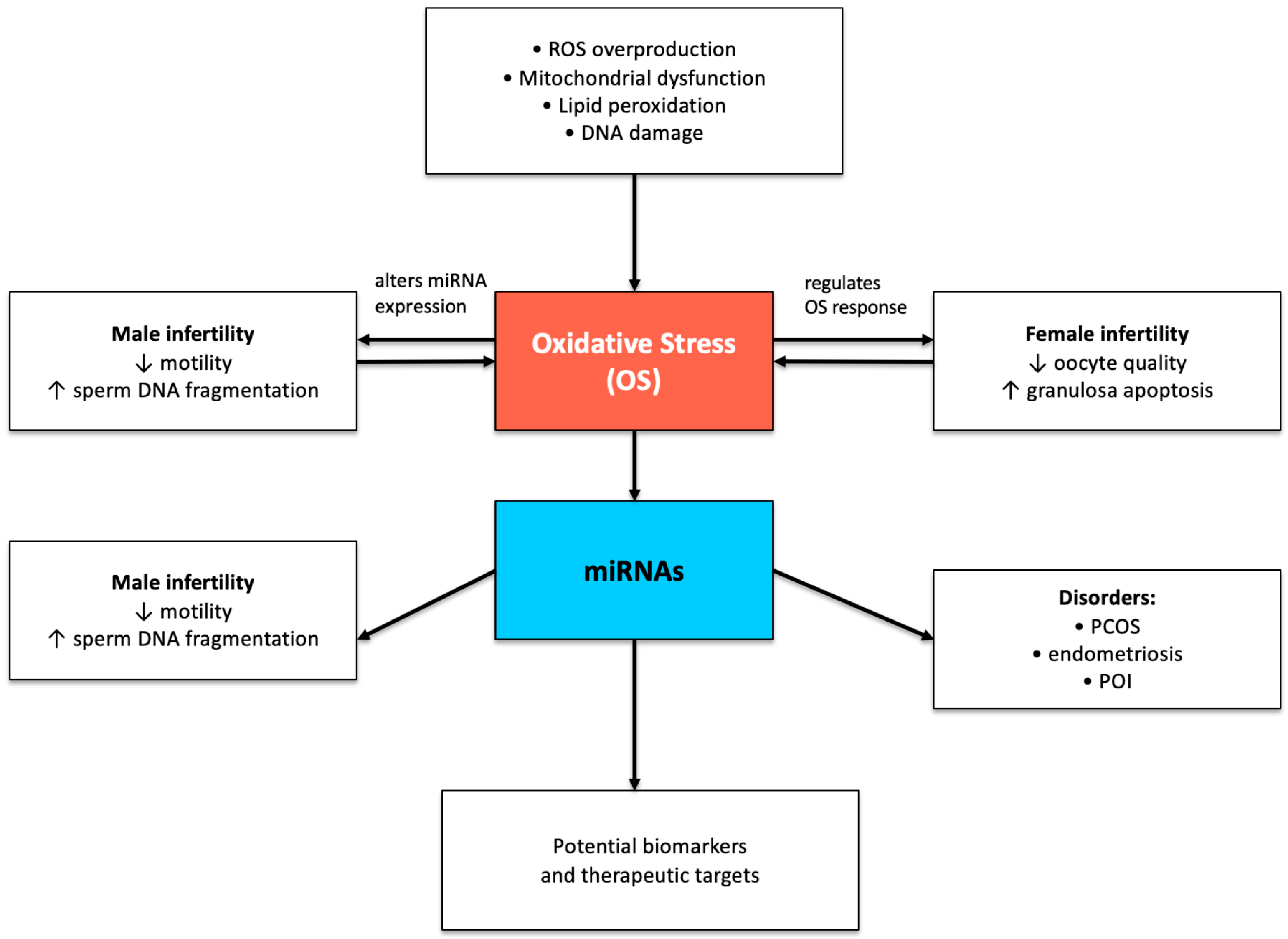

MicroRNAs Regulating Oxidative Stress in Human Fertility: A Narrative Review of Mechanistic Insights and Clinical Potential


 , , , ,
  , , , , ,
Abstract
1. Introduction
2. Materials and Methods
3. Biogenesis and Function of miRNAs in Reproduction
4. Functions of miRNAs in Reproduction
4.1. Male Infertility
4.2. Female Infertility
5. Discussion
6. Conclusions
Author Contributions
Funding
Institutional Review Board Statement
Informed Consent Statement
Data Availability Statement
Conflicts of Interest
Abbreviations
| OS | oxidative stress |
| miRNAs | microRNAs |
| ROS | reactive oxygen species |
| PCOS | polycystic ovary syndrome |
| CVD | cardiovascular disease |
| MDA | malondialdehyde |
| POI | premature ovarian insufficiency |
| ATP | adenosine triphosphate |
| RISC | RNA-induced silencing complex |
| OAT | oligoasthenoteratozoospermic |
| GPx | glutathione peroxidase |
| TNF-α | Tumor Necrosis Factor α |
| DFI | DNA fragmentation index |
| mTOR | mechanistic Target of Rapamycin |
| DEmiRNAs | differentially expressed miRNAs |
| TGF-β | Transforming Growth Factor β |
| FoxO | Forkhead box O |
| PI3K-Akt | Phosphoinositide 3-kinase/Protein Kinase B |
| ceRNA | competing endogenous RNA |
| SOD2 | Superoxide Dismutase 2 |
| circBRCA1 | circular BRCA1 |
| NF-Κb | nuclear factor kappa-light-chain-enhancer of activated B cells |
| POF | premature ovarian failure |
| H2O2 | hydrogen peroxide |
| H3K4me3 | histone H3K4 trimethylation |
| BAX | Bcl-2-associated X protein |
| BCL2 | B-cell lymphoma 2 |
| SESN2 | Sestrin2 |
| IKK | IκB kinase |
| COX-2 | Cyclooxygenase-2 |
| DUSP-2 | Dual-Specificity Phosphatase 2 |
| ERK/HIF-1α | Extracellular signal-Regulated Kinase/Hypoxia-Inducible Factor 1α |
| CXCL2 | C-X-C Motif Chemokine Ligand 2 |
| TBARS | Thiobarbituric Acid Reactive Substances |
| 8-OHdG | 8-hydroxy-2′-deoxyguanosine |
| TAC | total antioxidant capacity |
| FF | follicular fluid |
| GCs | granulosa cells |
| OEM | ovarian endometriosis |
| IGF1R | Insulin-like Growth Factor 1 Receptor |
| SIRT1 | Sirtuin 1 |
| DOR | Diminished Ovarian Reserve |
| IUA | intrauterine adhesion |
| IMRCs | Immunity and Matrix Regulatory Cells |
| PRRSV | Porcine Reproductive and Respiratory Syndrome Virus |
| PGLA | Polylactic-co-glycolic acid |
| SOD | Superoxide Dismutase |
| IDH1 | Isocitrate Dehydrogenase 1 |
| GSK3β | glycogen synthase kinase 3 beta |
References
- Mostafa, T.; Rashed, L.A.; Nabil, N.I.; Osman, I.; Mostafa, R.; Farag, M. Seminal miRNA Relationship with Apoptotic Markers and Oxidative Stress in Infertile Men with Varicocele. BioMed Res. Int. 2016, 2016, 4302754. [Google Scholar] [CrossRef] [PubMed]
- Du, X.; Li, Q.; Cao, Q.; Wang, S.; Liu, H.; Li, Q. Integrated Analysis of miRNA-mRNA Interaction Network in Porcine Granulosa Cells Undergoing Oxidative Stress. Oxid. Med. Cell Longev. 2019, 2019, 1041583. [Google Scholar] [CrossRef]
- Kumar, N.; Singh, A.K. Trends of male factor infertility, an important cause of infertility: A review of literature. J. Hum. Reprod. Sci. 2015, 8, 191–196. [Google Scholar] [CrossRef]
- Stavros, S.; Potiris, A.; Molopodi, E.; Mavrogianni, D.; Zikopoulos, A.; Louis, K.; Karampitsakos, T.; Nazou, E.; Sioutis, D.; Christodoulaki, C.; et al. Sperm DNA Fragmentation: Unraveling Its Imperative Impact on Male Infertility Based on Recent Evidence. Int. J. Mol. Sci. 2024, 25, 10167. [Google Scholar] [CrossRef]
- Schieber, M.; Chandel, N.S. ROS function in redox signaling and oxidative stress. Curr. Biol. 2014, 24, R453–R462. [Google Scholar] [CrossRef]
- Pizzino, G.; Irrera, N.; Cucinotta, M.; Pallio, G.; Mannino, F.; Arcoraci, V.; Squadrito, F.; Altavilla, D.; Bitto, A. Oxidative Stress: Harms and Benefits for Human Health. Oxid. Med. Cell Longev. 2017, 2017, 8416763. [Google Scholar] [CrossRef]
- Potiris, A.; Moustakli, E.; Trismpioti, E.; Drakaki, E.; Mavrogianni, D.; Matsas, A.; Zikopoulos, A.; Sfakianakis, A.; Tsakiridis, I.; Dagklis, T.; et al. From Inflammation to Infertility: How Oxidative Stress and Infections Disrupt Male Reproductive Health. Metabolites 2025, 15, 267. [Google Scholar] [CrossRef]
- Castleton, P.E.; Deluao, J.C.; Sharkey, D.J.; McPherson, N.O. Measuring Reactive Oxygen Species in Semen for Male Preconception Care: A Scientist Perspective. Antioxidants 2022, 11, 264. [Google Scholar] [CrossRef]
- O’Flaherty, C. Reactive Oxygen Species and Male Fertility. Antioxidants 2020, 9, 287. [Google Scholar] [CrossRef] [PubMed]
- Alahmar, A.T. Role of Oxidative Stress in Male Infertility: An Updated Review. J. Hum. Reprod. Sci. 2019, 12, 4–18. [Google Scholar] [CrossRef] [PubMed]
- Agarwal, A.; Parekh, N.; Panner Selvam, M.K.; Henkel, R.; Shah, R.; Homa, S.T.; Ramasamy, R.; Ko, E.; Tremellen, K.; Esteves, S.; et al. Male Oxidative Stress Infertility (MOSI): Proposed Terminology and Clinical Practice Guidelines for Management of Idiopathic Male Infertility. World J. Mens. Health 2019, 37, 296–312. [Google Scholar] [CrossRef] [PubMed]
- Ruder, E.H.; Hartman, T.J.; Blumberg, J.; Goldman, M.B. Oxidative stress and antioxidants: Exposure and impact on female fertility. Hum. Reprod. Update 2008, 14, 345–357. [Google Scholar] [CrossRef]
- Gerris, J.; De Neubourg, D.; Mangelschots, K.; Van Royen, E.; Van de Meerssche, M.; Valkenburg, M. Prevention of twin pregnancy after in-vitro fertilization or intracytoplasmic sperm injection based on strict embryo criteria: A prospective randomized clinical trial. Hum. Reprod. 1999, 14, 2581–2587. [Google Scholar] [CrossRef]
- Tamura, H.; Takasaki, A.; Miwa, I.; Taniguchi, K.; Maekawa, R.; Asada, H.; Taketani, T.; Matsuoka, A.; Yamagata, Y.; Shimamura, K.; et al. Oxidative stress impairs oocyte quality and melatonin protects oocytes from free radical damage and improves fertilization rate. J. Pineal Res. 2008, 44, 280–287. [Google Scholar] [CrossRef] [PubMed]
- Krisher, R.L. The effect of oocyte quality on development. J. Anim. Sci. 2004, 82 (Suppl. 13), E14–E23. [Google Scholar] [CrossRef] [PubMed]
- Botros, L.; Sakkas, D.; Seli, E. Metabolomics and its application for non-invasive embryo assessment in IVF. Mol. Hum. Reprod. 2008, 14, 679–690. [Google Scholar] [CrossRef]
- Khan, H.L.; Bhatti, S.; Abbas, S.; Kaloglu, C.; Qurat-Ul-Ain Zahra, S.; Khan, Y.L.; Hassan, Z.; Turhan, N.; Aydin, H.H. Melatonin levels and microRNA (miRNA) relative expression profile in the follicular ambient microenvironment in patients undergoing in vitro fertilization process. J. Assist. Reprod. Genet. 2021, 38, 443–459. [Google Scholar] [CrossRef]
- Duică, F.; Dănilă, C.A.; Boboc, A.E.; Antoniadis, P.; Condrat, C.E.; Onciul, S.; Suciu, N.; Creţoiu, S.M.; Varlas, V.N.; Creţoiu, D. Impact of Increased Oxidative Stress on Cardiovascular Diseases in Women With Polycystic Ovary Syndrome. Front. Endocrinol. 2021, 12, 614679. [Google Scholar] [CrossRef]
- Nasser, J.S.; Altahoo, N.; Almosawi, S.; Alhermi, A.; Butler, A.E. The Role of MicroRNA, Long Non-Coding RNA and Circular RNA in the Pathogenesis of Polycystic Ovary Syndrome: A Literature Review. Int. J. Mol. Sci. 2024, 25, 903. [Google Scholar] [CrossRef]
- Moustakli, E.; Stavros, S.; Katopodis, P.; Skentou, C.; Potiris, A.; Panagopoulos, P.; Domali, E.; Arkoulis, I.; Karampitsakos, T.; Sarafi, E.; et al. Oxidative Stress and the NLRP3 Inflammasome: Focus on Female Fertility and Reproductive Health. Cells 2025, 14, 36. [Google Scholar] [CrossRef]
- Amini, L.; Chekini, R.; Nateghi, M.R.; Haghani, H.; Jamialahmadi, T.; Sathyapalan, T.; Sahebkar, A. The Effect of Combined Vitamin C and Vitamin E Supplementation on Oxidative Stress Markers in Women with Endometriosis: A Randomized, Triple-Blind Placebo-Controlled Clinical Trial. Pain. Res. Manag. 2021, 2021, 5529741. [Google Scholar] [CrossRef]
- Nazou, E.; Potiris, A.; Mavrogianni, D.; Drakaki, E.; Vogiatzis, A.A.; Sarli, V.; Vrantza, T.; Zikopoulos, A.; Louis, K.; Skentou, C.; et al. Oocyte Maturation and miRNAs: Studying a Complicate Interaction to Reveal Possible Biomarkers for Female Infertility. Diseases 2024, 12, 121. [Google Scholar] [CrossRef]
- Moustakli, E.; Zikopoulos, A.; Skentou, C.; Katopodis, P.; Domali, E.; Potiris, A.; Stavros, S.; Zachariou, A. Impact of Reductive Stress on Human Infertility: Underlying Mechanisms and Perspectives. Int. J. Mol. Sci. 2024, 25, 11802. [Google Scholar] [CrossRef]
- Shi, Y.Q.; Zhu, X.T.; Zhang, S.N.; Ma, Y.F.; Han, Y.H.; Jiang, Y.; Zhang, Y.H. Premature ovarian insufficiency: A review on the role of oxidative stress and the application of antioxidants. Front. Endocrinol. 2023, 14, 1172481. [Google Scholar] [CrossRef]
- Ranganathan, K.; Sivasankar, V. MicroRNAs—Biology and clinical applications. J. Oral. Maxillofac. Pathol. 2014, 18, 229–234. [Google Scholar] [CrossRef]
- Maroto, M.; Torvisco, S.N.; García-Merino, C.; Fernández-González, R.; Pericuesta, E. Mechanisms of Hormonal, Genetic, and Temperature Regulation of Germ Cell Proliferation, Differentiation, and Death During Spermatogenesis. Biomolecules 2025, 15, 500. [Google Scholar] [CrossRef]
- Voros, C.; Varthaliti, A.; Athanasiou, D.; Mavrogianni, D.; Papahliou, A.M.; Bananis, K.; Koulakmanidis, A.M.; Athanasiou, A.; Athanasiou, A.; Zografos, C.G.; et al. The Whisper of the Follicle: A Systematic Review of Micro Ribonucleic Acids as Predictors of Oocyte Quality and In Vitro Fertilization Outcomes. Cells 2025, 14, 787. [Google Scholar] [CrossRef] [PubMed]
- Udesen, P.B.; Sorensen, A.E.; Svendsen, R.; Frisk, N.L.S.; Hess, A.L.; Aziz, M.; Wissing, M.L.M.; Englund, A.L.M.; Dalgaard, L.T. Circulating miRNAs in Women with Polycystic Ovary Syndrome: A Longitudinal Cohort Study. Cells 2023, 12, 983. [Google Scholar] [CrossRef] [PubMed]
- Brinca, A.T.; Ramalhinho, A.C.; Sousa, A.; Oliani, A.H.; Breitenfeld, L.; Passarinha, L.A.; Gallardo, E. Follicular Fluid: A Powerful Tool for the Understanding and Diagnosis of Polycystic Ovary Syndrome. Biomedicines 2022, 10, 1254. [Google Scholar] [CrossRef] [PubMed]
- Bahmyari, S.; Jamali, Z.; Khatami, S.H.; Vakili, O.; Roozitalab, M.; Savardashtaki, A.; Solati, A.; Mousavi, P.; Shabaninejad, Z.; Vakili, S.; et al. microRNAs in female infertility: An overview. Cell Biochem. Funct. 2021, 39, 955–969. [Google Scholar] [CrossRef]
- Munoz-Lopez, C.; Wong, A.; Lewis, K.; Bole, R.; Vij, S.C.; Lundy, S.D. The Evolving Landscape of Male Varicocele Pathophysiology in the Era of Multi-Omics: A Narrative Review of the Current Literature. Biology 2024, 13, 80. [Google Scholar] [CrossRef]
- Shi, Z.; Yu, M.; Guo, T.; Sui, Y.; Tian, Z.; Ni, X.; Chen, X.; Jiang, M.; Jiang, J.; Lu, Y.; et al. MicroRNAs in spermatogenesis dysfunction and male infertility: Clinical phenotypes, mechanisms and potential diagnostic biomarkers. Front. Endocrinol. 2024, 15, 1293368. [Google Scholar] [CrossRef] [PubMed]
- Nwokwu, C.D.; Xiao, A.Y.; Harrison, L.; Nestorova, G.G. Identification of microRNA-mRNA regulatory network associated with oxidative DNA damage in human astrocytes. ASN Neuro 2022, 14, 17590914221101704. [Google Scholar] [CrossRef] [PubMed]
- Ashrafzade, A.M.; Sadighi Gilani, M.A.; Topraggaleh, T.R.; Khojasteh, M.; Sepidarkish, M.; Borjian Boroujeni, P.; Zamanian, M.R. Oxidative stress-related miRNAs in spermatozoa may reveal the severity of damage in grade III varicocele. Andrologia 2020, 52, e13598. [Google Scholar] [CrossRef]
- Hekim, N.; Gunes, S.; Ergun, S.; Barhan, E.N.; Asci, R. Investigation of sperm hsa-mir-145-5p and MLH1 expressions, seminal oxidative stress and sperm DNA fragmentation in varicocele. Mol. Biol. Rep. 2024, 51, 588. [Google Scholar] [CrossRef]
- Cavarocchi, E.; Drouault, M.; Ribeiro, J.C.; Simon, V.; Whitfield, M.; Toure, A. Human asthenozoospermia: Update on genetic causes, patient management, and clinical strategies. Andrology 2025, 13, 1044–1064. [Google Scholar] [CrossRef] [PubMed]
- Chen, Y.; Xu, D.; Ma, Y.; Chen, P.; Hu, J.; Chen, D.; Yu, W.; Han, X. Sertoli cell-derived extracellular vesicles traverse the blood-testis barrier and deliver miR-24-3p inhibitor into germ cells improving sperm mobility. J. Control. Release 2023, 362, 58–69. [Google Scholar] [CrossRef]
- Liu, F.; Ma, M.; Li, L.; Zhang, Y.; Shang, Y.; Yuan, Q.; Ju, B.; Wang, Z. A Study of Sperm DNA Damage Mechanism Based on miRNA Sequencing. Am. J. Mens. Health 2024, 18, 15579883241286672. [Google Scholar] [CrossRef]
- Dujaili, F.; Khoshsokhan Muzaffar, M.; Jannatifar, R. The Relationship between The Expression of Sperm MicroRNA-149b and 34c and Sperm Quality in Men with Oligoasthenoteratozoospermia in Endometriosis. Int. J. Fertil. Steril. 2024, 18, 404–410. [Google Scholar] [CrossRef]
- Chen, X.; Li, X.; Guo, J.; Zhang, P.; Zeng, W. The roles of microRNAs in regulation of mammalian spermatogenesis. J. Anim. Sci. Biotechnol. 2017, 8, 35. [Google Scholar] [CrossRef]
- Bouhallier, F.; Allioli, N.; Lavial, F.; Chalmel, F.; Perrard, M.H.; Durand, P.; Samarut, J.; Pain, B.; Rouault, J.P. Role of miR-34c microRNA in the late steps of spermatogenesis. RNA 2010, 16, 720–731. [Google Scholar] [CrossRef] [PubMed]
- Kim, S.; Han, J.; Ahn, Y.H.; Ha, C.H.; Hwang, J.J.; Lee, S.E.; Kim, J.J.; Kim, N. Protective Role of miR-34c in Hypoxia by Activating Autophagy through BCL2 Repression. Mol. Cells 2022, 45, 403–412. [Google Scholar] [CrossRef]
- Rahbar, S.; Novin, M.G.; Alizadeh, E.; Shahnazi, V.; Pashaei-Asl, F.; AsrBadr, Y.A.; Farzadi, L.; Ebrahimie, E.; Pashaiasl, M. New insights into the expression profile of MicroRNA-34c and P53 in infertile men spermatozoa and testicular tissue. Cell. Mol. Biol. 2017, 63, 77–83. [Google Scholar] [CrossRef] [PubMed]
- Batiha, O.; Abu-Diak, R.; Ababneh, Q.; Alfaqih, M.A.; Nawafleh, M.; Al-Rub, R.A.; Abu-Halima, M. The Effects of miR-425-3p and Seminal Microbiota on Semen Parameters: Insights Into Male Infertility. Andrologia 2025, 2025, 6262703. [Google Scholar] [CrossRef]
- Huang, B.; You, D.; Liu, B.; Lai, S.; Ai, Y.; Huang, J.; Zhou, Y.; Ge, L.; Zeng, X.; Xu, Z.; et al. Porcine reproductive and respiratory syndrome virus downregulates the circ-107191/miR-34c/RAD54L axis to promote testicular cell apoptosis via impaired homologous recombination repair. Theriogenology 2025, 248, 117606. [Google Scholar] [CrossRef] [PubMed]
- Anwar, H.M.; Hamad, S.R.; Salem, G.E.M.; Soliman, R.H.M.; Elbaz, E.M. Inflammatory Modulation of miR-155 Inhibits Doxorubicin-Induced Testicular Dysfunction via SIRT1/FOXO1 Pathway: Insight into the Role of Acacetin and Bacillus cereus Protease. Appl. Biochem. Biotechnol. 2022, 194, 5196–5219. [Google Scholar] [CrossRef]
- Liang, K.; Yao, L.; Wang, S.; Zheng, L.; Qian, Z.; Ge, Y.; Chen, L.; Cheng, X.; Ma, R.; Li, C.; et al. miR-125a-5p increases cellular DNA damage of aging males and perturbs stage-specific embryo development via Rbm38-p53 signaling. Aging Cell 2021, 20, e13508. [Google Scholar] [CrossRef]
- Cassuto, N.G.; Boitrelle, F.; Mouik, H.; Larue, L.; Keromnes, G.; Ledee, N.; Part-Ellenberg, L.; Dray, G.; Ruoso, L.; Rouen, A.; et al. Genome-Wide microRNA Expression Profiling in Human Spermatozoa and Its Relation to Sperm Quality. Genes 2025, 16, 53. [Google Scholar] [CrossRef]
- Zhu, X.; Li, W.; Lu, M.; Shang, J.; Zhou, J.; Lin, L.; Liu, Y.; Xing, J.; Zhang, M.; Zhao, S.; et al. M(6)A demethylase FTO-stabilized exosomal circBRCA1 alleviates oxidative stress-induced granulosa cell damage via the miR-642a-5p/FOXO1 axis. J. Nanobiotechnol. 2024, 22, 367. [Google Scholar] [CrossRef]
- Heidarzadehpilehrood, R.; Pirhoushiaran, M. Biomarker potential of competing endogenous RNA networks in Polycystic Ovary Syndrome (PCOS). Noncoding RNA Res. 2024, 9, 624–640. [Google Scholar] [CrossRef]
- Xinyue, W.; Hongli, L.; Chunhui, G.; Jibing, C.; Hua, Y. Potential MiRNA therapies for premature ovarian failure: New challenges and opportunities. Stem Cell Res. Ther. 2025, 16, 364. [Google Scholar] [CrossRef]
- Jueraitetibaike, K.; Tang, T.; Ma, R.; Zhao, S.; Wu, R.; Yang, Y.; Huang, X.; Cheng, X.; Zhou, C.; Zhang, H.; et al. MiR-425-5p suppression of Crebzf regulates oocyte aging via chromatin modification. Geroscience 2024, 46, 3723–3742. [Google Scholar] [CrossRef]
- Wang, X.; Yang, J.; Li, H.; Mu, H.; Zeng, L.; Cai, S.; Su, P.; Li, H.; Zhang, L.; Xiang, W. miR-484 mediates oxidative stress-induced ovarian dysfunction and promotes granulosa cell apoptosis via SESN2 downregulation. Redox Biol. 2023, 62, 102684. [Google Scholar] [CrossRef]
- Abbaszadeh, M.; Karimi, M.; Rajaei, S. The landscape of non-coding RNAs in the immunopathogenesis of Endometriosis. Front. Immunol. 2023, 14, 1223828. [Google Scholar] [CrossRef]
- Shi, L.; Ying, H.; Dai, Y.; Rong, Y.; Chen, J.; Zhou, F.; Wang, S.; Xu, S.; Tong, X.; Zhang, S. Upregulated let-7 expression in the follicular fluid of patients with endometriomas leads to dysfunction of granulosa cells through targeting of IGF1R. Hum. Reprod. 2025, 40, 119–137. [Google Scholar] [CrossRef]
- Eckersten, D.; Tsatsanis, C.; Giwercman, A.; Bruun, L.; Pihlsgård, M.; Christensson, A. MicroRNA-155 and Anti-Müllerian Hormone: New Potential Markers of Subfertility in Men with Chronic Kidney Disease. Nephron Extra 2017, 7, 33–41. [Google Scholar] [CrossRef]
- Fengping He, Y.L.a.Z.Y. miRNA-146 Protects Against Oxidative Stress Induced Ovarian Dysfunction by Suppressing OX-LDL/ROS-Dependent NF-κB Signaling Pathway. Austin J. Obstet. Gynecol. 2023, 10, 1215. [Google Scholar]
- Shekibi, M.; Heng, S.; Nie, G. MicroRNAs in the Regulation of Endometrial Receptivity for Embryo Implantation. Int. J. Mol. Sci. 2022, 23, 6210. [Google Scholar] [CrossRef] [PubMed]
- Abo El Gheit, R.E.; Soliman, N.A.; Nagla, S.A.; El-Sayed, R.M.; Badawi, G.A.; Emam, M.N.; Abdel Ghafar, M.T.; Ibrahim, M.A.A.; Elswaidy, N.R.M.; Radwan, D.A.; et al. Melatonin epigenetic potential on testicular functions and fertility profile in varicocele rat model is mediated by silent information regulator 1. Br. J. Pharmacol. 2022, 179, 3363–3381. [Google Scholar] [CrossRef] [PubMed]
- Wei, C.; Xiang, S.; Yu, Y.; Song, J.; Zheng, M.; Lian, F. miR-221-3p regulates apoptosis of ovarian granulosa cells via targeting FOXO1 in older women with diminished ovarian reserve (DOR). Mol. Reprod. Dev. 2021, 88, 251–260. [Google Scholar] [CrossRef]
- Cao, Y.; Wu, J.; Huang, J.; Fan, X.; Zhang, Y.; Li, L.; Dai, Y. Human embryonic stem cell-derived immunity-and-matrix-regulatory cells promote endometrial repair and fertility restoration in IUA rats. Stem Cell Res. Ther. 2025, 16, 204. [Google Scholar] [CrossRef]
- Butler, A.E.; Cunningham, T.K.; Ramachandran, V.; Diboun, I.; Halama, A.; Sathyapalan, T.; Najafi-Shoushtari, S.H.; Atkin, S.L. Association of microRNAs With Embryo Development and Fertilization in Women Undergoing Subfertility Treatments: A Pilot Study. Front. Reprod. Health 2021, 3, 719326. [Google Scholar] [CrossRef]
- Lorenz, M.; Blaschke, B.; Benn, A.; Hammer, E.; Witt, E.; Kirwan, J.; Fritsche-Guenther, R.; Gloaguen, Y.; Bartsch, C.; Vietzke, A.; et al. Sex-specific metabolic and functional differences in human umbilical vein endothelial cells from twin pairs. Atherosclerosis 2019, 291, 99–106. [Google Scholar] [CrossRef]
- Brantner, C.L.; Nguyen, T.Q.; Tang, T.; Zhao, C.; Hong, H.; Stuart, E.A. Comparison of methods that combine multiple randomized trials to estimate heterogeneous treatment effects. Stat. Med. 2024, 43, 1291–1314. [Google Scholar] [CrossRef]
- Witwer, K.W. Circulating microRNA biomarker studies: Pitfalls and potential solutions. Clin. Chem. 2015, 61, 56–63. [Google Scholar] [CrossRef] [PubMed]
- Qian, H.; Maghsoudloo, M.; Kaboli, P.J.; Babaeizad, A.; Cui, Y.; Fu, J.; Wang, Q.; Imani, S. Decoding the Promise and Challenges of miRNA-Based Cancer Therapies: An Essential Update on miR-21, miR-34, and miR-155. Int. J. Med. Sci. 2024, 21, 2781–2798. [Google Scholar] [CrossRef] [PubMed]
- Sari-Tunel, F.; Demirkan, A.; Vural, B.; Yildiz, C.E.; Komurcu-Bayrak, E. Omics Data Integration Uncovers mRNA-miRNA Interaction Regions in Genes Associated with Chronic Venous Insufficiency. Genes 2024, 16, 40. [Google Scholar] [CrossRef] [PubMed]
- Moustakli, E.; Grigoriadis, T.; Stavros, S.; Potiris, A.; Zikopoulos, A.; Gerede, A.; Tsimpoukis, I.; Papageorgiou, C.; Louis, K.; Domali, E. Artificial Intelligence in Assessing Reproductive Aging: Role of Mitochondria, Oxidative Stress, and Telomere Biology. Diagnostics 2025, 15, 2075. [Google Scholar] [CrossRef]
- Potiris, A.; Alyfanti, E.; Drakaki, E.; Mavrogianni, D.; Karampitsakos, T.; Machairoudias, P.; Topis, S.; Zikopoulos, A.; Skentou, C.; Panagopoulos, P.; et al. The Contribution of Proteomics in Understanding Endometrial Protein Expression in Women with Recurrent Implantation Failure. J. Clin. Med. 2024, 13, 2145. [Google Scholar] [CrossRef]


| miRNA | Function/Action | Condition | Experimental Model | Clinical Relevance | Reference |
|---|---|---|---|---|---|
| miR-34c, miR-21, miR-122a | Anti-oxidative, anti-apoptotic | Varicocele | Human semen samples (in vivo; infertile men with varicocele) | ↓ in OAT; correlate with ROS and apoptotic markers; potential non-invasive fertility biomarkers | [1] |
| ssc-miR-424, ssc-miR-27b | Regulate ROS, apoptosis, hormone secretion | OS | Porcine granulosa cells (in vitro; hydrogen peroxide-induced OS) | Maintain GC homeostasis via FoxO, PI3K-Akt, mTOR, TGF-β pathways | [2] |
| miR-132-3p | Antioxidant regulation, promotes embryo quality | Follicular OS, IVF | Human follicular fluid (ex vivo; patients with unexplained infertility) | ↑ with melatonin; biomarker of oocyte quality (PI3K-Akt, TGF-β, Hippo pathways) | [17] |
| miR-18b, miR-146a, miR-135a | Disrupt steroidogenesis | PCOS | Human (ex vivo; granulosa cells and follicular fluid from PCOS patients) | Affect oocyte maturation and fertility | [19] |
| miR-93, miR21 | Follicular dysfunction, ↑ androgens, and insulin resistance | PCOS | Human serum and ovarian tissue (ex vivo; PCOS patients vs. controls) | Linked to OS and hyperandrogenism | [19] |
| miR-146a | Regulates NF-κΒ signaling | PCOS | Human granulosa cells (ex vivo; PCOS patients) | Modulates inflammation and OS modulation | [19] |
| miR-133a-3p | Inhibits PI3K/AKT, worsens insulin signaling | Obese PCOS | Human adipose tissue and ovarian (ex vivo; obese PCOS women) | Promotes OS and insulin resistance; potential therapeutic target | [19] |
| miR-15b | Impairs autophagy, ↓ ROS clearance | POF | Mouse (in vitro; granulosa cells, OS model) | Leads to OS and follicle destruction | [30] |
| miR-379-5p | Inhibits DNA repair, GC proliferation | POF | Mouse (in vitro; granulosa cells, OS model) | Promotes GC dysfunction and ovarian failure | [30] |
| miR-335-5p | ↓ expression leads to SGK3 overexpression | PCOS | Human (ex vivo; ovarian tissue from PCOS patients) | Causes abnormal CG proliferation | [30] |
| miR-135a | Promotes GC apoptosis via stress pathways | PCOS | Human (ex vivo; granulosa cells from PCOS patients) | Contributes to follicular damage and OS | [30] |
| miR-21, miR-34a, miR-122a | Anti-apoptotic (SSC survival); motility and chromatin regulation | Varicocele | Human (in vivo; semen samples from infertile men with grade III varicocele and fertile controls) | ↓ expression linked to ROS and apoptosis; biomarkers of oxidative damage | [34] |
| miR-145 | Regulates OS, DNA integrity, antioxidant capacity | Varicocele | Human (in vivo; semen samples from infertile men with grade III varicocele and fertile controls) | ↓ linked to poor sperm quality and oxidative imbalance | [35] |
| miR-24-3p | Targets GSK3β leads to ↓ ATP and antioxidant defense | Asthenozoospermia | Mouse (in vivo; gossypol-induced asthenozoospermia model, treated with SC-sEV@miR-24-3p inhibitor) | Inhibition restores motility, metabolism, and fertility; therapeutic target | [37] |
| miR-34c | Regulates spermatogenesis; OS-induced apoptosis | OAT, varicocele, asthenozoospermia | Human (in vivo; semen samples from infertile men with MOAT, SOAT, OA, and NOA compared to normozoospermic) | Correlates with DNA damage and ROS; biomarker and therapeutic target | [1] |
| miR-24-3p | Targets GSK3β leads to ↓ ATP and antioxidant defense; regulates sperm energy metabolism and ROS | Asthenozoospermia | Mouse (in vivo; gossypol-induced asthenozoospermia model treated with SC-sEV@miR-24-3p-inhibitor) | ↑ expression linked to poor sperm motility and OS; inhibition restores motility, metabolism, fertilization, and litter size; potential therapeutic target | [37] |
| miR-34c | Regulates spermatogenesis; linked to apoptosis and oxidative stress | Oligoasthenoteratozoospermia (MOAT, SOAT), NOA | Human (in vivo; semen samples from infertile men grouped by semen analysis) | Semen samples from infertile men grouped by semen analysis) ↑ expression in infertile groups associated with higher DNA fragmentation and oxidative stress; potential biomarker for male infertility | [43] |
| miR-425-3p | Associated with OS and semen quality; regulates sperm motility | Asthenozoospermia/low sperm motility | Human (in vivo; semen samples from men with sperm motility < 20% vs. >20%) | ↑ expression correlated with higher oxidative stress (MDA) and reduced sperm motility; potential biomarker for impaired semen quality | [44] |
| miR-34c | Promotes apoptosis, oxidative stress, and germ cell dysfunction via RAD54L suppression | PRRSV infection-induced testicular dysfunction | Porcine testicular cells (ex vivo) | Elevated miR-34c disrupts blood–testis barrier, increases inflammation and apoptosis, reduces testosterone; inhibition mitigates damage and restores function | [45] |
| miR-155 | Upregulated in testicular tissue under DOX-induced oxidative stress; contributes to apoptosis and inflammation | Doxorubicin-induced testicular injury | Rat (in vivo; Wistar rats treated with DOX ± ACA or B. cereus protease) | Modulation via ACA or B. cereus protease reduces oxidative stress, apoptosis, and restores testicular function | [46] |
| miR-34c | Germ cell-specific; aberrantly expressed under DOX stress; linked to impaired spermatogenesis and apoptosis | Doxorubicin-induced testicular injury | Rat (in vivo; Wistar rats treated with DOX ± ACA or B. cereus protease) | Protective interventions normalize miR-34c expression, improve spermatogenesis and testicular histology | [46] |
| miR-125a-5p | Upregulated in aging sperm; suppresses mitochondrial function, increases DNA damage, perturbs embryo development | Aging males (advanced paternal age) | Human sperm; functional validation in GC2 mouse spermatocyte cell line | Elevated miR-125a-5p is linked to poor sperm DNA integrity and early embryo developmental delay; potential biomarker or therapeutic target for paternal age-related infertility | [47] |
| miR-34, miR-30, miR-122, miR-20, miR-182, miR-191 | Upregulated in good-quality sperm; regulate cell death, survival, OS, and metabolism | Ovarian dysfunction (HFHS diet) | Human (ex vivo; semen samples) | Potential biomarker for sperm quality | [48] |
| miR-642a-5p | FOXO1 (sponged by circBRCA1) | Inhibition alleviates oxidative stress, mitochondrial dysfunction, apoptosis, and senescence; protects ovarian function | Human granulosa cells, rat POI model | Premature ovarian insufficiency (POI); potential therapeutic target to preserve ovarian function | [49] |
| miR-484 | Targets SESN2 leads to ↓ AMPK-FOXO1-SIRT1 signaling | Ovarian OS | Human granulosa cells (in vitro) and mouse models (in vivo) | ↑ ROS and apoptosis; blocking miR-484 restores mitochondrial function | [50] |
| miR-199a, miR-16, miR-182, miR-20a, miR-215-5p, let-7b, miR-301a-3p | Regulate NF-κB, ERK/HIF-1α, CXCL2, immune polarization | Endometriosis | Mouse (in vitro; granulosa cells) | Dysregulation leads to ↑ ROS and inflammation; pro-inflammatory microenvironment | [51] |
| let-7a-5p, miR-16, miR-182, miR-20a, miR-215-5p, let-7b, miR-301a-3p | Target IGF1R leads to ↓ GC proliferation, ↑ ROS | Ovarian endometriosis (OEM) | Mouse (in vivo; oocytes from reproductively aged females and in vitro oocyte culture) | Impaired steroidogenesis and redox balance; therapeutic let-7/IGF1R axis | [52] |
| Authors | Population/Condition | Sample Type | miRNAs | Assay and Normalization | Key Findings |
|---|---|---|---|---|---|
| Mostafa et al., 2016 [1] | Infertile men with varicocele (OAT) vs. fertile controls | Seminal plasma | miR-122, miR-181a, miR-34c-5p | RT-qPCR; U6 snRNA | ↓ in infertile men; correlated with GPx and BCL2, inversely with BAX and MDA (oxidative/apoptotic markers). |
| Ashrafzade et al., 2020 [34] | Varicocele patients (grade III) | Spermatozoa | miR-21, miR-34a, miR-122a | RT-qPCR | Reduced expression correlates with ROS overproduction; potential OS biomarkers. |
| Hekim et al., 2024 [35] | Varicocele-related infertility | Sperm | miR-145 | RT-qPCR; RNU48 | ↓ miR-145 leads to increased MLH1 and DNA fragmentation; OS biomarker. |
| Khan et al., 2021 [17] | IVF patients | Follicular fluid | miR-132-3p | RT-qPCR; RNU44 | ↑ miR-132-3p linked to higher melatonin and embryo quality; ↓ in OS. |
| Shi et al., 2023 [24] | Women with ovarian endometriosis | Follicular fluid/GCs | let-7a-5p, let-7c-5p, let-7d-5p | qPCR; miR-16 | Overexpression leads to ↓ IGF1R, ↑ ROS, impaired folliculogenesis. |
| Batiha et al., 2025 [44] | Men with reduced sperm motility | Semen | miR-425-3p | RT-qPCR | ↑ miR-425-3p associated with MDA levels and poor sperm quality. |
| Eckersten et al., 2017 [56] | Men with chronic kidney disease (subfertility) | Serum | miR-155 | RT-qPCR | ↑ miR-155 linked with subfertility and inflammation; possible biomarker of OS-related infertility. |
Disclaimer/Publisher’s Note: The statements, opinions and data contained in all publications are solely those of the individual author(s) and contributor(s) and not of MDPI and/or the editor(s). MDPI and/or the editor(s) disclaim responsibility for any injury to people or property resulting from any ideas, methods, instructions or products referred to in the content. |
© 2025 by the authors. Licensee MDPI, Basel, Switzerland. This article is an open access article distributed under the terms and conditions of the Creative Commons Attribution (CC BY) license (https://creativecommons.org/licenses/by/4.0/).
Share and Cite
Vassilaki, I.; Potiris, A.; Domali, E.; Karampitsakos, T.; Mavrogianni, D.; Grigoriadis, T.; Zikopoulos, A.; Moustakli, E.; Papadopoulou, A.; Anagnostaki, I.; et al. MicroRNAs Regulating Oxidative Stress in Human Fertility: A Narrative Review of Mechanistic Insights and Clinical Potential. Med. Sci. 2025, 13, 254. https://doi.org/10.3390/medsci13040254
Vassilaki I, Potiris A, Domali E, Karampitsakos T, Mavrogianni D, Grigoriadis T, Zikopoulos A, Moustakli E, Papadopoulou A, Anagnostaki I, et al. MicroRNAs Regulating Oxidative Stress in Human Fertility: A Narrative Review of Mechanistic Insights and Clinical Potential. Medical Sciences. 2025; 13(4):254. https://doi.org/10.3390/medsci13040254
Chicago/Turabian StyleVassilaki, Ioanna, Anastasios Potiris, Ekaterini Domali, Theodoros Karampitsakos, Despoina Mavrogianni, Themos Grigoriadis, Athanasios Zikopoulos, Efthalia Moustakli, Argyro Papadopoulou, Ismini Anagnostaki, and et al. 2025. "MicroRNAs Regulating Oxidative Stress in Human Fertility: A Narrative Review of Mechanistic Insights and Clinical Potential" Medical Sciences 13, no. 4: 254. https://doi.org/10.3390/medsci13040254
APA StyleVassilaki, I., Potiris, A., Domali, E., Karampitsakos, T., Mavrogianni, D., Grigoriadis, T., Zikopoulos, A., Moustakli, E., Papadopoulou, A., Anagnostaki, I., Kokkosi, E., Thomakos, N., & Stavros, S. (2025). MicroRNAs Regulating Oxidative Stress in Human Fertility: A Narrative Review of Mechanistic Insights and Clinical Potential. Medical Sciences, 13(4), 254. https://doi.org/10.3390/medsci13040254