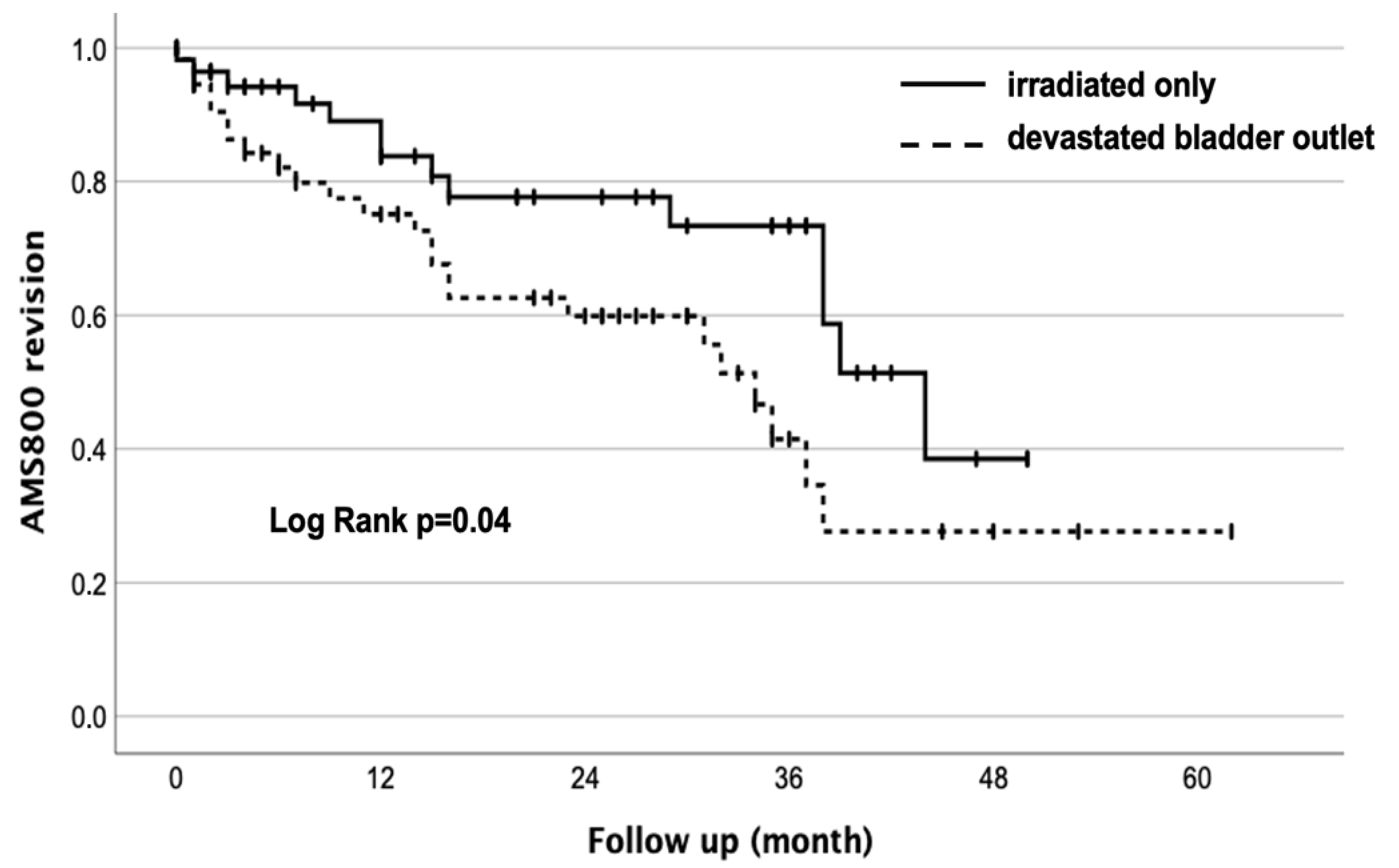
Is the Standard Artificial Urinary Sphincter AMS 800 Still a Treatment Option for the Irradiated Male Patient Presenting with a Devastated Bladder Outlet?

 , ,
, ,  , ,
, ,
Abstract
1. Introduction
2. Materials and Methods
3. Results
4. Discussion
5. Conclusions
Author Contributions
Funding
Institutional Review Board Statement
Informed Consent Statement
Data Availability Statement
Conflicts of Interest
References
- Gacci, M.; Sakalis, V.I.; Karavitakis, M.; Cornu, J.N.; Gratzke, C.; Herrmann, T.R.; Kyriazis, I.; Malde, S.; Mamoulakis, C.; Rieken, M.; et al. European Association of Urology Guidelines on Male Urinary Incontinence. Eur. Urol. 2022, 82, 387–398. [Google Scholar] [CrossRef] [PubMed]
- Bresolin, A.; Garibaldi, E.; Faiella, A.; Cante, D.; Vavassori, V.; Waskiewicz, J.M.; Girelli, G.; Avuzzi, B.; Villa, E.; Magli, A.; et al. Predictors of 2-Year Incidence of Patient-Reported Urinary Incontinence After Post-Prostatectomy Radiotherapy: Evidence of Dose and Fractionation Effects. Front. Oncol. 2020, 10, 1207. [Google Scholar] [CrossRef] [PubMed]
- Hughes, M.; Caza, T.; Li, G.; Daugherty, M.; Blakley, S.; Nikolavsky, D. Histologic characterization of the post-radiation urethral stenosis in men treated for prostate cancer. World J. Urol. 2020, 38, 2269–2277. [Google Scholar] [CrossRef] [PubMed]
- Nicholson, H.L.; Al-Hakeem, Y.; Maldonado, J.J.; Tse, V. Management of bladder neck stenosis and urethral stricture and stenosis following treatment for prostate cancer. Transl. Androl. Urol. 2017, 6 (Suppl. 2), S92–S102. [Google Scholar] [CrossRef] [PubMed]
- Browne, B.M.; Vanni, A.J. Management of Urethral Stricture and Bladder Neck Contracture Following Primary and Salvage Treatment of Prostate Cancer. Curr. Urol. Rep. 2017, 18, 76. [Google Scholar] [CrossRef]
- Riedmiller, H.; Kocot, A. The devastated bladder outlet: Treatment options. Curr. Opin. Urol. 2015, 25, 352–356. [Google Scholar] [CrossRef]
- Martins, F.E.; Holm, H.V.; Lumen, N. Devastated Bladder Outlet in Pelvic Cancer Survivors: Issues on Surgical Reconstruction and Quality of Life. J. Clin. Med. 2021, 10, 4920. [Google Scholar] [CrossRef]
- Meeks, J.J.; Brandes, S.B.; Morey, A.F.; Thom, M.; Mehdiratta, N.; Valadez, C.; Granieri, M.A.; Gonzalez, C.M. Urethroplasty for radiotherapy induced bulbomembranous strictures: A multi-institutional experience. J. Urol. 2011, 185, 1761–1765. [Google Scholar] [CrossRef]
- Ojima, K.; Horiguchi, A.; Shinchi, M.; Tabei, T.; Hirano, Y.; Ito, K.; Azuma, R. Transperineal bulbovesical anastomosis for extensive posterior urethral stenoses after treatment of prostatic disease. Int. J. Urol. 2022, 29, 1511–1516. [Google Scholar] [CrossRef]
- Munoz, F.; Sanguineti, G.; Bresolin, A.; Cante, D.; Vavassori, V.; Waskiewicz, J.M.; Girelli, G.; Avuzzi, B.; Garibaldi, E.; Faiella, A.; et al. Predictors of Patient-Reported Incontinence at Adjuvant/Salvage Radiotherapy after Prostatectomy: Impact of Time between Surgery and Radiotherapy. Cancers 2021, 13, 3243. [Google Scholar] [CrossRef]
- Hüsch, T.; Kretschmer, A.; Thomsen, F.; Kronlachner, D.; Kurosch, M.; Obaje, A.; Anding, R.; Pottek, T.; Rose, A.; Olianas, R.; et al. Risk Factors for Failure of Male Slings and Artificial Urinary Sphincters: Results from a Large Middle European Cohort Study. Urol. Int. 2017, 99, 14–21. [Google Scholar] [CrossRef]
- Kim, J.H.; Jenrow, K.A.; Brown, S.L. Mechanisms of radiation-induced normal tissue toxicity and implications for future clinical trials. Radiat. Oncol. J. 2014, 32, 103–115. [Google Scholar] [CrossRef]
- Sayedahmed, K.; Olianas, R.; Kaftan, B.; Omar, M.; El Shazly, M.; Burger, M.; Mayr, R.; Rosenhammer, B. Impact of previous urethroplasty on the outcome after artificial urinary sphincter implantation: A prospective evaluation. World J. Urol. 2020, 38, 183–191. [Google Scholar] [CrossRef]
- Simonato, A.; Gregori, A.; Lissiani, A.; Carmignani, G. Two-stage transperineal management of posterior urethral strictures or bladder neck contractures associated with urinary incontinence after prostate surgery and endoscopic treatment failures. Eur. Urol. 2007, 52, 1499–1504. [Google Scholar] [CrossRef]
- McGeady, J.B.; McAninch, J.W.; Truesdale, M.D.; Blaschko, S.D.; Kenfield, S.; Breyer, B.N. Artificial urinary sphincter placement in compromised urethras and survival: A comparison of virgin, irradiated and reoperative cases. J. Urol. 2014, 192, 1756–1761. [Google Scholar] [CrossRef]
- Mann, R.A.; Kasabwala, K.; Buckley, J.C.; Smith, T.G.; Westney, O.L.; Amend, G.M.; Breyer, B.N.; Erickson, B.A.; Alsikafi, N.F.; Broghammer, A.J.; et al. The “Fragile” Urethra as a Predictor of Early Artificial Urinary Sphincter Erosion. Urology 2022, 169, 233–236. [Google Scholar] [CrossRef]
- El-Akri, M.; Bentellis, I.; Tricard, T.; Brierre, T.; Cousin, T.; Dupuis, H.; Hermieu, N.; Gaillard, V.; Poussot, B.; Robin, D.; et al. Transcorporal vs. bulbar artificial urinary sphincter implantation in male patients with fragile urethra. World J. Urol. 2021, 39, 4449–4457. [Google Scholar] [CrossRef]
- Redmond, E.; Rourke, K.F.; Tong, S.; Zemp, L.; Hoy, N. Improved artificial urinary sphincter outcomes using a transcorporal cuff placement in patients with a “fragile urethra”. Can. Urol. Assoc. J. 2020, 14, E621–E624. [Google Scholar] [CrossRef]
- Hoy, N.Y.; Rourke, K.F. Artificial Urinary Sphincter Outcomes in the “Fragile Urethra”. Urology 2015, 86, 618–624. [Google Scholar] [CrossRef]
- Long, E.L.; Rebibo, J.D.; Nouhaud, F.X.; Grise, P. Transcorporal artificial urinary sphincter in irradiated and non-irradiated compromised urethra. Assessment with a minimum 2 year follow-up. Int. Braz. J. Urol. 2016, 42, 494–500. [Google Scholar] [CrossRef]
- Wiedemann, L.; Cornu, J.-N.; Haab, E.; Peyrat, L.; Beley, S.; Cathelineau, X.; Haab, F. Transcorporal artificial urinary sphincter implantation as a salvage surgical procedure for challenging cases of male stress urinary incontinence: Surgical technique and functional outcomes in a contemporary series. BJU Int. 2013, 112, 1163–1168. [Google Scholar] [CrossRef] [PubMed]
- Miller, D.; Pekala, K.; Zhang, X.; Orikogbo, O.; Rogers, D.; Fuller, T.W.; Maganty, A.; Rusilko, P. Outcomes of Initial Transcorporal Versus Standard Placement of Artificial Urinary Sphincter in Patients With Prior Radiation. Cureus 2022, 14, e25519. [Google Scholar] [CrossRef] [PubMed]
- Guralnick, M.L.; Miller, E.; Toh, K.L.; Webster, G.D. Transcorporal artificial urinary sphincter cuff placement in cases requiring revision for erosion and urethral atrophy. J. Urol. 2002, 167, 2075–2078, discussion 2079. [Google Scholar] [CrossRef] [PubMed]
- Ortiz, N.M.; Wolfe, A.R.; Baumgarten, A.S.; Ward, E.E.; VanDyke, M.E.; Hudak, S.J.; Morey, A.F. Artificial Urinary Sphincter Cuff Erosion Heat Map Shows Similar Anatomical Characteristics for Transcorporal and Standard Approach. J. Urol. 2020, 204, 1027–1032. [Google Scholar] [CrossRef]
- Queissert, F.; Huesch, T.; Kretschmer, A.; Anding, R.; Kurosch, M.; Kirschner-Hermanns, R.; Pottek, T.; Olianas, R.; Friedl, A.; Pfitzenmaier, J.; et al. Artificial Urinary Sphincter Cuff Size Predicts Outcome in Male Patients Treated for Stress Incontinence: Results of a Large Central European Multicenter Cohort Study. Int. Neurourol. J. 2019, 23, 219–225. [Google Scholar] [CrossRef]
- Ullate, A.; Arance, I.; Virseda-Chamorro, M.; Ruiz, S.; Szczesniewski, J.; Téllez, C.; Queissert, F.; Dorado, J.F.; Angulo, J.C. ATOMS (Adjustable Trans-Obturator Male System) in Patients with Post-Prostatectomy Incontinence and Previously Treated Urethral Stricture or Bladder Neck Contracture. J. Clin. Med. 2022, 11, 4882. [Google Scholar] [CrossRef]
- Agarwal, D.K.; Linder, B.J.; Elliott, D.S. Artificial urinary sphincter urethral erosions: Temporal patterns, management, and incidence of preventable erosions. Indian J. Urol. 2017, 33, 26–29. [Google Scholar]
- Weissbart, S.J.; Chughtai, B.; Elterman, D.; Sandhu, J.S. Management of anastomotic stricture after artificial urinary sphincter placement in patients who underwent salvage prostatectomy. Urology 2013, 82, 476–479. [Google Scholar] [CrossRef]
- Ramirez, D.; Simhan, J.; Hudak, S.J.; Morey, A.F. Standardized approach for the treatment of refractory bladder neck contractures. Urol. Clin. N. Am. 2013, 40, 371–380. [Google Scholar] [CrossRef]
- Myers, J.B.; Brant, W.O.; Hotaling, J.N.; Lenherr, S.M. Urethral Strictures and Artificial Urinary Sphincter Placement. Urol. Clin. N. Am. 2017, 44, 93–103. [Google Scholar] [CrossRef]


| RT Only | RT and Surgery for mU/BN Stenosis | ||
|---|---|---|---|
| Pat. (n) | 61 | 62 | |
| Age (mean) | 75.5 (± 6.8) | 74.4 (± 6.0) | p = 0.3 * |
| BMI (mean) | 28.6 (± 4.9) | 28.0 (± 4.2) | p = 0.4 * |
| Diab. mel. (n) | 16 (26.2%) | 10 (16.1%) | p = 0.17 ** |
| Brachytherapy (n) | 1 (1.6%) | 2 (3.2%) | p = 1 ** |
| External irradiation | 60 (98.4%) | 60 (96.8%) | p = 1 ** |
| Prior incontinence surgery | 19 (31.1%) | 19 (30.6%) | p = 1 ** |
| >1 prior surgery | 6 (9.8%) | 3 (4.8%) | p = 0.3 ** |
| Bulking agent | 4 (6.7%) | 4 (6.5%) | p = 1 ** |
| Fixed sling | 8 (13.1%) | 6 (9.7%) | p = 0.6 ** |
| Adjustable sling | 4 (6.7%) | 3 (4.8%) | p = 0.7 ** |
| proAct | 2 (3.2%) | 0 | p = 0.2 ** |
| AUS | 6 (9.8%) | 7 (11.3%) | p = 1 ** |
| RT Only | RT and Surgery for mU/BN Stenosis | ||
| Prior surgery for mU/BN Stenosis | |||
| n > 1 | 33 (53.2%) | ||
| UI | 29 (46.8%) | ||
| Bladder-neck resection/incision | 32 (51.6%) | ||
| Stent | 5 (8.1%) | ||
| Open urethroplasty | 7 (11.3%) | ||
| AUS surgery | |||
| SC | 26 (42.6%) | 30 (48.4%) | p = 0.6 ** |
| DC | 35 (57.4%) | 32 (51.6%) | p = 0.6 ** |
| Perineal | 44 (72.1%) | 50 (80.6%) | p = 0.3 ** |
| Penoscrotal | 17 (27.9% | 12 (19.4%) | p = 0.3 ** |
| TC | unknown | 10 of 41 (24.4%) | |
| Cuff size (cm, mean) | 4.26 | 4.48 | p = 0.03 *** |
| Cuff 3.5 cm | 4 (6.7%) | 7 (11.3%) | p = 0.4 *** |
| RT Only | RT and Surgery for mU/BN Stenosis | ||
|---|---|---|---|
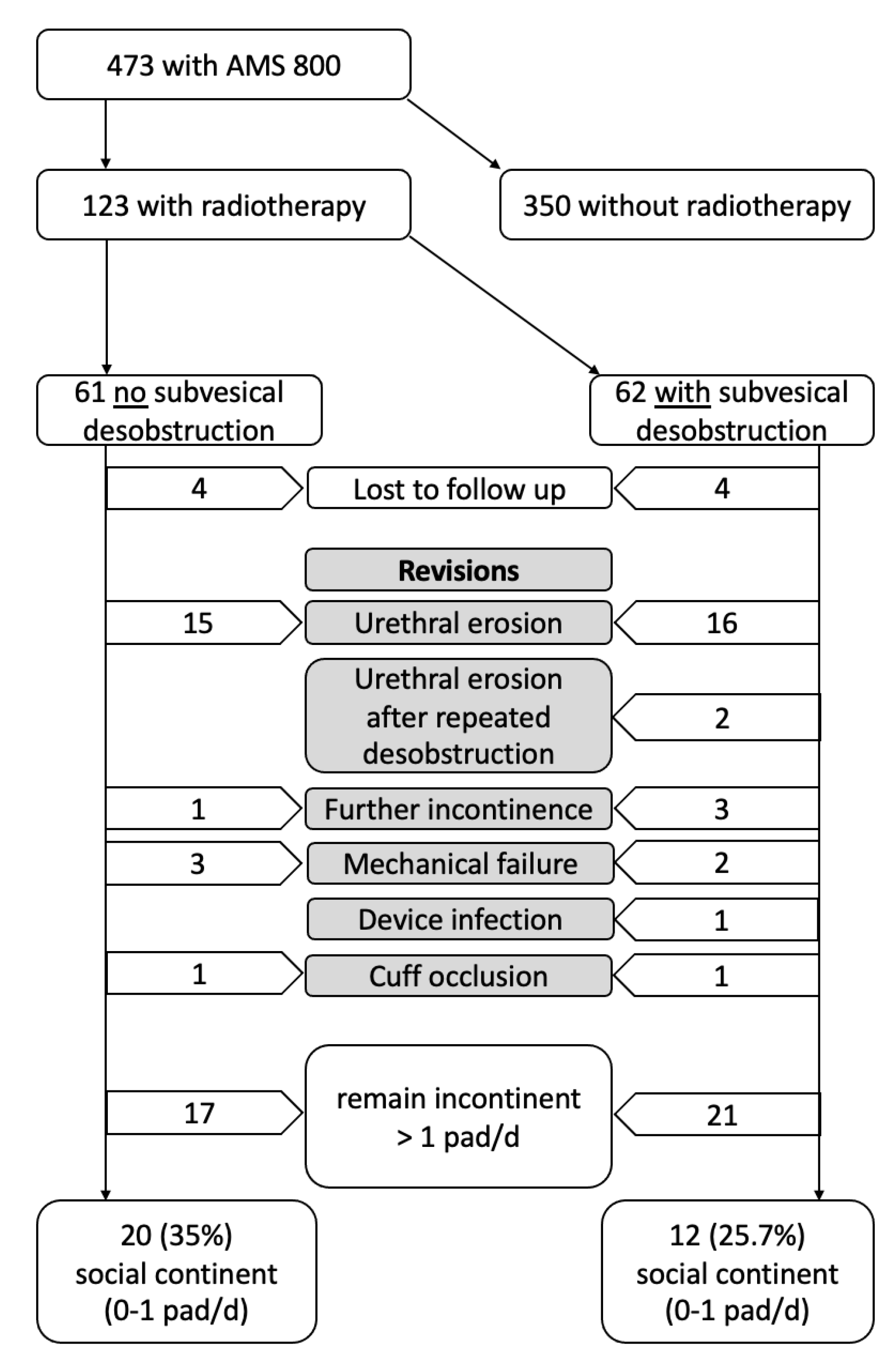
| Lost to follow-up | 4 (6.6%) | 4 (6.5%) | |
| Follow-up (mean month) | 20.5 | 21.5 | |
| Revisions | 15 (26.3%) | 25 (43.1%) | p = 0.05 * |
| Erosion | 11 (17.5%) | 18 (31.0%) | p = 0.15 * |
| Incontinence | 1 (1.8%) | 3 (5.2%) | p = 0.3 * |
| Mechanical failure | 3 (5.3%) | 2 (3.4%) | p = 0.6 * |
| Infection | 0 | 1 (1.7%) | p = 0.3 * |
| Cuff occlusion | 1 (1.8%) | 1 (1.7%) | p = 1 * |
| Functional outcome | |||
| Social continence (0–1 pad/24 h) | 20 (35.0%) | 12 (25.7%) | p = 0.08 * |
Disclaimer/Publisher’s Note: The statements, opinions and data contained in all publications are solely those of the individual author(s) and contributor(s) and not of MDPI and/or the editor(s). MDPI and/or the editor(s) disclaim responsibility for any injury to people or property resulting from any ideas, methods, instructions or products referred to in the content. |
© 2023 by the authors. Licensee MDPI, Basel, Switzerland. This article is an open access article distributed under the terms and conditions of the Creative Commons Attribution (CC BY) license (https://creativecommons.org/licenses/by/4.0/).
Share and Cite
Queissert, F.; Huesch, T.; Kretschmer, A.; Kirschner-Hermanns, R.; Pottek, T.; Olianas, R.; Friedl, A.; Homberg, R.; Pfitzenmaier, J.; Naumann, C.M.; et al. Is the Standard Artificial Urinary Sphincter AMS 800 Still a Treatment Option for the Irradiated Male Patient Presenting with a Devastated Bladder Outlet? J. Clin. Med. 2023, 12, 4002. https://doi.org/10.3390/jcm12124002
Queissert F, Huesch T, Kretschmer A, Kirschner-Hermanns R, Pottek T, Olianas R, Friedl A, Homberg R, Pfitzenmaier J, Naumann CM, et al. Is the Standard Artificial Urinary Sphincter AMS 800 Still a Treatment Option for the Irradiated Male Patient Presenting with a Devastated Bladder Outlet? Journal of Clinical Medicine. 2023; 12(12):4002. https://doi.org/10.3390/jcm12124002
Chicago/Turabian StyleQueissert, Fabian, Tanja Huesch, Alexander Kretschmer, Ruth Kirschner-Hermanns, Tobias Pottek, Roberto Olianas, Alexander Friedl, Roland Homberg, Jesco Pfitzenmaier, Carsten M. Naumann, and et al. 2023. "Is the Standard Artificial Urinary Sphincter AMS 800 Still a Treatment Option for the Irradiated Male Patient Presenting with a Devastated Bladder Outlet?" Journal of Clinical Medicine 12, no. 12: 4002. https://doi.org/10.3390/jcm12124002
APA StyleQueissert, F., Huesch, T., Kretschmer, A., Kirschner-Hermanns, R., Pottek, T., Olianas, R., Friedl, A., Homberg, R., Pfitzenmaier, J., Naumann, C. M., Nyarangi-Dix, J., Hofmann, T., Rose, A., Weidemann, C., Wotzka, C., Hübner, W., Loertzer, H., Abdunnur, R., Grabbert, M., ... Schrader, A. J., on behalf of the Debates on Male Incontinence (DOMINO)-Project. (2023). Is the Standard Artificial Urinary Sphincter AMS 800 Still a Treatment Option for the Irradiated Male Patient Presenting with a Devastated Bladder Outlet? Journal of Clinical Medicine, 12(12), 4002. https://doi.org/10.3390/jcm12124002