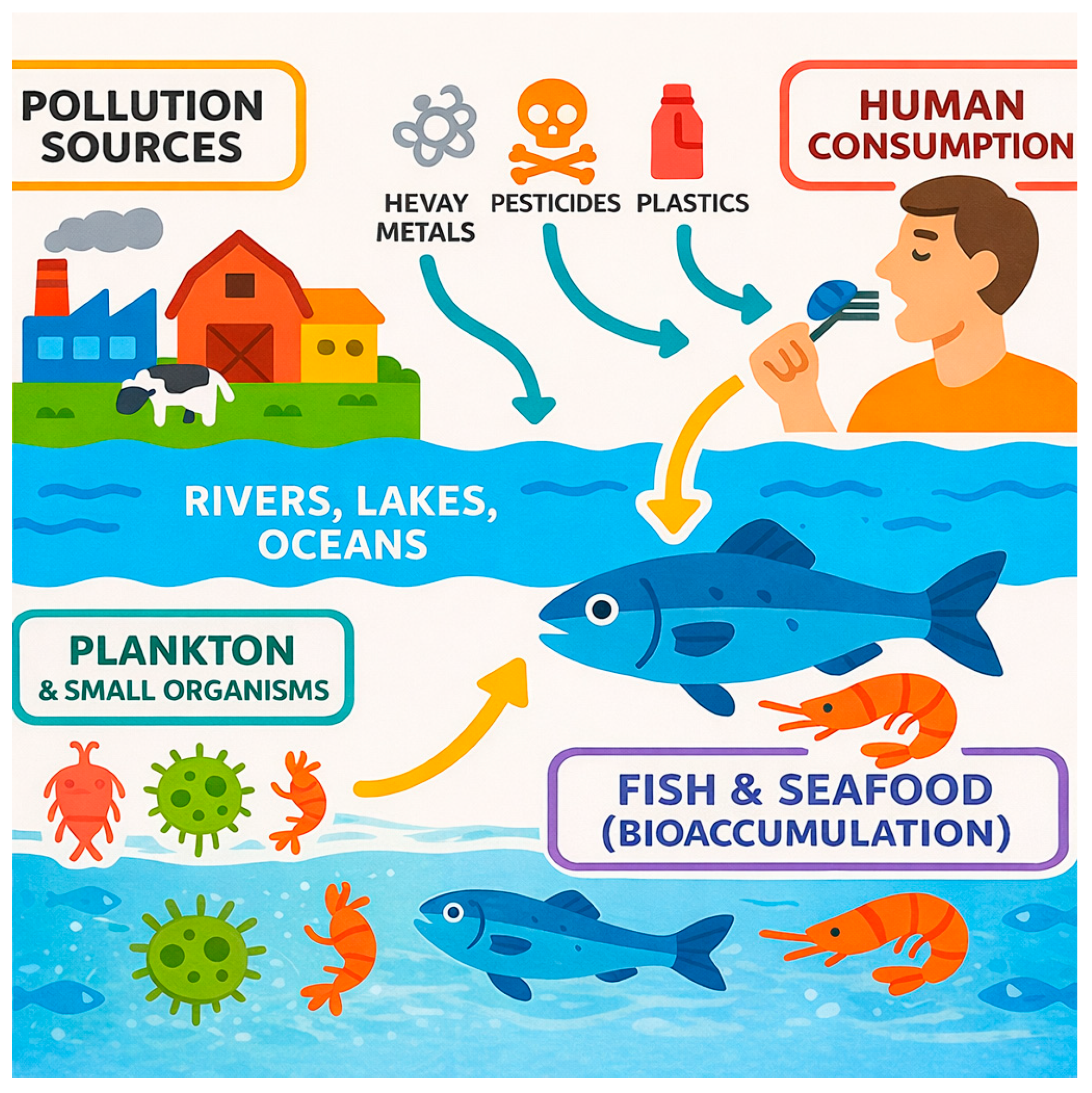
Risks Associated with Dietary Exposure to Contaminants from Foods Obtained from Marine and Fresh Water, Including Aquaculture


Highlights
- Fish and other foods produced in aquatic systems can be nutritious, but they are also prone to contain relatively high levels of chemical contaminants.
- Increased aquaculture and recommendations to consume more fish may have an impact on dietary exposure to pollutants and contaminants found in fish and other products produced in these environments.
- Risk–benefit analysis should support recommendations to consume more fish.
- Regulatory control should be considered for emerging contaminants such as micro- and nano-plastics.
Abstract
1. Introduction
2. Water Systems
2.1. Freshwater (Rivers, Lakes Etc.) v. Marine Environments
2.2. Aquaculture and Farmed Fish v. Wild Fish
3. Pollutants and Contaminants
4. Pesticides and Veterinary Medicines
4.1. Pesticides
4.2. Veterinary Medicines
5. Persistent Organic Pollutants (POPs)
5.1. Origins and Global Impact
5.2. The Stockholm Convention
6. POPs in Fish and Seafood
7. Metal(oid)s in Fish
8. Radionuclides
8.1. Health Risks from Dietary Exposure to Radionuclides
8.2. Natural Radioisotopes
8.3. Artificial Radioisotopes
9. Incidents Involving Food Contamination by Radionuclides
9.1. Chernobyl
9.2. Fukushima
10. Natural Toxicants and Contaminants
11. Eutrophication
12. Microplastics and Nanoplastics
12.1. Bioaccumulation and Trophic Transfer
12.2. Uptake in Filter Feeders and Human Exposure
12.3. Adsorption of Pollutants and Ecotoxicological Implications
13. Food Chemical Risk Assessment
Regulatory Landscape
14. Foods Produced from Aquatic Environments
14.1. Fish, Shellfish, and Other Aquatic Animal Species
14.2. Plant-Derived Aquatic Foods: Seaweeds and Algae
15. Adulteration in Fish and Aquaculture
16. Environmental Considerations
Environmental Risk Assessment
17. Water-Table Contamination
18. Risk Substitution
19. Research Gaps and Future Direction
19.1. Risk-Benefit Analysis and Personalised Medicine
19.2. Risk Assessment of Mixtures
19.3. Microplastics and Nanoplastics
19.4. Algae
19.5. Climate Change and Impact of Flooding
19.6. Cross Boundary Management/Considerations
20. Conclusions
Funding
Institutional Review Board Statement
Informed Consent Statement
Data Availability Statement
Acknowledgments
Conflicts of Interest
References
- FAO. The State of World Fisheries and Aquaculture; Food and Agriculture Organization of the United Nations: Rome, Italy, 2022. [Google Scholar]
- Boyd, C.E.; McNevin, A.A. Aquaculture, Resource Use, and the Environment; Wiley-Blackwell: Hoboken, NJ, USA, 2015. [Google Scholar]
- Barboza, L.G.A.; Lopes, C.; Oliveira, P.; Bessa, F.; Otero, V.; Henriques, B.; Raimundo, J.; Caetano, M.; Vale, C.; Guilhermino, L. Microplastics in wild fish from North East Atlantic Ocean and its potential for causing neurotoxic effects, lipid oxidative damage, and human health risks associated with ingestion exposure. Sci. Total. Environ. 2020, 717, 134625. [Google Scholar] [CrossRef]
- Hermsen, E.; Pompe, R.; Besseling, E.; Koelmans, A.A. Detection of low numbers of microplastics in North Sea fish using strict quality assurance criteria. Mar. Pollut. Bull. 2017, 122, 253–258. [Google Scholar] [CrossRef]
- Doney, S.C.; Ruckelshaus, M.; Duffy, J.E.; Barry, J.P.; Chan, F.; English, C.A.; Galindo, H.M.; Grebmeier, J.M.; Hollowed, A.B.; Knowlton, N.; et al. Climate Change Impacts on Marine Ecosystems. Annu. Rev. Mar. Sci. 2012, 4, 11–37. [Google Scholar] [CrossRef] [PubMed]
- Schellnhuber, H.J.; Rahmstorf, S.; Winkelmann, R. Why the right climate target was agreed in Paris. Nat. Clim. Chang. 2016, 6, 649–653. [Google Scholar] [CrossRef]
- Wright, S.L.; Kelly, F.J. Plastic and Human Health: A Micro Issue? Environ. Sci. Technol. 2017, 51, 6634–6647. [Google Scholar] [CrossRef]
- Galloway, T.S.; Cole, M.; Lewis, C. Interactions of microplastic debris throughout the marine ecosystem. Nat. Ecol. Evol. 2017, 1, 0116. [Google Scholar] [CrossRef]
- Koelmans, A.A.; Bakir, A.; Burton, G.A.; Janssen, C.R. Microplastic as a vector for chemicals in the aquatic environment: Critical review and model-supported reinterpretation of empirical studies. Environ. Sci. Technol. 2016, 50, 3315–3326. [Google Scholar] [CrossRef]
- Wells, M.L.; Potin, P.; Craigie, J.S.; Raven, J.A.; Merchant, S.S.; Helliwell, K.E.; Smith, A.G.; Camire, M.E.; Brawley, S.H. Algae as nutritional and functional food sources: Revisiting our understanding. J. Appl. Phycol. 2017, 29, 949–982. [Google Scholar] [CrossRef]
- Driscoll, C.T.; Mason, R.P.; Chan, H.M.; Jacob, D.J.; Pirrone, N. Mercury as a global pollutant: Sources, pathways, and effects. Environ. Sci. Technol. 2013, 47, 4967–4983. [Google Scholar] [CrossRef] [PubMed]
- Schuster, P.F.; Striegl, R.G.; Aiken, G.R.; Krabbenhoft, D.P.; Dewild, J.F.; Butler, K.; Kamark, B.; Dornblaser, M. Mercury Export from the Yukon River Basin and the Potential Response to a Changing Climate. Environ. Sci. Technol. 2011, 45, 9262–9267. [Google Scholar] [CrossRef]
- Pack, E.C.; Lee, S.H.; Kim, C.H.; Lim, C.H.; Sung, D.G.; Kim, M.H.; Park, K.H.; Lim, K.M.; Choi, D.W.; Kim, S.W. Effects of environmental temperature change on mercury absorption in aquatic organisms with respect to climate warming. J. Toxicol. Environ. Health A 2014, 77, 1477–1490. [Google Scholar] [CrossRef] [PubMed]
- Stachel, B.; Jantzen, E.; Knoth, W.; Krüger, F.; Lepom, P.; Oetken, M.; Reincke, H.; Sawal, G.; Schwartz, R.; Uhlig, S. The Elbe Flood in August 2002—Organic Contaminants in Sediment Samples Taken After the Flood Event. J. Environ. Sci. Health Part A 2005, 40, 265–287. [Google Scholar] [CrossRef]
- Diaz, J.H.; Brisolara, K.F.; Harrington, D.J.; Hu, C.Y.; Katner, A.L. The Environmental Health Impact of Hurricane Katrina on New Orleans. Am. J. Public Health 2020, 110, 1480–1484. [Google Scholar] [CrossRef] [PubMed]
- MacDonald, J. ‘How Toxic Are Flood Waters?’, JSTOR Daily. 2019. Available online: https://daily.jstor.org/how-toxic-are-flood-waters/ (accessed on 21 December 2025).
- Umlauf, G.; Bidoglio, G.; Christoph, E.H.; Kampheus, J.; Krüger, F.; Landmann, D.; Schulz, A.J.; Schwartz, R.; Severin, K.; Stachel, B.; et al. The Situation of PCDD/Fs and Dioxin-like PCBs after the Flooding of River Elbe and Mulde in 2002. Acta Hydrochim. et Hydrobiol. 2005, 33, 543–554. [Google Scholar] [CrossRef]
- Lake, I.; Foxall, C.; Fernandes, A.; Lewis, M.; Rose, M.; White, O.; Dowding, A. Seasonal variations in the levels of PCDD/Fs, PCBs, and PBDEs in cows’ milk. Chemosphere 2013, 90, 72–79. [Google Scholar] [CrossRef] [PubMed]
- Wolf, A.T.; Natharius, J.A.; Danielson, J.J.; Ward, B.S.; Pender, J.K. International river basins of the world. Int. J. Water Resour. Dev. 1999, 15, 387–427. [Google Scholar] [CrossRef]
- Zeitoun, M.; Mirumachi, N. Transboundary water interaction I: Reconsidering conflict and cooperation. Int. Environ. Agreem. 2008, 8, 297–316. [Google Scholar] [CrossRef]
- Gleick, P.H. Water use. Annu. Rev. Environ. Resour. 2003, 28, 275–314. [Google Scholar] [CrossRef]
- United Nations. Convention on the Law of the Non-Navigational Uses of International Watercourses; United Nations: New York, NY, USA, 1997. [Google Scholar]
- Rockström, J.; Steffen, W.; Noone, K.; Persson, Å.; Chapin, F.S., III; Lambin, E.; Lenton, T.M.; Scheffer, M.; Folke, C.; Schellnhuber, H.J.; et al. Planetary boundaries: Exploring the safe operating space for humanity. Ecol. Soc. 2009, 14, 32. [Google Scholar] [CrossRef]
- Justino, C.I.; Duarte, K.R.; Freitas, A.C.; Panteleitchouk, T.S.; Duarte, A.C.; Rocha-Santos, T.A. Contaminants in aquaculture: Overview of analytical techniques for their determination. TrAC Trends Anal. Chem. 2016, 80, 293–310. [Google Scholar] [CrossRef]
- EFSA. Opinion of the Scientific Panel on contaminants in the food chain on the presence of dioxins and PCBs in food and feed. EFSA J. 2005, 284, 1–37. [Google Scholar] [CrossRef]
- Wassenaar, P.N.H.; Verbruggen, E.M.J.; Cieraad, E.; Peijnenburg, W.J.G.M.; Vijver, M.G. Variability in fish bioconcentration factors: Influences of study design and consequences for regulation. Chemosphere 2020, 239, 124731. [Google Scholar] [CrossRef] [PubMed]
- European Council. Council Regulation (EC) No 710/2009 on the organic aquaculture animal and seaweed production. Off. J. Eur. Union 2009. Available online: https://eur-lex.europa.eu/LexUriServ/LexUriServ.do?uri=OJ:L:2009:204:0015:0034:EN:PDF (accessed on 4 November 2025).
- National Marine Fisheries Service Fisheries of the United States, 2016. U.S. Department of Commerce, NOAA Current Fishery Statistics No. 2016. Available online: https://www.st.nmfs.noaa.gov/commercial-fisheries/fus/fus16/index (accessed on 20 December 2025).
- Edwards, P. Aquaculture environment interactions: Past, present and likely future trends. Aquaculture 2015, 447, 2–14. [Google Scholar] [CrossRef]
- Cole, D.W.; Cole, R.; Gaydos, S.J.; Gray, J.; Hyland, G.; Jacques, M.L.; Powell-Dunford, N.; Sawhney, C.; Au, W.W. Aquaculture: Environmental, toxicological, and health issues. Int. J. Hyg. Environ. Health 2009, 212, 369–377. [Google Scholar] [CrossRef]
- FAO. The State of World Fisheries and Aquaculture 2014; Food and Agriculture Organization of the United Nations: Rome, Italy, 2014. [Google Scholar]
- Tacon, A.G.J.; Metian, M. Global overview on the use of fish meal and fish oil in industrially compounded aquafeeds: Trends and future prospects. Aquaculture 2008, 285, 146–158. [Google Scholar] [CrossRef]
- Ren, J.; Wang, X.; Wang, C.; Gong, P.; Wang, X.; Yao, T. Biomagnification of persistent organic pollutants along a high-altitude aquatic food chain in the Tibetan Plateau: Processes and mechanisms. Environ. Pollut. 2017, 220, 636–643. [Google Scholar] [CrossRef]
- FAO. The State of World Fisheries and Aquaculture; Food and Agriculture Organization of the United Nations: Rome, Italy, 2019. [Google Scholar]
- FAO. Responsible Use of Antibiotics in Aquaculture; Food and Agriculture Organization of the United Nations: Rome, Italy, 2019. [Google Scholar]
- Hanekamp, J.C.; Frapporti, G.; Olieman, K. Chloramphenicol, food safety and precautionary thinking in Europe. Environ. Liabil. 2003, 11, 209–221. [Google Scholar]
- Smith, P. Antibiotics in aquaculture: Use, abuse and alternatives. In Aquaculture and the Environment; Springer: Berlin/Heidelberg, Germany, 2012; pp. 217–234. [Google Scholar]
- World Organisation for Animal Health (WOAH). Veterinary Medicinal Products: Residues in Food of Animal Origin; WOAH: Paris, France, 2023. [Google Scholar]
- Stockholm Convention. Stockholm Convention on Persistent Organic Pollutants (POPs); United Nations Environment Programme: Nairobi, Kenya, 2009. [Google Scholar]
- Tanabe, S. Contamination and toxic effects of persistent endocrine disrupters in marine mammals and birds. Mar. Pollut. Bull. 2002, 45, 69–77. [Google Scholar] [CrossRef]
- AMAP (Arctic Monitoring and Assessment Programme). AMAP Assessment 2002: Persistent Organic Pollutants in the Arctic; AMAP: Oslo, Norway, 2004. [Google Scholar]
- Carpenter, D.O. Polychlorinated biphenyls (PCBs): Routes of exposure and effects on human health. Rev. Environ. Health 2006, 21, 1–23. [Google Scholar] [CrossRef]
- Diamanti-Kandarakis, E.; Bourguignon, J.P.; Giudice, L.C.; Hauser, R.; Prins, G.S.; Soto, A.M.; Zoeller, R.T.; Gore, A.C. Endocrine-disrupting chemicals: An Endocrine Society scientific statement. Endocr. Rev. 2009, 30, 293–342. [Google Scholar] [CrossRef]
- Giesy, J.P.; Kannan, K. Global distribution of perfluorooctane sulfonate in wildlife. Environ. Sci. Technol. 2001, 35, 1339–1342. [Google Scholar] [CrossRef]
- Kissa, E. Fluorinated Surfactants and Repellents, 2nd ed.; Marcel Dekker: New York, NY, USA, 2001. [Google Scholar]
- She, J.; Petreas, M.; Winkler, J.; Visita, P.; McKinney, M.; Kopec, D. PBDEs in the San Francisco Bay Area: Measurement in harbor seal blubber and human breast adipose tissue. Chemosphere 2016, 64, 271–279. [Google Scholar] [CrossRef] [PubMed]
- Borgå, K.; McKinney, M.A.; Routti, H.; Fernie, K.J.; Giebichenstein, J.; Hallanger, I.; Muir, D.C.G. The influence of global climate change on accumulation and toxicity of persistent organic pollutants and chemicals of emerging concern in Arctic food webs. Environ. Sci. Process. Impacts 2022, 24, 1544. [Google Scholar] [CrossRef]
- Wang, Y.; Wu, P.; Zhang, Y. Climate-driven changes of global marine mercury cycles in 2100. Proc. Natl. Acad. Sci. USA 2022, 119, e2202488120. [Google Scholar] [CrossRef]
- Jezierska, B.; Witeska, M. The Metal Uptake and Accumulation in Fish Living in Polluted Waters. In Soil and Water Pollution Monitoring, Protection and Remediation; Springer: Berlin/Heidelberg, Germany, 2006; pp. 107–114. [Google Scholar]
- Handy, R.; Sims, D.; Giles, A.; Campbell, H.; Musonda, M. Metabolic trade-off between locomotion and detoxification for maintenance of blood chemistry and growth parameters by rainbow trout (Oncorhynchus mykiss) during chronic dietary exposure to copper. Aquat. Toxicol. 1999, 47, 23–41. [Google Scholar] [CrossRef]
- Jaishankar, M.; Tseten, T.; Anbalagan, N.; Mathew, B.B.; Beeregowda, K.N. Toxicity, mechanism and health effects of some heavy metals. Interdiscip. Toxicol. 2014, 7, 60–72. [Google Scholar] [CrossRef] [PubMed]
- Canli, M.; Atli, G. The relationships between heavy metal (Cd, Cr, Cu, Fe, Pb, Zn) levels and the size of six Mediterranean fish species. Environ. Pollut. 2003, 121, 129–136. [Google Scholar] [CrossRef] [PubMed]
- Bhat, R.A.; Saoca, C.; Cravana, C.; Fazio, F.; Guerrera, M.C.; Labh, S.N.; Kesbiç, O.S. Effects of heavy metal pollution from different water bodies on male rainbow trout (Oncorhynchus mykiss) reproductive health. Environ. Sci. Pollut. Res. 2023, 30, 23467–23479. [Google Scholar] [CrossRef]
- Lemarié, G.; Dosdat, A.; Covès, D.; Dutto, G.; Gasset, E.; Person-Le Ruyet, J. Effect of chronic ammonia exposure on growth of European sea bass (Dicentrarchus labrax) juveniles. Aquaculture 2004, 229, 479–491. [Google Scholar] [CrossRef]
- Jezierska, B.; Ługowska, K.; Witeska, M. The effects of heavy metals on embryonic development of fish (a review). Fish Physiol. Biochem. 2009, 35, 625–640. [Google Scholar] [CrossRef] [PubMed]
- Francesconi, K.A. Arsenic species in seafood: Origin and human health implications. Pure Appl. Chem. 2010, 82, 373–381. [Google Scholar] [CrossRef]
- Francesconi, K.A.; Edmonds, J.S. Arsenic species in marine samples. Croat. Chem. Acta 1998, 71, 343–359. Available online: https://hrcak.srce.hr/file/195367 (accessed on 21 December 2025).
- Tchounwou, P.B.; Yedjou, C.G.; Patlolla, A.K.; Sutton, D.J. Heavy metal toxicity and the environment. Exp. Suppl. 2012, 101, 133–164. [Google Scholar] [CrossRef]
- Satarug, S.; Garrett, S.H.; Sens, M.A.; Sens, D.A. Cadmium, environmental exposure, and health outcomes. Environ. Health Perspect. 2010, 118, 182–190. [Google Scholar] [CrossRef]
- EFSA Panel on Contaminants in the Food Chain (CONTAM). Scientific opinion on the risk for public health related to the presence of mercury and methylmercury in food. EFSA J. 2012, 10, 2985. [Google Scholar] [CrossRef]
- Boening, D.W. Ecological effects, transport, and fate of mercury: A general review. Chemosphere 2000, 40, 1335–1351. [Google Scholar] [CrossRef]
- Mergler, D.; Anderson, H.A.; Chan, L.H.M.; Mahaffey, K.R.; Murray, M.; Sakamoto, M.; Stern, A.H. Methylmercury Exposure and Health Effects in Humans: A Worldwide Concern. AMBIO J. Hum. Environ. 2007, 36, 3–11. [Google Scholar] [CrossRef]
- Zhu, Y.G.; Yoshinaga, M.; Zhao, F.J.; Rosen, B.P. Earth Abides Arsenic Biotransformations. Annu. Rev. Earth Planet Sci. 2014, 42, 443–467. [Google Scholar] [CrossRef]
- WHO Radioactivity in Food After a Nuclear Emergency. 2023. Available online: https://www.who.int/news-room/questions-and-answers/item/radioactivity-in-food-after-a-nuclear-emergency (accessed on 25 October 2025).
- UNSCEAR. Sources and Effects of Ionizing Radiation; United Nations Scientific Committee on the Effects of Atomic Radiation: Vienna, Austria, 2000. [Google Scholar]
- IAEA. Radiation Protection and Safety of Radiation Sources: International Basic Safety Standards; International Atomic Energy Agency: Vienna, Austria, 2015. [Google Scholar]
- Hayashida, N.; Horiguchi, I. Summary of risk response on radioactive substances contained in food items in the aftermath of the Fukushima nuclear accident. J. Radiat. Res. 2024, 65, i97–i105. [Google Scholar] [CrossRef]
- Food Safety Institute. Fukushima Nuclear Disaster: Impact on Food Safety. 2011. Available online: https://foodsafety.institute/food-toxicology-public-health/fukushima-nuclear-disaster-food-safety-impact/ (accessed on 4 November 2025).
- Landsberg, J.H. The effects of harmful algal blooms on aquatic organisms. Rev. Fish. Sci. 2002, 10, 113–390. [Google Scholar] [CrossRef]
- Friedman, M.A.; Fleming, L.E.; Fernandez, M.; Bienfang, P.; Schrank, K.; Dickey, R.; Bottein, M.Y.; Backer, L.; Ayyar, R.; Weisman, R.; et al. Ciguatera fish poisoning: Treatment, prevention and management. Mar. Drugs 2017, 15, 176. [Google Scholar] [CrossRef]
- Noguchi, T.; Arakawa, O. Tetrodotoxin–Distribution and accumulation in aquatic organisms, and cases of human intoxication. Mar. Drugs 2008, 6, 220–242. [Google Scholar] [CrossRef]
- Knutsen, H.K.; Alexander, J.; Barregård, L.; Bignami, M.; Brüschweiler, B.; Ceccatelli, S.; Cottrill, B.; Dinovi, M.; Edler, L.; Grasl-Kraupp, B.; et al. Marine biotoxins in shellfish—Summary on regulated marine biotoxins. EFSA J. 2009, 7, 1306. [Google Scholar] [CrossRef]
- Botana, L.M. Seafood and Freshwater Toxins: Pharmacology, Physiology, and Detection, 3rd ed.; CRC Press: Boca Raton, FL, USA, 2014. [Google Scholar]
- Pietsch, C. Risk Assessment for Mycotoxin Contamination in Fish Feeds in Europe. Mycotoxin Res. 2020, 36, 41–62. [Google Scholar] [CrossRef] [PubMed]
- Matejova, I.; Svobodova, Z.; Vakula, J.; Mares, J.; Modra, H. Impact of Mycotoxins on Aquaculture Fish Species: A Review. J. World Aquacult. Soc. 2017, 48, 186–200. [Google Scholar] [CrossRef]
- Ziarati, M.; Imani, A.; Ghafarifarsani, H.; Bhatt, D. A Brief Review on Aflatoxicosis in Aquaculture with a Focus on Fish. Aquac. Nutr. 2024, 2024, 3130230. [Google Scholar] [CrossRef]
- Bullerman, L.; Bianchin, A. Stability of mycotoxins during food processing. Int. J. Food Microbiol. 2007, 119, 140–146. [Google Scholar] [CrossRef]
- Anderson, D.M.; Glibert, P.M.; Burkholder, J.M. Harmful algal blooms and eutrophication: Nutrient sources, composition, and consequences. Estuaries 2002, 25, 704–726. Available online: https://link.springer.com/article/10.1007/BF02804901 (accessed on 19 December 2025). [CrossRef]
- Lan, J.; Liu, P.; Hu, X.; Zhu, S. Harmful Algal Blooms in Eutrophic Marine Environments: Causes, Monitoring, and Treatment. Water 2024, 16, 2525. Available online: https://www.mdpi.com/2073-4441/16/17/2525 (accessed on 19 December 2025). [CrossRef]
- Ongley, E.D. Control of Water Pollution from Agriculture; FAO Irrigation and Drainage Paper 55; Food and Agriculture Organization of the United Nations: Rome, Italy, 1996. [Google Scholar]
- Xia, F.; Yang, W.; Zhao, H.; Cai, Y.; Tan, Q. Occurrence characteristics and transport processes of riverine microplastics in different connectivity contexts. npj Clean Water 2024, 7, 1. Available online: https://www.nature.com/articles/s41545-024-00424-4 (accessed on 19 December 2025). [CrossRef]
- Yong, C.Q.Y.; Valiyaveettil, S.; Tang, B.L. Toxicity of Microplastics and Nanoplastics in Mammalian Systems. Int. J. Environ. Res. Public Health 2020, 17, 1509. [Google Scholar] [CrossRef]
- Alimi, O.S.; Farner Budarz, J.; Hernandez, L.M.; Tufenkji, N. Microplastics and Nanoplastics in Aquatic Environments: Aggregation, Deposition, and Enhanced Contaminant Transport. Environ. Sci. Technol. 2018, 52, 1704–1724. [Google Scholar] [CrossRef]
- Owowenu, E.K.; Nnadozie, C.F.; Akamagwuna, F.; Noundou, X.S.; Uku, J.E.; Odume, O.N. A critical review of environmental factors influencing the transport dynamics of microplastics in riverine systems: Implications for ecological studies. Aquat. Ecol. 2023, 57, 557–570. [Google Scholar] [CrossRef]
- Mattsson, K.; de Lima, J.A.; Wilkinson, T.; Järlskog, I.; Ekstrand, E.; Andersson Sköld, Y.; Gustafsson, M.; Hassellöv, M. Tyre and road wear particles from source to sea. Microplastics Nanoplastics 2023, 3, 14. Available online: https://microplastics.springeropen.com/articles/10.1186/s43591-023-00060-8 (accessed on 19 December 2025). [CrossRef]
- McHale, M.E.; Sheehan, K.L. Bioaccumulation, transfer, and impacts of microplastics in aquatic food chains. J. Environ. Expo. Assess. 2024, 3, 15. Available online: https://www.oaepublish.com/articles/jeea.2023.49 (accessed on 25 October 2025). [CrossRef]
- Cañón-Bastidas, J.; Molina, A.; Duque, G. Impact of Microplastic Ingestion on Commercial Fish: A Trophic-Level Analysis. Int. J. Environ. Res. 2025, 19, 142. Available online: https://link.springer.com/article/10.1007/s41742-025-00798-4 (accessed on 25 October 2025). [CrossRef]
- Dey, P.; Bradley, T.M.; Boymelgreen, A. Trophic transfer and bioaccumulation of nanoplastics in Coryphaena hippurus (mahi-mahi) and effect of depuration. PLoS ONE 2024, 19, e0314191. Available online: https://journals.plos.org/plosone/article?id=10.1371/journal.pone.0314191 (accessed on 25 October 2025). [CrossRef]
- Fraissinet, S.; Arduini, D.; Martines, A.; De Benedetto, G.E.; Malitesta, C.; Giangrande, A.; Rossi, S. Microplastics uptake by four filter feeders. J. Mar. Sci. Eng. 2024, 12, 1000. Available online: https://airus.unisalento.it/retrieve/34d4f2dc-b32e-4f74-be78-0db3f10ce047/jmse-12-01000.pdf (accessed on 25 October 2025). [CrossRef]
- Gaur, P.; Raheja, Y.; Regar, R.K.; Singh, A.; Kumari, K.; Kumari, A.; Sharma, P.; Gaur, V.K.; Srivastava, J.K. Tiny plastics, massive consequences: The environmental and health crisis of micro (nano) plastics. Water Air Soil Pollut. 2025, 236, 705. Available online: https://link.springer.com/article/10.1007/s11270-025-08363-7 (accessed on 25 October 2025). [CrossRef]
- Wiener, M. New Research Highlights the Problem of Microplastic Pollution. Global Environmental Health Newsletter, NIEHS. 2023. Available online: https://www.niehs.nih.gov/research/programs/geh/geh_newsletter/2023/8/articles/new_research_highlights_the_problem_of_microplastic_pollution (accessed on 25 October 2025).
- Rochman, C.M.; Hoh, E.; Hentschel, B.T.; Kaye, S. Long-term field measurement of sorption of organic contaminants to five types of plastic pellets: Implications for plastic marine debris. Environ. Sci. Technol. 2013, 47, 1646–1654. [Google Scholar] [CrossRef]
- Teuten, E.L.; Saquing, J.M.; Knappe, D.R.U.; Barlaz, M.A.; Jonsson, S.; Björn, A.; Rowland, S.J.; Thompson, R.C.; Galloway, T.S.; Yamashita, R.; et al. Transport and release of chemicals from plastics to the environment and to wildlife. Philos. Trans. R. Soc. B Biol. Sci. 2009, 364, 2027–2045. [Google Scholar] [CrossRef]
- Zettler, E.R.; Mincer, T.J.; Amaral-Zettler, L.A. Life in the “plastisphere”: Microbial communities on plastic marine debris. Environ. Sci. Technol. 2013, 47, 7137–7146. [Google Scholar] [CrossRef]
- Zhai, X.; Zhang, X.-H.; Yu, M. Microbial colonization and degradation of marine microplastics in the plastisphere: A review. Front. Microbiol. 2023, 14, 1127308. Available online: https://www.frontiersin.org/articles/10.3389/fmicb.2023.1127308/full (accessed on 19 December 2025). [CrossRef]
- Dey, S.; Rout, A.K.; Behera, B.K.; Ghosh, K. Plastisphere community assemblage of aquatic environment: Plastic-microbe interaction, role in degradation and characterization technologies. Environ. Microbiome 2022, 17, 32. Available online: https://environmentalmicrobiome.biomedcentral.com/articles/10.1186/s40793-022-00430-4 (accessed on 19 December 2025). [CrossRef] [PubMed]
- Tang, K.H.D.; Li, R. The effects of plastisphere on the physicochemical properties of microplastics. Bioprocess Biosyst. Eng. 2025, 48, 1–15. Available online: https://link.springer.com/article/10.1007/s00449-024-03059-4 (accessed on 19 December 2025). [CrossRef] [PubMed]
- World Health Organization. Principles and Methods for the Risk Assessment of Chemicals in Food; Environmental Health Criteria 240; WHO: Geneva, Switzerland, 2009. [Google Scholar]
- EFSA Scientific Committee; Bennekou, S.H.; Allende, A.; Bearth, A.; Casacuberta, J.; Castle, L.; Coja, T.; Crépet, A.; Halldorsson, T.; Hoogenboom, L.; et al. Guidance on the use of read-across for chemical safety assessment in food and feed. EFSA J. 2025, 23, e9586. [Google Scholar] [CrossRef]
- Committee on Toxicity. Assessing Chemical Risks in Food. 2020. Available online: https://cot.food.gov.uk/assessingchemicalrisksinfood (accessed on 19 December 2025).
- Alexander, J.; Benford, D.; Boobis, A.; Eskola, M.; Fink-Gremmels, J.; Fürst, P.; Heppner, C.; Schlatter, J.; van Leeuwen, R. Risk assessment of contaminants in food and feed. EFSA J. 2012, 10, s1004. [Google Scholar] [CrossRef]
- Benford, D. Risk Assessment of Chemical Contaminants and Residues in Food. In Persistent Organic Pollutants and Toxic Metals in Food; Rose, M., Fernandes, A., Eds.; Woodhead Publishing: Cambridge, UK, 2013; ISBN 978-0-85709-245-8. [Google Scholar]
- Visciano, P. Environmental contaminants in fish products: Food safety issues and remediation strategies. Foods 2024, 13, 3511. [Google Scholar] [CrossRef]
- Adams, S.M.; Brown, A.M.; Goede, R.W. A quantitative health assessment index for rapid evaluation of fish condition in the field. Trans. Am. Fish. Soc. 1993, 122, 63–73. [Google Scholar] [CrossRef]
- EFSA. Risk Assessment Strategies for Contaminants in Seafood (RASCS); 2023:EN-8419; EFSA Supporting Publication: Parma, Italy, 2023. [Google Scholar]
- Koenig, E. Can Clams and Oysters Help Clean Up Waterways? Woods Hole Oceanographic Institution. 2018. Available online: https://www.whoi.edu/oceanus/feature/can-clams-and-oysters-help-clean-up-waterways/ (accessed on 20 December 2025).
- Rose, M.; Holland, J.; Dowding, A.; Petch, S.; White, S.; Fernandes, A.; Mortimer, D. Investigation of the formation of PAHs in foods prepared in the home to determine the effects of frying, grilling, barbe-cuing, toasting and roasting. Food Chem. Toxicol. 2015, 78, 1–9. [Google Scholar]
- Kibria, G.; Nugegoda, D.; Haroon, A.K.Y. Microplastic pollution and contamination of seafood. In Emerging Contaminants and Associated Treatment Technologies; Springer: Berlin/Heidelberg, Germany, 2022; pp. 277–322. [Google Scholar]
- Chen, Z.; Zhang, L.; Liu, Y.; Wen, Y.; Shan, S.; Zhao, C. Seaweed as a sustainable future food source. Int. J. Food Sci. Technol. 2024, 59, 1237–1247. [Google Scholar] [CrossRef]
- Rose, M.; Lewis, J.; Langford, N.; Baxter, M.; Origgi, S.; Barber, M.; MacBain, H.; Thomas, K. Arsenic in Seaweed—Forms, concentration and dietary exposure. Food Chem. Toxicol. 2007, 45, 1263–1267. [Google Scholar] [CrossRef]
- van der Oost, R.; Beyer, J.; Vermeulen, N.P.E. Fish bioaccumulation and biomarkers in environmental risk assessment: A review. Environ. Toxicol. Pharmacol. 2003, 13, 57–149. [Google Scholar] [CrossRef] [PubMed]
- Schäfer, S.; Buchmeier, G.; Claus, E.; Duester, L.; Heininger, P.; Körner, A.; Mayer, P.; Paschke, A.; Rauert, C.; Reifferscheid, G.; et al. Bioaccumulation in aquatic systems: Methodological approaches, monitoring and assessment. Environ. Sci. Eur. 2015, 27, 5. [Google Scholar] [CrossRef]
- European Chemicals Agency (ECHA). Benchmarking approach in Bioaccumulation Assessment. In Proceedings of the ECHA presentation (SETAC Vienna), Vienna, Austria, 19 September 2024; Available online: https://setac.secure-platform.com/vienna2025/solicitations/102006/sessiongallery/94157/application/6473 (accessed on 25 October 2025).
- Howard, G.; Bartram, J.; Pedley, S.; Schmoll, O.; Chorus, I.; Berger, P.; World Health Organization. Groundwater and Public Health. In Protecting Groundwater for Health: Managing the Quality of Drinking-Water Sources; Schmoll, O., Howard, G., Chilton, J., Chorus, I., Eds.; IWA Publishing: London, UK, 2006; ISBN 1843390795. [Google Scholar]
- Biswas, J.K.; Warke, M.; Datta, R.; Sarkar, D. Is Arsen. Rice A Major Hum. Health Concern? Curr. Pollut. Rep. 2020, 6, 37–42. [Google Scholar] [CrossRef]
- Meharg, A.A.; Adomako, E.; Lawgali, Y.; Deacon, C.; Williams, P. Levels of Arsenic in Rice—Literature Review, Food Standards Agency Contract C101045; Food Standards Agency: London, UK, 2008. [Google Scholar]
- Murphy, T.; Phan, K.; Yumvihoze, E.; Irvine, K.; Wilson, K.; Lean, D.; Ty, B.; Poulain, A.; Laird, B.; Chan, L.H.M. Groundwater irrigation and arsenic speciation in rice in Cambodia. Environ. Health Perspect. 2018, 126, 087011. [Google Scholar] [CrossRef]
- Kombo, G.O.M.; Escuder Bueno, I.; Chordà Ramón, E. Risk analysis methods of water supply systems: Comprehensive review from source to tap. Appl. Water Sci. 2022, 12, 56. [Google Scholar] [CrossRef]
- Kinniburgh, D.G.; Smedley, P.L. Arsenic Contamination of Groundwater in Bangladesh; Technical Report; British Geological Survey (BGS) and Department of Public Health Engineering (DPHE): Keyworth, UK, 2001. [Google Scholar]
- Raessler, M. The Arsenic contamination of drinking and groundwaters in Bangladesh: Biogeochemical aspects and implications on public health. Environ. Toxicol. Chem. 2018, 37, 1097–1108. [Google Scholar] [CrossRef] [PubMed]
- WHO (World Health Organization). Water Safety Plan Manual: Step by Step Risk Management for Drinking Water Supplies, 2nd ed.; WHO: Geneva, Switzerland, 2017. [Google Scholar]
- WHO (World Health Organization). Toxic Cyanobacteria in Water: A Guide to Their Public Health Consequences, Monitoring and Management, 2nd ed.; WHO: Geneva, Switzerland, 2021. [Google Scholar]
- Thomson, B.; Rose, M. Environmental contaminants in foods and feeds in the light of climate change. Qual. Assur. Saf. Crops Foods 2011, 3, 2–11. [Google Scholar]
- Sonke, J.E.; Angot, H.; Zhang, Y.; Poulain, A.; Björn, E.; Schartup, A. Global change effects on biogeochemical mercury cycling. Ambio 2023, 52, 853–876. [Google Scholar] [CrossRef]
- Schartup, A.T.; Thackray, C.P.; Qureshi, A.; Dassuncao, C.; Gillespie, K.; Hanke, A.; Sunderland, E.M. Climate change and overfishing increase neurotoxicant in marine predators. Nature 2019, 572, 648–650. [Google Scholar] [CrossRef] [PubMed]
- Muir, D.; Gunnarsdottir, M.J.; Koziol, K.; von Hippel, F.A.; Szuminska, D.; Ademollo, N.; Corsolini, S.; De Silva, A.; Gabrielsen, G.; Kallenborn, R.; et al. Local sources versus long-range transport of organic contaminants in the Arctic: Future developments related to climate change. Environ. Sci. Adv. 2025, 4, 355. [Google Scholar] [CrossRef]
- Costopoulou, D.; Leondiadis, L.; Rose, M. Climate change influence on the trends of BFRs in the environment and food. Chemosphere 2024, 367, 143578. [Google Scholar] [CrossRef] [PubMed]
- Briceño, H.O.; Boyer, J.N.; Harlem, P.W. Ecological Impacts on Biscayne Bay and Biscayne National Park from Proposed South Miami-Dade County Development, and Derivation of Numeric Nutrient Criteria for South Florida Estuaries and Coastal Waters; NPS TA# J5297-08-0085; Florida International University, Southeast Environmental Research Center Contribution: Miami, FL, USA, 2011; Available online: http://serc.fiu.edu/wqmnetwork/BNP/Final%20Report%20BNP.pdf (accessed on 19 December 2025).
- UN-Water. Transboundary Waters: Water Facts. United Nations. 2018. Available online: https://www.unwater.org/sites/default/files/app/uploads/2018/10/WaterFacts_transboundary_water_sep2018.pdf (accessed on 21 October 2025).
- Preventing Conflicts over Transboundary Dams. 2024. Available online: https://www.waterpowermagazine.com/analysis/preventing-conflicts-over-transboundary-dams/ (accessed on 25 October 2025).
- Azizi, M.A.; Leandro, J. Factors Affecting Transboundary Water Disputes: Nile, Indus, and Euphrates–Tigris River Basins. Water 2025, 17, 525. [Google Scholar] [CrossRef]


| Purpose/Scenario | Role of Veterinary Pharmaceuticals |
|---|---|
| Enhancing biosecurity and husbandry | Vaccines, disinfectants, and prophylactic agents form the foundation of robust health management, helping to prevent disease introduction and spread. |
| Treating production-limiting diseases | Therapeutic interventions minimize losses from reduced growth, poor feed conversion, and increased mortality caused by infections and parasites. |
| Managing epizootic disease outbreaks | Swift, effective use of veterinary medicines is crucial for controlling large-scale outbreaks and averting the collapse of operations or even entire industry sectors [34]. |
| Early cultivation of new species | Used where pathogen–host interactions are not fully understood. |
| When preventive measures fail | Applied in situations where vaccination or optimal husbandry do not prevent disease. |
| Managing emerging or re-emerging diseases in changing production environments | Used to address new or returning diseases as production environments evolve. |
| Responding to environmental and climatic shifts | Used when shifts affect pathogen distribution and virulence. |
| Ensuring animal welfare | Helps meet evolving standards for the health and treatment of cultured species [34]. |
| Concern/Issue | Description |
|---|---|
| Diagnostic challenges | Effective disease control depends on accurate, timely diagnosis before administering medicines. Without rapid diagnostics, treatments are often empirical or prophylactic, increasing risk of misuse and antimicrobial resistance (AMR). |
| Human and animal health risks | The emergence and spread of AMR among bacteria in aquatic environments and humans is a serious concern. Residues of banned or unregulated substances in aquaculture products may also pose direct health risks, such as toxic or allergic reactions. Concentrations exceeding established Maximum Residue Limits (MRLs) are hazardous, and residues can disrupt human gut flora and promote resistance in enteric pathogens [35,36]. |
| Environmental and ecological impacts | Veterinary medicines can enter the environment through uneaten medicated feed, effluent discharge, or excreted residues, accumulating in sediments and aquatic ecosystems. Consequences include changes in microbial communities, toxicity to non-target species, and the spread of AMR genes among aquatic bacteria [35]. |
| Legislative and regulatory limitations | Sustainable use of veterinary medicines requires strong legal and regulatory frameworks. National authorities must regulate drug registration, prescription, licensing, and record-keeping, and ensure enforcement through adequate capacity and resources. The absence of such frameworks contributes to misuse and over-use of veterinary medicines in aquaculture [35]. |
| Contaminant Type | Examples & Sources | Health Risks/Notes |
|---|---|---|
| Pesticides | Organophosphates, carbamates, pyrethroids, DDT, lindane, chlordane; agricultural runoff, direct use in aquaculture | Endocrine disruption, neurotoxicity, carcinogenicity, developmental effects; bioaccumulation in food web |
| Veterinary Medicines | Antimicrobials, antiparasitics, organophosphates, pyrethroids; used in aquaculture and livestock | Antimicrobial resistance, toxic/allergic reactions, residue accumulation, environmental contamination |
| Persistent Organic Pollutants (POPs) | Dioxins, PCBs, PBDEs, PFAS, BFRs, organochlorine pesticides; industrial/agricultural sources, contaminated feed | Carcinogenicity, immunotoxicity, neurotoxicity, endocrine disruption; bioaccumulation and biomagnification |
| Heavy Metals & Metalloids | Mercury (methylmercury), cadmium, lead, arsenic; industrial discharge, mining, runoff | Neurological deficits, renal/hepatic damage, reproductive toxicity, carcinogenicity; methylmercury in predatory fish |
| Radionuclides | Caesium-137, strontium-90, iodine-131; nuclear fallout, accidents, contaminated water | Cancer risk, thyroid dysfunction, bone disorders; bioaccumulation in aquatic organisms |
| Natural Biotoxins | Saxitoxins, domoic acid, ciguatoxins, tetrodotoxin; produced by algae, present in some fish/shellfish | Paralytic, amnesic, ciguatera fish poisoning; neurological and gastrointestinal symptoms |
| Mycotoxins | Aflatoxins, ochratoxins, fumonisins; from contaminated aquafeeds (plant-based) | Immunosuppression, carcinogenicity, organ toxicity |
| Polycyclic Aromatic Hydrocarbons (PAHs) | From combustion, smoked/charred foods, environmental pollution | Genotoxicity, carcinogenicity; bioaccumulation in shellfish |
| Microplastics & Nanoplastics | Plastic debris, synthetic fibers, tire wear particles; riverine/marine transport, aquaculture | Poorly understood toxicity, potential for adsorbing other pollutants, ingestion by filter feeders and humans |
| Eutrophication-related Toxins | Harmful algal blooms, cyanobacterial toxins; nutrient runoff from agriculture | Shellfish poisoning, fish kills, ecosystem disruption |
| Excess Iodine (from seaweed) | Iodine-rich seaweed, especially Hijiki; bioaccumulation from water | Thyroid dysfunction if consumed in excess |
Disclaimer/Publisher’s Note: The statements, opinions and data contained in all publications are solely those of the individual author(s) and contributor(s) and not of MDPI and/or the editor(s). MDPI and/or the editor(s) disclaim responsibility for any injury to people or property resulting from any ideas, methods, instructions or products referred to in the content. |
© 2026 by the author. Licensee MDPI, Basel, Switzerland. This article is an open access article distributed under the terms and conditions of the Creative Commons Attribution (CC BY) license.
Share and Cite
Rose, M. Risks Associated with Dietary Exposure to Contaminants from Foods Obtained from Marine and Fresh Water, Including Aquaculture. Int. J. Environ. Res. Public Health 2026, 23, 85. https://doi.org/10.3390/ijerph23010085
Rose M. Risks Associated with Dietary Exposure to Contaminants from Foods Obtained from Marine and Fresh Water, Including Aquaculture. International Journal of Environmental Research and Public Health. 2026; 23(1):85. https://doi.org/10.3390/ijerph23010085
Chicago/Turabian StyleRose, Martin. 2026. "Risks Associated with Dietary Exposure to Contaminants from Foods Obtained from Marine and Fresh Water, Including Aquaculture" International Journal of Environmental Research and Public Health 23, no. 1: 85. https://doi.org/10.3390/ijerph23010085
APA StyleRose, M. (2026). Risks Associated with Dietary Exposure to Contaminants from Foods Obtained from Marine and Fresh Water, Including Aquaculture. International Journal of Environmental Research and Public Health, 23(1), 85. https://doi.org/10.3390/ijerph23010085