A Systematic Review of Ecological Momentary Assessment Procedures of Self-Harm (With and Without Suicidal Intent) Studies in Adolescents and Young Adults

 , ,
, ,
Abstract
1. Introduction
2. Methods
2.1. Search Strategy
2.2. Eligibility Criteria
2.3. Study Selection
2.4. Data Extraction
2.5. Quality Assessment Methodology
3. Results
3.1. Search Results and Study Characteristics
3.1.1. Publication and Location Trends
3.1.2. Sample Characteristics
3.1.3. EMA Schedules and Tools
3.1.4. Measurement of Self-Harm
3.2. Quality Assessment Results

| Lead Author and Publication Date | Sample Size and Description | Mean Age (Range) | Percentage Female | EMA Methods (Duration, Prompt Strategy, Prompt Frequency, Tool) | Compliance | EMA Self-Harm Measure (Number of Items, Original Source) | Main Findings |
|---|---|---|---|---|---|---|---|
| Al-Dajani 2022 [27] | 78 adolescents after psychiatric hospitalisation | 15.19 (13–17) | 67.9% | 4 weeks of signal (1/day) sampling with mobile phone | 72.4% | Suicidal Urge Intensity (1 item [30]) | The interaction between burdensomeness and thwarted belongingness was significantly associated with increased same-day suicidal ideation but not next-day ideation. The only significant predictor of next-day ideation was higher burdensomeness reported the previous day. |
| Al-Dajani 2022 [31] | 78 adolescents after psychiatric hospitalisation | 15.19 (13–17) | 69% | 4 weeks of signal (1/day) sampling with mobile phone | 72.4% | Suicidal Ideation Urges (2 items based on [32]) | Seeking professional support and perception of coping helpfulness were associated with lower next-day suicidal urges, even after accounting for previous-day urges. Perceived coping helpfulness was particularly effective in reducing daily suicidal urge intensity at both within- and between-person levels. Support-seeking coping strategies were generally linked to less severe suicidal thoughts; however, professional support seeking was the least endorsed coping strategy. |
| Aleva 2023 [33] | Young people with past-year self-harm | 28 days of signal (5/day) sampling with mobile phone | Self-harm Thoughts and Behaviours (1 item) | N/A (protocol). | |||
| Andrewes 2017 [34] | 107 young people with BPD | 18.1 (15–25) | 83.2% | 6 days of signal (6/day) sampling with mobile phone | 51.6% | Self-injurious Thoughts (1 item) and NSSI Behaviour (1 item) | The number of negative complex emotions experienced before and after self-injurious thoughts and behaviour rose and fell alongside self-reported distress levels. However, changes in conflicting emotions did not align with distress levels and did not significantly increase before or decrease after self-injurious thoughts or NSSI. The intensity of distress reported while engaging in self-injurious thoughts and that reported during NSSI were not significantly different. Participants less accepting of their negative emotions were more likely to experience an increase in negative complex emotions before engaging in self-injurious thoughts and NSSI. |
| Andrewes 2017 [35] | 107 young people with BPD | 18.1 (15–25) | 83.2% | 6 days of signal (6/day) sampling with mobile phone | 51.6% | NSSI Thoughts and Behaviour (5 items) | The most commonly reported motive for engaging in NSSI was affect regulation. Changes in negative affect significantly increased prior to NSSI and reduced following NSSI, whereas positive affect significantly reduced prior to NSSI and increased following NSSI. The duration between self-injurious thoughts, changes in affect, and engagement in NSSI was highly variable. |
| Armey 2011 [36] | 36 university students with self-reported history of NSSI | 18.7 (18–35) | 75% | 7 days of signal (6/day) and event (self-initiate after experience of any NSSI) sampling with PDA device | 38% | NSSI Behaviour (3 items) | Individuals who endorsed NSSI behaviour experienced increases in negative affect prior to the behaviour, which peaked during the episode and faded gradually in the hours following the episode. These changes in affect were detected only at times in which individuals engaged in NSSI and were absent for individuals with NSSI history that did not report NSSI behaviour during the study. Further, these changes in negative affect were, on average, detectable hours prior to the NSSI event. |
| Bentley 2017 [37] | 10 adults with NSSI disorder | 21.3 (18–30) | 90% | 4 weeks of signal (1/day) and event (self-initiated after NSSI urge or act) sampling with mobile phone | NSSI Urge and Behaviour | N/A (no EMA-related findings reported; results focused on intervention). | |
| Bentley 2024 [38] | 236 adolescents after psychiatric hospitalisation | 14.87 (12–18) | 64.4% | 6 months of interval and signal (6/day for 3 months, then 1/day for 3 months) sampling with mobile phone | Suicidal Intent (1 item) and Suicidal Urge (1 item) | EMA completion did not differ after response-contingent interventions. Adolescents had a significantly increased likelihood, relative to the adult sample, to lower initially high-risk ratings to below the high-risk threshold after automated pop-up messages. | |
| Berghoff 2022 [39] | 103 young people with and without NSSI history | 20.35 (18–35) | 77.7% | 14 days of interval (1/day) sampling | 82.8% | NSSI Behaviour | Young adults with recent, recurrent NSSI reported more negative emotions following daily stressors. Overall, the groups with and without NSSI history did not differ in the frequency of reporting positive or negative interpersonal experiences. |
| Bresin 2013 [40] | 67 university students with past-year NSSI | 19.58 | 56.7% | 14 days of signal (1/day) sampling through email | 65.4% | NSSI Urge (1 item based on [32]) | Negative urgency moderated the association between daily sadness, but not guilt or general negative affect, and urge to engage in NSSI. |
| Briones-Buixassa 2021 [41] | 64 young people with BPD and young people without BPD | BPD = 23.62 (18–33) STD = 19.84 (18–33) HC = 22.65 (18–33) | BPD = 90% STD = 84.2% HC = 86.4% | 15 days of signal (3/day) sampling and event (self-initiated after engaging in self-injury) with mobile phone | BPD = 73.7% STD = 60.5% HC = 99.9% | NSSI (4 items) | Momentary frustration directly predicted NSSI behaviour. Momentary guilt and anger only predicted NSSI when interacting with more stable traits of borderline pathology and negative emotional symptoms. Higher decentering capacity reduced the risk of self-injury and weakened the association between momentary sadness and NSSI. |
| Burke 2021 [42] | 64 university students with repetitive NSSI history | 20 | 92.2% | 10 days of signal (4/day) sampling with mobile phone | 88% | NSSI Urge (1 item) and NSSI Behaviour (1 item) | Trait and aggregated state self-punishment predicted NSSI urges. Momentary self-criticism and self-punishment were prospectively associated with NSSI urge intensity. |
| Burke 2021 [43] | 60 university students with repetitive NSSI history | 20.13 (18–26) | 91.7% | 10 days of signal (4/day) sampling with mobile phone | 88.9% | NSSI Urge (1 item) and NSSI Behaviour (1 item) | Emotional response inhibition to self-harm images interacted with momentary negative affect to predict the strength of NSSI urges, after adjusting for emotional response inhibition to neutral images. Negative affect and urgency were associated with NSSI urge. |
| Burke 2022 [44] | 64 university students with NSSI history | 20.05 (18–26) | 92.2% | 10 days of signal (4/day) sampling with mobile phone | 87.4% | NSSI Urge (1 item) | Behavioural approach system facets (drive and reward responsiveness) were associated with NSSI urge severity, but were not predictive of NSSI urge severity. |
| Burke 2022 [45] | 119 university students with and without NSSI history | 19.87 (18–26) | 89.1% | 10 days of signal (4/day) sampling with mobile phone | 1132 of 1190 days of data completed | Momentary NSSI Urge Severity (1 item) | Individuals with a repetitive NSSI history were more likely to experience sleep irregularity than those without a history of NSSI. Higher sleep irregularity predicted higher daily NSSI urge severity, even after controlling for sleep duration, sleep timing, and negative affect. |
| Christensen 2023 [23] | 93 young people with past-month NSSI | 23.52 (18–34) | 55.9% | 2 weeks of signal (6/day) sampling | 75.5% | NSSI Urge (1 item) and NSSI Behaviour (1 item) | Baseline- and EMA-reported perceived emotional social support were positively correlated. EMA-reported social support was related to EMA-reported NSSI urges but not NSSI behaviours. |
| Clark 2024 [28] | 31 LGBTQ+ young people with past-year suicidal thinking | Median 21 (IQR = 18–22) | 71% | 28 days of signal (3/day) sampling with mobile phone | Median 90.5% | Suicidal Ideation Intensity (3 items based on [46]) | Real-time exposure to LGBTQ+ negative news or media, but not general negative news or media, was significantly associated with increased intensity of active suicidal ideation, passive suicidal ideation, and thoughts of self-harm. |
| Clark 2025 [47] | 50 LGBTQ+ young people with past-year suicidal thinking | 18.38 (13–24) | 76% | 28 days of signal (3/day) sampling with mobile phone | 80.2% | Active Suicidal Ideation Intensity (1 item based on [48,49]), Passive Suicidal Ideation Intensity (1 item based on [48,49]) and Non-Suicidal Self-Injury Ideation Intensity (1 item based on [42,50]) | The EMA protocol was shown to be feasible, with participants showing high compliance with the EMA surveys. Weekly feedback surveys reflected generally high acceptability, as participants reported that the EMA surveys were easy to complete, private, understandable, and minimally burdensome. |
| Coppersmith 2019 [51] | 53 adults with past-year suicide attempt | 23.52 (18–39) | 77.1% | 28 days of signal (1/day) sampling with mobile phone | 44% completed at least 21 days | Suicidal Ideation (3 items based on [52]) | Social support was associated with same-day suicidal ideation and next-day suicidal ideation, even after adjusting for the effects of sadness, burdensomeness, and thwarted belonging. However, social support was not significantly associated with next-day suicidal ideation when adjusting for same-day suicidal ideation. |
| Coppersmith 2022 [53] | 22 participants (7 adult psychiatric outpatients with NSSI disorder in sample 1 and 15 community-based adolescents in sample 2) | Sample 1 = 22 Sample 2 = 17 (12–19) | Sample 1 = 86% Sample 2 = 93% | Sample 1 = average 86 days of interval (1/day) and event (self-initiate whenever experiencing an urge to engage in or engaged in NSSI) sampling with mobile phone (varied on treatment-length) Sample 2 = 14 days of interval (2/day) and event (self-initiate when experienced a self-injurious thought or behaviour) sampling with PDA | Sample 1 = 94.1% of days | Sample 1 = NSSI (3 items) Sample 2 = NSSI (2 items) | Most participants exhibited changes in NSSI functions over time, reflecting high within-person variability. While a single function was typically reported per NSSI episode, some participants endorsed multiple functions co-occurring for the same episode. The most frequently endorsed function, and the only function reported by all participants, was automatic negative reinforcement. |
| Czyz 2018 [30] | 34 adolescents after psychiatric hospitalisation | 15.5 (13–17) | 76.5% | 28 days of signal (1/day) sampling with mobile phone | 69.4% | Suicidal Ideation and Behaviour (7 items based on [54]) | Adolescents without a history of suicide attempts were half as likely to adhere. Diaries were acceptable and most adolescents reported no change or a positive change in their thoughts and mood after daily surveys. |
| Czyz 2019 [55] | 36 adolescents after psychiatric hospitalisation | 15.42 (13–17) | 78.8% | 28 days of signal (1/day) sampling with mobile phone | 69% | Suicidal Ideation (3 items based on [54]) | N/A (no EMA-related findings reported; results focused on intervention). |
| Czyz 2019 [56] | 34 adolescents after psychiatric hospitalisation | 15.5 (13–17) | 76.5% | 4 weeks of signal (1/day) sampling with mobile phone | 69.4% | Suicidal Ideation (4 items based on [54]) | Same-day suicidal ideation frequency and duration were associated with connectedness, burdensomeness and hopelessness. The interaction between connectedness with both burdensomeness or hopelessness was significantly associated with next-day suicidal ideation frequency and duration. |
| Czyz 2019 [18] | 34 adolescents after psychiatric hospitalisation | 15.5 (13–17) | 76.5% | 4 weeks of signal (1/day) sampling with mobile phone | 69.4% | Suicidal Ideation (3 items based on [54]) and NSSI Behaviour (2 items) | NSSI was positively associated with suicidal ideation at the between- and within-person level. When NSSI and suicidal thoughts co-occurred, adolescents used NSSI to cope with thoughts of suicide in nearly all instances. Adolescents who utilised more coping strategies in general had lower probability of NSSI. The likelihood of NSSI also decreased when adolescents perceived coping to be helpful. |
| Czyz 2021 [57] | 32 adolescents after psychiatric hospitalisation | 15.4 (13–17) | 75% | 28 days of signal (1/day) sampling with mobile phone | 76.3% | Suicidal Ideation (1 item), Suicidal Ideation Duration (1 item based on [54]) and Self-efficacy to refrain from Suicidal Action (1 item from [58]) | Models derived from combinations of risk factors produced higher predictive accuracy for short-term suicide risk than single risk factor models. |
| Czyz 2021 [59] | 78 adolescents after psychiatric hospitalisation | 15.19 (13–17) | 67.9% | 4 weeks of interval (1/day) sampling with mobile phone | 74.2% | Suicidal Ideation (3 items based on [32,54]) and NSSI Behaviour and Functions (7 items based on [60,61]) | The likelihood of NSSI was significantly higher for adolescents who had more enduring and severe suicidal ideation, relative to those with lower levels of ideation. Further, when adolescents experienced more enduring and intense suicidal ideation, relative to their own typical levels, the probability of NSSI also increased. Suicide thoughts co-occurred with NSSI endorsements the majority of time. |
| Czyz 2022 [62] | 139 patients (61 psychiatric inpatients in sample 1 and 78 adolescents after psychiatric hospitalisation in sample 2) | Sample 1 = 15.16 (13–17) Sample 2 = 15.19 (13–17) | Sample 1 = 68.9% Sample 2 = 67.9% | Sample 1 = Max. 10 days of signal (5/day) sampling with mobile phone in clinical setting (varied on duration of hospitalisation) Sample 2 = 4 weeks of signal (1/day) sampling with mobile phone | Sample 1 = 65.8% Sample 2 = 74.2% | Suicidal Ideation (2 items based on [32,54]) | Suicidal thoughts followed three distinct longitudinal trajectories, characterised by low, declining, or persistently high ideation in terms of frequency and urge severity. The persistent ideation trajectory showed consistently increased within-person variability. The persistent ideation group was differentiated by higher hopelessness and lower coping self-efficacy compared to the declining ideation group, and by an overall more severe clinical presentation relative to the low ideation group. |
| Czyz 2023 [63] | 78 adolescents after psychiatric hospitalisation | 15.19 (13–17) | 67.9% | 4 weeks of signal (1/day) sampling with mobile phone | 74.2% | Suicidal Thoughts (1 item based on [54]) and Suicidal Ideation Duration (1 item based on [54]) | In working towards developing a decision tool from machine learning to predict next-day suicidal ideation, the best-performing model included ideation duration, hopelessness, burdensomeness, and self-efficacy to refrain from suicidal action. |
| Czyz 2023 [64] | 102 young people with recent emergency department visit for suicide risk | 20.9 (18–25) | 66.6% | 8 weeks of signal (4/day) sampling with mobile phone | 64.4% | Suicidal Ideation (3 items based on [54]), Death Thoughts (2 items), Self-efficacy to refrain from Suicidal Action (1 item from [58]) and NSSI (1 item) | EMA data produced a better-performing model and showed good accuracy for short-term prediction of suicidal ideation, compared to sensor data models. Passive sensing features did not improve prediction when combined with EMAs. Suicidal ideation-related features were the strongest predictors of next-day ideation. |
| Defayette 2023 [65] | 42 university students with self-harm thoughts | 19.6 (18–23) | 73.8% | 28 days of interval (1/day) and signal (5/day) sampling with mobile phone | 71.8% | Suicidal Ideation Presence and Intensity (2 items based on [32,46]) and Suicidal Behaviour (2 items based on [32,46]) | Feelings of exclusion were associated with increases in same-day suicidal ideation intensity. Increases in negative peer events were associated with increased odds of subsequent suicidal ideation among individuals with very low IL-6 activity. IL-6 activity moderated the relationship between number of negative peer events and subsequent, but not concurrent, presence of suicidal thoughts. |
| Esposito 2022 [19] | 41 adolescents who had recently received acute psychiatric care for suicide risk | 14.9 (12–17) | 61% | 28 days of interval (1/day), signal (3 to 6/day) and event (self-initiate if self-harm thoughts or behaviours occurred between assessments) sampling with mobile phone | 62% | NSSI (1 item), and Suicidal Ideation and Suicide-Related Behaviours (4 items) | There were no statistically significant differences in self-injurious thoughts and behaviour frequency by report method. Adolescents reported significantly more frequent suicidal ideation during the interview, compared to more severe suicidal ideation reported via EMA surveys. Reasons for not reporting thoughts or behaviours in EMA were avoiding additional EMA questions and uncertainty about consequences from EMA reporting. |
| Fischer 2022 [66] | 37 young people with PTSD diagnosis | 18.2 (14–21) | 89% | Variable duration based on treatment length of diary card (1/day) sampling in clinical setting | 85.7% | Suicidal Ideation (1 item) and Self-injury (2 items) | N/A (no EMA-related findings reported; results focused on intervention). |
| Fitzpatrick 2020 [24] | 47 actively self-injuring young people | 19.1 (15–21) | 68.1% | 2 weeks of signal (5/day) sampling and event (self-initiated after engaging in self-injury) with mobile phone | 85.1% of participants completed at least 80% of signal-contingent entries | NSSI Thoughts and Behaviour (8 items based on [32]) | Higher NSSI thought intensity increased the likelihood of self-injury. Thought intensity and duration interacted to predict NSSI frequency, duration, number of methods, and likelihood of cutting. During NSSI episodes, the presence of NSSI thoughts was linked to higher frequency of behaviour. |
| Franssens 2023 [67] | 131 young people | 20.9 | 64.9% | 14 days of signal (1/day) sampling | 66% | NSSI Thoughts (1 item) | Daily negative emotionality, disinhibition, interpersonal distrust, and rejection sensitivity were positively associated with daily NSSI thoughts. Those who generally experienced higher negative emotionality, interpersonal distrust, or rejection sensitivity were at greater overall risk of self-harming thoughts. |
| Franz 2021 [68] | 46 adults with past-year suicide attempt | 23.4 (18–38) | 78.2% | 28 days of signal (1/day) sampling with mobile phone | Suicidal Thinking (3 items based on [52]) | At higher levels of reappraisal, there was a weaker association between stress and suicidal thoughts. However, at higher levels of expressive suppression, there was also a weaker association between stress and suicidal thoughts. | |
| Gerner 2023 [69] | 43 university students with suicidal thoughts | 19.12 | 69.8% | 10 days of signal (5/day) sampling with mobile phone | 85.8% | Suicidal Desire (1 item [46]) | Hopelessness about one’s thwarted belongingness and interpersonal hopelessness about perceived burdensomeness on others showed greater consistency over time compared to general hopelessness. Hopelessness about one’s thwarted belongingness, interpersonal hopelessness about perceived burdensomeness on others and the interaction between these constructs were significant predictors of same-day and next-day suicidal desire. Hopelessness about one’s thwarted belongingness and interpersonal hopelessness about perceived burdensomeness on others were not stronger unique predictors of suicidal desire than general hopelessness. |
| Glenn 2021 [70] | 48 adolescents that had recently received acute psychiatric care for suicide risk | 14.96 | 64.6% | 28 days of interval (1/day) and signal (3 to 6/day) sampling with mobile phone | Suicidal Thoughts (4 items based on [32,46]) | The assessed indices of sleep problems via sleep diary (greater sleep onset latency, nightmares, ruminative thoughts before sleep) predicted next-day suicidal thinking, after controlling for baseline depression and daily sadness. Sleep indices assessed objectively (via actigraphy) were either not related to suicidal thinking or were related in the opposite direction than expected. | |
| Glenn 2022 [71] | 48 adolescents that had recently received acute psychiatric care for suicide risk | 14.96 | 64.4% | 28 days of interval (1/day) and signal (3 to 6/day) sampling with mobile phone | Suicidal Thoughts (4 items based on [32,46]) | There were significant direct effects between family thwarted belongingness and suicidal thoughts, as well as friend thwarted belongingness and suicidal thoughts. Family thwarted belongingness significantly mediated the association between interpersonal negative life events and next-day suicidal thoughts. | |
| Glenn 2022 [20] | 53 adolescents that had recently received acute psychiatric care for suicide risk | 14.85 (12–18) | 64.2% | 28 days of interval (2/day), signal (at least 3/day) and event (self-initiate when self-injurious thoughts and behaviours experienced) sampling with mobile phone | NSSI, and Suicidal Thoughts and Behaviours | The study’s feasibility was supported by reasonable enrollment rates and good adherence to EMA surveys and actigraphy. Adolescents reported a positive overall experience, finding the questions understandable, and the surveys minimally burdensome. Suicide attempts and re-hospitalisations were unrelated to the study and occurred at rates comparable to those of other adolescents at the recruitment site. Clinicians found the study minimally burdensome and somewhat positive for themselves, their patients, and families. | |
| Haliczer 2023 [72] | 134 university students | 21.01 | 100% | 14 days of other sampling: completed as close to end of day as possible (1/day) | 83.1% | Self-injury (2 items) | The NSSI (compared to the no NSSI) group showed significantly higher self-conscious and negative emotional reactions to daily social stressors, and social stressors characterised by greater dysfunction. In the NSSI group, experiencing social stressors characterised by greater distress (relative to one’s average) was associated with same-day NSSI urges and behaviour, greater confusion predicted same-day NSSI urges, and greater conflict predicted same-day NSSI behaviour. Greater self-conscious and negative emotional reactions to these stressors predicted same-day NSSI urges and behaviour. |
| Hamilton 2024 [29] | 60 high school students | 16.15 (14–17) | 49% | 8 weeks of signal (3/day) sampling with mobile phone | 86% of all study days had at least 1 EMA prompt completed | Passive Death Wish (1 item [73]) and Active Suicidal Ideation (1 item [73]) | The results highlighted a nuanced relationship where social media both increases and reduces the risk of suicidal ideation on a daily basis. Adolescents reported lower suicidal ideation on days they felt more supported or encouraged on social media, while more frequent negative social media experiences were associated with higher suicidal ideation. |
| Horowitz 2018 [74] | 38 self-injuring community young people | 21.9 (18–30) | 89% | 21 days of signal (1/day) sampling | NSSI Urges and Acts | Significant associations between trauma severity and the following functions of NSSI: affect regulation, interpersonal boundaries, self-care, anti-dissociation, and marking distress. Participants with higher trauma severity tended to endorse more NSSI functions. | |
| Hughes 2019 [26] | 47 self-injuring young people | 19.1 (15–21) | 68% | 2 weeks of signal (5/day) and event (self-initiate after NSSI thought or behaviour) sampling with mobile phone | NSSI Thoughts and Behaviours (8 items) | Higher reported levels of anxiety, feeling overwhelmed, overall negative affect, and repetitive negative thinking predicted more NSSI behaviours reported at the next assessment. Greater NSSI thought intensity ratings at the prior assessment also predicted more NSSI behaviours reported at the following assessment. Anxiety and feeling overwhelmed predicted NSSI most strongly when repetitive negative thinking was elevated. | |
| Janssens 2023 [75] | 1210 school students | 13.8 (12–19) | 66% | 6 days of signal (10/day) sampling with mobile phone | Self-Harm Thoughts and Behaviours (3 items) | Higher paternal and maternal attachment insecurities were significantly associated with current self-harm thoughts, while peer attachment insecurity was not. | |
| Jiang 2023 [76] | 106 young people with suicidal thoughts | 20.93 (18–25) | 81.1% | 8 weeks of signal (4/day) sampling with mobile phone | 62.1% | Suicidal Ideation (2 items based on [54]) | The EMA and wearable sensor protocol were feasible and acceptable in this sample. Adherence decreased over time. Greater baseline levels of hopelessness were associated with higher EMA adherence. Previous-day suicidal ideation predicted lower wearable sensor adherence on the next-day. |
| Kiekens 2020 [77] | 30 university students with frequent past-year NSSI | 20.1 | 80% | 12 days of signal (up to 8/day) sampling with mobile phone | median 79.2% | Momentary NSSI Thoughts and Occurrence of NSSI Behaviour (4 items) | Negative affect was positively associated with NSSI thoughts at the same assessment, whereas positive affect and self-efficacy to resist NSSI were each negatively associated with NSSI thoughts. Higher-than-usual negative affect and self-efficacy to resist NSSI were predictive of short-term change in NSSI thoughts. Self-efficacy to resist NSSI predicted a lower likelihood of NSSI behaviour, even when controlling for NSSI thoughts. |
| Kim 2023 [78] | 60 adults with repetitive NSSI | 22.47 (19–36) | 93.3% | 2 weeks of interval (4/day) sampling with mobile phone | NSSI, and Suicide Thoughts, Urges and Behaviours | The best-fitting model showed support for two NSSI subtypes: (1) substance abuse and suicide attempt, and (2) cutting and scratching. The substance abuse and suicide attempt subtype endorsed higher rates of lifetime suicide plans and attempts, more severe self-harm behaviour, borderline personality traits, anger, posttraumatic symptoms, and emotion regulation difficulties. They also experienced greater anger, rejection, loneliness, and helplessness in the EMA assessments, compared to the cutting and scratching subtype. | |
| Kleiman 2017 [46] | 54 adults with past-year suicide attempt | 23.24 (18–44) | 79.6% | 28 days of signal (4/day) and event (self-initiate whenever participant has suicidal thoughts) sampling with mobile phone | 62.8% | Suicidal Ideation (3 items) | Suicidal ideation varied dramatically over the course of most days: 94.1% of participants had at least 1 instance of intensity of suicidal ideation changing by a standard deviation or more from one response to the next. Risk factors for suicidal ideation, hopelessness, burdensomeness, and loneliness also varied considerably over just a few hours and correlated with suicidal ideation but were limited in predicting short-term change in suicidal ideation. |
| Kleiman 2018 [79] | 51 adults with past-year suicide attempt | 23.59 (18–38) | 79% | 28 days of signal (4/day) sampling with mobile phone | 55% | Suicidal Thoughts (3 items) | Five distinct phenotypes of suicidal thinking emerged that differed primarily in the intensity and variability of suicidal thoughts. Participants whose profile was characterised by more severe, persistent suicidal thoughts were most likely to have made a recent suicide attempt. |
| Koenig 2021 [80] | 37 female outpatients | 15.48 | 100% | 2 or 4 days of signal (12/day) sampling with mobile phone | Dysfunctional Behaviour (1 item) and Self-injury Urge (1 item) | Self-injury increased negative affect and reduced feelings of attachment (specifically to mothers) in the following hour. The urge to self-injure predicted self-injury in the next hour at the global and subject levels but not at the within-person level. Higher negative affect was linked to a greater likelihood of self-injury in the next hour across global, subject, and within-person levels. | |
| Kranzler 2018 [81] | 47 self-injuring young people | 19.1 (15–21) | 68.1% | 2 weeks of signal (5/day) and event (self-initiate after engaging in NSSI behaviours) sampling with mobile phone | 85.1% of participants completed at least 80% of signal-contingent entries | Self-injury Thoughts (3 items) and NSSI Behaviours (4 items) | Momentary changes in both negative and positive emotions predicted increased intensity of NSSI thoughts at the following assessment but only increases in negative emotion predicted NSSI behaviours. After NSSI behaviours, participants reported reduced negative emotions and increased positive emotions. The most commonly endorsed function of NSSI was “to stop or get rid of bad or negative feelings”. |
| Kuburi 2024 [82] | 160 university students with past-year NSSI | 19.75 | 83% | 14 days of signal (1/day) sampling | median compliance (completing 12 or more entries) = 86% | NSSI Thoughts and Engagement (4 items) | Daily stressors significantly predicted same-day, but not next-day, NSSI thoughts and engagement. Difficulties with emotion regulation significantly moderated the effect of daily stressors on NSSI thoughts and engagement. |
| Kudinova 2024 [22] | 158 adolescents after psychiatric hospitalisation | 15.18 (13–18) | 60.8% | 3 weeks of signal (5/day) sampling with mobile phone | NSSI Behaviour (1 item) | Levels of anger at self and others were associated with a higher number of subsequent NSSI occurrences within a day, even after adjusting for participants’ age, sex assigned at birth, number of current psychiatric diagnoses, EMA response rates, and lifetime history of suicidal ideation. Increases in NSSI occurrences were linked to subsequent increases in feelings of anger at self and feelings of shame. | |
| Kuehn 2021 [83] | 60 young people who self-harm or with past-year suicide attempt | 18.58 | 76.7% | 14 days of signal (5/day) and event (self-initiate when experiencing a significant increase in self-injurious thoughts or behaviour) sampling with mobile phone | 87.4% | Self-Injurious Thoughts and Behaviour (9 items based on [32]) | Suicidal thoughts were correlated with sadness, shame, guilt, fear, rumination, suppression, self-invalidation, distraction, and momentary urgency. Both within- and between-person negative emotions were predictive of suicidal thoughts, but not self-harm thoughts. |
| Lavis 2022 [84] | Young people with eating disorder diagnosis | 14 days of signal (6/day) sampling with mobile phone | Self-harm Thoughts and Behaviours (4 items based on [32]) | N/A (protocol). | |||
| Lear 2019 [85] | 47 university students with past-year self-injurious episode | 19.87 | 91.5% | 2 weeks of signal (1/day) sampling with mobile phone | 91.8% | NSSI Urge and Behaviour (3 items based on [86]) | Self-criticism did not directly predict self-injury outcomes, but did indirectly predict urge intensity through daily thoughts about punishment. Daily guilt predicted self-injury urge intensity beyond daily sadness, hostility and fear and was the only type of negative affect associated with self-injury behaviour. |
| Mereish 2023 [21] | 92 minority youth (Sexual and gender minority participants) | 16.45 (12–19) | cisgender female = 35% | 28 days of signal (1/day) sampling with mobile phone or computer | 76% | Suicidal Ideation and Behaviours (2 items based on [60]) and NSSI Ideation and Behaviours (3 items based on [60]) | On days minority young people experienced external and internalised minority stressors (i.e., identity concealment and internalised stigma), they reported greater intensity of suicidal and nonsuicidal self-injurious ideation and affective distress. Increased negative affect, lower positive affect and increased emotion dysregulation were associated with higher suicidal and nonsuicidal self-injurious ideation intensity on the same day. Within-person associations between minority stressors and intensity of suicidal ideation and NSSI ideation were mostly accounted for by negative affect and emotion dysregulation. |
| Miller 2019 [87] | 40 young females with NSSI history | 21.56 (18–25) | 100% | 14 days of interval (1/day) sampling with mobile phone | 88% | NSSI Thoughts and Acts (2 items based on [60]) | NSSI thoughts were positively associated with NSSI acts. Higher-than-usual daily perceived stress predicted same-day NSSI. Higher-than-usual stress did not predict next-day NSSI risk after accounting for same-day NSSI and next-day stress. |
| Molaie 2022 [88] | 197 university students | 19.4 (18–25) | 79.2% | 2 weeks of signal (1/day) sampling with mobile phone | 81.9% | Suicidal Ideation (1 item based on [89]) | Emotional satisfaction in daily interactions and the number of conflicts both predicted thwarted belongingness and suicidal ideation. |
| Nock 2009 [32] | 30 young people with recent NSSI history | 17.3 (12–19) | 86.7% | 14 days of signal (2/day) and event (self-initiate whenever experiencing self-destructive thoughts or behaviour) sampling with PDA device | 83.3% completed at least 28 entries | Presence of Self-Injurious/Self-Destructive Thoughts (4 items), Presence of Self-Injurious/Self-Destructive Behaviour (5 items) and Functions of Self-Injurious/Self-Destructive Behaviour (14 items) | NSSI behaviour was associated with a shorter duration of NSSI thoughts. When NSSI thoughts were present, the occurrence of NSSI behaviour was predicted by greater thought intensity. During episodes of NSSI thoughts, being alone was a significant predictor of NSSI behaviour. The likelihood of engaging in NSSI were significantly increased when feeling rejected, anger toward oneself, self-hatred, numb/nothing, and anger towards another, but decreased in the presence of feeling sad/worthless. |
| Nugent 2022 [90] | 194 adolescents after psychiatric hospitalisation | 15.14 (13–18) | 60.3% | 3 weeks of signal (5/day) and event (self-initiate whenever participants experienced feeling strong suicidal ideation or had the urge to engage in some type of self-harm or suicidal behaviour) sampling with mobile phone | Suicidal Ideation and Behaviour, and Non-suicidal Self-Injury Thoughts and Behaviour | N/A (protocol). | |
| Oakey-Frost 2023 [91] | 49 university students | 19.2 | 71.4% | 10 days of signal (5/day) sampling with mobile phone | 83.6% | Suicidal Desire (1 item), Wish to Live (1 item) and Wish to Die (1 item) | Wish To Die and suicidal ambivalence were associated with same-day and next-day suicidal desire. Wish To Live demonstrated a same-day protective relationship with suicidal desire and a positive next-day relationship with Wish To Die. |
| Portillo-Van Diest 2023 [92] | 782 university students | 15 days of signal (4/day) sampling with mobile phone | 77% | Suicidal Ideation | N/A (protocol). | ||
| Ratzon 2024 [93] | 29 psychiatric inpatients | 14.79 (12–18) | 100% | 10 days of interval (2/day) sampling with pen and paper in clinical setting | Death Wish (1 item based on [94]), Suicidal Intent (1 item based on [94]) and Suicidal Intent Severity (1 item based on [94]) | There was a significant positive association between sleep onset latency and expressing a “death wish” the following day, irrespective of sleep medication use and self-reported depression severity. Also a significant negative association between total sleep time and expressing a “death wish” the following day was observed. | |
| Reeves 2022 [95] | 10 adolescents with suicidal thoughts and in mental health treatment | (13–19) | 40% | 14 days of interval (9/day) sampling with mobile phone | 82% | Suicidal Ideation (4 items based on [54]) | The four suicidal ideation characteristics measured (desire to die, deterrents, controllability, and intent) varied significantly over the course of hours, days, and weeks. The suicidal ideation risk factors assessed (loneliness, feeling ignored, burdensomeness, feeling excluded, closeness, anger, and hopelessness) also showed significant variation. Desire to die was consistently related to rapid, subsequent decreases in the ability to control thoughts of suicide. Lastly, there were bi-directional relationships between suicidal ideation characteristics and suicidal ideation risk factors, suggesting that not only did risk factors influence suicidal thought but fluctuations in suicidal thought had an important impact on factors such as loneliness, anger, and hopelessness as well. |
| Schatten 2021 [96] | 34 adolescents after psychiatric hospitalisation | 15.5 (13–17) | 76.5% | 28 days of signal (1/day) sampling | 69% | Suicidal Ideation (1 item) | Adolescents reporting higher misery and lower happiness relative to others had a significantly increased likelihood of same-day suicidal ideation. Individuals with elevated same-day, but not previous-day, misery and anger showed increased suicidal ideation. Elevated within-person happiness was protective for same-day suicidal ideation but was associated with higher next-day suicidal ideation. |
| Selby 2014 [97] | 30 self-injuring young people | 17.3 (12–19) | 86.7% | 14 days of signal (2/day) and event (self-initiate for self-destructive thought or behaviour) sampling with PDA device | 83.3% | NSSI Thoughts (2 items), NSSI Behaviour (4 items) and Suicidal Thoughts (2 items) | Individuals with automatic positive reinforcement motivation reported higher NSSI thoughts, longer thought duration, and increased NSSI behaviours. They also reported more alcohol use thoughts, alcohol use behaviours, impulsive spending, and binge eating. In contrast, participants who reported trying to feel satisfaction during NSSI reported significantly less NSSI behaviour than those who did not. Individuals reporting actually feeling pain reported more NSSI behaviour than the other three motivations. Individuals who reported actually feeling stimulation, satisfaction, or some other sensation during NSSI did not report significantly different levels of NSSI than those who did not. |
| Selby 2021 [98] | 47 actively self-injuring young people | 19.1 (15–21) | 68% | 2 weeks of signal (5/day) and event (self-initiate entries after experiencing NSSI thought or behaviour) sampling with mobile phone | Dysregulated Behaviour (1 item; including NSSI) | Temporal Bayesian Network analysis showed strong support for the emotional cascade model, with high accuracy in predicting BPD diagnosis (around 90%) and reliably predicting rumination, negative emotions, and dysregulated behaviours (70% to 100% accuracy, depending on specificity). These findings reinforce the idea that BPD may arise from the interaction between emotional cascades and dysregulated behaviours. | |
| Shingleton 2013 [99] | 30 young people with NSSI history | 17 (12–19) | 87% | 14 days of event (self-initiate after self-destructive thoughts or behaviours) sampling with PDA device | Suicidal Thoughts/Behaviour and NSSI Thoughts/Behaviour | Binge/purge thoughts mostly co-occurred with other self-destructive thoughts. Perceived criticism and feelings of rejection/hurt were associated more often with binge/purge thoughts than with NSSI thoughts. | |
| Storkel 2021 [100] | 51 people with repetitive NSSI | 23.92 (18–45) | 100% | 14 days of signal (5/day, with 8 on first day) and event (self-initiate after NSSI act) sampling with mobile phone | 92% | NSSI Urge (1 item) and NSSI Behaviour (8 items) | Salivary beta-endorphin levels immediately before an NSSI act were significantly lower than directly after NSSI. There was a positive association between severity of the self-inflicted injury and beta-endorphin levels, but no significant association between beta-endorphin levels and subjectively experienced pain. |
| Turner 2016 [101] | 60 adults with recent repeated NSSI | 23.25 (18–35) | 85% | 14 days of signal (1/day) sampling with online survey in email | 87.5% | NSSI Urges (5 items [89]) and NSSI Acts (7 Items [32]) | Daily conflict was associated with higher same-day NSSI urges and greater likelihood of NSSI acts. Perceived support increased after disclosed NSSI acts but not after undisclosed ones. This perceived support was then also associated with stronger NSSI urges and greater likelihood of NSSI acts on the following day. |
| Turner 2016 [102] | 25 young people with NSSI and disordered eating episodes during diary period | 23.12 (18–35) | 92% | 14 days of interval (1/day) sampling | 90.9% | NSSI Behaviour (1 item) | Participants were more likely to act on NSSI thoughts after arguments or feelings of rejection. NSSI days featured more intense evening negative moods compared to fasting days and greater morning fatigue compared to binge eating/purging days. |
| Victor 2014 [103] | 84 university students with recent NSSI and university students without NSSI history | 23.3 (19–43) | 71.4% | 14 days of other sampling: completed as close to end of day as possible (1/day) with online or paper diary | NSSI Behaviour (12 items [104]) | The largest group differences in emotion between those with and without NSSI, were dissatisfied with self, ashamed and sad. After controlling for BPD symptoms, the largest relationships with NSSI history were for disgust, cheerfulness, and joy. | |
| Victor 2019 [105] | 62 women with past-year suicide risk or aggressive behaviour | 22 (18–24) | 100% | 21 days of signal (7/day) sampling with mobile phone | 76.1% | Self-injurious Urges (1 item) and Suicide Urges (1 item) | Within-person increases in internalising negative affect predicted later self-injurious urges. Rejection and criticism also predicted subsequent self-injurious urges. The impact of rejection and criticism on later NSSI and suicide urges was mediated by internalising negative affect, while rejection maintained a direct effect on NSSI urges. |
| Victor 2021 [106] | 161 young women with past-year suicide risk or aggressive behaviour | 21.52 (18–24) | 100% | 3 weeks of signal (7/day) sampling | NSSI Urge (1 item) and Suicide Attempt Urge (1 item) | Higher mean negative affect and negative affect variability were associated with all types of self-injurious thoughts and behaviour assessed prospectively or concurrently. | |
| Vine 2020 [107] | 162 adolescents receiving psychiatric or behavioural treatment | 12.03 (11–13) | 46.9% | 4 days of signal (2–3/day) sampling with mobile phone | Suicide Risk (2 items) | Suicide risk was related to daily dissociative experiences, independent of daily negative and positive affect and co-occurring borderline personality symptoms. This was only significant in adolescent girls when examining demographic effects in the model. | |
| Williams 2022 [108] | 16 LGBTQ+ young people with self-harm thoughts or behaviour | 19.2 (16–25) | 62.5% | 7 days of signal (6/day) sampling with mobile phone | 67.6% | Self-harm Thoughts (1 item [109]), Self-harm Behaviour (1 item [109]) and Suicidal Thoughts (1 item [109]) | The EMA design was feasible and acceptable among the sample. The pilot data demonstrated fluctuations of depression and anxiety symptoms. |
| Williams 2023 [110] | 40 minority young people (21 LGBTQ+ young people in sample 1 and 19 black and ethnic minority young people in sample 2) | Sample 1 = 21.4 (16–25) Sample 2 = 21.1 (17–25) | Sample 1 = 67% Sample 2 = 84.2% | 21 days of signal (1/day) sampling with mobile phone | Sample 1 = 80.7% Sample 2 = 78.9% | Self-harm Thoughts (1 item [109]) | N/A (no EMA-related findings reported; results focused on intervention). |
| Wolford-Clevenger 2019 [111] | 206 university students | 19.05 | 70.6% | 90 days of signal (1/day) sampling | NSSI, Suicidal Thoughts and Behaviour, and Perceived Capability for Suicide | Individuals with higher levels of suicidal ideation and hopelessness were more likely to drop out and not complete the final assessment. Participants who completed the final assessment had neutral to positive experiences in the study. |
| Reporting Quality Criteria | Study Compliance (n) | |||
|---|---|---|---|---|
| Full | Partial | No | N/A | |
| EMA/ESM/AA/IL in title and keywords | 27 | 22 | 30 | |
| Rationale for method in introduction | 60 | 7 | 12 | |
| Methods | ||||
| Training for participants | 17 | 21 | 41 | |
| Compliance and incentives | 59 | 8 | 12 | |
| Technology specified | 51 | 6 | 22 | |
| Sample size justified | 8 | 5 | 66 | |
| Sampling design rationale | 5 | 1 | 73 | |
| Sampling density/frequency | 8 | 15 | 56 | |
| Technical details of sampling | 2 | 6 | 71 | |
| Design feature | 6 | 3 | 70 | |
| Full text of items | 41 | 27 | 11 | |
| Item reliability and validity | 7 | 35 | 37 | |
| Inclusion/exclusion criteria for data | 6 | 18 | 52 | 3 |
| Description of data cleaning and preparation | 14 | 22 | 40 | 3 |
| Statistical analysis | 48 | 23 | 6 | 2 |
| Results | ||||
| Description of data | 38 | 22 | 15 | 4 |
| Prompt delivery | 1 | 4 | 69 | 5 |
| Latency | 1 | 2 | 71 | 5 |
| Compliance rate | 47 | 11 | 16 | 5 |
| Missing data | 9 | 8 | 58 | 4 |
| Discussion | ||||
| Limitations | 33 | 9 | 36 | 1 |
| Transparency and reproducibility | ||||
| Pre- or post-registration | 5 | 2 | 72 | |
| Open materials | 3 | 12 | 64 | |
| Open code | 3 | 4 | 68 | 4 |
| Open data | 2 | 19 | 56 | 2 |
3.3. Feasibility of EMA
3.4. Compliance
3.5. Safety Planning and Monitoring
3.6. Predictors of Variability in Self-Harm
4. Discussion
4.1. Limitations and Challenges of Conducting EMA
4.2. Limitations of the Current Review
4.3. Future Research Directions
5. Conclusions
Supplementary Materials
Author Contributions
Funding
Institutional Review Board Statement
Informed Consent Statement
Data Availability Statement
Conflicts of Interest
Appendix A
References
- World Health Organization. Suicide. 2024. Available online: https://www.who.int/news-room/fact-sheets/detail/suicide (accessed on 27 January 2025).
- NICE. Self-Harm: Assessment, Management and Preventing Recurrence (NICE Guideline NG225). 2022. Available online: https://www.nice.org.uk/guidance/ng225 (accessed on 27 January 2025).
- Gillies, D.; Christou, M.A.; Dixon, A.C.; Featherston, O.J.; Rapti, I.; Garcia-Anguita, A.; Villasis-Keever, M.; Reebye, P.; Christou, E.; Al Kabir, N.; et al. Prevalence and characteristics of self-harm in adolescents: Meta-analyses of community-based studies 1990–2015. J. Am. Acad. Child Adolesc. Psychiatry 2018, 57, 733–741. [Google Scholar] [CrossRef]
- Griffin, E.; McMahon, E.; McNicholas, F.; Corcoran, P.; Perry, I.J.; Arensman, E. Increasing rates of self-harm among children, adolescents and young adults: A 10-year national registry study 2007–2016. Soc. Psychiatry Psychiatr. Epidemiol. 2018, 53, 663–671. [Google Scholar] [CrossRef]
- Knipe, D.; Padmanathan, P.; Newton-Howes, G.; Chan, L.F.; Kapur, N. Suicide and self-harm. Lancet 2022, 399, 1903–1916. [Google Scholar] [CrossRef]
- McManus, S.; Gunnell, D.; Cooper, C.; Bebbington, P.E.; Howard, L.M.; Brugha, T.; Jenkins, R.; Hassiotis, A.; Weich, S.; Appleby, L. Prevalence of non-suicidal self-harm and service contact in England, 2000–2014: Repeated cross-sectional surveys of the general population. Lancet Psychiatry 2019, 6, 573–581. [Google Scholar] [CrossRef] [PubMed]
- Glenn, C.R.; Nock, M.K. Improving the short-term prediction of suicidal behavior. Am. J. Prev. Med. 2014, 47, S176–S180. [Google Scholar] [CrossRef]
- Kivelä, L.; van der Does, W.A.; Riese, H.; Antypa, N. Don’t miss the moment: A systematic review of ecological momentary assessment in suicide research. Front. Digit. Health 2022, 4, 876595. [Google Scholar] [CrossRef]
- Franklin, J.C.; Ribeiro, J.D.; Fox, K.R.; Bentley, K.H.; Kleiman, E.M.; Huang, X.; Musacchio, K.M.; Jaroszewski, A.C.; Chang, B.P.; Nock, M.K. Risk factors for suicidal thoughts and behaviors: A meta-analysis of 50 years of research. Psychol. Bull. 2017, 143, 187–232. [Google Scholar] [CrossRef] [PubMed]
- Shiffman, S.; Stone, A.A.; Hufford, M.R. Ecological momentary assessment. Annu. Rev. Clin. Psychol. 2008, 4, 1–32. [Google Scholar] [CrossRef] [PubMed]
- Sedano-Capdevila, A.; Porras-Segovia, A.; Bello, H.J.; Baca-Garcia, E.; Barrigon, M.L. Use of Ecological Momentary Assessment to Study Suicidal Thoughts and Behavior: A Systematic Review. Curr. Psychiatry Rep. 2021, 23, 41. [Google Scholar] [CrossRef]
- Gee, B.L.; Han, J.; Benassi, H.; Batterham, P.J. Suicidal thoughts, suicidal behaviours and self-harm in daily life: A systematic review of ecological momentary assessment studies. Digit. Health 2020, 6, 2055207620963958. [Google Scholar] [CrossRef]
- Rodriguez-Blanco, L.; Carballo, J.J.; Baca-Garcia, E. Use of ecological momentary assessment (EMA) in non-suicidal self-injury (NSSI): A systematic review. Psychiatry Res. 2018, 263, 212–219. [Google Scholar] [CrossRef]
- Torous, J.; Larsen, M.E.; Depp, C.; Cosco, T.D.; Barnett, I.; Nock, M.K.; Firth, J. Smartphones, sensors, and machine learning to advance real-time prediction and interventions for suicide prevention: A review of current progress and next steps. Curr. Psychiatry Rep. 2018, 20, 51. [Google Scholar] [CrossRef] [PubMed]
- Kleiman, E.M.; Nock, M.K. Real-time assessment of suicidal thoughts and behaviors. Curr. Opin. Psychol. 2018, 22, 33–37. [Google Scholar] [CrossRef] [PubMed]
- Cooke, A.; Smith, D.; Booth, A. Beyond PICO: The SPIDER tool for qualitative evidence synthesis. Qual. Health Res. 2012, 22, 1435–1443. [Google Scholar] [CrossRef]
- Janssens, J.J.; Kiekens, G.; Jaeken, M.; Kirtley, O.J. A systematic review of interpersonal processes and their measurement within experience sampling studies of self-injurious thoughts and behaviours. Clin. Psychol. Rev. 2024, 113, 102467. [Google Scholar] [CrossRef]
- Czyz, E.K.; Glenn, C.R.; Busby, D.; King, C.A. Daily patterns in nonsuicidal self-injury and coping among recently hospitalized youth at risk for suicide. Psychiatry Res. 2019, 281, 112588. [Google Scholar] [CrossRef]
- Esposito, E.C.; Duan, A.M.; Kearns, J.C.; Kleiman, E.M.; Conwell, Y.; Glenn, C.R. Measuring adolescents’ self-injurious thoughts and behaviors: Comparing ecological momentary assessment to a traditional interview. Res. Child Adolesc. Psychopathol. 2022, 50, 1095–1105. [Google Scholar] [CrossRef]
- Glenn, C.R.; Kleiman, E.M.; Kearns, J.C.; Santee, A.C.; Esposito, E.C.; Conwell, Y.; Alpert-Gillis, L.J. Feasibility and acceptability of ecological momentary assessment with high-risk suicidal adolescents following acute psychiatric care. J. Clin. Child Adolesc. Psychol. 2022, 51, 32–48. [Google Scholar] [CrossRef]
- Mereish, E.H.; Peters, J.R.; Brick, L.A.D.; Killam, M.A.; Yen, S.R. A daily diary study of minority stressors, suicidal ideation, nonsuicidal self-injury ideation, and affective mechanisms among sexual and gender minority youth. J. Psychopathol. Clin. Sci. 2023, 132, 372–384. [Google Scholar] [CrossRef] [PubMed]
- Kudinova, A.Y.; Brick, L.A.; Armey, M.; Nugent, N.R. Micro-sequences of anger and shame and non-suicidal self-injury in youth: An ecological momentary assessment study. J. Child Psychol. Psychiatry 2024, 65, 137–147. [Google Scholar] [CrossRef]
- Christensen, K.; Victor, S.E.; Littlefield, A.K.; Mitchell, S.M. A comparison of retrospectively reported and ecological momentary assessment-reported perceived social support in predicting ecological momentary assessment-reported non-suicidal self-injury. Suicide Life-Threat. Behav. 2023, 54, 184–194. [Google Scholar] [CrossRef]
- Fitzpatrick, S.; Kranzler, A.; Fehling, K.; Lindqvist, J.; Selby, E.A. Investigating the role of the intensity and duration of self-injury thoughts in self-injury with ecological momentary assessment. Psychiatry Res. 2020, 284, 112761. [Google Scholar] [CrossRef]
- Coppersmith, D.D.L.; Bentley, K.H.; Kleiman, E.M.; Nock, M.K. Variability in the functions of nonsuicidal self-injury: Evidence from three real-time monitoring studies. Behav. Ther. 2021, 52, 1516–1528. [Google Scholar] [CrossRef] [PubMed]
- Hughes, C.D.; King, A.M.; Kranzler, A.; Fehling, K.; Miller, A.; Lindqvist, J.; Selby, E.A. Anxious and overwhelming affects and repetitive negative thinking as ecological predictors of self-injurious thoughts and behaviors. Cogn. Ther. Res. 2019, 43, 88–101. [Google Scholar] [CrossRef]
- Al-Dajani, N.; Czyz, E.K. Suicidal desire in adolescents: An examination of the interpersonal psychological theory using daily diaries. J. Clin. Child Adolesc. Psychol. 2022, 53, 863–877. [Google Scholar] [CrossRef]
- Clark, K.A.; Kellerman, J.K.; Argiros, A.P.; Phillips, K.L.; Park, E.C.; Cyperski, M.; Pachankis, J.E.; Kleiman, E. Real-time exposure to negative news media and suicidal ideation intensity among LGBTQ+ young adults. JAMA Pediatr. 2024, 178, 1155–1163. [Google Scholar] [CrossRef]
- Hamilton, J.L.; Dalack, M.; Boyd, S.I.; Jorgensen, S.; Dreier, M.J.; Sarna, J.; Brent, D.A. Positive and negative social media experiences and proximal risk for suicidal ideation in adolescents. J. Child Psychol. Psychiatry 2024, 65, 1580–1589. [Google Scholar] [CrossRef]
- Czyz, E.K.; King, C.A.; Nahum-Shani, I. Ecological assessment of daily suicidal thoughts and attempts among suicidal teens after psychiatric hospitalization: Lessons about feasibility and acceptability. Psychiatry Res. 2018, 267, 566–574. [Google Scholar] [CrossRef]
- Al-Dajani, N.; Horwitz, A.G.; Czyz, E.K. Does coping reduce suicidal urges in everyday life? Evidence from a daily diary study of adolescent inpatients. Depress. Anxiety 2022, 39, 496–503. [Google Scholar] [CrossRef]
- Nock, M.K.; Prinstein, M.J.; Sterba, S.K. Revealing the form and function of self-injurious thoughts and behaviors: A real-time ecological assessment study among adolescents and young adults. J. Abnorm. Psychol. 2009, 118, 816–827. [Google Scholar] [CrossRef] [PubMed]
- Aleva, A.; van den Berg, T.; Laceulle, O.M.; van Aken, M.A.G.; Chanen, A.M.; Betts, J.K.; Hessels, C.J. A smartphone-based intervention for young people who self-harm (‘Primary’): Study protocol for a multicenter randomized controlled trial. BMC Psychiatry 2023, 23, 840. [Google Scholar] [CrossRef]
- Andrewes, H.E.; Hulbert, C.; Cotton, S.M.; Betts, J.; Chanen, A.M. An ecological momentary assessment investigation of complex and conflicting emotions in youth with borderline personality disorder. Psychiatry Res. 2017, 252, 102–110. [Google Scholar] [CrossRef]
- Andrewes, H.E.; Hulbert, C.; Cotton, S.M.; Betts, J.; Chanen, A.M. Ecological momentary assessment of nonsuicidal self-injury in youth with borderline personality disorder. Pers. Disord. Theory Res. Treat. 2017, 8, 357–365. [Google Scholar] [CrossRef]
- Armey, M.F.; Crowther, J.H.; Miller, I.W. Changes in ecological momentary assessment reported affect associated with episodes of nonsuicidal self-injury. Behav. Ther. 2011, 42, 579–588. [Google Scholar] [CrossRef] [PubMed]
- Bentley, K.H.; Nock, M.K.; Sauer-Zavala, S.; Gorman, B.S.; Barlow, D.H. A functional analysis of two transdiagnostic, emotion-focused interventions on nonsuicidal self-injury. J. Consult. Clin. Psychol. 2017, 85, 632–646. [Google Scholar] [CrossRef] [PubMed]
- Bentley, K.H.; Millner, A.J.; Bear, A.; Follett, L.; Fortgang, R.G.; Zuromski, K.L.; Kleiman, E.M.; Coppersmith, D.D.L.; Castro-Ramirez, F.; Millgram, Y.; et al. Intervening on high-risk responses during ecological momentary assessment of suicidal thoughts: Is there an effect on study data? Psychol. Assess. 2024, 36, 66–80. [Google Scholar] [CrossRef]
- Berghoff, C.R.; Dixon-Gordon, K.L.; Chapman, A.L.; Baer, M.M.; Turner, B.J.; Tull, M.T.; Gratz, K.L. Daily associations of interpersonal and emotional experiences following stressful events among young adults with and without nonsuicidal self-injury. J. Clin. Psychol. 2022, 78, 2329–2340. [Google Scholar] [CrossRef]
- Bresin, K.; Carter, D.L.; Gordon, K.H. The relationship between trait impulsivity, negative affective states, and urge for nonsuicidal self-injury: A daily diary study. Psychiatry Res. 2013, 205, 227–231. [Google Scholar] [CrossRef] [PubMed]
- Briones-Buixassa, L.; Alí, Í.; Schmidt, C.; Nicolaou, S.; Pascual, J.C.; Soler, J.; Vega, D. Predicting non-suicidal self-injury in young adults with and without borderline personality disorder: A multilevel approach combining ecological momentary assessment and self-report measures. Psychiatr. Q. 2021, 92, 1035–1054. [Google Scholar] [CrossRef]
- Burke, T.A.; Fox, K.; Kautz, M.; Siegel, D.M.; Kleiman, E.; Alloy, L.B. Real-time monitoring of the associations between self-critical and self-punishment cognitions and nonsuicidal self-injury. Behav. Res. Ther. 2021, 137, 103775. [Google Scholar] [CrossRef]
- Burke, T.A.; Allen, K.J.D.; Carpenter, R.W.; Siegel, D.M.; Kautz, M.M.; Liu, R.T.; Alloy, L.B. Emotional response inhibition to self-harm stimuli interacts with momentary negative affect to predict nonsuicidal self-injury urges. Behav. Res. Ther. 2021, 142, 103865. [Google Scholar] [CrossRef]
- Burke, T.A.; Shao, S.; Jacobucci, R.; Kautz, M.; Alloy, L.B.; Ammerman, B.A. Examining momentary associations between behavioral approach system indices and nonsuicidal self-injury urges. J. Affect. Disord. 2022, 296, 244–249. [Google Scholar] [CrossRef] [PubMed]
- Burke, T.A.; Hamilton, J.L.; Siegel, D.M.; Kautz, M.; Liu, R.T.; Alloy, L.B.; Barker, D.H. Sleep irregularity and nonsuicidal self-injurious urges and behaviors. Sleep 2022, 45, zsac084. [Google Scholar] [CrossRef] [PubMed]
- Kleiman, E.M.; Turner, B.J.; Fedor, S.; Beale, E.E.; Huffman, J.C.; Nock, M.K. Examination of real-time fluctuations in suicidal ideation and its risk factors: Results from two ecological momentary assessment studies. J. Abnorm. Psychol. 2017, 126, 726–738. [Google Scholar] [CrossRef] [PubMed]
- Clark, K.; Phillips, K.; Park, E.; Argiros, A.; Nikolaidis-Konstas, A.; Sexton, J.; Cyperski, M.; Kleiman, E.; Pachankis, J. Development, feasibility, and acceptability of a smartphone-based ecological momentary assessment of minority stress and suicidal ideation among sexual and gender minority youth. PLoS ONE 2025, 20, e0330204. [Google Scholar] [CrossRef]
- Kleiman, E.M.; Yeager, A.L.; Grove, J.L.; Kellerman, J.K.; Kim, J.S. Real-time mental health impact of the COVID-19 pandemic on college students: Ecological momentary assessment study. JMIR Ment. Health 2020, 7, e24815. [Google Scholar] [CrossRef]
- Krall, H.R.; Ruork, A.K.; Rizvi, S.L.; Kleiman, E.M. Hopelessness as a mechanism of the relationship between physical pain and thoughts of suicide: Results from two smartphone-based real-time monitoring samples. Cogn. Ther. Res. 2024, 48, 766–773. [Google Scholar] [CrossRef]
- Kiekens, G.; Claes, L.; Schoefs, S.; Kemme, N.D.F.; Luyckx, K.; Kleiman, E.M.; Nock, M.K.; Myin-Germeys, I. The detection of acute risk of self-injury project: Protocol for an ecological momentary assessment study among individuals seeking treatment. JMIR Res. Protoc. 2023, 12, e46244. [Google Scholar] [CrossRef]
- Coppersmith, D.D.L.; Kleiman, E.M.; Glenn, C.R.; Millner, A.J.; Nock, M.K. The dynamics of social support among suicide attempters: A smartphone-based daily diary study. Behav. Res. Ther. 2019, 120, 103348. [Google Scholar] [CrossRef]
- Beck, A.T.; Steer, R.A. Manual for the Beck Scale for Suicide Ideation; Psychological Corporation: San Antonio, TX, USA, 1991. [Google Scholar]
- Coppersmith, D.D.; Dempsey, W.; Kleiman, E.M.; Bentley, K.H.; Murphy, S.A.; Nock, M.K. Just-in-time adaptive interventions for suicide prevention: Promise, challenges, and future directions. Psychiatry 2022, 85, 317–333. [Google Scholar] [CrossRef]
- Posner, K.; Brown, G.K.; Stanley, B.; Brent, D.A.; Yershova, K.V.; Oquendo, M.A.; Currier, G.W.; Melvin, G.A.; Greenhill, L.; Shen, S.; et al. The Columbia–Suicide Severity Rating Scale: Initial validity and internal consistency findings from three multisite studies with adolescents and adults. Am. J. Psychiatry 2011, 168, 1266–1277. [Google Scholar] [CrossRef]
- Czyz, E.K.; King, C.A.; Biermann, B.J. Motivational interviewing-enhanced safety planning for adolescents at high suicide risk: A pilot randomized controlled trial. J. Clin. Child Adolesc. Psychol. 2019, 48, 250–262. [Google Scholar] [CrossRef]
- Czyz, E.K.; Horwitz, A.G.; Arango, A.; King, C.A. Short-term change and prediction of suicidal ideation among adolescents: A daily diary study following psychiatric hospitalization. J. Child Psychol. Psychiatry 2019, 60, 732–741. [Google Scholar] [CrossRef] [PubMed]
- Czyz, E.K.; Yap, J.R.T.; King, C.A.; Nahum-Shani, I. Using intensive longitudinal data to identify early predictors of suicide-related outcomes in high-risk adolescents: Practical and conceptual considerations. Assessment 2021, 28, 1949–1959. [Google Scholar] [CrossRef] [PubMed]
- Czyz, E.K.; Horwitz, A.G.; King, C.A. Self-rated expectations of suicidal behavior predict future suicide attempts among adolescent and young adult psychiatric emergency patients. Depress. Anxiety 2016, 33, 512–519. [Google Scholar] [CrossRef]
- Czyz, E.K.; Glenn, C.R.; Arango, A.; Koo, H.J.; King, C.A. Short-term associations between nonsuicidal and suicidal thoughts and behaviors: A daily diary study with high-risk adolescents. J. Affect. Disord. 2021, 292, 337–344. [Google Scholar] [CrossRef]
- Nock, M.K.; Holmberg, E.B.; Photos, V.I.; Michel, B.D. Self-injurious thoughts and behaviors interview: Development, reliability, and validity in an adolescent sample. Psychol. Assess. 2007, 19, 309–317. [Google Scholar] [CrossRef] [PubMed]
- Klonsky, E.D.; Glenn, C.R. Assessing the functions of non-suicidal self-injury: Psychometric properties of the inventory of statements about self-injury (ISAS). J. Psychopathol. Behav. Assess. 2009, 31, 215–219. [Google Scholar] [CrossRef]
- Czyz, E.K.; Koo, H.J.; Al-Dajani, N.; Kentopp, S.D.; Jiang, A.M.D.; King, C.A. Temporal profiles of suicidal thoughts in daily life: Results from two mobile-based monitoring studies with high-risk adolescents. J. Psychiatr. Res. 2022, 153, 56–63. [Google Scholar] [CrossRef]
- Czyz, E.K.; Koo, H.J.; Al-Dajani, N.; King, C.A.; Nahum-Shani, I. Predicting short-term suicidal thoughts in adolescents using machine learning: Developing decision tools to identify daily level risk after hospitalization. Psychol. Med. 2023, 53, 2982–2991. [Google Scholar] [CrossRef]
- Czyz, E.K.; King, C.A.; Al-Dajani, N.; Zimmermann, L.; Hong, V.; Nahum-Shani, I. Ecological momentary assessments and passive sensing in the prediction of short-term suicidal ideation in young adults. JAMA Netw. Open 2023, 6, e2328005. [Google Scholar] [CrossRef]
- Defayette, A.B.; Esposito-Smythers, C.; Cero, I.; Kleiman, E.M.; López, R., Jr.; Harris, K.M.; Whitmyre, E.D. Examination of proinflammatory activity as a moderator of the relation between momentary interpersonal stress and suicidal ideation. Suicide Life-Threat. Behav. 2023, 53, 922–939. [Google Scholar] [CrossRef] [PubMed]
- Fischer, A.; Rosner, R.; Renneberg, B.; Steil, R. Suicidal ideation, self-injury, aggressive behavior and substance use during intensive trauma-focused treatment with exposure-based components in adolescent and young adult PTSD patients. Borderline Personal. Disord. Emot. Dysregul. 2022, 9, 1. [Google Scholar] [CrossRef] [PubMed]
- Franssens, R.; Kaurin, A.; De Clercq, B. Daily nonsuicidal self-injury thoughts in emerging adulthood: The relevance of pre-adolescent borderline traits. Dev. Psychopathol. 2023, 37, 84–93. [Google Scholar] [CrossRef]
- Franz, P.J.; Kleiman, E.M.; Nock, M.K. Reappraisal and suppression each moderate the association between stress and suicidal ideation: Preliminary evidence from a daily diary study. Cogn. Ther. Res. 2021, 45, 1120–1127. [Google Scholar] [CrossRef]
- Gerner, J.L.; Moscardini, E.H.; Mitchell, S.M.; Hill, R.M.; Tucker, R.P. Examination of real-time variation in interpersonal hopelessness and suicidal desire in a college student sample reporting past-2-week suicidal ideation. Suicide Life-Threat. Behav. 2023, 53, 893–905. [Google Scholar] [CrossRef] [PubMed]
- Glenn, C.R.; Kleiman, E.M.; Kearns, J.C.; Boatman, A.E.; Conwell, Y.; Alpert-Gillis, L.J.; Pigeon, W. Sleep problems predict next-day suicidal thinking among adolescents: A multimodal real-time monitoring study following discharge from acute psychiatric care. Dev. Psychopathol. 2021, 33, 1701–1721. [Google Scholar] [CrossRef]
- Glenn, C.R.; Kleiman, E.M.; Kandlur, R.; Esposito, E.C.; Liu, R.T. Thwarted belongingness mediates interpersonal stress and suicidal thoughts: An intensive longitudinal study with high-risk adolescents. J. Clin. Child Adolesc. Psychol. 2022, 51, 295–311. [Google Scholar] [CrossRef]
- Haliczer, L.A.; Dixon-Gordon, K.L. Social stressors, emotional responses, and NSSI urges and behaviors in daily life. J. Affect. Disord. 2023, 338, 601–609. [Google Scholar] [CrossRef]
- Hamilton, J.L.; Tsypes, A.; Zelazny, J.; Sewall, C.J.; Rode, N.; Merranko, J.; Brent, D.A.; Goldstein, T.R.; Franzen, P.L. Sleep influences daily suicidal ideation through affective reactivity to interpersonal events among high-risk adolescents and young adults. J. Child Psychol. Psychiatry 2023, 64, 27–38. [Google Scholar] [CrossRef]
- Horowitz, S.; Stermac, L. The relationship between interpersonal trauma history and the functions of non-suicidal self-injury in young adults: An experience sampling study. J. Trauma Dissociation 2018, 19, 232–246. [Google Scholar] [CrossRef]
- Janssens, J.J.; Myin-Germeys, I.; Lafit, G.; Achterhof, R.; Hagemann, N.; Hermans, K.S.F.M.; Hiekkaranta, A.P.; Lecei, A.; Kirtley, O.J. Lifetime and current self-harm thoughts and behaviors and their relationship to parent and peer attachment. Crisis 2023, 44, 424–432. [Google Scholar] [CrossRef]
- Jiang, A.; Al-Dajani, N.; King, C.A.; Hong, V.C.; Koo, H.J.; Czyz, E.K. Acceptability and feasibility of ecological momentary assessment with augmentation of passive sensor data in young adults at high risk for suicide. Psychiatry Res. 2023, 326, 115347. [Google Scholar] [CrossRef] [PubMed]
- Kiekens, G.; Hasking, P.; Nock, M.K.; Boyes, M.; Kirtley, O.; Bruffaerts, R.; Myin-Germeys, I.; Claes, L. Fluctuations in affective states and self-efficacy to resist non-suicidal self-injury as real-time predictors of non-suicidal self-injurious thoughts and behaviors. Front. Psychiatry 2020, 11, 214. [Google Scholar] [CrossRef] [PubMed]
- Kim, S.; Woo, S.; Lee, J.S. Investigation of the subtypes of nonsuicidal self-injury based on the forms of self-harm behavior: Examining validity and utility via latent class analysis and ecological momentary assessment. J. Korean Med. Sci. 2023, 38, e132. [Google Scholar] [CrossRef] [PubMed]
- Kleiman, E.M.; Turner, B.J.; Fedor, S.; Beale, E.E.; Picard, R.W.; Huffman, J.C.; Nock, M.K. Digital phenotyping of suicidal thoughts. Depress. Anxiety 2018, 35, 601–608. [Google Scholar] [CrossRef]
- Koenig, J.; Klier, J.; Parzer, P.; Santangelo, P.; Resch, F.; Ebner-Priemer, U.; Kaess, M. High-frequency ecological momentary assessment of emotional and interpersonal states preceding and following self-injury in female adolescents. Eur. Child Adolesc. Psychiatry 2021, 30, 1299–1308. [Google Scholar] [CrossRef]
- Kranzler, A.; Fehling, K.B.; Lindqvist, J.; Brillante, J.; Yuan, F.P.; Gao, X.Y.; Miller, A.L.; Selby, E.A. An ecological investigation of the emotional context surrounding nonsuicidal self-injurious thoughts and behaviors in adolescents and young adults. Suicide Life-Threat. Behav. 2018, 48, 149–159. [Google Scholar] [CrossRef]
- Kuburi, S.; Ewing, L.; Hamza, C.A.; Goldstein, A.L. A daily diary study of the relation between stress and non-suicidal self-injury and the moderating role of emotion dysregulation in emerging adulthood. J. Youth Adolesc. 2024, 53, 1605–1614. [Google Scholar] [CrossRef]
- Kuehn, K.S. Using Bayesian Mixed-Effects Models to Predict Self-Injurious Thoughts in Intensive Longitudinal Data. Ph.D. Thesis, University of Washington, Seattle, WA, USA, 2021. [Google Scholar]
- Lavis, A.; McNeil, S.; Bould, H.; Winston, A.; Reid, K.; Easter, C.L.; Pendrous, R.; Michail, M. Self-harm in eating disorders (SHINE): A mixed-methods exploratory study. BMJ Open 2022, 12, e065065. [Google Scholar] [CrossRef]
- Lear, M.K.; Wilkowski, B.M.; Pepper, C.M. A daily diary investigation of the defective self model among college students with recent self-injury. Behav. Ther. 2019, 50, 1002–1012. [Google Scholar] [CrossRef]
- Washburn, J.J.; Juzwin, K.R.; Styer, D.M.; Aldridge, D. Measuring the urge to self-injure: Preliminary data from a clinical sample. Psychiatry Res. 2010, 178, 540–544. [Google Scholar] [CrossRef]
- Miller, A.B.; Eisenlohr-Moul, T.; Glenn, C.R.; Turner, B.J.; Chapman, A.L.; Nock, M.K.; Prinstein, M.J. Does higher-than-usual stress predict nonsuicidal self-injury? Evidence from two prospective studies in adolescent and emerging adult females. J. Child Psychol. Psychiatry 2019, 60, 1076–1084. [Google Scholar] [CrossRef] [PubMed]
- Molaie, A.M. The Context of Loneliness in Young Adulthood: An Exploratory Examination of the Construct of Thwarted Belongingness. Ph.D. Thesis, University of Nevada, Reno, NV, USA, 2022. [Google Scholar]
- Joiner, T.E., Jr.; Pfaff, J.J.; Acres, J.G. A brief screening tool for suicidal symptoms in adolescents and young adults in general health settings: Reliability and validity data from the Australian National General Practice Youth Suicide Prevention Project. Behav. Res. Ther. 2002, 40, 471–481. [Google Scholar] [CrossRef]
- Nugent, N.R.; Armey, M.; Boker, S.; Brick, L.; Knopik, V.; McGeary, J.E.; Spirito, A.; Mehl, M.R. Adolescents hospitalised for suicidality: Biomarkers, social and affective predictors: A cohort study. BMJ Open 2022, 12, e056063. [Google Scholar] [CrossRef] [PubMed]
- Oakey-Frost, N.; Moscardini, E.H.; Cowan, T.; Cohen, A.; Tucker, R.P. The temporal dynamics of wish to live, wish to die, and their short-term prospective relationships with suicidal desire. Behav. Ther. 2023, 54, 584–594. [Google Scholar] [CrossRef]
- Portillo-Van Diest, A.; Coma, L.B.; Mortier, P.; Vilagut, G.; Amigo, F.; Gracia, B.P.; García-Mieres, H.; Alayo, I.; Blasco, M.J.; Espi, P.C.; et al. Experience sampling methods for the personalised prediction of mental health problems in Spanish university students: Protocol for a survey-based observational study within the PROMES-U project. BMJ Open 2023, 13, e072641. [Google Scholar] [CrossRef]
- Ratzon, R.; Reiter, J.; Goltser-Dubner, T.; Segman, R.; Weisstub, E.G.; Benarroch, F.; Ran, S.R.Z.; Kianski, E.; Giesser, R.; Weinberg, P.B.; et al. Sleep measures as a predictor of suicidal ideation among high-risk adolescents. Eur. Child Adolesc. Psychiatry 2024, 33, 2781–2790. [Google Scholar] [CrossRef]
- Posner, K.; Oquendo, M.A.; Gould, M.; Stanley, B.; Davies, M. Columbia Classification Algorithm of Suicide Assessment (C-CASA): Classification of suicidal events in the FDA’s pediatric suicidal risk analysis of antidepressants. Am. J. Psychiatry 2007, 164, 1035–1043. [Google Scholar] [CrossRef]
- Reeves, K. Within-Person Patterns of Adolescent Suicidal Ideation and Related Risk Factors. Ph.D. Thesis, University of California, Berkeley, CA, USA, 2022. [Google Scholar]
- Schatten, H.T.; Brick, L.A.; Holman, C.S.; Czyz, E.K. Differential time varying associations among affective states and suicidal ideation among adolescents following hospital discharge. Psychiatry Res. 2021, 305, 114174. [Google Scholar] [CrossRef] [PubMed]
- Selby, E.A.; Nock, M.K.; Kranzler, A. How does self-injury feel? Examining automatic positive reinforcement in adolescent self-injurers with experience sampling. Psychiatry Res. 2014, 215, 417–423. [Google Scholar] [CrossRef]
- Selby, E.A.; Kondratyuk, S.; Lindqvist, J.; Fehling, K.; Kranzler, A. Temporal Bayesian network modeling approach to evaluating the emotional cascade model of borderline personality disorder. Pers. Disord. Theory Res. Treat. 2021, 12, 39–50. [Google Scholar] [CrossRef]
- Shingleton, R.M.; Eddy, K.T.; Keshaviah, A.; Franko, D.L.; Swanson, S.A.; Yu, J.S.; Krishna, M.; Nock, M.K.; Herzog, D.B. Binge/purge thoughts in nonsuicidal self-injurious adolescents: An ecological momentary analysis. Int. J. Eat. Disord. 2013, 46, 684–689. [Google Scholar] [CrossRef] [PubMed]
- Storkel, L.M.; Karabatsiakis, A.; Hepp, J.; Kolassa, I.-T.; Schmahl, C.; Niedtfeld, I. Salivary beta-endorphin in nonsuicidal self-injury: An ambulatory assessment study. Neuropsychopharmacology 2021, 46, 1357–1363. [Google Scholar] [CrossRef]
- Turner, B.J.; Cobb, R.J.; Gratz, K.L.; Chapman, A.L. The role of interpersonal conflict and perceived social support in nonsuicidal self-injury in daily life. J. Abnorm. Psychol. 2016, 125, 588–598. [Google Scholar] [CrossRef]
- Turner, B.J.; Yiu, A.; Claes, L.; Muehlenkamp, J.J.; Chapman, A.L. Occurrence and co-occurrence of nonsuicidal self-injury and disordered eating in a daily diary study: Which behavior, when? Psychiatry Res. 2016, 246, 39–47. [Google Scholar] [CrossRef]
- Victor, S.E.; Klonsky, E.D. Daily emotion in non-suicidal self-injury. J. Clin. Psychol. 2014, 70, 364–375. [Google Scholar] [CrossRef] [PubMed]
- Klonsky, E.D.; Olino, T.M. Identifying clinically distinct subgroups of self-injurers among young adults: A latent class analysis. J. Consult. Clin. Psychol. 2008, 76, 22–27. [Google Scholar] [CrossRef]
- Victor, S.E.; Scott, L.N.; Stepp, S.D.; Goldstein, T.R. I want you to want me: Interpersonal stress and affective experiences as within-person predictors of nonsuicidal self-injury and suicide urges in daily life. Suicide Life-Threat. Behav. 2019, 49, 1157–1177. [Google Scholar] [CrossRef] [PubMed]
- Victor, S.E.; Brown, S.L.; Scott, L.N. Prospective and concurrent affective dynamics in self-injurious thoughts and behaviors: An examination in young adult women. Behav. Ther. 2021, 52, 1158–1170. [Google Scholar] [CrossRef]
- Vine, V.; Victor, S.E.; Mohr, H.; Byrd, A.L.; Stepp, S.D. Adolescent suicide risk and experiences of dissociation in daily life. Psychiatry Res. 2020, 287, 112870. [Google Scholar] [CrossRef] [PubMed]
- Williams, A.J.; Arcelus, J.; Townsend, E.; Michail, M. Feasibility and acceptability of experience sampling among LGBTQ+ young people with self-harmful thoughts and behaviours. Front. Psychiatry 2022, 13, 916164. [Google Scholar] [CrossRef]
- Kirtley, O.; Achterhof, R.; Hagemann, N.; Hermans, K.S.F.M.; Hiekkaranta, A.P.; Lecei, A.; Boets, B.; Henquet, C.; Kasanova, Z.; Schneider, M.; et al. Initial cohort characteristics and protocol for SIGMA: An accelerated longitudinal study of environmental factors, inter- and intrapersonal processes, and mental health in adolescence. PsyArXiv, 2021; preprints. [Google Scholar] [CrossRef]
- Williams, A.J.; Townsend, E.; Naeche, N.; Chapman-Nisar, A.; Hollis, C.; Slovak, P. Investigating the feasibility, acceptability, and appropriation of a socially assistive robot among minority youth at risk of self-harm: Results of two mixed methods pilot studies. JMIR Form. Res. 2023, 7, e52336. [Google Scholar] [CrossRef]
- Wolford-Clevenger, C.; Hugley, M.J.; McNulty, J.; Elledge, L.C.; Cropsey, K.; Stuart, G.L. The risk–benefit ratio of studying psychiatric symptoms via daily diary methods. Account. Res. Ethics Integr. Policy 2019, 26, 498–511. [Google Scholar] [CrossRef]
- Aggarwal, S.; Patton, G.; Reavley, N.; Sreenivasan, S.A.; Berk, M. Youth self-harm in low- and middle-income countries: Systematic review of the risk and protective factors. Int. J. Soc. Psychiatry 2017, 63, 359–375. [Google Scholar] [CrossRef]
- Uddin, R.; Burton, N.W.; Maple, M.; Khan, S.R.; Khan, A. Suicidal ideation, suicide planning, and suicide attempts among adolescents in 59 low-income and middle-income countries: A population-based study. Lancet Child Adolesc. Health 2019, 3, 223–233. [Google Scholar] [CrossRef]
- Bentley, K.H.; Maimone, J.S.; Kilbury, E.N.; Tate, M.S.; Wisniewski, H.; Levine, M.T.; Roberg, R.; Torous, J.B.; Nock, M.K.; Kleiman, E.M. Practices for monitoring and responding to incoming data on self-injurious thoughts and behaviors in intensive longitudinal studies: A systematic review. Clin. Psychol. Rev. 2021, 90, 102098. [Google Scholar] [CrossRef] [PubMed]
- Nock, M.K.; Kleiman, E.M.; Abraham, M.; Bentley, K.H.; Brent, D.A.; Buonopane, R.J.; Castro-Ramirez, F.; Cha, C.B.; Dempsey, W.; Draper, J.; et al. Consensus statement on ethical & safety practices for conducting digital monitoring studies with people at risk of suicide and related behaviors. Psychiatr. Res. Clin. Pract. 2021, 3, 57–66. [Google Scholar] [CrossRef] [PubMed]
- Russell, K.; Allan, S.; Beattie, L.; Bohan, J.; MacMahon, K.; Rasmussen, S. Sleep problems, suicide and self-harm in university students: A systematic review. Sleep Med. Rev. 2019, 44, 58–69. [Google Scholar] [CrossRef]
- Carskadon, M.A. Sleep in adolescents: The perfect storm. Pediatr. Clin. 2011, 58, 637–647. [Google Scholar] [CrossRef] [PubMed]
- Reynolds, A.M.; Spaeth, A.M.; Hale, L.; Williamson, A.A.; LeBourgeois, M.K.; Wong, S.D.; Hartstein, L.E.; Levenson, J.C.; Kwon, M.; Hart, C.N.; et al. Pediatric sleep: Current knowledge, gaps, and opportunities for the future. Sleep 2023, 46, zsad060. [Google Scholar] [CrossRef]
- Nahum-Shani, I.; Smith, S.N.; Spring, B.J.; Collins, L.M.; Witkiewitz, K.; Tewari, A.; Murphy, S.A. Just-in-time adaptive interventions (JITAIs) in mobile health: Key components and design principles for ongoing health behavior support. Ann. Behav. Med. 2018, 52, 446–462. [Google Scholar] [CrossRef] [PubMed]
- Schneider, S.; Junghaenel, D.U.; Smyth, J.M.; Wen, C.K.F.; Stone, A.A. Just-in-time adaptive ecological momentary assessment (JITA-EMA). Behav. Res. Methods 2024, 56, 765–783. [Google Scholar] [CrossRef]
- Page, M.J.; McKenzie, J.E.; Bossuyt, P.M.; Boutron, I.; Hoffmann, T.C.; Mulrow, C.D.; Shamseer, S.; Tetzlaff, J.M.; Akl, E.A.; Brennan, S.E.; et al. The PRISMA 2020 statement: An updated guideline for reporting systematic reviews. BMJ 2021, 372, n71. [Google Scholar] [CrossRef] [PubMed]
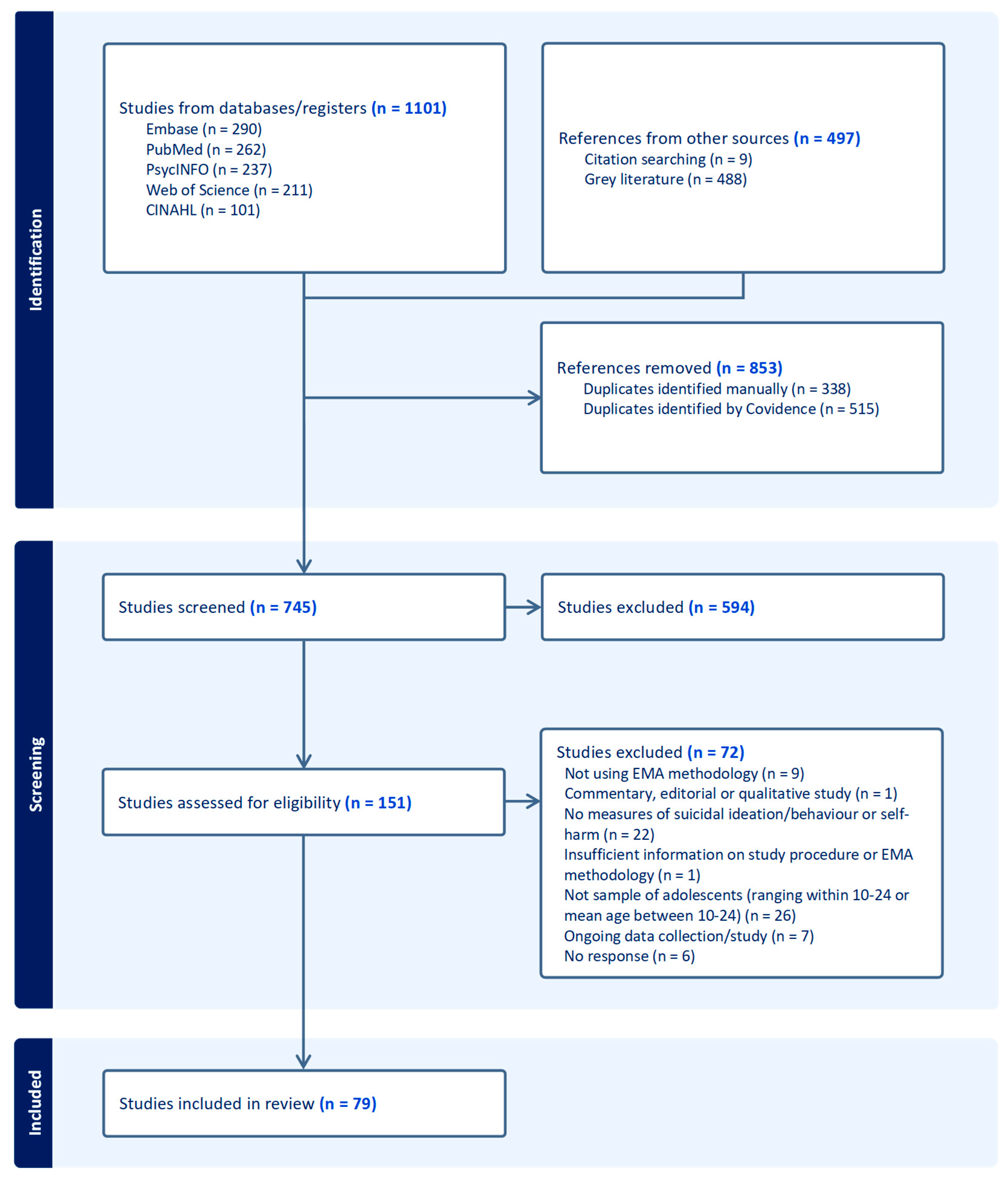

Disclaimer/Publisher’s Note: The statements, opinions and data contained in all publications are solely those of the individual author(s) and contributor(s) and not of MDPI and/or the editor(s). MDPI and/or the editor(s) disclaim responsibility for any injury to people or property resulting from any ideas, methods, instructions or products referred to in the content. |
© 2026 by the authors. Licensee MDPI, Basel, Switzerland. This article is an open access article distributed under the terms and conditions of the Creative Commons Attribution (CC BY) license.
Share and Cite
Martin, B.; Rasmussen, S.; Russell, K.; Crawford, M.; Whittaker, S.; Thomson, S.; Greenwood, A. A Systematic Review of Ecological Momentary Assessment Procedures of Self-Harm (With and Without Suicidal Intent) Studies in Adolescents and Young Adults. Int. J. Environ. Res. Public Health 2026, 23, 84. https://doi.org/10.3390/ijerph23010084
Martin B, Rasmussen S, Russell K, Crawford M, Whittaker S, Thomson S, Greenwood A. A Systematic Review of Ecological Momentary Assessment Procedures of Self-Harm (With and Without Suicidal Intent) Studies in Adolescents and Young Adults. International Journal of Environmental Research and Public Health. 2026; 23(1):84. https://doi.org/10.3390/ijerph23010084
Chicago/Turabian StyleMartin, Bethany, Susan Rasmussen, Kirsten Russell, Megan Crawford, Spence Whittaker, Scott Thomson, and Abbie Greenwood. 2026. "A Systematic Review of Ecological Momentary Assessment Procedures of Self-Harm (With and Without Suicidal Intent) Studies in Adolescents and Young Adults" International Journal of Environmental Research and Public Health 23, no. 1: 84. https://doi.org/10.3390/ijerph23010084
APA StyleMartin, B., Rasmussen, S., Russell, K., Crawford, M., Whittaker, S., Thomson, S., & Greenwood, A. (2026). A Systematic Review of Ecological Momentary Assessment Procedures of Self-Harm (With and Without Suicidal Intent) Studies in Adolescents and Young Adults. International Journal of Environmental Research and Public Health, 23(1), 84. https://doi.org/10.3390/ijerph23010084