Exploring the Impact of Tinnitus on Work Productivity

 , , and
Abstract
1. Introduction
2. Materials and Methods
2.1. Study Design
2.2. Participants
2.3. Data Collection
- Do you work less due to having tinnitus? (No or yes. If yes, select reduced hours, stopped working, disability allowance?).
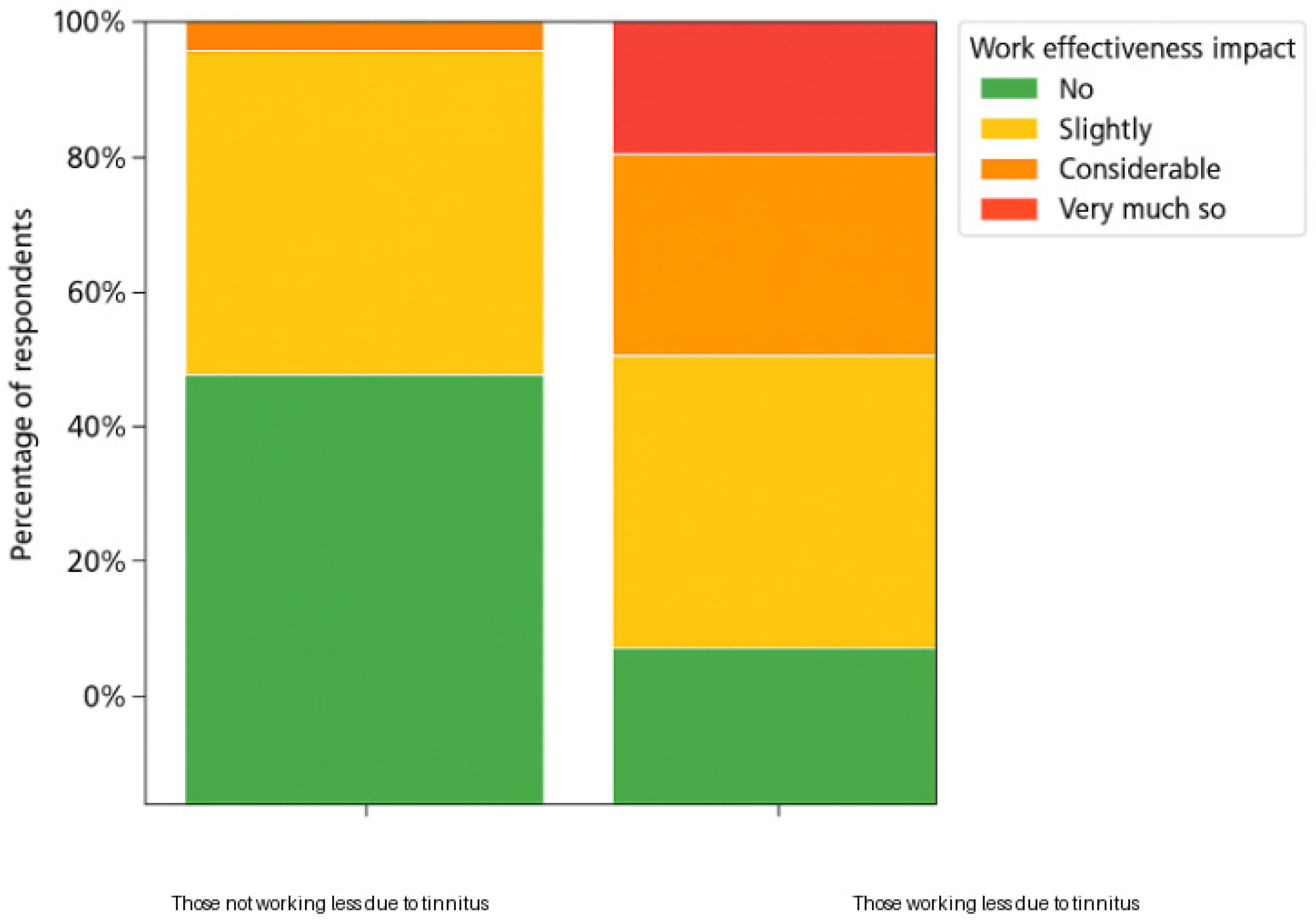
- Has the tinnitus experience made you less effective at doing your work or daily tasks? (No, slightly, considerable, very much so).
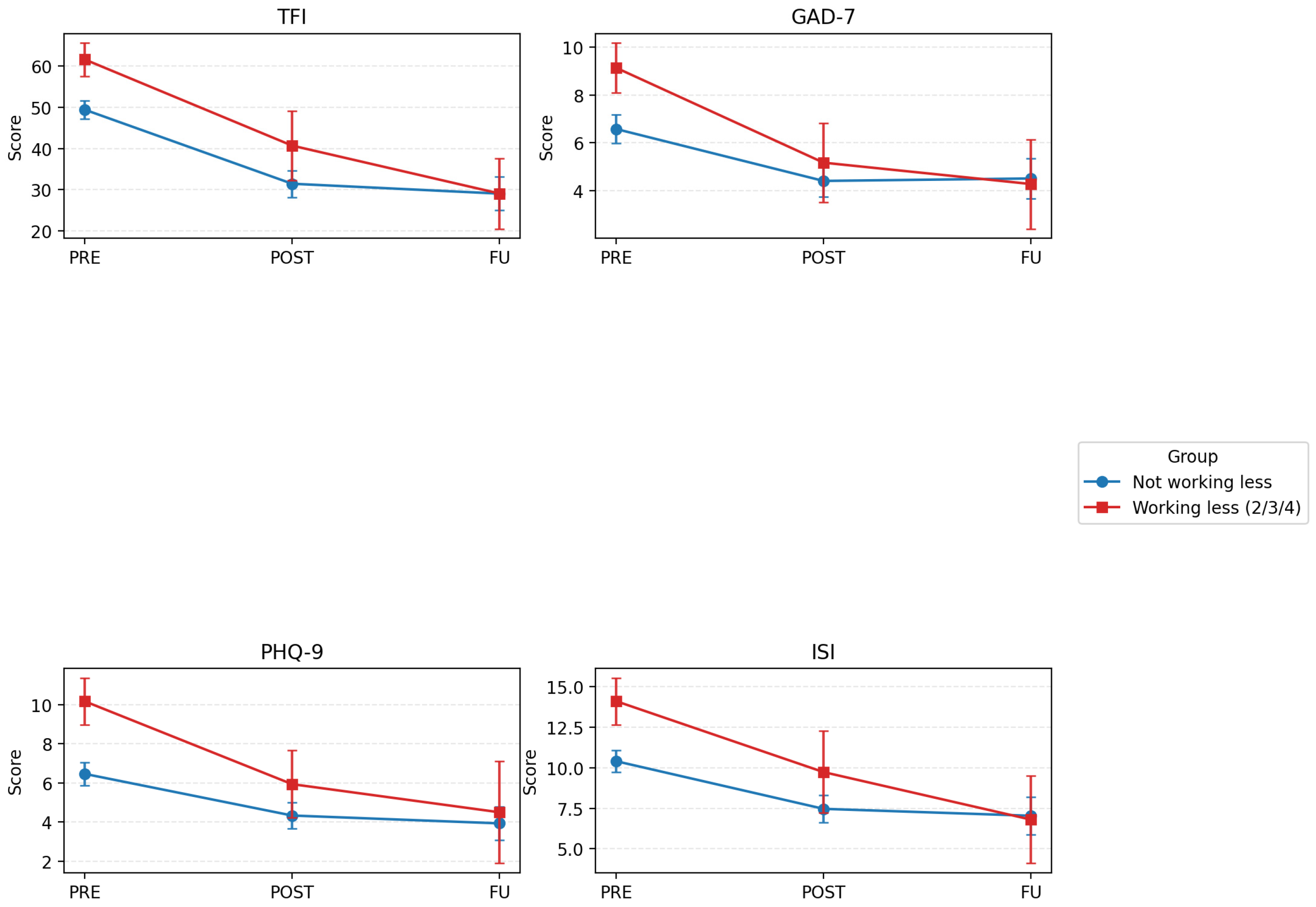
- The Tinnitus Functional Index (TFI) [19] to measure the degree of tinnitus distress.
- To assess common comorbidities associated with tinnitus the following questionnaires were selected. To assess anxiety, the Generalized Anxiety Disorder Questionnaire (GAD7) [20]. To assess depression, the Patient Health Questionnaire 9; (PHQ9) [21]. The insomnia-severity index (ISI) [22] and health-related quality of life (Euroqol EQ-5D-5L), [23] were also included.
- Open-ended question: What describes your work (select from entry level or unskilled work, skilled/professional work, skilled or professional work, retired, not working)
2.4. ICBT Intervention
2.5. Data Analysis
3. Results
3.1. Clinical Characteristics
3.2. Clinical Scores
3.3. Qualitative Analysis
4. Discussion
4.1. Impact of Tinnitus on Workplace Functioning
4.2. Comorbidities and Reduced Productivity
4.3. Effects of Evidence-Based Intervention on Work Productivity
4.4. Policy Implications
4.5. Study Limitations and Future Directions
5. Conclusions
Author Contributions
Funding
Institutional Review Board Statement
Informed Consent Statement
Data Availability Statement
Acknowledgments
Conflicts of Interest
Abbreviations
| ICBT | Internet-based cognitive behavioral therapy intervention |
| ISI | insomnia-severity index |
| EQ-5D-5L | Health-related quality of life (Euroqol) |
| TFI | Tinnitus Functional Index |
| GAD7 | Generalized Anxiety Disorder Questionnaire |
| PHQ9 | Patient Health Questionnaire 9 |
References
- Isham, A.; Mair, S.; Jackson, T. Worker wellbeing and productivity in advanced economies: Re-examining the link. Ecol. Econ. 2021, 184, 106989. [Google Scholar] [CrossRef]
- Jarach, C.M.; Lugo, A.; Scala, M.; van den Brandt, P.A.; Cederroth, C.R.; Odone, A.; Garavello, W.; Schlee, W.; Langguth, B.; Gallus, S. Global prevalence and incidence of tinnitus: A systematic review and meta-analysis. JAMA Neurol. 2022, 79, 888–900. [Google Scholar] [CrossRef]
- Lie, A.; Skogstad, M.; Johannessen, H.A.; Tynes, T.; Mehlum, I.S.; Nordby, K.C.; Tambs, K. Occupational noise exposure and hearing: A systematic review. Int. Arch. Occup. Environ. Health 2016, 89, 351–372. [Google Scholar] [CrossRef] [PubMed]
- Beukes, E.W.; Manchaiah, V.; Andersson, G.; Allen, P.M.; Terlizzi, P.M.; Baguley, D.M. Situationally influenced tinnitus coping strategies: A mixed methods approach. Disabil. Rehabil. 2018, 40, 2884–2894. [Google Scholar] [CrossRef] [PubMed]
- Andersson, G. Longitudinal follow-up of occupational status in tinnitus patients. Int. Tinnitus J. 2000, 6, 127–129. [Google Scholar] [PubMed]
- Andreassen, K.R.; Falck, A.; Solum, T.B.; Nielsen, G.E. Work absence and ability in tinnitus patients: The role of hyperacusis and tinnitus severity. Int. J. Audiol. 2025, 64, 1146–1154. [Google Scholar] [CrossRef]
- Friberg, E.; Jansson, C.; Mittendorfer-Rutz, E.; Rosenhall, U.; Alexanderson, K. Sickness absence due to otoaudiological diagnoses and risk of disability pension: A nationwide Swedish prospective cohort study. PLoS ONE 2012, 7, e29966. [Google Scholar] [CrossRef]
- Engdahl, B.; Krog, N.H.; Kvestad, E.; Hoffman, H.J.; Tambs, K. Occupation and the risk of bothersome tinnitus: Results from a prospective cohort study. BMJ Open 2012, 2, e000512. [Google Scholar] [CrossRef]
- Coco, L.; Hooker, E.R.; Gilbert, T.A.; Harker, G.R.; Clark, K.D.; Reavis, K.M.; Carlson, K.F. The impact of tinnitus severity on work functioning among US military veterans. In Seminars in Hearing; Thieme Medical Publishers, Inc.: New York, NY, USA, 2024; Volume 45, pp. 40–54. [Google Scholar]
- Friberg, E.; Rosenhall, U.; Alexanderson, K. Sickness absence and disability pension due to otoaudiological diagnoses: Risk of premature death. BMC Public Health 2014, 14, 137. [Google Scholar] [CrossRef]
- Hallam, R.S. Tinnitus impairs cognitive performance. J. Psychosom. Res. 2004, 57, 455–461. [Google Scholar]
- Trevis, K.J.; McLachlan, N.M.; Wilson, S.J. Cognitive mechanisms in chronic tinnitus: Psychological markers of a failure to switch attention. Front. Psychol. 2016, 7, 1262. [Google Scholar] [CrossRef] [PubMed]
- Waechter, S.; Wilson, W.J.; Brännström, J.K. The impact of tinnitus on working memory capacity. Int. J. Audiol. 2021, 60, 274–281. [Google Scholar] [CrossRef] [PubMed]
- Mohamad, N.H.; Hoare, D.J.; Hall, D.A. The consequences of tinnitus and tinnitus severity on cognition: A review. Hear. Res. 2016, 332, 199–209. [Google Scholar] [CrossRef] [PubMed]
- Zhong, C.Z. Meta-analysis update on cognitive behavioral therapy for tinnitus. Indian J. Otolaryngol. Head Neck Surg. 2025, 77, 3688–3700. [Google Scholar] [CrossRef]
- Beukes, E.W.; Andersson, G.; Fagelson, M.; Manchaiah, V. Audiologist-supported internet-based cognitive behavioral therapy for tinnitus in the United States: A pilot trial. Am. J. Audiol. 2021, 30, 717–729. [Google Scholar] [CrossRef]
- Beukes, E.W.; Andersson, G.; Fagelson, M.; Manchaiah, V. Internet-based audiologist-guided cognitive behavioral therapy for tinnitus: Randomized controlled trial. J. Med. Internet Res. 2022, 24, e27584. [Google Scholar] [CrossRef]
- Beukes, E.W.; Andersson, G.; Fagelson, M.A.; Manchaiah, V. Dismantling internet-based cognitive behavioral therapy for tinnitus: The contribution of applied relaxation. Internet Interv. 2021, 25, 100402. [Google Scholar] [CrossRef]
- Meikle, M.B.; Henry, J.A.; Griest, S.E.; Stewart, B.J.; Abrams, H.B.; McArdle, R.; Vernon, J.A. The tinnitus functional index: Development of a new clinical measure. Ear Hear. 2012, 33, 153–176. [Google Scholar] [CrossRef]
- Spitzer, R.L.; Kroenke, K.; Williams, J.B.; Löwe, B. A brief measure for assessing generalized anxiety disorder: The GAD-7. Arch. Intern. Med. 2006, 166, 1092–1097. [Google Scholar] [CrossRef]
- Kroenke, K.; Spitzer, R.L.; Williams, J.B. The PHQ-9: Validity of a brief depression severity measure. J. Gen. Intern. Med. 2001, 16, 606–613. [Google Scholar] [CrossRef]
- Bastien, C.H.; Vallières, A.; Morin, C.M. Validation of the Insomnia Severity Index as an outcome measure for insomnia research. Sleep Med. 2001, 2, 297–307. [Google Scholar] [CrossRef]
- Herdman, M.; Gudex, C.; Lloyd, A.; Janssen, M.F.; Kind, P.; Parkin, D.; Bonsel, G.; Badia, X. Development and preliminary testing of the EQ-5D-5L. Qual. Life Res. 2011, 20, 1727–1736. [Google Scholar] [CrossRef] [PubMed]
- Beukes, E.W.; Andersson, G.; Manchaiah, V.; Kaldo, V. Cognitive Behavioral Therapy for Tinnitus; Plural Publishing: San Diego, CA, USA, 2021. [Google Scholar]
- Graneheim, U.H.; Lundman, B. Qualitative content analysis in nursing research: Concepts, procedures and measures to achieve trustworthiness. Nurse Educ. Today 2004, 24, 105–112. [Google Scholar] [CrossRef] [PubMed]
- Trochidis, I.; Lugo, A.; Borroni, E.; Cederroth, C.R.; Cima, R.; Kikidis, D.; Langguth, B.; Schlee, W.; Gallus, S. Systematic review on healthcare and societal costs of tinnitus. Int. J. Environ. Res. Public Health 2021, 18, 6881. [Google Scholar] [CrossRef] [PubMed]
- US Department of Veterans Affairs. Annual Benefits Report: Fiscal Year 2024; Veterans Benefits Administration: Washington, DC, USA, 2024.
- Jacobs, M.T. Hearing loss and tinnitus: Association with employment and income among young adults. Front. Audiol. Otol. 2025, 3, 1595281. [Google Scholar] [CrossRef]
- Jafari, Z.C. Tinnitus, sound intolerance, and mental health: The role of long-term occupational noise exposure. Eur. Arch. Otorhinolaryngol. 2022, 279, 1723–1734. [Google Scholar]
- Rademaker, M.M.; Meijers, S.M.; Smit, A.L.; Stegeman, I. Prediction models for tinnitus presence and impact on daily life. J. Clin. Med. 2023, 12, 695. [Google Scholar] [CrossRef]
- Bakker, A.B.; Demerouti, E. The Job Demands–Resources model: State of the art. J. Manag. Psychol. 2007, 22, 309–328. [Google Scholar] [CrossRef]
- Lan, T.; Cao, Z.; Zhao, F.; Perham, N. The association between effectiveness of tinnitus intervention and cognitive function—A systematic review. Front Psychol. 2021, 11, 553449. [Google Scholar] [CrossRef]



| Week | Cognitive Behavioral Therapy Techniques | Progressive Relaxation Guide | Dealing with the Effects of Tinnitus |
|---|---|---|---|
| 1 | Introduction to the program Understanding tinnitus | Deep relaxation | Sound enrichment |
| 2 | Positive imagery | Deep breathing | Sleep guidelines |
| 3 | Reinterpretation of tinnitus | Entire body relaxation | Improving focus |
| 4 | Shift focus away from tinnitus | Frequent relaxation | Increasing sound tolerance |
| 5 | Thought pattern identification | Quick relaxation | Communication tactics |
| 6 | Challenging thoughts (Cognitive restructuring) | Incorporating a relaxation routine | Summary overview of the program |
| 7 | Being mindful | Implementing the designed relaxation routine | Future planning to maintain the tinnitus effects |
| 8 | Exposure to tinnitus | Evaluating the effects | Evaluating the intervention effects |
| Characteristics | Full Sample (n = 449) | Those Undertaking the Intervention and Completing Post-Intervention Scores (n = 200) | Not Working Less (n = 285) | Working Less (n = 164) | Group Differences (Working and Not Working) |
|---|---|---|---|---|---|
| Age mean in years (SD) | 54.4 (13.4) | 56.7 (12:12) | 50.0 (11.6) | 62.0 (SD: 13.0) | t(447) = −10.149, p = 0.001 |
| Gender Male Female | 219 (49%) 230 (51%) | 118 (59%) 82 (41%) | 152 (34%) 133 (30%) | 67 (15%) 97 (21%) | X2 (1) = 4.49, p = 0.01 |
| Ethnicity Hispanic or Latino Non- Hispanic | 96 (21%) 353 (78.6%) | 37 (19%) 163 (81%) | 73 (16%) 212 (48%) | 23 (5%) 141 (31%) | X2 (1) = 8.32, p = 0.004 |
| Race American Indian Asian Pacific Islander Black White More than one race | 5 (1%) 9 (2%) 1 (0.2%) 9 (2%) 396 (88%) 29 (6.8%) | 3 (1.5%) 2 (1%) 1 (0.5%) 5 (2.5%) 182 (91%) 7 (3.5%) | 3 (0.7%) 7 (1.6%) 0 4 (0.9%) 247 (55%) 24 (5.3%) | 2 (0.4%) 2 (0.4%) 1 (0.2%) 5 (1.1%) 149 (33.2%) 5 (1.1%) | X2 (5) = 8.82, p = 0.116 |
| Tinnitus duration mean in years (SD) | 12 (13.1) | 13 (14.44) | 12.2 (13.5) | 11.6 (12.3) | t(447) = 0.51, p = 0.61 |
| Undertaking the tinnitus Intervention completing the post-intervention scores Completing 2-month follow-up scores | 180 (40%) 122 (27%) | 109 (24%) 77 (17%) | 71 (16%) 45 (10%) |
| Characteristics | Full Sample (n = 449) | Those Completing the Post-Intervention Questionnaire (n = 200) | Those NOT Completing the Post-Intervention Questionnaire (n = 249) | Group Differences (Completing and Not Completing) |
|---|---|---|---|---|
| Age mean in years (SD) | 54.4 (13.4) | 57 (12.1) | 52 (15.1) | |
| Gender Male Female | 219 (49%) 230 (51%) | 82 (41%) 118 (59%) | 137 (55%) 112 (45%) | X2 (1) = 8.17, p = 0.004 |
| Tinnitus duration mean in years (SD) | 12 (13.1) | 13.1 (14.4) | 11.7 (13.3) | X2 (5) = 8.82, p = 0.12 |
| TFI mean scores Pre- intervention | 52.5 (SD: 21.6) | 54.11 (SD: 20.73) | 51.15 (SD: 22.27) | t(447) = 1.44, p = 0.15 |
| GAD-7 mean scores Pre- intervention | 7.21 (SD: 5.65) | 7.20 (SD: 5.43) | 7.22 (SD: 5.85) | t(447) = −0.03, p = 0.97 |
| PHQ-9 mean scores Pre-intervention | 7.38 (SD: 5.94) | 7.37 (SD: 5.73) | 7.39 (SD: 6.13) | t(447) = −0.03, p = 0.98 |
| ISI mean scores Pre-intervention | 11.3 (SD 6.7) | 11.69 (SD: 6.53) | 10.96 (SD: 6.90) | t(447) = 1.12, p = 0.26 |
| EQ 5D VAS mean score Pre-intervention | 74.1 (SD: 15.9) | 75.09 (SD:15.46) | 73.29 (SD: 16.17) | t(447) = 1.18, p = 0.24 |
| Pre-intervention | Full Sample (n = 401) | Not Working Less (n = 257) | Not Working or Reduced Working (n = 144) | Between Group Significance |
|---|---|---|---|---|
| Not working less Reduce hours Stopped work Disability allowance | 325 (81%) 42 (11%) 27 (7%) 7 (1%) | 221 (55%) 33 (8%) 2 (0.5%) 1 (0.2%) | 104 (26%) 9 (2%) 25 (6%) 6 (2%) | X2 (3) = 51.2, p < 0.001 |
| Post-intervention | Full sample (n = 180) | Working (n = 109) | Not working (n = 71) | Significance |
| Not working less Reduce hours Stopped work Disability allowance | 163 (91%) 4 (2%) 11 (6%) 2 (1%) | 104 (58%) 1 (1%) 3 (2%) 1 (1%) | 59 (33%) 3 (2%) 8 (4%) 1 (1%) | X2 (3) = 8.03, p = 0.045 |
| 2-month follow-up | Full sample (n = 122) | Working (n = 77) | Not working (n = 45) | Significance |
| Not working less Reduce hours Stopped work Disability allowance | 108 (89%) 4 (3%) 9 (7%) 1 (1%) | 73 (60%) 2 (2%) 2 (2%) 0 | 35 (29%) 2 (2%) 7 (6%) 1 (1%) | X2 (3) = 9.40, p = 0.024 |
| Between Time period significance | X2 (703, df = 4) = 17.42, p = 0.008 | X2 (443, df = 4) = 20.96, p = 0.002 | X2 (260, df = 4) = 3.66, p = 0.722 |
| Preintervention | Full Sample (n = 401) | Not Working Less (n = 257) | Not Working or Reduced Working Due to Tinnitus (n = 114) | Significance (Between the Groups) |
|---|---|---|---|---|
| Not less effective Slightly less effective Considerably less effective Very much less effective | 171 (43%) 177 (44%) 35 (9%) 18 (4.5%) | 103 (26%) 129 (32%) 19 (5%) 6 (2%) | 68 (17%) 48 (12%) 16 (4%) 12 (3%) | X2 (3) = 5.9, p = 0.001 |
| Post-intervention | Full sample (n = 180) | Not working less (n = 109) | Not working or reduced working (n = 71) | Significance |
| Not less effective Slightly less effective Considerably less effective Very much less effective | 115 (64%) 54 (30%) 8 (4%) 3 (2%) | 70 (39%) 34 (19%) 3 (2%) 2 (1%) | 45 (25%) 20 (11%) 5 (3%) 1 (1%) | X2 (3) = 1.96, p = 0.580 |
| 2-month follow-up | Full #sample (n = 122) | Not working less (n = 77) | Not working or reduced working (n = 45) | Significance |
| Not less effective Slightly less effective Considerably less effective Very much less effective | 91 (75%) 22 (18%) 6 (5%) 3 (2%) | 54 (44%) 17 (14%) 3 (3%) 3 (3%) | 37 (30%) 5 (4%) 3 (3%) 0 | X2 (3) = 4.65, p = 0.20 |
| Significance (within-group at different time points) | X2 (4) = 50.13, p = 0.001 | X2 (4) = 443, p = 0.001 | X2 (4) = 260, p = 0.002 |
| Characteristics | Full Sample (n = 436 Pre, 200 Post and 132 Follow-Up) | Not Working Less | Working Less or Not Working | Repeated Measures Statistical Results |
|---|---|---|---|---|
| TFI mean scores Pre- intervention Post- intervention 2-month follow-up | 52.5 (SD: 21.6) 33.1 (SD: 22.2) 29.1 (SD: 22.4) | 52.2 (SD: 20.8) 33.60 (SD: 22.1) 30.1 (SD: 23.4) | 53.0 (SD: 23.0) 32.1 (SD: 22.6) 27.4 (SD: 20.7) | Time F(2, 266) = 157.63; p = 0.001 Group: F(1, 266) = 6.00; p = 0.014 Time × Group: F(2, 266) = 7.70; p = 0.001 |
| GAD-7 mean scores Pre- intervention Post- intervention 2-months follow-up | 7.21 (SD: 5.65) 4.55 (SD: 4.44) 4.48 (SD: 4.57) | 7.38 (SD: 5.46) 4.70 (SD: 4.15) 4.60 (SD: 4.89) | 6.93 (SD: 5.99) 4.30 (SD: 4.89) 4.28 (SD: 4.04) | Time: F(2, 260) = 30.54; p = 0.001 Group: F(1, 260) = 0.10; p = 0.749 Time × Group: F(2, 260) = 4.00; p = 0.02 |
| PHQ-9 mean scores Pre-intervention Post- intervention 2-months follow-up | 7.38 (SD: 5.94) 4.51 (SD: 4. 56) 4.01 (SD: 4.82) | 7.22 (SD: 5.70) 4.53 (SD: 4.23) 3.81 (SD: 4.28) | 7.65 (SD: 6.34) 4.72 (SD: 5.05) 4.34 (SD: 5.58) | Time: F(2, 254) = 34.75; p = 0.001 Group: F(1, 254) = 4.75; p = 0.0303 Time × Group: F(2, 254) = 1.83; p = 0.163 |
| ISI mean scores Pre-intervention Post- intervention 2-months follow-up | 11.3 (SD 6.7) 7.85 (SD: 5.94) 7.0 (SD: 6.24) | 10.4 (SD: 6.21) 7.46 (SD: 5.54) 7.04 (SD: 6.29) | 14.1 (SD: 7.51) 9.73 (SD:7.4) 6.8 (SD 6.1) | Time: F(2, 244) = 64.71; p = 0.001 Group: F(1, 244) = 12.31; p = 0.001 Time × Group: F(2, 244) = 6.17; p = 0.002 |
| EQ 5D VAS mean score Pre-intervention Post- intervention 2-months follow-up | 74.1 (SD: 15.9) 77.9 (SD 15.1) 80.1 (SD: 14.8) | 75.2 (SD: 14.7) 77.5 (SD: 15.7) 80.9 (SD: 15.5) | 72.2 (SD: 17.5) 78.4 (SD: 14.1) 79.0 (SD: 13.7) | Time: F(1, 129) = 5.41; p = 0.022 Group: F(1, 129) = 0.52; p = 0.471 Time × Group: F(1, 129) = 0.24; p = 0.624 |
| Category | Sub-Category | No of Meaning Unit | Examples |
|---|---|---|---|
| Disrupted Productivity | Sustaining attention | 29 | Due to the tinnitus, I now have trouble reading and concentrating. To comprehend what is written, I have to reread, over and over again. Days of high tinnitus I am rarely able to focus at work. |
| Fatigue | 25 | I had to miss work yesterday due to lack of sleep-was a zombie and not functional. | |
| Difficulty working in quiet environments | 20 | It is difficult sitting at a computer, working with no other sounds around | |
| Increased errors and less productivity | 14 | When very loud. I cannot concentrate and make mistakes. It causes me to get distracted so I am not as productive as I could be. | |
| Slower task completion | 12 | I have had to work many more later hours to accomplish deadlines, and this is because of the tinnitus distracting my clarity of thought and ability to be continuous in the story I’m writing. I’ve just been pushing through it. I worry that it will affect my job and my pay. | |
| Impacting interactions | Not hearing crucial information | 24 | I interview students and sit in meetings. It’s very hard to hear students’ answers. especially if they are soft spoken. It’s also difficult to hear in meetings. I cannot talk on the phone the noise is making it hard to understand and hear people talk. |
| Withdrawing | 11 | I cancel meetings due to the tinnitus. It affects my ability to communicate in group situations. So, where possible I spread out or reduce my group activities, so they aren’t to frequent. | |
| Reduced work fulfillment | Increased anxiety/depression | 8 | I got fired from work as due to the tinnitus I was always anxious and depressed which lowered my productivity. |
| Frustration and irritability | 7 | I get irritable easily, so I only do necessary tasks. I am around loud sounds because of my job. The ringing after-effects linger for the rest of the evening. | |
| Reduced enjoyment of work | 11 | I primarily volunteer with children; it used to be more enjoyable—but now the loudness and being unable to hear soft voices makes me feel less effective and have less joy in what I am doing. | |
| Role changes | Modifications | 16 | I’ve had to change from working with clients to an administrative role |
| Career shift | 12 | I had to quit working with a band because I don’t go where it’s very loud. I can’t attend big public events. | |
| Unable to meet the demands | 9 | I retired early due to complications concentrating. I was an operator on a DCS and could no longer hear some alarms or understand the radio. Which was getting very dangerous for others. | |
| Adaptation strategies | Utilizing strategies | 13 | I’ve learned to focus on the activity at hand rather than the tinnitus. |
| Overcoming challenges | 7 | When I first got tinnitus, it was a problem at work. Now it bothers me sometimes, but I can push my way through it. | |
| Not interfering | 60 | No, it hasn’t. It’s in my attitude. I won’t let it get in my way at work. I won’t let it diminish my performance. |
Disclaimer/Publisher’s Note: The statements, opinions and data contained in all publications are solely those of the individual author(s) and contributor(s) and not of MDPI and/or the editor(s). MDPI and/or the editor(s) disclaim responsibility for any injury to people or property resulting from any ideas, methods, instructions or products referred to in the content. |
© 2026 by the authors. Licensee MDPI, Basel, Switzerland. This article is an open access article distributed under the terms and conditions of the Creative Commons Attribution (CC BY) license.
Share and Cite
Beukes, E.; Sharpe, J.A.; Andersson, G.; Manchaiah, V. Exploring the Impact of Tinnitus on Work Productivity. Brain Sci. 2026, 16, 150. https://doi.org/10.3390/brainsci16020150
Beukes E, Sharpe JA, Andersson G, Manchaiah V. Exploring the Impact of Tinnitus on Work Productivity. Brain Sciences. 2026; 16(2):150. https://doi.org/10.3390/brainsci16020150
Chicago/Turabian StyleBeukes, Eldre, Jennine A. Sharpe, Gerhard Andersson, and Vinaya Manchaiah. 2026. "Exploring the Impact of Tinnitus on Work Productivity" Brain Sciences 16, no. 2: 150. https://doi.org/10.3390/brainsci16020150
APA StyleBeukes, E., Sharpe, J. A., Andersson, G., & Manchaiah, V. (2026). Exploring the Impact of Tinnitus on Work Productivity. Brain Sciences, 16(2), 150. https://doi.org/10.3390/brainsci16020150