
Review

Copper Toxicity Is Not Just Oxidative Damage: Zinc Systems and Insight from Wilson Disease
Department of Biological Sciences, University of Alaska Anchorage, 3211 Providence Dr., Anchorage, AK 99058, USA
*
Author to whom correspondence should be addressed.
Biomedicines 2021, 9(3), 316; https://doi.org/10.3390/biomedicines9030316

Submission received: 28 February 2021 / Revised: 13 March 2021 / Accepted: 17 March 2021 / Published: 20 March 2021
(This article belongs to the Special Issue Zinc and Copper in Human Health and Disease)

Abstract

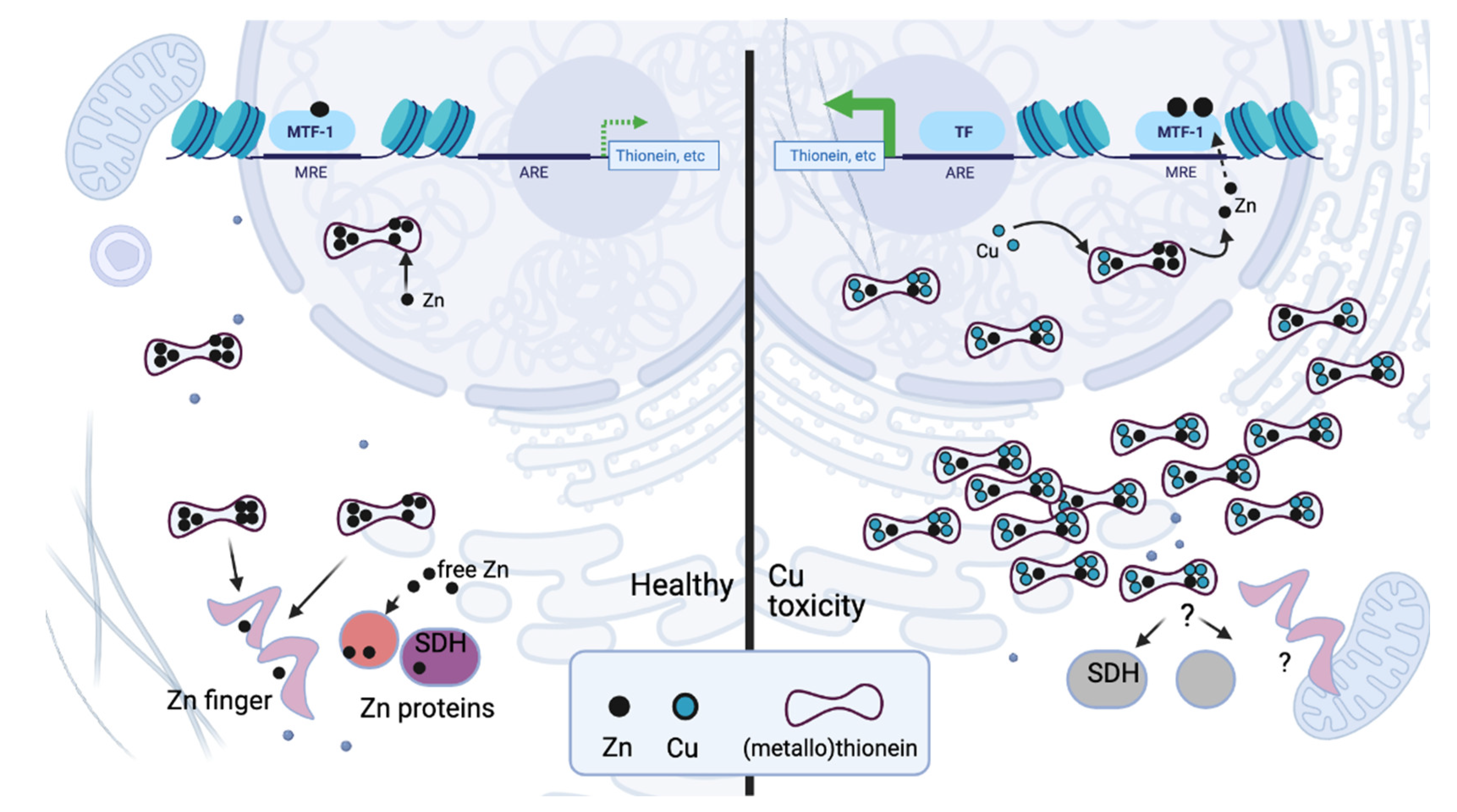
Essential metals such as copper (Cu) and zinc (Zn) are important cofactors in diverse cellular processes, while metal imbalance may impact or be altered by disease state. Cu is essential for aerobic life with significant functions in oxidation-reduction catalysis. This redox reactivity requires precise intracellular handling and molecular-to-organismal levels of homeostatic control. As the central organ of Cu homeostasis in vertebrates, the liver has long been associated with Cu storage disorders including Wilson Disease (WD) (heritable human Cu toxicosis), Idiopathic Copper Toxicosis and Endemic Tyrolean Infantile Cirrhosis. Cu imbalance is also associated with chronic liver diseases that arise from hepatitis viral infection or other liver injury. The labile redox characteristic of Cu is often discussed as a primary mechanism of Cu toxicity. However, work emerging largely from the study of WD models suggests that Cu toxicity may have specific biochemical consequences that are not directly attributable to redox activity. This work reviews Cu toxicity with a focus on the liver and proposes that Cu accumulation specifically impacts Zn-dependent processes. The prospect that Cu toxicity has specific biochemical impacts that are not entirely attributable to redox may promote further inquiry into Cu toxicity in WD and other Cu-associated disorders.
Keywords: copper; zinc; Wilson Disease; copper toxicity; oxidative stress copper; zinc; Wilson Disease; copper toxicity; oxidative stress