Algorithms for Games AI
Share This Topical Collection
Editors
 Dr. Haifeng Zhang
Dr. Haifeng Zhang
E-Mail
Website
Collection Editor
Institute of Automation, University of Chinese Academy of Science, Beijing 100190, China
Interests: multi-agent reinforcement learning; computational advertising; game agent; agent confrontation platform
Topical Collection Information
Dear Colleagues,
We invite you to submit your latest research in the area of gaming AI algorithms to this Topical Collection: Algorithms for Game AI. We are seeking new and innovative approaches to solving game AI problems, whether theoretically or empirically. Submissions are welcome for both traditional game AI algorithms (planning, tree search, etc.) and new algorithms (deep reinforcement learning, etc.). Potential topics include, but are not limited to, the history of game AI, the development of Monte Carlo tree search algorithms or other tree search algorithms, and the theoretical analysis of reinforcement learning algorithms or their applications in specific games.
Prof. Dr. Wenxin Li
Dr. Haifeng Zhang
Collection Editors
Manuscript Submission Information
Manuscripts should be submitted online at www.mdpi.com by registering and logging in to this website. Once you are registered, click here to go to the submission form. Manuscripts can be submitted until the deadline. All submissions that pass pre-check are peer-reviewed. Accepted papers will be published continuously in the journal (as soon as accepted) and will be listed together on the collection website. Research articles, review articles as well as short communications are invited. For planned papers, a title and short abstract (about 250 words) can be sent to the Editorial Office for assessment.
Submitted manuscripts should not have been published previously, nor be under consideration for publication elsewhere (except conference proceedings papers). All manuscripts are thoroughly refereed through a single-blind peer-review process. A guide for authors and other relevant information for submission of manuscripts is available on the Instructions for Authors page. Algorithms is an international peer-reviewed open access monthly journal published by MDPI.
Please visit the Instructions for Authors page before submitting a manuscript.
The Article Processing Charge (APC) for publication in this open access journal is 1800 CHF (Swiss Francs).
Submitted papers should be well formatted and use good English. Authors may use MDPI's
English editing service prior to publication or during author revisions.
Keywords
- games AI
- game AI algorithms
- reinforcement learning algorithms
- search algorithms
- Monte Carlo tree
- tree search
Related Special Issue
Published Papers (1 paper)
2025
Open AccessArticle
Mxplainer: Explain and Learn Insights by Imitating Mahjong Agents
by
Lingfeng Li, Yunlong Lu, Yongyi Wang, Qifan Zheng and Wenxin Li
Viewed by 348
Abstract
People need to internalize the skills of AI agents to improve their own capabilities. Our paper focuses on Mahjong, a multiplayer game involving imperfect information and requiring effective long-term decision-making amidst randomness and hidden information. Through the efforts of AI researchers, several impressive
[...] Read more.
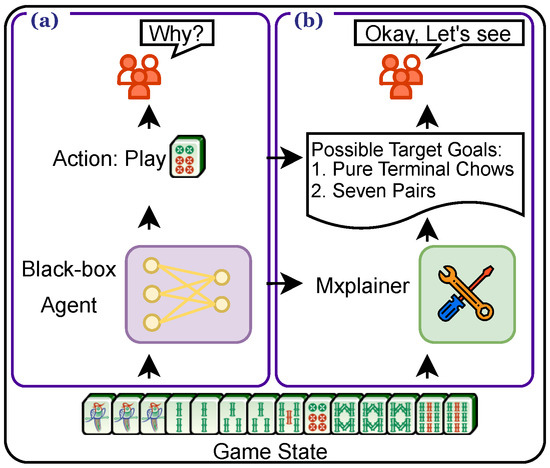
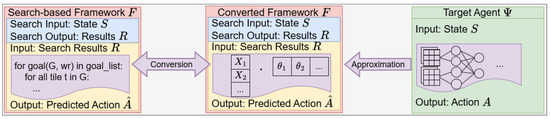
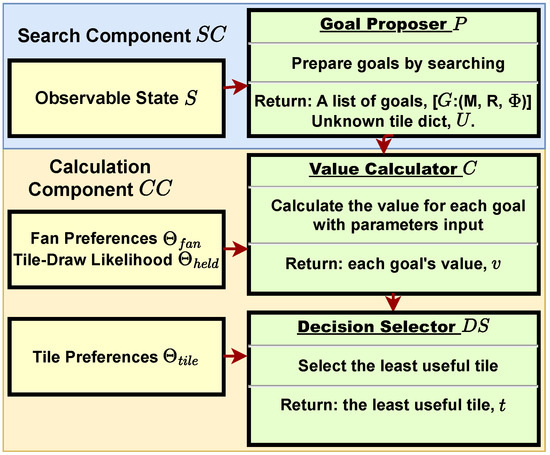
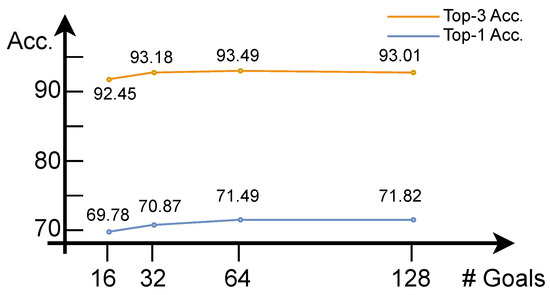
People need to internalize the skills of AI agents to improve their own capabilities. Our paper focuses on Mahjong, a multiplayer game involving imperfect information and requiring effective long-term decision-making amidst randomness and hidden information. Through the efforts of AI researchers, several impressive Mahjong AI agents have already achieved performance levels comparable to those of professional human players; however, these agents are often treated as black boxes from which few insights can be gleaned. This paper introduces Mxplainer, a parameterized search algorithm that can be converted into an equivalent neural network to learn the parameters of black-box agents. Experiments on both human and AI agents demonstrate that Mxplainer achieves a top-three action prediction accuracy of over 92% and 90%, respectively, while providing faithful and interpretable approximations that outperform decision-tree methods (34.8% top-three accuracy). This enables Mxplainer to deliver both strategy-level insights into agent characteristics and actionable, step-by-step explanations for individual decisions.
Full article
►▼
Show Figures