Article

From Agro-Livestock Residues to Functional Soil Amendments: Responses in Contrasting Iberian Soils


by
Gael Bárcenas-Moreno
1,*,
Sara Domínguez
1,
Paloma Campos
2,
Sara M. Pérez-Dalí
2,
Agustín Merino
3 and
José María de la Rosa
2,*
1
Departamento de Cristalografía, Mineralogía y Química Agrícola, Universidad de Sevilla, C/Profesor García González 1, 41012 Seville, Spain
2
Instituto de Recursos Naturales y Agrobiología de Sevilla (IRNAS-CSIC), Av. Reina Mercedes 10, 41012 Seville, Spain
3
Escuela Politécnica Superior, Universidad de Santiago de Compostela, 27002 Lugo, Spain
*
Authors to whom correspondence should be addressed.
Agronomy 2026, 16(17), 1617; https://doi.org/10.3390/agronomy16171617
Submission received: 28 July 2026 / Revised: 18 August 2026 / Accepted: 20 August 2026 / Published: 22 August 2026
(This article belongs to the Section Farming Sustainability)

Abstract

Organic amendments derived from agro-livestock residues offer a promising approach for soil restoration and nutrient recycling within circular economy frameworks. Nevertheless, their agronomic efficacy and environmental suitability may be contingent upon the formulation of the amendments and the properties of the soil. This study presents a preliminary evaluation of customized organic amendments derived from solid materials, such as biochar and green compost, and liquid residues, including cattle manure slurry, urban compost tea, and cattle digestate. These were applied either individually or as solid–liquid mixtures to two distinct Iberian soils. The study involved amendment characterization, seed germination assays, and a two-month greenhouse experiment with barley (Hordeum vulgare L.) to assess the effects on soil physicochemical properties, microbial activity, and plant development. The solid–liquid impregnation process facilitated the transfer of nutrients and potentially limiting elements from liquid residues to solid matrices, thereby altering amendment composition and mitigating some risks associated with the direct application of liquid residues. Mixtures based on biochar and compost generally alleviated excessive salinity and trace metal constraints, although responses varied depending on the liquid amendment and soil type. Biochar-containing amendments markedly increased soil total carbon, suggesting their potential to contribute to soil carbon sequestration. The effects of amendments were strongly dependent on soil type: acidic soil exhibited more pronounced pH improvement, whereas the carbonate-rich alkaline soil buffered several chemical changes but was more susceptible to alkalinization and sodium inputs. Urban compost tea consistently exhibited inhibitory effects on germination, plant development, and dehydrogenase activity, although these effects were partially mitigated when combined with solid amendments. Overall, the findings underscore the potential of tailored amendment mixtures to enhance residue valorisation, while highlighting the necessity for soil-specific evaluation prior to field application.

1. Introduction

The escalating production of organic residues from agricultural, livestock, forestry, and urban activities presents both an environmental challenge and an opportunity for sustainable soil management. Within the frameworks of a circular economy, the recovery and transformation of these residues into organic amendments can aid in reducing waste disposal, enhancing soil quality, and diminishing reliance on mineral fertilisers [1]. This strategy is particularly pertinent in Mediterranean and Atlantic agroecosystems, where soils frequently encounter diverse limitations, such as low organic matter content, nutrient imbalances, acidity or alkalinity constraints, and progressive degradation due to intensive land use and climatic pressures [2].
Organic amendments, including compost, biochar, animal manures, digestates, and compost-derived liquid extracts, have been extensively proposed as means to enhance soil fertility and rehabilitate degraded soils [3,4,5]. Their application can increase soil organic carbon, improve nutrient availability, enhance water retention, stimulate microbial activity, and support plant establishment [6,7,8]. Nevertheless, their effects are not universally beneficial and are significantly influenced by the chemical composition of the amendment, the application rate, the processing method, and the characteristics of the receiving soil [9]. In certain instances, organic amendments may also introduce challenges, such as excessive salinity, high pH, sodium accumulation, phytotoxic compounds, nutrient imbalances, or potentially toxic elements like Cd, Cu, Ni, Pb, and Zn [10]. Consequently, the agronomic and environmental suitability of organic residues cannot be presumed based solely on their organic origin; instead, an integrated evaluation is necessary prior to field application.
An additional challenge stems from the differing behaviours of solid and liquid organic residues. Solid amendments, such as compost and biochar, are often valued for their ability to improve soil structure, supply or stabilise organic carbon, and retain nutrients or contaminants through sorption processes [11,12]. Biochar, in particular, may offer stable carbon inputs and strong retention sites due to its aromatic structure, porosity, and surface functional groups [13]. Compost can serve as a more labile source of organic matter and nutrients, contributing to biological activity and nutrient cycling [14,15]. In contrast, liquid residues such as cattle manure slurry, digestate, and compost tea may contain readily available nutrients, dissolved organic compounds, and microbial inoculum, but they may also exhibit higher electrical conductivity, sodium concentrations, or trace metal loads [16,17]. The direct application of liquid residues may therefore pose higher short-term risks for seed germination, soil microbial functioning, and crop establishment, particularly in sensitive soils [18,19]. Integrating solid and liquid organic residues may present a viable approach to enhancing their agronomic value while mitigating certain individual limitations. Processes such as solid–liquid impregnation or soaking can facilitate the transfer of nutrients and dissolved organic compounds from liquid residues to solid matrices. This may result in enriched amendments characterized by improved handling, reduced immediate salinity impact, and enhanced nutrient retention. Concurrently, these mixtures may buffer extreme pH or electrical conductivity values and decrease the mobility or bioavailability of potentially harmful elements [19,20]. However, the interactions during these processes are intricate and may not adhere to simple additive patterns. They are contingent upon the physicochemical properties of each component, including pH, cation exchange capacity, organic matter composition, mineral content, and the affinity of solid phases for nutrients and trace metals. Consequently, tailored amendment mixtures may yield beneficial, neutral, or adverse effects depending on both the composition of the amendment and the soil context [21,22].
Despite the increasing interest in residue-based amendments, significant knowledge gaps persist regarding the performance of tailored mixtures derived from contrasting solid and liquid agro-livestock residues. Most research has concentrated on single amendments or broad comparisons among amendment types, with fewer studies evaluating how pre-formulated mixtures alter amendment properties and influence plant and soil responses under varying edaphic conditions [23,24,25]. This is particularly pertinent for soils with markedly different pH and carbonate status, where the same amendment may either alleviate a limitation or exacerbate an existing constraint. For instance, alkaline amendments like biochar may enhance acidic soils by increasing pH and reducing aluminium toxicity, yet they may further alkalinize calcareous soils and diminish nutrient availability [26,27]. Similarly, sodium-rich amendments may have limited short-term effects in calcium-rich soils but pose structural or physiological risks in soils with lower buffering capacity [28]. In this context, early biological and agronomic indicators are crucial for evaluating the effectiveness of amendments before they are applied on a larger scale. Seed germination is particularly sensitive to phytotoxicity and early plant establishment, as it reflects the influence of factors such as salinity, pH, soluble compounds, and other potential stressors [29,30]. Greenhouse plant growth, encompassing survival, biomass production, chlorophyll-related indices, and reproductive development, serves as a proxy for short-term agronomic performance under soil-mediated conditions. Concurrently, soil dehydrogenase activity is commonly employed as a proxy for overall microbial oxidative activity and soil biological functioning, reflecting the response of microbial communities to changes in organic matter inputs, pH, and nutrient availability [31]. Collectively, these indicators provide an integrated preliminary assessment of amendment suitability, linking physicochemical changes with functional soil and plant responses.
This study assessed the impact of tailored organic amendments, sourced from agro-livestock and urban residues, on two distinct Iberian soil types. The solid amendments, comprising green biochar (GB) and green compost (GC), were integrated with liquid residues such as cattle manure slurry (CMS), urban compost tea (UCT), and cattle digestate (CD) to create both single and mixed treatments. The evaluation concentrated on alterations in amendment properties, soil physicochemical parameters, barley germination and growth, and soil microbial activity. By comparing acidic and alkaline soils, the study further investigated how soil properties influence amendment efficacy and identified the primary advantages and potential risks associated with the application of tailored organic amendment mixtures for soil restoration and residue valorisation.

2. Materials and Methods

2.1. Experimental Design

Following the comprehensive characterization of the organic amendments and their mixtures, their agronomic and soil effects were assessed through germination and greenhouse assays. Two contrasting Iberian soils were selected, primarily on the basis of their distinct pH values and environmental contexts: one alkaline soil and one acidic soil. First, soil–water extracts from the different treatments were used in Petri dish assays to evaluate their direct effects on seed germination. Subsequently, a greenhouse pot experiment was conducted to examine the response of barley growth and development to amendment application under soil-specific conditions. After 67 days, the pot experiment was concluded to prevent the pot size from limiting plant growth. Subsequently, the effects of the treatments on soil physicochemical properties, composition, and microbial activity were analysed. These analyses facilitated the assessment of each soil’s role in modulating amendment performance, while also identifying the primary benefits and potential risks associated with their use. The materials, analytical procedures, and experimental assays are detailed below.

2.2. Organic Amendments

Five organic amendments, including two solid and three liquid materials, were used either individually or in combination to generate a total of 16 soil treatments. Hereafter, these are referred to as treatments and classified as either single-amendment treatments, when only one material was applied, or mixed treatments, when two or more amendments were combined (Table 1).
Table 1. Composition and codes of the organic amendment treatments applied to the soils.
CodeSolid AmendmentLiquid Amendment
Control
CMSCattle Manure Slurry
UCTUrban Compost Tea
CDCattle Digestate
GBGreen Biochar
GBSGreen BiocharCattle Manure Slurry
GBTGreen BiocharUrban Compost Tea
GBDGreen BiocharCattle Digestate
GCGreen Compost
GCSGreen CompostCattle Manure Slurry
GCTGreen CompostUrban Compost Tea
GCDGreen CompostCattle Digestate
BCBiochar and Compost
BCSBiochar and CompostCattle Manure Slurry
BCTBiochar and CompostUrban Compost Tea
BCDBiochar and CompostCattle Digestate

2.2.1. Solid Organic Amendments

Green biochar (GB) is an agro-forest green waste biochar synthesized using a rotary pyrolysis reactor, operating at 500 °C for 20 min in an inert atmosphere from a 50% w/w mixture of olive mill pomace, a by-product of olive oil production, and recycled pine shavings. Green compost (GC) refers to a commercial product composed entirely of garden pruning waste, which was acquired from the Carrefour store located in Montequinto (Seville, Spain). A 1:1 (w/w) mixture of GB and GC, called BC, was also prepared and incorporated into the experimental assays.

2.2.2. Liquid Organic Amendments

Cattle manure slurry (CMS), consisting of liquid and solid cattle excreta mixed with straw bedding residues, was collected from a dairy farm located in the same region as the soil sampling site in Lugo (NW Spain), and stored under refrigerated conditions until use. Urban compost tea (UCT) refers to a leachate produced from the organic composting of selectively collected urban solid waste within the Sierra de Cádiz municipal association (Basica S.A.U., Olvera, Cádiz, Spain). Cattle digestate (CD) represents the final residue resulting from the mesophilic anaerobic digestion of stabilized cattle manure mixed with pruning waste, provided by the company Sologas (A Coruña, Spain).

2.3. Preparation and Processing of Solid–Liquid Amendment Mixtures

Solid and liquid amendments were combined at a 1:4 (w/w) ratio. The resulting mixtures were continuously agitated for 2 h and then allowed to settle for 24 h. The solid fraction was subsequently recovered by decantation and oven-dried at 40 °C for 12 h. After drying, the material was homogenized, characterized by laboratory analyses, and stored in sealed bags at 6 °C until further use.

2.4. Soils Description

Two contrasting soils were selected from different regions of the Iberian Peninsula, one located in the north and the other in the south, representing distinct edaphoclimatic conditions. The soil from the south (hereinafter alkaline soil) was collected from a rainfed farm located in Montequinto (Dos Hermanas, Seville, Spain; 37°19′52.6″ N, 5°54′32.5″ W) and the soil collected from the north (hereinafter acidic soil) was sampled in an extensive pasture system in Meira (Lugo, Spain; 43°14′14.3″ N, 7°18′16.0″ W). Both soils were dried at 40 °C for 72 h and sieved (>2 mm) before analysis and experimental preparation. Soil texture was determined using the Bouyoucos hydrometer method [32]. Soil organic carbon (SOC) in the unamended bulk soils was quantified using the modified Walkley–Black method [33], following the procedure described by Yeomans and Bremner [34]. Soil carbonate content was measured with a Bernard calcimeter according to Guitián and Carballas [35]. The water-holding capacity (WHC) of each soil was determined gravimetrically in triplicate as the water retained by an initially saturated sample after free drainage ceased, relative to oven-dry soil mass.
The alkaline soil, classified as a Calcaric Cambisol, had a pH of 7.9 ± 0.1, an electrical conductivity of 270 ± 17 µS cm−1 and a WHC of 72 ± 31%. It exhibited a clay loam texture and contained 4.6 ± 0.1% total carbon, 0.14 ± 0.01% total nitrogen, 26.1 ± 0.8% carbonates, and 0.78 ± 0.05% SOC. In contrast, the acidic soil, classified as a Dystric Cambisol, had a pH of 5.2 ± 0.1, an electrical conductivity of 188 ± 4 µS cm−1 and a WHC of 88 ± 35%. It showed a silt loam texture and contained 2.7 ± 0.1% total carbon, 0.28 ± 0.01% total nitrogen, and 1.89 ± 0.02% SOC.

2.5. Analytical Methods for Elemental Composition and Physical and Chemical Properties of Amendments and Soils

Soil and amendment pH and electrical conductivity (EC) were measured in a 1:10 soil–water extract according to Campos et al. [11]. The total carbon (TC) and nitrogen (TN) contents were determined by dry combustion in a Flash 2000 HT elemental analyzer (ThermoScientific, Bremen, Germany).
The C/N ratio of the acidic soil was calculated directly from TC and TN contents. In contrast, for the alkaline soil, which contained substantial amounts of carbonates, an estimated organic C content was used to avoid overestimating the organic C contribution to the C/N ratio. Carbonate content was determined using the Bernard calcimeter method and expressed as CaCO3 (%). Carbonate-derived inorganic C was calculated from the stoichiometric C fraction of CaCO3 as:
C-carbonate (%) = CaCO3 (%) × (12.01/100.09) = CaCO3 (%) × 0.120,
Estimated organic C was then calculated as:
Estimated organic C (%) = TC (%) − C-carbonate (%),
The C/N ratio of the alkaline soil was subsequently calculated using this estimated organic C content and TN.
Total element concentrations (Ca, Cd, Cr, Cu, K, Mg, Na, Ni, P, Pb, and Zn) were determined by inductively coupled plasma optical emission spectrometry (ICP-OES 720-ES; Varian Inc., Palo Alto, CA, USA) following digestion with concentrated aqua regia (HCl3, 3:1, v/v) at 110 °C for 2 h using a DigiPrep-MS Jr system (SCP Science, Quebec, QC, Canada) [36]. Analytical accuracy was assessed using certified reference soil ERM-CC141 (Joint Research Centre), with recoveries ranging from 90 to 105%.

2.6. Seed Germination in Petri Dishes

A Petri dish germination assay was performed to evaluate the direct impact of organic amendment treatments on barley (Hordeum vulgare L.) seeds, excluding the influence of soil physical parameters. Amendment:water extracts for each treatment were prepared at a 1:5 (w:v) ratio. Following 1 h of shaking, the extracts were filtered using 0.45 μm syringe filters and applied directly to sterilised filter paper (121 °C, 1 h), ensuring that no excess wetting occurred. Ten seeds were placed equidistantly on each plate. Three replicates per treatment were incubated in the dark at room temperature, and germination was recorded on days 3 and 6 post-sowing. Seed viability was verified using a positive control consisting of five replicates prepared under identical experimental conditions, with distilled water replacing the organic amendment:water extract.

2.7. Greenhouse Pot Experiment and Post-Harvest Soil Analyses

One-litre pots were filled with homogenised soil–amendment mixtures prepared at a 9:1 ratio (w/w; n = 3), corresponding to 900 g soil and 100 g amendment material per pot. This high experimental dose was selected for comparative short-term screening and was not intended to represent a recommended field application rate. Amendments were applied on an as-prepared mass basis: liquid-only treatments received 100 g of homogenised liquid material, whereas solid and dried solid–liquid formulations received 100 g of the corresponding solid material. The water contributed by liquid amendments was included in the gravimetric mass balance, and only the additional water required to reach 50% of the experimentally determined soil WHC was added before sowing. Nine barley seeds were sown equidistantly in each pot. The experiment was conducted under greenhouse conditions for 67 days at 24 °C with an 11 h photoperiod. Unamended control pots were maintained under the same temperature, photoperiod, weighing, and irrigation conditions as the amended pots. Pot water content was monitored gravimetrically twice weekly. Each pot was weighed before irrigation, water loss was calculated from a running mass balance, and deionised water was slowly added using a graduated pipette to maintain gravimetric water content between 10% and 20% of dry soil mass without percolation. Pots were weighed again after irrigation to verify the amount supplied. At the end of the experiment, soil from each pot was divided into two subsamples. One subsample was oven-dried at 40 °C for determination of pH, EC, C and N contents, and nutrient and metal concentrations. The second was stored fresh at 5 °C and used to determine dehydrogenase activity as an indicator of overall microbial oxidative activity, following Trevors [37].

Seed Germination and Plant Growth Parameters

Seedling emergence was monitored during the first two weeks after sowing. Once establishment was complete, plants were thinned to a maximum of four individuals per pot by manually removing excess seedlings. Plant height was measured 60 days after sowing from the base of the stem to the uppermost point of the plant. Leaf chlorophyll content was determined at the end of the greenhouse experiment using a SPAD-502 Plus chlorophyll meter (Konica Minolta, Tokyo, Japan). Eight SPAD readings were taken per pot and averaged to obtain a representative value. At 67 days after sowing, all barley plants were manually harvested by cutting the aboveground biomass at the stem base. The harvested plant material from each pot was weighed immediately to determine fresh aboveground biomass production per pot. The samples were subsequently oven-dried at 40 °C for 48 h, and the nitrogen concentration of the dried aboveground plant material was determined. Nitrogen concentration therefore refers exclusively to dried aboveground biomass. Whole-plant N uptake was not estimated because sufficient root biomass free of adhering soil could not be consistently recovered across treatments to ensure representative TN measurements.

2.8. Statistical Analysis

Given the limited number of replicates, all inferential analyses were performed using non-parametric methods. Overall treatment effects were assessed using Kruskal–Wallis tests. Pairwise comparisons among treatments were explored using Dunn’s test with Bonferroni-adjusted p-values for the construction of response summary tables. Because the primary biological objective of the study was to compare each treatment with the untreated control, treatment-versus-control comparisons were additionally evaluated using Steel’s many-to-one rank test with single-step adjustment for multiple comparisons.
Treatment effects relative to the control were quantified using the probability of superiority (PS), defined as the probability that a randomly selected observation from a treatment exceeded a randomly selected observation from the corresponding control. Ninety-five percent confidence intervals for PS were estimated by non-parametric bootstrap resampling (10,000 iterations). Given the limited sample size, PS and its confidence intervals were interpreted as measures of effect magnitude and associated uncertainty rather than as formal tests of statistical significance.
Inferential analyses were restricted to seed germination and plant response variables. Soil physicochemical properties and dehydrogenase activity were assessed descriptively because the available analytical replication and broad screening design did not support robust multiple treatment-versus-control inference for these variables. Accordingly, Table 2 and corresponding figures present means, standard errors, and response patterns without claims of statistical significance. Owing to failures in seed germination and plant establishment, the number of biological replicates varied among treatments. Only treatments represented by at least two successfully established pots were included in inferential analyses; single-pot observations were retained solely for descriptive purposes and were not considered reliable estimates of treatment-level growth responses.
Treatment effects on plant height, SPAD, total fresh biomass production (TFBP), and plant total nitrogen (TN) concentration were analysed separately for the alkaline and acidic soils, using individual pots as experimental units. The UCT treatment was excluded from the acidic-soil analysis because no plants became established. Missing observations were treated as missing data and were not replaced by zero. Summary statistics, treatment response ratios, and significance tests for plant parameters in alkaline and acidic soils are provided in Supplementary Table S2 (ST2) in the electronic Supplementary Materials. In the alkaline soil, only one UCT pot contained a surviving plant; its growth measurements were therefore reported descriptively and excluded from inferential comparisons.
Treatment responses were expressed as log2 response ratios following the next equation:
Log2RR = log2 [treatment mean/control mean],
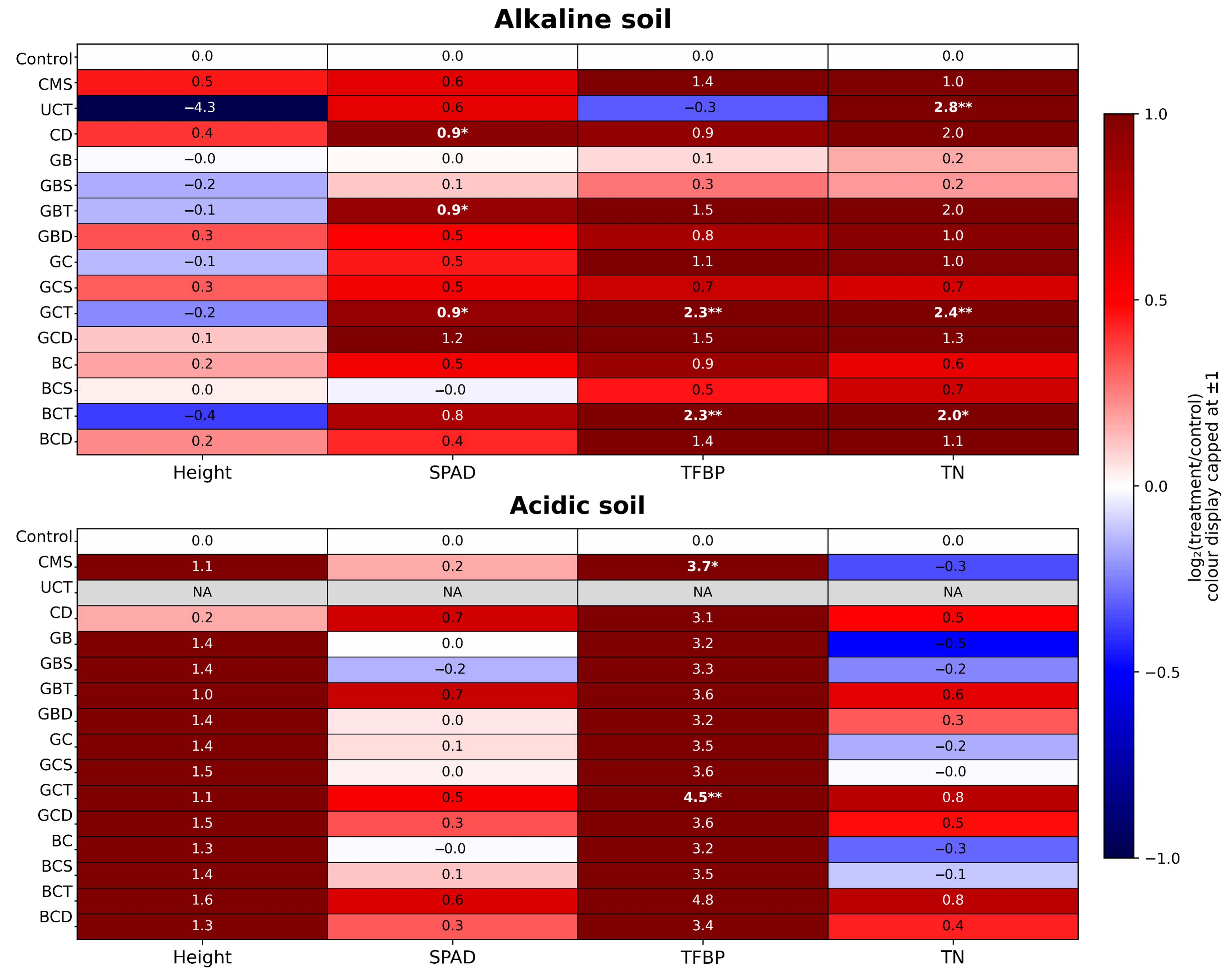
Positive values indicate increases relative to the control, whereas negative values indicate decreases. The log2 transformation was used only to represent effect magnitude and direction, not to normalize the data or satisfy test assumptions. The colour scale was capped at ±1, while the values shown in the cells correspond to the uncapped log2RR values.
Statistical analyses were performed using IBM SPSS Statistics 29.0.1.0 and R 4.6.1 (R Foundation for Statistical Computing, Vienna, Austria). The statistical workflow implemented in R was developed through custom scripts created specifically for this study, with assistance from ChatGPT Plus (OpenAI; San Francisco, CA, USA) in their development and refinement under the authors’ supervision. All generated code was reviewed, validated and executed by the authors.

3. Results

3.1. Composition and Properties of Organic Amendments

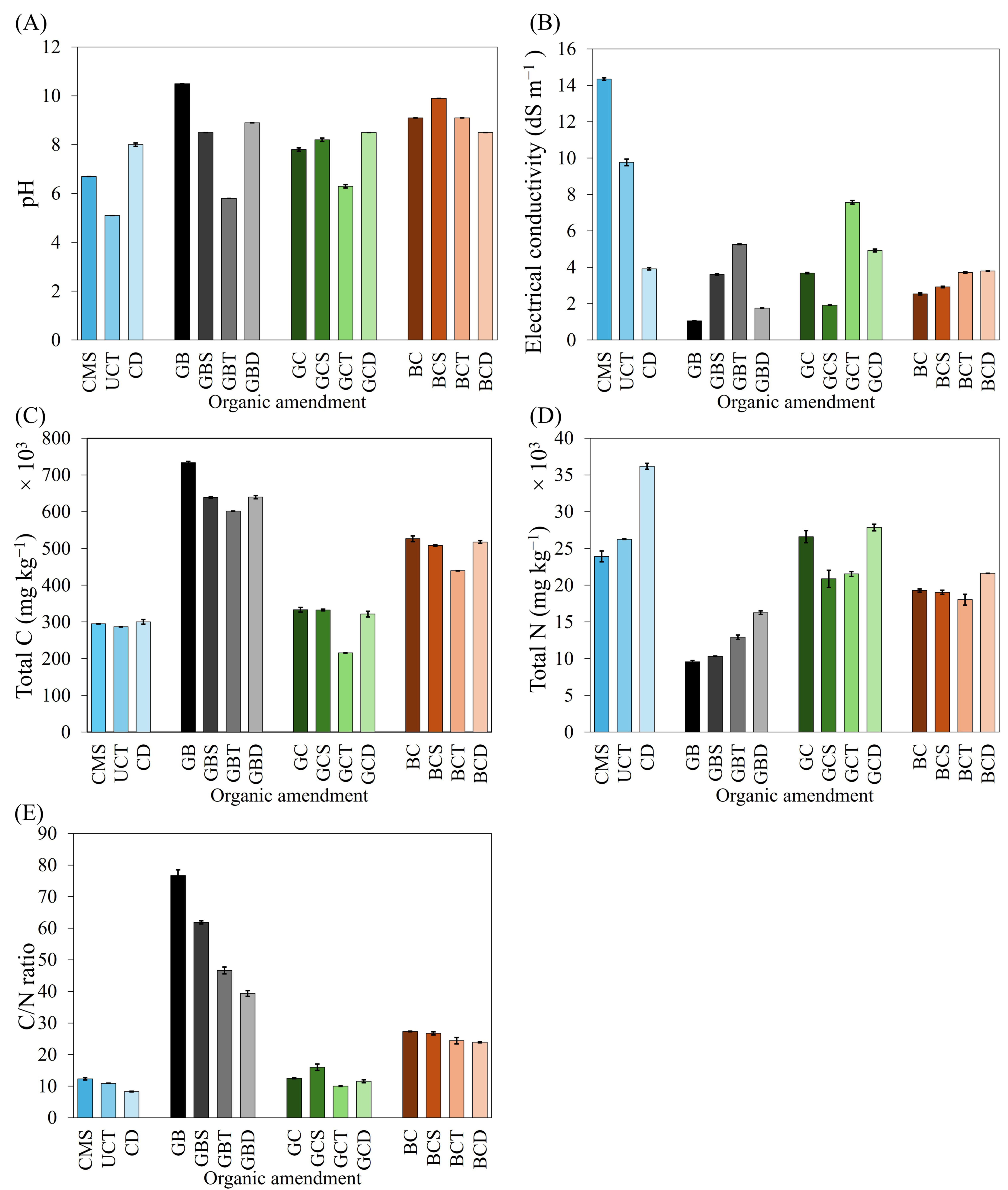
The physicochemical properties of the amendments exhibited noticeable differences based on their origin and formulation (Figure 1). Among the individual amendments, most materials demonstrated neutral to alkaline pH levels, with GB exhibiting the highest alkalinity, exceeding pH 10, while UCT was the sole amendment with slightly acidic values (<6) (Figure 1A). In the mixed treatments, the inclusion of UCT reduced the pH of the corresponding solid amendments, notably in GBT and GCT, whereas the pH of BCT remained similar to that of the solid amendment mixture. The EC was most pronounced in the liquid amendments, particularly CMS and UCT, whereas GB displayed the lowest values (Figure 1B). The integration of liquid residues with solid amendments resulted in lower EC values compared to those recorded for the corresponding liquid amendments applied independently, especially in the CMS- and UCT-based mixtures.
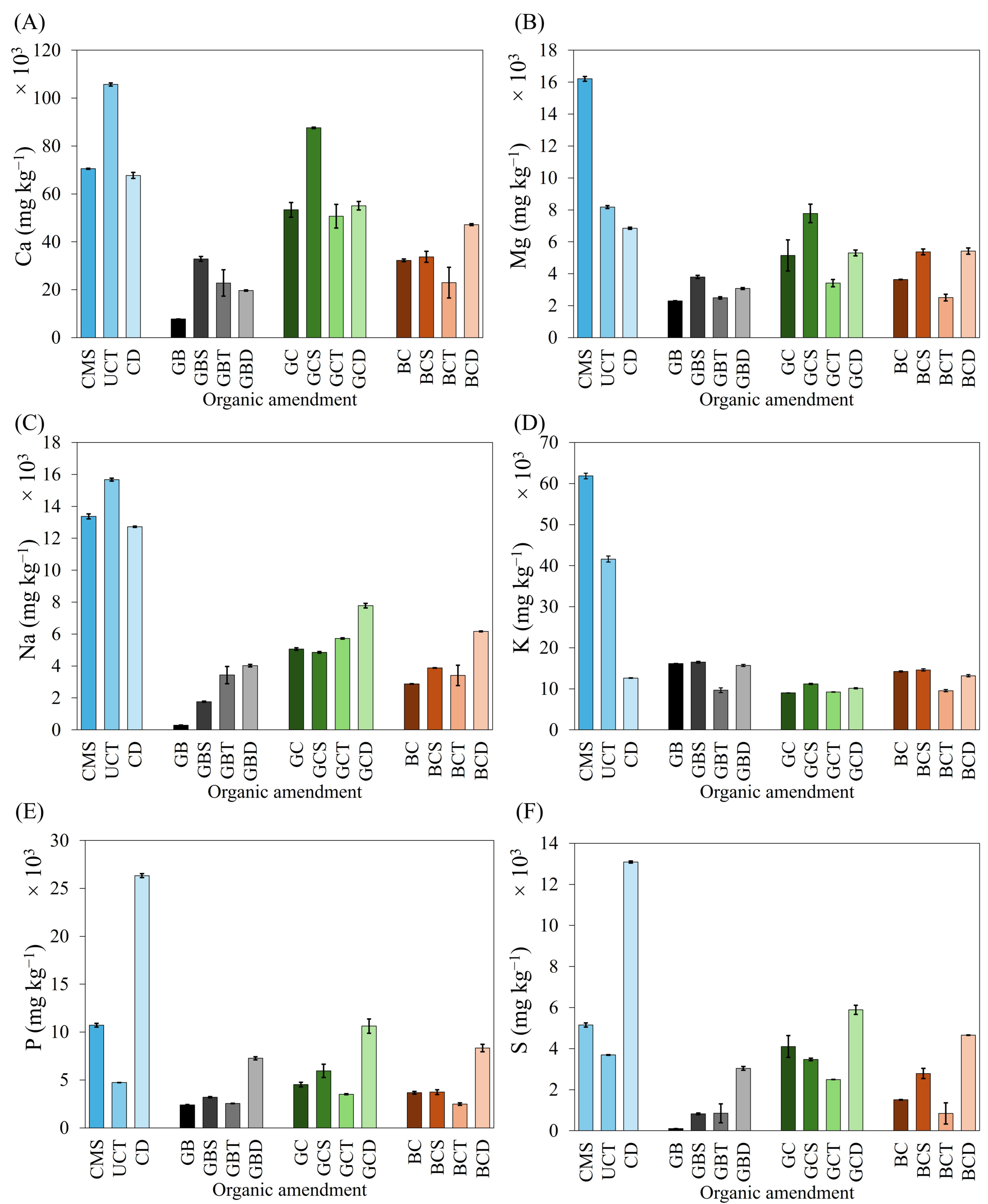
Distinct differences were also noted in total C, total N, and C/N ratio (Figure 1C–E). GB exhibited the highest total C concentration and the lowest total N content, leading to the widest C/N ratio among the amendments. In contrast, GC and the liquid amendments had relatively lower total C contents and higher N concentrations, with CD presenting the highest total N values. Consequently, mixtures containing CD exhibited higher N contents than their corresponding unblended solid amendments. Conversely, mixtures prepared with UCT showed a slight reduction in total C, particularly in GCT and BCT. Overall, the mixed treatments displayed intermediate physicochemical characteristics between those of their solid and liquid components. The concentrations of major nutrients and cations varied across different amendments and formulations (Figure 2). For Ca, Mg, and Na, the highest concentrations were typically observed in the liquid amendments, particularly CMS and UCT (Figure 2A–C). However, integrating liquid residues into solid amendments did not consistently enhance the concentrations of these elements in the resultant mixtures. For instance, despite the elevated Ca and Mg levels in UCT, the UCT-based mixtures did not exhibit a proportional increase in these elements compared to the unblended solid amendments. A comparable trend was noted for potassium, with CMS and UCT displaying the highest concentrations among the amendments (Figure 2D). Nonetheless, the mixtures did not demonstrate a clear enrichment in K relative to the corresponding solid amendments, and in some instances, K concentrations were lower than in the unblended materials. Conversely, CD exhibited the highest P and S concentrations among the amendments (Figure 2E,F). As expected, the incorporation of CD into the solid amendments resulted in increased P and S contents in the mixtures compared to their respective unblended solid forms.
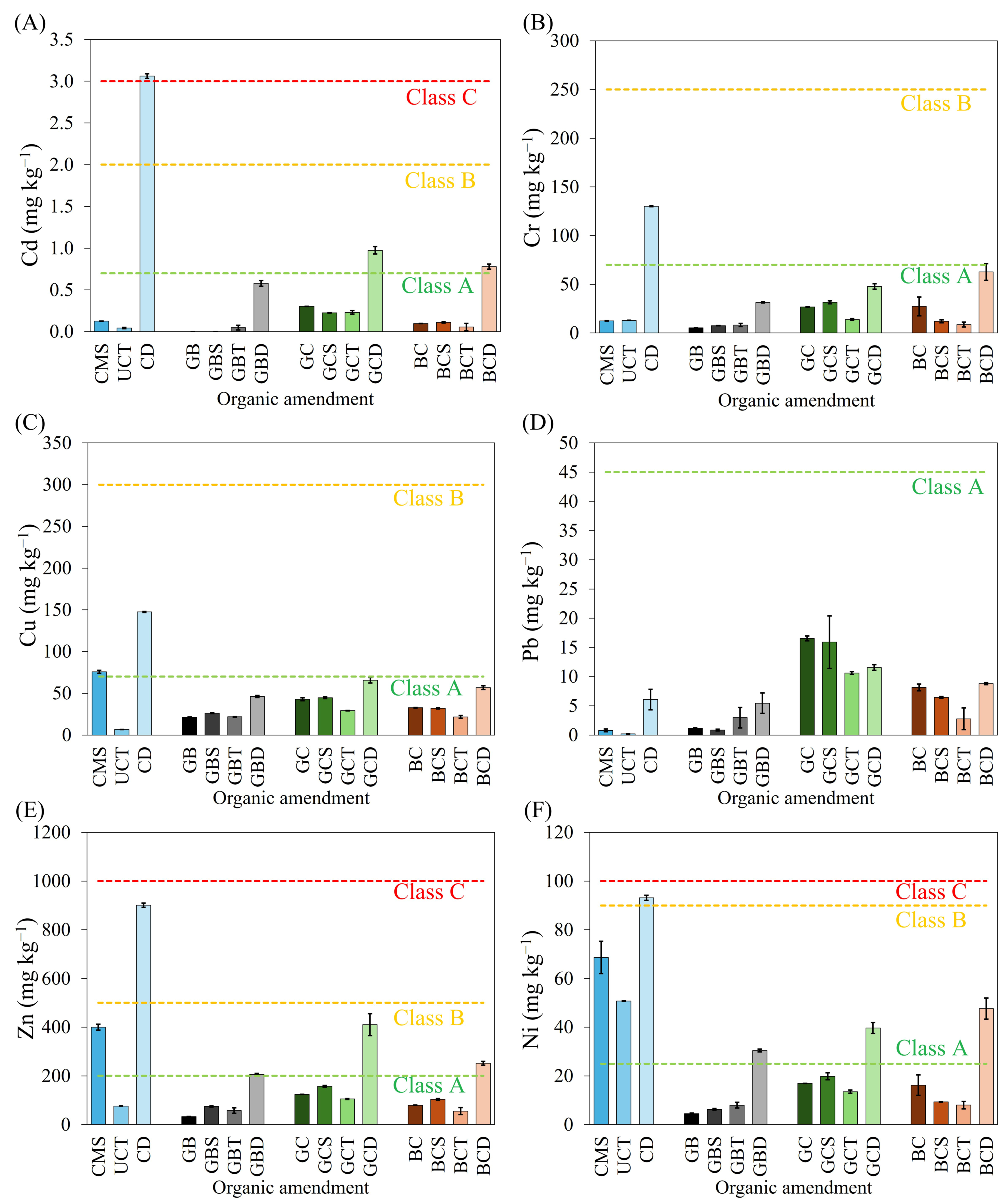
Heavy metal concentrations were evaluated in accordance with the quality classes delineated by Spanish Royal Decree 506/2013 [38], which specifies maximum allowable concentrations for three categories: class A, class B, and class C. Concentrations surpassing the class A threshold must be reported, while those exceeding the class C limit are prohibited for use as soil amendments. In general, the highest concentrations of heavy metals were observed in the liquid amendments (Figure 3). Among these, CD exhibited the most restrictive profile, with concentrations of Cd, Zn, and Ni categorizing this amendment as class C. CMS was classified as class B due to its Cu, Zn, and Ni contents, whereas UCT was assigned to class B based on its Ni concentration. The remaining single amendments were classified as class A, indicating their suitability for agricultural use as organic amendments. The integration of liquid residues into solid amendments typically resulted in lower heavy metal concentrations compared to those found in the corresponding unblended liquid amendments. However, mixtures based on CD demonstrated increased Cd and Ni contents relative to the single solid amendments, resulting in a reclassification from class A to class B (Figure 3A,F). Therefore, although mixing reduced heavy metal concentrations compared to the liquid residues alone, the inclusion of CD still influenced the regulatory classification of the resulting solid–liquid mixtures.

3.2. Effect of Organic Amendment Application on Soil Properties

3.2.1. Alkaline Soil

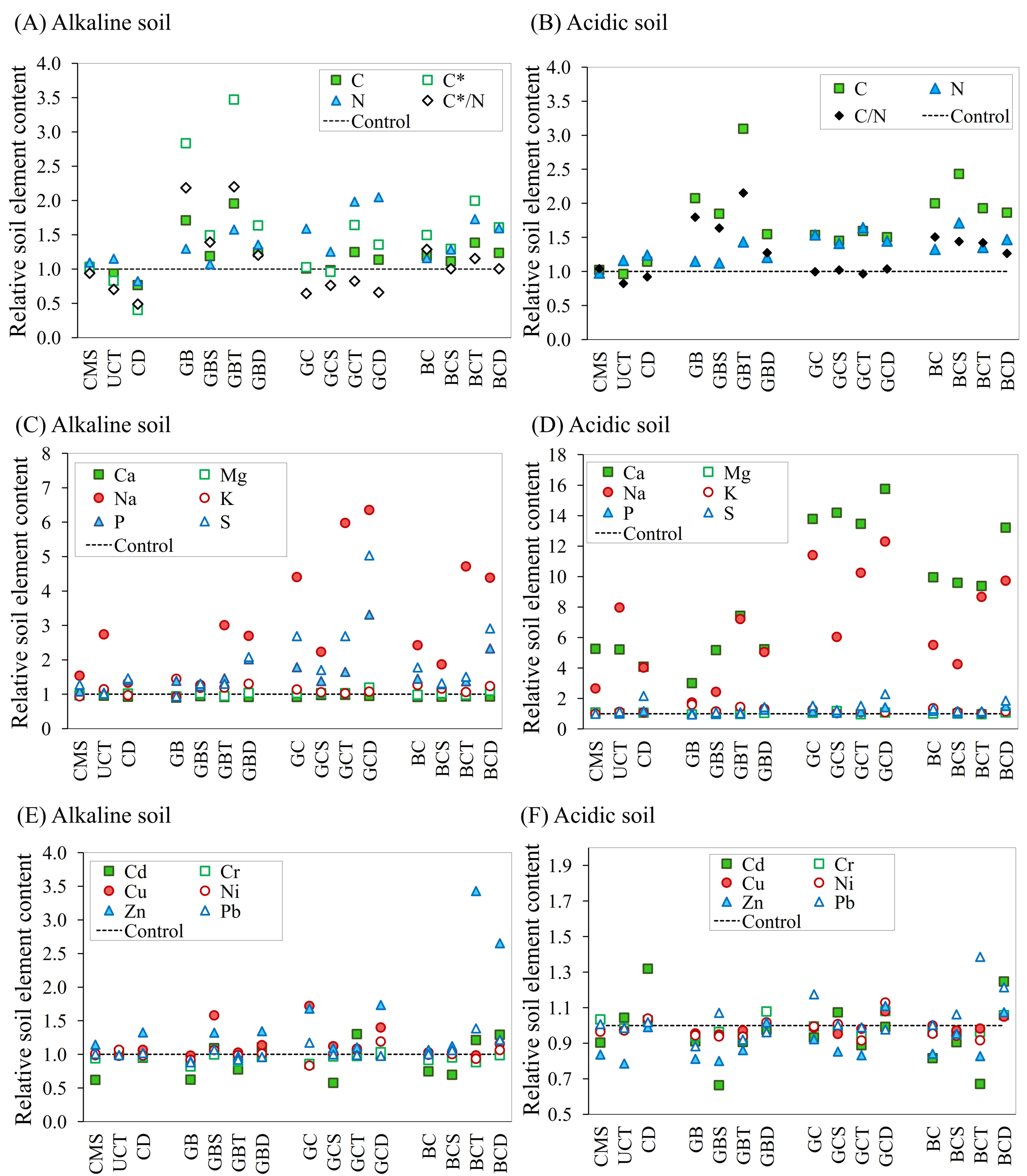
The alkaline soil initially exhibited a control pH of 7.9, which slightly increased to 8.2 by the conclusion of the greenhouse experiment (Table 2). The application of amendments generally sustained or elevated soil alkalinity, with all treatments remaining within the alkaline range after 67 days. The highest final pH values were observed in treatments containing GB or BC, whereas UCT, GCT, and GCD were the only treatments in which pH decreased during the experiment (Table 2). Electrical conductivity varied among treatments and generally increased during incubation (Table 2). The highest final EC values were recorded in UCT- and GC-based treatments, particularly UCT and GCT, whereas CD exhibited a marked decrease over time, reaching values close to those of the control. These results indicate that EC changes were treatment-specific and did not merely reflect the initial salinity of the amendments. At the conclusion of the experiment, total C and N contents varied according to amendment formulation (Table 2). The highest total C values were associated with GB and GB- or BC-based mixtures, particularly GBT, GB, and BCT, while CD showed the lowest C content among the amended treatments. Total N increased mainly in mixtures involving GC or BC combined with liquid amendments, with the highest values recorded in GCD, GCT, BCT, and BCD. Relative changes in C, N, and C/N ratio corroborated these patterns (Figure 4A). As these soil variables were evaluated descriptively, differences among treatments represent observed trends rather than statistically supported effects. They may reflect amendment dissolution, organic matter transformations, ion exchange, plant uptake, and ion redistribution under non-leaching conditions, although the contribution of each process could not be determined.
GB and GBT produced the largest relative increases in C, whereas C/N ratios remained mostly similar to or lower than the control soil, except in GB- and GBT-amended soils. Regarding the major elements analysed, Na increased in most treatments, while P and S were particularly enhanced in CD-containing mixtures (Figure 4C). Heavy metal contents remained generally close to the control, although Zn increased in some treatments, especially those involving BC and liquid amendments (Figure 4E). Cd did not show a marked increase in CD-amended soils.
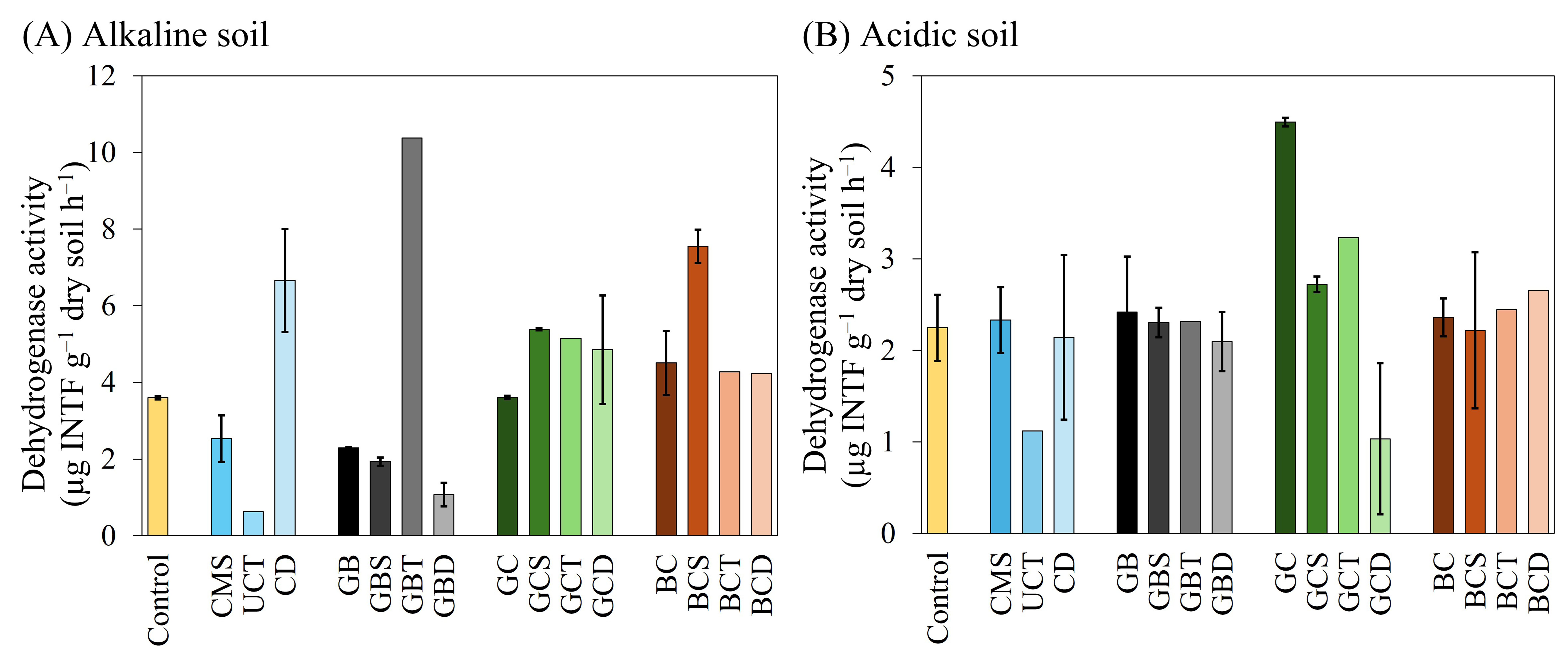
Dehydrogenase activity, used as an indicator of overall soil microbial activity, varied according to soil type and amendment formulation (Figure 5). In alkaline soil, the effects of treatments were more evident, with dehydrogenase activity demonstrating both increases and decreases compared to the control (Figure 5A). The highest activity levels were observed in GBT, followed by BCT and GCS, while UCT and BCD exhibited the lowest activities. Among the single amendments, CD demonstrated higher activity than the control, whereas GB and CMS remained at or near control levels.
Figure 4. Relative changes in soil element contents following amendment application in the alkaline (A,C,E) and acidic (B,D,F) soils. Values are expressed relative to the corresponding unamended control soil, with a value of 1 indicating no change. Dotted horizontal lines represent the control reference value. Panels show total C, total N and C/N ratio (A,B), macronutrients and Na (C,D), and heavy metals (E,F). (*) Carbon content in the alkaline soil was corrected for carbonate content prior to C/N calculation. Treatment codes are defined in Table 1.
Agronomy 16 01617 g004
Figure 5. Dehydrogenase activity in the alkaline (A) and acidic (B) soils following application of the different organic amendment formulations. Bars represent mean values ± standard error (SE). Treatment codes and formulation compositions are provided in Table 1.
Agronomy 16 01617 g005

3.2.2. Acidic Soil

The acidic control soil exhibited an initial control pH of 5.2. By the conclusion of the experiment, most treatments elevated the soil pH, with the highest final values recorded in GBD, UCT, BCT, and GCT. Conversely, the control, CMS, and CD treatments exhibited a slight decline in pH over time (Table 2). Electrical conductivity (EC) also varied among treatments (Table 2). The highest initial EC values were noted in UCT and UCT-based mixtures, whereas GB, GBS, CMS, and BCS displayed the lowest values. After 67 days, EC increased in several amended soils, particularly in those containing GC, BC, or CD, while UCT and BCT exhibited lower EC values than at the onset of the experiment. Overall, EC responses were specific to each treatment and differed from those observed in the alkaline soil. These soil-property patterns are descriptive rather than inferential. As in the alkaline soil, changes in pH and EC may have resulted from the combined effects of rewetting and incubation, amendment dissolution, mineralisation and nitrification, ion exchange, plant uptake, and redistribution of soluble ions under non-leaching irrigation. Most amendments resulted in numerically higher total C and N contents in the acidic soil, although these differences were not statistically assessed (Table 2). The highest total C values were observed in biochar amended soils (GBT, BCS, GB, BC, and BCT), while single liquid amendments had comparatively limited effects on soil C. Total N was generally higher in amended soils than in the control, particularly in GC-, BC-, and mixed treatments. Relative changes in C, N, and the C/N ratio were more pronounced in the acidic soil than in the alkaline soil (Figure 4B). Carbon increased mainly in GB-, BC-, and mixed treatments, whereas N increased across most amended soils. Among the analysed nutrients, Ca exhibited the strongest relative increase, especially in treatments containing GC or BC, while Na also increased in most amended soils (Figure 4D). Phosphorus and sulphur were primarily enhanced in CD-containing treatments.
In contrast to the alkaline soil, relative heavy metal contents in the acidic soils remained close to control values across treatments, with only minor variations (Figure 4F). Furthermore, despite the high heavy metal levels detected in several pure amendments, the concentrations measured in the amended soil pots complied with the permissible limits established by Decree 18/2015 [39].
Compared with the alkaline soil, dehydrogenase activity in the acidic soil varied within a much narrower range, with most treatments showing values close to that of the control (Figure 5B). Numerically, GC showed the highest activity, followed by GCS and BCD, whereas UCT and BCT showed the lowest values. These descriptive trends suggest less pronounced amendment-induced changes in the acidic soil, although the differences were not statistically assessed.

3.3. Effects of Organic Amendments on Plant Germination and Development

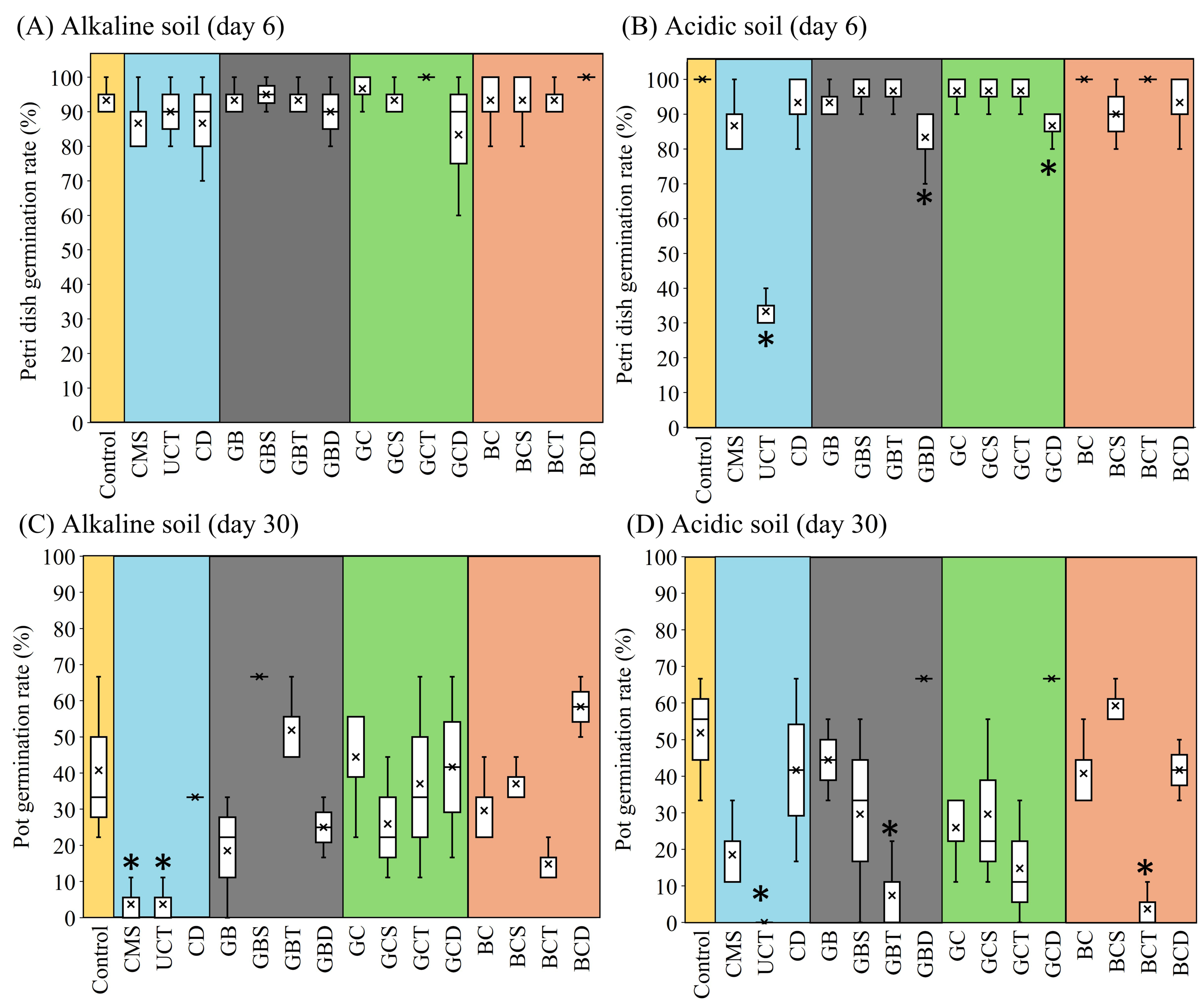
Seed germination rates on plates and pots are shown in Figure 6. In alkaline soil, the various amendment formulations did not exhibit significant differences compared to the control according to Steel’s many-to-one multiple comparison test (p > 0.05). As in alkaline soil, Steel’s test did not detect statistically significant differences from the control in the acidic soil (adjusted p > 0.05). Nevertheless, PS values indicate strong negative effect sizes for several treatments, reaching 0 (95% CI 0.0–0.0), particularly for UCT, GBD, and GCD measured in Petri dishes (day 6). Overall, seed germination in greenhouse pots was notably lower than on plates, including control treatments in both soil types. Despite variability among amendment treatments, Steel’s test did not detect statistically significant differences (adjusted p > 0.05), only in CMS and UCT in alkaline soil, and in UCT and some combinations with biochar and compost (GBT and BCT) in acidic soil exhibited PS values of 0 (95% CI: 0.0–0.0), indicating strong negative effect sizes relative to the control (Figure 6).
Plant growth responses during the greenhouse experiment varied according to soil type and amendment formulation (Figure 7 and Supplementary Table S1) In the alkaline soil, treatment effects on plant height were generally limited, whereas the most pronounced responses were observed for total fresh biomass production (TFBP) and plant N. GCT and BCT produced the largest biomass increases relative to the control, while UCT, CD, GBT, GCT, and BCT showed marked increases in total N. However, UCT reduced both plant height and biomass, indicating that increased plant N concentration did not necessarily result in greater plant growth. In the acidic soil, amendment effects were broader, with most treatments increasing plant height and biomass relative to the control. The strongest biomass responses were observed for CMS, GB, GC, GCS, GCT, BC, and BCT. Increases in SPAD and total N were more treatment-specific and were particularly evident for CD, GBT, GCT, GCD, BCT, and BCD (Figure 7) Across amendments, SPAD and total N showed similar response patterns, whereas biomass and height responded more independently. Plant total N was strongly and positively correlated with SPAD in both the alkaline soil (Spearman’s ρ = 0.697, p < 0.001) and the acidic soil (ρ = 0.852, p < 0.001). Plant growth responses should be interpreted in the context of establishment success, as low biomass in poorly established treatments may reflect impaired germination or establishment rather than reduced subsequent growth. As UCT produced no plants in the acidic soil and only one surviving plant in the alkaline soil, its effects on plant growth could not be reliably assessed.

4. Discussion

4.1. Composition, Agronomic Properties and Safety of Pure and Mixed Amendments

The pure amendments exhibited noticeable differences in physicochemical composition, nutrient content, and trace metal concentrations, which define both their agronomic potential and limitations for use as organic amendments (Figure 1, Figure 2 and Figure 3). Liquid amendments generally demonstrated higher EC and elevated concentrations of several nutrients and potentially limiting elements, whereas solid amendments primarily differed in pH, carbon content, and retention capacity. CD amendments exemplified this trade-off, possessing the highest total nitrogen, phosphorus, and sulfur contents, but also elevated Cd and Ni concentrations (Figure 1, Figure 2 and Figure 3). According to Spanish Royal Decree 506/2013 [38], which categorizes organic amendments into quality classes A, B, and C, CD was classified as class C due to its Cd, Zn, and Ni contents, rendering it the most restricted amendment (Figure 3). CMS was classified as class B because of its Cu, Zn, and Ni contents, and UCT as class B due to Ni, whereas the remaining single solid amendments were classified as class A, indicating their suitability for agricultural use; concentrations surpassing the class C limit are prohibited for use as organic amendments. Solid–liquid impregnation altered the properties of the original materials rather than producing a simple additive response. Compared to the unblended liquid amendments, the mixtures generally exhibited lower EC and trace metal concentrations, particularly in CD-based formulations (Figure 1, Figure 2 and Figure 3). Consequently, impregnation into GB, GC and their mixture (BC) reduced the operational and regulatory risk associated with CD and brought the mixtures within acceptable limits for agricultural use. Nevertheless, CD-based mixtures still contained more Cd and Ni than the corresponding unblended solids, indicating redistribution into the solid matrix rather than removal from the system. Variations among solid carriers suggest that element retention and recovery depended on the nature of the amendment. For instance, GBD mixtures showed lower recovered trace metal concentrations than GCD mixtures, despite both being prepared with CD (Figure 3). This may reflect stronger retention or lower analytical recoverability in biochar-based mixtures, as the aromatic structure, porosity, and alkaline pH of biochar favour stable associations with trace metals [40,41,42]. In compost-based materials, metal retention is more commonly associated with complexation by humic and fulvic substances [43,44,45,46,47]. The aqua-regia-extractable concentrations should therefore be interpreted as pseudototal: the method recovers the environmentally relevant non-silicate fractions extensively but does not completely dissolve metals structurally bound within silicate lattices, which are expected to be negligible in these organic amendments. Aqua regia was used because the Spanish and EU regulatory thresholds relevant to amendment classification are based on this operationally defined fraction, rather than on DTPA-extractable or sequentially fractionated pools. Regulatory compliance therefore provides a conservative screening measure, but not a direct estimate of mobility or bioavailability. Complementary DTPA extraction and sequential fractionation would be required to assess these environmental dimensions. From an agronomic perspective, the main benefit of impregnation is nutrient enrichment. CD-based mixtures showed the clearest increases in total N, P and S (Figure 1 and Figure 2), elements directly linked to crop nutrition and potentially useful for reducing mineral fertilization inputs [42,48,49]. However, this enrichment was accompanied by higher Na and trace metal contents, especially in CD-based mixtures, highlighting a trade-off between nutrient value and potential risk (Figure 3). Biochar-based mixtures showed a greater relative increase in total N than GC-based mixtures, probably because GB initially had very low N content (Figure 1). This agrees with the complementary roles of compost and biochar: compost may act as a nutrient source through organic matter mineralization [50], whereas biochar may function mainly as a retention matrix for N-containing compounds [48,51]. Nevertheless, total N determined by dry combustion indicates element transfer, but not necessarily plant-available N. UCT-based formulations showed a different response. UCT acidified GB and GC, as reflected in GBT and GCT, whereas BC partly buffered this effect (Figure 1A). These mixtures also showed a slight decrease in total C, particularly in GCT and BCT (Figure 1C), possibly related to the acidic and biologically active nature of compost tea. Acidification, dissolved organic compounds and microbial activity can promote dissolution, desorption or mobilization of organic compounds during soaking [41,52,53], while humic-derived compounds may act as natural surfactants favouring C desorption from amendment surfaces [54,55]. Overall, these results support previous evidence that organic amendments can improve fertility but may introduce constraints when applied directly, including high EC, pH shifts, trace metal inputs, phytotoxic compounds, biologically active dissolved fractions, organic pollutants, microbial shifts and soil-borne pathogens [41,53,54,56,57,58,59,60,61]. Thus, the suitability of each formulation depended on the balance between nutrient enrichment, salinity, trace metal contents and regulatory classification [56]. It does not distinguish NH4+ and NO3 from organic N, or resolve mineralisation, immobilisation, and plant uptake; interpretation of amendment-derived N must therefore remain limited to total-N transfer.

4.2. Influence on Soil Context

The results of the germination and plant establishment experiments indicated that the effectiveness of amendments was clearly influenced by the characteristics of the receiving soil and the interaction between liquid and solid materials. UCT was consistently linked to adverse effects. In the greenhouse experiment, UCT reduced plant establishment in both soil types and completely inhibited plant establishment in the acidic soil (Figure 6). In the alkaline soil, UCT supported only one surviving plant, which exhibited no inflorescences and very low fresh biomass production (Electronic Annex Table S1 and Figure 7). These effects could not be attributed solely to EC, Na, or trace metal contents. For example, although CD and UCT exhibited similar EC-related constraints in certain instances, CD did not result in the same level of germination inhibition (Table 2; Figure 6). Furthermore, the higher trace metal contents in CD were not consistently associated with reduced germination or plant establishment. This pattern suggests that inhibition resulted from interacting chemical, physical, and biological factors rather than from a single measured parameter. In addition to salinity and Na, uncharacterised phenolic compounds, low-molecular-weight organic acids, or other dissolved organic constituents may have contributed. The observed compaction and possible changes in seed–soil contact, wetting, aeration, and structural stability also provide plausible physical pathways, but the present analyses cannot identify their relative contributions.
A pronounced contrast between the two soils examined was observed for pH. These soils differed not only in acidity and carbonate status, but also in geographic origin, land use, texture, organic carbon, nutrient status, and other properties. The observed differences therefore cannot be attributed specifically to pH or generalised to acidic and alkaline soils as broad categories. Within this experiment, most amendments further increased pH in the carbonate-rich soil, with certain treatments producing strongly alkaline conditions (Table 2). Under such conditions, additional alkalinisation is unlikely to be advantageous and may reduce nutrient availability and increase nutritional imbalance [62,63]. In the Dystric Cambisol examined, by contrast, several amendments increased pH from initially acidic conditions (Table 2), which may have alleviated one growth constraint. This response was observed for CMS, GB, GC, BC, and several solid–liquid mixtures without the severe inhibition associated with UCT. These findings identify hypotheses for soil-specific formulation, but require validation across a broader range of soils before wider recommendations can be made. The responses of Ca and Na were also contingent on soil context. In alkaline soil, the high baseline Ca content restricted the relative impact of amendment-derived Ca inputs (Figure 4), although repeated applications could lead to excessive Ca accumulation and nutrient uptake imbalances in certain crops [64]. In contrast, in acidic soil, amendment-derived Ca resulted in more pronounced relative increases and may enhance nutrient supply and soil structure [65,66] (Figure 4). Na enrichment posed greater concerns. Most formulations increased relative Na abundance in both soil types, but the implications varied. In alkaline soil, high Ca and carbonate contents may partially buffer Na effects on structure [67], whereas in acidic soil, where buffering capacity is lower, Na enrichment may negate some beneficial effects of Ca, particularly in UCT-derived formulations and certain GB-based mixtures.
Variations in carbon and nitrogen responses were observed across different soils and amendment types. In alkaline soil, the amendments GB and GBT resulted in the most significant relative increase in the carbon ratio, approximately threefold higher than the control, whereas GC-based treatments and liquid amendments led to smaller increases or decreases (Figure 4A). A similar trend was noted in acidic soil, although the differences were less pronounced (Figure 4B). Total nitrogen increases were more prominent in treatments influenced by GC and CD, particularly GCT and GCD in alkaline soil, where final values were approximately double those of the control (Table 2). In acidic soil, total nitrogen levels were generally higher than in alkaline soil, with less marked treatment differences (Table 2). Overall, GB primarily contributed to carbon enrichment, while GC- and CD-based mixtures more clearly enhanced nitrogen, phosphorus, and sulphur enrichment. The marked increases in OC following GB and GBT application may be attributed to the inherently stable aromatic carbon derived from biochar, suggesting potential for longer-term soil carbon storage. Nevertheless, the short duration of the experiment precludes any assessment of carbon persistence or sequestration, which requires validation through long-term field studies.
Despite the high trace metal content in some amendments, notably CD, metal concentrations in both soils remained within the limits established by Decree 18/2015 [39]. This suggests that buffering, dilution, immobilization, and interactions with carbonates, clay minerals, oxides, and organic matter mitigated the expression of amendment-derived metal inputs at the soil level [68,69,70]. The acidic soil exhibited limited relative metal enrichment, whereas the alkaline soil showed more pronounced changes in zinc, particularly in BCT, where zinc levels were approximately three times higher than the control (Figure 4E). Notably, cadmium did not exhibit a significant increase in soil despite its high concentration in CD. Thus, regulatory classification based on total metal contents is useful for risk screening but does not fully predict soil metal accumulation following a single application. Repeated applications or more mobile metal fractions could elevate risk, especially in soils with lower buffering capacity. Evaluations that incorporate metal speciation, mobility, and bioavailability would provide a more realistic assessment of environmental implications [71,72]. Nevertheless, the findings of this study highlight the urgent need for a more comprehensive classification framework for organic amendments that, beyond conventional compositional and safety criteria, also considers their agronomic performance, including effects on nutrient availability, seed germination, and early plant development [73].
Dehydrogenase activity, employed as an indicator of soil microbial activity, also mirrored the influence of the initial biological and physicochemical conditions of each soil [74,75]. The activity was greater in the alkaline control compared to the acidic control soil, suggesting a more active baseline microbial community (Figure 5). This variation has been frequently reported and may be attributed to factors such as pH, carbonate content, organic matter quality, nutrient availability, and climatic conditions at the site of origin, including increased precipitation, lower temperatures, and reduced oxygen availability during certain periods [11,76,77,78]. Consequently, enzymatic responses were less pronounced and remained closer to the control in the acidic soil (Figure 5B), whereas the alkaline soil exhibited clearer treatment differentiation. In the alkaline soil, UCT decreased dehydrogenase activity, while GBT, GCS, and CD increased it relative to the control (Figure 5A). Previous research has demonstrated that compost teas can affect microbial abundance and diversity [58,79,80]. Although microbial community composition was not evaluated in this study, the combined inhibition of plant establishment and dehydrogenase activity suggests that UCT may have introduced biologically active compounds or microbial interactions that adversely impacted early soil–plant functioning. Therefore, microbial indicators should be interpreted in relation to the initial biological status of each soil, rather than solely as direct responses to amendment composition [11,81,82,83]. Dehydrogenase activity provides an integrative measure of microbial activity but does not resolve changes in microbial abundance, community composition, or functional potential. Future studies combining PLFA profiling and 16S rRNA gene sequencing would provide further insights into the microbial mechanisms underlying these responses.
The comparison between Petri-dish germination assays and greenhouse pot experiments raises questions regarding the predictive capacity of extract-based germination tests for plant responses in actual soil conditions. In Petri dishes, where soil–amendment water extracts were utilized, the inhibitory effects were generally less pronounced than in pots (Figure 6), suggesting that soluble extracts capture only a portion of the amendment effect. Under greenhouse conditions, amendments may influence germination not only through soluble compounds but also by altering seed–soil contact, wetting behaviour, aeration, nutrient availability, microbial activity, and structural stability. Organic residues can enhance soil water repellence and modify wetting dynamics, thereby limiting seed hydration despite nutrient availability [84]. Increases in Na contents and EC may also lead to clay dispersion, pore clogging, and surface sealing, which restrict gas exchange and seed emergence independently of direct salinity toxicity [85]. These mechanisms may elucidate why CMS and UCT inhibited germination in alkaline soil pots, whereas UCT, GBT, and BCT were the most limiting treatments in acidic soil pots (Figure 6). Consequently, while Petri-dish assays are effective for detecting acute soluble phytotoxicity, they may underestimate or fail to replicate soil-mediated constraints that arise when amendments interact directly with the soil matrix.
In summary, no amendment can be deemed universally beneficial or detrimental without considering the receiving soil. GB was most effective in enhancing C-related indicators, particularly in the alkaline soil. GC- and CD-based mixtures were more pertinent for N, P, and S enrichment, although CD also introduced a higher trace-metal burden. CMS exhibited inhibitory effects on establishment in the alkaline soil but comparatively positive growth responses in the acidic soil. UCT was the most consistently problematic amendment, especially in the acidic soil, where it hindered plant establishment and where UCT-based mixtures also reduced germination or delayed development. Solid amendments, particularly GB, GC, and BC, partially alleviated some negative effects of liquid amendments, although this mitigation was incomplete for UCT. Agronomic suitability thus depends on aligning amendment function with soil constraints: GB may be preferable where organic C input is the primary objective, GCD or BCD where N, P, and S inputs are required, and UCT-derived formulations should be used with caution, especially in acidic soils and during early crop establishment.
The contrasting plant responses indicate that amendment performance was strongly conditioned by soil properties. The broader increases in height and biomass in the acidic soil (Figure 7) suggest that the amendments alleviated growth limitations more effectively under acidic than alkaline conditions, likely because of differences in nutrient availability, pH, salinity, and amendment–soil interactions. The strong positive relationship between plant N and SPAD in both soils supports the use of SPAD as a rapid, non-destructive indicator of barley N status. Nevertheless, higher N did not consistently result in greater biomass or height. This decoupling may reflect nutrient concentration in plants with restricted growth or nutrient dilution when biomass increased faster than N accumulation. UCT-containing treatments were particularly illustrative, combining high SPAD and N with limited biomass and poor reproductive development. This pattern suggests the formation of hydrated, N-rich tissues without a proportional improvement in overall plant performance and may indicate delayed maturation ((Electronic Annex Table S1). The contrasting behaviour of CMS and CD further shows that amendment performance cannot be inferred solely from composition or trace-metal classification. Overall, SPAD and N were consistent indicators of plant N status, whereas biomass and reproductive development were additionally controlled by soil- and amendment-dependent factors.

4.3. Methodological Limitations and Future Perspectives

The extensive screening of organic amendments and mixtures enabled a comparative assessment of soil physicochemical properties, plant performance, and enzymatic activity in two contrasting soils. Several limitations nevertheless constrain interpretation. First, the soils differed simultaneously in pH, carbonate status, geographic origin, land use, texture, organic carbon, and nutrient status; responses cannot therefore be attributed to acidity alone or generalised to acidic and alkaline soils. Second, poor establishment reduced replication for some treatments. UCT produced no plants in the acidic soil and only one surviving plant in the alkaline soil, so its growth response could be described but not tested robustly; a further experiment with greater replication is needed to confirm the apparent negative effect and to separate establishment failure from subsequent growth. Third, soil physicochemical properties and dehydrogenase activity were interpreted descriptively. Fourth, the high 9:1 screening dose was applied on an as-prepared mass basis, and the absence of liquid-amendment dry-matter contents and soil bulk density precluded common dry-matter and field-equivalent rates. Fifth, aqua regia digestion provided regulatory pseudototal concentrations of trace elements, not element speciation or bioavailability, while total N did not resolve mineral N dynamics. Future work should therefore combine longer-term, better-replicated field trials with soil hydraulic measurements, amendment dry-matter normalisation, DTPA or sequential metal fractionation, NH4+ and NO3 dynamics, complete shoot and root N uptake, chemical profiling of potentially phytotoxic organic compounds, and microbial community analyses such as PLFA and 16S rRNA gene sequencing. Carbon-stock and biochar-stability measurements will also be required to evaluate medium- and long-term C sequestration.

5. Conclusions

This study demonstrates that solid–liquid impregnation is a suitable strategy for producing tailored organic amendments from agro-livestock residues. The evaluation of 15 formulations with markedly different physicochemical properties revealed that their agronomic performance depended strongly on both amendment composition and soil type. Impregnation effectively transferred nutrients from liquid residues to solid matrices, particularly in cattle-waste-based formulations enriched in nitrogen, phosphorus, and sulfur. Although cattle digestate also increased cadmium and nickel concentrations, metal contents remained within regulatory limits after formulation and soil application, indicating that the solid matrices and soil buffering capacity reduced the immediate risk associated with direct application. The amendments produced contrasting responses in the two soils examined. However, given their differences in multiple physicochemical properties, these responses should be interpreted within the specific context of the soils studied and not attributed exclusively to pH or extrapolated broadly to acidic and alkaline soils. In the acidic soil, several formulations increased pH and improved nutrient availability, supporting their potential to correct acidity and enhance fertility. In the carbonate-rich alkaline soil, calcium inputs were strongly buffered, whereas further alkalinization and sodium accumulation were less favourable. GB and GBT most consistently improved carbon-related indicators, while GC- and digestate-based formulations contributed more strongly to nitrogen and nutrient enrichment. Plant responses also differed substantially among formulations. UCT strongly inhibited plant establishment, especially in the acidic soil, whereas its mixtures partially reduced this effect. CMS showed a contrasting soil-dependent response, with greater inhibition in the alkaline soil but comparatively better performance in the acidic soil. The strong association observed between SPAD values and plant nitrogen content further supports the usefulness of chlorophyll measurements as a rapid, non-destructive indicator of plant nitrogen status when assessing amendment performance. Overall, these findings support the development of soil-specific amendment formulations. Furthermore, they demonstrate that the official classification of amendments into categories A–C according to heavy-metal concentrations alone is insufficient to predict agronomic performance. A more comprehensive assessment should also consider amendment effects on nutrient availability, soil properties, germination, and plant development in contrasting soils. Such an approach would support the selection of safer, more effective, and soil-specific amendment formulations.

Supplementary Materials

The following supporting information can be downloaded at: https://www.mdpi.com/article/10.3390/agronomy16171617/s1, Table S1: Plant growth, biomass production, SPAD index, and nitrogen concentration in plants grown in alkaline and acidic soils under greenhouse conditions. Values are expressed as mean ± standard error (SE). Table S2a: a Summary statistics, log2 response ratios relative to the control, and adjusted significance levels for plant parameters measured in alkaline soil. Table S2b: Summary statistics, log2 response ratios relative to the control, and adjusted significance levels for plant parameters measured in acidic soil. Table S2c: Verification of the soil-code assignment based on control values for total fresh biomass production, SPAD index, and plant nitrogen concentration.

Author Contributions

Conceptualization, J.M.d.l.R.; methodology, G.B.-M., S.D., S.M.P.-D. and P.C.; software, G.B.-M. and J.M.d.l.R.; validation, A.M. and J.M.d.l.R.; formal analysis, G.B.-M., S.D., S.M.P.-D. and P.C.; investigation, G.B.-M., S.D. and J.M.d.l.R.; resources, A.M. and J.M.d.l.R.; data curation, G.B.-M. and S.D.; writing—original draft preparation, G.B.-M.; writing—review and editing, S.D., S.M.P.-D., P.C., A.M. and J.M.d.l.R.; visualization, G.B.-M., S.M.P.-D. and P.C.; supervision, A.M. and J.M.d.l.R.; project administration J.M.d.l.R. and A.M.; funding acquisition, J.M.d.l.R. and A.M. All authors have read and agreed to the published version of the manuscript.

Funding

This research was funded by the Spanish Ministry of Science and Innovation (MCIN) and the State Research Agency (AEI) through the projects PIROVALOR (CPP2023-010757), AGRORES (PID2021-126349OB-C21) and RES2SOIL (PID2021-126349OB-C22), under the MCIN/AEI/10.13039/501100011033 call. P.C. acknowledges funding from MICIU/AEI/10.13039/501100011033 and ESF+ through her Technical Support contract PTA2023-023661-I.

Institutional Review Board Statement

This study did not involve genetically modified organisms, human participants, animals, or any products or procedures prohibited under current national or European Union legislation. All experimental procedures adhered to applicable regulatory and ethical standards. Additionally, this research and its associated funding projects adhered to gender equality principles in accordance with current legislation, ensuring fair and equitable participation and opportunities throughout the work.

Data Availability Statement

The raw data supporting the conclusions of this article will be made available by the authors on request.

Acknowledgments

During the preparation of this manuscript, the authors used AI-assisted tools solely to support English-language editing and the development of custom R scripts. ChatGPT Plus (OpenAI, San Francisco, CA, USA) assisted with script development and English-language editing, while Paperpal software (version 4.19.7; Cactus Communications Services Ltd., Singapore, Singapore) was used exclusively for grammar and language improvement. All AI-generated code and textual suggestions were critically reviewed and approved by the authors. The statistical analyses were performed and validated by the authors, who take full responsibility for the scientific content, interpretation, and conclusions of the manuscript. The authors have reviewed and edited the output and take full responsibility for the content of this publication. The authors gratefully acknowledge Sologas S.A. and Básica S.A.U. for providing the digestates and composts, respectively used for the experiments. Authors also acknowledge the technical support provided by “Servicio de Analisis Térmicos” at IRNAS-CSIC.

Conflicts of Interest

The authors declare that they have no known competing financial interests or personal relationships that could have influenced the work reported in this paper. The funders had no role in the design of the study; in the collection, analyses, or interpretation of data; in the writing of the manuscript; or in the decision to publish the results. None of the authors are affiliated with the editorial board of this journal, nor do they maintain any personal or professional relationships with its members.

Abbreviations

The following abbreviations are used in this manuscript:
BCBiochar and compost (1:1, w/w) mixture
BCDBiochar and compost impregnated with cattle digestate
BCSBiochar and compost impregnated with cattle manure slurry
BCTBiochar and compost impregnated with urban compost tea
CDCattle digestate
CMSCattle manure slurry
ECElectrical conductivity
GBGreen biochar
GBDGreen biochar impregnated with cattle digestate
GBSGreen biochar impregnated with cattle manure slurry
GBTGreen biochar impregnated with urban compost tea
GCGreen compost
GCDGreen compost impregnated with cattle digestate
GCSGreen compost impregnated with cattle manure slurry
GCTGreen compost impregnated with urban compost tea
ICP-OESInductively coupled plasma optical emission spectrometry
Log2RRBase-2 logarithm of the response ratio
PSProbability of superiority
SOCSoil organic carbon
SPADSoil–plant analysis development (leaf chlorophyll index)
TCTotal carbon
TNTotal nitrogen
TFBPTotal fresh biomass production
WHCWater holding capacity

References

  1. Kotyal, K. Sustainable Waste Management in the Circular Economy: Challenges and Opportunities. Environ. Rep. 2023, 5, 1–5. [Google Scholar] [CrossRef] [Scilit]
  2. Sánchez-Cueto, P.; Hartmann, M.; García-Velázquez, L.; Gozalo, B.; Ochoa, V.; Bongiorno, G.; Goede, R.; Zoka, M.; Stathopoulos, N.; Kontoes, C.; et al. Impacts of Climate, Organic Management, and Degradation Status on Soil Biodiversity in Agroecosystems Worldwide. Glob. Change Biol. 2025, 31, e70486. [Google Scholar] [CrossRef] [Scilit] [PubMed]
  3. Van Zwieten, L. The long-term role of organic amendments in addressing soil constraints to production. Nutr. Cycl. Agroecosyst. 2018, 111, 99–102. [Google Scholar] [CrossRef] [Scilit]
  4. Sánchez-Monedero, M.A.; Cayuela, M.L.; Sánchez-García, M.; Vandecasteele, B.; D’Hose, T.; López, G.; Martínez-Gaitán, C.; Kuikman, P.J.; Sinicco, T.; Mondini, C. Agronomic Evaluation of Biochar, Compost and Biochar-Blended Compost across Different Cropping Systems: Perspective from the European Project FERTIPLUS. Agronomy 2019, 9, 225. [Google Scholar] [CrossRef] [Scilit]
  5. Soria, R.; González-Pérez, J.A.; De la Rosa, J.M.; San Emeterio, L.M.; Domene, M.A.; Ortega, R.; Miralles, I. Effects of technosols based on organic amendments addition for the recovery of the functionality of degraded quarry soils under semiarid Mediterranean climate: A field study. Sci. Total Environ. 2022, 816, 151572. [Google Scholar] [CrossRef] [Scilit] [PubMed]
  6. Bamdad, H.; Papari, S.; Lazarovits, G.; Berruti, F. Soil amendments for sustainable agriculture: Microbial organic fertilizers. Soil Use Manag. 2022, 38, 94–120. [Google Scholar] [CrossRef] [Scilit]
  7. Siedt, M.; Schäffer, A.; Smith, K.E.C.; Nabel, M.; Roß-Nickoll, M.; Van Dongen, J.T. Comparing straw, compost, and biochar regarding their suitability as agricultural soil amendments to affect soil structure, nutrient leaching, microbial communities, and the fate of pesticides. Sci. Total Environ. 2021, 751, 141607. [Google Scholar] [CrossRef] [Scilit] [PubMed]
  8. Osman, A.I.; Fawzy, S.; Farghali, M.; El-Azazy, M.; Elgarahy, A.M.; Fahim, R.A.; Maksoud, M.I.A.A.; Ajlan, A.A.; Yousry, M.; Saleem, Y.; et al. Biochar for agronomy, animal farming, anaerobic digestion, composting, water treatment, soil remediation, construction, energy storage, and carbon sequestration: A review. Environ. Chem. Lett. 2022, 20, 2385–2485. [Google Scholar] [CrossRef] [Scilit] [PubMed]
  9. Matisic, M.; Dugan, I.; Bogunovic, I. Challenges in Sustainable Agriculture—The Role of Organic Amendments. Agriculture 2024, 14, 643. [Google Scholar] [CrossRef] [Scilit]
  10. Urra, J.; Alkorta, I.; Garbisu, C. Potential Benefits and Risks for Soil Health Derived from the Use of Organic Amendments in Agriculture. Agronomy 2019, 9, 542. [Google Scholar] [CrossRef] [Scilit]
  11. Campos, P.; Miller, A.Z.; Prats, S.A.; Knicker, H.; Hagemann, N.; De la Rosa, J.M. Biochar amendment increases bacterial diversity and vegetation cover in trace element-polluted soils: A long-term field experiment. Soil Biol. Biochem. 2020, 150, 108014. [Google Scholar] [CrossRef] [Scilit]
  12. Rani, M.; Abideen, Z.; Munir, N.; Hasnain, M.; Mehdizadeh, M.; Qasim, M.; Radicetti, E. Enhancing soil fertility, nutrient recovery and carbon sequestration: The role of biochar, composted biochar, and biochar-compost mixtures in sustainable agriculture. J. Trace Elem. Miner. 2026, 15, 100276. [Google Scholar] [CrossRef] [Scilit]
  13. De la Rosa, J.M.; Rosado, M.; Paneque, M.; Miller, A.Z.; Knicker, H. Effects of aging under field conditions on biochar structure and composition: Implications for biochar stability in soils. Sci. Total Environ. 2018, 613–614, 969–976. [Google Scholar] [CrossRef] [Scilit] [PubMed]
  14. Ho, T.T.K.; Tra, V.T.; Le, T.H.; Nguyen, N.-K.-Q.; Tran, C.-S.; Nguyen, P.-T.; Vo, T.-D.-H.; Thai, V.-N.; Bui, X.-T. Compost to improve sustainable soil cultivation and crop productivity. Case Stud. Chem. Environ. Eng. 2022, 6, 100211. [Google Scholar] [CrossRef] [Scilit]
  15. Adebayo, O.; Noble Strohm, T.; Acosta-Martinez, V.; Fonte, S.J.; Schipanski, M.; Mikha, M.M.; Bista, P.; Angadi, S.V.; Ghimire, R. Linking biological and organic matter indicators of soil health with soil water functions in semi-arid compost-amended and intensified cropping systems. Geoderma 2026, 466, 117692. [Google Scholar] [CrossRef] [Scilit]
  16. Nayak, J.K.; Ranade, V.V. Valorisation of digestate: Characteristics, products, processes and potential. Chem. Eng. J. Adv. 2025, 24, 100887. [Google Scholar] [CrossRef] [Scilit]
  17. Corrado, G.; Mataffo, A.; Zaccardelli, M.; Sigillo, L.; Basile, B. The role and efficacy of compost tea in sustainable fruit tree production: Current scientific knowledge and future directions. Environ. Technol. Innov. 2026, 41, 104782. [Google Scholar] [CrossRef] [Scilit]
  18. Van Midden, C.; Harris, J.; Shaw, L.; Sizmur, T.; Pawlett, M. The impact of anaerobic digestate on soil life: A review. Appl. Soil Ecol. 2023, 191, 105066. [Google Scholar] [CrossRef] [Scilit]
  19. Márquez-Moreno, J.; Sánchez-Martín, Á.; Pérez-Dalí, S.M.; Rodríguez-López, C.; Campos, P.; Moreno-Robles, A.; Souza-Alonso, P.; López-Nuñez, R.; De la Rosa, J.M. Feedstock and transformation processes drive the valorization of agro-livestock waste for a circular agriculture. Waste Manag. 2026, 210, 115243. [Google Scholar] [CrossRef] [Scilit] [PubMed]
  20. Schmidt, H.; Pandit, B.H.; Cornelissen, G.; Kammann, C.I. Biochar-Based Fertilization with Liquid Nutrient Enrichment: 21 Field Trials Covering 13 Crop Species in Nepal. Land Degrad. Dev. 2017, 28, 2324–2342. [Google Scholar] [CrossRef] [Scilit]
  21. Holatko, J.; Hammerschmiedt, T.; Kintl, A.; Mustafa, A.; Naveed, M.; Baltazar, T.; Latal, O.; Skarpa, P.; Ryant, P.; Brtnicky, M. Co-composting of cattle manure with biochar and elemental sulphur and its effects on manure quality, plant biomass and microbiological characteristics of post-harvest soil. Front. Plant Sci. 2022, 13, 1004879. [Google Scholar] [CrossRef] [Scilit] [PubMed]
  22. Oyebiyi, O.O.; Laezza, A.; Hoque, M.M.; Thammavongsa, S.; Li, M.; Tsipas, S.; Tasiopoulos, A.J.; Scopa, A.; Drosos, M. Organic Amendments for Sustainable Agriculture: Effects on Soil Function, Crop Productivity and Carbon Sequestration Under Variable Contexts. C 2026, 12, 7. [Google Scholar] [CrossRef] [Scilit]
  23. Ali, N.; Jiang, Q.; Akhtar, K.; Luo, R.; Jiang, M.; He, B.; Wen, R. Biochar and manure co-application improves soil health and rice productivity through microbial modulation. BMC Plant Biol. 2025, 25, 914. [Google Scholar] [CrossRef] [Scilit] [PubMed]
  24. Gao, D.; Tian, H.; Yang, H.; Tan, W.; Liang, X.; Wen, C.; Song, D.; Zhang, Y.; Tan, Q. Co-application of digestate and biochar reduced greenhouse gas emissions in paddy soil through enhanced denitrification and anaerobic methane oxidation. J. Environ. Manag. 2025, 381, 125244. [Google Scholar] [CrossRef] [Scilit] [PubMed]
  25. Xing, X.; Wang, R.; Guo, Y.; Li, X.; Zhu, Z.; Ouyang, C.; Zhao, Y.; Zhou, T. Effects of exogenous additives on thermophilic co-composting of food waste digestate: Coupled response of enhanced humification and suppressed gaseous emissions. Energy Environ. Sustain. 2025, 1, 100046. [Google Scholar] [CrossRef] [Scilit]
  26. Uwiringiyimana, E.; Lai, H.; Ni, N.; Shi, R.; Pan, X.; Gao, J.; Biswash, M.R.; Li, J.; Cui, X.; Xu, R. Comparative efficacy of alkaline slag, biomass ash, and biochar application for the amelioration of different acidic soils. Plant Soil 2024, 504, 47–61. [Google Scholar] [CrossRef] [Scilit]
  27. Zhang, L.; Chang, L.; Liu, H.; De Jesús Puy Alquiza, M.; Li, Y. Biochar application to soils can regulate soil phosphorus availability: A review. Biochar 2025, 7, 13. [Google Scholar] [CrossRef] [Scilit]
  28. Qadir, M.; Schubert, S. Degradation processes and nutrient constraints in sodic soils. Land Degrad. Dev. 2002, 13, 275–294. [Google Scholar] [CrossRef] [Scilit]
  29. Rogovska, N.; Laird, D.; Cruse, R.M.; Trabue, S.; Heaton, E. Germination Tests for Assessing Biochar Quality. J. Environ. Qual. 2012, 41, 1014–1022. [Google Scholar] [CrossRef] [Scilit] [PubMed]
  30. Solaiman, Z.M.; Murphy, D.V.; Abbott, L.K. Biochars influence seed germination and early growth of seedlings. Plant Soil 2012, 353, 273–287. [Google Scholar] [CrossRef] [Scilit]
  31. Kaczynski, P.; Lozowicka, B.; Hrynko, I.; Wolejko, E. Behaviour of mesotrione in maize and soil system and its influence on soil dehydrogenase activity. Sci. Total Environ. 2016, 571, 1079–1088. [Google Scholar] [CrossRef] [Scilit] [PubMed]
  32. Bouyoucos, G.J. Hydrometer Method Improved for Making Particle Size Analyses of Soils. Agron. J. 1962, 54, 464–465. [Google Scholar] [CrossRef] [Scilit]
  33. Walkley, A.; Black, I.A. An Examination of the Degtjareff Method for Determining Soil Organic Matter, and a Proposed Modification of the Chromic Acid Titration Method. Soil Sci. 1934, 37, 29–38. [Google Scholar] [CrossRef] [Scilit]
  34. Yeomans, J.C.; Bremner, J.M. A rapid and precise method for routine determination of organic carbon in soil. Commun. Soil Sci. Plant Anal. 1988, 19, 1467–1476. [Google Scholar] [CrossRef] [Scilit]
  35. Guitián Ojea, F.; Carballas Fernández, T. Técnicas de Análisis de Suelos; Editorial Pico Sacro: Santiago de Compostela, Spain, 1976. [Google Scholar]
  36. Campos, P.; Knicker, H.; Miller, A.Z.; Velasco-Molina, M.; De la Rosa, J.M. Biochar ageing in polluted soils and trace elements immobilisation in a 2-year field experiment. Environ. Pollut. 2021, 290, 118025. [Google Scholar] [CrossRef] [Scilit] [PubMed]
  37. Trevors, J.T. Dehydrogenase activity in soil: A comparison between the INT and TTC assay. Soil Biol. Biochem. 1984, 16, 673–674. [Google Scholar] [CrossRef] [Scilit]
  38. Gobierno de España. Real Decreto 506/2013, de 28 de Junio, sobre Productos Fertilizantes. In Boletín Oficial del Estado; Gobierno de España: Madrid, Spain, 2013; Volume 164, pp. 51489–51540. [Google Scholar]
  39. Junta de Andalucía. Decreto 18/2015, de 27 de Enero, Reglamento que Regula el Régimen Aplicable a los Suelos Contaminados; Consejería de Medio Ambiente y Ordenación del Territorio. In Boletín oficial Junta de Andalucía; Junta de Andalucía: Seville, Spain, 2015; Volume 38. Available online: https://www.juntadeandalucia.es/eboja/2015/38/BOJA15-038-00037-2880-01_00064157.pdf (accessed on 19 August 2026).
  40. Zhang, L.; Shang, Z.; Guo, K.; Chang, Z.; Liu, H.; Li, D. Speciation analysis and speciation transformation of heavy metal ions in passivation process with thiol-functionalized nano-silica. Chem. Eng. J. 2019, 369, 979–987. [Google Scholar] [CrossRef] [Scilit]
  41. Brtnicky, M.; Datta, R.; Holatko, J.; Bielska, L.; Gusiatin, Z.M.; Kucerik, J.; Hammerschmiedt, T.; Danish, S.; Radziemska, M.; Mravcova, L.; et al. A critical review of the possible adverse effects of biochar in the soil environment. Sci. Total Environ. 2021, 796, 148756. [Google Scholar] [CrossRef] [Scilit] [PubMed]
  42. Ndoung, O.C.N.; Figueiredo, C.C.D.; Ramos, M.L.G. A scoping review on biochar-based fertilizers: Enrichment techniques and agro-environmental application. Heliyon 2021, 7, e08473. [Google Scholar] [CrossRef] [Scilit] [PubMed]
  43. Weng, L.; Temminghoff, E.J.M.; Lofts, S.; Tipping, E.; Van Riemsdijk, W.H. Complexation with Dissolved Organic Matter and Solubility Control of Heavy Metals in a Sandy Soil. Environ. Sci. Technol. 2002, 36, 4804–4810. [Google Scholar] [CrossRef] [Scilit] [PubMed]
  44. Beesley, L.; Moreno-Jiménez, E.; Gomez-Eyles, J.L. Effects of biochar and greenwaste compost amendments on mobility, bioavailability and toxicity of inorganic and organic contaminants in a multi-element polluted soil. Environ. Pollut. 2010, 158, 2282–2287. [Google Scholar] [CrossRef] [Scilit] [PubMed]
  45. Farrell, M.; Perkins, W.T.; Hobbs, P.J.; Griffith, G.W.; Jones, D.L. Migration of heavy metals in soil as influenced by compost amendments. Environ. Pollut. 2010, 158, 55–64. [Google Scholar] [CrossRef] [Scilit] [PubMed]
  46. Huang, M.; Zhu, Y.; Li, Z.; Huang, B.; Luo, N.; Liu, C.; Zeng, G. Compost as a Soil Amendment to Remediate Heavy Metal-Contaminated Agricultural Soil: Mechanisms, Efficacy, Problems, and Strategies. Water Air Soil Pollut. 2016, 227, 359. [Google Scholar] [CrossRef] [Scilit]
  47. Zeng, Y.; Farooq, T.H.; Yuan, C.; Li, W.; Farooq, A.; Wang, G.; Fang, Y.; Wang, J.; Yan, W. Organic-based remediation of heavy metal-contaminated soils in the Taojia river basin affected by long-term non-ferrous mining and logging activities. Front. Plant Sci. 2025, 16, 1486575. [Google Scholar] [CrossRef] [Scilit] [PubMed]
  48. Kizito, S.; Luo, H.; Lu, J.; Bah, H.; Dong, R.; Wu, S. Role of Nutrient-Enriched Biochar as a Soil Amendment during Maize Growth: Exploring Practical Alternatives to Recycle Agricultural Residuals and to Reduce Chemical Fertilizer Demand. Sustainability 2019, 11, 3211. [Google Scholar] [CrossRef] [Scilit]
  49. Rombel, A.; Krasucka, P.; Oleszczuk, P. Sustainable biochar-based soil fertilizers and amendments as a new trend in biochar research. Sci. Total Environ. 2022, 816, 151588. [Google Scholar] [CrossRef] [Scilit] [PubMed]
  50. Azeem, M.; Hale, L.; Montgomery, J.; Crowley, D.; McGiffen, M.E., Jr. Biochar and compost effects on soil microbial communities and nitrogen induced respiration in turfgrass soils. PLoS ONE 2020, 15, e0242209. [Google Scholar] [CrossRef] [Scilit] [PubMed]
  51. Luo, L.; Li, J.; Xing, Z.; Jing, T.; Wang, X.; Zhang, G. Biochar for Mitigating Nitrate Leaching in Agricultural Soils: Mechanisms, Challenges, and Future Directions. Water 2025, 17, 2590. [Google Scholar] [CrossRef] [Scilit]
  52. Hilscher, A.; Heister, K.; Siewert, C.; Knicker, H. Mineralisation and structural changes during the initial phase of microbial degradation of pyrogenic plant residues in soil. Org. Geochem. 2009, 40, 332–342. [Google Scholar] [CrossRef] [Scilit]
  53. Cheng, L.; Luo, T.; Min, T.; Li, J. Acidic compost tea reduces fungal diversity but improves community structure and P availability in calcareous cotton fields. Rhizosphere 2025, 34, 101066. [Google Scholar] [CrossRef] [Scilit]
  54. Pane, C.; Celano, G.; Villecco, D.; Zaccardelli, M. Control of Botrytis cinerea, Alternaria alternata and Pyrenochaeta lycopersici on tomato with whey compost-tea applications. Crop Prot. 2012, 38, 80–86. [Google Scholar] [CrossRef] [Scilit]
  55. Verrillo, M.; Salzano, M.; Cozzolino, V.; Spaccini, R.; Piccolo, A. Bioactivity and antimicrobial properties of chemically characterized compost teas from different green composts. Waste Manag. 2021, 120, 98–107. [Google Scholar] [CrossRef] [Scilit] [PubMed]
  56. Ding, Z.; Kheir, A.M.S.; Ali, M.G.M.; Ali, O.A.M.; Abdelaal, A.I.N.; Lin, X.; Zhou, Z.; Wang, B.; Liu, B.; He, Z. The integrated effect of salinity, organic amendments, phosphorus fertilizers, and deficit irrigation on soil properties, phosphorus fractionation and wheat productivity. Sci. Rep. 2020, 10, 2736. [Google Scholar] [CrossRef] [Scilit] [PubMed]
  57. De la Rosa, J.M.; Sánchez-Martín, Á.M.; Campos, P.; Miller, A.Z. Effect of pyrolysis conditions on the total contents of polycyclic aromatic hydrocarbons in biochars produced from organic residues: Assessment of their hazard potential. Sci. Total Environ. 2019, 667, 578–585. [Google Scholar] [CrossRef] [Scilit] [PubMed]
  58. Luo, T.; Min, T.; Ru, S.; Li, J. Response of cotton root growth and rhizosphere soil bacterial communities to the application of acid compost tea in calcareous soil. Appl. Soil Ecol. 2022, 177, 104523. [Google Scholar] [CrossRef] [Scilit]
  59. Bonanomi, G.; Idbella, A.; Amoroso, G.; Iacomino, G.; Gherardelli, M.; De Sio, A.; Saccocci, F.; Abd-ElGawad, A.M.; Moreno, M.; Idbella, M. Agronomic impacts of chemically and microbiologically characterized compost tea in Mediterranean volcanic soils. Front. Plant Sci. 2025, 16, 1524884. [Google Scholar] [CrossRef] [Scilit] [PubMed]
  60. Funes-Pinter, I.; Martínez, L.E.; Fernández, M.; Uliarte, E.M. Compost tea and bioslurry as plant biostimulants. Part 1: Characterization and phytotoxicity testing. J. Plant Nutr. 2024, 47, 3951–3961. [Google Scholar] [CrossRef] [Scilit]
  61. Guo, B.; Ren, P.; Wang, L.; Li, S.; Luo, C.; Zhao, Y.; Zhao, H.; Sun, J.; Ji, P. Material flow analysis of heavy metals in large-scale cattle farms and ecological risk assessment of cattle manure application to fields. J. Environ. Manag. 2024, 364, 121452. [Google Scholar] [CrossRef] [Scilit] [PubMed]
  62. Neina, D. The Role of Soil pH in Plant Nutrition and Soil Remediation. Appl. Environ. Soil Sci. 2019, 2019, 5794869. [Google Scholar] [CrossRef] [Scilit]
  63. Barrow, N.J.; Hartemink, A.E. The effects of pH on nutrient availability depend on both soils and plants. Plant Soil 2023, 487, 21–37. [Google Scholar] [CrossRef] [Scilit]
  64. Rietra, R.P.J.J.; Heinen, M.; Dimkpa, C.O.; Bindraban, P.S. Effects of Nutrient Antagonism and Synergism on Yield and Fertilizer Use Efficiency. Commun. Soil Sci. Plant Anal. 2017, 48, 1895–1920. [Google Scholar] [CrossRef] [Scilit]
  65. Leiva Soto, A.; Culman, S.W.; Herms, C.; Sprunger, C.; Doohan, D. Managing soil acidity vs. soil Ca:Mg ratio: What is more important for crop productivity? Crop Forage Turfgrass Manag. 2023, 9, e20210. [Google Scholar] [CrossRef] [Scilit]
  66. Ismail, N.; Khiari, L.; Daoud, R. Calcium amendment strategies for alfalfa with biomass yield responses across contrasting soils and stand types. Field Crops Res. 2026, 339, 110347. [Google Scholar] [CrossRef] [Scilit]
  67. Wu, L.; Zheng, H.; Wang, X. Effects of soil amendments on fractions and stability of soil organic matter in saline-alkaline paddy. J. Environ. Manag. 2021, 294, 112993. [Google Scholar] [CrossRef] [Scilit] [PubMed]
  68. Tan, W.; Fang, L.; Xiong, J.; Yin, H.; Zhao, W. Contribution of Soil Active Components to the Control of Heavy Metal Speciation. In Twenty Years of Research and Development on Soil Pollution and Remediation in China; Luo, Y., Tu, C., Eds.; Springer: Singapore, 2018; pp. 165–188. [Google Scholar] [CrossRef] [Scilit] [PubMed]
  69. Burachevskaya, M.V.; Minkina, T.M.; Mandzhieva, S.S.; Bauer, T.V.; Kirichkov, M.V.; Nevidomskaya, D.G.; Zamulina, I.V. Effect of soil buffer capacity on the transformation of lead and cadmium compounds. Eurasian Soil Sci. 2024, 57, 1110–1121. [Google Scholar] [CrossRef] [Scilit]
  70. Ma, M.; Zhang, Y.; Ma, Q.; Wang, Z.; Du, Z.; Chen, Y.; Gao, Q.; Wang, F.; Gao, B.; Sun, K. Fourteen-year field evidence reveals superior co-benefits of biochar in immobilizing heavy metals and sequestering carbon. Biochar 2026, 8, 51. [Google Scholar] [CrossRef] [Scilit]
  71. Bonet-Garcia, N.; Baldasso, V.; Robin, V.; Gomes, C.R.; Guibaud, G.; Alves, M.J.; Castro, R.; Mucha, A.P.; Almeida, C.M.R. Metal mobility in an anaerobic-digestate-amended soil: The role of two bioenergy crop plants and their metal phytoremediation potential. Front. Environ. Sci. 2023, 11, 1267463. [Google Scholar] [CrossRef] [Scilit]
  72. Baldasso, V.; Tomasino, M.P.; Sayen, S.; Guillon, E.; Frunzo, L.; Gomes, C.A.R.; Alves, M.J.; Castro, R.; Mucha, A.P.; Almeida, C.M.R. Effects of digestate soil amendment on the fate of trace metals and on the soil microbial community. Environ. Pollut. 2025, 371, 125961. [Google Scholar] [CrossRef] [Scilit] [PubMed]
  73. Moreno-Robles, A.; Souza-Alonso, P.; Silva-Abilleira, D.; García Martín, S.; Peña Crecente, R.M.; Barciela García, J.; De la Rosa, J.M.; Piñeiro, V.; Merino, A.; Herrero-Latorre, C. Beyond heavy metals: Integrating safety and agronomic performance in the classification of organic amendments. J. Clean. Prod. 2026, 567, 148598. [Google Scholar] [CrossRef] [Scilit]
  74. Eslaminejad, P.; Heydari, M.; Kakhki, F.V.; Mirab-balou, M.; Omidipour, R.; Muñoz-Rojas, M.; Lucas-Borja, M.E. Plant species and season influence soil physicochemical properties and microbial function in a semi-arid woodland ecosystem. Plant Soil 2020, 456, 43–59. [Google Scholar] [CrossRef] [Scilit]
  75. Van Galen, L.G.; Smith, G.R.; Margenot, A.J.; Waldrop, M.P.; Crowther, T.W.; Peay, K.G.; Jackson, R.B.; Yu, K.; Abrahão, A.; Ahmed, T.A.; et al. A global database of soil microbial phospholipid fatty acids and enzyme activities. Sci. Data 2025, 12, 1568. [Google Scholar] [CrossRef] [Scilit] [PubMed]
  76. Zuccarini, P.; Asensio, D.; Ogaya, R.; Sardans, J.; Peñuelas, J. Effects of seasonal and decadal warming on soil enzymatic activity in a P-deficient Mediterranean shrubland. Glob. Change Biol. 2020, 26, 3698–3714. [Google Scholar] [CrossRef] [Scilit] [PubMed]
  77. Moreno, J.L.; Bastida, F.; Díaz-López, M.; Li, Y.; Zhou, Y.; López-Mondéjar, R.; Benavente-Ferraces, I.; Rojas, R.; Rey, A.; García-Gil, J.C.; et al. Response of soil chemical properties, enzyme activities and microbial communities to biochar application and climate change in a Mediterranean agroecosystem. Geoderma 2022, 407, 115536. [Google Scholar] [CrossRef] [Scilit]
  78. Asensio, D.; Zuccarini, P.; Sardans, J.; Marañón-Jiménez, S.; Mattana, S.; Ogaya, R.; Mu, Z.; Llusià, J.; Peñuelas, J. Soil biomass-related enzyme activity indicates minimal functional changes after 16 years of persistent drought treatment in a Mediterranean holm oak forest. Soil Biol. Biochem. 2024, 189, 109281. [Google Scholar] [CrossRef] [Scilit]
  79. St. Martin, C.C.G.; Brathwaite, R.A.I. Compost and compost tea: Principles and prospects as substrates and soil-borne disease management strategies in soil-less vegetable production. Biol. Agric. Hortic. 2012, 28, 1–33. [Google Scholar] [CrossRef] [Scilit]
  80. Garg, J.; Rakshit, A. Compost Tea: An Emerging Nature-Based Supplement Strengthening Options for Durable Agriculture. J. Soil Sci. Plant Nutr. 2024, 24, 8075–8098. [Google Scholar] [CrossRef] [Scilit]
  81. Cong, P.; Huang, P.; Huang, Z. The response of soil microbial community to application of organic amendment to saline land. Front. Microbiol. 2025, 15, 1481156. [Google Scholar] [CrossRef] [Scilit] [PubMed]
  82. Morales-Salmerón, L.; Fernández-Boy, E.; Herrador, B.; León, R.; Domínguez, M.T. Does an enhanced microbial diversity promote the resistance of soil multifunctionality against drought events in amended soils? Biol. Fertil. Soils 2025, 61, 1013–1031. [Google Scholar] [CrossRef] [Scilit]
  83. De la Rosa, J.M.; Pérez-Dalí, S.M.; Sánchez-Martín, Á.; Márquez-Moreno, J.; Martin-Sanchez, P.M.; San Emeterio, L.M.; Gutiérrez-Patricio, S.; Cubero, B.; Knicker, H.; Campos, P.; et al. Impact of organic amendments on carbon stability and carbon use efficiency in acidic and alkaline soils. Appl. Soil Ecol. 2026, 217, 106577. [Google Scholar] [CrossRef] [Scilit]
  84. Robles-Aguilar, A.A.; Temperton, V.M.; Jablonowski, N.D. Maize Silage Digestate Application Affecting Germination and Early Growth of Maize Modulated by Soil Type. Agronomy 2019, 9, 473. [Google Scholar] [CrossRef] [Scilit]
  85. Abrol, V.; Ben-Hur, M.; Verheijen, F.G.A.; Keizer, J.J.; Martins, M.A.S.; Tenaw, H.; Tchehansky, L.; Graber, E.R. Biochar effects on soil water infiltration and erosion under seal formation conditions: Rainfall simulation experiment. J. Soils Sediments 2016, 16, 2709–2719. [Google Scholar] [CrossRef] [Scilit]
Figure 1. Indicators of acidity and salinity and elemental composition in the organic amendments evaluated in the study. pH (A), electrical conductivity (EC) (B), total carbon (Total C) (C) and total nitrogen (Total N) (D), and organic carbon-to-nitrogen ratio (C/N) (E) of single-amendment treatments and amendment mixtures. Values are expressed as mean ± standard error (SE). Treatment codes are defined in Table 1.
Agronomy 16 01617 g001
Figure 2. Total concentrations of macronutrients and sodium in the organic amendments evaluated in single-amendment treatments and amendment mixtures. Panels show Ca (A), Mg (B), Na (C), K (D), P (E) and S (F), determined by ICP-OES after acid digestion. Values are expressed as mean ± standard error (SE). Treatment codes are defined in Table 1.
Agronomy 16 01617 g002
Figure 3. Total concentrations of potentially toxic elements in the organic amendment formulations determined by ICP-OES after acid digestion. Panels show Cd (A), Cr (B), Cu (C), Pb (D), Zn (E) and Ni (F). Bars represent the mean ± standard error (SE) for each single amendment and solid–liquid amendment combination. Horizontal dashed lines indicate the maximum concentrations established for Classes A, B, and C of organic fertilizers under Spanish Royal Decree 506/2013 [38]; the absence of a class line in a panel indicates that the corresponding legal threshold lies outside the plotted concentration range. Treatment codes and formulation compositions are provided in Table 1.
Agronomy 16 01617 g003
Figure 6. Seed germination response to amendment application 6 days after sowing in Petri dish (A,B) and pot (C,D) experiments. Values are expressed as mean ± standard error (SE). Asterisks (*) indicate treatments with a probability of superiority (PS) of 0, supported by 95% bootstrap confidence intervals of 0–0, indicating consistently lower observations than the control. Treatment codes are defined in Table 1.
Agronomy 16 01617 g006
Figure 7. Treatment effects on barley height, SPAD, total fresh biomass production (TFBP), and plant total N content (TN) in alkaline and acidic soils. Values are expressed as log2 response ratios relative to the corresponding control. Positive values indicate increases and negative values decreases relative to the control. The colour scale was visually capped at ±1, while actual log2 response ratios are shown within the cells. Grey cells indicate missing data. Asterisks denote level of significance of treatment–control differences: p < 0.05 (*) and p < 0.01 (**). Treatment codes are defined in Table 1.
Agronomy 16 01617 g007
Table 2. Soil pH, electrical conductivity (EC), total carbon and total nitrogen contents at the beginning and end of the greenhouse experiment (mean value ± standard error).
pHEC
(µS cm−1)
Total C
(%)
Total N
(%)
CodeDay 0Day 67Day 0Day 67Day 67Day 67
Alkaline soil Control7.5 ± 0.28.2 ± 0.0270 ± 17221 ± 25.10 ± 0.180.16 ± 0.01
CMS8.4 ± 0.08.8 ± 0.0165 ± 6248 ± 25.17 ± 0.250.18 ± 0.01
UCT8.9 ± 0.08.3 ± 0.0457 ± 8545 ± 94.76 ± 0.480.18 ± 0.02
CD8.3 ± 0.28.6 ± 0.0443 ± 10247 ± 13.92 ± 0.110.13 ± 0.00
GB8.3 ± 0.19.4 ± 0.0148 ± 4285 ± 28.73 ± 0.100.21 ± 0.01
GBS8.5 ± 0.08.8 ± 0.0153 ± 2288 ± 86.08 ± 0.530.17 ± 0.00
GBT8.2 ± 0.08.7 ± 0.1396 ± 21405 ± 29.98 ± 0.320.25 ± 0.00
GBD8.7 ± 0.09.0 ± 0.0185 ± 5305 ± 76.35 ± 0.260.22 ± 0.01
GC8.0 ± 0.08.6 ± 0.1209± 6481 ± 95.16 ± 0.100.25 ± 0.00
GCS8.4 ± 0.08.7 ± 0.0157± 4280 ± 75.02 ± 0.140.20 ± 0.01
GCT8.6 ± 0.08.5 ± 0.1377 ± 12539 ± 16.37 ± 0.020.32 ± 0.01
GCD8.9 ± 0.08.5 ± 0.0356 ± 8466 ± 55.80 ± 0.330.33 ± 0.01
BC8.2 ± 0.18.9 ± 0.1184± 3391 ± 186.08 ± 0.080.19 ± 0.00
BCS8.6 ± 0.08.9 ± 0.0130 ± 6281 ± 15.68 ± 0.020.21 ± 0.00
BCT8.1 ± 0.08.6 ± 0.1332 ± 1444 ± 27.07 ± 0.050.28 ± 0.01
BCD8.5 ± 0.08.8 ± 0.0330 ± 1336 ± 106.30 ± 0.070.26 ± 0.01
Acidic soilControl5.3 ± 0.25.0 ± 0.0188 ± 4145 ± 12.74 ± 0.050.26 ± 0.00
CMS6.1 ± 0.05.8 ± 0.188 ± 1203 ± 12.80 ± 0.030.26 ± 0.01
UCT4.7 ± 0.06.7 ± 0.0644 ± 27414 ± 52.64 ± 0.090.31 ± 0.01
CD5.8 ± 0.05.2 ± 0.0117 ± 1335 ± 163.14 ± 0.110.33 ± 0.01
GB5.9 ± 0.06.4 ± 0.080 ± 0142 ± 15.69 ± 0.390.30 ± 0.00
GBS5.9 ± 0.06.1 ± 0.084 ± 1223 ± 15.07 ± 0.780.30 ± 0.00
GBT5.1 ± 0.05.7 ± 0.0461 ± 12516 ± 88.48 ± 0.460.38 ± 0.00
GBD5.7 ± 0.16.9 ± 0.0243 ± 34227 ± 14.24 ± 0.490.32 ± 0.01
GC5.4 ± 0.06.1 ± 0.1246 ± 37358 ± 64.21 ± 0.030.40 ± 0.00
GCS5.7 ± 0.05.9 ± 0.0118 ± 2277 ± 63.98 ± 0.510.37 ± 0.04
GCT5.9 ± 0.06.5 ± 0.0402 ± 8415 ± 14.37 ± 0.310.43 ± 0.01
GCD5.7 ± 0.16.3 ± 0.0190 ± 6281 ± 24.13 ± 0.180.38 ± 0.00
BC5.7 ± 0.06.1 ± 0.1171 ± 2273 ± 25.49 ± 0.070.35 ± 0.01
BCS5.7 ± 0.06.1 ± 0.082 ± 0225 ± 16.66 ± 0.660.45 ± 0.04
BCT5.4 ± 0.06.6 ± 0.1651 ± 18302 ± 15.29 ± 0.200.36 ± 0.02
BCD5.5 ± 0.06.4 ± 0.0167 ± 3292 ± 105.11 ± 0.010.39 ± 0.01
Disclaimer/Publisher’s Note: The statements, opinions and data contained in all publications are solely those of the individual author(s) and contributor(s) and not of MDPI and/or the editor(s). MDPI and/or the editor(s) disclaim responsibility for any injury to people or property resulting from any ideas, methods, instructions or products referred to in the content.