City-Region Strategic Coupling in China: Central–Local State Interactions and the Geopolitical Processes of Kunming


Abstract
1. Introduction
2. Rethinking City-Regionalism as Geopolitical Processes in China
2.1. Literature Review
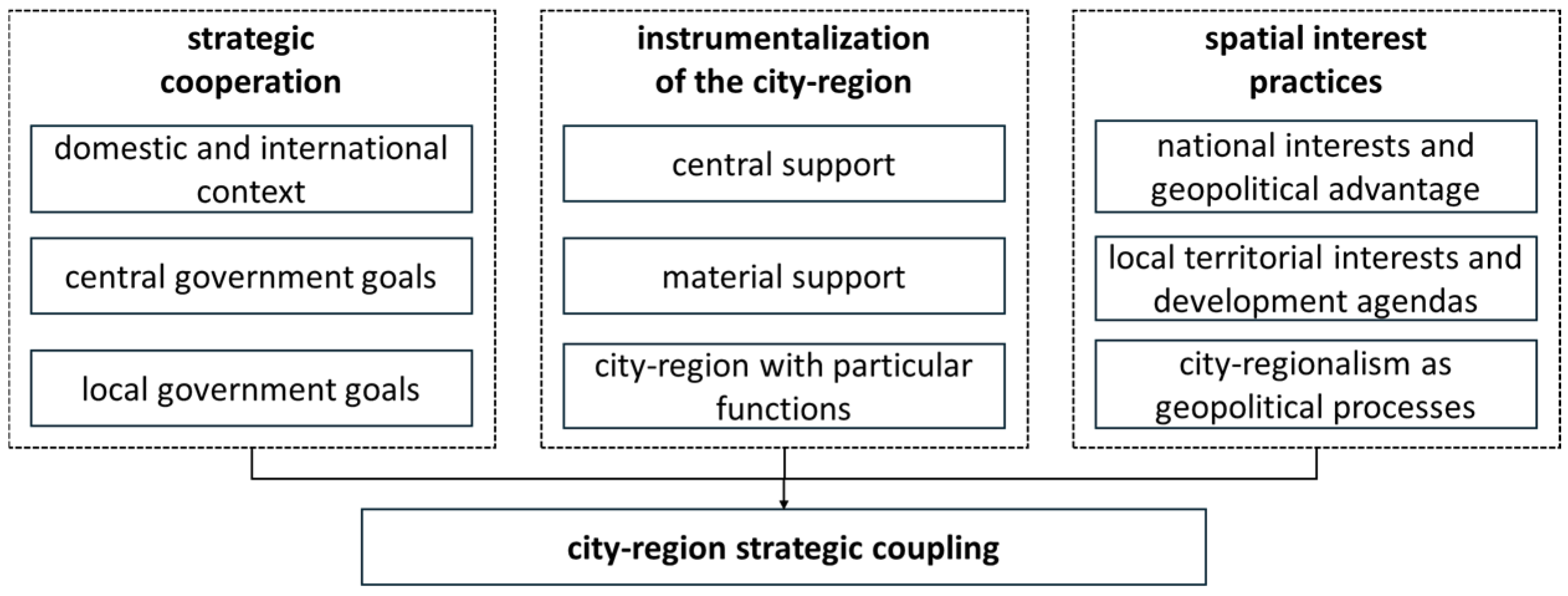
2.2. Analytical Framework
3. Methodology
3.1. Methods and Data
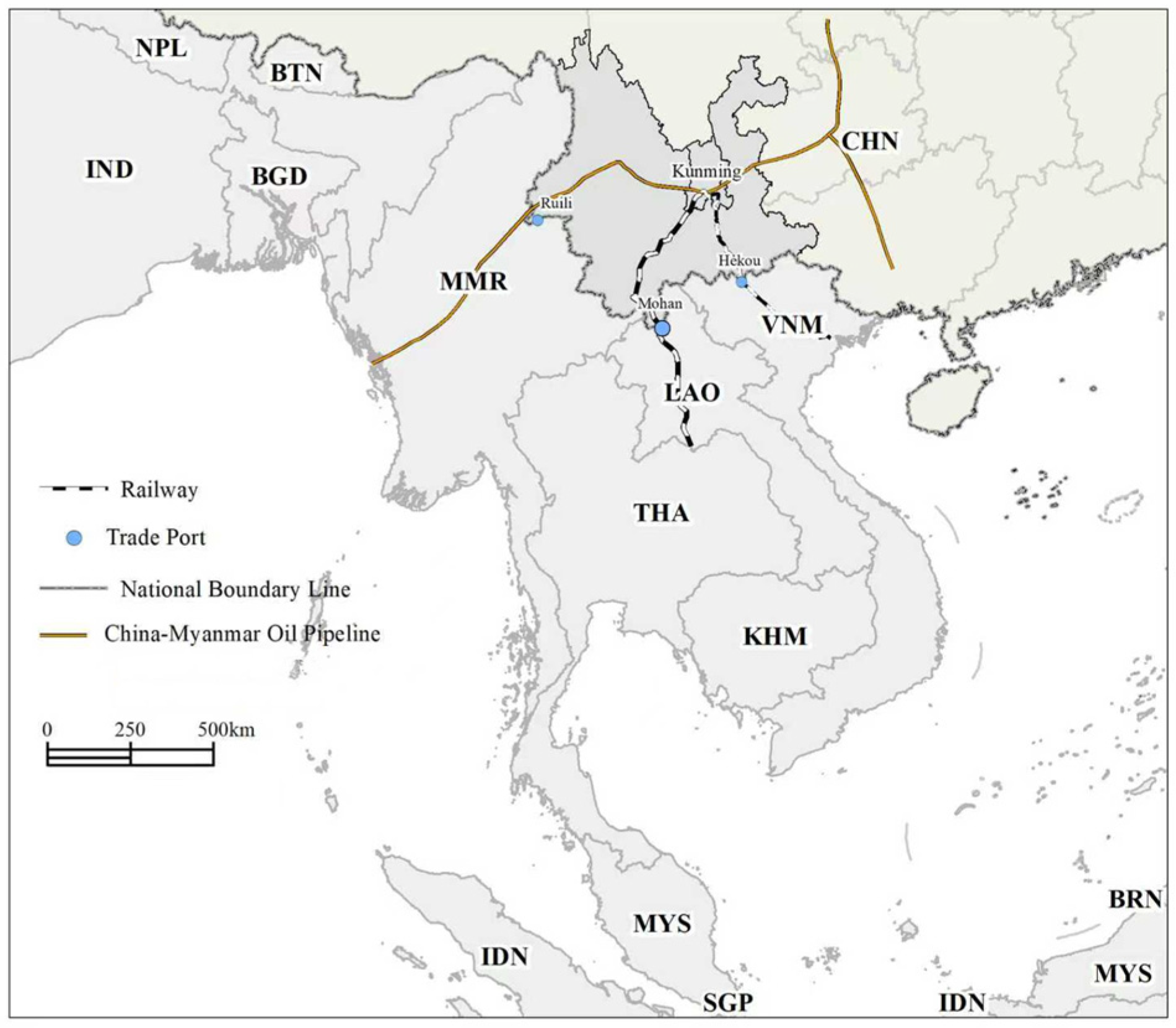
3.2. Study Area
4. City-Region Strategic Coupling of Kunming: Central–Local State Negotiation and Cooperation
5. The Kunming City-Region as a Geopolitical Instrument of Opening-Up
5.1. Material Support for Connectivity Infrastructure
“Although the conditions for interconnectivity in Myanmar remain immature, infrastructure, industrial parks, and other facilities in China’s domestic border regions have been built to a high standard. This kind of strategic investment takes into account Myanmar’s significance in great-power rivalry”(foreign affairs official, 2025).
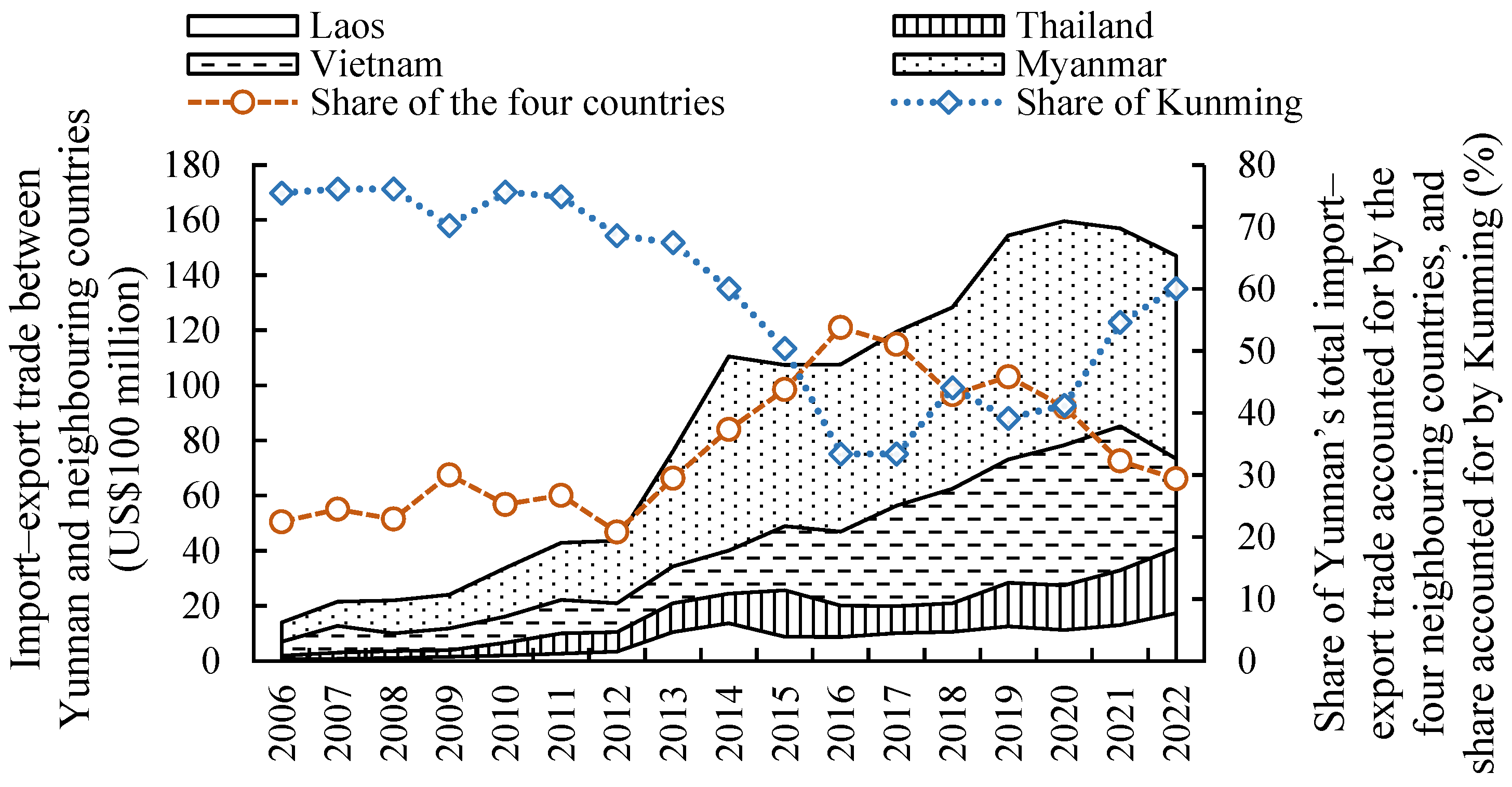
5.2. The External Flow Role of the Kunming City-Region
6. Spatial Interest Practices of Central and Local Governments
6.1. China’s Geopolitical Gains
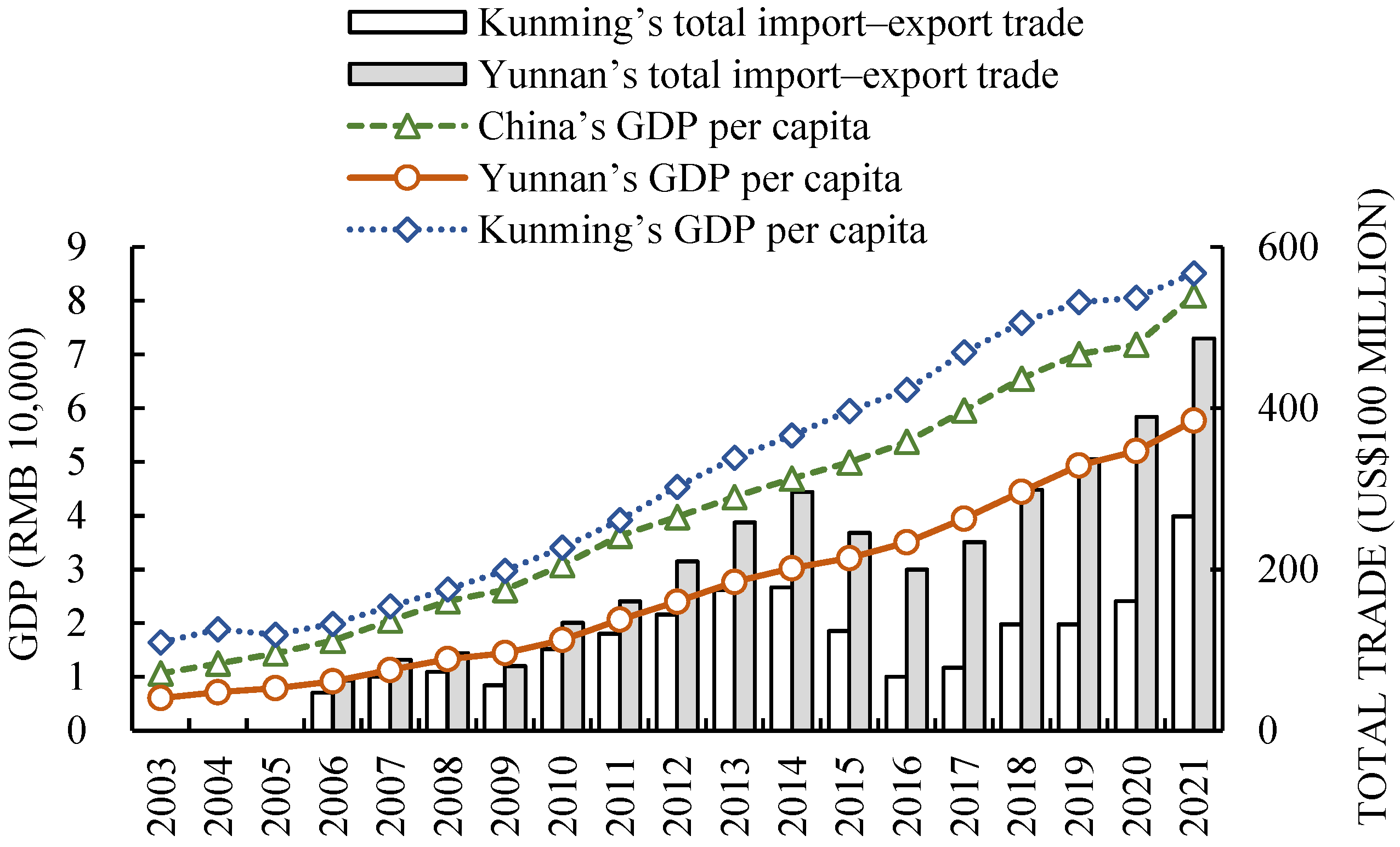
6.2. Yunnan’s Realization of Local Development Goals
7. Conclusions
Author Contributions
Funding
Data Availability Statement
Conflicts of Interest
Appendix A

| Interview Date | Type of Interviewee | Interview Format | Main Perspectives |
|---|---|---|---|
| July 2022 | Government official of Lincang Border Economic Cooperation Zone, Yunnan | Group meeting | The construction of the China–Myanmar international corridor has significant strategic value. Goods shipped to China from the Indian Ocean direction can bypass the Strait of Malacca. This route can save more than 20 days in transportation time. |
| July 2022 | A resident in Ruili, Yunnan | Semi-structured interview | In the past, border residents could easily cross the border illegally through mountains or rivers. Yunnan built a border wall during the COVID-19 pandemic. This wall essentially stopped illegal cross-border flows. |
| December 2023 | Government official of Jinghong Industrial Park, Yunnan | Group meeting | Jinghong is the main hinterland city for the Mohan port. The industrial park has developed rapidly with the support of the China–Laos Railway and policies from various levels of government in China. |
| December 2023 | Government official of Mohan–Boten Economic Cooperation Zone, Yunnan | Group meeting | The development of Mohan mainly comes from the strong support of the central governments of China and Laos, as well as the Kunming government. Mohan is one of the transportation hub centers between China and Southeast Asia. |
| September 2024 | Yunnan government official | Group meeting | The construction of Yunnan international corridors will form a new pattern for an international transportation system. This system links land and sea while enabling mutual assistance between the east and west. Yunnan is located at the central node of a transportation network that connects the Pacific Ocean and the Indian Ocean from east to west, as well as the Yangtze River Economic Belt in China and Southeast Asia. |
| October 2024 | A businessperson in Wanding, Yunnan | Semi-structured interview | The impact of Myanmar’s geopolitics is significant. Border residents of the two countries interacted frequently when the Myanmar government controlled the border. Now, ethnic minority armed forces occupy the Myanmar border, and the border is rarely open. |
| October 2024 | A postal staff member in Wanding, Yunnan | Semi-structured interview | Although Wanding is a border port, most of its commercial activities and young people have relocated to places like Ruili. |
| October 2024 | A Myanmar staff member at a coffee shop in Ruili, Yunnan | Unstructured interview | Due to the domestic war in Myanmar, she and her family struggled to maintain their livelihood. Therefore, she came to Ruili for work. |
| October 2024 | A transportation staff member in Ruili, Yunnan | Unstructured interview | Ruili was extremely bustling before the COVID-19 pandemic and was known as a sleepless city. However, almost everyone left during the pandemic. |
| October 2024 | A resident at the Houqiao port, Yunnan | Semi-structured interview | If the port can remain open long-term in the future and the economy develops, local residents will not have to go elsewhere for work. |
| October 2024 | A resident at the Houqiao port, Yunnan | Semi-structured interview | Engaging solely in local agricultural production cannot lead to wealth. They hope Kunming or border cities in Yunnan can develop better to provide more jobs. |
| October 2024 | An enterprise manager at the Diantan port, Yunnan | Semi-structured interview | Myanmar border residents cannot enter China through the Diantan port, but they can enter through Ruili. |
| October 2024 | An enterprise manager at the Diantan port, Yunnan | Semi-structured interview | Myanmar’s rare earth is an important strategic resource. It is not exported to countries like the United States. Instead, it is entirely exported to China. |
| November 2025 | An archaeological museum staff member in Yunnan | Unstructured interview | The historical Ancient Tea Horse Road in Yunnan was an important corridor for communication between Yunnan and the outside world. Kunming was already a crucial node in the eastern region of Yunnan at that time. |
| November 2025 | A staff member of the Lincang Urban Planning Exhibition Hall, Yunnan | Unstructured interview | Lincang City connects with Kunming and core cities in Myanmar, such as Mandalay and Yangon. It achieves this connection through cross-border economic cooperation zones and cross-border transportation infrastructure. |
| November 2025 | An official at the Qingshuihe port, Yunnan | Semi-structured interview | Although the various connectivity conditions in Myanmar are immature, the construction of infrastructure and industrial parks in China’s domestic border areas is quite complete. |
| November 2025 | An official of the Lincang Border Economic Cooperation Zone, Yunnan | Semi-structured interview | Nansan Park has created a three-tier commercial system consisting of mutual trade among border residents, professional markets, and cross-border e-commerce. |
| December 2025 | An official of the Ethnic and Religious Affairs Commission in Yunnan | Semi-structured interview | The construction of international corridors has driven border economic development. It has promoted the construction of border ethnic minority unity demonstration zones. It has also advanced border stability and grassroots governance. |
| December 2025 | An official of the Commerce Bureau in Yunnan | Semi-structured interview | The turbulent geopolitical situation in Myanmar is the primary risk to international corridor construction. |
| December 2025 | An official of the Foreign Affairs Office in Yunnan | Semi-structured interview | The construction of the China–Myanmar international corridor is a key node for China’s opening to the Indian Ocean. Some areas opposite the ports are controlled by ethnic minority armed forces in Myanmar. |
| December 2025 | An official of the Agriculture and Rural Affairs Bureau in Yunnan | Semi-structured interview | Roads have been built in all border villages to connect with international corridors. Through agricultural product trading, they have become the hinterland of major cities. |
| December 2025 | An official of the Culture and Tourism Bureau in Yunnan | Semi-structured interview | The construction of transportation infrastructure in Yunnan in recent years has greatly encouraged people from the Central Yunnan Urban Agglomeration and other provinces to travel to border areas for distinctive cultural tourism. |
References
- Rodríguez-Pose, A. The Rise of the “City-region” Concept and its Development Policy Implications. Eur. Plan. Stud. 2008, 16, 1025–1046. [Google Scholar] [CrossRef]
- Moisio, S.; Jonas, A.E. Economizing Imaginaries of City-Regionalism as Politics of City-Regionalization. In A Research Agenda for Regional and Local Government; Callanan, M., Loughlin, J., Eds.; Edward Elgar Publishing: Cheltenham, UK, 2021; pp. 79–95. [Google Scholar]
- Jonas, A.E.; Moisio, S. City Regionalism as Geopolitical Processes: A New Framework for Analysis. Prog. Hum. Geogr. 2018, 42, 350–370. [Google Scholar] [CrossRef]
- Moisio, S. Urbanizing the Nation-State? Notes on the Geopolitical Growth of Cities and City-Regions. Urban Geogr. 2018, 39, 1421–1424. [Google Scholar] [CrossRef]
- Zhang, M.; Xu, J. Central-Local State Strategic Coupling Towards Making Entrepreneurial Cities in China. Political Geogr. 2024, 109, 103062. [Google Scholar] [CrossRef]
- Li, Y.; Jonas, A.E. City-Regionalism as Countervailing Geopolitical Processes: The Evolution and Dynamics of Yangtze River Delta Region, China. Political Geogr. 2019, 73, 70–81. [Google Scholar] [CrossRef]
- Zhang, M.; Wen, T. The Rise of Chengdu between Geopolitics and Geo-Economics: City-Regional Development under the Belt and Road Initiative and Beyond. Trans. Inst. Br. Geogr. 2022, 47, 971–989. [Google Scholar] [CrossRef]
- Song, T.; Sun, M.; Liu, Z. Grounding Border City Regionalism in Contemporary China: Evidence from Ruili and Mengla in Yunnan Province. Territ. Politics Gov. 2024, 12, 1158–1176. [Google Scholar] [CrossRef]
- Wu, F.; Zhang, F.; Liu, Y. Beyond Growth Machine Politics: Understanding State Politics and National Political Mandates in China’s Urban Redevelopment. Antipode 2022, 54, 608–628. [Google Scholar] [CrossRef]
- Zhang, X.; Wen, T.; Luan, X. City Strategic Coupling in Practice: Regional Cooperation under the Greater Bay Area. Reg. Stud. 2026, 60, 2596735. [Google Scholar] [CrossRef]
- Ptak, T.; Laine, J.P.; Hu, Z.; Liu, Y.; Konrad, V.; van der Velde, M. Understanding Borders through Dynamic Processes: Capturing Relational Motion from South-West China’s Radiation Centre. Territ. Politics Gov. 2022, 10, 200–218. [Google Scholar] [CrossRef]
- Moisio, S.; Jonas, A.E. City-Regions and City-Regionalism. In Handbook on the Geographies of Regions and Territories; Paasi, A., Harrison, J., Jones, M., Eds.; Edward Elgar Publishing: Cheltenham, UK, 2018; pp. 285–297. [Google Scholar]
- Brenner, N. New State Spaces: Urban Governance and the Rescaling of Statehood; Oxford University Press: New York, NY, USA, 2004. [Google Scholar]
- Brenner, N. Open Questions on State Rescaling. Camb. J. Reg. Econ. Soc. 2009, 2, 123–139. [Google Scholar] [CrossRef]
- Deng, H.; Wu, F.; Zhang, F. Green Space Production as a State Project in Urban China. Trans. Inst. Br. Geogr. 2025, 51, e70054. [Google Scholar] [CrossRef]
- Wu, F. Planning Centrality, Market Instruments: Governing Chinese Urban Transformation under State Entrepreneurialism. Urban Stud. 2018, 55, 1383–1399. [Google Scholar] [CrossRef]
- Li, Y.; Wu, F. Understanding City-Regionalism in China: Regional Cooperation in the Yangtze River Delta. Reg. Stud. 2018, 52, 313–324. [Google Scholar] [CrossRef]
- Lin, G.C.S. State Policy and Spatial Restructuring in Post-Reform China, 1978–1995. Int. J. Urban Reg. Res. 1999, 23, 670–696. [Google Scholar] [CrossRef]
- Summers, T. The Belt and Road Initiative in Southwest China: Responses from Yunnan Province. Pac. Rev. 2021, 34, 206–229. [Google Scholar] [CrossRef]
- Wong, A. More Than Peripheral: How Provinces Influence China’s Foreign Policy. China Q. 2018, 235, 735–757. [Google Scholar] [CrossRef]
- Hameiri, S.; Jones, L.; Zou, Y. The Development-Insecurity Nexus in China’s Near-Abroad: Rethinking Cross-Border Economic Integration in an Era of State Transformation. J. Contemp. Asia 2019, 49, 473–499. [Google Scholar] [CrossRef]
- Li, M. China’s Economic Power in Asia: The Belt and Road Initiative and the Local Guangxi Government’s Role. Asian Perspect. 2019, 43, 273–295. [Google Scholar] [CrossRef]
- Li, Y.; Wu, F.; Hay, I. City-Region Integration Policies and Their Incongruous Outcomes: The Case of Shantou-Chaozhou-Jieyang City-Region in East Guangdong Province, China. Habitat Int. 2015, 46, 214–222. [Google Scholar] [CrossRef]
- Zhang, M.; Liu, Y. Global Financial Networks, Municipal Offshore Financing and State-Sponsored City-Regional Development. Reg. Stud. 2023, 57, 2119–2135. [Google Scholar] [CrossRef]
- Coe, N.M.; Hess, M.; Yeungt, H.W.C.; Dicken, P.; Henderson, J. ‘Globalizing’ Regional Development: A Global Production Networks Perspective. Trans. Inst. Br. Geogr. 2004, 29, 468–484. [Google Scholar] [CrossRef]
- Wang, W.; Wu, F.; Zhang, F. Assembling State Power Through Rescaling: Inter-Jurisdictional Development in the Beijing-Tianjin Zhongguancun Tech Town. Political Geogr. 2024, 112, 103131. [Google Scholar] [CrossRef]
- Yang, W.; Wei, Q. Soft Space Development against Territorial-Bounded Governance Logics: The Case of Shenzhen-Shanwei Cooperation Zone. Environ. Plan. A Econ. Space 2025, 57, 969–984. [Google Scholar] [CrossRef]
- Chung, C.K.L.; Xu, J. Scalar Politics of Urban Sustainability: Governing the Chinese City in the Era of Ecological Civilisation. Trans. Inst. Br. Geogr. 2021, 46, 689–703. [Google Scholar] [CrossRef]
- Wu, F.; Deng, H.; Feng, Y.; Wang, W.; Wang, Y.; Zhang, F. Statecraft at the Frontier of Capitalism: A Grounded View from China. Prog. Hum. Geogr. 2024, 48, 779–804. [Google Scholar] [CrossRef]
- Summers, T. Yunnan-A Chinese Bridgehead to Asia: A Case Study of China’s Political and Economic Relations with Its Neighbours; Chandos: Oxford, UK, 2013. [Google Scholar]
- Summers, T. China’s ‘New Silk Roads’: Sub-National Regions and Networks of Global Political Economy. Third World Q. 2016, 37, 1628–1643. [Google Scholar] [CrossRef]
- Su, X. From Frontier to Bridgehead: Cross-Border Regions and the Experience of Yunnan, China. Int. J. Urban Reg. Res. 2013, 37, 1213–1232. [Google Scholar] [CrossRef]
- Su, X. Transnational Regionalization and the Rescaling of the Chinese State. Environ. Plan. A Econ. Space 2012, 44, 1327–1347. [Google Scholar] [CrossRef]
- Su, X. Repositioning Yunnan: Security and China’s Geoeconomic Engagement with Myanmar. Area Dev. Policy 2016, 1, 178–194. [Google Scholar] [CrossRef]
- Su, X.; Lim, K.F. Capital Accumulation, Territoriality, and the Reproduction of State Sovereignty in China: Is this “New” State Capitalism? Environ. Plan. A Econ. Space 2023, 55, 697–715. [Google Scholar] [CrossRef]
- Ptak, T.; Konrad, V. “Crossing the River by Feeling the Stones”: How Borders, Energy Development and Ongoing Experimentation Shape the Dynamic Transformation of Yunnan Province. J. Borderl. Stud. 2021, 36, 765–789. [Google Scholar] [CrossRef]
- Wirth, C. Solidifying Sovereign Power in Liquid Space: The Making and Breaking of ‘Island Chains’ and ‘Walls’ at Sea. Political Geogr. 2023, 103, 102889. [Google Scholar] [CrossRef]
- Kuik, C.-C. Laos’s Enthusiastic Embrace of China’s Belt and Road Initiative. Asian Perspect. 2021, 45, 735–759. [Google Scholar] [CrossRef]
- Lauridsen, L.S. Drivers of China’s Regional Infrastructure Diplomacy: The Case of the Sino-Thai Railway Project. J. Contemp. Asia 2020, 50, 380–406. [Google Scholar] [CrossRef]
- Harvey, D. The Geopolitics of Capitalism. In Social Relations and Spatial Structures; Gregory, D., Urry, J., Eds.; Palgrave: London, UK, 1985; pp. 128–163. [Google Scholar]
- Jonas, A.E. The New Urban Managerialism in Geopolitical Context. Dialogues Hum. Geogr. 2020, 10, 330–335. [Google Scholar] [CrossRef]
- McWilson, W.K.; Sun, Y. City Regionalism in the Global South: Evidence from Sub-Saharan Africa. Ann. Assoc. Am. Geogr. 2025, 115, 1–18. [Google Scholar] [CrossRef]
- Li, Y. Four Phases of City-Regionalism in China: The State, Geopolitics and Business of Mega City-Region Development. Area Dev. Policy 2025, 10, 432–451. [Google Scholar] [CrossRef]



| Data Source | Collection Period | Number of Documents/Interviews |
|---|---|---|
| Five-year plans for the National Economic and Social Development issued by multi-level governments (national, provincial, municipal, county) related to Kunming | 2025 | 9 |
| Documents and reports on Kunming urban planning | 2025 | 10 |
| Official news or newspaper platforms of governments in Yunnan | 2025 | 45 |
| Statistical yearbooks of China, Yunnan, and ports of entry | 2025 | 55 |
| Interviews with Yunnan government officials | July 2022; December 2023; October 2024; November 2025 | 16 |
| Interviews with Yunnan residents and businesspeople | July 2022; December 2023; October 2024 | 47 |
Disclaimer/Publisher’s Note: The statements, opinions and data contained in all publications are solely those of the individual author(s) and contributor(s) and not of MDPI and/or the editor(s). MDPI and/or the editor(s) disclaim responsibility for any injury to people or property resulting from any ideas, methods, instructions or products referred to in the content. |
© 2026 by the authors. Licensee MDPI, Basel, Switzerland. This article is an open access article distributed under the terms and conditions of the Creative Commons Attribution (CC BY) license.
Share and Cite
Yang, Q.; Hu, Z.; Zhang, Z.; Li, Y. City-Region Strategic Coupling in China: Central–Local State Interactions and the Geopolitical Processes of Kunming. Land 2026, 15, 933. https://doi.org/10.3390/land15060933
Yang Q, Hu Z, Zhang Z, Li Y. City-Region Strategic Coupling in China: Central–Local State Interactions and the Geopolitical Processes of Kunming. Land. 2026; 15(6):933. https://doi.org/10.3390/land15060933
Chicago/Turabian StyleYang, Qike, Zhiding Hu, Zhe Zhang, and Yingxin Li. 2026. "City-Region Strategic Coupling in China: Central–Local State Interactions and the Geopolitical Processes of Kunming" Land 15, no. 6: 933. https://doi.org/10.3390/land15060933
APA StyleYang, Q., Hu, Z., Zhang, Z., & Li, Y. (2026). City-Region Strategic Coupling in China: Central–Local State Interactions and the Geopolitical Processes of Kunming. Land, 15(6), 933. https://doi.org/10.3390/land15060933