


Removal of Metformin from Wastewater: A Review on Physical, Chemical and Biological Processes

 , ,
, ,  ,
,  ,
,  and
and 
Abstract
1. Introduction
2. Properties and Effects of Metformin in the Environment
3. Technologies for Metformin Removal
3.1. Physical–Chemical Processes
- Adsorption
- Coagulant/Flocculation
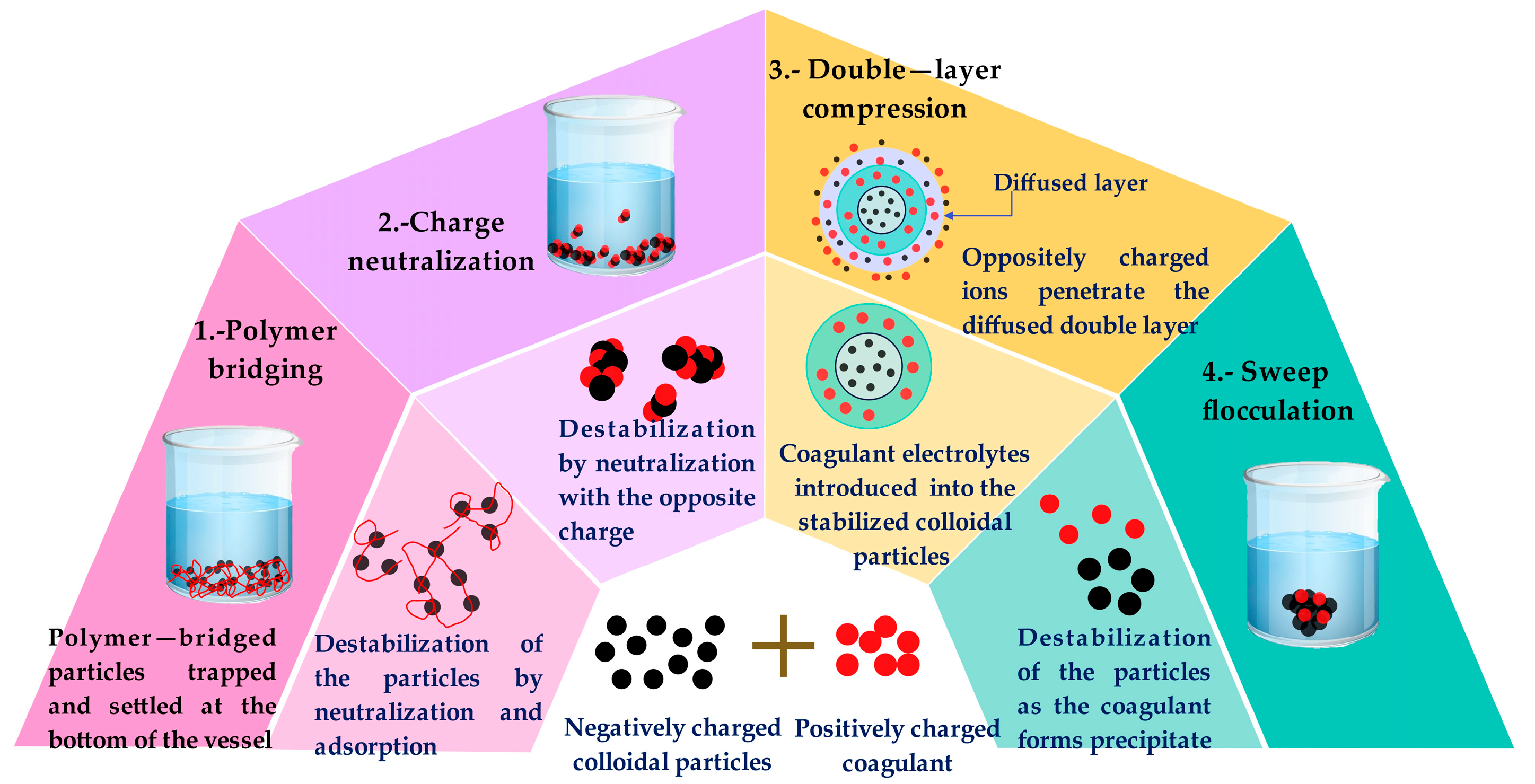
- Metformin is a low-molecular-weight pharmaceutical compound and is highly water-soluble due to its octanol–water partition coefficient (log Kow = −2.64) [20]. This physicochemical property promotes its preferential distribution in the aqueous phase rather than adsorption onto the solid flocs formed during coagulation. Consequently, metformin exhibits negligible affinity toward solid or hydrophobic phases. Furthermore, commonly used metal-based coagulants, such as Al2(SO4)3 and FeCl3, are highly effective for removing hydrophobic organic matter from contaminated effluents. However, given the hydrophilic nature of metformin, these coagulants are ineffective at destabilizing metformin molecules, primarily due to the strong hydration shell surrounding the compound.
- In addition, metformin exists predominantly in its protonated form at neutral pH, indicating that it carries a positive charge (cationic species) [36]. This results in electrostatic repulsion forces [37] when metal coagulants with similarly positive charge characteristics are applied. As a result, metformin molecules are not effectively incorporated into the forming flocs. This limitation is further exacerbated by its low molecular weight, which hinders its removal via conventional coagulation–flocculation mechanisms.
- Chlorination
3.2. Biological Processes
3.2.1. Sequential Treatment Processes
3.2.2. Biological Treatment
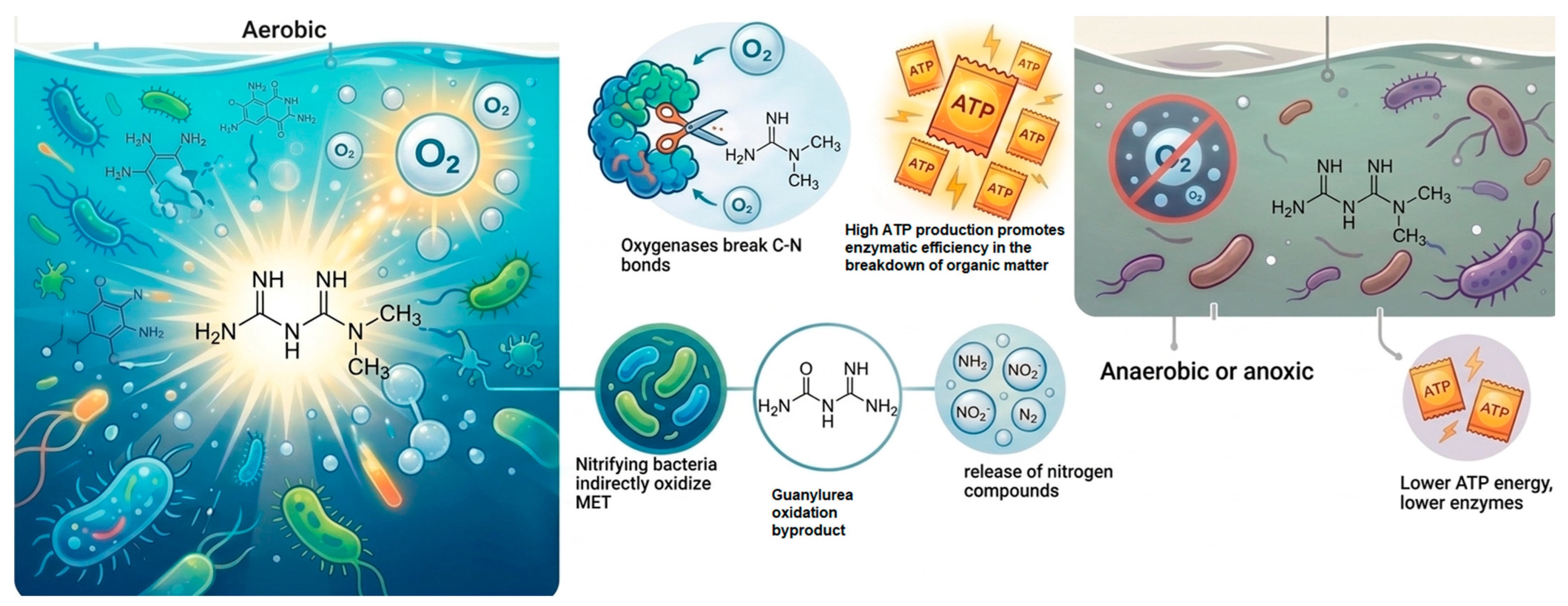
- Activated sludge process
- Biological filtration
- Phytoremediation
3.3. Advanced Technologies
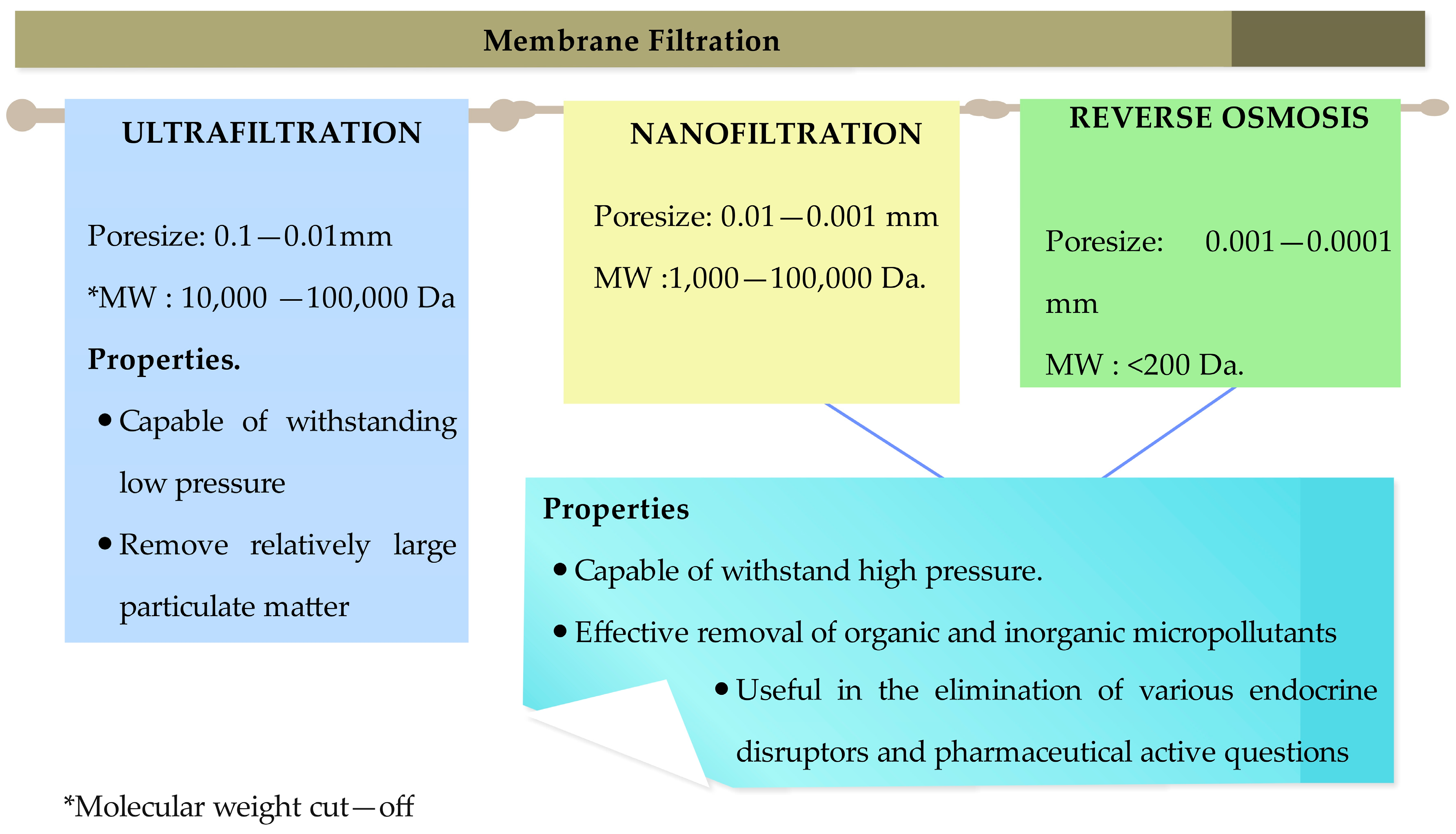
3.3.1. Membrane Filtration
3.3.2. Advanced Oxidation Processes (AOPs)
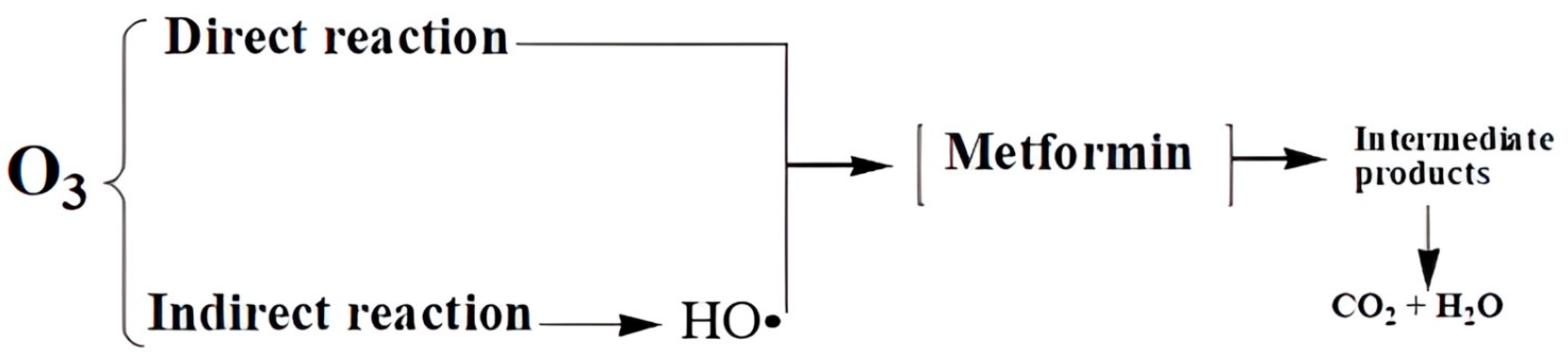
- Ozonation
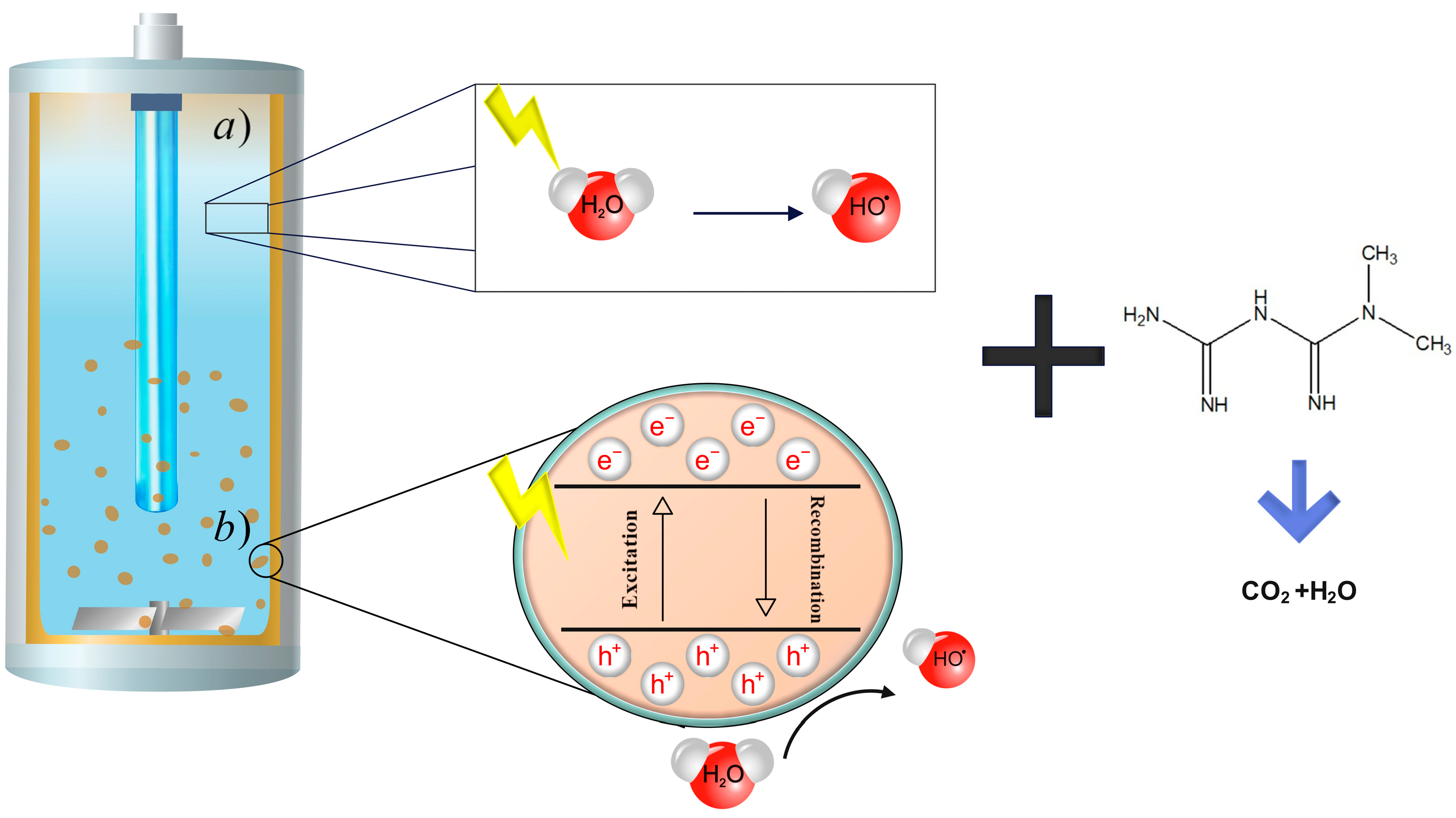
- UV photolysis and photochemical oxidation processes
- Photocatalytic process
- Fenton, Fenton-like and Photo-Fenton

| Type of Treatment | Conditions | Results % Removal | Reference |
|---|---|---|---|
| Nanofiltration | [MET]initial: 20 mg⋅L−1 Membrane: AFC 30 and AFC 80 15–30 bar | 87 (AFC 30) 98 (AFC 80) | [54] |
| [MET]initial: 10 mg∙L−1 Polyamide NF Membrane (NF 99) 10 bar | 70 | [53] | |
| [MET]initial: 200 µg∙L−1 Membrane: dual-charged dense COF membrane 5 bar 24 h | 92.6 | [84] | |
| Ultrafiltration | [MET]initial: - Membrane: bifunctional ceramics based on kaolin and coffee waste COD: 320 mg∙L−1 pH: 6.7 1 bar | 91 | [84] |
| Reverse osmosis | [MET]initial: 0.002815 µg∙L−1 spiral wound reverse osmosis membrane Flow: 7.08 m3∙h−1 active surface area: 37.2 m2 | 92.6 | [57] |
| [MET]initial: 100 µg∙L−1 Membranes RE2012–100 and RE2012-PF pH: 7 10 bar | 99 | [55] | |
| Ozonation | TOC 50 mg∙L−1 Ozone dose of 10 mg∙L−1 Time: 0.75 h | 65 | [68] |
| [MET]initial: 1 µg∙L−1 pH: 7.3 TOC: 0.9 mg∙L−1 Ozone dose of 1 mg∙L−1 Time: 1 h | 70 | [35] | |
| [MET]initial: 0.94 µg∙L−1 pH: 8.5 Ozone dose of 5 mg∙L−1 | ~100 | [66] | |
| Photolysis | [MET]initial: 10 mg∙L−1 Radiation: UV pH: 5.4 Time: 1 h Temperature: 25 °C Volume: 500 mL | ~30 | [72] |
| [MET]initial: 0.5 mg∙L−1 Lamp (125 W, 365 nm) Volume: 100 mL Cylindrical quartz reactor: (φ14 cm × 13 cm) Temperature: 25 °C Time: 5 h | 64.7 (ultrapure water) 96.1 (Secondary effluent) | [70] | |
| [MET]initial: 13,000 ng∙L−1 Lamp: UV radiation (254 nm) Volume: 100 mL Time: 0.5 h pH: 6.2 Temperature: 25 °C Time: 1.5 h | 45 | [11] | |
| [MET]initial: 10 mg∙L−1 Radiation: UV-C Time: 0.5 h | 9.2 | [75] | |
| photochemical oxidation processes | [MET]initial: 1 mg∙L−1 UV oxidizing agent: Hydrogen peroxide (HP) 6 mM, sodium percarbonate (SP) 6 mM, and peracetic acid (PA) pHUV/HP: 3 pHUV/SP: 5 pHUV/PA: 9 Time: 1.25 h | 40.7 (UV/HP) 74.1 (UV/SP) 47.9 (UV/PA) | [85] |
| [MET]initial: 5 mg∙L−1 UV radiation Time: 1 h pH 6.5 Temperature: 45 °C K2S2O8: 2750 μM | 87.3 | [62] | |
| [MET]initial: 13,000 ng∙L−1 Lamp: UV radiation (254 nm) Volume: 100 mL Material: 0.5 g∙L−1 iron pillared clay pH: 6.2 Temperature: 25 °C Time: 1.5 h H2O2: 11.2 mg·L−1 | ~100 | [11] | |
| [MET]initial: 20 mg∙L−1 UV oxidizing agent: Hydrogen peroxide (HP) 1.5 mM, sodium percarbonate (SP) 1.5 mM pHUV/HP: 6.2 pHUV/SP: 6.2 Time: 1 h | 20 (UV/HP) 30% (UV/SP) | [73] | |
| Photocatalysis | [MET]initial: 100 mg∙L−1 Lamp: UV radiation (365 nm) Volume: 100 mL TiO2: 1000 mg∙L−1 Time: 0.5 h | 81 | [86] |
| [MET]initial: 13,000 ng∙L−1 Lamp: UV radiation (254 nm) Volume: 100 mL Material: 0.5 g∙L−1 iron pillared clay Time: 0.5 h pH: 6.2 Temperature: 25 °C Time: 0.5 h | 98 | [11] | |
| [MET]initial: 1 mg∙L−1 Light wavelengths (UVA, UVB, UVC, and visible light) Poly(3,4- ethylenedioxythiophene) (PEDOT) polymer: 0.5 g∙L−1 Stirred: 250 rpm Time: 1 h pH: 5.6 | >99 | [3] | |
| [MET]initial: 9.7 mg∙L−1 Catalyst: TiO2 nanoparticle prepared through green synthesis using Calotropis gigantea (CG) leaf extract pH 9.7 A 300 W tungsten halogen lamp The irradiation of the lamp was 41.4 kilolux (0.006 W∙cm−2) Catalyst (CG-TiO2) dosage: 0.7 g∙L−1 Volume: 100 mL Time: 4 h | 96.7 | [87] | |
| [MET]initial: 5mg∙L−1 Catalyst: TiO2 Degussa P25 (80% anatase, 20% rutile) Catalyst concentration: 0.1 g∙L−1 Reaction time: 240 min Q: 254.80 mL∙min−1, pH free Volume: 500 mL Sunlight irradiation inclination angle: 36.8° | 83 | [88] | |
| [MET]initial: 10 mg∙L−1 Material: 120 mg∙L−1 TiO2 Radiation: UV-C Time: 0.5 h | 31 | [4] | |
| [MET]initial: 5mg L−1 Material: 5000 µM de K2S2O8 Temperature: 30 °C pH: 6.5 | 84.2 | [62] | |
| Fenton’s process | [MET]initial: 1027 ng∙L−1 Time: 0.5 h Volume: 400 mL Cylindrical water-jacketed glass reactor Mercury lamp at 254 nm Temperature at 17 °C ± 1 °C 5 mg∙L−1 of Fe2+ (ferrous sulfate), H2O2 (10, 25 or 50 mg∙L−1) photo-Fenton, UV/H2O2 (without Fe2+) and dark Fenton | 43 (Fenton process) 88 (photo-Fenton) | [89] |
| [MET]initial: 320 mg∙L−1 Volume: 1.5 L Two 36 W UV lamps (PL-L 36W/841/4P, radiation peak at 365 nm. Photoreactor: quartz tube (diameter of 2.5 cm, 100 cm in length) Catalysts: TiO2 pH 5.5 H2O2: 250 mg∙L−1 Fe3+ concentration: 30 mg∙L−1 Reaction time: 2 h | 97 (photocatalytic) 66 (photo-Fenton) 41 (photo-ferrioxalate) | [81] | |
| [MET]initial: 13,000 ng∙L−1 Lamp: UV radiation (254 nm) 0.05 g∙L−1 iron pillared clay Volume: 100 mL Reaction time: 0.5 h H2O2: 11.2 mg∙L−1 pH: 6.2 Temperature: 25 °C Time: 0.17 h | ~100 (photo-Fenton) | [11] | |
| [MET]initial: 0.02 mg∙L−1 Lamp: UV radiation (254 nm) 0.05 g∙L−1 iron pillared clay Volume: 100 mL Reaction time: 0.5 h H2O2: 7.3 × 10⁻² μL∙L−1 pH: 6.2 Temperature: 25 °C Time: 0.17 h | ~100 (photo-Fenton) | [90] | |
| Electro-Fenton process | [MET]initial: 230.8 ng∙L−1 Time: 10 min Current density: 6 mA cm−2 H2O2: 250 mL∙L−1 Clay smectite (SME): 60 mg∙L−1 pH: 7 ± 0.3 Volume: 2 L | 21 | [40] |
| [MET]initial: 33.12 mg∙L−1 Supporting electrolyte: 16 g∙L−1 Volume: 500 mL Boron-doped diamond (BDD) anode and carbon as a cathode. FeSO4: 22.8 mg Fe2+ concentration: 0.3 mM Time: 27 min pH: 3 Current: 300 mA H2O2: 600 mg∙L−1 | 99.6 | [91] | |
| Other hybrid methods | VUV/Fe/PMS process [MET]initial: 5 mg∙L−1 | ~100 | [92] |
| Electro-activation of persulfate and H2O2 | 89.3 | [93] | |
| Aerated biofilter packed with Ficus benjamina wood chips | 94 | [47] | |
| A pilot aerated sub-surface flow constructed wetland treating municipal and hospital wastewater | 99 (with aeration) 68 (without aeration) | [94] | |
| Biocatalyzed microbial electrosynthesis system | [MET]initial: 0.5 mg∙L−1 Cathodic potential: −800 mV Time: 2 h Anaerobic conditions Temperature: 35 °C | 90 | [95] |
| Electrocatalytic oxidation | [MET]initial: 10 mg∙L−1 Material: 10 mg two-dimensional transition metal carbide nanosheets interspersed with sodium ions Time: 24 h pH: 4–9 | 99–95% | [96] |
4. Future Perspective
5. Conclusions
Author Contributions
Funding
Data Availability Statement
Acknowledgments
Conflicts of Interest
Abbreviations
| MET | Metformin |
| Log Koc | Soil–organic carbon partition coefficient |
| Log Kow | Octanol–water partition coefficient |
| pKa | ionization constant |
| pH | hydrogen potential |
| UF | ultrafiltration |
| RO | reverse osmosis |
| NF | nanofiltration |
| GO | graphene oxide |
| qe | concentration of compound |
| Ce | compound concentration at equilibrium |
| KL | constant related to the adsorption equilibrium |
| KF | equilibrium constant of the Freundlich isotherm |
| a | constant of the isotherm of Prausnitz–Radke |
| b | constant of the isotherm of Prausnitz–Radke |
| β | constant of the isotherm of Prausnitz–Radke |
| qm | maximum mass of adsorbed solute on the adsorbent |
| n | constant related to the adsorption intensity |
| DBPs | chlorinated disinfection by-products |
| THMs | trihalomethanes |
| TTHMs | total trihalomethanes |
| TPs | transformation products |
| Y | (3E)-3-(chloroimino)-N,Ndimethyl-3H-1,2,4-triazole-5-amine |
| C | N-cyano-N,N-dimethylcarbaminmidic chloride |
| DMA | dimethylamine |
| MN | monochloro-metformin |
| DM | dichloro-metformin |
| DMG | dimethylguanidine |
| NDMA | nitrosodimethylamine |
| ND | no data |
| T | Transformed |
| O | Original |
| MG | methylbiguanid |
| GU | guanylurea |
| GUE | guanidine |
| AMT | 2-amino-4-methylamino-1,3,5-triazine |
| DT | 2,4-diamine-1,3,5-triazine |
| COD | chemical oxygen demand |
| AOP | Advanced Oxidation Process |
| ROS | reactive oxygen species |
| OPs | ozonation products |
| POP | photochemical oxidation process |
| BV | valence band |
| BC | conduction band |
References
- He, Y.; Zhang, Y.; Ju, F. Metformin Contamination in Global Waters: Biotic and Abiotic Transformation, Byproduct Generation and Toxicity, and Evaluation as a Pharmaceutical Indicator. Environ. Sci. Technol. 2022, 56, 13528–13545. [Google Scholar] [CrossRef]
- Zhang, R.; He, Y.; Yao, L.; Chen, J.; Zhu, S.; Rao, X.; Tang, P.; You, J.; Hua, G.; Zhang, L.; et al. Metformin chlorination byproducts in drinking water exhibit marked toxicities of a potential health concern. Environ. Int. 2021, 146, 106244. [Google Scholar] [CrossRef]
- Kumar, R.; Akbarinejad, A.; Jasemizad, T.; Fucina, R.; Travas-Sejdic, J.; Padhye, L.P. The removal of metformin and other selected PPCPs from water by poly(3,4-ethylenedioxythiophene) photocatalyst. Sci. Total Environ. 2021, 751, 142302. [Google Scholar] [CrossRef]
- Elizalde-Velázquez, G.A.; Gómez-Oliván, L.M. Occurrence, toxic effects and removal of metformin in the aquatic environments in the world: Recent trends and perspectives. Sci. Total Environ. 2020, 702, 134924. [Google Scholar] [CrossRef]
- Wu, L.; Wang, L.; Huang, C.; Gu, C.; Tan, W.; Tian, Y.; Ma, J. Advances in the detection of emerging contaminant metformin: A critical review. Microchem. J. 2024, 200, 110422. [Google Scholar] [CrossRef]
- Balakrishnan, A.; Sillanpää, M.; Jacob, M.M.; Vo, D.-V.N. Metformin as an emerging concern in wastewater: Occurrence, analysis and treatment methods. Environ. Res. 2022, 213, 113613. [Google Scholar] [CrossRef] [PubMed]
- Global Metformin Market—Industry Trends and Forecast to 2030. Available online: https://www.databridgemarketresearch.com/reports/global-metformin-market (accessed on 24 July 2024).
- Wilkinson, J.L.; Boxall, A.B.A.; Kolpin, D.W.; Leung, K.M.Y.; Lai, R.W.S.; Galbán-Malagón, C.; Adell, A.D.; Mondon, J.; Metian, M.; Marchant, R.A.; et al. Pharmaceutical pollution of the world’s rivers. Proc. Natl. Acad. Sci. USA 2022, 119, e2113947119. [Google Scholar] [CrossRef]
- Barros, S.; Alves, N.; Pinheiro, M.; Ribeiro, M.; Morais, H.; Montes, R.; Rodil, R.; Quintana, J.B.; Coimbra, A.M.; Santos, M.M.; et al. Are Fish Populations at Risk? Metformin Disrupts Zebrafish Development and Reproductive Processes at Chronic Environmentally Relevant Concentrations. Environ. Sci. Technol. 2023, 57, 1049–1059. [Google Scholar] [CrossRef] [PubMed]
- Ussery, E.J.; Nielsen, K.M.; Simmons, D.; Pandelides, Z.; Mansfield, C.; Holdway, D. An ‘omics approach to investigate the growth effects of environmentally relevant concentrations of guanylurea exposure on Japanese medaka (Oryzias latipes). Aquat. Toxicol. 2021, 232, 105761. [Google Scholar] [CrossRef]
- Amado-Piña, D.; Romero, R.; Ramírez-Serrano, A.; Martínez-Vargas, S.L.; Torres-Blancas, T.; Natividad, R. Metformin Mineralization via an Fe-PILC-Catalyzed Photo-Fenton Reaction Driven by UV and Visible Light. Water 2025, 17, 3028. [Google Scholar] [CrossRef]
- Lertxundi, U.; Domingo-Echaburu, S.; Barros, S.; Santos, M.M.; Neuparth, T.; Quintana, J.B.; Rodil, R.; Montes, R.; Orive, G. Is the Environmental Risk of Metformin Underestimated? Environ. Sci. Technol. 2023, 57, 8463–8466. [Google Scholar] [CrossRef] [PubMed]
- da Trindade, M.T.; Kogawa, A.C.; Salgado, H.R.N. Metformin: A Review of Characteristics, Properties, Analytical Methods and Impact in the Green Chemistry. Crit. Rev. Anal. Chem. 2018, 48, 66–72. [Google Scholar] [CrossRef]
- Information NC for Biotechnology. Metformin 2025. Available online: https://pubchem.ncbi.nlm.nih.gov/compound/Metformin (accessed on 24 June 2025).
- Sousa, M.; Rodrigues, S.; Pretti, C.; Meucci, V.; Battaglia, F.; Freitas, R.; Antunes, S.C. A forecast effects of climate change and anthropogenic compounds in Gambusia holbrooki: Ecotoxicological effects of salinity and metformin. Aquat. Toxicol. 2023, 258, 106494. [Google Scholar] [CrossRef]
- Nielsen, K.M.; DeCamp, L.; Birgisson, M.; Palace, V.P.; Kidd, K.A.; Parrott, J.L.; McMaster, M.E.; Alaee, M.; Blandford, N.; Ussery, E.J. Comparative Effects of Embryonic Metformin Exposure on Wild and Laboratory-Spawned Fathead Minnow (Pimephales promelas) Populations. Environ. Sci. Technol. 2022, 56, 10193–10203. [Google Scholar] [CrossRef]
- Parrott, J.L.; Restivo, V.E.; Kidd, K.A.; Zhu, J.; Shires, K.; Clarence, S.; Khan, H.; Sullivan, C.; Pacepavicius, G.; Alaee, M. Chronic Embryo-Larval Exposure of Fathead Minnows to the Pharmaceutical Drug Metformin: Survival, Growth, and Microbiome Responses. Environ. Toxicol. Chem. 2022, 41, 635–647. [Google Scholar] [CrossRef]
- Elizalde-Velázquez, G.A.; Herrera-Vázquez, S.E.; Gómez-Oliván, L.M.; García-Medina, S. Health impact assessment after Danio rerio long-term exposure to environmentally relevant concentrations of metformin and guanylurea. Chemosphere 2023, 341, 140070. [Google Scholar] [CrossRef]
- Sibiya, A.; Al-Ghanim, K.A.; Govindarajan, M.; Nicoletti, M.; Sachivkina, N.; Vaseeharan, B. Biochemical Patterns and Genotoxicity of the Endocrine Disruptor Metformin in the Freshwater Fish Labeo rohita. Fishes 2023, 8, 380. [Google Scholar] [CrossRef]
- Zheng, Y.; Shao, Y.; Zhang, Y.; Liu, Z.; Zhao, Z.; Xu, R.; Ding, J.; Li, W.; Wang, B.; Zhang, H. Metformin as an Emerging Pollutant in the Aquatic Environment: Occurrence, Analysis, and Toxicity. Toxics 2024, 12, 483. [Google Scholar] [CrossRef] [PubMed]
- Giannouli, M.; Panagiotidis, K.; Rochfort, K.D.; Grintzalis, K. Development and application of a sensitive feeding assay for daphnids based on the ingestion of fluorescent microparticles. Environ. Sci. Adv. 2023, 2, 1351–1359. [Google Scholar] [CrossRef]
- Tominaga, F.K.; Boiani, N.F.; Silva, T.T.; Garcia, V.S.G.; Borrely, S.I. Acute and chronic ecotoxicological effects of pharmaceuticals and their mixtures in Daphnia similis. Chemosphere 2022, 309, 136671. [Google Scholar] [CrossRef] [PubMed]
- Bernardini, I.; Mezzelani, M.; Panni, M.; Dalla Rovere, G.; Nardi, A.; El Idrissi, O.; Peruzza, L.; Gorbi, S.; Ferraresso, S.; Bargelloni, L.; et al. Transcriptional modulation in Mediterranean Mussel Mytilus galloprovincialis following exposure to four pharmaceuticals widely distributed in coastal areas. Aquat. Toxicol. 2025, 279, 107255. [Google Scholar] [CrossRef]
- Ferri, B.B.; Wernke, G.; Resende, J.F.; Ribeiro, A.C.; Cusioli, L.F.; Bergamasco, R.; Vieira, M.F. Natural zeolite as adsorbent for metformin removal from aqueous solutions: Adsorption and regeneration properties. Desalination Water Treat. 2024, 320, 100602. [Google Scholar] [CrossRef]
- Aguilar-Maruri, S.A.; Perera-Triana, D.; Flórez, E.; Forgionny, A.; Palestino, G.; Gómez-Durán, C.F.A.; Ocampo-Pérez, R. Highly Adsorptive Organic Xerogels for Efficient Removal of Metformin from Aqueous Solutions: Experimental and Theoretical Approach. Processes 2024, 12, 1431. [Google Scholar] [CrossRef]
- Raji, Z.; Karim, A.; Karam, A.; Khalloufi, S. Adsorption of Heavy Metals: Mechanisms, Kinetics, and Applications of Various Adsorbents in Wastewater Remediation—A Review. Waste 2023, 1, 775–805. [Google Scholar] [CrossRef]
- Sanchez-Silva, J.M.; Collins-Martínez, V.H.; Padilla-Ortega, E.; Aguilar-Aguilar, A.; Labrada-Delgado, G.J.; Gonzalez-Ortega, O.; Palestino-Escobedo, G.; Ocampo-Pérez, R. Characterization and transformation of nanche stone (Byrsonima crassifolia) in an activated hydrochar with high adsorption capacity towards metformin in aqueous solution. Chem. Eng. Res. Des. 2022, 183, 580–594. [Google Scholar] [CrossRef]
- Vieira, Y.; Ribeiro, T.H.; Leichtweis, J.; Dotto, G.L.; Foletto, E.L.; Georgin, J.; Franco, D.S.P.; Lima, E.C. A critical review of the current environmental risks posed by the antidiabetic Metformin and the status, advances, and trends in adsorption technologies for its remediation. J. Water Process Eng. 2023, 54, 103943. [Google Scholar] [CrossRef]
- Balasubramani, K.; Sivarajasekar, N.; Naushad, M. Effective adsorption of antidiabetic pharmaceutical (metformin) from aqueous medium using graphene oxide nanoparticles: Equilibrium and statistical modelling. J. Mol. Liq. 2020, 301, 112426. [Google Scholar] [CrossRef]
- Dave, P.N.; Chopda, L.V.; Kamaliya, B.P. Adsorption of Metformin hydrochloride and sodium diclofenac over Gum ghatti-g-poly(NIPAM-co-AA)/-o-MWCNT. Next Mater. 2024, 4, 100190. [Google Scholar] [CrossRef]
- Pap, S.; Shearer, L.; Gibb, S.W. Effective removal of metformin from water using an iron-biochar composite: Mechanistic studies and performance optimisation. J. Environ. Chem. Eng. 2023, 11, 110360. [Google Scholar] [CrossRef]
- Alazaiza, M.; Albahnasawi, A.; Ali, G.; Bashir, M.; Nassani, D.; Al Maskari, T.; Abu Amr, S.S.; Abujazar, M.S.S. Application of Natural Coagulants for Pharmaceutical Removal from Water and Wastewater: A Review. Water 2022, 14, 140. [Google Scholar] [CrossRef]
- Nguyen, T.A.; Nguyen, H.D.; Schmalz, B.; Tran, L.L. Coagulation/floculation as a key unit in the decentralized surface water treatment systems in upland rural areas of Vietnam: Results from a lab scale to a pilot scale system. Process Saf. Environ. Prot. 2025, 194, 1194–1205. [Google Scholar] [CrossRef]
- Kooijman, G.; de Kreuk, M.K.; Houtman, C.; van Lier, J.B. Perspectives of coagulation/flocculation for the removal of pharmaceuticals from domestic wastewater: A critical view at experimental procedures. J. Water Process Eng. 2020, 34, 101161. [Google Scholar] [CrossRef]
- Scheurer, M.; Michel, A.; Brauch, H.-J.; Ruck, W.; Sacher, F. Occurrence and fate of the antidiabetic drug metformin and its metabolite guanylurea in the environment and during drinking water treatment. Water Res. 2012, 46, 4790–4802. [Google Scholar] [CrossRef] [PubMed]
- Abd-El Hafeez, S.I.; Eleraky, N.E.; Hafez, E.; Abouelmagd, S.A. Design and optimization of metformin hydrophobic ion pairs for efficient encapsulation in polymeric drug carriers. Sci. Rep. 2022, 12, 1–14. [Google Scholar] [CrossRef]
- Bharti, S. A Critical Review on Flocculants and Flocculation. Non-Met. Mater. Sci. 2019, 1, 11–21. [Google Scholar] [CrossRef]
- He, Y.; Chen, Y.; Zhang, Y.; Wang, W.; Ju, F. Chlorination of metformin: Deciphering transformation kinetics, novel products and pathways, and evaluating chlorination-derived risks. Chem. Eng. J. 2025, 513, 162973. [Google Scholar] [CrossRef]
- He, Y.; Jin, H.; Gao, H.; Zhang, G.; Ju, F. Prevalence, production, and ecotoxicity of chlorination-derived metformin byproducts in Chinese urban water systems. Sci. Total Environ. 2022, 816, 151665. [Google Scholar] [CrossRef]
- Mohd Amin, M.F.; Heijman, S.G.J.; Rietveld, L.C. Clay–starch combination for micropollutants removal from wastewater treatment plant effluent. Water Sci. Technol. 2016, 73, 1719–1727. [Google Scholar] [CrossRef]
- Rahman, N.; Bharti, M.; Nasir, M.; Azmi, S.N.H. Performance assessment of graphene oxide decorated with silver nanoparticles as adsorbent for removal of metformin from water: Equilibrium modeling, kinetic and thermodynamic studies. Next Mater. 2024, 3, 100046. [Google Scholar] [CrossRef]
- Adel Niaei, H.; Rostamizadeh, M. Adsorption of metformin from an aqueous solution by Fe-ZSM-5 nano-adsorbent: Isotherm, kinetic and thermodynamic studies. J. Chem. Thermodyn. 2020, 142, 106003. [Google Scholar] [CrossRef]
- Hethnawi, A.; Alnajjar, M.; Manasrah, A.D.; Hassan, A.; Vitale, G.; Jeong, R.; Nassar, N.N. Metformin Removal from Water Using Fixed-bed Column of Silica-Alumina Composite. Colloids Surf. A Physicochem. Eng. Asp. 2020, 597, 124814. [Google Scholar] [CrossRef]
- Poursat, B.A.J.; van Spanning, R.J.M.; Braster, M.; Helmus, R.; de Voogt, P.; Parsons, J.R. Biodegradation of metformin and its transformation product, guanylurea, by natural and exposed microbial communities. Ecotoxicol. Environ. Saf. 2019, 182, 109414. [Google Scholar] [CrossRef]
- Oosterhuis, M.; Sacher, F.; Ter Laak, T.L. Prediction of concentration levels of metformin and other high consumption pharmaceuticals in wastewater and regional surface water based on sales data. Sci. Total Environ. 2013, 442, 380–388. [Google Scholar] [CrossRef]
- Carrillo-Campos, J. Estructura y función de las oxigenasas tipo Rieske/mononuclear. TIP Rev. Espec. Ciencias. Químico-Biol. 2019, 22, 1–12. [Google Scholar] [CrossRef]
- García-Sánchez, L.; Gutiérrez-Macías, T.; Estrada-Arriaga, E.B. Assessment of a Ficus benjamina wood chip-based aerated biofilter used for the removal of metformin and ciprofloxacin during domestic wastewater treatment. J. Chem. Technol. Biotechnol. 2019, 94, 1870–1879. [Google Scholar] [CrossRef]
- Santos, L.H.; Gros, M.; Rodriguez-Mozaz, S.; Delerue-Matos, C.; Pena, A.; Barceló, D.; Montenegro, M.C.B.S.M. Contribution of hospital effluents to the load of pharmaceuticals in urban wastewaters: Identification of ecologically relevant pharmaceuticals. Sci. Total Environ. 2013, 461–462, 302–316. [Google Scholar] [CrossRef]
- Kitamura, R.S.A.; Marques, R.Z.; Kubis, G.C.; Kochi, L.Y.; Barbato, M.L.; Maranho, L.T.; Juneau, P.; Gomes, M.P. The phytoremediation capacity of Lemna minor prevents deleterious effects of anti-HIV drugs to nontarget organisms. Environ. Pollut. 2023, 329, 121672. [Google Scholar] [CrossRef] [PubMed]
- Cui, H.; Schröder, P. Uptake, translocation and possible biodegradation of the antidiabetic agent metformin by hydroponically grown Typha latifolia. J. Hazard. Mater. 2016, 308, 355–361. [Google Scholar] [CrossRef] [PubMed]
- Moogouei, R.; Borghei, M.; Hosseini, S.; Tajadod, G. Potential of plant species for phytoremediation of metformin from solutions. Int. J. Environ. Sci. Technol. 2018, 15, 593–598. [Google Scholar] [CrossRef]
- Gupta, S.; Singh, A.; Sharma, T.; Kaur, R.; Khandelwal, V.; Rawat, K.D.; Pathak, S.; Sharma, M.K.; Singh, J.; Shah, M.P.; et al. Applications of ultrafiltration, nanofiltration, and reverse osmosis in pharmaceutical wastewater treatment. Dev. Wastewater Treat. Res. Process. 2024, 33–49. [Google Scholar] [CrossRef]
- Hidalgo, A.M.; León, G.; Murcia, M.D.; Gómez, M.; Gómez, E.; Gómez, J.L. Using Pressure-Driven Membrane Processes to Remove Emerging Pollutants from Aqueous Solutions. Int. J. Environ. Res. Public. Health 2021, 18, 4036. [Google Scholar] [CrossRef]
- Anike, O.; Cuhorka, J.; Ezeogu, N.; Mikulášek, P. Separation of Antibiotics Using Two Commercial Nanofiltration Membranes—Experimental Study and Modelling. Membranes 2024, 14, 248. [Google Scholar] [CrossRef]
- Matin, A.; Jillani, S.M.S.; Baig, U.; Ihsanullah, I.; Alhooshani, K. Removal of pharmaceutically active compounds from water sources using nanofiltration and reverse osmosis membranes: Comparison of removal efficiencies and in-depth analysis of rejection mechanisms. J. Environ. Manag. 2023, 338, 117682. [Google Scholar] [CrossRef]
- Patel, M.; Kumar, R.; Kishor, K.; Mlsna, T.; Pittman, C.U.; Mohan, D. Pharmaceuticals of Emerging Concern in Aquatic Systems: Chemistry, Occurrence, Effects, and Removal Methods. Chem. Rev. 2019, 119, 3510–3673. [Google Scholar] [CrossRef] [PubMed]
- Choe, H.-S.; Kim, K.Y.; Oh, J.-E.; Kim, J.-H. Parallel study on removal efficiency of pharmaceuticals and PFASs in advanced water treatment processes: Ozonation, GAC adsorption, and RO processes. Environ. Eng. Res. 2020, 27, 200509. [Google Scholar] [CrossRef]
- Al-Juboori, R.A.; Hilal, N. Pharmaceuticals removal from wastewater: Ultrasound technology and its potential amalgamation with membrane processes. J. Water Process Eng. 2023, 53, 103810. [Google Scholar] [CrossRef]
- Zhang, S.Y.; Kong, F.X.; Wang, Y.; Chen, J.F.; Zhou, A.G. Dual-charged dense COF membranes for efficient removal of low-molecular-weight pharmaceuticals. J. Membr. Sci. 2025, 734, 124369. [Google Scholar] [CrossRef]
- Aouay, F.; Deratani, A.; Attia, A.; Dammak, L.; Amar, R.B. Bifunctional ceramic membranes from spent coffee grounds for selective removal of pharmaceuticals and textile dyes. Sep. Purif. Technol. 2026, 396, 137971. [Google Scholar] [CrossRef]
- Roy, G.; Gautam, M.K.; Bobde, K.; Mondal, D.; Mondal, S. A conceptual framework for algal-based membrane bioreactors (AMBR) in the removal of pharmaceutical micropollutants from wastewater. Clean. Water 2026, 6, 100263. [Google Scholar] [CrossRef]
- Parra-Marfil, A.; López-Ramón, M.V.; Aguilar-Aguilar, A.; García-Silva, I.A.; Rosales-Mendoza, S.; Romero-Cano, L.A.; Bailón-García, E.; Ocampo-Pérez, R. An efficient removal approach for degradation of metformin from aqueous solutions with sulfate radicals. Environ. Res. 2023, 217, 114852. [Google Scholar] [CrossRef]
- Arvanitoyannis, I.S.; Kassaveti, A. Olive Oil Waste Management: Treatment Methods and Potential Uses of Treated Waste. In Waste Management for the Food Industries; Academic Press: Cambridge, MA, USA, 2008; pp. 453–568. [Google Scholar] [CrossRef]
- Sorokhaibam, L.G.; Ahmaruzzaman, M. Phenolic Wastewater Treatment. Ind. Wastewater Treat. Recycl. Reuse 2014, 1, 323–368. [Google Scholar] [CrossRef]
- Chavoshani, A.; Hashemi, M.; Mehdi Amin, M.; Ameta, S.C. Pharmaceuticals as emerging micropollutants in aquatic environments. In Micropollutants and Challenges; Elsevier: Amsterdam, The Netherlands, 2020; pp. 35–90. [Google Scholar] [CrossRef]
- Seiwert, B.; Nihemaiti, M.; Bauer, C.; Muschket, M.; Sauter, D.; Gnirss, R.; Reemtsma, T. Ozonation products from trace organic chemicals in municipal wastewater and from metformin: Peering through the keyhole with supercritical fluid chromatography-mass spectrometry. Water Res. 2021, 196, 117024. [Google Scholar] [CrossRef]
- Liao, X.; Shen, L.; Jiang, Z.; Gao, M.; Qiu, Y.; Qi, H.; Chen, C. NDMA formation during ozonation of metformin: Roles of ozone and hydroxyl radicals. Sci. Total Environ. 2021, 796, 149010. [Google Scholar] [CrossRef] [PubMed]
- Gartiser, S.; Hafner, C.; Kronenberger-Schäfer, K.; Happel, O.; Trautwein, C.; Kümmerer, K. Approach for detecting mutagenicity of biodegraded and ozonated pharmaceuticals, metabolites and transformation products from a drinking water perspective. Environ. Sci. Pollut. Res. 2012, 19, 3597–3609. [Google Scholar] [CrossRef]
- Khan, S.; Raja, M.A.; Sayed, M.; Shah, L.A.; Sohail, M. Advanced Oxidation and Reduction Processes. Adv. Water Purif. Tech. 2019, 135–164. [Google Scholar] [CrossRef]
- Lin, W.; Zhang, X.; Li, P.; Tan, Y.; Ren, Y. Ultraviolet photolysis of metformin: Mechanisms of environmental factors, identification of intermediates, and density functional theory calculations. Environ. Sci. Pollut. Res. 2020, 27, 17043–17053. [Google Scholar] [CrossRef]
- Quintão, F.J.O.; Freitas, J.R.L.; de Fátima Machado, C.; Aquino, S.F.; de Queiroz Silva, S.; de Cássia Franco Afonso, R.J. Characterization of metformin by-products under photolysis, photocatalysis, ozonation and chlorination by high-performance liquid chromatography coupled to high-resolution mass spectrometry. Rapid Commun. Mass. Spectrom. 2016, 30, 2360–2368. [Google Scholar] [CrossRef]
- Carbuloni, C.F.; Savoia, J.E.; Santos, J.S.P.; Pereira, C.A.A.; Marques, R.G.; Ribeiro, V.A.S.; Ferrari, A.M. Degradation of metformin in water by TiO2–ZrO2 photocatalysis. J. Environ. Manag. 2020, 262, 110347. [Google Scholar] [CrossRef]
- Alanís-Leal, I.A.; Hincapié-Mejía, G.; Granda-Ramírez, F.; Blanco, L.M.; Peral, J. Degradation of Metformin Hydrochloride and Glibenclamide by Several Advanced Oxidation Processes. Photocatal. Res. Potential 2025, 2, 10001. [Google Scholar] [CrossRef]
- Zou, Y.; Hu, Y.; Shen, Z.; Yao, L.; Tang, D.; Zhang, S.; Wang, S.; Hu, B.; Zhao, G.; Wang, X. Application of aluminosilicate clay mineral-based composites in photocatalysis. J. Environ. Sci. 2022, 115, 190–214. [Google Scholar] [CrossRef] [PubMed]
- Castañeda-Sánchez, J.M.; Silerio-Vázquez, F.D.J.; Villanueva-Fierro, I.; García-Prieto, J.C.; González-Burciaga, L.A.; Proal-Nájera, J.B. Metformin Degradation by Advanced Oxidation Processes: Performance, Limitations, and Environmental Concerns. Int. J. Mol. Sci. 2025, 26, 5925. [Google Scholar] [CrossRef] [PubMed]
- Solano, R.; Mallarino, L.; Mueses, M.; Herrera, A. Photocatalytic degradation of metformin using TiO2-CuO heterojunctions synthesized by green chemistry and immobilized on beach sand granules in fluidized bed annular photoreactor (FBAP). J. Environ. Chem. Eng. 2024, 12, 113576. [Google Scholar] [CrossRef]
- Nevárez-martínez, M.C.; Espinoza-montero, P.J.; Quiroz-chávez, F.J.; Ohtani, B. Fotocatálisis: Inicio, actualidad y perspectivas a través del TiO2. Av. En. Química 2017, 12, 45–59. [Google Scholar]
- Ameta, R.; Chohadia, A.K.; Jain, A.; Punjabi, P.B. Fenton and Photo-Fenton Processes. In Advanced Oxidation Processes for Waste Water Treatment; Academic Press: Cambridge, MA, USA, 2018; pp. 49–87. [Google Scholar] [CrossRef]
- Shokri, A.; Fard, M.S. A critical review in Fenton-like approach for the removal of pollutants in the aqueous environment. Environ. Chall. 2022, 7, 100534. [Google Scholar] [CrossRef]
- Neamţu, M.; Grandjean, D.; Sienkiewicz, A.; Le Faucheur, S.; Slaveykova, V.; Colmenares, J.J.V.; Pulgarín, C.; de Alencastro, L.F. Degradation of eight relevant micropollutants in different water matrices by neutral photo-Fenton process under UV254 and simulated solar light irradiation—A comparative study. Appl. Catal. B Environ. 2014, 158–159, 30–37. [Google Scholar] [CrossRef]
- Estrada-Arriaga, E.B.; García-Sánchez, L.; Falcón-Rojas, A. Experimental design approach for the removal of the antidiabetic drug, metformin at a high concentration by photocatalytic processes. Water Environ. J. 2021, 35, 759–771. [Google Scholar] [CrossRef]
- Kim, K.-W.; Kim, Y.-J.; Kim, I.-T.; Park, G.-I.; Lee, E.-H. The electrolytic decomposition mechanism of ammonia to nitrogen at an IrO2 anode. Electrochim. Acta 2005, 50, 4356–4364. [Google Scholar] [CrossRef]
- Collin, F.; Khoury, H.; Bonnefont-Rousselot, D.; Thérond, P.; Legrand, A.; Jore, D.; Gardès-Albert, M. Liquid chromatographic/electrospray ionization mass spectrometric identification of the oxidation end-products of metformin in aqueous solutions. J. Mass Spectrom. 2004, 39, 890–902. [Google Scholar] [CrossRef]
- Hollman, J.; Khan, M.F.; Dominic, J.A.; Achari, G. Pilot-Scale Treatment of Neutral Pharmaceuticals in Municipal Wastewater Using Reverse Osmosis and Ozonation. J. Environ. Eng. 2020, 146, 04020121. [Google Scholar] [CrossRef]
- Garazade, N.; Can-Güven, E.; Güven, F.; Yazici Guvenc, S.; Varank, G. Application of machine learning algorithms for the prediction of metformin removal with hydroxyl radical-based photochemical oxidation and optimization of process parameters. J. Hazard. Mater. 2025, 489, 137552. [Google Scholar] [CrossRef]
- Chinnaiyan, P.; Thampi, S.G.; Bharath Krishnaa, A.; Sasi, M.; Tejashwi, L. Optimisation of system parameters for the removal of Metformin in a photocatalytic reactor employing TiO2. IOP Conf. Ser. Mater. Sci. Eng. 2019, 561, 012087. [Google Scholar] [CrossRef]
- Prashanth, V.; Priyanka, K.; Remya, N. Solar photocatalytic degradation of metformin by TiO2 synthesized using Calotropis gigantea leaf extract. Water Sci. Technol. 2021, 83, 1072–1084. [Google Scholar] [CrossRef]
- Nezar, S.; Laoufi, N.A. Electron acceptors effect on photocatalytic degradation of metformin under sunlight irradiation. Sol. Energy 2018, 164, 267–275. [Google Scholar] [CrossRef]
- De la Cruz, N.; Giménez, J.; Esplugas, S.; Grandjean, D.; de Alencastro, L.F.; Pulgarín, C. Degradation of 32 emergent contaminants by UV and neutral photo-fenton in domestic wastewater effluent previously treated by activated sludge. Water Res. 2012, 46, 1947–1957. [Google Scholar] [CrossRef] [PubMed]
- Elizalde-Velázquez, G.A.; Victoria, C.; Amado-Piña, D.; Herrera-Vázquez, S.E.; Romero, R.; Natividad, R.; Gómez-Oliván, L.M. Detrimental impact of photo-Fenton treated COVID-19 drugs on liver function: A thorough investigation in Danio rerio. J. Environ. Manag. 2025, 381, 125182. [Google Scholar] [CrossRef] [PubMed]
- Orata, E.D.; De Leon, P.D.P.; Doma, B.T. Degradation of metformin in water using electro-Fenton process. IOP Conf. Ser. Earth Environ. Sci. 2019, 344, 012007. [Google Scholar] [CrossRef]
- Karimian, S.; Moussavi, G.; Fanaei, F.; Mohammadi, S.; Shekoohiyan, S.; Giannakis, S. Shedding light on the catalytic synergies between Fe(II) and PMS in vacuum UV (VUV/Fe/PMS) photoreactors for accelerated elimination of pharmaceuticals: The case of metformin. Chem. Eng. J. 2020, 400, 125896. [Google Scholar] [CrossRef]
- Aseman-Bashiz, E.; Sayyaf, H. Metformin degradation in aqueous solutions by electro-activation of persulfate and hydrogen peroxide using natural and synthetic ferrous ion sources. J. Mol. Liq. 2020, 300, 112285. [Google Scholar] [CrossRef]
- Auvinen, H.; Havran, I.; Hubau, L.; Vanseveren, L.; Gebhardt, W.; Linnemann, V.; Van Oirschot, D.; Du Laing, G.; Rousseau, D.P. Removal of pharmaceuticals by a pilot aerated sub-surface flow constructed wetland treating municipal and hospital wastewater. Ecol. Eng. 2017, 100, 157–164. [Google Scholar] [CrossRef]
- Ali, A.S.; Tahir, K.; Kim, B.; Lim, Y.; Lee, D.S. Microbially catalyzed anode and cathode microbial electrosynthesis system for efficient metformin removal and volatile fatty acid production. Fuel 2024, 358, 130237. [Google Scholar] [CrossRef]
- Ghani, A.A.; Maile, N.; Tahir, K.; Kim, B.; Lim, Y.; Jang, J.; Lee, D.S. Electrocatalytic oxidation of antidiabetic drug metformin adsorbed on intercalated MXene. Chemosphere 2022, 307, 135767. [Google Scholar] [CrossRef]
- Electricity Monthly Update-U.S. Energy Information Administration (EIA). Available online: https://www.eia.gov/electricity/monthly/update/end-use.php (accessed on 17 May 2026).
- Alanis, C.; Padilla-Rivera, A.; Romero, R.; Ramírez-Serrano, A.; Natividad, R. Life Cycle Assessment of a Cu/Fe-Pillared Clay Catalyzed Photo-Fenton Process for Paracetamol Removal. Processes 2025, 13, 3165. [Google Scholar] [CrossRef]
| Water Source | Type | Concentration Range [ng∙L−1] | Country/Region | Reference |
|---|---|---|---|---|
| Surface water | Reservoir Madín | 378–11,694 | Mexico | [11] |
| River/lake | 588–107,000 | Mexico | [1] | |
| River/lake | 0.2–5800 | China | ||
| River/lake | 191–6680 | Malaysia | ||
| River | 2800–51,000 | Pakistan | [12] | |
| River/lake | 189–42,900 | Pakistan | [1] | |
| River/laker | 8–4471 | Brazil | ||
| Wastewater | Influent | 21,000–38,300 | China | [1] |
| Effluent | 10–7667 | China | ||
| Influent | 14,000–250,100 | Germany | ||
| Effluent | 500–13,700 | Germany | ||
| Influent | 8950–32,000 | Sweden | ||
| Effluent | 600–54,000 | Sweden | ||
| Influent | 13,400–94,600 | Mexico | ||
| Effluent | 57.6–3770 | Mexico | ||
| Drinking water | Treated water (drinking water) | 0−32.1 | South Korea | [1] |
| 14.5−1203 | China | |||
| 1.7–8.0 | Poland |
| Property | Values |
|---|---|
| Molecular Formula | C4H11N5 |
| Synonyms | 1,1-Dimethylbiguanide N,N-dimethylimidodicarbonimidic diamide |
| Molecular Weight | 165.2 g∙mol−1 |
| Topological Polar Surface Area | 91.5 Å2 |
| Water solubility (25 °C) | 300 g∙mol−1 |
| pH * | 2.7 |
| pKa * | 12.4 |
| Log Kow * | −2.6 at 25 °C |
| Log Koc * | 39.2 for biological sludge 3.1 for soil matrix |
| Boiling Point | 224.1 °C (760 mmHg) |
| Melting Point | 223–226 °C |
| Organism | Species | Conditions | Effects | Reference |
|---|---|---|---|---|
| Fish | Pimephales promelas | [MET]initial: 40 µg∙L−1 Time: 4 weeks | Upregulation of vitellogenin mRNA expression in male specimens | [15] |
| [MET]initial: 5 and 50 µg∙L−1 Time: 7 days | Imbalances in energy homeostasis and visual impacts. | [16] | ||
| [MET]initial: 0.02, 3.4, 33.6, and 269 µg∙L−1 Time: 21 days | Modification of the microbial flora imbalance. | [17] | ||
| [MET]initial: 0.39−5 µg∙L−1 | Interruption of embryonic development. | [12] | ||
| Danio Rerio | [MET]initial: 390–14,423 ng∙L−1 | Alterations in embryonic development, growth, reproduction, and gene expression | [9] | |
| [MET]initial: 1.40 and 100 µg∙L−1 Time: 6 months | Oxidative damage, apoptosis in liver, gills, brain, and intestine, as well as hematological alterations | [18] | ||
| Oryzias latipes | [MET]initial: 0.39–40 µg∙L−1 | Endocrine disruption (intersex, gene alteration), oxidative stress, and alteration of the antioxidant system | [12] | |
| [MET]initial: 1, 3,2, 10, 32, and 100 ng∙L−1 Time: 28 days | Change in several crucial pathways linked to the overall health of ELS fish, such as:
| [10] | ||
| Labeo rohita | [MET]initial: 40−80 µg∙L−1 Time: 28 days | Hematologic, oxidative, and genotoxic damage. | [19] | |
| Gambusia holbrooki | [MET]initial: 0.5−5 µg∙L−1 Time: 28 days | Oxidative stress and increased glycogen content | [15] | |
| Clarias gariepinus | [MET]initial: 10 and 50 mg∙L−1 Time: 7 days |
| [20] | |
| Crustaceans | Daphnia magna | [MET]initial: 5 and 20 mg∙L−1 Time: 24 h |
| [21] |
| Daphnia similis | [MET]initial: 2.5 mg∙L−1 Time: 21 days | Sublethal effects on reproduction. | [22] | |
| Mussels | Mytilus galloprovincialis | [MET]initial: 1 µg∙L−1 Time: 30 days | Changes in the manifestation of genes linked to energy metabolism and insulin signaling in physiological physiology. | [23] |
| Mytilus edulis | [MET]initial: 40 µg∙L−1 Time: 7 days | Lysosomal membrane destabilization. | [4] |
| Compound | Type | Log Kow | Criterion (IC50/EC50/LC50) | Value [mg∙L−1] | Species Affected | Reference |
|---|---|---|---|---|---|---|
| Metformin | O | −2.6 | EC50 | 1470 | Chlorophyceae | [39] |
| EC50 (72 h) | 320 | Desmodesmus subspicatus | ||||
| ND | No toxic effects at 258.3 | Pseudokirchneriella subcapitata | ||||
| LC50 | 3000 | Pimephales promelas | [38] | |||
| Y | T | −0.05 | IC50 (72 h) | 0.6 | Pseudokirchneriella subcapitata | [39] |
| IC50 | 0.3 | chlorophyceae | ||||
| LC50 | ~31 | Pimephales promelas | [38] | |||
| C | T | −1.02 | IC50 (72 h) | 4.4 | Pseudokirchneriella subcapitata | [39] |
| IC50 | 2.5 | chlorophyceae | ||||
| LC50 | ~15 | Pimephales promelas | [38] | |||
| NM | T | ND | LC50 | ~609 | Pimephales promelas | [38] |
| DM | ~1562 | |||||
| TP4 [C4H8N5Cl3 + H]+ | ~1125 | |||||
| TP15 [C8H15N7O + H]+ | ~313 | |||||
| TP16 [C8H14N7OCl + H]+ | ~312 | |||||
| TP21 [C8H15N8OCl + H]+ | ~15 | |||||
| TP26 [C8H13N11Cl2 + H]+ | ~1625 |
| Type of Treatment | Conditions | Results % Removal | Reference |
|---|---|---|---|
| Coagulation/flocculation | [MET]initial: 1 µg∙L−1 Material: Al and Fe salts pH: 7–8 Time: 1 h | <10 | [35] |
| [MET]initial: 230.8 ng∙L−1 Material: 60 mg∙L−1 Clay–starch combination pH: 7 Time: 1 h | 21 | [6,40] | |
| Chlorination | [MET]initial: 1 µg∙L−1 pH: 7–8 Chlorine: 0.2 and 1 mg∙L−1 Time: 48 h | ~99 (1 mg∙L−1 Cl2) ~90 (0.2 mg∙L−1 Cl2) | [35] |
| [MET]initial: 8 and 1280 µg∙L−1 100 mg∙L−1 NaOCl Time: 24 h | ~ 100 | [39] | |
| [MET]initial: 10 µM pH: 8 Chlorine: 100 µM Time: 1 h | ~75 | [38] | |
| Adsorption | [MET]initial: 10 mg∙L−1 Material: 0.003 g graphene oxide pH: 4–11 Temperature: 14.85–44.85 °C Time: 0.33 h | 60 | [4] |
| [MET]initial: 50 mg∙L−1 Material: 0.015g graphene oxide with AgNPs pH: 6.5 Time: 0.83 h | 99.3 | [41] | |
| [MET]initial: 10 mg∙L−1 Material: 1.1 g∙L−1 Fe-Z Contact time of 2 h pH = 8.33 Temperature: 25 °C | 95.7 | [42] | |
| [MET]initial: 75 mg∙L−1 Flow rate: 2 mL∙min−1 pH: 9 Bed height: 3.63 cm. Fixed-bed Column of Silica–Alumina Composite | 84.2 | [43] | |
| [MET]initial: 50–500 mg∙L−1 Material: 0.5 g Resorcinol–Formaldehyde xerogels pH: 11 Temperature: 25 °C Time: 7 days | ~ 32 | [25] | |
| [MET]initial: 10 mg∙L−1 Material: 1 g∙L−1 zeolite pH: 7 Temperature: 25 °C Time: 6 h | 76 | [24] | |
| [MET]initial: 500 mg∙L−1 Material: 100 g∙L−1 of graphene oxide pH: 6.5 Temperature: 30 °C Time: 1–3 h | 97.6 | [29] | |
| [MET]initial: 1000 mg∙L−1 Material: 2.5 g∙L−1 of hydrochar pH: 7 Temperature: 25 °C Time: 7 days | 28.4 | [27] | |
| [MET]initial: 100 mg∙L−1 Material: 40 mg of biopolymer pH: 6 Temperature: 25 °C Time: 24 h | 60.4 | [30] | |
| [MET]initial: 0.1 mg∙L−1 Material: 5 g∙L−1 Magnetic Brewery Spent Grain Biochar pH: 8 Room Temperature Time: 24 h | 95 | [31] | |
| [MET]initial: 13,000 ng∙L−1 Material: 0.5 g∙L−1 iron pillared clay pH: 5.5 Temperature: 25 °C Time: 1.5 h | 10 | [11] |
| Type of Treatment | Conditions | Results % Removal | Reference |
|---|---|---|---|
| Activated sludge process | [MET]initial: 20 mg∙L−1 Aerobic Material: 0.4 g∙L−1 sludge Temperature: 20 °C Time: 25 days | 76 | [4] |
| Mix 215 mL [MET]initial + 245.2 mg∙L−1 [GU]initial + 5000 mg∙L−1 [Glu] Aerobic Material: 0.5 mL sludge Temperature: 30 °C pH: 7 Time: 30 days | 34 | ||
| Mix 215 mg∙L−1 [MET]initial + 5000 mg∙L−1 [GU]initial Aerobic Material: 0.5 mL sludge Temperature: 30°C pH: 7 Time: 10 days | ~100 | ||
| [MET]initial: 215 mg∙L−1 Anaerobic Material: 0.5 mL sludge Temperature: 30 °C pH: 7 Time: 10 days | ~100 | ||
| Mix 5 mg∙L−1 [MET]initial + 13 mg∙L−1 [GU]initial Anaerobic Material: 3 g∙L−1 sludge Temperature: 22°C Time: 12 days | 99 | ||
| [MET]initial: 9 mg∙L−1 Anaerobic Material: 8 g∙L−1 sludge Temperature: 22 °C Time: 36 days | ~100 | ||
| [MET]initial: 6 mg∙L−1 Anaerobic Material: 30 g∙L−1 sludge Temperature: 22 °C Time: 40 days | ~100 | ||
| Biological filtration | Mix 100 µg∙L−1 [Met]initial + 5 µg∙L−1 [CPF] Aerated biofilter packed with Ficus benjamina wood chips Constant aeration: 500 mL∙min−1 Temperature: 25 °C Time: 7 h | 94 | [47] |
| [MET]initial: 1568 ng∙L−1 trickling filters Room temperature | 70 | [48] | |
| Phytoremediation | [MET]initial: 6.5–32.3 mg∙L−1 Material: Typha latifolia Time: 28 days | 74–81.1 | [50] |
| [MET]initial: 20 and 50 mg∙L−1 hydroponics Material: Amaranthus retroflexus pH: 5.5 Temperature: 36–17 °C Time: 14 days | 63 (20 mg∙L−1) 58 (50 mg∙L−1) | [51] | |
| [MET]initial: 20 and 50 mg∙L−1 hydroponics Material: Phragmites australis pH: 5.5 Temperature: 36–17 °C Time: 14 days | 32.1 (20 mg∙L−1) 35.7 (50 mg∙L−1) | ||
| [MET]initial: 20 and 50 mg∙L−1 hydroponics Material: Ricinus communis pH: 5.5 Temperature: 36–17 °C Time: 14 days | ~11 (20 mg∙L−1) 39.5 (50 mg∙L−1) | ||
| [MET]initial: 20 and 50 mg∙L−1 hydroponics Material: Brassica napus pH: 5.5 Temperature: 36–17 °C Time: 14 days | 13.8 (20 mg∙L−1) 21.5 (50 mg∙L−1) | ||
| [MET]initial: 20 and 50 mg∙L−1 hydroponics Material: Celosia cristata pH: 5.5 Temperature: 36–17 °C Time: 14 days | 8.4 (20 mg∙L−1) 20.9 (50 mg∙L−1) | ||
| [MET]initial: 20 and 50 mg∙L−1 hydroponics Material: Amaranthus retroflexus pH: 5.5 Temperature: 36–17 °C Time: 14 days | 63 (20 mg∙L−1) 58 (50 mg∙L−1) |
Disclaimer/Publisher’s Note: The statements, opinions and data contained in all publications are solely those of the individual author(s) and contributor(s) and not of MDPI and/or the editor(s). MDPI and/or the editor(s) disclaim responsibility for any injury to people or property resulting from any ideas, methods, instructions or products referred to in the content. |
© 2026 by the authors. Licensee MDPI, Basel, Switzerland. This article is an open access article distributed under the terms and conditions of the Creative Commons Attribution (CC BY) license.
Share and Cite
Victoria, C.; Amado-Piña, D.; Romero, R.; Martínez-Vargas, S.L.; Regalado-Méndez, A.; Espinoza-Montero, P.J.; Natividad, R. Removal of Metformin from Wastewater: A Review on Physical, Chemical and Biological Processes. Processes 2026, 14, 1713. https://doi.org/10.3390/pr14111713
Victoria C, Amado-Piña D, Romero R, Martínez-Vargas SL, Regalado-Méndez A, Espinoza-Montero PJ, Natividad R. Removal of Metformin from Wastewater: A Review on Physical, Chemical and Biological Processes. Processes. 2026; 14(11):1713. https://doi.org/10.3390/pr14111713
Chicago/Turabian StyleVictoria, Claudia, Deysi Amado-Piña, Rubi Romero, Sandra Luz Martínez-Vargas, Alejandro Regalado-Méndez, Patricio J. Espinoza-Montero, and Reyna Natividad. 2026. "Removal of Metformin from Wastewater: A Review on Physical, Chemical and Biological Processes" Processes 14, no. 11: 1713. https://doi.org/10.3390/pr14111713
APA StyleVictoria, C., Amado-Piña, D., Romero, R., Martínez-Vargas, S. L., Regalado-Méndez, A., Espinoza-Montero, P. J., & Natividad, R. (2026). Removal of Metformin from Wastewater: A Review on Physical, Chemical and Biological Processes. Processes, 14(11), 1713. https://doi.org/10.3390/pr14111713

