
Article

Glucose Variability in Elite Female Soccer Players: A Pilot Study Using Interstitial Monitoring on Match Day


1
Section of Physical Education and Sport, Department of Sport and Informatics, Pablo de Olavide University, 41013 Sevilla, Spain
2
A.C.F. Fiorentina S.r.l., Via Pian di Ripoli 5, Bagno a Ripoli, 50012 Florence, Italy
3
Research Centre in Sports Sciences, Health Sciences and Human Development (CIDESD), University of Maia, Avenida Carlos de Oliveira Campos, Castêlo da Maia, 4475-690 Maia, Portugal
4
FPF Academy, Portuguese Football Federation, Cidade do Futebol, Avenida das Seleções, 1495-433 Oeiras, Portugal
5
Department of Experimental and Clinical Medicine, University of Florence, Largo Brambilla 3, 50134 Florence, Italy
*
Author to whom correspondence should be addressed.
Appl. Sci. 2026, 16(9), 4458; https://doi.org/10.3390/app16094458
Submission received: 14 April 2026 / Revised: 27 April 2026 / Accepted: 29 April 2026 / Published: 2 May 2026

Abstract

Observing fluctuations in blood sugar during competitive events yields significant data regarding the metabolic demands placed upon athletes. This investigation sought to delineate the glycemic characteristics of top-level female soccer players throughout official matches. A total of ten elite women’s soccer players (age: 27.2 ± 3.8 years; BMI: 21.7 ± 1.5 kg/m2) from the same team had their interstitial glucose (iG) levels recorded via continuous glucose monitoring (CGM) throughout two distinct match cycles. External physical workloads were captured using global positioning systems. The athletes were categorized by their playing role, as starters or bench players, and the observation window was partitioned into four segments: night-time, pre-match, match, and post-match. Data indicated a between-subject coefficient of variation (CV) of 13% and a within-subject CV of 17%. Starting players showed elevated variability (16% between; 20% within) relative to bench players (9% and 13%). While temporal factors remained stable, playing status influenced iG significantly (F = 5.44, p = 0.006, ηp2 = 0.44). Specifically, starters experienced higher iG during competition versus night (+26.5 mg/dL, p = 0.001), pre-match (+22.2 mg/dL, p = 0.002), and post-match (+25.9 mg/dL, p = 0.004). These findings suggest that CGM may assist staff in developing tailored nutritional interventions, given the wide range of individual responses found in this unexplored field.

1. Introduction

Female soccer has experienced exponential growth in recent years [1]. As in male professional soccer, ensuring players’ health and well-being while optimizing performance is a priority for coaches and support staff. However, due to the rapid increase in female participation, scientific research in female soccer has struggled to keep pace with the demand for evidence-based practices [2].
Currently, research of females in sports science remains limited, with most studies on the metabolic response to physical exertion conducted in laboratory settings [3,4], where environmental variables can be tightly controlled. However, from an ecological perspective, laboratory-based findings do not always translate effectively to real-world sporting scenarios, particularly in dynamic, high-intensity team sports. Observational studies conducted during official matches are therefore essential to improve our understanding of the physiological and performance-related demands of female soccer players.
Existing research on women’s soccer has primarily focused on the sport’s physical demands, analyzing parameters such as workload, intensity, and movement patterns [5,6]. Tracking data from global positioning systems (GPS) indicate that elite female players at national and international levels cover approximately 10 km per match [7,8,9,10,11]. Notably, around 10–12% of this distance is covered at high intensity, and players perform an average of five repeated-sprint actions per match [5,6].
Meeting these physical demands requires adequate energy availability, with carbohydrates and circulating glucose serving as the primary fuel sources for high-intensity exercise [12]. Continuous glucose monitoring (CGM) is a relatively new technology that provides real-time data on interstitial glucose (iG) levels via subcutaneous sensors placed on the upper arm, lower abdomen, or back [13]. Originally developed for clinical diabetes management [14], CGM has recently garnered interest for its potential application in physical activity, particularly for monitoring glucose responses during exercise [15]. Although some studies have explored its use in individuals with diabetes [16], evidence regarding its application in high-performance sports remains limited [13]. Using CGM to monitor iG responses during exercise could offer valuable insights into carbohydrate availability and inform nutritional strategies aimed at optimizing glucose control. However, to fully understand the relevance of CGM in different sport disciplines, glucose data should be analyzed alongside physical exertion metrics to assess sport-specific metabolic demands. Furthermore, most research on iG responses has been conducted in male athletes and endurance-based, cyclical sports [17,18]. To date, only one study has evaluated interstitial glucose during soccer activity in a male cohort, reporting an increase in glucose levels as detected by CGM [19].
Considering physiological differences between the sexes, different activity profiles of endurance-based versus intermittent sports, and the gap between laboratory and field-based studies, further research focused on female athletes in real competitive settings is warranted. Laboratory conditions require the control of numerous variables that may not reflect the unpredictable nature of competition. In contrast, match play exposes athletes to various external influences—such as environmental temperature, psychological stress and sympathetic nervous system activation, or the playing surface—that collectively define real-world sports performance.
To address this knowledge gap, this study aimed to characterize the glucose profile of elite female soccer players by continuously monitoring iG levels during two consecutive official matches.
Therefore, the study hypothesis is that match play in elite female soccer players induces significant fluctuations in iG levels, reflecting inter-individual variability in energy metabolism and recovery dynamics [13].

2. Materials and Methods

2.1. Participants

Ten female soccer players (age: 27.2 years ± 3.8; weight: 64.8 ± 5.7 kg; height: 172.8 ± 4.6 cm; Body Mass Index: 21.7 ± 1.5 kg/m2) from the same Italian Women’s Serie A team voluntarily participated in this pilot cohort study. The inclusion criteria were: (1) female athletes with normal glycemic control; (2) aged 18–35 years; (3) actively registered with the Italian Football Federation for the current season; (4) a minimum of 10 years of competitive soccer experience; (5) classification at least as Tier 4 (Elite/International Level) according to McKay et al. [20]; (6) no use of medications affecting interstitial glucose; and (7) no signs of energy imbalance that could affect the iG levels. The participants were divided into two groups: five starters, who played the full 90 min of each match, and five non-playing bench players, who were not part of the starting eleven and did not participate in either of the two analyzed matches. The inclusion of the non-playing athletes as a control group ensured that the primary factor influencing iG levels was match participation. The sample size was determined based on convenience due to the limited availability of elite athletes under controlled conditions. However, a post hoc power analysis for the main effect of ‘playing status’ on iG levels reported F = 5.44, partial eta squared = 0.44. Given the pilot nature of this study and the challenge of recruiting elite athletes, the sample size was one of convenience. The observed effect sizes can be used to inform power calculations for future, larger-scale investigations. All players were informed about the study procedures and provided written informed consent. The study was conducted in accordance with the Declaration of Helsinki and approved by the Antidoping Lab Institutional Review Board (Qatar; IRB number: E201300004).

2.2. Design

This observational descriptive study involved continuous monitoring of iG levels on two different match days (26 March 2023, and 2 April 2023), alongside the collection of external match load data for two official soccer matches. The researchers divided each day into four periods based on physiological demands (Figure 1):
  • Night-time: 21:00–04:59;
  • Pre-match: 05:00–12:59, with breakfast at 9:00 and lunch at 11:30;
  • Match: 13:00–16:30;
  • Post-match: 16:30–20:59.
Both matches took place at the same time of day. The researchers further divided the match period into:
  • Warm-up: 13:30–14:14;
  • First half: 14:30–15:15;
  • Second half: 15:30–16:15;
  • Post-match: 16:30–17:30.
To ensure consistency, the only dietary intervention was a standardized, collective pre-match meal. Otherwise, athletes received no nutritional guidance or supplements and were required to adhere to their usual diet for the two-week period.

2.3. Continuous Glucose Monitoring

A CGM system (Abbott Libre Sense Glucose Sport Biosensor, Supersapiens, Atlanta, GA, USA) was used to monitor iG levels, placing the sensor subcutaneously on the upper arm. A researcher provided and applied the sensors the evening before data collection, and the players wore them throughout the following day, including during matches. Gómez et al. [21] validated the device’s accuracy against capillary blood samples, and previous research has already been used during football matches to monitor iG [19].
Raw data from the Supersapiens dashboard was exported, and an overview of the data was conducted in Microsoft Excel. Due to the nature of CGM data collection, recordings were not at fixed intervals. To manage this, hourly averages were used for daily analysis. For match-period analysis, the nearest available data point within a ±5 min window was used if a specific 15 min interval point was missing. Figure 1 illustrates an example of raw and processed glucose data for a single player over one day.

2.4. Match External Loads

GPS devices (GPEXE 18 GHz, Udine, Italy) were used to monitor matched external loads. Raw GPS data was then imported to R 4.5 software to be analyzed. Following a pre-established R routine, the following GPS metrics were calculated: total distance covered (m), relative distance (RD, m/min), high-speed running (HSR, >15.8 km/h), sprint distance (>22.5 km/h), and the number of accelerations/decelerations (≥2 m/s2). These velocity thresholds were selected based on team practices and player profiles, given the variability in the literature [22,23]. The analysis included the entire match duration.

2.5. Data Analysis

Individual files containing individual raw glucose data were first exported to a CSV file and then imported into Microsoft Excel. Raw data from each player was inserted as a new sheet in Microsoft Excel. Then, individual sheets were imported into Rstudio for data visualization and statistical analysis. All imported sheets were combined into a single dataset, which contained raw data for each player. The full raw dataset was then visually inspected for outliers before any analysis was performed. A new dataset was then created, containing the raw daily data by averaging hour intervals for each participant (Figure 1).

2.6. Statistical Analysis

Data are presented as mean ± SD. Normality and homogeneity of the data were assessed using the Shapiro–Wilk and Levene’s tests, respectively. To evaluate between- and within-subject variability in iG throughout the day and during the match period, the coefficient of variation (CV) was calculated. Differences in iG levels between periods of the day, match periods, and player status were analyzed using linear mixed model analysis with a forward selection approach. Linear mixed models were applied, as they appropriately account for the repeated-measures structure of the data and occasional missing observations. Models’ performance was compared using the performance package. iG was considered the outcome variable, while periods of the day (factor four levels: night, pre-match, match, and post-match), match period (factor four levels: warm-up, 1st half, 2nd half, and post-match), and player status (factor two levels: starter or bench) were considered fixed effects, and player ID and hour of the day were inserted as random effects. An interaction between periods of the day and player status, and between match period and player status was considered. Model residual distributions were visually inspected for normality via QQ plots using the redress package. When normal distribution was not verified, data was log-transformed for analysis and then back transformed (glucose on match period analysis). When significance was observed, post hoc pairwise comparison tests using the Bonferroni correction were computed to assess the differences within the day period and/or between player status. Partial eta2 (ηp2) was computed for the linear mixed model results and interpreted as 0.01 (small effect), 0.06 (moderate effect), and 0.14 (large effect). Effect sizes (ES) were calculated for the post hoc analysis by converting the t statistics to d [24] and the associated 95% confidence intervals. ES were calculated using Cohen’s d (d), and the magnitude of the ES was interpreted as follows: trivial <0.2; small >0.2; moderate >0.6; large >1.2; very large >2.0 [25]. The level of significance was set at α p < 0.05. Statistical analyses were performed using the R statistical software (version 4.2.2, R Foundation for Statistical Computing, Vienna, Austria).

3. Results

There were no differences in the external loads between the two matches (Table 1).
Similarly, no differences were observed in iG levels throughout the day across both observation days (F = 0.20, p = 0.6, ηp2 = 0.001) or between match periods (F = 1.19, p = 0.27, ηp2 = 0.001). Therefore, data from both days were pooled for analysis. A significant main effect of playing status (starters vs. bench players) on iG levels was found (F = 5.44, p = 0.006, ηp2 = 0.44), whereas the period of the day did not reach statistical significance (F = 3.39, p = 0.06, ηp2 = 0.02). Additionally, a significant interaction between playing status and period of the day was observed (F = 6.35, p < 0.001, ηp2 =0.06).
The between-subjects CV evaluation shows values below 10% during the match with lower values for starters than for bench (6% vs. 9%). The within-subjects CV values during the match tend to increase above 10% for starters (18%) while for bench remain at the between-subjects value (9%). Mean iG levels, between-subjects and within-subject CV for all athletes, starters, and bench players during the entire day and match period are presented in Table 2.
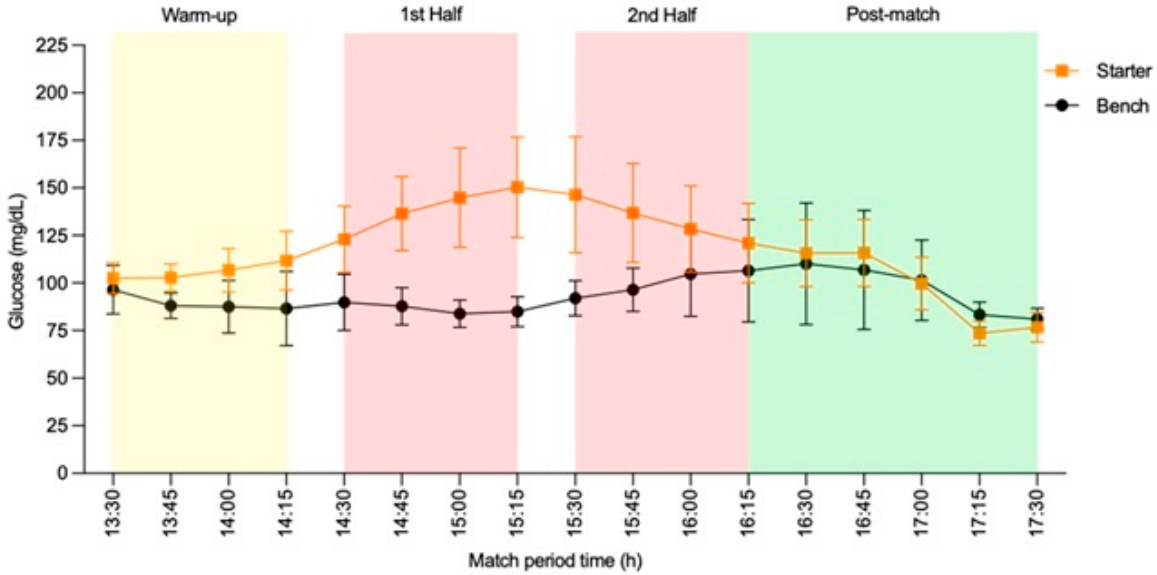
No statistical differences in iG levels were found between different periods of the day for bench players (Table 3). However, starters displayed higher iG levels during the match compared to night-time (+26.5 mg/dL, p = 0.001, d = 2.1 [1.04; 3.08]), pre-match (+22.2 mg/dL, p = 0.002, d = 2.0 [0.97; 3.0]), and post-match (+25.9 mg/dL, p = 0.004, d = 1.41 [0.48; 2.32]). iG levels remained stable during night-time, pre-match, and post-match for starters, with no statistically significant differences between these periods. When comparing iG levels between starters and bench players within the same period of the day, significant differences were found only during the match, with starters displaying higher iG levels (+14.1 mg/dL, p = 0.0005, d = 0.52 [0.31; 0.76]).
During the match period, a main effect of playing status on iG levels was observed (F = 18.59, p < 0.0001, ηp2 = 0.10), along with a significant interaction between playing status and match period (F = 18.84, p < 0.0001, ηp2 = 0.22). However, the match period alone was not statistically significant (F = 2.24, p = 0.14, ηp2 = 0.39).
No significant differences in iG levels were found between different match periods for bench players. However, for starters, iG levels were significantly higher during the match compared to post-match (+48.1 mg/dL, p = 0.01, d = 2.73 [1.11; 4.29]). Additionally, during the match, starters had significantly higher iG levels than bench players, with the highest difference during the first half (+47.6 mg/dL, p > 0.0001, d = 0.95 [0.65; 1.24]). During the second half of matches, the differences tend to decrease (Figure 2). Supplementary Material describing the linear mixed model output for comparing iG levels between periods of the day and player status (Table S1) and between periods of the match and player status (Table S2) is available.

4. Discussion

This study aimed to assess variations in iG levels during two official matches played by elite women soccer players (Serie A championship), comparing starters with bench players, who served as a control group. These findings provide novel insights into the daily glucose responses of women soccer players from an ecological perspective. The main findings indicate that starters experienced a greater increase in iG levels during the match. However, a high coefficient of variation (CV) in iG levels was observed both between and within individuals throughout the entire day and specifically during the match period. This variability suggests that players were exposed to different physiological stimuli across different days, even under seemingly similar conditions, highlighting the need for individualized strategies.
Previous studies using continuous glucose monitoring (CGM), predominantly in individual sports, have consistently demonstrated that athletes exhibit highly individualized iG profiles with significant intra- and inter-individual variations [26,27,28]. Therefore, the CV values found in this study align with existing literature, reinforcing the importance of personalized recommendations to maintain optimal iG levels for each athlete.
Despite match external loads being consistent with the values reported in the literature [5,6,7,8,10], players’ iG levels remained within the normal range (86.1–112.5 mg/dL pre- and post-match, respectively); therefore, it cannot be considered clinically relevant nor as having any impact on the performance of the athletes. While physical training is generally associated with improved glucose regulation, intense exercise can transiently impair glucose tolerance, even in healthy individuals [29]. Additionally, studies on endurance athletes in free-living conditions have reported frequent episodes of hypo- and hyperglycaemia compared to non-athletic populations [4,30], indicating long-term metabolic adaptations to training. These adaptations may be linked to increased lipid oxidation and energy deficits following prolonged exertion [30].
During the match, this current study observed higher iG values in starters (~112 mg/dL), as expected, with lower inter-player variability. In elite men’s soccer, Skroce et al. [19] reported higher concentrations than those found in the present study for both active players (159.1 ± 23.2 mg/dL) and those on the bench (133.4 ± 25.1 mg/dL), despite using identical equipment. This discrepancy may be attributed not only to the sex-based differences between the samples but also to the variations in match intensity. Conversely, Yoshitake et al. [31] reported similar findings in decathlon athletes, identifying instances of both high (>112 mg/dL) and low (<80 mg/dL) iG levels.
Maintaining glucose homeostasis is crucial for optimal brain and central nervous system function during competition. A low glucose level at the start of exercise or after halftime in team sports can negatively impact both physical and cognitive performance [32]. If iG drops too low, the neural drive to skeletal muscles may be compromised, though carbohydrate ingestion can help restore it [33]. In most team sports, iG are generally well-maintained throughout competition (90 min) and even during extra time (120 min in soccer) in well-fed athletes [34]. However, while low iG is often associated with fatigue, some studies have reported conflicting results, suggesting that fatigue and blood glucose concentrations are not always directly correlated [35,36].
It is important to acknowledge that CGM may have limitations in accurately tracking iG during intermittent exercise [3]. However, its application in endurance activities such as marathons, cycling, and triathlons remains promising and may also be relevant for soccer, as highlighted by recent publications [19]. During matches, the between-subject CV values of starting players are lower than benches (6% vs. 9%). Additionally, within-subject CV values tend to decrease compared to the entire day (18% vs. 20%). The combination of these two factors suggests a reasonable level of reliability for the assessed parameters. However, the CV of the results obtained in the present study could be due to: 1. changes in intensity, psychological stress, hydration, and fueling strategies. In soccer, even players in the same match and position can experience different workloads or exertion levels based on tactical roles, in-game events, and decision-making. Although GPS data indicated no differences in average external load across the two observed matches, it is plausible that the same player encountered different internal demands depending on the unique context and situational requirements of each match. This may help explain the large intra-individual fluctuations during the match; 2. CGM captures minute-by-minute fluctuations in interstitial glucose, which may lag slightly behind blood glucose and are sensitive to abrupt physiological changes (e.g., post-goal adrenaline surges, high-intensity sprints). These acute changes may disproportionately inflate within-subject variability, particularly in active (starter) players [37].
Further research is needed, since the use of CGM in sports is still relatively new and its practical applications remain underexplored. CGM technology enables the assessment of glucose variability in daily life and the quantification of time spent in hyper- and hypoglycaemia [38]. However, its interpretation in athletes is not yet well-established. While CGM could potentially aid practitioners in determining acute carbohydrate intake strategies, some limitations persist [39]. Despite strong agreement between CGM devices and the gold standard (venous blood glucose) in both healthy individuals and those with diabetes [13], discrepancies can occur [40]. Additionally, interstitial glucose changes may lag behind blood glucose fluctuations [41], and CGM accuracy tends to decrease during exercise, even with normal glucose regulation [3]. In this study, the highest within-player CV values were observed among starters (whole day: 20%; match: 18%).
Glucose monitoring may also serve as a valuable tool for assessing recovery, particularly during night-time. In this study, iG remained stable and within normal ranges at night, although no data were collected after midnight following the match. Nocturnal low glucose availability can disrupt sleep and negatively impact recovery [39]. Additionally, reduced fasting iG has been proposed as a potential marker of overreaching in athletes [42]. Future research should explore the combined use of CGM and sleep monitoring to better understand the role of glucose regulation in recovery. Given Clavel et al.’s [3] findings, glucose dynamics at rest can be reliably assessed using CGM, which could help practitioners develop individualized nutritional strategies.
Glucose regulation is a complex process influenced by multiple factors, including carbohydrate intake, exercise, and training status [43]. Nutrition plays a crucial role in soccer performance, influencing energy availability, recovery, and overall health [12]. While limited data prevent the establishment of universal energy intake guidelines for women’s soccer players, ensuring adequate energy availability is essential. Carbohydrate intake should be periodized based on expected training duration and intensity [12]. Current recommendations suggest that 3–5 g·kg−1·day−1 is sufficient for short-duration (<1 h) skill-based sessions, whereas 6–10 g·kg−1·day−1 is required for longer, high-intensity activities such as matches [44]. Following nutritional guidelines while considering individual glucose responses to sport-specific demands could lead to personalized supplementation strategies that optimize energy balance and performance.

4.1. Practical Applications and Future Directions

The present findings highlight the potential value of CGM as a practical tool for informing individualized nutritional and recovery strategies in elite women’s soccer. Given the considerable intra- and inter-individual variability observed in interstitial iG, even under comparable match conditions, practitioners should consider integrating CGM into athlete monitoring routines to assess individual glycemic responses to match demands. Monitoring glucose patterns on the day before, during match play, and possibly the day after the match may provide insights into carbohydrate availability and metabolic readiness, thereby supporting personalized fueling protocols. Furthermore, the detection of suboptimal iG, particularly during or following matches, may help identify athletes at risk of impaired recovery. In this context, CGM could be especially useful when combined with other monitoring tools such as sleep tracking and load metrics, enabling a more comprehensive evaluation of athlete readiness and recovery. While the use of CGM is still emerging in sports, these findings support its feasibility and relevance for applied practice in the intermittent, high-intensity team sports.
Future research should aim to expand on these findings by including larger and more diverse cohorts across multiple teams, competition levels, and different match intensities and scenarios. Integrating detailed information about dietary intake data, hormonal profiles, and psychophysiological markers could help clarify the underlying drivers of glycemic variability in female athletes. Additionally, extending the CGM data collection into the post-match night and subsequent recovery days would provide valuable insights into nocturnal glucose dynamics and their relationship with recovery and sleep.

4.2. Limitations

While this study has several strengths, being the first to investigate continuous glucose monitoring in elite women’s soccer players during official matches with a sample from the same club, ensuring homogeneity in training plans, workload, and frequency, some limitations must be acknowledged. First, the small sample size may limit the statistical robustness of the findings, as participants were selected based on availability. However, the sample size is consistent with recent studies on this topic with a similar ecological perspective [17] and allows for providing valuable preliminary data from a pilot study. Second, no CGM data were collected beyond midnight following the match, potentially missing important insights into post-match recovery. Future studies should extended glucose monitoring beyond match days to assess long-term recovery patterns. Third, CGM has a lag in data collection, which may impact the interpretation of glucose response to exercise, particularly during intense play. Fourth, as an observational study, detailed information on individual nutritional strategies was not collected. Although all players followed a standardized nutritional plan before and on match day, future studies should integrate dietary assessments to explore the impact of nutrition on glucose dynamics more comprehensively. Five, the present study did not examine the relationship between external load variables and concomitant glycemic responses. Larger samples would enable such analyses, thereby enhancing the practical applicability of combining CGM with match load monitoring in soccer. Lastly, factors such as menstrual cycle phase, hydration status, and dietary variability may have acted as potential confounders. These variables should be systematically accounted for in future large-scale studies that extend beyond the exploratory scope of the present work.

5. Conclusions

Continuous glucose monitoring (CGM) in sports is an emerging field, gradually transitioning from controlled laboratory settings to real-world applications. However, available data remain limited. This pilot study adds to the growing body of evidence by investigating CGM use in elite female soccer players during official matches and reporting preliminary findings. The results suggest that match demands may lead to increased interstitial iG, which remains within normal ranges. These findings suggest that CGM can be a valuable tool for informing data-driven nutritional strategies in female team sports. Nonetheless, the observed inter-individual variability highlights the need for personalized approaches to optimize athletic performance. Future research should expand on these findings by incorporating dietary intake assessments, hormonal profiling, and larger sample sizes to better tailor CGM applications and develop individualized nutritional strategies based on glycemic responses.

Supplementary Materials

The following supporting information can be downloaded at: https://www.mdpi.com/article/10.3390/app16094458/s1, Table S1: Linear mixed model output for the comparison of glucose between periods of the day and player status; Table S2: Linear mixed model output for the comparison of glucose level between match periods and player status.

Author Contributions

Conceptualization, C.P., J.B. and L.P.; methodology, C.P. and J.B.; validation, L.S.-A., J.A.C. and A.B.; formal analysis, J.B.; investigation, C.P.; data curation, C.P. and A.B.; writing—original draft preparation, C.P.; writing—review and editing, J.B. and G.M.; visualization, J.A.C., L.P. and A.B.; supervision, L.S.-A. All authors have read and agreed to the published version of the manuscript.

Funding

This research received no external funding.

Institutional Review Board Statement

The study was conducted in accordance with the Declaration of Helsinki, and approved by the Antidoping Lab Institutional Review Board (Qatar; IRB number: E201300004).

Informed Consent Statement

Informed consent was obtained from all subjects involved in the study.

Data Availability Statement

Data can be obtained from Cristian Petri on cristian.petri@outlook.com.

Acknowledgments

The authors express their gratitude to all the participants involved in this study.

Conflicts of Interest

The authors declare no conflicts of interest.

References

  1. Fédération Internationale de Football Association (FIFA). Women’s Football Member Associations Survey Report; FIFA: Zurich, Switzerland, 2019. [Google Scholar]
  2. Okholm Kryger, K.; Wang, A.; Mehta, R.; Impellizzeri, F.M.; Massey, A.; McCall, A. Research on women’s football: A scoping review. Sci. Med. Footb. 2022, 6, 549–558. [Google Scholar] [CrossRef]
  3. Clavel, P.; Tiollier, E.; Leduc, C.; Fabre, M.; Lacome, M.; Buchheit, M. Concurrent Validity of a Continuous Glucose-Monitoring System at Rest and During and Following a High-Intensity Interval Training Session. Int. J. Sports Physiol. Perform. 2022, 17, 627–633. [Google Scholar] [CrossRef] [PubMed]
  4. Thomas, F.; Pretty, C.G.; Signal, M.; Shaw, G.; Chase, J.G. Accuracy and performance of continuous glucose monitors in athletes. Biomed. Signal Process. Control 2017, 32, 124–129. [Google Scholar] [CrossRef]
  5. Datson, N.; Hulton, A.; Andersson, H.; Lewis, T.; Weston, M.; Drust, B.; Gregson, W. Applied physiology of female soccer: An update. Sports Med. 2014, 44, 1225–1240. [Google Scholar] [CrossRef]
  6. Harkness-Armstrong, A.; Till, K.; Datson, N.; Myhill, N.; Emmonds, S. A systematic review of match-play characteristics in women’s soccer. PLoS ONE 2022, 17, e0268334. [Google Scholar] [CrossRef]
  7. Hewitt, A.; Norton, K.; Lyons, K. Movement profiles of elite women soccer players during international matches and the effect of opposition’s team ranking. J. Sports Sci. 2014, 32, 1874–1880. [Google Scholar] [CrossRef]
  8. Jagim, A.R.; Murphy, J.; Schaefer, A.Q.; Askow, A.T.; Luedke, J.A.; Erickson, J.L.; Jones, M.T. Match Demands of Women’s Collegiate Soccer. Sports 2020, 8, 87. [Google Scholar] [CrossRef]
  9. Oliveira, R.; Brito, J.P.; Moreno-Villanueva, A.; Nalha, M.; Rico-González, M.; Clemente, F.M. Reference Values for External and Internal Training Intensity Monitoring in Young Male Soccer Players: A Systematic Review. Healthcare 2021, 9, 1567. [Google Scholar] [CrossRef]
  10. Ramos, G.P.; Nakamura, F.Y.; Penna, E.M.; Wilke, C.F.; Pereira, L.A.; Loturco, I.; Capelli, L.; Mahseredjian, F.; Silami-Garcia, E.; Coimbra, C.C. Activity Profiles in U17, U20, and Senior Women’s Brazilian National Soccer Teams During International Competitions: Are There Meaningful Differences? J. Strength. Cond. Res. 2019, 33, 3414–3422. [Google Scholar] [CrossRef]
  11. Sausaman, R.W.; Sams, M.L.; Mizuguchi, S.; DeWeese, B.H.; Stone, M.H. The Physical Demands of NCAA Division I Women’s College Soccer. J. Funct. Morphol. Kinesiol. 2019, 4, 73. [Google Scholar] [CrossRef] [PubMed]
  12. Collins, J.; Maughan, R.J.; Gleeson, M.; Bilsborough, J.; Jeukendrup, A.; Morton, J.P.; Phillips, S.M.; Armstrong, L.; Burke, L.M.; Close, G.L.; et al. UEFA expert group statement on nutrition in elite football. Current evidence to inform practical recommendations and guide future research. Br. J. Sports Med. 2021, 55, 416. [Google Scholar] [CrossRef] [PubMed]
  13. Bowler, A.M.; Whitfield, J.; Marshall, L.; Coffey, V.G.; Burke, L.M.; Cox, G.R. The Use of Continuous Glucose Monitors in Sport: Possible Applications and Considerations. Int. J. Sport. Nutr. Exerc. Metab. 2022, 33, 121–132. [Google Scholar] [CrossRef]
  14. Guerci, B.; Drouin, P.; Grangé, V.; Bougnères, P.; Fontaine, P.; Kerlan, V.; Passa, P.; Thivolet, C.; Vialettes, B.; Charbonnel, B. Self-monitoring of blood glucose significantly improves metabolic control in patients with type 2 diabetes mellitus: The Auto-Surveillance Intervention Active (ASIA) study. Diabetes Metab. 2003, 29, 587–594. [Google Scholar] [CrossRef]
  15. Skroce, K.; Zignoli, A.; Fontana, F.Y.; Maturana, F.M.; Lipman, D.; Tryfonos, A.; Riddell, M.C.; Zisser, H.C. Real World Interstitial Glucose Profiles of a Large Cohort of Physically Active Men and Women. Sensors 2024, 24, 744. [Google Scholar] [CrossRef] [PubMed]
  16. Chang, C.R.; Roach, L.A.; Russell, B.M.; Francois, M.E. Using continuous glucose monitoring to prescribe an exercise time: A randomised controlled trial in adults with type 2 diabetes. Diabetes Res. Clin. Pract. 2025, 222, 112072. [Google Scholar] [CrossRef]
  17. Hamilton, R.; McCarthy, O.M.; Bain, S.C.; Bracken, R.M. Continuous measurement of interstitial glycaemia in professional female UCI world tour cyclists undertaking a 9-day cycle training camp. Eur. J. Sport. Sci. 2024, 24, 1573–1582. [Google Scholar] [CrossRef] [PubMed]
  18. Podlogar, T.; Wallis, G.A. New Horizons in Carbohydrate Research and Application for Endurance Athletes. Sports Med. 2022, 52, 5–23. [Google Scholar] [CrossRef]
  19. Skroce, K.; Zignoli, A.; Mihic, N.; Lipman, D.J.; Turner, L.V.; Riddell, M.C.; Zisser, H.C. Continuous Glucose Monitoring Profiles in Elite-Level Professional European Football Players. J. Diabetes Sci. Technol. 2025. OnlineFirst. [Google Scholar] [CrossRef]
  20. McKay, A.K.A.; Stellingwerff, T.; Smith, E.S.; Martin, D.T.; Mujika, I.; Goosey-Tolfrey, V.L.; Sheppard, J.; Burke, L.M. Defining Training and Performance Caliber: A Participant Classification Framework. Int. J. Sports Physiol. Perform. 2022, 17, 317–331. [Google Scholar] [CrossRef]
  21. Gómez, A.M.; Umpierrez, G.E.; Muñoz, O.M.; Herrera, F.; Rubio, C.; Aschner, P.; Buendia, R. Continuous Glucose Monitoring Versus Capillary Point-of-Care Testing for Inpatient Glycemic Control in Type 2 Diabetes Patients Hospitalized in the General Ward and Treated With a Basal Bolus Insulin Regimen. J. Diabetes Sci. Technol. 2015, 10, 325–329. [Google Scholar] [CrossRef]
  22. Costa, J.A.; Rago, V.; Brito, P.; Figueiredo, P.; Sousa, A.; Abade, E.; Brito, J. Training in women soccer players: A systematic review on training load monitoring. Front. Psychol. 2022, 13, 943857. [Google Scholar] [CrossRef]
  23. Gualtieri, A.; Rampinini, E.; Dello Iacono, A.; Beato, M. High-speed running and sprinting in professional adult soccer: Current thresholds definition, match demands and training strategies. A systematic review. Front. Sports Act. Living 2023, 5, 1116293. [Google Scholar] [CrossRef]
  24. Rosnow, R.L.; Rosenthal, R.; Rubin, D.B. Contrasts and correlations in effect-size estimation. Psychol. Sci. 2000, 11, 446–453. [Google Scholar] [CrossRef] [PubMed]
  25. Hopkins, W.G.; Marshall, S.W.; Batterham, A.M.; Hanin, J. Progressive statistics for studies in sports medicine and exercise science. Med. Sci. Sports Exerc. 2009, 41, 3–13. [Google Scholar] [CrossRef]
  26. Ishihara, K.; Uchiyama, N.; Kizaki, S.; Mori, E.; Nonaka, T.; Oneda, H. Application of Continuous Glucose Monitoring for Assessment of Individual Carbohydrate Requirement during Ultramarathon Race. Nutrients 2020, 12, 1121. [Google Scholar] [CrossRef]
  27. Sengoku, Y.; Nakamura, K.; Ogata, H.; Nabekura, Y.; Nagasaka, S.; Tokuyama, K. Continuous glucose monitoring during a 100-km race: A case study in an elite ultramarathon runner. Int. J. Sports Physiol. Perform. 2015, 10, 124–127. [Google Scholar] [CrossRef] [PubMed]
  28. Suzuki, Y.; Shimizu, T.; Ota, M.; Hirata, R.; Sato, K.; Tamura, Y.; Imanishi, A.; Watanabe, M.; Sakuraba, K. Different training status may alter the continuous blood glucose kinetics in self-paced endurance running. Exp. Ther. Med. 2015, 10, 978–982. [Google Scholar] [CrossRef]
  29. Borghouts, L.B.; Keizer, H.A. Exercise and insulin sensitivity: A review. Int. J. Sports Med. 2000, 21, 1–12. [Google Scholar] [CrossRef]
  30. Flockhart, M.; Nilsson, L.C.; Tais, S.; Ekblom, B.; Apró, W.; Larsen, F.J. Excessive exercise training causes mitochondrial functional impairment and decreases glucose tolerance in healthy volunteers. Cell Metab. 2021, 33, 957–970. [Google Scholar] [CrossRef]
  31. Yoshitake, R.; Ogata, H.; Omi, N. Blood Glucose Levels during Decathlon Competition: An Observational Study in Timing of Intake and Competing Time. Metabolites 2024, 14, 47. [Google Scholar] [CrossRef] [PubMed]
  32. Kingsley, M.; Penas-Ruiz, C.; Terry, C.; Russell, M. Effects of carbohydrate-hydration strategies on glucose metabolism, sprint performance and hydration during a soccer match simulation in recreational players. J. Sci. Med. Sport. 2014, 17, 239–243. [Google Scholar] [CrossRef]
  33. Nybo, L. CNS fatigue and prolonged exercise: Effect of glucose supplementation. Med. Sci. Sports Exerc. 2003, 35, 589–594. [Google Scholar] [CrossRef] [PubMed]
  34. Harper, L.D.; Briggs, M.A.; McNamee, G.; West, D.J.; Kilduff, L.P.; Stevenson, E.; Russell, M. Physiological and performance effects of carbohydrate gels consumed prior to the extra-time period of prolonged simulated soccer match-play. J. Sci. Med. Sport. 2016, 19, 509–514. [Google Scholar] [CrossRef]
  35. Claassen, A.; Lambert, E.V.; Bosch, A.N.; Rodger, L.M.; St Clair Gibson, A.; Noakes, T.D. Variability in exercise capacity and metabolic response during endurance exercise after a low carbohydrate diet. Int. J. Sport. Nutr. Exerc. Metab. 2005, 15, 97–116. [Google Scholar] [CrossRef]
  36. Felig, P.; Cherif, A.; Minagawa, A.; Wahren, J. Hypoglycemia during prolonged exercise in normal men. N. Engl. J. Med. 1982, 306, 895–900. [Google Scholar] [CrossRef]
  37. Impey, S.G.; Hearris, M.A.; Hammond, K.M.; Bartlett, J.D.; Louis, J.; Close, G.L.; Morton, J.P. Fuel for the Work Required: A Theoretical Framework for Carbohydrate Periodization and the Glycogen Threshold Hypothesis. Sports Med. 2018, 48, 1031–1048. [Google Scholar] [CrossRef] [PubMed]
  38. Keshet, A.; Shilo, S.; Godneva, A.; Talmor-Barkan, Y.; Aviv, Y.; Segal, E.; Rossman, H. CGMap: Characterizing continuous glucose monitor data in thousands of non-diabetic individuals. Cell Metab. 2023, 35, 758–769. [Google Scholar] [CrossRef] [PubMed]
  39. Flockhart, M.; Tischer, D.; Nilsson, L.C.; Blackwood, S.J.; Ekblom, B.; Katz, A.; Apró, W.; Larsen, F.J. Reduced glucose tolerance and insulin sensitivity after prolonged exercise in endurance athletes. Acta Physiol. 2023, 238, e13972. [Google Scholar] [CrossRef]
  40. Cengiz, E.; Tamborlane, W.V. A tale of two compartments: Interstitial versus blood glucose monitoring. Diabetes Technol. Ther. 2009, 11, S11–S16. [Google Scholar] [CrossRef]
  41. Siegmund, T.; Heinemann, L.; Kolassa, R.; Thomas, A. Discrepancies Between Blood Glucose and Interstitial Glucose—Technological Artifacts or Physiology: Implications for Selection of the Appropriate Therapeutic Target. J. Diabetes Sci. Technol. 2017, 11, 766–772. [Google Scholar] [CrossRef]
  42. Ishigaki, T.; Koyama, K.; Tsujita, J.; Tanaka, N.; Hori, S.; Oku, Y. Plasma leptin levels of elite endurance runners after heavy endurance training. J. Physiol. Anthropol. Appl. Human. Sci. 2005, 24, 573–578. [Google Scholar] [CrossRef] [PubMed]
  43. Flockhart, M.; Larsen, F.J. Continuous Glucose Monitoring in Endurance Athletes: Interpretation and Relevance of Measurements for Improving Performance and Health. Sports Med. 2024, 54, 247–255. [Google Scholar] [CrossRef] [PubMed]
  44. Williams, C.; Rollo, I. Carbohydrate Nutrition and Team Sport Performance. Sports Med. 2015, 45, S13–S22. [Google Scholar] [CrossRef] [PubMed]
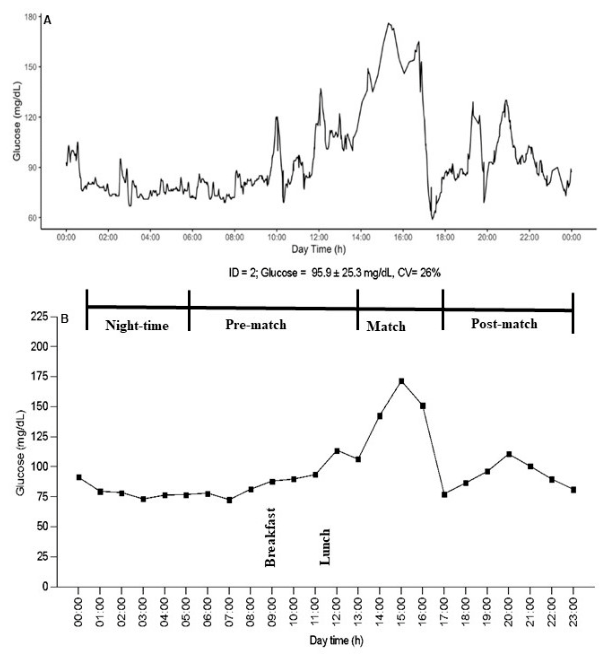
Figure 1. Example raw data (A) and post-processed data (B) for one player, for a single day. ID, player identity; CV, coefficient of variation.
Applsci 16 04458 g001
Figure 2. iG for starters (orange squares) and bench (black circles) players during the match period.
Applsci 16 04458 g002
Table 1. External match loads of the players who have played the whole match. Data are expressed as mean ± standard deviation.
External Load VariableMatch 1Match 2p Valueηp2 (95%CI)
Total distance (m)10,660.3 ± 1105.810,126.5 ± 894.80.270.35 (0.0, 1.0)
HSR (m)1147.7 ± 539.01249.8 ± 244.80.930.00 (0.0, 1.0)
RD (m/min)118.4 ± 12.3112.7 ± 10.10.280.35 (0.0, 1.0)
Sprint (m)87.2 ± 56.4147.3 ± 85.40.360.12 (0.0, 1.0)
Max Speed (m/s)7.2 ± 0.67.8 ± 0.30.160.49 (0.0, 1.0)
Accelerations (n)10.7 ± 0.910.0 ± 3.10.690.06 (0.0, 1.0)
Decelerations (n)23.0 ± 4.521.8 ± 3.30.710.02 (0.0, 1.0)
Legend: HSR = high-speed running, RD = Relative Distance, n = numbers.
Table 2. iG throughout the periods of the day. Mean ± SD and coefficients of variations for glucose concentrations.
Time IntervalGroupiG (mg/dL)
(95%CI)
Between-Subjects CVWithin-Subjects CV
Whole-dayAll90.2 ± 11.4
(88.8; 91.6)
13%17%
Starter92.2 ± 15.1
(89.9; 94.5)
16%20%
Bench86.3 ± 7.6
(84.5; 88.1)
9%13%
MatchAll106.1 ± 26.4
(99.0; 113.4)
25%14%
Starter112.5 ± 28.5
(103.1; 121.9)
25%18%
Bench93.2 ± 8.4
(85.0; 101.2)
9%9%
Legend: CV = coefficient of variation; iG = interstitial glucose; CI = confidence interval.
Table 3. iG levels for all players grouped by starting status during the four periods of the day.
GroupNightPre-MatchMatchPost-Match
(95%CI)(95%CI)(95%CI)(95%CI)
All84.1 ± 9.585.8 ± 11.2106.1 ± 26.490.1 ± 12.5
(82.0; 86.2)(83.2; 88.4)(99.0; 113.4)(86.2; 94.0)
Starter85.6 ± 9.686.1 ± 10.9112.5 ± 28.5 *†‡¥90.7 ± 11.5
(83.1; 88.1)(83.0; 89.2)(103.1; 121.9)(86.5; 94.9)
Bench81.1 ± 8.485.4 ± 11.993.1 ± 15.488.9 ± 13.9
(77.7; 84.5)(80.3; 90.5)(85.0; 101.2)(81.1; 96.7)
Legend: * Statistically different from bench, † statistically different from night-time, ‡ statistically different from pre-match, ¥ statistically different from post-match. CI = confidence interval.
Disclaimer/Publisher’s Note: The statements, opinions and data contained in all publications are solely those of the individual author(s) and contributor(s) and not of MDPI and/or the editor(s). MDPI and/or the editor(s) disclaim responsibility for any injury to people or property resulting from any ideas, methods, instructions or products referred to in the content.