1. Introduction
The deployment of unmanned aerial vehicles (UAVs) in emergency scenarios has become increasingly important, particularly through the integration of artificial intelligence [
1,
2,
3,
4]. Recent research highlights the significant role of multi-UAV coordination in enabling resilient wireless connectivity [
5,
6,
7,
8]. The unique characteristics of UAVs, such as their versatility to operate in both urban and rural environments, have garnered considerable attention due to their impressive range capabilities, spanning from 1 km to 150 km [
9]. This adaptability allows UAVs to perform a variety of tasks, including ensuring connectivity in critical scenarios. In military and security applications, drones are widely utilized for surveillance, reconnaissance, and targeted operations, providing real-time data without endangering human lives [
10]. In the commercial sector, drones enhance efficiency by enabling rapid shipping deliveries, conducting aerial damage assessments, and facilitating precise mapping [
11]. Furthermore, advancements in smaller, autonomous drones are expanding their potential applications in urban environments and everyday life [
12]. In the context of maritime communications, Quality of Service (QoS) optimization has been addressed through route prediction techniques [
13]. Xu and Shi propose a communication coverage model based on mobile user route prediction combined with a dynamic UAV deployment algorithm that employs a modified long short-term memory network to predict the trajectory of maritime users and a proximal policy optimization (PPO) algorithm.
Despite the growing body of research on Machine Learning (ML)-based optimization for UAV networks, most existing approaches rely on computationally expensive deep reinforcement learning algorithms that are impractical for real-time deployment on resource-constrained UAV hardware. Furthermore, few studies integrate empirical propagation measurements from real UAV flights with network-level simulation to validate their QoS mechanisms under realistic channel conditions. This gap motivates the development of a lightweight, data-driven QoS framework specifically designed for multi-UAV emergency communications in FANETs.
The main contributions of this work are as follows:
- 1.
Empirical LoS and NLoS propagation models are derived from real UAV flight measurements at multiple altitudes over the Yachay Tech campus and integrated into the ns-3 simulator to enhance channel realism.
- 2.
A comprehensive data pipeline is developed encompassing ArduSim-based mobility models, ns-3 network simulation with four concurrent User Datagram Protocol (UDP) applications per UAV, binary data labeling, feature extraction, and Synthetic Minority Over-sampling Technique (SMOTE)-based class balancing.
- 3.
A CatBoost-based QoS optimization framework (Artificial Intelligence (AI) SMOTE EMERGENCY) is proposed and benchmarked against nine alternative ML algorithms, demonstrating 94.7% classification accuracy with sub-millisecond inference time suitable for real-time UAV deployment.
- 4.
An energy consumption analysis quantifies savings of approximately 30% in energy per successfully delivered packet (EPSDP) by improving PDR from 0.63 to 0.90, with the absolute energy savings scaling proportionally to network hop count.
The remainder of this paper is organized as follows.
Section 2 reviews the related work on ad hoc networks, FANETs, and ML-based QoS optimization.
Section 3 describes the methodology, including propagation measurements, data collection, preprocessing, and the learning phase.
Section 4 presents the experimental results and performance evaluation.
Section 5 discusses the findings and their implications, and
Section 6 draws the conclusions and outlines future work.
2. Related Work
Ad hoc networks are decentralized wireless networks formed by devices communicating directly without a fixed infrastructure, enabling dynamic and temporary connections for data exchange among mobile nodes [
14,
15,
16,
17]. They are particularly useful in scenarios where rapid deployment is necessary, such as identifying disaster zones or delivering medication to isolated areas [
18].
The key aspects of ad hoc networks include the following:
Spontaneous connectivity: Ad hoc networks enable spontaneous connections among mobile devices, facilitating communication through multi-hop links without relying on base stations [
19].
Routing: Efficient routing protocols are essential, necessitating dynamic allocation of unique addresses to nodes, which remains a challenge in mobile ad hoc networks (MANETs) [
20].
Antenna design: The use of directional antennas can significantly enhance network performance by improving throughput and reducing interference [
14]. Employing multiple antennas and advanced techniques such as beamforming can further optimize transmission capacity [
21].
While ad hoc networks offer flexibility and rapid deployment, they also face challenges such as maintaining stable connections and efficient routing in dynamic environments. Designing and implementing ad hoc networks for emergency response scenarios presents several key challenges. These challenges arise from the dynamic nature of disaster environments and the need for reliable communication among different agencies.
Emergency scenarios often involve physical obstacles and mobility, which can disrupt communication paths. Traditional routing protocols may fail, necessitating innovative solutions like store-and-forward mechanisms to maintain connectivity [
22,
23,
24,
25]. Ensuring that different agencies can communicate effectively is crucial. Hastily Formed Networks (HFNs) must support various data types and technologies to facilitate real-time situational awareness [
26]. The effectiveness of routing protocols is critical, yet many existing models do not adequately simulate the mobility of rescue teams, leading to inefficiencies in data transmission [
27]. Ad hoc networks must adapt to rapidly changing conditions, which requires ongoing evaluation and refinement of routing strategies to enhance performance in real-world scenarios [
28].
Despite these challenges, ad hoc networks for emergency response are becoming increasingly feasible due to technological and methodological developments. FANETs are characterized by their unique communication challenges, including high node mobility, dynamic network topology, and limited communication ranges. These challenges make FANETs more prone to communication failures compared to traditional ad hoc networks. The communication architecture and routing protocols in FANETs must be designed to handle these challenges effectively [
29].
Quality of Service (QoS) policies within FANETs present significant shortcomings. These failures arise due to the dynamic nature of UAV networks, where nodes frequently change positions, leading to potential disconnections and network bottlenecks. Addressing these challenges requires innovative routing protocols and connectivity preservation strategies to ensure reliable communication and maintain QoS. The LARP-EQ protocol, a 3D cone-shaped location-aided routing protocol, has been proposed to improve QoS by balancing power consumption and reducing end-to-end delay, resulting in a 20% increase in the Packet Delivery Ratio (PDR) and a 15% reduction in average delay [
30].
An Analysis of Variance (ANOVA)-based analysis of routing techniques highlights the importance of selecting trustworthy intermediate relay devices to ensure reliable data transmission between UAVs, which is crucial for maintaining QoS in varying traffic scenarios [
31]. A connectivity preservation controller using Markov switching topology and artificial potential functions has been developed to maintain network connectivity despite communication failures and limited communication distances. This approach ensures stable UAV formations and reliable communication links [
32].
The integration of machine learning plays a crucial role in UAV communications, addressing challenges such as limited energy capacity, varying service requirements, and the need for reliable communication links in complex environments. Machine learning techniques, including reinforcement learning and predictive modeling, have shown significant improvements in UAV performance and QoS. For instance, a combination of genetic algorithms and double deep reinforcement learning (GA-DDRL) has been used to optimize UAV throughput and QoS by enhancing path planning and phase shift configurations in multi-Reconfigurable Intelligent Surface (RIS) UAV networks, resulting in a 28.57% increase in data rate compared to traditional methods [
33].
Deep reinforcement learning (DRL) and particle swarm optimization (PSO) have been employed to maximize throughput and coverage in multi-UAV systems, achieving a 30% improvement in QoS over baseline solutions [
34].
However, these approaches present notable limitations. Despite the promising results achieved through the integration of the genetic algorithm with deep double reinforcement learning (GA-DDRL), the study also identifies several limitations. One of the most significant is the limited energy capacity of UAVs, which constrains both their operating time and deployment frequency. This directly affects the sustainability and scalability of the proposed system.
In addition, the diversity of user service requirements poses a considerable challenge, requiring the system to adapt dynamically to highly variable scenarios. While the GA-DDRL approach outperforms traditional methods, its computational complexity may hinder real-time implementation, particularly in environments with limited processing resources.
The study also emphasizes that conventional linear programming methods are not well-suited for real-time decision-making in this context. This reinforces the need to explore more efficient or lightweight alternatives capable of striking a balance between performance and operational feasibility [
33].
Within the broader context of UAV communications over cellular networks, several key limitations are identified. One notable challenge is the selection of frequency bands, as this significantly influences uplink throughput at varying altitudes. Such variability adds complexity to optimizing communication performance and limits the generalizability of one-size-fits-all strategies across different scenarios.
Another critical issue is the reliance of machine learning models on diverse and representative training data. The article notes that insufficient data diversity can degrade the accuracy of throughput predictions, thereby reducing the effectiveness of predictive QoS models for UAVs. This suggests a potential lack of robustness in environments not adequately captured in the training dataset.
Moreover, although field tests were conducted in a suburban environment, their findings may not be directly transferable to urban or rural settings, thus limiting the broader applicability of the study’s conclusions [
35].
Recent studies have further investigated the influence of UAV altitude on air-to-ground propagation characteristics. Zhou et al. [
36] construct a path-loss prediction model at 3.6 GHz under agricultural scenarios by jointly incorporating propagation distance, UAV altitude, and carrier frequency as input variables to an artificial neural network trained on field measurements at multiple flight heights, demonstrating that altitude significantly modulates the LoS probability and the resulting path-loss exponent. Similarly, Chang et al. [
37] present air-to-ground channel measurements at 2.7 GHz in a rural environment using a fixed-wing UAV, showing that the large-scale fading statistics—including the path-loss exponent and shadow-fading standard deviation—vary systematically with altitude due to changes in terrain clearance and scattering geometry. These findings underscore the necessity of altitude-aware propagation modeling for UAV networks. In the present work, altitude dependence is captured empirically: LoS measurements were collected at four distinct altitudes (40, 60, 80, and 100 m) and NLoS measurements at 14 m, and the resulting regression models (Equations (
7) and (
9)) explicitly incorporate the flight height
h as an independent variable, allowing the channel model to reflect altitude-induced variations in received power.
Energy consumption is a critical constraint in UAV networks, where battery capacity directly limits mission duration. Heinzelman et al. [
38] proposes a radio energy model for wireless mesh networks assuming an
path-loss law: transmitting a
k-bit message over a distance
d costs
, and receiving the same message costs
, where
nJ/bit and
pJ/bit/m
2. This model has been validated in multi-hop wireless scenarios and quantifies the dominant role of distance in amplifier energy. In FANET deployments, congestion-induced retransmissions and failed packet deliveries represent direct energy waste at each relay hop. A QoS-aware admission control mechanism that suppresses transmissions predicted to fail therefore yields energy savings proportional to the avoided per-hop transmission cost, reinforcing the case for lightweight, real-time ML-based QoS in resource-constrained aerial networks.
Table 1 summarizes the key characteristics of the reviewed approaches and highlights the distinguishing features of the proposed work. To the best of our knowledge, no prior study simultaneously combines empirical UAV propagation measurements, SMOTE-balanced data preprocessing, lightweight CatBoost-based QoS optimization, and energy-aware packet admission control within a cross-layer ns-3 FANET simulation framework.
3. Methodology
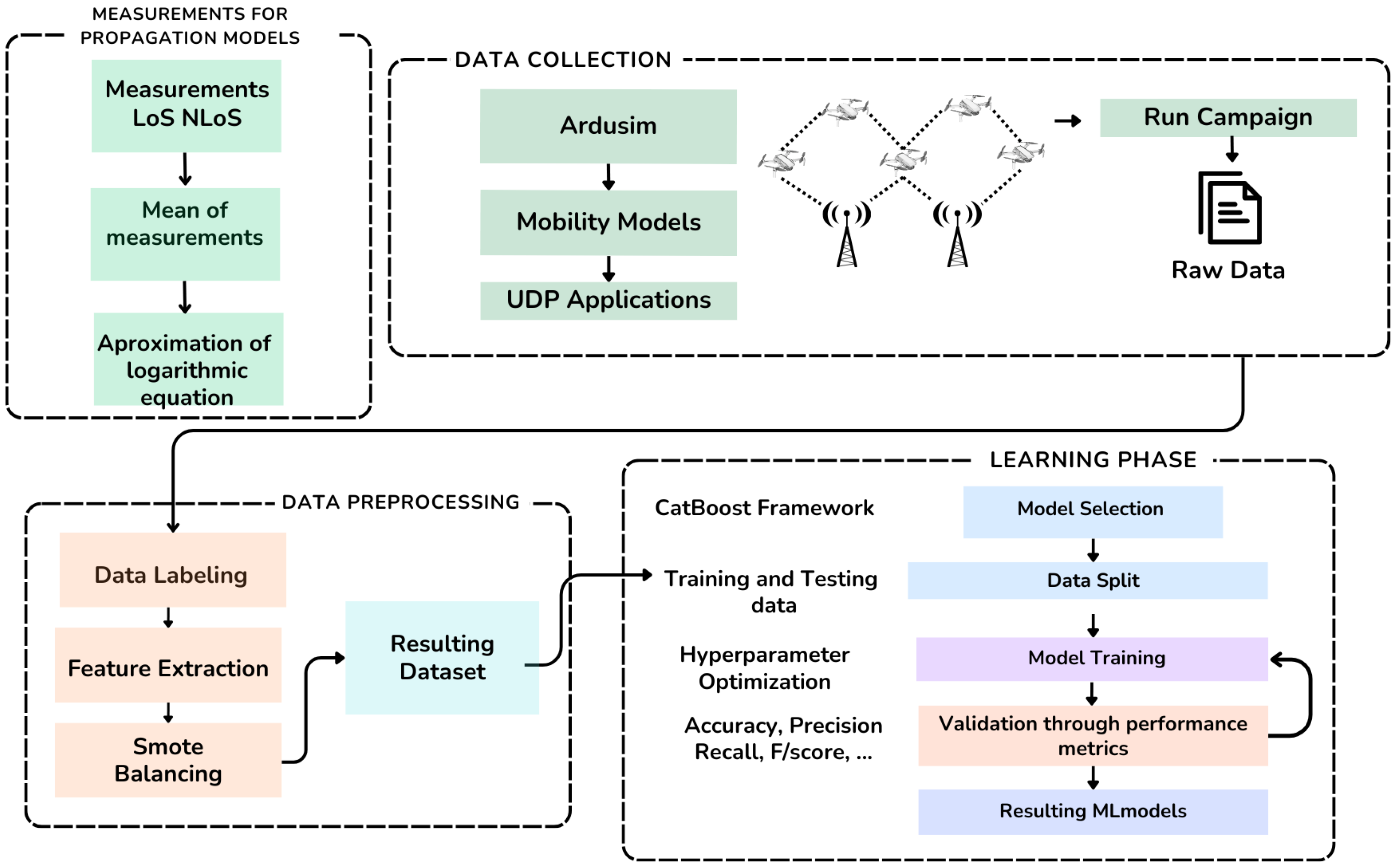
The development of the proposed AI-enhanced multi-UAV QoS simulation follows a structured pipeline composed of four main stages, as illustrated in
Figure 1. First,
Measurements for Propagation Models are obtained from real UAV flight experiments to derive and validate LoS and NLoS channel models. Second, a
Data Collection phase uses ArduSim-based mobility models and UDP applications within the ns-3 simulator to generate realistic FANET communication traces. Third, a
Data Preprocessing stage transforms the raw simulation data through labeling, feature extraction, and SMOTE balancing to produce a suitable dataset for machine learning. Finally, the
Learning Phase employs the CatBoost framework for model training, hyperparameter optimization, and evaluation using standard classification metrics.
3.1. Measurements for Propagation Models
This stage focuses on obtaining empirical propagation measurements from real UAV flights to derive channel models that are later integrated into the ns-3 simulation environment.
3.1.1. Line-of-Sight (LoS) Measurements
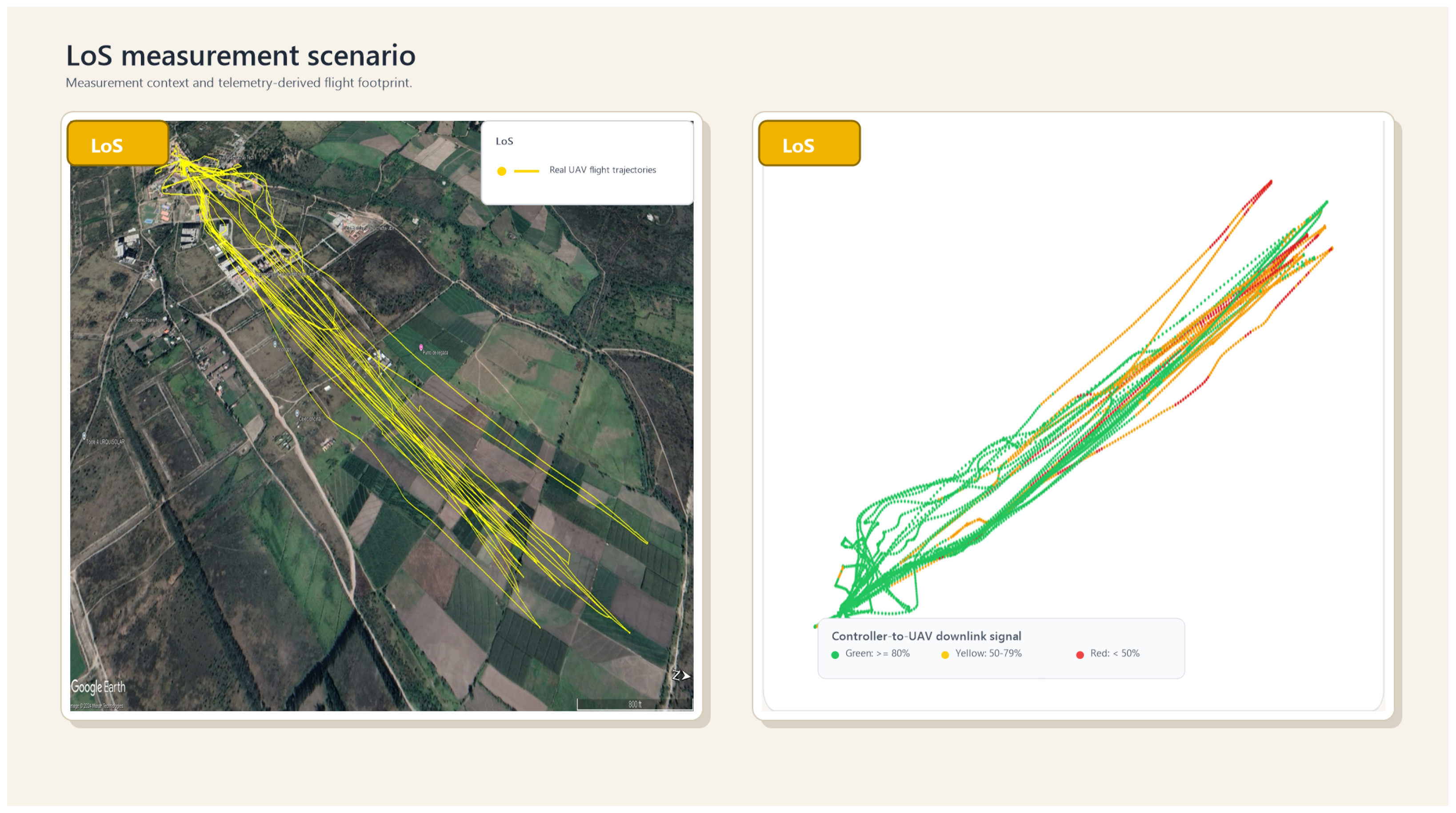
To capture the received signal power along the flight trajectory, 15 flight missions were conducted to collect measurements. These missions were designed to provide repeated observations under the same campus environment, so that the resulting propagation characterization would not depend on a single flight path.
Figure 2 illustrates the UAV flight paths at an altitude of 40 m. The primary purpose of these tests is to analyze the behavior of the signal transmitted from the ground remote control and received by the UAV along its trajectory.
Based on the studies presented in [
39,
40], after measuring the signal power received by the UAV, a logarithmic approximation is applied using the averaged collected data to derive an equation that accurately describes the LoS propagation model. Using the averaged measurements at a height of 40 m:
Using the averaged measurements at a height of 60 m:
Using the averaged measurements at a height of 80 m:
Using the averaged measurements at a height of 100 m:
where
x is the distance in meters from the transmitter (controller) to the UAV receiver.
Subsequently, the average of the constants is calculated to establish a relationship between the height and the distance of the UAV. The correlation values
are:
By incorporating additional parameters such as the frequency (Hz), the horizontal distance, and the transmission height, the following expression is obtained [
39]:
where
f is the frequency in Hz,
h is the height of the drone in meters,
x is the horizontal distance of the UAV in meters, and
is the vertical distance of the transmitting antenna relative to the ground in meters.
3.1.2. Non-Line-of-Sight (NLoS) Measurements
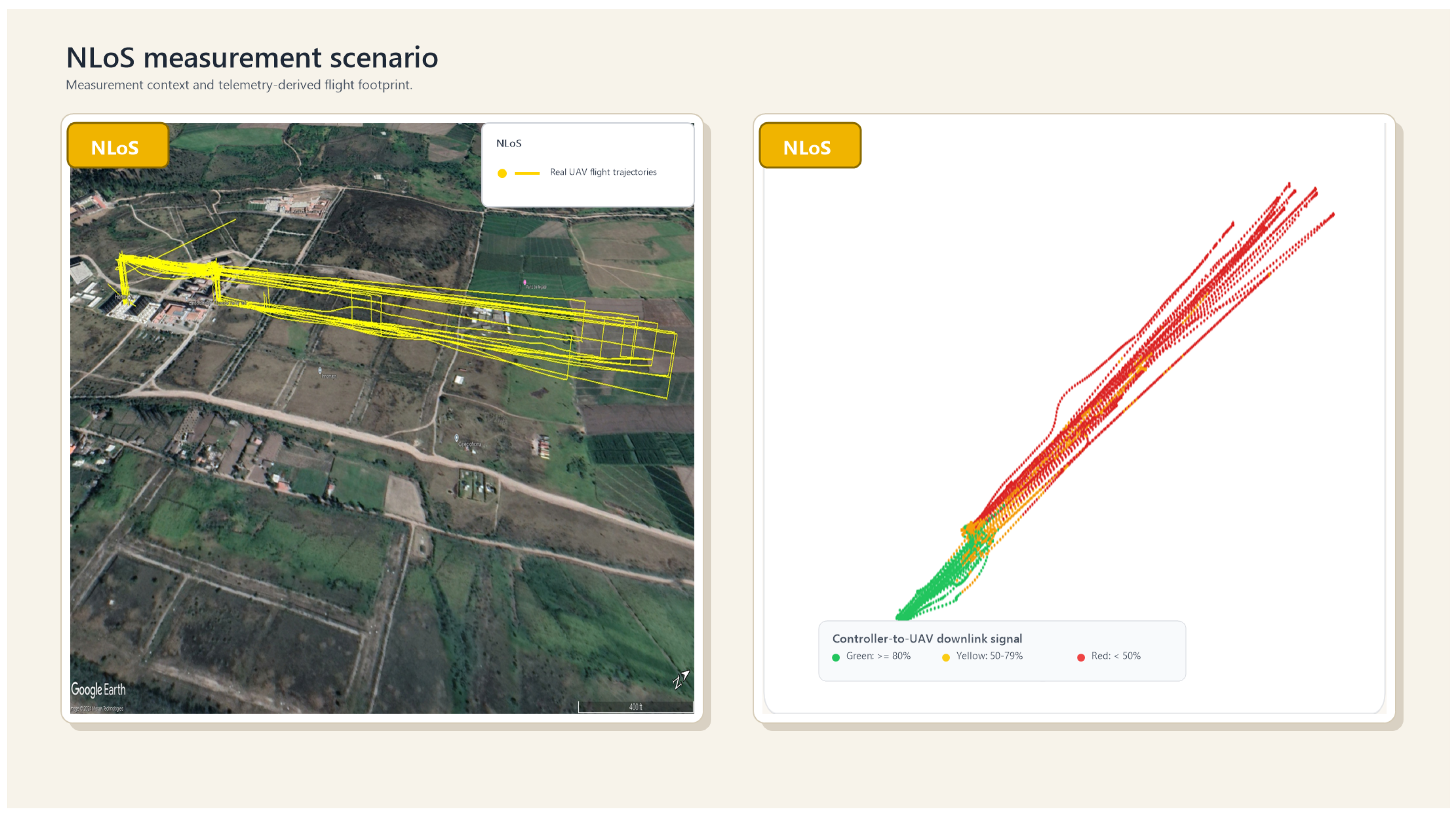
To analyze the mobility pattern under Non-Line-of-Sight (NLoS) conditions, data from 15 UAV flight tracks are consolidated (
Figure 3).
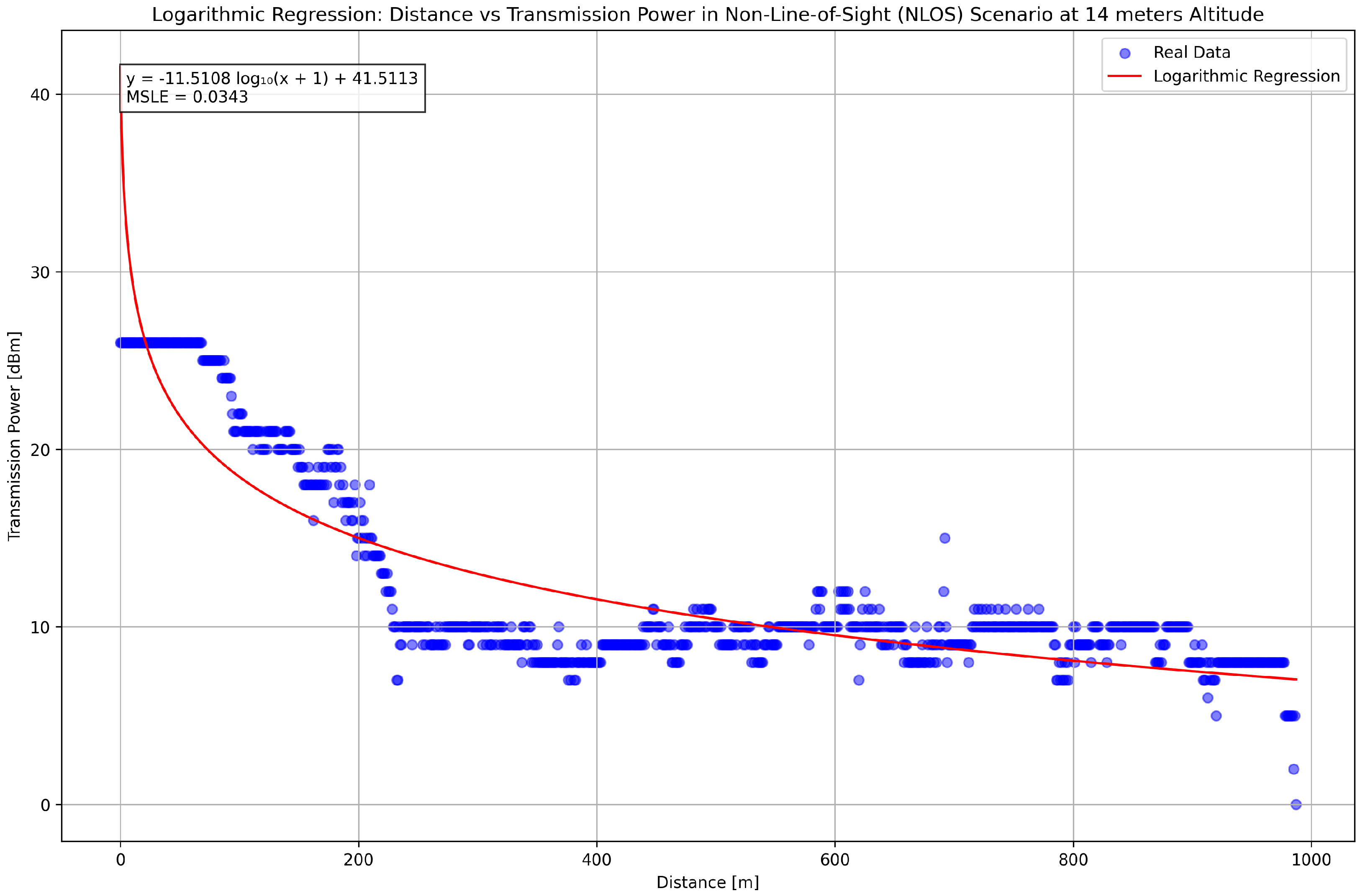
A logarithmic regression is applied to approximate the propagation model:
By incorporating additional parameters such as the frequency (MHz), horizontal distance, and transmission height, the following expression is obtained [
39]:
3.1.3. Comparison of Propagation Models
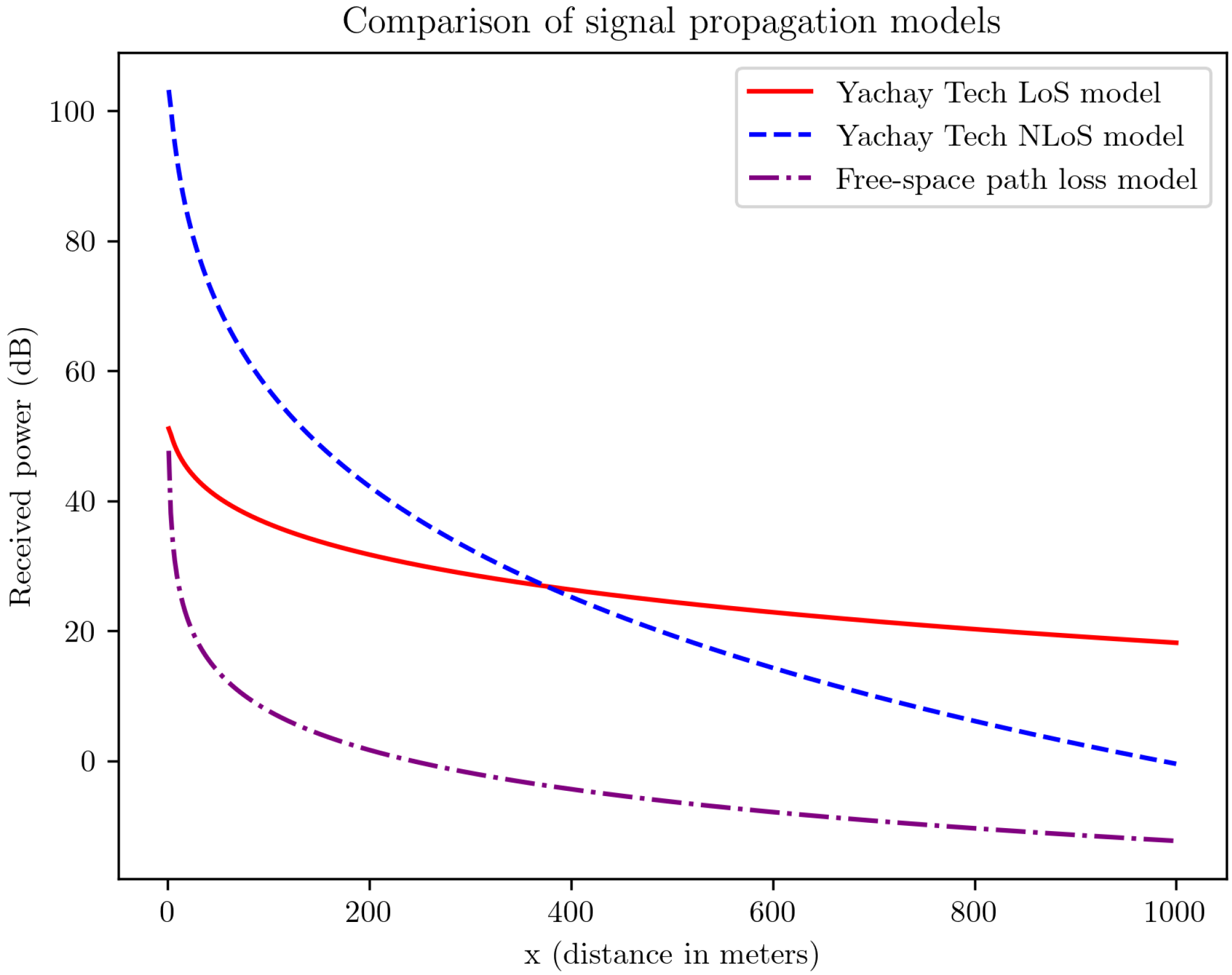
After analyzing and comparing the propagation models—including the Free Space Path Loss (FSPL) model [
41], Burke’s ballistic wave propagation model for drone communications [
40], the ray-tracing-based model for 5G UAV networks in rural mountainous areas [
39], and the LoS/NLoS models developed at Yachay Tech—it is observed that the FSPL model provides a basic estimate of signal attenuation under ideal, obstacle-free conditions.
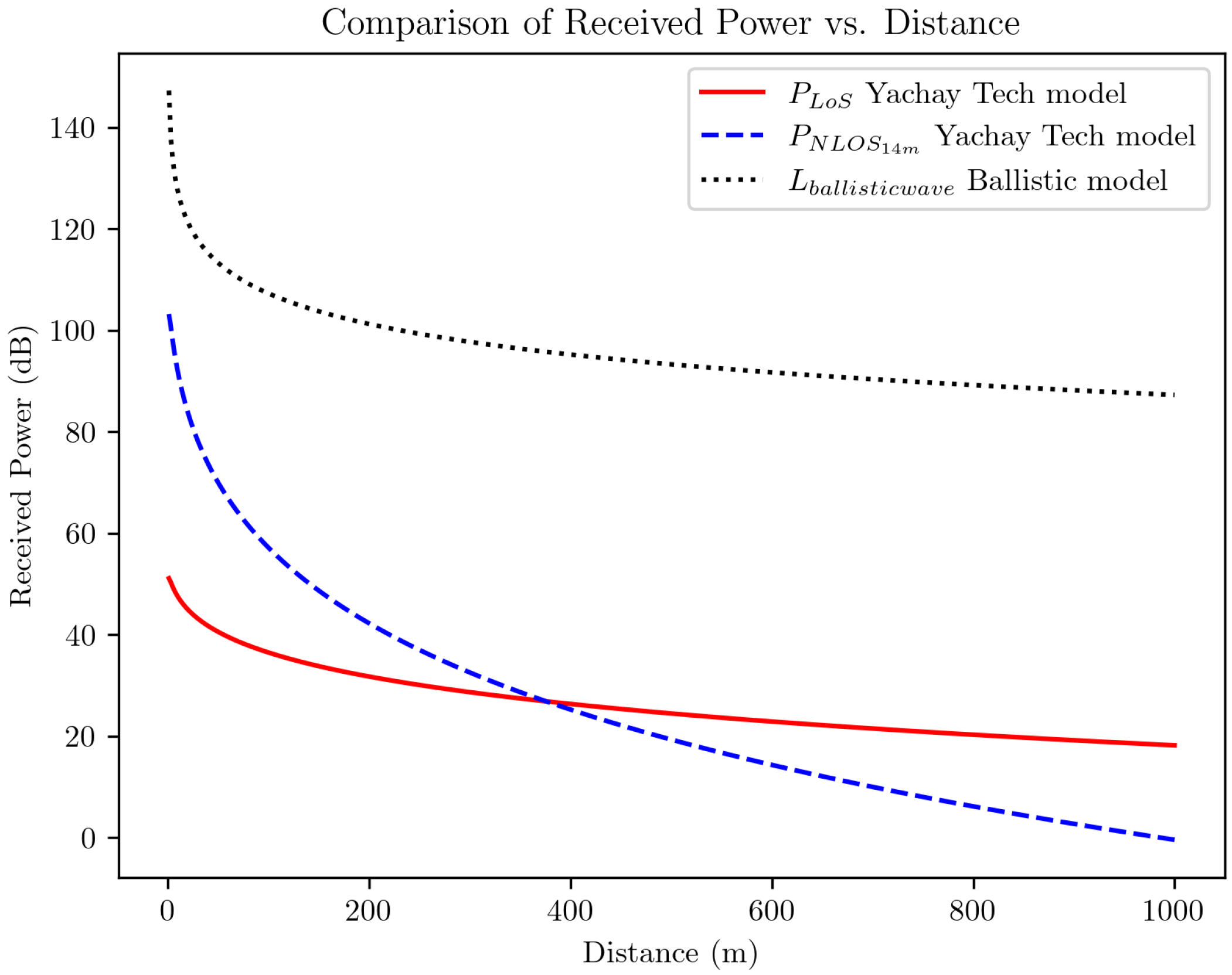
Figure 4 compares the received power as a function of distance for Burke’s ballistic model against the proposed Yachay Tech models.
Figure 5 presents the same comparison using the FSPL model as baseline, while
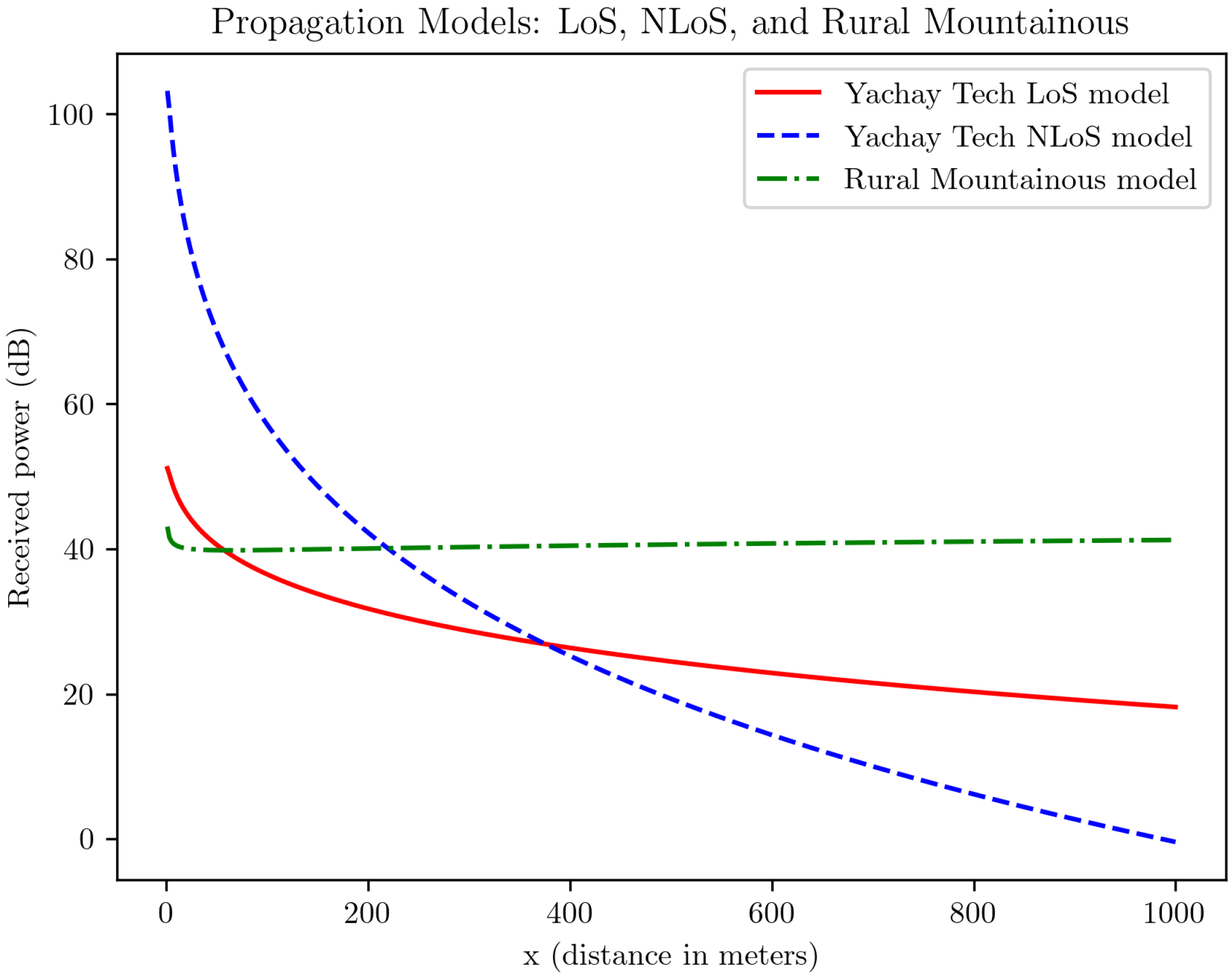
Figure 6 evaluates the ray-tracing model designed for rural mountainous regions. Across all comparisons, the Yachay Tech LoS and NLoS models exhibit steeper attenuation profiles consistent with the empirical measurements, confirming that environment-specific calibration is essential for accurate FANET channel modeling.
3.2. Data Collection
The second stage of the methodology generates the network-level data required for machine learning model training. A FANET scenario is constructed in the ns-3 simulator comprising 6 UAVs and 1 base station, configured according to the parameters in
Table 2. The ns-3 simulator was selected because it provides a well-documented discrete-event network simulation environment with modular support for communication protocols, devices, channels, sockets, and applications, making it suitable for packet-level and QoS-oriented analysis in FANETs. To generate realistic UAV mobility patterns, we complemented ns-3 with ArduSim [
42], a real-time multi-UAV simulator used to produce the drone trajectories later incorporated into the network simulations. In addition, ArduSim supports exporting mobility traces in formats such as NS2, which facilitates their integration into ns-3-based simulations. Multiple UDP applications are then deployed over these mobility traces to emulate differentiated emergency traffic.
3.2.1. ArduSim Mobility Models
To increase the variability and representativeness of the mobility conditions considered in this study, UAV trajectories were defined using ArduSim-based mobility patterns [
42], taking advantage of a simulator specifically designed for real-time multi-UAV mission execution and coordinated drone movements. In particular, the 13 flight missions were designed to cover diverse UAV trajectory realizations rather than relying on a single flight path. This design allowed us to capture different relative node positions, inter-UAV separations, and topology changes that are relevant for FANET communications.
Table 3 summarizes the 13 mobility patterns employed, each characterized by a geometric shape, inter-drone distance, and flight altitude. These patterns range from compact formations, such as the Star pattern with 15 m separation, to more extended layouts, such as the Square pattern with distances up to 2500 m. This diversity was intended to provide richer mobility conditions for the later ns-3 simulations, allowing the communication analysis to include both dense and sparse network configurations under different trajectory geometries. In other words, these mobility patterns were selected to expose the network to diverse communication conditions, including different contention scenarios, moderate-separation layouts, multi-hop regimes, and sparse long-range configurations.
3.2.2. UDP Applications and Traffic Model
Each of the six source UAVs runs four concurrent UDP applications—one per EDCA access category (VO, VI, BE, BK)—mapped to ports 80 through 83, where port 80 corresponds to the emergency service. The protocol stack spans the physical layer (802.11p), the Medium Access Control (MAC) layer (EDCA), the network layer (OLSR), and the application layer (UDP traffic generators). This work compares a machine learning model as a QoS mechanism against a non-QoS scenario and the well-known EDCA [
43,
44,
45,
46].
The simulation configuration generates a non-trivial traffic load that induces measurable congestion across the network. Each source UAV transmits with an exponentially distributed inter-packet interval of mean 1.0 s and a packet size of 1000 bytes, yielding an aggregate offered load of 24 packets/s (i.e., pkt/s), corresponding to 192 kbps of application-layer data directed toward a single sink node in a many-to-one convergence pattern.
Although the nominal Physical Layer (PHY) data rate of the 802.11p interface operating at 10 MHz bandwidth is 6 Mbps, several factors significantly reduce the effective channel capacity available for payload delivery. First, the Carrier Sense Multiple Access with Collision Avoidance (CSMA/CA) medium access mechanism introduces mandatory inter-frame spacing (Distributed Inter-Frame Spacing (DIFS)/Arbitration Inter-Frame Spacing (AIFS)), random backoff periods, and MAC-layer acknowledgments, which collectively reduce the achievable throughput to approximately 50–60% of the nominal rate [
43]. Second, the multi-hop forwarding required by the OLSR routing protocol amplifies the effective channel occupancy, as each packet must be retransmitted at every intermediate relay node. As shown in
Table 3, inter-drone distances range from 15 m to 2500 m across the evaluated topologies; for the largest separations, a single packet may traverse up to four or five hops before reaching the base station, thereby multiplying the per-packet channel cost by the corresponding hop count. Third, the OLSR protocol itself imposes periodic control overhead through HELLO messages (every 2 s) and Topology Control messages (every 5 s) at each node, further consuming channel resources. Fourth, contention among the four EDCA access categories at every transmitting and relaying node increases collision probability and triggers additional backoff cycles.
Table 4 summarizes the estimated effective channel load for representative topologies, accounting for multi-hop amplification and MAC overhead.
The convergence of all traffic toward a single sink node constitutes an additional structural bottleneck: the base station must process the entire aggregate load, and the nodes in its immediate vicinity experience elevated channel contention due to their dual role as sources and relay forwarders. In compact topologies such as the Star pattern (15 m), all nodes share the same collision domain, which leads to high contention despite the single-hop advantage. Conversely, in extended topologies (e.g., 2500 m), the hidden-node problem becomes relevant, as transmitting nodes outside each other’s carrier-sensing range may generate concurrent transmissions that collide at intermediate relays.
These conditions collectively produce observable congestion indicators in the simulation: (i) Channel Busy Ratio (CBR) values exceeding zero across all nodes, reflecting persistent channel occupancy; (ii) non-empty transmission queues (QP > 0), indicating that packets accumulate faster than they can be dispatched; and (iii) Packet Delivery Ratios (PDRs) below 100%, confirming that a fraction of the offered traffic is lost due to buffer overflow, excessive retransmissions, or route failures. The metrics collected from each simulation run are the channel busy ratio (CBR) and the queued packets (QPs) of both the source and destination nodes [
47,
48,
49].
3.3. Data Preprocessing
The raw data collected from the ns-3 simulations must be transformed into a structured dataset suitable for supervised machine learning. This stage encompasses four steps: data labeling, feature extraction, class balancing via SMOTE, and the construction of the final dataset.
3.3.1. Data Labeling
Each packet transmission event recorded during the ns-3 simulation is assigned a binary label based on its delivery outcome. A packet that successfully reaches the destination node is labeled as successful (), whereas a packet that is dropped due to buffer overflow, excessive retransmissions, or route failure is labeled as failed (). This binary classification formulation enables the machine learning model to learn the mapping between instantaneous network state and transmission success probability.
3.3.2. Feature Extraction
Four features are extracted from the simulation logs for each transmission event, capturing the bidirectional congestion state of the communication link:
: Channel Busy Ratio at the source node, representing the fraction of time the wireless channel is sensed as occupied.
: Queued Packets at the source node, indicating the number of packets waiting in the MAC-layer transmission buffer.
: Channel Busy Ratio at the destination node.
: Queued Packets at the destination node.
These four features were intentionally selected as a lightweight cross-layer representation of the network state. In particular, CBR reflects channel occupancy conditions derived from carrier sensing, while QP captures MAC-layer congestion through queue buildup at both communication endpoints. This compact feature set was preferred to reduce computational overhead and facilitate real-time deployment on resource-constrained UAV platforms.
3.3.3. SMOTE Balancing and Resulting Dataset
In FANET scenarios, the distribution of successful and failed transmissions is inherently imbalanced, with one class often dominating the dataset. To prevent the classifier from being biased toward the majority class, the Synthetic Minority Over-sampling Technique (SMOTE) [
50] was applied. To avoid information leakage, the dataset was first partitioned into training, validation, and testing subsets. SMOTE was then applied only to the training subset, while the validation and testing subsets remained untouched for model selection and final unbiased performance evaluation, respectively.
SMOTE generates synthetic samples of the minority class by interpolating between existing minority-class instances in the feature space, thereby producing a balanced training set without simply duplicating existing records. The configuration used in this work is summarized in
Table 5. The resulting scheme is denoted AI SMOTE EMERGENCY throughout this work.
After feature extraction and train–test partitioning, the training subset was balanced with SMOTE and represented using the four input features (
,
,
,
) and the binary output label (
). Data from all 13 mobility patterns listed in
Table 3 were considered to promote generalization across diverse topology conditions.
3.4. Learning Phase
The learning phase trains and evaluates multiple supervised machine learning algorithms to identify the model best suited for real-time QoS decision-making in FANETs. After preprocessing, data from all 13 mobility topologies were considered for model development. For each mobility topology, 100,000 labeled samples were generated, resulting in a total of 1,300,000 samples. Each sample is represented by the four input features , , , and , together with a binary output label indicating successful or failed transmission.
The dataset was partitioned into 60% for training, 20% for validation, and 20% for testing. The training subset was used to fit the candidate models, the validation subset was used during hyperparameter optimization with Optuna, and the testing subset was reserved exclusively for the final unbiased evaluation of the selected model. This separation was intended to ensure that the reported results reflect generalization to unseen samples rather than overfitting to the training data.
Model Selection
A broad set of supervised machine learning algorithms was evaluated, including Decision Tree, Random Forest, Support Vector Machine (SVM), k-Nearest Neighbors (k-NN), Gradient Boosting, XGBoost, LightGBM, Naive Bayes, Neural Network, and CatBoost. Hyperparameter optimization was carried out with Optuna, and the best configuration for each model was selected according to validation performance.
Table 6 summarizes the candidate models and the corresponding hyperparameter search spaces used during the optimization process.
Model performance was assessed on the held-out test set using standard classification metrics, namely accuracy, precision, recall, and F1-score. These metrics were used to compare the candidate models under a consistent evaluation protocol and to select the final QoS prediction model.
3.5. Energy Model
To quantify the energy implications of the proposed QoS-aware admission control, a radio energy dissipation model is adopted. Specifically, the model proposed by Heinzelman et al. [
38] for wireless sensor networks is used, which assumes a free-space (
) path-loss law. Under this model, the energy consumed by a node to transmit a
k-bit packet over a single-hop distance
d is:
and the energy consumed to receive the same packet is:
where
nJ/bit is the per-bit electronics dissipation (identical for transmitter and receiver circuitry) and
pJ/bit/m
2 is the transmit-amplifier coefficient. In a multi-hop path of
h hops, each intermediate relay both receives and retransmits the packet, so the total path energy per transmission attempt is
.
It is important to note that this energy model accounts exclusively for radio transceiver energy—i.e., the energy spent in the electronic circuits and power amplifier during packet transmission and reception. It does not include the propulsion or mechanical energy required for UAV flight, hovering, or maneuvering, which is several orders of magnitude larger but is independent of the communication protocol. The rationale is that the QoS admission control mechanism proposed in this work affects only packet transmission decisions; therefore, the relevant energy savings are those associated with avoiding wasted communication energy on packets that would otherwise be dropped due to congestion.
The key metric derived from this model is the energy per successfully delivered packet (EPSDP), defined as , which penalizes the energy wasted on failed transmissions. By improving PDR through intelligent admission control, the proposed scheme reduces EPSDP and thus the communication energy cost per useful delivered packet.
4. Results
This section presents the experimental results organized in five parts. First, the propagation model fitting is validated against the empirical measurements. Second, the classification performance of the evaluated machine learning models is reported. The remaining results are then structured around three complementary dimensions: (i) performance gains, which quantify the QoS improvements achieved by the proposed AI SMOTE EMERGENCY scheme across three representative topologies—Star (compact, 15 m), Rectangle (intermediate, 100 m), and Square (extended, 400 m); (ii) computational complexity, which demonstrates that the CatBoost model satisfies the lightweight deployment constraints of FANET nodes; and (iii) robustness and energy analysis, which evaluates cross-topology consistency and the energy savings enabled by improved packet delivery. Although all 13 mobility patterns from
Table 3 were used during the data collection and training phases, the three aforementioned topologies are presented in detail as they capture the full range of single-hop to multi-hop communication conditions.
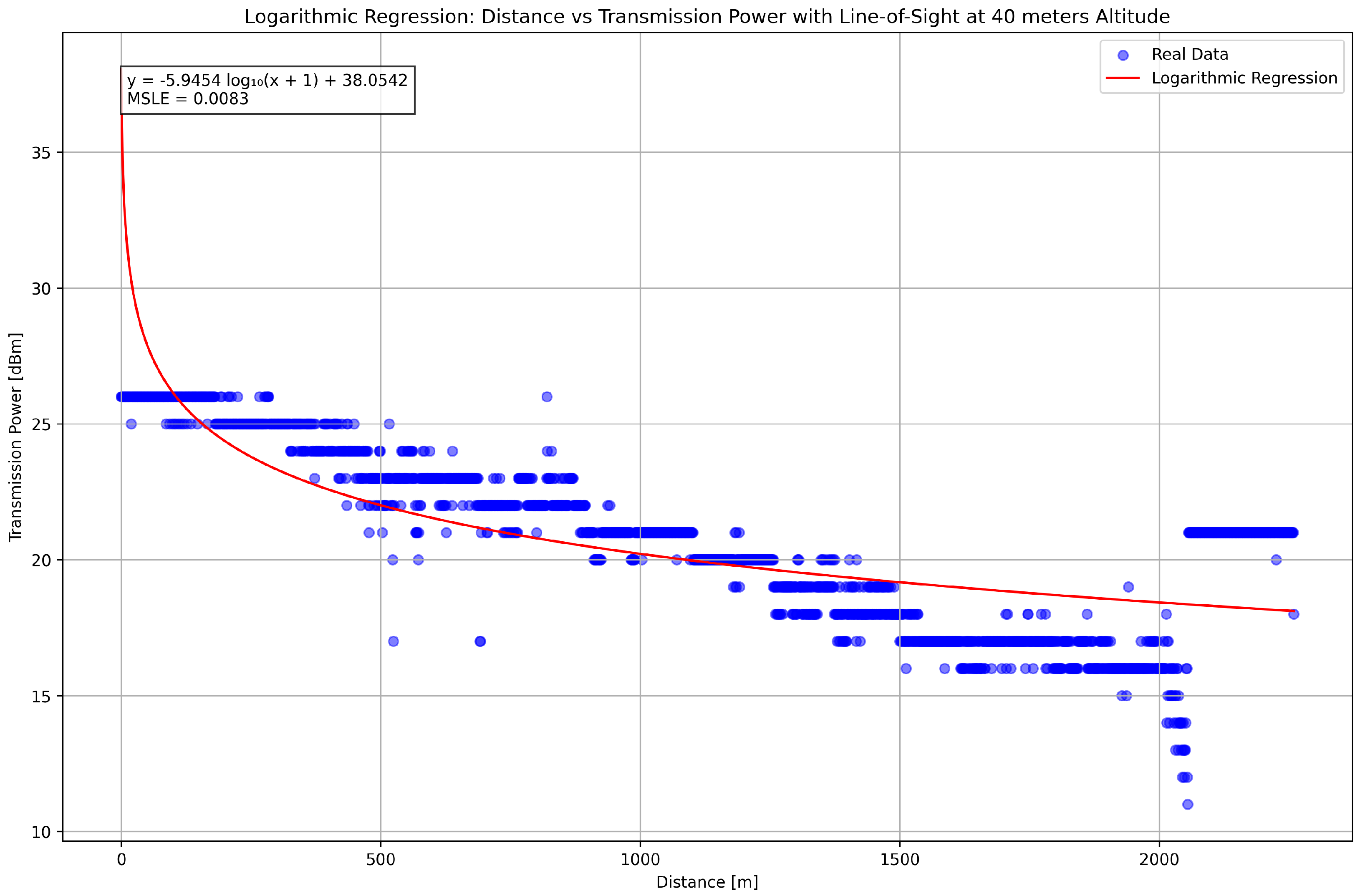
Figure 7 shows the logarithmic regression of received power versus distance for the LoS scenario at 40 m altitude, fitted over the averaged data from 15 flight experiments.
Figure 8 presents the corresponding fit for the NLoS scenario at 14 m altitude. In both cases, the logarithmic model closely follows the empirical measurements, confirming the validity of the derived propagation equations.
4.1. Machine Learning Models
Table 7 reports the classification performance of all ten evaluated models. CatBoost, LightGBM, and k-NN share the highest accuracy (0.947), while the neural network achieves only 0.669 due to insufficient training data for its architecture.
4.2. Performance Gains
4.2.1. QoS Configurations and Source-Side Decision Mechanism
Four traffic-management configurations are evaluated in this work. The first one is No-QoS, where all packets generated by the applications are transmitted without any admission decision. The second one is EDCA, in which QoS is provided exclusively by the standard IEEE 802.11e [
51]. MAC mechanism through the corresponding access categories (VO, VI, BE, BK), with higher-priority traffic receiving preferred channel access. EDCA is used only as an independent baseline for comparison and is not combined with the proposed machine-learning mechanisms.
The third configuration is AI SMOTE. In this case, the QoS decision is taken at the application layer of the source node before the packet is injected into the network. Let p denote the predicted success probability produced by the trained model from the feature vector . In AI SMOTE, the binary classifier output is used directly: packets predicted as successful are transmitted, whereas packets predicted as failed are discarded at the source. No differentiation is made among the four application ports.
The fourth configuration is AI SMOTE EMERGENCY. This mechanism also operates at the source node, but instead of relying only on the binary decision, it uses the predicted success probability together with port-dependent admission thresholds. Specifically, a packet associated with port
j is transmitted only if
, where
. In this way, port 80, corresponding to the emergency application, has the lowest admission threshold and therefore the highest transmission priority, while lower-priority ports are admitted more selectively. The thresholds used in this work are summarized in
Table 8.
Once a packet is admitted by either IA-based mechanism, it is forwarded normally by the standard communication stack, without additional AI-based decisions at intermediate relay nodes. This source-side design was adopted to avoid consuming transmission opportunities, relay resources, and UAV energy on packets that are unlikely to reach the destination under congested FANET conditions.
Therefore, the proposed AI-based schemes do not introduce packet delaying, MAC-layer re-prioritization, or EDCA queue manipulation. Their action is limited to a source-side transmit/drop decision before packet injection into the network.
4.2.2. Performance Metrics
To quantify the performance gains of the proposed AI SMOTE EMERGENCY scheme over the baseline configurations, the following metrics are employed. For metrics where higher values indicate better performance (PDR, Throughput), the percentage improvement is computed as:
where
denotes the metric value obtained with the AI SMOTE EMERGENCY method and
corresponds to the value under the reference scheme (No-QoS or EDCA).
For delay, where lower values indicate better performance, the percentage reduction is calculated as:
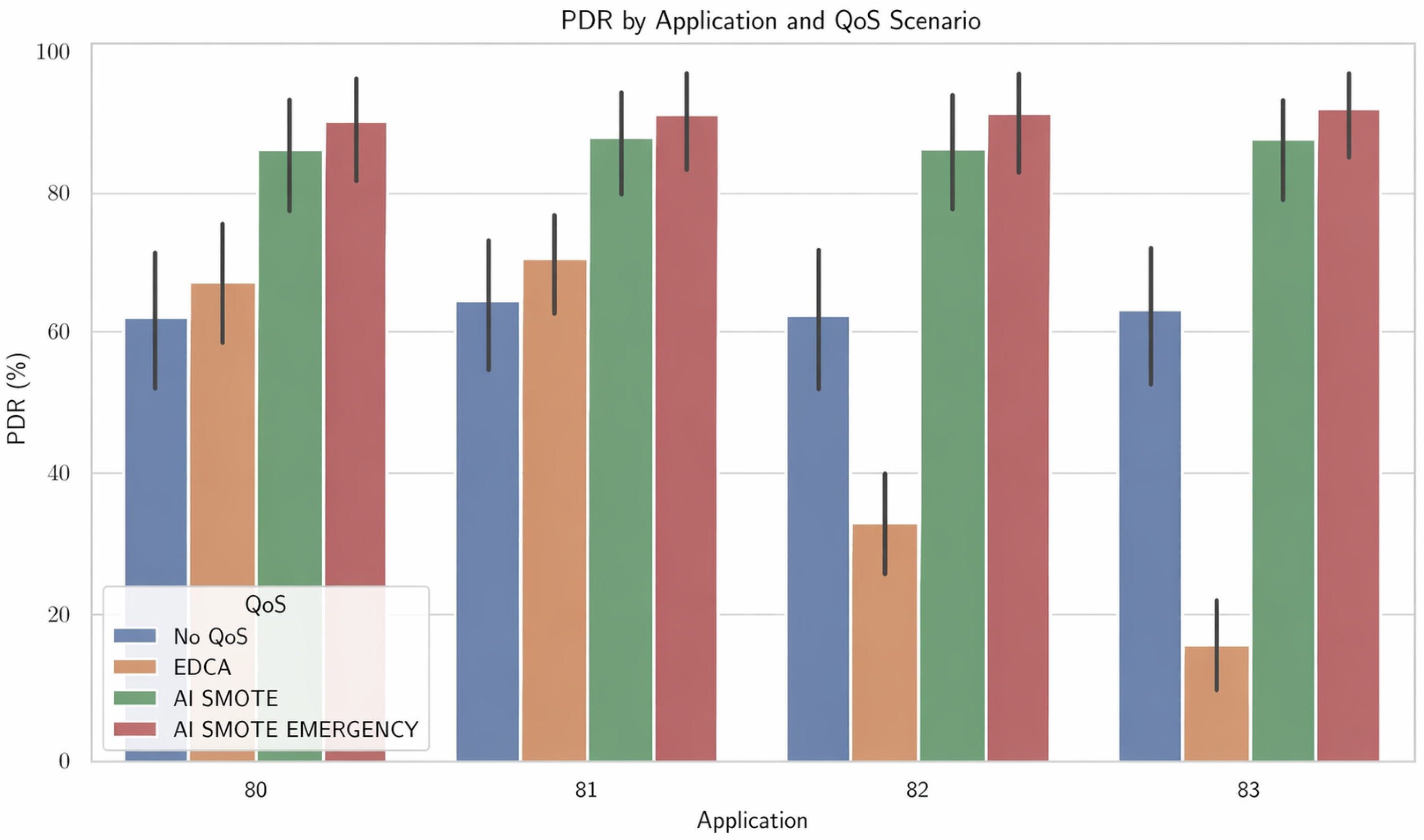
Using these definitions, the simulation results reveal three complementary advantages of the AI SMOTE EMERGENCY scheme. First, PDR improves uniformly across all four ports: the proposed scheme achieves approximately 89–93% PDR for every application, compared with 61–65% under No-QoS, representing an overall improvement of approximately 43%. Critically, unlike EDCA—which improves PDR for high-priority ports (80–81) at the expense of severely degrading low-priority ports (82–83 drop to 13–33%)—the ML-based scheme maintains high delivery reliability for all services simultaneously. Second, the emergency traffic prioritization is manifested primarily in throughput: port 80 receives approximately 148–155 kbps under AI SMOTE EMERGENCY, compared with 109–114 kbps under No-QoS, representing a 34–36% increase. Third, the end-to-end delay for emergency traffic is reduced from approximately 0.33–0.37 s under No-QoS to approximately 0.10 s under AI SMOTE EMERGENCY, representing a reduction of approximately 70%.
4.2.3. Simulation Results
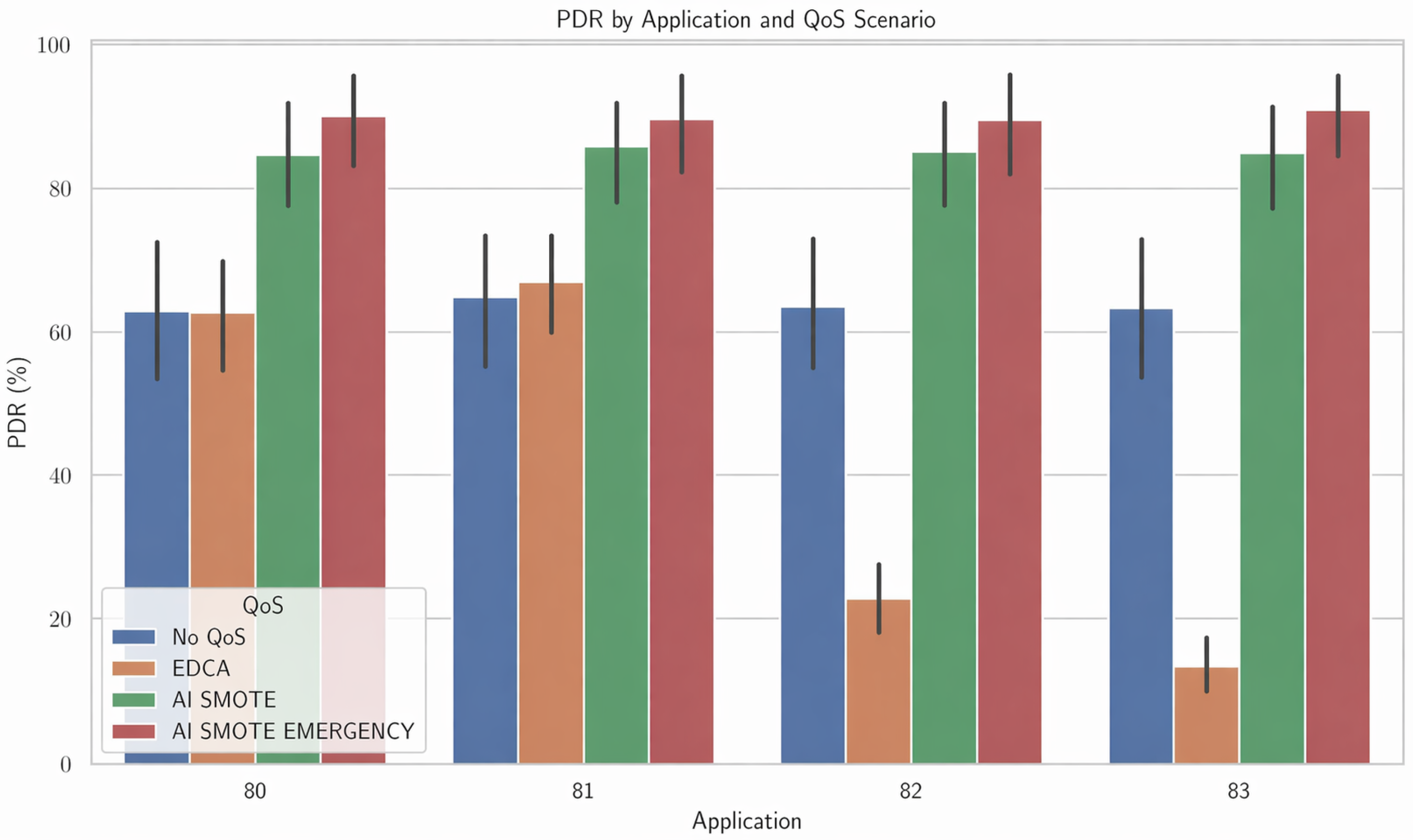
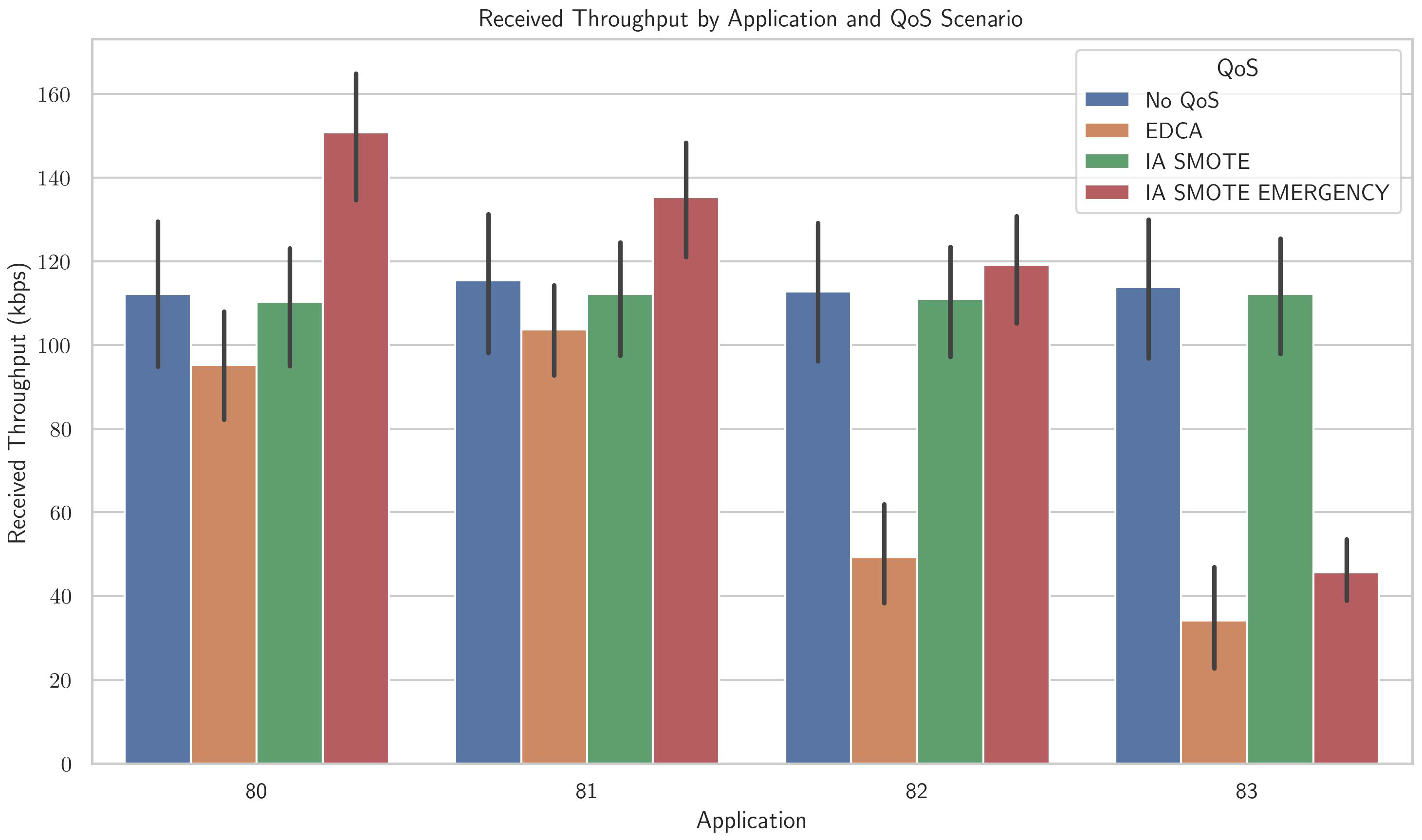
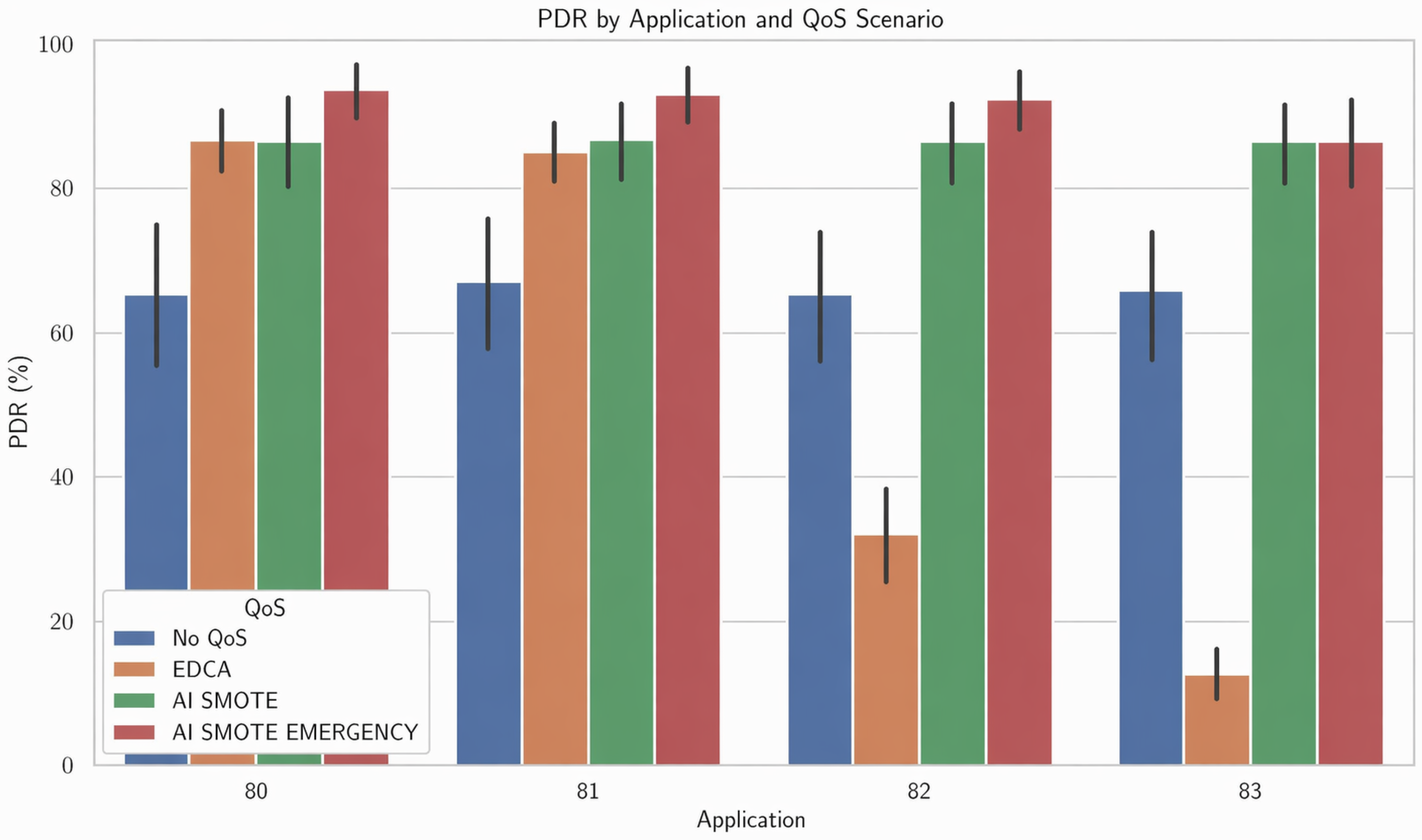
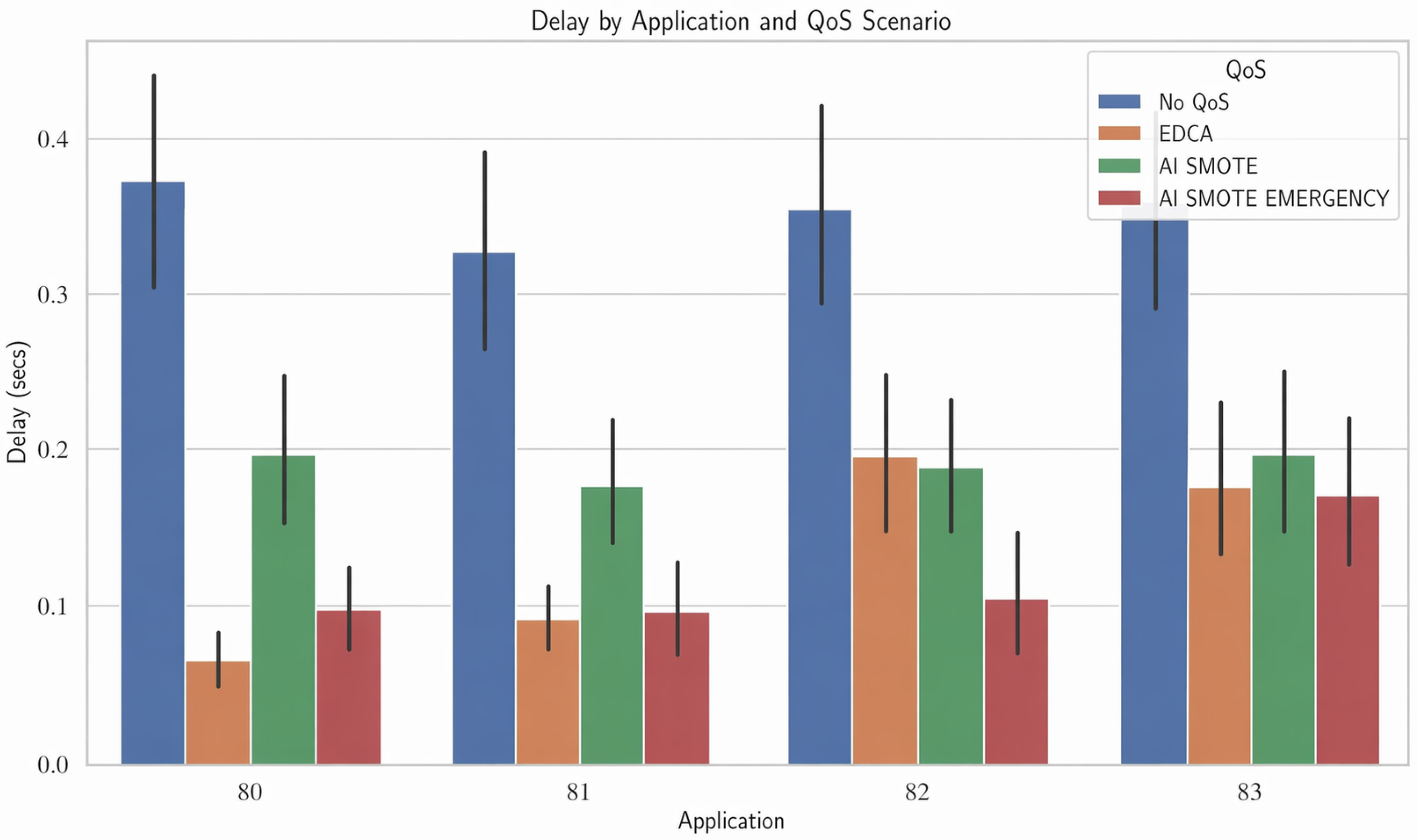
Figure 9,
Figure 10 and
Figure 11 present the simulation results for the Square topology (400 m inter-drone distance, 2–3 hops).
Figure 9 shows that AI SMOTE EMERGENCY achieves approximately 90% PDR uniformly across all four ports, compared with approximately 63% under No-QoS. Notably, EDCA severely degrades ports 82 and 83 (approximately 23% and 14% PDR, respectively), whereas the ML-based schemes maintain high delivery for all applications.
Figure 10 reveals that the end-to-end delay for port 80 drops from approximately 0.37 s under No-QoS to approximately 0.10 s under AI SMOTE EMERGENCY, a 73% reduction.
Figure 11 demonstrates the throughput-level prioritization: port 80 receives approximately 150 kbps under AI SMOTE EMERGENCY versus 112 kbps under No-QoS (34% increase), while port 83 (lowest priority) is reduced to approximately 45 kbps, confirming that the model reallocates channel resources toward emergency traffic.
Figure 12 presents the PDR results for the Star topology (15 m, single hop). In this compact configuration, all nodes share the same collision domain, resulting in high contention. AI SMOTE EMERGENCY achieves approximately 93% PDR for port 80, compared with 65% under No-QoS (43% improvement). The corresponding throughput and delay figures show that port 80 receives approximately 155 kbps (versus 114 kbps under No-QoS) with delay reduced from 0.33 s to 0.10 s. EDCA achieves the lowest delay for port 80 (approximately 0.06 s) but at the cost of starving ports 82–83 to 13–31% PDR, whereas AI SMOTE EMERGENCY maintains high PDR for all ports simultaneously.
Figure 13 shows the PDR for the Rectangle topology (100 m, 1–2 hops), which represents an intermediate scenario. AI SMOTE EMERGENCY achieves approximately 89% PDR for port 80 versus 61% under No-QoS (46% improvement), while maintaining similarly high PDR (91–93%) for ports 81–83. The throughput results confirm the prioritization pattern: port 80 receives approximately 148 kbps under AI SMOTE EMERGENCY versus 109 kbps under No-QoS (36% increase), and delay drops from 0.37 s to 0.11 s (70% reduction). This topology indicates that the CatBoost model remains effective across the evaluated congestion regimes, consistently reallocating resources toward emergency traffic without degrading overall delivery reliability.
4.3. Computational Complexity
A key claim of this work is that the proposed QoS framework is lightweight enough for real-time deployment on resource-constrained UAV hardware. To substantiate this claim,
Table 9 compares the three top-accuracy models (CatBoost, LightGBM, and k-NN, all achieving 0.947 accuracy) along three operational dimensions: serialized model size, deserialization (load) time, and inference throughput.
CatBoost achieves the fastest deserialization time (1.11 ms) and the highest inference throughput (1244 predictions per second), corresponding to an inference latency of approximately 0.804 ms per sample. Given that the inter-packet interval in the simulated FANET is exponentially distributed with a mean of 1.0 s, the CatBoost inference time is three orders of magnitude below the packet generation rate, confirming that the model introduces negligible computational overhead. In contrast, k-NN requires storing the entire training dataset in memory (48.1 MB) and performing distance computations at inference time, which limits its throughput to 312 predictions per second and makes it impractical for memory-constrained UAV platforms. LightGBM offers competitive performance but exhibits approximately twice the load latency of CatBoost. The neural network, despite being the only deep learning candidate, combines the lowest accuracy (0.669) with by far the largest model size (1.2 GB) and the slowest inference, making it unsuitable for edge deployment.
4.4. Robustness and Energy Analysis
This subsection evaluates two complementary aspects of the proposed framework: cross-topology robustness and energy efficiency. Regarding robustness, the AI SMOTE EMERGENCY scheme achieves consistent PDR improvements of 43–46% over No-QoS across all three representative topologies—Star (single-hop, 15 m), Rectangle (1–2 hops, 100 m), and Square (2–3 hops, 400 m)—despite significant differences in hop count, contention level, and channel conditions. This consistency indicates that the CatBoost model generalizes well across the range of congestion regimes captured by the four input features, rather than overfitting to a single topology configuration.
As defined in the Methodology (
Section 3), the energy analysis considers only radio transceiver energy (electronics and amplifier dissipation), not the propulsion energy required for UAV flight. This scope is appropriate because the QoS admission control mechanism affects only packet transmission decisions; propulsion energy remains constant regardless of the communication protocol employed.
The energy implications of QoS-aware admission control are quantified using the radio energy model of Heinzelman et al. [
38], as introduced in
Section 3. The energy expended by a UAV node to transmit a
k-bit message over a distance
d is:
and the energy required to receive the same message is:
where
nJ/bit is the electronics dissipation (identical for transmitter and receiver), and
pJ/bit/m
2 is the transmitter amplifier coefficient. For the 1000-byte packets used in our simulations (
bits), the per-hop energy costs are:
In a multi-hop path of
h hops, each intermediate relay both receives and retransmits the packet, so the total path energy per transmission attempt is:
Table 10 reports
and
for the four representative topologies from
Table 4, using the estimated hop counts therein.
The energy per successfully delivered packet (EPSDP) captures the true energetic cost of reliable communication, penalizing failed transmissions whose energy is entirely wasted:
Without QoS control, every offered packet is injected into the MAC layer regardless of network congestion, and dropped packets waste
entirely. The CatBoost model (AI SMOTE EMERGENCY) reduces this waste by improving PDR from approximately 0.63 to 0.90 across the evaluated topologies: fewer packets are lost, so less energy is wasted on failed transmissions.
Table 11 compares EPSDP for the No-QoS and AI SMOTE EMERGENCY scenarios using PDR values for the emergency application (port 80) obtained from our ns-3 simulations (
Figure 9,
Figure 10,
Figure 11,
Figure 12 and
Figure 13).
The results demonstrate that the improved PDR under AI SMOTE EMERGENCY translates directly into communication energy savings of approximately 30% per successfully delivered packet (EPSDP) across all evaluated topologies. This value is derived directly from the EPSDP formula () applied to the simulation-measured PDR values, and corresponds exclusively to radio transceiver energy savings. Since , the higher PDR achieved by the CatBoost model (0.89–0.93 versus 0.61–0.65 under No-QoS) reduces the effective energy cost per delivered packet. Moreover, the absolute energy wasted per failed packet grows with hop count: in the Square topology (400 m, 3 hops), each failed transmission dissipates 386 mJ across the relay chain, making the 30% EPSDP reduction increasingly significant in absolute terms as network scale grows. This improvement is attributable to the model’s 94.7% classification accuracy over the four congestion features (, , , ), which enables reliable identification of channel conditions that would lead to packet loss.
5. Discussion
5.1. Model Selection and Performance Analysis
Among the ten evaluated machine learning algorithms, CatBoost, LightGBM, and k-NN achieved the highest classification accuracy of 0.947. However, the selection of CatBoost for deployment was driven by a multi-criteria evaluation encompassing accuracy, model load latency, and inference throughput. As reported in
Table 9, CatBoost achieved the fastest deserialization time (1.11 ms) and the highest inference throughput (1244 predictions per second), both of which are critical for real-time packet admission decisions in FANET environments where inter-packet intervals are on the order of one second.
The superior performance of gradient boosting methods (CatBoost, LightGBM, XGBoost, Gradient Boosting) over simpler classifiers can be attributed to their ability to model nonlinear interactions between the four congestion features (, , , ). Decision Trees and Naive Bayes, which rely on axis-aligned splits or feature independence assumptions, cannot capture these interactions effectively, resulting in accuracies of 0.813 and 0.867, respectively.
In contrast, the neural network model exhibited significantly lower performance (accuracy of 0.669) despite its high representational capacity. This result is attributable to the limited size of the training dataset, which is insufficient to adequately train even a moderately sized architecture (19,448 parameters). Deep learning models typically require orders of magnitude more training samples than tree-based methods to achieve competitive performance, which makes them less suitable for scenarios where data collection is constrained by simulation cost.
5.2. Comparison with State of the Art
Compared to existing ML-based QoS approaches for UAV networks, the proposed AI SMOTE EMERGENCY framework offers several advantages. Elmadina et al. [
33] report a 28.57% improvement in data rate using GA-DDRL, but their approach requires computationally intensive reinforcement learning training that is impractical for onboard UAV deployment. Similarly, Dhuheir et al. [
34] achieve a 30% QoS improvement using DRL combined with PSO, yet the inference complexity of deep reinforcement learning policies far exceeds the sub-millisecond budget available in 802.11p packet scheduling. In contrast, the proposed CatBoost-based scheme achieves a 43% PDR improvement over the No-QoS baseline, increases emergency throughput by 34–36%, and reduces delay by approximately 70%, with an inference time of only 0.804 ms per sample. This demonstrates that lightweight supervised learning can outperform complex RL-based approaches when the problem is formulated as a binary classification task over readily available network state features.
Furthermore, unlike Varghese et al. [
35], who rely on field tests in a single suburban environment, this work integrates real UAV propagation measurements across multiple altitudes (14–100 m) into the ns-3 simulation, providing a more controlled and reproducible experimental framework. The LARP-EQ protocol proposed by Farithkhan et al. [
30] achieves a 20% PDR improvement through protocol-level optimization but does not address throughput allocation or delay for differentiated services. In contrast, the AI SMOTE EMERGENCY scheme achieves a 43% PDR improvement while simultaneously increasing emergency throughput and reducing delay, and—unlike EDCA—does so without degrading low-priority applications (which retain 85–93% PDR versus 13–33% under EDCA).
5.3. Impact of Topology on QoS Performance
Among the evaluated topologies, the Rectangular, Square, and Star mobility patterns yielded the best simulation performance. The Star topology (15 m inter-drone distance) benefits from single-hop communication, achieving the highest PDR (93%) under AI SMOTE EMERGENCY and the lowest absolute delay. The Rectangle topology (100 m, 1–2 hops) shows the largest relative PDR improvement (46%) and throughput gain (36%). A consistent pattern emerges across all topologies: AI SMOTE EMERGENCY improves PDR by 43–46% over No-QoS while maintaining uniform delivery across all four ports, in contrast to EDCA which achieves priority differentiation by starving low-priority applications (ports 82–83 degrade to 13–33% PDR). This uniform-PDR, throughput-differentiated approach is more suitable for emergency scenarios where all application data—including non-critical telemetry—must reach the base station reliably.
5.4. Limitations
This work has several limitations that should be acknowledged. First, the network topology comprises only 7 nodes (6 UAVs and 1 base station), which validates the feasibility of the cross-layer approach but does not fully characterize scalability to larger swarms. Second, the CatBoost model relies on only four input features; incorporating additional features such as node velocity, link quality indicators, or queue occupancy trends could further improve classification accuracy. Third, the propagation models are derived from measurements at the Yachay Tech campus, and their generalizability to other geographic environments (e.g., dense urban areas, maritime settings) requires further validation. Fourth, the current evaluation relies on a fixed train–validation–test split rather than a grouped validation strategy across mobility topologies. Although the dataset includes samples from 13 different topologies, a topology-grouped validation protocol would provide a stricter assessment of generalization to unseen FANET configurations. Finally, the SMOTE balancing technique, while effective for addressing class imbalance, may introduce synthetic samples that do not fully represent the diversity of real network conditions.
6. Conclusions
This study explored multi-UAV wireless networks as an efficient alternative when infrastructure-based connections are disrupted, either due to power outages or natural disasters. We developed mobility patterns based on different topologies of the Yachay Tech campus to design a Quality of Service (QoS) scheme that prioritizes emergency applications, which operate through port 80.
Additionally, several machine learning models were trained to optimize connectivity between drones. The selected model ensures an efficient Packet Delivery Ratio (PDR) across various applications, regardless of their priority level.
The proposed AI SMOTE EMERGENCY QoS management system establishes a priority hierarchy for ports based on differentiated thresholds. In this scheme, port 80, used for emergency applications, has the lowest admission threshold of 0.5, thereby granting it the highest transmission priority.
Regarding robustness, each UAV node operates within a coverage range of 5 km, which defines the communication radius in the simulated area of 5 km × 5 km. This constraint ensures that the network topology remains realistic, as nodes must maintain proximity to sustain reliable links. Within the evaluated simulation setting, the proposed QoS scheme combined with the CatBoost model maintained stable PDR and low delay under varying mobility patterns and topology changes, supporting the feasibility of the approach under the considered FANET conditions.
In terms of scalability, the complexity of this work lies in the cross-layer simulation spanning the physical layer (802.11p propagation with custom LoS/NLoS models), the MAC layer (EDCA channel access), the network layer (OLSR routing protocol), and the application layer (multi-port traffic generation with differentiated QoS policies). Integrating machine learning-based QoS optimization across all four layers within the ns-3 simulator represents a significant computational effort. The current scenario with 7 nodes validates the feasibility of this cross-layer approach; however, extending the framework to larger swarms will require addressing the increased overhead in routing, channel contention, and model inference time.
As future work, we plan to evaluate the proposed framework under larger UAV swarms, more diverse geographic environments, and more complex channel conditions in order to better assess its robustness beyond the current campus-based validation setting. We also plan to incorporate stricter topology-grouped validation strategies and to analyze how the computational cost of the full cross-layer pipeline scales with network size.
In addition, future work will replace the current fixed train–validation–test split with a Leave-One-Topology-Out (LOTO) cross-validation protocol combined with nested hyperparameter search, in which SMOTE is re-fitted within each training fold to avoid leakage between topologies. This will provide a stricter, topology-aware assessment of the generalization of the proposed AI SMOTE EMERGENCY scheme to unseen FANET configurations, and will allow PDR, throughput, and delay to be reported with fold-level confidence intervals rather than as point estimates.
Following this stricter validation, a systematic feature-importance analysis of the proposed AI SMOTE EMERGENCY scheme will be carried out, combining CatBoost’s built-in importance scores with model-agnostic techniques such as SHAP values and permutation importance over the four input features (, , , ). This analysis will quantify the individual contribution of each congestion-related descriptor to the QoS decision, providing interpretability that is valuable in safety-critical emergency deployments, guiding the selection of the additional link quality descriptors mentioned below (RSSI/SNR, node velocity, neighborhood density), and identifying low-impact features that could be pruned to further reduce inference latency without degrading classification accuracy.
In conclusion, the machine learning model CatBoost (AI SMOTE EMERGENCY) emerges as the most effective strategy to maximize performance (throughput), ensure reliable packet delivery (PDR), and minimize delay in multi-UAV communications. Although the proposed model achieved strong performance using only four lightweight congestion-related features, future work will investigate the inclusion of richer descriptors such as node velocity, neighborhood density, RSSI/SNR, and other link quality indicators to improve robustness under more complex and rapidly changing FANET topologies.





 ,
,