1. Introduction
Mitochondria are double-membrane organelles that undergo regulated cycles of fusion and division to maintain cellular and organismal homeostasis [
1,
2,
3]. Dysregulation of these dynamic processes contributes to various pathological conditions, such as inflammation, metabolic disorders, neurodegeneration, and cancer [
4,
5]. Mitochondrial dynamics are primarily coordinated by large GTPases: Mitofusin 1 (MFN1) and Mitofusin 2 (MFN2) mediate outer mitochondrial membrane (OMM) fusion, while Optic Atrophy 1 (OPA1) controls inner mitochondrial membrane (IMM) fusion [
6]. Mitochondrial division is mediated by Dynamin Related Protein 1 (DRP1), a monomeric cytosolic protein that translocates to the OMM upon activation, binds to adaptor proteins (e.g., Mitochondrial Fragmentation Factor, MFF), and oligomerizes to mediate GTP-dependent scission of both the OMM and IMM [
2].
Mitochondrial fusion ensures the proper exchange of lipids, metabolites, mtDNA, and proteins between mitochondria, which is essential for maintaining organelle function [
1]. Mitochondrial division is critical for the distribution of mitochondria to daughter cells during mitosis, subcellular localization of mitochondria to meet local metabolic demands, and facilitating mitochondrial quality control [
2]. The regulation of DRP1-dependent mitochondrial division is a central regulator of disease biology across multiple organ systems. When DRP1 is hyperactivated or suppressed, it directly impacts metabolism, apoptosis, inflammation, and cell fate. As such, DRP1 is subject to a variety of post-translational mechanisms (e.g., phosphorylation) that regulate DRP1 activation, membrane translocation, and oligomer stabilization [
7].
The Mitogen-Activated Protein Kinase (MAPK) pathway is a master regulator of proliferation, differentiation, and survival that directly controls DRP1 function [
8]. Previous studies suggest a mechanistic connection between oncogene-induced MAPK (e.g., RAS
Q61R, BRAF
V600E) signaling and mitochondrial dynamics. Specifically, ERK1/2 (p42/p44) phosphorylates DRP1 at serine 616 (DRP1-S616Ⓟ), thus activating DRP1 translocation to the OMM and mitochondrial division [
9]. Oncogene-induced chronic mitochondrial division leads to impaired mitochondrial function, characterized by reduced oxidative phosphorylation and an increased reliance on alternative metabolic pathways. The literature suggests that DRP1-dependent mitochondrial division is essential to cancer mechanisms as silencing DRP1 inhibits transformation [
9]. Furthermore, pharmacological inhibition of MAPK signaling in RAS and BRAF mutant human cancer models eliminates DRP1-S616Ⓟ, resulting in hyperfused mitochondria, reactivation of mitochondrial function, and sensitization to cell death [
9]. DRP1-S616Ⓟ is observed in tumors with oncogenic MAPK mutations and is suggested to support the development and growth of breast, colon, glioblastoma, lung, pancreatic, and skin cancers [
10,
11,
12,
13,
14,
15].
In the majority of cutaneous melanomas, the BRAF
V600E mutation occurs early in pathogenesis but is insufficient to induce malignancy and requires additional events to initiate disease [
16,
17]. One downstream event subsequent to BRAF
V600E-induced transformation is sustained DRP1-S616Ⓟ, suggesting chronic mitochondrial division may be a robust biomarker for BRAF
V600E melanoma and progression. Indeed, DRP1-S616Ⓟ status dichotomized with BRAF
V600E and was detected in ~80% of nevi that subsequently progressed to melanoma, where it persisted throughout the melanomagenesis process [
18]. This persistence highlights the potential for DRP1-S616Ⓟ as a reliable indicator for disease initiation and a promising tool for improving our understanding of melanoma biology. However, most antibodies raised against DRP1-S616Ⓟ are traditional monoclonals with undefined variable heavy/light regions (VH/L), restricted by commercial availability and cost, and the early generation hybridomas are subject to genetic drift, potentially impacting their specificity. To circumvent these constraints, we developed a recombinant monoclonal DRP1-S616Ⓟ antibody, derived from a human DRP1 peptide, referred to as 3G11. We validated the 3G11 antibody using a range of techniques, including immunoblotting, immunofluorescence, and immunohistochemistry in melanoma models and patient tissues. These data support the specificity of 3G11 for DRP1-S616Ⓟ and highlight its potential utility in detecting oncogene-induced chronic mitochondrial division in melanoma and diverse disease models and patient samples.
2. Materials and Methods
2.1. Reagents
Opti-MEM Reduced Serum Media (Gibco, Waltham, MA, USA, Cat. No. 31985-070) was supplemented with 5% FBS, 1% penicillin/streptomycin, 0.01 μg/mL heparin (Sigma-Aldrich, Darmstadt, Germany, Cat. No. H3393), 0.01 μg/μL human FGF-basic (Gibco, Waltham, MA, USA, Cat. No. PHG0026), 0.05 mg/mL dibutyryl cyclic-AMP sodium salt (Sigma-Aldrich, Darmstadt, Germany, Cat. No. DO627), and 0.1 mM 3-isobutyl-1-methylxanthine (Sigma-Aldrich, Darmstadt, Germany, Cat. No. I5789). 2% Tumor Media was prepared with L-15 (Leibovitz) medium (Sigma Aldrich, Darmstadt, Germany, Cat. No. L486) and supplemented with 2.5 μg/mL insulin solution (Sigma Aldrich, Darmstadt, Germany, Cat. No. I0516), 0.187 mg/mL calcium chloride dihydrate (Sigma Aldrich, Darmstadt, Germany, Cat. No. C7902), 1.5 mg/mL sodium bicarbonate (Santa Cruz Biotechnology, Dallas, TX, USA, Cat. No. 203271A), 17.53 g/L MCDB 153 powder (Sigma Aldrich, Darmstadt, Germany, Cat. No. L1518-500ML), 1% penicillin/streptomycin, and 2% FBS. Following preparation, 2% Tumor Media was filtered using a 0.2 micron sterile Nalgene filter unit with polyethersulfone (ThermoFisher-Scientific, Waltham, MA, USA, Cat. No. 567-0020). Dulbecco’s Modification of Eagle’s Medium (DMEM) (Corning, Corning, NY, USA, Cat. No. 10-017-CV) was supplemented with 3% FBS, 1% penicillin/streptomycin, and 1% L-glutamine. The drugs used in this study are GSK1120212 (Selleck Chemicals, Houston, TX, USA, Cat. No. S2673) and PLX4032 (Selleck Chemicals, Houston, TX, USA, Cat. No. S1267). The antibodies utilized for Western blot are total DRP1 (Cell Signaling Technology, Danvers, MA, USA, Cat. No. 8570), DRP1-S616Ⓟ (Cell Signaling Technology, Danvers, MA, USA, Cat. No. 3455S), DRP1-S637Ⓟ (Cell Signaling Technology, Danvers, MA, USA, Cat. No. 4867S), total ERK (Cell Signaling Technology, Danvers, MA, USA, Cat. No. 137F5), ERK1/2Ⓟ (Abcam, Cambridge, UK, Cat. No. AB278538), β-Actin (Abcam, Cambridge, UK, Cat. No. ab8227), TOMM20 (Santa Cruz Biotechnology, Dallas, TX, USA, Cat. No. SC-17764), MFN1 (Santa Cruz Biotechnology, Dallas, TX, USA, Cat. No. SC-166644), MFN2 (Santa Cruz Biotechnology, Dallas, TX, USA, Cat. No. SC-515647), and OPA1 (Invitrogen, Carlsbad, CA, USA, Cat. No. MA5-32786). For microscopy, cells were stained for HSP60 (Cell Signaling Technology, Danvers, MA, USA, Cat. No. 12165) or TOMM20 (Santa Cruz Biotechnology, Dallas, TX, USA, Cat. No. SC-17764), Alexa Fluor® 594-conjugated goat anti-mouse IgG secondary antibody (ThermoFisher-Scientific, Waltham, MA, USA, Cat. No. A11032), and Alexa Fluor® 488-conjugated goat anti-rabbit IgG secondary antibody (ThermoFisher-Scientific, Waltham, MA, USA, Cat. No. A11034). Cells were co-stained with Hoechst 33342 (ThermoFisher-Scientific, Waltham, MA, USA, Cat. No. H3570) to visualize nuclei. For immunohistochemistry, tissues were stained with recombinant 3G11 and BRAFV600E (Cell Signaling Technology, Danvers, MA, USA, Cat. No. 2900S).
2.2. Cell Culture
The YUPEET human-derived primary melanoma cell line was cultured in Opti-MEM Reduced Serum Media. The WM35, WM853, WM902, WM983, and WM1152 human-derived primary melanoma lines were cultured in 2% Tumor Media. A375 and SKMEL28 human-derived non-primary (i.e., lymph node and secondary metastasis-derived, respectively) melanoma lines were purchased from ATCC and cultured in DMEM media. All cell lines were cultured at 37 °C in a humidified 5% CO2 incubator, passaged every 3–4 days, and regularly tested for mycoplasma contamination.
2.3. Immunizations and Hybridoma Generation
Animal experiments were conducted in accordance with the ARRIVE (Animal Research: Reporting of In Vivo Experiments) guidelines and complied with institutional and national regulations for the care and use of laboratory animals. All procedures were approved by the Institutional Animal Care and Use Committee (IACUC) (#IPROTO202200000097). Animals were housed in an AAALAC-accredited facility under controlled environmental conditions (temperature, humidity, and 12 h light/dark cycle) with ad libitum access to food and water. Standard husbandry practices were followed, including routine health monitoring and provision of environmental enrichment. All efforts were made to minimize pain and distress. Blood collection via submandibular vein sampling and surgical procedures, including splenectomy, were performed using approved anesthetic and/or analgesic regimens in accordance with institutional guidelines. Animals were closely monitored throughout the study for signs of pain or distress, including changes in body weight, activity, posture, and grooming behavior. Humane endpoints were predefined, and animals were euthanized if they exhibited signs of significant distress, including sustained weight loss, reduced mobility or inactivity, or failure to groom. The study design adhered to the principles of the 3Rs. Reduction was achieved by using the minimal number of animals necessary to obtain robust results (n = 5), and refinement was implemented through appropriate anesthesia, analgesia, and monitoring to minimize discomfort. Replacement alternatives are currently not applicable for hybridoma-based monoclonal antibody generation, which requires in vivo immunization.
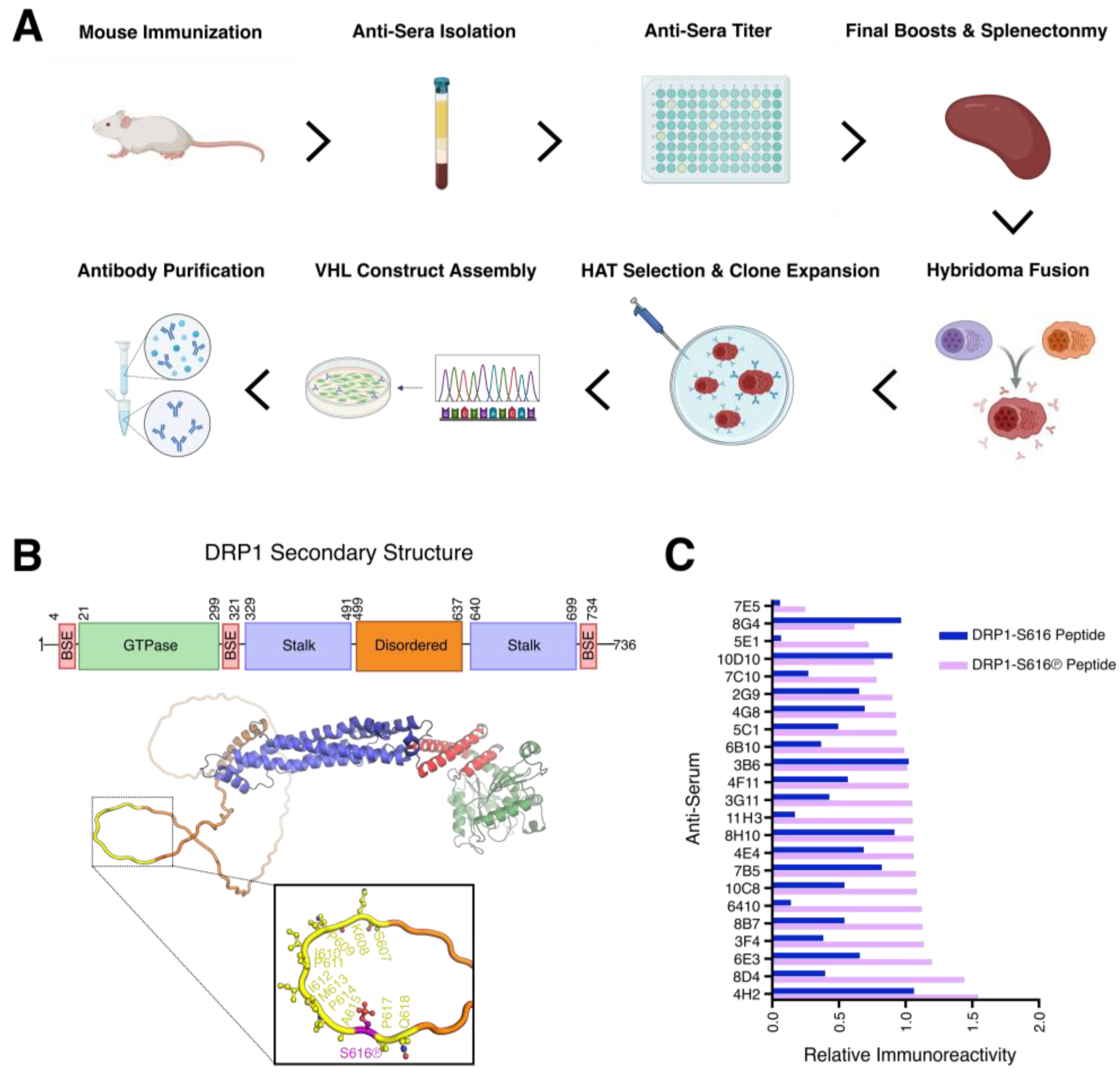
For hybridoma generation, five 8-week-old BALB/c female mice were primed subcutaneously (s.c.) with 80 µg (40 µg in each rear flank) of a keyhole limpet hemocyanin (KLH) conjugated DRP1 peptide spanning amino acid residues 607–620, in which Serine 616 was phosphorylated (KLH-Cys-SKPIPIMPA{pSer616}PQKG) (GenScript USA Inc., Piscataway, NJ, USA) in the presence of complete Freund’s adjuvant (CFA). Four weeks after priming, a total of two more boosts commenced in the same manner in the presence of incomplete Freund’s adjuvant. After immunizations, blood was collected from the submandibular vein before each boost to monitor the titer of serum antibodies by enzyme-linked fluorescent immunosorbent assay (ELISA).
For the ELISA, plates (ThermoFisher Scientific, Waltham, MA, USA, Cat. No. 2205) were coated with 100 µL of 10 µg/mL peptide in 1× PBS, followed by blocking with 1% BSA/PBS and washing (3×) using a BioTek 405 microplate washer (Agilent Technologies, Santa Clara, CA, USA). Serum was diluted in 1% BSA/PBS and added to the coated well. After 3× washes, goat anti-mouse IgG-HRP (1:4000 in 1% BSA/PBS) (Jackson ImmunoResearch Labs, West Grove, PA, USA; Cat. No. 115-035-003) was added and positive wells were detected with ABTS substrate solution (Roche, Sommerville, CA, USA, Cat. No. 11684302001). All incubation steps were performed at 25 °C for 1 h. Unimmunized sera were also added as a negative control. The mouse with the highest titer at the 1:10,000 dilution that was also >2× the negative control was selected for hybridoma fusion and received 2 final boosts of 150 µg BSA-conjugated phosphorylated-DRP1 peptide s.c. (50 µg in 3 sites) over 2 days. A final bleeding (“fusion sera”) and terminal splenectomy were performed 3 days after the last final boost. The spleen was processed to a single-cell suspension and fused in the presence of ClonaCell HY-PEG (Stemcell Technologies, Vancouver, BC, Canada; Cat. No. 03806) with Sp2/0 hetero-myeloma fusion partners. Individual hybridoma B cell clones were grown under selection on soft agar containing hypoxanthine-aminopterin-thymidine (HAT), and expanded colonies were picked ten days later into 96-well tissue culture plates using a robotic ClonaCell Easy Pick instrument (Hamilton/Stem Cell Technology, Vancouver, BC, Canada) in ClonaCell HY-Medium E (Stemcell Technologies; Vancouver, BC, Canada; Cat. No. 03805). Clones were expanded, and the supernatant was used to screen for DRP1 detections.
2.4. Dot Blot Analyses
Indicated peptides were solubilized in 1× PBS, 10 µL of 10 µg/mL of peptide was manually spotted onto nitrocellulose membranes, and the membranes were dried. Membranes were rehydrated in 1× PBST and blocked in 4% nonfat dry milk in 1× PBST. Membranes were incubated with either the indicated anti-serum or commercially available DRP1 and DRP1-S616Ⓟ antibodies diluted in blocking buffer (1:1000, 4% milk in 1× PBST) at 4 °C for 14 to 16 h. After incubation, blots were washed with 1× PBST and visualized using enhanced chemiluminescence detection (Millipore, Burlington, MA, USA, Cat. No. WBLUF0100).
2.5. Cloning and Expression of the 3G11 Antibody
Sequencing of the 3G11 antibody was performed using SMARTer 5′ RACE technology (Takara Bio, MoutainView, CA, USA, Cat. No. 634858) adapted for immunoglobulins to amplify the variable genes from the heavy and kappa chains from the 3G11 hybridoma. Briefly, RNA was extracted from the hybridoma using a RNeasy Mini Kit (Qiagen, Hilden, Germany, Cat. No. 74104), followed by first-strand cDNA synthesis using constant gene-specific 3′ primers (GSP1) based on mouse IgG/mouse kappa constant isotypes and incubation with the SMARTer II A Oligonucleotide and SMARTscribe reverse transcriptase (Takara, MoutainView, CA, USA).
GSP1 Primers (5′–3′):
mG1-AGAGGTCAGACTGCAGGACA, mG2a- CTTGTCCACTTTGGTGCTGC,
mG2b-GACAGTCACTGAGCTGCTCA, mG2b-GACAGTCACTGAGCTGCTCA,
and mcK-CCAACTGTTCAGGACGCCAT.
PCR amplification of the first-strand cDNA product was then performed using SeqAmp DNA Polymerase (Takara, MoutainView, CA, USA, Cat. No. 638504) with a nested 3′ primer (GSP2 Primer) to the constant genes and a 5′ universal primer (kit provided) based on universal primer sites added to the 5′ end during cDNA generation.
GSP2 Primers (5′–3′):
mG1-CCCAGGGTCACCATGGAGTT, mG2a-GGTCACTGGCTCAGGGAAAT,
mG2b-CTTGACCAGGCATCCCAGAG, mG3-GACAGGGCTCCATAGTTCCATT,
and mCk-CTGAGGCACCTCCAGATGTTAAC.
Purified PCR products were submitted for Sanger sequencing using 3′ constant gene primers (GeneWiz, South Plainfield, NJ, USA). Sequence results were BLASTed against the IMGT mouse databank of germline genes using V-Quest (
https://www.imgt.org/, accessed on 8 January 2026). Complete 3G11 heavy and kappa chain variable region cDNAs were then synthesized with an Il-2 signal sequence and cloned into a pcDNA-3.4 mammalian expression vector in-frame on the 3′ end to a vector-encoded mouse IgG2a constant region (heavy chain) or a mouse kappa constant region (light chain) (GenScript USA Inc., Piscataway, NJ, USA). Cloned vectors representing full heavy and kappa chains were then transfected in a 1:1 ratio into HEK Expi293 suspension cells using ExpiFectamine transfection reagent following manufacturer instructions (ThermoFisher, Waltham, MA, USA, Cat. No. A14524). Supernatant was collected 5 days after initial transfection, filtered (0.45 micron), and subjected to quantitation/verification by bio-layer interferometry (BLI) and purification.
2.6. Quantitation and Verification of 3G11 Supernatant
For BLI analysis, 3G11 supernatant was quantitated and verified on an Octet Red96 (ForteBio, Sartorius, Goettiengen, Germany). Optically capable biosensors conjugated with Protein A were dipped into supernatants containing the 3G11 mAb. Supernatants were measured undiluted and diluted 1:10 in conditioned media and compared to an isotype standard (mIgG2a), diluted in conditioned media in a 1:2 dilution series ranging from 100 µg/mL to 1.56 µg/mL. Standard curves were analyzed in the ForteBio Data Analysis Software v.10 (ForteBio, Goettiengen, Germany) using a 5 parameter logistics (5PL) dose response curve fitting model on the initial binding slopes. MAb concentrations are then calculated from the standard curve. Diluted samples were compared to undiluted samples after application of the respective dilution factors. Total concentrations were averaged together from the diluted and undiluted samples.
2.7. 3G11 Antibody Purification
The supernatant was purified on an ÄKTA pure FPLC system using a Protein-A affinity column (HiTrap-1 mL, GE/Cytiva, Uppsala, Sweden, #17-0404-01) with UV monitored extraction. A single UV peak fraction was collected, representative of the antibody, dialyzed against PBS and quantitated by both bicinchoninic assay (BCA) (Pierce Biotechnology, Rockford, IL, USA, Cat. No. 23225) and absorption at OD 280 nm. 3G11 yielded ~4–10 μg/mL across ~300 mL of culture over three production runs, resulting in ~2.1 mg total purified antibody.
2.8. In Vitro Kinase Assay and Analysis
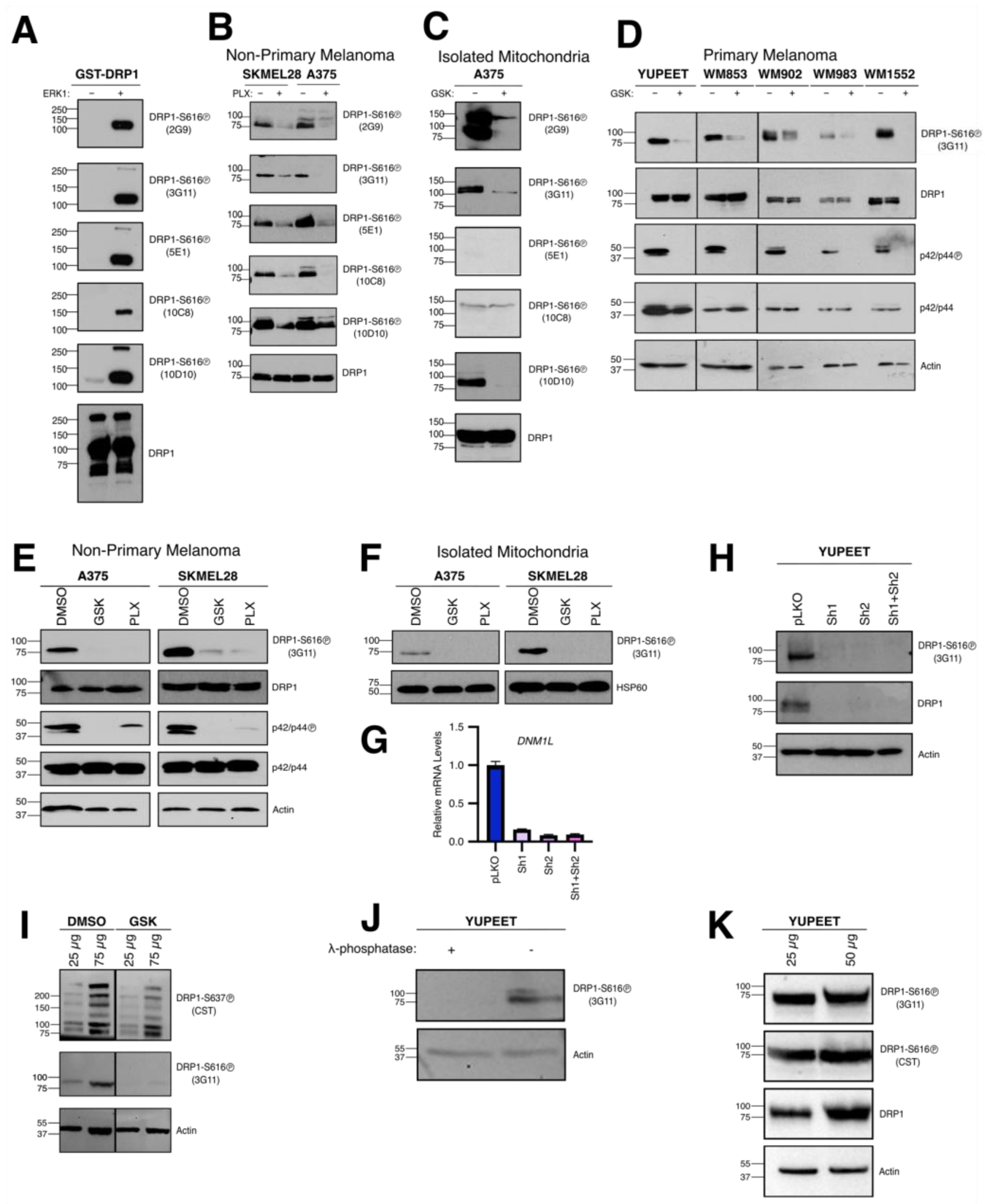
Recombinant, GST-tagged, full-length, human DRP1 protein (10 ng/μL) [
19] was incubated with recombinant ERK1 kinase (2 ng/μL; Sigma, Darmstadt, Germany, Cat. No. 14-439-M) in kinase buffer (50 mM Tris-HCl pH 7.4, 30 mM NaCl, 15 mM MgCl
2, 200 μg/mL BSA, 2 mM DTT, and 1 mM ATP) at 37 °C for 30 min. The reaction was terminated by the addition of 4× SDS loading buffer (0.2 M Tris-HCl, 0.4 M 2-mercaptoethanol, 277 mM SDS, 6 mM Bromophenol Blue, 4.3 M Glycerol). DRP1 (100 ng/lane) was subjected to SDS-PAGE, followed by standard Western blotting. The nitrocellulose membrane was blocked in 5% dried nonfat milk in 1× TBST and incubated with primary antibodies (1:1000; 5% milk in 1× TBST) at 4 °C for 14 to 16 h. The membrane was then washed 3 times with 1× TBST, incubated with the secondary antibody (1:2500; 5% milk in 1× TBST) at 25 °C for 1 h, washed 3 times with 1× TBST, and detected using enhanced chemiluminescence (Millipore, Burlington, MA, USA Cat. No. WBLUF0100).
2.9. Lentiviral Short Hairpin RNA (shRNA) Generation
pLKO control (SHC007, TRC2), sh1-DNM1L (TRCN0000001097), and sh2-DNM1L (TRCN0000001099) lentiviral vectors were obtained from Sigma Mission shRNA. Lentiviral particles were produced in HEK293T cells. In brief, HEK293T cells were seeded in three 10 cm dishes at a density of 4 × 10⁶ cells per dish. The following day, cells were transfected using Lipofectamine 2000 (Thermo Fisher Scientific, Waltham, MA, USA, Cat No. 11668019) in Opti-MEM (Gibco, Waltham, MA, USA, Cat. No.31985-070). For each viral construct, two transfection mixtures were prepared. The first contained 12 µL Lipofectamine 2000 diluted in 250 µL Opti-MEM. The second contained 5 µg of the transfer vector, together with 2 µg of each of the packaging plasmids psPAX2 (Addgene, Watertown, MA, USA, Cat. No. 12260) and pMD2.G (Addgene, Watertown, MA, USA, Cat. No. 12259), diluted in 250 µL Opti-MEM. Each mixture was incubated separately for 5 min at room temperature, then combined and incubated for an additional 15 min to allow complex formation. The transfection mixture was added dropwise to the HEK293T cells. Cells were incubated at 37 °C for 16 h, after which the transfection medium was replaced with fresh DMEM. Viral supernatants were collected at 24 and 48 h after medium change, for a total collection volume of 20 mL per construct. The collected supernatants were passed through a 0.45 micron filter to remove cellular debris. Lentiviral particles were then concentrated using Lenti-X Concentrator (Takara, MoutainView, CA, USA, Cat. No. 631232) according to the manufacturer. The final volume of concentrated lentivirus was 200 µL.
For transduction, YUPEET cells were seeded at 0.2 × 10⁶ cells per 6 cm dish for RNA analysis. Cells were transduced with concentrated lentivirus at 20 µL per 10 cm dish or 10 µL per 6 cm dish and incubated at 37 °C for 48 h. The medium was then replaced with fresh medium containing 2 µg/mL of puromycin (Gibco, Waltham, MA, USA, A11138-03) for selection. After 48 h of puromycin selection, cells were maintained in 1 µg/mL puromycin for 7 days, and harvested for SDS-PAGE/Western blot or RNA extraction.
2.10. Reverse Transcription Polymerase Chain Reaction
Total RNA was extracted from cell pellets with the RNeasy mini kit (Qiagen, Hilden, Germany, Cat. No. 74104), following the manufacturer’s instructions. RNA was quantified using a Nanodrop One Spectrophotometer. 2 μg of RNA was used to synthesize cDNA using the RNA to cDNA EcoDryTM Premix Double Primed 28 (Takara Bio, MoutainView, CA, USA, Cat. No. 639548). Reaction tubes were placed in the thermocycler and subjected to 42 °C for 1 h and 70 °C for 10 min, followed by an indefinite hold at 4 °C until they were moved to storage at −20 °C. Forward and reverse primers for genes of interest (see
Table 1 below) were combined with
Power SYBR Green Master Mix (Applied Biosystems, Carlsbad, CA, USA, Cat. No. 437659), and gene expression was analyzed using a ViiA7 Real-Time PCR system. The expression of relevant genes was normalized to
18S. 2.11. Whole Cell Lysate Isolation and Analysis
One 10 cm dish of cells at 80% confluency was used per condition. Cells were treated with DMSO, GSK1120212 (50 nM), or PLX4032 (1 μM) for 6 h. Cells were trypsinized, pelleted by centrifugation at 800× g for 10 min, washed with pre-chilled 1× PBS, and pelleted again using the same parameters. The cell pellets were lysed by resuspending in 1× RIPA buffer supplemented with protease inhibitors (ThermoFisher-Scientific, Waltham, MA, USA, HALT Tablet, Cat. No. 87786) and phosphatase inhibitors (ApexBio, Houston, TX, USA, Cat. No. k1015b). The suspension was incubated on ice for 10 min and then centrifuged at 21,000× g at 4 °C for 10 min. Protein concentrations were determined using a BCA assay. Cell lysates were adjusted with 1× RIPA buffer to achieve the same protein concentration across samples. 4× SDS loading buffer(0.2 M Tris-HCl, 0.4 M 2-mercaptoethanol, 277 mM SDS, 6 mM Bromophenol Blue, 4.3 M Glycerol) was added to each sample and diluted to a final 1× concentration, Samples were then boiled at 95 °C for 5 min. 75 μg of cell lysate per lane was subjected to SDS-PAGE followed by transferring to a nitrocellulose membrane. The nitrocellulose membrane was blocked in 5% milk/1× TBST and then incubated with primary antibodies (1:1000, 5% milk in 1× TBST) at 4 °C for 14–16 h. The membrane was then incubated with the secondary antibody (1:2500, 5% milk in 1× TBST) at 25 °C for 1 h before enhanced chemiluminescence detection (Millipore, Burlington, MA, USA Cat. No. WBLUF0100).
2.12. Heavy Membrane Isolation and Analysis
At least two 15 cm dishes of cells at 90–95% confluency were used per condition for heavy membrane (i.e., mitochondrial fractions) isolations. Cells were treated with DMSO, GSK1120212 (50 nM), or PLX4032 (1 μM) for 6 h. The cells were harvested by trypsinization and pelleted by centrifugation at 800× g at 4 °C for 10 min. The cell pellets were washed with 1 mL of pre-chilled 1× PBS, pelleted, washed with 1 mL of pre-chilled trehalose isolation buffer (TIB) [300 mM Trehalose, 10 mM HEPES-KOH (pH 7), 10 mM KCl, 1 mM EDTA, 1 mM EGTA], and pelleted by centrifugation at 800× g for 5 min. The cell pellets were resuspended with TIB (supplemented with 1× protease inhibitors, ThermoFisher-Scientific, Waltham, MA, USA, HALT Tablet, Cat. No. 87786) at a 1:1 volume and incubated on ice for 30 min to allow for cell swelling. The suspension was then transferred into a pre-chilled 2 mL Potter-Elvehjem dounce and homogenized with fifty strokes to reach 70–80% cell lysis. The homogenate was then transferred to a 1.5 mL Eppendorf tube and centrifuged at 1000× g at 4 °C for 5 min. The supernatant was collected and centrifuged again under the same conditions to ensure that no unlysed cells or nuclei were present. The resulting supernatants were centrifuged at 10,000× g at 4 °C for 10 min, and the pellets were collected as the heavy membrane fraction. Sample yield was determined using the Pierce BCA Assay Kit, cell lysates were adjusted with 1× RIPA buffer to achieve the same protein concentration across all samples, and 4× SDS loading buffer was added. 50 μg of cell lysate was loaded per lane, and analyzed by SDS-PAGE and Western blotting.
2.13. Lambda Phosphatase Treatment
YUPEET RIPA lysates were prepared at an initial protein concentration of 16.99 μg/μL. Lysates (100 μg) were brought to a final volume of 40 μL with molecular biology-grade water. Reactions were supplemented with 5 μL of 10× NEBuffer for Protein MetalloPhosphatases (New England Biolabs, Ipswich, MA, USA, Cat. No. B0761) and 5 μL of 10 mM MnCl2 (New England Biolabs, Ipswich, MA, USA, Cat. No. B1761). Lambda protein phosphatase (New England Biolabs, Ipswich, MA, USA, Cat. No. P0753S) was added (2 μL) for a total of 800 U/reaction. For untreated controls, 2 μL of molecular biology-grade water was added in place of the enzyme. Samples were mixed gently and briefly centrifuged. Reactions were incubated at 30 °C for 30 min. Following incubation, Laemmli buffer was added to each sample, which were then boiled at 95 °C for 5 min and briefly centrifuged prior to downstream analysis by SDS-PAGE and Western blotting.
2.14. Immunofluorescence (IF)
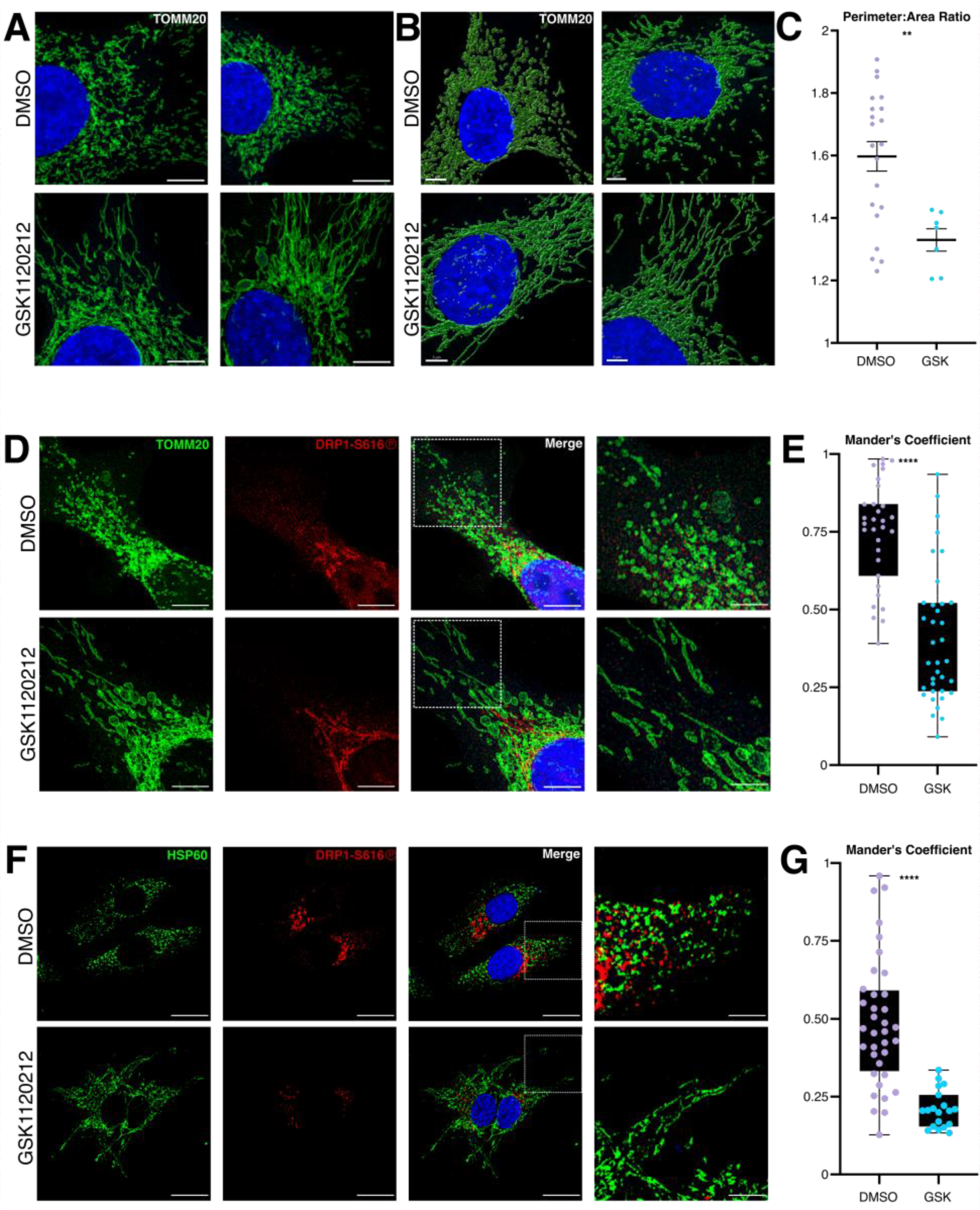
A375 and SKMEL28 cells were seeded on 1.5 mm coverslips (Electron Microscopy Science, Hatfield, PA, USA, Cat. No. 72230-01) and allowed to adhere for 24 h. The next day, cells were treated with GSK1120212 (50 nM) for 16 h. After treatment, cells were washed 3 times with 1× PBS and fixed in 4% formaldehyde for 15 min. The cells were then washed another 3 times in 1× PBS and then permeabilized using 0.3% Triton X-100 at 25 °C for 12 min. Cells were washed again 3 times with 1× PBS and subsequently incubated in the blocking buffer (50% 1× PBS, 4% BSA, and 10% goat serum) at 25 °C for 2 h. Coverslips were incubated with primary antibodies (3G11, 1:3200; TOMM20, 1:400; HSP60:, 1:400) diluted in the blocking buffer at 4 °C for 14–16 h. Secondary antibodies Alexa Fluor® 594 (1:250) and Alexa Fluor® 488 (1:250) were diluted in the blocking buffer and incubated at 25 °C for 1 h. Samples were treated with Hoechst 33342 (1:5000), mounted with ProLong Glass (ThermoFisher, Waltham, MA, USA, Cat. No. P36980) and cured at 4 °C overnight.
Images were captured at the Mount Sinai Tisch Cancer Center Microscopy and Advanced Bioimaging Shared Resource. Images were acquired with LAS X software (Leica Application Suite X 4.3.0.24308) on Leica Stellaris 8 (Leica Microsystems GmbH, Wetzlar, Germany) confocal microscope. Imaging was performed using a 63×/1.3 HC PlanApo oil immersion lens (Leica Microsystems GmbH, Wetzlar, Germany), the frame size was set to 2048 × 2048 pixels (X/Y), and images were acquired at 8 bits. The acquisition was performed at frame scan mode, using 1 frame averaging and 2 line accumulation. Fluorophores were excited with a 440 nm laser derived from an 80 MHz pulsed White Light Laser (Leica Microsystems GmbH, Wetzlar, Germany). The fluorophore emission was collected with Hybrid Detectors (HyDS, Leica Microsystems GmbH, Wetzlar, Germany) with a spectral window of 445–650 nm. The laser power and gain were set to provide the best signal-to-noise ratio for each chromophore while utilizing the full dynamic range of the detector and avoiding detector saturation.
Image analysis and mitochondrial quantification were performed using ImageJ’s plugins MitochondrialAnalyzer-V2.3.1 and DeconvolutionLab2_2.0.0. All images were pre-processed manually, which included masking the image to focus on a single cell (if there are multiple cells in the frame), performing a background subtraction, deconvolution (if not done through microscopy software while imaging), and image thresholding. Background subtraction was performed with a 4-pixel rolling-ball radius to minimize the background noise while still maintaining the integrity of the mitochondrial structure. Deconvolution was performed through the DeconvolutionLab2 plugin and was optimized for these images with respect to resolution, morphology structure, image size, and overall image quality. A Gaussian PSF with a Richardson-Lucy algorithm (15 iterations) was used to develop the deconvolved image. Once deconvolved, all images were auto-thresholded using Moments from ImageJ (1.54r). Moments creates a binary based on the pixel intensity in the original image histogram and is a very consistent thresholding option. Mitochondrial Analyzer2D Analysis provides per-mitochondrion and summary data for each cell, using the binary image to identify total count, branch count, branch length, and additional metrics. For the purposes of elongation and fragmentation, the area-to-perimeter and perimeter-to-area ratios were calculated to better illustrate the level of fragmentation between groups. A power test revealed that 21 cells were necessary to establish statistical significance at a 5% significance level, with a t-test used to evaluate p-values.
2.15. Immunohistochemistry (IHC)
De-identified formalin-fixed paraffin-embedded (FFPE) human skin sample biopsy sections (5 micron thickness) were obtained from the Mount Sinai Tisch Cancer Center Biorepository and Pathology Shared Resource. A Leica BOND RX automated system for immunohistochemistry was utilized to stain tissue samples using a Bond Polymer Refine Red Detection Kit, which contains polymeric alkaline phosphatase (AP) conjugate as a secondary reagent to detect primary antibodies (Leica Biosystems, Nussloch, Germany, Cat. No. DS9390). Primary antibodies (were diluted in BOND Primary Antibody Diluent (Leica Biosystems, Cat. No. AR9352) as indicated: 3G11 (1:1000) and BRAFV600E (1:150). Bond Epitope Retrieval (ER) Solution 2 (Leica Biosystems, Cat. No. AR9640) was used for 20 min; the slides were then mounted with DAKO Glycergel mounting medium (Agilent Technologies, Santa Clara, CA, USA, Cat. No. C0563) and imaged. Slides were scored by a binary measure (0 or 1), which represents the absence/presence of stain, and a subset of samples was confirmed by pathologists within the Mount Sinai Division of Dermatopathology. Scoring was analyzed via Fisher’s Exact Test and a Chi-Squared Test with Yates correction. Statistics were performed with GraphPad Prism software (11.0.0). The Program for the Protection of Human Subjects office determined that the above study is exempt from human research (HS#13-00606) as defined by DHHS regulations (45CFR46.101(b)(4)).
4. Discussion
In this study, we developed and characterized 3G11, a recombinant monoclonal DRP1-S616Ⓟ antibody. We describe that 3G11 is a sensitive and reliable tool for detecting DRP1-S616Ⓟ across multiple applications. 3G11 exhibits high specificity for recombinant DRP1-S616Ⓟ protein (
Figure 2), successfully detects endogenous DRP1-S616Ⓟ in cell lysates and isolated organelles via Western blot (
Figure 2), and effectively tracks dynamic changes in DRP1-S616Ⓟ in response to oncogenic MAPK inhibition using immunofluorescence (
Figure 3). Most notably, in patient tissue sections, 3G11 produced consistent staining patterns and revealed an association between DRP1-S616Ⓟ and BRAF
V600E in malignant primary melanocytic lesions (
Table 2,
Table 3 and
Table 4). In studies we could not readily detect murine or rat forms of DRP1 with 3G11, nor did we obtain successful immunoprecipitation of human DRP1-S616Ⓟ.
Recombinant 3G11 readily detects DRP1-S616Ⓟ in archival and recent FFPE tissues, immunoblots, and immunofluorescence assays. This versatility expands the tools available for studying mitochondrial dynamics in diverse cancer models and human samples. This supports explorations aimed at understanding how DRP1-S616Ⓟ influences metabolic rewiring, therapy responses, and disease progression as chronic mitochondrial division is implicated in the mechanistic control of these phenotypes [
9,
21,
22,
23,
24,
25,
26,
27]. DRP1-S616Ⓟ status is also linked to tumor types beyond melanoma, so broader applications of 3G11 have the potential to define shared mitochondrial vulnerabilities in multiple tumor types [
10,
11,
12,
13,
14,
15]. The performance of 3G11 in these models remains to be established and warrants future study. Additionally, further investigations should also examine DRP1-S616Ⓟ in receptor tyrosine kinase (e.g., EGFR
L858R) and RAS (e.g., N-RAS
Q61R) mutant tumors to define a more complete biological and translational scope.
The scoring of the IHC sections was performed in a binary manner, consistent with the approach described in Weider et al. [
18], and as the cohort size increased, this classification aligned with BRAF
V600E staining patterns. However, this approach does not capture potential staining heterogeneity, and future studies should incorporate cohort-level, semi-quantitative analyses to better resolve variation in signal intensity. Furthermore, the associations observed in
Table 2,
Table 3 and
Table 4 vary across lesion types. In benign and atypical nevi, DRP1-S616Ⓟ positivity was not significantly associated with BRAF
V600E status, whereas a significant association was observed in primary melanoma (
p < 0.0001).
We posit these findings are consistent with the established role of oncogene-induced senescence in early melanocytic lesions, where BRAF
V600E is present, but MAPK signaling remains constrained. As a result, activation of DRP1-S616 phosphorylation may be driven by multiple alternative kinases, diluting any direct association with BRAF status. In contrast, progression to melanoma is associated with escape from senescence and reactivation of MAPK signaling, which is linked to increased DRP1-S616 phosphorylation and its detection by 3G11. Indeed, melanoma cells may have greater reliance on mitochondrial dynamics to support proliferation, survival, and stress adaptation; as such, DRP1-mediated fission may become more directly linked to oncogenic signaling outputs. Thus, in primary melanoma, BRAF
V600E-driven signaling more consistently promotes DRP1-S616 phosphorylation to meet metabolic and apoptotic thresholds, whereas in nevi, mitochondrial dynamics are less tightly coupled to oncogenic BRAF status and remain more heterogeneous [
28,
29].
These IHC patterns also suggest that DRP1-S616Ⓟ is more reflective of established malignant signaling rather than an indicator of early lesion initiation. Accordingly, the current data support the use of 3G11 as a tool to assess MAPK pathway activity in melanoma, while its prognostic value in benign or premalignant lesions remains unclear. Determining whether DRP1-S616Ⓟ provides information independent of BRAFV600E status will require further evaluation in larger, clinically annotated cohorts. We also hypothesize that understanding the relationship between BRAFV600E and DRP1-S616Ⓟ may reveal insights into mitochondria-focused metabolic vulnerabilities and stress signaling that could impact combination therapies and immune checkpoint inhibition.
Similar observations have been described in RAS-driven systems, which share features such as increased glycolytic activity and altered mitochondrial dynamics [
9,
10]. These observations support the use of DRP1-S616Ⓟ as a molecular readout of mitochondrial division in oncogenic contexts, although further validation across tumor types is needed, including brain, colon, lung, and pancreatic tumors, where DRP1 is implicated in disease [
10,
11,
12,
13,
14,
15]. Building upon this, the 3G11 antibody recognizing active DRP1 enables the integration of DRP1-S616Ⓟ into established biomarker paradigms, positioning mitochondrial dynamics alongside established melanoma markers to potentially support both discovery efforts and clinically actionable patient stratification, prognosis, and therapeutic response prediction [
30,
31].
Compared with most commercially available DRP1-S616Ⓟ antibodies commonly used in the literature, the new recombinant monoclonal antibody derived from a human DRP1 peptide offers several important advantages for the study of mitochondrial division. Most antibodies targeting DRP1-S616Ⓟ are polyclonal preparations generated against undefined phosphopeptides using standard hybridomas, resulting in heterogeneous antibody populations with variable affinity and epitope recognition. This heterogeneity can lead to lot-to-lot variability, reduced reliability, and increased susceptibility to cross-reactivity with closely related phospho-epitopes. In contrast, recombinant production of a defined VH/L human-sequence monoclonal DRP1-S616Ⓟ antibody ensures molecular uniformity, batch-to-batch consistency, stable long-term availability throughout research program longevity, and is more economical. The single human-specific epitope further improves performance in complex human samples, including FFPE tissues, where polyclonal reagents frequently exhibit elevated background or inconsistent staining and are not recommended. In summary, recombinant 3G11 demonstrates robust and reproducible detection of DRP1-S616Ⓟ across immunoblotting, immunofluorescence, and histologic platforms, thereby enhancing experimental rigor throughout a complex study and supporting its use for integrated mechanistic and translational investigations of mitochondrial division in cancer and related disease contexts.




 ,
,