Adherence to Plant-Based Dietary Patterns and Digestive Cancers: A Scoping Review

 ,
,  , and
, and 
Abstract
1. Introduction
2. Materials and Methods
2.1. Search Strategy
2.2. Inclusion and Exclusion Criteria
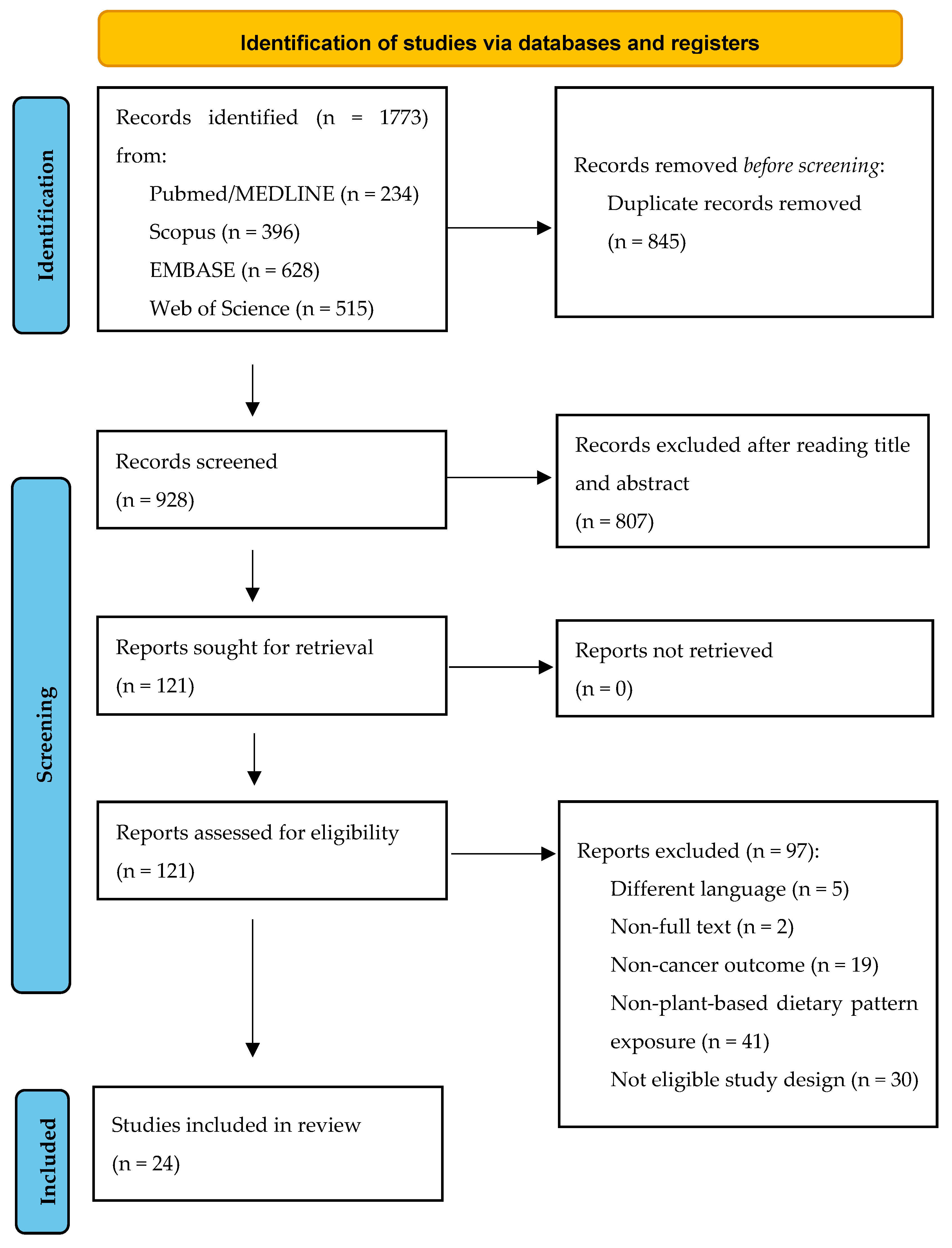
2.3. Study Selection Process
2.4. Data Extraction and Synthesis
2.5. Risk of Bias and Limitations
3. Results
3.1. Characteristics of the Included Studies
3.2. PBD Patterns Used in the Included Studies
3.3. Main Results of the Included Studies
3.4. Main Limitations of the Included Studies
4. Discussion
5. Conclusions
Supplementary Materials
Author Contributions
Funding
Data Availability Statement
Conflicts of Interest
Abbreviations
| EDIH | Empirical Dietary Index for Hyperinsulinemia |
| ELIH | Empirical Lifestyle Index for Hyperinsulinemia |
| FFQ | Food frequency questionnaire |
| HCC | Hepatocellular carcinoma |
| hPDI | Healthful plant-based diet index |
| hPVG | Healthful pro-vegetarian pattern |
| LCD | Low-Carb Diet |
| MD | Mediterranean Diet |
| PBD | Plant-based dietary |
| PDI | Plant-based diet index |
| PDQS | Plant-based diet quality score |
| PVG | Pro-vegetarian |
| uPDI | Unhealthful plant-based diet index |
| uPVG | Unhealthful pro-vegetarian pattern |
References
- Bray, F.; Laversanne, M.; Sung, H.; Ferlay, J.; Siegel, R.L.; Soerjomataram, I.; Jemal, A. Global Cancer Statistics 2022: GLOBOCAN Estimates of Incidence and Mortality Worldwide for 36 Cancers in 185 Countries. CA A Cancer J. Clin. 2024, 74, 229–263. [Google Scholar] [CrossRef] [PubMed]
- Li, S.; He, Y.; Liu, J.; Chen, K.; Yang, Y.; Tao, K.; Yang, J.; Luo, K.; Ma, X. An Umbrella Review of Socioeconomic Status and Cancer. Nat. Commun. 2024, 15, 9993. [Google Scholar] [CrossRef] [PubMed]
- Key, T.J.; Bradbury, K.E.; Perez-Cornago, A.; Sinha, R.; Tsilidis, K.K.; Tsugane, S. Diet, Nutrition, and Cancer Risk: What Do We Know and What Is the Way Forward? BMJ 2020, 368, m511. [Google Scholar] [CrossRef]
- Ruze, R.; Song, J.; Yin, X.; Chen, Y.; Xu, R.; Wang, C.; Zhao, Y. Mechanisms of Obesity- and Diabetes Mellitus-Related Pancreatic Carcinogenesis: A Comprehensive and Systematic Review. Signal Transduct. Target. Ther. 2023, 8, 139. [Google Scholar] [CrossRef] [PubMed]
- Brauer, M.; Roth, G.A.; Aravkin, A.Y.; Zheng, P.; Abate, K.H.; Abate, Y.H.; Abbafati, C.; Abbasgholizadeh, R.; Abbasi, M.A.; Abbasian, M.; et al. Global Burden and Strength of Evidence for 88 Risk Factors in 204 Countries and 811 Subnational Locations, 1990–2021: A Systematic Analysis for the Global Burden of Disease Study 2021. Lancet 2024, 403, 2162–2203. [Google Scholar] [CrossRef] [PubMed]
- Tapsell, L.C.; Neale, E.P.; Satija, A.; Hu, F.B. Foods, Nutrients, and Dietary Patterns: Interconnections and Implications for Dietary Guidelines. Adv. Nutr. 2016, 7, 445–454. [Google Scholar] [CrossRef] [PubMed]
- Tessier, A.-J.; Wang, F.; Korat, A.A.; Eliassen, A.H.; Chavarro, J.; Grodstein, F.; Li, J.; Liang, L.; Willett, W.C.; Sun, Q.; et al. Optimal Dietary Patterns for Healthy Aging. Nat. Med. 2025, 31, 1644–1652. [Google Scholar] [CrossRef]
- Storz, M.A. What Makes a Plant-Based Diet? A Review of Current Concepts and Proposal for a Standardized Plant-Based Dietary Intervention Checklist. Eur. J. Clin. Nutr. 2022, 76, 789–800. [Google Scholar] [CrossRef]
- Melina, V.; Craig, W.; Levin, S. Position of the Academy of Nutrition and Dietetics: Vegetarian Diets. J. Acad. Nutr. Diet. 2016, 116, 1970–1980. [Google Scholar] [CrossRef]
- Bai, T.; Peng, J.; Zhu, X.; Wu, C. Vegetarian Diets and the Risk of Gastrointestinal Cancers: A Meta-Analysis of Observational Studies. Eur. J. Gastroenterol. Hepatol. 2023, 35, 1244–1252. [Google Scholar] [CrossRef] [PubMed]
- Greenwell, J.; Grant, M.; Young, L.; Mackay, S.; Bradbury, K.E. The Prevalence of Vegetarians, Vegans and Other Dietary Patterns That Exclude Some Animal-Source Foods in a Representative Sample of New Zealand Adults. Public. Health Nutr. 2024, 27, e5. [Google Scholar] [CrossRef]
- Martínez-González, M.A.; Sánchez-Tainta, A.; Corella, D.; Salas-Salvadó, J.; Ros, E.; Arós, F.; Gómez-Gracia, E.; Fiol, M.; Lamuela-Raventós, R.M.; Schröder, H.; et al. A Provegetarian Food Pattern and Reduction in Total Mortality in the Prevención Con Dieta Mediterránea (PREDIMED) Study. Am. J. Clin. Nutr. 2014, 100, 320S–328S. [Google Scholar] [CrossRef]
- Satija, A.; Bhupathiraju, S.N.; Rimm, E.B.; Spiegelman, D.; Chiuve, S.E.; Borgi, L.; Willett, W.C.; Manson, J.E.; Sun, Q.; Hu, F.B. Plant-Based Dietary Patterns and Incidence of Type 2 Diabetes in US Men and Women: Results from Three Prospective Cohort Studies. PLoS Med. 2016, 13, e1002039. [Google Scholar] [CrossRef]
- Oncina-Cánovas, A.; González-Palacios, S.; Notario-Barandiaran, L.; Torres-Collado, L.; Signes-Pastor, A.; de-Madaria, E.; Santibañez, M.; García-de La Hera, M.; Vioque, J. Adherence to Pro-Vegetarian Food Patterns and Risk of Oesophagus, Stomach, and Pancreas Cancers: A Multi Case–Control Study (The PANESOES Study). Nutrients 2022, 14, 5288. [Google Scholar] [CrossRef] [PubMed]
- Martínez, C.F.; Di Castelnuovo, A.; Costanzo, S.; Panzera, T.; Esposito, S.; Cerletti, C.; Donati, M.B.; de Gaetano, G.; Iacoviello, L.; Bonaccio, M.; et al. Pro-Vegetarian Food Patterns and Cancer Risk among Italians from the Moli-Sani Study Cohort. Nutrients 2023, 15, 3976. [Google Scholar] [CrossRef]
- Hargreaves, S.M.; Rosenfeld, D.L.; Moreira, A.V.B.; Zandonadi, R.P. Plant-Based and Vegetarian Diets: An Overview and Definition of These Dietary Patterns. Eur. J. Nutr. 2023, 62, 1109–1121. [Google Scholar] [CrossRef] [PubMed]
- Carey, C.N.; Paquette, M.; Sahye-Pudaruth, S.; Dadvar, A.; Dinh, D.; Khodabandehlou, K.; Liang, F.; Mishra, E.; Sidhu, M.; Brown, R.; et al. The Environmental Sustainability of Plant-Based Dietary Patterns: A Scoping Review. J. Nutr. 2023, 153, 857–869. [Google Scholar] [CrossRef] [PubMed]
- Willett, W.; Rockstrأ¶m, J.; Loken, B.; Springmann, M.; Lang, T.; Vermeulen, S.; Garnett, T.; Tilman, D.; DeClerck, F.; Wood, A.; et al. Food in the Anthropocene: The EAT—Lancet Commission on Healthy Diets from Sustainable Food Systems. Lancet 2019, 393, 447–492. [Google Scholar] [CrossRef]
- Arksey, H.; O’Malley, L. Scoping Studies: Towards a Methodological Framework. Int. J. Soc. Res. Methodol. 2005, 8, 19–32. [Google Scholar] [CrossRef]
- Peters, M.D.; Godfrey, C.; McInerney, P.; Munn, Z.; Tricco, A.C.; Khalil, H. Chapter 11: Scoping Reviews. In JBI Manual for Evidence Synthesis; JBI: London, UK, 2020. [Google Scholar]
- Page, M.J.; McKenzie, J.E.; Bossuyt, P.M.; Boutron, I.; Hoffmann, T.C.; Mulrow, C.D.; Shamseer, L.; Tetzlaff, J.M.; Akl, E.A.; Brennan, S.E.; et al. The PRISMA 2020 Statement: An Updated Guideline for Reporting Systematic Reviews. BMJ 2021, 372, n71. [Google Scholar] [CrossRef]
- Radd-Vagenas, S.; Kouris-Blazos, A.; Singh, M.F.; Flood, V.M. Evolution of Mediterranean Diets and Cuisine: Concepts and Definitions. Asia Pac. J. Clin. Nutr. 2017, 26, 749–763. [Google Scholar] [CrossRef]
- Mattavelli, E.; Olmastroni, E.; Bonofiglio, D.; Catapano, A.L.; Baragetti, A.; Magni, P. Adherence to the Mediterranean Diet: Impact of Geographical Location of the Observations. Nutrients 2022, 14, 2040. [Google Scholar] [CrossRef]
- Ouzzani, M.; Hammady, H.; Fedorowicz, Z.; Elmagarmid, A. Rayyan—A Web and Mobile App for Systematic Reviews. Syst. Rev. 2016, 5, 210. [Google Scholar] [CrossRef] [PubMed]
- Tricco, A.C.; Lillie, E.; Zarin, W.; O’Brien, K.K.; Colquhoun, H.; Levac, D.; Moher, D.; Peters, M.D.J.; Horsley, T.; Weeks, L.; et al. PRISMA Extension for Scoping Reviews (PRISMA-ScR): Checklist and Explanation. Ann. Intern. Med. 2018, 169, 467–473. [Google Scholar] [CrossRef]
- Peters, M.D.J.; Marnie, C.; Tricco, A.C.; Pollock, D.; Munn, Z.; Alexander, L.; McInerney, P.; Godfrey, C.M.; Khalil, H. Updated Methodological Guidance for the Conduct of Scoping Reviews. JBI Evid. Synth. 2020, 18, 2119. [Google Scholar] [CrossRef]
- Watling, C.Z.; Schmidt, J.A.; Dunneram, Y.; Tong, T.Y.N.; Kelly, R.K.; Knuppel, A.; Travis, R.C.; Key, T.J.; Perez-Cornago, A. Risk of Cancer in Regular and Low Meat-Eaters, Fish-Eaters, and Vegetarians: A Prospective Analysis of UK Biobank Participants. BMC Med. 2022, 20, 73. [Google Scholar] [CrossRef] [PubMed]
- Abd Rashid, A.A.; Ashari, L.S.; Shafiee, N.H.; Raja Ali, R.A.; Yeong Yeh, L.; Shahril, M.R.; Jan Mohamed, H.J. Dietary Patterns Associated with Colorectal Cancer Risk in the Malaysian Population: A Case-Control Study with Exploratory Factor and Regression Analysis. BMC Public. Health 2023, 23, 1386. [Google Scholar] [CrossRef] [PubMed]
- Nejad, E.T.; Moslemi, E.; Souni, F.; Mahmoodi, M.; Vali, M.; Vatanpour, M.; Nouri, M.; Ramezani, A.; Shateri, Z.; Rashidkhani, B. The Association between Pro-Vegetarian Dietary Pattern and Risk of Colorectal Cancer: A Matched Case-Control Study. BMC Res. Notes 2023, 16, 326. [Google Scholar] [CrossRef]
- Ren, X.; Yu, C.; Peng, L.; Gu, H.; Xiao, Y.; Tang, Y.; He, H.; Xiang, L.; Wang, Y.; Jiang, Y. Compliance with the EAT-Lancet Diet and Risk of Colorectal Cancer: A Prospective Cohort Study in 98,415 American Adults. Front. Nutr. 2023, 10, 1264178. [Google Scholar] [CrossRef]
- Mohammadi, F.; Alijani, S.; Abdollahi, N.; Mashoufi, A.; Nouri, M.; Soltanii, M.; Shateri, Z.; Rashidkhani, B. The Association between Planetary Health Diet Index and the Risk of Colorectal Cancer: A Case-Control Study. Sci. Rep. 2024, 14, 26546. [Google Scholar] [CrossRef]
- Hu, F.-L.; Liu, J.-C.; Li, D.-R.; Xu, Y.-L.; Liu, B.-Q.; Chen, X.; Zheng, W.-R.; Wei, Y.-F.; Liu, F.-H.; Li, Y.-Z.; et al. EAT-Lancet Diet Pattern, Genetic Risk, and Risk of Colorectal Cancer: A Prospective Study from the UK Biobank. Am. J. Clin. Nutr. 2025, 121, 1017–1024. [Google Scholar] [CrossRef] [PubMed]
- Yue, Y.; Hur, J.; Cao, Y.; Tabung, F.K.; Wang, M.; Wu, K.; Song, M.; Zhang, X.; Liu, Y.; Meyerhardt, J.A.; et al. Prospective Evaluation of Dietary and Lifestyle Pattern Indices with Risk of Colorectal Cancer in a Cohort of Younger Women. Ann. Oncol. 2021, 32, 778–786. [Google Scholar] [CrossRef] [PubMed]
- Kim, J.; Boushey, C.J.; Wilkens, L.R.; Haiman, C.A.; Le Marchand, L.; Park, S.-Y. Plant-Based Dietary Patterns Defined by a Priori Indices and Colorectal Cancer Risk by Sex and Race/Ethnicity: The Multiethnic Cohort Study. BMC Med. 2022, 20, 430. [Google Scholar] [CrossRef]
- Wang, F.; Ugai, T.; Haruki, K.; Wan, Y.; Akimoto, N.; Arima, K.; Zhong, R.; Twombly, T.S.; Wu, K.; Yin, K.; et al. Healthy and Unhealthy Plant-Based Diets in Relation to the Incidence of Colorectal Cancer Overall and by Molecular Subtypes. Clin. Transl. Med. 2022, 12, e893. [Google Scholar] [CrossRef]
- Wu, B.; Zhou, R.-L.; Ou, Q.-J.; Chen, Y.-M.; Fang, Y.-J.; Zhang, C.-X. Association of Plant-Based Dietary Patterns with the Risk of Colorectal Cancer: A Large-Scale Case-Control Study. Food Funct. 2022, 13, 10790–10801. [Google Scholar] [CrossRef]
- Liu, F.; Lv, Y.; Peng, Y.; Qiao, Y.; Wang, P.; Si, C.; Wang, X.; Gong, J.; Zhou, H.; Zhang, M.; et al. Plant-Based Dietary Patterns, Genetic Predisposition and Risk of Colorectal Cancer: A Prospective Study from the UK Biobank. J. Transl. Med. 2023, 21, 669. [Google Scholar] [CrossRef]
- Yarmand, S.; Rashidkhani, B.; Alimohammadi, A.; Shateri, Z.; Shakeri, M.; Sohrabi, Z.; Nouri, M. A Healthful Plant-Based Diet Can Reduce the Risk of Developing Colorectal Cancer: Case-Control Study. J. Health Popul. Nutr. 2024, 43, 111. [Google Scholar] [CrossRef]
- Zhong, G.-C.; Li, Z.; You, A.-J.; Zhu, Q.; Wang, C.-R.; Yang, P.-F. Plant-Based Diets and the Risk of Pancreatic Cancer: A Large Prospective Multicenter Study. Am. J. Clin. Nutr. 2023, 117, 235–242. [Google Scholar] [CrossRef] [PubMed]
- Di Maso, M.; Augustin, L.S.A.; Jenkins, D.J.A.; Crispo, A.; Toffolutti, F.; Negri, E.; La Vecchia, C.; Ferraroni, M.; Polesel, J. Adherence to a Cholesterol-Lowering Diet and the Risk of Pancreatic Cancer: A Case—Control Study. Nutrients 2024, 16, 2508. [Google Scholar] [CrossRef]
- Shyam, S.; Greenwood, D.C.; Mai, C.-W.; Tan, S.S.; Yusof, B.-N.M.; Moy, F.M.; Cade, J.E. Major Dietary Patterns in the United Kingdom Women’s Cohort Study Showed No Evidence of Prospective Association with Pancreatic Cancer Risk. Nutr. Res. 2023, 118, 41–51. [Google Scholar] [CrossRef]
- Kim, J.; Setiawan, V.W.; Wilkens, L.R.; Le Marchand, L.; Park, S.-Y. Healthful Plant-Based Dietary Pattern and Risk of Hepatocellular Carcinoma in a Multiethnic Population: A Cohort Study. Am. J. Clin. Nutr. 2023, 118, 194–200. [Google Scholar] [CrossRef]
- Dong, X.; Zhang, M.; Shu, J.; Li, Y.; Tan, P.; Peng, T.; Lu, J.; Zhang, Y.; Zhong, X.; Fang, A. The Quality of Plant-Based Diets and Liver Cancer Incidence and Liver Disease Mortality in the UK Biobank. Clin. Nutr. ESPEN 2025, 67, 541–548. [Google Scholar] [CrossRef]
- Liu, Y.; Yang, W.; VoPham, T.; Ma, Y.; Simon, T.G.; Gao, X.; Chan, A.T.; Meyerhardt, J.A.; Giovannucci, E.L.; Zhang, X. Plant-Based and Animal-Based Low-Carbohydrate Diets and Risk of Hepatocellular Carcinoma Among US Men and Women. Hepatology 2021, 73, 175–185. [Google Scholar] [CrossRef]
- Zhang, X.; He, F.; Li, J.; Chen, R.; Li, X.; Li, L.; Liu, F.; Wang, S.; Wei, W. Plant-Based Dietary Patterns and Risk of Esophageal Cancer: A Prospective Cohort Study Spanning 17 Years. Chin. J. Cancer Res. 2024, 36, 36–45. [Google Scholar] [CrossRef] [PubMed]
- Cai, Y.; Hong, C.; Han, J.; Fan, L.; Xiao, X.; Xiao, J.; Wei, Y.; Zhu, Y.; Tian, J.; Zhu, X.; et al. Healthy Dietary Patterns, Genetic Risk, and Gastrointestinal Cancer Incident Risk: A Large-Scale Prospective Cohort Study. Am. J. Clin. Nutr. 2024, 119, 406–416. [Google Scholar] [CrossRef] [PubMed]
- Kim, J.; Khil, J.; Kim, H.; Keum, N.N.; Zhang, X.; Giovannucci, E. Plant-Based Dietary Patterns and the Risk of Digestive System Cancers in 3 Large Prospective Cohort Studies. Eur. J. Epidemiol. 2023, 38, 617–627. [Google Scholar] [CrossRef]
- Turati, F.; Mignozzi, S.; Esposito, G.; Bravi, F.; D’Angelo, A.; Alicandro, G.; Garavello, W.; Augustin, L.S.A.; Vitale, S.; Giacosa, A.; et al. Indices of Healthy and Unhealthy Plant-Based Diets and the Risk of Selected Digestive Cancers. Clin. Nutr. 2025, 44, 76–85. [Google Scholar] [CrossRef]
- Steck, S.E.; Guinter, M.; Zheng, J.; Thomson, C.A. Index-Based Dietary Patterns and Colorectal Cancer Risk: A Systematic Review. Adv. Nutr. 2015, 6, 763–773. [Google Scholar] [CrossRef]
- Moazzen, S.; Cortes-Ibanez, F.O.; van der Vegt, B.; Alizadeh, B.Z.; de Bock, G.H. Diet Quality Indices and Gastrointestinal Cancer Risk: Results from the Lifelines Study. Eur. J. Nutr. 2022, 61, 317–327. [Google Scholar] [CrossRef]
- Xie, L.; Li, Y.; Song, Z.; Huang, Y.; Yao, Q. Plant-Based Diet and Colorectal Cancer: A Systematic Review and Meta-Analysis of Prospective Cohort Studies. J. Gastrointest. Surg. 2025, 29, 102232. [Google Scholar] [CrossRef] [PubMed]
- Madrigal-Matute, J.; Bañón-Escandell, S. Colorectal Cancer and Microbiota Modulation for Clinical Use. A Systematic Review. Nutr. Cancer 2023, 75, 123–139. [Google Scholar] [CrossRef] [PubMed]
- Hardt, L.; Mahamat-Saleh, Y.; Aune, D.; Schlesinger, S. Plant-Based Diets and Cancer Prognosis: A Review of Recent Research. Curr. Nutr. Rep. 2022, 11, 695–716. [Google Scholar] [CrossRef]
- Chu, A.H.; Lin, K.; Croker, H.; Kefyalew, S.; Becerra-Tomás, N.; Dossus, L.; González-Gil, E.M.; Ahmadi, N.; Park, Y.; Krebs, J.; et al. Dietary Patterns and Colorectal Cancer Risk: Global Cancer Update Programme (CUP Global) Systematic Literature Review. Am. J. Clin. Nutr. 2025, 121, 999–1016. [Google Scholar] [CrossRef] [PubMed]
- Monteiro, C.A.; Cannon, G.; Levy, R.B.; Moubarac, J.-C.; Louzada, M.L.; Rauber, F.; Khandpur, N.; Cediel, G.; Neri, D.; Martinez-Steele, E.; et al. Ultra-Processed Foods: What They Are and How to Identify Them. Public. Health Nutr. 2019, 22, 936–941. [Google Scholar] [CrossRef] [PubMed]
- Wang, L.; Du, M.; Wang, K.; Khandpur, N.; Rossato, S.L.; Drouin-Chartier, J.-P.; Steele, E.M.; Giovannucci, E.; Song, M.; Zhang, F.F. Association of Ultra-Processed Food Consumption with Colorectal Cancer Risk among Men and Women: Results from Three Prospective US Cohort Studies. BMJ 2022, 378, e068921. [Google Scholar] [CrossRef]
- Zhong, G.; Zhu, Q.; Cai, D.; Hu, J.; Dai, X.; Gong, J.; Sun, W. Ultra-processed Food Consumption and the Risk of Pancreatic Cancer in the Prostate, Lung, Colorectal and Ovarian Cancer Screening Trial. Intl J. Cancer 2023, 152, 835–844. [Google Scholar] [CrossRef]
- Zhao, L.; Zhang, X.; Yu, D.; Wang, L.; Shrubsole, M.J.; Zheng, W.; Sudenga, S.L.; Zhang, X. Ultra-Processed Products and Risk of Liver Cancer: A Prospective Cohort Study. Clin. Nutr. 2024, 43, 2298–2304. [Google Scholar] [CrossRef]
- Morales-Berstein, F.; Biessy, C.; Viallon, V.; Goncalves-Soares, A.; Casagrande, C.; Hémon, B.; Kliemann, N.; Cairat, M.; Blanco Lopez, J.; Al Nahas, A.; et al. Ultra-Processed Foods, Adiposity and Risk of Head and Neck Cancer and Oesophageal Adenocarcinoma in the European Prospective Investigation into Cancer and Nutrition Study: A Mediation Analysis. Eur. J. Nutr. 2024, 63, 377–396. [Google Scholar] [CrossRef]
- Meine, G.C.; Picon, R.V.; Espírito Santo, P.A.; Sander, G.B. Ultra-Processed Food Consumption and Gastrointestinal Cancer Risk: A Systematic Review and Meta-Analysis. Am. J. Gastroenterol. 2024, 119, 1056–1065. [Google Scholar] [CrossRef]
- Vithayathil, S.; Walizada, M.; Siddi, G.; Gumireddy, S.R.; Anto, M.; Elkashif, I.; Yu, A.K. Navigating Evidence on Ultra-Processed Foods and Cancer: A Narrative Review. Cureus 2025, 17, e96173. [Google Scholar] [CrossRef]
- Kantilafti, M.; Magiakou, E.; Chrysostomou, S. Ultra-Processed Foods and Cancer Risk: A Narrative Review of Epidemiological Findings and Biological Mechanisms. Int. J. Food Sci. Nutr. 2025, 76, 843–852. [Google Scholar] [CrossRef]
- Katz, D.L.; Meller, S. Can We Say What Diet Is Best for Health? Annu. Rev. Public. Health 2014, 35, 83–103. [Google Scholar] [CrossRef] [PubMed]
- Zhao, Y.; Zhan, J.; Wang, Y.; Wang, D. The Relationship Between Plant-Based Diet and Risk of Digestive System Cancers: A Meta-Analysis Based on 3,059,009 Subjects. Front. Public. Health 2022, 10, 892153. [Google Scholar] [CrossRef]
- Hemler, E.C.; Hu, F.B. Plant-Based Diets for Personal, Population, and Planetary Health. Adv. Nutr. 2019, 10, S275–S283. [Google Scholar] [CrossRef] [PubMed]
- Lane, M.M.; Gamage, E.; Du, S.; Ashtree, D.N.; McGuinness, A.J.; Gauci, S.; Baker, P.; Lawrence, M.; Rebholz, C.M.; Srour, B.; et al. Ultra-Processed Food Exposure and Adverse Health Outcomes: Umbrella Review of Epidemiological Meta-Analyses. BMJ 2024, 384, e077310. [Google Scholar] [CrossRef] [PubMed]
- Chang, K.; Gunter, M.J.; Rauber, F.; Levy, R.B.; Huybrechts, I.; Kliemann, N.; Millett, C.; Vamos, E.P. Ultra-Processed Food Consumption, Cancer Risk and Cancer Mortality: A Large-Scale Prospective Analysis within the UK Biobank. EClinicalMedicine 2023, 56, 101840. [Google Scholar] [CrossRef]
- Jankovic, N.; Steppel, M.T.; Kampman, E.; de Groot, L.C.; Boshuizen, H.C.; Soedamah-Muthu, S.S.; Kromhout, D.; Feskens, E.J. Stability of Dietary Patterns Assessed with Reduced Rank Regression; the Zutphen Elderly Study. Nutr. J. 2014, 13, 30. [Google Scholar] [CrossRef]
- Newby, P.K.; Weismayer, C.; Akesson, A.; Tucker, K.L.; Wolk, A. Long-Term Stability of Food Patterns Identified by Use of Factor Analysis among Swedish Women. J. Nutr. 2006, 136, 626–633. [Google Scholar] [CrossRef]


| Databases | Search Strategy | Results |
|---|---|---|
| Pubmed/MEDLINE | ||
| #1 | (“diet, plant based” [MeSH Terms] OR “plant-based diet” [All Fields] OR “plant-based index” [All Fields] OR “plant-based indices” [All Fields] OR “PDI” [All Fields] OR “hPDI” [All Fields] OR “uPDI” [All Fields] OR “pro-vegetarian” [All Fields] OR “provegetarian” [All Fields] OR “PVG” [All Fields] OR “hPVG” [All Fields] OR “uPVG” [All Fields] OR “EAT-Lancet diet” [All Fields] OR “diet, mediterranean” [MeSH Terms] OR “Mediterranean diet” [All Fields] OR “diet, vegetarian” [MeSH Terms] OR “vegetarian diet” [All Fields] OR “planetary health diet” [All Fields]) | 34,132 |
| #2 | (“Gastrointestinal Neoplasms” [MeSH Terms] OR “digestive cancer” [All Fields] OR “pancreatic cancer” [All Fields] OR “Pancreatic Neoplasms” [MeSH Terms] OR “oesophagus cancer” [All Fields] OR “Esophageal Neoplasms” [MeSH Terms] OR “stomach cancer” [All Fields] OR “gastric cancer” [All Fields] OR “Stomach Neoplasms” [MeSH Terms] OR “liver cancer” [All Fields] OR “Liver Neoplasms” [MeSH Terms] OR “colorectal cancer” [All Fields] OR “Colorectal Neoplasms” [Mesh]) | 802,017 |
| #3 | #1 AND #2 | 580 |
| #1 AND #2 Last 5 years | 234 | |
| Scopus | ||
| #1 | TITLE-ABS-KEY (“plant-based diet” OR “plant-based index” OR “plant-based indices” OR “PDI” OR “hPDI” OR “uPDI” OR “pro-vegetarian” OR “provegetarian” OR “PVG” OR “hPVG” OR “uPVG” OR “EAT-Lancet diet” OR “mediterranean diet” OR “vegetarian diet” OR “planetary health diet”) | 50,759 |
| #2 | TITLE-ABS-KEY (“gastrointestinal cancer” OR “digestive cancer” OR “pancreatic cancer” OR “esophageal cancer” OR “stomach cancer” OR “gastric cancer” OR “liver cancer” OR “colorectal cancer”) | 542,086 |
| #3 | #1 AND #2 | 808 |
| #1 AND #2 Last 5 years | 396 | |
| EMBASE | ||
| #1 | ‘plant based diet’/exp OR ‘plant-based diet’:ti,ab OR ‘plant-based index’:ti,ab OR ‘plant-based indices’:ti,ab OR ‘pdi’:ti,ab OR ‘hpdi’:ti,ab OR ‘updi’:ti,ab OR ‘pro-vegetarian’:ti,ab OR ‘provegetarian’:ti,ab OR ‘pvg’:ti,ab OR ‘hpvg’:ti,ab OR ‘upvg’:ti,ab OR ‘eat-lancet diet’:ti,ab OR ‘mediterranean diet’/exp OR ‘mediterranean diet’:ti,ab OR ‘vegetarian diet’/exp OR ‘vegetarian diet’:ti,ab OR ‘planetary health diet’:ti,ab | 42,774 |
| #2 | ‘gastrointestinal cancer’/exp OR ‘digestive cancer’:ti,ab OR ‘pancreatic cancer’:ti,ab OR ‘pancreatic neoplasm’/exp OR ‘esophageal cancer’:ti,ab OR ‘esophageal neoplasm’ OR ‘stomach cancer’:ti,ab OR ‘gastric cancer’:ti,ab OR ‘stomach neoplasm’/exp OR ‘liver cancer’:ti,ab OR ‘liver neoplasm’/exp OR ‘colorectal cancer’:ti,ab OR ‘colorectal neoplasm’/exp | 1,338,833 |
| #3 | #1 AND #2 | 1338 |
| #1 AND #2 Last 5 years | 628 | |
| Web of Science | ||
| #1 | TS = ((“plant-based diet” OR “plant-based index” OR “plant-based indices” OR “pdi” OR “hpdi” OR “updi” OR “pro-vegetarian” OR “provegetarian” OR “pvg” OR “hpvg” OR “upvg” OR “EAT-Lancet diet” OR “mediterranean diet” OR “vegetarian diet” OR “planetary health diet”)) | 51,714 |
| #2 | TS = ((“gastrointestinal cancer” OR “digestive cancer” OR “pancreatic cancer” OR “esophageal cancer” OR “stomach cancer” OR “gastric cancer” OR “liver cancer” OR “colorectal cancer”)) | 707,316 |
| #3 | #1 AND #2 | 1067 |
| #1 AND #2 Last 5 years | 515 |
| Location, Author and Year | Design, Study Population and Follow-Up (F-U) | Objective | Dietary Patterns | Main Results | Conclusions |
|---|---|---|---|---|---|
| Colorectal Cancer (CRC) | |||||
| UK (Watling et al., 2022) [27] | Cohort (UK Biobank) 5882 CRC cases; age range 40–70 (mean age 56.3 y); 53.9% women. F-U: 11.4 y | To assess the associations of vegetarian and non-vegetarian diets with the risk of all cancers, including CRC. | Touchscreen questionnaire diet groups defined: regular meat-eaters (>5 times/week), low meat-eaters (≤5 times/week), fish-eaters (exclude meat/poultry), vegetarians (exclude all meat and fish, including vegans). | CRC: low meat-eaters HR = 0.91 (95% CI 0.86–0.96) vs. regular meat-eaters. Fish-eaters (HR = 0.84; 0.68–1.03) and vegetarian (HR = 0.78; 0.61; 1.01). | Low meat, fish-based, and vegetarian diets were associated with modestly lower risks of specific cancers. |
| Malaysia (Abd Rashid et al., 2023) [28] | Hospital case–control 264 CRC cases: 79 (mean age 61.0 y; 54.4% male): controls: 185 (mean age 50.8 y; 54.1% male). Controls had benign colorectal findings (diverticulum, colitis, etc.). F-U: Not applicable | To determine the main dietary patterns and their association with the risk of CRC in the Malaysian population. | Semi-quantitative FFQ (142 food items). Four dietary patterns were identified using exploratory factor analysis (PBD: fresh and dried fruits, raw and cooked vegetables, spreads; processed diet: confectionery and fast food; energy-dense diet: cereals, alcoholic beverages; allergy diet: condiments, eggs, fish, seafood, dairy products). | The PBD pattern was not significantly associated with CRC risk after adjusting for confounding factors (OR: 1.43 95% CI: 0.69, 2.97 for tertile 2; OR: 0.45 95% CI: 0.19, 1.04 for tertile 3). | No associations were observed between the PBD and the risk of CRC, although those on the third tertile showed a trend towards an inverse association. |
| Iran (Nejad et al., 2023) [29] | Hospital case–control. 213 participants: CRC cases: 71 (mean age 58.2 y; 49.3% male); controls: 142 (mean age 57.7 y; 49.3% male), matched by age and sex. Control diagnoses were non-neoplastic (acute conditions such as fractures). F-U: Not applicable *. | To investigate the association between the gPVG and CRC. | Dietary intake was assessed using a validated semi-quantitative 168-item FFQ. Adherence to the PVG diet was measured using the gPVG. | gPVG: OR (Q3 vs. Q1) = 0.41 (95% CI: 0.18–0.94) and OR (Q4 vs. Q1) = 0.35 (95% CI: 0.14–0.87). | Adherence to a gPVG, characterized by higher intake of vegetables, fruits, cereals, and dairy, and lower meat consumption, was associated with reduced odds of CRC. |
| US (Ren et al., 2023) [30] | Cohort (PLCO) 98,415 participants: CRC cases: 1054; proximal colon cancer cases: 626; distal colon cancer cases: 214; and rectal cancers: 194; non-cases: 97, 361; (mean age 65.5 y); 47.9% male. F-U: 8.8 y | To explore the association between the EAT-Lancet diet and CRC risk. | Dietary information was collected using a validated FFQ with 124 food items. Adherence to the EAT-Lancet diet was quantified using the ELD-I. | ELD-I: HR (Q4 vs. Q1) = 0.81 (95% CI: 0.67–0.98). Although the protective direction was maintained, the associations between ELD-I scores and specific CRC subsites did not reach statistical significance (proximal colon: HR = 0.85; 95% CI: 0.67–1.09; distal colon: HR = 0.73; 95% CI: 0.47–1.12; RC: HR = 0.69; 95% CI: 0.43–1.11). | Higher adherence to the ELD-I score was associated with a lower risk of CRC in a dose–response manner, supporting its potential role in CRC prevention. |
| Iran (Mohammadi et al., 2024) [31] | Hospital case–control. 213 participants: CRC cases: 71 (mean age 58.2 y; 49.3% male); controls: 142 (mean age 57.7 y; 49.3% male), matched by age and sex. Controls were non-neoplastic diagnoses, such as fractures. F-U: Not applicable *. | To assess the association between the PHDI and CRC. | Dietary intake was assessed using a validated semi-quantitative FFQ. Adherence to the EAT-Lancet diet was measured using the PHDI. | PHDI: OR (T3 vs. T1) = 0.41 (95% CI: 0.18–0.91). Total Adequacy Score: OR = 0.26 (95% CI: 0.11–0.62). Total Moderation Score: OR = 0.38 (95% CI: 0.16–0.89). Total Ratio Score: OR = 0.33 (95% CI: 0.13–0.88); no significant trend in third tertile. | Higher PHDI, adequacy, moderation, and ratio scores were associated with lower odds of CRC. |
| UK (Hu et al., 2025) [32] | Cohort (UK Biobank) 177,441 participants: CRC cases: 2016; non-cases: 175,425; aged 37–73 years; 46.3% male. F-U: 13.05 y | To investigate the association between adherence to the EAT-Lancet diet and CRC risk, and to evaluate its interaction with genetic predisposition. | Dietary intake was assessed using the Oxford WebQ 24 h dietary recall questionnaire. Adherence to the EAT-Lancet diet was quantified using the ELD-I. A polygenic risk score (PRS) based on 197 SNPs was used to assess genetic risk. | Higher ELD-I was associated with reduced CRC risk: HR (Q5 vs. Q1) = 0.87 (95% CI: 0.76–0.99). Per SD increase in ELD-I was associated with a 7% reduction in CRC risk (HR: 0.93; 95% CI: 0.89–0.98). High genetic risk (Q5) was associated with a 4.10-fold increased CRC risk (HR: 4.10; 95% CI: 3.48–4.84). Significant additive interaction between ELD-I and PRS: RERI = 0.142 (95% CI: 0.058–0.225); AP = 0.632. Participants with high ELD-I and low PRS had a 75% lower CRC risk compared to those with low ELD-I and high PRS (HR: 0.25; 95% CI: 0.17–0.36). | Greater adherence to the EAT-Lancet diet was associated with reduced CRC risk, particularly among individuals with moderate genetic risk. Diet may offer a feasible and sustainable strategy for CRC prevention, integrating both nutritional and genetic risk factors. |
| US (Yue et al., 2021) [33] | Cohort (NHS II). 94,217 participants: 332 CRC cases; age range 26–45 y (age mean 46.7 y) 100% women. F-U: 24 y | To investigate whether dietary and lifestyle patterns during adulthood are associated with CRC risk overall and by age at diagnosis in younger women from the NHS II. | Repeated FFQs; PDQS, PDI, hPDI, uPDI, and empirical indices of insulinemic potential (EDIH, ELIH). | Hyperinsulinemic patterns increased CRC risk (Q4 vs. Q1: HR: 1.67; 95% CI: 1.15–2.44)), whereas PBD indices showed no association. The overall PDI was non-linearly associated with CRC risk [Q4 vs. Q1: 1.16 (0.81–1.67); Q3 vs. Q1: 1.45 (1.05–2.00)]. | Plant-based diet indices were not consistently associated with CRC risk, while higher insulinemic dietary/lifestyle patterns increased risk, especially for early-onset CRC. |
| US (Kim et al., 2022) [34] | Cohort (MEC). 173,427 participants: CRC cases: 4976; non-cases: 168,451; aged 45–75 years; 46% male. Ethnic groups included African American, Japanese American, Latino, Native Hawaiian, and White. F-U: 19.2 y | To evaluate the association between PBD patterns and CRC risk, and to assess whether associations vary by sex, race/ethnicity, and tumor subsite. | Diet was assessed using a validated quantitative FFQ. Three PBD indexes were calculated (range: 18 to 90 points): Overall PDI, hPDI, and uPDI. | Women: No significant associations for any index. No associations across racial/ethnic groups or subsites. Men: PDI: HR = 0.76 (95% CI: 0.67–0.87); hPDI: HR = 0.79 (95% CI: 0.69–0.91); uPDI: HR = 1.08 (95% CI: 0.95–1.22). Subsite-specific: PDI: stronger inverse association for left colon (HR = 0.62) and rectum (HR = 0.69) than right colon (HR = 0.90); hPDI: inverse association across all subsites. uPDI: increased risk for rectal cancer (HR = 1.24) | Greater adherence to PBDs rich in healthy plant foods and low in less healthy plant foods was associated with a reduced CRC risk in men, but not women. The strength of the association varied by race/ethnicity and tumor subsite. |
| US (Wang et al., 2022) [35] | Cohort (NHS and HPFS) 123,733 participants: 3077 CRC cases; age range 30–55 y (NHS) and 40–75 y (HPFS) (mean age 60 y); 61.7% women. F-U: 32 y | To examine the associations of healthy and unhealthy PBDs with the incidence of CRC and its molecular subtypes. | Repeated validated FFQs every 4 years; hPDI and uPDI indices derived (higher hPDI = greater healthy plant food intake; higher uPDI = greater unhealthy plant food intake). | hPDI associated with lower CRC risk (HR = 0.86; 95% CI 0.77–0.96); uPDI associated with higher CRC risk (HR = 1.16; 95% CI 1.04–1.29); hPDI inversely associated with KRAS-wildtype CRC (HR = 0.74; 95% CI 0.57–0.96) but not KRAS-mutant tumors. | Healthy PBDs were associated with a lower CRC risk—especially KRAS-wildtype—while unhealthy PBDs were associated with higher risk. |
| China (Wu et al., 2022) [36] | Hospital case–control. 5598 participants: 2799 CRC cases; 2799 controls; age range: 30–75 y (mean age cases 57.10 y; mean age controls 57.05 y); 42.73% women. F-U: Not applicable *. | To investigate the association between different types of PBD patterns and CRC risk in the Chinese population. | Validated 81-item FFQ; PDI, hPDI and uPDI indices from 16 food groups and analyzed in sex-specific quintiles. | PDI (Q5 vs. Q1) OR = 0.79 (95% CI 0.66–0.95); hPDI OR = 0.45 (95% CI 0.38–0.55); uPDI OR = 1.45 (95% CI 1.18–1.78). In sex-stratified analyses, the inverse PDI association was not observed in women, while the positive uPDI association was not observed in men. | Higher adherence to a healthy PBD was associated with lower CRC risk, whereas higher adherence to an unhealthy PBD was associated with higher risk. |
| UK (Liu et al., 2023) [37] | Cohort (UK Biobank) 186,675 participants: CRC cases: 2163; non-cases: 184,512; aged 37–73 years at baseline; men and women included. Ethnic groups included White, Mixed, Asian Black, Chinese, and Others. F-U: 9.5 y | To investigate the association between PDIs and CRC risk and to explore genetic interaction. | Diet was assessed using the Oxford WebQ, a validated tool that used 24 h recall information and biomarkers. Three PDIs were calculated (ranging from 17 to 85 points–without vegetable oils component): PDI, hPDI y uPDI. | CRC: PDI: HR (Q4 vs. Q1) = 0.87 (95% CI: 0.77–0.99); hPDI: HR (Q4 vs. Q1) = 0.85 (95% CI: 0.75–0.97); uPDI: HR (Q2 vs. Q1) = 1.18 (95% CI: 1.04–1.33) and (Q4 vs. Q1) = 1.14 (95% CI: 1.01–1.30). Per 10-point increment in PDI and hPDI: 12% and 9% lower risk of CRC, respectively. Subsite-specific: hPDI: HR (Q4 vs. Q1) = 0.77 (95% CI: 0.60–0.98); uPDI: HR (Q4 vs. Q1) = 1.30 (95% CI: 1.02–1.65) for DCC. PDI: HR (Q4 vs. Q1) = 0.76 (0.64–0.91) for RC. In addition, per 10-point increment in PDI and hPDI: 7% and 6% lower risk of RC, respectively. Genetic risk: Lowest PRS + highest PDI: HR = 0.41 (95% CI: 0.34–0.50); lowest PRS + highest hPDI: HR = 0.37 (95% CI: 0.30–0.46); highest PRS + highest uPDI: HR = 2.35 (95% CI: 1.92–2.87). No interaction observed between PDIs and PRS. | Greater adherence to higher-quality PDIs was associated with a reduced risk of CRC, particularly for DC and RC. The protective effect was enhanced when combined with lower genetic risk. Diet quality plays a key role in CRC prevention. |
| Iran (Yarmand et al., 2024) [38] | Hospital case–control. 213 participants: 71 CRC cases; 142 controls; age range 40–75 y (mean age cases 58.2 y; mean age controls 57.7 y); 50.7% women. F-U: Not applicable *. | To investigate associations of PBD indices with CRC risk in an Iranian population. | 168-item semi-quantitative FFQ; PDI, hPDI and uPDI indices constructed and analyzed in tertiles. | hPDI was inversely associated with CRC risk (T3 vs. T1 OR = 0.21; 95% CI 0.07–0.56) while uPDI was positively associated (T3 vs. T1 OR = 6.76; 95% CI 2.41–18.94); PDI showed no association. | A healthy PBD was associated with a markedly lower risk of CRC, whereas an unhealthy PBD was associated with a substantially higher risk. |
| Pancreatic cancer | |||||
| US (Zhong et al., 2023) [39] | Cohort (PLCO Cancer Screening Trial) 101,748 participants: 421 pancreatic cancer cases; age range 55–74 (mean age 65.5 y); 51.4% female. F-U: 8.86 y | To examine the potential associations of three PBD indices with the risk of pancreatic cancer in a US population. | FFQ with 124 items assessing past year intake; foods grouped into 18 groups then into healthy plant/less-healthy plant/animal foods; PDI/hPDI/uPDI constructed per Satija et al. scoring (quartile scoring). | PDI HR = 0.74 (95% CI 0.57–0.96); hPDI (Q4 vs. Q1) HR = 0.56 (95% CI 0.42–0.75); uPDI HR = 1.38 (95% CI 1.02–1.85). Association of uPDI stronger in BMI < 25 kg/m2 subgroup (HR = 3.22; 95% CI 1.56–6.65). | Adherence to a healthful PBD was associated with a lower risk of pancreatic cancer, whereas adherence to an unhealthful PBD was associated with a higher risk. |
| Italy (Di Maso et al., 2024) [40] | Hospital case–control 809 participants: incident pancreatic cancer cases: 258 (median age 63 y; 54.3% male); hospital-based controls: 551 (median age 62 y; 55.2% male), matched by sex, age, and study center. Controls were admitted for acute, non-neoplastic, non-digestive conditions. Participants on lipid-lowering medications were excluded. F-U: Not applicable *. | To evaluate the association between adherence to a plant-based cholesterol-lowering diet (CLD) and the risk of pancreatic cancer. | A 7-point CLD score derived from a validated 78-item FFQ. | High adherence to the CLD (score 5–7) was associated with a 70% reduced risk of pancreatic cancer compared to low adherence (score 0–2): OR = 0.30 (95% CI: 0.18–0.52). The inverse association was strongest among individuals with low or medium physical activity. | Greater adherence to a plant-based CLD was inversely associated with pancreatic cancer risk. The effect was modified by physical activity levels, with stronger associations observed in sedentary individuals. |
| UK (Shyam et al., 2023) [41] | Cohort (UK Women’s Cohort Study) 35,365 participants: pancreatic cancer cases: 136; non-cases: 35,229; mean age at enrollment 52 y, 9 SD; only women included. F-U: 18.5 y | To evaluate the associations between dietary patterns and pancreatic cancer risk. | Diet was assessed using a 217-item FFQ based on the EPIC questionnaire used for vegetarians. Dietary patterns include: 1. Self-reported vegan/vegetarian diets; 2. Diet quality indices (WHO-HDI); 3. Mediterranean Diet score and; 4. Five patterns selected using principal component analysis: prudent; meat-based; fast food–SSB–carbohydrate-rich snacks; ready-to-eat cereal and dairy-rich; and low-diversity–low-fat. | Self-reported vegan or vegetarian diet: not significantly associated (HR = 1.16; 95% CI: 0.76–1.79). WHO-HDI score: not significantly associated (per unit increase, HR = 0.98; 95% CI: 0.90–1.07). Posteriori (data-derived) dietary patterns: “Prudent” pattern: HR = 0.99 (95% CI: 0.92–1.07). “Meat-based” pattern: HR = 1.02 (95% CI: 0.94–1.11). “Fast food, sugary drinks, snacks” pattern: HR = 0.98 (95% CI: 0.88–1.09). “Cereal and dairy-rich” pattern: HR = 1.04 (95% CI: 0.95–1.15). “Low-diversity, low-fat” pattern: HR = 1.02 (95% CI: 0.91–1.15). | Commonly consumed dietary patterns, including those of low dietary quality, were not associated with pancreatic cancer risk over long-term follow-up. |
| Hepatocellular cancer (HCC) | |||||
| US (Kim et al., 2023b) [42] | Cohort (MEC) 170,321 participants: HCC cases: 722; non-cases: 169,599; aged 45–75 years (mean age 59.5 y, SD 8.8); 46.3% male. Ethnic groups included African American, Japanese American, Latino, Native Hawaiian, and White. F-U: 19.6 y | To investigate the association between PBD patterns and HCC risk, and to assess whether associations vary by sex or race/ethnicity. | Diet was assessed using a validated quantitative FFQ. Three PBD indexes were calculated (range: 18 to 90 points): Overall PDI, hPDI, and uPDI. | Per 10-point increase: PDI: HR = 0.82 (95% CI: 0.71–0.94; hPDI: HR = 0.84 (95% CI: 0.74–0.96); uPDI: HR = 1.08 (95% CI: 0.95–1.23). Participants in the highest quintile (Q5) of PDI had a 23% lower risk of HCC compared to Q1 (HR = 0.77; 95% CI: 0.61–0.98). For hPDI, Q5 vs. Q1 showed a 19% lower risk (HR = 0.81; 95% CI: 0.63–1.03). No significant heterogeneity across racial/ethnic groups. | Greater adherence to a PBD rich in healthy plant foods and low in less healthy plant foods was associated with a reduced risk of HCC. The quality of plant-based foods is crucial, and the benefits were more evident among never smokers. |
| UK (Dong et al., 2025) [43] | Cohort (UK Biobank) 187,781 participants: HCC cases: 177; non-cases: 187,604; aged 37–73 years (mean age: males 56.4 y, SD 8.0; females 55.4 y, SD 7.8); 48.1% male. F-U: 16 y | To investigate the association between PBD patterns and the risk of HCC incidence and liver disease mortality. | Dietary intake was assessed using the Oxford WebQ 24 h dietary recall questionnaire. Three PBD indexes were constructed, based on 17 food groups and scored using quintile-based positive and reverse scoring (range: 17–85 points): PDI, hPDI, and uPDI. | In males, higher hPDI scores were associated with lower HCC incidence (HR (Q5 vs. Q1): 0.47; 95% CI: 0.26–0.85) and lower liver disease mortality (HR: 0.46; 95% CI: 0.27–0.77). Higher uPDI scores were associated with increased HCC incidence (HR: 1.90; 95% CI: 1.00–3.63) and liver disease mortality (HR: 2.21; 95% CI: 1.37–3.57). No significant associations were found in females. | Greater adherence to a hPDI may reduce the risk of HCC and liver disease mortality in males, but not in females. The quality of plant-based foods is crucial in cancer disease prevention. |
| US (Liu et al., 2021) [44] | Cohort (NHS and HPFS) 136,967 participants: HCC cases: 156; non-cases: 136,811; aged 30–55 years at baseline in NHS (females) and 40–75 years at baseline in HPFS (males); 35.2% male. F-U: 26.7 y | To examine the association between three Low-Carb Diet (LCDs) scores and HCC risk and assess the relationship of total, animal and plant-origin macronutrient intake with HCC risk. | Dietary data were collected using a validated semi-quantitative FFQ every 4 years. Three LCDs were calculated: an overall LCD, an animal-based LCD and a plant-based LCD (scoring positive the consumption of fats and proteins, and conversely, the carbohydrate consumption). | Plant-based LCD: HR per 1 SD increment = 0.83 (95% CI: 0.70–0.98); overall LCD and animal-based LCD: no significant associations. Higher intake of plant fat was associated with lower HCC risk (HR per 1 SD increment = 0.78; 95% CI: 0.65–0.95), while refined grain carbohydrates were associated with higher risk (HR = 1.18; 95% CI: 1.00–1.39). Isocaloric substitution of 5% energy from carbohydrates or refined grains with plant fat and protein was associated with 26% (HR = 0.74; 95% CI: 0.58–0.93) and 30% (HR = 0.70; 95% CI: 0.55–0.90) lower risk of HCC, respectively. | Greater adherence to a plant-based LCD and lower intake of refined grain carbohydrates was associated with lower risk of HCC. Replacing carbohydrates, particularly from refined grains, with plant fat and protein may further enhance the protective association. Macronutrient quality and source are key factors in HCC prevention. |
| Esophageal cancer | |||||
| China (Zhang et al., 2024) [45] | Cohort (NCEDTP) 15,184 participants: 176 esophageal cancer cases; age range 40–69 (mean age 51.8 y); 54% female. F-U: 17 y | To examine the associations between three predefined indices of PBD patterns and the risk of esophageal cancer. | Structured FFQ (range 15–75 points; 15 food groups adapted to local diet). Indices: PDI, hPDI, and uPDI. | hPDI (Q4 vs. Q1) HR = 0.50 (95% CI 0.32–0.77); per 10-point increase HR = 0.42 (95% CI 0.27–0.66). uPDI Q4 vs. Q1 HR = 1.80 (95% CI 1.16–2.82); per 10-point increase HR = 1.90 (95% CI 1.26–2.88). Overall, PDI showed a non-significant inverse trend. | A healthful PBD was associated with a substantially lower risk of esophageal cancer, whereas an unhealthful PBD was associated with a higher risk. |
| Several gastrointestinal cancer localizations | |||||
| UK (Cai et al., 2024) [46] | Cohort 105,463 participants: GIC cases: 1661; non-cases: 103,802; aged 40–72 years (mean 56.6 y, SD 7.8); 48.1% male. F-U: 11.7 y | To evaluate how healthy dietary patterns (including hPDI) and genetic predisposition contribute independently and jointly to the risk of GIC. | 24 h dietary recall questionnaire (Oxford WebQ). hPDI (18–90 points, 18 components). | Association with GIC risk after full adjustment. Colorectal: hPDI: HR = 0.73 (95% CI: 0.61–0.87). Pancreatic: hPDI: HR = 0.36 (95% CI: 0.24–0.54). Esophageal: hPDI: HR = 0.62 (95% CI: 0.39–0.97). Gastric: hPDI: HR = 0.51 (95% CI: 0.30–0.88). | Greater adherence to hPDI was significantly associated with lower risk of all four GICs. |
| US (Kim et al., 2023a) [47] | Cohort (NHS, NHS II, HPFS) 211,673 participants: digestive system cancer cases: 6518; non-cases: 205,155; aged 25–75 years (mean age 58 y); men and women included. F-U: NHS (34 y), NHS II (26 y), HPFS (30 y). | To examine the associations between three predefined PBD indices and the risk of total and site-specific digestive system cancers. | Dietary intake was assessed using validated semi-quantitative FFQs every 4 years. Three PBD indexes were calculated (ranging from 18 to 90 points): Overall PDI, hPDI, and uPDI. | Total digestive system cancer: PDI: HR = 0.94 (95% CI: 0.89–0.99); hPDI: HR = 0.93 (95% CI: 0.89–0.97); uPDI: HR = 1.04 (95% CI: 0.99–1.08). Oropharyngeal cancer: PDI: HR = 0.78 (95% CI: 0.65–0.95); hPDI: HR = 0.86 (95% CI: 0.73–1.02); uPDI: HR = 0.97 (95% CI: 0.83–1.13). Esophageal cancer: PDI: HR = 1.09 (95% CI: 0.86–1.40); hPDI: HR = 0.91 (95% CI: 0.74–1.12); uPDI: HR = 1.12 (95% CI: 0.91–1.37). Stomach cancer: PDI: HR = 1.22 (95% CI: 0.97–1.54); hPDI: HR = 1.10 (95% CI: 0.90–1.35); uPDI: HR = 0.98 (95% CI: 0.81–1.19). Small intestine cancer: PDI: HR = 0.86 (95% CI: 0.60–1.24); hPDI: HR = 0.86 (95% CI: 0.63–1.18); uPDI: HR = 0.87 (95% CI: 0.65–1.17). CRC: PDI: HR = 0.98 (95% CI: 0.92–1.05); hPDI: HR = 0.94 (95% CI: 0.89–1.00); uPDI: HR = 1.07 (95% CI: 1.01–1.13). CC: PDI: HR = 0.98 (95% CI: 0.90–1.07); hPDI: HR = 0.94 (95% CI: 0.87–1.01); uPDI: HR = 1.04 (95% CI: 0.97–1.11). RC: PDI: HR = 1.02 (95% CI: 0.88–1.19); hPDI: HR = 0.99 (95% CI: 0.87–1.13); uPDI: HR = 1.08 (95% CI: 0.96–1.22). Pancreatic cancer: PDI: HR = 0.83 (95% CI: 0.73–0.94); hPDI: HR = 0.91 (95% CI: 0.81–1.01); uPDI: HR = 0.93 (95% CI: 0.84–1.04). Biliary tract cancer: PDI: HR = 1.01 (95% CI: 0.77–1.32); hPDI: HR = 0.98 (95% CI: 0.78–1.23); uPDI: HR = 1.04 (95% CI: 0.84–1.29). HCC: PDI: HR = 0.69 (95% CI: 0.50–0.95); hPDI: HR = 0.68 (95% CI: 0.52–0.91); uPDI: HR = 1.08 (95% CI: 0.83–1.40). | A hPDI was associated with a lower risk of total digestive system cancers, particularly colorectal, liver, and pancreatic cancers. In contrast, the uPDI was associated with an increased risk of colorectal and gastrointestinal tract cancers. The quality of plant-based foods is crucial in cancer prevention. |
| Italy (Turati et al., 2025) [48] | Hospital case–control. Oral/pharyngeal cancer: 942 cases (752 men; 190 women; median age 58 y) and 2492 controls (1497 men; 995 women; median age 58 y); esophageal cancer: 304 cases (275 men; 29 women; median age 60 y) and 743 controls (593 men; 150 women; median age 60 y); stomach cancer: 230 cases (143 men; 87 women; median age 63 y) and 547 controls (286 men; 261 women; median age 63 y); CRC: 1953 cases (1125 men; 828 women; median age 62 y) and 4154 controls (2073 men; 2081 women; median age 58 y); pancreatic cancer: 326 cases (174 men; 152 women; median age 63 y) and 652 controls (348 men; 304 women; median age 63 y). F-U: Not applicable *. | To examine the association of the overall PDI, hPDI and uPDI with the risk of selected digestive cancers. | Validated interviewer-administered FFQ on usual diet 2 years before diagnosis/admission; PBD indices (PDI, hPDI, uPDI) from 16 food groups (healthy plant, unhealthy plant, animal foods). | Oropharyngeal: PDI was inversely associated (Q5 vs. Q1) OR = 0.63; 95% CI 0.47–0.84) Esophageal: PDI was inversely associated (T3 vs. T1) OR = 0.47; 95% CI 0.31–0.7). hPDI inversely associated with all sites (e.g., CRC OR = 0.69; 95% CI 0.57–0.84). uPDI positively associated with oral/pharyngeal (OR (Q5 vs. Q1) =1.43, 95% CI 1.06–1.94), colorectal (OR = 2.28, 95% CI 1.86–2.81), and pancreatic cancer (OR = 1.74, 95% CI 1.14–2.65) | A healthy PBD was associated with a lower risk of several digestive cancers, whereas an unhealthy PBD increased the risk. |
| Spain (Oncina-Cánovas et al., 2022) [14] | Hospital case–control (PANESOES). 1233 participants: esophageal cancer cases: 199 (mean age 60.5 y; 92.5% male); stomach cancer cases: 414 (mean age 64.8 y; 65.5% male); pancreatic cancer cases: 165 (mean age 65.2 y; 60.6% male); hospital-based controls: 455 (mean age 63 y; 62.6% male), matched by age, sex and province. Control diagnoses were a priori unrelated to the exposure of interest (e.g., hernias). F-U: Not applicable *. | To investigate the association between three PVG food patterns and cancers of esophagus, stomach and pancreas. | Dietary data were collected using a validated semi-quantitative 93-item FFQ based on the Harvard questionnaire. Three PVG food patterns were calculated: the gPVG, the hPVG and the uPVG. | Pancreatic: gPVG: RRR (Q5 vs. Q1) = 0.43 (95% CI: 0.35–0.52); hPVG: RRR = 0.74 (95% CI: 0.59–0.92). Esophageal: gPVG: RRR (Q5 vs. Q1) = 0.37 (95% CI: 0.32–0.42); hPVG: RRR = 0.72 (95% CI: 0.58–0.90). Stomach: gPVG: RRR (Q5 vs. Q1) = 0.34 (95% CI: 0.27–0.43); hPVG: RRR = 0.42 (95% CI: 0.34–0.52); uPVG: RRR = 1.76 (95% CI: 1.42–2.18). uPVG: No significant associations were observed for esophagus cancer and pancreatic cancer. | Greater adherence to gPVG and hPVG was associated with a lower risk of esophagus, stomach and pancreatic cancer, while greater adherence to uPVG was associated with a higher risk of stomach cancer. The quality of plant-based foods is essential for effective dietary guidance in the prevention of digestive tumors. |
| Italy (Martinez et al., 2023) [15] | Cohort (Moli-Sani Study) 24,325 participants: digestive cancer cases: 598; non-cases: 23,727; aged ≥35 years (mean age 55.2 y, 11.7 SD); 48% male. F-U: 12.9 y | To examine the association between three PVG food patterns and cancer risk (including digestive cancers). | Dietary data were collected using a semi-quantitative FFQ (EPIC model). Three PVG food patterns were calculated: the general PVG pattern (gPVG), the healthful PVG pattern (hPVG) and the unhealthful PVG pattern (uPVG). | Hospitalization due to any cancer: gPVG: HR (Q5 vs. Q1) = 0.85 (95% CI: 0.75–0.97); per 1 SD increment: HR = 0.95 (95% CI: 0.91–0.99). No associations were observed for hPVG or uPVG patterns with overall cancer risk. Hospitalization risk due to any digestive cancer: gPVG pattern: associated with lower hospitalization rates for digestive cancers (HR Q5 vs. Q1 = 0.74; 95% CI: 0.57–0.95); hPVG: inversely associated with digestive cancer hospitalizations (HR Q5 vs. Q1 = 0.76; 95% CI: 0.58–0.99); uPVG: positively associated with respiratory cancer hospitalizations (HR Q5 vs. Q1 = 1.68; 95% CI: 1.06–2.68). | Greater adherence to a gPVG pattern, rich in plant-based foods and low in animal products, was associated with lower cancer risk assessed through cancer hospitalizations. These findings highlight the importance of both plant food quality and minimal animal product consumption in cancer prevention. |
| Author and Year | Main Limitations | Funding/Support | Conflicts of Interest |
|---|---|---|---|
| Liu et al. (2021) [44] | Limited number of HCC cases affects risk estimate accuracy; confounding bias because it was not possible to adjust for all comorbidities and liver diseases; HBV/HCV data available only for a small group; the participants were predominantly White, educated health professionals, which may limit generalizability to other populations; observational design allows possible residual confounding; FFQs are tools that are prone to measurement error. | Supported by UM1 CA186107 (Nurses’ Health Study infrastructure grant), P01 CA87969 (Nurses’ Health Study program grant for cancer research), U01 CA167552 (Health Professionals Follow-up Study infrastructure grant), NIH K24 DK098311 (ATC), and NIH K07 CA188126 (XZ), R21CA238651 (XZ), American Cancer Society Research Scholar Grant (RSG NEC-130476, XZ). XZ is also supported by the Dana-Farber Harvard Cancer Center (DF/HCC) GI SPORE Developmental Research Project Award (P50CA127003) and DF/HCC Nodal Award (Cancer Center Support Grant, P30CA006516-55). ATG is a Stuart and Suzanne Steele MGH Research Scholar. | One author (JAM) declared to have received research funding from Boston Biomedical and acted as a consultant for several companies. Other authors declared no conflicts of interest. |
| Yue et al. (2021) [33] | Lack of genetic data; small number of CRC cases (especially early-onset); limited generalizability (mainly White women). | NIH (U01CA176726, R37CA246175, R00CA215314), American Cancer Society (MRSG-17-220-01-NEC). | The authors declared no conflicts of interest. |
| Kim et al. (2022) [34] | Diet assessed only at baseline (updated for 46% of participants); potential residual confounding; negative scoring of all animal foods may overlook potential benefits of fish and dairy; limited power in subgroup analyses (e.g., Native Hawaiians). | Supported by the National Research Foundation of Korea (2021R1A2C1003211) and the U.S. National Cancer Institute (R03 CA223890, U01 CA164973). | The authors declared no conflicts of interest. |
| Oncina-Cánovas et al. (2022) [14] | Small sample size, particularly for esophageal and pancreatic cancer, reducing statistical power; case–control design is more susceptible to biases, including selection bias; diet was assessed five years prior to the interview, possibly leading to misclassification; potential confounders may not have been accounted for in the analysis. | Funded by the Spanish Ministry of Health (FIS 91/0435, RCESP C 03/09), Generalitat Valenciana (EVES 030/2005, CTGCA/2002/06, G03/136), and CIBERESP. | The authors declared no conflicts of interest. |
| Wang et al. (2022) [35] | Potential unmeasured or residual confounding; dietary data from questionnaires (measurement error); limited tissue availability for molecular analyses; small subgroups reduced power; limited generalizability (mostly White health professionals). | NIH (multiple grants), Cancer Research UK, Japan Society for the Promotion of Science, Prevent Cancer Foundation. | ATC investigator for Zoe Global Ltd.; MG received funding from pharma; JAM consultancy for COTA Healthcare; others declared no conflicts of interest. |
| Watling et al. (2022) [27] | Limited cancer cases among vegetarians/fish-eaters; incomplete cancer registry data after 2015/2019; inability to adjust for total energy intake; possible residual confounding, misclassification, and chance findings; limited generalizability (mostly White British). | Cancer Research UK (C8221/A29017), World Cancer Research Fund (2019/1953), Wellcome Trust, MRC, University of Oxford, other fellowships. | The authors declared no conflicts of interest. |
| Wu et al. (2022) [36] | Recruitment from a single hospital (potential selection bias); recall bias; questionnaire lacked key food items (e.g., oils, coffee, tea, animal fats). | National Natural Science Foundation of China, Guangdong Basic and Applied Research Foundation. | The authors declared no conflicts of interest. |
| Abd Rashid et al. (2023) [28] | The FFQ, although validated, relies on self-reporting; the sample is hospital-based and may not be representative of the entire Malaysian population; limited sample size, especially in some subgroups (e.g., Indian ethnicity not present in cases). | The study is funded by the Long-Term Research Grant Scheme (LRGS)-Malaysia Research University Network (MRUN) (203/PPSK/6720021, LRGS/MRUN/FI/02/2018/01, and LR001-2019). | The authors declared no conflicts of interest. |
| Kim et al. (2023a) [47] | Residual confounding cannot be ruled out; limited generalizability due to predominantly White health professional population; inability to assess strict vegetarian or vegan diets; potential misclassification of dietary intake. | Supported by the National Research Foundation of Korea (Grant No. 2021R1A2C1003211) and the U.S. National Institutes of Health (NIH) (Grant Nos. UM1 CA186107, P01 CA87969, U01 CA176726, U01 CA167552). | The authors declared no conflicts of interest. |
| Kim et al. (2023b) [42] | Lack of data on HBV/HCV infection and cirrhosis; dietary updates only available for 46% of participants; limited power in race-specific analyses due to small case numbers. | Supported by the National Research Foundation of Korea (2021R1A2C1003211) and the U.S. National Cancer Institute (R01 CA228589, U01 CA164973, R03 CA223890). | The authors declared no conflicts of interest. |
| Liu et al. (2023) [37] | Low participation rate (5.5%) in UK Biobank may introduce selection bias and therefore, lack of representativeness may distort genetic associations; the use of 24-hour recall for dietary assessment is prone to measurement errors leading to misclassification; only 17 food groups included in PDIs due to lack of data on vegetable oils; PDIs treat all animal foods equally, ignoring potential benefits of some groups, such as dairy and seafood; no distinction between red and white meat (different association with CRC); possible residual confounding; analyses limited to European populations. | Funded by the National Key R&D Program of China (2021YFC2500400, 2021YFC2500401), National Natural Science Foundation of China (81974488), Tianjin Key Medical Discipline Construction Project (TJYXZDXK-009 A), the Young Elite Scientists Sponsorship Program by China Association for Science and Technology (YESS20210143) and Guangdong Basic and Applied Basic Research Foundation (2022A1515010436) | The authors declared no conflicts of interest. |
| Martinez et al. (2023) [15] | Possible residual confounding due to the observational design; only cancer hospitalizations considered, possibly missing outpatient cases; risk estimates may be limited by small subgroup events; no repeated dietary assessments; self-reported diet data prone to error; classification of healthy plant foods may be subjective; potatoes scored unhealthy regardless of preparation; generalizability limited to the Italian population. | Partially funded by the Italian Ministry of Health (Ricerca Corrente 2022–2024). | The authors declared no conflicts of interest. |
| Nejad et al. (2023) [29] | Presence of selection bias; possible recall bias due to FFQs; long-term effects of risk factors on CRC could not be evaluated; hospital-based design was another limitation; relatively small sample size. | Not reported. | The authors declared no conflicts of interest. |
| Ren et al. (2023) [30] | Diet was assessed only once at baseline, without accounting for dietary changes over time; potential residual confounding cannot be excluded; limited CRC subsite cases reduced statistical power; results may not be generalizable beyond older American adults; no significant subgroup interactions observed. | Supported by the General Project of Chongqing Natural Science Foundation, Chongqing Science and Technology Commission, China [cstc2021jcyjmsxmX0153 (LP)], [cstc2021jcyj-msxmX0112 (YW)], [CSTB2022NSCQ-MSX1005 (HG)], and the Kuanren Talents Project of the Second Affiliated Hospital of Chongqing Medical University in China [kryc-yq-2110 (HG)]. | The authors declared no conflicts of interest. |
| Shyam et al. (2023) [41] | Low number of pancreatic cancer cases may have limited statistical power; dietary intake and physical activity were self-reported, introducing potential measurement error; FFQs did not capture key dietary details (e.g., cooking methods, additives); lack of data on specific fatty acids affected score accuracy; the relatively healthy cohort may have diluted associations; residual confounding cannot be ruled out. | Funded by the Institute for Research, Development and Innovation at the International Medical University [IMU 435/2019]. | One author (JD) declared to be the Director of Dietary Assessment Ltd. Other authors declared no conflicts of interest. |
| Zhong et al. (2023) [39] | PDI not specific to pancreatic cancer; baseline-only diet assessment; possible nondifferential bias from changes in lifestyle; limited generalizability (mostly non-Hispanic White, lower education, aspirin users, smokers); residual confounding. | National Natural Science Foundation of China, China Postdoctoral Science Foundation, Chongqing Postdoctoral Research Funding. | The authors declared no conflicts of interest. |
| Cai et al. (2024) [46] | Use of a single 24 h dietary recall may introduce measurement error; potential residual confounding; CRC not stratified by molecular subtype or staging. | NSFC-82130098 (China), Fundamental Research Funds for the Central Universities (WHU:2042022kf1205), Wuhan Knowledge Innovation Program (whkxjsj011). | The authors declared no conflicts of interest. |
| Di Maso et al. (2024) [40] | Potential recall bias from self-reported dietary data; lack of adjustment for obesity due to possible misclassification; limited generalizability outside Mediterranean populations; dietary cut-offs derived from the study population; potential residual confounding. | Partially funded by the Italian Ministry of Health (Ricerca Corrente). | One author (DJAJ) reported numerous research grants and honoraria from the food industry and health-related organizations. Other authors declared no conflicts of interest. |
| Mohammadi et al. (2024) [31] | Small sample size; possible unmeasured confounders; use of FFQs relies on memory and may lead to measurement errors; hospital-based participant selection may introduce selection bias. | Not reported. | The authors declared no conflicts of interest. |
| Yarmand et al. (2024) [38] | Selection bias and recall bias inherent to the case–control design. | Not reported. | The authors declared no conflicts of interest. |
| Zhang et al. (2024) [45] | PDI classification based on local dietary habits; non-quantitative FFQ (frequency, not servings); no energy intake adjustment; diet measured only at baseline (possible misclassification); missing lifestyle data; 49% compliance with screening (selection bias). | Beijing Nova Program, CAMS Innovation Fund, Cancer Hospital Talent Incentive Program. | The authors declared no conflicts of interest. |
| Dong et al. (2025) [43] | Potential recall bias from dietary assessments; lack of data on food preparation methods; residual confounding; observational design limits causal inference; limited generalizability beyond White European populations. | Supported by the Natural Science Foundation of Guangdong Province, China (grant number 2022A1515011744) and the Science and Technology Program of Guangzhou, China (grant number 202201011485). | The authors declared no conflicts of interest. |
| Hu et al. (2025) [32] | Potential residual confounding due to observational design; reliance on self-reported dietary data; limited compatibility of ELD-I with 24 h recall format; lack of data on Lynch syndrome; generalizability limited to European ancestry. | Supported by the Outstanding Scientific Fund of Shengjing Hospital (Qi-Jun Wu). | The authors declared no conflicts of interest. |
| Turati et al. (2025) [48] | Possible selection bias; recall bias and dietary measurement error; retrospective design allows reverse causation; incomplete FFQ coverage (e.g., juices, animal-based foods, nuts); results may not reflect current dietary patterns. | AIRC Foundation (IG 21378); PRIN 2022 (2022A4WZFC); Italian Ministry of Health (Ricerca Corrente). | LSAA member and CLV member of ICQC; LSAA received honoraria from the Nutrition Foundation of Italy; other authors declared no conflicts of interest. |
Disclaimer/Publisher’s Note: The statements, opinions and data contained in all publications are solely those of the individual author(s) and contributor(s) and not of MDPI and/or the editor(s). MDPI and/or the editor(s) disclaim responsibility for any injury to people or property resulting from any ideas, methods, instructions or products referred to in the content. |
© 2026 by the authors. Licensee MDPI, Basel, Switzerland. This article is an open access article distributed under the terms and conditions of the Creative Commons Attribution (CC BY) license.
Share and Cite
Oncina-Cánovas, A.; Cabañas-Alite, L.; Comino, I.; Mustieles, V. Adherence to Plant-Based Dietary Patterns and Digestive Cancers: A Scoping Review. Nutrients 2026, 18, 756. https://doi.org/10.3390/nu18050756
Oncina-Cánovas A, Cabañas-Alite L, Comino I, Mustieles V. Adherence to Plant-Based Dietary Patterns and Digestive Cancers: A Scoping Review. Nutrients. 2026; 18(5):756. https://doi.org/10.3390/nu18050756
Chicago/Turabian StyleOncina-Cánovas, Alejandro, Luis Cabañas-Alite, Iris Comino, and Vicente Mustieles. 2026. "Adherence to Plant-Based Dietary Patterns and Digestive Cancers: A Scoping Review" Nutrients 18, no. 5: 756. https://doi.org/10.3390/nu18050756
APA StyleOncina-Cánovas, A., Cabañas-Alite, L., Comino, I., & Mustieles, V. (2026). Adherence to Plant-Based Dietary Patterns and Digestive Cancers: A Scoping Review. Nutrients, 18(5), 756. https://doi.org/10.3390/nu18050756