1. Introduction
The history of education for deaf people has been marked by a constant struggle for the recognition of their linguistic and cultural rights [
1]. Throughout the 20th century, especially between the 1960s and 1980s, educational policies in Spain and many other countries marginalised this group, denying them an equitable, accessible education adapted to their communication needs. In this context, the use of sign language was systematically devalued and restricted both in schools and in public spaces, which contributed to reinforcing stigmas and consolidating various social barriers.
However, to properly frame this period, it is essential to acknowledge that oralist pressure began much earlier, particularly after the 1880 Milan Congress, and continued well into the mid-20th century [
2,
3]. In Spain, the roots of deaf education date back to the 16th century, making it one of the earliest countries to institutionalise education for deaf people [
4] This long-standing process of educational institutionalisation provides an essential context for understanding how oralist ideology became deeply embedded in Spanish educational practices during the 20th century [
5].
Faced with this reality, international organisations began to promote principles of equality and non-discrimination in education, appealing to regulatory frameworks such as the Universal Declaration of Human Rights [
6]. Later instruments specifically addressing disability—particularly from the 1970s onwards—began to introduce explicit references to accessibility, participation and the rights of persons with disabilities, although the international community was slow to incorporate disability into human-rights agendas after World War II.
In this context, the effects of decades of exclusion still linger in the memories and life stories of many older deaf people, whose educational experiences reflect the consequences of a system that did not recognise their language or cultural identity. Several recent studies have pointed out that the imposition of oralism and the denial of the use of sign language led to feelings of isolation, low self-esteem, school dropout and loss of identity references [
7,
8,
9]. These consequences are the result of policies that prioritised linguistic and cultural homogenisation to the detriment of the recognition of the deaf community as a linguistic minority.
In order to contextualise the historical moment studied here, it is important to clarify the rationale for selecting the period 1960–1980. This timeframe corresponds to a generation whose educational trajectories were shaped prior to the emergence of formal sign language research (beginning with Stokoe, 1960) and before the gradual introduction of bilingual or Total Communication approaches during the 1970s. In Spain, this generation represents the last cohort educated predominantly under strictly oralist regimes, whose long-term educational and life experiences continued to unfold during the period analysed, prior to the legislative and social shifts that would begin in the 1990s and 2000s.
This study aims to reconstruct these experiences through the technique of life stories, with the purpose of understanding how older deaf people in Spain experienced their schooling during a period dominated by oralist practices, in which the use of sign language was prohibited. One of the most significant findings is that many of these individuals were perceived as rude or inappropriate for communicating in their natural language, which generated feelings of shame, invisibility, and exclusion.
Although comparisons with younger generations are mentioned, these references are not drawn from empirical data within this study but from existing literature documenting the shift toward bilingual and inclusive education from the late 20th century onward.
In this sense, recovering these memories not only makes the injustices of the past visible, but also allows them to be contrasted with the experiences of younger generations, in order to assess the progress made in terms of educational inclusion and identify areas that still require attention. This historical and comparative analysis provides valuable evidence for the design of public policies aimed at truly inclusive education, based on respect for linguistic and cultural diversity.
1.1. The Education of Deaf People: Barriers Throughout History
Throughout the 20th century, despite some legislative reforms aimed at inclusion, deaf people continued to face significant barriers in education. Segregation in special schools was common practice, and many of these institutions adopted an oralist approach, influenced by the resolutions of the 1880 Milan Congress, which prohibited the use of sign language in teaching [
10].
This event marked a negative turning point in the history of deaf education, establishing that spoken language should be the only valid method of instruction. As a result, the use of sign language was delegitimised, depriving deaf students of access to their mother tongue and severely limiting their academic, emotional and social development [
11].
In addition, many schools lacked essential resources, such as adapted materials, sign language interpreters and trained teaching staff, which deepened educational inequalities [
12]. This exclusion not only restricted learning, but also contributed to the reproduction of social stereotypes and prejudices.
One of the most persistent myths has been the mistaken belief that deaf people cannot learn to read and write. This idea has been widely refuted by research showing that, with appropriate methodologies such as bicultural teaching, which combines sign language and written language, deaf people can develop language skills comparable to those of their hearing peers [
13].
In this context, the concept of audism, introduced by Tom Humphries (1977) [
14], which refers to the belief in the superiority of hearing people and oral communication, takes on special relevance. This term highlights the discriminatory attitudes and structural prejudices that affect the deaf community by assuming that voice and hearing are the only valid forms of communication [
15]. This phenomenon manifests itself, for example, in the systematic exclusion of sign language in school environments or in the tendency to ‘normalise’ deaf people through exclusively oral methods.
The lack of effective communication between deaf and hearing people has also been a recurring barrier. Deafness should be understood not as a hearing deficit, but as a communication mismatch created by the lack of accessible linguistic environments.
Dall’Asen and Pieczkowski [
16] explain that deafness is often interpreted as a communication impairment, leading to condescending attitudes and an underestimation of the effort required to establish equitable interactions.
During the 1960s to 1980s, older deaf people faced significant barriers to accessing higher education and skilled employment as a result of discrimination and social stigma. They were often relegated to unskilled jobs and excluded from full participation in social life [
17,
18]. Deaf women, in particular, suffered double discrimination, being steered towards domestic or manual labour as part of their training [
19].
It is important to note that the obstacles faced by this generation reflect broader structural forces in Spain’s segregated special-education system, which differentiated between deaf and hard-of-hearing students and provided limited pathways to post-secondary education. These institutional classifications significantly influenced academic expectations and career opportunities.
From the 1980s onwards, there were notable advances in educational inclusion; however, significant challenges remained, such as a lack of accessibility in school environments and the use of poorly adapted teaching methodologies [
4].
In the regulatory sphere, Law 27/2007 of 23 October recognises Spanish sign languages and regulates the means of support for oral communication for deaf, hearing-impaired and deafblind persons [
20], together with Royal Legislative Decree 1/2013 of 29 November, which approves the Consolidated Text of the General Law on the Rights of Persons with Disabilities and their Social Inclusion [
21], have represented fundamental advances in guaranteeing the right to inclusive education and participation for the deaf community in Spain. According to Viñarás-Abad et al. [
22], this legislation has helped to facilitate access to education and employment, promoting positive developments in the social and professional inclusion of persons with disabilities.
At the international level, the United Nations Convention on the Rights of Persons with Disabilities [
23] recognises the right to education without discrimination and based on equal opportunities. This legal instrument emphasises the need to guarantee an inclusive education system at all levels, which respects the linguistic, cultural and communicative identity of persons with disabilities, expressly including the use of sign language as a legitimate means of teaching and learning.
In this context, the bilingual/bicultural or intercultural approach to education, which combines two languages—sign language and spoken language—and two cultures—deaf and hearing—is particularly important. This model allows deaf students to develop in an educational environment that recognises and values their linguistic and cultural identity [
24].
Despite historical challenges, the 20th century saw a gradual shift towards greater educational inclusion of deaf people, thanks to legislative reforms, inclusive public policies and a growing commitment to equity [
25]. However, these changes mainly affected generations educated after the 1990s and therefore post-date the cohort analysed in this study (1960–1980).
1.2. The Education of Deaf People Today
Despite regulatory advances and international initiatives promoting equality and non-discrimination in education, the reality for deaf people continues to be marked by multiple barriers and challenges. Several recent studies indicate that, although recognition of sign language and deaf cultural identity has increased, prejudices, stereotypes, and inequalities persist, hindering effective educational inclusion. Sign language allows deaf people to communicate without barriers, promoting their linguistic and cognitive development [
12,
26,
27].
One of the main obstacles continues to be access to formal education, especially at higher levels such as university education. The literature shows that deaf people face limitations due to physical and communication barriers, as well as teaching practices and attitudes that do not respond to their specific needs [
28]. The lack of specialised training for teachers in bilingual environments—integrating sign language and spoken language—is a recurring difficulty, with a direct impact on the quality of education these students receive [
29].
Teaching methodologies in many institutions do not adequately incorporate sign language as a natural vehicle for learning, which reduces the participation and academic performance of deaf students [
30]. This situation translates into higher dropout rates and low representation in higher education. Only 3% of deaf people go on to university, a figure that is considerably lower than that of the general population [
31]. Furthermore, the scarcity of accessible educational resources, adapted materials and inclusive technologies perpetuates inequality [
32].
Regarding technological accessibility, although tools have been developed to facilitate communication and learning, their implementation in the education system is still limited [
33]. The lack of adequate infrastructure, coupled with the lack of teacher training in the effective use of these technologies, restricts their use [
34]. Furthermore, the limited availability of sign language materials and training prevents the creation of fully inclusive learning environments [
35].
The social and educational context continues to be permeated by stereotypes and prejudices towards deafness [
12]. Some teachers and classmates display attitudes that render deaf students invisible or underestimate their abilities, leading to situations of exclusion or discrimination [
36]. These prejudices affect both emotional well-being and academic development and contribute to the under-representation of this group in high-level educational or professional positions, as shown in the study on the labour inclusion of deaf youth in Spain [
25].
These educational barriers have a direct impact on labour market integration. The lack of accessible, quality education limits employment opportunities, leading many deaf people to only access precarious jobs or jobs unrelated to their training [
26]. In this sense, ensuring inclusive education becomes an essential requirement for promoting the social and economic inclusion of the deaf community.
In short, recent research shows that, despite advances in the visibility and recognition of the deaf community, significant deficiencies persist in access to education, teacher training, methodologies used, availability of accessible resources and technologies, and overcoming social stigmas.
These issues must be addressed comprehensively through public policies and educational actions that recognise sign language as a linguistic right and an essential vehicle for the learning and development of deaf people.
This review of the current state of education for deaf students is essential to contextualise and contrast the experiences collected in this study (1960–1980), which focuses on older deaf people. This will make it possible to identify the progress made and the barriers that still exist, offering guidance for improving educational policies and inclusive practices.
The overall objective of this study is to describe the educational trajectories of older deaf people in Spain between 1960 and 1980, analysing the prejudices, structural barriers, and teaching practices that shaped their academic experiences. More specifically, the study explores the stereotypes held by teachers, the main barriers present in educational centres, the behaviours and attitudes of teachers towards deaf students, and the ways in which sign language and Deaf culture were treated within schools. Through these themes, the study aims to highlight the historical obstacles faced by deaf people and to generate evidence that can inform future inclusive education policies.
The questions guiding this research are:
What barriers existed in educational centres between 1960 and 1980?
What stereotypes and prejudices did teachers have towards deaf people during that period?
How did teachers behave towards deaf students?
How did teachers relate to sign language, the deaf community and the specific needs of students?
This research seeks to highlight the historical barriers faced by deaf people, providing key information for the design of inclusive education policies that guarantee real equality of opportunity for future generations.
3. Results
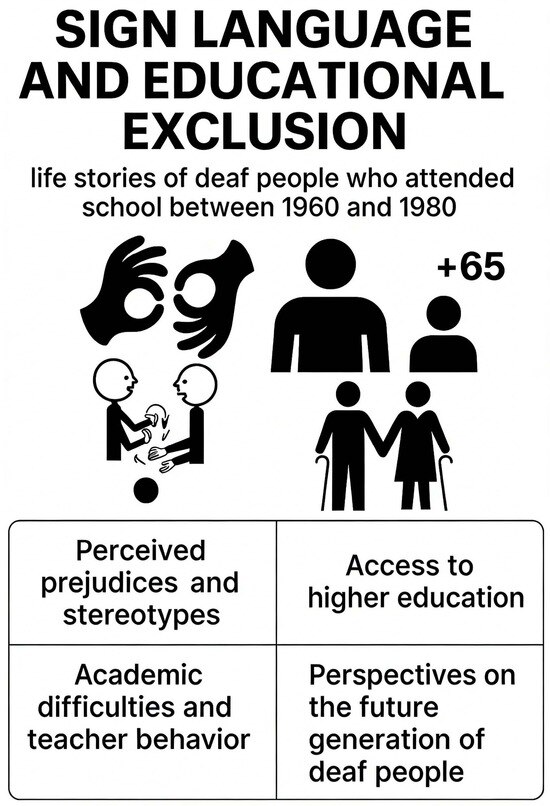
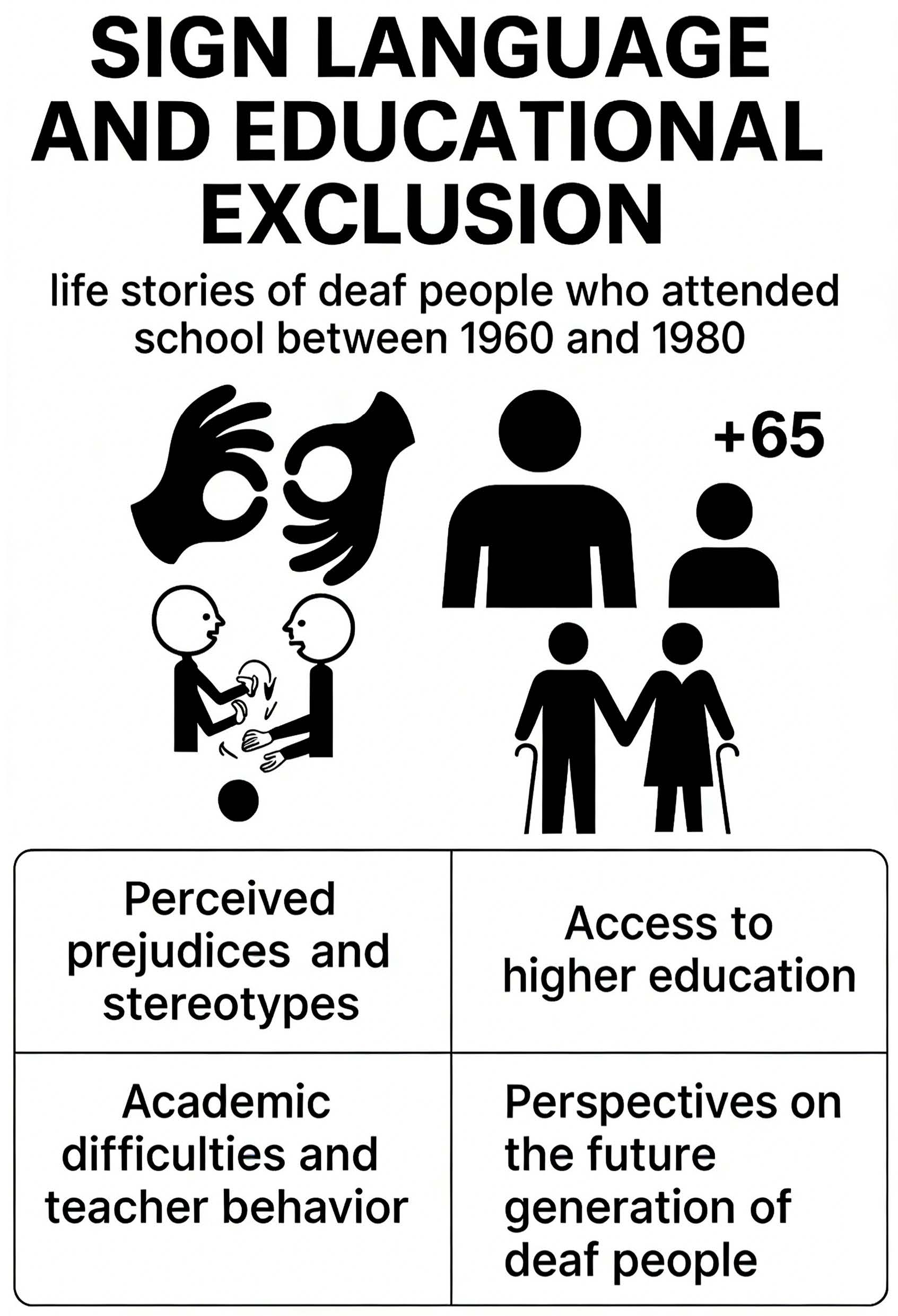
The qualitative analysis of the interviews, carried out with the support of ATLAS.ti, identified a set of recurring codes that reflect the experiences and perceptions of older Deaf adults regarding their education and social integration. The main codes included perceived prejudices and stereotypes, access to higher education and institutional adaptations, academic difficulties and teacher behaviour, positive and negative schooling experiences, and views on the future of the Deaf community.
The thematic analysis resulted in six major themes that structure the findings presented below: perceived prejudices and stereotypes, access to higher education, academic difficulties and teacher behaviour, positive experiences, negative experiences involving punishment or humiliation, and perspectives on younger Deaf generations.
The results are structured around the following thematic dimensions that emerged from the analysis:
3.1. Perceived Prejudices and Stereotypes About the Deaf Community and Sign Language
The accounts revealed deep-rooted prejudices and stereotypes that negatively shaped the educational experiences of older Deaf adults. Many participants described teasing, discrimination and paternalistic attitudes from classmates and teachers. For instance, E-5, who lost her hearing at the age of eight, recalled being called “deafie” and mocked by classmates who resented the additional attention she received from teachers. E-8 described the sadness of witnessing a peer struggle to learn to speak through lip-reading without any emotional or pedagogical support.
Participants also reported symbolic and physical violence. E-10 remembered being labelled “stupid” due to his deafness and receiving physical punishment for speech difficulties. One extreme case involved a teacher who allegedly cut a classmate’s tongue as punishment, creating an atmosphere of fear.
Sign language was often delegitimised. Several participants explained that schools prohibited signing in public spaces, arguing it might provoke pity or ridicule from hearing people. E-3 recalled that nuns insisted students communicate orally to “show good manners,” further excluding sign language from educational spaces.
Stereotypes also extended to family environments. Some parents, lacking information, pursued medical “cures” for deafness and held unrealistic expectations. Hierarchical and competitive classroom dynamics were also noted; E-18 described how teachers encouraged students to declare themselves “the smartest,” generating tension and exclusion.
Despite these challenges, a minority of participants (e.g., E-1, E-2, E-15) reported positive or neutral experiences, highlighting the diversity within the Deaf community. Testimonies also showed that prejudice extended beyond school into workplaces, where Deaf adults encountered restricted job opportunities, negative self-perception, and intersectional discrimination—particularly Deaf women facing gendered educational barriers (e.g., E-13).
3.2. Access to Higher Education, Perspectives and Adaptations in Educational Institutions
Most participants reported low motivation and limited awareness of higher education options. Some attributed this to discouragement and low academic self-confidence. E-16, driven by interests in reading, writing and photography, expressed a desire to study journalism but faced persistent discouragement.
Family and school environments rarely promoted academic aspirations, directing Deaf students toward unskilled work. Interviewees unanimously noted the absence of institutional adaptations—such as visual alerts, visual teaching systems or interpreters—that could have supported learning (e.g., E-1, E-3). The exclusive use of oral communication was a constant barrier; E-1 recalled that “teachers only communicated orally… we had no interpreter,” which hindered comprehension and effective learning.
Teachers often had a preference for students with stronger oral skills, which created inequity and resentment (E-14). Consequently, many described frustration, demotivation and social exclusion in the classroom.
3.3. Academic Difficulties and Teacher Behaviour
Most academic challenges stemmed from the lack of adapted teaching strategies. As E-1 described, classes were entirely oral, forcing students to copy notes mechanically “as if we were parrots.” This approach fostered frustration and demotivation.
Participants described discriminatory attitudes and exclusion. E-16, educated in an integrated setting, recalled feeling constantly watched and isolated: “I sat in the front row, feeling like I was in prison.” Others, like E-12, perceived equal treatment, illustrating the diversity of experiences.
The strict oralist approach was a major barrier. E-3 explained that learning improved only when a Deaf teacher taught him visually based subjects like sculpture. Some recalled being punished for using sign language; E-14 noted that “the nuns considered it ugly and believed signing would frighten hearing people,” reflecting systemic exclusion and its impact on identity and self-esteem.
Several participants emphasised the importance of interaction with Deaf adults as role models. E-18 said that two Deaf adults taught him valuable social and cultural knowledge, reinforcing the importance of Deaf–Deaf interaction for personal and academic growth.
3.4. Positive Experiences in the Education System
Despite the obstacles, participants also shared meaningful positive experiences. Many valued moments using sign language with peers, which fostered belonging and emotional support. E-18 remembered Deaf adults who served as role models and shaped his commitment to supporting others.
E-10 recalled joyful experiences playing role-play games in sign language, describing them as intellectually stimulating and socially enriching. These interactions strengthened identity, self-esteem and social development.
In addition, several participants described the school as the first place where they established long-lasting bonds with other Deaf peers, highlighting the role of Deaf schools as spaces for community formation rather than merely educational institutions. For example, E-6 and E-18 emphasised that meeting other Deaf children allowed them to develop a sense of belonging, identity and cultural continuity that they did not experience at home. These accounts reinforce the idea, widely recognised in Deaf Studies, that schools for the Deaf historically served as hubs for the creation of Deaf communities and transmission of cultural practices.
3.5. Negative Experiences: Humiliation, Punishment and Bullying
Some participants recounted painful memories of humiliation and exclusion due to the prohibition of sign language. E-3 shared that at age 13 he left school feeling “lazy and useless” after teachers blamed sign language for his difficulties.
Others described physical punishment for not meeting oralist expectations. E-10 recalled being forced to eat food he had vomited and later being punished without explanation. He also recounted being beaten with a stick for failing naming tasks, reflecting the cruelty of some practices.
Bullying was also frequent. E-16 felt mocked and isolated. E-18 was rejected for being academically successful. E-15 described being pressured to stay within one friendship group. E-14 was excluded by peers who envied her oral skills. These experiences contributed to demotivation, fear and deep emotional suffering.
By “double intersectional discrimination” we refer to the combined effect of being Deaf and being a woman in educational contexts that systematically marginalised both identities. Deaf women such as E-13 and E-14 reported restricted academic expectations, limited access to training, and early assignment to domestic or low-skilled work, illustrating how gender and disability intersected to narrow their life opportunities.
3.6. Perspectives on the Future Generation of Deaf People
These participants expressed hope and concern for future Deaf generations. They valued today’s increased access to education, interpreters and technology, which contrasts sharply with their own experiences. Many saw great progress in inclusion (e.g., E-6) and celebrated opportunities now available to young Deaf people (e.g., E-1).
They also warned about the importance of preserving sign language amidst oral-focused education and cochlear implant expansion. E-10 stressed: “Young people must not forget their language and culture.”
Despite educational improvements, barriers remain in employment. As E-7 noted, adapted jobs are still insufficient.
Finally, participants offered messages of encouragement: defend your rights, use available opportunities and pursue education despite challenges (e.g., E-5).
4. Discussion
Although the study focuses on Galicia, its findings resonate with historical trajectories documented in other Deaf communities in Spain and Europe, particularly those educated during periods dominated by oralism. Similar patterns of teacher prejudice, linguistic deprivation, and long-term emotional impact have been described in Italy, Portugal, France, and the United Kingdom. For this reason, the present results contribute to a broader understanding of how oralist policies shaped the schooling and identity of older Deaf generations across different national contexts.
The results of this study show the persistence of communication and symbolic barriers that affect older deaf people in their educational experience, consistent with previous findings [
43,
44,
45]. The prohibition of sign language and the imposition of oralism during their schooling had a significant negative impact on both their academic development and their emotional well-being, as pointed out by MoralesLópez and Galarza et al. [
46,
47]. Although older Deaf adults are no longer in compulsory education, they still face structural barriers when accessing lifelong learning, adult education programmes, vocational training or community courses, due to the persistent lack of interpreters, captioning and adapted materials.
Examples such as that of E-14, who reported that “
the nuns did not want us to use sign language, as they considered it ugly,” or the case of E-10, who was forced to speak and not sign, reflect how these repressive policies limited natural language acquisition, violated cultural rights, and affected self-esteem. These types of practices fall within what Pérez de la Fuente [
17] defines as institutionalised symbolic violence.
The experiences of prejudice, humiliation, and bullying reported by participants also coincide with previous studies [
18,
48]. The testimony of E-5, who was ridiculed and called “deafie” by her classmates, or that of E-1, who stated that “
we just copied the notes like parrots,” evidence the educational and social exclusion that persists despite apparent legislative progress. In addition, some testimonies describe episodes of physical abuse by teachers, such as that of E-6, who was beaten with a stick for not responding orally, reinforcing the findings from MoralesLópez [
46] on coercive practices still in place in certain school environments.
Despite this adverse outlook, narratives of resilience and empowerment are emerging. For example, E-18 highlighted the importance of deaf adults as role models in their development: “
I learned a lot from two deaf adults who taught me about everyday life.” These experiences reinforce the theory of linguistic empowerment by Ladd [
49], which emphasises the fundamental role of sign language and positive role models in building a strong deaf identity.
The evidence gathered underscores the urgency of implementing bilingual and inclusive educational models that recognise sign language as a natural vehicle for teaching [
50,
51]. The few positive experiences described by participants in contexts where the use of sign language was encouraged, as well as access to deaf adults as mentors, reinforce the pedagogical and social benefits of bilingual approaches [
52].
Significant structural barriers were identified in relation to access to higher education. The testimony of E-1, who pointed out the total absence of interpreters during their university years, highlights the lack of accessible resources, in line with what was described by Pérez Herrada [
43]. These limitations are exacerbated by ableist attitudes on the part of teachers and insufficient training to adequately address diversity [
46]. Furthermore, tensions between deaf students with different oral skills, such as those experienced by one participant who was accused of being “selfish” for speaking well, highlight the intra-community complexity derived from the imposed oralist model [
48].
Perspectives on the younger generations reflect a combination of hope and concern. The statement by E-10, “It is important that young people do not forget their language and culture,” highlights the desire to preserve their identity in the face of the rapid advance of technologies such as cochlear implants, which often displace sign language in the dominant educational discourse.
The contrasting perspectives among participants should not be viewed as a methodological limitation but rather as an analytical strength. These divergences reflect the internal tensions experienced by deaf individuals educated under oralist models, who were often compelled to navigate between a stigmatised deaf identity and expectations of conformity to a hearing-centred environment. Such contradictions reveal the complexity of emotional, social and linguistic negotiation processes, offering valuable insights into how individuals managed belonging, resistance and self-perception within restrictive educational contexts.
Access to higher education was generally unattainable for the generation analysed (1960–1980). Unlike countries such as the United States, which established specialised institutions such as Gallaudet University or the Rochester Institute of Technology, Spain had no equivalent structures for Deaf university students. The segregated education system and oralist emphasis did not provide the academic preparation needed for university entry. Participants repeatedly stated that they were unaware that university was even an option, highlighting a systemic barrier rather than individual disinterest.
Several testimonies also reveal internal hierarchies between Deaf and hard-of-hearing students, often reinforced by teachers who favoured those with better oral skills. This phenomenon, documented in other countries, reflects how oralism produced stratification even within the Deaf student body. Understanding this hierarchy is essential for interpreting intra-community tensions reported by participants.
Technological issues also emerged implicitly in the narratives. Although cochlear implants were not widely used until the late 1980s and 1990s, hearing aids and classroom amplification systems (e.g., FM systems) were introduced earlier in some European countries. However, participants did not recall systematic use of such technologies in Galicia during their schooling years, suggesting major regional disparities in technological access. This absence further intensified communicative inequality, as oralist expectations were imposed without providing the technological support required for oral communication.
Participants also referred to the presence of some Deaf adults within the schools, although their roles varied. In several cases, these adults were former pupils who worked informally as monitors, assistants or workshop instructors rather than qualified teachers. Their presence was highly valued because they provided linguistic models, cultural knowledge and emotional support—roles that hearing teachers often could not fulfil. Their marginal status within the institution reflects broader historical patterns in which Deaf adults were included informally but excluded from positions of authority.
This study has several limitations that should be considered when interpreting the results. Firstly, the small sample size and the intentional nature of the selection limit the generalisation of the findings to the deaf community as a whole. Furthermore, no comparison groups (such as hearing people or deaf people educated in other sociolinguistic contexts) were included, which restricts the comparative analysis and makes it difficult to identify intergenerational differences or differences between educational models.
Another significant limitation is the possible presence of bias in the narratives, as memories of the school years may be conditioned by the passage of time and subsequent identity-building processes. Although the sign language interviews provided authenticity and expressive richness, the written transcription may have reduced relevant communicative nuances inherent in the visual-gestural modality. Added to this is the methodological complexity of interpreting personal experiences from an ethnographic perspective without falling into essentialism or overgeneralisation.
The qualitative analysis of the interviews, carried out with the support of ATLAS.ti, identified a set of recurring codes that reflect the experiences and perceptions of older Deaf adults regarding their education and social integration. The main codes included perceived prejudices and stereotypes, access to higher education and institutional adaptations, academic difficulties and teacher behaviour, positive and negative schooling experiences, and views on the future of the Deaf community.
In addition to the code frequency analysis, a co-occurrence analysis was conducted to explore the relationships between key thematic categories. Strong co-occurrences were observed between “teacher prejudice” and “oralism”, as well as between “oralism” and “self-esteem”. These associations indicate that negative teacher attitudes and the enforcement of oralist practices often appeared together within the same narrative segments, shaping long-term emotional and educational consequences for participants.
This analytical step allows for a deeper understanding of how concepts such as sign language, teachers, classmates, prejudice, family and education interrelate across the narratives, highlighting the main barriers and facilitators present in their educational and social trajectories.
Furthermore, some contradictory responses among participants—for example, between those who highlighted the benefits of oralism and those who experienced it as a violent imposition—could not be explored in sufficient depth, and further research is therefore suggested to examine these intra-community tensions in greater detail. Recognising this heterogeneity does not weaken the results, but rather reflects the complexity of life trajectories in contexts of linguistic and cultural oppression.
5. Conclusions
Older deaf people are an irreplaceable reference point for present and future generations, not only because of the richness of their personal trajectories, but also because of their active role in transforming the educational and sociocultural frameworks that have historically excluded the deaf community. Their experiences, marked by constant struggle, resistance to oppressive practices and commitment to the defence of sign language, have been key to the progress made in linguistic rights and access to education.
In this sense, the recognition and appreciation of their legacy should be understood not only as an act of historical justice, but also as an opportunity to rethink educational models from a genuinely inclusive perspective that recognises linguistic and cultural diversity as a core value. Their sustained effort and capacity for collective agency are essential pillars for building more equitable educational environments that respect difference and are geared towards empowering future deaf generations.
In terms of methodological limitations, the difficulty in locating members of a minority deaf community and the complexity of accurately transcribing sign language posed significant challenges. However, conducting face-to-face interviews facilitated in-depth and contextualised data collection, which enabled rigorous and high-quality analysis.
Based on these results, several lines of future research are proposed. First, it is essential to compare the educational experiences of previous generations with those of young deaf people in contemporary contexts, with the aim of assessing the progress made and the barriers that still exist. It is also necessary to study the impact of bilingual and bicultural models on social inclusion and access to employment opportunities. Finally, it is recommended to further analyse the active role of the deaf community in transforming educational policies and practices, which could generate innovative, sustainable and culturally respectful strategies that promote truly inclusive education.
Although older Deaf adults are no longer in compulsory education, they continue to encounter structural barriers when accessing lifelong learning, adult education programmes, vocational training or community courses, due to the persistent lack of interpreters, captioning and adapted materials. The full and effective incorporation of sign language into education systems is therefore an urgent necessity to ensure inclusive, equitable and culturally respectful education, in line with international recommendations.