

Evaluating PM2.5 Exposure Disparities Through Agent-Based Geospatial Modeling in an Urban Airshed


Abstract
1. Introduction
2. Background
2.1. PM2.5 Effects on Human Health
2.2. Environmental Justice and PM2.5 Exposure and Health Effect Disparities
2.3. Agent-Based Modeling in Air Quality Assessment
3. Methods
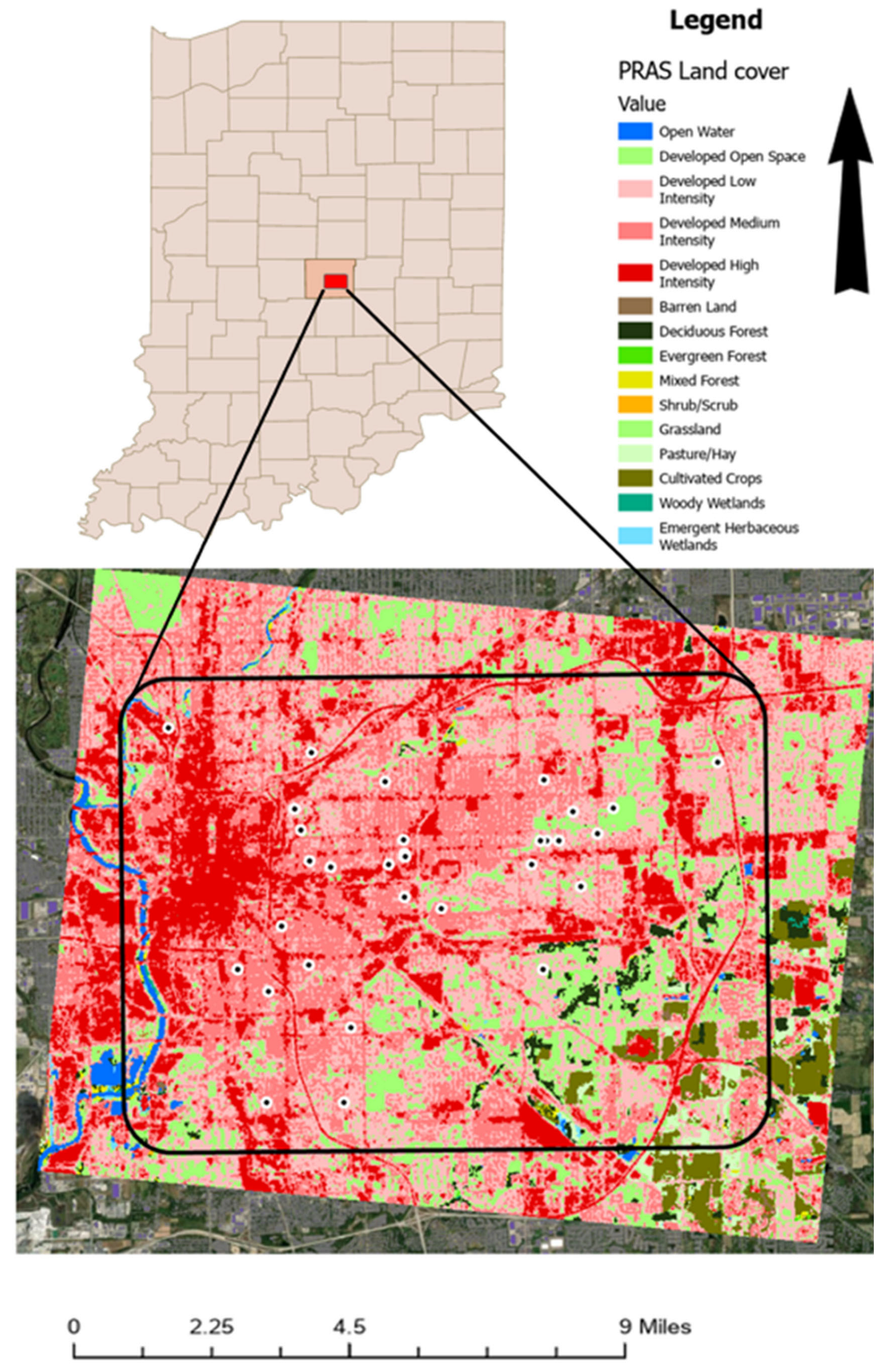
3.1. Study Area
3.2. PM2.5 Data Collection
3.3. PM2.5 Interpolation
- Direct measurements from 23 PurpleAir sensors (point locations).
- MODIS Level 2 AOD at 1 km resolution (Collection 6.1 Dark Target algorithm [15].
- Meteorological covariates at 13–14 km resolution from NLDAS-2 (temperature, wind, precipitation, PBL height [11].
- Land use/land cover at 30 m resolution from NLCD.
- Distance to roads (vector data with sub-meter precision).

| Covariate | Source (Citation) | Native Spatial Resolution | Native Temporal Resolution | Aggregation to 250 m/Week | Units/Notes |
|---|---|---|---|---|---|
| Air temperature (2 m) | NLDAS-2 (Cosgrove et al., [11]) | 0.125° (~13–14 km) | Hourly | Weekly mean; bilinear resample to grid; center/scale | °C |
| Precipitation | NLDAS-2 (Cosgrove et al., [11]) | 0.125° | Hourly | Weekly sum; nearest-neighbor to grid; center/scale | mm/week |
| Wind speed (10 m) | NLDAS-2 (Cosgrove et al., [11]) | 0.125° | Hourly | Weekly mean; bilinear to grid; center/scale | m s−1 |
| Wind direction (10 m) | NLDAS-2 (Cosgrove et al., [11]) | 0.125° | Hourly | Convert to sin/cos; weekly mean; bilinear to grid | Degrees (stored as sinθ, cosθ) |
| Planetary boundary layer height | NLDAS/NARR/ERA5 (specify used) | 0.125° (or reanalysis native) | Hourly | Weekly mean; bilinear to grid; center/scale | m |
| Aerosol Optical Depth (AOD) | MODIS Terra (Thome, [13]; Li et al. [12]) | 1 km (Collection 6.1 Dark Target algorithm) | Daily | QA filter (e.g., QA ≥ 1); weekly mean; gap-fill to grid | Unitless (550 nm) |
| Distance to road (primary/secondary/tertiary) | OpenStreetMap/TIGER | Vector | Static | Min distance from cell centroid to nearest class; center/scale | m |
| Land cover (developed %, canopy %) | NLCD 2019 (USGS) [19] | 30 m | Static | Percent cover aggregated to 250 m grid | % |
3.3.1. INLA-SPDE Model Formulation and Priors
3.3.2. Sensitivity and Uncertainty Analysis
- Field uncertainty propagation: We drew N = 200 posterior predictive samples from the INLA-SPDE model for each week, capturing both parameter and spatial prediction uncertainty. Propagating these samples through the ABM generated exposure and health impact distributions that reflect full modeling uncertainty rather than deterministic point estimates.
- Spatial-block cross-validation: In addition to leave-one-out cross-validation (Section 3.3.3), we conducted spatial-block cross-validation by holding out clusters of nearby sensors to evaluate model performance in spatial extrapolation scenarios. We used 3–5 sensor blocks (median inter-sensor separation ≈ 2.3 km) to simulate local extrapolation.
- Temporal cross-validation: We evaluated model performance by training on weeks 1–40 and testing on weeks 41–50 to assess temporal stability.
- Covariate sensitivity: We assessed model performance with and without key covariates, especially MODIS AOD, to determine their individual contributions to predictive skill. Results show that although AOD improves model fit (ΔR2 ≈ 0.04), the sensor network and land use variables remain the main sources of predictive power.
- Parameter sensitivity: We evaluated sensitivity of VWDI calculations to variations in key parameters, including susceptibility factors (±20% variation), risk parameters (using confidence intervals from original epidemiological studies), and inhalation rates (4.5 km/h to 5.5 km/h walking speeds, ±20% breathing rates).
3.3.3. Temporal Resolution Considerations
- Data availability and reliability: Our 23-sensor network provides consistent weekly averages with adequate temporal coverage; daily or hourly data would experience significant gaps due to sensor connectivity problems and the manufacturer’s three-week power cord recall period (no data during that time), which could increase uncertainty.
- Representative exposure patterns: By modeling 50 weeks of routine home-to-work commutes, we capture typical long-term exposure patterns—what residents usually experience over a full year—rather than specific high-exposure events or rush-hour concentration spikes.
3.3.4. Model Validation
3.4. Agent-Based Model Development
3.5. Behavioral and Exposure Assumptions
3.6. Simulation Timeline and Outputs
3.7. Susceptibility Groups and Vulnerability-Weighted Dose Index (VWDI)
- Very Low: 0.01.
- Low: 0.03.
- Medium: 0.05.
- High: 0.1.
- Base risk: A constant base risk value (0.01).
- Susceptibility factor: The factor associated with the agent’s susceptibility group.
- Risk parameter: The predefined health risk parameters.
- PM2.5 value: The PM2.5 concentration value encountered at each step in the simulation in tens of μg/m3.
- Home to Work Path: PM2.5 values are retrieved each time an agent moves into a new cell of the 250 m SPDE interpolated grid. VWDI is calculated and accumulated for each step.
- Time at Work: The PM2.5 value at the work location is used. The VWDI is calculated for the duration spent at work (assumed to be 8 h).
- Work to Home Path: PM2.5 values are retrieved each time an agent moves into a new cell of the 250 m SPDE interpolated grid. The VWDI is calculated and accumulated for each step.
- Time at Home: The PM2.5 value at the home location is used. The VWDI is calculated for the duration spent at home (assumed to be 16 h).
- Base risk: 0.01
- Susceptibility factor: 0.1 (for high susceptibility)
- PM2.5 value at a node: 25 µg/m3
4. Results
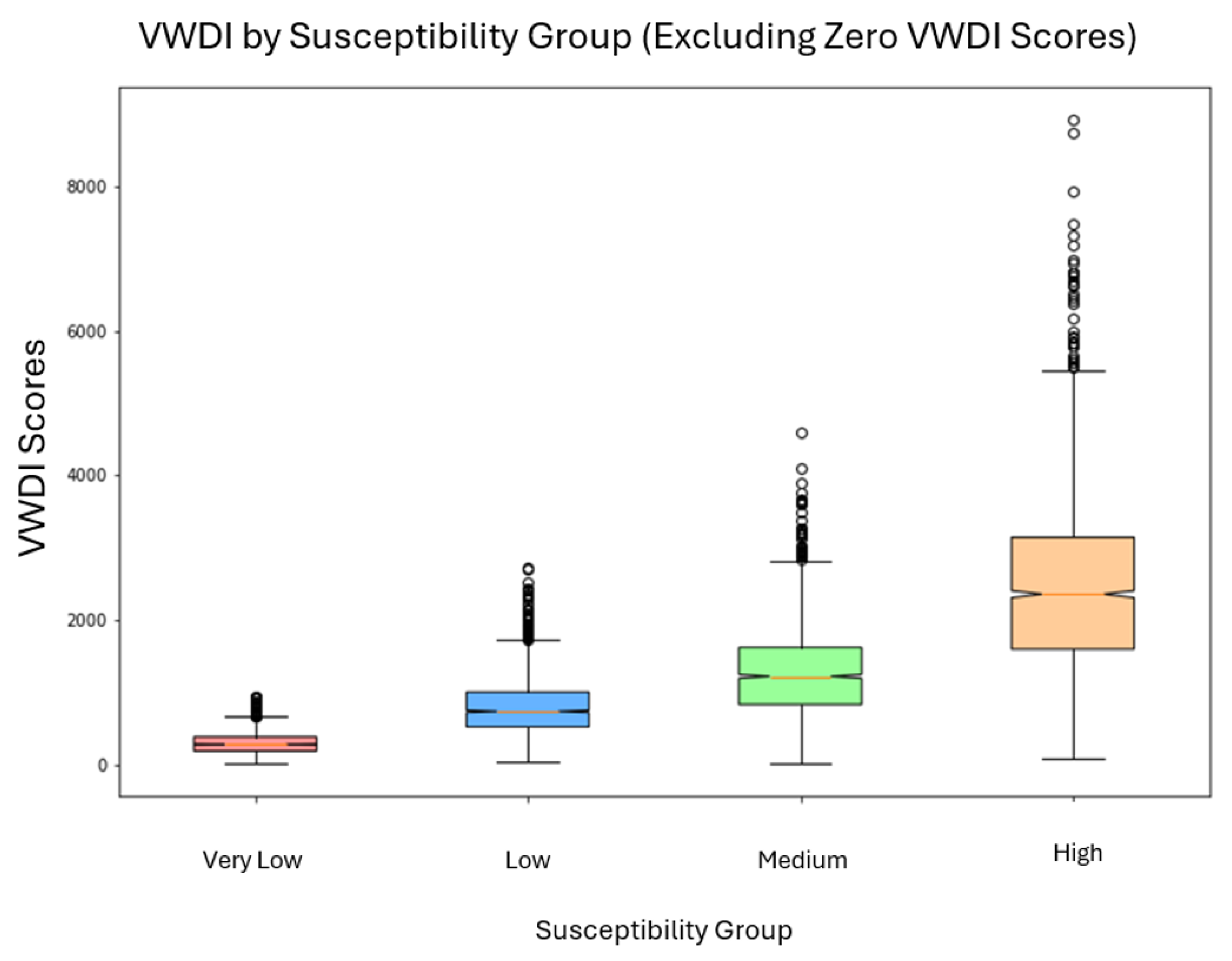
4.1. VWDI by Susceptibility Group
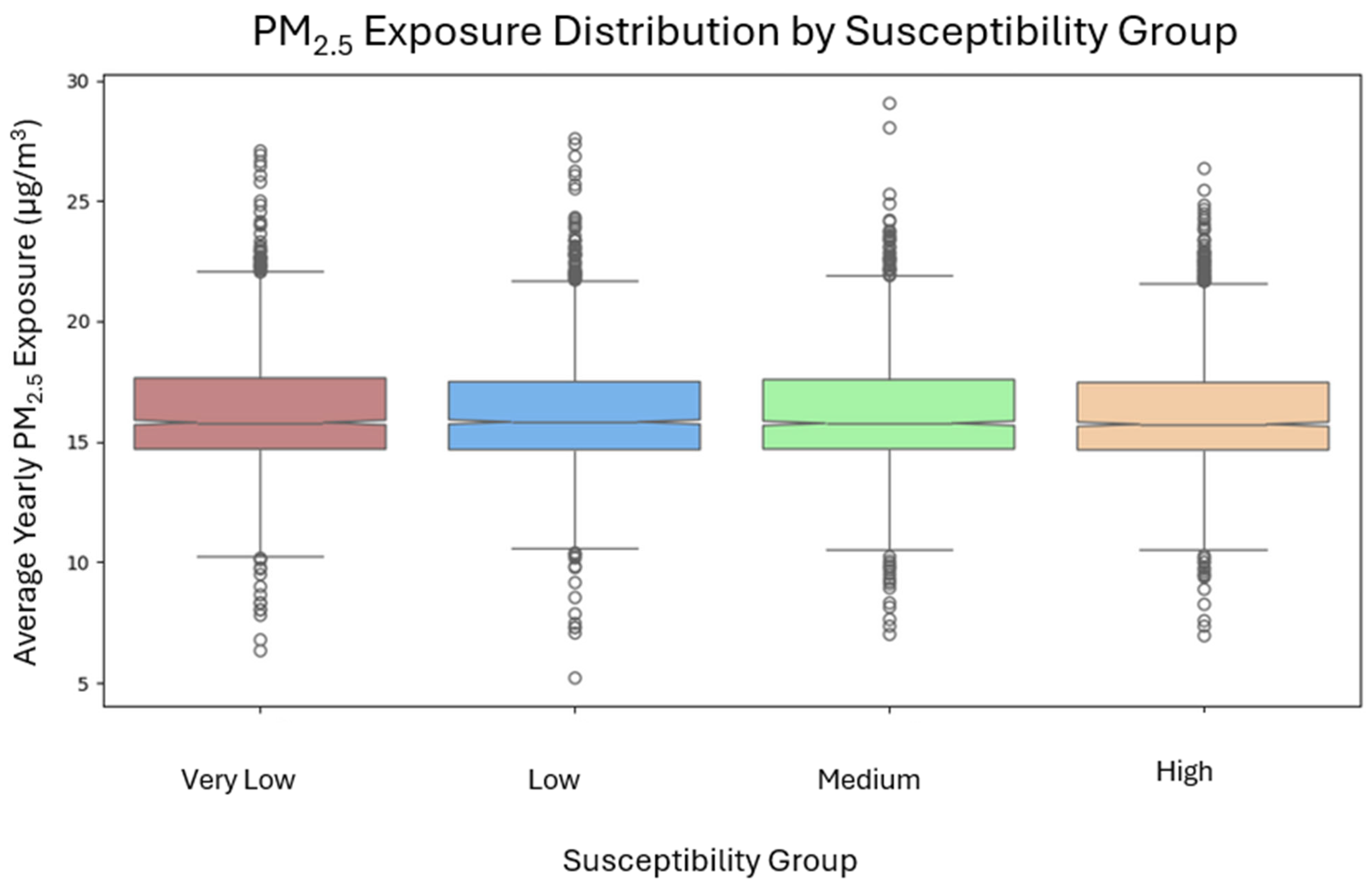
4.2. Exposure Patterns Under Spatial Equity
4.3. Spatial Distribution of PM2.5 Exposure and Agent Mobility Patterns
- Spatial interventions targeting pollution sources and transportation corridors can benefit all urban residents by reducing exposure spikes associated with mobility through high-emission micro-environments.
- Environmental justice interventions must pair spatial equity with vulnerability-targeted health strategies, since susceptibility alone produced an order-of-magnitude difference in modeled VWDI burden even where exposure was equalized.
4.4. Exposure-Aware Route Optimization and Mobility Trade-Offs
5. Discussion
5.1. Contextualizing the Floor Effect: Linking to Environmental Justice and Exposure Science
- Exposure inequality arises primarily from spatial and social structure (residence, infrastructure, mobility constraints).
- Health inequality persists even if exposure is equalized.
5.2. Exposure Patterns and Activity Spaces
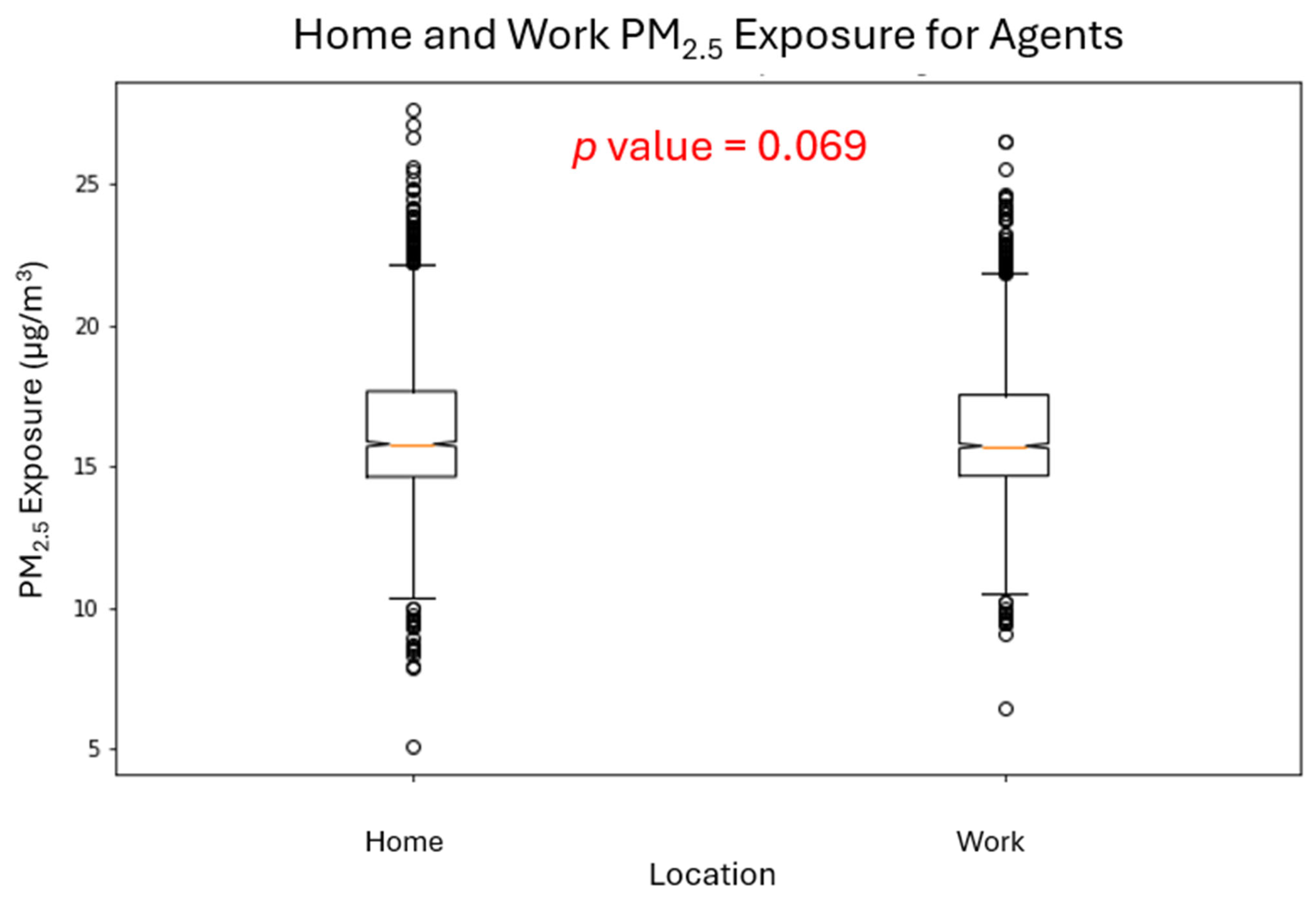
5.3. Home and Workplace Exposure Under Spatial Equity
5.4. Route Optimization and Mobility Constraints
5.5. Policy Implications: Dual Pathways to Environmental Health Equity
5.6. Comparison to Literature and Methodological Contributions
5.7. Limitations and Future Directions
6. Conclusions
Author Contributions
Funding
Institutional Review Board Statement
Informed Consent Statement
Data Availability Statement
Use of Artificial Intelligence
Conflicts of Interest
References
- Brook, R.D.; Rajagopalan, S.; Pope, C.A.; Brook, J.R.; Bhatnagar, A.; Diez-Roux, A.V.; Holguin, F.; Hong, Y.; Luepker, R.V.; Mittleman, M.A.; et al. Particulate Matter Air Pollution and Cardiovascular Disease. Circulation 2010, 121, 2331–2378. [Google Scholar] [CrossRef] [PubMed]
- Pope, C.A.; Burnett, R.T.; Thun, M.J.; Calle, E.E.; Krewski, D.; Ito, K.; Thurston, G.D. Lung cancer, cardiopulmonary mortality, and long-term exposure to fine particulate air pollution. JAMA 2002, 287, 1132–1141. [Google Scholar] [CrossRef] [PubMed]
- Calderón-Garcidueñas, L.; Villarreal-Calderon, R.; Valencia-Salazar, G.; Henríquez-Roldán, C.; Gutiérrez-Castrellón, P.; Torres-Jardón, R.; Osnaya-Brizuela, N.; Romero, L.; Torres-Jardón, R.; Solt, A.; et al. Systemic Inflammation, Endothelial Dysfunction, and Activation in Clinically Healthy Children Exposed to Air Pollutants. Inhal. Toxicol. 2008, 20, 499–506. [Google Scholar] [CrossRef] [PubMed]
- Hajat, S.; Sarran, C.; Bezgrebelna, M.; Kidd, S. Ambient Temperature and Emergency Hospital Admissions in People Experiencing Homelessness: London, United Kingdom, 2011–2019. Am. J. Public Health 2023, 113, 981–984. [Google Scholar] [CrossRef]
- Testi, I.; Wang, A.; Paul, S.; Mora, S.; Walker, E.; Nyhan, M.; Duarte, F.; Santi, P.; Ratti, C. Big mobility data reveals hyperlocal air pollution exposure disparities in the Bronx, New York. Nat. Cities 2024, 1, 512–521. [Google Scholar] [CrossRef]
- Jiang, F.; Ma, J. Environmental Justice in the 15-Minute City: Assessing Air Pollution Exposure Inequalities Through Machine Learning and Spatial Network Analysis. Smart Cities 2025, 8, 53. [Google Scholar] [CrossRef]
- Chapizanis, D.; Karakitsios, S.; Gotti, A.; Sarigiannis, D.A. Assessing personal exposure using Agent Based Modelling informed by sensors technology. Environ. Res. 2021, 192, 110141. [Google Scholar] [CrossRef]
- Gurram, S.; Stuart, A.L.; Pinjari, A.R. Agent-based modeling to estimate exposures to urban air pollution from transportation: Exposure disparities and impacts of high-resolution data. Comput. Environ. Urban Syst. 2019, 75, 22–34. [Google Scholar] [CrossRef]
- Heintzelman, A.; Filippelli, G.M.; Moreno-Madriñan, M.J.; Wilson, J.S.; Wang, L.; Druschel, G.K.; Lulla, V.O. Efficacy of Low-Cost Sensor Networks at Detecting Fine-Scale Variations in Particulate Matter in Urban Environments. Int. J. Environ. Res. Public Health 2023, 20, 1934. [Google Scholar] [CrossRef]
- Barkjohn, K.K.; Gantt, B.; Clements, A.L. Development and Application of a United States wide correction for PM2.5 data collected with the PurpleAir sensor. Atmos. Meas. Tech. 2021, 4, 4617–4637. [Google Scholar] [CrossRef]
- Cosgrove, B.A.; Lohmann, D.; Mitchell, K.E.; Houser, P.R.; Wood, E.F.; Schaake, J.C.; Robock, A.; Marshall, C.; Sheffield, J.; Duan, Q.; et al. Real-time and retrospective forcing in the North American Land Data Assimilation System (NLDAS) project. J. Geophys. Res. Atmos. 2003, 108, GCP 3-1–GCP 3-12. [Google Scholar] [CrossRef]
- Li, J.; Carlson, B.E.; Lacis, A.A. How well do satellite AOD observations represent the spatial and temporal variability of PM2.5 concentration for the United States? Atmos. Environ. 2015, 102, 260–273. [Google Scholar] [CrossRef]
- Thome, K. MODIS|Terra. 610 WebDev. 2020. Available online: https://terra.nasa.gov/about/terra-instruments/modis (accessed on 5 March 2021).
- Yang, Z.; Zdanski, C.; Farkas, D.; Bang, J.; Williams, H. Evaluation of Aerosol Optical Depth (AOD) and PM2.5 associations for air quality assessment. Remote Sens. Appl. Soc. Environ. 2020, 20, 100396. [Google Scholar] [CrossRef]
- Levy, R.C.; Mattoo, S.; Munchak, L.A.; Remer, L.A.; Sayer, A.M.; Patadia, F.; Hsu, N.C. The Collection 6 MODIS aerosol products over land and ocean. Atmos. Meas. Tech. 2013, 6, 2989–3034. [Google Scholar] [CrossRef]
- Cameletti, M.; Lindgren, F.; Simpson, D.; Rue, H. Spatio-temporal modeling of particulate matter concentration through the SPDE approach. AStA Adv. Stat. Anal. 2013, 97, 109–131. [Google Scholar] [CrossRef]
- Chen, J.; Miao, C.; Yang, D.; Liu, Y.; Zhang, H.; Dong, G. Estimation of fine-resolution PM2. 5 concentrations using the INLA-SPDE method. Atmos. Pollut. Res. 2023, 14, 101781. [Google Scholar] [CrossRef]
- Fioravanti, G.; Martino, S.; Cameletti, M.; Cattani, G. Spatio-temporal modelling of PM10 daily concentrations in Italy using the SPDE approach. Atmos. Environ. 2021, 248, 118192. [Google Scholar] [CrossRef]
- National Land Cover Database (NLCD) 2019 Products. Available online: https://www.usgs.gov/data/national-land-cover-database-nlcd-2019-products-ver-30-february-2024 (accessed on 1 September 2025).
- Pun, V.C.; Kazemiparkouhi, F.; Manjourides, J.; Suh, H.H. Long-Term PM2.5 Exposure and Respiratory, Cancer, and Cardiovascular Mortality in Older US Adults. Am. J. Epidemiol. 2017, 186, 961–969. [Google Scholar] [CrossRef]
- Research and High Performance Computing. 2020. Available online: https://kb.iu.edu/d/apes (accessed on 4 March 2021).
- McKinney, W. Data Structures for Statistical Computing in Python. In SciPy Proceedings; Curvenote: Austin, TX, USA, 2010; pp. 56–61. Available online: https://conference.scipy.org/proceedings/scipy2010/mckinney.html (accessed on 11 June 2024).
- Hagberg, A.; Swart, P.J.; Schult, D.A. Exploring Network Structure, Dynamics, and Function Using NetworkX; Report No.: LA-UR-08-05495; LA-UR-08-5495; Los Alamos National Laboratory (LANL): Los Alamos, NM, USA, 2008. Available online: https://aric.hagberg.org/papers/hagberg-2008-exploring.pdf (accessed on 11 June 2024).
- Dijkstra, E.W. A Note on Two Problems in Connexion with Graphs. In Edsger Wybe Dijkstra: His Life, Work, and Legacy, 1st ed.; Association for Computing Machinery: New York, NY, USA, 2022; pp. 287–290. [Google Scholar] [CrossRef]
- Dijkstra, E.W. A Note on Two Problems in Connexion with Graphs. Numer. Math. 1959, 1, 269–271. [Google Scholar] [CrossRef]
- Analitis, A.; Katsouyanni, K.; Dimakopoulou, K.; Samoli, E.; Nikoloulopoulos, A.K.; Petasakis, Y.; Touloumi, G.; Schwartz, J.; Anderson, H.R.; Cambra, K.; et al. Short-term effects of ambient particles on cardiovascular and respiratory mortality. Epidemiol. Camb. Mass 2006, 17, 230–233. [Google Scholar] [CrossRef]
- Katanoda, K.; Sobue, T.; Satoh, H.; Tajima, K.; Suzuki, T.; Nakatsuka, H.; Takezaki, T.; Nakayama, T.; Nitta, H.; Tanabe, K.; et al. An association between long-term exposure to ambient air pollution and mortality from lung cancer and respiratory diseases in Japan. J. Epidemiol. 2011, 21, 132–143. [Google Scholar] [CrossRef]
- Shin, H.H.; Gogna, P.; Maquiling, A.; Parajuli, R.P.; Haque, L.; Burr, B. Comparison of hospitalization and mortality associated with short-term exposure to ambient ozone and PM2.5 in Canada. Chemosphere 2021, 265, 128683. [Google Scholar] [CrossRef]
- Badyda, A.J.; Grellier, J.; Dąbrowiecki, P. Ambient PM2.5 Exposure and Mortality Due to Lung Cancer and Cardiopulmonary Diseases in Polish Cities. In Respiratory Treatment and Prevention; Pokorski, M., Ed.; Springer International Publishing: Cham, Switzerland, 2017; pp. 9–17. [Google Scholar] [CrossRef]
- Xing, Y.-F.; Xu, Y.-H.; Shi, M.-H.; Lian, Y.-X. The impact of PM2.5 on the human respiratory system. J. Thorac. Dis. 2016, 8, E69–E74. [Google Scholar] [CrossRef]
- Hayes, R.B.; Lim, C.; Zhang, Y.; Cromar, K.; Shao, Y.; Reynolds, H.R.; Silverman, D.T.; Jones, R.R.; Park, Y.; Jerrett, M.; et al. PM2.5 air pollution and cause-specific cardiovascular disease mortality. Int. J. Epidemiol. 2020, 49, 25–35. [Google Scholar] [CrossRef] [PubMed]


| Land Cover Type | Area (km2) | Percent Area (%) |
|---|---|---|
| Open Water | 1.05 | 0.78 |
| Developed Open Space | 16.07 | 11.90 |
| Developed Low Intensity | 39.96 | 29.58 |
| Developed Medium Intensity | 46.65 | 34.54 |
| Developed High Intensity | 25.35 | 18.72 |
| Barren Land | 0.11 | 0.08 |
| Deciduous Forest | 2.01 | 1.49 |
| Evergreen Forest | 0.02 | 0.01 |
| Mixed Forest | 0.24 | 0.18 |
| Shrub/Scrub | 0.01 | 0.01 |
| Grassland | 0.08 | 0.06 |
| Pasture/Hay | 1.07 | 0.79 |
| Cultivated Crops | 2.21 | 1.64 |
| Woody Wetlands | 0.05 | 0.04 |
| Emergent Herbaceous Wetlands | 0.19 | 0.14 |
| Component | Source | Magnitude (from Literature) |
|---|---|---|
| Exposure | Residential segregation; mobility; environmental planning | ~98–99% of observed exposure disparity in real cities [5,6] |
| Vulnerability | Baseline health, comorbidities, age, healthcare access | ~10× difference in modeled VWDI (this study) |
| Target | Mechanism | Policy Strategies |
|---|---|---|
| Reduce exposure inequality | Address spatial emissions & mobility inequities. | Emission controls, industrial zoning reform, transit electrification, green buffers, traffic restrictions, canopy investment, 15 min clean-air neighborhoods |
| Reduce vulnerability inequality | Protect high-risk populations independent of location. | Healthcare access, screenings, chronic disease management, air filtration programs, risk communication, and community health infrastructure |
Disclaimer/Publisher’s Note: The statements, opinions and data contained in all publications are solely those of the individual author(s) and contributor(s) and not of MDPI and/or the editor(s). MDPI and/or the editor(s) disclaim responsibility for any injury to people or property resulting from any ideas, methods, instructions or products referred to in the content. |
© 2025 by the authors. Licensee MDPI, Basel, Switzerland. This article is an open access article distributed under the terms and conditions of the Creative Commons Attribution (CC BY) license (https://creativecommons.org/licenses/by/4.0/).
Share and Cite
Johnson, D.P.; Filippelli, G.; Heintzelman, A. Evaluating PM2.5 Exposure Disparities Through Agent-Based Geospatial Modeling in an Urban Airshed. Air 2025, 3, 33. https://doi.org/10.3390/air3040033
Johnson DP, Filippelli G, Heintzelman A. Evaluating PM2.5 Exposure Disparities Through Agent-Based Geospatial Modeling in an Urban Airshed. Air. 2025; 3(4):33. https://doi.org/10.3390/air3040033
Chicago/Turabian StyleJohnson, Daniel P., Gabriel Filippelli, and Asrah Heintzelman. 2025. "Evaluating PM2.5 Exposure Disparities Through Agent-Based Geospatial Modeling in an Urban Airshed" Air 3, no. 4: 33. https://doi.org/10.3390/air3040033
APA StyleJohnson, D. P., Filippelli, G., & Heintzelman, A. (2025). Evaluating PM2.5 Exposure Disparities Through Agent-Based Geospatial Modeling in an Urban Airshed. Air, 3(4), 33. https://doi.org/10.3390/air3040033