1. Introduction
The transition to university is a fundamental period in students’ academic and social development, particularly for those entering through non-traditional routes such as foundation programmes or articulation agreements [
1,
2,
3]. These students may face academic and social challenges, including misaligned expectations, limited disciplinary preparation, and unfamiliar learning environments [
4,
5,
6]. International and alternative entry students often report reduced self-efficacy, stress, and difficulty adjusting to independent learning [
7,
8,
9]. Although AI tools may offer support [
10,
11], little is known about their role in supporting Year 2 direct entrants. Social integration can also be difficult, mainly when students join established cohorts. Belonging is key to success and well-being [
12,
13], yet barriers such as cultural misalignment and exclusionary norms persist [
14,
15,
16]. While institutions offer pre-arrival and induction initiatives, these may lack the sustained, culturally responsive support necessary [
17,
18].
This study investigated the transition experiences of direct Year 2 entry students at a UK undergraduate computing science degree. It explored their academic preparedness, transition challenges, use of AI tools, sense of belonging, and perceptions of institutional support. The study addressed the following research questions:
How do direct Year 2 entry students perceive their academic preparedness for computing study, and what challenges do they face during their transition?
How do these students experience social integration, peer support, and institutional belonging at university?
To what extent do direct Year 2 entry students use and perceive AI tools as supporting their academic learning and transition?
2. Related Work
Transitions into higher education are increasingly understood as multidimensional, extending beyond induction to a prolonged process of identity development and adaptation [
1,
19]. This is especially relevant for students entering through international or alternative pathways, who often face mismatches between prior learning and UK university expectations [
4,
20]. These students may struggle with independent learning, critical thinking, and unfamiliar assessment formats [
6,
21]. Expectations, shaped by prior education and institutional messaging, also influence early engagement [
9,
22]; unmet expectations may reduce motivation, particularly in the first semester [
23]. Early academic experiences shape both performance and well-being. Academic adjustment has been shown to predict social adaptation and reduce distress [
24], while profiles combining academic and emotional challenges influence learner persistence [
25]. Supportive, scaffolded teaching can buffer these effects [
26].
2.1. Psychosocial Adjustment and Belonging
Emotional turbulence, identity negotiation, and distress often accompany transitions to university, particularly for non-traditional and international students facing culture shock, language barriers, and social disconnection [
27,
28,
29,
30]. Peer support plays a protective role: a greater connection with peers correlates with lower stress [
7,
31]. Autonomy-supportive environments that meet psychological needs enhance resilience [
26,
32]. However, maintaining such conditions can be challenging in hybrid or massified systems [
33]. Belonging is crucial for academic success and persistence [
12,
34,
35,
36]; yet it is often tenuous for students who lack early exposure to university environments. MacFarlane [
37] found that pre-university experiences supported the development of academic identity and a sense of belonging. In contrast, international and transfer students report lower connectedness [
38] and face misrecognition or exclusion that is shaped by factors such as race, class, or language [
13,
15,
22,
29]. Informal peer spaces are vital [
39], but barriers such as language insecurity and reliance on translation tools can hinder participation [
29]. Indeed, English proficiency is a key factor in navigating academic and social transitions [
40,
41].
2.2. Academic Self-Efficacy, Support Structures, and Digital Platforms
Academic self-efficacy (ASE) and self-regulated learning (SRL) are central to academic adjustment, particularly in computing education, which demands rapid adaptation to abstract content and independent study [
42,
43,
44,
45]. However, students often enter with low ASE and limited SRL strategies [
46]. Interventions such as First-Year Experience (FYE) programmes and pre-arrival activities improve confidence and belonging [
17,
42], particularly when culturally attuned [
33]. Meanwhile, Digital platforms and hybrid learning environments offer new modalities for support and engagement. Kahu, Thomas, and Heinrich [
47] demonstrate that platforms like Discord and Teams foster community and reduce isolation. Complementary strategies, peer mentoring, intercultural events, and inclusive pedagogy further support resilience. Yet [
14] caution that higher education relationships are often instrumental rather than relational, highlighting the importance of authentic staff-student connections as key to fostering long-term academic identity.
Despite these challenges, many students actively (re)construct their educational identities during transition. Conceptualisations of “becoming” in transition theory [
1] and work on “multiple selves” in transnational academic mobility [
48] suggest that students’ identities are not fixed but continuously negotiated in relation to institutional discourses, social interactions, and internalised goals. Support structures that affirm students’ agency, validate diverse trajectories, and scaffold motivational development are thus essential in fostering sustainable academic identities [
46,
49].
2.3. Domain-Specific Challenges in Computing Science
Computing science presents distinct challenges compared to other STEM fields due to the cumulative and abstract nature of its core skills [
50]. Students without a strong background in programming often struggle in key modules such as data structures and algorithms. Early success in introductory programming courses (CS1) predicts later performance [
51], making prior preparation critical. However, the impact of prior programming experience is nuanced. Wilcox and Lionelle [
52] found that while students with prior exposure perform significantly better in CS1, the performance gap narrows considerably by CS2, with no significant differences in overall scores. Other studies show that the effect of prior experience depends on both the extent of exposure and the mode of assessment.
For example, a study [
53] found that students with more years of experience outperform their peers primarily on timed, individual assessments (quizzes, midterms, final exams). In contrast, longer assignments with support reveal no significant differences, and performance disparities largely disappear once students have at least one year of experience [
53].
Students entering via non-traditional routes may have encountered less rigorous or differently focused curricula [
54], which can increase their transition difficulty. Admission of such students reflects multiple institutional priorities: for domestic entrants, policies often emphasise widening participation, equity of access, and recognition of diverse prior learning [
55], while for international students, recruitment supports globalisation strategies and acknowledges the wide variation in prior preparation, curricula, and educational practices across countries [
56]. International students may additionally face language and cultural barriers that shape their experience of introductory programming and computing curricula [
57]. These practices highlight ongoing debates about the balance between access and preparedness: while inclusive admission policies broaden opportunities and diversify student cohorts, they may also place additional pressure on programs to provide bridging mechanisms such as foundation years, preparatory courses, language support, tutoring, or targeted interventions [
58,
59].
3. Materials and Methods
3.1. Context
The study was conducted at a university in Scotland, United Kingdom, where typical undergraduate degrees span four years (1 to 4). At that institution, students can start university as first-year or second-year students. The second-year students join the university from (1) foundation pathways for international students, (2) UK colleges (further education), and (3) UK or international secondary schools, where they would have achieved excellent grades. A successful Year 2 student can progress to Year 3 Honours, then to Year 4 Honours, and earn their Honours degree. A Year 2 student can also progress to Year 3 designated when they do not meet the requirements for progression to honours. They receive a designated degree (ordinary degree) upon completing the programme. However, rather than progressing to Year 3 Designated, students can also choose to repeat Year 2 in order to progress to Year 3 Honours, then to Year 4.
3.2. Research Design
This study used a mixed-methods design [
60]. A single survey instrument collected both quantitative and qualitative data: the former captured structured measures of academic preparedness, transition challenges, and perceptions of AI tools; the latter provided contextualised accounts of student experiences. The two strands were integrated to identify convergence, divergence, and expansion, offering deeper insight than either alone [
61]. This approach is well-suited to computing education, where complex experiences such as student transitions involve both measurable outcomes and personal, relational, and disciplinary adjustments [
62].
3.3. Participants
As stated, the study was conducted at a Scottish university, and it focused on students entering directly into Year 2. Ethical approval was obtained from the College of Science and Engineering Ethics Committee Participation was voluntary and anonymous, with students free to skip questions or withdraw at any time. This design choice was intended to minimise participant burden and to allow students to omit items they did not feel comfortable answering.
Participants were drawn from the 2022 to 2024 cohorts of current and former direct Year 2 entrants.
3.4. Data Collection and Analysis
Participants were sent a survey via the course mailing lists. The online survey instrument comprised ordinal seven-point Likert items that were grouped into subscales and assessed for internal consistency using Cronbach’s alpha: (a) Academic Preparedness before starting university at Year 2 (AP); (b) Students’ perceived level of difficulty in various transition aspects (Transition Difficulties, TD), and (c) Perceptions of AI Tools (AIT).
Table 1 presents the descriptives of AP, TD and AIT scales. As shown in
Table 2, the survey also included one Likert item that measured students’ English language confidence (CE): “I am confident in my English language skills (verbal and written).” Another Likert item captured students’ overall perception of their academic and social transition to university: “I found the transition to university academically and socially challenging.” This item is called TASC (Transition to University: Academic and Social Challenges). The survey also included two open-ended questions: (1) “Can you describe your transition from [your foundation institution/high school/college] to university? What was the most challenging aspect for you?” and (2) “What type of support (academic, social, or administrative) do you feel would have improved your experience when you started Year 2?”.
Quantitative data were analysed in SPSS v29 using descriptive (mean, median, standard deviation) and inferential statistics (Mann–Whitney U, Pearson and Spearman correlations). As participation was voluntary and no items were mandatory, not all respondents completed every subscale, leading to variation in initial response counts (e.g., 73 for some, 70 for others). During data cleaning, cases with insufficient responses within a given scale were excluded (e.g., when only one item of a multi-item scale was completed), ensuring that scale scores reflected valid data. For inferential analyses, SPSS applied listwise exclusion of missing values, resulting in a final valid
N of 70 per scale. Qualitative data underwent inductive thematic analysis [
63]. Inductive thematic analysis (ITA), as articulated by Braun and Clarke, comprises six iterative phases conducted in a data-driven manner to allow themes to emerge naturally from educational data. The process begins with familiarisation, where researchers immerse themselves in the dataset by reading and re-reading transcripts or texts while noting initial ideas. This is followed by coding, systematically labelling significant features across the data. Next, researchers search for themes by collating similar codes into broader provisional themes. These themes are then reviewed, checking for coherence with both individual coded extracts and the entire dataset. In the defining and naming themes phase, the essence of each theme is clarified and given a concise, descriptive label. Finally, producing the report involves weaving together themes into a compelling narrative supported by data excerpts, linking back to research questions and educational contexts. The author conducted the thematic analysis. While a colleague with experience supporting direct Year 2 entrants reviewed a subset of codes informally, they did not act as a co-analyst and are therefore not listed as an author or acknowledged as part of the research team. Potential coder misalignment was addressed through analytic triangulation: codes and themes were revisited iteratively against the dataset, and reflexive memos were kept to document coding decisions. This approach ensured transparency in theme development, even in the absence of multiple formal coders. The mixed-methods design enabled triangulation between statistical findings and students’ narrative accounts.
3.5. Reflexivity
The researcher holds academic and pedagogical roles within the computing programme and has experience supporting direct Year 2 entry students through a non-credit bearing course specific to that cohort and as Advisor of Studies. While this insider status provided rich contextual understanding and informed data interpretation, efforts were made to mitigate potential bias through anonymised data collection and analytic triangulation.
4. Results
Out of the 77 students who completed the survey, 43 (56%) are current Year 2 students (2024–2025 cohort) and 8 (10%) are currently repeating Year 2. The remaining students include two (3%) Year 3 Designated students, 12 (16%) Year 3 Honours students, 5 (6%) Year 4 Honours students, 2 (3%) MSci (Integrated master’s) students, and 5 (6%) students who have already graduated. Most of them come from foundation pathways (N = 58, 75%), while 19 (25%) are non-foundation students (UK further education or High school). As stated, participation was voluntary, and no items were mandatory; therefore, not all respondents completed every scale, resulting in variation in initial response counts. Differences in number reflect listwise exclusion of missing data and the removal of cases with insufficient responses to compute valid scale scores.
To examine how prior educational experiences shaped students’ entry into Year 2, the author first compared perceptions of English language confidence, overall transition experiences, and academic preparedness between foundation (F) and non-foundation (n-F) students.
Table 2 summarises descriptive statistics and the percentage of students rating 5 or above on each item. As shown in the table, confidence in English was high overall (
M = 5.45), with all non-foundation students and nearly two-thirds of foundation students rating 5 or above. In contrast, perceptions of preparedness were more mixed, particularly with respect to teaching style and prior programming courses, where fewer than 40% of foundation students and about two-thirds of non-foundation students felt adequately prepared.
To explore which aspects of university transition students found more or less challenging, students’ reported difficulties across academic and social domains were examined.
Table 3 presents descriptive statistics for each area, with higher scores indicating easier experiences, alongside the proportion of foundation (F) and non-foundation (n-F) students rating 5 or above. The item with the lowest rating, as reported by students, was “Managing independent learning” (
M = 3.51).
Given the growing prominence of AI-assisted learning, this study examined students’ perceptions of AI tools such as ChatGPT and Copilot in supporting their academic transition.
Table 4 summarises descriptive statistics and the percentage of foundation (F) and non-foundation (n-F) students rating 5 or above for each item. Overall, students generally reported positive perceptions of AI tools.
4.1. “It Was Horrible”—Academic Preparedness and Programming Readiness
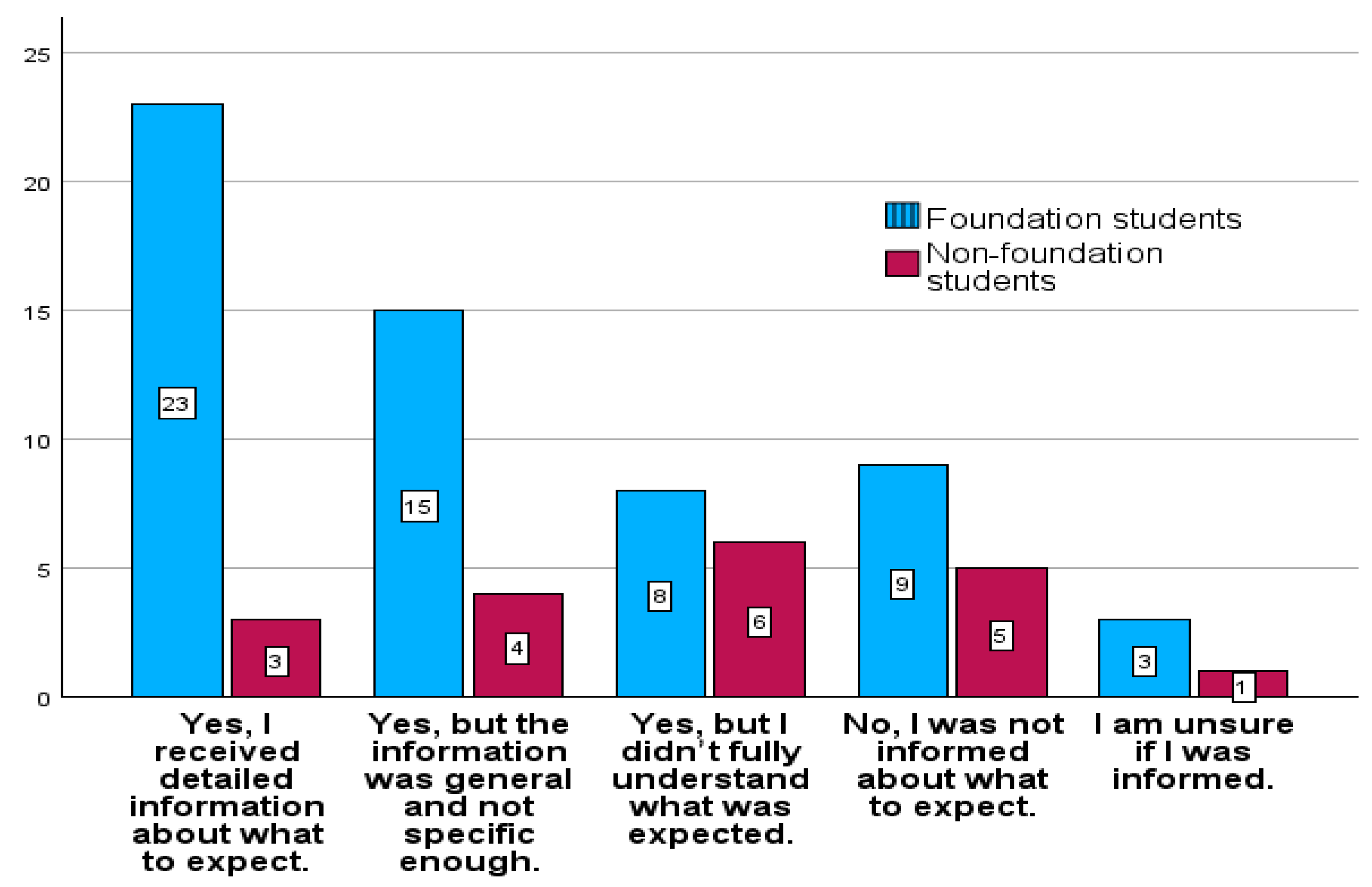
A central theme emerging from both the quantitative and qualitative data was the perceived gap between students’ prior educational experiences. Students were asked whether they had been informed about what to expect before starting Year 2. As summarised in
Table 5, only 26 (34%) out of 77 students reported receiving detailed information about what to expect in Year 2 before transitioning from their previous institution. Students entered Year 2 from different feeder institutions, which were expected to pass on the university’s information about what to expect. In practice, the extent and way this information was conveyed appeared to differ, with some students feeling less well-informed than others. This was reflected in survey responses.
Figure 1 shows that 39.7% (23 students) of all foundation students (
N = 58) selected that option compared to just 15.8% (3 students) of non-foundation students (
N = 19). A few expressed frustrations about the lack of transparency in academic expectations, summarised in this comment: “It was horrible. We didn’t know what we were expecting. We didn’t get support from [previous institution].” Another student reflected on the widespread lack of awareness among foundation students about the nature of the direct entrance into Year 2. They stated: “As I know, there are many students who came from [institution], and they don’t know anything about [Year 2], …. I don’t want new students waste their time and money to be a repeater like me.”, suggesting a critical gap in communication and orientation before Year 2 enrolment. The student self-identifies as a “repeater,” showing that such a lack of prior information can result in emotional and financial burdens, and they do not want others to experience the same fate.
As highlighted in
Table 1, Students’ overall self-reported academic preparedness before university (AP) was moderate (
M = 11.93,
SD = 4.14). Students felt that they were not well prepared for the teaching style expected at the university, with the item ‘The teaching style at my previous institution prepared me effectively for the teaching style at the university’ (
M = 3.70,
SD = 1.75) receiving one of the lowest scores (See
Table 2). A student’s comment reinforced this as they critiqued the quality of tutoring at the foundation pathway: “Many of the tutors were not well-chosen or adequately qualified… Their teaching methods were often unclear… and in some cases, their English proficiency was not at the level required for clear and effective instruction.” As shown in
Table 6, a Mann–Whitney U test revealed statistically significant differences between foundation (
N = 53,
M = 11.4) and non-foundation (
U = 290.5,
p = 0.028,
r = −0.26) groups, indicating that non-foundation students (
N = 17,
M = 13.8) felt more academically prepared.
As presented in
Table 7, Pearson and Spearman rho’s correlation analyses showed that students who felt more academically prepared (AP) also reported finding transition in various aspects of university (TD) easier (
r = 0.364 **,
p = 0.002;
ρ = 0.269 *,
p = 0.025).
The most mentioned gap was in programming readiness. Indeed, one of the AP scale statements (
Table 2), The programming courses at my previous institution provided sufficient preparation for Level 2 programming courses,” received a low rating (
M = 3.67,
SD = 1.82). This was reinforced with qualitative data, with one foundation student stating: “More preparation on programming and coding using the materials used by L1 students instead of assuming we know about it already.” Meanwhile, a high school (non-foundation) student commented, “If my school had taught us Python rather than Visual Basic, it would’ve been more helpful.” This reflects a broader concern among students who felt that their prior programming education did not adequately prepare them for university-level computing courses.
The most beneficial support in their pre-university education (
Table 8) would be ‘better guidance about university expectations’ (67%). This included more precise articulation of academic expectations, workload, independent learning, and university-level assessment standards. A substantial proportion (61%) also identified a need for more programming-focused courses, reflecting dissatisfaction with the adequacy of prior programming preparation, particularly among students from foundation pathways. Interestingly, 35% of students indicated they would have benefited from more challenging coursework, suggesting that the academic level of prior studies was too low.
4.2. English Language Confidence and Language Barriers
Students reported high confidence in English (CE) language skills (
M = 5.45,
SD = 1.63) (see
Table 2), with a Mann
U test (see
Table 6) showing that non-foundation students (
N = 17,
Md = 7) have significantly higher confidence in their English language skills (
U = 218.0,
p < 0.001,
r = 0.4) than foundation students (
N = 53,
Md = 5). English language confidence (CE) also positively correlated with students’ perceived ease of transition in various aspects of university (TD) (
r = 0.306 **,
p = 0.010;
ρ = 0.272 *,
p = 0.023) (see
Table 7). Qualitative data revealed substantial language and communication challenges, particularly in the areas of academic English, digital communication norms, and adapting to classroom discourse. Students described struggling with technical vocabulary, email etiquette, and the unfamiliar structure of lectures. One student recalled: “My English was extremely poor at that time. I couldn’t understand the lessons in class and didn’t know how to communicate.” Another student echoed similar concerns: Language is the most challenging aspect for me. There are so many words that I had never heard from the book, and the sentences they use in daily life and studying are totally different from my previous experience.”
4.3. Overall Transition Challenge
As presented in
Table 2, the overall transition at the university was perceived as moderately challenging both academically and socially (TASC) (
M = 4.75,
SD = 1.52), with no significant differences between foundation and non-foundation students (
p = 0.6). Qualitative responses revealed that students struggled with the pace and depth of instruction, the shift toward independent learning, and the expectation for critical thinking, all of which contrasted sharply with the more scaffolded environments of their previous institutions. One student reflected: “The transition from […] to university was quite challenging, primarily due to the significant differences in teaching quality and academic expectations… independent learning and critical thinking were emphasised, [and] that felt overwhelming at first.” In adapting to these expectations, some students developed new study habits and metacognitive strategies. One participant shared: “I had to figure out what worked best for me during lectures. I couldn’t understand concepts in lectures, which led me to pre-read, something I had never done during college.” This reflects how the transition required not only content knowledge but also new approaches to engaging with the learning process. The increased workload and intensity of Year 2 were also sources of pressure. Students noted difficulty managing multiple assignments. One student reported: “The workload in [foundation pathway] was a fraction of the work needed in Level 2; hence, it was easy to be overwhelmed at first.” Another student shared: “Went from only having two lessons (subjects) a day to multiple in a day. Most challenging was time management as there were many graded assignments due in a single week.” Another student supported this, “The amount of planning needed towards independent learning, and the fact that university work tends to be more than the ‘9-5’ that lecturers usually mention, was difficult to adjust to.” These findings show the importance of earlier and clearer preparation in areas such as independent learning, time management, and study strategies.
4.4. Social Belonging: “I Mostly Had to Make Friends Elsewhere”
Students reported a lack of social belonging, particularly because they entered at a later stage when most peers had already formed friendships in Year 1. This was specifically critical among foundation students, who noted the absence of targeted social events or peer-building initiatives. Many described struggling to establish friendships and feeling isolated during the transition. For example, one student commented: “Most in my course already had existing friend groups, so I mostly had to make friends elsewhere.” That social aspect contributed to feelings of marginalisation and difficulty accessing peer support and made the transition “more stressful.” Moreover, the social integration challenge for some students was not only due to cultural adjustment or existing friend groups but also due to perceived mismatches in peer communication abilities. One participant explained: “Social adaptation was difficult, since I was put into a class where most of the students were barely able to formulate a sentence that would be comprehensible and clear.” This suggests that expectations surrounding peer interaction and classroom discourse were unmet, contributing to a sense of disconnection and potential academic isolation. Another student shared how COVID-19 exacerbated social difficulties, making it harder to form connections, “During the COVID time, when most classes were online, it was difficult to create friends, hence difficult finding peer support, making it more stressful.” While many students reported difficulty forming connections, others highlighted the positive impact of supportive relationships with peers and lecturers. One student shared, “I must say it’s my classmates and lecturers, every time when I wanna give [up], they always encourage me to face the problem and solve it”. This demonstrates the important role that informal social and academic encouragement plays in sustaining student motivation and fostering a sense of community.
Many participants expressed a desire for more structured, proactive support tailored to direct Year 2 entry students. Suggestions included face-to-face mentorship programs, peer-led transition workshops, and more personal engagement from staff. As one student explained, “More direct support network (face-to-face meetings) with tutors e.g., would be helpful rather than *us* needing to reach out to a tutor. Most of us were shy and foreign not used to the university life.” Several recommended mentoring by older students who had completed Year 2 through the programme. Another student suggested “more events for just the [direct Year 2 entry] students … some compulsory sessions just to try and help the students build that community initially.”
4.5. Student Perceptions of AI Tools for Academic Support
Descriptive statistics for the AI tools scale (AIT) indicate that students’ perceptions of AI tools (
Table 4) were generally positive. The highest-rated items reflected the use of AI for understanding difficult concepts (
M = 5.49), bridging gaps in programming understanding (
M = 5.56), and clarifying challenging lecture or coursework content (
M = 5.51). Students also viewed AI tools as effective supplements to university teaching (
M = 5.36) and supportive of independent learning (
M = 5.45). The statement “AI tools have reduced the stress I feel about transitioning to university-level coursework” received a more modest mean rating (
M = 4.73), indicating limited emotional reassurance despite perceived practical utility. Similarly, perceptions of AI’s impact on English language development showed even greater variability, with a lower mean score (
M = 4.36) and a higher standard deviation (
SD = 1.90). For most foundation students (73.6%) compared to non-foundation students (64.7%), “AI tools have been an effective way to supplement the teaching and learning methods at the university”.
Mann–Whitney
U tests revealed no statistically significant differences between current (new) and former Year 2 students in perceptions of AI tools (
p = 0.38) and between foundation and non-foundation students (
p = 0.62). As shown in
Table 7, There was a significant positive correlation between students’ perception of AI tools (AIT) and their overall perception of their academic and social transition to university (TASC) (
r = 0.311 **,
p = 0.009;
ρ = 0.336 **,
p = 0.004), indicating that students who found the transition more academically and socially challenging were more likely to value AI tools.
While some students acknowledged the university’s efforts to support direct Year 2 entrants, many described difficulties navigating the academic systems, including course registration, grading structures, and digital platforms. Administrative confusion was a common theme, particularly among those unfamiliar with email, course portals, or institutional regulations. Others noted that lecturing styles also contributed to their struggles, mainly when lecturers were difficult to follow, as explained by one student: “Some of the lecturers of quite hard modules had monotone approaches that were hard to follow and stay consistent.” These issues were echoed in student suggestions for better orientation, simplified course guidance, and clearer academic expectations.
While no significant relationship was found between AI tool use and either preparedness or transition difficulty (see
Table 7), a near-significant negative association emerged between preparedness (AP) and AI tool perceptions (AIT) (Spearman’s
ρ = −0.218,
p = 0.069). This trend suggests that students who felt more academically confident may have been less reliant on AI. In contrast, those who faced greater challenges may have turned to AI for compensatory support. Students’ qualitative feedback corroborated these findings. Some described AI tools as instrumental for reinforcing programming concepts or clarifying assignments. For example, one student stated: “I use ChatGPT whenever I get stuck on an assignment. It helps break things down in a way I can understand.” Another student noted: “AI tools like Copilot help me when I’m coding and don’t know how to solve a problem. It’s like having a tutor on demand.”
6. Conclusions
This study extends the transition literature by examining international and alternative-entry students who bypass Year 1 and enter directly into Year 2 of a UK Computing Science degree. Survey and thematic analysis data revealed the interplay of academic preparedness, peer belonging, AI tool use, and institutional support in shaping transition quality. Key findings include:
Academic Preparedness: Students often felt underprepared for the pedagogical shift at university, particularly concerning programming. Misalignments between prior and current learning experiences were also noted.
Transition Difficulty: Academic adjustment was closely tied to social and emotional strain. Students cited time management, unclear expectations, and the pressures of independent learning as significant sources of stress. These experiences were intensified by inconsistent induction and limited access to targeted guidance during the early weeks of Year 2.
AI Tool Use: AI tools were perceived as valuable aids for concept clarification, problem-solving, and bridging learning gaps, mainly among students with lower English confidence or weaker prior programming exposure. However, AI usage did not significantly correlate with overall transition difficulty, suggesting these tools serve as supplements rather than primary solutions.
Institutional Support and Belonging: A pervasive sense of fragmentation emerged from student narratives, particularly among those from foundation pathways, with many expressing that they felt unsupported, alienated, or uncertain of expectations.
Peer Networks and Social Integration: Students frequently described social disconnection, exacerbated by late entry into established cohorts and limited opportunities to form meaningful peer bonds.
Although conducted in a single department, the findings resonate with cross-disciplinary reports of non-traditional entrants negotiating unfamiliar pedagogies, compressed socialisation windows, and uneven digital literacy [
4,
14]. Thus, while statistical generalisation is constrained, this study offers analytical generalisability: it identifies mechanisms, misaligned curricula, delayed sense of belonging, and compensatory AI reliance that are likely to recur wherever students join established cohorts at an advanced stage.
The main limitation is the single-institution sample, which restricts external validity. Replication across multiple universities, disciplines, and national contexts would clarify how local policies, teaching cultures, and student demographics mediate the patterns reported here. Longitudinal designs could also explore how AI literacy interconnects with confidence, identity, and autonomy in computing education [
11]. Finally, mixed-methods studies comparing direct entrants with traditional Year 1 starters would illuminate cohort-specific needs and test the transferability of the present findings.
Implications
This study highlights the need for curriculum, support, and policy changes to better serve international and alternative entry students entering advanced years. First, initial induction should be followed by workshops, mid-semester check-ins, and peer-led revision groups that address emerging challenges in independent study, programming, and assessment [
3,
64]. Integrated, peer-supported onboarding delivered through accessible platforms echoes recommendations by [
47]. Students reported gaps in programming preparation, including the use of outdated languages, highlighting the need for collaborative curriculum design that harmonises content, assessment, and critical-thinking expectations across sending and receiving institutions [
21,
71]. Feelings of isolation and anxiety, mainly among foundation students, suggest value in structured mentoring by successful past entrants. Facilitating cross-cultural dialogue can enhance belonging and language confidence [
13,
14,
22,
39]. Students used AI mainly for programming support, confirming its role as a “just-in-time tutor.” Embedding AI literacy in curricula, as part of broader digital fluency initiatives, can ensure equitable and ethical use and reduce over-reliance on ad hoc solutions [
11,
70]. Finally, institutions should move beyond deficit framings to recognise diverse trajectories, aligning support with students’ lived experiences [
1,
2,
33]. By adopting an equity lens, universities can transform transitions from hurdles to shared responsibilities, fostering inclusive academic cultures and improving retention.