
Article

Jurassic Tectono-Sedimentary Evolution of Fault-Bounded Structural Highs in the Monte Bove Area (Umbria–Marche–Sabina Basin, Northern Apennines, Italy)
Geology Division, School of Science and Technology, University of Camerino, 62032 Camerino, Italy
Stratigr. Sedimentol. 2026, 1(1), 2; https://doi.org/10.3390/stratsediment1010002
Submission received: 12 December 2025 / Revised: 10 January 2026 / Accepted: 14 January 2026 / Published: 26 January 2026

Abstract

This study presents a new 1:10,000 geological map of the Monte Bove area (northern Apennines), produced through an original field survey, which allows a detailed reconstruction of Jurassic tectono-sedimentary evolution. The area is characterized by three wedge-shaped structural highs that emerged from the basin floor due to extensional tectonics, following the demise of the Early Jurassic carbonate platform. Stratigraphic and geometric relationships indicate that these highs were already established by the earliest Pliensbachian, bounded by steep fault escarpments and locally mantled by condensed pelagic deposits. Through the Jurassic, the fault-bounded blocks were progressively buried by predominantly micritic pelagic sediments, with evidence of onlap, unconformities, and reworking. The new geological map allows precise delineation of fault geometries and depositional contacts, highlighting the importance of synsedimentary tectonics in shaping basin architecture and documenting a consistent structural trend.

1. Introduction

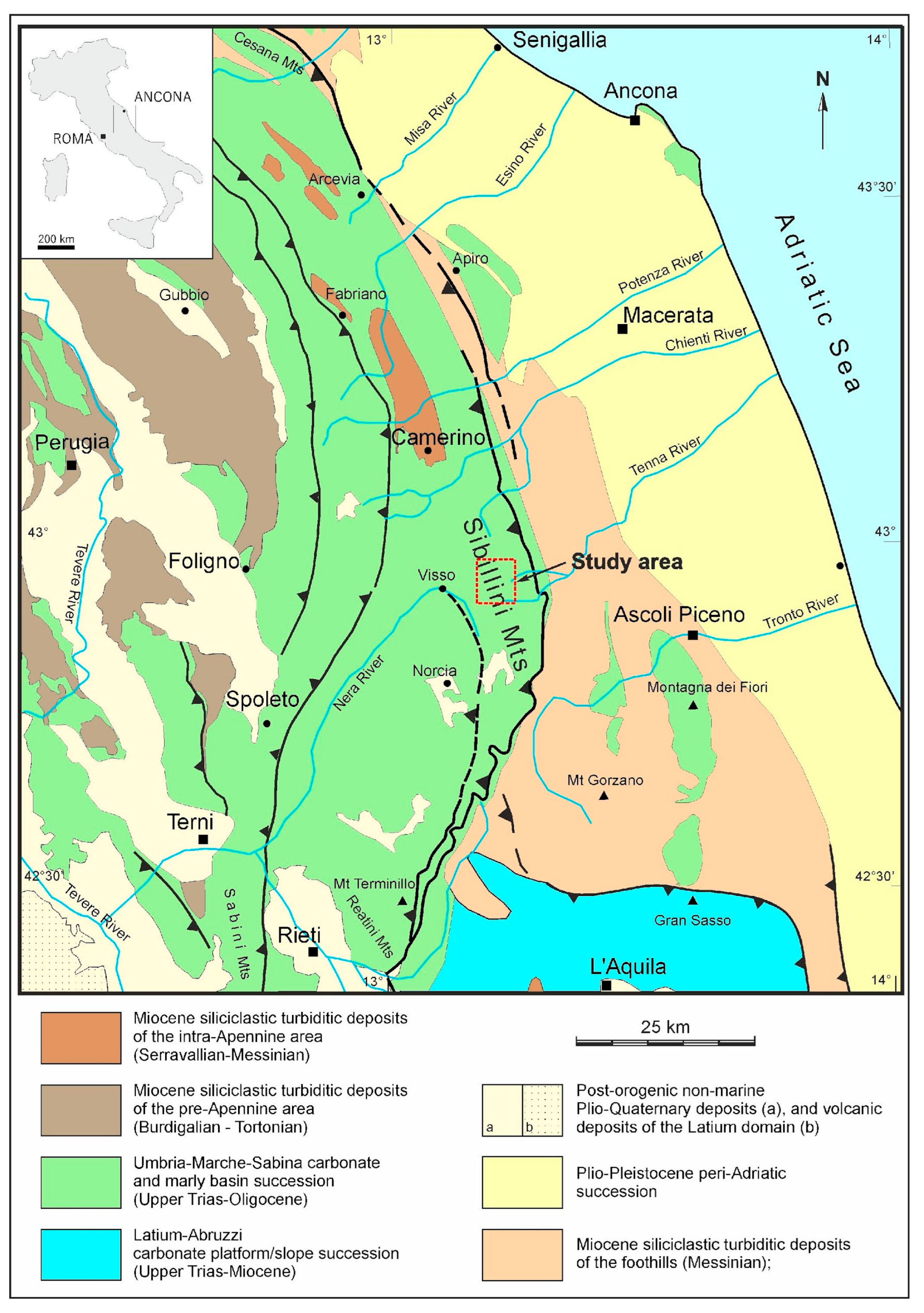
The Umbria–Marche–Sabina Basin in the northern Apennines (Italy) provides exceptional exposures of the Jurassic sedimentary succession, which has been the subject of paleontological and stratigraphic research since the late 19th century. Beginning in the second half of the 20th century, studies revealed differentiated successions that reflect the development of structural highs and intervening depocenters. This basin architecture is linked to the rifting phase that, since the Late Triassic, led to the breakup of Pangea and the opening of the Tethys Ocean. The resulting configuration was produced by syndepositional extensional tectonics that dismembered the extensive Early Jurassic carbonate platform formerly covering the region [1,2,3,4]. From that point onward, the evolution of the Umbria–Marche–Sabina Basin diverged from that of the adjacent Latium–Abruzzi platform to the southeast, where shallow-water carbonate environments persisted until the Miocene (Figure 1).
In the following decades, the sedimentologic and stratigraphic features of the Jurassic deposits were examined at numerous sites [3,5], including detailed studies of the condensed successions exposed on structural highs [6,7]. A defining feature of Jurassic depositional architecture in the region is the marked diversification of sedimentary environments, particularly across structural highs. These highs have been classified into two principal types: (i) those associated with conjugate, oppositely dipping fault systems, and (ii) those characterized by inclined homoclinal geometries [8]. However, wedge-shaped structures lacking a well-developed summit surface are also well documented [9,10,11,12].
Figure 1. Geological sketch map of the northern Apennines, showing the main thrusts; the study area is outlined in the inset box (redrawn and modified from [12]).
Stratsediment 01 00002 g001
The small size of these structures, together with the lack of a clear structural trend, led early research to propose a deformational control linked to dehydration processes within the underlying Upper Triassic evaporitic succession [2,13]. The structural role of evaporites was later reaffirmed, and they were interpreted as a detachment level for Jurassic faulting [11]. Although the existing geological maps allow the distribution of structural highs and the geometry of their contacts with adjacent basinal areas to be broadly outlined, their interpretation remains challenging because many contacts have been modified by later deformation and their true Jurassic origin is not always confirmed in the field. As a result, the same area may be interpreted either as a highly irregular mosaic of isolated highs and intervening basins [13] or, alternatively, as preserving a recurrent orientation of Jurassic fault systems despite the small size and strong subdivision of the structures [10].
The main objective of this study is to reconstruct the structural trends of Jurassic fault systems, a fundamental step toward defining the regional paleogeography of the Tethyan margin and assessing the potential role of salt-controlled deformation. This approach relies primarily on mapping the areal distribution of the different units, with particular attention to their mutual stratigraphic and structural relationships, rather than on detailed analysis of a few particularly significant outcrops. The Monte Bove area offers outstanding exposure conditions in this respect, having undergone only minor deformation during Neogene compressional tectonics. As a result, the original tecto-sedimentary contacts between the various Jurassic units are well preserved, allowing a reliable reconstruction of the original depositional configuration.
This work presents a new 1:10,000-scale geological map of the study area (Figure S1), complemented by a detailed analysis of the contacts between Jurassic pelagic units and fault-bounded carbonate platform blocks. These data refine the local paleogeographic and tectonic framework and provide improved constraints on fault orientation, the extent and geometry of platform blocks, and the morphology of their margins.

2. Methods

This research is mainly based on a 1:10,000-scale geological survey (Figure S1) focused on unconformable contacts between Jurassic pelagic deposits and their substrate. Fieldwork was conducted in two stages: the first (2000–2001) completed geological mapping of the southern sector, while the second (2021–2025) extended coverage to the northern sector and refined the characterization of key localities and critical tectono-stratigraphic contacts.
The fieldwork involved (i) detailed analysis of sedimentary facies, primarily documented through direct outcrop observations and, where necessary, locally confirmed by thin-section analysis; (ii) systematic mapping of stratigraphic and tectonic contacts between Jurassic units; (iii) measurement of bedding and fault attitudes across the entire study area, including remote and less accessible sectors.
Synsedimentary extensional faults of Jurassic age were differentiated using a color-based scheme. Contacts expressed as steep, relatively continuous surfaces were mapped as faults. In the up-section, where these surfaces remained long exposed and significantly reworked by erosion, they were mapped as unconformities. The distinction reflects the degree of preservation and surface reworking.
During the 2000–2001 phase, data acquisition and recording were performed manually. In the 2021–2025 phase, structural and stratigraphic data were collected and digitized in the field using PETEX FieldMove software (v.1.5.2). All geological information was compiled onto a 1:10,000 topographic base (Regione Marche). Field-mapped contacts were initially sketched by hand, then digitized and vectorized using CorelDRAW 2024 (V. 25.2.1.313). The same dataset was used to construct geological cross-sections, enabling estimation of formation thicknesses and fault throws. Finally, cartographic data, combined with structural observations at critical contacts, formed the basis for reconstruction of paleogeographic models for the Monte Bove area.

3. Geological Setting

3.1. Regional Framework

The study area is located in the Sibillini Mountains of the northern Apennines, within the Umbria–Marche–Sabina Basin, which is characterized by a Meso-Cenozoic carbonate succession [14,15] (Figure 1).
The present geological configuration largely reflects the tectonic evolution of the Apennine orogenic system (see [16] and references therein). The extensive Hettangian carbonate platform, which during Mesozoic rifting covered much of the present-day Italian region [17], underwent tectonic dismemberment in the Sinemurian across the northern Apennines, giving rise to contrasting sedimentary conditions. Shallow-water environments persisted on the footwalls of extensional faults, whereas adjacent down-dropped areas were sites of early pelagic sedimentation, which became regionally widespread by the Pliensbachian [18].
Within the Basin, seafloor morphology was strongly controlled by faulting, which produced steep escarpments only partially smoothed by the accumulation on hanging walls of thicker sedimentary packages [1,2,3,4], composed predominantly of cherty limestones. At the same time, a condensed carbonate-dominated succession formed on structural highs. The sedimentological and stratigraphic features of these deposits have been investigated at numerous sites [3,5], with detailed analyses of condensed successions developed on structural highs [6,7].
Many studies have focused on the morphology and depositional conditions that developed along Jurassic fault escarpments, which are typically characterized by unconformable contacts with faulted limestone substrates, frequent silicification, sediment-filled neptunian dykes, and both clastic and megaclastic deposits [9,19,20,21,22,23,24,25,26,27,28,29]. The resulting tectonic framework has also been illustrated across broad sectors of the Basin [10,12].
By the end of the Jurassic, depositional conditions had become more uniform across the entire Basin, with pelagic cherty limestones prevailing until the Eocene, when terrigenous input increased as a consequence of Alpine orogenesis. During the late Miocene, the compressional phase directly affected the Basin, leading to uplift of the Apennine chain, which was thrust eastward over Miocene turbidites. The central and western sectors of the chain were subsequently affected by a post-orogenic extensional regime, active from the Pliocene to the present day [30].

3.2. The Monte Bove Area

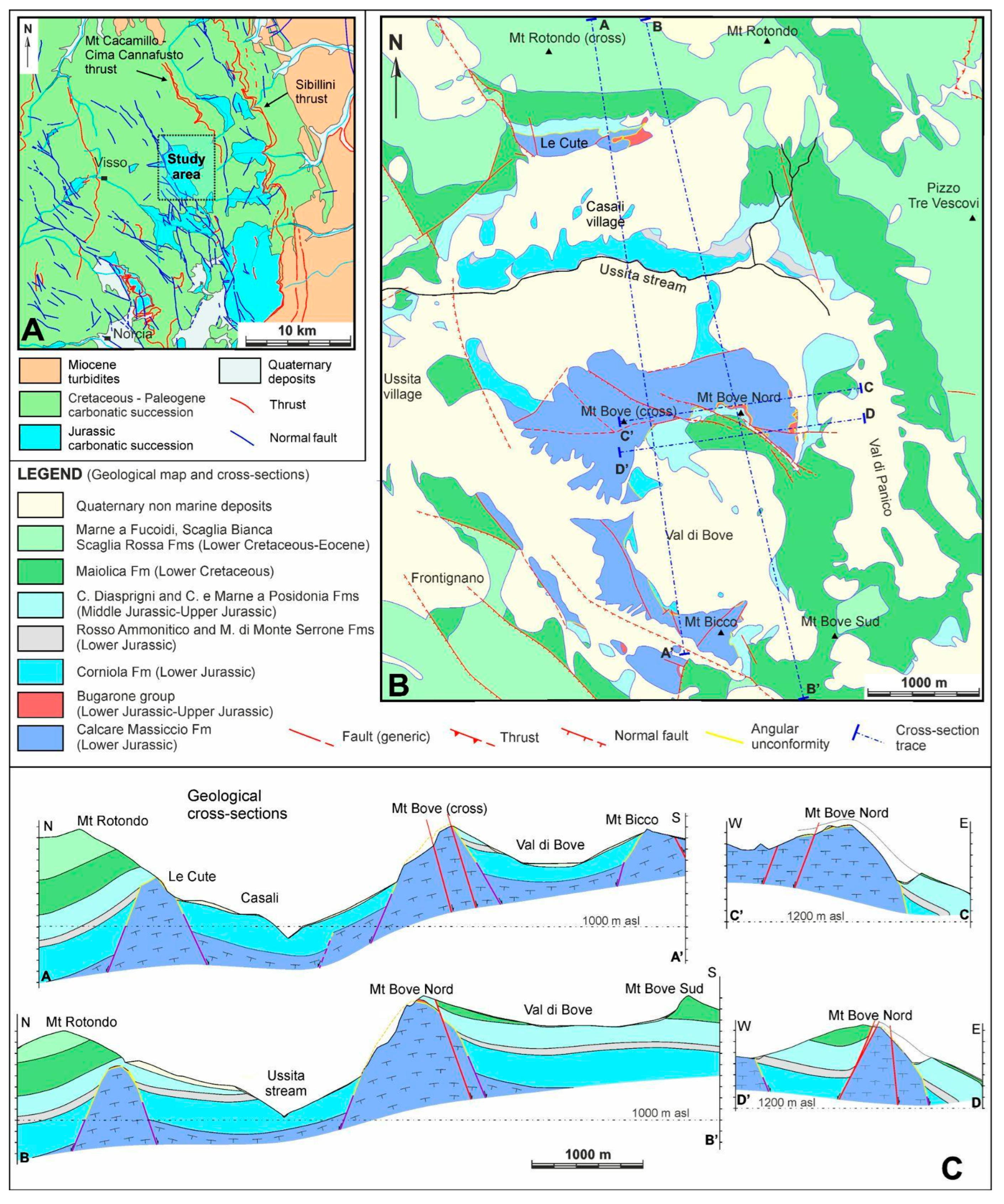
The study area corresponds to the northern sector of the Monte Bove minor anticline, which forms part of the large fold system of the Sibillini Mountains, thrust eastward over Neogene deposits (Figure 1 and Figure 2A). The new 1:10,000-scale geological mapping (Figure S1) provides the basis for a refined reconstruction of the geological framework and structural evolution of the Monte Bove area and its surroundings.

3.2.1. Summary of Previous Studies

A first detailed geological survey at a 1:100,000 scale is provided in the sheet Foglio 132 Norcia, published in 1941 [31]. Later, the area was mapped at a scale of 1:10,000 during field surveys carried out between 2000 and 2001 for the Geological Map of the Marche Region, now available online in a revised form that may differ from the original authors’ interpretation [32]. Subsequent revision, integration, and comparison of these surveys contributed to the publication of a 1:40,000-scale geological map of the Sibillini Mountains and to broader discussions of the tectono-sedimentary evolution of the region since the Jurassic [12].
Numerous studies have investigated the tectonic architecture and evolution of the area, with particular attention to the east-verging thrust of the Meso–Cenozoic carbonate succession onto Miocene foreland deposits [33,34,35,36], and the recent extensional tectonic activity responsible for the 2016–2017 seismic sequence [37,38].
The Jurassic succession of the Monte Bove area, however, has received only limited treatment in the scientific literature. Notable contributions provided a detailed sedimentological and stratigraphic analysis of the unconformable contacts between pelagic successions and the escarpments produced by synsedimentary tectonics [20,39]. At Le Cute and Monte Bove Nord, some erosional structures were interpreted as grooves carved into fault scarps during the Pliensbachian by bypassing sediments shed from the structural highs towards the basin floor [20,39]. An additional reference to the Monte Bove sector is a north–south schematic geological cross-section illustrating the Jurassic structure [12].

3.2.2. Structural and Geological Framework

The study area lies in the core of an anticline with a NNW–SSE axial trend, interpreted as a minor fold associated with the overthrust Monte Cacamillo–Cima Cannafusto structure (Figure 2A). The fold is strongly asymmetrical, with the eastern limb steeply dipping along the Val di Panico. A well-developed system of minor folds deforming the Cretaceous–Paleogene units near the thrust surface is clearly exposed in the Pizzo Tre Vescovi sector (Figure S1). In the northern part of the area, the anticline plunges toward the NNW, marking its periclinal closure.
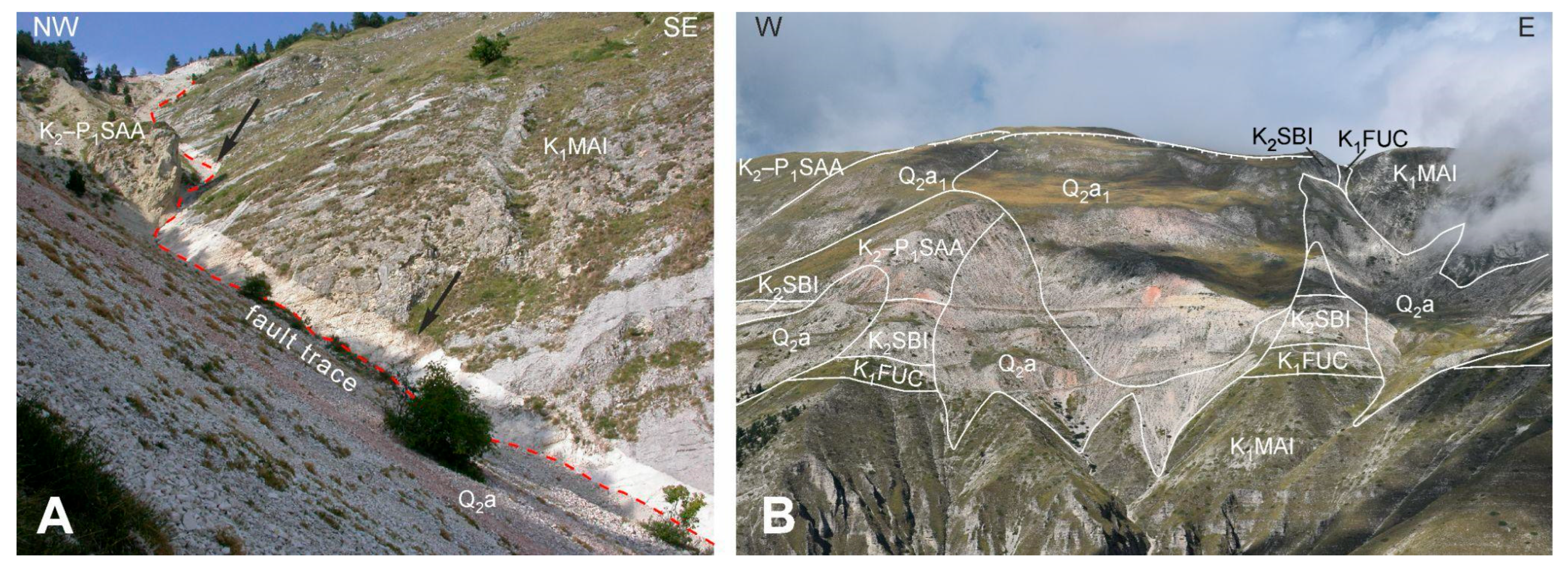
A system of normal faults trending NW–SE to NNW–SSE displaces the western limb of the anticline by roughly 1000 m to the southwest. Some of these structures remained active during the Pleistocene and were involved in the 2016–2017 earthquake sequence [38], producing documented coseismic surface ruptures (Figure 3A).
The area is deeply incised by the Ussita stream, which cuts through more than 1000 m of pelagic strata between Monte Bove to the south and Monte Rotondo to the north. The upper section of the valley, oriented north–south (Val di Panico), exhibits a classic glaciogenic morphology well documented in the Sibillini Mountains [40,41], including a U-shaped cross-section, moraine deposits on the valley floor, and well-preserved cirques at its head. In the lower, east–west-trending portion of the valley, the stream has incised into bedrock, and perched fluvioglacial deposits occur along the valley flanks.
High relief, ongoing tectonic activity, and the presence of marl interbeds within the carbonate succession have facilitated large landslides, particularly active in the Monte Rotondo and Frontignano sectors (Figure 3B). Older, inactive, and locally reworked landslide bodies are also present on the lower slopes of the valley.
Slope deposits derived from gelifraction are widespread and have been reworked into debris-flow and alluvial-fan accumulations. These deposits show variable clast textures—from breccias and fine breccias with a clay matrix to subordinate pebble lenses and dispersed blocks—depending on the lithology and position of their source areas.

4. Lithostratigraphy

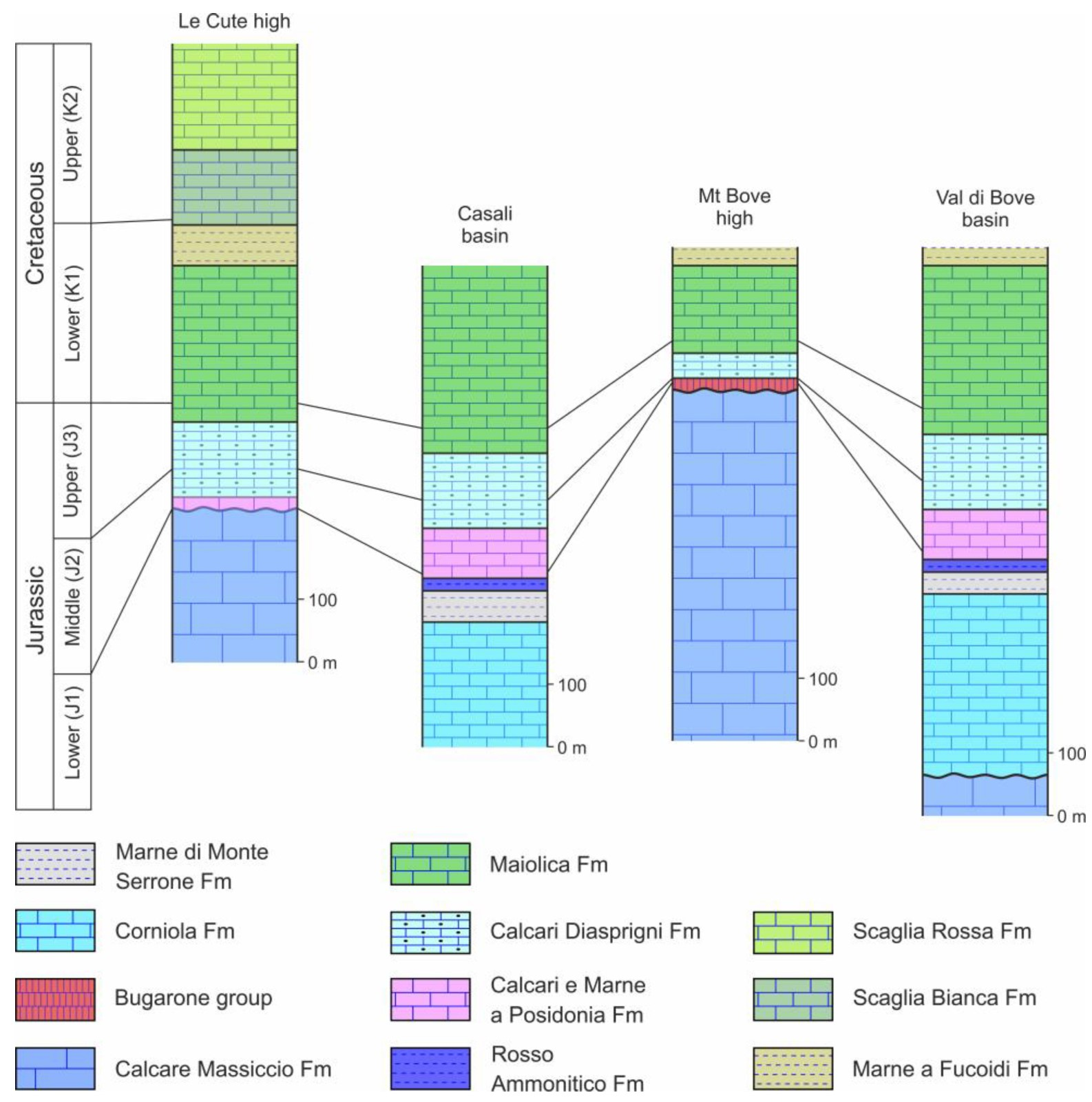
Jurassic rocks are widely exposed in the axial part of the fold, where faulted limestones belonging to the Lower Jurassic carbonate platform are flanked by an extensive pelagic succession. The latter shows the typical features of the Umbria–Marche–Sabina realm [14,15], including the five classical formations deposited from the Sinemurian onward in the basinal domains, together with condensed, carbonate-rich successions formed on structural highs (Figure 4). Turbiditic intercalations of fine- to coarse-grained calcarenites occur at all stratigraphic levels in the basinal deposits, representing resedimented material sourced from adjacent areas where shallow-water carbonate production continued [42,43,44]. In the study area, however, these turbiditic deposits are less abundant than in other parts of the Sibillini Mountains [12].

4.1. The Carbonate Platform

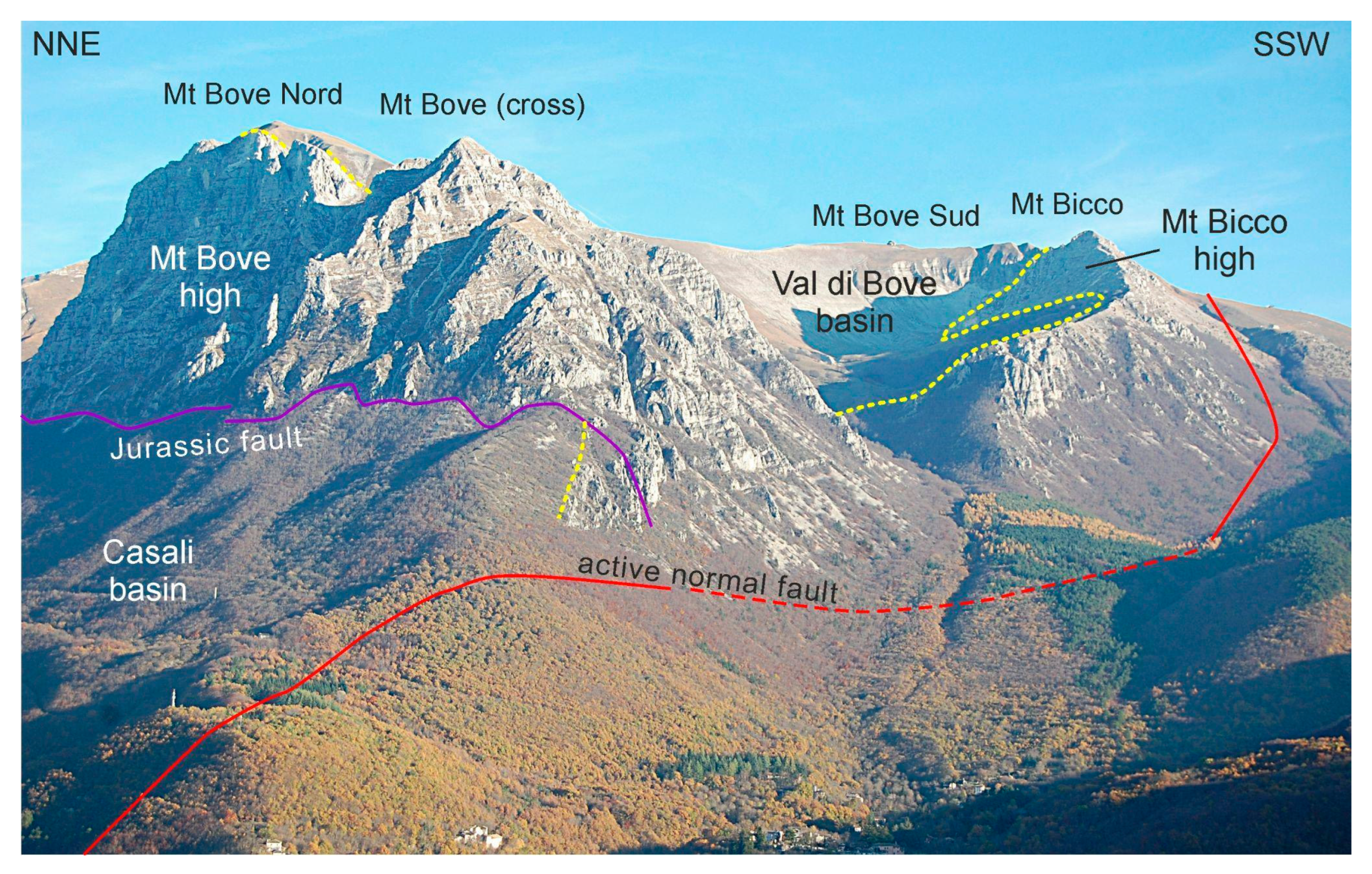
The Calcare Massiccio Formation (J1MAS; Hettangian–Sinemurian) forms nearly the entire mass of Monte Bove Nord (Figure 5), where it is exposed for more than 500 m, without the basal contact being reached. Minor outcrops also occur at Le Cute to the north and in the Monte Bicco area to the south (Figure 2B and Figure S1). This Formation represents shallow-water carbonate deposits developed during the Early Jurassic and consists of pure white to pale hazel limestone, mainly comprising packstone and wackestone rich in peloids and bioclasts. Bedding is generally thick and regular, reflecting intertidal to supratidal depositional conditions, with intermittent episodes of subaerial exposure.
The boundary with the overlying pelagic units on the structural highs is unconformable, and the original stratigraphic top is either faulted or eroded. In these areas, there is no evidence of the well-sorted, fine-grained packstone–grainstone beds lacking tidal features that typically characterize the upper part of the Formation [45].
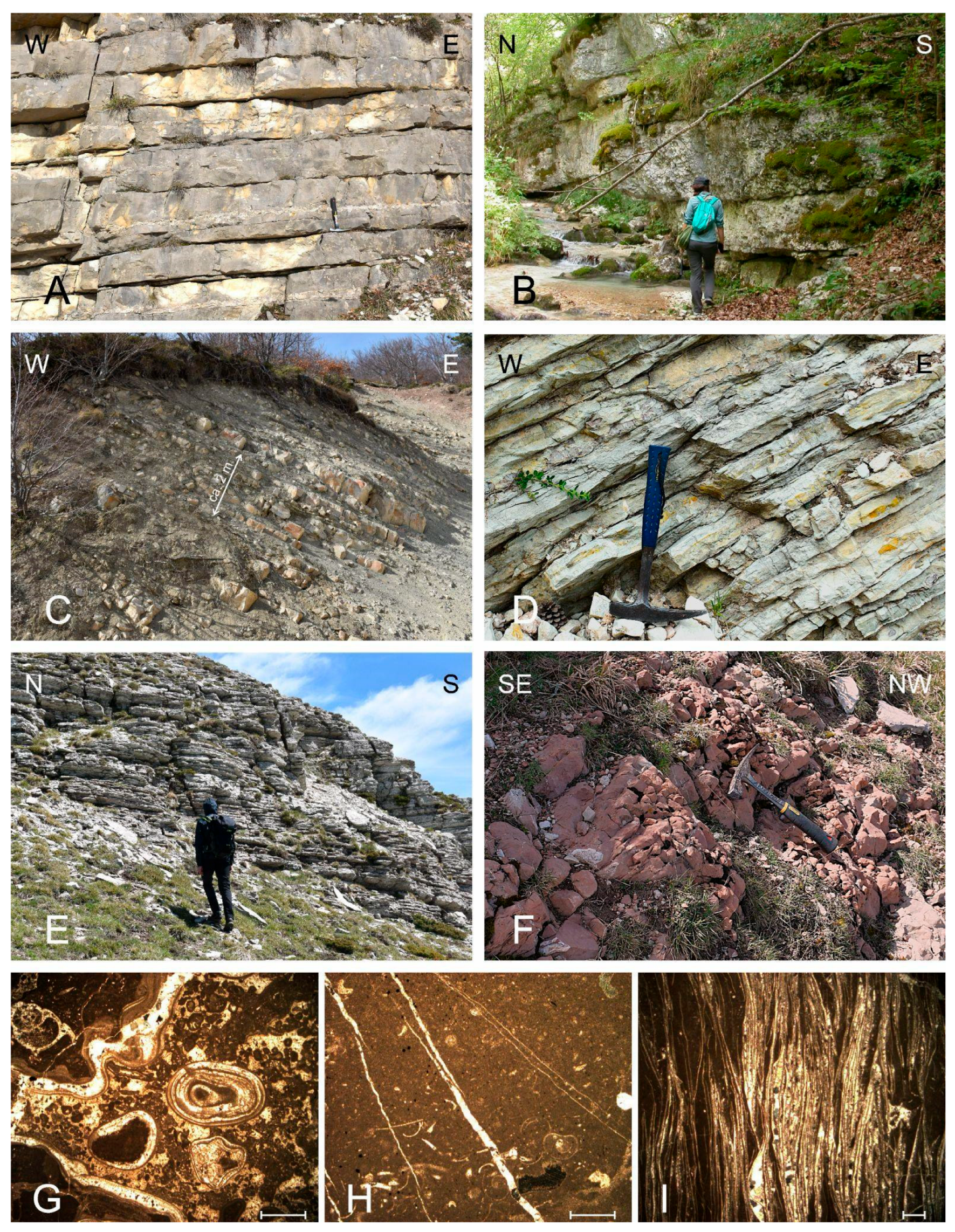
Within the basinal domain, the transition to the overlying Corniola Formation is exposed only locally at the base of paleo-escarpments, where it may also be unconformable. In such settings, the Calcare Massiccio beds preserve their typical features (Figure 6G), including indicators of subaerial exposure, and lack the permanently subtidal, mud-supported facies [45] that can underlie thicker drowning successions on the hanging walls of normal faults [43].

4.2. Corniola Formation (J1COI; Sinemurian–Lower Toarcian)

The Corniola Formation consists of grey, hazel, or brown micritic to microclastic limestones containing radiolarians and sponge spicules, typically in medium to thick beds (Figure 6A). Whitish to grey chert occurs as nodules, layers, and discontinuous bands, accompanied by thin, shaly interbeds, both features being more common toward the top of the unit. Turbiditic intercalations up to 1 m thick are present throughout the Formation, although they are generally more abundant in its lower part, reflecting direct resedimentation from nearby sectors where the Calcare Massiccio platform environment persisted (Figure 6B).
A thick breccia containing olistoliths of Calcare Massiccio mixed with Pliensbachian micritic limestone from the Bugarone group, exposed in Val di Bove (geological map in Figure S1), records mass-wasting processes—likely rockfall events—linked to active steep paleoslopes.
Stratigraphic contacts on the underlying Calcare Massiccio Fm are exposed in Val di Bove and west of Monte Bove Nord, toward the Casali basin, on the hanging walls of faults bounding the structural high (Figure 5; Figure S1). In the latter sector, cherty beds appear to lie in apparent stratigraphic continuity directly above carbonate-platform limestone. In Val di Bove, the boundary is marked by an unconformable surface, with Bugarone group deposits draping the substrate to the south, near Monte Bicco. In these areas, the Corniola Formation reaches only ~200 m in thickness, but likely thickens away from fault escarpments.

4.3. Marne del Monte Serrone Formation (J1RSN; Toarcian) and Rosso Ammonitico Formation (J1RSA; Toarcian)

The two units may be partially or entirely heteropic and together form a continuous marly horizon. They mainly crop out on the northern side of the Ussita Stream valley, whereas in Val di Bove, they are obscured by Quaternary debris. They are treated as a single unit here, since the upper formation (Rosso Ammonitico) is represented only by reddish debris within the study area.
The Marne del Monte Serrone consists of gray to green calcareous mudstone, marlstone, and argillaceous limestone enriched with calcarenitic layers derived from extra-basinal carbonate platforms (Figure 6C). These layers show planar or convolute lamination. The total thickness, including the Rosso Ammonitico, is estimated at approximately 60 m.

4.4. Calcari e Marne a Posidonia Formation (J2POD; Upper Toarcian–Lower Bajocian)

This unit comprises whitish to brown, well-bedded limestone in medium-to-thick layers, with chert content increasing upward and interbedded detrital levels. In the study area, the total thickness reaches approximately 80 m. Pelagic, thin-shelled bivalves (Posidoniidae) may occur, sometimes abundantly.

4.5. Calcari Diasprigni Formation (J2–J3CDU; Lower Bajocian–Lower Tithonian)

The transition from the underlying unit is marked by a progressive increase in silica content. This formation is subdivided into two members, which are not mapped separately. The lower member (membro selcifero) consists of grey to green cherty calcilutite with interbedded calcarenite layers (Figure 6D). Chert becomes dominant in the central part of the unit, while carbonate content increases upward and the color shifts to reddish tones. The upper member (calcari a Saccocoma e Aptici) consists of grey–green, cherty biodetrital limestone and represents the transition to the overlying Maiolica Formation (Figure 6E). In the study area, the total thickness of the unit reaches approximately 100 m.

4.6. Bugarone Group (J1–J2BU; Pliensbachian–Lower Bajocian)

The pelagic facies overlying the Calcare Massiccio Fm on structural highs are characterized by their predominantly carbonate composition, reduced thickness, and richer bioclastic content (Figure 6H,I). This condensed succession, comprising up to five characteristic sub-units, is mapped as the Bugarone group [46]. In the study area, only the three lower sub-units are present. They crop out as small, discontinuous bodies resting unconformably on the substrate of the structural highs and are overlain by Middle Jurassic Fms of the basinal domain.
The basal unit, J1BU1—corresponding to Calcari nodulari dell’Infernaccio Formation (Pliensbachian–lower Toarcian) [47]—consists of whitish, pink, or hazel micritic limestone, often nodular and bioclast-rich. Fossil content includes ammonites, crinoids, gastropods, brachiopods, benthic foraminifera, and coated grains.
J1BU2—corresponding to Calcari nodulari e marne verdi di I Ranchi Formation (Toarcian) [47]—is a thin unit of reddish marlstone, frequently weathered to yellow–gray. It is observed primarily as slope debris at Le Cute and as a 3–4 m-thick outcrop at Mt Bove Nord (Figure 6F).
J2BU3—corresponding to Calcari nodulari a filamens di Fosso del Presale Formation (upper Toarcian–lower Bajocian) [47]—typically consists of light brownish limestone, often very rich in Posidoniidae.
The upper part of the condensed succession—not present within the mapped area—continues with a few meters of argillaceous and siliceous limestones or, in the most typical examples, with a hiatus extending up to the upper unit (Calcari nodulari ad ammoniti ed aptici di Cava Bugarone Formation, Kimmeridgian–Tithonian) [47].

4.7. Cretaceous–Paleogene Succession

From the late Tithonian onward, depositional conditions became more uniform, leading to a regionally consistent lithostratigraphic succession, with variability largely controlled by the amount of resedimented intra- and extra-basinal material. A white to ivory micritic cherty limestone (Maiolica Formation; K1MAI, upper Tithonian–lower Aptian) overlies the Jurassic units, with a thickness ranging from approximately 150–200 m over structural highs to about 300 m in adjacent depocenters.
An increase in organic content and the appearance of dark pelitic levels mark the onset of the Marne a Fucoidi Formation (K1FUC; lower Aptian–upper Albian), a 40–50 m thick unit of regularly bedded grey–green and, less commonly, reddish marlstone and calcareous mudstone, with sparse cherty intercalations.
In the upper portion of the Marne a Fucoidi Fm, a progressive increase in silica and carbonate content marks the transition to the Scaglia Bianca Formation (K2SBI; upper Albian–lower Turonian). This unit consists of whitish argillaceous limestone and limestone with pink chert beds in the lower part, gradually shifting to darker, typically black tones toward the top. A distinctive, approximately 1-m-thick black shale bed (the Bonarelli Level) characterizes its uppermost part. The total thickness reaches 80–100 m, varying depending on the presence of calcarenites, which are limited within the study area.
The Scaglia Rossa Formation (K2–P1SAA; lower Turonian–Lutetian) has been divided into three or four informal members [48], which are not mapped separately. In the study area, it is predominantly represented by its Cretaceous deposits, consisting of regularly bedded reddish cherty limestone that gradually evolves upward into reddish limestone lacking chert. Isolated outcrops of Paleogene reddish and argillaceous limestones occur at the cores of western synclines, while the uppermost cherty member is absent due to surface erosion. The total thickness of the Scaglia Rossa Fm may exceed 250 m, strongly influenced by the influx of calcareous–clastic turbidites derived from adjacent carbonate platforms [44]. These calcarenites are more abundant in the central Cretaceous interval, particularly in the eastern part of the study area (Pizzo Tre Vescovi), where they form a prominent ridge shaped by differential erosion.

5. Jurassic Outcrops and Tectono-Sedimentary Contacts

The area is characterized by three prominent structural highs, Le Cute, Monte Bove, and Monte Bicco, where the platform limestone substrate is overlain by small, discontinuous bodies of condensed pelagic deposits and bordered by broader basinal domains containing thicker sedimentary successions (Figure 2B and Figure S1).

5.1. The Structural Highs

5.1.1. Le Cute–Monte Rotondo

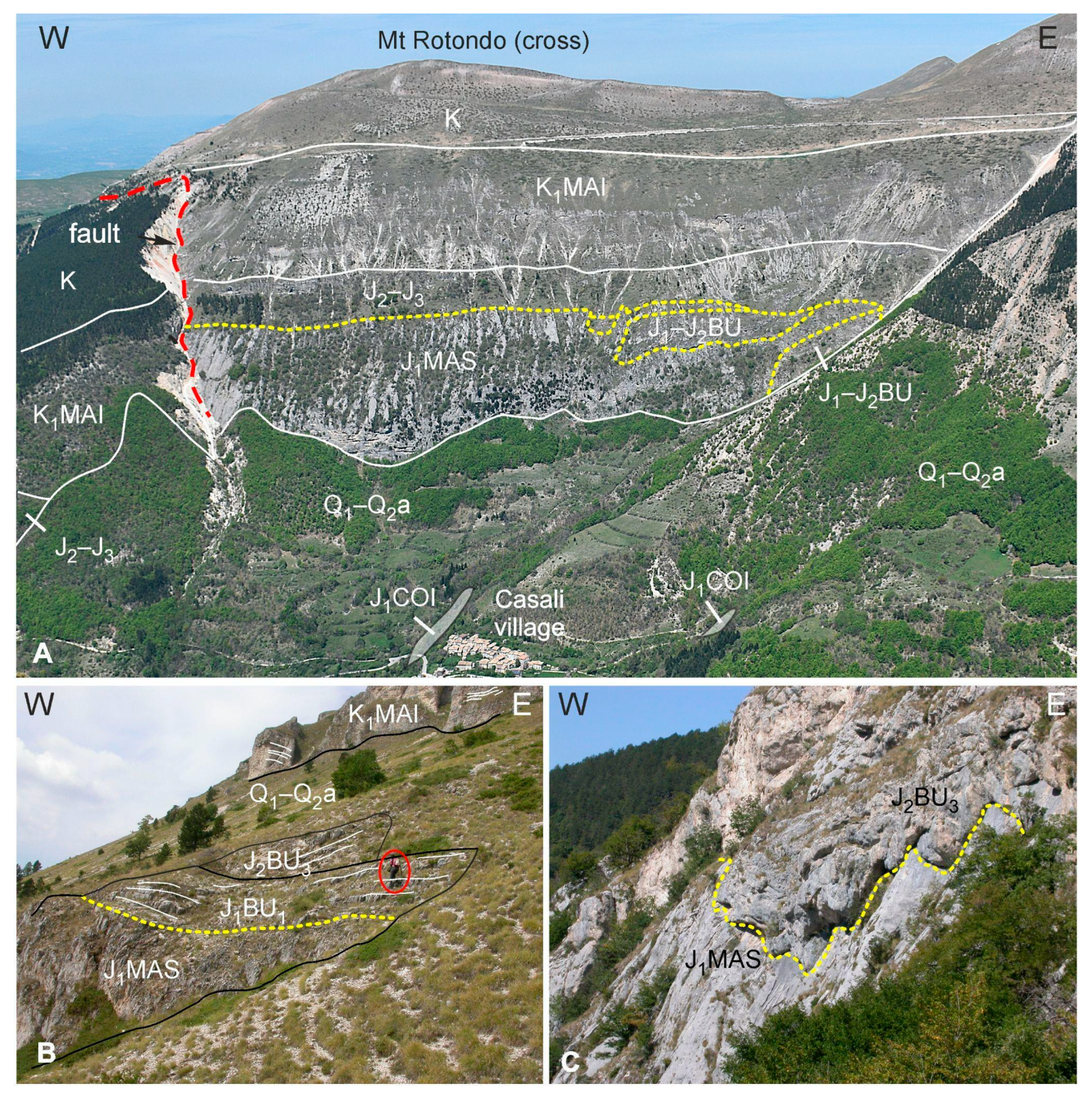
The Calcare Massiccio Fm outcrop on the southern slope of Monte Rotondo represents the northernmost structural high (Figure 2B and Figure S1). It is bounded to the south by an E–W-trending fault-controlled paleo-escarpment, exhumed through removal of the thick pelagic units that once covered the structure (Figure 7A). The limestone surface is cut by large sub-parallel incisions, interpreted as erosional grooves produced by bypassing pelagic sediments flowing off the top of the structural high [20,39], or, as proposed in earlier studies, as large Quaternary karst karren [49].
The top of the structural high is directly sealed by Middle Jurassic Calcari e Marne a Posidonia, overlain in stratigraphic continuity by the Calcari Diasprigni and Maiolica Fms, with no evidence of faulting propagating into these units.
The paleo-escarpment consists of a lower, sub-vertical sector and an upper, inclined surface, unconformably overlain by irregular bodies of Bugarone deposits in the eastern zone. At its eastern end, these condensed deposits form an irregularly stratified mass including all three lower sub-units, resting on the upper part of the escarpment (Figure 7B). Toward the central sector, the Bugarone body is represented by irregular, downslope-displaced masses along the paleoslope (Figure 7C), whereas in the western sector, this cover disappears.
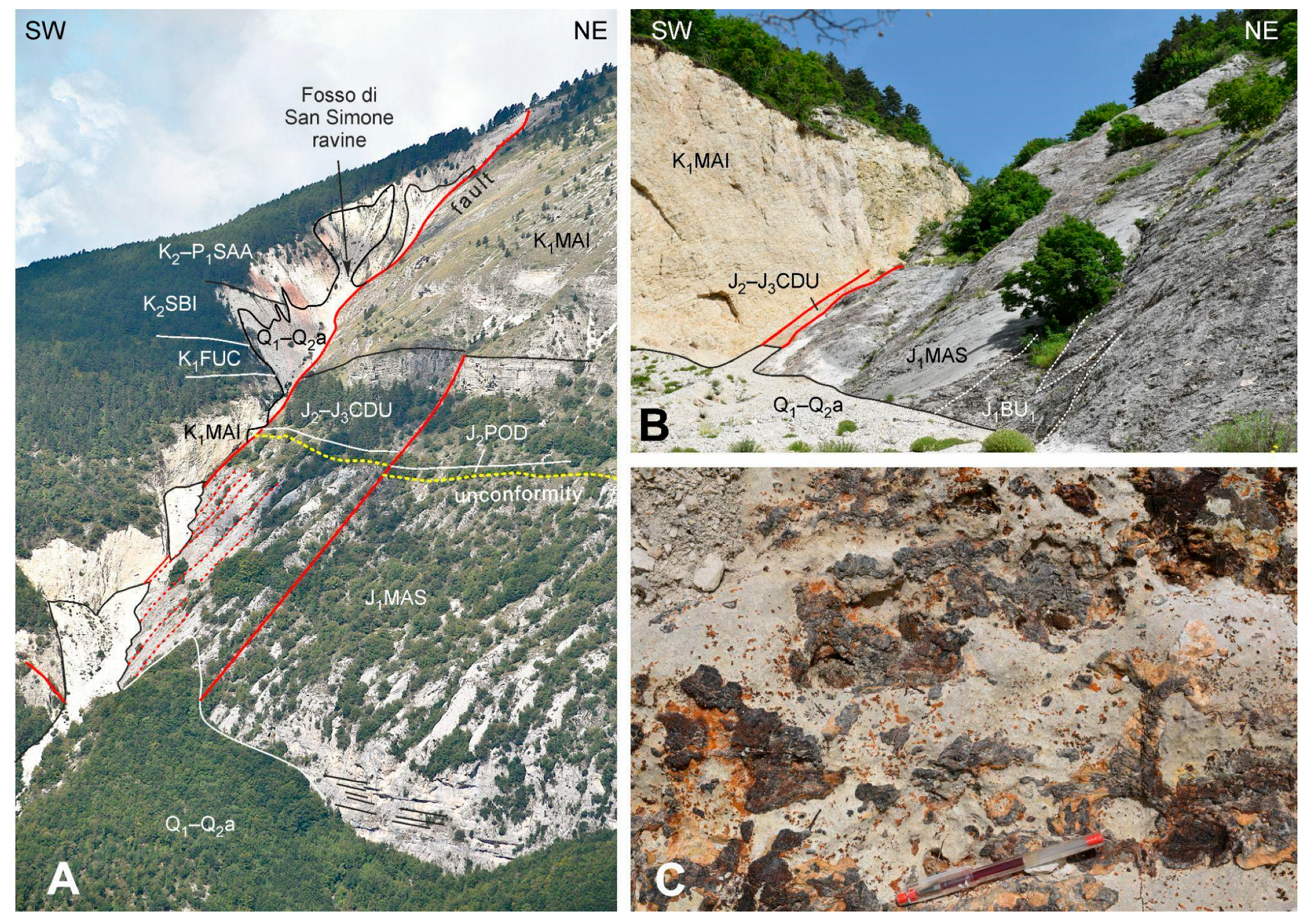
The westernmost sector of this structure was more directly affected by post-Jurassic extensional tectonics (Figure 8A). Along the Fosso di San Simone ravine, the structural high is truncated by a SE–NW-trending normal fault belonging to the Mt Vettore–Mt Bove fault system [50,51], which was active during the most recent seismic sequence (Figure 3A). The Calcare Massiccio surface in the hanging wall of the fault is dissected by minor, sub-parallel faults and fractures, producing a serrated, saw-tooth morphology (Figure 8A,B). These surfaces are draped by thin, discontinuous unconformable deposits rich in large ammonites and brachiopods, mainly referable to the Pliensbachian. The fault plane itself is strongly mineralized with iron oxides and hydroxides (goethite and limonite), as well as quartz (Figure 8C). These condensed deposits locally fill straight dikes or a narrow channel-like feature previously interpreted as an erosional groove [20,39].
Taken together, these characteristics confirm that the contact represents a paleo-escarpment, whereas the present near-direct tectonic contact with the Maiolica Fm (Figure 8B) reflects later fault reactivation.

5.1.2. Monte Bove Nord

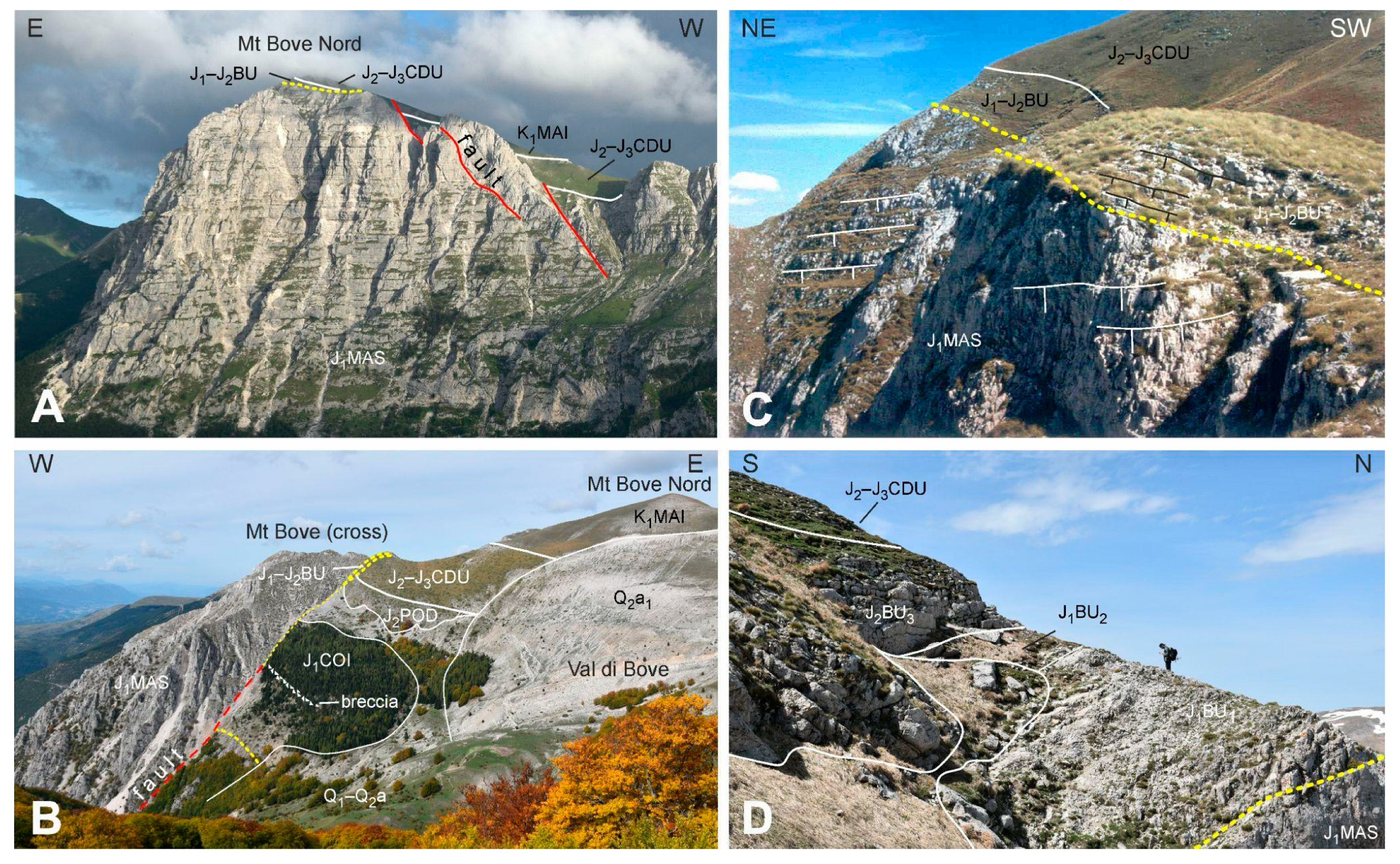
This structural high forms an elongated ridge with a well-defined culmination along the crest of Mt Bove Nord (Figure 9A,B; geological map and cross-sections in Figure 2 and Figure S1). It is bounded by fault paleo-escarpments to the north, south, and east, while the entire Jurassic structure is truncated to the southwest by the system of Pleistocene normal faults.
An angular unconformity sharply truncates the platform limestone at the top of the high (Figure 9A,C), where it is overlain by condensed pelagic deposits that vary laterally in thickness and facies. The most continuous succession occurs at the summit of Mt Bove Nord (Figure 9D) and consists of regularly bedded Pliensbachian condensed facies (J1BU1), overlain by up to 4 m of reddish nodular Toarcian marls (J1BU2, Figure 6F). Above these, a few meters of limestone rich in Posidoniidae (J2BU3) are followed by ~30 m of chert and cherty limestone belonging to the Calcari Diasprigni Fm.
Westward, the condensed deposits progressively thin along the contact with the substrate, passing into small, discontinuous massive lenses or thin veneers between the platform limestone and the overlying Val di Bove basin units (Figure 9B). In particular, the Middle Jurassic deposits tend to become unconformable on the underlying deposits and gradually transition into coeval basinal equivalents, marked by the development of chert beds.
On the southern margin, the high is dissected by normal faults that offset the Val di Bove basinal succession downward by several tens of meters, probably reactivating the pre-existing Jurassic faults (Figure 2C and Figure S1). To the north, the high connects to the Casali basin through a paleo-escarpment represented by the steep slope of Mt Bove Nord (Figure 9A), carved into the platform limestone and lacking any preserved condensed pelagic deposits.
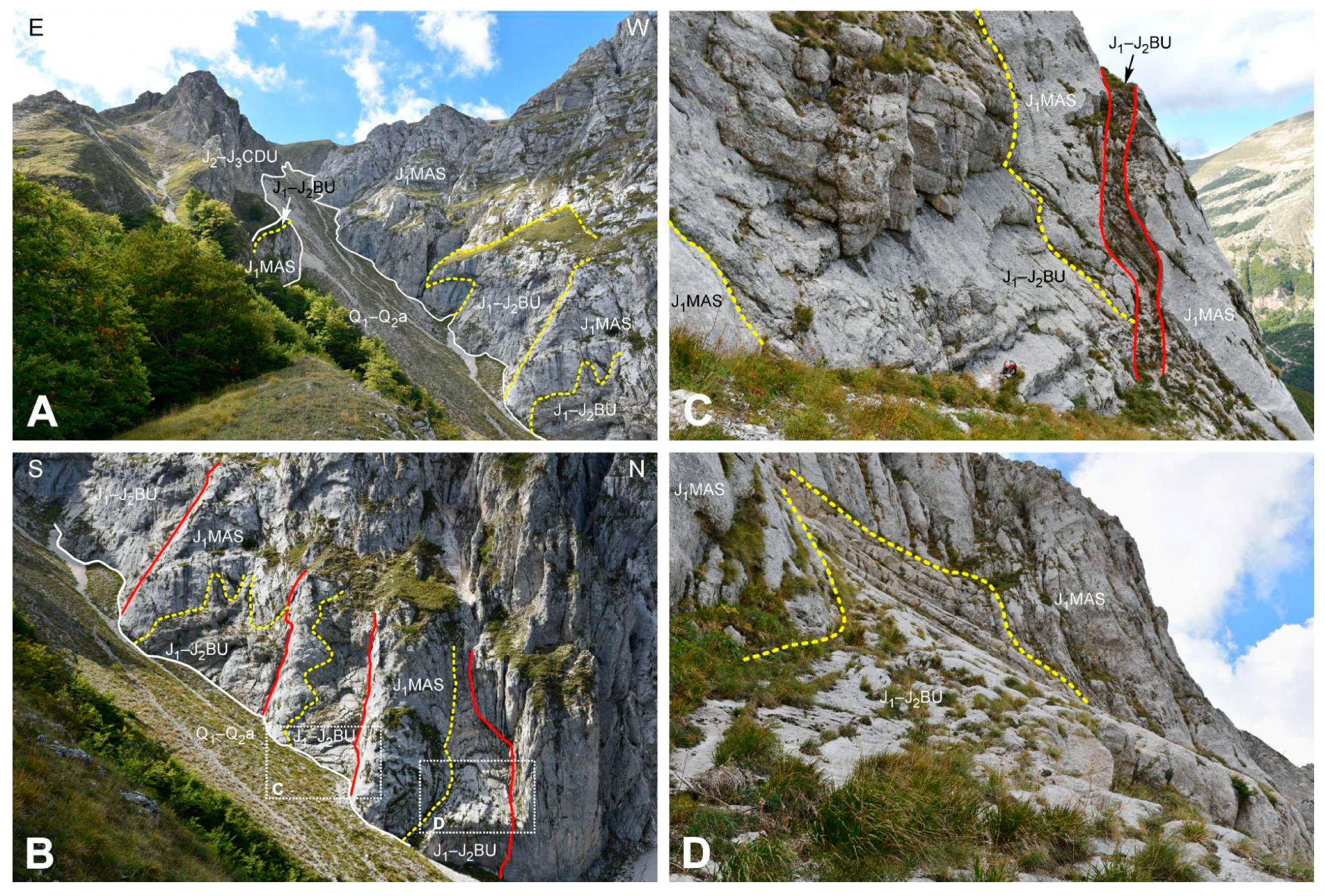
The best exposures of the paleo-escarpments are found to the east, within the steep Santa Romana ravine (Figure 10A), where the slope surface is mantled by a discontinuous cover of Bugarone deposits, previously interpreted as groove infills [20,39]. These condensed pelagic facies occur as small, irregular bodies along the escarpment, crudely bedded due to downslope displacement, or as fillings of neptunian dikes and dihedral indents developed along fractures at the base of the slope (Figure 10B–D). These deposits are predominantly Pliensbachian in age (Figure 6H). Condensed Middle Jurassic Bugarone beds (Figure 6I) are only present along the lower part of the escarpment, at the same elevation as the basinal equivalent exposed on the opposite side of the ravine.
The paleo-escarpment is confined to the east by the thick Middle and Upper Jurassic basinal formations (Figure 2 and Figure S1). The Calcari e Marne a Posidonia Fm buries only the lower part of the slope, reaching elevations of up to ~1500 m, whereas the Calcari Diasprigni Fm onlaps the paleo-slope almost to its crest. No direct stratigraphic contact between the overlying Maiolica Fm and the paleo-escarpment is exposed in the currently accessible outcrops.

5.1.3. Monte Bicco

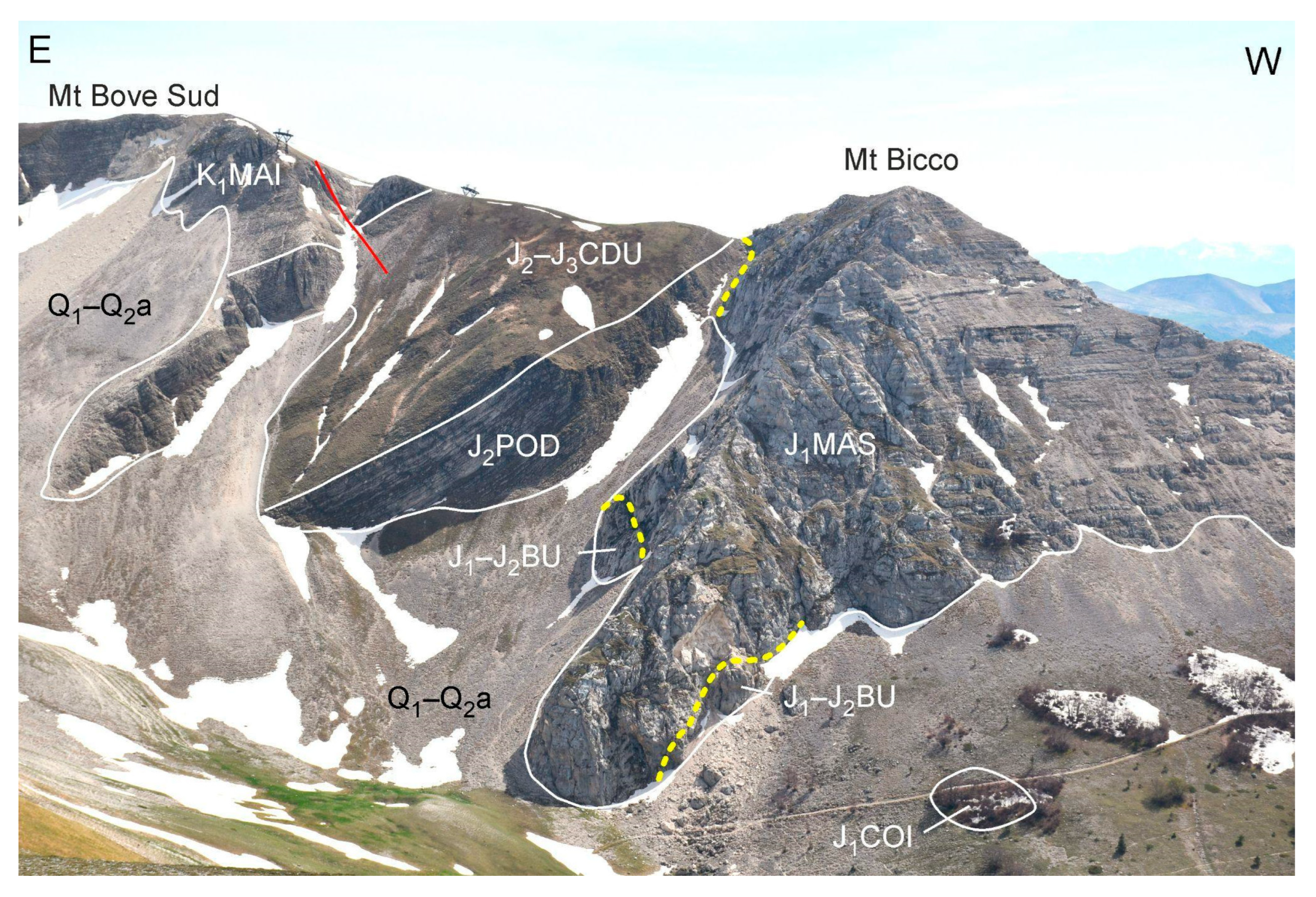
Monte Bicco represents a sharp, ESE–WNW–elongated structural high. It is bounded by basinal deposits along its northern and eastern margins, whereas its southwestern side is truncated by Pleistocene extensional faults (Figure 2B and Figure S1). The highest part of the structure corresponds to the summit of Mt Bicco, where the pelagic cover has been completely removed by recent erosion. Around this apex, discontinuous Bugarone bodies are preserved at the base of two fault escarpments, which dip respectively toward E and NNW.
The eastern flank of the structure is well exposed, with thick Middle–Upper Jurassic basinal units onlapping the paleo-escarpment almost to the summit (Figure 11). On the northern side, these units have been completely eroded, and the paleo-escarpment is directly bordered by the upper levels of the Corniola Fm, with Bugarone deposits locally interposed above the substrate. Northwestward, the structure continues as a descending ridge, directly overlain by the Corniola Fm, with no interposed condensed deposits.

5.2. The Basins

The three structural highs are bordered by thick Jurassic basinal formations (Figure 2B and Figure S1). The main depressed zone corresponds to the Val di Panico–Vallinfante basin, extending eastward to the vertical limb of the fold and continuing south-southeast outside the study area along the axis of the anticline [12]. Conversely, toward the north and west, the absence or discontinuity of Jurassic outcrops prevents determining the extent of the basinal domain.
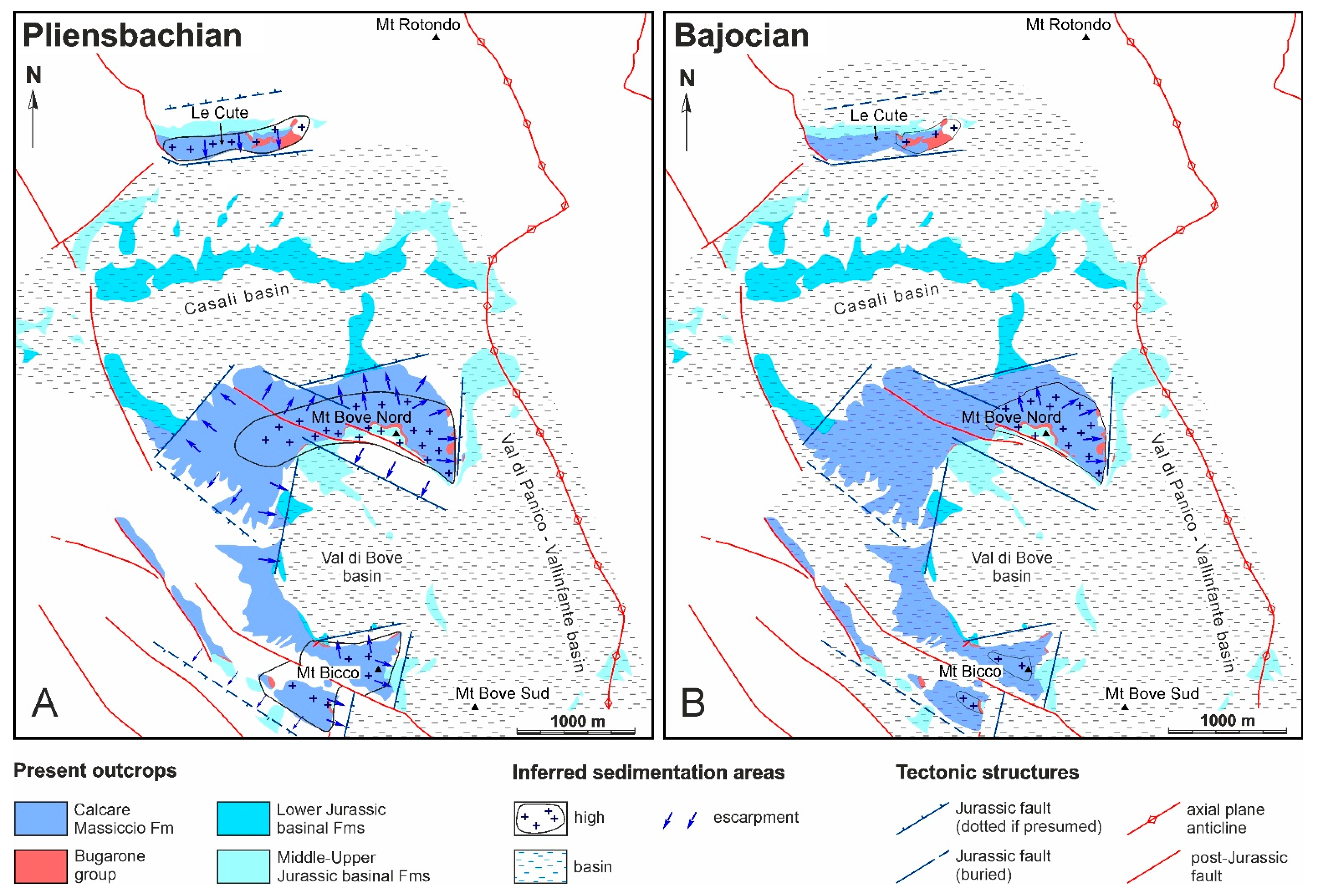
Within the study area, two minor, distinct depressions lie between the structural highs at the hanging walls of opposing faults: a trough approximately 2 km wide between Mt Bove Nord and Le Cute, and a similarly depressed inlet between Mt Bove Nord and Mt Bicco (Figure 12). The most extensive outcrops belong to the Middle and Upper Jurassic units, which display fairly uniform characteristics, with thickness variations occurring mainly over large distances or near the tectono-sedimentary contacts along the margins of the structural highs. Notably, the depositional area of these units, particularly the Calcari Diasprigni Fm, also extended onto the structural highs, albeit with reduced thickness, whereas the Lower Jurassic formations are confined exclusively to the adjacent basins (Figure 12).
The lower part of the Jurassic succession is exposed along the Ussita valley and in Val di Bove, but the stratigraphic contact between the Corniola Fm and the platform substrate is observable only near the fault escarpments bordering the structural high of Mt Bove Nord. In Val di Bove, the Corniola Fm overlies the Calcare Massiccio Fm with an angular unconformity at the hanging wall of the Jurassic fault and includes a detrital body containing blocks of Calcare Massiccio and condensed deposits collapsed from the structural high (Figure 9B). On the opposite side of the Jurassic high, toward the Casali basin, the contact occurs through a direct transition from the low-energy tidal facies of the platform (Figure 6G) to the cherty limestone of the Corniola Fm, without any transitional facies, suggesting a possible paraconformity. In both localities, the succession reaches approximately 250 m in thickness, although a significant increase cannot be excluded away from the basin margins.

6. Discussion and Concluding Remarks

The Jurassic pelagic units in the study area exhibit significant variations in both thickness and lithofacies, primarily due to the presence of three structural highs formed by faulted blocks of the Calcare Massiccio Fm. According to [12], these positive features were already well established during the Early Jurassic and were progressively buried beneath cherty limestone deposits during the Middle and Late Jurassic.
In the region, the dismemberment of the carbonate platform is attributed to the Sinemurian, when Corniola deposition commenced in the basinal domains while platform conditions persisted in adjacent areas, as indicated by ammonite findings [18,27,52,53]. Within the study area, these earliest sedimentary phases in the basins are documented only near the base of the paleo-slopes, where the Corniola Fm directly overlies the platform facies. These contacts likely occur on partly elevated surfaces at the hanging wall of Jurassic faults (geological map and cross sections in Figure 2 and Figure S1). The presence of chert, reduced thickness, and scarcity of turbiditic intercalations suggest that these Corniola beds do not represent the lowermost part of the unit. On the structural highs, unconformable Pliensbachian deposits occur in small patches at ridge tops or as discontinuous, deformed sliding bodies along the paleo-escarpments.
The submarine landscape exhibited a highly irregular topography, likely shaped by transfer-fault activity within an extensional tectonic regime. This configuration resulted in broad subsiding areas located in the hanging walls of faults and elevated, protruding structures oriented E–W to ENE–WNW, bounded by steep paleo-slopes (Figure 12).
The largest depressed area, the Val di Panico basin, is bounded to the west by an NNE–SSW fault system and represents part of the wider basinal domain that continues south of Mt Bove Sud. Smaller basins developed between the structural highs, including a ~2 km wide trough (Casali basin) to the north and a ~1 km wide depressed inlet (Val di Bove basin), the latter enclosed between two highs and also bordered to the west by an NNE–SSW escarpment.
The structural highs are characterized by the absence of a flat top surface. The best example is Mt Bove Nord—an elongated high bounded on both sides by steep fault escarpments. A similar morphology is observed at Mt Bicco.
In contrast, the geometry of the Le Cute high is only partly constrained: its southern paleo-escarpment, facing the Casali basin, is well exposed, whereas the northern side is entirely buried beneath younger units. At the culmination of the exposed paleo-escarpment, the thick sealing basinal deposits overlying the structural high dip northward, indicating onlap from the side opposite the Le Cute escarpment (Figure 2C and Figure S1).
This configuration may be interpreted either as a structure bounded by conjugate faults, analogous to Mt Bove Nord and Mt Bicco, or as a homoclinal ramp, comparable to the type-2 highs [8]. In the present cross-sections (Figure 2C and Figure S1), the former interpretation is preferred, supported both by similarity to adjacent structures and by the absence of morphological or stratigraphic indicators of a gently inclined structural surface. Moreover, the steeper dip of the overlying strata relative to the platform substrate is consistent with a paleo-escarpment setting, whereas a homoclinal ramp would typically produce onlapping deposits with a gentler inclination.
The wedge-shaped geometry of the structural highs represents a new result of this study. Compared to previous interpretations, which already envisaged summit areas limited to a few hundred meters [12], the top surfaces appear even more reduced in extent, particularly for the Le Cute high. This geometry is hardly compatible with the presence of an extensive, flat top surface capable of generating the sediment volumes required to account for large-scale groove incision [20,39].
The geological configuration established during the Sinemurian remained essentially unchanged throughout the rest of the Jurassic (Figure 12). Protruding tectonic highs, characterized by condensed or locally absent deposits, were flanked by basins that progressively accumulated mainly micritic sediments, with additional extra-basinal detrital input. By the end of the Early Jurassic, the lower portions of the fault escarpments were permanently buried beneath pelagic sediments, whereas the upper sectors of the slopes remained exposed or only partially covered by discontinuous bodies of condensed facies.
On the tops of the structural highs, a progressive reduction in the extent of condensed facies deposition is observed; during the Bajocian, such deposits persisted only along the eastern terminations of all three highs (Figure 12). Unlike more typical condensed successions, where conditions favorable to the deposition of purely calcareous, bioclast-rich facies were re-established during the Kimmeridgian–Tithonian [6,7,54,55], the Monte Bove area records a progressive burial of the structural highs by the cherty limestones of the adjacent basins. This process appears to have been completed in the Late Jurassic, during deposition of the Calcari Diasprigni Fm.
From a structural perspective, the outcome of this burial process is the development of structural highs sealed by the calcareous–siliceous units typical of adjacent basinal domains. A comparable configuration has been described at Le Roccacce, about 7 km east of the study area [12], suggesting that this evolutionary pattern may characterize this sector of the basin, possibly reflecting relatively less shallow depositional conditions.
Across the area, the residual bathymetric differences were progressively reduced during the Early Cretaceous by differential accumulation of cherty limestone (Maiolica Fm). Although a local direct contact between the Maiolica and Calcare Massiccio Fms along paleo-escarpments cannot be ruled out, no field evidence of such relationships has been identified within the study area, unlike in other sectors of the Umbria–Marche–Sabina Basin.
The restriction of condensed facies to the eastern terminations of all three structural highs also provides important constraints on the geometry of the uplifted blocks, indicating that these elongated ridges dipped westward or northwestward. In the Mt Bove Nord and Mt Bicco highs, the structural culminations coincide with the eastern edge of the NNE–SSW escarpments that bound the Val di Panico–Vallinfante basin.
The gradual burial of the elevated areas occurred without evidence of renewed or significant fault activity during the Middle and Late Jurassic, in contrast to the northern sectors of the Basin, where minor persistence or reactivation of tectonic activity, particularly during the early Middle Jurassic, is documented by neptunian dykes and megaclastic deposits [19,28,29,56,57].
In the study area, significant post-Jurassic modification affected only the Mt Bicco high, which was cut by Pleistocene normal faults along its southwestern margin. Most other fault escarpments were only partially reactivated during later tectonic phases. At Le Cute, only the western termination of the Jurassic margin was affected by later extensional deformation, while along the southern side of Mt Bove Nord, post-Jurassic reactivation produced only a minor throw of a few tens of meters.
The major fault displacements can therefore be attributed to the Jurassic, specifically its earliest phase, as Middle Jurassic deposits had already onlapped and buried large portions of the paleo-escarpments. The most significant movement occurred around Mt Bove Nord, where the total fault displacement exceeded 1000 m, including nearly 800 m of vertical throw. On the hanging wall of the fault, the Lower Jurassic pelagic deposits are at least ~400 m thick, which implies that a considerable portion of the original escarpment relief was already masked by sedimentation on the sea floor.
In the present landscape, the combined effects of gentle tilting associated with folding and erosion-driven removal of post-Corniola units enhance the apparent vertical relief of the escarpments, most notably at Mt Bove Nord. Geometric reconstructions indicate that these scarps were not very steep and, by the end of Early Jurassic, rose only ~300 m above the basin floor (cross-sections in Figure 2C and Figure S1). Their moderate relief likely reflects both the initial fault dip (around 60°) and subsequent slope degradation, particularly along the eastern ridges where different fault sets intersect. Under these conditions, pelagic sediments could progressively cover the paleoslope without requiring pronounced onlap geometries.
This field-based study, carried out in a well-known area, highlights the value of tracing Jurassic tectono-sedimentary contacts along their full extent to constrain their geometry. The results contribute to a clearer understanding of the structural style developed during rifting in the study area. Although the new map mainly refines outcrop distribution and introduces only locally significant modifications, the analysis reveals an organized fault pattern with a recurrent geometry, characterized by wedge-shaped structural highs bounded by conjugate fault sets, likely linked to transfer zones.

Supplementary Materials

The following supporting information can be downloaded at https://www.mdpi.com/article/10.3390/stratsediment1010002/s1. Figure S1: Geological map of the Mt Bove area (Sibillini Mountains, central Italy) with four geological cross-sections.

Funding

This research received no external funding.

Data Availability Statement

The geological map at 1:10,000 is available in the Supplementary Materials of this paper.

Conflicts of Interest

The author declares no conflicts of interest.

References

  1. Bernoulli, D. Probleme der Sedimentation im Jura Westgriechenlands und der zentralen Apennins. Verh. Naturforsch. Ges. 1967, 78, 35–54. [Google Scholar]
  2. Colacicchi, R.; Passeri, L.; Pialli, G. Nuovi dati sul Giurese Umbro–Marchigiano ed ipotesi per un suo inquadramento regionale. Mem. Soc. Geol. Ital. 1970, 9, 839–874. [Google Scholar]
  3. Centamore, E.; Deiana, G.; Micarelli, A.; Potetti, M. Il Trias–Paleogene delle Marche. Studi Geol. Camerti 1986, Spec. Vol., 9–27. [Google Scholar]
  4. Farinacci, A.; Mariotti, N.; Nicosia, U.; Pallini, G.; Schiavinotto, F. Jurassic sediments in the Umbro-Marchean Apennines: An alternative model. In Rosso Ammonitico Symposium Proceedings; Farinacci, A., Elmi, S., Eds.; Edizioni Tecnoscienza: Rome, Italy, 1981; pp. 335–398. [Google Scholar]
  5. Colacicchi, R.; Parisi, G.; Zamparelli, V. (Eds.) A multidisciplinary approach to the geology of the Italian Jurassic: Twelve years of research into the Umbria–Marche Basin (Central Italy). In Bioevents and Integrated Stratigraphy of the Triassic and the Jurassic in Italy; Palaeopelagos Special Publication: Naples, Italy, 1999; Volume 3, pp. 85–184. Available online: https://www.socgeol.info/en/volumes/?t=vol&id=6812 (accessed on 13 January 2026).
  6. Cecca, F.; Cresta, S.; Pallini, G.; Santantonio, M. Ammoniti e biostratigrafia del Dogger–Malm di Colle Tordina (Monti della Rossa, Appennino marchigiano). Boll. Serv. Geol. Ital. 1986, 104, 177–204. [Google Scholar]
  7. Cecca, F.; Cresta, S.; Pallini, G.; Santantonio, M. (Eds.) Il Giurassico di Monte Nerone (Appennino marchigiano, Italia Centrale): Biostratigrafia, litostratigrafia ed evoluzione paleogeografica. In Atti del II Convegno Internazionale “Fossili, Evoluzione, Ambiente; Tecnostampa Edizioni: Ostra Vetere, Italy, 1990; pp. 63–139. [Google Scholar]
  8. Santantonio, M. Pelagic carbonate platforms in the geologic record: Their classification, and sedimentary and paleotectonic evolution. AAPG Bull. 1994, 78, 122–141. [Google Scholar] [CrossRef]
  9. Galdenzi, S. La struttura giurassica di Monte Acuto, Appennino Umbro-Marchigiano. Boll. Soc. Geol. It. 1990, 109, 707–722. [Google Scholar]
  10. Deiana, G.; Cello, G.; Chiocchini, M.; Galdenzi, S.; Mazzoli, S.; Pistolesi, E.; Potetti, M.; Romano, A.; Turco, E.; Principi, M. Tectonic evolution of the external zones of the Umbria-Marche Apennines in the M. S. Vicino-Cingoli area (Central Italy). Boll. Soc. Geol. It. 2002, Vol. Spec. 1, 229–238. [Google Scholar]
  11. Santantonio, M.; Carminati, E. Jurassic rifting evolution of the Apennines and Southern Alps (Italy): Parallels and differences. Geol. Soc. Am. Bull. 2011, 123, 468–484. [Google Scholar] [CrossRef]
  12. Pierantoni, P.; Deiana, G.; Galdenzi, S. Stratigraphic and structural features of the Sibillini Mountains (Umbria-Marche Apennines, Italy). Ital. J. Geosci. 2013, 132, 497–520. [Google Scholar] [CrossRef]
  13. Coltorti, M.; Bosellini, A. Sedimentazione e tettonica nel Giurassico della Dorsale Marchigiana. Studi Geol. Camerti 1980, 6, 13–22. [Google Scholar]
  14. Centamore, E.; Chiocchini, M.; Deiana, G.; Micarelli, A.; Pieruccini, V. Contributo alla conoscenza del Giurassico dell’Appennino umbro-marchigiano. Studi Geol. Camerti 1971, 1, 7–89. [Google Scholar]
  15. Cresta, S.; Monechi, S.; Parisi, G. Mesozoic–Cenozoic Stratigraphy in the Umbria–Marche Area; Memorie Descrittive della Carta Geologica d’Italia: Rome, Italy, 1989; Volume 39, p. 182. [Google Scholar]
  16. Crescenti, U.; D’Offizzi, S.; Merlino, S.; Sacchi, L. (Eds.) Geology of Italy; Special Volume of Italian Geological Society for the IGC 32: Florence, Italy, 2004; p. 234. [Google Scholar]
  17. Bosellini, A. The western passive margin of Adria and its carbonate platforms. In Geology of Italy; Crescenti, U., D’Offizzi, S., Merlino, S., Sacchi, L., Eds.; Special Volume of the Italian Geological Society for the IGC: Florence, Italy, 2004; pp. 79–92. [Google Scholar]
  18. Passeri, L.; Venturi, F. Timing and causes of drowning of the Calcare Massiccio platform in Northern Apennines. Boll. Soc. Geol. It. 2005, 124, 247–258. [Google Scholar]
  19. Galdenzi, S. Megabrecce giurassiche nella dorsale marchigiana e loro implicazioni paleotettoniche. Boll. Soc. Geol. It. 1986, 105, 371–382. [Google Scholar]
  20. Bice, D.M.; Stewart, K.G. The formation and drowning of isolated carbonate seamounts: Tectonic and ecologic controls in the Northern Apennines. In Carbonate Platforms: Facies, Sequences, and Evolution; Tucker, M.E., Wilson, J.L., Crevello, P.D., Sarg, J.R., Read, J.F., Eds.; IAS Special Publication; Blackwell: Oxford, UK, 1990; Volume 9, pp. 145–169. [Google Scholar]
  21. Santantonio, M.; Galluzzo, F.; Gill, G. Anatomy and palaeobathymetry of a Jurassic pelagic carbonate platform/basin system, Rossa Mts, Central Apennines (Italy): Geological implications. Palaeopelagos 1996, 6, 123–169. [Google Scholar]
  22. Galluzzo, F.; Santantonio, M. The Sabina Plateau: A new element in the Mesozoic palaeogeography of Central Apennines. Boll. Soc. Geol. It. 2002, Vol. Spec. 1, 561–588. [Google Scholar]
  23. Marino, M.; Santantonio, M. Understanding the geological record of carbonate platform drowning across rifted Tethyan margins: Examples from the Lower Jurassic of the Apennines and Sicily (Italy). Sediment. Geol. 2010, 225, 116–137. [Google Scholar] [CrossRef]
  24. Donatelli, U.; Tramontana, M. Platform-to-basin facies transition and tectono-sedimentary processes in the Jurassic deposits of the Furlo area (Umbria-Marche Apennines, Italy). Facies 2014, 60, 541–560. [Google Scholar] [CrossRef]
  25. Cipriani, A. Geology of the Mt. Cosce sector (Narni Ridge, Central Apennines, Italy). J. Maps 2016, 12, 328–340. [Google Scholar] [CrossRef]
  26. Cipriani, A.; Citton, P.; Romano, M.; Fabbi, S. Testing two open-source photogrammetry software as a tool to digitally preserve and objectively communicate significant geological data: The Agolla case study (Umbria–Marche Apennines). Ital. J. Geosci. 2016, 135, 199–209. [Google Scholar] [CrossRef]
  27. Santantonio, M.; Cipriani, A.; Fabbi, S.; Meister, C. Constraining the slip rate of Jurassic rift faults through the drowning history of a carbonate platform. Terra Nova 2022, 34, 137–145. [Google Scholar] [CrossRef]
  28. Santantonio, M.; Innamorati, G.; Cipriani, A.; Antonelli, M.; Fabbi, S. An exceptionally well-preserved Jurassic plateau-top to marginal escarpment in the Northern Apennines (Central Italy): Sedimentological, palaeontological and palaeostructural features. J. Iber. Geol. 2024, 50, 253–268. [Google Scholar] [CrossRef]
  29. Galdenzi, S. Geological Map of the Frasassi Gorge (Northern Apennines, Italy). Geosciences 2025, 15, 454. [Google Scholar] [CrossRef]
  30. Lavecchia, G.; Brozzetti, F.; Barchi, M.; Menichetti, M.; Keller, J.V.A. Seismotectonic zoning in east-central Italy deduced from an analysis of the Neogene to present deformations and related stress fields. Geol. Soc. Am. Bull. 1994, 106, 1107–1120. [Google Scholar] [CrossRef]
  31. Regio Ufficio Geologico d’Italia. Carta Geologica d’Italia Scala 1:100.000, Foglio 132 “Norcia”; Roma, 1941. Available online: https://sgi.isprambiente.it/geologia100k/mostra_foglio.aspx?numero_foglio=132 (accessed on 13 January 2026).
  32. Regione Marche. Carta Geologica Regionale CTR. 2017. Available online: https://www.regione.marche.it/Regione-Utile/Paesaggio-Territorio-Urbanistica/Cartografia/Repertorio/Cartageologicaregionale10000#PDF-e-GeoTIFF (accessed on 12 September 2025).
  33. Koopmann, A. Detachment tectonics in the central Apennines, Italy. Geol. Ultraiectina 1983, 30, 1–55. [Google Scholar]
  34. Lavecchia, G. Il sovrascorrimento dei Monti Sibillini: Analisi cinematica e strutturale. Boll. Soc. Geol. It. 1985, 104, 161–194. [Google Scholar]
  35. Cooper, J.C.; Burbi, L. The geology of the Sibillini mountains. Mem. Soc. Geol. Ital. 1988, 35, 323–347. [Google Scholar]
  36. Stendardi, F.; Capotorti, F.; Fabbi, S.; Ricci, V.; Silvestri, S.; Bigi, S. Geological map of the Mt. Vettoretto–Capodacqua area (Central Apennines, Italy) and cross-cutting relationships between Mts. Sibillini Thrust and Mt. Vettore normal faults system. Geol. Field Trips Maps 2020, 12, 1–22. [Google Scholar] [CrossRef]
  37. Chiaraluce, L.; Di Stefano, E.; Tinti, E.; Scognamiglio, L.; Michele, M.; Casarotti, M.; Cattaneo, M.; De Gori, P.; Chiarabba, C.; Monachesi, G.; et al. The 2016 Central Italy seismic sequence: A first look at the mainshocks, aftershocks, and source models. Seismol. Res. Lett. 2017, 88, 757–771. [Google Scholar] [CrossRef]
  38. Civico, R.; Pucci, S.; Villani, F.; Pizzimenti, L.; De Martini, P.M.; Nappi, R.; Open Emergeo Working Group. Surface ruptures following the 30 October 2016 Mw 6.5 Norcia earthquake, central Italy. J. Maps 2018, 14, 151–160. [Google Scholar] [CrossRef]
  39. Bice, D.M.; Stewart, K.G. Ancient erosional grooves on exhumed bypass margins of carbonate platforms: Examples from the Apennines. Geology 1985, 13, 565–568. [Google Scholar] [CrossRef]
  40. Coltorti, M.; Farabollini, P. Quaternary evolution of the Castelluccio di Norcia basin (Umbro–Marchean Apennines, Italy). Il Quaternario 1995, 8, 149–166. [Google Scholar]
  41. Jaurand, E. Il glacialismo negli Appennini. Testimonianze geomorfologiche e riferimenti cronologici e paleoclimatici. Boll. Soc. Geogr. Ital. 1999, 12, 399–432. [Google Scholar]
  42. Colacicchi, R. Event stratigraphy and relationships between basin and platform margin. Palaeopelagos Spec. Publ. 1999, 3, 137–141. [Google Scholar]
  43. Fabbi, S.; Santantonio, M. Footwall progradation in syn-rift carbonate platform-slope systems (Early Jurassic, Northern Apennines, Italy). Sediment. Geol. 2012, 281, 21–34. [Google Scholar] [CrossRef]
  44. Colacicchi, R.; Baldanza, A. Carbonate turbidites in a Mesozoic pelagic basin: Scaglia Formation, Apennines. Comparison with siliciclastic depositional models. Sediment. Geol. 1986, 48, 81–105. [Google Scholar] [CrossRef]
  45. Petti, F.M.; Falorni, P.; Marino, M. Calcare Massiccio. In Carta Geologica d’Italia 1:50,000. Catalogo delle Formazioni—Unità Tradizionali (1); Cita, M.B., Abbate, E., Aldighieri, B., Balini, M., Conti, M.A., Falorni, P., Germani, D., Groppelli, G., Manetti, P., Petti, F.M., Eds.; Quaderni Servizio Geologico d’Italia, Serie III, 7 (VI); APAT: Rome, Italy, 2007; pp. 117–128. [Google Scholar]
  46. ISPRA. Verbale Riunione Comitato Area Appennino Settentrionale. Successioni Carbonatiche Meso-Cenozoiche dell’Appennino Settentrionale e Centrale. 7 Maggio 2002. Available online: https://www.isprambiente.gov.it/files/carg/verbale-7mag.pdf (accessed on 12 September 2025).
  47. ISPRA. Approfondimenti. Gruppo del Bugarone. Available online: https://www.isprambiente.gov.it/it/progetti/cartella-progetti-in-corso/suolo-e-territorio-1/progetto-carg-cartografia-geologica-e-geotematica/comitati-di-coordinamento/integrazione_approfondimenti.pdf (accessed on 25 September 2025).
  48. Petti, F.M.; Falorni, P. Scaglia Rossa. In Carta Geologica d’Italia 1:50,000. Catalogo delle Formazioni—Unità tradizionali (1); Cita, M.B., Abbate, E., Aldighieri, B., Balini, M., Conti, M.A., Falorni, P., Germani, D., Groppelli, G., Manetti, P., Petti, F.M., Eds.; Quaderni Servizio Geologico d’Italia, Serie III, 7 (VI); APAT: Rome, Italy, 2007; pp. 211–222. [Google Scholar]
  49. Lippi Boncampi, C. Il fenomeno carsico nei Sibillini centro settentrionali (2a campagna 1947). La Ric. Sci. 1948, 18, 816–820. [Google Scholar]
  50. Calamita, F.; Pizzi, A. Tettonica quaternaria nella dorsale appenninica umbro-marchigiana e bacini intrappenninici associati. Studi Geol. Camerti 1993, Spec. Vol. 1992/1, 17–26. [Google Scholar]
  51. Calamita, F.; Pizzi, A.; Roscioni, M. I “fasci” di faglie recenti ed attive di M. Vettore-M. Bove e di M. Castello-M. Cardosa (Appennino umbro-marchigiano). Studi Geol. Camerti 1993, Spec. Vol. 1992/1, 81–95. [Google Scholar]
  52. Pozza, G.C. Spiriferina del Lias inferiore di Cingoli. Boll. Soc. Paleontol. Ital. 1989, 28, 49–62. [Google Scholar]
  53. Venturi, F.; Nannarone, C.; Bilotta, M. Ammonites from the early Pliensbachian of the Furlo Pass (Marche, Italy): Biostratigraphic and paleobiogeographic implications. Boll. Soc. Paleontol. Ital. 2007, 46, 1–31. [Google Scholar]
  54. Gill, G.A.; Santantonio, M.; Lathulière, B. The depth of pelagic deposits in the Tethyan Jurassic and the use of corals: An example from the Apennines. Sediment. Geol. 2004, 166, 311–334. [Google Scholar] [CrossRef]
  55. Cipriani, A.; Fabbi, S.; Lathuilière, B.; Santantonio, M. A reef coral in the condensed Maiolica facies on the Mt. Nerone pelagic carbonate platform (Marche Apennines): The enigma of ancient pelagic deposits. Sediment. Geol. 2019, 385, 45–60. [Google Scholar] [CrossRef]
  56. Società Geologica Italiana; Istituto di Geologia, Università di Perugia. Guida alle Escursioni. Simposio “Sedimentologia delle Rocce Carbonatiche di Mare Sottile”, 5–7 October 1973; University of Perugia: Perugia, Italy, 1973; p. 24. [Google Scholar]
  57. Cipriani, A.; Zuccari, C.; Innamorati, G.; Marino, M.C.; Petti, F.M. Mass-transport deposits from the Toarcian of the Umbria-Marche-Sabina Basin (Central Italy). Ital. J. Geosci. 2020, 139, 9–29. [Google Scholar] [CrossRef]
Figure 2. (A) Regional geological framework showing the location of the study area. (B) Simplified geological map of the study area. (C) Simplified geological cross-sections. The complete geological map, including the full base map, cross-sections, and detailed lithostratigraphic information, is provided in Figure S1.
Stratsediment 01 00002 g002
Figure 3. (A) The Fosso San Simone fault (west of Le Cute), with arrows indicating displacement associated with the 2016–2017 earthquake sequence. (B) Active landslides on the southern slope of Mt Rotondo. Labels: K1MAI—Maiolica; K1FUC—Marne a Fucoidi; K2SBI—Scaglia Bianca; K2-P1SAA—Scaglia Rossa; Q2a—slope deposits; Q2a1—landslide.
Stratsediment 01 00002 g003
Figure 4. Lithostratigraphic columns representative of the main structural domains of the study area, reconstructed from field observations and stratigraphic relationships.
Stratsediment 01 00002 g004
Figure 5. Panoramic view of the Monte Bove group, illustrating Jurassic structural highs and intervening basins. Unconformities are highlighted by yellow dashed lines.
Stratsediment 01 00002 g005
Figure 6. Representative outcrop photographs (AF) and thin-section images (GI). Outcrops. (A) Corniola Fm: regularly bedded cherty limestone (Location: 42°56′43″ N 13°09′41″ E); (B) Corniola Fm: thick calcarenitic beds along the Ussita stream (Location: 42°56′45″ N 13°10′02″ E); (C) Marne del Serrone Fm: alternation of limestone and argillaceous beds (Location: 42°56′54″ N 13°11′24″ E); (D) Calcari Diasprigni Fm: cherty limestone and chert belonging to the membro selcifero (Location: 42°56′53″ N 13°11′16″ E); (E) Calcari Diasprigni Fm: the cherty limestone of the upper member, in morphological evidence due to differential erosion. (Location: 42°57′31″ N 13°09′57″ E); (F) Bugarone group: reddish Toarcian nodular marlstone (Location: 42°56′01″ N 13°11′04″ E). Thin sections (scale bar: 2 mm). Calcare Massiccio Fm: (G) inter-supratidal facies with bioclasts, peloids, and coated grains at the transition (probably paraconcordant) to the Corniola Fm (sampling point: 42°56′09″ N, 13°09′56″ E). Bugarone group: (H) bioclast-rich micrite and (I) coquina with bivalve shells (Posidoniidae), both directly overlying the paleo-escarpment surface east of Mt Bove (sampling points: 42°56′07″ N, 13°11′49″ E and 42°56′13″ N, 13°11′45″ E, respectively).
Stratsediment 01 00002 g006
Figure 7. Jurassic outcrop at Le Cute, with unconformities highlighted by yellow dashed lines. (A) Panoramic view of the paleo-escarpment, with sub-parallel incisions. (B) Eastern sector: Bugarone stratified body resting on the upper part of the escarpment (outcrop location: 42°57′30″ N 13°10′47″ E). (C) Eastern sector: Middle Jurassic condensed deposits perched on the steep paleo-escarpment surface (outcrop location: 42°57′25″ N 13°10′34″ E). Labels: J1MAS—Calcare Massiccio Fm; J1–J2BU—Bugarone group (subunits as in the main text); J1COI—Corniola Fm; J2–J3—Calcari e Marne a Posidonia and Calcari Diasprigni Fms; K1MAI—Maiolica Fm; K—post-Maiolica Cretaceous Fms; Q1–Q2a—slope deposits.
Stratsediment 01 00002 g007
Figure 8. Jurassic outcrop at Le Cute, western sector. (A) Panoramic view of the steep Fosso di San Simone ravine (view from SE, drone survey image, courtesy of Tiziano Volatili). (B) Tectonic contact between the mineralised escarpment surface, draped by Jurassic condensed deposits, and the Maiolica Fm, showing an interposed Calcari Diasprigni cataclasite (outcrop location: 42°57′23″ N 13°10′00″ E). (C) Detail of the mineralized surface with quartz, iron oxides and hydroxides. Labels: J1MAS—Calcare Massiccio Fm; J1BU1—Pliensbachian Bugarone; J2POD—Calcari e Marne a Posidonia Fm; J2–J3CDU—Calcari Diasprigni Fm; K1MAI—Maiolica Fm; K1FUC Fm–Marne a Fucoidi Fm; K2SBI–Scaglia Bianca Fm; K2–P1SAA—Scaglia Rossa Fm; Q1–Q2a–slope deposits.
Stratsediment 01 00002 g008
Figure 9. The Jurassic structure of Mt Bove Nord, with unconformable contacts marked by yellow dashed lines. (A) View of the steep northern slope, with Corniola (not exposed) at the base and the unconformable pelagic succession resting atop the structural high. (B) Southern slope facing the Val di Bove basin, bordered to the west by the Jurassic fault escarpment of Mt Bove (cross). (C) Detail of the unconformable contact at the summit of Mt Bove Nord (viewpoint from NE: 42°56′09″ N 13°11′20″ E). (D) Pelagic succession at the summit, showing the three Bugarone sub-units, including reddish nodular marlstone (J1BU2), overlain by the Calcari Diasprigni Fm (viewpoint from SSE: 42°56′07”N 13°11′29″ E). Labels: J1MAS—Calcare Massiccio Fm; J1–J2BU—Bugarone group (sub-units as in the main text); J1COI—Corniola Fm; J2POD—Calcari e Marne a Posidonia Fm; J2–J3CDU—Calcari Diasprigni Fm; K1MAI—Maiolica Fm; Q1–Q2a—slope deposits; Q2a1—landslide.
Stratsediment 01 00002 g009
Figure 10. The paleo-escarpment along the Fosso di Santa Romana ravine, with unconformable contacts marked by yellow dashed lines. (A) Panoramic view of the tectono-sedimentary contact between the basinal units and the substrate, with discontinuous Bugarone deposits interposed. (viewpoint from north: 42°56′10″ N 13°11′56″ E). (B) Detail of the Bugarone infills occupying dihedral indents along the paleo-escarpment controlled by a set of sub-parallel Jurassic fractures (highlighted in red). Dotted boxes indicate the areas enlarged in panels (C) and (D) (viewpoint from ENE: 42°56′10″ N 13°11′56″ E). (C) Close-up of irregular Bugarone layers within a fracture-controlled indent. A neptunian dyke is visible on the right. (D) Fan-shaped Bugarone deposit accumulated at the base of the paleo-escarpment. Labels: J1MAS—Calcare Massiccio Fm; J1–J2BU—Bugarone group; J2–J3CDU—Calcari Diasprigni Fm; Q1–Q2a—slope deposits.
Stratsediment 01 00002 g010
Figure 11. Panoramic view of the Mt Bicco structure, bordered by two Jurassic escarpments with discontinuous Bugarone deposits interposed. Unconformable contacts marked by yellow dashed lines. Labels: J1MAS—Calcare Massiccio Fm; J1–J2BU—Bugarone group; J1COI—Corniola Fm; J2POD—Calcari e Marne a Posidonia Fm; J2–J3CDU—Calcari Diasprigni Fm; K1MAI—Maiolica Fm; Q1–Q2a—slope deposits.
Stratsediment 01 00002 g011
Figure 12. Jurassic paleogeographic scheme for the study area, showing Jurassic outcrops and tectonic structures derived from the geological map and outcrop analysis. The figure illustrates inferred depositional domains for areas where Jurassic rocks are absent due to burial or erosion: (A) Pliensbachian, during deposition of the Corniola Fm, when fault-controlled structural highs still formed positive relief; and (B) Bajocian, during deposition of the Calcari e Marne a Posidonia Fm, when the same tectonic framework persisted but most structural highs had already been submerged and buried by basinal deposits.
Stratsediment 01 00002 g012
Disclaimer/Publisher’s Note: The statements, opinions and data contained in all publications are solely those of the individual author(s) and contributor(s) and not of MDPI and/or the editor(s). MDPI and/or the editor(s) disclaim responsibility for any injury to people or property resulting from any ideas, methods, instructions or products referred to in the content.