
Case Report

Pitfalls in the Diagnosis of Pituitary Germinoma in a Case of Klinefelter Syndrome: Case Report and Literature Review

1
Dipartimento di Endocrinologia, Diabetologia e Medicina Interna, Fondazione Policlinico Universitario Agostino Gemelli IRCCS, 00168 Rome, Italy
2
Facoltà di Medicina e Chirurgia, Università Cattolica del Sacro Cuore, 00168 Rome, Italy
3
Advanced Radiology Center (ARC), Department of Oncological Radiotherapy, and Hematology, Fondazione Policlinico Universitario Agostino Gemelli IRCCS, 00168 Rome, Italy
4
UOC di Medicina Nucleare, Dipartimento di Diagnostica per Immagini e Radioterapia Oncologica, Fondazione Policlinico Universitario Agostino Gemelli IRCCS, 00168 Rome, Italy
5
Unità di Neuropatologia, Fondazione Policlinico Universitario Agostino Gemelli IRCCS, 00168 Rome, Italy
6
Dipartimento di Neurochirurgia, Fondazione Policlinico Universitario Agostino Gemelli IRCCS, 00168 Rome, Italy
*
Author to whom correspondence should be addressed.
Neuroimaging 2026, 1(1), 4; https://doi.org/10.3390/neuroimaging1010004
Submission received: 4 December 2025 / Revised: 30 December 2025 / Accepted: 30 January 2026 / Published: 10 February 2026

Abstract

In this case report, we described the pitfalls in the differential diagnosis of a pituitary stalk lesion in a patient affected by Klinefelter Syndrome (KS) that was initially suspected of infundibulo-neuro-hypophysitis (INH). According to the atypical radiological picture for INH, the not-conclusive pathology findings, and the partial response to glucocorticoid treatment, a [18F] fluorocholine ([18F] FCH) positron emission computed tomography (PET-CT) scan was performed and identified a pituitary stalk proliferative lesion that was suggestive for neoplasia. This clinical case emphasizes the prospective and potential diagnostic role of the [18F] FCH PET-CT in pituitary stalk lesions and in the diagnosis of pituitary germinoma. Our article also includes a brief review of the literature, focusing on the differential diagnosis of lesions involving the pituitary stalk, the oncological risk associated with KS, and the role of nuclear imaging in the evaluation of such cases.
Key Contribution: This case report highlights the diagnostic challenges of pituitary stalk lesions in a patient with Klinefelter Syndrome and demonstrates the potential role of [18F] fluorocholine PET-CT in identifying neoplastic lesions and aiding the differential diagnosis of pituitary germinoma.

1. Introduction

Pituitary stalk lesions are relatively uncommon and are challenged for diagnosis and clinical management due to their diverse etiology, which includes congenital, inflammatory, and neoplastic origins. Germinomas and Langerhans cell histiocytosis (LCH) are the most frequent neoplastic and infiltrative disorders, while inflammatory lesions include more common conditions such as neurosarcoidosis and lymphocytic hypophysitis. The overlapping clinical presentations of these diseases require a meticulous differential diagnosis [1,2]. In a retrospective study conducted at the Mayo Clinic on 152 patients with pituitary stalk lesions, neoplastic etiology was identified in 32% of patients, an inflammatory etiology in 20% of patients, and congenital etiology in 9% of cases [1]. Neoplastic causes include metastases (mainly from lung cancer −44.2%, breast cancer −25.3%, and lymphoma −9.5%) and primitive tumors, while the most common inflammatory conditions found were neurosarcoidosis and lymphocytic hypophysitis. In 43 (28%) of the 152 patients, diabetes insipidus (DI) was diagnosed, and 49 (32%) patients had at least one anterior pituitary hormone deficit. The most prevalent endocrine deficiency was secondary hypogonadism [1].
A recent meta-analysis including eighteen studies and covering 1368 patients with pituitary stalk thickening (PST) showed that the most common neoplasms among pituitary stalk lesions were germ cell tumors (GCTs) (14.0%), followed by LCH (10.2%) and metastases (4.7%). In pediatric populations, neoplasms accounted for 67.4% of cases, with GCTs (26.9%) and LCH (22.2%) being the predominant types, while no metastases were reported. In contrast, in mixed-age studies, the incidence of neoplasia was lower (39.4%) [2]. Among GCTs, pituitary germinomas are uncommon diseases causing pituitary dysfunctions, especially in children and adolescents, usually showing symptoms directly related to tumor size, location, and impact on nearby structures, with variable degrees of anterior pituitary hormone deficits [3,4,5,6]. Germinoma is an uncommon malignant neoplasm originating from germ cells, predominantly located in the central nervous system (CNS), mostly in children and adolescent patients. These neoplasms commonly originate in central brain structures, such as the pineal and suprasellar regions, and are recognized for their heightened susceptibility to radiation, resulting in positive outcomes when managed with a combination of radiation and chemotherapy [3,4]. Germinomas are histologically defined by the presence of undifferentiated cells, together with infiltrating lymphocytes, typically T cells over B cells. Specific markers such as the transcription factors Sal-Like Protein 4 (SALL4) and Octamer-Binding Transcription Factor 4 (OCT4) are essential in immunohistochemistry for distinguishing germinomas from other GCTs, making it a specific diagnostic tool. The onset symptoms of germinomas are impacted by the tumor extension and site and include a large spectrum of impaired endocrine function, such as arginine-vasopressin deficit, partial or complete anterior hypopituitarism, or panhypopituitarism [3,4]. Germinoma should be differentiated from other pituitary stalk lesions, such as INH, an inflammatory disease that may exhibit comparable clinical and radiological characteristics, such as sellar-suprasellar masses, optic chiasm compression, and pituitary hormone insufficiencies [5,6]. Hypophysitis can manifest as either primary/autoimmune or secondary, frequently linked to systemic autoimmune disorders, vasculitis, infections, or malignancies [7,8]. The differential diagnosis between primary hypophysitis and germinoma is particularly challenging. The thickening of the pituitary stalk is in fact reported both in neoplastic and inflammatory disorders [9]. Here, we report the medical history of a currently 19-year-old male patient with pituitary germinoma and KS, which was originally diagnosed for primary hypophysitis. The objective of this paper is to outline the difficulties in distinguishing between benign and malignant disease with PST, such as germinoma and hypophysitis. A comprehensive analysis of the diagnostic methodology will be presented, encompassing the utilization of magnetic resonance imaging (MRI), PET-CT, and biopsy. MRI and PET-CT complement each other by combining high-resolution anatomy with metabolic profiling, though diagnostic specificity remains constrained by similar appearances across etiologies. In this context, diagnostic uncertainty is amplified by the presence of dense inflammatory infiltrates that can mask neoplastic tissue, reducing the reliability of biopsy and conventional MRI for distinguishing germinoma from hypophysitis. These limitations prompted consideration of [^18F]-FCH PET-CT, which offers enhanced metabolic characterization and improved specificity, thereby addressing a critical gap in the diagnostic pathway for pituitary stalk lesions. The described case highlights the significance of adopting a multidisciplinary strategy when dealing with intricate endocrine and neuro-oncological situations.

2. Case Presentation

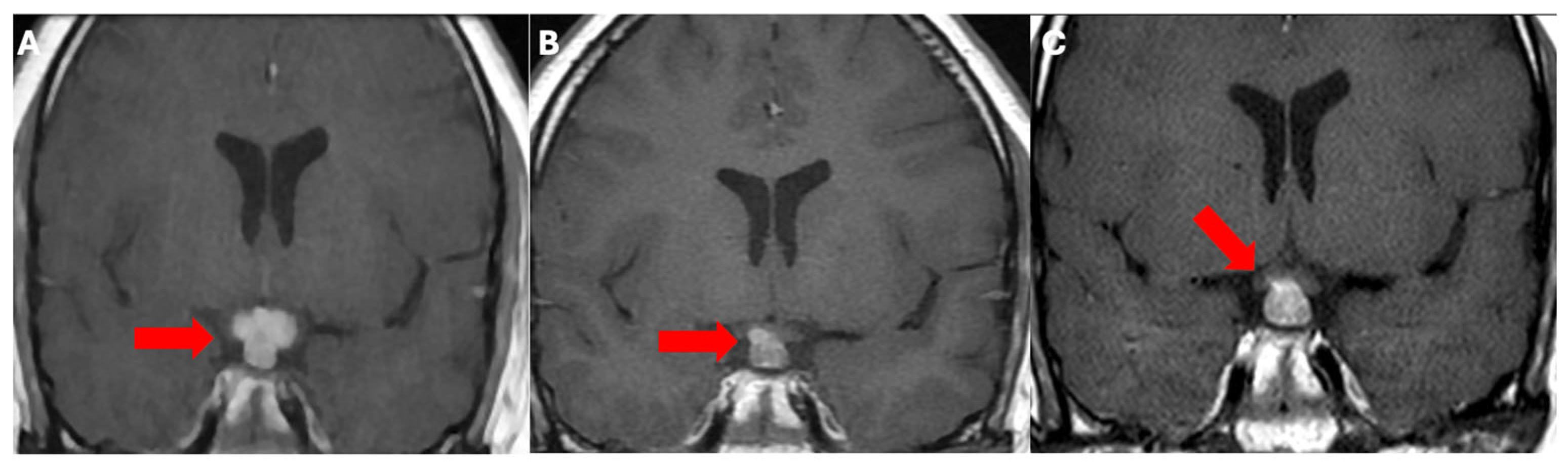
In October 2022, a 17-year-old male patient referred to our institution for a second opinion evaluation. The patient’s clinical history started when he was 15 years old, for delayed puberty, polyuria, and polydipsia in March 2021. At the clinical examination, the patient was tall with long limbs, pale skin, a childish voice, sparse body hair, abdominal obesity, muscle hypotrophy, small testicles, and gynecomastia. The patient underwent hormone evaluation, which first revealed hypogonadism. According to the pre-pubertal appearance and clinical findings, a genetic karyotype test was performed, resulting in the diagnosis of KS (47, XXY). Moreover, according to the history of polyuria and polydipsia, a brain and pituitary contrasted MRI was performed, showing a sellar and suprasellar mass involving the pituitary stalk and extending bilaterally in the parasellar region with compression of the optic chiasm (Figure 1). The mass was hypointense in T2-weighted sequences, isointense on T1-weighted sequences, and with post-contrast enhancement, which was suspected of a germinoma.
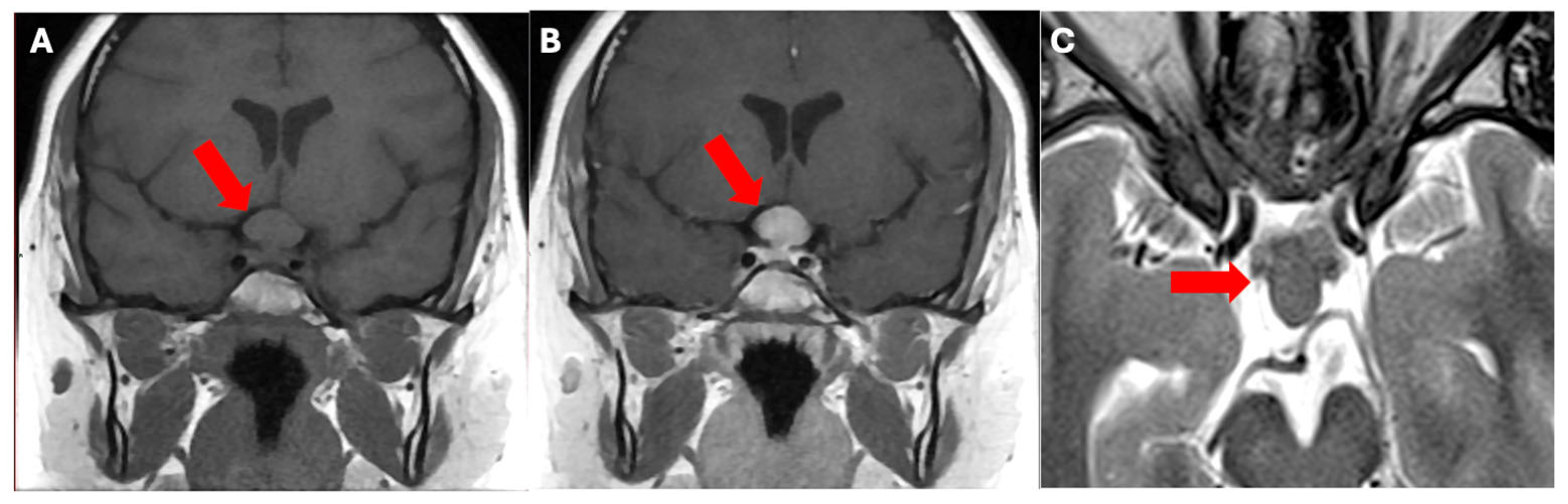
A visual field showed bitemporal hemianopsia. Therefore, a comprehensive pituitary hormone evaluation was performed, resulting in panhypopituitarism. Hormonal replacement therapy with hydrocortisone (50 mg/daily), levothyroxine (150 mcg/daily), and desmopressin acetate (60 mg, as needed) was prescribed. Stimulation with gonadotropins and hormonal replacement therapy with testosterone and recombinant human growth hormone (rhGH) were not prescribed due to the oncological risk of a pituitary mass that was not yet histologically characterized. In May 2021, the patient underwent a transsphenoidal biopsy. The extemporaneous histological examination was suggestive for germinoma, but the definitive histological examination provided a CD20+ B-lymphocyte and CD3+ T-lymphocyte infiltration, with negative immunohistochemistry for PLAP and c-kit. The diagnosis of germinoma was therefore ruled out. A local multidisciplinary evaluation suggested the alternative diagnosis of lymphocytic hypophysitis, and treatment with prednisone was started. However, according to the poor response to corticosteroid therapy, a second pituitary lesion biopsy through a transsphenoidal approach was performed in June 2021. The histology examination revealed the presence of immune cells such as CD20+ B-lymphocytes, CD3+ T-lymphocytes, and histiocytes. Immunohistochemical analysis for c-Kit, PLAP, CD1a, S100, myeloperoxidase (MPO), CD30, and CD15 was negative, and the pathology report confirmed the diagnosis of hypophysitis. The patient was then treated with high-dose corticosteroids (methylprednisolone 1 g intravenous daily for 3 days) in March 2022. A follow-up MRI in October 2022 showed a reduction in size of the sellar–suprasellar mass and a reduced compression of the optic chiasm and the pre-chiasmatic tracts of the optic nerves, suggesting a partial therapeutic response respect to the post-surgery pituitary MRI (Figure 2).
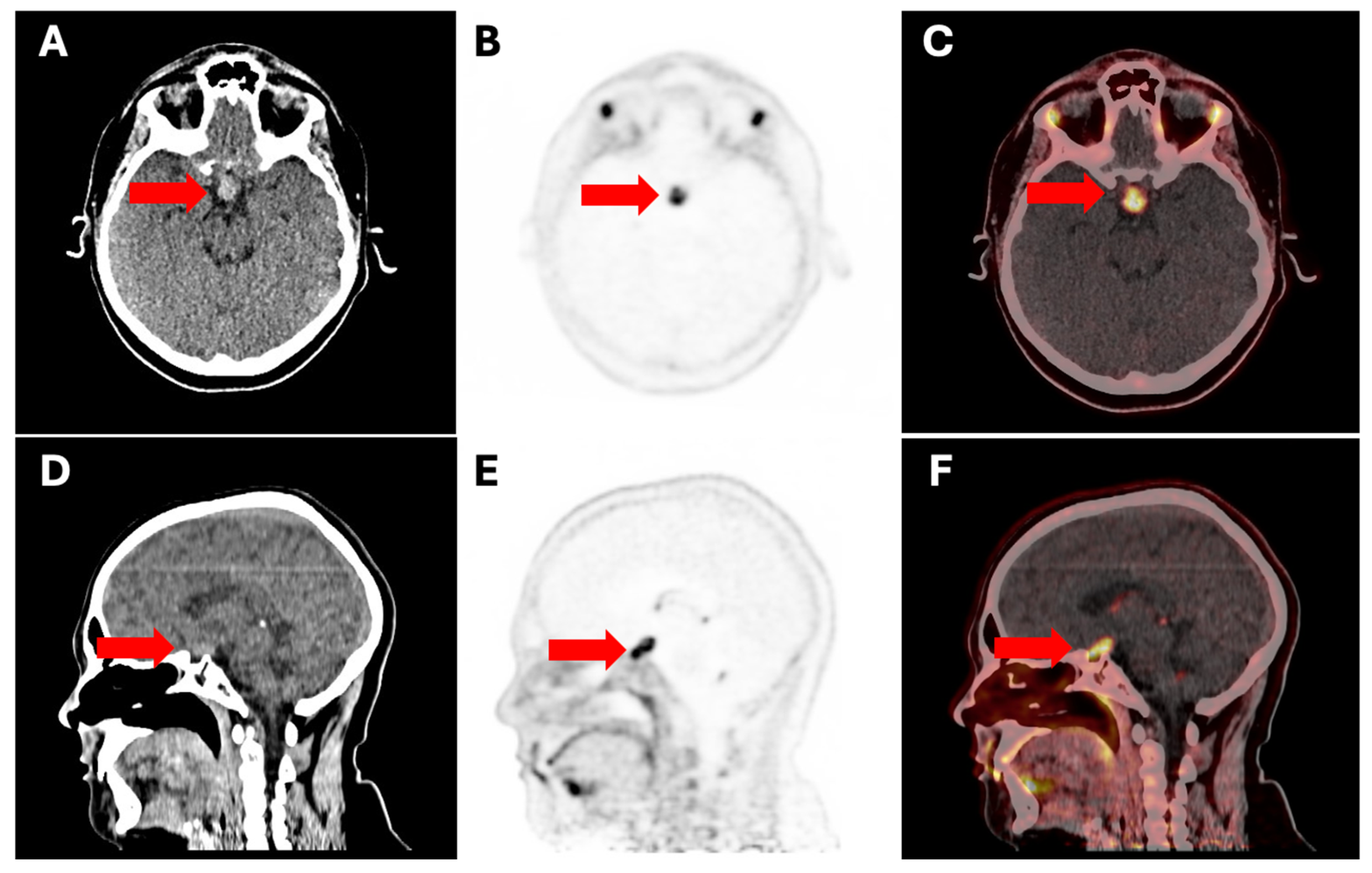
In October 2022, an 18-fluorodeoxyglucose Positron Emission Tomography ([18F] FDG-PET) scan was conducted and showed an uptake at the sellar–suprasellar region; therefore, a third pituitary lesion biopsy was suggested. In October 2022, the patient referred to our institution. After the revision of all the clinical reports and after the discussion at the pituitary tumor board, an [18F] FCH PET-CT scan was performed according to the patient’s clinical history and the not conclusive histological diagnosis. The inconclusive biopsy findings can be attributed to restricted tissue sampling, obscuration by dense lymphoid infiltrates, and the small tumor burden typical of germinomas; these factors are consistently highlighted in reports of biopsy-negative germinomas, where histology alone may fail to confirm diagnosis despite progressive clinical and imaging evidence [9]. The [18F] FCH PET-CT scan showed a diffuse, intense uptake of the phospholipid tracer corresponding to the known expansive lesion. Functionally active areas extended caudally and anteriorly to the right paramedian sellar region. No significant anomalies in phospholipid tracer distribution were observed in other sites in bone and brain structures. The findings were suggestive for neoplasia due to increased turnover of phospholipid membranes in the suprasellar region (Figure 3).
Therefore, debulking surgery was suggested to decompress the optic chiasm and nerves and attempt a conclusive pathological diagnosis. In November 2023, the patient underwent gross-total surgical removal of the tumor. The final pathology description reported lymphoid tissue with scattered large epithelioid and nucleolated cells, positive for PLAP, OCT4, and SALL4, and negative for pan-CK, which was conclusive for the diagnosis of germinoma. In January 2024, three months after surgery, a brain and pituitary MRI with contrast was performed, showing residual tumor tissue, closely to the pituitary stalk, extending posteriorly and cranially to the anterior recesses of the third ventricle, contacting the inferior margin of the optic chiasm. Therefore, the patient began radio-chemotherapy according to the International Society of Paediatric Oncology—Germ Cell Tumor Central Nervous System protocol (SIOP GCTCNS protocol), receiving carboplatin and etoposide, and then ifosfamide and etoposide. The last MRI performed in April 2024 shows stable residual solid tissue in the posterior part of the surgical cavity in the suprasellar region, with contrast enhancement extending towards the anterior recesses of the third ventricle and in contact with the lower margin of the optic chiasm and left optic nerve.

3. Discussion

This case shows the intriguing open issues of the differential diagnosis of pituitary stalk lesions in a patient affected by KS. Until now, the clinical cases of sellar masses associated with KS are rare or anecdotal. Scheitauer and collaborators reported three patients with KS, carrying also a gonadotroph adenoma in a single patient, a diffuse gonadotroph cell hyperplasia in the second patient, and a gonadotroph cell hyperplasia with GH-secreting adenoma in the third patient [10]. More recently, patients with Cushing’s disease, germinoma, and acromegaly were reported [11,12,13]. No cases of hypophysitis in KS were reported until now. Lymphocytic infundibulo-neurohypophysitis is recognized as a pituitary disorder, occurring also in pediatric populations. Moszczyńska et al. [9] have shown that in individuals younger than 18 years old, the presence of PST and pituitary mass might be indicative of both malignant and inflammatory conditions. This diagnostic challenge is due to the presence of PST and pituitary mass in both of these disorders, which also results in overlapping clinical characteristics such as DI and hypopituitarism. The PST is often detected by brain MRI, although its etiology may not be established only through imaging, requiring pathological analysis. The protocol for diagnosis and management of PST is not conclusive or universally standardized, a view supported by the literature [14] and consistent with our experience, which aligns with the perspective shared by some other referral centers.” The differential diagnosis between germinoma and hypophysitis was particularly challenging in our case, not solely due to the coexistence of KS, but because KS acted as an additional confounding factor among others that could complicate the clinical picture. In fact, in adolescents and young adults, a higher risk for midline tumors seems to be linked to the diagnosis of KS. A higher prevalence of extragonadal germ cell tumors (eGCTs) in this population has been reported in several studies, despite a clear relationship between KS and cancer risk remaining unclear. Interestingly, eGCTs are observed in about 1.5 out of 1000 KS patients and have an odds ratio of 50 compared to the general population [15]. In a Danish cohort of 696 males with KS, the risk of mediastinal germ cell tumors was significantly increased, with a relative risk (RR) of 67 when compared to age-matched controls, whereas the overall cancer incidence was not significantly elevated (RR: 1.1) [16]. Primary intracranial and spinal germinomas were described in four young males with KS [17,18,19]. Molecular cytogenetic studies have shown that the 47-XXY karyotype is present in both gonadal and extragonadal tissues in individuals with KS, indicating a possible predisposition for germ cell transformation [20]. A review published in 2023 on the association between birth defects and the occurrence of GCTs in children and adolescents reported an increased risk of pediatric GCTs in males but not in females with syndromic birth defects due to chromosome changes, such as Down syndrome and KS [21]. Thus, even in the absence of a documented and already recognized history of GCTs, clinicians should keep a high index of suspicion for these malignancies in young male patients with KS who present with mediastinal, spinal, or cerebral masses. Personalized monitoring and early imaging in patients exhibiting atypical symptoms, in our idea, based also on this specific case, should be taken into consideration, even though standard cancer screening in KS may not be uniformly necessary in light of the recent findings [15]. Being aware of these associations may be able to improve outcomes for this susceptible group by enabling earlier diagnosis and intervention.
Refocusing on our clinical case, the sellar–suprasellar mass observed on the initial MRI indicated a potential diagnosis of either germinoma or hypophysitis, as both disorders exhibit compressive symptoms and hormone deficiencies [22,23,24]. Lymphocytic infiltration observed in biopsies was initially suggestive for hypophysitis, also according to the partial response to corticosteroid treatment [7,8,14,25]. Nevertheless, it is well-established that certain tumors, such as germinoma, have the ability to invoke an inflammatory reaction, thereby complicating the distinction between a mostly inflammatory process and a malignant one [26]. Although sophisticated imaging techniques, such as [18F] FDG PET-CT scans, revealed uptake in the sellar region, germinoma and primary hypophysitis remained possible differential diagnoses [27,28,29]. In our case, the [18F] FCH PET scan showed an increased turnover of phospholipid membranes, that was suggestive for the presence of neoplasia. Although [18F] FCH PET is widely used for the identification of CNS neoplasm and brain tumors [30,31,32], there is no existing literature that specifically supports the use of this technique for the diagnosis of germinoma. This finding can be potentially remarkable, considering that C-11 methionine PET is instead currently the most used technique to diagnose a germinoma [33]. [18F]-FCH PET-CT was selected because it was one of the modalities available at our center, acknowledging that methionine PET remains the established reference for germinoma; however, recent common applications supports the growing use of choline tracers in primary brain tumors, providing a rationale for its application in this diagnostic context. To our knowledge, this clinical case likely represents one of the few reported instances of pituitary germinoma diagnosed under these specific circumstances with a [18F] FCH PET, that was finally confirmed through the identification of distinctive germinoma markers including PLAP, OCT4, and SALL4 [34].

4. Conclusions

In conclusion, our case illustrates the complexity of differentiating hypophysitis from pituitary germinoma, compounded by discordant imaging and histopathology, and highlights the need for a multidisciplinary approach involving radiologists, endocrinologists, neuropathologists, oncologists, and neurosurgeons, integrating biopsies with morphological and nuclear imaging to reach a definitive diagnosis [35]. Nuclear imaging, specifically PET scans, was important in the study through its ability to provide detailed functional information, although the precise diagnostic capabilities of [18F] FCH PET-CT for germinomas are still uncertain and require more research. Additional research and the description of more similar cases and a larger population may have the potential to enhance and help to understand better the diagnostic process in these intricate circumstances, driving better management of these diagnostic and therapeutic pitfalls.

Author Contributions

Conceptualization, S.C. and A.I.; methodology, S.C.; software, C.C.; validation, S.C., A.I. and C.C.; formal analysis, S.R. ans S.G.; investigation, C.M.; resources, S.T.; data curation, A.G.; writing—original draft preparation, S.C. and T.T.; writing—review and editing, M.G.; visualization, L.D.M.; supervision, A.B.; project administration, A.P. and F.D. All authors have read and agreed to the published version of the manuscript.

Funding

This research received no external funding.

Institutional Review Board Statement

Not applicable.

Informed Consent Statement

Informed consent was obtained from all subjects involved in the study.

Data Availability Statement

Data is unavailable due to privacy or ethical restrictions.

Conflicts of Interest

S.C., A.B., A.G. have served as investigator for clinical trials funded by Novartis, Pfizer, Ipsen and Crinetics. S.C. and A.B. received grants from Pfizer. S.C. won the 2022 Arrigo Recordati Research Grant. The remaining authors declare that the research was conducted in the absence of any commercial or financial relationships that could be construed as a potential conflict of interest.

References

  1. Turcu, A.F.; Erickson, B.J.; Lin, E.; Guadalix, S.; Schwartz, K.; Scheithauer, B.W.; Atkinson, J.L.; Young, W.F., Jr. Pituitary stalk lesions: The Mayo Clinic experience. J. Clin. Endocrinol. Metab. 2013, 98, 1812–1818. [Google Scholar] [CrossRef] [PubMed]
  2. Kim, D.Y.; Kim, P.H.; Jung, A.Y.; Choi, J.H.; Cho, Y.A.; Yoon, H.M.; Lee, J.S. Neoplastic Etiology and Natural Course of Pituitary Stalk Thickening. J. Clin. Endocrinol. Metab. 2022, 107, 563–574. [Google Scholar] [CrossRef] [PubMed]
  3. Ben Amor, S.; Siddiqui, K.; Baessa, S. Primary midbrain germinoma. Br. J. Neurosurg. 2004, 18, 310–313. [Google Scholar] [CrossRef] [PubMed]
  4. Frappaz, D.; Dhall, G.; Murray, M.J.; Goldman, S.; Faure Conter, C.; Allen, J.; Kortmann, R.D.; Haas-Kogen, D.; Morana, G.; Finlay, J.; et al. EANO, SNO and Euracan consensus review on the current management and future development of intracranial germ cell tumors in adolescents and young adults. Neuro Oncol. 2022, 24, 516–527. [Google Scholar] [CrossRef] [PubMed] [PubMed Central]
  5. Hacioglu, A.; Karaca, Z.; Uysal, S.; Ozkaya, H.M.; Kadioglu, P.; Selcukbiricik, O.S.; Gul, N.; Yarman, S.; Koksalan, D.; Selek, A.; et al. Evaluation and follow-up of patients diagnosed with hypophysitis: A cohort study. Eur. J. Endocrinol. 2024, 191, 312–322. [Google Scholar] [CrossRef] [PubMed]
  6. Schaefers, J.; Cools, M.; De Waele, K.; Gies, I.; Beauloye, V.; Lysy, P.; Francois, I.; Beckers, D.; De Schepper, J. Clinical presentation and outcome of children with central diabetes insipidus associated with a self-limited or transient pituitary stalk thickening, diagnosed as infundibuloneurohypophysitis. Clin. Endocrinol. 2017, 87, 171–176. [Google Scholar] [CrossRef] [PubMed]
  7. Langlois, F.; Varlamov, E.V.; Fleseriu, M. Hypophysitis, the Growing Spectrum of a Rare Pituitary Disease. J. Clin. Endocrinol. Metab. 2022, 107, 10–28. [Google Scholar] [CrossRef] [PubMed] [PubMed Central]
  8. Menotti, S.; Giampietro, A.; Raia, S.; Veleno, M.; Angelini, F.; Tartaglione, T.; Gaudino, S.; Doglietto, F.; De Marinis, L.; Pontecorvi, A.; et al. Unveiling the Etiopathogenic Spectrum of Hypophysitis: A Narrative Review. J. Pers. Med. 2023, 13, 1210. [Google Scholar] [CrossRef] [PubMed] [PubMed Central]
  9. Moszczyńska, E.; Baszyńska-Wilk, M.; Zasada, K.; Majak, D.; Szaniawska, M.; Szalecki, M. Pituitary stalk thickening in patients under 18 years of age—The most common causes and diagnostic procedures. Pediatr. Endocrinol. Diabetes Metab. 2022, 28, 213–227. [Google Scholar] [CrossRef] [PubMed] [PubMed Central]
  10. Scheithauer, B.W.; Moschopulos, M.; Kovacs, K.; Jhaveri, B.S.; Percek, T.; Lloyd, R.V. The pituitary in klinefelter syndrome. Endocr. Pathol. 2005, 16, 133–138. [Google Scholar] [CrossRef] [PubMed]
  11. Shimizu, Y.; Kitamura, A.; Tsukamoto, T.; Kim, H.; Kawai, H.; Urushitani, M. Subacute myopathy in a patient with mild Cushing disease manifested by accompanying Kleinfelter syndrome. Rinsho Shinkeigaku 2019, 59, 253–257. (In Japanese) [Google Scholar] [CrossRef]
  12. Özyörük, D.; Kocayozgat, A.; Yaman-Bajin, İ.; Çetindağ, F.; Oğuz-Erdoğan, A.S.; Güneş, A. A synchronous occurrence of bifocal intracranial germinoma and bilateral testicular epidermoid cyst in an adolescent patient with Klinefelter’s syndrome. Turk. J. Pediatr. 2019, 61, 456–459. [Google Scholar] [CrossRef]
  13. Ságová, I.; Pávai, D.; Kantárová, D.; Vaňuga, A.; Sadloňová, J.; Vaňuga, P.; Dragula, M. The combination of acromegaly and Klinefelter syndrome in one patient. Vnitr. Lek. 2019, 65, 51–54. [Google Scholar] [CrossRef] [PubMed]
  14. Chiloiro, S.; Capoluongo, E.D.; Tartaglione, T.; Giampietro, A.; Bianchi, A.; Giustina, A.; Pontecorvi, A.; De Marinis, L. The Changing Clinical Spectrum of Hypophysitis. Trends Endocrinol. Metab. 2019, 30, 590–602. [Google Scholar] [CrossRef] [PubMed]
  15. Bonouvrie, K.; van der Werff Ten Bosch, J.; van den Akker, M. Klinefelter syndrome and germ cell tumors: Review of the literature. Int. J. Pediatr. Endocrinol. 2020, 2020, 18. [Google Scholar] [CrossRef] [PubMed] [PubMed Central]
  16. Hasle, H.; Mellemgaard, A.; Nielsen, J.; Hansen, J. Cancer incidence in men with Klinefelter syndrome. Br. J. Cancer 1995, 71, 416–420. [Google Scholar] [CrossRef] [PubMed] [PubMed Central]
  17. Kaido, T.; Sasaoka, Y.; Hashimoto, H.; Taira, K. De novo germinoma in the brain in association with Klinefelter’s syndrome: Case report and review of the literature. Surg. Neurol. 2003, 60, 553–558. [Google Scholar] [CrossRef] [PubMed]
  18. Nakata, Y.; Yagishita, A.; Arai, N. Two patients with intraspinal germinoma associated with Klinefelter syndrome: Case report and review of the literature. AJNR Am. J. Neuroradiol. 2006, 27, 1204–1210. [Google Scholar] [PubMed] [PubMed Central]
  19. Phowthongkum, P. The second case of de novo intracranial germinoma association with Klinefelter’s syndrome. Surg. Neurol. 2006, 66, 332. [Google Scholar] [CrossRef] [PubMed]
  20. Aguirre, D.; Nieto, K.; Lazos, M.; Peña, Y.R.; Palma, I.; Kofman-Alfaro, S.; Queipo, G. Extragonadal germ cell tumors are often associated with Klinefelter syndrome. Hum. Pathol. 2006, 37, 477–480. [Google Scholar] [CrossRef] [PubMed]
  21. Schraw, J.M.; Sok, P.; Desrosiers, T.A.; Janitz, A.E.; Langlois, P.H.; Canfield, M.A.; Frazier, A.L.; Plon, S.E.; Lupo, P.J.; Poynter, J.N. Associations between birth defects and childhood and adolescent germ cell tumors according to sex, histologic subtype, and site. Cancer 2023, 129, 3300–3308. [Google Scholar] [CrossRef] [PubMed] [PubMed Central]
  22. Feola, T.; Pirchio, R.S.; Puliani, G.; Pofi, R.; Crocco, M.; Sada, V.; Sesti, F.; Verdecchia, F.; Gianfrilli, D.; Appetecchia, M.; et al. Sellar and parasellar lesions in the transition age: A retrospective Italian multi-centre study. J. Endocrinol. Investig. 2023, 46, 181–188. [Google Scholar] [CrossRef] [PubMed] [PubMed Central]
  23. Caranci, F.; Leone, G.; Ponsiglione, A.; Muto, M.; Tortora, F.; Muto, M.; Cirillo, S.; Brunese, L.; Cerase, A. Imaging findings in hypophysitis: A review. Radiol. Med. 2020, 125, 319–328. [Google Scholar] [CrossRef] [PubMed]
  24. Johnsen, D.E.; Woodruff, W.W.; Allen, I.S.; Cera, P.J.; Funkhouser, G.R.; Coleman, L.L. MR imaging of the sellar and juxtasellar regions. Radiographics 1991, 11, 727–758. [Google Scholar] [CrossRef] [PubMed]
  25. Chen, K.; Yao, Y.; Mao, X.; You, H.; Wang, L.; Duan, L.; Deng, K.; Zhang, W.; Lian, X.; Zhu, H. Sellar germinoma mimicking IgG4-related hypophysitis: A case report. BMC Endocr. Disord. 2022, 22, 23. [Google Scholar] [CrossRef] [PubMed] [PubMed Central]
  26. Warmbier, J.; Lüdecke, D.K.; Flitsch, J.; Buchfelder, M.; Fahlbusch, R.; Knappe, U.J.; Kreutzer, J.; Buslei, R.; Bergmann, M.; Heppner, F.; et al. Typing of inflammatory lesions of the pituitary. Pituitary 2022, 25, 131–142. [Google Scholar] [CrossRef] [PubMed] [PubMed Central]
  27. Iglesias, P.; Cardona, J.; Díez, J.J. The pituitary in nuclear medicine imaging. Eur. J. Intern. Med. 2019, 68, 6–12. [Google Scholar] [CrossRef] [PubMed]
  28. Kong, Z.; Wang, Y.; Ma, W.; Cheng, X. Role of 18F-fluorodeoxyglucose (FDG) and 18F-2-fluorodeoxy sorbitol (FDS) in autoimmune hypophysitis: A case report. BMC Endocr. Disord. 2020, 20, 84. [Google Scholar] [CrossRef] [PubMed] [PubMed Central]
  29. Okochi, Y.; Nihashi, T.; Fujii, M.; Kato, K.; Okada, Y.; Ando, Y.; Maesawa, S.; Takebayashi, S.; Wakabayashi, T.; Naganawa, S. Clinical use of (11)C-methionine and (18)F-FDG-PET for germinoma in central nervous system. Ann. Nucl. Med. 2014, 28, 94–102. [Google Scholar] [CrossRef] [PubMed] [PubMed Central][Green Version]
  30. Leung, K. [18F] Fluorocholine. In Molecular Imaging and Contrast Agent Database (MICAD); National Center for Biotechnology Information: Bethesda, MD, USA, 2004; pp. 2004–2013. [Google Scholar] [PubMed]
  31. Calabria, F.F.; Barbarisi, M.; Gangemi, V.; Grillea, G.; Cascini, G.L. Molecular imaging of brain tumors with radiolabeled choline PET. Neurosurg. Rev. 2018, 41, 67–76. [Google Scholar] [CrossRef] [PubMed]
  32. Giovannini, E.; Lazzeri, P.; Milano, A.; Gaeta, M.C.; Ciarmiello, A. Clinical applications of choline PET/CT in brain tumors. Curr. Pharm. Des. 2015, 21, 121–127. [Google Scholar] [CrossRef] [PubMed]
  33. Park, Y.J.; Lee, J.W.; Cho, H.W.; Choe, Y.S.; Lee, K.H.; Choi, J.Y.; Sung, K.W.; Moon, S.H. Value of C-11 methionine PET/CT in patients with intracranial germinoma. PLoS ONE 2022, 17, e0263690. [Google Scholar] [CrossRef] [PubMed] [PubMed Central]
  34. Zhou, J.; Wang, S.; Zhu, L.; Zhou, L.; Zeng, H.; Gan, Y.; Wang, C. Terminal Deoxynucleotidyl Transferase Commonly Expresses in Germ Cell Tumors: Evaluation on a Large Series from Multiple Centers. Int. J. Gen. Med. 2021, 14, 119–129. [Google Scholar] [CrossRef] [PubMed] [PubMed Central]
  35. Moszczyńska, E.; Kunecka, K.; Baszyńska-Wilk, M.; Perek-Polnik, M.; Majak, D.; Grajkowska, W. Pituitary Stalk Thickening: Causes and Consequences. The Children’s Memorial Health Institute Experience and Literature Review. Front. Endocrinol. 2022, 13, 868558. [Google Scholar] [CrossRef] [PubMed]
Figure 1. Coronal T1-weighted (A), T1-weighted after contrast (B) show a sellar and sovrasellar mass, involving the pituitary stalk and extending bilaterally in the parasellar region. Axial T2-weighted image (C) shows the low signal intensity of the lesion. The red arrows show the position of the mass.
Neuroimaging 01 00004 g001
Figure 2. Coronal T1-weighted images after contrast, acquired before (A) and after (B) high-dose corticosteroid treatment, show a reduction in the size of the sellar–suprasellar mass. Notably, after treatment, the optic chiasm (C, arrow) is visible again, indicating a partial therapeutic response compared to the initial post-surgical pituitary MRI (A). The red arrows show the position of the mass.
Neuroimaging 01 00004 g002
Figure 3. CT, 18F-Choline PET and fused PET-CT images in axial (AC) and sagittal (DF) view, showing intense 18F-Choline uptake by a hyperdense round-shaped expansive lesion in the supra-sellar region; sagittal images depict extension of 18F-Choline positive area caudally and anteriorly to the right paramedian sellar region. The red arrows show the relative position of the hyperuptake.
Neuroimaging 01 00004 g003
Disclaimer/Publisher’s Note: The statements, opinions and data contained in all publications are solely those of the individual author(s) and contributor(s) and not of MDPI and/or the editor(s). MDPI and/or the editor(s) disclaim responsibility for any injury to people or property resulting from any ideas, methods, instructions or products referred to in the content.