Article

Association of Occupational Stress and Resilience with Sleep Quality Moderated by the HTR2A Gene rs6313 Polymorphism

1
School of International Education, Beijing International Studies University, Beijing 100024, China
2
Beijing Key Laboratory of Behavior and Mental Health, Key Laboratory of Machine Perception (Ministry of Education), School of Psychological and Cognitive Sciences, Peking University, Beijing 100871, China
3
School of Biological Sciences, Georgia Institute of Technology, Atlanta, GA 30332, USA
4
Key Laboratory of Brain, Cognition and Education Sciences, Ministry of Education, Institute for Brain, Research and Rehabilitation, Guangdong Key Laboratory of Mental Health and Cognitive Science, South China Normal University, Guangzhou 510631, China
5
The Ninth Medical Center, Chinese PLA General Hospital, Beijing 100101, China
6
Institute of Circulation and Consumption, Chinese Academy of International Trade and Economic Cooperation, Beijing 100710, China
*
Authors to whom correspondence should be addressed.
These authors contributed equally to this work.
Occup. Health 2026, 1(2), 15; https://doi.org/10.3390/occuphealth1020015
Submission received: 14 February 2026 / Accepted: 24 March 2026 / Published: 30 March 2026

Abstract

Objectives: Occupational stress, resilience and 5-hydroxytryptamine receptor 2A gene (HTR2A) polymorphisms potentially influence sleep quality. However, evidence of their effects and relationships remains ambivalent and insufficient. Therefore, this study investigated the association of occupational stress, resilience, HTR2A polymorphisms, and their interactions with sleep quality. Methods: Using a cross-sectional design, 809 Chinese Han subjects (47% female and 53% male; age: 33.1 ± 6.3 years) were genotyped for HTR2A rs6313 polymorphism. Occupational stress, resilience and sleep quality were measured using Work Stress Scale, Connor-Davidson Resilience Scale, and Pittsburgh Sleep Quality Index, respectively. Results: Higher occupational stress was significantly correlated with poorer sleep quality (odds ratio (OR) = 2.020, 95% confidence interval (CI): [1.736, 2.394], p = 0.00031), while higher resilience was significantly correlated with better sleep quality (OR = 0.610, 95% CI: [0.522, 0.697], p = 0.00047). Occupational stress played a mediating role in the association between resilience and sleep quality (indirect: β1β2 = −0.067, 95% CI: [−0.101, −0.041], p = 0.00045; direct: β3 = −0.119, 95% CI: [−0.205, −0.032], p = 0.008). The rs6313 polymorphism moderated the association between resilience and sleep quality (β6 = 0.786, 95% CI: [0.092, 1.422], p = 0.027), but not the indirect effect. Conclusions: Resilience is associated with better sleep quality both directly and by attenuating the negative correlation between occupational stress and sleep quality, and the rs6313 polymorphism is associated with modifying the relationship between resilience and sleep quality (but not occupational stress and sleep quality), which suggests potential distinct biological association patterns for resilience and stress. Subjects with TT and TC/CC genotypes had different sleep quality response to resilience, implying potential molecular mechanisms of resilience. Our findings provide implications for the prevention and intervention of stress-related sleep problems in occupational populations by targeting modifiable factors including occupational stress and individual resilience.

1. Introduction

Sleep is a fundamental process for human health and well-being. Impaired sleep quality is associated with diabetes, anxiety and other physical and mental disorders [1]. Nevertheless, decrease in sleep durance and increase in sleep disturbances have been found worldwide [1,2]. Understanding the factors that affect sleep quality is crucial for improving the sleep quality.
A variety of factors have been found to influence sleep quality, including demographics, occupational stress, and other psychological factors [1,2]. The effect of occupational stress has been examined in different populations, with results consistently showing that occupational stress negatively impacts sleep quality [3,4]. Current biological evidence suggests that stress can activate the hypothalamic–pituitary–adrenal (HPA) axis, which is a major stress-response system in the body. Although activation of the HPA axis may help in coping with stress, long-term, repetitive activation of the HPA axis may cause allostatic load and lead to devastating results [5].
Resilience is another psychological factor that has received much attention lately, and is defined as “the ability to withstand or recover quickly from difficult conditions” [6,7]. Resilience can be also categorized into passive and active resilience based on its different mechanisms [8]. Passive resilience is characterized by the absence of certain molecular mechanisms that may contribute to susceptible phenotypes, whereas active resilience is mediated by the presence of unique systems that help cope with stress [9]. Evidence from neurobiology has linked resilience to certain neural circuits and neuroendocrine systems, including the medial prefrontal cortex (mPFC), hippocampus, ventral tegmental area-nucleus accumbens (VTA-NAc) pathways, locus coeruleus (LC) and HPA axis [8,10], which are also important systems in the regulation of sleep behavior [11]. A recent study showed that resilience mediated the relationship between functional connectivity of the middle frontal gyrus and sleep quality, and had a positive impact on sleep quality [12]. A recent meta-analysis in healthy populations showed a weak but significant positive correlation between resilience and sleep quality, but this study could not suggest about the pathways in which resilience affects sleep [13]. Only a few studies have focused on the relationship between resilience and perceived stress and its impact on sleep [14,15]. Although these studies demonstrate that resilience can mediate or regulate the impact of perceived stress on sleep, the populations used in these studies still have limitations in terms of occupation [14] or health status [15]. As previously noted, occupational stress is a vital determinant of sleep quality in the general working population; however, there is no systematic study on the relationship between resilience, occupational stress, and sleep quality in general occupational groups.
In addition to psychological factors, genetic factors have also been found to affect sleep quality. 5-Hydroxytryptamine (serotonin, 5-HT) is a key neurotransmitter that regulates the sleep-wake cycle [16]. The effects of 5-HT on sleep depends on the type of receptor to which it binds. There are seven 5-HT receptor families (HTR1-HTR7), of which HTR2A receptors have been extensively studied. HTR2A receptors are enriched in brain areas including the cerebral cortex, hippocampal formation, hypothalamus, VTA, LC and dorsal raphe nucleus (DRN), which have been characterized as key regions in the regulation of sleep-wake behavior [11]. Studies have shown that inactivation of HTR2A leads to increased slow-wave sleep (SWS) in animals and humans [11]. Thus, the effects of sequence variability in the HTR2A gene on sleep has been studied, with the rs6313 polymorphism being the most intensively investigated. HTR2A rs6313 is a synonymous single nucleotide polymorphism (SNP) located in exon 1 of the HTR2A gene, and is in complete linkage disequilibrium (LD) with another SNP, rs6311, near the promoter sequence [17]. Previous studies have demonstrated that the assumed effects of rs6313 is entirely attributed to its complete LD with rs6311 [18]. However, results are ambiguous in postmortem studies examining the molecular effects of rs6311. While one study reported that rs6311 polymorphism was associated with the expression of the HTR2A gene [19], another study did not observe a clear association [20]. Epidemiological studies examining the effects of haplotypes using rs6313 as a marker have also obtained mixed results. Several studies have reported the C allele of rs6313 as a risk allele for treatment-induced insomnia and self-reported impaired sleep quality [21,22,23]. One study found that T allele carriers were susceptible to sleep bruxism [24], while no significant association between the rs6313 polymorphism and sleep disorders was observed in other studies [25,26,27].
Although a few studies have examined the effects of occupational stress and rs6313 polymorphism on sleep quality [23,28], divergent findings have been reported regarding the impact of rs6313. Furthermore, while resilience, occupational stress, and sleep have been linked to the function of shared brain regions with a high density of HTR2A receptors, no previous investigations have explored how resilience alone, or in combination with the rs6313 polymorphism and occupational stress, affects sleep quality in general occupational groups. To address these questions, this study used a cross-sectional design to measure sleep quality, occupational stress, and resilience of subjects from general occupational groups in Beijing, who were genotyped for HTR2A gene rs6313 polymorphism. This study aimed to investigate the association of resilience, occupational stress, rs6313 polymorphism, and their interactions, with sleep quality, with the goal of enhancing our comprehension of the intricate physio-psychological association patterns involved.

2. Participants and Methods

2.1. Participants

Using a cross-sectional design, 809 full-time employees were recruited in Beijing. All participants (age: 33.1 ± 6.3 years, ranging from 17 to 59 years) belonged to the general occupational groups. Subjects identified themselves as female (47.0%) and male (53.0%). Most subjects had a bachelor’s (46.5%) or master’s (44.4%) degree. The exclusion criteria for this study were: (a) those with a history or current diagnosis of psychiatric disorders, and (b) individuals who had used any sleeping medication within one month prior to the study.
This study has been obtained ethical approval (Approval number: #2021-03-02), and all participants have been informed of the research and consented to take part.

2.2. Measures

Occupational stress was measured using the Work Stress Scale (WSS) [29], which has been widely recognized and used in the Chinese population [30,31]. The 11-item scale utilizes a 6-point Likert scale ranging from 1 (completely disagree) to 6 (completely agree), including the aspects such as workload, work conflicts, and career development pressure with elevated WSS total scores indicative of heightened occupational stress. The Cronbach’s alpha coefficient in this study was 0.93.
The Chinese version of the Connor-Davidson Resilience Scale (CD-RISC) [32,33] was used to measure resilience. The 25-item questionnaire adopts a 5-point Likert scale, which is divided into three subscales: tenacity (10 items), strength (8 items) and optimism (7 items). Higher scores indicate higher levels of resilience. The alpha coefficients for tenacity, strength, optimism, and the sum in this study were 0.87, 0.83, 0.55, and 0.92. A low optimism coefficient will not compromise results as it was only three items in total.
The Pittsburgh Sleep Quality Index (PSQI) [34] was used to assess sleep quality, which has been proven to be applicable to the Chinese population [35]. The scale has 19 items across seven dimensions, including subjective sleep quality, sleep latency, sleep duration, sleep efficiency, sleep disorders, hypnotic drug use, and daytime functional impairment, each with scores from 0 to 3 for a total from 0 to 21. Buysse et al. (1989) established a cut-off value of 5, indicating impaired sleep quality in cases where the value was above this threshold.

2.3. Genotyping

Fasting venous blood samples of 5 mL were drawn from all subjects at around 8 a.m., from which genomic DNA was extracted using a genomic DNA purification kit (Beijing Thinkout Sci-Tech Co., Ltd., Beijing, China). The HTR2A gene rs6313 polymorphism was genotyped by BioMiao Biological Technology (Co., Ltd., Beijing, China), on a high-throughput genotyping platform using a matrix-assisted laser desorption/ionization time-of-flight mass spectrometry in the Mass ARRAY System (Agena Bioscience Inc., San Diego, CA, USA). For quality control, 5% of the DNA samples were genotyped again and the results were replicated. Hardy-Weinberg Equilibrium test was performed and all SNPs under investigation had p values greater than 0.05.

2.4. Statistical Analysis

Data in this study were analyzed with R (4.2.2) and Jamovi (2.3.21). Since sleep quality was dichotomized according to PSQI score, chi-square (χ2) tests and logistic regression were mainly used. For categorical independent variables (e.g., gender), chi-square tests were used to assess their association with sleep quality. Logistic regression was utilized to examine the association between sleep quality and continuous independent variables (such as resilience), employing odds ratios (ORs) with 95% bias-corrected and accelerated (BCa) bootstrap confidence intervals (CIs) and parameter-calculated Wald statistics to assess statistical significance. Particularly, logistic regression was used to determine the association between rs6313 polymorphism and sleep quality after adjusting for covariates. Given that the subjects’ PSQI sub-scores and total score were not normally distributed, spearman correlation was used to determine their association with continuous independent variables. A mediation analysis in which sleep quality was treated as a dichotomous variable was programed with R, using fully standardized regression coefficient (β) with 95% BCa CI to determine significance. All covariates were adjusted for in the mediation analysis. All continuous variables were standardized prior to regression analysis. To confirm our results, we repeated all tests using normalized PSQI scores (square root of the original PSQI scores) in the general linear models (as shown in Supplementary Materials, Table S1–S6 and Figure S1). Multicollinearity was checked using variance inflation factor (VIF). The variables in multiple regression models in this study all met the criterion that VIF should be less than 10, with a maximum VIF of 5.29. False discovery rate (FDR) correction was applied for multiple comparisons. All tests in this study were two-tailed and the significance level was set at 0.05.

3. Results

3.1. Distribution of Sleep Quality Across Demographics, Lifestyle Factors and Health Conditions

Table 1 shows the demographic, lifestyle and health characteristics of the subjects, and their sleep quality. A total of 37.3% had impaired sleep quality. There was a significant association between sleep quality and education level (q = 0.012, p = 0.009), marital status (q = 0.023, p = 0.018), and physical and mental health (q = 0.005, p = 0.004). Those with postgraduate education had lower prevalence of impaired sleep quality (32.3%) than those with undergraduate education (42.7%). Married people had lower prevalence of impaired sleep quality (34.8%) than unmarried people (43.3%). Poorer physical or mental health conditions were linked to impaired sleep quality.
For other variables, although the statistical significance threshold was not reached, there were some notable trends in the data. Specifically, participants with a monthly income between 10,000 and 20,000 yuan had the lowest prevalence of impaired sleep quality (32.9%), while those with incomes below 10,000 or above 20,000 yuan had comparable prevalence (41.7% and 37.8%, respectively). Additionally, smokers had a higher likelihood of experiencing impaired sleep quality compared to non-smokers (44.7% vs. 36.1%).
Results were replicated using general linear models (Table S1), and were consistent with those obtained from the chi-square tests for gender, age, education level, smoking, physical condition, and mental condition. However, the effect of monthly income reached statistical significance in the general linear models (p = 0.023 and q = 0.047), while the impact of marital status was not significant (p = 0.142 and q = 0.189).

3.2. Association Between Occupational Stress, Resilience, HTR2A Gene Polymorphism and Sleep Quality

Results of logistic regression using occupational stress, resilience and rs6313 polymorphism as independent variable respectively are shown in Table 2. A higher risk for impaired sleep quality was significantly associated with a one-standard deviation (1-SD) increase in occupational stress (OR = 2.020, 95% CI: [1.736, 2.394], p = 0.00031, q = 0.00052). However, 1-SD increase in resilience was significantly correlated with lower risk for impaired sleep quality (OR = 0.610, 95% CI: [0.522, 0.697], p = 0.00047, q = 0.00068). The association remained significant after adjusting for covariates. No significant association between rs6313 polymorphism and sleep quality was observed before or after adjusting for the covariates (Table 2). Consistent results were obtained using general linear models (Table S2).
We further investigated the association between occupational stress, resilience and PSQI sub-scores (Table S3). Occupational stress was found to be positively correlated with all the PSQI sub-scores (subjective sleep quality: r = 0.32, p = 0.00073, q = 0.00091; sleep latency: r = 0.28, p = 0.0012, q = 0.0015; sleep duration: r = 0.25, p = 0.0018, q = 0.0021; sleep efficiency: r = 0.21, p = 0.0025, q = 0.0029; sleep disturbance: r = 0.29, p = 0.0011, q = 0.0014; hypnotic use: r = 0.18, p = 0.0032, q = 0.0037; daytime dysfunction: r = 0.31, p = 0.00085, q = 0.0010) and PSQI total score (r = 0.35, p = 0.00028, q = 0.00043), while significant negative correlations were found between resilience and subjective sleep quality (r = −0.27, p = 0.0014, q = 0.0017), sleep latency (r = −0.23, p = 0.0021, q = 0.0025), sleep duration (r = −0.20, p = 0.0029, q = 0.0033), sleep disturbance (r = −0.24, p = 0.0019, q = 0.0023), daytime dysfunction (r = −0.26, p = 0.0016, q = 0.0019), and the total score of PSQI (r = −0.29, p = 0.0010, q = 0.0013).

3.3. Mediation Analysis of Occupational Stress, Resilience, and Sleep Quality

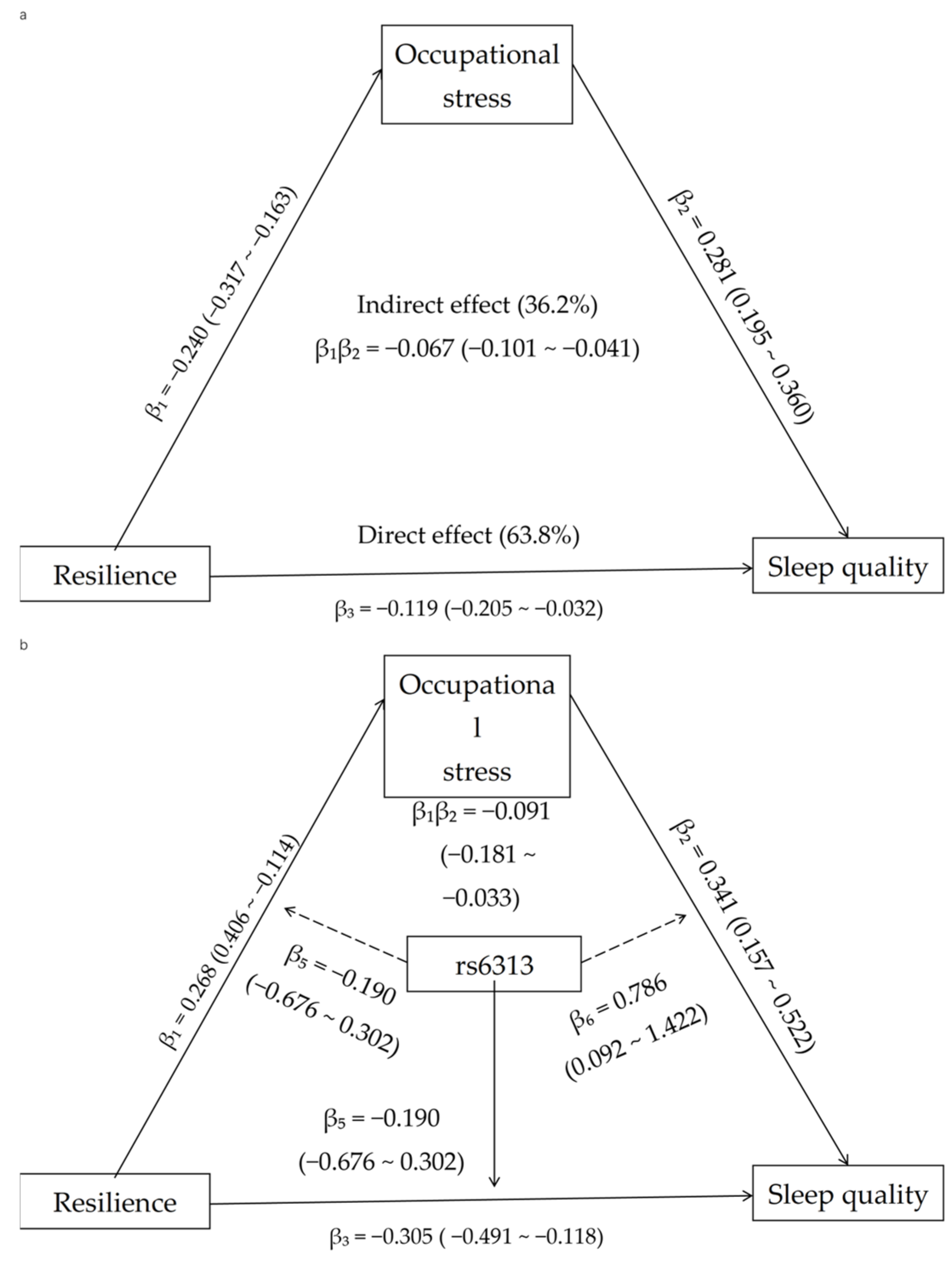
We performed a mediation analysis to determine the relationship of occupational stress, resilience, and sleep quality (Figure 1a). Although higher occupational stress was significantly correlated with a greater risk for impaired sleep quality (β2 = 0.281, 95% CI: [0.195, 0.360], p = 0.00036), resilience was negatively correlated with occupational stress (β1 = −0.240, 95% CI: [−0.317, −0.163], p = 0.00042). The product of the two fully standardized coefficients reached statistical significance (β1β2 = −0.067, 95% CI: [−0.101, −0.041], p = 0.00045), indicating that occupational stress may play a mediating role in the association between resilience and sleep quality. Results supported a partial mediation model, in which higher resilience was directly associated with better sleep quality (β3 = −0.119, 95% CI: [−0.205, −0.032], p = 0.008). The direct and indirect effects accounted for 63.8% and 36.2% of the total effect, respectively. We found consistent results using a general linear model (Figure S1).

3.4. Moderating Role of HTR2A Gene Polymorphism Between Resilience and Sleep Quality

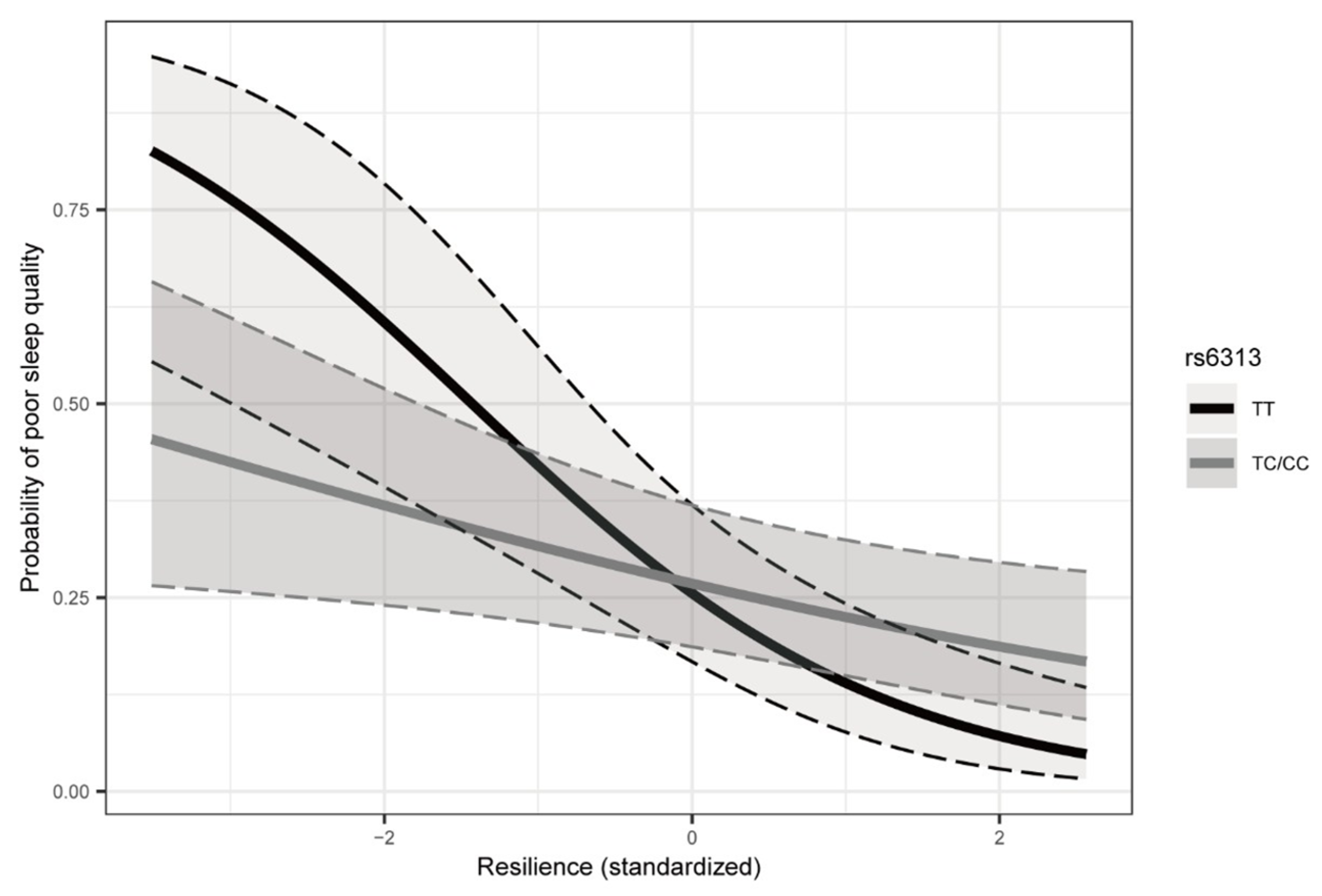
We further examined the effect of rs6313 polymorphism by adding it as a moderating variable to the mediation model (Figure 1b). Interestingly, the rs6313 polymorphism, in its dominant model, was significantly associated with a moderating effect on the direct relationship between resilience and sleep quality (β6 = 0.786, 95% CI: [0.092, 1.422], p = 0.027), but not on the association between resilience and occupational stress (β4 = 0.119, 95% CI: [−0.402, 0.640]), nor on the relationship between occupational stress and sleep quality (β5 = −0.190, 95% CI: [−0.676, 0.302]). To confirm the moderating effect of rs6313 polymorphism, we performed logistic regressions examining the interaction between rs6313 and occupational stress, and between rs6313 and resilience, respectively. While the coefficient of the interaction term between occupational stress and rs6313 polymorphism failed to reach statistical significance in all SNP models (dominant model: β = −0.190, 95% CI: [−0.676, 0.302], p = 0.456; allelic model: β = −0.152, 95% CI: [−0.589, 0.285], p = 0.491; Table S4), that between resilience and rs6313 polymorphism was significant in the dominant model (Table 3; OR = 1.672, 95% CI: [1.131, 2.518], p = 0.012, q = 0.018). A significant result was also found using the allelic model (Table S4; OR = 1.586, 95% CI: [1.012, 2.489], p = 0.045), while the moderating effect of the CC allele slightly missed statistical significance (p = 0.053), which we assumed was due to insufficient sample size. Based on these results, we considered the C allele to have a moderating effect. To further clarify the genotype-specific association between resilience and sleep quality, we conducted stratified analyses by rs6313 genotype. For individuals with the TT genotype, each 1-standard deviation increase in resilience was significantly associated with a reduced risk of impaired sleep quality (OR = 0.423, 95% CI: [0.312, 0.575]). In contrast, the protective association of resilience with sleep quality was relatively attenuated in individuals with the TC/CC genotype (OR = 0.718, 95% CI: [0.586, 0.879]). This difference suggests that the rs6313 polymorphism (as a candidate genetic marker) may be associated with variations in HTR2A gene expression efficiency, which may relate to individual differences in resilience resource utilization, and this may further lead to divergent associations between resilience and sleep quality. Low-resilience subjects with TT genotype were more susceptible to impaired sleep quality than those with TC or CC genotype. However, TT-genotyped subjects with high resilience were at lower risk for impaired sleep quality compared to those TC- or CC-genotyped subjects (Figure 2). The interaction was replicated using a general linear model with consistent results (Table S5).

4. Discussion

To our knowledge, this is the first and largest study to investigate the influence of resilience and its interaction with occupational stress and rs6313 polymorphism on sleep quality in general occupational groups. We revealed a strong association between higher occupational stress, lower resilience, and poorer sleep quality. Our findings suggest that resilience has both a direct association with sleep quality and an indirect association by attenuating the negative correlation between occupational stress and sleep quality. Although HTR2A rs6313 polymorphism was not directly linked to sleep quality, it was found to moderate the direct effect of resilience on sleep, but not the effect of occupational stress, which may provide new insights into the underlying biological mechanisms.
Studies have shown that people who are more stressed at work tend to have worse sleep quality. This is in line with other studies [3,4,23]. This study further confirmed the negative association between occupational stress and impaired sleep quality, and identified significant positive correlations of occupational stress with sleep latency, sleep disturbance, and daytime dysfunction, as well as significant negative correlations with sleep duration and sleep efficiency.
The study found a correlation between resilience and sleep quality, with higher resilience linked to better sleep. There was also a negative correlation between resilience and the PSQI. However, no significant correlation was found between resilience and sleep efficiency, possibly due to the small sample size. The findings show that resilience influences health and well-being in various ways [5].
The study identifies the association patterns through which resilience is linked to sleep quality. The analysis shows that occupational stress plays a key role. Higher resilience may be associated with lower stress, which improves sleep. A previous study found that resilience moderates the effect of psychological distress on sleep quality [36]. In this study, resilience did not significantly moderate the effect of occupational stress (OR = 0.963, 95% CI: [0.815, 1.145], p = 0.649). The inconsistent results may be attributable to the distinction between psychological distress and occupational stress. The study suggests that resilience is associated with attenuating the negative correlation between occupational stress and sleep quality in relation to work-related stressors. This is supported by previous research [5,37,38]. Current evidence suggests that higher resilience may be associated with lower hair cortisol levels and less altered cortisol responses [5], which may explain why resilient people perceive less occupational stress. Other studies have examined the relationship between resilience and HPA axis activation in the face of acute stress. Notably, these studies revealed comparable HPA axis activation in individuals with high and low resilience, yet superior performance on post-stress cognitive tasks in the high resilience group. The results imply that resilience may act as a buffering factor against the effects of stress on emotional and cognitive performance through alternative systems in addition to the HPA axis.
In addition to the indirect effect of occupational stress, a direct effect of resilience on sleep quality was also observed. This may be due to different kinds of stressors, such as social exclusion and childhood traumatic experiences [8]. Alternatively, resilience may be linked to its own autonomous biological association patterns that may be associated with better sleep quality. The question of whether diverse stressors share pathways and whether resilience exhibits distinct mechanisms independent of the stress-response system remains unresolved.
Previous results on the role of the rs6313 polymorphism in sleep have been mixed. In the present study, no significant association between rs6313 polymorphism and sleep quality was detected, supporting several previous studies [25,26,27]. However, we did find that the rs6313 polymorphism (as an exploratory genetic marker) was associated with a moderating effect on the relationship between resilience and sleep quality. Interestingly, we found that rs6313 was only associated with the modification of the relationship between resilience and sleep quality, but not the association between occupational stress and sleep quality, which further supports the exploratory assumption that different stressors may have different association patterns or that resilience has distinct biological association patterns independent of the stress-response system. A previous study also examined the interaction between occupational stress and the rs6313 polymorphism [23]. Inconsistent with our results, they reported a significant interaction on sleep, where subjects with CT or TT genotype were more susceptible to impaired sleep quality at high resilience than subjects with CC genotype, but more resilient to impaired sleep quality at low resilience. Discrepancies may be due to questionnaire differences and study populations.
As previously mentioned, the effect of rs6313 in association studies is attributed to the fact that it is in full LD with rs6311 [18]. Recent studies using modern molecular biology and bioinformatics techniques have provided new insights into the molecular effects of rs6311. It has been demonstrated that rs6311 polymorphism can affect HTR2A promoter methylation and transcription factor binding, and models suggest that rs6311 may alter the expression of HTR2A in both directions depending on the presence and cellular concentration of certain transcription factors [18,39]. Multiple transcription factors, including E47, glucocorticoid response element (GRE), and early growth response 3 (EGR3), may interact with the rs6311 polymorphism to affect transcription [17,39]. Of those, EGR3 is the most promising candidate, whose genetic polymorphisms have been associated with schizophrenia [18]. A recent study further demonstrated that environmental stress affected HTR2A expression in an EGR3-dependent manner [40]. Given our findings of a significant interaction between resilience and rs6313 polymorphism, where the association of rs6313 was only evident in individuals with relatively low or high resilience (Table S6), it is plausible that resilience may be associated with the expression of specific transcription factors that are associated with the HTR2A gene expression and, consequently, may be associated with sleep quality.
In conclusion, this study investigated the association and interaction between occupational stress, resilience, HTR2A gene rs6313 polymorphism, and sleep quality in 809 Chinese Han general occupational population. Research has found that: (1) occupational stress is significantly negatively correlated with sleep quality, while resilience is significantly positively correlated with sleep quality; (2) occupational stress plays a partial mediating role in the relationship between resilience and sleep quality, that is, resilience may directly be associated with sleep quality and indirectly affects sleep quality by reducing occupational stress; and (3) the rs6313 polymorphism of the HTR2A gene is associated with modifying the association between resilience and sleep quality. Individuals with the TT genotype have better sleep quality at high resilience levels, while individuals with the TC/CC genotype have relatively better sleep quality at low resilience levels. Moreover, this polymorphism does not regulate the association between occupational stress and sleep quality. The findings of this study reveal a complex association pattern between occupational stress, resilience, and genetic polymorphism in regulating sleep quality, providing a new perspective for understanding the influencing factors and potential mechanisms of sleep quality in occupational populations. At the practical level, research results suggest that improving the sleep quality of occupational populations can be primarily achieved by targeting modifiable workplace and individual factors, including alleviating occupational stress and enhancing individual resilience. Given the exploratory nature of the genetic findings, personalized sleep interventions based on the rs6313 genotype are currently premature and require further functional and longitudinal validation. Based on the above findings, the present study provides new ideas for the intervention of sleep problems in occupational populations from the perspective of occupational health practice, with a focus on modifiable factors. Firstly, given the direct protective association of resilience with sleep quality and its association with attenuating the negative correlation between occupational stress and sleep quality, workplace resilience training should be an important universal intervention for improving sleep quality in occupational populations. The training content can focus on cultivating resilience qualities, improving stress coping skills (such as problem-oriented coping and emotional regulation), and shaping optimistic thinking to help individuals accumulate resilience resources, which is feasible for routine occupational health promotion programs. Secondly, as occupational stress is a key mediating factor in the association between resilience and sleep quality, occupational health practitioners can collaborate with employers to reduce occupational stress at the root by optimizing the work environment (such as reasonable task assignment, establishing supportive leadership practices), improving employee assistance programs (EAP), and providing systematic guidance on work-life balance, thus providing a fundamental guarantee for employees’ sleep health. These universal, multidimensional intervention strategies focusing on modifiable workplace and individual factors are expected to enhance the targeted and sustainable effectiveness of sleep interventions in occupational populations.

5. Limitations and Research Prospects

The cross-sectional study design employed in this study limits the observation of temporal relationships and causal mechanisms between variables. It is recommended that future research adopts a longitudinal tracking design, which would enable the observation of dynamic changes in occupational stress, resilience, and sleep quality over time. In view of the limitations of this study, such as the compatibility between the scale and the survey population, the possible lack of sample representativeness in the sampling method, and the specificity of the research population, subsequent research can explore larger research samples based on reasonable sampling methods and targeted scales, thereby improving the universality of the results and the cross-population stability of the research conclusions. In addition, the rs6313 polymorphism investigated in this study is a synonymous SNP with no direct functional evidence supporting its biological role, and its observed moderating association is merely exploratory and hypothesis-generating in nature. The association between rs6313 and the resilience-sleep quality relationship may be mediated by its linkage disequilibrium with other functional variants (e.g., rs6311) or contextual factors like transcription factor interactions, and this finding requires further validation in functional molecular studies and larger cohorts. Furthermore, this study focuses on the general occupational population and does not analyze the differences in the association patterns across specific occupational subgroups (e.g., high-stress vs. low-stress occupations), which limits the targeted application of the findings in occupational health practice. Future research can explore occupation-specific characteristics to provide more targeted intervention suggestions for different occupational groups. In addition, the present study lacks specific data on the feasibility and effectiveness of workplace intervention strategies, and future translational research is needed to bridge the gap between our basic research findings and clinical occupational health practice.

Supplementary Materials

The following supporting information can be downloaded at: https://www.mdpi.com/article/10.3390/occuphealth1020015/s1, Table S1: Comparison of PSQI total scores among subject characteristics; Table S2: Association between occupational stress, resilience, rs6313 polymorphism and PSQI total scores; Table S3: Correlation between occupational stress, resilience and PSQI sub-scores and total scores; Table S4: Odds ratios (ORs) for the interaction terms using different models of rs6313 polymorphism; Table S5: Interaction between resilience and rs6313 polymorphism on PSQI total scores; Table S6: Simple effect of rs6313 polymorphism at different levels of resilience; Figure S1: Models for the interplay between occupational stress, resilience and rs6313 polymorphism on PSQI total scores.

Author Contributions

Methodology, C.Z., T.Z. and Y.Q.; Formal analysis, C.Z.; Investigation, C.Z., H.X., Y.Q., Y.L. and Y.D.; Resources, Y.L., Y.D. and S.Z.; Data curation, H.X. and T.Z.; Writing—original draft, T.Z.; Writing—review and editing, H.X. and S.H.; Supervision, S.H.; Project administration, S.Z.; Funding acquisition, S.H. All authors have read and agreed to the published version of the manuscript. All authors have read and agreed to the published version of the manuscript.

Funding

This study was funded by the National Natural Science Foundation of China (grant numbers 82171862 and 82371884) and Guangdong Philosophy and Social Science Foundation (grant number GD24XGL051). These sources had no further role in this study design, in the data collection and analysis, in the writing of the report, and in the decision to submit the paper for publication.

Institutional Review Board Statement

This study was conducted with the approval of the Institutional Review Board of the School of Psychological and Cognitive Sciences, Peking University (approval numbers: Approval of IRB Protocol #2021-03-02), and all procedures complied with the ethical standards of the relevant national and institutional committees on human experimentation and with the Helsinki Declaration as revised 2013. Prior to the study, all potential participants were provided with a detailed description of the study’s purpose, procedures, and potential risks. Participants were given ample opportunity to ask questions and clarify any concerns they may have had. All participants were required to provide written informed consent prior to participating in the research.

Informed Consent Statement

Informed consent was obtained from all subjects involved in the study.

Data Availability Statement

Our data will be available on the requests of the readers.

Conflicts of Interest

The authors declare no conflicts of interest.

References

  1. Grandner, M.A. Sleep, health, and society. Sleep Med. Clin. 2017, 12, 117–139. [Google Scholar] [CrossRef]
  2. Pavlova, M.K.; Latreille, V. Sleep disorders. Am. J. Med. 2019, 132, 292–299. [Google Scholar] [CrossRef] [PubMed]
  3. Deng, X.; Liu, X.; Fang, R. Evaluation of the correlation between job stress and sleep quality in community nurses. Medicine 2020, 99, e18822. [Google Scholar] [CrossRef]
  4. Li, Y.; Cao, Z.; Wu, S.; Wang, C.; He, S.; Dong, Y.; Zhang, X. Association of job stress, CLOCK gene polymorphism and their interaction with impaired sleep quality. J. Sleep Res. 2021, 30, e13133. [Google Scholar] [CrossRef] [PubMed]
  5. García-León, M.Á.; Pérez-Mármol, J.M.; Gonzalez-Pérez, R.; García-Ríos, M.d.C.; Peralta-Ramírez, M.I. Relationship between resilience and stress: Perceived stress, stressful life events, HPA axis response during a stressful task and hair cortisol. Physiol. Behav. 2019, 202, 87–93. [Google Scholar] [CrossRef] [PubMed]
  6. Fletcher, D.; Sarkar, M. Psychological resilience: A review and critique of definitions, concepts, and theory. Eur. Psychol. 2013, 18, 12–23. [Google Scholar] [CrossRef]
  7. Robertson, I.T.; Cooper, C.L.; Sarkar, M.; Curran, T. Resilience training in the workplace from 2003 to 2014: A systematic review. J. Occup. Organ. Psychol. 2015, 88, 533–562. [Google Scholar] [CrossRef]
  8. Liu, H.; Zhang, C.; Ji, Y.; Yang, L. Biological and psychological perspectives of resilience: Is it possible to improve stress resistance? Front. Hum. Neurosci. 2018, 12, 326. [Google Scholar] [CrossRef]
  9. Krishnan, V.; Han, M.-H.; Graham, D.L.; Berton, O.; Renthal, W.; Russo, S.J.; LaPlant, Q.; Graham, A.; Lutter, M.; Lagace, D.C.; et al. Molecular adaptations underlying susceptibility and resistance to social defeat in brain reward regions. Cell 2007, 131, 391–404. [Google Scholar] [CrossRef]
  10. Cathomas, F.; Murrough, J.W.; Nestler, E.J.; Han, M.H.; Russo, S.J. Neurobiology of resilience: Interface between mind and body. Biol. Psychiatry 2019, 86, 410–420. [Google Scholar] [CrossRef]
  11. Monti, J.M. Serotonin control of sleep-wake behavior. Sleep Med. Rev. 2011, 15, 269–281. [Google Scholar] [CrossRef] [PubMed]
  12. Shi, Y.; Bai, Y.; Zhang, L.; Chen, Y.; Liu, X.; Liu, Y.; Yin, H. Psychological resilience mediates the association of the middle frontal gyrus functional connectivity with sleep quality. Brain Imaging Behav. 2022, 16, 2735–2743. [Google Scholar] [CrossRef] [PubMed]
  13. Arora, T.; Grey, I.; Östlundh, L.; Alamoodi, A.; Omar, O.M.; Hubert Lam, K.B.; Grandner, M. A systematic review and meta-analysis to assess the relationship between sleep duration/quality, mental toughness and resilience amongst healthy individuals. Sleep Med. Rev. 2022, 62, 101593. [Google Scholar] [CrossRef] [PubMed]
  14. Lin, Y.E.; Lin, C.T.; Hu, M.L.; Tzeng, S.; Chien, L.Y. The relationships among perceived stress, resilience, sleep quality and first-month retention of newly employed nurses: A cross-sectional survey. Nurs. Open 2023, 10, 4004–4012. [Google Scholar] [CrossRef]
  15. Liu, L.; Cao, Q. Perceived stress and sleep quality among Chinese drug users: Analysis of rumination as a mediator and resilience as a moderator. Int. J. Ment. Health Addict. 2022, 20, 569–580. [Google Scholar] [CrossRef]
  16. Bacqué-Cazenave, J.; Bharatiya, R.; Barrière, G.; Delbecque, J.P.; Bouguiyoud, N.; Di Giovanni, G.; Cattaert, D.; De Deurwaerdère, P. Serotonin in animal cognition and behavior. Int. J. Mol. Sci. 2020, 21, 1649. [Google Scholar] [CrossRef]
  17. Parsons, M.J.; D’Souza, U.M.; Arranz, M.-J.; Kerwin, R.W.; Makoff, A.J. The –1438A/G polymorphism in the 5-hydroxytryptamine type 2A receptor gene affects promoter activity. Biol. Psychiatry 2004, 56, 406–410. [Google Scholar] [CrossRef]
  18. Ruble, C.L.; Smith, R.M.; Calley, J.; Munsie, L.; Airey, D.C.; Gao, Y.; Shin, J.H.; Hyde, T.M.; Straub, R.E.; Weinberger, D.R.; et al. Genomic structure and expression of the human serotonin 2A receptor gene (HTR2A) locus: Identification of novel HTR2A and antisense (HTR2A-AS1) exons. BMC Genet. 2016, 17, 16. [Google Scholar] [CrossRef]
  19. Polesskaya, O.O.; Sokolov, B.P. Differential expression of the “C” and “T” alleles of the 5-HT2A receptor gene in the temporal cortex of normal individuals and schizophrenics. J. Neurosci. Res. 2002, 67, 812–822. [Google Scholar] [CrossRef]
  20. Bray, N.J.; Buckland, P.R.; Hall, H.; Owen, M.J.; O’Donovan, M.C. The serotonin-2A receptor gene locus does not contain common polymorphism affecting mRNA levels in adult brain. Mol. Psychiatry 2004, 9, 109–114. [Google Scholar] [CrossRef]
  21. Abe, Y.; Suganuma, T.; Ishii, M.; Yamamoto, G.; Gunji, T.; Clark, G.T.; Tachikawa, T.; Kiuchi, Y.; Igarashi, Y.; Baba, K. Association of genetic, psychological and behavioral factors with sleep bruxism in a Japanese population. J. Sleep Res. 2012, 21, 289–296. [Google Scholar] [CrossRef] [PubMed]
  22. Badamasi, I.M.; Lye, M.S.; Ibrahim, N.; Stanslas, J. Genetic endophenotypes for insomnia of major depressive disorder and treatment-induced insomnia. J. Neural Transm. 2019, 126, 711–722. [Google Scholar] [CrossRef] [PubMed]
  23. Jiang, Y.; Cui, C.; Ge, H.; Guan, S.; Lian, Y.; Liu, J. Effect of 5-HT2A receptor polymorphisms and occupational stress on self-reported sleep quality: A cross-sectional study in Xinjiang, China. Sleep Med. 2016, 20, 30–36. [Google Scholar] [CrossRef] [PubMed]
  24. Wieckiewicz, M.; Bogunia-Kubik, K.; Mazur, G.; Danel, D.; Smardz, J.; Wojakowska, A.; Poreba, R.; Dratwa, M.; Chaszczewska-Markowska, M.; Winocur, E.; et al. Genetic basis of sleep bruxism and sleep apnea-response to a medical puzzle. Sci. Rep. 2020, 10, 7497. [Google Scholar] [CrossRef]
  25. Cruz-Fierro, N.; Martínez-Fierro, M.; Cerda-Flores, R.M.; Gómez-Govea, M.A.; Delgado-Enciso, I.; Martínez-De-Villarreal, L.E.; González-Ramírez, M.T.; Rodríguez-Sánchez, I.P. The phenotype, psychotype and genotype of bruxism. Biomed. Rep. 2018, 8, 264–268. [Google Scholar] [CrossRef]
  26. Duarte, J.; Pauletto, P.; Polmann, H.; Réus, J.C.; de Souza, J.F.; Gaio, D.C.; Brancher, J.A.; Vieira, A.; Machado-Souza, C.; de Souza Melo, G.; et al. Is there an association of genetic polymorphisms of the catechol-O-methyltransferase gene (rs165656 and rs174675) and the 5-hydroxytryptamine receptor 2A gene (rs4941573 and rs6313) with sleep bruxism in individuals with obstructive sleep apnea? Arch. Oral Biol. 2022, 133, 105315. [Google Scholar] [CrossRef]
  27. Qin, B.; Sun, Z.; Liang, Y.; Yang, Z.; Zhong, R. The association of 5-HT2A, 5-HTT, and LEPR polymorphisms with obstructive sleep apnea syndrome: A systematic review and meta-analysis. PLoS ONE 2014, 9, e95856. [Google Scholar] [CrossRef]
  28. Gao, X.; Ge, H.; Jiang, Y.; Lian, Y.; Zhang, C.; Liu, J. Relationship between Job Stress and 5-HT2A Receptor Polymorphisms on Self-Reported Sleep Quality in Physicians in Urumqi (Xinjiang, China): A Cross-Sectional Study. Int. J. Environ. Res. Public Health 2018, 15, 1034. [Google Scholar] [CrossRef]
  29. House, R.J.; Rizzo, J.R. Toward the measurement of organizational practices: Scale development and validation. J. Appl. Psychol. 1972, 56, 388–396. [Google Scholar] [CrossRef]
  30. Fang, Y.; Li, Z.; Wu, S.; Wang, C.; Dong, Y.; He, S. Oxytocin receptor gene polymorphisms moderate the relationship between job stress and general trust in Chinese Han university teachers. J. Affect. Disord. 2020, 260, 18–23. [Google Scholar] [CrossRef]
  31. Ma, J.; Liang, Y. Structural Analysis of High Order Factors of Managerial Work Stress. Chin. J. Appl. Psychol. 1997, 3, 21–26. [Google Scholar] [CrossRef]
  32. Connor, K.M.; Davidson, J.R. Development of a new resilience scale: The Connor-Davidson Resilience Scale (CD-RISC). Depress Anxiety 2003, 18, 76–82. [Google Scholar] [CrossRef]
  33. Yu, X.; Zhang, J. Factor analysis and psychometric evaluation of the Connor-Davidson Resilience Scale (CD-RISC) with Chinese people. Soc. Behav. Personal. Int. J. 2007, 35, 19–30. [Google Scholar] [CrossRef]
  34. Buysse, D.J.; Reynolds, C.F., 3rd; Monk, T.H.; Berman, S.R.; Kupfer, D.J. The pittsburgh sleep quality index: A new instrument for psychiatric practice and research. Psychiatry Res. 1989, 28, 193–213. [Google Scholar] [CrossRef] [PubMed]
  35. Lu, T.; Li, Y.; Xia, P.; Zhang, G.; Wu, D. Reliability and validity analysis of Pittsburgh Sleep Quality Index. Chongqing Med. J. 2014, 43, 260–263. [Google Scholar]
  36. Hughes, J.M.; Ulmer, C.S.; Hastings, S.N.; Gierisch, J.M.; Howard, M.O. Sleep, resilience, and psychological distress in United States military Veterans. Mil. Psychol. 2018, 30, 404–414. [Google Scholar] [CrossRef]
  37. Folkman, S. Stress: Appraisal and Coping. In Encyclopedia of Behavioral Medicine; Gellman, M.D., Turner, J.R., Eds.; Springer: New York, NY, USA, 2013; pp. 1913–1915. [Google Scholar] [CrossRef]
  38. Rahimi, B.; Baetz, M.; Bowen, R.; Balbuena, L. Resilience, stress, and coping among Canadian medical students. Can. Med. Educ. J. 2014, 5, e5–e12. [Google Scholar] [CrossRef]
  39. Falkenberg, V.R.; Gurbaxani, B.M.; Unger, E.R.; Rajeevan, M.S. Functional genomics of serotonin receptor 2A (HTR2A): Interaction of polymorphism, methylation, expression and disease association. Neuromol. Med. 2011, 13, 66–76. [Google Scholar] [CrossRef]
  40. Maple, A.M.; Zhao, X.; Elizalde, D.I.; McBride, A.K.; Gallitano, A.L. Htr2a expression responds rapidly to envi-ronmental stimuli in an Egr3-dependent manner. ACS Chem. Neurosci. 2015, 6, 1137–1142. [Google Scholar] [CrossRef]
Figure 1. Models for the interplay between occupational stress, resilience and rs6313 polymorphism on sleep quality. (a) Mediation analysis of occupational stress, resilience, and sleep quality. (b) Moderated mediation analysis of occupational stress, resilience, rs6313 polymorphism and sleep quality. β4, β5 and β6 are coefficients of the interaction terms of rs6313 and the independent variables. The standardized regression coefficients for each path are presented with their 95% bias-corrected and accelerated (BCa) bootstrap confidence interval (CI). Paths with significant coefficients are represented with black, solid lines; others with coefficients that did not reach statistical significance are represented with gray, dashed lines.
Occuphealth 01 00015 g001
Figure 2. Visualization of the interaction effect between resilience and rs6313 polymorphism on sleep quality. Note: Regression curves for subjects with TT and TC/CC genotypes are represented in black and gray, respectively. The 95% confidence intervals (CIs) of the regression curves are plotted in light shade (for TT genotype) and dark shade (for TC/CC genotype). Simple slope analysis revealed that the slope of the regression curve for the TT genotype was −0.382 (95% CI: [−0.514, −0.250]), while the slope for the TC/CC genotype was −0.126 (95% CI: [−0.231, −0.021]). The difference in slopes between the two genotype groups was statistically significant (β = 0.786, p = 0.027), indicating that the strength of the protective association of resilience with sleep quality was significantly stronger in individuals with the TT genotype compared with those with the TC/CC genotype.
Occuphealth 01 00015 g002
Table 1. Prevalence of impaired sleep quality by demographics and other subject characteristics.
CharacteristicsNumber of Subjects aNumber of Subjects
with Impaired Sleep Quality b
c2 Valuep Valueq Value c
Gender
Male429 (53.0%)160 (37.3%)0.03230.8570.857
Female380 (47.0%)145 (38.2%)
Age (y)
≤30292 (36.1%)122 (41.8%)3.270.1950.222
30–40398 (49.2%)140 (35.2%)
≥40119 (14.7%)43 (36.1%)
Monthly income (CNY)
≤10,000374 (46.2%)156 (41.7%)5.650.0590.084
10,000–20,000316 (39.1%)104 (32.9%)
≥20,000119 (14.7%)45 (37.8%)
Education level
Undergraduate and below422 (52.2%)180 (42.7%)8.780.0030.008
Postgraduate and above387 (47.8%)125 (32.3%)
Marital status
Unmarried275 (34.0%)119 (43.3%)5.150.0230.046
Married534 (66.0%)186 (34.8%)
Smoking
No659 (81.5%)238 (36.1%)3.450.0630.084
Yes150 (18.5%)67 (44.7%)
Physical health condition
Excellent194 (24.0%)51 (26.3%)22.2<0.001<0.001
Good519 (64.2%)202 (38.9%)
Average/poor96 (11.9%)52 (54.2%)
Mental health condition
Excellent392 (48.5%)108 (27.6%)36.2<0.001<0.001
Good369 (45.6%)169 (45.8%)
Average/poor48 (5.9%)28 (58.3%)
Total809305 (37.3%)
Note: a: percent calculated within column; b: percent calculated within row; c: p values adjusted with FDR.
Table 2. Association between occupational stress, resilience, rs6313 polymorphism and sleep quality.
VariablesOR (95% CI) aWaldp Valueq Value e
Occupational
stress
2.020 (1.736~2.394) b69.833<0.001<0.001
1.846 (1.534~2.200) c45.141<0.001<0.001
Resilience0.610 (0.522~0.697) b39.546<0.001<0.001
0.705 (0.597~0.846) c15.089<0.001<0.001
rs6313
TTReference d
TC1.064 (0.763~1.454) b0.1330.7160.716
1.095 (0.762~1.637) c0.2540.6140.702
CC0.819 (0.553~1.286) b0.8690.3510.562
0.844 (0.548~1.396) c0.5640.4530.604
Note: a: OR = odds ratio, 95% CI = 95% bias-corrected and accelerated bootstrap confidence interval; b: not adjusted for covariates; c: adjusted for covariates; d: set as the reference level in the logistic regression model; e: p values adjusted with FDR.
Table 3. Interaction between resilience and rs6313 polymorphism on sleep quality.
Variables aOR (95% CI) bWaldp Value
Covariates
Gender (Female)1.034 (0.701~1.502)0.0360.850
Age (30–40)0.709 (0.486~1.064)2.9560.086
Age (≥40)0.760 (0.438~1.298)1.0040.316
Monthly income (10,000–20,000)0.885 (0.625~1.312)0.4720.492
Monthly income (≥20,000)1.450 (0.851~2.345)2.0940.148
Educational level
(Postgraduate and above)
0.712 (0.513~1.012)4.2910.038
Marital status (Married)0.738 (0.527~1.086)2.4920.114
Smoking (Yes)1.548 (1.016~2.421)4.2240.040
Physical health condition
(Good)
1.383 (0.899~2.080)2.3490.125
Physical health condition
(Average/poor)
1.921 (1.021~3.709)4.1610.041
Mental health condition
(Good)
1.824 (1.257~2.581)11.337<0.001
Mental health condition
(Average/poor)
2.008 (0.895~4.217)3.3540.067
Main effects
rs6313 (TC/CC)1.067 (0.748~1.525)0.1280.721
Resilience0.474 (0.323~0.674)16.18<0.001
Interaction
Resilience×rs63131.672 (1.131~2.518)6.3790.012
Note: a: the reference levels of the variables in the model are omitted in the table; b: OR = odds ratio, 95% CI = 95% bias-corrected and accelerated bootstrap confidence interval.
Disclaimer/Publisher’s Note: The statements, opinions and data contained in all publications are solely those of the individual author(s) and contributor(s) and not of MDPI and/or the editor(s). MDPI and/or the editor(s) disclaim responsibility for any injury to people or property resulting from any ideas, methods, instructions or products referred to in the content.