Review

Artificial Intelligence in Adverse Outcome Pathways: A Review of Strategies for Automated Information Extraction, Quantitative Analysis, and Iterative Optimization

1
Department of Occupational and Environmental Health Sciences, School of Public Health, Peking University, Beijing 100191, China
2
School of Engineering Medicine, Beijing Advanced Innovation Center for Big Data-Based Precision Medicine, Beihang University, Beijing 100191, China
*
Author to whom correspondence should be addressed.
Occup. Health 2026, 1(1), 9; https://doi.org/10.3390/occuphealth1010009
Submission received: 28 December 2025 / Revised: 12 February 2026 / Accepted: 21 February 2026 / Published: 25 February 2026

Abstract

The rapid emergence of novel chemical substances escalates the occupational and environmental health risks, posing significant challenges to the traditional toxicological risk assessment framework. While adverse outcome pathways (AOPs) have become a pivotal theoretical framework for alternative toxicity testing and future risk assessments, their development and optimization remain hindered by time-consuming and labor-intensive manual processing. This narrative review systematically elucidates how artificial intelligence (AI) facilitates the development and optimization of AOPs. Specifically, AI automates the extraction of knowledge modules for AOPs via natural language processing, quantifies key relationships through integrating methods like Bayesian networks, and supports continuous AOP refinement using machine learning platforms. Together, these technologies establish a modern, data-driven, and iterative framework. Furthermore, the review discusses the current limitations in applying AI to the AOP domain alongside its substantial potential to enhance chemical risk assessment and regulatory decision-making. Ultimately, this work aims to provide new insights and methodologies for advancing AOP development, thereby strengthening the risk assessment and regulation of chemical exposures in environmental and occupational settings.

1. Introduction

Globally, a vast array of novel chemical substances are continuously synthesized, posing new challenges for prevention strategies. These substances can become sources of occupational and environmental exposure in humans, and the assessment of the risks associated with these emerging exposures is essential for effective prevention [1,2,3,4]. The Global Burden of Disease study estimates that toxic occupational pollutants, including occupational carcinogens and occupational particulates, gases, and fumes, accounted for 0.88 million deaths and 18.6 million disability-adjusted life years (DALYs) globally in 2015 [5,6]. Consequently, to reduce the disease burden attributable to toxic chemicals, particularly within occupational settings, it is necessary to develop more robust risk assessment frameworks and regulatory strategies.
Traditional toxicological risk assessment systems primarily rely on in vivo whole-animal toxicity testing strategies. However, these strategies are increasingly insufficient to meet the growing demands of chemical risk assessment [7]. First, the inherent challenges of extrapolating from high to low doses and from animals to humans remain significant hurdles. Second, a substantial proportion of existing chemicals still lack fundamental toxicity data. Third, current protocols are often inadequate for assessing complex exposures, new chemicals, and emerging materials such as nanomaterials. Fourth, these methods entail substantial costs and time investment. Finally, the “3Rs” principle of “reduction, replacement, and refinement” in animal testing is gaining increasing prominence [7]. To address the aforementioned issues, the National Academy of Sciences published a landmark report in 2007 outlining a vision for 21st-century toxicology. This vision prioritizes in vitro toxicology and toxicological pathways, aiming to enhance the efficiency of toxicity testing and reduce animal experimentation [7]. In this context, the concept of adverse outcome pathways (AOPs) was introduced in 2010 to support ecotoxicological risk assessment, rapidly evolving into a vital component of predictive toxicology [8].
Building on toxicological pathways, an AOP employs computational biology methodologies and human-relevant in vitro testing strategies to conduct toxicity testing and risk assessment for hazardous substances, prioritizing toxicological endpoints of regulatory and decision-making significance. As a cornerstone for the advancement of new approach methodologies, AOPs have become a crucial theoretical framework for developing alternative toxicity testing approaches and future occupational and environmental health risk assessments. This framework has gained widespread acceptance and adoption by major governmental bodies and regulatory organizations, including the United States Environmental Protection Agency and the Organization for Economic Co-operation and Development (OECD) [9,10]. Although AOPs have garnered significant attention globally, they remain in a nascent developmental stage. Several critical challenges persist, including the quantification of dose–response relationships, threshold setting, the transition from qualitative to quantitative AOPs, quality control, review and updating procedures, and the assessment of associated costs and complexity [11].
Driven by rapid technological advancements, machine learning and artificial intelligence (AI) methodologies are increasingly being applied across diverse toxicological domains. These applications span physiologically based pharmacokinetic modeling [12], quantitative structure–activity relationship modeling for toxicity prediction [13], image-based high-content screening data [14], toxicogenomics [15], and big data and toxicology databases [16], presenting exceptional opportunities for further advancement in toxicology. Within the specific realm of occupational health, AI is utilized for real-time health monitoring and risk alerts, thereby enhancing occupational safety in the workplace [17,18]. Concurrently, some researchers have begun exploring the integration of AI with AOP analysis, providing new momentum for AOP development and optimization [19].
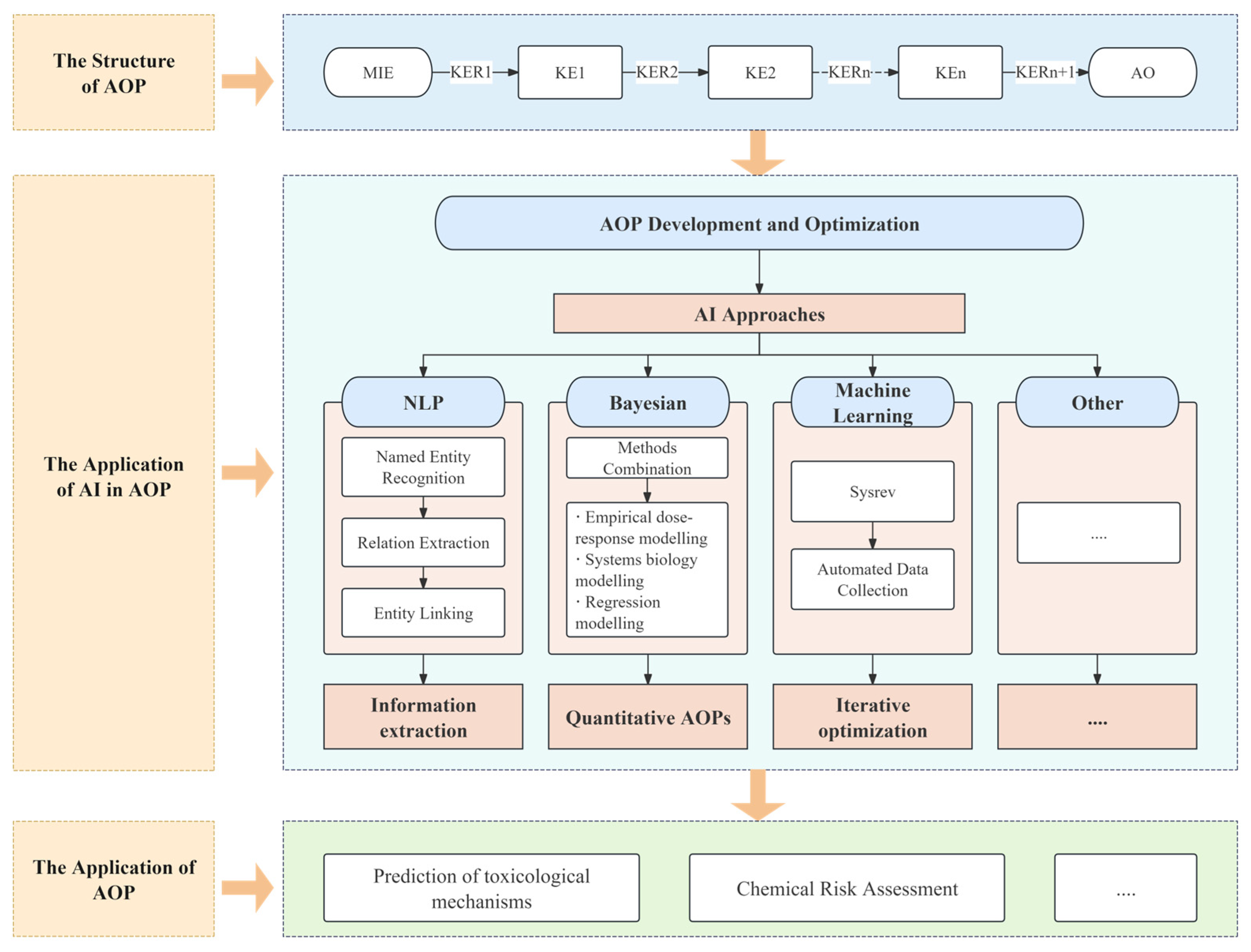
Figure 1 illustrates the central framework of this review regarding the deep integration of AI methods into the development and optimization of AOPs. By deploying multi-layered, collaborative AI technologies, the traditionally labor-intensive and time-consuming manual construction process, heavily reliant on expert knowledge, can be transformed into a modernized, data-driven, and semi-automated framework capable of iterative refinement. Specifically, natural language processing (NLP) enables the systematic mining of the vast unstructured scientific literature to automatically extract potential molecular initiating events (MIEs), adverse outcomes (AOs), key events (KEs), and their key event relationships (KERs). This significantly accelerates the preliminary discovery and information extraction of AOP knowledge modules. Building upon this foundation, the integration of AI techniques such as Bayesian methods with traditional modeling approaches like dose–response modeling can enhance the quantification and systematic understanding of KERs, facilitating the evolution from qualitative to quantitative AOPs. Concurrently, as new knowledge emerges, machine learning-based systems, such as Sysrev, can automate information gathering. This enables the continuous optimization and refinement of AOPs, sustainably and dynamically enhancing their capacity to predict toxicological mechanisms and support chemical risk assessment. Consequently, this review highlights AI as a pivotal auxiliary tool throughout the AOP lifecycle, spanning construction, quantification, and practical application.
By covering the entire AOP spectrum, from the fundamental theoretical framework and the AI-driven development and optimization strategies to practical applications, this narrative review aims to provide innovative insights and methodologies for toxicity testing and risk assessment strategies based on AOPs.

2. Overview of AOPs

2.1. Basic Concept of AOPs

The AOP framework is a conceptual framework that simplifies the description of toxicity mechanisms. Specifically, it organizes causal links between an MIE and an AO at the biological tissue level relevant to risk assessment into a linear and modular format. It bridges the MIE and AO through a series of KEs as specified by KERs (Figure 1) [8,20]. The MIE occurs at the molecular level, representing the initial point of chemical-biological interactions within an organism. The AO typically resides at the organ level or higher, signifying morphological or physiological alterations in an organism or system that result in impaired function or compensatory capacity. Each pair of KEs is linked via a KER, which defines the relationship between upstream and downstream events. This encompasses causal relationships, mechanism relationships, inference relationships, or correlation relationships, and may even provide quantitative relationships [21,22]. According to the guidelines published by the OECD [23], each AOP should have one MIE and one AO, but there is no restriction on the number of KEs. With the further development of AOPs, instances emerged where different AOPs shared one or more KEs. Considering potential interactions between distinct AOPs, researchers subsequently constructed AOP networks. These are defined as combinations of two or more AOPs sharing one or more KEs, enabling a more accurate and systematic representation of biological and toxicological complexity [24].
By definition, AOPs are characterized by their systematic nature, structure, format, strict quality control, and evidence-based weighting. This risk assessment methodology represents a more standardized approach than previous mechanistic toxicology. By systematically describing the KEs leading to AOs and substituting classical toxicological endpoints with mechanistic information chains, this approach facilitates a deeper understanding of the toxicological mechanisms underlying occupational hazards. Consequently, it provides a foundation for developing alternative testing methods for hazard identification and risk assessment, thereby offering more effective support for regulatory decision-making in occupational health [11,25,26].

2.2. Application of AOP in Occupational Health

As a conceptual framework designed to elucidate chemical toxicity and predict toxicological mechanisms, AOPs have been widely applied in risk assessments for both acute toxicity and chronic toxic chemical exposures in the workplace. Numerous AOPs have now been proposed to describe specific chemically induced adverse effects in humans and the environment. For instance, nanomaterials pose potential threats to human health, particularly in occupational settings, due to their minute dimensions. However, their toxic effects often diverge from conventional mechanisms, complicating direct comparisons, while their physicochemical variability continues to expand. Consequently, faster, more cost-effective, sensitive, and efficient alternative testing methods, supported by mechanistic evidence, are required to accurately assess their potential impacts on human health [27]. AOPs and AOP networks facilitate a deeper understanding of the inhalation toxicity of nanomaterials and provide strategies for developing alternative testing methods for hazard identification and risk assessment [25]. Furthermore, some researchers have employed the AOP framework to outline the principal pathways by which chemical respiratory sensitizers, a significant occupational health concern, induce adverse health effects [28]. This application not only enhances the understanding of the mechanisms underlying respiratory sensitization processes but also establishes a foundation for further research and the development of occupational regulatory strategies. Additionally, the challenges of occupational and environmental pollution exposure can also be addressed by combining AOP frameworks with occupational epidemiological methodologies. By integrating toxicological and epidemiological data, these approaches can better elucidate the toxicological mechanisms underlying both single-exposure scenarios and combined exposure to multiple pollutants, thereby providing a robust scientific basis for health risk assessments [26,29].

2.3. Development Methods for AOPs

AOPs are categorized into qualitative and quantitative types. In recent years, the OECD has successively published a series of guidance documents outlining the development and assessment of AOPs. Specifically, the guidelines released in 2016 describe the methodology and fundamental steps for constructing qualitative AOPs [20,23,30]. Generally, the development of qualitative AOPs involves three consecutive steps [20,31]. First, primary information blocks are identified. This entails defining the three principal information blocks—MIEs, AOs, and KEs—through literature review or experimental research. Second, data consolidation is conducted, involving the modularization of information at all levels and weight of evidence (WoE) analysis. Third, an evaluation is carried out to assess the reliability and robustness of the newly developed AOP. This is achieved through a two-stage process: the application of modified Bradford Hill criteria for WoE assessment, followed by the OECD’s five key questions for assessing confidence [20,32,33].
Currently, AOP frameworks primarily focus on qualitative analysis, while quantitative AOPs have only recently emerged and still lack official development guidelines. Quantitative AOPs represent an evolution of the qualitative framework, employing mathematical models, such as Bayesian networks and regression models, to describe dose–response or response–response relationships between associated events [34]. This capability enables the quantitative prediction of adverse outcomes, which constitutes a core requirement for risk assessment. Consequently, AOP frameworks, particularly quantitative AOPs, hold significant potential in regulatory toxicology for enhancing understanding and improving the accuracy of predicting compound toxicity and associated risks. However, given the vast volume of existing scientific literature and data, identifying the relevant biological information required to construct or optimize AOPs, especially complex AOP networks, remains a laborious and intricate task. The advancement of AI offers avenues to address this challenge.

3. AI Approaches

AI refers to the simulation of human intelligence by a system or a machine. It can be described as a multidisciplinary field that integrates computer science, mathematics, cognitive psychology, neuroscience, and other disciplines, aiming to create intelligent systems capable of reasoning, learning, and decision-making [35,36]. The key research domains of AI encompass machine learning, deep learning, and NLP. Machine learning constitutes a fundamental methodology of AI, enabling computers to learn from data and construct models for classification and prediction. By leveraging existing datasets, machine learning is typically employed to mimic human behavior [37,38]. Machine learning encompasses a diverse array of algorithms, including linear regression [39], support vector regression [40], decision trees [41], random forests [42], neural networks [43], and more (Table 1). Deep learning, a critical subset of machine learning, employs multi-layer artificial neural networks to simulate the learning processes of the human brain [44]. Deep learning technologies have significantly propelled the development of AI, substantially enhancing technical capabilities across various fields, including speech recognition, visual object recognition, object detection, and many other domains. Deep neural networks represent an advanced evolution of artificial neural networks, characterized by architectures with more than three layers (comprising two or more hidden layers) [45]. By integrating deep architectures with sophisticated training algorithms, these networks facilitate higher-level data abstraction and the processing of complex information. NLP is an applied field situated at the intersection of AI and linguistics. Primarily reliant on deep learning techniques, NLP focuses on the automated analysis of human language and is widely applied in tasks such as sentiment analysis and language detection [46,47]. Notably, Corradi et al. [48] have proposed that advancements in NLP, particularly regarding neural networks, could offer toxicologists the potential to screen scientific literature with greater efficiency.

4. The Application of AI in AOP Development and Optimization

4.1. Information Extraction for AOP Construction

The construction and optimization of AOP frameworks rely upon gathering, reviewing, and synthesizing vast amounts of existing knowledge, encompassing multiple information streams ranging from existing literature to knowledge databases. Such knowledge typically exists in free-text form—that is, unstructured text—that computers cannot immediately process. Concurrently, the exponential growth of available data renders the manual processing of this information a time-consuming and labor-intensive endeavor. Advances in AI offer a solution to this challenge, enabling toxicologists to utilize their time more effectively. Specifically, in the process of constructing AOPs, NLP can be employed to systematically retrieve scientific literature, segment texts into relevant sections, and automatically mine relationships between MIEs, KEs, and AOs. This information is then stored in a computer-readable format. Researchers developing AOPs can thus fully leverage their domain expertise, devoting more time and effort to quality control and critical evaluation of the extracted information.
The information extraction task within NLP comprises the following three components [48]. First, named entity recognition (NER) identifies entities with specific meaning within a text—namely, lexical segments representing concepts of interest. In the context of AOP construction, NER is employed to recognize concepts such as MIEs, KEs, and AOs. Second, relation extraction identifies causal relationships between entities, thereby supporting the definition of KERs and WoE. Finally, entity linking assigns unique identifiers to specific terms to resolve lexical ambiguity and facilitate integration with existing databases and external resources. Depending on the specific AOP development strategies, distinct keywords can be deployed to systematically retrieve relevant literature. Searches may target the toxicological effects of selected chemicals (a top-down approach) or specific AOs of interest (a bottom-up approach), followed by automatic information extraction from the retrieved articles via NLP. For instance, Corradi et al. [49] employed deep learning language models to identify target entities within texts, utilizing cholestasis and steatosis as case studies. They established a model based on simple semantic rules for relation extraction, thereby facilitating the screening of literature for compounds associated with hepatic adverse reactions and related mechanistic information (https://github.com/ontox-project/en-tox (accessed on 20 February 2026)). Similarly, Ciallella et al. [50] developed a knowledge-based deep neural network model to analyze publicly available high-throughput screening data, identifying compounds with the potential to bind to the nuclear estrogen receptors alpha and beta (ERα and ERβ). The network utilized rodent uterine weight gain bioactivity—driven by ERα/ERβ activation—as the target outcome. Following training, it successfully inferred key relationships between ERα/ERβ target assays. By utilizing an AOP framework, the study modeled the signaling pathway initiated by ERα—from compound-induced ERα activation to rodent uterine weight gain bioactivity. This enabled the efficient and accurate identification and prioritization of potential estrogen mimetics. This demonstrates how AI-based models can integrate AOPs with high-throughput screening data to characterize and prioritize the hazards of potentially toxic compounds, thereby facilitating robust risk assessment.
Additionally, AI technologies, particularly NLP, are increasingly applied at the intersection of AOPs and bioinformatics. While AOPs simulate event cascades from MIEs to AOs across various levels of biological organization—ranging from organs to individuals and populations—multi-omics technologies allow for a deeper investigation of the molecular mechanisms underlying chemical exposure. In 2023, Saarimäki et al. established the first systematic AOP-gene annotation framework by integrating NLP with manual curation techniques [51]. They integrated the Unified Knowledge Space knowledge graph to achieve semantic alignment between KEs, Gene Ontology terms, and pathway databases. This approach provides molecular-level evidence to support the mechanistic interpretation of AOPs and has subsequently been applied to the development of biomarkers for pulmonary fibrosis [52].
In parallel, some researchers have developed “AOP-helpFinder”, an AI-based tool designed to assist in AOP construction (https://aop-helpfinder-v3.u-paris-sciences.fr (accessed on 20 February 2026)). This tool integrates text mining, graph theory, and NLP methodologies to analyze PubMed abstracts, thereby identifying relationships between stressors and biological events (MIEs, KEs, AOs), as well as linkages between pairs of biological events (KE-KE). The tool assigns a confidence score to each identified connection based on co-occurrence frequency and statistical significance. This scoring system facilitates subsequent WoE assessment. Furthermore, it enables the automatic linking of extracted information to various relevant toxicological and bioinformatics databases and directly visualizes the identified KERs as interactive biological networks [53,54,55]. The utility of this tool has been demonstrated through its successful application in multiple studies [56,57,58,59].

4.2. Construction of Quantitative AOPs

Quantitative AOP models serve as a bridge between descriptive knowledge and the prediction of adverse outcomes in hazard and risk assessment, extending the traditional AOP framework by integrating experimental data with mathematical modeling. Despite the utility of AOPs, some researchers remain skeptical about the reliability of AOPs, particularly due to the lack of robust quantitative support for KERs. Quantitative understanding is paramount for the development of AOPs. It not only enhances the accuracy and reliability of toxicity predictions but also promotes broader acceptance and application of AOPs within regulatory frameworks. This, in turn, supports more informed risk assessments and regulatory decisions, potentially enabling personalized toxicity evaluations and precision interventions [34,60,61]. However, development in this field remains limited. AI offers a promising pathway to accelerate the construction and refinement of quantitative AOP models.
Bayesian networks are probabilistic graphical models that visually represent probabilistic dependencies between variables (e.g., chemical substances, MIEs, KEs, and AOs) through directed acyclic graphs, utilizing Bayes’ theorem to perform inference under uncertainty [62]. They constitute a primary AI methodology for constructing quantitative AOPs. For instance, Zgheib et al. demonstrated that an approach based on dynamic Bayesian networks (DBNs) exhibits significant advantages when quantifying the AOP of oxidative stress-induced chronic kidney disease [63]. The DBN model’s residual uncertainty in fitting 6-carboxy-2′,7′-dichlorofluorescein and lactate data (approximately 25% and 10%, respectively) demonstrated superior precision compared to empirical dose–response models (approximately 20% and 30%). Concurrently, the network architecture was directly determined by the AOP, proving more concise than systems biology models that required 57 differential equations. Although calibrating DBNs presents challenges, the study emphasizes that the optimal quantification strategy involves the parallel integration of two approaches: mechanistic modeling (such as systems biology models) and lightweight statistical modeling (such as DBNs). This strategy combines the biological insights of mechanistic modeling with the predictive flexibility of statistical modeling, thereby providing more reliable support for risk assessment [63]. Similarly, a proof-of-concept study by Moe et al. [64] employed dose–response functions commonly used in ecotoxicology, quantifying each dose–response and response–response relationship through Bayesian regression modeling. Internal validation indicated that the model achieved high prediction accuracy, ranging from 77.8% to 88.9%, particularly when operated at intermediate nodes and when the AO was defined by lower-resolution states (e.g., three states). These results further demonstrate that combining Bayesian network modeling with regression modeling constitutes a robust approach for quantifying AOPs, even under conditions of data scarcity [64]. Moreover, dynamic Bayesian network analysis can be further applied to construct quantitative AOPs for chronic toxicity resulting from repeated exposure [65].
Additionally, traditional quantitative structure–activity relationship (QSAR) modeling has evolved from basic linear models to sophisticated machine learning and deep learning frameworks capable of integrating complex nonlinear patterns across large chemical spaces [66]. AI-integrated QSAR modeling has subsequently become a standard practice in computational toxicology, cheminformatics, and regulatory risk assessment [67]. For example, studies have combined machine learning with QSAR modeling to provide a robust framework for optimizing human DNA polymerase η (hpol η) inhibition, offering both high predictive accuracy and biochemical interpretability [68]. Researchers trained 17 machine learning algorithms—including random forest, extreme gradient boosting, and neural networks—on a curated library of 85 indole thio-barbituric acid analogs with validated hpol η inhibition data, using 80% of the data for training and evaluating performance across 14 metrics. The results demonstrated that ensemble learning approaches outperformed other algorithms, with the random forest model achieving near-perfect predictive performance (training mean squared error = 0.0002, R2 = 0.9999; testing mean squared error = 0.0003, R2 = 0.9998). Furthermore, AI-integrated QSAR modeling has been extended within the AOP domain to predict the activity of compounds against MIE-related protein targets associated with organ-specific toxicity [69].

4.3. Iterative Optimization of AOPs

According to the fundamental principles of AOP development proposed by Villeneuve et al. [22], an AOP constitutes a dynamic document requiring periodic updates to incorporate the latest data. The current development and iterative optimization of AOPs primarily rely on manual processes, which are not only time-consuming but also prone to bias and the oversight of critical data. The rapid advancement of AI-assisted data collection and extraction offers a potential solution to this issue [11]. For instance, van Ertvelde et al. [70] introduced a novel approach employing AI to iteratively optimize a previously published AOP network for chemical cholestasis. This method facilitated automated data collection, followed by quantitative confidence assessments of the MIE, KEs, and KERs. This study employed AI-assisted data collection via Sysrev, a free web platform integrating human and machine learning algorithms, and quantified WoE assessments based on modified Bradford Hill criteria [71]. This approach successfully optimized the AOP network by demonstrating KE incidence rates and relative KER confidence levels. Concurrently, the development of the “xploreaop” web application by van Ertvelde et al. enables interactive data exploration and streamlines the future integration of chemical cholestasis datasets [70]. Ultimately, this optimized AOP network serves as a mechanistic guide for developing a series of in vitro assays to reliably predict chemical cholestasis.

5. Challenges and Prospects

AOPs provide a standardized description of toxicological mechanisms, serving as a foundation for new methodological development and constituting a vital framework for alternative approaches to chemical toxicity testing and risk assessment. These mechanism frameworks connect MIEs to AOs through a cascade of events spanning various biological levels, relying on substantial data to provide robust evidence for the relationships between each step. As the development of AOPs remains in its early stages, the application of AI technology can accelerate their development and optimization. This integration can enhance the quality of AOP, advance the field, and facilitate the widespread application of these frameworks in occupational health risk assessment.
International regulatory bodies have recognized the potential of AI to enhance regulatory efficiency. The 2024 Global Summit on Regulatory Science emphasized that the integration of AI into regulatory science is inevitable and already underway [72]. However, it is important to recognize that AI currently functions only as an auxiliary tool. It cannot be employed for the independent development of AOPs due to its persistent limitations across multiple dimensions, particularly within the context of regulatory science.
Firstly, the quality of data and information utilized by AI methods presents distinct limitations. AI methods typically extract information solely from scientific literature and databases without assessing its quality. Moreover, common issues in regulatory science, such as data noise, bias, and experimental inconsistencies, may further compromise the credibility of model inputs and the reliability of AI outcomes [73]. To address these constraints and mitigate the risk of false positives, filters may be applied during the screening process, combined with manual verification by AOP developers or expert consultation [48,59,74].
Secondly, the explainability of most existing AI models falls short of regulatory science requirements. Regulatory bodies require models to possess transparency, reproducibility, and verifiability [72]. However, owing to the “black-box” nature of AI models, concerns persist among some researchers regarding the reliability of information generated during AI-driven AOP development and iterative optimization. This creates ongoing regulatory challenges and constitutes a limiting factor for the advancement of the AI-AOP field. The rapid advancement of explainable AI, which enables human users to understand, appropriately trust, and develop more explainable models, may offer solutions to some of these issues [75,76]. Moreover, effective human-AI interaction serves as a crucial pathway for the trustworthy application of AI within regulatory science [72]. Therefore, following the AI-assisted construction of an AOP framework, it remains necessary to conduct quality assessments based on the modified Bradford Hill criteria proposed by the OECD. The WoE approach, particularly quantitative WoE methodologies, is crucial for enhancing AOP quality and facilitating their application in regulation and risk assessment [71].
Thirdly, AI methods may be constrained by the availability of open science format publications and the preference for positive results within such publications. While this bias also persists in non-automated approaches, AI methods remain more efficient than manual processing and enable the identification of gaps within the current knowledge system [48]. Additionally, ethical issues such as data privacy, algorithmic fairness, and accountability remain inadequately addressed [72]. As the automation of AOPs advances, regulatory bodies must also comprehensively understand these challenges and establish flexible AI regulatory frameworks.

6. Conclusions

This review emphasizes that AI can be effectively employed as an auxiliary tool integrated into various processes of AOP development and optimization. By leveraging AI technologies such as NLP, Bayesian models, and machine learning, it is possible not only to achieve efficient information extraction, quantitative analysis, and continuous optimization of AOPs, but also to significantly accelerate the evolution of AOPs from qualitative, static descriptions to quantitative, dynamic models. This integration strategy may further advance the refinement of risk assessment and regulatory strategies for novel chemicals based on AOPs, particularly concerning occupational chemical exposure. Despite certain limitations in AI usage, the application of AI in the development and optimization of AOPs has demonstrated immense potential, garnering extensive attention and driving experimental research from researchers internationally [77]. Empowered by AI technology, the AOP domain is poised for accelerated progress and development in the future. Concurrently, associated toxicity evaluation and risk assessment systems will undergo further innovation, providing more precise guidance for risk assessment and regulatory oversight of chemical substances. This trajectory necessitates heightened engagement and scrutiny from the toxicology and occupational health research communities.

Author Contributions

Z.Z. served as the lead author; conducted the systematic literature search, performed the initial screening and data extraction, and drafted the main body of the manuscript; G.H. conceived the study, provided methodological and structural guidance throughout the review process, and critically revised the manuscript for important intellectual content; G.J. supervised the project, ensured academic rigor, provided strategic input on overall direction, and secured funding. All authors have read and agreed to the published version of the manuscript.

Funding

This research was funded by the National Natural Science Foundation of China (No. 82473600 and 82273603).

Institutional Review Board Statement

Not applicable.

Informed Consent Statement

Not applicable.

Data Availability Statement

No new data were created or analyzed in this study. Data sharing is not applicable to this article.

Conflicts of Interest

The authors declare no conflicts of interest. The funders had no role in the design of the study; in the collection, analysis, or interpretation of data; in the writing of the manuscript; or in the decision to publish the results.

Abbreviations

The following abbreviations are used in this manuscript:
DALYsDisability-adjusted life years
AOPAdverse outcome pathway
AIArtificial intelligence
NLPNatural language processing
MIEMolecular initiating event
AOAdverse outcome
KEKey event
KERKey event relationship
OECDOrganization for Economic Co-operation and Development
WoEWeight of evidence
NERNamed entity recognition
DBNsDynamic Bayesian networks
QSARQuantitative structure–activity relationship
hpol ηHuman DNA polymerase η

References

  1. Barouki, R.; Samson, M.; Blanc, E.B.; Colombo, M.; Zucman-Rossi, J.; Lazaridis, K.N.; Miller, G.W.; Coumoul, X. The exposome and liver disease-how environmental factors affect liver health. J. Hepatol. 2023, 79, 492–505. [Google Scholar] [CrossRef]
  2. Vasse, G.F.; Melgert, B.N. Microplastic and plastic pollution: Impact on respiratory disease and health. Eur. Respir. Rev. 2024, 33, 230226. [Google Scholar] [CrossRef]
  3. Yu, G.; Wu, L.; Su, Q.; Ji, X.; Zhou, J.; Wu, S.; Tang, Y.; Li, H. Neurotoxic effects of heavy metal pollutants in the environment: Focusing on epigenetic mechanisms. Environ. Pollut. 2024, 345, 123563. [Google Scholar] [CrossRef]
  4. Hussain, M.S.; Gupta, G.; Mishra, R.; Patel, N.; Gupta, S.; Alzarea, S.I.; Kazmi, I.; Kumbhar, P.; Disouza, J.; Dureja, H.; et al. Unlocking the secrets: Volatile Organic Compounds (VOCs) and their devastating effects on lung cancer. Pathol. Res. Pract. 2024, 255, 155157. [Google Scholar] [CrossRef] [PubMed]
  5. Global, regional, and national comparative risk assessment of 79 behavioural, environmental and occupational, and metabolic risks or clusters of risks, 1990–2015: A systematic analysis for the Global Burden of Disease Study 2015. Lancet 2016, 388, 1659–1724. [CrossRef] [PubMed]
  6. Landrigan, P.J.; Fuller, R.; Acosta, N.J.R.; Adeyi, O.; Arnold, R.; Basu, N.N.; Baldé, A.B.; Bertollini, R.; Bose-O’Reilly, S.; Boufford, J.I.; et al. The Lancet Commission on pollution and health. Lancet 2018, 391, 462–512. [Google Scholar] [CrossRef]
  7. Krewski, D.; Acosta, D., Jr.; Andersen, M.; Anderson, H.; Bailar, J.C., 3rd; Boekelheide, K.; Brent, R.; Charnley, G.; Cheung, V.G.; Green, S., Jr.; et al. Toxicity testing in the 21st century: A vision and a strategy. J. Toxicol. Environ. Health B Crit. Rev. 2010, 13, 51–138. [Google Scholar] [CrossRef] [PubMed]
  8. Ankley, G.T.; Bennett, R.S.; Erickson, R.J.; Hoff, D.J.; Hornung, M.W.; Johnson, R.D.; Mount, D.R.; Nichols, J.W.; Russom, C.L.; Schmieder, P.K.; et al. Adverse outcome pathways: A conceptual framework to support ecotoxicology research and risk assessment. Environ. Toxicol. Chem. 2010, 29, 730–741. [Google Scholar] [CrossRef]
  9. Mortensen, H.M.; Senn, J.; Levey, T.; Langley, P.; Williams, A.J. The 2021 update of the EPA’s adverse outcome pathway database. Sci. Data 2021, 8, 169. [Google Scholar] [CrossRef]
  10. Chauhan, V.; Beaton, D.; Tollefsen, K.E.; Preston, J.; Burtt, J.J.; Leblanc, J.; Hamada, N.; Azzam, E.I.; Armant, O.; Bouffler, S.; et al. Radiation Adverse Outcome pathways (AOPs): Examining priority questions from an international horizon-style exercise. Int. J. Radiat. Biol. 2024, 100, 982–995. [Google Scholar] [CrossRef]
  11. Leist, M.; Ghallab, A.; Graepel, R.; Marchan, R.; Hassan, R.; Bennekou, S.H.; Limonciel, A.; Vinken, M.; Schildknecht, S.; Waldmann, T.; et al. Adverse outcome pathways: Opportunities, limitations and open questions. Arch. Toxicol. 2017, 91, 3477–3505. [Google Scholar] [CrossRef]
  12. Chou, W.C.; Lin, Z. Machine learning and artificial intelligence in physiologically based pharmacokinetic modeling. Toxicol. Sci. 2023, 191, 1–14. [Google Scholar] [CrossRef] [PubMed]
  13. Cheng, W.; Ng, C.A. Using Machine Learning to Classify Bioactivity for 3486 Per- and Polyfluoroalkyl Substances (PFASs) from the OECD List. Environ. Sci. Technol. 2019, 53, 13970–13980. [Google Scholar] [CrossRef]
  14. Atila, Ü.; Baydilli, Y.Y.; Sehirli, E.; Turan, M.K. Classification of DNA damages on segmented comet assay images using convolutional neural network. Comput. Methods Programs Biomed. 2020, 186, 105192. [Google Scholar] [CrossRef] [PubMed]
  15. Chen, X.; Roberts, R.; Tong, W.; Liu, Z. Tox-GAN: An Artificial Intelligence Approach Alternative to Animal Studies-A Case Study with Toxicogenomics. Toxicol. Sci. 2022, 186, 242–259. [Google Scholar] [CrossRef] [PubMed]
  16. Luechtefeld, T.; Marsh, D.; Rowlands, C.; Hartung, T. Machine Learning of Toxicological Big Data Enables Read-Across Structure Activity Relationships (RASAR) Outperforming Animal Test Reproducibility. Toxicol. Sci. 2018, 165, 198–212. [Google Scholar] [CrossRef]
  17. Gholamizadeh, K.; Zarei, E.; Gualtieri, L.; De Marchi, M. Advancing occupational and system safety in Industry 5.0: Effective HAZID risk analysis frameworks, and human-AI interaction management. Saf. Sci. 2025, 184, 106770. [Google Scholar] [CrossRef]
  18. Shah, I.A.; Mishra, S. Artificial intelligence in advancing occupational health and safety: An encapsulation of developments. J. Occup. Health 2024, 66, uiad017. [Google Scholar] [CrossRef]
  19. Lin, Z.; Chou, W.-C. Machine Learning and Artificial Intelligence in Toxicological Sciences. Toxicol. Sci. 2022, 189, 7–19. [Google Scholar] [CrossRef]
  20. OECD. Proposal for a Template, and Guidance on Developing and Assessing the Completeness of Adverse Outcome Pathways; OECD: Paris, France, 2012. [Google Scholar]
  21. Vinken, M.; Knapen, D.; Vergauwen, L.; Hengstler, J.G.; Angrish, M.; Whelan, M. Adverse outcome pathways: A concise introduction for toxicologists. Arch. Toxicol. 2017, 91, 3697–3707. [Google Scholar] [CrossRef]
  22. Villeneuve, D.L.; Crump, D.; Garcia-Reyero, N.; Hecker, M.; Hutchinson, T.H.; LaLone, C.A.; Landesmann, B.; Lettieri, T.; Munn, S.; Nepelska, M.; et al. Adverse outcome pathway (AOP) development I: Strategies and principles. Toxicol Sci 2014, 142, 312–320. [Google Scholar] [CrossRef]
  23. OECD. Users’ Handbook Supplement to the Guidance Document for Developing and Assessing Adverse Outcome Pathways; OECD Series on Adverse Outcome Pathways; OECD: Paris, France, 2018; p. 1. [Google Scholar]
  24. Knapen, D.; Angrish, M.M.; Fortin, M.C.; Katsiadaki, I.; Leonard, M.; Margiotta-Casaluci, L.; Munn, S.; O’Brien, J.M.; Pollesch, N.; Smith, L.C.; et al. Adverse outcome pathway networks I: Development and applications. Environ. Toxicol. Chem. 2018, 37, 1723–1733. [Google Scholar] [CrossRef] [PubMed]
  25. Halappanavar, S.; van den Brule, S.; Nymark, P.; Gaté, L.; Seidel, C.; Valentino, S.; Zhernovkov, V.; Danielsen, P.H.; De Vizcaya, A.; Wolff, H.; et al. Adverse outcome pathways as a tool for the design of testing strategies to support the safety assessment of emerging advanced materials at the nanoscale. Part Fibre Toxicol. 2020, 17, 16. [Google Scholar] [CrossRef]
  26. Wang, Y.C.; Qiao, M.Y.; Yang, H.T.; Chen, Y.Y.; Jiao, B.; Liu, S.; Duan, A.R.; Wu, S.Y.; Wang, H.H.; Yu, C.Y.; et al. Investigating the relationship of co-exposure to multiple metals with chronic kidney disease: An integrated perspective from epidemiology and adverse outcome pathways. J. Hazard. Mater. 2024, 480, 135844. [Google Scholar] [CrossRef] [PubMed]
  27. Rim, K.-T. Adverse outcome pathways for chemical toxicity and their applications to workers’ health: A literature review. Toxicol. Environ. Health Sci. 2020, 12, 99–108. [Google Scholar] [CrossRef]
  28. Kimber, I.; Dearman, R.J.; Basketter, D.A.; Boverhof, D.R. Chemical respiratory allergy: Reverse engineering an adverse outcome pathway. Toxicology 2014, 318, 32–39. [Google Scholar] [CrossRef]
  29. Lambert, J.C. Adverse Outcome Pathway ‘Footprinting’: A Novel Approach to the Integration of 21st Century Toxicology Information into Chemical Mixtures Risk Assessment. Toxics 2022, 11, 37. [Google Scholar] [CrossRef]
  30. OECD. Guidance Document on Developing and Assessing Adverse Outcome Pathways; OECD: Paris, France, 2013. [Google Scholar]
  31. Vinken, M. The adverse outcome pathway concept: A pragmatic tool in toxicology. Toxicology 2013, 312, 158–165. [Google Scholar] [CrossRef]
  32. Hill, A.B. The environment and disease: Association or causation? 1965. J. R. Soc. Med. 2015, 108, 32–37. [Google Scholar] [CrossRef]
  33. Becker, R.A.; Ankley, G.T.; Edwards, S.W.; Kennedy, S.W.; Linkov, I.; Meek, B.; Sachana, M.; Segner, H.; Van Der Burg, B.; Villeneuve, D.L.; et al. Increasing Scientific Confidence in Adverse Outcome Pathways: Application of Tailored Bradford-Hill Considerations for Evaluating Weight of Evidence. Regul. Toxicol. Pharmacol. 2015, 72, 514–537. [Google Scholar] [CrossRef] [PubMed]
  34. Jeong, J.; Gasparyan, M.; Choi, J. Advancing the quantitative understanding of adverse outcome pathways: Current status, methodologies, and future directions. Environ. Toxicol. Chem. 2025, 44, 614–623. [Google Scholar] [CrossRef]
  35. Surya, M. Artificial Super Intelligence (ASI), A Revolutionary and Hypothetical Potential for Artificial Intelligence. Int. J. Adv. Res. Interdiscip. Sci. Endeav. 2025, 2, 764–769. [Google Scholar] [CrossRef]
  36. Xu, Y.; Liu, X.; Cao, X.; Huang, C.; Liu, E.; Qian, S.; Liu, X.; Wu, Y.; Dong, F.; Qiu, C.W.; et al. Artificial intelligence: A powerful paradigm for scientific research. Innovation 2021, 2, 100179. [Google Scholar] [CrossRef]
  37. Cohen, S. Chapter 2—The basics of machine learning: Strategies and techniques. In Artificial Intelligence and Deep Learning in Pathology; Cohen, S., Ed.; Elsevier: Amsterdam, The Netherlands, 2021; pp. 13–40. [Google Scholar]
  38. Shalev-Shwartz, S.; Ben-David, S. Understanding Machine Learning: From Theory to Algorithms; Cambridge University Press: Cambridge, UK, 2014. [Google Scholar]
  39. Schneider, A.; Hommel, G.; Blettner, M. Linear Regression Analysis. Dtsch Arztebl Int. 2010, 107, 776–782. [Google Scholar] [CrossRef]
  40. Awad, M.; Khanna, R. Support Vector Regression. In Efficient Learning Machines: Theories, Concepts, and Applications for Engineers and System Designers; Awad, M., Khanna, R., Eds.; Apress: Berkeley, CA, USA, 2015; pp. 67–80. [Google Scholar]
  41. Navada, A.; Ansari, A.N.; Patil, S.; Sonkamble, B.A. Overview of use of decision tree algorithms in machine learning. In Proceedings of the 2011 IEEE Control and System Graduate Research Colloquium, 27–28 June 2011; IEEE: New York, NY, USA, 2011; pp. 37–42. [Google Scholar]
  42. Sun, Z.; Wang, G.; Li, P.; Wang, H.; Zhang, M.; Liang, X. An improved random forest based on the classification accuracy and correlation measurement of decision trees. Expert Syst. Appl. 2024, 237, 121549. [Google Scholar] [CrossRef]
  43. Schmidhuber, J. Deep learning in neural networks: An overview. Neural Netw. 2015, 61, 85–117. [Google Scholar] [CrossRef]
  44. LeCun, Y.; Bengio, Y.; Hinton, G. Deep learning. Nature 2015, 521, 436–444. [Google Scholar] [CrossRef] [PubMed]
  45. Masood, A.; Ahmad, K. A review on emerging artificial intelligence (AI) techniques for air pollution forecasting: Fundamentals, application and performance. J. Clean. Prod. 2021, 322, 129072. [Google Scholar] [CrossRef]
  46. Jahan, M.S.; Oussalah, M. A systematic review of hate speech automatic detection using natural language processing. Neurocomputing 2023, 546, 126232. [Google Scholar] [CrossRef]
  47. Jim, J.R.; Talukder, M.A.R.; Malakar, P.; Kabir, M.M.; Nur, K.; Mridha, M.F. Recent advancements and challenges of NLP-based sentiment analysis: A state-of-the-art review. Nat. Lang. Process. J. 2024, 6, 100059. [Google Scholar] [CrossRef]
  48. Corradi, M.P.F.; de Haan, A.M.; Staumont, B.; Piersma, A.H.; Geris, L.; Pieters, R.H.H.; Krul, C.A.M.; Teunis, M.A.T. Natural language processing in toxicology: Delineating adverse outcome pathways and guiding the application of new approach methodologies. Biomater. Biosyst. 2022, 7, 100061. [Google Scholar] [CrossRef]
  49. Corradi, M.; Luechtefeld, T.; de Haan, A.M.; Pieters, R.; Freedman, J.H.; Vanhaecke, T.; Vinken, M.; Teunis, M. The application of natural language processing for the extraction of mechanistic information in toxicology. Front. Toxicol. 2024, 6, 1393662. [Google Scholar] [CrossRef]
  50. Ciallella, H.L.; Russo, D.P.; Aleksunes, L.M.; Grimm, F.A.; Zhu, H. Revealing Adverse Outcome Pathways from Public High-Throughput Screening Data to Evaluate New Toxicants by a Knowledge-Based Deep Neural Network Approach. Environ. Sci. Technol. 2021, 55, 10875–10887. [Google Scholar] [CrossRef]
  51. Saarimäki, L.A.; Fratello, M.; Pavel, A.; Korpilähde, S.; Leppänen, J.; Serra, A.; Greco, D. A curated gene and biological system annotation of adverse outcome pathways related to human health. Sci. Data 2023, 10, 409. [Google Scholar] [CrossRef] [PubMed]
  52. Saarimäki, L.A.; Morikka, J.; Pavel, A.; Korpilähde, S.; Del Giudice, G.; Federico, A.; Fratello, M.; Serra, A.; Greco, D. Toxicogenomics Data for Chemical Safety Assessment and Development of New Approach Methodologies: An Adverse Outcome Pathway-Based Approach. Adv. Sci. 2023, 10, e2203984. [Google Scholar] [CrossRef]
  53. Jaylet, T.; Jornod, F.; Capdet, Q.; Armant, O.; Audouze, K. AOP-helpFinder 3.0: From text mining to network visualization of key event relationships, and knowledge integration from multiple sources. Bioinformatics 2025, 41, btaf381. [Google Scholar] [CrossRef]
  54. Jaylet, T.; Coustillet, T.; Jornod, F.; Margaritte-Jeannin, P.; Audouze, K. AOP-helpFinder 2.0: Integration of an event-event searches module. Environ. Int. 2023, 177, 108017. [Google Scholar] [CrossRef] [PubMed]
  55. Jornod, F.; Jaylet, T.; Blaha, L.; Sarigiannis, D.; Tamisier, L.; Audouze, K. AOP-helpFinder webserver: A tool for comprehensive analysis of the literature to support adverse outcome pathways development. Bioinformatics 2021, 38, 1173–1175. [Google Scholar] [CrossRef]
  56. Benoit, L.; Jornod, F.; Zgheib, E.; Tomkiewicz, C.; Koual, M.; Coustillet, T.; Barouki, R.; Audouze, K.; Vinken, M.; Coumoul, X. Adverse outcome pathway from activation of the AhR to breast cancer-related death. Environ. Int. 2022, 165, 107323. [Google Scholar] [CrossRef] [PubMed]
  57. Kaiser, A.M.; Zare Jeddi, M.; Uhl, M.; Jornod, F.; Fernandez, M.F.; Audouze, K. Characterization of Potential Adverse Outcome Pathways Related to Metabolic Outcomes and Exposure to Per- and Polyfluoroalkyl Substances Using Artificial Intelligence. Toxics 2022, 10, 449. [Google Scholar] [CrossRef]
  58. Gundacker, C.; Audouze, K.; Widhalm, R.; Granitzer, S.; Forsthuber, M.; Jornod, F.; Wielsøe, M.; Long, M.; Halldórsson, T.I.; Uhl, M.; et al. Reduced Birth Weight and Exposure to Per- and Polyfluoroalkyl Substances: A Review of Possible Underlying Mechanisms Using the AOP-HelpFinder. Toxics 2022, 10, 684. [Google Scholar] [CrossRef] [PubMed]
  59. Jaylet, T.; Quintens, R.; Armant, O.; Audouze, K. An integrative systems biology strategy to support the development of adverse outcome pathways (AOPs): A case study on radiation-induced microcephaly. Front. Cell Dev. Biol. 2023, 11, 1197204. [Google Scholar] [CrossRef]
  60. Perkins, E.J.; Ashauer, R.; Burgoon, L.; Conolly, R.; Landesmann, B.; Mackay, C.; Murphy, C.A.; Pollesch, N.; Wheeler, J.R.; Zupanic, A.; et al. Building and Applying Quantitative Adverse Outcome Pathway Models for Chemical Hazard and Risk Assessment. Environ. Toxicol. Chem. 2019, 38, 1850–1865. [Google Scholar] [CrossRef]
  61. Mortensen, H.M.; Chamberlin, J.; Joubert, B.; Angrish, M.; Sipes, N.; Lee, J.S.; Euling, S.Y. Leveraging human genetic and adverse outcome pathway (AOP) data to inform susceptibility in human health risk assessment. Mamm. Genome 2018, 29, 190–204. [Google Scholar] [CrossRef] [PubMed]
  62. Pearl, J. Probabilistic Reasoning in Intelligent Systems: Networks of Plausible Inference; Morgan Kaufmann: San Mateo, CA, USA, 1988; p. xix, 552. [Google Scholar]
  63. Zgheib, E.; Gao, W.; Limonciel, A.; Aladjov, H.; Yang, H.; Tebby, C.; Gayraud, G.; Jennings, P.; Sachana, M.; Beltman, J.B.; et al. Application of three approaches for quantitative AOP development to renal toxicity. Comput. Toxicol. 2019, 11, 1–13. [Google Scholar] [CrossRef]
  64. Moe, S.J.; Wolf, R.; Xie, L.; Landis, W.G.; Kotamäki, N.; Tollefsen, K.E. Quantification of an Adverse Outcome Pathway Network by Bayesian Regression and Bayesian Network Modeling. Integr. Environ. Assess. Manag. 2021, 17, 147–164. [Google Scholar] [CrossRef]
  65. Ito, S.; Mukherjee, S.; Erami, K.; Muratani, S.; Mori, A.; Ichikawa, S.; White, W.; Yoshino, K.; Fallacara, D. Proof of concept for quantitative adverse outcome pathway modeling of chronic toxicity in repeated exposure. Sci. Rep. 2024, 14, 4741. [Google Scholar] [CrossRef]
  66. Koirala, M.; Yan, L.; Mohamed, Z.; DiPaola, M. AI-Integrated QSAR Modeling for Enhanced Drug Discovery: From Classical Approaches to Deep Learning and Structural Insight. Int. J. Mol. Sci. 2025, 26, 9384. [Google Scholar] [CrossRef]
  67. Shaikh, S.; Alte, A.; Pande, V.; Wagh, V.; Suryawanshi, J. Artificial Intelligence in Modern Deep-Learning QSAR. J. Educ. Technol. Health Sci. 2025, 12, 77–88. [Google Scholar] [CrossRef]
  68. Kakraba, S.; Ayyadevara, S.; Yadem Clement, A.; Abraham, K.E.; Compadre, C.M.; Shmookler Reis, R.J. Machine Learning–Enhanced Quantitative Structure-Activity Relationship Modeling for DNA Polymerase Inhibitor Discovery: Algorithm Development and Validation. JMIR AI 2025, 4, e77890. [Google Scholar] [CrossRef]
  69. Gadaleta, D.; Garcia de Lomana, M.; Serrano-Candelas, E.; Ortega-Vallbona, R.; Gozalbes, R.; Roncaglioni, A.; Benfenati, E. Quantitative structure-activity relationships of chemical bioactivity toward proteins associated with molecular initiating events of organ-specific toxicity. J. Cheminform. 2024, 16, 122. [Google Scholar] [CrossRef]
  70. van Ertvelde, J.; Verhoeven, A.; Maerten, A.; Cooreman, A.; Santos Rodrigues, B.d.; Sanz-Serrano, J.; Mihajlovic, M.; Tripodi, I.; Teunis, M.; Jover, R.; et al. Optimization of an adverse outcome pathway network on chemical-induced cholestasis using an artificial intelligence-assisted data collection and confidence level quantification approach. J. Biomed. Inform. 2023, 145, 104465. [Google Scholar] [CrossRef]
  71. Verhoeven, A.; van Ertvelde, J.; Boeckmans, J.; Gatzios, A.; Jover, R.; Lindeman, B.; Lopez-Soop, G.; Rodrigues, R.M.; Rapisarda, A.; Sanz-Serrano, J.; et al. A quantitative weight-of-evidence method for confidence assessment of adverse outcome pathway networks: A case study on chemical-induced liver steatosis. Toxicology 2024, 505, 153814. [Google Scholar] [CrossRef]
  72. Hartung, T.; Whelan, M.; Tong, W.; Califf, R.M. Is regulatory science ready for artificial intelligence? npj Digit. Med. 2025, 8, 200. [Google Scholar] [CrossRef]
  73. Parikh, R.B.; Teeple, S.; Navathe, A.S. Addressing Bias in Artificial Intelligence in Health Care. JAMA 2019, 322, 2377–2378. [Google Scholar] [CrossRef]
  74. Jaylet, T.; Quintens, R.; Benotmane, M.A.; Luukkonen, J.; Tanaka, I.B., III; Ibanez, C.; Durand, C.; Sachana, M.; Azimzadeh, O.; Adam-Guillermin, C.; et al. Development of an adverse outcome pathway for radiation-induced microcephaly via expert consultation and machine learning. International J. Radiat. Biol. 2022, 98, 1752–1762. [Google Scholar] [CrossRef]
  75. Ali, S.; Abuhmed, T.; El-Sappagh, S.; Muhammad, K.; Alonso-Moral, J.M.; Confalonieri, R.; Guidotti, R.; Del Ser, J.; Díaz-Rodríguez, N.; Herrera, F. Explainable Artificial Intelligence (XAI): What we know and what is left to attain Trustworthy Artificial Intelligence. Inf. Fusion 2023, 99, 101805. [Google Scholar] [CrossRef]
  76. Dwivedi, R.; Dave, D.; Naik, H.; Singhal, S.; Omer, R.; Patel, P.; Qian, B.; Wen, Z.; Shah, T.; Morgan, G.; et al. Explainable AI (XAI): Core Ideas, Techniques, and Solutions. ACM Comput. Surv. 2023, 55, 194. [Google Scholar] [CrossRef]
  77. Audouze, K. S25-04 Developing and optimizing adverse outcome pathways using artificial intelligence. Toxicol. Lett. 2025, 411, S43. [Google Scholar] [CrossRef]
Figure 1. The central framework for the AI-driven development and optimization of adverse outcome pathways (AOPs).
Occuphealth 01 00009 g001
Table 1. The introduction of common machine learning algorithms: concepts, strengths, limitations, and applications.
AlgorithmBrief Summary
Linear regression [39]Concept: a statistical model used to establish linear relationships between a dependent variable and one or more independent variables.
Advantages: simple and intuitive, easy to interpret and deploy rapidly, with high computational efficiency.
Limitations: only fit linear relationships, are sensitive to outliers and multicollinearity, and cannot infer causality.
Applications: risk factor association studies in medical research.
Support vector regression [40]Concept: seeks the flattest fitting function by constructing an interval that permits a certain margin of error (ε-tube) to fit the data.
Advantages: excels at handling high-dimensional data, possesses strong generalization capabilities, and yields sparse solutions (relying solely on support vectors).
Limitations: training speed is relatively slow for large-scale datasets, and performance is highly dependent on the selection of kernel functions and penalty parameters.
Applications: financial time series forecasting, engineering systems prediction, scenarios with specific requirements for prediction error directionality.
Decision tree [41]Concept: a classification or regression model that progresses from feature testing to final decision-making through a tree-like structure of ‘if-then’ rule chains.
Advantages: intuitively interpretable, requires no complex data preprocessing, and can automatically handle non-linear relationships and feature interactions.
Limitations: highly prone to overfitting, with unstable models (minor data variations may cause drastic structural changes).
Applications: customer segmentation and classification, medical diagnostic support systems.
Random forests [42]Concept: an ensemble learning method that constructs numerous decision trees and aggregates their predictions to make decisions.
Advantages: effectively mitigates overfitting risks inherent in individual decision trees, delivering stable and accurate results while enabling feature importance assessment.
Limitations: high model complexity, slower training and prediction speeds, and reduced interpretability compared to standalone decision trees.
Applications: diverse classification and regression tasks, including remote sensing image classification and bioinformatics.
Neural networks [43]Concept: simulates biological neural networks, learning complex mapping relationships between inputs and outputs through multi-layer nonlinear transformations and weight adjustments.
Advantages: exceptionally expressive, capable of autonomously learning hierarchical features within data, and delivering outstanding performance in complex pattern recognition tasks.
Limitations: requires vast datasets and substantial computational power; constitutes a quintessential “black-box model” with intricate training processes and challenging parameter tuning.
Applications: computer vision, natural language processing, speech recognition.
Disclaimer/Publisher’s Note: The statements, opinions and data contained in all publications are solely those of the individual author(s) and contributor(s) and not of MDPI and/or the editor(s). MDPI and/or the editor(s) disclaim responsibility for any injury to people or property resulting from any ideas, methods, instructions or products referred to in the content.