
Who Is the “Ideal” Peer Support Trainer? Peer Trainers’ Perceptions of Gender Dynamics in Resiliency Training for Firefighters and Correctional Officers
 , , , and
Abstract
1. Introduction
- Does gender affect resiliency training for firefighters and correctional officers, based on the experiences and perceptions of peer support trainers?
- What are the effects of gender on resiliency training for firefighters and correctional officers, based on the experiences and perceptions of peer support trainers?
2. Materials and Methods
2.1. Study Purpose and Design
2.2. Sampling, Recruitment, and Consent
2.3. Data Collection
2.4. Data Analysis
3. Results
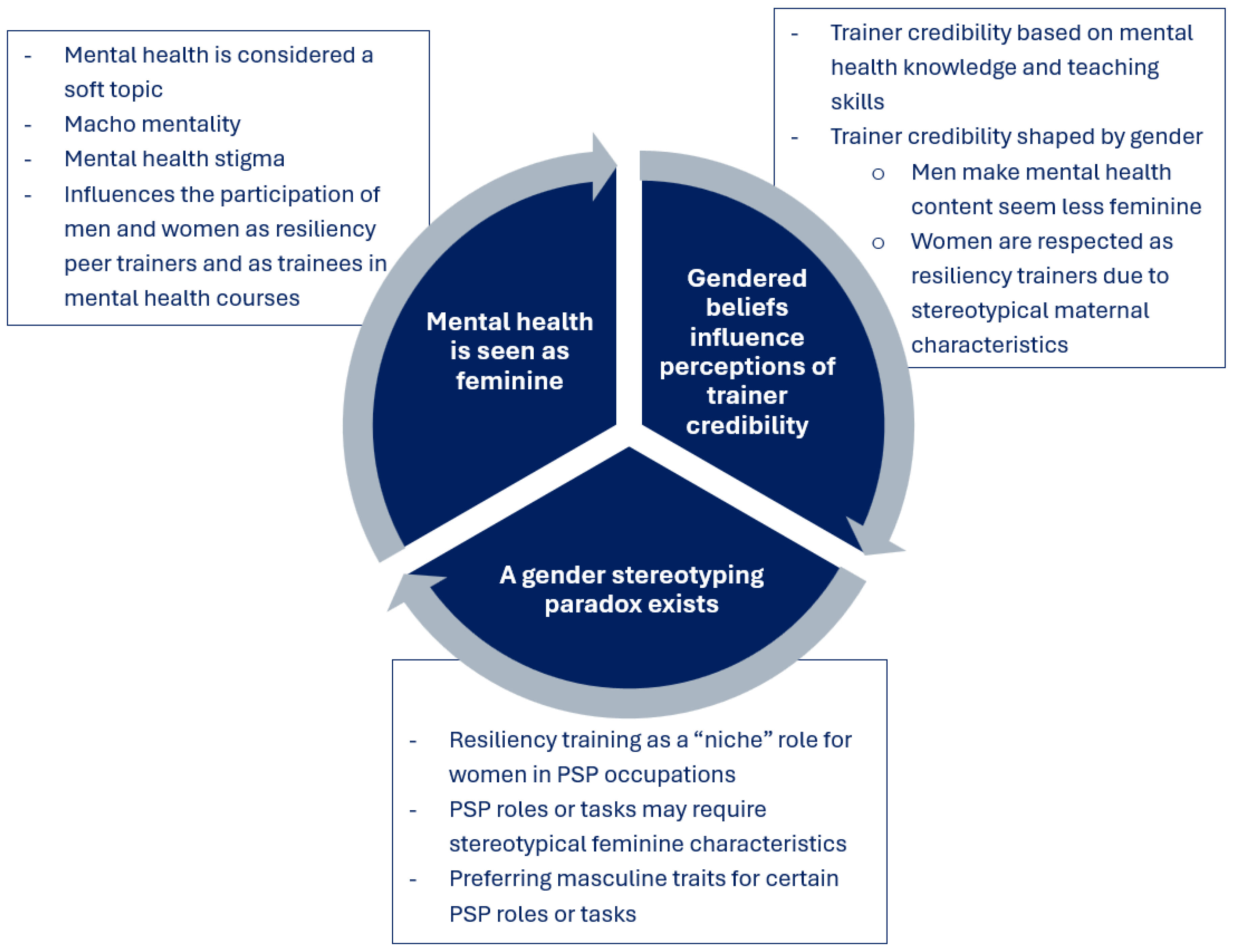
3.1. Theme 1: Mental Health Is Seen as Feminine in Firefighting and Correctional Services
“And as much as there were males in our program, it’s really hard for a lot of our males due to stigma to actually come out and teach it, let alone talk about mental health. I work in Corrections, and it’s a dinosaur environment, so it’s extremely archaic. Stigma is still very much a real thing.”(Man trainer)
“A department that has 25 people may have four women and you’ll get nine people sign up [for resiliency training] and all four of the women.”(Woman trainer)
“When it comes to doing like actual mental health work, yeah, you need to separate the group… if you have a group full of just women people will open up, they won’t when there’s men in the room—guaranteed.”(Woman trainer)
“When I came out and said that I had PTSD, [management] immediately wanted me to remove myself from the [Emergency Response] team… It comes to not trusting their managers, too, which is huge. Because a lot of people are feeling they’re afraid to death to be ridiculed.”(Man trainer)
“I used to notice that if I was really disturbed by a call or even if I wasn’t, the men would–it would give the men a place to focus their attention. Like, ‘are you OK’?”(Woman trainer)
3.2. Theme 2: Gendered Beliefs Influence Perceptions of Trainers’ Credibility and Teaching Skills
“The content is there, so like I think equally male and female can deliver it well. I think that if you’re a good facilitator and you’re invested in the content–and like I said, you have some mental health awareness and that sensitivity piece, I think you can do a great job… That comes down to the personality of the individual, not so much gender.”(Woman trainer)
“If you’re confident, believable and passionate about what you’re teaching, I think you can teach anything… Somebody who’s believable is somebody who almost, they have the knowledge, they know the material… I really think the believable part of it is for me, is it’s somebody who walks the walk and can talk the talk at the same time.”(Man trainer)
“I have one fellow that had counselling, had a breakdown, and he was quite willing to participate… He was excellent giving [the training] because he is your 35-year, 270-pound, you know, tough man that is always a perfect example to use for the situation, because everybody looked at him as, you know, a real tough character that’s fought fires for years… And as a result of him speaking about it, you know, it certainly added weight to the whole program… because it’s still like you don’t think that this could happen to this person, and it did.”(Woman trainer)
“I do think that women can lead. However, I think it’s important, I think it’s extremely important that we have men leading [the resiliency training] as well because the problem becomes if women lead it then men will continue to see it as a female thing, as a soft skill that they see as feminine.”(Woman trainer)
3.3. Theme 3: A Gender Stereotyping Paradox Exists in These Male-Dominated Occupations
“I think the maternal instinct for women is always there when it comes to a bunch of men, you know, and you’re kind of like the mother so there’s a little bit of respect there from most.”(Women trainer)
“I’m going to get way more buy-in and participation and support from the same group of men that if I’m teaching them a subject like Resilient Minds versus a subject like auto extrication.”(Woman trainer)
“…that male stereotype that the males know the material better, their size. It’s such a gender thing. Yeah, I think the males know the contents better, can teach it better. At the end of the day if they were having an incident with an offender, that they would be better capable of handling it. So, I think a lot of the little-just the gender stereotypes that might come into play.”(Woman trainer)
“The work of fire is changing to become more female or more gendered… We’re not kicking in doors, but we’re providing that one-on-one medical response… With more women in the service, with the focus on mental health, with the focus on medical calls, the male-dominated duties are starting to dwindle.”(Woman trainer)
“I’m finding with our three girls [sic] that we have, they’re very good on the medical side. They seem to be even better on the medical side because they’re petite, they’re not really big women, and kids seem to take to them, female victims and that definitely take to them. And I find they have a good sense of communication when they’re talking to these people… On the medical side, I think they were ahead of [men firefighters] a little bit because they have a way of talking to victims. And when they approach a victim, because of their size, it’s not like a great, big, burly firefighter coming there with a scruffy voice.”(Man trainer)
4. Discussion
Limitations
5. Conclusions
Supplementary Materials
Author Contributions
Funding
Institutional Review Board Statement
Informed Consent Statement
Data Availability Statement
Acknowledgments
Conflicts of Interest
Abbreviations
| PSP | Public safety personnel |
| R2MR | Road to Mental Readiness |
References
- Carleton, R.N.; Afifi, T.O.; Taillieu, T.; Turner, S.; Mason, J.E.; Ricciardelli, R.; McCreary, D.R.; Vaughan, A.D.; Anderson, G.S.; Krakauer, R.L.; et al. Assessing the Relative Impact of Diverse Stressors among Public Safety Personnel. Int. J. Environ. Res. Public Health 2020, 17, 1234. [Google Scholar] [CrossRef]
- Carleton, R.; Teckchandani, T.; MacPhee, R.; Camp, R.; Nisbet, J. An Assessment of Mental Health Challenges and Occupational Stressors Among Public Safety Personnel Senior Leadership. J. Psychiatr. Res. 2025, 193, 451–460. [Google Scholar] [CrossRef]
- Ricciardelli, R.; Mitchell, M.M.; Taillieu, T.; Cassiano, M.S.; Afifi, T.O.; Carleton, R.N. Exposures to Correctional-Specific Potentially Psychologically Traumatic Events among Ontario Provincial Correctional Workers. Psychol. Trauma Theory Res. Pract. Policy 2023, 15, S246. [Google Scholar] [CrossRef]
- Wagner, S.L.; McFee, J.A.; Martin, C.A. Effects of Traumatic Stress on Firefighters’ World Assumptions. Traumatology 2009, 15, 75–84. [Google Scholar] [CrossRef]
- Jaegers, L.A.; El Ghaziri, M.; Katz, I.M.; Ellison, J.M.; Vaughn, M.G.; Cherniack, M.G. Critical Incident Exposure among Custody and Noncustody Correctional Workers: Prevalence and Impact of Violent Exposure to Work-related Trauma. Am. J. Ind. Med. 2022, 65, 500–511. [Google Scholar] [CrossRef]
- Nazari, G.; MacDermid, J.C.; Sinden, K.; D’Amico, R.; Brazil, A.; Carleton, N.; Cramm, H. Prevalence of Exposure to Critical Incidents in Firefighters across Canada. Work 2020, 67, 215–222. [Google Scholar] [CrossRef] [PubMed]
- Brazil, A. Exploring Critical Incidents and Postexposure Management in a Volunteer Fire Service. J. Aggress. Maltreatment Trauma 2017, 26, 244–257. [Google Scholar] [CrossRef]
- Khoury, J.; Andrews, K.L.; Fletcher, A.J.; Jamshidi, L.; Asmundson, G.J.; Teckchandani, T.A.; Carleton, R.N. Sexual Victimization among Royal Canadian Mounted Police. Psychol. Trauma Theory Res. Pract. Policy 2024, 17, 289–297. [Google Scholar] [CrossRef]
- Khoury, J.M.; Fletcher, A.J.; Nisbet, J.; Carleton, R.N. Understanding and Addressing Sexual-and Gender-Based Harassment and Discrimination among Royal Canadian Mounted Police. Police Pract. Res. 2025, 26, 207–222. [Google Scholar] [CrossRef]
- Angehrn, A.; Fletcher, A.J.; Carleton, R.N. “Suck It up, Buttercup”: Understanding and Overcoming Gender Disparities in Policing. Int. J. Environ. Res. Public Health 2021, 18, 7627. [Google Scholar] [CrossRef]
- Carleton, R.N.; Afifi, T.O.; Turner, S.; Taillieu, T.; Duranceau, S.; LeBouthillier, D.M.; Sareen, J.; Ricciardelli, R.; MacPhee, R.S.; Groll, D. Mental Disorder Symptoms among Public Safety Personnel in Canada. Can. J. Psychiatry 2018, 63, 54–64. [Google Scholar] [CrossRef]
- Mackay, L.; Campbell, J.L.; Darby, J.; Pendergast, K.; Schofield, G. Associations between Exposure to Potentially Psychologically Traumatic Events and Mental Ill Health among New Zealand Firefighters: A Cross-Sectional Study. Compr. Psychiatry 2025, 139, 152595. [Google Scholar] [CrossRef] [PubMed]
- Voth, M.; Chisholm, S.; Sollid, H.; Jones, C.; Smith-MacDonald, L.; Brémault-Phillips, S. Efficacy, Effectiveness, and Quality of Resilience-Building Mobile Health Apps for Military, Veteran, and Public Safety Personnel Populations: Scoping Literature Review and App Evaluation. JMIR MHealth UHealth 2022, 10, e26453. [Google Scholar] [CrossRef]
- Ancheta, M.L.C. Combat-Related Trauma, Posttraumatic Stress Disorder, and Moral Injury in Combat Medics: A Comprehensive Survey of the Literature and Critical Analysis; Alliant International University: Alhambra, CA, USA, 2020. [Google Scholar]
- Pole, N.; Kulkarni, M.; Bernstein, A.; Kaufmann, G. Resilience in Retired Police Officers. Traumatology 2006, 12, 207–216. [Google Scholar] [CrossRef]
- Masten, A.S. Resilience from a Developmental Systems Perspective. World Psychiatry 2019, 18, 101. [Google Scholar] [CrossRef]
- Bonanno, G.A. Resilience in the Face of Potential Trauma. Curr. Dir. Psychol. Sci. 2005, 14, 135–138. [Google Scholar] [CrossRef]
- Hu, T.; Zhang, D.; Wang, J. A Meta-Analysis of the Trait Resilience and Mental Health. Pers. Individ. Differ. 2015, 76, 18–27. [Google Scholar] [CrossRef]
- Holland-Winkler, A.M.; Hamil, B.K.; Greene, D.R.; Kohler, A.A. Strategies to Improve Physiological and Psychological Components of Resiliency in Firefighters. Physiologia 2023, 3, 611–626. [Google Scholar] [CrossRef]
- Mental Health Commission of Canada. The Road to Mental Readiness (R2MR): Reduce Stigma and Increase Resiliency in Police Employees, 2014. Available online: https://mentalhealthcommission.ca/resource/the-road-to-mental-readiness-r2mr-one-page-overview/ (accessed on 6 February 2026).
- Sharifi, N.; Basharpoor, S.; Narimani, M. Comparison of the Effectiveness of Resilience Training and Emotion Regulation on Psychological Well-Being and Self-Efficacy of Firefighters. Avicenna J. Neuro Psycho Physiol. 2021, 8, 199–204. [Google Scholar]
- Klinoff, V.A.; Van Hasselt, V.B.; Black, R.A.; Masias, E.V.; Couwels, J. The Assessment of Resilience and Burnout in Correctional Officers. Crim. Justice Behav. 2018, 45, 1213–1233. [Google Scholar] [CrossRef]
- MacDermid, J.C.; Killip, S.C.; Brazil, A.; Lomotan, M.; Fraser, S.; Bryant, D.; Cramm, H.; Carleton, R.N. Adaptation, Implementation, and Evaluation of a Protective Mental Health Intervention (Resilient Minds) for Canadian Volunteer Firefighters. Compr. Psychiatry 2025, 144, 152643. [Google Scholar] [CrossRef]
- Robertson, I.T.; Cooper, C.L.; Sarkar, M.; Curran, T. Resilience Training in the Workplace from 2003 to 2014: A Systematic Review. J. Occup. Organ. Psychol. 2015, 88, 533–562. [Google Scholar] [CrossRef]
- Hollaar, M.H.; Kemmere, B.; Kocken, P.L.; Denktaş, S. Resilience-Based Interventions in the Public Sector Workplace: A Systematic Review. BMC Public Health 2025, 25, 350. [Google Scholar] [CrossRef]
- Johnston, M.S.; Ricciardelli, R.; Ghodrati, M.; Czarnuch, S. Assessing Road to Mental Readiness (R2MR) Training among Correctional Workers in Canada. Health Justice 2023, 11, 2. [Google Scholar] [CrossRef]
- Moreno, A.F.; Karanika-Murray, M.; Batista, P.; Hill, R.; Vilalta, S.R.; Oliveira-Silva, P. Resilience Training Programs with Police Forces: A Systematic Review. J. Police Crim. Psychol. 2024, 39, 227–252. [Google Scholar] [CrossRef]
- Ricciardelli, R.; Adorjan, M. Correctional Officer Training: Opportunities and Challenges of the AMStregnth Program in Canada. J. Forensic Psychol. Res. Pract. 2021, 21, 40–60. [Google Scholar] [CrossRef]
- Rahna, K.; Shamim, M.A.; Valappil, H.C.; Subramanian, J.; Sharma, G.A.; Padhi, B.K. Gender Disparity in Prevalence of Mental Health Issues in Kerala: A Systematic Review and Meta-Analysis. Int. J. Equity Health 2024, 23, 209. [Google Scholar] [CrossRef]
- Lin, I.; Njoo, L.; Field, A.; Sharma, A.; Reinecke, K.; Althoff, T.; Tsvetkov, Y. Gendered Mental Health Stigma in Masked Language Models. In Proceedings of the 2022 Conference on Empirical Methods in Natural Language Processing; Association for Computational Linguistics: Stroudsburg, PA, USA, 2022; pp. 2152–2170. [Google Scholar]
- Addis, M.E.; Mahalik, J.R. Men, Masculinity, and the Contexts of Help Seeking. Am. Psychol. 2003, 58, 5–14. [Google Scholar] [CrossRef]
- Galdas, P.M.; Cheater, F.; Marshall, P. Men and Health Help-seeking Behaviour: Literature Review. J. Adv. Nurs. 2005, 49, 616–623. [Google Scholar] [CrossRef] [PubMed]
- McKenzie, S.K.; Oliffe, J.L.; Black, A.; Collings, S. Men’s Experiences of Mental Illness Stigma across the Lifespan: A Scoping Review. Am. J. Mens Health 2022, 16, 15579883221074789. [Google Scholar] [CrossRef] [PubMed]
- Rice, S.; Oliffe, J.; Seidler, Z.; Borschmann, R.; Pirkis, J.; Reavley, N.; Patton, G. Gender Norms and the Mental Health of Boys and Young Men. Lancet Public Health 2021, 6, e541–e542. [Google Scholar] [CrossRef]
- Courtenay, W.H. Constructions of Masculinity and Their Influence on Men’s Well-Being: A Theory of Gender and Health. Soc. Sci. Med. 2000, 50, 1385–1401. [Google Scholar] [CrossRef]
- Jakubowski, T.D.; Sitko-Dominik, M.M. The Impact of the Traditional Male Role Norms on the Posttraumatic Stress Disorder among Polish Male Firefighters. PLoS ONE 2021, 16, e0259025. [Google Scholar] [CrossRef]
- Cotton, S.M.; Wright, A.; Harris, M.G.; Jorm, A.F.; McGorry, P.D. Influence of Gender on Mental Health Literacy in Young Australians. Aust. N. Z. J. Psychiatry 2006, 40, 790–796. [Google Scholar] [CrossRef] [PubMed]
- Simões de Almeida, R.; Trigueiro, M.J.; Portugal, P.; de Sousa, S.; Simões-Silva, V.; Campos, F.; Silva, M.; Marques, A. Mental Health Literacy and Stigma in a Municipality in the North of Portugal: A Cross-Sectional Study. Int. J. Environ. Res. Public Health 2023, 20, 3318. [Google Scholar] [CrossRef] [PubMed]
- Schofield, T.; Connell, R.W.; Walker, L.; Wood, J.F.; Butland, D.L. Understanding Men’s Health and Illness: A Gender-Relations Approach to Policy, Research, and Practice. J. Am. Coll. Health 2000, 48, 247–256. [Google Scholar] [CrossRef]
- Caisaguano, T.D.T.; Guadalupe, G.A.P. Emotional Regulation and Psychological Well-Being in Operational Firefighters. Arandu UTIC 2025, 12, 2083–2099. [Google Scholar] [CrossRef]
- Barney, L.J.; Griffiths, K.M.; Jorm, A.F.; Christensen, H. Stigma about Depression and Its Impact on Help-Seeking Intentions. Aust. N. Z. J. Psychiatry 2006, 40, 51–54. [Google Scholar] [CrossRef]
- Coles, M.E.; Coleman, S.L. Barriers to Treatment Seeking for Anxiety Disorders: Initial Data on the Role of Mental Health Literacy. Depress. Anxiety 2010, 27, 63–71. [Google Scholar] [CrossRef]
- Roche, A.M.; Pidd, K.; Fischer, J.A.; Lee, N.; Scarfe, A.; Kostadinov, V. Men, Work, and Mental Health: A Systematic Review of Depression in Male-Dominated Industries and Occupations. Saf. Health Work 2016, 7, 268–283. [Google Scholar] [CrossRef] [PubMed]
- Ricciardelli, R.; Carleton, R.N.; Mooney, T.; Cramm, H. “Playing the System”: Structural Factors Potentiating Mental Health Stigma, Challenging Awareness, and Creating Barriers to Care for Canadian Public Safety Personnel. Health Interdiscip. J. Soc. Study Health Illn. Med. 2020, 24, 259–278. [Google Scholar] [CrossRef]
- Newell, C.J.; Ricciardelli, R.; Czarnuch, S.M.; Martin, K. Police Staff and Mental Health: Barriers and Recommendations for Improving Help-Seeking. Police Pract. Res. 2022, 23, 111–124. [Google Scholar] [CrossRef]
- Krakauer, R.L.; Stelnicki, A.M.; Carleton, R.N. Examining Mental Health Knowledge, Stigma, and Service Use Intentions among Public Safety Personnel. Front. Psychol. 2020, 11, 536193. [Google Scholar] [CrossRef] [PubMed]
- Perrott, T. Beyond ‘Token’ Firefighters: Exploring Women’s Experiences of Gender and Identity at Work. Sociol. Res. Online 2016, 21, 51–64. [Google Scholar] [CrossRef]
- Ainsworth, S.; Batty, A.; Burchielli, R. Women Constructing Masculinity in Voluntary Firefighting. Gend. Work Organ. 2014, 21, 37–56. [Google Scholar] [CrossRef]
- Batty, A.; Burchielli, R. Out of the Frying Pan, into the Fire? Persistent Gender Barriers in Australian Fire-Fighting and Challenges for HRM. Asia Pac. J. Hum. Resour. 2011, 49, 308–324. [Google Scholar] [CrossRef]
- Center for Fire Statistics. Center of Fire Statistics: World Fire Statistics; Report 28; Center for Fire Statistics: Berlin, Germany, 2023; pp. 1–144. Available online: https://www.ctif.org/sites/default/files/2023-06/CTIF_Report28-ESG.pdf (accessed on 6 February 2026).
- Jasper, J.; Donelon, D.B.; Handfield, A. Gender Based Violence Amongst First Responders: A Scoping Review; Justice Institute: New Westminster, BC, Canada, 2023. [Google Scholar]
- Lopes, B.G.; Marques, A.M.; Santos, M.H. Gender in Portuguese Firefighters: The Experiences and Strategies of Women. Soc. Sci. 2024, 13, 431. [Google Scholar] [CrossRef]
- Compton, C.A.; Brandhorst, J.K. Prison Is Power: Federal Correctional Officers, Gender, and Professional Identity Work. Gend. Work Organ. 2021, 28, 1490–1506. [Google Scholar] [CrossRef]
- Hermary, S. Gender Roles in Corrections: How Gendered Expectations Impact Female Correctional Officers. MacEwan Univ. Stud. Ejournal 2024, 8, 269400638. [Google Scholar] [CrossRef]
- Carbonell, M.; Ricciardelli, R. Correctional Officer Culture in Canada: Proving Oneself for In-Group Acceptance. Prison J. 2023, 103, 791–811. [Google Scholar] [CrossRef]
- Britton, D.M. At Work in the Iron Cage: The Prison as Gendered Organization; NYU Press: New York, NY, USA, 2003. [Google Scholar]
- Ricciardelli, R. Also Serving Time: Canada’s Provincial and Territorial Correctional Officers; University of Toronto Press: Toronto, ON, USA, 2019. [Google Scholar]
- Collica-Cox, K. Women Corrections Executives: The Keys to Reaching the Top; Lexington Books: Lanham, MD, USA, 2023. [Google Scholar]
- Wells, I.; Giacco, D. Theoretical Frameworks Used to Inform Qualitative Mental Health Research: A Focus on Positivism, Interpretivism and Critical Realism. BJPsych Adv. 2024, 31, 299–307. [Google Scholar] [CrossRef]
- Braun, V.; Clarke, V. Can I Use TA? Should I Use TA? Should I Not Use TA? Comparing Reflexive Thematic Analysis and Other Pattern-based Qualitative Analytic Approaches. Couns. Psychother. Res. 2021, 21, 37–47. [Google Scholar] [CrossRef]
- Braun, V.; Clarke, V. Reflecting on Reflexive Thematic Analysis. Qual. Res. Sport Exerc. Health 2019, 11, 589–597. [Google Scholar] [CrossRef]
- Braun, V.; Clarke, V. Using Thematic Analysis in Psychology. Qual. Res. Psychol. 2006, 3, 77–101. [Google Scholar] [CrossRef]
- Ahmed, S.K.; Mohammed, R.A.; Nashwan, A.J.; Ibrahim, R.H.; Abdalla, A.Q.; Ameen, B.M.M.; Khdhir, R.M. Using Thematic Analysis in Qualitative Research. J. Med. Surg. Public Health 2025, 6, 100198. [Google Scholar] [CrossRef]
- McGregor, S.L. Understanding and Evaluating Research: A Critical Guide; Sage Publications: Thousand Oaks, CA, USA, 2017. [Google Scholar]
- Schwartz-Shea, P. Feminist Use of Qualitative/Interpretive Methods. In the Routledge Handbook of Feminist Economics; Routledge: Oxfordshire, UK, 2021; pp. 138–147. [Google Scholar]
- Junjie, M.; Yingxin, M. The Discussions of Positivism and Interpretivism. Online Submiss. 2022, 4, 10–14. [Google Scholar] [CrossRef]
- Ikram, M.; Kenayathulla, H.B. Out of Touch: Comparing and Contrasting Positivism and Interpretivism in Social Science. Asian J. Res. Educ. Soc. Sci. 2022, 4, 39–49. [Google Scholar]
- Cohen, J.A.; Kassan, A.; Wada, K.; Suehn, M. The Personal and the Political: How a Feminist Standpoint Theory Epistemology Guided an Interpretative Phenomenological Analysis. Qual. Res. Psychol. 2022, 19, 917–948. [Google Scholar] [CrossRef]
- van der Haar, M. Doing Feminist Research Qualitatively: A Review of What Interpretive Feminist Research Means Today. In the Routledge Companion to Qualitative Research in Organization Studies; Mir, R., Jain, S., Eds.; Routledge: Oxfordshire, UK, 2017; pp. 56–64. [Google Scholar]
- Hay, C. Interpreting Interpretivism Interpreting Interpretations: The New Hermeneutics of Public Administration. Public Adm. 2011, 89, 167–182. [Google Scholar] [CrossRef]
- FIREWELL. FIREWELL. Available online: https://firewell.ca/ (accessed on 29 November 2025).
- Malterud, K.; Siersma, V.D.; Guassora, A.D. Sample Size in Qualitative Interview Studies: Guided by Information Power. Qual. Health Res. 2016, 26, 1753–1760. [Google Scholar] [CrossRef]
- Younas, A.; Masih, Y.; Sundus, A. Alternatives to ‘Saturation’for Greater Transparency in Reporting of Sample Size Decision-Making in Qualitative Research. Evid. Based Nurs. 2025, 28, 77–80. [Google Scholar] [CrossRef]
- Tight, M. Saturation: An Overworked and Misunderstood Concept? Qual. Inq. 2024, 30, 577–583. [Google Scholar] [CrossRef]
- Leese, J.; Li, L.C.; Nimmon, L.; Townsend, A.F.; Backman, C. Moving beyond “until Saturation Was Reached”: Critically Examining How Saturation Is Used and Reported in Qualitative Research. Arthritis Care Res. 2021, 73, 1225–1227. [Google Scholar] [CrossRef] [PubMed]
- Beatson, R.; McLennan, J. Australia’s Women Volunteer Fire Fighters. Aust. J. Volunt. 2005, 10, 18. [Google Scholar]
- Gouliquer, L.; Poulin, C.; McWilliams, J. Othering of Full-Time and Volunteer Women Firefighters in the Canadian Fire Services. Qual. Sociol. Rev. 2020, 16, 48–69. [Google Scholar] [CrossRef]
- Eriksen, C.; Waitt, G.; Wilkinson, C. Gendered Dynamics of Wildland Firefighting in Australia. Soc. Nat. Resour. 2016, 29, 1296–1310. [Google Scholar] [CrossRef]
- Baigent, D. Gender Relations, Masculinities and the Fire Service: A Qualitative Study of Firefighters’ Constructions of Masculinity During Firefighting and in Their Social Relations at Work; Anglia Ruskin University: Cambridge, UK, 2001. [Google Scholar]
- Ricciardelli, R.; McKendy, L. Gender and Prison Work: The Experience of Female Provincial Correctional Officers in Canada. Prison J. 2020, 100, 617–639. [Google Scholar] [CrossRef]
- Bel-Latour, L.; Granié, M.-A. The Influence of the Perceived Masculinity of an Occupation on Risk Behavior: The Case of Firefighters. Saf. Sci. 2022, 150, 105702. [Google Scholar] [CrossRef]
- Grimm, P. Social Desirability Bias. In Wiley International Encyclopedia of Marketing; Wiley: Hoboken, NJ, USA, 2010. [Google Scholar]
- Bispo Júnior, J.P. Social Desirability Bias in Qualitative Health Research. Rev. Saude Publica 2022, 56, 101. [Google Scholar] [CrossRef]
- Thorne, S.; Kirkham, S.R.; MacDonald-Emes, J. Interpretive Description: A Noncategorical Qualitative Alternative for Developing Nursing Knowledge. Res. Nurs. Health 1997, 20, 169–177. [Google Scholar] [CrossRef]


| Theme | Relevant Categories | Example Quotes * |
|---|---|---|
| Mental health is seen as feminine in firefighting and correctional services | Mental health stigma Mental health is seen as a “soft” topic Macho mentality in men-dominated public safety occupations | “They recognize that there’s a certain emotional connection that–or a certain connection to emotions and understanding of mental health… they look at women differently for that versus a very masculine topic, right, and Resilient Minds is not a masculine topic.” (Woman trainer) |
| Gendered beliefs influence perceptions of trainers’ credibility and teaching skills | Trainer credibility is based on mental health knowledge or experiences, and teaching skills Trainer credibility is influenced by gender or gender stereotypes A man and a women should perform the resiliency training together for best trainee engagement | “To have someone, a male counterpart opening up and sharing examples and being comfortable I think is more of a positive thing more than anything because the typical stereotype is the females are usually the ones that are sharing their experiences.” (Woman trainer) “We’re allowed to be touchy-feely. We’re allowed to care about–we’re allowed to be emotional, right? It’s literally because in my department I can tell you there is nobody else picking [the resiliency trainer role] up… At the time, it was a great place for me to go and focus my attention because I sure as heck wasn’t going to be picking up the jaws, right, and cutting a car open. So ‘yeah, you go do that’. And ‘yeah, yeah, we’ll let you’…‘It’s a good girl thing’.” (Woman trainer) |
| A gender stereotyping paradox exists in these men-dominated occupations | Resiliency peer training as a “niche” role for women in public safety occupations Certain public safety personnel roles or tasks require stereotypically feminine characteristics Certain public safety personnel roles or tasks prefer masculine traits | “I delivered an open training at the provincial fire school and put a call out to all the departments across the province, and I had a large number of women. So, what I personally see is that this is a niche for female firefighters.” (Woman trainer) “The idea that we can actually use those characteristics that have often been kind of used against women and actually show that they can be really important and really, really useful even in really masculine contexts.” (Woman trainer) “I joined in 2011, myself and another female were the first females to ever really been on that department and like that’s not that long ago. And we would hear things when we went to fire school like ‘well, I thought they don’t take women’. So, there is very much a culture in my department of male exclusivity and the opportunities within the fire service in that department for me were definitely limited because I was female.” (Woman trainer) |
Disclaimer/Publisher’s Note: The statements, opinions and data contained in all publications are solely those of the individual author(s) and contributor(s) and not of MDPI and/or the editor(s). MDPI and/or the editor(s) disclaim responsibility for any injury to people or property resulting from any ideas, methods, instructions or products referred to in the content. |
© 2026 by the authors. Licensee MDPI, Basel, Switzerland. This article is an open access article distributed under the terms and conditions of the Creative Commons Attribution (CC BY) license.
Share and Cite
MacDermid, J.C.; Fletcher, A.J.; Killip, S.C.; Brazil, A.; Ricciardelli, R.; Campbell Bromhead, R. Who Is the “Ideal” Peer Support Trainer? Peer Trainers’ Perceptions of Gender Dynamics in Resiliency Training for Firefighters and Correctional Officers. Occup. Health 2026, 1, 10. https://doi.org/10.3390/occuphealth1010010
MacDermid JC, Fletcher AJ, Killip SC, Brazil A, Ricciardelli R, Campbell Bromhead R. Who Is the “Ideal” Peer Support Trainer? Peer Trainers’ Perceptions of Gender Dynamics in Resiliency Training for Firefighters and Correctional Officers. Occupational Health. 2026; 1(1):10. https://doi.org/10.3390/occuphealth1010010
Chicago/Turabian StyleMacDermid, Joy C., Amber J. Fletcher, Shannon C. Killip, Amanda Brazil, Rosemary Ricciardelli, and Robin Campbell Bromhead. 2026. "Who Is the “Ideal” Peer Support Trainer? Peer Trainers’ Perceptions of Gender Dynamics in Resiliency Training for Firefighters and Correctional Officers" Occupational Health 1, no. 1: 10. https://doi.org/10.3390/occuphealth1010010
APA StyleMacDermid, J. C., Fletcher, A. J., Killip, S. C., Brazil, A., Ricciardelli, R., & Campbell Bromhead, R. (2026). Who Is the “Ideal” Peer Support Trainer? Peer Trainers’ Perceptions of Gender Dynamics in Resiliency Training for Firefighters and Correctional Officers. Occupational Health, 1(1), 10. https://doi.org/10.3390/occuphealth1010010