The Impact of Western- and Middle Eastern-Educated Indonesian Scholars (1980–2010) on Islamic Education Challenges in Indonesia




Abstract
1. Introduction
2. Research Methods
3. Results
3.1. Scholars Educated in the Middle East
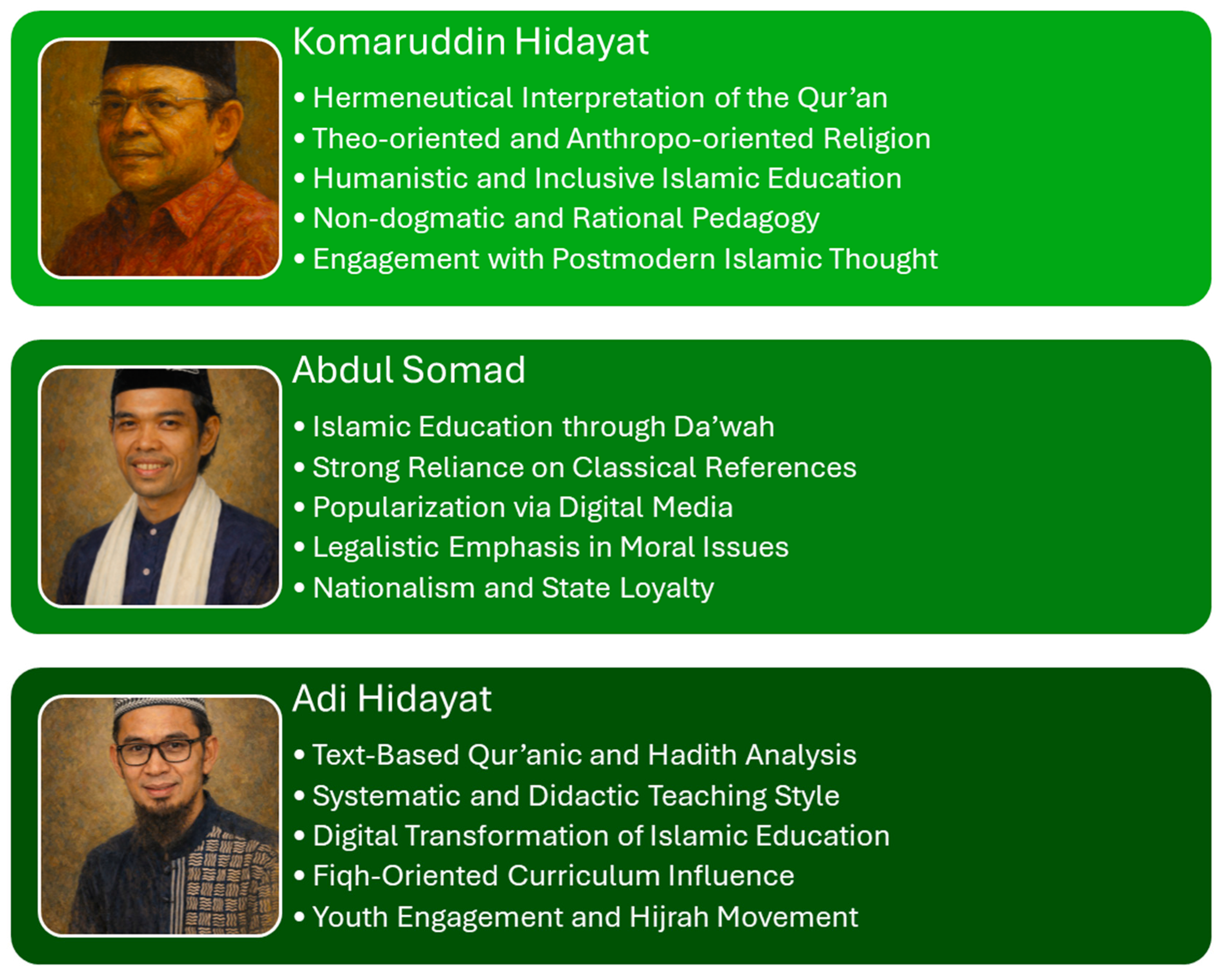
3.1.1. The Educational Thought of Komaruddin Hidayat
3.1.2. The Educational Thought of Abdul Somad
3.1.3. The Educational Thought of Adi Hidayat
3.2. Western-Educated Muslim Scholars
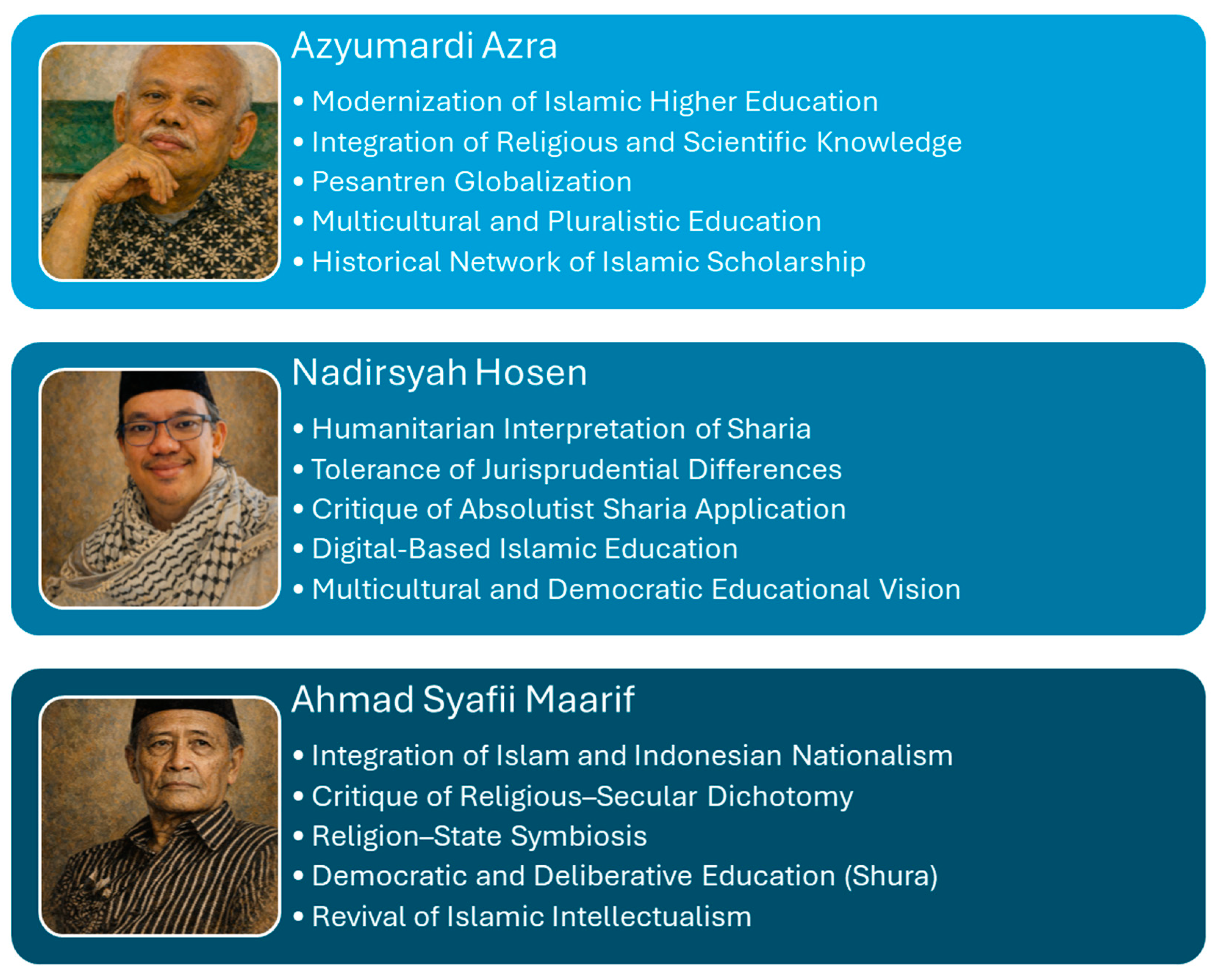
3.2.1. The Thoughts of Azyumardi Azra
- Islamic education is a process of human development based on Islamic teachings for worldly and spiritual well-being;
- Modernization of Islamic education as a reorientation and restructuring aligned with Islamic values;
- Institutional change that is focused on goals, curriculum, and Islamic institutions that guide students in Indonesia [44].
3.2.2. Nadirsyah Hosen’s Thought on Islamic Education
3.2.3. Ahmad Syafii Maarif’s Thought on Islamic Education and the Nation
4. Discussion
5. Conclusions
Author Contributions
Funding
Institutional Review Board Statement
Informed Consent Statement
Data Availability Statement
Conflicts of Interest
References
- Nursyarief, A. Pendidikan islam di indonesia dalam lintasan sejarah: Perspektif kerajaan islam (islamic education in indonesia in the traffic of history: Perspective of islamic kingdoms). Lentera Pendidik. J. Ilmu Tarb. Dan Kegur. 2014, 17, 256–271. [Google Scholar] [CrossRef]
- Soleh, A.K. Mencermati Sejarah Perkembangan Filsafat Islam (Examining the History of the Development of Islamic Philosophy). Tsaqafah 2014, 10, 63. [Google Scholar] [CrossRef]
- Sauri, S. Sejarah Perkembangan Bahasa Arab Dan Lembaga Islam (History of the Development of the Arabic Language and Islamic Institutions). Insa. J. Islam. Stud. Indones. Southeast Asia 2020, 5, 73–88. [Google Scholar] [CrossRef]
- Hanipudin, S. Pendidikan Islam di Indonesia dari Masa ke Masa (Islamic Education in Indonesia from Time to Time). Matan J. Islam Muslim Soc. 2019, 1, 39. [Google Scholar] [CrossRef]
- Falikul Isbah, M. Pesantren in the changing indonesian context: History and current developments. Qudus Int. J. Islam. Stud. 2020, 8, 65–106. [Google Scholar] [CrossRef]
- Asrohah, H. The Dynamics of Pesantren Responses toward Modernity and Mechanism in Organizing Transformation. J. Indones. Islam 2011, 5, 66–90. [Google Scholar] [CrossRef]
- Nilan, P. The “spirit of education” in Indonesian Pesantren. Br. J. Sociol. Educ. 2009, 30, 219–232. [Google Scholar] [CrossRef]
- Zainiyati, H.S.; Al Hana, R.; Sakdullah, A. Pendidikan Islam Berbasis Karakter Perspektif Gus Dur dan Cak Nur (Character-Based Islamic Education from the Perspective of Gus Dur and Cak Nur), 1st ed.; PT. Rajawali Buana Pusaka: Depok, Indonesia, 2021. [Google Scholar]
- Zainal, A. Perkembangan pesantren di indonesia (development of islamic boarding school in indonesia). Pendidik. Agama Islam 2012, 1, 40–53. [Google Scholar]
- Azra, A. Islam in the Indonesian World: An Account of Institutional Formation; Mizan Pustaka: Bandung, Indonesia, 2006. [Google Scholar]
- Tan, C. Title Educative tradition and Islamic schools in Indonesia Educative Tradition and Islamic Schools in Indonesia. J. Arab. Islam. Stud. 2014, 14, 47–62. [Google Scholar] [CrossRef]
- Khoirurrijal, M.F.; Karim, A.R.; Zaini, A.; Salik, M. Pesantren and the Human Development Index in Indonesia Post Law Number 18 of 2019. Santri J. Pesantren Fiqh Sos. 2023, 4, 45–66. [Google Scholar] [CrossRef]
- Luthfi Hakim, M.; Habiburrohman Aksa, A. Axiological Study Towards the Law Number 18/2019 about Pesantren. J. Pesantren Fiqh Sos. 2021, 2, 197–212. [Google Scholar] [CrossRef]
- Hefner, R.W. Making Modern Muslims: The Politics of Islamic Education in Southeast Asia; University of Hawaii Press: Honolulu, HI, USA, 2008. [Google Scholar]
- Bali, M.M.E.I. Perguruan Tinggi Islam Berbasis Pondok Pesantren (Islamic Higher Education Institutions Based on Islamic Boarding Schools). Al-Tanzim: J. Manaj. Pendidik. Islam 2017, 1, 1–14. [Google Scholar] [CrossRef]
- Kafrawi, M.; Riyaldi, R. Pendekatan dan peranan dakwah alumni al-azhar melalui organisasi internasional alumni al-azhar riau (oiaa riau) dalam menyebarkan dakwah islam di riau: Sebuah tinjauan awal (approaches and role of dakwah al-azhar graduate through international organization al-azhar graduate in riau (oiaa riau) in spreading islamic dakwah in riau: An initial review). Malays. J. Islam. Stud. 2021, 5, 40–46. [Google Scholar] [CrossRef]
- Sudrajat, A. Pesantren Sebagi Transformsi Pendidikan Islam di Indonesia (Islamic Boarding Schools as a Transformation of Islamic Education in Indonesia). Vicratina J. Pendidik. Islam 2018, 2, 64–88. [Google Scholar]
- Khafidhoh, K. Penafsiran intertekstualitas:telaah konsep hermeneutika komaruddin hidayat (intertextuality interpretation: A Study of Komaruddin Hidayat’s Hermeneutic Concept). J. Al-Adab. 2019, 14, 103–117. [Google Scholar] [CrossRef]
- Hanifiyah, F. Konsep bahasa agama: Sebuah Kajian Hermeneutik dalam Perspektif Komaruddin Hidayat (the concept of religious language: A Hermeneutic Study from the Perspective of Komaruddin Hidayat). Turāṡ J. Studi Keislam. 2020, 7, 179–190. [Google Scholar] [CrossRef]
- Fatmawati, F.M.R. Analisis framing pesan kesalehan sosial pada buku ungkapan hikmah karya komaruddin hidayat (framing analysis of social piety messages in the book “ungkapan hikma” by komaruddin hidayat). Al-Balagh J. Dakwah Dan Komun. 2018, 3, 73–102. [Google Scholar] [CrossRef]
- Masturi, A. Dakwah komaruddin hidayat pada masyarakat perkotaan (komaruddin hidayat’s da’wah in urban communities). J. Pengkaj. Dan Implimentasi Ilmu Dakwah Dakwah 2017, XII, 105–129. [Google Scholar]
- Zainuddin, A. Islam dalam era post-modern.; Melacak Periodesasi Pemikiran dalam Studi Keislaman (islam in the post-modern era; Tracing the Periodization of Thought in Islamic Studies). Miyah 2016, XI, 118–131. [Google Scholar] [CrossRef]
- Sauna, M.S. Etika dakwah dan profesionalisme da’i (studi psikologi komunikasi pesan dakwah ustadz abdul somad di channel youtube ustadz abdul somad official) (da’wah ethics and preacher professionalism (study of communication psychology of ustadz abdul somad’s da’wah messages on the ustadz abdul somad official youtube channel)). Nida’ J. Prodi Komun. Dan Penyiaran Islam 2021, IX, 24–45. [Google Scholar]
- Yanuar, D.; Adlani, A.N. Gaya retorika dakwah ustadz abdul somad pada ceramah peringatan maulid nabi muhammad saw tahun 1440 h di mesjid raya baiturahman banda aceh (the da’wah rhetorical style of ustadz abdul somad at the maulid nabi muhammad saw commemoration lecture in 1440 h at the baiturrahman grand mosque banda aceh). J. Al-Bayan Media Kaji. Dan Pengemb. Ilmu Dakwah 2019, 25, 354–385. [Google Scholar]
- Sari, N.Y.W.; Afifa, A.; Nur, A. Analisis Framing Pemberitaan Kasus Dugaan Penistaan Agama Ustadz Abdul Somad Dalam Kompas TV (Framing Analysis of News Reporting on the Alleged Religious Blasphemy Case of Ustadz Abdul Somad on Kompas TV). J. Communicol. 2019, 7, 222–235. [Google Scholar]
- Manya, D.; Ibrahim, R.; Subhayni, S. Tindak tutur ilokusi dalam ceramah ustaz abdul somad di aceh (illocutionary speech acts in ustadz abdul somad’s lectures in aceh). J. Bhs. Dan Sastra 2020, 14, 111–119. [Google Scholar]
- Kholifah, N.; Rolando, D.M. Stereotipe perempuan dakwah ustadz abdul somad: Perspektif representasi (stereotypes of women in ustadz abdul somad’s da’wah: A representation perspective). Al-Idza’ah J. Dakwah Dan Komun. 2020, 2, 46–64. [Google Scholar] [CrossRef]
- Rohman, D.A. Komunikasi dakwah melalui media sosial (da’wah communication through social media). Tatar Pas. J. Diklat Keagamaan 2019, XIII, 121–132. [Google Scholar] [CrossRef]
- Baihaqi, N.N. Masuklah dalam Islam Secara Kāffah: Analisis atas Tafsir Q 2: 208 dalam Ceramah Ustadz Adi Hidayat di Youtube (Enter into Islam Completely: Analysis of the Interpretation of Q 2: 208 in Ustadz Adi Hidayat’s Lectures on Youtube). Contemp. Quran 2021, 1, 1–11. [Google Scholar] [CrossRef]
- Malik, H. Youtube sebagai guru agama di era cyber religion (YouTube as a religious teacher in the era of cyber religion). AdZikra J. Komun. Dan Penyiaran Islam 2021, 12, 12–26. [Google Scholar] [CrossRef]
- Cahyono, G. Pemanfaatan Media Youtube Dakwah Ustadz Adi Hidayat dalam Pengembangan Materi Fikih Madrasah Ibtidaiyah (The Utilization of Ustadz Adi Hidayat’s YouTube Da’wah Media in the Development of Fiqh Materials for Madrasah Ibtidaiyah). Tarbawi J. Kaji. Kependidikan Islam 2019, 4, 78. [Google Scholar] [CrossRef]
- Fajriani, S.W.; Sugandi, Y.S. Hijrah islami milenial berdasarkan paradigma berorientasi identitas (millennial islamic hijrah based on an identity-oriented paradigma). Sosioglobal J. Pemikir. Dan Penelit. Sosiol. 2019, 3, 77–88. [Google Scholar] [CrossRef]
- Fitria, V. Menilik Perkembangan Pemikiran Politik Islam Masa Modern (Sebuah Pembacaan Awal) (Observing the Development of Islamic Political Thought in the Modern Era (A Preliminary Reading)). HUMANIKA 2014, 14. [Google Scholar] [CrossRef]
- Kartikaningrum, K.A. Hijab dalam Pandangan Muslimah (Studi Living Quran Komunitas Muslimah Peduli Hijab Purwokerto) (Hijab in the View of Muslim Women (A Living Quran Study of the Muslimah Peduli Hijab Community in Purwokerto). Maghza J. Ilmu Al-Qur’an Dan Tafsir 2019, 4, 134–146. [Google Scholar] [CrossRef]
- Arrobi, M.Z.; Nadzifah, A. Otoritas Agama di Era Korona: Dari Fragmentasi Ke Konvergensi? (Religious Authority in the Corona Era: From Fragmentation to Convergence?). MAARIF 2020, 15, 197–215. [Google Scholar] [CrossRef]
- Sayyi, A. Modernisasi kurikulum pendidikan islam dalam perspektif azyumardi azra (modernization of islamic education curriculum from the perspective of azyumardi azra). Tadris 2017, 12, 20–39. [Google Scholar] [CrossRef]
- Ahmad, R. Mengenal azyumardi azra dalam pemikiran islam (getting to know azyumardi azra in islamic thought). Anal. Islam. 2013, 2, 352–370. [Google Scholar] [CrossRef]
- Kirana, Z.C. Pandangan azyumardi azra terhadap modernisasi pesantren (azyumardi azra’s views on the modernization of pesantren). Inovatif 2015, 1, 77–94. [Google Scholar] [CrossRef]
- Irsad, M. Pembaruan Pendidikan Islam di Indonesia Perspektif Azyumardi Azra (Renewal of Islamic Education in Indonesia from the Perspective of Azyumardi Azra). Tadbir J. Manaj. Pendidik. Islam 2016, 4, 149–159. [Google Scholar] [CrossRef]
- Iswatir, M. Gagasan dan Pemikiran Serta Praksis Pendidikan Islam di Indonesia (Studi Pemikiran dan Praksis Pendidikan Islam Menurut Azyumardi Azra) (Ideas and Thoughts and the Praxis of Islamic Education in Indonesia (A Study of Islamic Educational Thought and Praxis According to Azyumardi Azra)). J. Educ. J. Educ. Stud. 2017, 2, 165–178. [Google Scholar] [CrossRef]
- Marhamah Abdullah, A.H. Reform of the islamic education system in indonesia according to azyumardi azra. Islam Universalia 2020, 2, 35–108. [Google Scholar] [CrossRef]
- Azra, A. Kegalauan Identitas dan Kekerasan Sosial: Multikulturalisme, Demokrasi dan Pancasila (Identity Anxiety and Social Violence: Multiculturalism, Democracy and Pancasila). EMPATI J. Ilmu Kesejaht. Sos. 2012, 1, 1–12. [Google Scholar] [CrossRef]
- Azra, A. Pendidikan Akhlak dan Budi Pekerti ‘Membangun kembali anak Bangsa’ (Moral and Character Education ‘Rebuilding the Nation’s Children’). Mimb. Pendidik. 2001, 20, 24–29. [Google Scholar]
- Barus, M.I. Modernisasi Pendidikan Islam Menurut Azyumardi Azra (The Modernization of Islamic Education According to Azyumardi Azra). J. Al-Karim STAI-YAPTIP 2016, 1, 55–70. Available online: https://www.riset-iaid.net/index.php/TA/article/view/98 (accessed on 15 December 2025).
- Azra, A. Revitalisasi wawasan kebangsaan melalui pendidikan multikultural (revitalizing national insight through multicultural education). J. Ledalero 2019, 18, 183–202. [Google Scholar] [CrossRef]
- Noor, W. Azyumardi Azra: Pembaruan Pemikiran Dan Kelembagaan Pendidikan Islam Di Indonesia (Azyumardi Azra: Renewal of Islamic Educational Thought and Institutions in Indonesia). Tarbawy J. Pendidik. Islam 2018, 5, 19–28. [Google Scholar] [CrossRef]
- Mabrur. Era Digital dan Tafsir al Qur’an Nusantara: Studi Penafsiran Nadirsyah Hosen di Media Sosial (Digital Era and Archipelago Qur’anic Exegesis: A Study of Nadirsyah Hosen’s Interpretation on Social Media). Pros. Konf. Integr. Interkoneksi Islam Dan Sains 2020, 2, 207–213. [Google Scholar]
- Bariroh, A. Analisis Nilai-Nilai Pendidikan Islam Dalam Buku Kiai Ujang di Negeri Kanguru Karya Nadirsyah Hosen (Analysis of Islamic Educational Values in the Book “Kiai Ujang di Negeri Kanguru” by Nadirsyah Hosen). Master’s Thesis, Universitas Islam Negeri Maulana Malik Ibrahim Malang, Malang, Indonesia, 2021. [Google Scholar]
- Dahlan, M. Dialektika norma hukum islam paradigma ulama nahdlatul ulama: Kajian tipologis (dialectics of islamic legal norms in the paradigm of nahdlatul ulama scholars: A typological study). J. Islam Nusant. 2019, 3, 238–262. [Google Scholar] [CrossRef]
- Fauzi, N.A.F. Review artikel: Mengelola keberagaman dan perbedaan di indonesia (article review: Managing diversity and differences in indonesia). J. Tarjih 2016, 13, 81–98. [Google Scholar]
- Hosen, N. Religion and the Indonesian Constitution: A Recent Debate. J. Southeast Asian Stud. 2005, 36, 419–440. [Google Scholar] [CrossRef]
- Muzakka, A.K. Otoritas keagamaan dan fatwa personal di indonesia (Religious authority and personal fatwas in Indonesia). Episteme 2018, 13, 63–88. [Google Scholar] [CrossRef]
- Nurhasanah, A.; Atoillah, A.N.; Rohman, A.A. Konsep Pendidikan Multikultural Menurut Nadirsyah Hosen (The Concept of Multicultural Education According to Nadirsyah Hosen). Bestari 2020, 17, 239–248. [Google Scholar] [CrossRef]
- Wibowo, E.N. Revitalisasi Pendidikan Islam di Zaman Kontemporer: Membaca Pemikiran Ahmad Syafii Maarif tentang Pendidikan Islam (Revitalizing Islamic Education in the Contemporary Era: Reading Ahmad Syafii Maarif’s Thoughts on Islamic Education). Merawat Pemikiran Keislaman, Keindonesiaan dan Buya Syafii (Kemanusiaan, Keindonesiaan dan Kemanusiaan); Maarif Institute for Culture and Humanity: South Jakarta, Indonesia, 2019; pp. 274–297. [Google Scholar]
- Wahdini, M. Paradigma simbiotik agama dan negara (studi pemikiran ahmad syafi’i maarif) (symbiotic paradigm of religion and state (a study of ahmad syafii maarif’s thoughts)). J. Islam. Law Stud. 2020, 4, 1–32. [Google Scholar] [CrossRef]
- Saputra, R.; Putra, R.; Putri, E.W. Moderasi Islam Ahmad Syafii Maarif (Kontribusinya terhadap Pluralitas Agama di Indonesia) (Islamic Moderation of Ahmad Syafii Maarif (His Contribution to Religious Plurality in Indonesia)). Fikr. J. Ilmu Aqidah Dan Studi Keagamaan 2020, 9, 63–84. [Google Scholar] [CrossRef]
- Marlena, L. Hubungan Islam dan Negara dalam Pandangan Ahmad Syafii Maarif (The Relationship Between Islam and the State in the View of Ahmad Syafii Maarif). J. Manthiq 2022, 6. Available online: https://ejournal.uinfasbengkulu.ac.id/index.php/manthiq/article/view/5048/0 (accessed on 15 December 2025).
- Khoironi, N.; Muhid, A. Pendidikan Islam dan Upaya Membumikan Kesadaran Pluralisme (Islamic Education and Efforts to Ground Pluralism Awareness). Dirasat J. Manaj. Dan Pendidik. Islam 2020, 6, 144–157. [Google Scholar] [CrossRef]
- Ali, M. Pemikiran pendidikan islam ahmad syafii maarif (ahmad syafii maarif’s thoughts on islamic education). Profetika J. Studi Islam 2016, 17, 1–14. [Google Scholar] [CrossRef]
- Parker, L.; Raihani, R. Democratizing Indonesia through education? community participation in Islamic Schooling. Educ. Manag. Adm. Leadersh. 2011, 39, 712–732. [Google Scholar] [CrossRef]



| Aspect | Middle Eastern Graduates | Western Graduates |
|---|---|---|
| Main Orientation | Textual–Normative | Contextual–Integrative |
| Method | Scriptural and Da’wah-based | Historical, Philosophical |
| Media | Sermons, YouTube | Books, Journals, social media |
| View on Interpretation | Cautious reinterpretation | Open reinterpretation |
| Core Values | Orthodoxy, Morality | Pluralism, Democracy |
| Shared Ground | National unity, peace, and tolerance |
Disclaimer/Publisher’s Note: The statements, opinions and data contained in all publications are solely those of the individual author(s) and contributor(s) and not of MDPI and/or the editor(s). MDPI and/or the editor(s) disclaim responsibility for any injury to people or property resulting from any ideas, methods, instructions or products referred to in the content. |
© 2026 by the authors. Licensee MDPI, Basel, Switzerland. This article is an open access article distributed under the terms and conditions of the Creative Commons Attribution (CC BY) license.
Share and Cite
Mubarokah; Purnama, S.; Baroroh, U.; Muflikhun, M.A. The Impact of Western- and Middle Eastern-Educated Indonesian Scholars (1980–2010) on Islamic Education Challenges in Indonesia. Culture 2026, 2, 7. https://doi.org/10.3390/culture2020007
Mubarokah, Purnama S, Baroroh U, Muflikhun MA. The Impact of Western- and Middle Eastern-Educated Indonesian Scholars (1980–2010) on Islamic Education Challenges in Indonesia. Culture. 2026; 2(2):7. https://doi.org/10.3390/culture2020007
Chicago/Turabian StyleMubarokah, Sigit Purnama, Umi Baroroh, and Muhammad Akhsin Muflikhun. 2026. "The Impact of Western- and Middle Eastern-Educated Indonesian Scholars (1980–2010) on Islamic Education Challenges in Indonesia" Culture 2, no. 2: 7. https://doi.org/10.3390/culture2020007
APA StyleMubarokah, Purnama, S., Baroroh, U., & Muflikhun, M. A. (2026). The Impact of Western- and Middle Eastern-Educated Indonesian Scholars (1980–2010) on Islamic Education Challenges in Indonesia. Culture, 2(2), 7. https://doi.org/10.3390/culture2020007