Article

Innovative Bioelectrochemical Leach-Bed Reactor for Enhanced Methane Production in Percolation Dry Anaerobic Digestion of Food Waste


1
Civil & Environmental Engineering, University of Waterloo, Waterloo, ON N2L 3G, Canada
2
Greeneple, Inc., 21 Kentech-gil, B-207-3, Naju-si 58330, Jeollanam-do, Republic of Korea
3
Department of Environmental Engineering, Korea Maritime and Ocean University, Busan 49112, Republic of Korea
4
Institute for Environmental and Climate Technology, Korea Institute of Energy Technology (KENTECH), 200, Hyeoksin-ro, Naju-si 58330, Jeollanam-do, Republic of Korea
*
Author to whom correspondence should be addressed.
†
These authors contributed equally to this work.
Bioresour. Bioprod. 2026, 2(3), 15; https://doi.org/10.3390/bioresourbioprod2030015
Submission received: 25 June 2026 / Revised: 5 August 2026 / Accepted: 6 August 2026 / Published: 10 August 2026

Abstract

Percolation-based dry anaerobic digestion (AD) is an attractive technology for treating high-solids food waste (FW) because it requires minimal water addition and eliminates the need for mechanical mixing. However, its methane production is often limited by slow hydrolysis and inefficient conversion of soluble intermediates. To overcome these limitations, this study developed a bioelectrochemical leach-bed reactor (BLBR) by integrating a microbial electrolysis cell with a percolation-based dry AD system to enhance methane production kinetics. Two 10-L reactors were operated in 10-day batch mode: an open-circuit control reactor and a bioelectrochemical reactor operated with applied voltages ranging from 0.3 to 1.2 V. Moderate voltage application significantly enhanced methane production, with the highest cumulative methane yield reaching 293 mL CH4/gVSadded at 0.9 V, representing a 47% increase over the control (199 mL CH4/gVSadded), while volatile solids removal remained comparable between treatments. Voltage-assisted operation promoted a rapid increase in soluble chemical oxygen demand (SCOD), followed by faster consumption than in the control. Similarly, acetate and propionate accumulated and were depleted earlier, indicating accelerated conversion of soluble intermediates. A transient butyrate concentration of 8.8 g COD/L was observed at 0.9 V, suggesting enhanced fermentative activity under moderate bioelectrochemical stimulation.

1. Introduction

Global food waste (FW) has emerged as a major sustainability challenge, with approximately 1.05 billion tonnes generated annually at retail, food service, and household levels, representing nearly 19% of the food available to consumers worldwide [1]. Improper disposal of FW in landfills results in uncontrolled anaerobic decomposition, producing methane (CH4), a potent greenhouse gas with a global warming potential approximately 27–30 times greater than carbon dioxide over 100 years, according to the IPCC Sixth Assessment Report [2]. In addition to contributing to climate change, FW represents a substantial loss of resources and imposes significant environmental and economic burdens. Therefore, diverting FW from landfills through anaerobic digestion (AD) has attracted increasing attention as an effective strategy for renewable energy recovery and greenhouse gas mitigation [3].
Conventional wet AD systems typically operate at total solids (TS) concentrations below 8% and have been extensively applied for FW treatment. Although wet AD generally achieves high methane yields, its operation requires substantial dilution water, large reactor volumes, and energy-intensive mechanical mixing [4]. In contrast, dry AD (typically >15% TS) enables higher volumetric loading and reduces free water use, making it attractive for FW treatment. However, dry AD often suffers from slower hydrolysis and volatile fatty acid (VFA)-to-methane conversion, leading to delayed methane generation and the risks of intermediate accumulation, with reported yields commonly 150–300 mL CH4/g VS and higher transient VFA peaks (up to 5–20 g COD/L or more) due to mass-transfer limitations and acid inhibition [4,5].
Among dry AD configurations, percolation-based leach-bed digestion (leachate trickling with recirculation) has been developed to enhance mass transfer between microorganisms and high-solids substrates while avoiding impeller-driven mixing [6,7]. In this configuration, a low-solids leachate typically containing a dilute microbial consortium (≈0.5–0.8%) is continuously distributed over the solid bed to extract soluble organics and VFAs and to return active biomass, thereby improving spatial distribution of hydrolytic/fermentative activity and reducing localized acidification [8]. Compared with wet AD in continuous stirred tank reactors (CSTRs), which rely on energy-intensive mechanical mixing, percolation systems rely on gravity-driven percolation with controlled leachate recirculation, offering lower operational energy demand and reduced wastewater generation [5,9]. Furthermore, leachate recirculation can improve process stability by diluting inhibitory metabolites and promoting uniform microbial colonization of the solid matrix, thereby reducing VFA accumulation and methanogenic inhibition under dry AD conditions [7,8]. Nevertheless, methane production in percolation-based dry AD remains slower than in wet AD, particularly during the initial hydrolysis and VFA-to-methane conversion stages. Process performance also remains highly dependent on efficient leachate management, limiting the broader application of percolation-based dry AD for FW treatment [9].
To overcome these kinetic limitations, microbial electrolysis cell (MEC) technology has emerged as a promising strategy for enhancing AD. In MEC-assisted digestion, electroactive microorganisms can exchange electrons with electrodes, which may enhance methanogenesis through multiple routes, including electrode-enabled electron transfer and/or cathodic hydrogen evolution coupled to hydrogenotrophic methanogenesis. Prior work in wet and semi-wet AD has shown that MEC integration can improve methane production and process stability, particularly during start-up by accelerating conversion of soluble intermediates [10,11]. However, extending these benefits to higher-solids systems remains challenging because elevated solids (e.g., 3–8% TS) can impede electrode performance through mass-transfer limitations, biofilm overgrowth, competition for space and ineffective coupling between hydrolysis-fermentation and electrode-associated processes [11,12].
Unlike conventional high-solids digesters, percolation dry AD inherently produces a low-solids leachate (≈0.5–0.8% TS), which may provide a more favorable electrochemical niche for electrode biofilms while retaining the operational benefits of dry AD. High current densities in MECs have been associated with balanced electrode biofilms where fermenters, exoelectrogens, and hydrogen/CO2-utilizing microbes coexist and are metabolically coupled [13,14]. In addition, electrode-associated oxidation of VFAs, particularly acetate and propionate, could help stabilize the percolate loop by accelerating VFA turnover and reducing pH instability, which are frequent constraints in dry digestion [14]. Cathodic reactions may further enrich hydrogenotrophic or mixotrophic methanogens at the cathode, potentially improving conversion resilience under dry AD conditions [15,16].
Despite the demonstrated benefits of MEC-assisted AD, most previous studies have focused on wet or semi-wet systems, whereas bioelectrochemical stimulation of percolation-based dry AD remains largely unexplored. In particular, the effects of applied voltage on methane-production kinetics, soluble intermediate conversion, microbial community structure, and energy recovery in high-solids leach-bed systems have not been systematically evaluated. To address this gap, we developed a bioelectrochemical leach-bed reactor (BLBR) that integrates an MEC into a percolation-based dry AD process treating FW. The objectives of this study are to: (i) evaluate the influence of applied voltage on methane production and substrate degradation; (ii) investigate soluble COD and volatile fatty acid dynamics as indicators of conversion enhancement; (iii) characterize voltage-responsive microbial communities using 16S rRNA gene amplicon sequencing; and (iv) assess the net energy performance of the integrated system. The findings provide new insights into the application of bioelectrochemical stimulation for improving methane-production kinetics in dry AD and contribute to the development of energy-efficient technologies for FW valorization and resource recovery.

2. Materials and Methods

2.1. Substrate Collection and Preparation

FW utilized in this study was collected from dining facilities at the University of Waterloo, Ontario, Canada. The collected FW was manually sorted to remove materials that could interfere with AD, including bones and other non-digestible components. The remaining FW consisted primarily of readily biodegradable materials such as fruits, vegetable peels, bread, potatoes, and noodles. To enhance hydrolysis by increasing the available surface area, the sorted FW was chopped into pieces approximately 1 cm in size using a mesh chopper and subsequently homogenized in a blender. The prepared substrate was sealed in airtight bags and stored at −20 °C until use. Prior to each experiment, the substrate was thawed and equilibrated at 4 °C for 24 h to ensure homogeneity before reactor loading [17].
The physicochemical characteristics of the substrate, including total solids (TS), volatile solids (VS), and pH, were determined in triplicate according to Standard Methods [18]. These measured properties were used for reactor loading, operational calculations, and methane yield determination throughout the study.
Anaerobic inoculum was obtained from the Galt Wastewater Treatment Plant (Cambridge, ON, Canada). The sludge was sieved to remove coarse particles that could interfere with reactor operation and subsequently acclimated in a leach-bed reactor under percolation-based dry AD conditions following the procedure described in our previous study [18]. The inoculum was characterized by TS, VS, and pH in triplicate according to Standard Methods prior to use.

2.2. Reactor Configurations

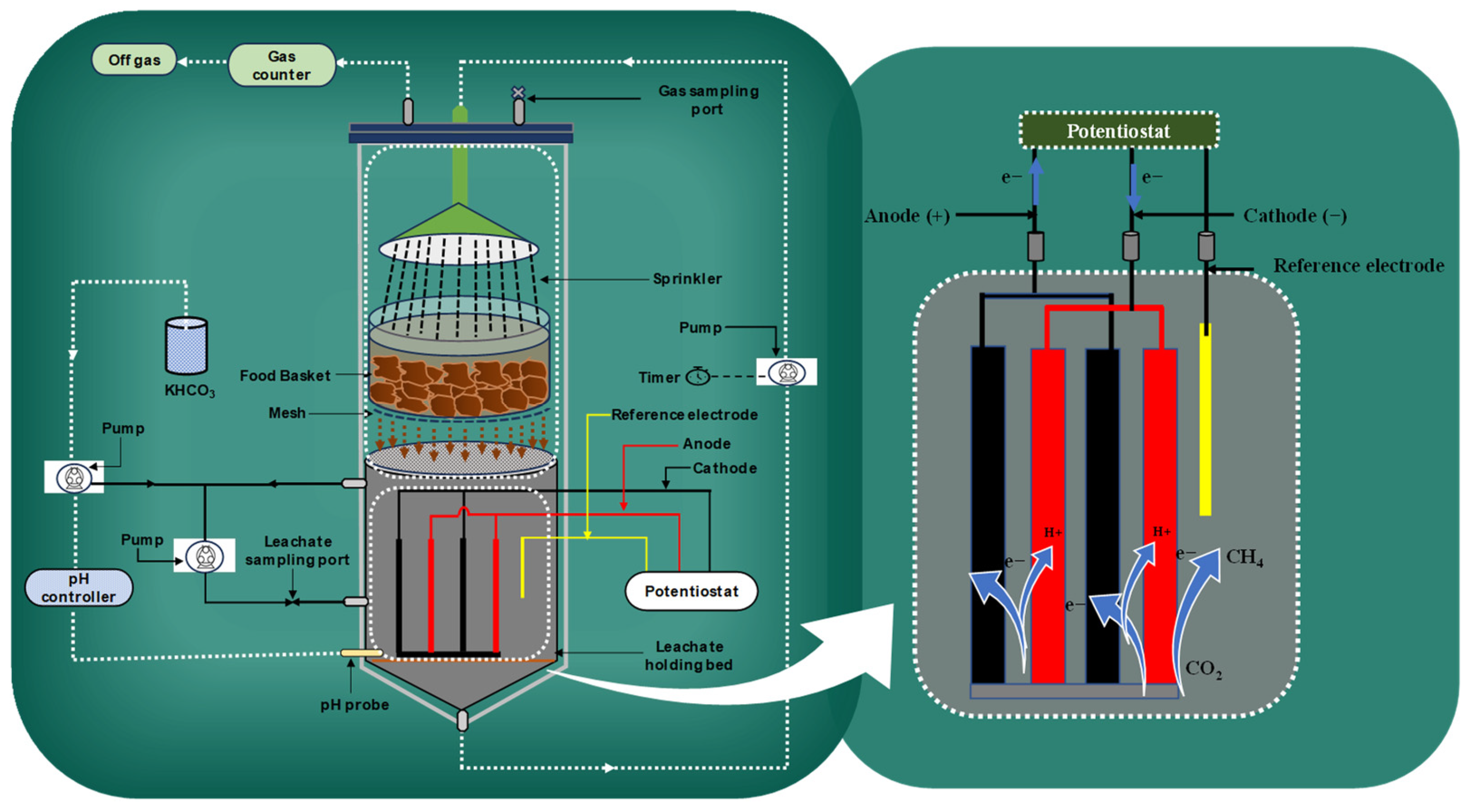
Two reactors were operated in parallel: an open-circuit control reactor and a bioelectrochemical leach-bed reactor connected to a potentiostat. The bioelectrochemical reactor was sequentially operated under applied voltages of 0.3, 0.6, 0.9, and 1.2 V. Each voltage condition represented one independent 10 day operational cycle, resulting in four consecutive voltage-assisted conditions. The control reactor was operated simultaneously under open-circuit conditions during each cycle (Figure 1). Both reactors were cylindrical and constructed from transparent acrylic, with a working volume of 10 L, an internal diameter of 0.14 m, and a height of 0.70 m (Figure 1 left). Each reactor was equipped with a detachable top cover incorporating a leachate sprinkling system to ensure uniform distribution over the FW bed, as well as a gas outlet for biogas collection.
The reactors were divided into two functional compartments: (i) a bottom leachate reservoir and (ii) an upper FW holding zone containing a perforated acrylic basket (0.10 m diameter, 0.25 m height). The basket base was perforated (5 mm openings) to allow leachate percolation while retaining solid FW particles. Leachate was continuously recirculated at 60 L/h using a peristaltic pump (Masterflex L/S Digital Drive, Model 07523-80, Cole-Parmer Instrument Company, Vernon Hills, IL, USA) for closed-loop mixing to prevent stratification and maintain homogeneity. No impeller-based mechanical mixing was used; recirculation provided sufficient homogeneity without additional stirring energy. An integrated electrode system enabled extracellular electron transfer within the leachate reservoir (Figure 1 right). Two pairs of carbon fiber anodes and stainless-steel cathodes were spaced 0.15 m apart for optimized electron transfer [12]. Electrodes were connected to a Bio-Logic VSP potentiostat (Model VSP-300, BioLogic Science Instruments, Seyssinet-Pariset, France) for voltage control, with an Ag/AgCl reference electrode (MF-2052, Bioanalytical Systems Inc., West Lafayette, IN, USA) positioned 5 mm from the anode to monitor electrode potential and current. Reactors operated at mesophilic temperature (35 °C) via a recirculating water bath (PolyScience 9702A11C, Niles, IL, USA). In-situ pH probes (Milwaukee MC-122 controller, Milwaukee Instruments, Inc., Rocky Mount, NC, USA) with automated sodium bicarbonate dosing maintained near-neutral conditions (pH 6.8–7.5 throughout; sodium accumulation remained <0.5 g/L, below inhibitory thresholds). Biogas volume was quantified using a MilliGas counter (Dr.-Ing. RITTER Apparatebau GmbH & Co. KG, Bochum, Germany) and samples were collected via dedicated ports.

2.3. Experimental Setup and BLBR Operation

The BLBRs were operated in three consecutive experimental cycles, each consisting of a 10 day batch run, to systematically evaluate the effect of bioelectrochemical stimulation on methane production during percolation-based dry AD and to enable progressive microbial acclimation. Two operational modes were evaluated: (i) an open-circuit control reactor (0 V) and (ii) a bioelectrochemical reactor subjected to applied voltages of 0.3, 0.6, 0.9, and 1.2 V using a potentiostat (Model VSP-300, BioLogic Science Instruments, Seyssinet-Pariset, France). Voltage was applied sequentially across cycles in the bioelectrochemical reactor, with the control reactor run in parallel under open-circuit conditions for direct comparison. Prior to each batch cycle, reactors were inoculated with acclimated anaerobic sludge at an inoculum-to-substrate ratio of 25% (w/w) and loaded with 2.5 L of initial leachate. Leachate handling used a dual-pump configuration: (i) continuous closed-loop mixing at 60 L/h to prevent phase stratification and maintain homogeneous leachate composition, and (ii) intermittent sprinkling onto the FW bed at 90 L/h for 15 s every 75 min, corresponding to an average recirculation rate of 0.3 L/h (7.2 L/day). No impeller-based mechanical mixing was employed; recirculation provided sufficient homogeneity [18].
The initial VS loading of the FW was standardized at approximately 72 g for all experiments. Prior to the start of each batch cycle, reactors were purged with nitrogen gas at a flow rate of 0.5 L/min for 30 min to establish anaerobic conditions. Reactor performance was monitored daily via biogas volume/composition and periodic leachate sampling. At the end of each 10-day batch, the leachate was centrifuged at 9500 rpm for 20 min, and the recovered solids were reused as inoculum in the subsequent batch, enabling progressive enrichment of acclimated fermentative and methanogenic microbial communities within the BLBRs. This progressive acclimation approach was intentional to simulate adaptive microbial development; potential carry-over effects from prior voltage exposure are acknowledged as a limitation and addressed through control comparisons and voltage-specific performance analysis.

2.4. Chemical Analysis

TS, VS, total suspended solids (TSS), and volatile suspended solids (VSS) were measured following the APHA standard methods [19]. TS and VS analyses were conducted at both the beginning and end of each experimental run to evaluate solids degradation efficiency. Leachate samples were collected on days 0, 2, 4, 7, and 10 of each batch cycles and analyzed for total and soluble chemical oxygen demand (TCOD and SCOD), VFAs, ammonia nitrogen (NH3-N), pH, and alkalinity. Throughout the experiment, pH was continuously monitored (Milwaukee MC-122); values remained stable at 6.8–7.5 across conditions due to automated dosing. COD analysis was carried out using Hach digestion vials (Catalog No. 21215-CA), while NH3-N concentrations were determined using Hach TNT832 test kits (Hach Company, Loveland, CO, USA) in accordance with the manufacturer’s guidelines. VFA composition (acetic, propionic, and butyric acids) was analyzed by gas chromatography with flame ionization detection (GC-FID) using the protocol described by Saha and Lee [17]. VFA concentrations were converted to COD equivalents for comparative analysis. Other VFAs (e.g., valeric, caproic) were minor (<5% of total SCOD) and not quantified separately. Biogas composition (CH4 and CO2) was measured daily by GC with a thermal conductivity detector (SRI Instruments Model 310, Torrance, CA, USA) per [20]; H2 was not quantified. All analyses were in triplicate. Methane yield was calculated by normalizing the cumulative methane production to the VSadded at the beginning of each experiment and is expressed as mL CH4/gVSadded.

2.5. Genomic DNA Isolation and 16S rRNA Gene Sequencing

To investigate the microbial communities within the BLBR system under applied voltages of 0, 0.3, 0.6, 0.9, and 1.2 V, 250 µL of leachate was collected at the conclusion of each batch operation, while samples of the FW residue and biofilms from the anode and cathode were collected using swabs. A total of 20 samples, corresponding to four sample types (leachate, food waste residue, anode biofilm, and cathode biofilm) collected under five conditions (control and 0.3, 0.6, 0.9, and 1.2 V), were trasfered in DNA/RNA Shield™ swab tubes (Zymo Research Corporation, Irvine, CA, USA) and stored at −20 °C until DNA extraction. DNA was extracted using the DNeasy PowerSoil Pro Kit (Qiagen, Valencia, CA, USA), with slight modifications to the manufacturer’s protocol [18]. The quantity and purity of the extracted DNA were evaluated using a Nano-300 spectrophotometer (Allsheng, Hangzhou, China) and 2% agarose gel electrophoresis. Amplification of the V4 region of the 16S rRNA gene was carried out using the primer pair 515F (5′-GTGYCAGCMGCCGCGGTAA-3′) and 806R (5′-GGACTACNVGGGTWTCTAAT-3′). Subsequent indexing, library preparation, and sequencing were conducted on the Illumina MiSeq PE300 platform (Illumina, San Diego, CA, USA) by Macrogen Inc. (Seoul, Republic of Korea).

2.6. Sequence and Statistical Analyses

The 16S rRNA sequences were analyzed utilizing Mothur software (v1.45.3) [21], with slight modifications to a previously described method [22]. The paired-end reads were merged to generate contigs, after which primers and barcodes were trimmed. Chimeric and low-quality sequences were identified and removed. The remaining high-quality reads were clustered into operational taxonomic units at a similarity threshold of 0.03 [22]. Reads classified as non-bacterial or non-archaeal, including those from chloroplasts and mitochondrial genomes, were excluded from the analysis [18]. Taxonomic classification of bacterial and archaeal sequences was conducted using the SILVA reference database (release 132) [22]. Beta diversity was assessed using Bray-Curtis dissimilarity, and differences among conditions were tested by permutational multivariate analysis of variance (PERMANOVA) and visualized by principal coordinates analysis (PCoA). Statistical analysis and data visualization were carried out using the “vegan” and “ggplot2” packages in R version 4.2.1. Variations in microbial community composition across samples were evaluated using the Kruskal–Wallis test, with statistical significance set at p < 0.05.

3. Results and Discussion

3.1. Physicochemical Characteristics of Food Waste and Inoculum

The physicochemical characteristics of FW and anaerobic inoculum are summarized in Table 1. The FW contained 25.20 ± 0.03% TS, 11.62 ± 0.02% VS, and had an initial pH of 4.34 ± 0.02. The relatively low VS/TS ratio (46.1%) reflects the heterogeneous composition of cafeteria-derived food waste, which contains both biodegradable organic matter and inorganic residues. In contrast, the anaerobic inoculum exhibited 12.50 ± 0.40% TS, 8.20 ± 0.30% VS (VS/TS = 65.6%), and a near-neutral pH of 7.20 ± 0.10, indicating a well-acclimated microbial consortium with adequate buffering capacity for reactor start-up. These substrate and inoculum characteristics provided suitable initial conditions for evaluating the performance of BLBR.

3.2. Effect of Different Voltages on Methane Production

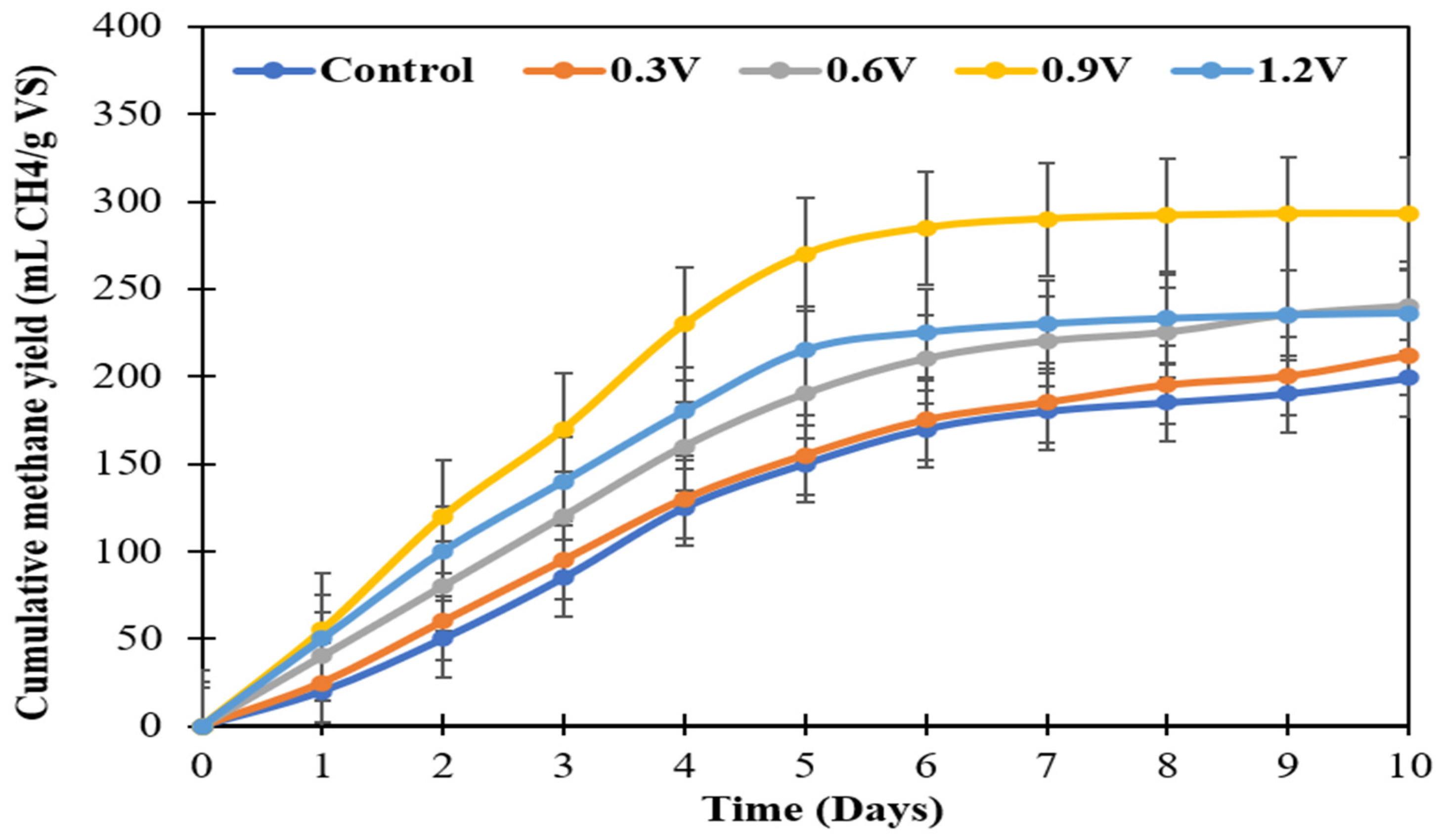
The effect of applied voltage on cumulative methane yield is shown in Figure 2. Under open-circuit conditions (control), cumulative methane yield reached 199 mL CH4/gVSadded after 10 days, with most methane produced during the first five days followed by a plateau. Application of 0.3 V resulted in a modest increase to 212 mL CH4/gVSadded (+6.5%, p > 0.05 vs. control). More pronounced enhancement was observed at 0.6 V (240 mL CH4/gVSadded; +20.6%, p < 0.05) and 0.9 V, which produced the highest methane yield (293 mL CH4/gVSadded; +47.2% vs. control, p < 0.05). At 1.2 V, methane yield remained significantly higher than the control (p < 0.05) but was lower than that obtained at 0.9 V.
These findings are consistent with previous MEC-assisted AD studies reporting enhanced methane production at moderate applied voltages through improved extracellular electron transfer and microbial activity [23,24,25,26]. A comparison of representative MEC-assisted AD studies with the present work is summarized in Table 2. Previous investigations primarily employed wet or semi-wet digesters treating slurry substrates, whereas the present study demonstrates the successful application of bioelectrochemical stimulation in a percolation-based dry AD system. Under high-solids conditions, the BLBR achieved a methane yield of 293 mL CH4/gVSadded at 0.9 V, corresponding to a 47.2% increase over the open-circuit control [27,28,29].
The highest methane production observed at 0.9 V indicates the existence of an optimum operating window for bioelectrochemical stimulation in the BLBR. Although increasing the applied voltage generally enhanced methane production relative to the open-circuit control, further increasing the voltage to 1.2 V did not produce additional improvement. This voltage-dependent response suggests that excessive electrical input does not necessarily translate into higher methane productivity and may alter microbial metabolism or electron-transfer efficiency. Similar optimum voltage ranges have been reported for wet MEC-assisted AD systems (Table 2), where moderate applied voltages promoted methanogenic activity more effectively than either lower or higher voltages. The present results indicate that this voltage-dependent behavior also applies to percolation-based dry AD under high-solids conditions.
Collectively, these studies demonstrate that moderate applied voltages consistently enhance methane production across diverse MEC-assisted AD configurations. The present study extends this concept to percolation-based dry AD operating under high-solids conditions, thereby demonstrating the applicability of bioelectrochemical stimulation in leach-bed digestion systems.

3.3. VS Removal and SCOD Profile

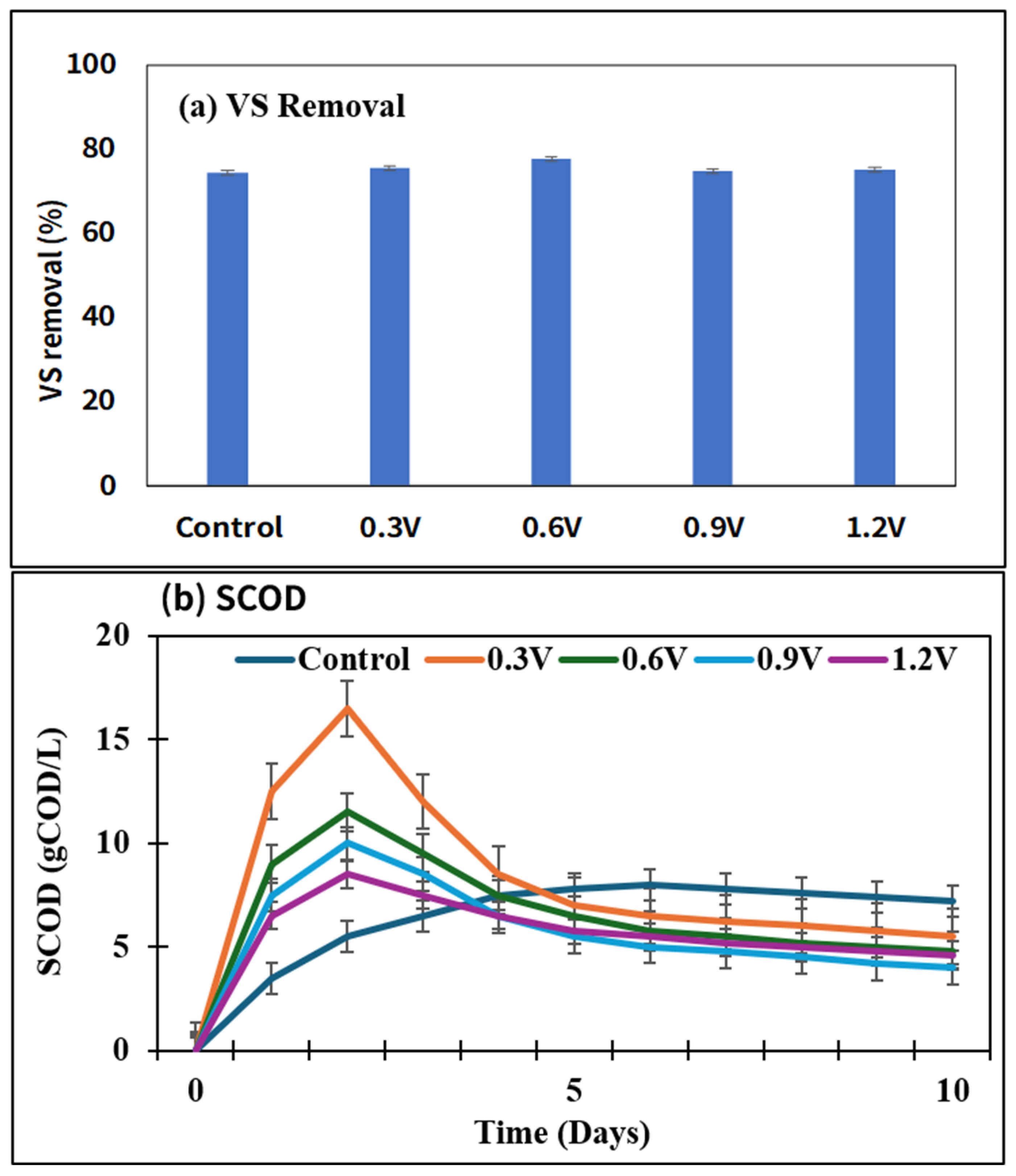
Figure 3 summarizes VS removal and SCOD profiles under different voltage conditions. The controls achieved a VS removal of 74.3%, while BLBR operation resulted in a comparable range of 74.7–77.6%. These differences were not statistically significant (p > 0.05, Kruskal-Wallis test), indicating that applied voltage did not substantially affect the overall extent of solids degradation during the 10-day digestion period. In contrast, clear differences were observed in the temporal evolution of SCOD. As shown in Figure 3b, SCOD increased rapidly during the initial phase of digestion under all conditions, reflecting the solubilization of organic matter from FW. The BLBR treatments exhibited a more rapid rise and subsequent decline in SCOD than the control, whereas the control showed a slower increase and a more prolonged plateau. These results indicate that voltage application influenced the production and consumption of soluble intermediates within the recirculating leachate system.
Among the tested conditions, the 0.9 V treatment exhibited the most pronounced SCOD conversion, which coincided with the highest methane yield (Figure 2). The faster decline in SCOD following its peak suggests more rapid conversion of soluble organics during digestion. Similar observations have been reported in bioelectrochemical AD, where applied voltage alters soluble organic matter dynamics and overall process performance [11]. Because leachate continuously circulates through the substrate bed, changes in leachate composition may influence substrate conversion throughout the reactor.
The summed COD equivalents of acetate, propionate, and butyrate were generally lower than the corresponding SCOD concentrations, indicating that the quantified VFAs constituted part of the soluble organic matter pool. However, on Day 2, the summed VFA-COD slightly exceeded SCOD at 0.6 V and more noticeably at 0.9 V. These discrepancies likely arose because SCOD and VFAs were measured independently using different analytical procedures and were therefore subject to cumulative uncertainty associated with sample heterogeneity, filtration, dilution, calibration, and instrumental analysis. Accordingly, the affected Day 2 values were interpreted with caution, and emphasis was placed on the temporal patterns rather than exact COD closure.
Recent MEC-assisted AD studies have similarly reported that moderate applied voltages enhance the conversion of soluble intermediates, mitigate VFA accumulation, and improve methane production and process stability by promoting syntrophic metabolism and bioelectrochemical interactions [11,30]. These findings are consistent with the accelerated SCOD conversion and enhanced methane production observed in the present BLBR system, indicating that voltage-assisted bioelectrochemical stimulation promoted more efficient utilization of soluble organic intermediates without significantly affecting the overall extent of VS removal.

3.4. VFA Profile Dynamics Under Different Applied Voltages

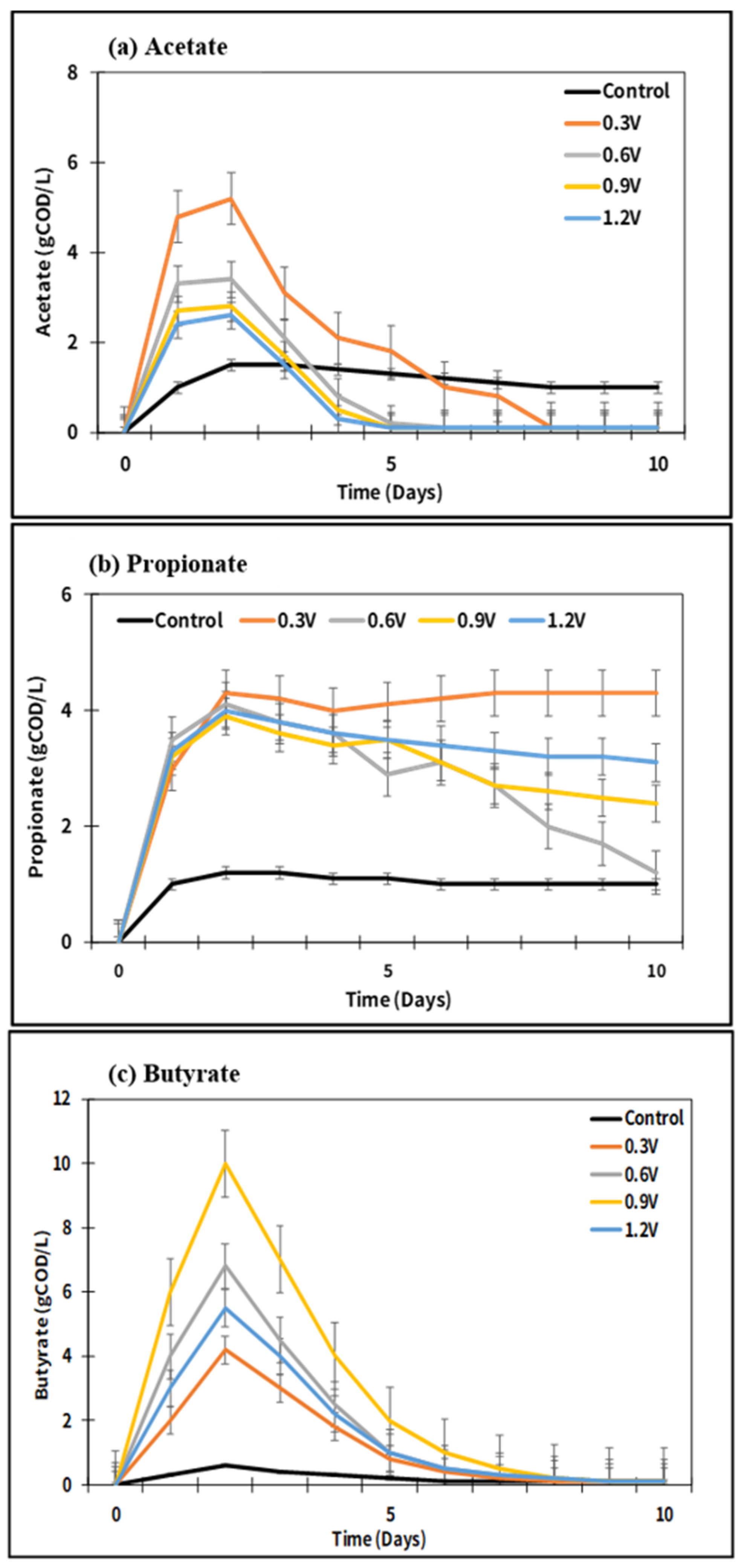
Figure 4 presents the temporal profiles of acetate, propionate, and butyrate under control and BLBR conditions. Acetate, propionate, and butyrate were the dominant VFAs detected throughout digestion and accounted for most of the soluble organic intermediates. Minor VFAs, including valerate and caproate, were detected at substantially lower concentrations and are therefore not discussed separately.
Acetate accumulated rapidly during the early stage of digestion (Figure 4a), consistent with the increase in SCOD observed in Figure 3. In the BLBR treatments, peak acetate concentrations were observed on day 2, reaching 5.23, 3.41, 2.82, and 2.60 g COD/L at 0.3, 0.6, 0.9, and 1.2 V, respectively. Thereafter, acetate concentrations declined rapidly and reached near-complete depletion (<0.1 g COD/L) by approximately day 5 under most voltage conditions. In contrast, the control exhibited slower accumulation and a prolonged plateau around 1.50 g COD/L. These results indicate that applied voltage influenced production and subsequent conversion of acetate during digestion [31].
Propionate displayed a similar voltage-dependent response (Figure 4b). Under BLBR operation, propionate concentrations increased during the initial phase and subsequently declined over time, whereas changes in the control were comparatively limited. The concurrent accumulation of acetate and propionate during the early digestion stage suggested that acidogenic fermentation proceeded more rapidly than the subsequent conversion of these intermediates. As digestion progressed, the decline in both VFAs indicates increased consumption through downstream microbial processes associated with methane formation.
Among the measured VFAs, butyrate showed the most pronounced response to voltage application (Figure 4c). In the BLBR, transient butyrate accumulation was observed during the early digestion stage, with the highest concentration recorded at 0.9 V (8.8 g COD/L on day 2), compared with a maximum of only 0.6 g COD/L in the control. Following this peak, butyrate concentrations progressively declined under all voltage conditions. The transient accumulation and subsequent depletion of butyrate indicate active formation and conversion processes during digestion, with the most pronounced turnover occurring at 0.9 V. Similar transient butyrate accumulation has been reported in high-rate AD, where rapid fermentation temporarily exceeds downstream conversion capacity [31,32]. The temporal coincidence between rapid butyrate turnover and enhanced methane production at 0.9 V suggests that voltage application influenced carbon-flow dynamics within the BLBR and promoted more efficient conversion of soluble intermediates during digestion.
Minor discrepancies between the summed VFA-COD and measured SCOD were observed during the early acidogenic stage, particularly for the Day 2 sample at 0.9 V. Because SCOD and VFAs were determined independently using Hach dichromate digestion and GC-FID, respectively, these discrepancies did not affect the overall temporal trends or the interpretation that voltage application enhanced soluble organic matter turnover and methane production.
Collectively, the coordinated behaviour of acetate, propionate, and butyrate provides further insight into carbon-flow dynamics within the BLBR. The rapid accumulation of VFAs during the initial digestion phase followed by their subsequent depletion suggests that applied voltage accelerated both acidogenesis and methanogenic conversion without causing persistent VFA accumulation. Particularly at 0.9 V, transient butyrate accumulation followed by rapid utilization coincided with accelerated SCOD turnover and the highest methane yield, indicating efficient coupling between fermentative and methanogenic processes under bioelectrochemical stimulation.

3.5. Microbial Compositions Response to Applied Voltage

Microbial community composition in leachate, FW residue, and electrode-associated biofilms (anode and cathode) was analyzed using 16S rRNA gene amplicon sequencing. Beta diversity analysis was used to test whether the compositional patterns described below were associated with applied voltage rather than with sample type alone (Figure S1) Figure S1. Principal coordinates analysis (PCoA) of Bray-Curtis dissimilarities for (a) bacterial and (b) archaeal communities in the control and BLBR system across leachate, food waste residue, anode, and cathode samples under different applied voltage. Point color indicates applied voltage and point shape indicates sample type. Dashed ellipses denote 95% confidence regions grouped by voltage. PERMANOVA R2 and p-value for the voltage effect are shown above each panel; axis labels give the percentage of variation explained. PERMANOVA on Bray-Curtis dissimilarities showed that both factors contributed, with their relative weights differing between the two domains. In bacterial communities, applied voltage accounted for a larger share of the variation (R2 = 0.62, p < 0.001) than sample type (R2 = 0.26, p < 0.001), and the open-circuit control separated from all voltage-assisted conditions. This ranking was reversed in archaeal communities, where sample type dominated (R2 = 0.64, p < 0.001) and applied voltage accounted for a smaller but significant share (R2 = 0.21, p = 0.003). Group dispersions were homogeneous in all comparisons (p > 0.05), indicating shifts in community centroids rather than uneven within-group variability. This contrast suggests that voltage-associated structuring reached the fermentative bacteria distributed by leachate recirculation, whereas methanogenic archaea remained partitioned mainly by habitat, a pattern also evident at the genus level below. Because voltages were applied sequentially in a single reactor, this term also carries progressive acclimation across cycles.
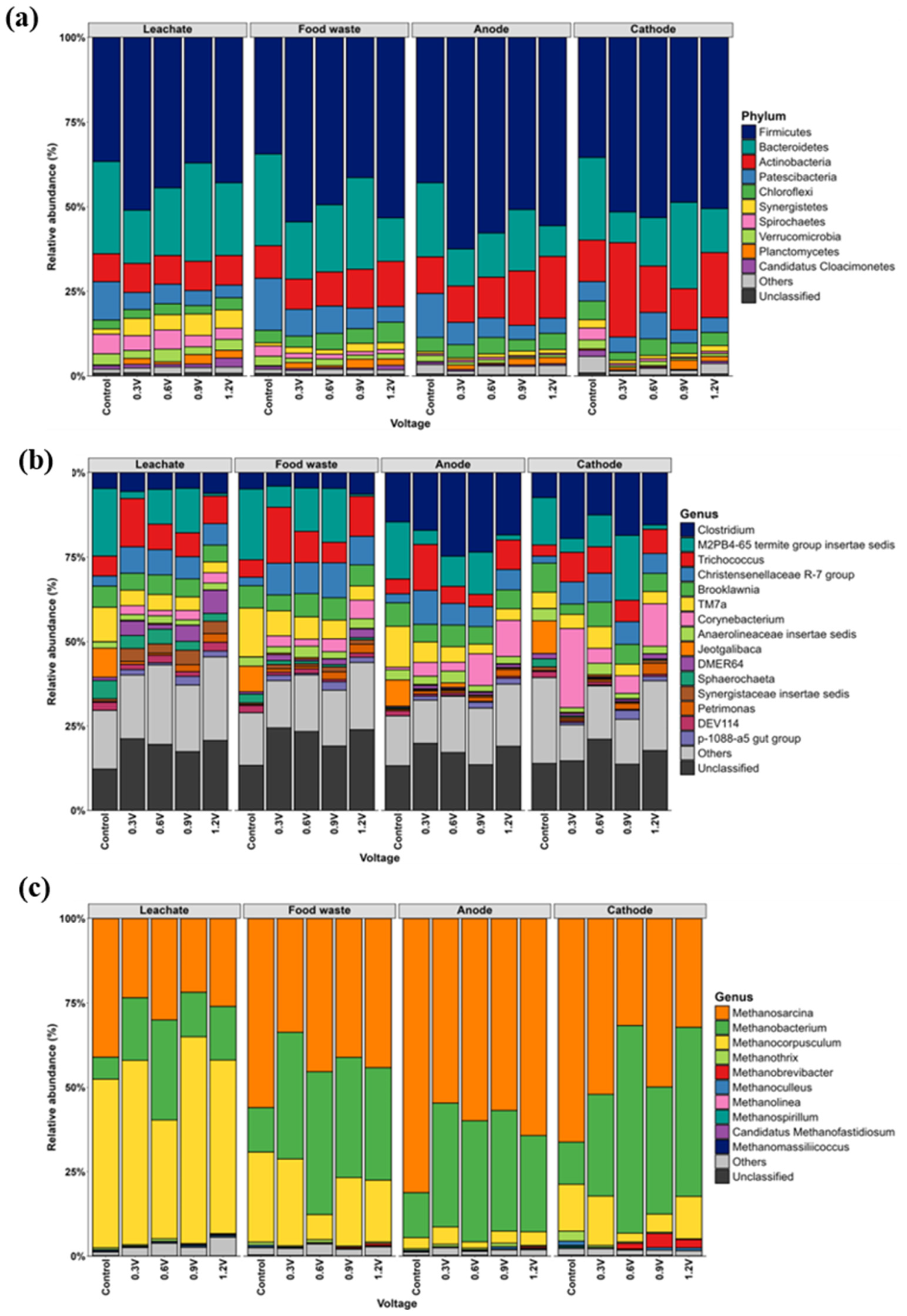
The relative abundances of the dominant bacterial and archaeal taxa are presented in Figure 5. At the phylum level (Figure 5a), microbial communities were dominated by Firmicutes (47.7 ± 4.8%), Bacteroidetes (18.8 ± 3.6%), and Actinobacteria (12.5 ± 3.7%), which are commonly reported as key microbial groups in AD. These phyla are widely associated with hydrolysis and fermentation of complex organic substrates, leading to the production of soluble intermediates and VFAs [33,34]. Under voltage-assisted operation, the relative abundances of Firmicutes (50.3 ± 5.3%) and Actinobacteria (13.0 ± 4.2%) were generally higher than those observed in the control reactor, whereas Bacteroidetes showed a moderate decrease.
Distinct spatial differences were observed among sample types. Bacteroidetes were more abundant in leachate and FW samples than in electrode-associated biofilms, suggesting a stronger association with degradation of organic substrates within the solid bed and recirculating leachate. Notably, the highest relative abundances of Bacteroidetes were observed at 0.9 V, reaching 29.1% in leachate and 27.1% in FW. Given the established role of many Bacteroidetes members in carbohydrate degradation and acidogenesis, their enrichment may have contributed to the increased production of soluble intermediates observed during the early digestion stage [33].
In contrast, Firmicutes were particularly enriched in anode biofilms, where their abundance increased from 42.9% in the control to 62.5% at 0.3 V and remained elevated under voltage-assisted conditions. Actinobacteria also showed greater representation in electrode-associated biofilms, particularly on the cathode. These findings indicate that applied voltage influenced microbial community structure and promoted selective enrichment of specific bacterial groups within electrode-associated environments.
At the genus level (Figure 5b), substantial differences were observed among leachate, FW, and biofilm samples. M2PB4-65 termite group insertae sedis and Trichococcus were among the dominant genera in leachate and FW samples. Trichococcus abundance increased under voltage-assisted conditions, reaching 14.3% in leachate and 16.6% in FW at 0.3 V. Members of this genus are commonly associated with fermentative metabolism and have frequently been reported in anaerobic digestion systems treating carbohydrate-rich substrates [34,35].
Clostridium was the dominant genus in both anode and cathode biofilms, accounting for 19.7 ± 4.3% and 14.7 ± 2.9% of the bacterial community, respectively. The abundance of Clostridium increased under voltage-assisted conditions, reaching 23.5% in anode biofilms at 0.9 V. Clostridium species are widely recognized as important fermentative bacteria capable of degrading complex organic matter and producing a range of VFAs, including acetate and butyrate, during AD [36,37,38]. Their enrichment coincided with the pronounced VFA dynamics observed in the BLBR, particularly under the 0.9 V condition.
Corynebacterium also exhibited substantial enrichment under applied voltage, particularly within electrode-associated biofilms. Relative abundances increased markedly compared with the control, with the largest increases observed in cathode samples. Although Corynebacterium has been reported in various bioelectrochemical environments, its functional role in anaerobic digestion remains incompletely understood [39,40]. The observed enrichment therefore suggests adaptation to the voltage-assisted environment rather than direct evidence of electrochemical activity.
Several additional genera, including Christensenellaceae R-7 group and Petrimonas, also increased under voltage-assisted operation. While the ecological roles of these taxa remain under investigation, previous studies have associated them with syntrophic interactions and anaerobic carbon-conversion processes [41,42]. Conversely, taxa such as Brooklawnia and M2PB4-65 termite group insertae sedis generally declined in electrode-associated samples, highlighting the spatial differentiation of microbial populations within the BLBR.
Overall, the bacterial community analysis demonstrates that voltage-assisted operation influenced microbial community composition throughout the reactor system. The enrichment of fermentative taxa, including Clostridium, Trichococcus, and members of Bacteroidetes, was consistent with the enhanced production and turnover of soluble intermediates observed in the BLBR [34,37]. However, the specific metabolic pathways responsible for these shifts cannot be determined from taxonomic data alone and require further investigation using functional analyses.
The archaeal community structure is presented in Figure 5c. Methanosarcina was the dominant archaeal genus in FW, anode, and cathode samples, accounting for 44.1 ± 5.3%, 63.4 ± 4.2%, and 46.4 ± 11.0% of the respective communities. Methanobacterium was the second most abundant genus in these samples. In contrast, Methanocorpusculum dominated the leachate community, representing 50.5 ± 11.1% of total archaeal sequences. Methanosarcina is a metabolically versatile methanogen capable of utilizing acetate, H2/CO2, and methylated compounds for methane production, whereas Methanobacterium and Methanocorpusculum are commonly associated with hydrogenotrophic methanogenesis [43,44,45].
Applied voltage altered archaeal community composition across all sample types. Methanobacterium increased substantially under voltage-assisted conditions relative to the control, while Methanobrevibacter, although present at lower abundance, also exhibited marked enrichment. The greatest increases were observed at 0.9 V, which also corresponded to the highest methane yield. Methanocorpusculum similarly reached its highest abundance in the leachate at 0.9 V, suggesting a relationship between archaeal community structure and reactor performance. Methanobacterium and Methanobrevibacter are generally associated with hydrogenotrophic methanogenesis, while Methanosarcina can utilize both acetoclastic and hydrogenotrophic pathways [43,44,45].
The temporal VFA patterns observed in Figure 4 are consistent with the archaeal community shifts identified under voltage-assisted conditions. Rapid accumulation of acetate and butyrate during the early digestion phase was followed by substantial depletion as methane production increased. The coexistence of Methanosarcina, Methanobacterium, Methanobrevibacter, and Methanocorpusculum indicates that multiple methanogenic pathways may have operated simultaneously within the BLBR [43,44,45]. The highest methane production occurred at 0.9 V, where both bacterial and archaeal communities exhibited the greatest divergence from the control condition.
Previous MEC-assisted AD studies have suggested that extracellular electron transfer (EET) and direct interspecies electron transfer (DIET) contribute to enhanced methane production by facilitating electron exchange between electroactive bacteria and methanogenic archaea. In the present study, the enrichment of fermentative bacteria (e.g., Clostridium) and versatile methanogens (e.g., Methanosarcina) under voltage-assisted conditions is consistent with these proposed mechanisms and with observations reported for wet MEC-AD systems. However, the present study did not include electrochemical characterization, current measurements, hydrogen quantification, conductive pili analysis, or functional gene expression analyses required to verify DIET directly. Therefore, enhanced methane production is conservatively attributed to voltage-assisted bioelectrochemical stimulation, while DIET is considered a plausible but unconfirmed mechanism. Future studies integrating electrochemical analyses with microbial community and functional investigations are needed to elucidate the electron-transfer pathways governing methane enhancement in percolation-based dry AD [43,45].
Taken together, the microbial community analysis demonstrates a clear association between applied voltage, microbial community structure, and methane-production performance. The enrichment of specific fermentative and methanogenic taxa under voltage-assisted conditions was consistent with enhanced intermediate turnover and methane production. Amplicon sequencing resolved how these communities were composed and how their composition tracked applied voltage. Defining how voltage redistributes carbon and electron flow among the resident populations calls for metagenomic profiling and quantification of functional marker genes, which would connect the taxonomic shifts observed here to the pathways that carry them. In addition, because hydrogen concentrations, current densities, electrode potentials, and functional gene expression were not measured, the specific bioelectrochemical mechanisms responsible for these shifts remain to be confirmed in future studies.
Collectively, the microbial community shifts provide a biological explanation for the enhanced reactor performance observed under voltage-assisted operation. Enrichment of fermentative bacteria such as Clostridium and Trichococcus coincided with accelerated production of soluble intermediates, whereas increased abundances of Methanosarcina, Methanobacterium, and Methanobrevibacter corresponded with enhanced methane production. This coordinated response suggests that applied voltage influenced multiple stages of anaerobic digestion, including hydrolysis, acidogenesis, syntrophic metabolism, and methanogenesis. Although EET, including DIET, has been proposed as one mechanism contributing to improved methane production in MEC-assisted anaerobic digestion, the present study did not include electrochemical characterization or functional microbial analyses required to verify these pathways. Therefore, the observed improvements are conservatively attributed to bioelectrochemical stimulation rather than confirmed DIET.

3.6. Energy Balance

An energy balance was conducted to compare the electrical energy input associated with voltage application against the energy recovered as methane. As shown in Table 3, electrical energy consumption increased with applied voltage, ranging from 0.21 to 0.44 kWh kg/VS, compared with 0.20 kWh kg/VS in the open-circuit control. Methane energy recovery was calculated by converting the measured methane yield (mL CH4 g/VS) to kWh kg/VS using the lower heating value (LHV) of methane (35.8 MJ m−3):
E n e r g y   r e c o v e r e d   k W h k g V S = C H 4 y i e l d m L g V S × 10 − 6 m 3 m L × 35.8 M J   m − 3 × 1 3.6 k W h   M J − 1 × 10 3 g k g
All voltage-assisted conditions delivered positive net energy outputs. The 0.9 V condition achieved the highest net energy gain (2.90 kWh/kg/VS), representing a 45% improvement over the control (2.00 kWh/kg/VS) and corresponding to the highest methane yield observed in this study. Although operation at 1.2 V also increased methane production relative to the control, the higher electrical energy demand (0.44 kWh/kg/VS) reduced the net energy output to 2.17 kWh/kg/VS, indicating diminishing energy returns at elevated voltage. Lower voltages (0.3 and 0.6 V) produced intermediate net energy outputs of 2.13 and 2.42 kWh/kg/VS, respectively. This assessment reflects the electrical-energy boundary used for Table 3 and does not include facility-level thermal energy requirements, such as reactor heating, unless separately measured. Overall, moderate voltage application, particularly at 0.9 V, maximized net energy recovery and represents the most favorable operating condition among those evaluated in this study.
Taken together, the combined evidence from methane production, SCOD dynamics, VFA turnover, microbial community composition, and energy balance consistently demonstrates that moderate bioelectrochemical stimulation enhanced the overall performance of percolation-based dry AD. The optimum applied voltage of 0.9 V promoted the highest methane yield, accelerated soluble organic matter turnover, facilitated rapid VFA conversion, enriched key fermentative and methanogenic microorganisms, and achieved the greatest net energy recovery. These findings indicate that applied voltage primarily enhanced microbial activity and substrate conversion kinetics rather than increasing the overall extent of substrate degradation, as reflected by the comparable VS removals across all treatments. Unlike previous MEC-assisted AD studies that have largely focused on wet or slurry-based systems, the present study demonstrates that bioelectrochemical stimulation can be successfully integrated with percolation-based dry AD conditions. Collectively, these results establish the BLBR as a promising strategy for improving methane recovery and energy efficiency while maintaining the operational advantages of high-solid AD.
Although the present study demonstrated the effectiveness of the BLBR during 10-day batch operation, its long-term stability under continuous or semi-continuous operation remains to be established. Sustained reactor performance will depend on maintaining stable electroactive and methanogenic biofilms, effective leachate recirculation, uniform substrate distribution, and long-term electrode integrity, and minimizing clogging, internal resistance, and mass-transfer limitations. At larger scales, reactor hydrodynamics and the energy requirements associated with leachate recirculation and voltage application will also influence overall process efficiency. Future studies should therefore investigate long-term continuous operation, pilot-scale validation, reactor optimization, detailed electrochemical characterization, and comprehensive techno-economic and life-cycle assessments to support practical implementation and commercial deployment of bioelectrochemically assisted dry AD systems.

4. Conclusions

This study demonstrated that integrating MEC with percolation-based dry AD effectively enhanced methane production from high-solids food waste. The BLBR achieved the highest methane yield of 293 mL CH4/gVSadded at an applied voltage of 0.9 V, representing a 47% increase over the open-circuit control while maintaining comparable VS removal (74–78%). Bioelectrochemical stimulation accelerated the turnover of soluble intermediates, resulting in faster utilization of SCOD, acetate, and propionate, together with transient butyrate accumulation under the optimum operating condition. Microbial community analysis revealed voltage-dependent shifts in bacterial and archaeal communities consistent with enhanced substrate conversion and methane production. Furthermore, energy balance analysis demonstrated positive net energy recovery at all applied voltages, with the highest net energy output obtained at 0.9 V. Overall, the proposed BLBR represents a promising approach for enhancing methane recovery in percolation-based dry AD while preserving the operational advantages of high-solids, low-water treatment. By extending bioelectrochemical stimulation from conventional wet reactors to percolation-based dry configurations, this study broadens the application of MEC-assisted AD and provides a foundation for the development of energy-efficient, dry AD systems for FW valorization. Future research should focus on long-term continuous and pilot-scale operation, detailed electrochemical characterization, and comprehensive techno-economic and life-cycle assessments to support practical implementation and commercialization.

Supplementary Materials

The following supporting information can be downloaded at https://www.mdpi.com/article/10.3390/bioresourbioprod2030015/s1, Figure S1: Principal coordinates analysis (PCoA) of Bray-Curtis dissimilarities for (a) bacterial and (b) archaeal communities in the control and BLBR system across leachate, food waste residue, anode, and cathode samples under different applied voltage. Point color indicates applied voltage and point shape indicates sample type. Dashed ellipses denote 95% confidence regions grouped by voltage. PERMANOVA R2 and p-value for the voltage effect are shown above each panel; axis labels give the percentage of variation explained.

Author Contributions

Conceptualization, Y.W. and H.-S.L.; methodology, Y.W., S.J., K.Y. and H.K.; formal analysis, Y.W., S.J., K.Y. and H.K.; investigation, Y.W. and S.J.; data curation, Y.W. and S.J.; writing—original draft preparation, Y.W., S.J. and H.-S.L.; writing—review and editing, K.Y., H.K., E.L. and H.-S.L.; supervision, H.-S.L.; funding acquisition, H.-S.L. All authors have read and agreed to the published version of the manuscript.

Funding

This research was funded by the Ministry of Education of the Republic of Korea and the National Research Foundation of Korea (grant number: NRF RS-2023-00279906).

Institutional Review Board Statement

Not applicable.

Informed Consent Statement

Not applicable.

Data Availability Statement

The data presented in this study are available on request from the corresponding author. The data are not publicly available because they form part of ongoing research.

Conflicts of Interest

Author Sudharshan Juntupally was employed by Greeneple, Inc. The remaining authors declare that the research was conducted in the absence of any commercial or financial relationships that could be construed as a potential conflict of interest.

Abbreviations

The following abbreviations are used in this manuscript
ADAnaerobic Digestion
BLBRBioelectrochemical Leach-Bed Reactor
CODChemical Oxygen Demand
CSTRContinuously Stirred Tank Reactor
FWFood Waste
GHGGreenhouse Gas
ISRInoculum-to-Substrate Ratio
LBRLeach-Bed Reactor
LHVLower Heating Value
MECMicrobial Electrolysis Cell
SCODSoluble Chemical Oxygen Demand
TCODTotal Chemical Oxygen Demand
TSTotal Solids
TSSTotal Suspended Solids
VFAVolatile Fatty Acids
VSVolatile Solids
VSSVolatile Suspended Solids

References

  1. United Nations Environment Programme (UNEP). Food Waste Index Report 2024; UNEP: Nairobi, Kenya, 2024. [Google Scholar]
  2. IPCC. Summary for Policymakers. In Climate Change 2023: Synthesis Report. Contribution of Working Groups I, II and III to the Sixth Assessment Report of the Intergovernmental Panel on Climate Change; Core Writing Team, Lee, H., Romero, J., Eds.; IPCC: Geneva, Switzerland, 2023; pp. 1–34. [Google Scholar] [CrossRef] [Scilit]
  3. Yaman, C. Investigation of greenhouse gas emissions and energy recovery potential from municipal solid waste management practices. Environ. Dev. 2020, 33, 100484. [Google Scholar] [CrossRef] [Scilit]
  4. Angelonidi, E.; Smith, S.R. A comparison of wet and dry anaerobic digestion processes for the treatment of municipal solid waste and food waste. Water Environ. J. 2015, 29, 549–557. [Google Scholar] [CrossRef] [Scilit]
  5. Saboohi, Z.; Hosseini, S.E. Advancements in biogas production: Process optimization and innovative plant operations. Clean Energy 2025, 9, 52–65. [Google Scholar] [CrossRef] [Scilit]
  6. Shewani, A.; Horgue, P.; Pommier, S.; Debenest, G.; Lefebvre, X.; Gandon, E.; Paul, E. Assessment of percolation through a solid leach bed in dry batch anaerobic digestion processes. Bioresour. Technol. 2015, 178, 209–216. [Google Scholar] [CrossRef] [Scilit] [PubMed]
  7. Li, C.; Tao, Y.; Fang, J.; Li, Q.; Lu, W. Impact of continuous leachate recirculation during solid state anaerobic digestion of Miscanthus. Renew. Energy 2020, 154, 38–45. [Google Scholar] [CrossRef] [Scilit]
  8. Xiong, Z.; Hussain, A.; Lee, H.-S. Food waste treatment with a leachate bed reactor: Effects of inoculum to substrate ratio and reactor design. Bioresour. Technol. 2019, 285, 121350. [Google Scholar] [CrossRef] [Scilit] [PubMed]
  9. Abbassi-Guendouz, A.; Brockmann, D.; Trably, E.; Dumas, C.; Delgenès, J.P.; Steyer, J.P.; Escudié, R. Total solids content drives high-solid anaerobic digestion via mass transfer limitation. Bioresour. Technol. 2012, 111, 55–61. [Google Scholar] [CrossRef] [Scilit] [PubMed]
  10. Singh, V.; Tartakovsky, B.; Örmeci, B.; Li, H.; Hussain, A. Combining a solid-state submerged fermenter with bioelectrn chemically enhanced anaerobic digestion (BEAD) process for enhanced methane (CH4) production from food waste: Effects of the organic loading rates and applied voltages. J. Environ. Chem. Eng. 2025, 13, 116801. [Google Scholar] [CrossRef] [Scilit]
  11. Liu, C.; Cao, Q.; Luo, X.; Yan, S.; Sun, Q.; Zheng, Y.; Zhen, G. In-depth exploration of microbial electrolysis cell coupled with anaerobic digestion (MEC-AD) for methanogenesis in treating protein wastewater at high organic loading rates. Energy Convers. Manag. 2025, 323, 119152. [Google Scholar] [CrossRef] [Scilit] [PubMed]
  12. Wang, Y.; Gao, Y.; Hussain, A.; Lee, H.-S. Optimization of biofilm conductance measurement with two-electrode microbial electrochemical cells (MECs). Sci. Total Environ. 2023, 858, 159577. [Google Scholar] [CrossRef] [Scilit] [PubMed]
  13. Yu, Z.; Leng, X.; Zhao, S.; Ji, J.; Zhou, T.; Khan, A.; Kakde, A.; Liu, P.; Li, X. A review on the applications of microbial electrolysis cells in anaerobic digestion. Bioresour. Technol. 2018, 255, 340–348. [Google Scholar] [CrossRef] [Scilit] [PubMed]
  14. Doki, M.M.; Thulluru, L.P.; Chowdhury, S.; Ghangrekar, M.M. Application of dark fermentation and electro-fermentation for CO2 conversion to value-added products. In Electro-Fermentation for Synthesis of Chemicals, Biochemicals and Biofuels; Springer Nature: Singapore, 2025; pp. 263–280. [Google Scholar]
  15. Madondo, N.I.; Rathilal, S.; Bakare, B.F.; Tetteh, E.K. Application of bioelectrochemical systems and anaerobic additives in wastewater treatment: A conceptual review. Int. J. Mol. Sci. 2023, 24, 4753. [Google Scholar] [CrossRef] [Scilit] [PubMed]
  16. Han, Y.; Yang, S.; Guo, G.; Chen, J.; Wu, X.; Zan, F. Strengthening the syntrophic pathway for acetate oxidation-hydrogenotrophic methanogenesis by biogas stirring for effectively mitigating acidification in anaerobic digestion. Chem. Eng. J. 2024, 502, 157834. [Google Scholar] [CrossRef] [Scilit]
  17. Saha, S.; Lee, H.-S. High-rate carboxylate production in dry fermentation of food waste at room temperature. Sci. Total Environ. 2020, 714, 136695. [Google Scholar] [CrossRef] [Scilit] [PubMed]
  18. APHA; AWWA; WEF. Standard Methods for the Examination of Water and Wastewater, 20th ed.; American Public Health Association: Washington, DC, USA, 1998. [Google Scholar]
  19. Wang, Y.; Juntupally, S.; Hussain, A.; Mishra, S.; Kim, H.; Yoo, K.; Lee, H.-S. Optimization of Dry Anaerobic Digestion of Food Waste in Leachate Bed Reactors. ACS ES&T Eng. 2024, 4, 2721–2733. [Google Scholar] [CrossRef] [Scilit]
  20. Radadiya, P.; Lee, J.; Venkateshwaran, K.; Benn, N.; Lee, H.; Hussain, A. Acidogenic fermentation of food waste in a leachate bed reactor (LBR) at high volumetric organic Loading: Effect of granular activated carbon (GAC) and sequential enrichment of inoculum. Bioresour. Technol. 2022, 361, 127705. [Google Scholar] [CrossRef] [Scilit] [PubMed]
  21. Schloss, P.D.; Westcott, S.L.; Ryabin, T.; Hall, J.R.; Hartmann, M.; Hollister, E.B.; Lesniewski, R.A.; Oakley, B.B.; Parks, D.H.; Robinson, C.J.; et al. Introducing mothur: Open-source, platform-independent, community-supported software for describing and comparing microbial communities. Appl. Environ. Microbiol. 2009, 75, 7537–7541. [Google Scholar] [CrossRef] [Scilit] [PubMed]
  22. Kim, Y.K.; Yoo, K.; Kim, M.S.; Han, I.; Lee, M.; Kang, B.R.; Lee, T.K.; Park, J. The capacity of wastewater treatment plants drives bacterial community structure and its assembly. Sci. Rep. 2019, 9, 14809. [Google Scholar] [CrossRef] [Scilit] [PubMed]
  23. Zhao, L.; Wang, X.-T.; Chen, K.-Y.; Wang, Z.-H.; Xu, X.-J.; Zhou, X.; Xing, D.-F.; Ren, N.-Q.; Lee, D.-J.; Chen, C. The underlying mechanism of enhanced methane production using microbial electrolysis cell assisted anaerobic digestion (MEC-AD) of proteins. Water Res. 2021, 201, 117325. [Google Scholar] [CrossRef] [Scilit] [PubMed]
  24. Gajaraj, S.; Huang, Y.; Zheng, P.; Hu, Z. Methane production improvement and associated methanogenic assemblages in bioelectrochemically assisted anaerobic digestion. Biochem. Eng. J. 2017, 117, 105–112. [Google Scholar] [CrossRef] [Scilit]
  25. Liu, W.; Abrha, H.; Dai, Y.; Li, J.; Liu, M.; Maryam, B.; Jiao, S.; Zhang, P.; Liu, X. Microbial electrolysis cell assisted anaerobic digestion system boosted the methane production from polylactic acid by optimizing the methanogenesis pathway. Biochem. Eng. J. 2023, 200, 109105. [Google Scholar] [CrossRef] [Scilit]
  26. Kanellos, G.; Tremouli, A.; Arvanitakis, G. Lyberatos, boosting methane production and raw waste activated sludge treatment in a microbial electrolysis cell-anaerobic digestion (MEC-AD) system: The effect of organic loading rate. Bioelectrochemistry 2024, 155, 108555. [Google Scholar] [CrossRef] [Scilit] [PubMed]
  27. Park, J.; Lee, B.; Tian, D.; Jun, H. Bioelectrochemical enhancement of methane production from highly concentrated food waste in a combined anaerobic digester and microbial electrolysis cell. Bioresour. Technol. 2018, 247, 226–233. [Google Scholar] [CrossRef] [Scilit] [PubMed]
  28. Flores-Rodriguez, C.; Reddy, C.N.; Min, B. Enhanced methane production from acetate intermediate by bioelectrochemical anaerobic digestion at optimal applied voltages. Biomass Bioenergy 2019, 127, 105261. [Google Scholar] [CrossRef] [Scilit]
  29. Harb, M.; Ermer, N.; BouNehme Sawaya, C.; Smith, A.L. Increased applied voltage in the presence of GAC enhances microbial activity and methane production during anaerobic digestion of food waste. Environ. Sci. Water Res. Technol. 2020, 6, 737–746. [Google Scholar] [CrossRef] [Scilit]
  30. Xing, X.; Wang, X.-T.; Zhao, L.; Ren, N.; Lee, D.-J.; Chen, C. Mitigating over-acidification and enhancing methane production in hybrid microbial electrolysis cells-anaerobic digestion (MEC-AD) treating fruit and vegetable wastewater: Performance and mechanisms. Chem. Eng. J. 2025, 519, 164749. [Google Scholar] [CrossRef] [Scilit]
  31. Lee, H.-S.; Lee, S.Y.; Yoo, K.; Kim, H.W.; Lee, E.; Im, N.G. Biohydrogen production and purification: Focusing on bioelectrochemical systems. Bioresour. Technol. 2022, 363, 127956. [Google Scholar] [CrossRef] [Scilit] [PubMed]
  32. Li, B.-Y.; Xia, Z.-Y.; Gou, M.; Sun, Z.-Y.; Huang, Y.-L.; Jiao, S.-B.; Dai, W.-Y.; Tang, Y.-Q. Production of volatile fatty acid from fruit waste by anaerobic digestion at high organic loading rates: Performance and microbial community characteristics. Bioresour. Technol. 2022, 346, 126648. [Google Scholar] [CrossRef] [Scilit] [PubMed]
  33. Ban, Q.; Wang, J.; Guo, P.; Yue, J.; Zhang, L.; Li, J. Improved biohydrogen production by co-fermentation of corn straw and excess sludge: Insights into biochemical process, microbial community and metabolic genes. Environ. Res. 2024, 256, 119171. [Google Scholar] [CrossRef] [Scilit] [PubMed]
  34. Ma, K.; Li, Q.; Han, X.; Du, Y.; Jiang, Y.; Yan, X.; Cui, Y.; Kang, W.; Meng, L.; Cao, Z. Unleashing the potential of short-chain fatty acids: Alginate-degrading consortium boosts anaerobic sludge fermentation. J. Environ. Chem. Eng. 2024, 12, 112178. [Google Scholar] [CrossRef] [Scilit]
  35. Liu, W.; Wang, A.; Sun, D.; Ren, N.; Zhang, Y.; Zhou, J. Characterization of microbial communities during anode biofilm reformation in a two-chambered microbial electrolysis cell (MEC). J. Biotechnol. 2012, 157, 628–632. [Google Scholar] [CrossRef] [Scilit] [PubMed]
  36. Almatouq, A.; Babatunde, A.O.; Khajah, M.; Webster, G.; Alfodari, M. Microbial community structure of anode electrodes in microbial fuel cells and microbial electrolysis cells. J. Water Process Eng. 2020, 34, 101140. [Google Scholar] [CrossRef] [Scilit]
  37. Doloman, A.; Boeren, S.; Miller, C.D.; Sousa, D.Z. Stimulating effect of Trichococcus flocculiformis on a coculture of Syntrophomonas wolfei and Methanospirillum hungatei. Appl. Environ. Microbiol. 2022, 88, e00391-22. [Google Scholar] [CrossRef] [Scilit] [PubMed]
  38. Koch, C.; Harnisch, F. Is there a Specific Ecological Niche for Electroactive Microorganisms? ChemElectroChem 2016, 3, 1282–1295. [Google Scholar] [CrossRef] [Scilit]
  39. Lee, S.Y.; Min, J.; Lee, S.; Fitriana, H.N.; Kim, M.-S.; Park, G.W.; Lee, J.-S. Bioelectricity generation by Corynebacterium glutamicum with redox-hydrogel-modified carbon electrode. Appl. Sci. 2019, 9, 4251. [Google Scholar] [CrossRef] [Scilit]
  40. Naradasu, D.; Miran, W.; Okamoto, A. Metabolic current production by an oral biofilm pathogen Corynebacterium matruchotii. Molecules 2020, 25, 3141. [Google Scholar] [CrossRef] [Scilit] [PubMed]
  41. Xafenias, N.; Kmezik, C.; Mapelli, V. Cathodes enhance Corynebacterium glutamicum growth with nitrate and promote acetate and formate production. Bioresour. Technol. 2016, 216, 105–113. [Google Scholar] [CrossRef] [Scilit] [PubMed]
  42. Lustermans; Sereika, M.; Burdorf, L.D.W.; Albertsen, M.; Schramm, A.; Marshall, I.P.G. Extracellular electron transfer genes expressed by candidate flocking bacteria in cable bacteria sediment. mSystems 2025, 10, e01259-24. [Google Scholar] [CrossRef] [Scilit] [PubMed]
  43. Lin, X.; Zheng, L.; Zhang, M.; Qin, Y.; Liu, Y.; Li, H.; Li, C. Simultaneous boost of anodic electron transfer and exoelectrogens enrichment by decorating electrospinning carbon nanofibers in microbial fuel cell. Chemosphere 2022, 308, 136434. [Google Scholar] [CrossRef] [Scilit] [PubMed]
  44. De Vrieze, J.B.A.; Arends; Verbeeck, K.; Gildemyn, S.; Rabaey, K. Interfacing anaerobic digestion with (bio) electrochemical systems: Potentials and challenges. Water Res. 2018, 146, 244–255. [Google Scholar] [CrossRef] [Scilit] [PubMed]
  45. Jiang, Q.; Chen, Y.; Yu, S.; Zhu, R.; Zhong, C.; Zou, H.; Gu, L.; He, Q. Effects of citrus peel biochar on anaerobic co-digestion of food waste and sewage sludge and its direct interspecies electron transfer pathway study. Chem. Eng. J. 2020, 398, 125643. [Google Scholar] [CrossRef] [Scilit]
Figure 1. Schematic illustration of the bioelectrochemical leach-bed reactor (BLBR): (left) overall reactor configurations with the leachate recirculation system and (right) integrated electrode arrangement for voltage-assisted AD. Arrows indicate the direction of leachate flow and electron/proton transfer, as indicated in the respective panels. The symbols e− and H+ represent electrons and protons, respectively, while + and − denote electrode polarity. Colors are used only for visual differentiation of the reactor components.
Bioresourbioprod 02 00015 g001
Figure 2. Effect of applied voltage (0.3–1.2 V) on cumulative methane yield (mL CH4 /gVSadded) in the bioelectrochemical leach-bed reactor.
Bioresourbioprod 02 00015 g002
Figure 3. Effect of applied voltage on (a) volatile solids (VS) removal and (b) soluble chemical oxygen demand (SCOD) dynamics during percolation-based dry AD in the bioelectrochemical leach-bed reactor.
Bioresourbioprod 02 00015 g003
Figure 4. Temporal profiles of (a) acetate, (b) propionate, and (c) butyrate under open-circuit (control) and voltage-assisted (0.3–1.2 V) operation in the bioelectrochemical leach-bed reactor. Moderate applied voltages accelerated VFA turnover, with the most pronounced transient butyrate accumulation observed at 0.9 V.
Bioresourbioprod 02 00015 g004
Figure 5. Microbial community composition in the open-circuit control and bioelectrochemical leach-bed reactor (BLBR) under different applied voltages. Relative abundances of (a) the top 10 bacterial phyla, (b) the top 15 bacterial genera, and (c) the top 10 archaeal genera in leachate, food waste residue, anode biofilm, and cathode biofilm. Remaining taxa are grouped as “Others” and “Unclassified”.
Bioresourbioprod 02 00015 g005
Table 1. Physicochemical characteristics of FW and anaerobic inoculum used in this study.
ParameterUnitFood Waste (FW)Anaerobic Inoculum
Total solids (TS)% (wet basis)25.20 ± 0.0312.50 ± 0.40
Volatile solids (VS)% (wet basis)11.62 ± 0.028.20 ± 0.30
VS/TS ratio%46.165.6
pH–4.34 ± 0.027.20 ± 0.10
Table 2. Comparison of representative experimental MEC-assisted AD studies with the present BLBR.
StudyReactor Configurations and FeedstockApplied VoltageReported Methane YieldMain Distinction
[27]Wet, continuously operated AD integrated with an MEC; concentrated food wasteNot compared across multiple voltagesMethane-production rate was reported to be approximately 1.7-fold higher than that of conventional ADWet/slurry-based continuous digestion with mechanical mixing
[28]Wet bioelectrochemical AD; acetate as a soluble model substrate0.5, 1.0 and 1.5 VMaximum yield of 0.351 L CH4/gCOD at 1.0 V, compared with 0.167 L CH4/g COD in the controlDemonstrated an optimum applied voltage using a soluble substrate
[29]Wet BES-assisted AD with granular activated carbon; food waste1.25–2.75 VMethane yield remained >300 mL CH4/gCOD at applied voltages up to 2.75 V in the GAC-amended systemCombined electrical stimulation with suspended conductive material
Present studyPercolation-based BLBR; high-solids food waste containing 25.2% TS0.3, 0.6, 0.9 and 1.2 V293 mL CH4/gVSadded at 0.9 V, 47.2% higher than the open-circuit controlApplies bioelectrochemical stimulation to dry, high-solids leach-bed digestion with leachate recirculation
Table 3. Summary of electrical energy consumption, methane energy recovery, and net energy output under different operating conditions.
Experimental SetupEnergy Consumption (kWh/kg-VS)Energy Recovery (kWh/kg-VS)Net Energy Output (kWh/kg-VS)
Control0.202.202.00
0.3 V0.212.342.13
0.6 V0.242.662.42
0.9 V0.353.252.90
1.2 V0.442.612.17
Disclaimer/Publisher’s Note: The statements, opinions and data contained in all publications are solely those of the individual author(s) and contributor(s) and not of MDPI and/or the editor(s). MDPI and/or the editor(s) disclaim responsibility for any injury to people or property resulting from any ideas, methods, instructions or products referred to in the content.