Article

Strategies for Increasing Methane Removal in Methanotroph Stirred-Tank Reactors for the Production of Ectoine


Sustainable Waste-to-Bioproducts Engineering Center, Department of Biological Engineering, Utah State University, Logan, UT 84322-4105, USA
*
Author to whom correspondence should be addressed.
Bioresour. Bioprod. 2025, 1(2), 7; https://doi.org/10.3390/bioresourbioprod1020007

Submission received: 25 August 2025 / Revised: 28 September 2025 / Accepted: 29 October 2025 / Published: 1 November 2025

Abstract

Methane is a potent greenhouse gas that requires its emissions to be mitigated. A significant source for methane emissions is in the form of the biogas that is produced from anaerobic digestion in wastewater reclamation and landfill facilities. Biogas has a high valorization potential in the form of its bioconversion into ectoines, an active ingredient in skin care products, by halotolerant alkaliphilic methanotrophs. Cultures of Methylotuvimicrobium alcaliphilum 20Z were grown in bench scale stirred-tank reactors to determine factors to improve methane uptake and removal. Tangential flow filtration was also implemented for a bio-milking method to recover ectoine from culture media. Methane uptake and reactor productivity increased, with a temperature of 28 °C compared with 21 °C. Decreasing the methane gas bubble diameter by decreasing the sparger pore size from 1 mm to 0.5 µm significantly improved methane removal and reactor productivity by increasing mass transfer. Premixing methane and air before sparging into the reactor saw a higher removal of methane, while sparging methane and air separately created an increase in reactor productivity. Maximum methane removal efficiency was observed to be 70.56% ± 0.54 which translated to a CH4-EC of 93.82 ± 3.36 g CH4 m−3 h−1. Maximum ectoine yields was observed to be 0.579 mg ectoine L−1 h−1.

1. Introduction

1.1. Methane Background

Methane (CH4), a potent greenhouse gas with a global warming potential 28 times greater than that of carbon dioxide (CO2), is regarded as a high-priority greenhouse gas [1]. A significant amount of anthropogenic CH4 is generated from anaerobic processes that occur in landfills and wastewater treatment facilities to treat organic solids, with landfills generating approximately 50 Tg of CH4 annually [2,3]. Historically, CH4 collected in these facilities in the form of biogas has been combusted for generating electricity to reduce operational costs [4]. Recently, the concept of using this biogas to generate high-value bioproducts has been considered [5].

1.2. Methanotroph Background

One method of sequestering carbon from biogas is utilizing methanotrophic bacteria to treat anaerobic digester gas effluent that is diluted with air. Methanotrophs are able to utilize CH4 as a carbon source by use of the enzyme methane mono-oxygenase (MMO) to convert CH4 into methanol under aerobic conditions [6]. Select strains of methanotrophs have also been observed to naturally produce high-value bioproducts, such as ectoine, and bioplastics, such as polyhydroxybutyrate [7]. Industrial biogas treatment can utilize methanotrophs to consume CH4 while simultaneously producing bioproducts, thus providing an economic incentive.
One promising strain for industrial-scale biogas treatment is Methylotuvimicrobium alcaliphilum 20Z, a halotolerant methanotroph isolated from the Tuva Soda Lakes [8]. M. alcaliphilum 20Z is capable of using CH4 as its sole carbon source and has been observed to survive in highly saline environments of 9% NaCl [9]. The mechanism that M. alcaliphilum 20Z uses to survive in saline environments is the production of ectoine, an osmoprotectant [10]. Previous research regarding M. alcaliphilum 20Z has involved attempts to grow the bacterium in reactor settings to observe the strain’s ability to biosynthesize ectoine from synthetic biogas [9,11].

1.3. Ectoine

Ectoine (1,4,5,6-tetrahydro-2-methyl-4-pyrimidinecarboxylic acid) is an amino acid derivative typically produced by halotolerant bacteria as an osmoprotectant [12]. It has been observed that strains will produce and accumulate more ectoine in response to increased osmotic pressure or extremes in temperature [13]. Ectoine prevents protein denaturation by the mechanism of preferential exclusion [14]. As well as preventing protein denaturation, ectoine has been observed to have hydrating effects while being a UV protectant [15]. For these reasons, ectoine is prevalent in cosmetic products, making it a high-value bioproduct worth approximately USD 1000/kg, with a demand of 15,000 tons annually [7]. Table 1 shows physiochemical properties of ectoine.
Commercial ectoine production is typically accomplished using the halotolerant heterotrophic Halomonas elongata that is fed glucose as a carbon source and grown to densities of 25 g L−1. The ectoine is produced and partially isolated using a multistage operation where H. elongata culture is initially grown in a high salinity solution (10% NaCl) to encourage ectoine production. The culture is then transferred to a low salinity (2% NaCl) second stage solution to induce a hypo-osmotic shock [20]. It was initially demonstrated that H. elongata would excrete the majority of ectoine when exposed to a hypo-osmotic shock in a process called “bio-milking” [21]. This mechanism of ectoine excretion simplifies the downstream processing for further isolation and purification while also providing a path for cell recycling. To generate this hypo-osmotic shock without diluting the cell culture, the culture is subject to tangential flow filtration (TFF) to separate it from its highly saline media in order to create cell culture concentrations of >200 g L−1. The separated culture is then rediluted with saline-free media to cause the hypo-osmotic shock that results in the excretion of ectoine.
A bio-milking method has also successfully been implemented on methanotrophs [22,23]. The current process for bio-milking methanotrophs utilizes a centrifugation method for concentrating cells, rather than the TFF method used for H. elongata. TFF has not been tested on methanotrophs for bio-milking as an alternative to the centrifugation method. This alternate bio-milking method may require less power, exert less strain on cells than centrifugation, and be more susceptible to automation, translating to TFF being preferable [24].
Ectoine is generated from CH4 through the natural metabolic pathways found in M. alcaliphilum 20Z. CH4 is initially converted to methanol through the enzyme methane monooxygenase. The methanol is then converted into formaldehyde, which serves as the primary carbon source for the ribulose monophosphate pathway. This pathway is responsible for producing amino acids, including aspartate, the precursor for ectoine production [5].

1.4. Mass Transfer of CH4

A challenge for the economic scalability of the conversion of biogas to ectoine is the mass transfer of CH4 in large-scale cultures [25]. CH4 has low solubility in water compared with the high solubility of glucose, which is used for most fermentation. As salinity and temperature increases, CH4 solubility has been observed to decrease [26]. Increased salinity has also been observed to have a negative effect on CH4 uptake by methanotrophs, which creates an additional constraint, as increased salinity is important for increasing intra-cellular ectoine concentrations [27]. Despite CH4 having decreased solubility at higher temperatures, the activity of MMO is observed to be optimal at 30 C and lower temperatures inhibits CH4 uptake [28]. Maximizing the mass transfer of CH4 is important for optimizing reactor design. By increasing the mass transfer of CH4, the system can remove a greater proportion of the introduced CH4 and generate more ectoine-rich biomass, thus improving the economic feasibility of this process. A techno-economic analysis has indicated that the process of using methanotrophs to treat biogas could be profitable, assuming a CH4 removal efficiency of 90% [29].
Optimizing reactor design and operation to encourage better CH4 dissolution and removal through transfer to biomass has been attempted recently on both a 10 L and 20 L scale [23,30]. This set-up was accomplished by utilizing bubble column reactors (BCRs) to grow a consortium of methanotrophs. BCRs utilize a tall and narrow design to increase the aspect ratio and gas retention time (GRT) of CH4 entering the system [31]. GRT has also been further improved by implementing gas recirculation to allow CH4 to move through the system more than once. Maximum CH4 removal efficiency was observed to be 44.5 ± 2.6% for the 10 L system and 79 ± 4% for the 20 L system when the CH4 content was approximately 5% [23,30].
Other strategies of increasing CH4 mass transfer could include decreasing sparger pore size and separating CH4 sparging from air sparging. Decreasing sparger pore size could provide a benefit as it generates a smaller bubble diameter and increases surface area to maximize mass transfer. Separating CH4 gas streams from air gas streams may also provide a benefit as it potentially avoids decreases in the solubility generated from gas mixtures.
In this study, the influences of system temperature, sparger pore size to modify gas bubble size, and the gas input method were investigated to determine their effects on CH4 removal, microbial specific growth rate, and ectoine productivity within a 10 L stirred-tank fermenter. This study is also the first to implement TFF, the preferred method for the industrial bio-milking of ectoine, on methanotrophic cultures.

2. Methods

2.1. Culture and Media

A pure culture of M. alcaliphilum 20Z was purchased from DSMZ (Leibniz Institute, Hannover, Germany). The cultures were grown on a modified mineral salt medium (MSM) formula similar to the one developed by Kalyuzhnaya et al. [32]. These modifications included increasing copper concentrations by 5 μM and adding 0.2 μM of tungsten to limit formate excretion [33,34]. MSM either contained 60 g/L NaCl (6% volume) for ectoine production or 0 g/L NaCl (0% volume) for the saline-free MSM used for bio-milking.

2.2. Inoculation Preparation

Cultures obtained from DSMZ were inoculated in 50 mL of cell media and stored in glass serum vials sealed with butyl rubber stoppers and aluminum crimp caps to create a gas-tight container. The volume of these containers was approximately 250 mL, generating a 1:4 ratio of media to overhead space. The cultures were fed by removing 20 mL of air and replacing the volume with 20 mL of CH4, so that the concentration of CH4 made up 10% total volume. The cultures were kept in an incubator operated at 28 °C and 160 RPM.
To prepare for the inoculation of the 10 L fermenter, two 1 L bottles of media were prepared and inoculated with the CH4-fed 50 mL culture. The 1 L cultures were fed 2 mL of methanol per bottle and kept in an incubator at 28 °C and 160 RPM. After each bottle reached a density of 0.34 g L−1 DCW, the 2 L of culture were pumped into the bench-scale fermenter along with 8 L of uninoculated media.

2.3. Reactor Setup

Cultures were grown in a 10 L stirred-tank fermenter, using a Winpact Evo Fermentation System FS-07 series as the control unit (Major Science, Taoyuan, Tawain). The impeller was set to agitate at 300 RPM, as it has been observed that M. alcaliphilum 20Z agitated at higher speeds may negatively affect growth and ectoine production [35]. Continuous CH4 and air flow rates were 25 mL min−1 and 700 mL min−1, respectively and were controlled using rotameters. The CH4 concentrations of the influent gas were kept at approximately 4% volume of the total gas input, to be below the lower explosive limit, translating to a loading rate of 126.14 g CH4 m−3 h−1. The mass transfer of CH4 and oxygen was increased by introducing the gas mixture from the bottom to allow the impellers to break up the bubbles into smaller sizes. Cultures were grown until log phase was achieved.

2.4. Tested Factors

Three factors were tested, with two levels for each, leading to eight treatment groups to determine the effect of each factor and potential interactions (Table 2).

2.4.1. Temperature

The 10 L fermenter temperature was controlled using a temperature probe and a heating plate underneath the reactor. The heating plate was set to the desired temperature for the experiment, either 28 °C or 21 °C. The temperature of 28 °C was selected as it is considered ideal for the growth of M. alcaliphilum 20Z [36]. The temperature of 21 °C was selected as it matched closely with the ambient temperature of the surrounding environment.

2.4.2. Sparger Pore Size

Two different spargers were implemented to test the effect of bubble diameter on CH4 removal. The first sparger was the stock ring sparger for the fermenter, with a pore size of 1 mm in diameter. The second sparger was a micro-bubbler typically utilized in home brewing for carbonation, with a pore size of 0.5 µm in diameter. Because this study was designed to test the effects of bubble diameter on CH4 removal, only gas inputs containing CH4 were altered using different sparger sizes.

2.4.3. Gas Input

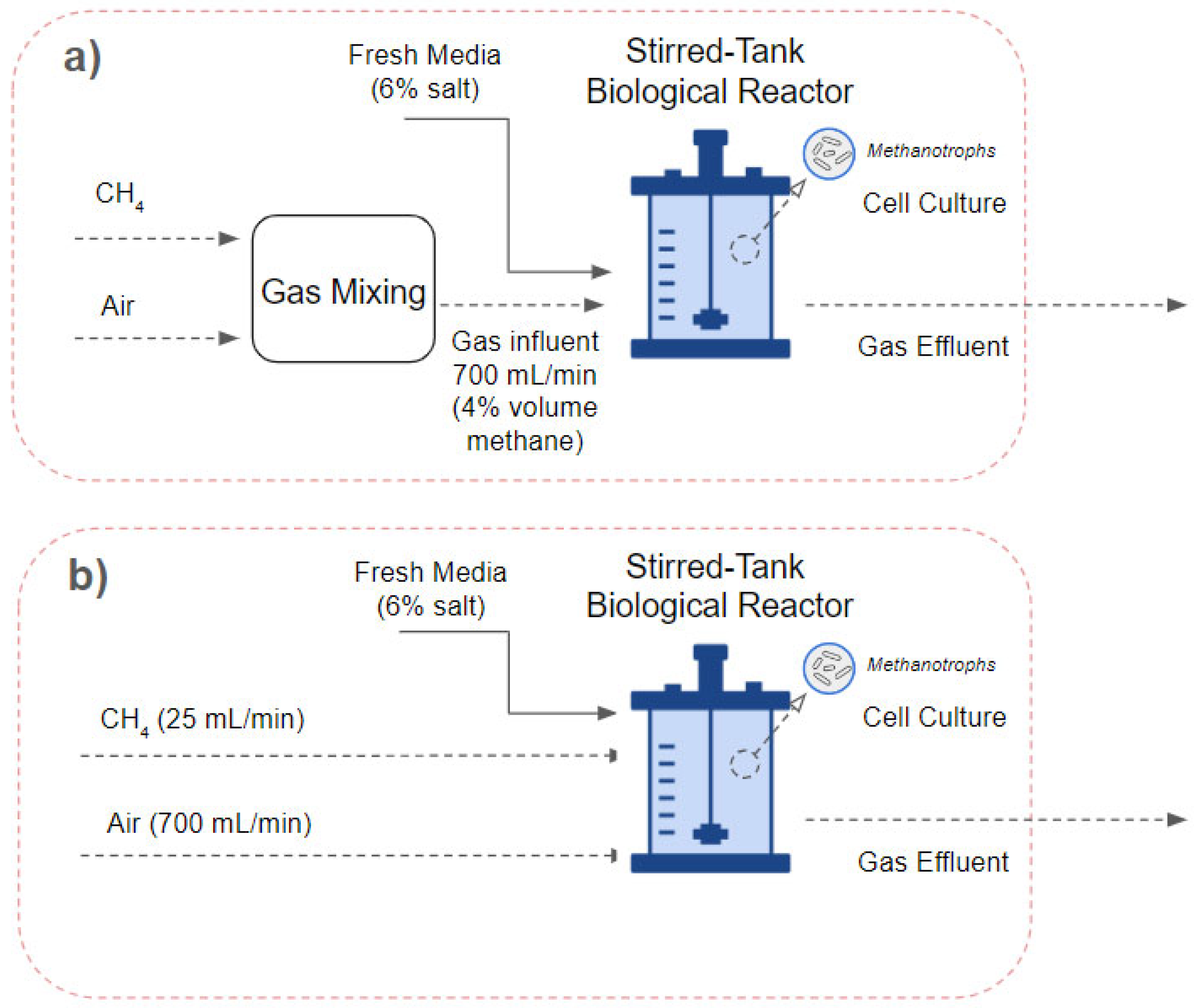
Two methods for adding CH4 and air were implemented: (1) air and CH4 were premixed in a chamber and introduced into the fermenter as a single gas stream, and (2) CH4 and air were introduced into the fermenter using separate gas streams by introducing an additional sparger (Figure 1). For experiments using a single sparger, gases were premixed beforehand to generate a mixture of air and CH4 (approximately 4% of the total volume) to be sparged into the reactor at 0.7 L min−1. For tests that utilized separate gas streams, two spargers were installed in the fermenter, with CH4 and air going through separate spargers. For separated gas stream tests, air was sparged using the 1 mm pore size sparger, while CH4 was sparged through either the 1 mm pore size or 0.5 μm pore size sparger, depending on the test. Figure 1 demonstrates the methods for adding CH4 and air.

2.5. Downstream Processing

Ectoine was extracted from samples via a bio-milking method similar to the one described in Sauer and Galinski [21]. Cultures were grown to a density of 2.0 g/L DCW, and a 150 mL sample was taken for bio-milking.
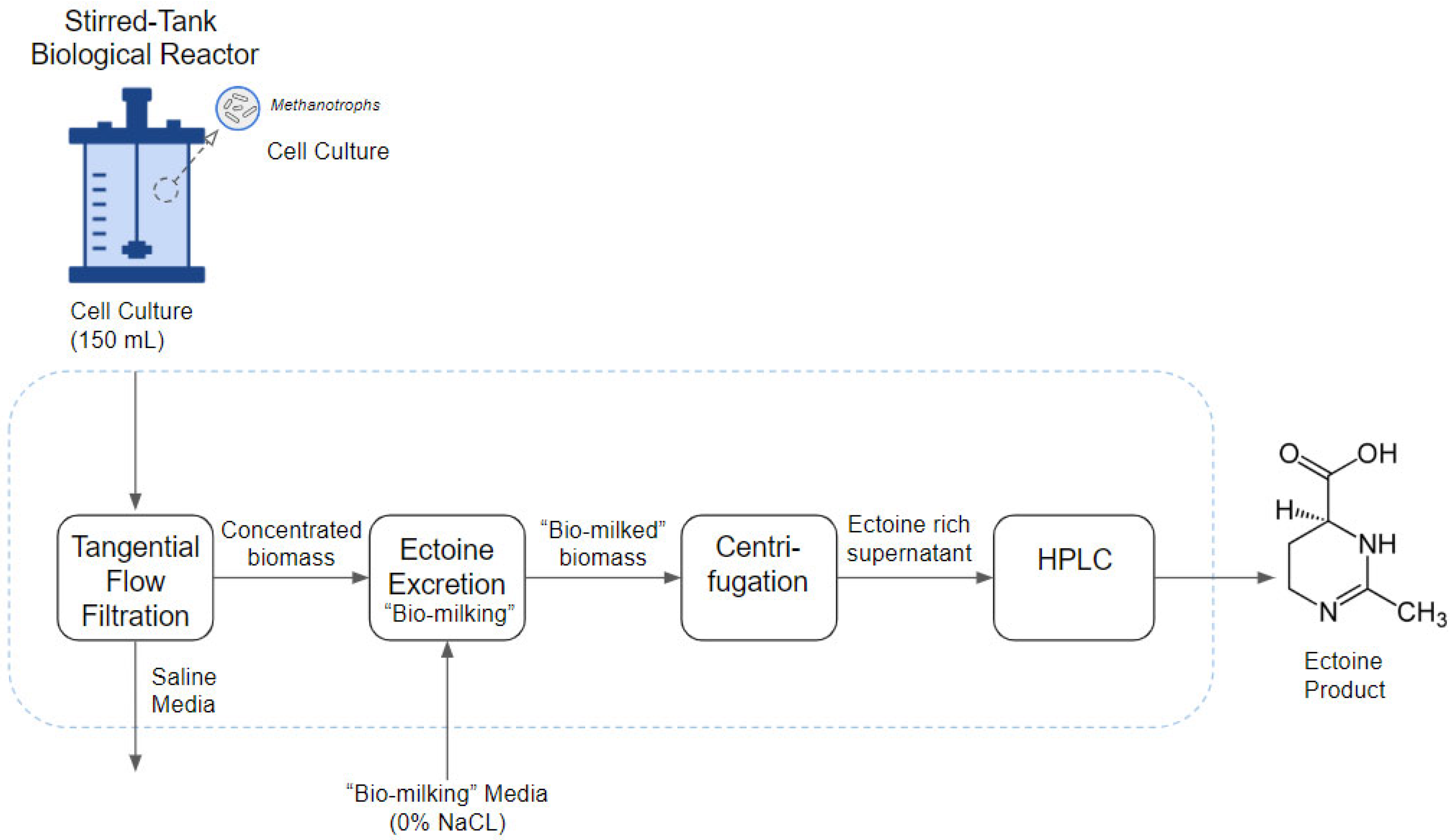
For TFF bio-milking, the Minimate Tangent Flow Filtration System was used (Pall, New York, NY, USA). The cassettes that served as filters were Minimate TFF Capsules with a pore size of 1000 K Daltons. Bio-milking was performed by taking a 150 mL sample of culture and using TFF to concentrate the culture to approximately 7 mL. The culture was then diluted with saline-free MSM to decrease NaCl concentrations from 6% to 2% volume. The culture was then incubated for one hour to allow for ectoine excretion. The specific impact of this concentration factor on cell osmotic shock was not determined in this study. However, dynamic change data of the ectoine excretion rate and cell viability under different concentration factors could be supplemented to determine the optimal concentration process parameters. After the bio-milking incubation period, samples were centrifuged for 15 min at 10,000× g. The supernatant was frozen until it was analyzed for ectoine content using high performance liquid chromatography (HPLC) (Figure 2).

2.6. Analytical

2.6.1. Cell Density

Culture density was measured daily by spectroscopy. Samples in triplicate were analyzed using a wavelength of 600 nm to obtain an optical density (OD) value (HACH, Ames, IA, USA). Depending on the culture density, samples were withdrawn from the fermenter and diluted to obtain an accurate reading from the spectrometer. By comparing OD values to samples taken at the same time that were dried and weighed, it was determined that one unit of OD was equivalent to 0.34 g L−1 DCW.

2.6.2. CH4 Concentration

CH4 content for influent and effluent gas samples was measured using gas chromatography (GC) by the Agilent 7890A (Santa Clara, CA, USA). An Agilent CarbonPLOT column with a length of 30 m, a diameter of 0.32 µm, and a film thickness of 3.00 µm was used. Column flow was set to 1.5 mL/min. A flame ionization detector (FID) was used to measure CH4 content. The FID was operated at a temperature of 250 C, an airflow of 300 mL/min, H2 flow of 40 mL/min, and N2 as makeup flow for 25 mL/min. The oven was operated at a temperature of 200 °C. The inlet was operated at 125 °C with a 3 mL/min septum purge flow. To quantify the CH4 concentrations of test samples, the peak area of samples was compared against a standard curve generated from gas standards of known CH4 concentrations.
Gas samples were taken using a 10 μL gas-tight syringe injected directly into the GC. Effluent gas samples were obtained by injecting the syringe into a septum located on the top of the fermenter and collecting a sample of the reactor headspace.
The method for collecting influent CH4 samples varied depending on whether the CH4 and air inputs into the reactor were premixed or added separately. For premixed cultures, a syringe was injected into the gas mixing chamber using a septum similar to the one used to collect effluent samples, a sample was collected to determine influent CH4 concentration.
For tests that utilized separate flow streams for air and CH4, no premixed influent CH4 concentration could be compared with the effluent CH4 concentration. To overcome this constraint, CH4 and air flows were temporarily redirected to a 1 L bottle filled with approximately 500 mL of water. There were two ports on the bottle for adding the respective gases, which were sparged through the water from the bottom. After waiting 10 min for the system to reach equilibrium, headspace samples of the 1 L bottle were taken to be considered as influent gas measurements for the system.
For each day that CH4 concentration data were collected, three influent and three effluent samples were collected. Average values for influent and effluent gas samples were calculated, and the average values were used for further calculation and statistical analysis.

2.6.3. Ectoine Quantification

Ectoine concentrations in the cultures were quantified with HPLC-UV using an Agilent 1260 Infinity II (Santa Clara, CA, USA). To prepare samples for HPLC, samples were thawed, centrifuged at 10,000× g for 15 min, and filtered through 0.22 µm filters. For HPLC operation, a ZORBAX Eclipse Plus C-18 column was used with a C-18 precolumn (Agilent, Santa Clara, CA, USA). The column was operated at 30 C. The HPLC method for ectoine quantification utilized a gradient mobile phase of water and acetyl nitrate. At 0, 10, and 15 min the concentration of acetyl nitrate was 0%, 20%, and 95%, respectively. A flow rate of 1 mL min−1 for the mobile phase was used. Peak areas were quantified at a wavelength of 230 nm. Ectoine concentration was quantified by comparing peak areas of samples to a standard curve generated by standards made from ectoine that was purchased (95% purity, Sigma Aldrich, St. Louis, MO, USA). The retention time for ectoine was observed to occur between 2.47 and 2.50 min.

2.7. Calculation and Statistical Analysis

2.7.1. Calculation

To determine the amount of CH4 removed by the system, the following equations from Rodríguez et al. [37] were used to describe CH4 removal efficiency (CH4-RE) and CH4 elimination capacity (CH4-EC).
C H 4 R E % = c C H 4 , I N c C H 4 , O U T c C H 4 , I N
C H 4 E C g CH 4 m 3 h 1 = Q I N × C H 4 , I N Q O U T × C H 4 , O U T V
where QIN and QOUT are representative of inlet and outlet gas flow rates, respectively (m3 h−1); CIN and COUT indicate influent and effluent CH4 concentrations, respectively (g m−3); and V describes the working volume of the fermenter (m3).
The volumetric mass transfer coefficient (kLa) of CH4 was determined by Equation (3) [30].
k L a ( h 1 ) = C H 4 E C C C H 4 , O U T H C H 4 C L , C H 4
where HCH4 is the dimensionless Henry’s constant (CG/CL), and with values of 29.1 for 21 °C and 32.2 for 28 °C [38]. CL,CH4 is representative of the CH4 concentration in the aqueous phase, which is considered negligible due to the limited mass transfer of CH4 from the gas to liquid phase. Despite the low solubility that O2 exhibits, no limitation was observed due to the higher concentration of O2 in the influent flow.
Reactor productivity describes the efficiency of the reactor at producing ectoine in terms of the amount of product produced within a certain time period. Reactor productivity was calculated using Equation (4).
R p ( mg ectoine L 1 h 1 ) = Y P × Y X t
where RP represents reactor productivity, YP is the yield of ectoine (mg ectoine/g DCW), YX is the yield of biomass (g DCW/L), and t (hours) indicates time elapsed since the beginning of the test. Reactor productivity was calculated at the end of the exponential growth phase. Reactor productivity was chosen over total ectoine titer for displaying ectoine production, as productivity better communicates the production rate at which maximum titer is achieved and is more applicable to scale-up.

2.7.2. Statistical Analysis

Statistical analysis was performed using SAS® Studio software Version 3 (Cary, NC, USA). The statistical significance of variables was determined using a 2 × 2 × 2 factorial design ANOVA. The factorial design included the three tested variables, with two levels for each variable (Table 1). Results for factors and interactions were considered significant based on a selected p-value of p ≤ 0.05. Mean values for a factor’s level were calculated by averaging values from all tests that utilize the given level. i.e., any of the eight tests conducted (Table 1) where the culture temperature was maintained at 28 °C were averaged together, and, similarly, any tests that were maintained at 21 °C were averaged together with the two mean values then being compared against another. This process was repeated with the factors of sparger pore size, and gas input method. Mean values are reported with standard error.
Time as a factor was considered due to the limitations of the experiment design, as only one reactor could be operated for each experiment. Samples used to measure CH4-RE were taken over three consecutive days during exponential growth to increase the data set size. To compensate for this, an additional factor for time was added with three levels to generate a 2 × 2 × 2 × 3 factorial design ANOVA. The addition of a time factor was to determine if these samples, taken over the course of peak CH4 consumption across three days, were statistically significant from one another. If these samples were not significantly different in reference to time, then these samples could effectively be considered triplicates and could be used to increase the data set size and provide better statistic insight. The statistical analysis showed that time was not a significant factor over the selected period for CH4 biodegradation (ANOVA test value of p = 0.3330). As time was not a significant factor in CH4 removal, the samples taken over the time period could be treated as triplicates. Conditions that were replicated showed consistency in CH4-RE, CH4-EC, and growth rates, however most fermentation conditions were conducted once due to constraints of time and resources.

3. Results and Discussion

3.1. Effects of Temperature

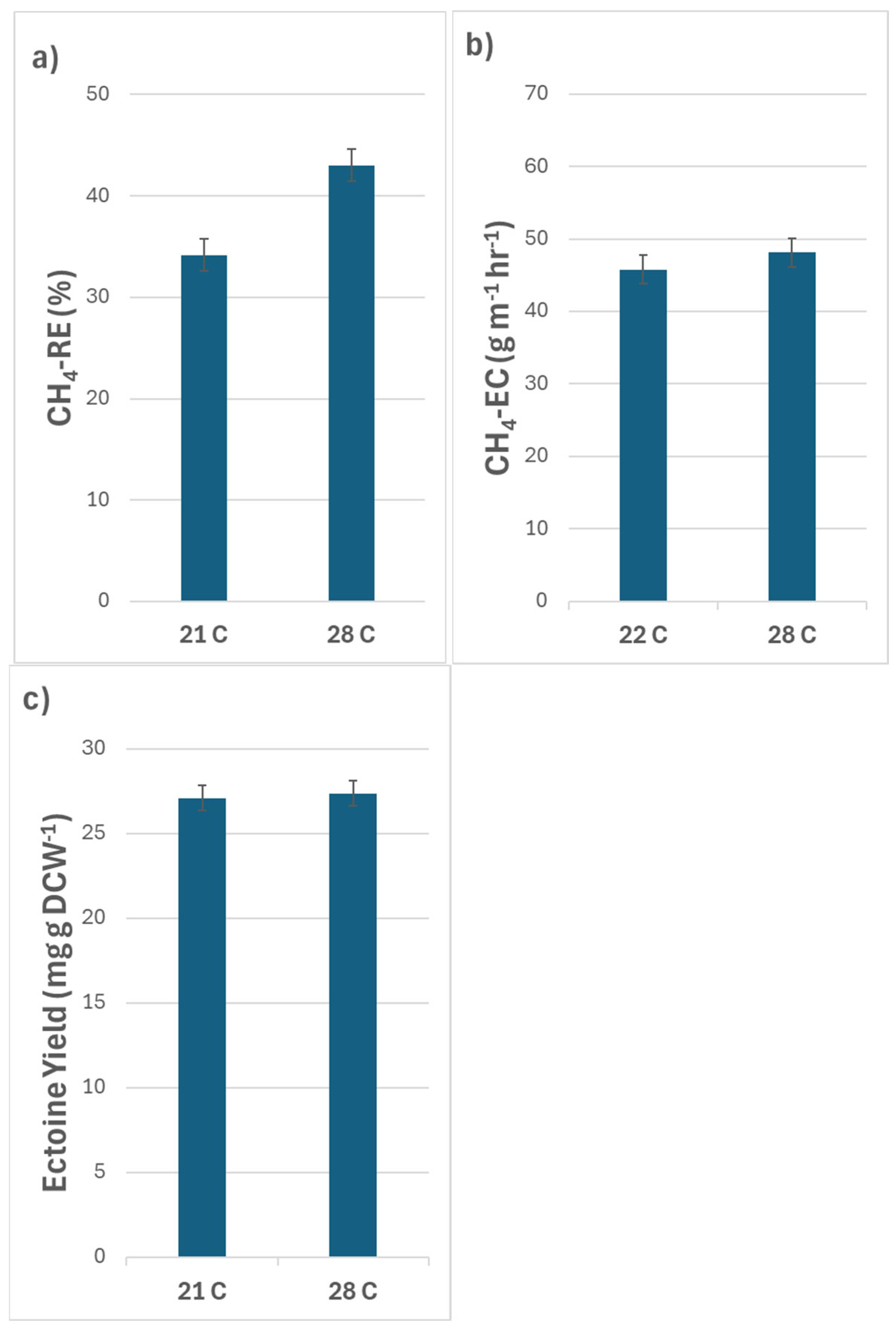
Effects of temperature on CH4 removal, ectoine production, and growth rate were determined. Mean CH4-RE for 21 °C and 28 °C were 34.18 ± 1.57% and 43.04 ± 1.57%, respectively (Figure 3a). Mean CH4-EC values for 21 °C and 28 °C were 45.80 ± 1.96 g CH4 m−3 h−1 and 48.152 ± 1.96 g CH4 m−3 h−1, respectively (Figure 3b). Results were outside the threshold of significance with an ANOVA test value of p = 0.0574. Although methane removal efficiency at 28 °C is higher than that at 21 °C, which was speculated to be associated with the optimization of enzyme kinetics, the specific activity of MMO at these two temperatures was not directly measured. Additional testing at intermediate temperature points of 25 C and 35 C would more accurately help fit the comprehensive influence curve of temperature on methane removal efficiency, MMO activity, and methane solubility, and determine the optimal temperature for the balance among the three. Mean growth rates during the exponential phase at 21 °C and 28 °C were observed to be 0.032 h−1 and 0.044 h−1, respectively. Mean ectoine yields for 21 °C and 28 °C were 27.09 ± 0.74 mg ectoine g DCW−1 and 27.36 ± 0.74 mg ectoine g DCW−1, respectively (Figure 3c). The differences in ectoine yields between the two temperatures were not statistically significant. Carmona-Martínez et al. [13] had previously observed that variances in temperature can have an effect on ectoine yields, with lower temperatures of 15 °C having higher intracellular ectoine concentrations. For the range of temperatures tested in this study, there was no observed effect on ectoine production.

3.2. Effects of Sparger Pore Size

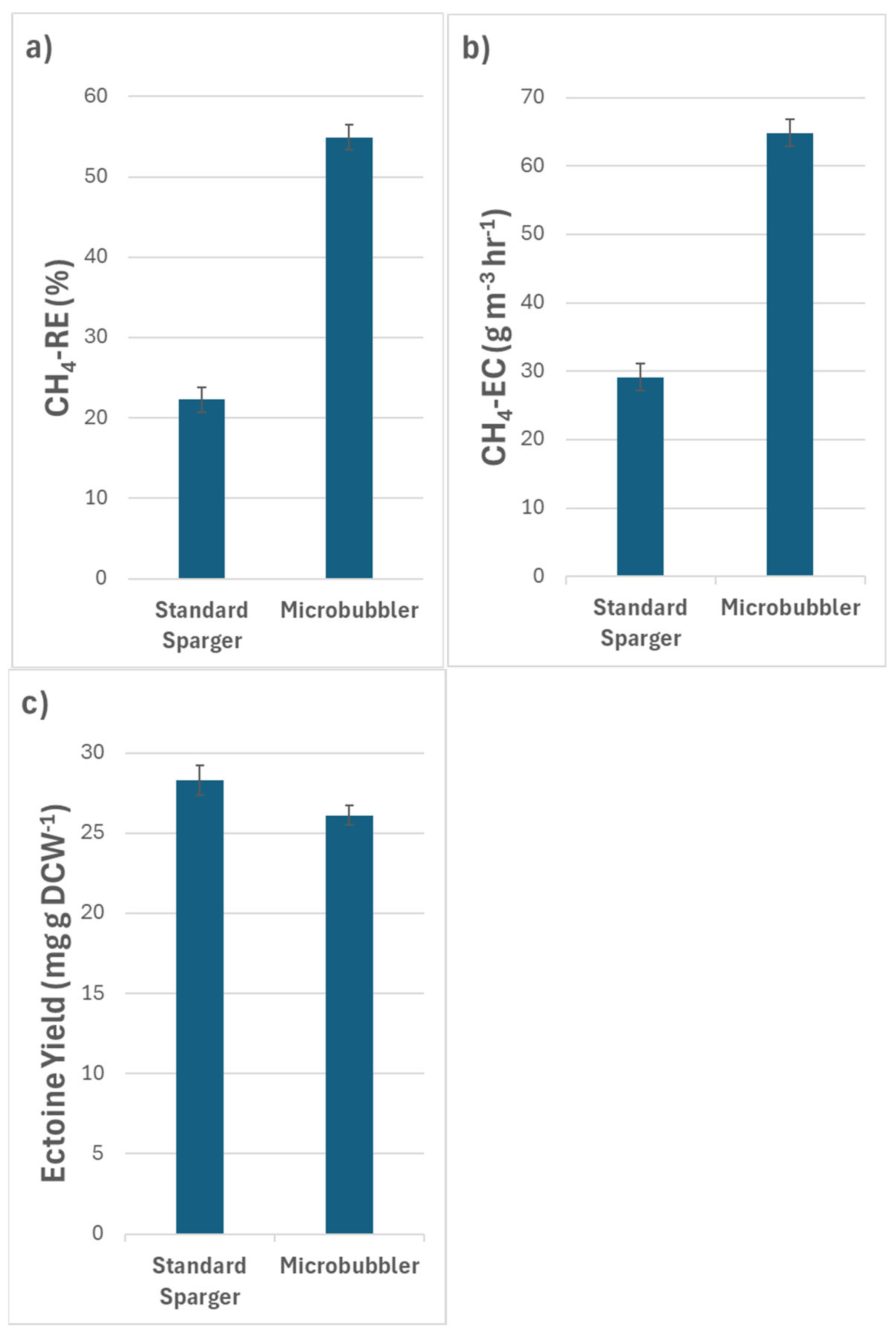
Effects of sparger type on CH4 removal, ectoine production, and growth rate were determined. Decreasing bubble diameter by adjusting sparger pore size had the most significant effect on CH4 removal. Sparger pore sizes of 1 mm and 0.5 µm produced mean CH4-RE values of 22.30 ± 1.57% and 54.92 ± 1.57%, respectively (Figure 4a). The calculated CH4-RE values were statistically significant, with an ANOVA test value of p = 0.0046. Mean CH4-EC for the 1 mm sparger pore size was observed to be 29.12 ± 1.96 g CH4 m−3 h−1. The 0.5 μm pore size resulted in a CH4-EC value of 64.84 ± 1.96 g CH4 m−3 h−1 (Figure 4b). The increases in both CH4-RE and CH4-EC can be attributed to the fact that the decreasing bubble diameter increases the specific surface area of the gas bubble, which increases the ratio of surface area to volume between the gas and liquid phase, and therefore the overall volumetric gas transfer coefficient. This increase in mass transfer is further demonstrated when comparing calculated mean kLa values for the sparger types, which were 33.93 h−1 for the 1 mm pore size and 146.96 h−1 for the 0.5 µm pore size. Mean specific growth rates for the 1 mm and 0.5 µm sparger pore sizes were observed to be 0.032 h−1 and 0.043 h−1, respectively. Reported differences in mean ectoine yields were not statistically significant, with mean ectoine yields for 1 mm and 0.5 um sparger pore sizes producing values of 28.32 ± 0.93 mg ectoine g DCW−1 and 26.13 ± 0.61 mg ectoine g DCW−1, respectively (Figure 4c). Sparger pore size demonstrated an effect on methane removal and growth rate, while having no statistical effect on ectoine yields.

3.3. Effects of Gas Input Method

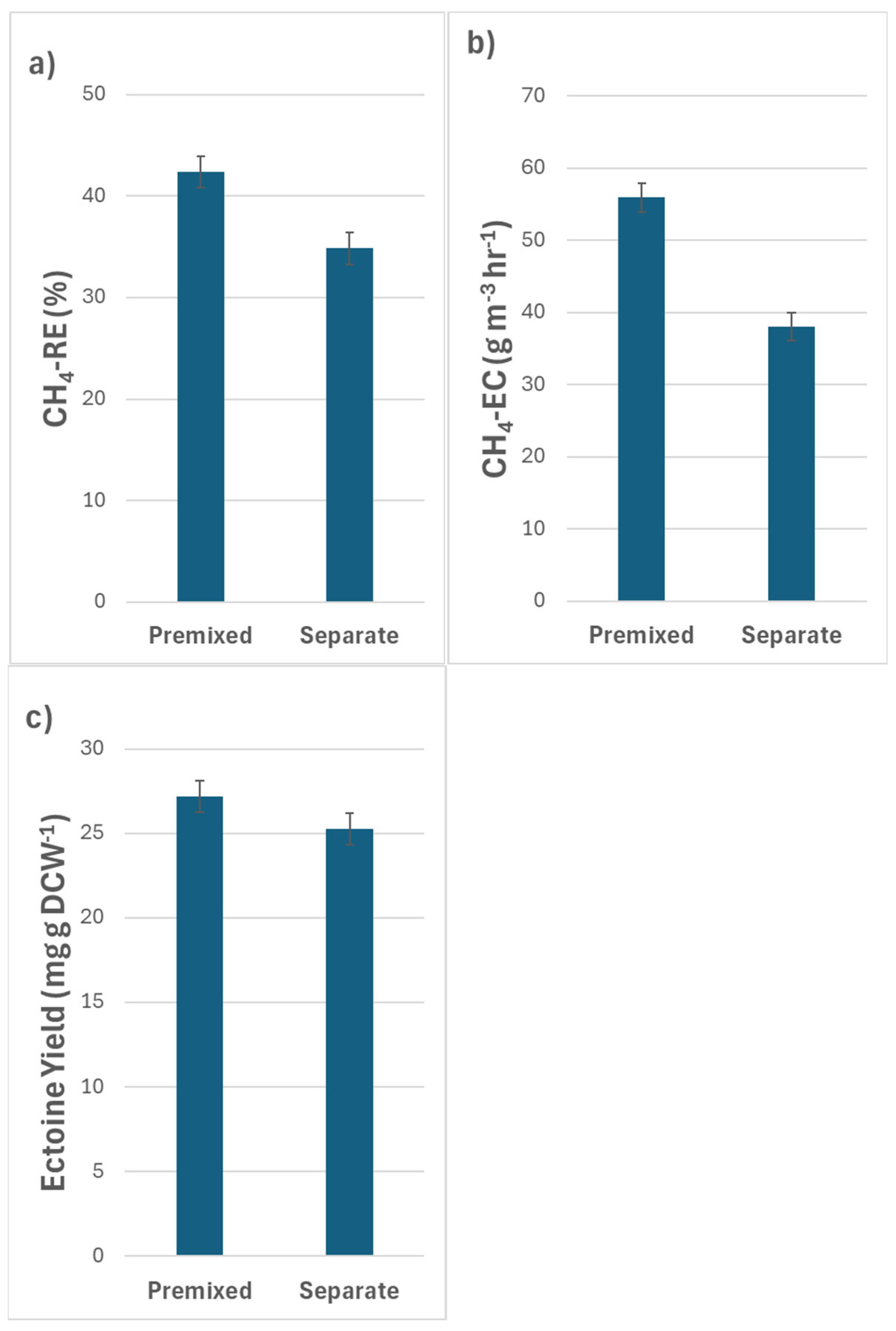
Methods for introducing CH4 and air were evaluated to determine their effects on CH4 removal, growth rates, and ectoine production. There was an observed effect on CH4-RE and CH4-EC based on the gas input method depending on whether air and CH4 were premixed before being introduced into the reactor together, or input separately through independent spargers. Experiments that utilized a premixed gas input outperformed the separated gas streams, with mean CH4-RE values of 42.38 ± 1.57% and 34.83 ± 1.57%, respectively (Figure 5a). This translated to CH4-EC values of 55.92 ± 1.96 g CH4 m−3 h−1 for premixed gas input and 38.04 ± 1.96 g CH4 m−3 h−1 for separate gas input (Figure 5b). These results are statistically significant, with an ANOVA test value of p = 0.0114. These results were unexpected as it was anticipated that the separate gas streams would be more ideal for gas transfer and CH4 removal. This is due to the premixed gas input having a flow of approximately 0.7 L min−1, while the separate gas input CH4 would have a much slower flow of 25 mL min−1 to possibly increase GRT. One potential reason separate gas streams were less effective may have to do with the reactor design. The configuration to install the two spargers into the reactor caused the spargers to be offset from the impeller. This offset may have negatively affected mixing, which could lead to the observed decrease of CH4 removal. Mean growth rates for premixed and separate gas inputs were 0.036 h−1 and 0.039 h−1, respectively. Mean ectoine yields were observed to be 27.24 ± 0.93 mg ectoine g DCW−1 for premixed input and 27.21 ± 0.93 mg ectoine g DCW−1 for separate input (Figure 5c). This difference in ectoine yields was not statistically significant. The gas input method was observed to have a significant effect on CH4 removal, but growth rates were comparable between the methods. Ectoine yields were unaffected by gas input method.

3.4. Optimal Set-Up

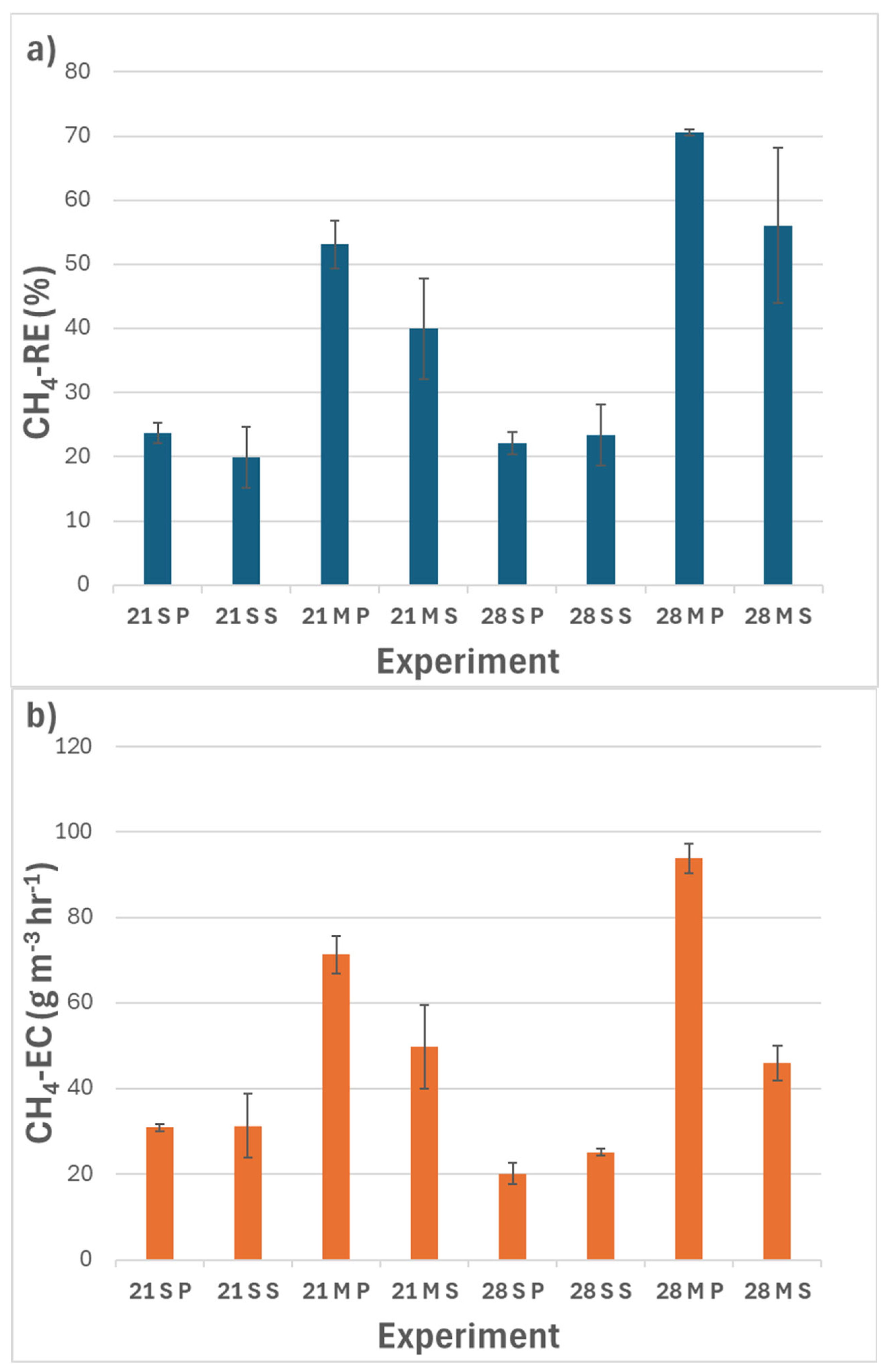
Maximum CH4 removal occurred when the fermenter was operated at 28 °C, utilized the micro-bubbler with a 0.5 µm pore size, and implemented a premixed gas input of CH4 and air (experiment 28MP). The observed CH4-RE for this configuration was 70.56 ± 0.54%, which translated to a CH4-EC of 93.82 ± 3.36 g CH4 m−3 h−1 (Figure 6). This CH4-RE of 70.56 ± 0.54% is comparable to the maximum CH4-RE observed in the literature of 79 ± 4% [23]. The maximum CH4-EC of this study exceeds the highest CH4-EC observed in the literature related to bench-scale methanotrophic cultures, which was reported to be 53.0 ± 2.3 g CH4 m−3 h−1 [37]. It was also observed in this study that cultures that utilized a micro-bubbler and maintained at 28 °C experienced the highest specific growth rate of 0.053 h−1, regardless of the gas input method.
The strategies for optimizing CH4 removal differ in this study from those performed previously. It should also be noted that these other studies were more focused on increasing ectoine yields, while this study was focused on CH4 removal. Rodriguez et al. [37] and Rodero et al. [23] found success in utilizing a BCR and by introducing gas recirculation in order to increase the GRT of the CH4. This study utilized a more conventional stirred-tank reactor set-up without a system for gas circulation. Rodero et al. [23] also utilized a consortium of methanotrophs, while this study focused on using a pure culture of M. alcaliphilum 20Z.
As the aim of this research was to identify factors to improve CH4 removal, this study identified that factors, including temperature, sparger pore size, and the gas input method, did not have a significant effect on intracellular ectoine yields. For these reasons, an optimal reactor set-up for increasing intra-cellular ectoine yields was not identified.

3.5. Interactions Between Factors

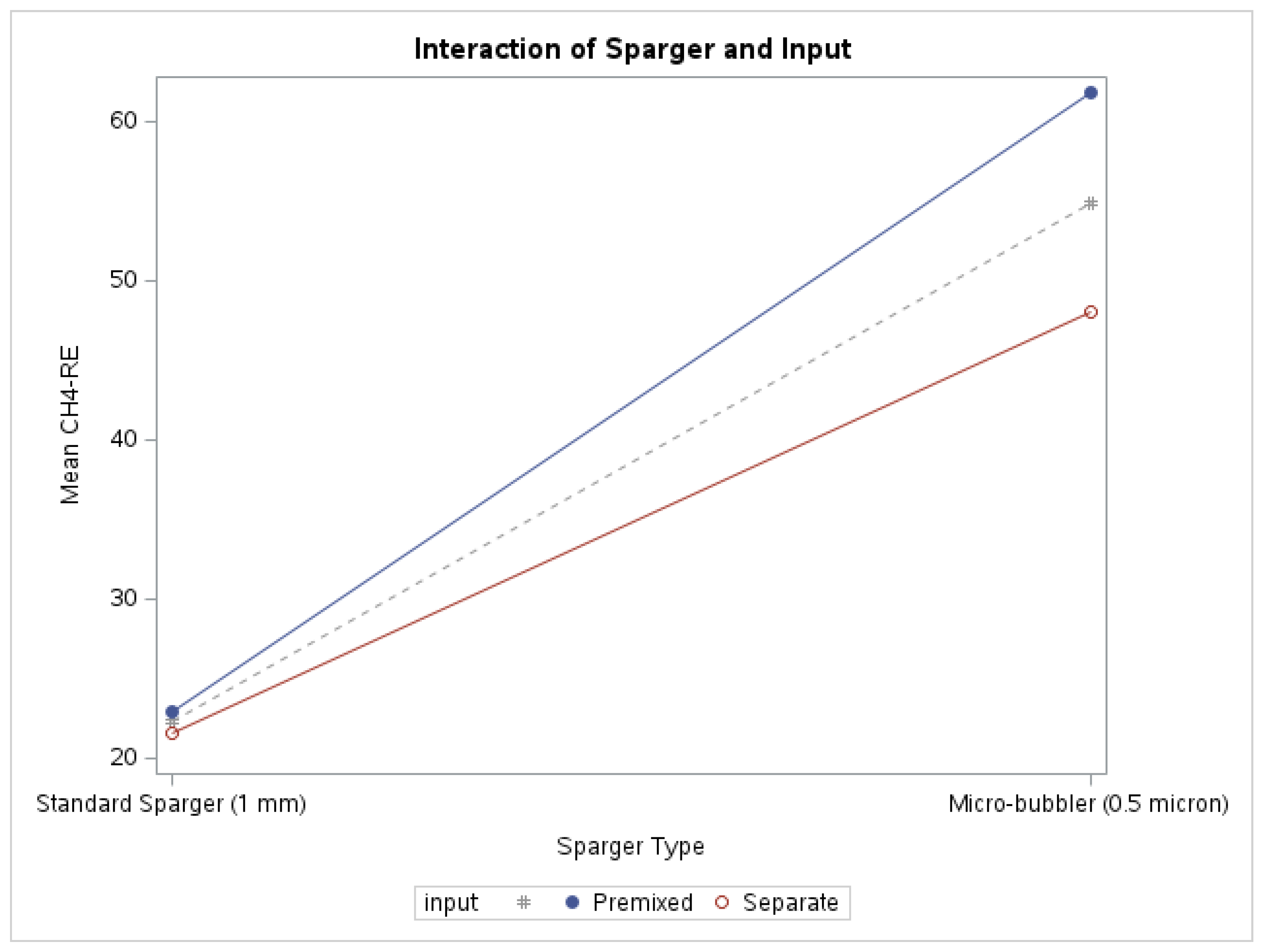
With regard to CH4 removal efficiency, there was a statistically significant interaction between the sparger choice and the gas input method, with an ANOVA test value of p = 0.0256. When utilizing the 0.5 μm pore size sparger, there was a significant difference of CH4 removal between the premixed and separate gas input methods. Conversely, when using the 1 mm pore size sparger the difference for mean CH4 removal between premixed and separate input of gases was negligible (Figure 7). The fact that there was a significant difference in CH4 removal between the two gas input methods when using the 0.5 μm pore size sparger, but no significant difference when using the 1 mm pore size sparger, is evidence of an interaction.
This interaction suggests that the most important factor to increase CH4 removal is to decrease sparger pore size to improve mass transfer. Due to the decreased mass transfer of the larger bubbles using the 1 mm sparger, inputting the gases premixed or separately resulted in little difference in CH4 removal. Once the mass transfer of CH4 was improved by using the 0.5 μm pore size sparger, the effects of gas input methods on CH4-RE were observed to be significant.

3.6. Tangential Flow Filtration

Bio-milking M. alcaliphilum 20Z utilizing a TFF method was successful. Ectoine yields from TFF bio-milking ranged from 22 to 32 mg ectoine g DCW−1, which are typical yields for M alcaliphilum 20Z [9]. The centrifugation method for bio-milking found in Cantera et al. [9] showed higher ectoine yields, with intracellular ectoine concentrations observed to be 70.4 mg ectoine g DCW−1, being able to extract 70.4% of the ectoine using bio-milking, and translating to a yield of 49.6 mg g DCW−1. It should be noted that operation conditions were different between this study and previous studies, which may potentially explain the differences in total ectoine yields. This study serves as a proof of concept for ectoine bio-milking of methanotrophs utilizing TFF. More research is required to determine the cell viability after TFF treatment and how it compares to a centrifugation method, in which TFF may be better suited as it involves less shear stresses [24,39]. This increase in cell viability opens possibilities for cell recycle that could further strengthen the case for TFF implementation. There may also be a benefit in an analysis to compare the economic feasibility of TFF and centrifugation for industrial scale application. This comparative analysis could take into consideration anticipated biomass yields, cost of maintenance (consumables, equipment upkeep), power requirements, speed of treatment, and benefits of cell recycle.

3.7. Reactor Productivity

As intracellular ectoine yields did not significantly vary between tests in this experiment, it was determined that ectoine yields were directly correlated with biomass yields. Although all tests obtained a maximum density of approximately 3 g L−1 DCW, the time taken to obtain this maximum density varied from test to test. Increasing the specific growth rate was associated with a decrease in time to reach maximum density. For this study, increasing the specific growth rate of the culture was the biggest factor in increasing total reactor productivity of ectoine. A cultivation temperature of 28 °C demonstrated higher productivity compared with 22 °C, with values of 0.542 mg ectoine L−1 h−1 and 0.500 mg ectoine L−1 h−1, respectively, with higher temperatures relating to improved enzyme kinetics and growth rates. The 0.5 μm pore size microbubbler generated a productivity of 0.566 mg ectoine L−1 h−1 compared with the standard 1 mm pore size that generated a productivity of 0.426 mg ectoine L−1 h−1. The improved mass transfer of CH4 using a smaller sparger pore size improved growth rates and associated reactor productivity. Utilizing separate gas input streams resulted in the largest effect on reactor productivity with an average value of 0.579 mg ectoine L−1 h−1 while the premixed gas inputs only resulted in an average productivity of 0.426 mg ectoine L−1 h−1. This increase of reactor productivity associated with separate gas input streams could be attributed to increased CH4 mass transfer. This is because the separate gas streams contain gas rather than a mixture which, according to Raoult’s law, would increase the concentration of CH4 in the liquid phase.

4. Conclusions

Optimizing reactor operational conditions greatly improved CH4 removal by M. alcaliphilum 20Z in a stirred-tank reactor. Utilizing a gas sparger with a smaller pore size proved to be the most important factor in improving CH4 removal of the system by generating smaller bubbles that are more effective for mass transfer. Reactor configurations that used a premixed gas input of CH4 and air saw greater CH4 removal than set-ups that input gases separately. Higher temperatures allow for maximized enzyme kinetics of MMO and allow for the uptake of a greater proportion of CH4, despite lower solubility. The variation of these factors did not have a significant effect on intracellular ectoine yields but did have an effect on the reactor productivity in terms of total yield of ectoine. Increasing the specific growth rate of the culture increased the reactor productivity. Specific growth rates were increased by utilizing higher temperatures, smaller sparger pore size, and separate gas input. This study also validates the proof of concept of implementing TFF for bio-milking ectoine in methanotrophs.

Author Contributions

Conceptualization, J.S.; methodology, J.S.; software, J.S.; validation, J.S.; formal analysis, J.S., T.M.M. and B.H.; investigation, J.S.; resources, R.C.S.; data curation, T.M.M. and B.H.; writing—original draft preparation, J.S., B.H. and T.M.M.; writing—review and editing, R.C.S.; visualization, J.S.; supervision, J.S.; project administration, J.S.; funding acquisition, R.C.S. All authors have read and agreed to the published version of the manuscript.

Funding

Funding for this research was provided by the Utah Water Research Laboratory (A02606) and the Huntsman Corporation Endowed Professorship (A53879). Research space is provided by the SWBEC lab.

Institutional Review Board Statement

Not applicable.

Informed Consent Statement

Not applicable.

Data Availability Statement

The raw data supporting the conclusions of this article will be made available by the authors on request.

Acknowledgments

Funding for this research was provided by the Utah Water Research Laboratory. The authors also acknowledge the Sustainable Waste-to-Bioproducts Engineering Center for providing materials, along with a research space to conduct this study. Other acknowledgments go to Ethan Rico, Isaac Trejo, and Will Pendelton who assisted in study preparation and data collection. The authors also acknowledge Richard Cutler for his assistance in statistical analysis of the data.

Conflicts of Interest

The authors declare no conflicts of interest. The funders had no role in the design of the study; in the collection, analyses, or interpretation of data; in the writing of the manuscript; or in the decision to publish the results.

References

  1. U.S. Environmental Protection Agency. Importance of Methane. Available online: https://www.epa.gov/gmi/importance-methane (accessed on 29 June 2024).
  2. Song, C.; Zhu, J.-J.; Willis, J.L.; Moore, D.P.; Zondlo, M.A.; Ren, Z.J. Methane Emissions from Municipal Wastewater Collection and Treatment Systems. Environ. Sci. Technol. 2023, 57, 2248–2261. [Google Scholar] [CrossRef] [PubMed]
  3. Wang, Y.; Fang, M.; Lou, Z.; He, H.; Guo, Y.; Pi, X.; Wang, Y.; Yin, K.; Fei, X. Methane Emissions from Landfills Differentially Underestimated Worldwide. Nat. Sustain. 2024, 7, 496–507. [Google Scholar] [CrossRef]
  4. Yang, L.; Ge, X.; Wan, C.; Yu, F.; Li, Y. Progress and Perspectives in Converting Biogas to Transportation Fuels. Renew. Sustain. Energy Rev. 2014, 40, 1133–1152. [Google Scholar] [CrossRef]
  5. Strong, P.J.; Xie, S.; Clarke, W.P. Methane as a Resource: Can the Methanotrophs Add Value? Environ. Sci. Technol. 2015, 49, 4001–4018. [Google Scholar] [CrossRef]
  6. Murrell, J.C.; Gilbert, B.; McDonald, I.R. Molecular Biology and Regulation of Methane Monooxygenase. Arch. Microbiol. 2000, 173, 325–332. [Google Scholar] [CrossRef]
  7. Strong, P.J.; Kalyuzhnaya, M.; Silverman, J.; Clarke, W.P. A Methanotroph-Based Biorefinery: Potential Scenarios for Generating Multiple Products from a Single Fermentation. Bioresour. Technol. 2016, 215, 314–323. [Google Scholar] [CrossRef]
  8. Khmelenina, V.N. Isolation and Characterization of Halotolerant Alkaliphilic Methanotrophic Bacteria from Tuva Soda Lakes. Curr. Microbiol. 1997, 35, 257–261. [Google Scholar] [CrossRef]
  9. Cantera, S.; Lebrero, R.; Sadornil, L.; García-Encina, P.A.; Muñoz, R. Valorization of CH 4 Emissions into High-Added-Value Products: Assessing the Production of Ectoine Coupled with CH 4 Abatement. J. Environ. Manag. 2016, 182, 160–165. [Google Scholar] [CrossRef] [PubMed]
  10. Khmelenina, V.N.; Kalyuzhnaya, M.G.; Sakharovsky, V.G.; Suzina, N.E.; Trotsenko, Y.A.; Gottschalk, G. Osmoadaptation in Halophilic and Alkaliphilic Methanotrophs. Arch. Microbiol. 1999, 172, 321–329. [Google Scholar] [CrossRef] [PubMed]
  11. Cantera, S.; Estrada, J.M.; Lebrero, R.; García-Encina, P.A.; Muñoz, R. Comparative Performance Evaluation of Conventional and Two-Phase Hydrophobic Stirred Tank Reactors for Methane Abatement: Mass Transfer and Biological Considerations. Biotechnol. Bioeng. 2016, 113, 1203–1212. [Google Scholar] [CrossRef]
  12. Pastor, J.M.; Salvador, M.; Argandoña, M.; Bernal, V.; Reina-Bueno, M.; Csonka, L.N.; Iborra, J.L.; Vargas, C.; Nieto, J.J.; Cánovas, M. Ectoines in Cell Stress Protection: Uses and Biotechnological Production. Biotechnol. Adv. 2010, 28, 782–801. [Google Scholar] [CrossRef] [PubMed]
  13. Carmona-Martínez, A.A.; Marcos-Rodrigo, E.; Bordel, S.; Marín, D.; Herrero-Lobo, R.; García-Encina, P.A.; Muñoz, R. Elucidating the Key Environmental Parameters during the Production of Ectoines from Biogas by Mixed Methanotrophic Consortia. J. Environ. Manag. 2021, 298, 113462. [Google Scholar] [CrossRef]
  14. Yu, I.; Jindo, Y.; Nagaoka, M. Microscopic Understanding of Preferential Exclusion of Compatible Solute Ectoine:  Direct Interaction and Hydration Alteration. J. Phys. Chem. B 2007, 111, 10231–10238. [Google Scholar] [CrossRef]
  15. Schröter, M.-A.; Meyer, S.; Hahn, M.B.; Solomun, T.; Sturm, H.; Kunte, H.J. Ectoine Protects DNA from Damage by Ionizing Radiation. Sci. Rep. 2017, 7, 15272. [Google Scholar] [CrossRef]
  16. Galinski, E.A.; Pfeiffer, H.-P.; Trüper, H.G. 1,4,5,6-Tetrahydro-2-Methyl-4-Pyrimidinecarboxylic Acid. Eur. J. Biochem. 1985, 149, 135–139. [Google Scholar] [CrossRef]
  17. Jarusintanakorn, S.; Mastrobattista, E.; Yamabhai, M. Ectoine Enhances Recombinant Antibody Production in Chinese Hamster Ovary Cells by Promoting Cell Cycle Arrest. New Biotechnol. 2024, 83, 56–65. [Google Scholar] [CrossRef]
  18. Widderich, N.; Höppner, A.; Pittelkow, M.; Heider, J.; Smits, S.H.J.; Bremer, E. Biochemical Properties of Ectoine Hydroxylases from Extremophiles and Their Wider Taxonomic Distribution among Microorganisms. PLoS ONE 2014, 9, e93809. [Google Scholar] [CrossRef]
  19. Zaccai, G.; Bagyan, I.; Combet, J.; Cuello, G.J.; Demé, B.; Fichou, Y.; Gallat, F.-X.; Galvan Josa, V.M.; von Gronau, S.; Haertlein, M.; et al. Neutrons Describe Ectoine Effects on Water H-Bonding and Hydration around a Soluble Protein and a Cell Membrane. Sci. Rep. 2016, 6, 31434. [Google Scholar] [CrossRef]
  20. Kunte, H.; Lentzen, G.; Galinski, E. Industrial Production of the Cell Protectant Ectoine: Protection Mechanisms, Processes, and Products. Curr. Biotechnol. 2014, 3, 10–25. [Google Scholar] [CrossRef]
  21. Sauer, T.; Galinski, E.A. Bacterial Milking: A Novel Bioprocess for Production of Compatible Solutes. Biotechnol. Bioeng. 1998, 57, 306–313. [Google Scholar] [CrossRef]
  22. Cantera, S.; Lebrero, R.; Rodríguez, S.; García-Encina, P.A.; Muñoz, R. Ectoine Bio-Milking in Methanotrophs: A Step Further towards Methane-Based Bio-Refineries into High Added-Value Products. Chem. Eng. J. 2017, 328, 44–48. [Google Scholar] [CrossRef]
  23. del Rodero, M.R.; Carmona-Martínez, A.A.; Martínez-Fraile, C.; Herrero-Lobo, R.; Rodríguez, E.; García-Encina, P.A.; Peña, M.; Muñoz, R. Ectoines Production from Biogas in Pilot Bubble Column Bioreactors and Their Subsequent Extraction via Bio-Milking. Water Res. 2023, 245, 120665. [Google Scholar] [CrossRef]
  24. Shah, N.K.; Ivone, R.; Shen, J.; Meenach, S.A. A Comparison of Centrifugation and Tangential Flow Filtration for Nanoparticle Purification: A Case Study on Acetalated Dextran Nanoparticles. Particuology 2020, 50, 189–196. [Google Scholar] [CrossRef]
  25. Yu, Y.; Ramsay, J.A.; Ramsay, B.A. On-Line Estimation of Dissolved Methane Concentration during Methanotrophic Fermentations. Biotechnol. Bioeng. 2006, 95, 788–793. [Google Scholar] [CrossRef]
  26. Wiesenburg, D.A.; Guinasso, N.L., Jr. Equilibrium Solubilities of Methane, Carbon Monoxide, and Hydrogen in Water and Sea Water. J. Chem. Eng. Data 1979, 24, 356–360. [Google Scholar] [CrossRef]
  27. Zhang, S.; Yan, L.; Cao, J.; Wang, K.; Luo, Y.; Hu, H.; Wang, L.; Yu, R.; Pan, B.; Yu, K.; et al. Salinity Significantly Affects Methane Oxidation and Methanotrophic Community in Inner Mongolia Lake Sediments. Front. Microbiol. 2023, 13, 1067017. [Google Scholar] [CrossRef] [PubMed]
  28. Reddy, K.R.; Rai, R.K.; Green, S.J.; Chetri, J.K. Effect of Temperature on Methane Oxidation and Community Composition in Landfill Cover Soil. J. Ind. Microbiol. Biotechnol. 2019, 46, 1283–1295. [Google Scholar] [CrossRef]
  29. Pérez, V.; Moltó, J.L.; Lebrero, R.; Muñoz, R. Ectoine Production from Biogas in Waste Treatment Facilities: A Techno-Economic and Sensitivity Analysis. ACS Sustain. Chem. Eng. 2021, 9, 17371–17380. [Google Scholar] [CrossRef] [PubMed]
  30. del Rodero, M.R.; Herrero-Lobo, R.; Pérez, V.; Muñoz, R. Influence of Operational Conditions on the Performance of Biogas Bioconversion into Ectoines in Pilot Bubble Column Bioreactors. Bioresour. Technol. 2022, 358, 127398. [Google Scholar] [CrossRef]
  31. Cantera, S.; Phandanouvong-Lozano, V.; Pascual, C.; García-Encina, P.A.; Lebrero, R.; Hay, A.; Muñoz, R. A Systematic Comparison of Ectoine Production from Upgraded Biogas Using Methylomicrobium Alcaliphilum and a Mixed Haloalkaliphilic Consortium. Waste Manag. 2020, 102, 773–781. [Google Scholar] [CrossRef]
  32. Kalyuzhnaya, M.G.; Khmelenina, V.; Eshinimaev, B.; Sorokin, D.; Fuse, H.; Lidstrom, M.; Trotsenko, Y. Classification of Halo(Alkali)Philic and Halo(Alkali)Tolerant Methanotrophs Provisionally Assigned to the Genera Methylomicrobium and Methylobacter and Emended Description of the Genus Methylomicrobium. Int. J. Syst. Evol. Microbiol. 2008, 58, 591–596. [Google Scholar] [CrossRef]
  33. Akberdin, I.R.; Thompson, M.; Hamilton, R.; Desai, N.; Alexander, D.; Henard, C.A.; Guarnieri, M.T.; Kalyuzhnaya, M.G. Methane Utilization in Methylomicrobium Alcaliphilum 20ZR: A Systems Approach. Sci. Rep. 2018, 8, 2512. [Google Scholar] [CrossRef] [PubMed]
  34. Cho, S.; Ha, S.; Kim, H.S.; Han, J.H.; Kim, H.; Yeon, Y.J.; Na, J.G.; Lee, J. Stimulation of Cell Growth by Addition of Tungsten in Batch Culture of a Methanotrophic Bacterium, Methylomicrobium alcaliphilum 20Z on Methane and Methanol. J. Biotechnol. 2020, 309, 81–84. [Google Scholar] [CrossRef] [PubMed]
  35. Cantera, S.; Lebrero, R.; Rodríguez, E.; García-Encina, P.A.; Muñoz, R. Continuous Abatement of Methane Coupled with Ectoine Production by Methylomicrobium alcaliphilum 20Z in Stirred Tank Reactors: A Step Further towards Greenhouse Gas Biorefineries. J. Clean. Prod. 2017, 152, 134–141. [Google Scholar] [CrossRef]
  36. Rozova, O.N.; Khmelenina, V.N.; Bocharova, K.A.; Mustakhimov, I.I.; Trotsenko, Y.A. Role of NAD+-Dependent Malate Dehydrogenase in the Metabolism of Methylomicrobium Alcaliphilum 20Z and Methylosinus Trichosporium OB3b. Microorganisms 2015, 3, 47–59. [Google Scholar] [CrossRef]
  37. Rodríguez, Y.; Firmino, P.I.M.; Pérez, V.; Lebrero, R.; Muñoz, R. Biogas Valorization via Continuous Polyhydroxybutyrate Production by Methylocystis hirsuta in a Bubble Column Bioreactor. Waste Manag. 2020, 113, 395–403. [Google Scholar] [CrossRef]
  38. Sander, R. Compilation of Henry’s Law Constants (Version 4.0) for Water as Solvent. Atmos. Chem. Phys. 2015, 15, 4399–4981. [Google Scholar] [CrossRef]
  39. Liu, H.F.; Ma, J.; Winter, C.; Bayer, R. Recovery and Purification Process Development for Monoclonal Antibody Production. mAbs 2010, 2, 480–499. [Google Scholar] [CrossRef]
Figure 1. Diagram showing different methods for adding gas into the fermenter. (a) Air and CH4 are premixed before being sparged into the reactor. (b) Air and CH4 are sparged separately through individual spargers.
Bioresourbioprod 01 00007 g001
Figure 2. Process flow diagram demonstrating the downstream processing of bio-milking using TFF.
Bioresourbioprod 01 00007 g002
Figure 3. Mean values for 28 °C and 21 °C to measure the influence of temperature on (a) CH4 removal efficiency, (b) CH4 elimination capacity, and (c) ectoine yields.
Bioresourbioprod 01 00007 g003
Figure 4. Mean values for the standard sparger (1 mm) and the micro-bubbler (0.5 μm) to measure the influence of sparger pore size on (a) CH4 removal efficiency, (b) CH4 elimination capacity, and (c) ectoine yields.
Bioresourbioprod 01 00007 g004
Figure 5. Mean values for inputting CH4 and air, premixed or separately, to measure the influence of temperature on (a) CH4 removal efficiency, (b) CH4 elimination capacity, and (c) ectoine yields.
Bioresourbioprod 01 00007 g005
Figure 6. Performance of individual experiments for (a) CH4 removal efficiency, and (b) CH4 elimination capacity. Individual experiments can be distinguished by a three-variable code: 28 or 21 to signify temperature, S or M to signify if the standard or micro-bubbler sparger was used, and P or S to signify if the gas input was premixed or introduced separately.
Bioresourbioprod 01 00007 g006
Figure 7. Interaction plot between sparger pore size and gas input method. Standard sparger is representative of the 1 mm pore size, while micro-bubbler is representative of the 0.5 μm pore size.
Bioresourbioprod 01 00007 g007
Table 1. Summary of physiochemical properties of ectoine from Galinski et al. [16], Jarusintanakorn et al. [17], Widderich et al. [18], and Zaccai et al. [19].
Molecular WeightMelting PointSolubilitypH RangepKa
142.16 g/mol280 °C568 g/L (Water)5.5–9.63.14
10 g/L (MeOH)
Table 2. Operational conditions tested to study chosen factors for improving CH4 removal. Premixed implies that air and CH4 were sparged in together, while separate implies that air and CH4 were sparged separately. Individual experiments can be distinguished by a three-variable code: 28 or 21 to signify temperature, S or M to signify if the standard or micro-bubbler sparger was used, and P or S to signify if the gas input was premixed or introduced separately.
ExperimentTemperatureSparger Pore SizeGas Input Method
21SP211 mmPremixed
21SS211 mmSeparate
21MP210.5 µmPremixed
21MS210.5 µmSeparate
28SP281 mmPremixed
28SS281 mmSeparate
28MP280.5 µmPremixed
28MS280.5 µmSeparate
Disclaimer/Publisher’s Note: The statements, opinions and data contained in all publications are solely those of the individual author(s) and contributor(s) and not of MDPI and/or the editor(s). MDPI and/or the editor(s) disclaim responsibility for any injury to people or property resulting from any ideas, methods, instructions or products referred to in the content.