
Beyond Classic Carcinogens: Micro- and Nanoplastics (MNPs) as Pervasive Factors in Cancer Risk

Abstract
1. Introduction
2. Emerging Multifaceted Origins of Cancer
2.1. Genetic and Epigenetic Factors
2.2. The Role of the Microenvironment (TME)
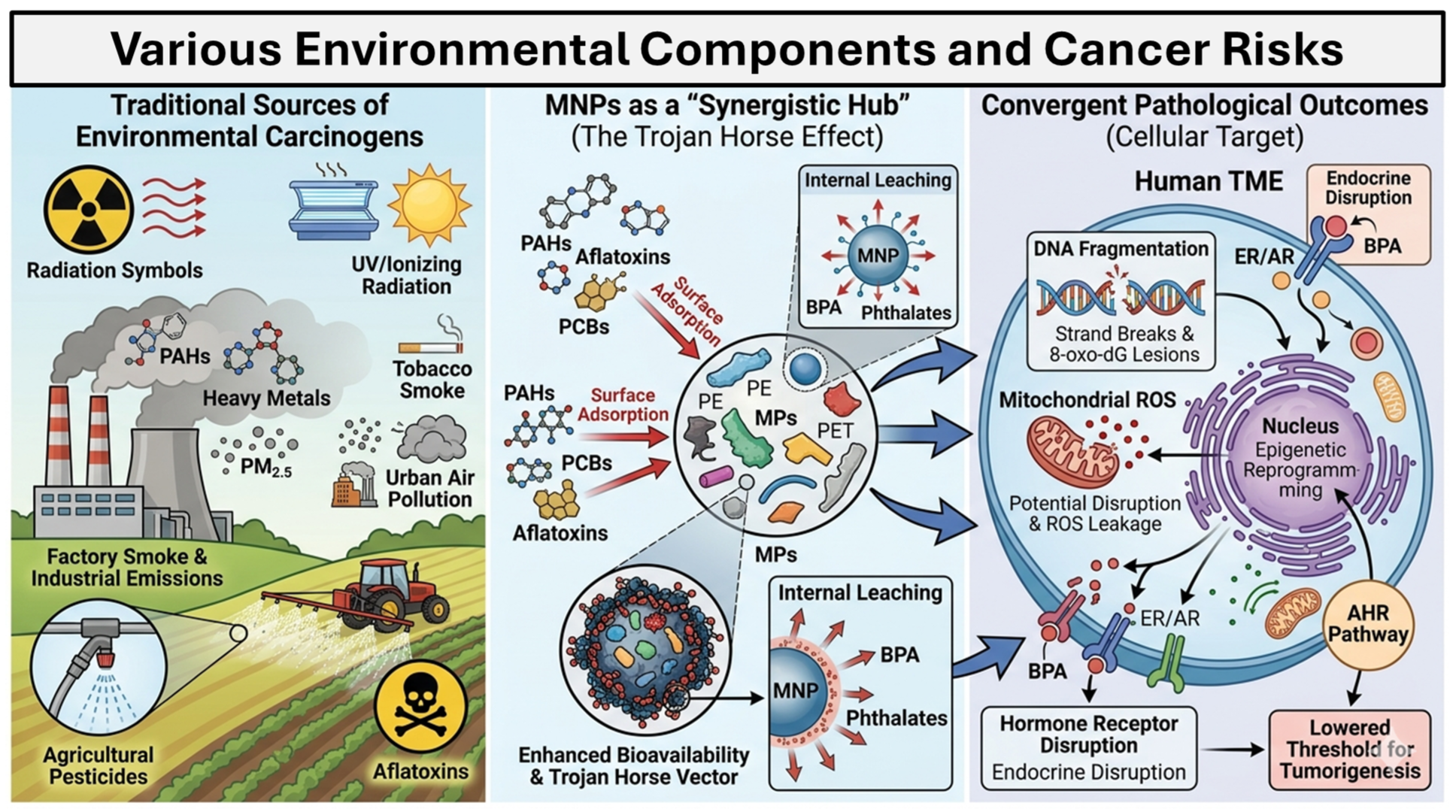
2.3. Environmental and Biological Exposures
2.4. Lifestyle and Socio-Economic Factors
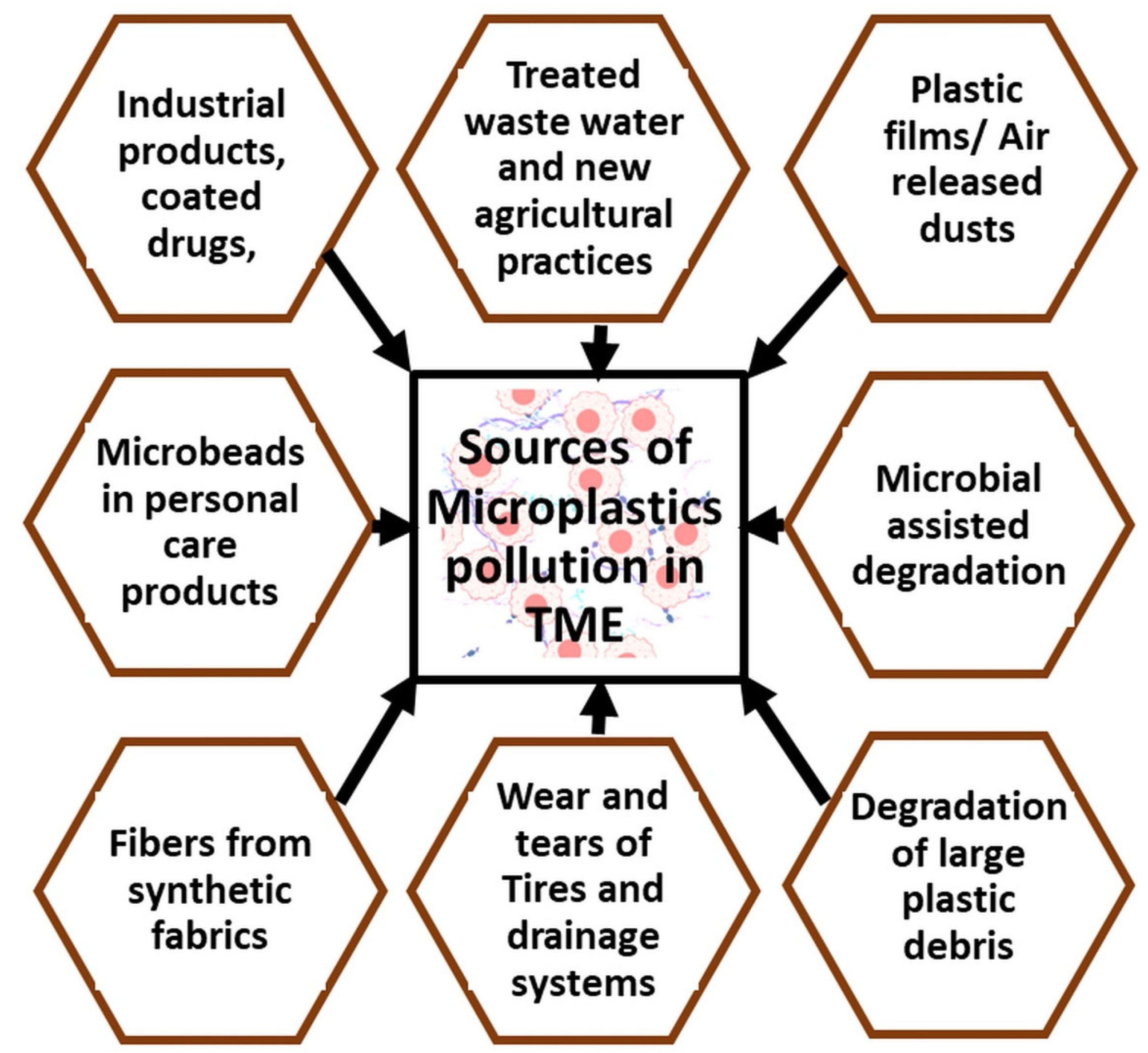
3. What Are the Sources and Types of Microplastics?
4. Uptake and Internalization of MNPs
4.1. Primary Pathways of Entry
4.2. Factors Influencing Internalization
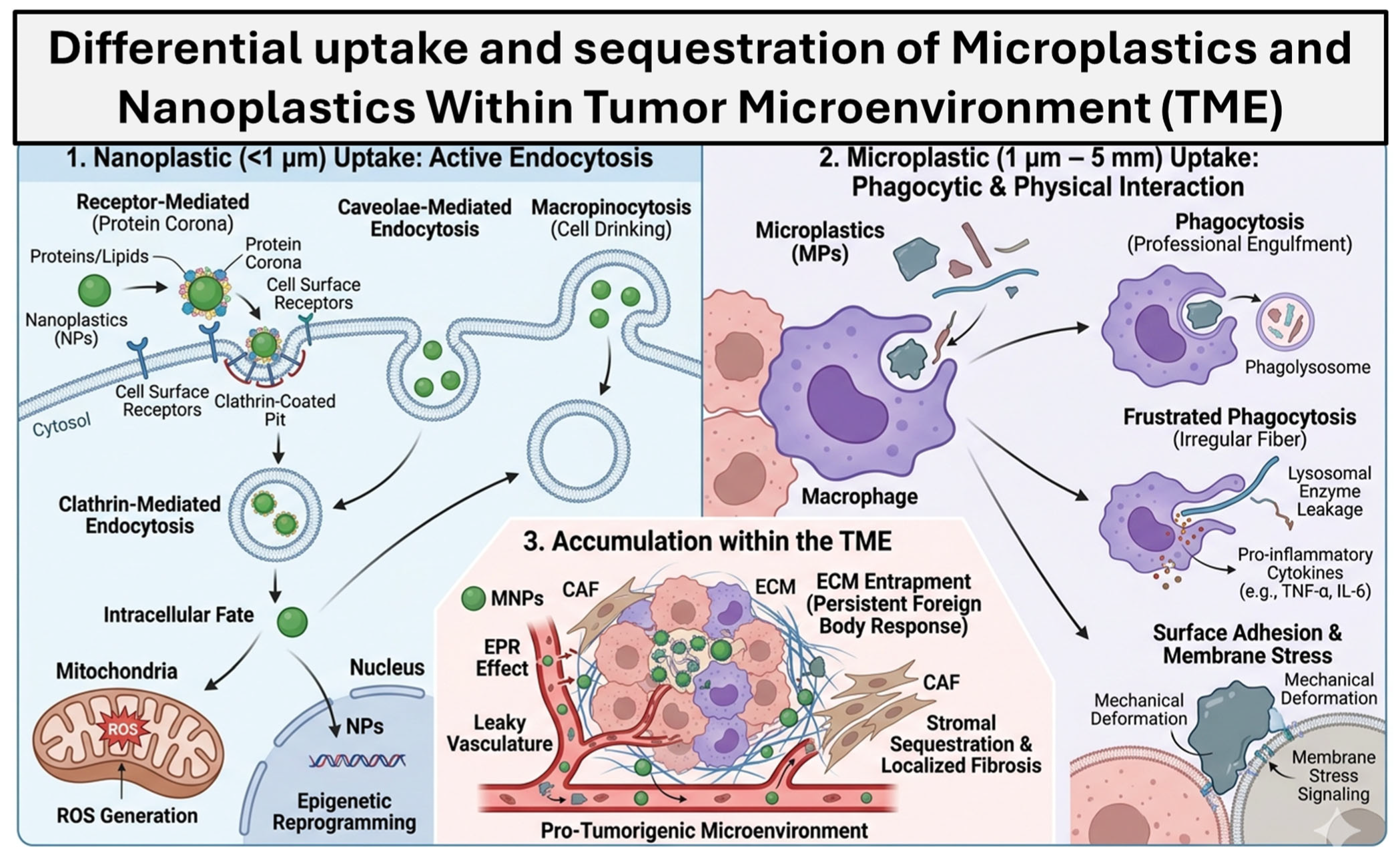
4.3. The Distinct Uptake and Internalization of MPs and NPs
5. Human Exposure Pathways to Microplastics (MPs)
6. Mechanisms and Evidence of MNPs in Cancer
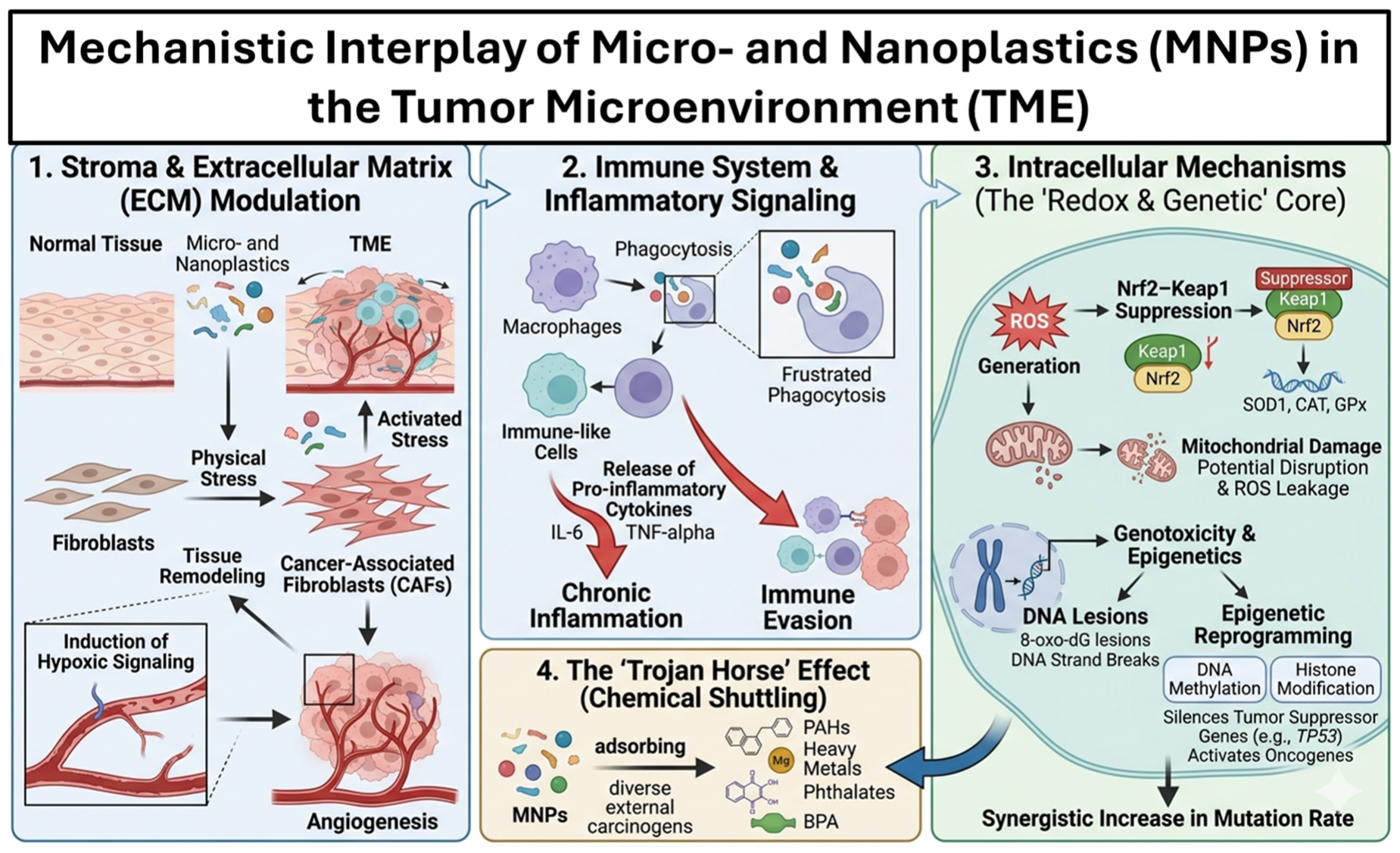
Stroma and ECM Modulation
7. Oxidative Stress and Chronic Inflammation: Concerted Role
8. Epigenetic Dysregulation
9. Endocrine Disruption and Hormone-Mediated Effects
10. Co-Pollutant Interactions and Synergistic Toxicity
11. Physical and Structural Disruption (Particle–Cell Interactions)
12. Microbiome–MNP Axis
In Vitro and Preclinical Evidence
13. Detection and Characterization of MNPs
14. Public Health Implications and Regulatory Responses to MP Pollution
15. Gaps and Future Directions
- One such major gap lies in longitudinal human studies since most studies concerning the potential carcinogenic effects of MPs have been conducted on animals or cell lines; while these are informative, they have notable limitations.
- Although existing evidence suggests that the possibility of chronic exposure to MPs can lead to the bioaccumulation of these substances in several tissues, no large human study explains the real risk of cancer induced through such exposures.
- Mechanisms whereby MPs induce inflammation, oxidative stress, and DNA damage have also been reported; more research has to be conducted on them to validate those effects on human tissues. This includes a deeper understanding of how MPs interact with the human immune and endocrine systems because they can play critical roles in cancer progression by disrupting these systems.
- Most current studies focus on specific types of MPs, like polystyrene or polyethylene, while disregarding comparative effects between different polymers and their particle sizes. Considering that MPs may display considerable differences in toxicological impact, more research should be conducted in this regard.
- The preponderance of short-term research provides further support for the need for long-term studies. Chronic exposure studies are necessary to evaluate the bioaccumulation of MPs and their cumulative effect on organs. Most cell mutations leading to cancer can only be manifested after years of exposure. The importance of long-term epidemiological studies is therefore critical for detecting accurately associated cancer risk.
- Additionally, multigenerational animal studies are crucial for establishing the real hereditary or epigenetic health risks associated with exposure to MPs across generations.
- Innovative experimental approaches may be explored to understand the intracellular and extracellular effects of MPs that could influence the cellular conductivity of normal tissue, one of the major factors that can potentiate the initiation and development of tumors.
- Novel approaches can be developed that can precisely estimate components of MPs at intra-organelle, intracellular, and extracellular levels within the TME.
- The potential involvement of MPs in stemness and EMT processes could be evaluated in the context of epigenetic remodeling that could be one of the crucial changes in carcinogenetic processes.
- Last but not least, the establishment of human cohort studies with differing intensities of exposure to MPs is extremely vital in providing an apparent view of long-term impacts such as cancer events. These studies should be implemented across diverse regions worldwide to account for differential exposure factors related to lifestyle and environmental conditions.
- Addressing these research gaps will improve our understanding of the long-term health implications of MPs and their role in cancer development.
- Preclinical and clinical evaluation and guidelines on the use of MPs in various components of molecular, nanomedicine, biosensors, and drugs for various diseases need to be emphasized to lessen carcinogenic effects as a secondary outcome of primary diseases.
- With increasing human activity in space, the possibility of generation and accumulation of MPs in extraterrestrial habitats (e.g., space stations, spacecraft) and their exposures may be the focus of future studies to identify associations with diseases such as cancer.
16. Conclusions
- While current data remain preliminary, converging evidence suggests that MPs can act as accelerants of carcinogenesis through oxidative stress, chronic inflammation, and epigenetic disruption, and by serving as vectors of toxic co-contaminants. Hence, the positioning of MPs as not merely inert pollutants but as actively involved in the development and progression of cancer is being emphasized.
- The potential role of MPs in modulating stromal, immune, and endothelial components of the TME highlights a paradigm where environmental particles may reprogram the niche that fosters tumor initiation, progression, and metastasis.
- Bridging toxicology, oncology, molecular genetics, and environmental sciences is the need of the time to evaluate MPs as co-carcinogens and co-promoters of cancer. Therefore, integrated approaches could accelerate translation from bench to policy, guiding preventive frameworks to manage the burdens of MPs in a polluted world that is imposing additional layers of complexity to cancer.
- Evidence of MPs in human biopsies should serve as a call to action for legislative bodies to regulate plastic production, usage, and waste management with a “cancer prevention” perspective. Public health advisories may eventually evolve to include plastic exposure as a modifiable cancer risk factor.
- However, current findings highlight associative links between MPs and cancer-related pathways but fall short of demonstrating a direct role in cancer incidences in the human population. Hence, long-term prospective epidemiological studies are warranted to link MPs with pro-tumorigenic changes leading to cancer.
- The toxicokinetics of MPs, including threshold exposure levels, biodistribution, organ tropism, persistence, and clearance, as well as improved risk assessment models, are needed for better evaluation of the role of MPs in cancer.
- While oxidative stress and inflammation are associated with the uptake of MPs in cellular contexts, precise molecular mechanisms (e.g., direct DNA damage, oncogene activation, tumor suppressor inactivation, and immune escape induction) are still not clear.
- The rationale that MPs can alter stromal–immune–vascular crosstalk requires further investigation using advanced approaches such as co-culture and in vivo models.
- Future studies on MPs as carriers of heavy metals, PAHs, and persistent organic pollutants may be needed, using sound methodological approaches.
- Current findings cannot establish causation between MPs and specific cancer types. Threshold levels for safe exposure of MPs are unknown and may be associated with cancer risk. Preclinical and clinical evidence on inter-individual variability in MP retention and clearance is poorly understood. Preclinical and clinical data gaps prevent MPs from being formally classified as carcinogens within IARC or WHO frameworks. Policy recommendations on MP exposure are based on precautionary evidence rather than quantitative risk assessments.
Author Contributions
Funding
Institutional Review Board Statement
Informed Consent Statement
Data Availability Statement
Acknowledgments
Conflicts of Interest
References
- Fink, H.; Langselius, O.; Vignat, J.; Rumgay, H.; Rehm, J.; Martinez, R.X.; Santero, M.; Lopez-Perez, L.; Inoue, M.; Zeng, H.; et al. Global and regional cancer burden attributable to modifiable risk factors to inform prevention. Nat. Med. 2026, 32, 1306–1315. [Google Scholar] [CrossRef] [PubMed]
- Biray Avci, C.; Goker Bagca, B.; Nikanfar, M.; Takanlou, L.S.; Takanlou, M.S.; Nourazarian, A. Tumor microenvironment and cancer metastasis: Molecular mechanisms and therapeutic implications. Front. Pharmacol. 2024, 15, 1442888. [Google Scholar] [CrossRef] [PubMed]
- Yu, H.; Li, J.; Peng, S.; Liu, Q.; Chen, D.; He, Z.; Xiang, J.; Wang, B. Tumor microenvironment: Nurturing cancer cells for immunoevasion and druggable vulnerabilities for cancer immunotherapy. Cancer Lett. 2024, 611, 217385. [Google Scholar] [CrossRef]
- Yuan, S.; Almagro, J.; Fuchs, E. Beyond genetics: Driving cancer with the tumour microenvironment behind the wheel. Nat. Rev. Cancer 2024, 24, 274–286. [Google Scholar] [CrossRef]
- Siegel, R.L.; Kratzer, T.B.; Wagle, N.S.; Sung, H.; Jemal, A. Cancer statistics, 2026. CA Cancer J. Clin. 2026, 76, e70043. [Google Scholar] [CrossRef]
- Wallace, T.A.; Martin, D.N.; Ambs, S. Interactions among genes, tumor biology and the environment in cancer health disparities: Examining the evidence on a national and global scale. Carcinogenesis 2011, 32, 1107–1121. [Google Scholar] [CrossRef]
- Hanahan, D.; Weinberg, R.A. Hallmarks of cancer: The next generation. Cell 2011, 144, 646–674. [Google Scholar] [CrossRef] [PubMed]
- Senga, S.S.; Bisson, W.H.; Colacci, A. Key characteristics of carcinogens meet hallmarks for prevention-cutting the Gordian knot. Front. Oncol. 2024, 14, 1420687. [Google Scholar] [CrossRef]
- Zhang, S.; Xiao, X.; Yi, Y.; Wang, X.; Zhu, L.; Shen, Y.; Lin, D.; Wu, C. Tumor initiation and early tumorigenesis: Molecular mechanisms and interventional targets. Signal Transduct. Target. Ther. 2024, 9, 149. [Google Scholar] [CrossRef]
- Kay, E.J.; Zanivan, S. The tumor microenvironment is an ecosystem sustained by metabolic interactions. Cell Rep. 2025, 44, 115432. [Google Scholar] [CrossRef]
- Wang, M.; Kim, R.Y.; Kohonen-Corish, M.R.J.; Chen, H.; Donovan, C.; Oliver, B.G. Particulate matter air pollution as a cause of lung cancer: Epidemiological and experimental evidence. Br. J. Cancer 2025, 132, 986–996. [Google Scholar] [CrossRef]
- Wu, Z.; Xia, F.; Lin, R. Global burden of cancer and associated risk factors in 204 countries and territories, 1980–2021: A systematic analysis for the GBD 2021. J. Hematol. Oncol. 2024, 17, 119. [Google Scholar] [CrossRef]
- Deng, X.; Gui, Y.; Zhao, L. The micro(nano)plastics perspective: Exploring cancer development and therapy. Mol. Cancer 2025, 24, 30. [Google Scholar] [CrossRef]
- Chen, C.-H.S.; Yuan, T.-H.; Lu, T.-P.; Lee, H.-Y.; Chen, Y.-H.; Lai, L.-C.; Tsai, M.-H.; Chuang, E.Y.; Chan, C.-C. Exposure-associated DNA methylation among people exposed to multiple industrial pollutants. Clin. Epigenetics 2024, 16, 111. [Google Scholar] [CrossRef]
- Goswami, S.; Adhikary, S.; Bhattacharya, S.; Agarwal, R.; Ganguly, A.; Nanda, S.; Rajak, P. The alarming link between environmental microplastics and health hazards with special emphasis on cancer. Life Sci. 2024, 355, 122937. [Google Scholar] [CrossRef] [PubMed]
- Winiarska, E.; Jutel, M.; Zemelka-Wiacek, M. The potential impact of nano- and microplastics on human health: Understanding human health risks. Environ. Res. 2024, 251, 118535. [Google Scholar] [CrossRef]
- Jayaraman, S.; Eswaran, A.; Priya Veeraraghavan, V.; Fazal, M.; Al-Rahbi, A.; Sirasanagandla, S.R. Implications of petrochemical exposure and epigenetic alterations on human health. Front. Toxicol. 2025, 7, 1542871. [Google Scholar] [CrossRef] [PubMed]
- Yang, J.; Luo, M.; Wang, H.; Huang, J. Phthalates unleashed: Decoding ovarian carcinogenesis through multi-omics networks, single-cell insights, and molecular docking. J. Ovarian Res. 2025, 18, 131. [Google Scholar] [CrossRef] [PubMed]
- Alijagic, A.; Suljević, D.; Fočak, M.; Sulejmanović, J.; Šehović, E.; Särndahl, E.; Engwall, M. The triple exposure nexus of microplastic particles, plastic-associated chemicals, and environmental pollutants from a human health perspective. Environ. Int. 2024, 188, 108736. [Google Scholar] [CrossRef]
- Li, Y.; Chen, L.; Zhou, N.; Chen, Y.; Ling, Z.; Xiang, P. Microplastics in the human body: A comprehensive review of exposure, distribution, migration mechanisms, and toxicity. Sci. Total Environ. 2024, 946, 174215. [Google Scholar] [CrossRef]
- Hussain, Z.; Bhatti, S.A.; Chandio, M.A. Hazard effects and mechanisms of action of microplastics on health. J. Biomed. Sci. Res. 2024, 2, 1–6. [Google Scholar] [CrossRef]
- Zhao, J.; Zhang, H.; Shi, L.; Jia, Y.; Sheng, H. Detection and quantification of microplastics in various types of human tumor tissues. Ecotoxicol. Environ. Saf. 2024, 283, 116818. [Google Scholar] [CrossRef]
- Zhi, L.; Li, Z.; Su, Z.; Wang, J. Immunotoxicity of microplastics: Carrying pathogens and destroying the immune system. TrAC Trends Anal. Chem. 2024, 177, 117817. [Google Scholar] [CrossRef]
- Ivleva, N.P. Chemical analysis of microplastics and nanoplastics: Challenges, advanced methods, and perspectives. Chem. Rev. 2021, 121, 11886–11936. [Google Scholar] [CrossRef]
- Leslie, H.A.; van Velzen, M.J.M.; Brandsma, S.H.; Vethaak, A.D.; Garcia-Vallejo, J.J.; Lamoree, M.H. Discovery and quantification of plastic particle pollution in human blood. Environ. Int. 2022, 163, 107199. [Google Scholar] [CrossRef] [PubMed]
- Cetin, M.; Miloglu, F.D.; Baygutalp, N.K.; Ceylan, O.; Yildirim, S.; Eser, G.; Gul, H.I. Higher number of microplastics in tumoral colon tissues from patients with colorectal adenocarcinoma. Environ. Chem. Lett. 2023, 21, 639–646. [Google Scholar] [CrossRef]
- Winiarska Gruber, E.S.; Stadlbauer, V.; Pichler, V.; Resch-Fauster, K.; Todorovic, A.; Meisel, T.C.; Trawoeger, S.; Hollóczki, O.; Turner, S.D.; Wadsak, W.; et al. To waste or not to waste: Questioning potential health risks of micro- and nanoplastics with a focus on their ingestion and potential carcinogenicity. Expo. Health 2023, 15, 33–51. [Google Scholar] [CrossRef] [PubMed]
- Marfella, R.; Prattichizzo, F.; Sardu, C.; Fulgenzi, G.; Graciotti, L.; Spadoni, T.; D’oNofrio, N.; Scisciola, L.; La Grotta, R.; Frigé, C.; et al. Microplastics and Nanoplastics in Atheromas and Cardiovascular Events. N. Engl. J. Med. 2024, 390, 900–910. [Google Scholar] [CrossRef]
- Chartres, N.; Cooper, C.B.; Bland, G.; Pelch, K.E.; Gandhi, S.A.; BakenRa, A.; Woodruff, T.J. Effects of Microplastic Exposure on Human Digestive, Reproductive, and Respiratory Health: A Rapid Systematic Review. Environ. Sci. Technol. 2024, 58, 22843–22864. [Google Scholar] [CrossRef]
- Guo, S.; Feng, D.; Li, Y.; Liu, L.; Tang, J. Innovations in chemical degradation technologies for the removal of micro/nano-plastics in water: A comprehensive review. Ecotoxicol. Environ. Saf. 2024, 271, 115979. [Google Scholar] [CrossRef]
- Nelson, B.; Faquin, W. New urgency for answers on the health impacts of microplastics: In this first of a two-part series on early studies of microplastics and nanoplastics, researchers are finding numerous hints of health effects-and warnings of a far greater potential for harm. Cancer Cytopathol. 2025, 133, e70035. [Google Scholar] [CrossRef]
- Ho, K.L.; Yeap, S.P.; Lee, K.M. A critical review of microplastics and nanoplastics in wastewater: Insights into adsorbent-based remediation strategies. Environ. Pollut. 2025, 382, 126658. [Google Scholar] [CrossRef]
- Joseph, M.M.; Nair, J.B.; Joseph, A.M. Microscopic menace: Exploring the link between microplastics and cancer pathogenesis. Environ. Sci. Process Impacts 2025, 27, 1768–1795. [Google Scholar] [CrossRef] [PubMed]
- Landrigan, P.J.; Raps, H.; Cropper, M.; Bald, C.; Brunner, M.; Canonizado, E.M.; Charles, D.; Chiles, T.C.; Donohue, M.J.; Enck, J.; et al. The Minderoo-Monaco Commission on Plastics and Human Health. Ann. Glob. Health 2023, 89, 23. [Google Scholar] [CrossRef]
- Mishra, S.K.; Sanyal, T.; Kundu, P.; Kumar, R.; Ghosh, D.; Chakrabarti, G.; Sikdar, N.; Bhattacharya, S.; Paul, S.; Das, A. Microplastics as emerging carcinogens: From environmental pollutants to oncogenic drivers. Mol. Cancer 2025, 24, 248. [Google Scholar] [CrossRef] [PubMed]
- Rochman, C.M.; Hoh, E.; Hentschel, B.T.; Kaye, S. Long-term field measurement of sorption of organic contaminants to five types of plastic pellets: Implications for plastic marine debris. Environ. Sci. Technol. 2013, 47, 1646–1654. [Google Scholar] [CrossRef] [PubMed]
- Liang, S.; Liu, J.; Bao, M.; Fan, Y.; Kong, M. Microplastics in lakes: Distribution patterns and influencing factors. J. Hazard. Mater. 2025, 493, 138339. [Google Scholar] [CrossRef] [PubMed]
- He, N.; Zhang, J.; Liu, M.; Yin, L. Elucidating the mechanism of plasticizers inducing breast cancer through network toxicology and molecular docking analysis. Ecotoxicol. Environ. Saf. 2024, 284, 116866. [Google Scholar] [CrossRef]
- Arif, I.; Adams, M.D.; Johnson, M.T.J. A meta-analysis of the carcinogenic effects of particulate matter and polycyclic aromatic hydrocarbons. Environ. Pollut. 2024, 351, 123941. [Google Scholar] [CrossRef]
- Wu, A.H.; Wu, J.; Tseng, C.; Stram, D.O.; Shariff-Marco, S.; Larson, T.; Goldberg, D.; Fruin, S.; Jiao, A.; Inamdar, P.P.; et al. Air pollution and breast cancer incidence in the Multiethnic Cohort Study. J. Clin. Oncol. 2025, 43, 273–284. [Google Scholar] [CrossRef]
- Pavinato, L.; Baggiolini, A. Oncogenic competence: Balancing mutations, cellular state, and microenvironment. Trends Cancer 2025, 11, 276–285. [Google Scholar] [CrossRef] [PubMed]
- Lichtenstein, P.; Holm, N.V.; Verkasalo, P.K.; Iliadou, A.; Kaprio, J.; Koskenvuo, M.; Pukkala, E.; Skytthe, A.; Hemminki, K. Environmental and heritable factors in the causation of cancer. N. Engl. J. Med. 2000, 343, 78–85. [Google Scholar] [CrossRef] [PubMed]
- Lee, J.J.; Ng, K.Y.; Bakhtiar, A. Extracellular matrix: Unlocking new avenues in cancer treatment. Biomark. Res. 2025, 13, 78. [Google Scholar] [CrossRef] [PubMed]
- Hanahan, D. Hallmarks of cancer—Then and now, and beyond. Cell 2026, 189, 2254–22779. [Google Scholar] [CrossRef] [PubMed]
- Cannataro, V.L.; Mandell, J.D.; Townsend, J.P. Attribution of cancer origins to endogenous, exogenous, and preventable mutational processes. Mol. Biol. Evol. 2022, 39, msac084. [Google Scholar] [CrossRef]
- Verma, A.; Lindroth, A.M. The emerging intertwined activities of metabolism and epigenetics unveils culprits and prospects in cancer. Exp. Mol. Med. 2025, 57, 1928–1939. [Google Scholar] [CrossRef]
- Vogelstein, B.; Kinzler, K.W. Cancer genes and the pathways they control. Nat. Med. 2004, 10, 789–797. [Google Scholar] [CrossRef]
- Feinberg, A.P.; Tycko, B. The history of cancer epigenetics. Nat. Rev. Cancer 2004, 4, 143–153. [Google Scholar] [CrossRef] [PubMed]
- Esteller, M. Epigenetics in cancer. N. Engl. J. Med. 2008, 358, 1148–1159. [Google Scholar] [CrossRef]
- Valencia, C.I.; Gachupin, F.C.; Molina, Y.; Batai, K. Interrogating patterns of cancer disparities by expanding the social determinants of health framework to include biological pathways of social experiences. Int. J. Environ. Res. Public Health 2022, 19, 2455. [Google Scholar] [CrossRef]
- Hecht, S.S. Tobacco carcinogens, their biomarkers and tobacco-induced cancer. Nat. Rev. Cancer 2003, 3, 733–744. [Google Scholar] [CrossRef]
- Straif, K.; Benbrahim-Tallaa, L.; Baan, R.; Grosse, Y.; Secretan, B.; El Ghissassi, F.; Bouvard, V.; Guha, N.; Freeman, C.; Galichet, L.; et al. A review of human carcinogens—Part C: Metals, arsenic, dusts, and fibres. Lancet Oncol. 2009, 10, 453–454. [Google Scholar] [CrossRef]
- Li, S.; Keenan, J.I.; Shaw, I.C.; Frizelle, F.A. Could microplastics be a driver for early onset colorectal cancer? Cancers 2023, 15, 3323. [Google Scholar] [CrossRef]
- Preda, O.T.; Vlasceanu, A.M.; Andreescu, C.V.; Tsatsakis, A.; Mezhuev, Y.; Negrei, C.; Baconi, D.L. Health implications of widespread micro- and nanoplastic exposure: Environmental prevalence, mechanisms, and biological impact on humans. Toxics 2024, 12, 730. [Google Scholar] [CrossRef]
- Bodke, V.; Tekade, B.W.; Mali, A. Health impacts and detection challenges of human exposure to microplastics. Cancer Plus 2025, 6, 4954. [Google Scholar] [CrossRef]
- Merletti, F.; Galassi, C.; Spadea, T. The socioeconomic determinants of cancer. Environ. Health 2011, 10, S7. [Google Scholar] [CrossRef]
- Andrady, A.L. Microplastics in the marine environment. Mar. Pollut. Bull. 2011, 62, 1596–1605. [Google Scholar] [CrossRef]
- Law, K.L.; Thompson, R.C. Microplastics in the seas. Science 2014, 345, 144–145. [Google Scholar] [CrossRef]
- Harini, R.; Sandhya, K.; Sunil, C.K.; Natarajan, V. Seaweed as a sink for microplastic contamination: Uptake, identifications and food safety implications. Environ. Res. 2025, 278, 121631. [Google Scholar] [CrossRef]
- Nikhil, V.G.; Abisha, C.; Raghavan, R.; Ph, A.A.; Ranjeet, K.; Varghese, G.K. Bioaccumulation and trophic transfer of microplastics in oceanic food webs. Mar. Pollut. Bull. 2026, 224, 119113. [Google Scholar] [CrossRef]
- Kole, P.J.; Löhr, A.J.; Van Belleghem, F.G.A.J.; Ragas, A.M.J. Wear and tear of tyres: A stealthy source of microplastics in the environment. Int. J. Environ. Res. Public Health 2017, 14, 1265. [Google Scholar] [CrossRef]
- Rillig, M.C.; Ziersch, L.; Hempel, S. Microplastic transport in soil by earthworms. Sci. Rep. 2017, 7, 1362. [Google Scholar] [CrossRef]
- Geyer, R.; Jambeck, J.R.; Law, K.L. Production, use, and fate of all plastics ever made. Sci. Adv. 2017, 3, e1700782. [Google Scholar] [CrossRef]
- Kadac-Czapska, K.; Ośko, J.; Knez, E.; Grembecka, M. Microplastics and oxidative stress—Current problems and prospects. Antioxidants 2024, 13, 579. [Google Scholar] [CrossRef]
- Ali, N.A.; Katsouli, J.; Marczylo, E.L.; Gant, T.W.; Wright, S.; de la Serna, J.B. The potential impacts of micro- and nano-plastics on various organ systems in humans. eBioMedicine 2024, 99, 104901. [Google Scholar] [CrossRef]
- Amesho, K.T.T.; Chinglenthoiba, C.; Samsudin, M.S.; Lani, M.N.; Pandey, A.; Mohd Desa, M.N.; Suresh, V. Microplastics in the environment: An urgent need for coordinated waste management policies and strategies. J. Environ. Manag. 2023, 344, 118713. [Google Scholar] [CrossRef]
- Nibude, S.; Rathored, J.; Shende, S.; Badkhal, A. The impact of environmental microplastics as emerging carcinogens: A public health concern. Multidiscip. Rev. 2024, 8, 2025067. [Google Scholar] [CrossRef]
- Cox, K.D.; Covernton, G.A.; Davies, H.L.; Dower, J.F.; Juanes, F.; Dudas, S.E. Human consumption of microplastics. Environ. Sci. Technol. 2019, 53, 7068–7074. [Google Scholar] [CrossRef]
- Casella, C.; Ballaz, S.J. Genotoxic and neurotoxic potential of intracellular nanoplastics: A review. J. Appl. Toxicol. 2024, 44, 1657–1678. [Google Scholar] [CrossRef]
- Mattsson, K.; Johnson, E.V.; Malmendal, A.; Linse, S.; Hansson, L.A.; Cedervall, T. Brain damage and behavioural disorders in fish induced by plastic nanoparticles delivered through the food chain. Environ. Sci. Technol. 2015, 49, 11113–11121. [Google Scholar] [CrossRef]
- Paternina-Ramos, A.; Gracia, C.A.; Rangel-Buitrago, N. Zooplankton assemblage and microplastics associated with a coastal sandspit (Tubará, Atlántico). Mar. Pollut. Bull. 2025, 215, 117853. [Google Scholar] [CrossRef]
- Tomazic-Jezic, V.J.; Merritt, K.; Umbreit, T.H. Significance of the type and the size of biomaterial particles on phagocytosis and tissue distribution. J. Biomed. Mater. Res. 2001, 55, 523–529. [Google Scholar] [CrossRef]
- Carr, K.E.; Smyth, S.H.; McCullough, M.T.; Morris, J.F.; Moyes, S.M. Morphological aspects of interactions between microparticles and mammalian cells: Intestinal uptake and onward movement. Prog. Histochem. Cytochem. 2012, 46, 185–252. [Google Scholar] [CrossRef]
- Cole, M.; Lindeque, P.K.; Fileman, E.; Clark, J.; Lewis, C.; Halsband, C.; Galloway, T.S. Microplastics alter the properties and sinking rates of zooplankton faecal pellets. Environ. Sci. Technol. 2016, 50, 3239–3246. [Google Scholar] [CrossRef]
- Zhang, T.; Wang, Z.; Wu, Y.; Zhu, S.; Su, J. Interactions of Micro- and Nanoplastics with Biomolecules: From Public Health to Protein Corona Effect and Beyond. J. Phys. Chem. B 2025, 129, 5355–5374. [Google Scholar] [CrossRef]
- Zhao, Y.; Liu, C.; Zhang, X.; Gu, T.; Wang, Y.; Zuo, T.; Liu, S.; Xu, X.; Meng, H. Mechanistic and Strategic Insights into How Lipid Nanoparticles Interact with Membrane-Based Biological Barriers. ACS Nano 2026, 20, 8971–9006. [Google Scholar] [CrossRef]
- Zhang, M.; Xu, L. Transport of micro- and nanoplastics in the environment: Trojan-Horse effect for organic contaminants. Crit. Rev. Environ. Sci. Technol. 2022, 52, 810–846. [Google Scholar] [CrossRef]
- Cho, Y.; Seo, E.U.; Hwang, K.S.; Kim, H.; Choi, J.; Kim, H.N. Evaluation of size-dependent uptake, transport and cytotoxicity of polystyrene microplastic in a blood-brain barrier (BBB) model. Nano Converg. 2024, 11, 40. [Google Scholar] [CrossRef]
- Priyadharshini, S.; Jeyavani, J.; Al Ghanim, K.A.; Govindarajan, M.; Karthikeyan, S.; Vaseeharan, B. Ecotoxicity assessment of polypropylene microplastics in juvenile zebrafish (Danio rerio). J. Contam. Hydrol. 2024, 266, 104415. [Google Scholar] [CrossRef]
- Son, T.; Cho, Y.J.; Lee, H.; Cho, M.Y.; Goh, B.; Kim, H.M.; Hoa, P.T.N.; Cho, S.H.; Park, Y.J.; Park, H.S.; et al. Monitoring in vivo behavior of size-dependent fluorescent particles as a model fine dust. J. Nanobiotechnol. 2022, 20, 227. [Google Scholar] [CrossRef]
- Zhu, Y.; Che, R.; Zong, X.; Wang, J.; Li, J.; Zhang, C.; Wang, F. A comprehensive review on the source, ingestion route, attachment and toxicity of microplastics/nanoplastics in human systems. J. Environ. Manag. 2024, 352, 120039. [Google Scholar] [CrossRef]
- Sawicka, D.; Chojnacka-Puchta, L.; Zapór, L.; Miranowicz-Dzierżawska, K.; Skowroń, J. The exposure routes of micro- and nanoplastics and their potential toxic effects on human health. Med. Pr. 2024, 75, 81–96. [Google Scholar] [CrossRef]
- Zuri, G.; Karanasiou, A.; Lacorte, S. Microplastics: Human exposure assessment through air, water, and food. Environ. Int. 2023, 179, 108150. [Google Scholar] [CrossRef]
- Qiao, R.; Mortimer, M.; Richter, J.; Rani-Borges, B.; Yu, Z.; Heinlaan, M.; Lin, S.; Ivask, A. Hazard of polystyrene micro-and nanospheres to selected aquatic and terrestrial organisms. Sci. Total Environ. 2022, 853, 158560. [Google Scholar] [CrossRef]
- Bruno, A.; Dovizio, M.; Milillo, C.; Aruffo, E.; Pesce, M.; Gatta, M.; Chiacchiaretta, P.; Di Carlo, P.; Ballerini, P. Orally ingested micro- and nano-plastics: A hidden driver of inflammatory bowel disease and colorectal cancer. Cancers 2024, 16, 3079. [Google Scholar] [CrossRef]
- Deng, Y.; Zhang, Y.; Lemos, B.; Ren, H. Tissue accumulation of microplastics in mice and biomarker responses suggest widespread health risks of exposure. Sci. Rep. 2017, 7, 46687. [Google Scholar] [CrossRef]
- Rochman, C.M.; Tahir, A.; Williams, S.L.; Baxa, D.V.; Lam, R.; Miller, J.T.; Teh, F.C.; Werorilangi, S.; Teh, S.J. Anthropogenic debris in seafood: Plastic debris and fibers from textiles in fish and bivalves sold for human consumption. Environ. Toxicol. Chem. 2020, 39, 931–944. [Google Scholar] [CrossRef]
- Wright, S.L.; Ulke, J.; Font, A.; Chan, K.L.A.; Kelly, F.J. Atmospheric microplastic deposition in an urban environment and an evaluation of transport. Environ. Sci. Technol. 2020, 54, 5750–5758. [Google Scholar] [CrossRef]
- Kumar, N.; Lamba, M.; Pachar, A.K.; Yadav, S.; Acharya, A. Microplastics—A growing concern as carcinogens in cancer etiology: Emphasis on biochemical and molecular mechanisms. Cell Biochem. Biophys. 2024, 82, 3109–3121. [Google Scholar] [CrossRef]
- Rashid, K.; Ali, S.; Chaudhry, A.H.; Sial, N.; Akram, M.R.; Aslam, M. A comprehensive review on microplastics: Their presence in surface and ground water, environmental distribution, and impact on human and aquatic systems. Sci. Total Environ. 2026, 1020, 181547. [Google Scholar] [CrossRef]
- Liu, Z.; You, M. Recent progress of microplastic toxicity on human exposure based on in vitro and in vivo studies. Sci. Total Environ. 2024, 903, 166766. [Google Scholar] [CrossRef]
- Das, A. The emerging role of microplastics in systemic toxicity: Involvement of reactive oxygen species (ROS). Sci. Total Environ. 2024, 895, 165076. [Google Scholar] [CrossRef]
- Qiao, R.; Deng, Y.; Zhang, S.; Wolosker, M.B.; Zhu, Q.; Ren, H.; Zhang, Y. Accumulation of different shapes of microplastics initiates intestinal injury and gut microbiota dysbiosis in the gut of zebrafish. Environ. Sci. Technol. 2019, 53, 11070–11078. [Google Scholar] [CrossRef]
- Pan, W.; Hao, J.; Zhang, M.; Liu, H.; Tian, F.; Zhang, X.; Jiang, Z.; Chen, C.; Gao, M.; Zhang, H. Identification and analysis of microplastics in peritumoral and tumor tissues of colorectal cancer. Sci. Rep. 2025, 15, 16130. [Google Scholar] [CrossRef] [PubMed]
- Rochman, C.M.; Kross, S.M.; Armstrong, J.B.; Bogan, M.T.; Darling, E.S.; Green, S.J.; Smyth, A.R.; Veríssimo, D. Scientific evidence supports a ban on microbeads. Nature 2015, 526, 169–173. [Google Scholar] [CrossRef]
- Dzierżyński, E.; Gawlik, P.J.; Puźniak, D.; Flieger, W.; Jóźwik, K.; Teresiński, G.; Forma, A.; Wdowiak, P.; Baj, J.; Flieger, J. Microplastics in the human body: Exposure, detection, and risk of carcinogenesis—A state of the art review. Cancers 2024, 16, 3703. [Google Scholar] [CrossRef] [PubMed]
- Yang, Q.; Dai, H.; Wang, B.; Xu, J.; Zhang, Y.; Chen, Y.; Ma, Q.; Xu, F.; Cheng, H.; Sun, D.; et al. Nanoplastics shape adaptive anticancer immunity in the colon in mice. Nano Lett. 2023, 23, 3516–3523. [Google Scholar] [CrossRef] [PubMed]
- Yang, X.Y.; Zhang, Z.W.; Chen, G.D.; Yuan, S. Gut microbiome remodeling induced by microplastic exposure in humans. Gut Microbes 2026, 18, 2617696. [Google Scholar] [CrossRef]
- Tian, Z.; Ding, B.; Guo, Y.; Zhou, J.; Jiang, S.; Lu, J.; Li, N.; Zhou, X.; Zhang, W. Microplastics accumulated in breast cancer patients lead to mitophagy via ANXA2-mediated endocytosis and IL-17 signaling pathway. Environ. Pollut. 2025, 364, 125321. [Google Scholar] [CrossRef]
- Sun, N.; Shi, H.; Li, X.; Gao, C.; Liu, R. Combined toxicity of micro/nanoplastics loaded with environmental pollutants to organisms and cells: Role, effects, and mechanism. Environ. Int. 2023, 171, 107711. [Google Scholar] [CrossRef]
- Ojo, A.B.; Agbeye, O.D.; Ogwa, T.O.; Adedoyin, D.; Rotimi, D.E.; Ojo, O.A. Implications of plastic-derived endocrine disruptors on human health. Toxicol. Mech. Methods 2025, 35, 894–918. [Google Scholar] [CrossRef] [PubMed]
- Nguyen, M.K.; Lin, C.; Nguyen, D.D. Microplastic pollution associated with probabilistic human health risks: Potential hazards, critical factors, challenges, and limitations. Mar. Pollut. Bull. 2025, 221, 118528. [Google Scholar] [CrossRef]
- Brynzak-Schreiber, E.; Schögl, E.; Bapp, C.; Cseh, K.; Kopatz, V.; Jakupec, M.A.; Weber, A.; Lange, T.; Toca-Herrera, J.L.; del Favero, G.; et al. Microplastics role in cell migration and distribution during cancer cell division. Chemosphere 2024, 353, 141463. [Google Scholar] [CrossRef]
- Zhou, L.; Ran, L.; He, Y.; Huang, Y. Mechanisms of microplastics on gastrointestinal injury and liver metabolism disorder. Mol. Med. Rep. 2025, 31, 98. [Google Scholar] [CrossRef]
- Cheng, Y.; Yang, Y.; Bai, L.; Cui, J. Microplastics: An often-overlooked issue in the transition from chronic inflammation to cancer. J. Transl. Med. 2024, 22, 959. [Google Scholar] [CrossRef]
- Di Cintio, F.; Ruggieri, A.G.; De Simone, C.; Di Carlo, P.; Ronci, M.; Perrotti, V.; Sallese, M. Polystyrene microplastics are internalized by human gingival fibroblasts, enhance cell motility and induce molecular changes revealed through proteomic analysis. Sci. Rep. 2025, 15, 35128. [Google Scholar] [CrossRef]
- Chen, Z.; Han, F.; Du, Y.; Shi, H.; Zhou, W. Hypoxic microenvironment in cancer: Molecular mechanisms and therapeutic interventions. Signal Transduct. Target. Ther. 2023, 8, 70. [Google Scholar] [CrossRef]
- Chen, Y.C.; Chen, K.F.; Andrew Lin, K.Y.; Su, H.P.; Wu, D.N.; Lin, C.H. Evaluation of toxicity of polystyrene microplastics under realistic exposure levels in human vascular endothelial EA.hy926 cells. Chemosphere 2023, 313, 137582. [Google Scholar] [CrossRef] [PubMed]
- Anik, A.H.; Oishy, M.N.; Murshed, M.F.; Abdullah, R.B.; Khan, M.R. Distribution and health impacts of micro- and nanoplastics (MNPs) in human organs: Accumulation, translocation, and toxicity—A systematic review of current evidence. J. Hazard. Mater. Plast. 2025, 1, 100002. [Google Scholar] [CrossRef]
- Kong, S.; Zhang, K.; Sang, J.; Zhang, J.; Kan, C.; Sun, X.; Hou, N. Micro- and nanoplastics and PM2.5 in cardiovascular disease: Emerging mechanisms, impacts, and therapeutic insights. Food Chem. Toxicol. 2026, 211, 115982. [Google Scholar] [CrossRef] [PubMed]
- Chen, Q.; Allgeier, A.; Yin, D.; Hollert, H. Leaching of endocrine disrupting chemicals from marine microplastics and mesoplastics under common life stress conditions. Environ. Int. 2019, 130, 104938. [Google Scholar] [CrossRef] [PubMed]
- da Silva Brito, W.A.; Mutter, F.; Wende, K.; Cecchini, A.L.; Schmidt, A.; Bekeschus, S. Consequences of nano and microplastic exposure in rodent models: The known and unknown. Part. Fibre Toxicol. 2022, 19, 28. [Google Scholar] [CrossRef]
- Ponce-Cusi, R.; Barletta-Carrillo, C.; Pilco-Ferreto, N. Microplastics and Nanoplastics in Cancer Progression: Biology and Public Health. Biomedicines 2025, 14, 1. [Google Scholar] [CrossRef]
- Pavlovic, D.; Papic, D.; Janjic, V.; Mitrovic, M.; Dimitrijevic Stojanovic, M.; Gazdic Jankovic, M. Nuclear and Mitochondrial Epigenetic Mechanisms Underlying Neurodegeneration and Gut-Brain Axis Dysregulation Induced by Micro- and Nanoplastics. Genes 2026, 17, 151. [Google Scholar] [CrossRef]
- Rafazi, P.; Bagheri, Z.; Haghi-Aminjan, H.; Rahimifard, M.; Ahvaraki, A. Long-term exposure of human U87 glioblastoma cells to polyethylene microplastics: Investigating the potential cancer progression. Toxicol. Rep. 2024, 13, 101757. [Google Scholar] [CrossRef] [PubMed]
- Traversa, A.; Mari, E.; Pontecorvi, P.; Gerini, G.; Romano, E.; Megiorni, F.; Amedei, A.; Marchese, C.; Ranieri, D.; Ceccarelli, S. Polyethylene micro/nanoplastics exposure induces epithelial-mesenchymal transition in human bronchial and alveolar epithelial cells. Int. J. Mol. Sci. 2024, 25, 10168. [Google Scholar] [CrossRef]
- Huang, H.; Hou, J.; Yu, C.; Wei, F.; Xi, B. Microplastics exacerbate tissue damage and promote carcinogenesis following liver infection in mice. Ecotoxicol. Environ. Saf. 2024, 286, 117217. [Google Scholar] [CrossRef] [PubMed]
- Remigante, A.; Spinelli, S.; Gambardella, L.; Bozzuto, G.; Vona, R.; Caruso, D.; Villari, V.; Cappello, T.; Maisano, M.; Dossena, S.; et al. Internalization of nano- and micro-plastics in human erythrocytes leads to oxidative stress and estrogen receptor-mediated cellular responses. Free Radic. Biol. Med. 2024, 223, 1–17. [Google Scholar] [CrossRef]
- Jiang, Y.; Zhang, H.; Wang, J.; Liu, Y.; Luo, T.; Hua, H. Targeting extracellular matrix stiffness and mechanotransducers to improve cancer therapy. J. Hematol. Oncol. 2022, 15, 34. [Google Scholar] [CrossRef]
- Tischenko, K.; Brill-Karniely, Y.; Steinberg, E.; Segev-Yekutiel, H.; Benny, O. Surface physical cues mediate the uptake of foreign particles by cancer cells. APL Bioeng. 2023, 7, 016113. [Google Scholar] [CrossRef]
- Oeckinghaus, A.; Hayden, M.S.; Ghosh, S. Crosstalk in NF-κB signaling pathways. Nat. Immunol. 2011, 12, 695–708. [Google Scholar] [CrossRef]
- Xu, M.; Halimu, G.; Zhang, Q.; Song, Y.; Fu, X.; Li, Y.; Li, Y.; Zhang, H. Internalization and toxicity: A preliminary study of effects of nanoplastic particles on human lung epithelial cell. Sci. Total Environ. 2019, 694, 133794. [Google Scholar] [CrossRef]
- Merkley, S.D.; Moss, H.C.; Goodfellow, S.M.; Ling, C.L.; Meyer-Hagen, J.L.; Weaver, J.; Campen, M.J.; Castillo, E.F. Polystyrene microplastics induce an immunometabolic active state in macrophages. Cell Biol. Toxicol. 2022, 38, 31–41. [Google Scholar] [CrossRef]
- Park, J.H.; Hong, S.; Kim, O.-H.; Kim, C.-H.; Kim, J.; Kim, J.-W.; Hong, S.; Lee, H.J. Polypropylene microplastics promote metastatic features in human breast cancer. Sci. Rep. 2023, 13, 6252. [Google Scholar] [CrossRef]
- Subramanian, D.; Ponnusamy Manogaran, G.; Dharmadurai, D. A systematic review on the impact of micro-nanoplastics on human health: Potential modulation of epigenetic mechanisms and identification of biomarkers. Chemosphere 2024, 363, 142986. [Google Scholar] [CrossRef]
- Rahman, L.; Williams, A.; Wu, D.; Halappanavar, S. Polyethylene terephthalate microplastics generated from disposable water bottles induce interferon signaling pathways in mouse lung epithelial cells. Nanomaterials 2024, 14, 1287. [Google Scholar] [CrossRef] [PubMed]
- Rubio, L.; Marcos, R.; Hernández, A. Potential adverse health effects of ingested micro- and nanoplastics on humans. Lessons learned from in vivo and in vitro mammalian models. J. Toxicol. Environ. Health B Crit. Rev. 2020, 23, 51–68. [Google Scholar] [CrossRef] [PubMed]
- Palaniappan, S.; Sadacharan, C.M.; Rostama, B. Polystyrene and polyethylene microplastics decrease cell viability and dysregulate inflammatory and oxidative stress markers of MDCK and L929 cells in vitro. Expo. Health 2022, 14, 75–85. [Google Scholar] [CrossRef]
- Zou, H.; Chen, Y.; Qu, H.; Sun, J.; Wang, T.; Ma, Y.; Yuan, Y.; Bian, J.; Liu, Z. Microplastics exacerbate cadmium-induced kidney injury by enhancing oxidative stress, autophagy, apoptosis, and fibrosis. Int. J. Mol. Sci. 2022, 23, 14411. [Google Scholar] [CrossRef] [PubMed]
- Lu, T.; Li, D.; Yuan, X.; Wang, Z.; Shao, Z.; Feng, X. Potential effects of orally ingesting polyethylene terephthalate microplastics on the mouse heart. Cardiovasc. Toxicol. 2024, 24, 291–301. [Google Scholar] [CrossRef]
- Wade, M.J.; Bucci, K.; Rochman, C.M.; Meek, M.H. Microplastic exposure is associated with epigenomic effects in the model organism Pimephales promelas (fathead minnow). J. Hered. 2025, 116, 113–125. [Google Scholar] [CrossRef] [PubMed]
- Kurchaba, N.; Cassone, B.J.; Northam, C.; Ardelli, B.F.; LeMoine, C.M.R. Effects of MP polyethylene microparticles on Microbiome and inflammatory response of larval zebrafish. Toxics 2020, 8, 55. [Google Scholar] [CrossRef] [PubMed]
- Parthasarathy, S.; Sundaramanickam, A.; Nithin, A. Comment on “cancer may be induced by microplastics-sorbed polycyclic aromatic hydrocarbons?”. Oral Oncol. 2024, 11, 100555. [Google Scholar]
- Dan, K.; Yoo, J.Y.; Min, H. The emerging threat of micro- and nanoplastics on the maturation and activity of immune cells. Biomol. Ther. 2024. [Google Scholar] [CrossRef] [PubMed]
- Kuai, Y.; Chen, Z.; Xie, K.; Chen, J.; He, J.; Gao, J.; Yu, C. Long-term exposure to polystyrene microplastics reduces macrophages and affects the microbiota–gut–brain axis in mice. Toxicology 2024, 509, 153951. [Google Scholar] [CrossRef]
- Wang, P.; Shi, Y.Z.; Guan, Q. The Microplastic-PFAS Nexus: From Co-Occurrence to Combined Toxicity in Aquatic Environments. Toxics 2025, 13, 1041. [Google Scholar] [CrossRef]
- Sands, M.; Sachdeva, A.; Bukavina, L.; Irudayaraj, J. Synergistic toxicity of PFAS and microplastic mixtures across five human cell lines. Environ. Pollut. 2025, 386, 127256. [Google Scholar] [CrossRef]
- Lusher, A.L.; Munno, K.; Hermabessiere, L.; Carr, S. Isolation and extraction of microplastics from environmental samples: An evaluation of practical approaches and recommendations for further harmonization. Appl. Spectrosc. 2020, 74, 1049–1065. [Google Scholar] [CrossRef]
- Cowger, W.; Gray, A.; Christiansen, S.H.; DeFrond, H.; Deshpande, A.D.; Hermabessiere, L.; Lee, E.; Mill, L.; Munno, K.; Ossmann, B.E.; et al. Critical review of processing and classification techniques for images and spectra in microplastic research. Appl. Spectrosc. 2020, 74, 989–1010. [Google Scholar] [CrossRef]
- Ribeiro, F.; Okoffo, E.D.; O’Brien, J.W.; Fraissinet-Tachet, S.; O’Brien, S.; Gallen, M.; Samanipour, S.; Kaserzon, S.; Mueller, J.F.; Galloway, T.; et al. Quantitative analysis of selected plastics in high-commercial-value Australian seafood by pyrolysis gas chromatography mass spectrometry. Environ. Sci. Technol. 2020, 54, 9408–9417. [Google Scholar] [CrossRef]
- Colson, B.C.; Michel, A.P.M. Flow-through quantification of microplastics using impedance spectroscopy. ACS Sens. 2021, 6, 238–244. [Google Scholar] [CrossRef]
- Rotchell, J.M.; Jenner, L.C.; Chapman, E.; Bennett, R.T.; Bolanle, I.O.; Loubani, M.; Sadofsky, L.; Hobkirk, J.; Palmer, T.M. Detection of microplastics in human saphenous vein tissue using μFTIR: A pilot study. PLoS ONE 2023, 18, e0280594. [Google Scholar] [CrossRef]
- Luo, Q.; Tan, H.; Ye, M.; Jho, E.H.; Wang, P.; Iqbal, B.; Zhao, X.; Shi, H.; Lu, H.; Li, G. Microplastics as an emerging threat to human health: An overview of potential health impacts. J. Environ. Manag. 2025, 387, 125915. [Google Scholar] [CrossRef]




| Type of Microplastics | Exposure Routes | Mechanisms of Carcinogenicity | Chemical Composition | References |
|---|---|---|---|---|
| Microbeads | Cosmetics, personal care products, wastewater | Physical damage, inflammation, oxidative stress | Polyethylene (PE), polypropylene (PP), polyvinyl chloride (PVC) | [64] |
| Microfibers | Synthetic clothing, laundry wastewater | Inflammation, oxidative stress, DNA damage | Polyester (PET), nylon (PA), acrylic (PAN) | [65] |
| Microfragments | Plastic debris, food packaging | Physical damage, chemical leaching | Polyethylene terephthalate (PET), high-density polyethylene (HDPE) | [57] |
| Microplastic Additives | Food, water, consumer products | Endocrine disruption, chemical carcinogenesis | Phthalates, bisphenol A (BPA), organophosphates | [19] |
| Microplastic Films | Food packaging, agriculture | Physical damage, chemical leaching | Low-density polyethylene (LDPE), polyvinyl chloride (PVC) | [62] |
| Microplastic Spheres | Cosmetics, personal care products | Physical damage, inflammation | Polyethylene (PE), polypropylene (PP) | [66,67] |
| Nanoplastics | Food, water, air | Cellular uptake, oxidative stress, epigenetic changes | Polyethylene (PE), polyvinyl chloride (PVC), polystyrene (PS) | [68,69] |
| Aspect | What Is Known (Established Evidence) | What Is Hypothesized (Emerging or Proposed Concepts) |
|---|---|---|
| Microplastic Presence in Human Systems | Microplastics (<5 mm) are found in human tissues, including lungs, blood, gastrointestinal tract, and even tumors [25,97]. | Persistent accumulation of microplastics within the TME may influence carcinogenesis by modulating stromal–immune–vascular interactions. |
| Oxidative Stress and Inflammation | Microplastics generate reactive oxygen species (ROS) and provoke chronic inflammation in experimental models [87,93]. | Continuous oxidative stress from microplastics may act as a co-carcinogenic trigger, facilitating oncogene activation and tumor suppressor inactivation. |
| Epigenetic Remodeling | Environmental pollutants, including plastics and phthalates, can induce epigenetic changes such as DNA methylation and histone modification [38]. | Microplastic exposure could drive epigenetic reprogramming of the TME, influencing cancer cell plasticity, EMT, and immune evasion. |
| Co-contaminant Carriage | Microplastics bind polycyclic aromatic hydrocarbons (PAHs), heavy metals, and endocrine disruptors [19,36] | The combined exposure to microplastics and adsorbed carcinogens could synergistically elevate mutagenic and oncogenic risks. |
| Cellular Uptake and Internalization | Microplastics enter cells through phagocytosis and endocytosis [70]. | Once internalized, microplastics may disrupt intracellular organelle signaling and induce pro-tumor metabolic shifts. |
| Experimental Findings | Animal studies and in vitro models demonstrate inflammation, DNA damage, and altered gene expression upon microplastic exposure [27,128]. | Chronic, low-dose exposure may reprogram the TME to favor tumor initiation and mimic a “pre-malignant” niche in non-tumorous tissues. |
| Public Health Implications | Microplastics are recognized as an environmental hazard with potential for systemic toxicity [67]. | Microplastic exposure could become a modifiable cancer risk factor, warranting inclusion in cancer prevention frameworks. |
Disclaimer/Publisher’s Note: The statements, opinions and data contained in all publications are solely those of the individual author(s) and contributor(s) and not of MDPI and/or the editor(s). MDPI and/or the editor(s) disclaim responsibility for any injury to people or property resulting from any ideas, methods, instructions or products referred to in the content. |
© 2026 by the authors. Licensee MDPI, Basel, Switzerland. This article is an open access article distributed under the terms and conditions of the Creative Commons Attribution (CC BY) license.
Share and Cite
Singh, M.; Gupta, S.; Pal, J.K.; Sharma, N.K. Beyond Classic Carcinogens: Micro- and Nanoplastics (MNPs) as Pervasive Factors in Cancer Risk. Int. J. Environ. Med. 2026, 1, 8. https://doi.org/10.3390/ijem1020008
Singh M, Gupta S, Pal JK, Sharma NK. Beyond Classic Carcinogens: Micro- and Nanoplastics (MNPs) as Pervasive Factors in Cancer Risk. International Journal of Environmental Medicine. 2026; 1(2):8. https://doi.org/10.3390/ijem1020008
Chicago/Turabian StyleSingh, Mansaa, Sneha Gupta, Jayanta K. Pal, and Nilesh Kumar Sharma. 2026. "Beyond Classic Carcinogens: Micro- and Nanoplastics (MNPs) as Pervasive Factors in Cancer Risk" International Journal of Environmental Medicine 1, no. 2: 8. https://doi.org/10.3390/ijem1020008
APA StyleSingh, M., Gupta, S., Pal, J. K., & Sharma, N. K. (2026). Beyond Classic Carcinogens: Micro- and Nanoplastics (MNPs) as Pervasive Factors in Cancer Risk. International Journal of Environmental Medicine, 1(2), 8. https://doi.org/10.3390/ijem1020008