
Review

KRAS and Beyond: Emerging Targeted and Molecularly Stratified Strategies in Pancreatic Ductal Adenocarcinoma

Gastrointestinal Unit, Department of Medicine, Royal Marsden Hospital, London SW3 6JJ, UK
*
Author to whom correspondence should be addressed.
Precis. Oncol. 2026, 1(2), 9; https://doi.org/10.3390/precisoncol1020009
Submission received: 30 March 2026 / Revised: 7 May 2026 / Accepted: 13 May 2026 / Published: 18 May 2026

Abstract

Pancreatic ductal adenocarcinoma (PDAC) is a highly lethal malignancy, with rising incidence and a 5-year survival rate of 13%. Late presentation, early metastasis, and intrinsic resistance constrain the efficacy of cytotoxic chemotherapy, which remains the backbone of PDAC treatment, with only modest survival gains and resistance nearly universal. Although KRAS mutations dominate tumour biology (~90% of cases), PDAC is a heterogeneous disease with distinct molecular subtypes that confer differential therapeutic vulnerabilities. Advances in comprehensive molecular profiling have catalysed a paradigm shift toward precision oncology in PDAC. In KRAS-mutant PDAC, mutation-specific inhibitors have established proof-of-concept, particularly in KRAS G12C disease, while next-generation approaches including KRAS G12D inhibitors, RAS-“ON” inhibitors, proteolysis-targeting chimeras (PROTACs), and KRAS-targeted vaccine strategies are expanding the therapeutic landscape. Combination strategies targeting upstream and downstream effectors of the RAS–MAPK pathway are also being explored to enhance the depth and durability of response. In parallel, KRAS-wild-type PDAC has emerged as a molecularly distinct subgroup enriched for rare but actionable alternative oncogenic fusion drivers including NRG1, NTRK, RET, ALK, and FGFR. Additional molecularly directed strategies targeting HER2 alterations, BRAF mutations, EGFR-dependent signalling, and tumour-selectively exposed surface antigens such as CLDN18.2 are under investigation across PDAC irrespective of KRAS mutation status. Synthetic lethal approaches, including targeting the PRMT5/CDKN2A/MTAP axis, represent a further emerging therapeutic strategy. Germline homologous recombination repair defects, particularly involving BRCA1/2 and PALB2, further define clinically important subsets with sensitivity to platinum chemotherapy and PARP inhibition. This review summarises current and emerging targeted and molecularly directed therapeutic strategies in PDAC, emphasising the importance of molecular stratification and recent advances shaping precision oncology in this historically treatment-refractory disease.

1. Introduction

Pancreatic ductal adenocarcinoma (PDAC) is one of the most lethal solid malignancies worldwide. Globally, PDAC accounts for ~2.6% of all cancer diagnoses but represents a disproportionate cause of cancer-related mortality (4.8% of cancer-related deaths), with over 511,000 new cases and 467,000 deaths reported annually [1]. Incidence rates continue to rise, with a 5-year overall survival (OS) rate of 13%, reflecting persistent challenges in early detection and effective treatment. The 5-year OS varies substantially by stage, from 44% for localised disease to 17% for regional disease and 3% for distant disease [2,3]. The majority of patients present with advanced or metastatic disease, and recurrence rates remain high even after curative-intent surgery [4].
Chemotherapy remains the backbone of PDAC treatment, with regimens such as FOLFIRINOX (5-Fluorouracil, Irinotecan and Oxaliplatin) or Gemcitabine-based combinations providing modest survival benefits at the cost of significant toxicity and inevitable therapeutic resistance [5,6]. In selected trial populations, a median OS of 11.1 months and PFS of 6.4 months can be achieved in the first-line setting (PRODIGE, NCT00112658), whereas second-line outcomes remain poor, with a median OS of 6.1 months at best (NAPOLI-1, NCT01494506) [5,7].
Kirsten rat sarcoma viral oncogene homologue (KRAS) mutations are the dominant driver (~90% of cases) and shape tumour biology and resistance [8]. Advances in comprehensive molecular profiling have begun to identify actionable vulnerabilities in PDAC, increasing the recognition of distinct subtypes, enabling the development of targeted therapies, synthetic lethal strategies, and emerging vaccine-based approaches [9].
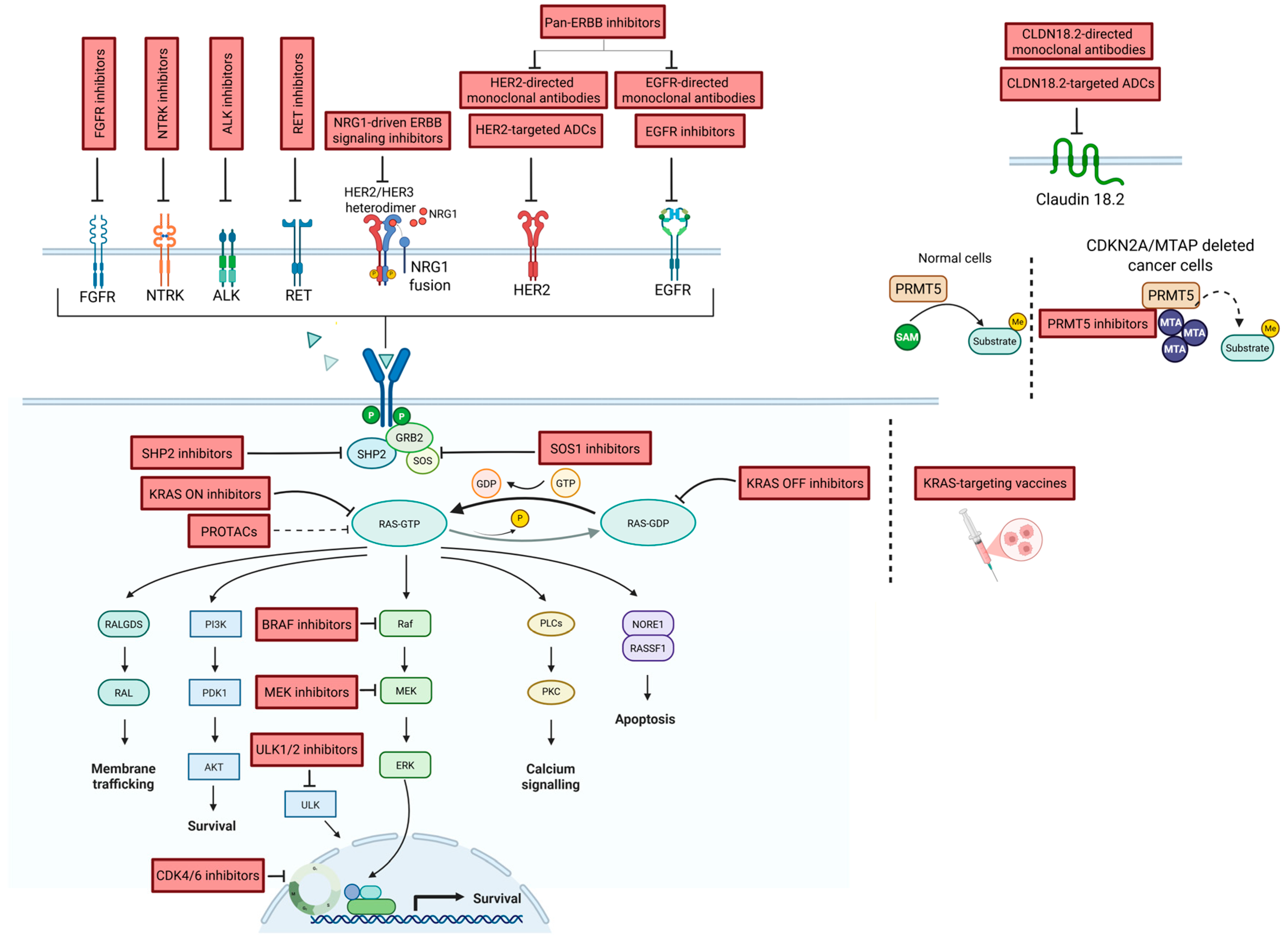
In this review, targeted agents are defined as therapies directed against tumour-associated genomic alterations, oncogenic signalling dependencies, or differentially expressed tumour-associated proteins. This includes agents targeting tumour-specific mutations, oncogenic fusions, pathway dependencies, and surface antigens that are overexpressed or therapeutically exploitable in PDAC. Within this framework, we focus on the evolving precision oncology landscape in PDAC, highlighting molecularly directed treatment strategies and the challenges and opportunities associated with translating molecular insights into durable clinical benefit in this historically treatment-refractory disease (Figure 1).

2. Targeting KRAS-Mutant PDAC

Up to 90% of PDAC cases harbour a mutation of the KRAS oncogene [10]. KRAS encodes a small GTPase that functions as a binary molecular ON–OFF switch, cycling between an inactive GDP-bound state and an active GTP-bound state to regulate mitogenic signalling downstream of receptor tyrosine kinases [11]. Oncogenic hotspot mutations impair GTP hydrolysis, resulting in constitutive KRAS activation and persistent signalling that drives tumour initiation and progression [11].
Typical KRAS mutations in PDAC are G12D (36–44%), G12V (34–36%), G12R (14–20%), and Q61H (4%), while KRAS G12C is found in only 1–3% of cases [11]. Prognostically, KRAS-mutant tumours show worse outcomes compared with KRAS-wild-type tumours (median OS 22 months vs. 38 months) [12]. Given the high prevalence and adverse prognostic impact of KRAS mutations in PDAC, substantial efforts have been directed toward the development of targeted therapeutic strategies for KRAS-mutant disease (Table 1).

2.1. KRAS Inhibitors

2.1.1. KRAS G12C

Since its initial discovery in the early 1980s, KRAS was considered an “undruggable” oncogene due to the absence of suitable binding sites for small molecules [13]. In 2013, the identification of an allosteric pocket near the switch II region and the mutant cysteine residue enabled stabilisation of KRAS G12C in its inactive, GDP-bound state, leading to the development of selective KRAS G12C inhibitors [14].
The phase I/II CodeBreaK 100 trial (NCT03600883) evaluated the KRAS G12C inhibitor Sotorasib (AMG 510) in advanced/metastatic solid tumours. In the early exploratory PDAC cohort (n = 8), six patients exhibited stable disease, of which three had tumour reductions of 30%, at a median follow-up of 4.3 months [15]. In an updated analysis of 38 heavily pre-treated patients with PDAC treated with Sotorasib, the objective response rate (ORR) was 21% with a median PFS of 4 months and a median OS of 6.9 months [15]. The most common treatment-related adverse events (TRAEs) were abdominal pain (37%), nausea (24%), diarrhoea (24%), vomiting (21%), and pyrexia (21%) [15]. The most frequent grade 3 TRAEs were fatigue and diarrhoea (5% each); no grade 4 or higher TRAEs were reported [15].
The phase I/II KRYSTAL-1 trial (NCT03785249) evaluated the KRAS G12C inhibitor Adagrasib (MRTX849) in patients with advanced/metastatic KRAS G12C-mutated solid tumours. In the heavily pre-treated PDAC cohort (n = 21), the ORR was 33.3% [16]. In the overall safety population (n = 63), grade 3 TRAEs were reported in 25.4% of patients, the most common being fatigue (6.3%) and electrocardiogram QT prolongation (6.3%) [16]. One patient experienced a grade 4 TRAE (febrile neutropenia), and no grade 5 TRAEs were reported [16].
Despite establishing clinical proof-of-concept, first-generation KRAS G12C inhibitors have important limitations. Sotorasib and Adagrasib selectively trap KRAS G12C in the inactive GDP-bound state and therefore depend on nucleotide cycling, which may limit activity in tumours with a high fraction of active GTP-bound KRAS [17,18,19]. Responses in PDAC are also frequently incomplete and of limited durability, supporting the development of next-generation KRAS G12C inhibitors with improved potency, target engagement and pharmacokinetic properties, as well as rational combination strategies.
Next-generation KRAS G12C inhibitors are beginning to show higher response rates in PDAC cohorts. In the phase I/II LOXO-RAS-20001 trial (NCT04956640), Olomorasib (LY3537982) achieved an ORR of 46% with a median PFS of 6.4 months in the heavily pre-treated (median three prior lines of treatment) PDAC cohort (n = 24) [20]. In the overall safety population of 157 patients with KRAS G12C-mutant advanced solid tumours, the most common any-grade TRAEs were diarrhoea (24%), fatigue (10%) and nausea (10%) [20]. Grade ≥ 3 TRAEs occurred in 5% of patients, with no single event predominating [20].
In a phase I basket trial (NCT04449874), Divarasib (GDC-6036) demonstrated durable activity across KRAS G12C-mutant solid tumours. In the heavily pre-treated PDAC cohort (n = 7), the ORR was 43% with a disease control rate (DCR) of 100% [21]. In the overall safety population (n = 137), grade 3 TRAEs were reported in 11% of patients, the most common being diarrhoea (5%) and raised aspartate aminotransferase levels (3%) [21]. One patient experienced a grade 4 TRAE (anaphylaxis) [21].
In pooled phase I/II trials (NCT05009329, NCT05002270) of 32 pre-treated PDAC patients treated with Glecirasib (JAB-21822), the reported ORR was 46.9% with a median PFS and OS of 5.5 and 10.8 months, respectively [22]. In the overall safety population (n = 54), grade ≥ 3 TRAEs occurred in 27.8% of patients [22]. Anaemia was the most common (7.4%) [22].

2.1.2. KRAS G12D

KRAS G12D has historically been difficult to target because it lacks a nucleophilic cysteine residue required for covalent inhibition, precluding the strategy successfully used for KRAS G12C [23]. In addition, KRAS G12D preferentially resides in the active, GTP-bound state, reducing opportunities to trap the inactive conformation [23].
MRTX1133 is a non-covalent KRAS G12D inhibitor that was designed by optimising selective binding to the Asp12 residue [24]. This structure-based approach enables high-affinity and mutation-specific inhibition of KRAS G12D while avoiding the need for covalent engagement, thereby overcoming a key limitation associated with targeting non-G12C KRAS variants. In preclinical studies, MRTX1133 has shown promising results—including in PDAC [24,25]. A first-in-human phase I/II trial (NCT05737706) evaluating MRTX1133 in patients with advanced solid tumours harbouring a KRAS G12D mutation is ongoing. Other KRAS G12D inhibitors being investigated in phase I clinical trials include: HRS-4642 (NCT05533463), QTX3046 (NCT06428500) and INCB161734 (NCT06179160).

2.1.3. Novel KRAS Inhibitors

RAS-“ON” Inhibitors
Trimeric-complex KRAS inhibitors are “ON-state” (RAS-“ON”) inhibitors, because they bind KRAS in its active, GTP-bound conformation rather than the inactive GDP-bound state targeted by first-generation inhibitors [26]. These agents function through a molecular-glue-like mechanism, promoting formation of a ternary complex between RAS–GTP, the small-molecule inhibitor, and cyclophilin A (CypA) [26]. Recruitment of CypA remodels the surface of active RAS and sterically blocks interaction with downstream effector proteins, thereby suppressing oncogenic RAS-dependent signalling [26]. This mechanism may be particularly relevant in PDAC, where oncogenic KRAS signalling is constitutively active and strongly tumour-maintaining [27].
RMC-6291 is a KRAS G12C RAS-“ON” inhibitor [28]. It is being investigated in a phase I trial (NCT05462717) for its antitumour activity in patients with advanced KRAS G12C-mutant solid tumours.
Zoldonrasib (RMC-9805) is a KRAS G12D RAS-“ON” inhibitor [29]. In a phase I trial (NCT06040541), treatment of 40 previously treated patients with KRAS G12D-mutant advanced PDAC resulted in an ORR of 30% (12 responses) and a DCR of 80%. Preliminary data suggest that nausea (27%), diarrhoea (20%), vomiting (15%) and rash (10%) are the most common any-grade TRAEs [29].
Daraxonrasib (RMC-6236) is a pan-KRAS RAS-“ON” inhibitor evaluated as monotherapy in a phase I clinical trial (NCT05379985) in 127 patients with pre-treated advanced RAS-mutant PDAC [30]. The ORR was 27–29% with a median PFS of 7.6–8.5 months in the second-line setting and 4.2 months in the third line and beyond [30]. Preliminary data suggest that rash (91%), diarrhoea (48%), nausea (43%), vomiting (31%), stomatitis (31%), fatigue (20%), paronychia (13%), mucositis (13%), decreased appetite (11%), and peripheral oedema (10%) are the most common any-grade TRAEs [30].
Daraxonrasib is also being investigated in combination with Gemcitabine plus Nab-Paclitaxel as first-line treatment for metastatic RAS-mutant PDAC. In preliminary phase I/II data from RMC-GI-102 (NCT06445062), the combination achieved a confirmed ORR of 58% among 40 patients, with immature median PFS and OS [31]. Estimated 6-month PFS and OS rates were 84% and 90%, respectively, and the most common grade ≥ 3 TRAEs were anaemia (33%), neutropenia (20%), fatigue (18%), rash (15%), diarrhoea (15%) and mucositis (10%) [31].
These data have supported the phase III development of Daraxonrasib in PDAC across both previously treated and first-line settings. RASolute 302 (NCT06625320) is an ongoing phase III trial comparing Daraxonrasib monotherapy with investigator’s choice of standard-of-care chemotherapy in patients with previously treated metastatic PDAC after one prior line of therapy. RASolute 303 (NCT07491445) is an ongoing phase III trial in the first-line metastatic setting comparing Daraxonrasib monotherapy, Daraxonrasib plus Gemcitabine/Nab-Paclitaxel, and Gemcitabine/Nab-Paclitaxel.
Daraxonrasib is also being evaluated in the adjuvant setting in RASolute 304 (NCT07252232), an ongoing randomised phase III trial comparing adjuvant Daraxonrasib with standard-of-care observation in patients with resected PDAC who have completed neoadjuvant and/or adjuvant chemotherapy, with disease-free survival as the primary endpoint.
Proteolysis-Targeting Chimeras (PROTACs)
PROTACs are bifunctional small molecules that induce selective degradation of target proteins by simultaneously binding the protein of interest and an E3 ubiquitin ligase, thereby promoting ubiquitination and proteasomal destruction [32].
ASP3082 is a PROTAC targeting KRAS G12D [33]. In an ongoing phase I trial (NCT05382559), ASP3082 is being evaluated as monotherapy and in combination with standard-of-care chemotherapy regimens in pre-treated patients with KRAS G12D-mutant solid tumours including PDAC. In preliminary analyses of the PDAC cohort (n = 27), an ORR and DCR of 19% and 48%, respectively, have been reported [34]. TRAEs occurring in ≥5% of patients (n = 98) included fatigue (15.3%), infusion-related reactions (14.3%), pruritus (9.2%), nausea (7.1%), urticaria (7.1%), increased aspartate aminotransferase (7.1%), increased alanine aminotransferase (6.1%), and vomiting (5.1%) [34].
Based on this early clinical activity, ASP3082 has advanced into a phase III randomised, double-blind, placebo-controlled trial (NCT07409272) in KRAS G12D-mutated metastatic PDAC, evaluating ASP3082 or placebo in combination with mFOLFIRINOX or NALIRIFOX (Liposomal Irinotecan, 5-Fluorouracil, Oxaliplatin) as first-line treatment.

2.1.4. KRAS-Targeted Vaccines

A notable recent advance in KRAS-targeted vaccination is the phase I AMPLIFY-201 trial (NCT04853017), which evaluated ELI-002 2P, an off-the-shelf lymph-node-targeting amphiphile vaccine incorporating mutant KRAS G12D and G12R peptides with an amphiphile-modified CpG-7909 adjuvant, in 25 patients (20 PDAC and 5 colorectal) with minimal residual disease (MRD) following definitive locoregional therapy [35]. AMPLIFY-201 incorporated an MRD-enriched population, defined by detectable ctDNA and/or persistently elevated serum tumour antigens after locoregional therapy. At a median follow-up of 19.7 months, patients whose mutant KRAS-specific T-cell responses exceeded a predefined 9.17-fold threshold experienced prolonged radiographic relapse-free survival (median not reached vs. 3.02 months; HR 0.12; p = 0.0002), as well as prolonged OS (median not reached vs. 15.98 months; HR 0.23; p = 0.0099) [35]. At extended follow-up, 21/25 patients generated mutant KRAS-specific T-cell responses, and patients with responses above the 9.17-fold threshold universally achieved tumour biomarker reductions, including complete ctDNA clearance in 6/6 patients [35]. Both CD4+ and CD8+ mutant KRAS-specific T-cell responses were detected in 71% of patients, supporting the biological rationale for coordinated helper and cytotoxic T-cell immunity, and antigen spreading to additional tumour antigens was observed in approximately 67% of patients [35]. TRAEs occurred in 48% of patients and were exclusively grade 1–2 in severity, with no grade ≥ 3 vaccine-related toxicities, cytokine release syndrome, or dose-limiting toxicities observed. The most common TRAEs were fatigue (24%), injection-site reactions (16%) and myalgia (12%) [35].
TG01/GM-CSF is a KRAS-targeted (G12C, G12D, G12R, G12V, and G13D) synthetic long peptide vaccine combined with GM-CSF [36]. In a phase I/II trial of 32 patients with resected RAS-mutant PDAC, adjuvant TG01/GM-CSF combined with Gemcitabine was associated with a median OS of 34.1 months and 2-year OS of 66% [36]. TRAEs were predominantly grade 1–2 injection-site and systemic symptoms, including erythema, pruritus, oedema, injection-site pain, fatigue, and flu-like symptoms [36]. Rare severe hypersensitivity reactions occurred, with two grade 4 anaphylactic events and one hypersensitivity reaction attributed to TG01, which resolved within 1–2 h with antihistamines and corticosteroids [36].
A separate phase I trial (NCT04117087) evaluated a pooled mutant KRAS synthetic long peptide vaccine targeting G12V, G12A, G12R, G12C, G12D, and G13D, administered with poly-ICLC, Nivolumab, and Ipilimumab in patients with resected PDAC or microsatellite-stable colorectal cancer [37]. In the reported cohort of 12 patients, vaccine-related adverse events were limited to grade 1–2 [37]. Significant increases in average mutant KRAS-specific T-cell responses across the six vaccine antigens were observed in 11/12 patients (91.7%), while 10/12 patients (83.3%) developed significant T-cell responses against their tumour-matched KRAS mutation [37]. At a median follow-up of 35.8 months, 4/12 patients (33%) remained disease-free and 8/12 (66.7%) had developed recurrence; median DFS and OS from first vaccination were 6.35 months and 29.59 months, respectively [37]. In exploratory analyses, stronger mutant KRAS-specific T-cell responses were associated with longer DFS (18.8 vs. 2.76 months; HR 0.19; 95% CI 0.04–0.95; p = 0.024) [37].
A phase I/II trial (NCT03953235) evaluated a heterologous prime/boost shared neoantigen vaccine regimen, GRT-C903 followed by GRT-R904, using chimpanzee adenoviral and self-amplifying mRNA vectors in combination with Ipilimumab and Nivolumab in patients with advanced or metastatic solid tumours, including PDAC [38]. The vaccine encoded up to 20 shared oncogenic neoantigens, including recurrent KRAS mutations such as G12D, G12R, G12V, G13D, and Q61H [38]. In the interim phase I analysis, 19 patients were treated, of whom 18 had KRAS-mutant tumours. The regimen was generally tolerable, with most TRAEs being grade 1–2; however, two patients experienced grade 3/4 serious TRAEs that were also dose-limiting toxicities [38]. No objective responses were reported; stable disease was observed in 8/19 patients (42%), with target-lesion reductions in three patients. Median PFS and OS were 1.9 months and 7.9 months, respectively [38]. Immunologically, robust KRAS G12C-specific CD8+ T-cell responses were observed in approximately one-third of treated patients, supporting proof-of-mechanism, although clinical activity was limited and PDAC-specific efficacy was not established [38].

2.2. Resistance to KRAS Inhibition and Rationale for Combination Strategies

The rationale for KRAS-directed therapy in PDAC is underpinned by the marked dependence of these tumours on oncogenic KRAS signalling, often described as “KRAS addiction” [27,39]. However, KRAS inhibitor monotherapy is limited by incomplete responses and early resistance. Tumour cells may restore pathway output through increased receptor tyrosine kinase signalling, SHP2- or SOS1-mediated nucleotide exchange, secondary KRAS alterations, downstream RAF–MEK–ERK reactivation, or activation of parallel survival pathways such as PI3K–AKT–mTOR, cell-cycle escape and epithelial-to-mesenchymal transition (EMT)-associated plasticity [40,41,42].
In patients with KRAS G12C-mutant PDAC treated with Sotorasib or Adagrasib, acquired resistance has included PIK3CA mutations, KRAS mutations or amplification, and copy-number gains involving MYC, MET, EGFR and CDK6 [43]. In KRAS G12D-mutant preclinical models exposed to MRTX1133, EMT and PI3K–AKT–mTOR signalling have also emerged as non-genetic resistance mechanisms [43].
Combination strategies are therefore being pursued along two broad lines. The first is vertical KRAS pathway blockade, combining KRAS inhibition with upstream regulators such as SHP2 or SOS1, or downstream effector pathways such as RAF–MEK–ERK and PI3K–AKT–mTOR, to deepen pathway suppression and limit signalling rebound (described in Section 2.3 and Section 2.4). The second is orthogonal combination therapy, pairing KRAS inhibition with chemotherapy, immunotherapy, CDK4/6 inhibition, autophagy inhibition, or other context-specific approaches to target parallel dependencies, residual resistant cell states and tumour-microenvironment-mediated escape. The most clinically advanced chemotherapy-based example in PDAC is Daraxonrasib combined with Gemcitabine/Nab-Paclitaxel, which has shown encouraging preliminary activity in the first-line metastatic RAS-mutant PDAC cohort of RMC-GI-102 (NCT06445062). This strategy is being further evaluated in the phase III RASolute 303 trial, which compares Daraxonrasib monotherapy, Daraxonrasib plus Gemcitabine/Nab-Paclitaxel, and Gemcitabine/Nab-Paclitaxel in the first-line metastatic setting.
However, the clinical evidence for KRAS inhibitor combinations in PDAC remains immature. Most data derive from early-phase, non-randomised, molecularly selected or tumour-agnostic cohorts, and PDAC-specific efficacy data are limited for several combinations. Key unresolved questions include optimal partner selection, whether combinations should be used upfront or at resistance, tolerability of sustained pathway co-inhibition, and the biomarkers needed to select patients most likely to benefit.

2.3. Co-Inhibition Upstream of the KRAS Pathway

2.3.1. SOS1

Son of sevenless homologue 1 (SOS1) is a guanine nucleotide exchange factor that activates KRAS by catalysing GDP–GTP exchange, thereby sustaining downstream MAPK signalling [44]. SOS1 inhibitors, such as BI-3406, disrupt the SOS1–KRAS interaction and suppress downstream RAS pathway activation [45]. Optimisation of BI-3406 led to the clinical candidate BI-1701963, which has entered early-phase trials in patients (n = 28) with pre-treated KRAS-mutant solid tumours [46]. TRAEs occurred in 64% of patients; most commonly diarrhoea, fatigue and thrombocytopenia (all 14%) [46]. Three grade ≥ 3 TRAEs were observed (hypertension, duodenal obstruction and thrombocytopenia) [46]. A single dose-limiting toxicity (grade 4 thrombocytopenia) was observed at the highest dose level [46]. Further SOS1 inhibitors in the preclinical phase of development include: BAY-293, RM-0331, RMC-5845 and MRTX0902 [47,48].

2.3.2. SHP2

Src homology region 2-containing protein tyrosine phosphatase-2 (SHP2), encoded by PTPN11, is a non-receptor protein tyrosine phosphatase that plays a central role in upstream RAS–MAPK pathway activation [49]. The SHP2 inhibitor RMC-4630 was initially evaluated in combination with Sotorasib in a phase II multicentre, open-label study in patients with KRAS G12C-mutant non-small-cell lung cancer (NSCLC) after failure of prior standard therapies (NCT05054725) [50]. This combination was also evaluated in patients with KRAS G12C-mutant NSCLC and other solid tumours in a phase Ib dose-exploration cohort of the CodeBreaK101 trial (NCT04185883) [51]. Preliminary activity in the CodeBreaK101 NSCLC cohort was modest: among 11 patients with NSCLC, 3 had confirmed partial responses, corresponding to an ORR of 27%, and 7 achieved disease control, corresponding to a DCR of 64% [51]. Data specifically for a PDAC cohort have not been separately reported.
The phase I KontRASt-01 trial (NCT04699188) evaluated the combination of the selective KRAS G12C inhibitor Opnurasib (JDQ443) and the SHP2 inhibitor Batoprotafib (TNO155) in patients with advanced KRAS G12C-mutated solid tumours [52]. In preliminary analyses, the ORR was 33.3% in both KRAS G12C inhibitor-naïve and pre-treated subgroups [52].
JAB-3312, another SHP2 inhibitor, is being evaluated in a phase I/II trial (NCT05288205) in combination with the KRAS G12C inhibitor Glecirasib in patients with pre-treated KRAS G12C-mutant solid tumours [53]. In preliminary analyses, although high ORR and DCR rates have been reported in the NSCLC cohort (72.5% and 96.3%, respectively), no efficacy results for PDAC have been detailed yet [53].

2.4. Co-Inhibition Downstream of the KRAS Pathway

2.4.1. CDK4/6 Inhibitors

Cyclin-dependent kinases 4 and 6 (CDK4/6) are key regulators of cell-cycle progression and tumour proliferation. Aberrant CDK4/6 activation has been implicated in resistance to KRAS G12C inhibitors by sustaining retinoblastoma protein (RB) phosphorylation and thereby bypassing KRAS-dependent G1 cell-cycle arrest [54]. One of the experimental arms of CodeBreaK 101 is evaluating Sotorasib in combination with CDK4/6 inhibitors. KRYSTAL-16 is a phase I basket trial (NCT05178888) evaluating the combination of the KRAS G12C inhibitor Adagrasib with the CDK4/6 inhibitor Palbociclib in heavily pre-treated KRAS G12C-mutated solid tumours. CDK4/6 inhibitors are also being investigated in combination with MEK (NCT05554367; Palbociclib and Binimetinib) and ERK inhibitors (NCT03454035; Palbociclib and Ulixertinib) in RAS-mutant cancers including PDAC.

2.4.2. ULK1/2 Inhibitors

Unc-51-like autophagy-activating kinases 1 and 2 (ULK1/2) are central regulators of autophagy, integrating upstream signals from the mTORC1 and AMPK pathways through coordinated phosphorylation events [55]. Preclinical studies in KRAS G12C-mutant lung cancer cell lines and xenograft models have demonstrated that combined inhibition of ULK1/2 and KRAS G12C results in tumour regression [56]. Based on this rationale, NCT04892017 is a first-in-human phase I/II trial evaluating the ULK1/2 inhibitor Inlexisertib (DCC-3116), administered as monotherapy or in combination with Sotorasib in patients with advanced solid tumours harbouring RAS/MAPK pathway alterations.

2.4.3. PI3K–AKT–mTOR and RAF–MEK–ERK Pathways

The RAF–MEK–ERK and PI3K–AKT–mTOR pathways are two major downstream effector arms of oncogenic KRAS signalling and provide a rationale for combined downstream pathway inhibition. However, clinical translation has been challenging. SWOG S1115 (NCT01658943) was a randomised phase II trial of Selumetinib, a MEK inhibitor, plus MK-2206, a pan-AKT inhibitor, versus modified FOLFOX in metastatic PDAC after Gemcitabine-based therapy [57]. The combination did not improve outcomes (median OS 3.9 vs. 6.7 months and median PFS 1.9 vs. 2.0 months, respectively) [57].
MAPK inhibition has also been combined with autophagy blockade. In a phase I study (NCT04132505) of Binimetinib, a MEK inhibitor, plus hydroxychloroquine, a lysosomal autophagy inhibitor, in previously treated KRAS-mutant metastatic PDAC, activity was modest, with an ORR of 6.5%, a DCR of 35.5%, a median PFS of 1.9 months and a median OS of 5.3 months, with toxicity limiting tolerability [58]. BRAF-directed therapy in molecularly selected BRAF-mutant PDAC is discussed separately in Section 4.2.

3. Targeting Fusion Drivers Exclusive to KRAS-Wild-Type PDAC

Although KRAS mutations dominate PDAC, ~8–10% of tumours lack oncogenic KRAS mutations and represent a distinct molecular subset enriched for alternative oncogenic drivers, most notably gene fusions involving receptor tyrosine kinases and downstream signalling effectors, which function as primary tumorigenic events in the absence of KRAS activation [59]. Comprehensive genomic profiling studies have demonstrated that KRAS-wild-type (KRAS-WT) PDAC is disproportionately associated with actionable alterations such as NRG1, NTRK, RET, ALK, ROS1, and FGFR fusions, creating therapeutic vulnerabilities that are largely absent in KRAS-mutant disease (Table 2).
Table 2. Clinical outcomes of targeted fusion-driver therapies in advanced/metastatic PDAC.
Name/
NCT Number
Phase/
Line
AgentTargetOverall
Cohort
DCRORRmPFS/mOS
(Months)
eNRGy/
NCT02912949
I/II
Mixed *
ZenocutuzumabBispecific HER2 × HER3
antibody
n = 36
(all PDAC)
-42% in PDAC
cohort
mPFS 9.2
in PDAC
cohort
CRESTONE/
NCT04383210 †
II
2L+
SeribantumabAnti-HER3 IgG2 monoclonal
antibody
n = 29
(3 PDAC)
79% in
overall
cohort
34.5% in
overall
cohort;
33.3% in PDAC
cohort
mPFS 5.4;
mOS 20.3
in overall
cohort
Pooled analysis:
LOXO-TRK-14001/
NCT02122913, SCOUT/NCT02637687,
NAVIGATE/
NCT02576431
I/II
Mixed *
LarotrectinibPan-TRK
inhibitor
n = 55
(1 PDAC)
90% in
overall
cohort
75% in
overall
cohort
-
Pooled analysis:
STARTRK-1/
NCT02097810
STARTRK-2/
NCT02568267
ALKA-372-001/
NCT02122913
I/II
Mixed *
EntrectinibPan-TRK
inhibitor with
activity
against ROS1
and ALK
n = 121
(4 PDAC)
71.9% in
overall
cohort;
75% in
PDAC
cohort
61.2% in
overall
cohort;
0% in
PDAC
cohort
mPFS 13.8;
mOS 33.8 in overall
cohort
In PDAC: mPFS 12.8;
mOS 22.0
TRIDENT-1/
NCT03093116
I/II
Mixed (TKI-naïve and TKI-pre-treated)
RepotrectinibNext-generation pan-TRK
and ROS1
inhibitor
n = 88 (40 TRK-
naïve, 48 TRK-pre-treated)
-58% in TRK-naïve;
50% in TRK-pre-treated
-
LIBRETTO-001/
NCT03157128
I/II
Mixed *
SelpercatinibSelective RET
inhibitor
n = 41 solid
tumours excluding NSCLC and
thyroid
(13 PDAC)
78% in
overall
cohort
43.9% in
overall
cohort;
53.8% in PDAC
mPFS 13.2;
mOS 18 in overall
cohort
In PDAC: mPFS 5.6
ARROW/
NCT03037385
I/II
Mixed *
PralsetinibSelective RET
inhibitor
n = 23 solid
tumours
excluding NSCLC and
thyroid
(4 PDAC)
-57% in
overall
cohort;
100% in PDAC
cohort
mPFS 7;
mOS 14 in overall
cohort
RAGNAR/
NCT04083976
II
2L+
ErdafitinibFGFR1–4
inhibitor
n = 217
(18 PDAC)
74% in
overall
cohort;
94% in
PDAC
cohort
30% in
overall
cohort;
55.6% in PDAC
cohort
mPFS 4.2
mOS 10.7 in overall
cohort
FIGHT-207/
NCT03822117 †
II
2L+
PemigatinibFGFR1-3
inhibitor
n = 107
(Cohort A–49,
Cohort B
–32,
Cohort C
–26),
8 PDAC
-Cohort A–26.5%
Cohort B–9.4%
Cohort C–
3.8%;
37.5% in PDAC
(3/8 PR)
Cohort A–mPFS 4.5, mOS 17.5
Cohort B–
mPFS 3.7,
mOS 11.4
Ambrosini M
et al. 2022 [77]
Case Series
2L+
Alectinib,
Crizotinib
ALK
inhibitors
n = 12
(5 PDAC)
-41% in
overall
cohort
mPFS 5;
mOS 9.3 in overall
cohort
* Mixed = 2L+ or no appropriate 1L SOC. † Terminated due to business decision. 2L+: Second-line and beyond. ORR (objective response rate): Proportion of patients with confirmed complete or partial response per RECIST v1.1. DCR (disease control rate): Proportion of patients with complete response, partial response, or stable disease. mPFS (median progression-free survival): Time from treatment initiation to progression or death. mOS (median overall survival): Time from treatment initiation to death from any cause.

3.1. NRG1 Fusions

Neuregulin 1 (NRG1) fusions are rare (0.6–1.3%) in PDAC [59]. NRG1 fusions drive HER2/HER3 dimerisation, leading to enhanced tumour cell proliferation via activation of downstream MAPK and PI3K signalling pathways [60].
The phase I/II eNRGy trial (NCT02912949) investigated Zenocutuzumab (a bispecific monoclonal antibody targeting HER2 and HER3) in patients with NRG1 fusion-positive solid tumours. In the pre-treated PDAC cohort (n = 36), the ORR was 42% with a median duration of response of 7.4 months [61]. The median PFS was 9.2 months. The most common TRAEs were diarrhoea (18%), fatigue (12%) and nausea (11%) [61]. Zenocutuzumab was granted FDA Breakthrough Therapy designation for the treatment of adults with advanced, unresectable or metastatic PDAC harbouring an NRG1 gene fusion who have experienced disease progression on or after prior systemic therapy in 2024.
In the CRESTONE phase II trial (NCT04383210), Seribantumab (an anti-HER3 IgG2 monoclonal antibody that selectively inhibits NRG1 fusion-driven signalling) demonstrated an ORR of 34.5% and a DCR of 79% in patients with locally advanced or metastatic NRG1 fusion-positive tumours [62]. The study population (n = 29) predominantly comprised patients with NSCLC. However, three patients with pre-treated PDAC were included. Among these, one achieved a partial response and two exhibited stable disease. TRAEs were mostly grade 1–2, the most common being diarrhoea (39%), fatigue (32%) and nausea (22%) [62].

3.2. NTRK Fusions

There are three neurotrophic tyrosine receptor kinase (NTRK) fusion types: NTRK1, NTRK2, and NTRK3, which encode proteins TRKA, TRKB, and TRKC, respectively. NTRK fusions are rare (0.3–0.8%) in PDAC [63].
Larotrectinib, the first approved pan-TRK inhibitor, selectively inhibits TRK proteins [64]. In a pooled analysis of three phase I/II trials involving 55 patients with NTRK fusion-positive solid tumours, Larotrectinib achieved an ORR of 75% [64]. The single patient with PDAC included in the analysis achieved a partial response [64]. In the safety population (n = 260), the most common grade ≥ 3 TRAEs were increased alanine aminotransferase (3%), anaemia (2%) and decreased neutrophil count (2%) [64].
Entrectinib is another first-generation pan-TRK inhibitor with additional activity against ROS1 and ALK [65]. In a pooled analysis of three phase I/II clinical trials involving 121 patients with NTRK fusion-positive solid tumours, Entrectinib achieved an ORR of 61.2% with a DCR of 71.9% [65]. Four patients with advanced PDAC were included. Although no objective responses were observed in this cohort, the DCR was 75%, with a median PFS of 12.8 months, a median duration of disease control of 12.9 months and a median OS of 22 months [65]. In the safety population, grade ≥ 3 TRAEs were reported in 38% of patients, the most common being dysgeusia (35.9%), diarrhoea (25.9%), fatigue (28.8%) and weight gain (27.3%) [65].
In the phase I/II TRIDENT-1 trial (NCT03093116), the next-generation ROS1 and pan-TRK inhibitor Repotrectinib was evaluated in patients (n = 88) with locally advanced or metastatic NTRK fusion-positive solid tumours [66]. Among NTRK inhibitor-naïve patients (n = 40), the ORR was 58% versus 50% in NTRK inhibitor pre-treated patients (n = 48) [66,67]. Repotrectinib received accelerated FDA approval for NTRK fusion-positive solid tumours in June 2024 [67].

3.3. RET Fusions

Rearranged during transfection (RET) fusions are rare (~0.5–1%) in PDAC [68]. In the phase I/II LIBRETTO-001 trial (NCT03157128), the selective RET inhibitor Selpercatinib demonstrated substantial activity across RET fusion-positive malignancies excluding NSCLC and thyroid cancer [69]. Among 41 patients, the ORR was 43.9% with a DCR of 78% [69]. In the safety population, the most common grade ≥ 3 TRAEs were hypertension (22%), increased alanine aminotransferase (16%) and aspartate aminotransferase (13%) [69]. In an update of the same trial, the ORR in the PDAC cohort (n = 13) was 53.8% (one complete response and six partial responses) with a median duration of response of 52.1 months and a median PFS of 5.6 months [70].
The phase I/II ARROW trial (NCT03037385) evaluated the use of Pralsetinib in a tumour-agnostic cohort of patients with advanced RET fusion-positive solid tumours excluding NSCLC and thyroid cancer [71]. The ORR was 57% with a median duration of response of 12 months, a median PFS of 7 months and a median OS of 14 months [71]. The most common grade ≥ 3 TRAEs were neutropenia (31%) and anaemia (14%) [71]. All four patients with KRAS-WT RET fusion-positive PDAC achieved objective responses, including one durable complete response exceeding 33 months [71].

3.4. FGFR Fusions

Fibroblast growth factor receptor (FGFR) fusions are rare (~1–1.5%) in PDAC [72]. In the phase II RAGNAR basket trial (NCT04083976), treatment with Erdafitinib showed meaningful activity in FGFR1–4 fusion-positive solid tumours with an ORR of 30% and a DCR of 74% [73]. Median PFS and OS were 4.2 and 10.7 months, respectively, in a heavily pre-treated population [73]. In the safety population (n = 217), the most common grade ≥ 3 TRAEs were stomatitis (12%), anaemia (8%) and palmar–plantar erythrodysaesthesia syndrome (6%) [73]. Notably, PDAC was among the most responsive tumour types, with objective responses observed in 10 of 18 patients (ORR 56%) [73]. However, PDAC-specific survival outcomes were not separately reported.
Pemigatinib is a selective FGFR1-3 tyrosine kinase inhibitor that received FDA approval for FGFR2 fusion-positive cholangiocarcinoma based on the phase II FIGHT-202 trial [74]. In the FIGHT-207 basket trial (NCT03822117), Pemigatinib demonstrated tumour-agnostic activity in patients with advanced solid tumours harbouring activating FGFR alterations [75]. Eight efficacy-evaluable patients with PDAC were included, with partial responses observed in three patients, corresponding to an ORR of 37.5% [75]. However, PDAC-specific survival outcomes have not been reported separately. The most common any-grade TRAEs were hyperphosphataemia (84%) and stomatitis (53%) [75].

3.5. ALK Fusions

Anaplastic lymphoma kinase (ALK) fusions are rare in PDAC (overall ~0.1–0.2%, but enriched to ~1–1.5% in patients < 50 years old) [72]. Observed fusions include echinoderm microtubule-associated protein-like (EML4)-ALK and striatin (STRN)-ALK [76]. In an international GI cancer dataset of 12 evaluable patients with ALK fusion-positive malignancies, including 5 with PDAC, treatment with ALK inhibitors resulted in an ORR of 41% with a median PFS of 5.0 months and a median OS of 9.3 months [77]. PDAC-specific efficacy outcomes were not reported separately.

4. Targeting Actionable Molecular Targets Independent of KRAS Status

Beyond oncogenic fusions that define KRAS-WT PDAC, a broader spectrum of actionable molecular alterations occurs across both KRAS-WT and KRAS-mutant PDAC. These include HER2 alterations, BRAF mutations, EGFR-dependent signalling, tumour-associated surface antigens such as CLDN18.2, and metabolic vulnerabilities arising from MTAP loss. These alterations define distinct therapeutic opportunities that underscore the growing importance of molecularly guided precision oncology in PDAC (Table 3).

4.1. HER2 Alterations

The human epidermal growth factor receptor 2 (HER2/ERBB2) gene encodes the HER2 receptor tyrosine kinase. In PDAC, HER2 amplification or overexpression is observed in ~2–5% of cases, while activating HER2 mutations occur in a further 1–2%, resulting in an overall HER2-altered prevalence of ~3–7% [72]. Notably, ~70–75% of HER2-altered PDACs also carry concurrent KRAS mutations, whereas ~25–30% are KRAS-WT [72].
Early studies evaluating HER2-directed strategies in PDAC yielded largely negative results. In a phase II trial of Trastuzumab plus Capecitabine in HER2-overexpressing metastatic PDAC (n = 17), PFS after 12 weeks was 23.5% with a median OS of 6.9 months [78]. Grade ≥ 3 TRAEs included leukopenia, nausea, diarrhoea and hand–foot syndrome (each 7%) [78]. In the phase II GATE1 trial (NCT01204372) evaluating first-line Gemcitabine, Trastuzumab and Erlotinib in HER2-overexpressing (n = 59) metastatic PDAC, the DCR was 64% [79]. However, this did not translate into meaningful clinical benefit, with a median PFS and OS of 3.7 and 7.7 months, respectively [79]. The main severe toxicities observed were neutropenia (32%), cutaneous rash (37%) and thrombosis/embolisms (35.5%) [79].
In the phase II tissue-agnostic MyPathway trial (NCT02091141), three patients with HER2-amplified and/or overexpressed PDAC were treated with Trastuzumab plus Pertuzumab; one patient achieved a partial response (ORR 33%), and another experienced durable stable disease lasting more than 120 days [80]. Notably, all observed responses occurred exclusively in patients with KRAS-WT tumours, underscoring the importance of KRAS status. In the safety population (n = 346), TRAEs were reported in 72.5% of patients. Grade ≥ 3 TRAEs occurred in 12.1% of patients. Two grade 5 TRAEs occurred (pneumonitis and sepsis) [80].
Antibody–drug conjugates have also been explored as an alternative strategy. The DESTINY-PanTumor02 trial (NCT04482309) evaluated Trastuzumab Deruxtecan (T-DXd) in patients with HER2-expressing (IHC 2+ or 3+) solid tumours. In the PDAC cohort (n = 25), T-DXd showed limited single-agent efficacy relative to other cohorts [81]. The ORR was 4%, although stable disease was observed in 64% of patients, translating into a median PFS of 3.2 months and an OS of 5.0 months [81]. Grade ≥ 3 treatment-related adverse events were observed in 40.8% of patients across the study population, compared to 12.1% in MyPathway [81].
The phase II ACCEPT trial (NCT01728818) evaluated Afatinib (a small-molecule TKI targeting EGFR (ERBB1), HER2 (ERBB2) and HER4 (ERBB4)) in combination with Gemcitabine versus Gemcitabine alone as first-line treatment in patients (n = 119) with advanced or metastatic PDAC [82]. HER2 status was not required for inclusion, as at the time the trial was conceived, the prevailing hypothesis was that broad ERBB signalling blockade could suppress PDAC growth even in the absence of HER2 amplification or mutation. Moreover, the premise was that pan-ERBB inhibition with Afatinib could enhance Gemcitabine efficacy. The study demonstrated no improvement in therapeutic efficacy with the addition of Afatinib (median OS 7.3 months vs. 7.4 months and identical median PFS of 3.9 months) but a marked increase in toxicity, including higher rates of diarrhoea (71% vs. 13%) and rash (65% vs. 5%) [82].
Clinically, although HER2 alterations in PDAC are linked to poorer outcomes, the overall therapeutic activity of HER2-directed treatments has been modest.

4.2. BRAF

B-Raf proto-oncogene, serine/threonine kinase (BRAF) alterations occur in ~2–4% of PDACs overall but are markedly enriched in KRAS-WT tumours (~10–20%, and up to ~30% in selected cohorts) compared with KRAS-mutant disease (~1–3%) [72].
The phase II BELIEVE basket trial evaluated the combination of Dabrafenib (BRAF inhibitor) and Trametinib (MEK inhibitor) in patients with BRAF-mutated (predominantly BRAF V600E) advanced solid tumours beyond melanoma, colorectal cancer and NSCLCs [83]. It included three pre-treated PDAC patients with BRAF V600E mutations [83]. Among these, one patient achieved a partial response, while the other two demonstrated stable disease, yielding an ORR of 33.3%, with a median PFS of 5.2 months [83]. Reported adverse events among the PDAC cases were mostly grade 1–2, including fever, anaemia, and elevated liver transaminases [83].
The NCI-MATCH (Molecular Analysis for Therapy Choice) trial is a genomically guided study that assigns patients with advanced solid tumours to targeted therapies based on actionable molecular alterations rather than tumour histology [84]. Subprotocol H (EAY131-H) evaluated the combination of Dabrafenib and Trametinib in patients with BRAF V600E-mutant tumours including PDAC [85]. It reported an ORR of 38% with a median PFS of 11.4 months [85]. However, PDAC-specific outcomes were not reported separately.
In contrast, NCI-MATCH Subprotocol R evaluated Trametinib monotherapy in tumours harbouring non-V600E BRAF mutations or fusions and demonstrated minimal activity with a median PFS of 1.8 months [86]. An additional NCI-MATCH subprotocol, evaluating the ERK1/2 inhibitor Ulixertinib, in patients with BRAF fusions or certain non-V600E mutations is ongoing.

4.3. EGFR

Epidermal growth factor receptor (EGFR) is frequently overexpressed at the protein level in PDAC, with reported rates ranging from 30 to 60% [87]. In contrast, EGFR gene amplification is uncommon in PDAC, and activating EGFR mutations (typical of NSCLCs) are rare to absent [87].
A phase III NCIC Clinical Trials Group PA.3 trial (NCT00033241) evaluating Erlotinib, a reversible EGFR tyrosine kinase inhibitor, in combination with Gemcitabine versus Gemcitabine alone in treatment-naïve patients with advanced/metastatic PDAC (n = 569) demonstrated a DCR of 57.5% (vs. 49.2%) and modest improvement in median time to progression (3.75 vs. 3.55) and OS (6.24 vs. 5.91 months), leading to FDA approval of this combination in this setting [88]. Adverse events were more frequent with Erlotinib plus Gemcitabine than with Gemcitabine alone, although most were grade 1–2 [88]. The most clinically relevant Erlotinib-associated TRAEs were diarrhoea and rash, occurring in 71% vs. 13% and 65% vs. 5% of patients, respectively [88].
The phase III SWOG S0205 trial (NCT00075686) assessing the anti-EGFR IgG1 monoclonal antibody Cetuximab in combination with Gemcitabine versus Gemcitabine alone in the first-line setting in patients with advanced/metastatic PDAC showed no improvement in ORR, OS or PFS [89]. The addition of Cetuximab was associated with increased treatment-related toxicity, particularly EGFR-related skin rash and electrolyte disturbances [89]. Similarly, the phase II GEMOXCET trial which combined Cetuximab with Gemcitabine and Oxaliplatin in the first-line setting failed to show meaningful clinical benefit [90]. Phase II trials (NCT00601627) combining the anti-EGFR IgG2 monoclonal antibody Panitumumab with chemotherapy have likewise not demonstrated meaningful survival benefit [91].
Conversely, the phase III NOTABLE trial (NCT02395016) evaluated the newer anti-EGFR monoclonal antibody Nimotuzumab in combination with Gemcitabine versus Gemcitabine alone in the first-line setting in patients with KRAS-WT advanced/metastatic PDAC (n = 82) [92]. In this molecularly selected population, the Nimotuzumab arm demonstrated improved OS (10.9 vs. 8.5 months) and PFS (4.2 vs. 3.6 months) [92]. The OS benefit corresponded to a hazard ratio of ~0.50, with the strongest effect seen in patients with EGFR expression and KRAS-WT status, helping explain why earlier EGFR-targeted strategies failed in unselected PDAC populations [92]. With this combination, there was no significant increase in grade ≥ 3 TRAEs and a notably low incidence of EGFR-associated toxicities [92]. However, given the limited sample size and the non-contemporaneous control arm, further studies are required to determine the true clinical benefit of Nimotuzumab.

4.4. Claudin-18.2 (CLDN18.2)

Claudin-18.2 (CLDN18.2) is a tight junction protein expressed in gastric mucosa. However, aberrant expression has been observed in multiple adenocarcinomas. In PDAC, moderate-to-high CLDN18.2 expression is observed in ~30–50% of cases [93].
The phase II GLEAM trial (NCT03816163) evaluated the addition of the CLDN18.2-targeting IgG monoclonal antibody Zolbetuximab to Gemcitabine plus Nab-Paclitaxel as first-line therapy in patients with CLDN18.2-positive metastatic PDAC [94]. While the regimen showed an acceptable safety profile, the study did not meet its primary endpoint of improved OS compared with chemotherapy alone [94]. Detailed efficacy results have not yet been published.
Data for the CLDN18.2-targeted antibody–drug conjugate IBI343, which incorporates a topoisomerase I inhibitor payload (Exatecan), have been reported from a phase I dose-escalation and expansion study (NCT05458219) [95]. Eighty-three patients with advanced PDAC were enrolled and treated. In the CLDN18.2-positive subgroup, defined as CLDN18.2 expression in ≥60% of tumour cells (n = 44), the confirmed ORR was 22.7%, the DCR was 81.8%, median PFS was 5.4 months, and median OS was 8.5 months [95]. Among CLDN18.2-low/negative patients (n = 12), no objective responses were observed [95]. Grade ≥ 3 TRAEs occurred in ~50.6% of patients, driven predominantly by haematologic toxicities: anaemia (15.7%), neutropenia (9.6%), and leukopenia (9.6%) [95]. Treatment discontinuation due to TRAEs occurred in a minority (7.2%), and no fatalities occurred [95].
The CLDN18.2 × CD47 bispecific antibody Spevatamig (PT886) is currently being evaluated in the phase I/II TWINPEAK study (NCT05482893), which includes a PDAC cohort.
Satricabtagene autoleucel (CT041) is a CLDN18.2-targeted chimeric antigen receptor T-cell (CAR-T) therapy. In a pooled analysis of two trials (NCT03874897 and NCT04581473), the efficacy of CT041 was evaluated in patients (n = 24) with refractory metastatic PDAC [96]. Five patients (20.8%) had previously received one line of therapy, whereas 19 (79.2%) received ≥2 lines of therapy [96]. The ORR and DCR were 16.7% and 70.8%, respectively [96]. The median PFS was 3.3 months, and median OS was 10.0 months [96]. Cytokine release syndrome occurred in the majority of patients but was limited to grade 1–2 events [96]. The most common grade ≥ 3 TRAEs were haematological toxicities [96].

5. Synthetic Lethal and Metabolic Vulnerabilities in PDAC: The PRMT5/CDKN2A/MTAP Axis

The chromosomal region 9p21.3 encodes both the tumour suppressor gene cyclin-dependent kinase inhibitor 2A (CDKN2A) and the enzyme methylthioadenosine phosphorylase (MTAP) [97]. Loss of CDKN2A is among the most frequent genetic alterations in cancer, and because of their close genomic proximity, CDKN2A deletion commonly occurs as part of a larger 9p21.3 deletion that results in co-deletion of adjacent genes, including MTAP [97]. Homozygous deletion of the 9p21.3 locus, observed in ~10–15% of solid tumours and at higher frequencies (15–25%) in PDAC, leads to accumulation of methylthioadenosine, partial inhibition of protein arginine methyltransferase 5 (PRMT5), and downstream disruption of RNA splicing, gene expression, and DNA repair [98,99]. These alterations create a synthetic lethal vulnerability to PRMT5 inhibition, which has been shown in preclinical studies to impair tumour growth and enhance chemosensitivity in PDAC models [99].
Early clinical activity of MTA-cooperative PRMT5 inhibitors has been reported in MTAP-deleted solid tumours. In a phase I study (NCT05094336) of AMG-193, an MTA-cooperative PRMT5 inhibitor, objective responses were observed across multiple pre-treated MTAP-deleted tumour types, with an ORR of 21.4% in dose-expansion cohorts [100]. The most common TRAEs were nausea (48.8%), fatigue (31.3%), and vomiting (30.0%) [100]. In the PDAC cohort (n = 23), there were two confirmed partial responses (ORR ~9%) and additional unconfirmed responses observed [101].
Similarly, early results from a phase I/II study (NCT05732831) of Vopimetostat (TNG462), another MTA-cooperative PRMT5 inhibitor, demonstrated modest antitumour activity in MTAP-deleted pre-treated PDAC. Among 64 treated patients with PDAC, 39 were efficacy-evaluable; in this efficacy-evaluable cohort, the ORR was 15%, increasing to 25% in the second-line setting [102]. In the second- and third-line settings, median PFS was 7.2 and 4.1 months, respectively [102]. The most common TRAEs were nausea (26%), anaemia (20%), fatigue (19%), dysgeusia (19%) and thrombocytopenia (13%). Grade 3 events were rare, except for anaemia, which was observed in 13% of patients [102].
A phase I study (NCT05245500) evaluated MRTX1719/BMS-986504, a selective MTA-cooperative PRMT5 inhibitor, in patients with heavily pre-treated advanced solid tumours with homozygous MTAP deletion, including PDAC. Among 152 heavily pre-treated patients enrolled across all doses, 41 had PDAC [103]. Across tumour types and doses, the ORR was 23% and the DCR was 70%, with a median duration of response of 10.5 months [103].
Ongoing combination strategies are being explored, including an actively recruiting phase Ib study (MTAPESTRY 103, NCT06360354) of AMG-193 in combination with standard-of-care chemotherapy regimens in patients with advanced PDAC, biliary tract cancer, or other gastrointestinal malignancies harbouring homozygous MTAP-deletion.

6. Germline Mutations

6.1. BRCA1/2

Germline mutations in breast cancer susceptibility genes 1 and 2 (BRCA1/2) are among the most common hereditary alterations in PDAC, occurring in ~3–7% of patients [104]. BRCA2 mutations predominate, accounting for roughly two-thirds of BRCA-associated PDAC [104]. Mutation frequencies are substantially higher in familial pancreatic cancer kindreds, reaching up to 20% in selected series [105].
Loss-of-function mutations in BRCA1 or BRCA2 impair homologous recombination repair, resulting in homologous recombination deficiency (HRD) and marked genomic instability [104]. BRCA1/2-mutant PDAC has an increased susceptibility to platinum-based chemotherapy (most commonly FOLFIRINOX), leading to a greater response rate and longer PFS [104].
In the phase III POLO trial (NCT02184195), maintenance Olaparib significantly prolonged PFS compared with a placebo in patients with germline BRCA1/2-mutated metastatic PDAC whose disease had not progressed after first-line platinum-based chemotherapy (7.4 vs. 3.8 months) [106]. However, at final analysis, no statistically significant OS benefit was observed (median OS 19.0 vs. 19.2 months; HR 0.83), although late separation of survival curves was noted, with higher 3-year survival in the Olaparib arm (33.9% vs. 17.8%) [107].
Despite this initial therapeutic vulnerability, resistance to platinum agents and poly(ADP-ribose) polymerase (PARP) inhibitors frequently emerges [108]. Proposed mechanisms include secondary or reversion mutations, restoration of homologous recombination through replication fork stabilisation, and recovery of RAD51 homologue 1 (RAD51) function, representing a major challenge in the long-term management of BRCA-mutant PDAC [108,109].
The phase II RUCAPANC trial (NCT02042378) evaluated Rucaparib monotherapy in patients with advanced/metastatic pre-treated PDAC harbouring germline or somatic BRCA1/2 mutations who had received at least one prior line of chemotherapy [110]. Efficacy outcomes demonstrated modest but clinically meaningful activity with an ORR of 16% [110]. However, responses were observed exclusively in patients with platinum-sensitive disease, defined as those who had not progressed on prior platinum-based chemotherapy [110].

6.2. Other Genes Involved in Homologous Recombination Repair (HRR): ATM, PALB2 and CHEK1/2

Germline mutations in homologous recombination deficiency (HRR) genes beyond BRCA1/2, including PALB2 (partner and localiser of BRCA2), ATM (ataxia–telangiectasia mutated), and CHEK2 (checkpoint kinase 2), define clinically relevant PDAC subgroups with potential sensitivity to DNA-damage-targeted therapies [111].
PALB2 germline pathogenic variants occur in 0.4–0.5% of PDAC and confer homologous recombination deficiency [112]. Clinical activity of PARP inhibition has been reported in BRCA/PALB2-altered PDAC, including a phase II maintenance rucaparib study that enrolled patients with BRCA1, BRCA2, or PALB2 pathogenic variants (NCT03140670).
ATM germline pathogenic variants are observed in a minority of PDAC cases [112]. Preclinical PDAC work supports ATM loss as a sensitiser to ATR (ataxia–telangiectasia and Rad3-related) inhibition [113]. Early-phase studies such as ATRiUM (NCT03669601) are evaluating Xeralasertib (AZD6738) in combination with Gemcitabine, while NCT03682289 evaluates Ceralasertib alone and in combination with Olaparib or Durvalumab in selected solid tumours.
CHEK2 germline pathogenic variants occur in PDAC at low frequency (~0.5–1%), whilst germline CHEK1 variants are extremely rare [111]. CHEK1 is a central effector of ATR-mediated DNA damage response (DDR) signalling and replication stress management. Preclinical studies indicate that ATR or CHEK1 inhibition can induce synthetic lethality, particularly in KRAS-mutant and DDR-deficient contexts [114,115].

7. Conclusions and Future Perspectives

PDAC remains one of the most therapeutically challenging malignancies, with persistently poor outcomes reflecting the limitations of conventional, non-selective treatment approaches. While cytotoxic chemotherapy continues to underpin current management, its modest efficacy highlights the necessity of moving beyond empiric regimens toward biologically informed therapeutic strategies. Increasing molecular resolution has revealed PDAC to be a heterogeneous disease, shaped by diverse genomic features that contribute to therapeutic resistance.
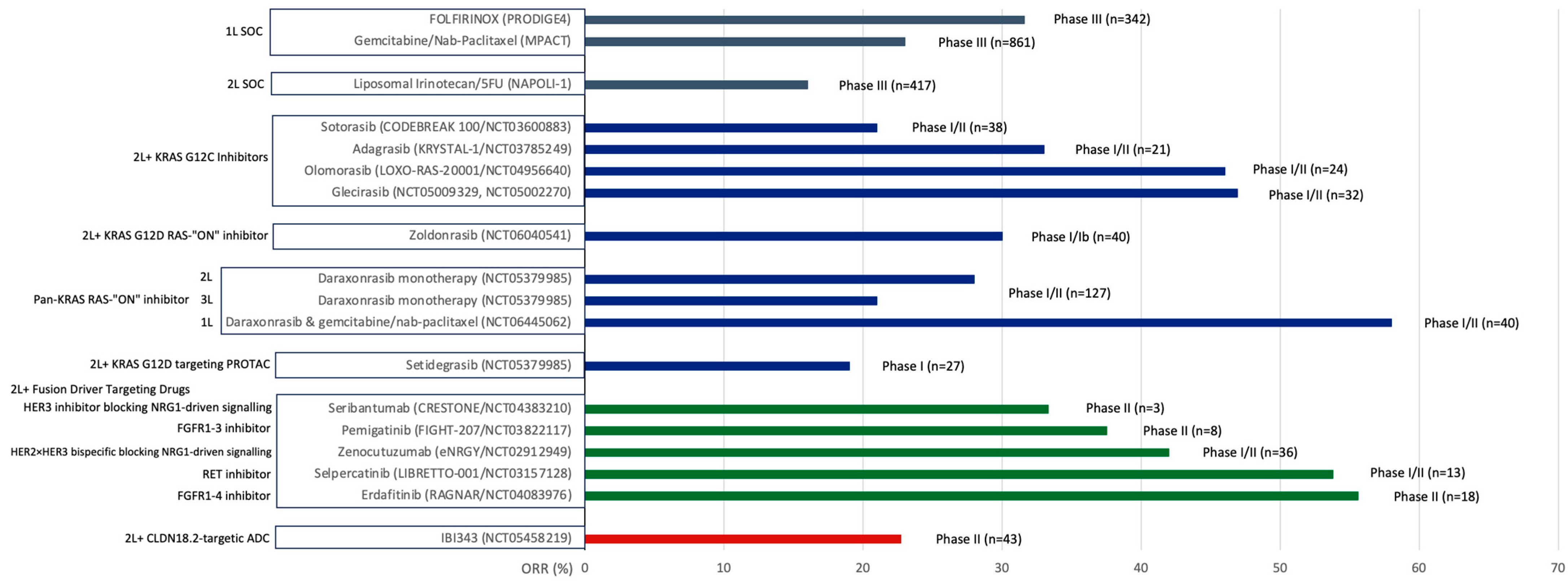
Against this backdrop, the rapid evolution of KRAS-directed therapeutics, including mutation-specific inhibitors, RAS-“ON” agents, PROTACs, and emerging vaccine-based strategies, marks a pivotal shift in the treatment landscape of KRAS-mutant PDAC. Early clinical signals for these approaches are particularly encouraging, with objective response rates in molecularly selected populations that in some cases compare favourably with conventional second-line outcomes (Figure 2). Notably, this momentum is now translating into late-stage development, with Daraxonrasib and Setidegrasib both progressing to phase III trials in PDAC (RASolute 302/NCT06625320, RASolute 303/NCT07491445 and RASolute 304/NCT07252232, and NCT07409272, respectively).
Therapies targeting oncogenic fusions and receptor-driven signalling have likewise shown notable activity in small, molecularly defined subsets, with objective response rates that in some cases exceed those typically observed with conventional second-line chemotherapy (Figure 2). Although these alterations are rare, the magnitude of response observed highlights their clinical relevance and reinforces the importance of systematic molecular profiling. The field is also beginning to generate regulatory and registrational validation beyond KRAS, exemplified by the accelerated FDA approval of Zenocutuzumab for NRG1 fusion-positive PDAC.
The comparatively better outcomes observed in KRAS-WT PDAC may partly reflect its enrichment for targetable alternative oncogenic drivers, including NRG1, NTRK, RET, ALK and FGFR fusions, as well as differences in tumour biology compared with KRAS-mutant disease. This again reinforces the importance of comprehensive molecular profiling, both to identify rare actionable subgroups and to avoid treating PDAC as a single biologically uniform entity.
This growing molecular granularity has also revealed a broader spectrum of actionable vulnerabilities across both KRAS-WT and KRAS-mutant disease, including DNA damage repair deficiencies, synthetic lethal dependencies such as MTAP loss, and tumour-associated targets such as CLDN18.2. IBI343, a CLDN18.2-directed ADC, has entered phase III testing (G-HOPE-002, NCT07066098) in previously treated PDAC. Collectively, these advances underscore the central role of molecularly stratified strategies and signal a transition from histology-based treatment towards precision oncology in PDAC.
Looking ahead, the successful integration of targeted therapies will likely depend on rational combination strategies designed to overcome adaptive resistance and the immunosuppressive tumour microenvironment. Improved patient stratification, longitudinal molecular monitoring, and the incorporation of functional biomarkers will be critical to optimising therapeutic sequencing and durability of response. Equally important will be the development of innovative clinical trial designs that allow efficient evaluation of personalised interventions in molecularly defined subsets.
Although this review focuses primarily on tumour-intrinsic genomic alterations and molecularly directed therapies, therapeutic response in PDAC is also shaped by the tumour microenvironment. The dense desmoplastic stroma, hypovascularity, immune exclusion, cancer-associated fibroblast heterogeneity, myeloid-cell infiltration and T-cell dysfunction characteristic of PDAC may limit drug delivery, promote adaptive survival signalling and constrain vaccine- or immune-mediated antitumour responses [116,117]. These factors are likely to influence the efficacy of KRAS-directed agents, receptor-targeted therapies, antibody-based approaches and vaccine strategies. Future precision strategies will therefore need to integrate tumour-intrinsic molecular profiling with stromal and immune biomarkers, while rational combinations may require context-specific modulation of the microenvironment to enhance therapeutic durability.
Transcriptomic profiling has identified reproducible PDAC tumour-cell states with distinct biology and clinical behaviour. These were initially described as classical and basal-like subtypes [118], with subsequent analyses describing squamous, pancreatic progenitor, immunogenic and aberrantly differentiated endocrine exocrine (ADEX) subtypes [119]. Although these classifications are not identical, they broadly distinguish classical/pancreatic progenitor tumours, which retain epithelial differentiation and pancreatic lineage features, from basal-like/squamous tumours, which are characterised by gene-expression patterns associated with mesenchymal transition, inflammation, hypoxia and poor differentiation, and are associated with poorer prognosis.
To date, the clearest clinical relevance of subtype identity lies in its potential predictive value for chemotherapy sensitivity. Classical tumours appear to derive greater benefit from 5-FU-based regimens such as FOLFIRINOX compared with basal-like tumours, which are associated with poorer outcomes and relative chemoresistance [120,121,122]. The relationship with Gemcitabine/Nab-Paclitaxel appears less clear, and prospective validation is ongoing [123].
Nevertheless, subtype identity is increasingly relevant to drug discovery and resistance biology. Subtype identity may also affect KRAS inhibitor response. Basal-like and mesenchymal states show greater sensitivity to KRAS inhibition than classical states [43]. Conversely, classical epithelial-state cells can persist after KRAS inhibition and drive tumour regrowth [124]. Basal PDAC models show greater sensitivity to CDK7 and CDK9 inhibition than classical models, supporting subtype-informed development of CDK inhibitors [125]. These findings support incorporating transcriptional subtype assessment alongside genomic profiling during PDAC drug discovery and early translational development.
Artificial intelligence and computational modelling are increasingly being applied in PDAC research. Multiomic AI platforms have shown potential to predict PDAC survival outcomes [126], deep-learning approaches can link histopathological features with molecular and proteomic states [127], and computational drug-screening models have been used to nominate candidate synergistic drug combinations in pancreatic cancer [128]. Although these approaches remain largely investigational, they may help prioritise future molecularly selected trials and accelerate precision oncology in PDAC [128,129].
Although significant obstacles remain, the convergence of advances in tumour biology, drug development, and translational research offers cautious optimism that precision oncology may finally reshape the therapeutic landscape of PDAC. Continued commitment to molecularly guided treatment strategies, longitudinal assessment of treatment response, and collaborative clinical investigation will be essential to translating these advances into meaningful and durable benefit for patients.

Author Contributions

Writing—original draft preparation, A.Y.L.; writing—review and editing, A.Y.L., H.L. and I.C. All authors have read and agreed to the published version of the manuscript.

Funding

This review received no external funding. Dr. Hazel Lote and Dr. Alicia Y. Lefas are funded by a grant from Cancer Research UK (the Bowelbabe Fund, Grant Award Reference SEBBBF-2024/100001).

Data Availability Statement

No new data were created or analysed in this study. Data sharing is not applicable to this article.

Conflicts of Interest

I.C. has served on consulting or advisory boards for Bristol Myers Squibb, Astellas, Daiichi-Sankyo, BioNTech, Novartis, Takeda, Beigene, Jazz Pharmaceuticals, Gilead, Revolution Medicines, Merck Serono, and Pfizer and received research funding from Eli Lilly and honoraria from Servier, Roche, BMS, Jazz Pharmaceuticals, Astellas and Astra-Zeneca. H.L. has served on commercial advisory boards for Merck and has received honoraria from Merck and BMS. The remaining authors declare no conflicts of interest.

Abbreviations

The following abbreviations are used in this manuscript:
1LFirst-line therapy
2LSecond-line therapy
5-FU5-Fluorouracil
AKTProtein kinase B
ALKAnaplastic lymphoma kinase
AMPKAMP-activated protein kinase
ATMAtaxia–telangiectasia mutated
ATPAdenosine triphosphate
ATRAtaxia–telangiectasia and Rad3-related
BRAFB-Raf proto-oncogene, serine/threonine kinase
BRCA1/2Breast cancer gene 1/2
CAR-TChimeric antigen receptor T-cell therapy
CDK4/6Cyclin-dependent kinases 4 and 6
CDKN2ACyclin-dependent kinase inhibitor 2A
CHEK1/2Checkpoint kinase 1/2
CLDN18.2Claudin 18 isoform 2
CRComplete response
DCRDisease control rate
DNADeoxyribonucleic acid
EGFREpidermal growth factor receptor
EML4Echinoderm microtubule-associated protein-like 4
ERBBErb-B receptor tyrosine kinase family
ERKExtracellular signal-regulated kinase
FGFRFibroblast growth factor receptor
FOLFIRINOX5-Fluorouracil, Leucovorin, Irinotecan and Oxaliplatin
GDPGuanosine diphosphate
GTPGuanosine triphosphate
HER2Human epidermal growth factor receptor 2
HRRHomologous recombination repair
IHCImmunohistochemistry
KRASKirsten rat sarcoma viral oncogene homologue
MAPKMitogen-activated protein kinase
MTAPMethylthioadenosine phosphorylase
mTORC1Mammalian target of rapamycin complex 1
NRG1Neuregulin 1
NTRKNeurotrophic tyrosine receptor kinase
ORRObjective response rate
OSOverall survival
PALB2Partner and localiser of BRCA2
PARPPoly(ADP-ribose) polymerase
PDACPancreatic ductal adenocarcinoma
PFSProgression-free survival
PI3KPhosphoinositide 3-kinase
PKCProtein kinase C
PLCPhospholipase C
PRPartial response
PRMT5Protein arginine methyltransferase 5
PROTACProteolysis-targeting chimera
RAD51RAD51 homologue 1
RAFRAF proteins
RALGDSRal Guanine nucleotide dissociation stimulator
RASRat sarcoma
RBRetinoblastoma
RETRearranged during transfection
ROS1ROS proto-oncogene 1 receptor tyrosine kinase
SHP2Src homology region 2-containing protein tyrosine phosphatase-2
SOCStandard-of-care
SOS1Son of sevenless homologue 1
STRNStriatin
TRAETreatment-related adverse event
ULK1/2Unc-51-like autophagy activating kinase 1/2
WTWild type

References

  1. Bray, F.; Laversanne, M.; Sung, H.; Ferlay, J.; Siegel, R.L.; Soerjomataram, I.; Jemal, A. Global cancer statistics 2022: GLOBOCAN estimates of incidence and mortality worldwide for 36 cancers in 185 countries. CA Cancer J. Clin. 2024, 74, 229–263. [Google Scholar] [CrossRef]
  2. Siegel, R.L.; Giaquinto, A.N.; Jemal, A. Cancer statistics, 2024. CA Cancer J. Clin. 2024, 74, 12–49. [Google Scholar] [CrossRef]
  3. Rahib, L.; Coffin, T.; Kenner, B. Factors driving pancreatic cancer survival rates. Pancreas 2025, 54, e530–e536. [Google Scholar] [CrossRef]
  4. Groot, V.P.; Rezaee, N.; Wu, W.; Cameron, J.L.; Fishman, E.K.; Hruban, R.H.; Weiss, M.J.; Zheng, L.; Wolfgang, C.L.; He, J. Patterns, timing, and predictors of recurrence following pancreatectomy for pancreatic ductal adenocarcinoma. Ann. Surg. 2018, 267, 936–945. [Google Scholar] [CrossRef]
  5. Conroy, T.; Desseigne, F.; Ychou, M.; Bouché, O.; Guimbaud, R.; Bécouarn, Y.; Adenis, A.; Raoul, J.-L.; Gourgou-Bourgade, S.; de la Fouchardière, C.; et al. FOLFIRINOX versus gemcitabine for metastatic pancreatic cancer. N. Engl. J. Med. 2011, 364, 1817–1825. [Google Scholar] [CrossRef]
  6. Von Hoff, D.D.; Ervin, T.; Arena, F.P.; Chiorean, E.G.; Infante, J.; Moore, M.; Seay, T.; Tjulandin, S.A.; Wee Ma, W.; Saleh, M.N.; et al. Increased survival in pancreatic cancer with nab-paclitaxel plus gemcitabine. N. Engl. J. Med. 2013, 369, 1691–1703. [Google Scholar] [CrossRef]
  7. Wang-Gillam, A.; Li, C.P.; Bodoky, G.; Dean, A.; Shan, Y.-S.; Jameson, G.; Macarulla, T.; Lee, K.-H.; Cunningham, D.; Blanc, J.F. NAPOLI-1 Study Group; et al. Nanoliposomal irinotecan with fluorouracil and folinic acid in metastatic pancreatic cancer after previous gemcitabine-based therapy (NAPOLI-1): A global, randomised, open-label, phase 3 trial. Lancet 2016, 387, 545–557. [Google Scholar] [CrossRef]
  8. Ryan, D.P.; Hong, T.S.; Bardeesy, N. Pancreatic adenocarcinoma. N. Engl. J. Med. 2014, 371, 1039–1049. [Google Scholar] [CrossRef]
  9. Waddell, N.; Pajic, M.; Patch, A.-M.; Chang, D.K.; Kassahn, K.S.; Bailey, P.; Johns, A.L.; Miller, D.; Nones, K.; Quek, K.; et al. Whole genomes redefine the mutational landscape of pancreatic cancer. Nature 2015, 518, 495–501. [Google Scholar] [CrossRef]
  10. Prior, I.A.; Lewis, P.D.; Mattos, C. A comprehensive survey of Ras mutations in cancer. Cancer Res. 2012, 72, 2457–2467. [Google Scholar] [CrossRef]
  11. Waters, A.M.; Der, C.J. KRAS: The critical driver and therapeutic target for pancreatic cancer. Cold Spring Harb. Perspect. Med. 2018, 8, a031435. [Google Scholar] [CrossRef]
  12. Norton, C.; Shaw, M.S.; Rubnitz, Z.; Smith, J.; Soares, H.P.; Nevala-Plagemann, C.D.; Garrido-Laguna, I.; Florou, V. KRAS Mutation Status and Treatment Outcomes in Patients with Metastatic Pancreatic Adenocarcinoma. JAMA Netw. Open 2025, 8, e2453588. [Google Scholar] [CrossRef]
  13. Cox, A.D.; Fesik, S.W.; Kimmelman, A.C.; Luo, J.; Der, C.J. Drugging the undruggable RAS: Mission possible? Nat. Rev. Drug Discov. 2014, 13, 828–851. [Google Scholar] [CrossRef]
  14. Ostrem, J.M.; Peters, U.; Sos, M.L.; Wells, J.A.; Shokat, K.M. K-Ras(G12C) inhibitors allosterically control GTP affinity and effector interactions. Nature 2013, 503, 548–551. [Google Scholar] [CrossRef]
  15. Strickler, J.H.; Satake, H.; George, T.J.; Yaeger, R.; Hollebecque, A.; Garrido-Laguna, I.; Schuler, M.; Burns, T.F.; Coveler, A.L.; Falchook, G.S.; et al. Sotorasib in KRAS p.G12C-mutated advanced pancreatic cancer. N. Engl. J. Med. 2023, 388, 33–43. [Google Scholar] [CrossRef]
  16. Bekaii-Saab, T.S.; Yaeger, R.; Spira, A.I.; Pelster, M.S.; Sabari, J.K.; Hafez, N.; Barve, M.; Velastegui, K.; Yan, X.; Shetty, A.; et al. Adagrasib in Advanced Solid Tumors Harboring a KRASG12C Mutation. J. Clin. Oncol. 2023, 41, 4097–4106. [Google Scholar] [CrossRef]
  17. Canon, J.; Rex, K.; Saiki, A.Y.; Mohr, C.; Cooke, K.; Bagal, D.; Gaida, K.; Holt, T.; Knutson, C.G.; Koppada, N.; et al. The clinical KRAS(G12C) inhibitor AMG 510 drives anti-tumour immunity. Nature 2019, 575, 217–223. [Google Scholar] [CrossRef]
  18. Hallin, J.; Engstrom, L.D.; Hargis, L.; Calinisan, A.; Aranda, R.; Briere, D.M.; Sudhakar, N.; Bowcut, V.; Baer, B.R.; Ballard, J.A.; et al. The KRASG12C inhibitor MRTX849 provides insight toward therapeutic susceptibility of KRAS-mutant cancers in mouse models and patients. Cancer Discov. 2020, 10, 54–71. [Google Scholar] [CrossRef]
  19. Kim, D.; Xue, J.Y.; Lito, P. Targeting KRASG12C: From inhibitory mechanism to modulation of antitumor effects in patients. Cell 2020, 183, 850–859. [Google Scholar] [CrossRef]
  20. Heist, R.S.; Koyama, T.; Murciano-Goroff, Y.R.; Hollebecque, A.; Cassier, P.A.; Han, J.-Y.; Tosi, D.; Sacher, A.G.; Burns, T.F.; Spira, A.I.; et al. Pan-tumor activity of olomora sib (LY3537982), a second-generation KRAS G12C inhibitor (G12Ci), in patients with KRAS G12C-mutant advanced solid tumors. J. Clin. Oncol. 2024, 42, 3007. [Google Scholar] [CrossRef]
  21. Sacher, A.; LoRusso, P.; Patel, M.R.; Miller, W.H.; Garralda, E.; Forster, M.D.; Santoro, A.; Falcon, A.; Kim, T.W.; Paz-Ares, L.; et al. Single-agent divarasib (GDC-6036) in solid tumors with a KRAS G12C mutation. N. Engl. J. Med. 2023, 389, 710–721. [Google Scholar] [CrossRef]
  22. Li, J.; Deng, T.; Gu, Y.; Calles Blanco, A.; Li, Z.; Bai, C.; Wu, L.; Huang, J.; Li, X.; Yao, Y.; et al. Efficacy and safety of glecirasib in solid tumors with KRAS G12C mutation: A pooled analysis of two phase I/II trials. Cancer Commun. 2025, 45, 1500–1512. [Google Scholar] [CrossRef]
  23. Hobbs, G.A.; Der, C.J.; Rossman, K.L. RAS isoforms and mutations in cancer at a glance. J. Cell Sci. 2016, 129, 1287–1292. [Google Scholar] [CrossRef]
  24. Wang, X.; Allen, S.; Blake, J.F.; Bowcut, V.; Briere, D.M.; Calinisan, A.; Dahlke, J.R.; Fell, J.B.; Fischer, J.P.; Gunn, R.J.; et al. Identification of MRTX1133, a noncovalent, potent, and selective KRAS G12D inhibitor. J. Med. Chem. 2022, 65, 3123–3133. [Google Scholar] [CrossRef]
  25. Wei, D.; Wang, L.; Zuo, X.; Maitra, A.; Bresalier, R.S. A small molecule with big impact: MRTX1133 targets the KRASG12D mutation in pancreatic cancer. Clin. Cancer Res. 2024, 30, 655–662. [Google Scholar] [CrossRef]
  26. Schulze, C.J.; Seamon, K.J.; Zhao, Y.; Yang, Y.C.; Cregg, J.; Kim, D.; Tomlinson, A.; Choy, T.J.; Wang, Z.; Sang, B.; et al. Chemical remodeling of a cellular chaperone to target the active state of mutant KRAS. Science 2023, 381, 794–799. [Google Scholar] [CrossRef]
  27. Ying, H.; Kimmelman, A.C.; Lyssiotis, C.A.; Hua, S.; Chu, G.C.; Fletcher-Sananikone, E.; Locasale, J.W.; Son, J.; Zhang, H.; Coloff, J.L.; et al. Oncogenic Kras maintains pancreatic tumors through regulation of anabolic glucose metabolism. Cell 2012, 149, 656–670. [Google Scholar] [CrossRef]
  28. Cregg, J.; Pota, A.; Tomlinson, A.C.A.; Yano, J.; Marquez, A.; Liu, Y.; Schulze, C.J.; Seamon, K.J.; Holderfield, M.; Wei, X.; et al. Discovery of elironrasib (RMC-6291), a potent and orally bioavailable, RAS(ON) G12C-selective, covalent tricomplex inhibitor for the treatment of patients with RAS G12C-addicted cancers. J. Med. Chem. 2025, 68, 6041–6063. [Google Scholar] [CrossRef]
  29. Spira, A.I.; Papadopoulos, K.P.; Kim, D.W.; Parikh, A.R.; Barve, M.A.; Powderly, J.D.; Starodub, A.; Strickler, J.H.; Li, B.T.; Oberstein, P.E.; et al. Preliminary safety, antitumor activity, and circulating tumor DNA (ctDNA) changes with zoldonrasib (RMC-9805), an oral, RAS(ON) G12D-selective, tri-complex inhibitor in patients with KRAS G12D pancreatic ductal adenocarcinoma (PDAC) from a phase 1 study in advanced solid tumors. J. Clin. Oncol. 2025, 43, 724. [Google Scholar]
  30. Garrido-Laguna, I.; Wolpin, B.M.; Park, W.; Azad, N.S.; Spira, A.I.; Sarodub, A.; Sommerhalder, D.; Punekar, R.; Herzberg, B.; Barve, M.A.; et al. Safety, efficacy, and on-treatment circulating tumor DNA (ctDNA) changes from a phase 1 study of RMC-6236, a RAS(ON) multi-selective, tri-complex inhibitor, in patients with RAS-mutant pancreatic ductal adenocarcinoma (PDAC). J. Clin. Oncol. 2025, 43, 722. [Google Scholar] [CrossRef]
  31. Wolpin, B.M.; Musher, B.L.; Manji, G.A.; Park, W.; Spira, A.; Azad, N.; Florou, V.; Biachi De Castria, T.; O’Hara, M.H.; Borazanci, E.; et al. Abstract LB407: Daraxonrasib plus chemotherapy as first-line treatment for patients with RAS mutant metastatic pancreatic ductal adenocarcinoma. Cancer Res. 2026, 86, LB407. [Google Scholar] [CrossRef]
  32. Chirnomas, D.; Hornberger, K.R.; Crews, C.M. Protein degraders enter the clinic—A new approach to cancer therapy. Nat. Rev. Clin. Oncol. 2023, 20, 265–278. [Google Scholar] [CrossRef]
  33. Nagashima, T.; Inamura, K.; Nishizono, Y.; Suzuki, A.; Tanaka, H.; Yoshinari, T.; Yamanaka, Y. ASP3082, a First-in-class novel KRAS G12D degrader, exhibits remarkable anti-tumor activity in KRAS G12D mutated cancer models. Eur. J. Cancer 2022, 174, S30. [Google Scholar] [CrossRef]
  34. Park, W.; Kasi, A.; Spira, A.I.; Berlin, J.D.; Wang, J.S.; Herzberg, B.; Kuboki, Y.; Kitano, S.; Pelster, M.; Goldman, J.W.; et al. Preliminary safety and clinical activity of ASP3082, a first-in-class KRAS G12D-selective protein degrader, in adults with advanced KRAS G12D-mutant solid tumors (ESMO Congress 2024 Abstract 608O). Ann. Oncol. 2024, 35, S486–S487. [Google Scholar] [CrossRef]
  35. Wainberg, Z.A.; Weeks, C.D.; Furqan, M.; Kasi, P.M.; Devoe, C.E.; Leal, A.D.; Chung, V.; Perry, J.R.; Kheoh, T.; McNeil, L.K.; et al. Lymph node-targeted, mKRAS-specific amphiphile vaccine in pancreatic and colorectal cancer: Phase 1 AMPLIFY-201 trial final results. Nat. Med. 2025, 31, 3648–3653. [Google Scholar] [CrossRef]
  36. Palmer, D.H.; Valle, J.W.; Ma, Y.T.; Faluyi, O.; Neoptolemos, J.P.; Jensen Gjertsen, T.; Iversen, B.; Amund Eriksen, J.; Møller, A.S.; Aksnes, A.K.; et al. TG01/GM-CSF and adjuvant gemcitabine in patients with resected RAS-mutant adenocarcinoma of the pancreas (CT TG01-01): A single-arm, phase 1/2 trial. Br. J. Cancer 2020, 122, 971–977. [Google Scholar] [CrossRef]
  37. Huff, A.L.; Haldar, S.D.; Girgis, A.A.; Wang, H.H.; Danilova, L.; Heumann, T.; Berg, M.; Wang, Y.; Andaloori, L.; Hernandez, A.; et al. Mutant KRAS vaccine with dual checkpoint blockade in resected pancreatic cancer: A phase I trial. Nat. Commun. 2026, 17, 1538. [Google Scholar] [CrossRef]
  38. Rappaport, A.R.; Kyi, C.; Lane, M.; Hart, M.G.; Johnson, M.L.; Henick, B.S.; Liao, C.Y.; Mahipal, A.; Shergill, A.; Spira, A.I.; et al. A shared neoantigen vaccine combined with immune checkpoint blockade for advanced metastatic solid tumors: Phase 1 trial interim results. Nat. Med. 2024, 30, 1013–1022. [Google Scholar] [CrossRef] [PubMed]
  39. Collins, M.A.; Brisset, J.C.; Zhang, Y.; Bednar, F.; Pierre, J.; Heist, K.A.; Galbán, C.J.; Galbán, S.; di Magliano, M.P. Metastatic pancreatic cancer is dependent on oncogenic Kras in mice. PLoS ONE 2012, 7, e49707. [Google Scholar] [CrossRef] [PubMed]
  40. Awad, M.M.; Liu, S.; Rybkin, I.I.; Arbour, K.C.; Dilly, J.; Zhu, V.W.; Johnson, M.L.; Heist, R.S.; Patil, T.; Riely, G.J.; et al. Acquired resistance to KRASG12C inhibition in cancer. N. Engl. J. Med. 2021, 384, 2382–2393. [Google Scholar] [CrossRef] [PubMed]
  41. Tanaka, N.; Lin, J.J.; Li, C.; Ryan, M.B.; Zhang, J.; Kiedrowski, L.A.; Michel, A.G.; Syed, M.U.; Fella, K.A.; Sakhi, M.; et al. Clinical acquired resistance to KRASG12C inhibition through a novel KRAS switch-II pocket mutation and polyclonal alterations converging on RAS–MAPK reactivation. Cancer Discov. 2021, 11, 1913–1922. [Google Scholar] [CrossRef]
  42. Ryan, M.B.; de la Cruz, F.F.; Phat, S.; Myers, D.T.; Wong, E.; Shahzade, H.A.; Hong, C.B.; Corcoran, R.B. Vertical pathway inhibition overcomes adaptive feedback resistance to KRASG12C inhibition. Clin. Cancer Res. 2020, 26, 1633–1643. [Google Scholar] [CrossRef] [PubMed]
  43. Dilly, J.; Hoffman, M.T.; Abbassi, L.; Li, Z.; Paradiso, F.; Parent, B.D.; Hennessey, C.J.; Jordan, A.C.; Morgado, M.; Dasgupta, S.; et al. Mechanisms of resistance to oncogenic KRAS inhibition in pancreatic cancer. Cancer Discov. 2024, 14, 2135–2161. [Google Scholar] [CrossRef] [PubMed]
  44. Kessler, D.; Gerlach, D.; Kraut, N.; McConnell, D.B. Targeting Son of Sevenless 1: The pacemaker of KRAS. Curr. Opin. Chem. Biol. 2021, 62, 109–118. [Google Scholar] [CrossRef]
  45. Hofmann, M.H.; Gmachl, M.; Ramharter, J.; Savarese, F.; Gerlach, D.; Marszalek, J.R.; Sanderson, M.P.; Kessler, D.; Trapani, F.; Arnhof, H.; et al. BI-3406, a potent and selective SOS1–KRAS interaction inhibitor, is effective in KRAS-driven cancers through combined MEK inhibition. Cancer Discov. 2021, 11, 142–157. [Google Scholar] [CrossRef]
  46. Johnson, M.L.; Gort, E.; Pant, S.; Lolkema, M.P.; Sebastian, M.; Scheffler, M.; Hwang, J.; Dünzinger, U.; Riemann, K.; Kitzing, T.; et al. 524P A phase I, open-label, dose-escalation trial of BI 1701963 in patients (pts) with KRAS mutated solid tumours: A snapshot analysis. Ann. Oncol. 2021, 32, S591–S592. [Google Scholar] [CrossRef]
  47. Hillig, R.C.; Sautier, B.; Schroeder, J.; Moosmayer, D.; Hilpmann, A.; Stegmann, C.M.; Werbeck, N.D.; Briem, H.; Boemer, U.; Weiske, J.; et al. Discovery of potent SOS1 inhibitors that block RAS activation via disruption of the RAS–SOS1 interaction. Proc. Natl. Acad. Sci. USA 2019, 116, 2551–2560. [Google Scholar] [CrossRef]
  48. Hofmann, M.H.; Gerlach, D.; Misale, S.; Petronczki, M.; Kraut, N. Expanding the reach of precision oncology by drugging all KRAS mutants. Cancer Discov. 2022, 12, 924–937. [Google Scholar] [CrossRef]
  49. Matozaki, T.; Murata, Y.; Saito, Y.; Okazawa, H.; Ohnishi, H. Protein tyrosine phosphatase SHP-2: A proto-oncogene product that promotes activation of the Ras-MAPK signaling pathway. Cancer Sci. 2009, 100, 1786–1793. [Google Scholar] [CrossRef]
  50. Johnson, M.L.; Langdon, R.; Ellison, D.; Spira, A.; Amin, H.; Castine, M.; Daniel, D.B.; Sohoni, S.; Chen, Y.-C.; Hayes, J.; et al. 76TiP RMC-4630 and sotorasib for advanced KRASG12C NSCLC after failure of prior standard therapies: A phase II trial. Ann. Oncol. 2022, 33, S66–S67. [Google Scholar] [CrossRef]
  51. Falchook, G.; Li, B.T.; Marrone, K.A.; Bestvina, C.M.; Langer, C.J.; Krauss, J.C.; Strickler, J.H.; Meloni, A.; Dai, T.; Varrieur, T.; et al. OA03.03 Sotorasib in combination with RMC-4630, a SHP2 inhibitor, in KRAS p.G12C-mutated NSCLC and other solid tumors. J. Thorac. Oncol. 2022, 17, S8. [Google Scholar] [CrossRef]
  52. Negrao, M.V.; Cassier, P.A.; Solomon, B.; Schuler, M.; Rohrberg, K.; Cresta, S.; Dooms, C.; Tan, D.S.W.; Loong, H.H.-F.; Amatu, A.; et al. MA06.03 KontRASt-01: Preliminary safety and efficacy of JDQ443 + TNO155 in patients with advanced, KRAS G12C-mutated solid tumors. J. Thorac. Oncol. 2023, 18, S117–S118. [Google Scholar] [CrossRef]
  53. Wang, J.; Zhao, J.; Zhong, J.; Li, X.; Fang, J.; Yu, Y.; Li, X.; Fang, X.; Chang, J.; Liu, Z.; et al. 653O Glecirasib (KRAS G12C inhibitor) in combination with JAB-3312 (SHP2 inhibitor) in patients with KRAS p.G12C mutated solid tumors. Ann. Oncol. 2023, 34, S459. [Google Scholar] [CrossRef]
  54. Akhave, N.S.; Bitter, A.B.; Hong, D.S. Mechanisms of resistance to KRAS G12C-targeted therapies. Cancer Discov. 2021, 11, 1345–1352. [Google Scholar] [CrossRef] [PubMed]
  55. Pareek, G.; Kundu, M. Physiological functions of ULK1/2. J. Mol. Biol. 2024, 436, 168472. [Google Scholar] [CrossRef] [PubMed]
  56. Ghazi, P.C.; O’Toole, K.T.; Srinivas Boggaram, S.; Scherzer, M.T.; Silvis, M.R.; Zhang, Y.; Bogdan, M.; Smith, B.D.; Lozano, G.; Flynn, D.L.; et al. Inhibition of ULK1/2 and KRASG12C controls tumor growth in preclinical models of lung cancer. eLife 2024, 13, RP96992. [Google Scholar] [CrossRef] [PubMed]
  57. Chung, V.; McDonough, S.; Philip, P.A.; Cardin, D.; Wang-Gillam, A.; Hui, L.; Tejani, M.A.; Seery, T.E.; Dy, I.A.; Al Baghdadi, T.; et al. Effect of Selumetinib and MK-2206 vs. Oxaliplatin and Fluorouracil in Patients with Metastatic Pancreatic Cancer After Prior Therapy: SWOG S1115 Study Randomized Clinical Trial. JAMA Oncol. 2017, 3, 516–522. [Google Scholar] [CrossRef]
  58. Haldar, S.D.; Saj, F.; Hong, S.J.; Surana, R.; Xiao, L.; Lee, J.J.; Smaglo, B.; Zhao, D.; Zhu, H.; Huey, R.; et al. Phase I Trial of Binimetinib Plus Hydroxychloroquine in Patients with Previously Treated Metastatic Pancreatic Cancer. Oncologist 2026, 31, oyag071. [Google Scholar] [CrossRef]
  59. Philip, P.A.; Azar, I.; Xiu, J.; Hall, M.J.; Hendifar, A.E.; Lou, E.; Hwang, J.J.; Gong, J.; Feldman, R.; Ellis, M.; et al. Molecular characterization of KRAS wild-type tumors in patients with pancreatic adenocarcinoma. Clin. Cancer Res. 2022, 28, 2704–2714. [Google Scholar] [CrossRef]
  60. Laskin, J.; Liu, S.V.; Tolba, K.; Heining, C.; Schlenk, R.F.; Cheema, P.; Cadranel, J.; Jones, M.R.; Drilon, A.; Cseh, A.; et al. NRG1 fusion-driven tumors: Biology, detection and the clinical landscape. Ann. Oncol. 2020, 31, S322–S330. [Google Scholar] [CrossRef]
  61. Schram, A.M.; Goto, K.; Kim, D.W.; Macarulla, T.; Hollebecque, A.; O’Reilly, E.M.; Ou, S.I.; Rodon, J.; Rha, S.Y.; Nishino, K.; et al. Efficacy of zenocutuzumab in NRG1 fusion–positive cancer. N. Engl. J. Med. 2025, 392, 566–576. [Google Scholar] [CrossRef]
  62. Patil, T.; Lin, J.J.; Cheema, P.K.; Carrizosa, D.R.; Burkard, M.E.; Elamin, Y.Y.; Desai, J.; Patel, J.D.; Nagasaka, M.; Reckamp, K.L.; et al. CRESTONE: A Phase II Study of the Efficacy and Safety of the HER3 Monoclonal Antibody, Seribantumab, in Solid Tumors with Neuregulin-1 (NRG1) Fusions. JCO Precis. Oncol. 2025, 9, e2500221. [Google Scholar] [CrossRef] [PubMed]
  63. Okamura, R.; Boichard, A.; Kato, S.; Sicklick, J.K.; Bazhenova, L.; Kurzrock, R. Analysis of NTRK alterations in pan-cancer adult and pediatric malignancies: Implications for NTRK-targeted therapeutics. JAMA Oncol. 2018, 4, e183020. [Google Scholar] [CrossRef]
  64. Hong, D.S.; DuBois, S.G.; Kummar, S.; Farago, A.F.; Albert, C.M.; Rohrberg, K.S.; van Tilburg, C.M.; Nagasubramanian, R.; Berlin, J.D.; Federman, N.; et al. Larotrectinib in patients with TRK fusion-positive solid tumours: A pooled analysis of three phase 1/2 clinical trials. Lancet Oncol. 2020, 21, 531–540. [Google Scholar] [CrossRef]
  65. Demetri, G.D.; De Braud, F.; Drilon, A.; Siena, S.; Patel, M.R.; Cho, B.C.; Liu, S.V.; Ahn, M.J.; Chiu, C.H.; Lin, J.J.; et al. Updated integrated analysis of the efficacy and safety of entrectinib in patients with NTRK fusion-positive solid tumors. Clin. Cancer Res. 2022, 28, 1302–1312. [Google Scholar] [CrossRef]
  66. Besse, B.; Lin, J.J.; Bazhenova, L.; Goto, K.; de Langen, A.J.; Kim, D.W.; Wolf, J.; Springfeld, C.; Popat, S.; Lim, D.W.T.; et al. Repotrectinib in NTRK fusion–positive advanced solid tumors: A phase 1/2 trial. Nat. Med. 2026, 32, 682–689. [Google Scholar] [CrossRef]
  67. US Food and Drug Administration. FDA Grants Accelerated Approval to Repotrectinib for Adult and Pediatric Patients with NTRK Gene Fusion-Positive Solid Tumors; US Food and Drug Administration: Silver Spring, MD, USA, 2024.
  68. Kato, S.; Subbiah, V.; Marchlik, E.; Elkin, S.K.; Carter, J.L.; Kurzrock, R. RET aberrations in diverse cancers: Next-generation sequencing of 4871 patients. Clin. Cancer Res. 2017, 23, 1988–1997. [Google Scholar] [CrossRef]
  69. Subbiah, V.; Wolf, J.; Konda, B.; Kang, H.; Spira, A.; Weiss, J.; Takeda, M.; Ohe, Y.; Khan, S.; Ohashi, K.; et al. Tumour-agnostic efficacy and safety of selpercatinib in patients with RET fusion-positive solid tumours other than lung or thyroid tumours (LIBRETTO-001): A phase 1/2, open-label, basket trial. Lancet Oncol. 2022, 23, 1261–1273. [Google Scholar] [CrossRef] [PubMed]
  70. Subbiah, V.; Drilon, A.E.; Sukrithan, V.; Spira, A.I.; Robinson, B.; Deschler-Baier, B.; Barker, S.; Lin, Y.; Szymczak, S.; Ohe, Y. Durable efficacy of selpercatinib in patients with RET fusion + solid tumors, with a focus on GI tumors: LIBRETTO-001. J. Clin. Oncol. 2024, 42, 746. [Google Scholar] [CrossRef]
  71. Subbiah, V.; Cassier, P.A.; Siena, S.; Garralda, E.; Paz-Ares, L.; Garrido, P.; Nadal, E.; Vuky, J.; Lopes, G.; Kalemkerian, G.P.; et al. Pan-cancer efficacy of pralsetinib in patients with RET fusion–positive solid tumors from the phase 1/2 ARROW trial. Nat. Med. 2022, 28, 1640–1645. [Google Scholar] [CrossRef]
  72. Singhi, A.D.; George, B.; Greenbowe, J.R.; Chung, J.; Suh, J.; Maitra, A.; Klempner, S.J.; Hendifar, A.; Milind, J.M.; Golan, T.; et al. Real-time targeted genome profile analysis of pancreatic ductal adenocarcinomas identifies genetic alterations that might be targeted with existing drugs or used as biomarkers. Gastroenterology 2019, 156, 2242–2253.e4. [Google Scholar] [CrossRef]
  73. Pant, S.; Schuler, M.; Iyer, G.; Witt, O.; Doi, T.; Qin, S.; Tabernero, J.; Reardon, D.A.; Massard, C.; Minchom, A.; et al. Erdafitinib in patients with advanced solid tumours with FGFR alterations (RAGNAR): An international, single-arm, phase 2 study. Lancet Oncol. 2023, 24, 925–935. [Google Scholar] [CrossRef]
  74. Abou-Alfa, G.K.; Sahai, V.; Hollebecque, A.; Vaccaro, G.; Melisi, D.; Al-Rajabi, R.; Paulson, A.S.; Borad, M.J.; Gallinson, D.; Murphy, A.G.; et al. Pemigatinib for previously treated, locally advanced or metastatic cholangiocarcinoma: A multicentre, open-label, phase 2 study. Lancet Oncol. 2020, 21, 671–684. [Google Scholar] [CrossRef] [PubMed]
  75. Rodón, J.; Damian, S.; Furqan, M.; García-Donas, J.; Imai, H.; Italiano, A.; Spanggaard, I.; Ueno, M.; Yokota, T.; Veronese, M.L.; et al. Pemigatinib in previously treated solid tumors with activating FGFR1-FGFR3 alterations: Phase 2 FIGHT-207 basket trial. Nat. Med. 2024, 30, 1645–1654. [Google Scholar] [CrossRef]
  76. Singhi, A.D.; Ali, S.M.; Lacy, J.; Hendifar, A.; Nguyen, K.; Koo, J.; Chung, J.H.; Greenbowe, J.; Ross, J.S.; Nikiforova, M.N.; et al. Identification of Targetable ALK Rearrangements in Pancreatic Ductal Adenocarcinoma. J. Natl. Compr. Cancer Netw. 2017, 15, 555–562. [Google Scholar] [CrossRef] [PubMed]
  77. Ambrosini, M.; Del Re, M.; Manca, P.; Hendifar, A.; Drilon, A.; Harada, G.; Ree, A.H.; Klempner, S.; Mælandsmo, G.M.; Flatmark, K.; et al. ALK Inhibitors in Patients with ALK Fusion–Positive GI Cancers: An International Data Set and a Molecular Case Series. JCO Precis. Oncol. 2022, 6, e2200015. [Google Scholar] [CrossRef]
  78. Harder, J.; Ihorst, G.; Heinemann, V.; Hofheinz, R.; Moehler, M.; Buechler, P.; Kloeppel, G.; Röcken, C.; Bitzer, M.; Boeck, S.; et al. Multicentre phase II trial of trastuzumab and capecitabine in patients with HER2 overexpressing metastatic pancreatic cancer. Br. J. Cancer 2012, 106, 1033–1038. [Google Scholar] [CrossRef]
  79. Assenat, E.; Mineur, L.; Mollevi, C.; Lopez-Crapez, E.; Lombard-Bohas, C.; Samalin, E.; Portales, F.; Walter, T.; de Forges, H.; Dupuy, M.; et al. Phase II study evaluating the association of gemcitabine, trastuzumab and erlotinib as first-line treatment in patients with metastatic pancreatic adenocarcinoma (GATE 1). Int. J. Cancer 2021, 148, 682–691. [Google Scholar] [CrossRef]
  80. Sweeney, C.J.; Hainsworth, J.D.; Bose, R.; Burris, H.A.; Kurzrock, R.; Swanton, C.; Friedman, C.F.; Spigel, D.R.; Szado, T.; Schulze, K.; et al. MyPathway Human Epidermal Growth Factor Receptor 2 Basket Study: Pertuzumab + Trastuzumab Treatment of a Tissue-Agnostic Cohort of Patients with Human Epidermal Growth Factor Receptor 2-Altered Advanced Solid Tumors. J. Clin. Oncol. 2024, 42, 258–265. [Google Scholar] [CrossRef] [PubMed]
  81. Meric-Bernstam, F.; Makker, V.; Oaknin, A.; Oh, D.Y.; Banerjee, S.; González-Martín, A.; Jung, K.H.; Ługowska, I.; Manso, L.; Manzano, A.; et al. Efficacy and safety of trastuzumab deruxtecan in patients with HER2-expressing solid tumors: Primary results from the DESTINY-PanTumor02 Phase 2 trial. J. Clin. Oncol. 2024, 42, 47–58. [Google Scholar] [CrossRef]
  82. Haas, M.; Waldschmidt, D.T.; Stahl, M.; Reinacher-Schick, A.; Freiberg-Richter, J.; Fischer von Weikersthal, L.; Kaiser, F.; Kanzler, S.; Frickhofen, N.; Seufferlein, T.; et al. Afatinib plus gemcitabine versus gemcitabine alone as first-line treatment of metastatic pancreatic cancer: The randomised, open-label phase II ACCEPT study. Eur. J. Cancer 2021, 146, 95–106. [Google Scholar] [CrossRef]
  83. Shimoi, T.; Sunami, K.; Tahara, M.; Nishiwaki, S.; Tanaka, S.; Baba, E.; Kanai, M.; Kinoshita, I.; Shirota, H.; Hayashi, H.; et al. Dabrafenib and trametinib administration in patients with BRAF V600E/R or non-V600 BRAF mutated advanced solid tumours (BELIEVE, NCCH1901): A multicentre, open-label, single-arm phase II trial. EClinicalMedicine 2024, 69, 102447. [Google Scholar] [CrossRef]
  84. Flaherty, K.T.; Gray, R.; Chen, A.; Li, S.; Patton, D.; Hamilton, S.R.; Williams, P.M.; Mitchell, E.P.; Iafrate, A.J.; Sklar, J.; et al. The Molecular Analysis for Therapy Choice (NCI-MATCH) Trial: Lessons for Genomic Trial Design. J. Natl. Cancer Inst. 2020, 112, 1021–1029. [Google Scholar] [CrossRef]
  85. Salama, A.K.S.; Li, S.; Macrae, E.R.; Park, J.I.; Mitchell, E.P.; Zwiebel, J.A.; Chen, H.X.; Gray, R.J.; McShane, L.M.; Rubinstein, L.V.; et al. Dabrafenib and trametinib in patients with tumours with BRAF V600E mutations: Results of the NCI-MATCH trial subprotocol H. J. Clin. Oncol. 2020, 38, 3895–3904. [Google Scholar] [CrossRef]
  86. Johnson, D.B.; Zao, F.; Noel, M.; Riely, G.J.; Mitchell, E.P.; Wright, J.J.; Chen, H.X.; Gray, R.J.; Li, S.; McShane, L.M.; et al. Trametinib activity in patients with solid tumors and lymphomas harboring BRAF non-V600 mutations or fusions: Results from NCI-MATCH Subprotocol R (EAY131-R). Clin. Cancer Res. 2020, 26, 1838–1846. [Google Scholar] [CrossRef]
  87. Tzeng, C.-W.D.; Frolov, A.; Frolova, N.; Jhala, N.C.; Howard, J.H.; Buchsbaum, D.J.; Vickers, S.M.; Heslin, M.J.; Arnoletti, J.P. Epidermal growth factor receptor (EGFR) is highly conserved in pancreatic cancer. Ann. Surg. Oncol. 2007, 14, 1383–1392. [Google Scholar] [CrossRef]
  88. Moore, M.J.; Goldstein, D.; Hamm, J.; Figer, A.; Hecht, J.R.; Gallinger, S.; Au, H.J.; Murawa, P.; Walde, D.; Wolff, R.A.; et al. Erlotinib plus gemcitabine compared with gemcitabine alone in patients with advanced pancreatic cancer: A phase III trial of the National Cancer Institute of Canada Clinical Trials Group. J. Clin. Oncol. 2007, 25, 1960–1966. [Google Scholar] [CrossRef]
  89. Philip, P.A.; Benedetti, J.; Corless, C.L.; Wong, R.; O’Reilly, E.M.; Flynn, P.J.; Rowland, K.M.; Atkins, J.N.; Mirtsching, B.C.; Rivkin, S.E.; et al. Phase III study comparing gemcitabine plus cetuximab versus gemcitabine in patients with advanced pancreatic adenocarcinoma: Southwest Oncology Group-Directed Intergroup Trial S0205. J. Clin. Oncol. 2010, 28, 3605–3610. [Google Scholar] [CrossRef]
  90. Kullmann, F.; Hollerbach, S.; Dollinger, M.M.; Harder, J.; Fuchs, M.; Messmann, H.; Trojan, J.; Gäbele, E.; Hinke, A.; Hollerbach, C.; et al. Cetuximab plus gemcitabine/oxaliplatin (GEMOXCET) in first-line metastatic pancreatic cancer: A multicentre phase II study. Br. J. Cancer 2009, 100, 1032–1036. [Google Scholar] [CrossRef]
  91. Halfdanarson, T.R.; Foster, N.R.; Kim, G.P.; Haddock, M.G.; Dakhil, S.R.; Behrens, R.J.; Alberts, S.R. N064A (Alliance): Phase II study of panitumumab, chemotherapy, and external beam radiation in patients with locally advanced pancreatic adenocarcinoma. Oncologist 2022, 27, E534–E546. [Google Scholar] [CrossRef]
  92. Qin, S.; Li, J.; Bai, Y.; Wang, Z.; Chen, Z.; Xu, R.; Xu, J.; Zhang, H.; Chen, J.; Yuan, Y.; et al. Nimotuzumab plus gemcitabine for K-Ras wild-type locally advanced or metastatic pancreatic cancer: Results of the NOTABLE Phase III trial. J. Clin. Oncol. 2023, 41, 5163–5173. [Google Scholar] [CrossRef]
  93. Lyu, S.I.; Fretter, C.; Simon, A.G.; Spielmann, S.M.; Damanakis, A.I.; Zhao, Y.; Bruns, C.J.; Schmidt, T.; Popp, F.C.; Waldschmidt, D.; et al. Extent and clinical significance of the therapy-relevant tight junction protein Claudin 18.2 in pancreatic ductal adenocarcinoma—Real-world evidence. Transl. Oncol. 2024, 47, 102044. [Google Scholar] [CrossRef]
  94. Park, W.; O’Reilly, E.M.; Li, C.-P.; Oh, D.-Y.; Garcia-Cabonero, R.; Roth, G.; Nakajima, T.; Moran, D.; Yang, J.; Li, R.; et al. 1532TiP Zolbetuximab with gemcitabine + nab-paclitaxel (GN) in first-line treatment of Claudin 18.2–positive metastatic pancreatic cancer (mPC): Phase II, open-label, randomized study. Ann. Oncol. 2024, 35, S934. [Google Scholar] [CrossRef]
  95. Yu, X.; Ying, J.; Enxiao, L.; Zhou, A.; Sun, Y.; Yue, J.; Ruan, J.; Zhang, J.; Shen, L.; Du, J.; et al. Claudin18.2 (CLDN18.2) expression and efficacy in pancreatic ductal adenocarcinoma: Results from a phase I dose expansion cohort evaluating IBI343 (anti-CLDN18.2 ADC). J. Clin. Oncol. 2025, 43, 4017. [Google Scholar] [CrossRef]
  96. Qi, C.; Zhang, P.; Liu, C.; Zhang, J.; Zhou, J.; Yuan, J.; Liu, D.; Zhang, M.; Gong, J.; Wang, X.; et al. Safety and Efficacy of CT041 in Patients with Refractory Metastatic Pancreatic Cancer: A Pooled Analysis of Two Early-Phase Trials. J. Clin. Oncol. 2024, 42, 2565–2577. [Google Scholar] [CrossRef] [PubMed]
  97. Kalev, P.; Hyer, M.L.; Gross, S.; Konteatis, Z.; Chen, C.C.; Fletcher, M.; Lein, M.; Aguado-Fraile, E.; Frank, V.; Barnett, A.; et al. MAT2A inhibition blocks the growth of MTAP-deleted cancer cells by reducing PRMT5-dependent mRNA splicing and inducing DNA damage. Cancer Cell 2021, 39, 209–224.e11. [Google Scholar] [CrossRef] [PubMed]
  98. Gorbokon, N.; Wößner, N.; Ahlburg, V.; Plage, H.; Hofbauer, S.; Furlano, K.; Weinberger, S.; Bruch, P.G.; Schallenberg, S.; Roßner, F.; et al. Loss of MTAP expression is strongly linked to homozygous 9p21 deletion, unfavorable tumor phenotype, and noninflamed microenvironment in urothelial bladder cancer. J. Pathol. Clin. Res. 2024, 11, e70012. [Google Scholar] [CrossRef]
  99. Wei, X.; Yang, J.; Adair, S.J.; Ozturk, H.; Kuscu, C.; Lee, K.Y.; Kane, W.J.; O’Hara, P.E.; Liu, D.; Demirlenk, Y.M.; et al. Targeted CRISPR screening identifies PRMT5 as a synthetic lethality target with gemcitabine in pancreatic ductal adenocarcinoma. Proc. Natl. Acad. Sci. USA 2020, 117, 9661–9671. [Google Scholar] [CrossRef] [PubMed]
  100. Rodon, J.; Prenen, H.; Sacher, A.; Villalona-Calero, M.; Penel, N.; El Helali, A.; Rottey, S.; Yamamoto, N.; Ghiringhelli, F.; Goebeler, M.E.; et al. First-in-human study of AMG 193, an MTA-cooperative PRMT5 inhibitor, in patients with MTAP-deleted solid tumors: Results from phase I dose exploration. Ann. Oncol. 2024, 35, 1138–1147. [Google Scholar] [CrossRef]
  101. Sacher, A.G.; Villalona-Calero, M.; O’Neil, B.H.; Rodon, J.; Doi, T.; Postel-Vinay, S.; Ghiringhelli, F.; Yamamoto, N.; Wahlroos, S.; Villaruz, L.; et al. Phase I dose escalation and initial dose expansion results of AMG-193, an MTA-cooperative PRMT5 inhibitor, in patients with MTAP-deleted solid tumors. Ann. Oncol. 2024, 35, S484–S485. [Google Scholar] [CrossRef]
  102. Tango Therapeutics. Tango Therapeutics Reports Positive Data from Ongoing Phase 1/2 Study with Vopimetostat (TNG462) in Patients with MTAP-Deleted Cancers; Tango Therapeutics: Boston, MA, USA, 2025. [Google Scholar]
  103. Arbour, K.C.; George, B.; Henry, J.T.; Leventakos, K.; Ahnert, J.R.; Johnson, M.L.; Papadopoulos, K.; Spira, A.I.; Perez, C.A.; Zuniga, R.; et al. BMS-986504 in patients (pts) with advanced solid tumors with homozygous MTAP deletion (MTAP-del): Clinical update and first report of pharmacokinetics (PK) and pharmacodynamic (PD) analyses from CA240-0007. J. Clin. Oncol. 2025, 43, 3011. [Google Scholar] [CrossRef]
  104. Lai, E.; Ziranu, P.; Spanu, D.; Dubois, M.; Pretta, A.; Tolu, S.; Camera, S.; Liscia, N.; Mariani, S.; Persano, M.; et al. BRCA-mutant pancreatic ductal adenocarcinoma. Br. J. Cancer 2021, 125, 1321–1332. [Google Scholar] [CrossRef]
  105. Golan, T.; Kanji, Z.S.; Epelbaum, R.; Devaud, N.; Dagan, E.; Holter, S.; Aderka, D.; Paluch-Shimon, S.; Kaufman, B.; Gershoni-Baruch, R.; et al. Overall survival and clinical characteristics of pancreatic cancer harboring BRCA1/2 mutations. Br. J. Cancer 2014, 111, 1132–1138. [Google Scholar] [CrossRef]
  106. Golan, T.; Hammel, P.; Reni, M.; Van Cutsem, E.; Macarulla, T.; Hall, M.J.; Park, J.O.; Hochhauser, D.; Arnold, D.; Oh, D.Y.; et al. Maintenance olaparib for germline BRCA-mutated metastatic pancreatic cancer. N. Engl. J. Med. 2019, 381, 317–327. [Google Scholar] [CrossRef]
  107. Kindler, H.L.; Hammel, P.; Reni, M.; Van Cutsem, E.; Macarulla, T.; Hall, M.J.; Park, J.O.; Hochhauser, D.; Arnold, D.; Oh, D.Y.; et al. Overall Survival Results from the POLO Trial: A Phase III Study of Active Maintenance Olaparib Versus Placebo for Germline BRCA-Mutated Metastatic Pancreatic Cancer. J. Clin. Oncol. 2022, 40, 3929–3939. [Google Scholar] [CrossRef]
  108. Ray Chaudhuri, A.; Callen, E.; Ding, X.; Gogola, E.; Duarte, A.A.; Lee, J.E.; Wong, N.; Lafarga, V.; Calvo, J.A.; Panzarino, N.J.; et al. Replication fork stability confers chemoresistance in BRCA-deficient cells. Nature 2016, 535, 382–387. [Google Scholar] [CrossRef]
  109. Jackson, L.M.; Moldovan, G.-L. Mechanisms of PARP1 inhibitor resistance and their implications for cancer treatment. NAR Cancer 2022, 4, zcac042. [Google Scholar] [PubMed]
  110. Shroff, R.T.; Hendifar, A.; McWilliams, R.R.; Geva, R.; Epelbaum, R.; Rolfe, L.; Goble, S.; Lin, K.K.; Biankin, A.V.; Giordano, H.; et al. Rucaparib Monotherapy in Patients with Pancreatic Cancer and a Known Deleterious BRCA Mutation. JCO Precis. Oncol. 2018, 2, PO.17.00316. [Google Scholar] [CrossRef] [PubMed]
  111. Park, W.; Chen, J.; Chou, J.F.; Varghese, A.M.; Yu, K.H.; Wong, W.; Capanu, M.; Balachandran, V.; McIntyre, C.A.; El Dika, I.; et al. Genomic methods identify homologous recombination deficiency in pancreas adenocarcinoma and optimize treatment selection. Clin. Cancer Res. 2020, 26, 3239–3247. [Google Scholar] [CrossRef] [PubMed]
  112. Hu, C.; Hart, S.N.; Bamlet, W.R.; Moore, R.M.; Nandakumar, K.; Eckloff, B.W.; Lee, Y.K.; Petersen, G.M.; McWilliams, R.R.; Couch, F.J. Prevalence of pathogenic mutations in cancer predisposition genes among pancreatic cancer patients. Cancer Epidemiol. Biomark. Prev. 2016, 25, 207–211. [Google Scholar] [CrossRef]
  113. Dunlop, C.R.; Wallez, Y.; Johnson, T.I.; Bernaldo de Quirós Fernández, S.; Durant, S.T.; Cadogan, E.B.; Lau, A.; Richards, F.M.; Jodrell, D.I. Complete loss of ATM function augments replication catastrophe induced by ATR inhibition and gemcitabine in pancreatic cancer models. Br. J. Cancer 2020, 123, 1424–1436. [Google Scholar] [CrossRef]
  114. Klomp, J.E.; Lee, Y.S.; Goodwin, C.M.; Papke, B.; Klomp, J.A.; Waters, A.M.; Stalnecker, C.A.; DeLiberty, J.M.; Drizyte-Miller, K.; Yang, R.; et al. CHK1 protects oncogenic KRAS-expressing cells from DNA damage and is a target for pancreatic cancer treatment. Cell Rep. 2021, 37, 110060. [Google Scholar] [CrossRef] [PubMed]
  115. Dietlein, F.; Kalb, B.; Jokic, M.; Noll, E.M.; Strong, A.; Tharun, L.; Ozretić, L.; Künstlinger, H.; Kambartel, K.; Randerath, W.J.; et al. A synergistic interaction between Chk1- and MK2 inhibitors in KRAS-mutant cancer. Cell 2015, 162, 146–159. [Google Scholar] [CrossRef]
  116. Hosein, A.N.; Brekken, R.A.; Maitra, A. Pancreatic cancer stroma: An update on therapeutic targeting strategies. Nat. Rev. Gastroenterol. Hepatol. 2020, 17, 487–505. [Google Scholar] [CrossRef]
  117. Hartupee, C.; Nagalo, B.M.; Chabu, C.Y. Pancreatic cancer tumor microenvironment is a major therapeutic barrier. Front. Immunol. 2024, 15, 1287459. [Google Scholar] [CrossRef]
  118. Moffitt, R.A.; Marayati, R.; Flate, E.L.; Volmar, K.E.; Loeza, S.G.; Hoadley, K.A.; Rashid, N.U.; Williams, L.A.; Eaton, S.C.; Chung, A.H.; et al. Virtual microdissection identifies distinct tumor- and stroma-specific subtypes of pancreatic ductal adenocarcinoma. Nat. Genet. 2015, 47, 1168–1178. [Google Scholar] [CrossRef] [PubMed]
  119. Bailey, P.; Chang, D.K.; Nones, K.; Johns, A.L.; Patch, A.M.; Gingras, M.C.; Miller, D.K.; Christ, A.N.; Bruxner, T.J.; Quinn, M.C.; et al. Genomic analyses identify molecular subtypes of pancreatic cancer. Nature 2016, 531, 47–52. [Google Scholar] [CrossRef] [PubMed]
  120. Martinelli, P.; Carrillo-de Santa Pau, E.; Cox, T.; Sainz, B., Jr.; Dusetti, N.; Greenhalf, W.; Rinaldi, L.; Costello, E.; Ghaneh, P.; Malats, N.; et al. GATA6 regulates EMT and tumour dissemination, and is a marker of response to adjuvant chemotherapy in pancreatic cancer. Gut 2017, 66, 1665–1676. [Google Scholar] [CrossRef]
  121. Aung, K.L.; Fischer, S.E.; Denroche, R.E.; Jang, G.H.; Dodd, A.; Creighton, S.; Southwood, B.; Liang, S.B.; Chadwick, D.; Zhang, A.; et al. Genomics-driven precision medicine for advanced pancreatic cancer: Early results from the COMPASS trial. Clin. Cancer Res. 2018, 24, 1344–1354. [Google Scholar] [CrossRef]
  122. O’Kane, G.M.; Grünwald, B.T.; Jang, G.H.; Masoomian, M.; Picardo, S.; Grant, R.C.; Denroche, R.E.; Zhang, A.; Wang, Y.; Lam, B.; et al. GATA6 expression distinguishes classical and basal-like subtypes in advanced pancreatic cancer. Clin. Cancer Res. 2020, 26, 4901–4910. [Google Scholar] [CrossRef]
  123. Knox, J.J.; O’Kane, G.; King, D.A.; Laheru, D.; Habowski, A.N.; Yu, K.; Perez, K.; Aguirre, A.J.; Coyne, Z.; Harvey, H.; et al. PASS-01: Randomized phase II trial of modified FOLFIRINOX versus gemcitabine/nab-paclitaxel and molecular correlatives for previously untreated metastatic pancreatic ductal adenocarcinoma. J. Clin. Oncol. 2025, 43, 3355–3368. [Google Scholar] [CrossRef]
  124. Singhal, A.; Styers, H.C.; Rub, J.; Li, Z.; Torborg, S.R.; Kim, J.Y.; Grbovic-Huezo, O.; Feng, H.; Tarcan, Z.C.; Sahin Ozkan, H.; et al. A classical epithelial state drives acute resistance to KRAS inhibition in pancreas cancer. Cancer Discov. 2024, 14, 2122–2134. [Google Scholar] [CrossRef]
  125. Kugel, S.; Kartha, N.; Gianopulos, J.E.; Schrank, Z.; Cavender, S.M.; Dobersch, S.; Faiyaz, N.; Price, D.H.; Hsieh, A.C.; Hingorani, S.R. Targeting CDK7/9 in basal pancreatic cancer. Cancer Res. 2024, 84, PR12. [Google Scholar] [CrossRef]
  126. Osipov, A.; Nikolic, O.; Gertych, A.; Parker, S.; Hendifar, A.; Singh, P.; Filippova, D.; Dagliyan, G.; Ferrone, C.R.; Zheng, L.; et al. The Molecular Twin artificial-intelligence platform integrates multi-omic data to predict outcomes for pancreatic adenocarcinoma patients. Nat. Cancer 2024, 5, 299–314. [Google Scholar] [CrossRef]
  127. Wang, J.M.; Hong, R.; Demicco, E.G.; Tan, J.; Lazcano, R.; Moreira, A.L.; Li, Y.; Calinawan, A.; Razavian, N.; Schraink, T.; et al. Deep learning integrates histopathology and proteogenomics at a pan-cancer scale. Cell Rep. Med. 2023, 4, 101248. [Google Scholar]
  128. Pourmousa, M.; Jain, S.; Barnaeva, E.; Jin, W.; Hochuli, J.; Itkin, Z.; Maxfield, T.; Melo-Filho, C.; Thieme, A.; Wilson, K.; et al. AI-driven discovery of synergistic drug combinations against pancreatic cancer. Nat. Commun. 2025, 16, 4020. [Google Scholar] [CrossRef]
  129. Mukund, A.; Afridi, M.A.; Karolak, A.; Park, M.A.; Permuth, J.B.; Rasool, G. Pancreatic ductal adenocarcinoma (PDAC): A review of recent advancements enabled by artificial intelligence. Cancers 2024, 16, 2240. [Google Scholar] [CrossRef] [PubMed]
Figure 1. Therapeutic landscape of actionable molecular targets and downstream signalling vulnerabilities in PDAC. Overview of the emerging targeted and molecularly directed therapeutic landscape in PDAC. Upstream rare but actionable alterations include FGFR, NTRK, ALK and RET fusions, ERBB-family alterations involving HER2 and EGFR, and NRG1 fusion-mediated HER2–HER3 signalling, which may be targeted using selective tyrosine kinase inhibitors, monoclonal antibodies, antibody–drug conjugates or broader pan-ERBB inhibition. Additional actionable vulnerabilities include CLDN18.2, targetable by monoclonal antibodies and ADCs, and CDKN2A/MTAP loss, which creates PRMT5 dependency and a rationale for PRMT5 inhibition. Central to this network is KRAS, which functions as a molecular switch cycling between inactive GDP-bound and active GTP-bound states, under the control of upstream regulatory proteins including SHP2 and SOS1, driving oncogenic signalling in PDAC. Therapeutic strategies under investigation aim to disrupt KRAS signalling directly or indirectly through KRAS-“ON” inhibitors, KRAS-“OFF” inhibitors, SOS1 inhibitors, SHP2 inhibitors, KRAS-directed degradation approaches (PROTACs) and KRAS-targeting vaccines. Downstream effector pathways include the RAF–MEK–ERK, PI3K–AKT, RAL and PLC–PKC cascades, together with apoptosis-regulatory pathways, which collectively govern proliferation, survival, membrane dynamics, calcium signalling, autophagy and cell death. Targetable downstream targets include BRAF, MEK, ULK1/2 and CDK4/6. The figure highlights how both rare actionable genomic alterations, convergent KRAS-centred signalling and metabolic dependencies are shaping next-generation precision treatment strategies in PDAC. FDA-approved molecularly directed options include Larotrectinib, Entrectinib and Repotrectinib for NTRK fusions, Selpercatinib for RET fusions, Dabrafenib–Trametinib for BRAF V600E mutations, and Trastuzumab Deruxtecan for HER2 IHC 3+ solid tumours. Zenocutuzumab is FDA-approved under accelerated approval for previously treated advanced NRG1 fusion-positive pancreatic adenocarcinoma. Erlotinib plus Gemcitabine is approved for unselected first-line advanced pancreatic cancer but is not biomarker-directed and is rarely used in contemporary practice. The graphic was created with BioRender.com.
Precisoncol 01 00009 g001
Figure 2. Comparative objective response rates (ORRs) for standard-of-care chemotherapy regimens in first- and second-line and emerging targeted therapies in PDAC. Comparison of ORRs across standard-of-care (SOC) chemotherapy regimens and selected promising emerging molecularly driven therapies in PDAC. SOC regimens are shown in grey and include first-line (1L) FOLFIRINOX and Gemcitabine plus Nab-Paclitaxel, and second-line (2L) liposomal Irinotecan plus 5-Fluorouracil (5-FU). In blue are reported ORRs for selected KRAS-directed inhibitors, including KRAS G12C inhibitors and emerging KRAS-“ON” inhibitors. In green are ORRs for therapies targeting fusion-driven or receptor-mediated signalling, including agents directed at NRG1 fusions, HER3 signalling, RET fusions and FGFR alterations. Red bars denote other molecularly targeted therapies outside the KRAS and fusion/receptor-signalling categories, represented here by the CLDN18.2-targeted antibody–drug conjugate IBI343. Values are derived from representative clinical trials (trial identifiers indicated). Cross-trial comparisons should be interpreted cautiously owing to differences in study design, patient selection and line of therapy.
Precisoncol 01 00009 g002
Table 1. Clinical outcomes of KRAS-targeting therapies in advanced/metastatic PDAC.
Name/
NCT Number
Phase/
Line
AgentTargetPDAC
Cohort
DCRORRmPFS/mOS
(Months)
CodeBreaK 100/
NCT03600883
I/II
2L+
Sotorasib
(AMG 510)
KRAS G12Cn = 3884.2%21%mPFS 4.0
mOS 6.9
KRYSTAL-1/
NCT03785249
I/II
2L+
Adagrasib (MRTX849)KRAS G12Cn = 2181%33%mPFS 5.4
mOS 8.0
LOXO-RAS-20001/
NCT04956640
I/II
2L+
Olomorasib (LY3537982)KRAS G12Cn = 24-46%mPFS 6.4
NCT04449874Ia/Ib
2L+
Divarasib
(GDC-6036)
KRAS G12Cn = 7100%
(3 PR, 4 SD)
43%-
NCT05009329,
NCT05002270
I/II
2L+
Glecirasib
(JAB-21822)
KRAS G12Cn = 32-46.9%mPFS 5.5
mOS 10.8
NCT05737706I/II
1L+ (cohort-dependent)
MRTX1133KRAS G12DTerminated *---
NCT05533463I
2L+
HRS-4642KRAS G12DOngoing---
NCT06428500I
2L+
QTX3046KRAS G12DOngoing---
NCT06179160I
1L+ (cohort-dependent)
INCB161734KRAS G12DOngoing---
NCT05462717I/Ib
2L+
RMC-6291KRAS G12C RAS-“ON”
inhibitor
Ongoing---
NCT06040541I/Ib
2L+
Zoldonrasib
(RMC-9805)
KRAS G12D RAS-“ON”
inhibitor
n = 4080%
(32 SD/PR/CR)
30%-
NCT05379985I/II
2L+
Daraxonrasib (RMC-6236)
monotherapy
Pan-KRAS RAS-“ON”
inhibitor
n = 127-2L: ORR
~27–29%;
3L: ORR
~20–22%
2L: mPFS
7.6–8.5;
3L+: mPFS ~4.2
RMC-GI-102/
NCT06445062
I/II
1L
Daraxonrasib (RMC-6236) plus Gemcitabine/Nab-PaclitaxelPan-KRAS RAS-“ON”
inhibitor
n = 4090%58%6-month PFS: 84%
6-month OS: 90%
RASolute 302/
NCT06625320
III
2L+
Daraxonrasib (RMC-6236)
vs. investigator’s choice
chemotherapy
Pan-KRAS RAS-“ON”
inhibitor
Ongoing---
RASolute 303/
NCT07491445
III
1L
Daraxonrasib (RMC-6236) vs. Gemcitabine/Nab-Paclitaxel vs. Daraxonrasib plus Gemcitabine/Nab-PaclitaxelPan-KRAS RAS-“ON”
inhibitor
Ongoing---
RASolute 304/
NCT07252232
III
Adjuvant
Daraxonrasib (RMC-6236)
vs. surveillance
Pan-KRAS RAS-“ON”
inhibitor
Ongoing---
NCT05382559I
2L+
ASP3082
(Setidegrasib)
PROTAC
targeting
KRAS G12D
n = 2748%19%-
NCT07409272III
1L
ASP3082/
placebo with
mFOLFIRINOX or
NALIRIFOX
PROTAC
targeting
KRAS G12D
Ongoing---
* Terminated due to formulation challenges. 1L+: First-line and beyond. 2L+: Second-line and beyond. ORR (objective response rate): Proportion of patients with confirmed complete or partial response per RECIST v1.1. DCR (disease control rate): Proportion of patients with complete response, partial response, or stable disease. mPFS (median progression-free survival): Time from treatment initiation to progression or death. mOS (median overall survival): Time from treatment initiation to death from any cause. CR (complete response): The disappearance of all target and non-target lesions, with no new lesions, sustained for the required assessment period. PR (partial response): A significant reduction in tumour burden that does not meet criteria for complete response, with no evidence of disease progression or new lesions. SD (stable disease): Neither sufficient tumour shrinkage to qualify for partial response nor sufficient tumour increase to qualify for progressive disease, with no new lesions.
Table 3. Clinical outcomes of other molecularly targeted therapies in advanced/metastatic PDAC.
Name/
NCT Number
Phase/
Line
AgentTargetPDAC
Cohort
DCRORRmPFS/mOS
(Months)
HER2
MyPathway/
NCT02091141
II
All lines
(mostly 2L+)
Trastuzumab/
Pertuzumab
Humanised monoclonal antibodies against HER2n = 3-33.3%-
DESTINY-PanTumor02/
NCT04482309
II
2L+
Trastuzumab Deruxtecan
(T-DXd)
HER2-targeted antibody–drug conjugaten = 25-4%mPFS 3.2
mOS 5.0
ACCEPT/
NCT01728818
II
1L
Afatinib
(in combination with
Gemcitabine vs. Gemcitabine alone)
Small-molecule TKI targeting EGFR, HER2, and HER4n = 119--mPFS 3.9 in
both arms;
mOS 7.3 vs. 7.4
BRAF
BELIEVEII
All lines
(mostly 2L+)
Dabrafenib/
Trametinib
BRAF inhibitor/
MEK inhibitor
n = 3-33.3%mPFS 5.2
EGFR
NCIC Clinical Trials Group PA.3/
NCT00033241
III
1L
Erlotinib
(in combination with Gemcitabine vs. Gemcitabine alone)
Reversible small-molecule EGFR tyrosine kinase inhibitorn = 56957.5%
vs.
49.2%
-mPFS 3.75 vs. 3.55
mOS 6.24 vs. 5.91
NOTABLE/
NCT02395016
III
1L
Nimotuzumab
(in combination with Gemcitabine vs. Gemcitabine alone)
Humanised
monoclonal
antibody that binds EGFR
n = 8268%
vs.
63%
7%
vs.
10%
mPFS 4.2 vs. 3.6;
mOS 10.9 vs. 8.5
SWOG S0205/
NCT00075686
III
1L
Cetuximab
(in combination with Gemcitabine vs. Gemcitabine alone)
Chimeric
monoclonal
antibody that binds EGFR
n = 745-12%
vs.
14%
mPFS 3.4 vs. 3.0
mOS 6.3 vs. 5.9
GEMOXCETII
1L
Cetuximab
(in combination with Gemcitabine and Oxaliplatin)
Chimeric
monoclonal
antibody that binds EGFR
n = 61-33%
(1 CR,
19 PR)
mPFS 3.9
mOS 7.0
Claudin-18.2
GLEAM trial/
NCT03816163
II
1L
Zolbetuximab (in combination with Gemcitabine plus Nab-Paclitaxel)CLDN18.2-
targeting IgG
monoclonal
antibody
n = 393--- *
NCT05458219I
2L+
IBI343CLDN18.2-
targeted antibody–drug
conjugate
n = 44 in the CLDN18.2-positive
cohort
81.8% 22.7%mPFS 5.4
mOS 8.5
TWINPEAK/
NCT05482893
I/II
All lines (2L+ predominant + dedicated 1L cohort)
Spevatamig (PT886)CLDN18.2×CD47
bispecific antibody
Ongoing---
Pooled analysis
NCT03874897, NCT04581473
I
2L+
Satricabtagene
autoleucel
CLDN18.2-
targeted CAR-T therapy
n = 2470.8%16.7%mPFS 3.3
mOS 10.0
MTAP
NCT05094336I/II
2L+
AMG-193Selective MTA-cooperative PRMT5 inhibitorn = 23-9%-
NCT05732831I/II
2L+
Vopimetostat (TNG462)Selective MTA-cooperative PRMT5 inhibitorn = 39
efficacy-evaluable
71% in
efficacy-evaluable
cohort
15%
overall;
25% in 2L PDAC
mPFS 7.2 in 2L,
4.1 in ≥3L
NCT05245500I
2L+
(predominant)
MRTX1719
(BMS-986504)
Selective MTA-cooperative PRMT5 inhibitorn = 41 PDAC70% in overall
cohort
23% in overall
cohort
-
MTAPESTRY 103/
NCT06360354
Ib
Mixed
AMG-193 (in combination with standard-of-care chemotherapy)Selective MTA-cooperative PRMT5 inhibitorOngoing---
* Did not meet the primary endpoint of overall survival. DCR/ORR/mPFS/mOS not provided. 2L+: Second-line and beyond. ORR (objective response rate): Proportion of patients with confirmed complete or partial response per RECIST v1.1. DCR (disease control rate): Proportion of patients with complete response, partial response, or stable disease. mPFS (median progression-free survival): Time from treatment initiation to progression or death. mOS (median overall survival): Time from treatment initiation to death from any cause. CR (complete response): The disappearance of all target and non-target lesions, with no new lesions, sustained for the required assessment period. PR (partial response): A significant reduction in tumour burden that does not meet the criteria for complete response, with no evidence of disease progression or new lesions.
Disclaimer/Publisher’s Note: The statements, opinions and data contained in all publications are solely those of the individual author(s) and contributor(s) and not of MDPI and/or the editor(s). MDPI and/or the editor(s) disclaim responsibility for any injury to people or property resulting from any ideas, methods, instructions or products referred to in the content.