
Article

Effects of Vermicompost and Arbuscular Mycorrhizal Fungi on Plant Performance and Manganese Phytostabilization Potential in Mining-Degraded Soil

by
Kaio Gráculo Vieira Garcia
1,*,
Arthur Prudêncio de Araujo Pereira
1,
Luís Miguel Alves dos Santos
1,
Ryan Felipe Araújo Sousa
1,
Jônathas Eugênio Silva
1,
Maria Elizeth da Silva Ávila
1,
Geocleber Gomes de Sousa
2,
José de Souza Oliveira Filho
3 and
Paulo Furtado Mendes Filho
1
1
Soil Science Department, Federal University of Ceará, Fortaleza 60440-554, Brazil
2
Institute of Rural Development, University for International Integration of the Afro-Brazilian Lusophony, Redenção 62790-000, Brazil
3
Centre of Agrarian and Biological Sciences, State University of Acaraú Valley, São Benedito 62370-000, Brazil
*
Author to whom correspondence should be addressed.
Biosphere 2026, 2(2), 5; https://doi.org/10.3390/biosphere2020005
Submission received: 1 April 2026 / Revised: 5 May 2026 / Accepted: 12 May 2026 / Published: 13 May 2026
(This article belongs to the Special Issue Sustainable and Resilient Biosphere)

Abstract

Mining activities severely degrade soil quality, impairing ecosystem functioning by reducing organic matter and increasing metal toxicity, which limits plant establishment. This study evaluated the effects of vermicompost and arbuscular mycorrhizal fungi (AMF) on plant growth, manganese (Mn) dynamics, and plant–soil interactions associated with early ecosystem recovery in Mimosa caesalpiniifolia cultivated in mining-degraded soil. A greenhouse experiment was conducted in a 3 × 2 factorial design, with three vermicompost doses (0, 60, and 120 g kg−1) and two inoculation treatments (with and without Claroideoglomus etunicatum). Vermicompost significantly increased shoot and root biomass. AMF inoculation enhanced shoot and root biomass by 25% and 16%, respectively. Although vermicompost reduced mycorrhizal colonization, AMF increased spore density. The highest vermicompost dose reduced Mn concentrations in shoots and roots by up to 44% and 39%, respectively. AMF altered Mn partitioning by decreasing shoot Mn and increasing root retention, suggesting the potential for phytostabilization. Mn toxicity was reduced by 74% with vermicompost and 24% with AMF. Overall, vermicompost and AMF contributed independently to improved plant establishment and regulated Mn dynamics, supporting early indicators relevant to ecosystem recovery and their potential use in sustainable strategies for the ecological restoration of mining-degraded soils.

1. Introduction

Mining activities have expanded rapidly in recent decades, reaching a global production of 17.2 billion metric tons in 2017, with Asia, North America, and Europe accounting for more than 80% of total production [1]. As economically valuable minerals are integral components of the Earth’s crust, their extraction typically involves extensive vegetation removal and the excavation of large soil volumes, leading to profound degradation of soil quality and disruption of key soil–plant interactions associated with ecosystem stability.
Manganese (Mn) is the twelfth most abundant element in the Earth’s crust and plays a critical role in the metallurgical industry, particularly in steel production, where it acts as a deoxidizing and desulfurizing agent during iron refining [2]. However, Mn mining severely disrupts soil structure and function, promoting aggregate breakdown, oxidation processes, and the loss of stabilized organic matter [3,4,5]. These changes are accompanied by declines in biological activity [6] and nutrient availability [7], ultimately impairing key soil-mediated ecosystem processes and transforming the system into an inert substrate and a long-term environmental liability.
The restoration of mining-degraded soils is therefore essential for the recovery of ecosystem structure and for the reestablishment of functional soil–plant interactions, and often relies on two key edaphic interventions. The first involves the reintroduction of carbon (C) through stabilized organic materials. Humified organic amendments can enhance enzymatic activity, soil respiration, and aggregation [8], while also reducing metal bioavailability through complexation processes, thereby mitigating toxicity to plants [9]. Additionally, humified substances may influence metal dynamics and plant responses by facilitating phytostabilization, while also contributing to plant growth and the reestablishment of soil ecological functions [10].
The second strategy involves the establishment of pioneer plant species capable of thriving under harsh, oligotrophic conditions. Leguminous species are particularly relevant due to their ability to enhance nitrogen (N) inputs via biological nitrogen fixation, which is a key process for ecosystem recovery. The tropical legume Mimosa caesalpiniifolia has demonstrated a strong capacity to become established in Mn-contaminated soils [11]. Furthermore, its growth is significantly enhanced by inoculation with arbuscular mycorrhizal fungi (AMF), which improves nutrient acquisition, increases tolerance to Mn toxicity, and contributes to phytostabilization processes [12,13,14]. These plant–microbe interactions play a central role in restoring belowground biodiversity and enhancing plant–microbe interactions is associated with ecosystem recovery.
Despite these promising outcomes, the effectiveness of AMF in degraded mining environments may be constrained by the inherently oligotrophic conditions, particularly low C and N availability [15], as well as by unfavorable physical soil properties [16]. These limitations can restrict fungal establishment, reduce the efficiency of plant–fungus symbiosis, and ultimately slow down ecosystem recovery trajectories.
However, the interactive effects between organic amendments and AMF under Mn-contaminated conditions remain poorly understood, particularly in tropical systems and in terms of their implications for plant performance, mycorrhizal development, and soil–plant interactions during ecosystem recovery. Therefore, combining humified organic amendments with AMF inoculation may represent a synergistic strategy to enhance both plant performance and soil ecological processes. By improving soil conditions and fostering mutualistic interactions, this integrated approach has the potential to accelerate ecosystem recovery and promote the reestablishment of functional soil–plant interactions in mining-degraded areas.
In this study, we evaluated the effects of a commercial humified organic material and AMF inoculation on the initial growth of M. caesalpiniifolia cultivated in Mn-degraded soil. We hypothesized that these treatments could enhance plant establishment, mycorrhizal development, and Mn phytostabilization potential, representing key early indicators of ecosystem recovery. If confirmed, this strategy may offer a promising biotechnological pathway for the ecological restoration of Mn-impacted ecosystems.

2. Materials and Methods

2.1. Study Area, Soil Characterization, and Vermicompost

The experiment was carried out under greenhouse conditions at the Department of Soil Science of the Universidade Federal do Ceará, located at the Pici Campus, Fortaleza, Ceará, Brazil (3°45′47″ S; 38°31′23″ W). The soil used in this study was collected from the 0–20 cm surface layer of a Mn-contaminated mining area situated in the municipality of Ocara. To ensure representativeness, 15 subsamples were collected at different points across the degraded area and combined to form a composite sample. The soil was then homogenized and sieved (2 mm) prior to being used to fill the experimental pots. This site has been severely degraded due to prolonged mining activities, resulting in marked deterioration of soil quality. The soil is characterized by low organic matter content, limited nutrient availability, and elevated Mn concentrations, which collectively constrain plant establishment and favor the persistence of bare soil conditions.
Prior to the experiment, soil samples were air-dried, sieved (2 mm), and chemically characterized according to [17]. The soil was acidic (pH 4.95) and exhibited low fertility, with exchangeable Ca (1.40 cmolc kg−1), Mg (1.20 cmolc kg−1), Na (0.12 cmolc kg−1), and K (0.15 cmolc kg−1), low available P (2.90 mg kg−1), total N (0.28 g kg−1), and organic matter (3.93 g kg−1), along with high potential acidity (H+ + Al3+ = 4.00 cmolc kg−1). Available micronutrient concentrations (Mehlich-1 extractable) showed markedly elevated Mn levels (425.8 mg kg−1), while Fe, Cu, and Zn were 82.81 mg kg−1, 2.39 mg kg−1, and 2.91 mg kg−1, respectively. The organic amendment consisted of a commercial vermicompost (GNÚMUS®, Vitória de Santo Antão, Pernambuco, Brazil), hereafter referred to as vermicompost, characterized by pH 7.0, 50% organic matter content, 60% water holding capacity (WHC), and a cation exchange capacity (CEC) of 200 mmolc kg−1.

2.2. Experimental Setup and Treatment Structure

The experiment followed a completely randomized design arranged in a 3 × 2 factorial scheme, comprising three vermicompost application rates (0, 60, and 120 g kg−1 of vermicompost) and two inoculation conditions (non-inoculated control and inoculation with the AMF Claroideoglomus etunicatum). Each treatment combination was replicated four times, resulting in a total of 24 experimental units.

2.3. Experimental Procedures

The previously characterized soil was allocated into 2 L plastic pots according to the established treatments. Vermicompost was incorporated into the soil at rates of 60 and 120 g kg−1 (fresh weight basis), depending on the treatment, by thorough manual mixing to ensure a uniform distribution of the amendment throughout the substrate. M. caesalpiniifolia, a fast-growing woody legume known for its responsiveness to arbuscular mycorrhizal symbiosis, was selected as the model species. Seeds were obtained from a commercial supplier (Biosementes®, Ilhéus, Bahia, Brazil) and germinated in polystyrene trays containing 128 cells. Two seeds were sown per cell at a depth of approximately 2 cm, using sterilized sand as substrate. The sand was previously autoclaved at 121 °C and 1 atm for 2 h to eliminate potential microbial interference. After germination stabilization (10 days), seedlings were thinned to one plant per cell, retaining the most vigorous individual. Subsequently, uniform seedlings were transplanted into experimental pots. At transplanting, inoculation with the arbuscular mycorrhizal fungus C. etunicatum was performed by adding 40 g of inoculum per pot, which contained ~300 viable spores. The inoculum consisted of a soil-based mixture containing spores and root fragments of maize (Zea mays L.) previously colonized by the fungus, and was placed approximately 4 cm below the soil surface to promote early root–fungus contact. Throughout the experimental period (60 days), plants were maintained under greenhouse conditions (~29 °C, ~75% relative humidity) and irrigated daily to maintain soil moisture near field capacity.

2.4. Plant Biomass, Manganese Concentration and Phytotoxicity Assessment

At the end of the experimental period, plants were harvested and separated into shoots and roots. The samples were oven-dried under forced air circulation (SSDicr-150, PROLAB, São Paulo, SP, Brazil) at approximately 65 °C until constant weight was achieved, and dry biomass was subsequently determined. The dried tissues were then ground using a Wiley-type mill (R-TE-648, Tecnal, Piracicaba, SP, Brazil) for further analysis. Mn concentrations in shoot and root tissues were determined after nitric–perchloric acid digestion, while soil Mn was extracted using the Mehlich-1 solution, and both were quantified by atomic absorption spectrophotometry (iCE 3000 Series AA, Thermo Scientific, Waltham, MA, USA) according to [17]. Mn phytotoxicity was estimated as the percentage of leaves showing visible toxicity symptoms in relation to the total leaf number per plant, using the expression: (symptomatic leaves/total leaves) × 100 [18].

2.5. Assessment of Arbuscular Mycorrhizal Colonization and Spore Number

For arbuscular mycorrhizal colonization assessment, roots were separated from the soil, washed to remove adhering particles, and preserved in 70% ethanol until analysis. Clearing and staining followed a modified [19] protocol. Root segments were incubated in 10% KOH at 65 °C for 1 h, rinsed, acidified in 1% HCl, and stained with 0.05% trypan blue in acidified glycerol with heating at 65 °C. Samples were then washed and stored in distilled water at 4 °C prior to microscopic evaluation. Root fragments (~1 cm) were mounted on slides and examined under an optical microscope (Blue-1600, BIOFOCUS, Araucária, PR, Brazil) at 400× magnification. Colonization was quantified using the gridline intersection method [20] and expressed as the percentage of colonized root length.
AMF spore density in the soil was determined from 100 g of each sample using a wet sieving procedure, following the original method proposed by [21].

2.6. Statistical Approach

A two-way ANOVA was applied to examine the effects of vermicompost rate and AMF inoculation and their interaction. Significant responses were further explored by comparing treatment means using the Scott–Knott test (p ≤ 0.05). All computations were performed in SISVAR version 5.6 [22]. Detailed ANOVA outputs are provided in the Supplementary Material (Tables S1–S4).

3. Results

3.1. Plant Growth Responses to Vermicompost and AMF Inoculation

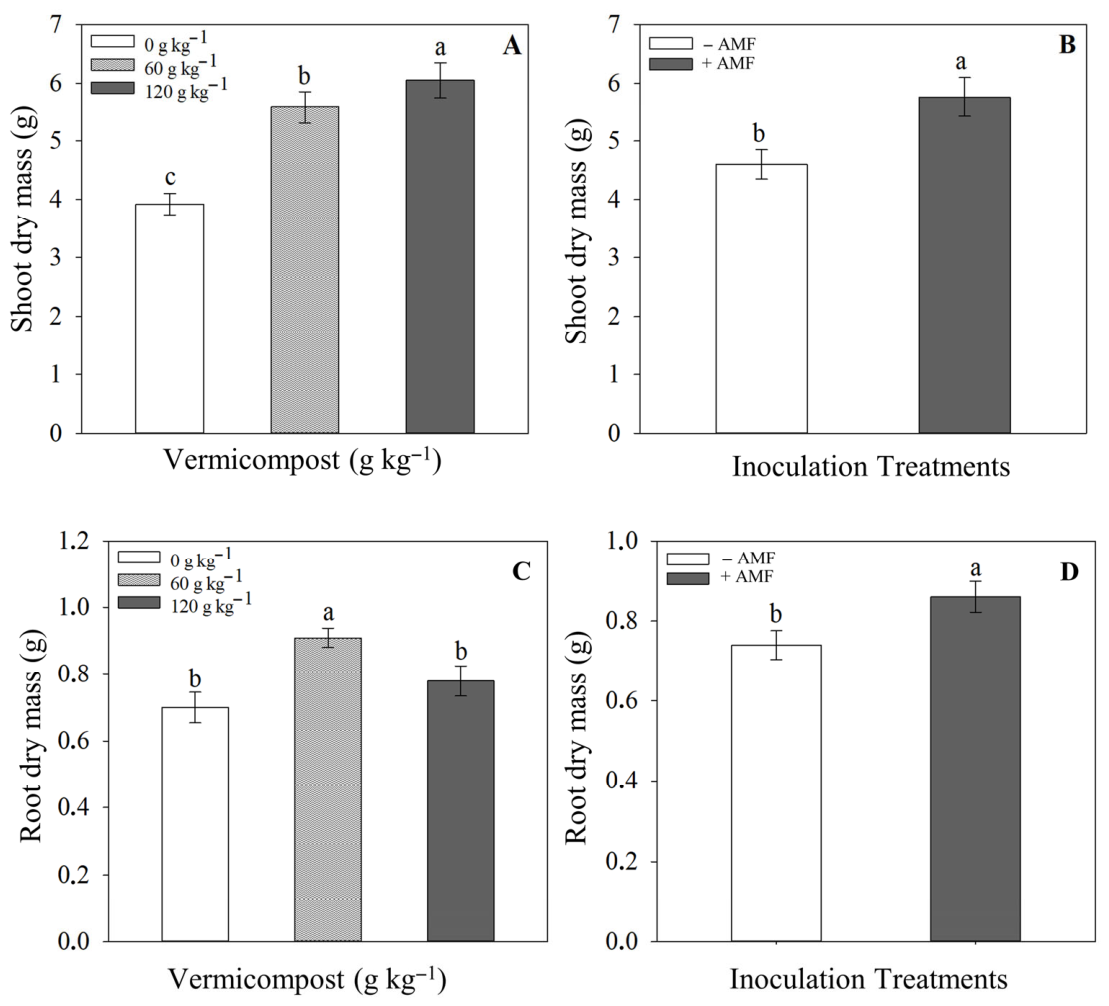
Vermicompost application significantly affected plant growth parameters (Figure 1). Shoot dry mass increased progressively with the addition of vermicompost, reaching the highest values at 120 g kg−1, while lower doses resulted in reduced biomass (Figure 1A). Inoculation treatments also had a significant effect, with +AMF plants exhibiting a 25.21% increase in shoot dry mass compared to non-inoculated plants (−AMF) (Figure 1B). Root dry mass responded differently to vermicompost levels, with the highest values observed at 60 g kg−1, whereas plants grown at 120 g kg−1 showed similar values to the control treatment (0 g kg−1) (Figure 1C). In addition, +AMF plants showed a significant increase of 16.21% in root dry mass compared to −AMF plants (Figure 1D).

3.2. AMF Spore Number and Mycorrhizal Colonization

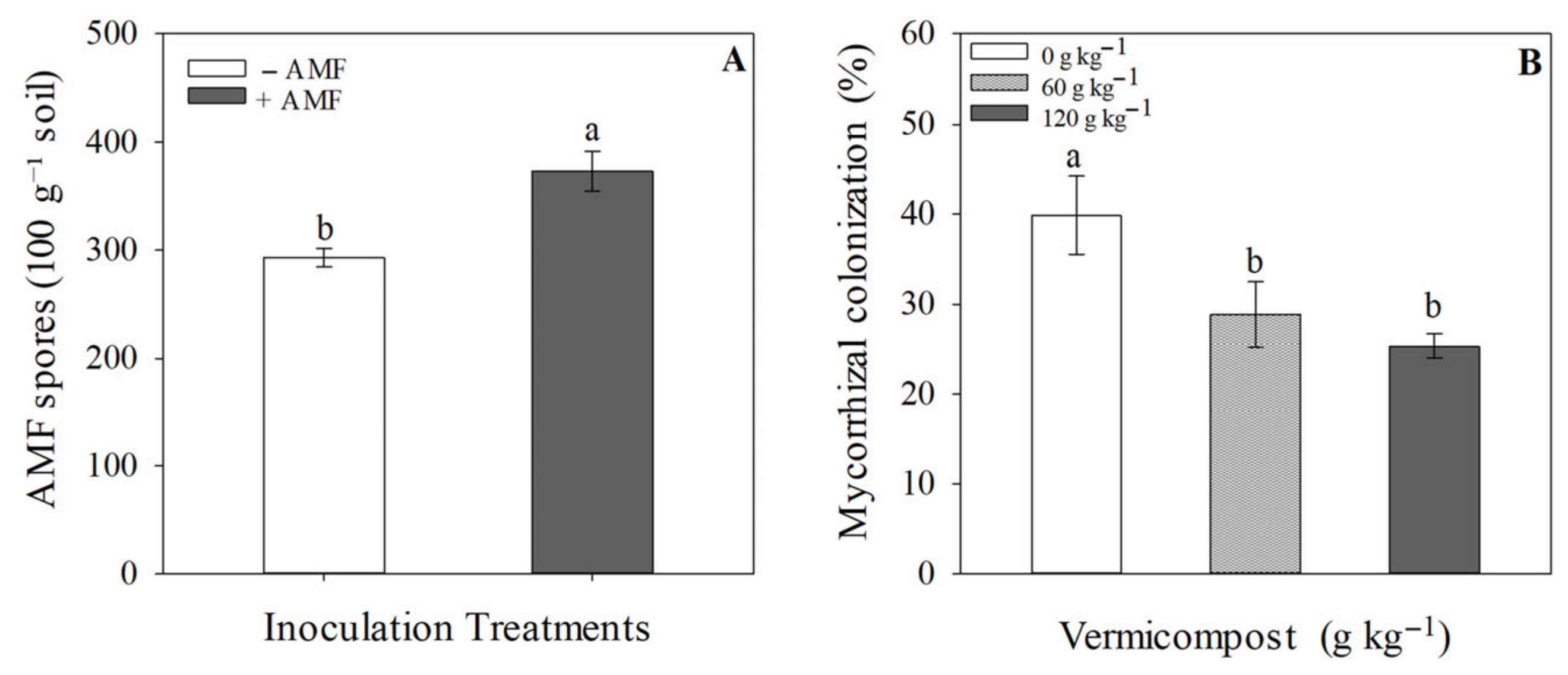
The number of AMF spores in the soil was significantly influenced by inoculation treatments, with +AMF increasing spore numbers by ~28% compared to the non-inoculated treatment (−AMF) (Figure 2A). In contrast, mycorrhizal colonization was significantly affected by vermicompost application, showing a decreasing trend with increasing doses (Figure 2B). The highest colonization was observed in the control treatment (0 g kg−1), reaching approximately 40%, while it declined to around 29% and 25% at 60 and 120 g kg−1, respectively.

3.3. Mn in Shoots, Roots, and Soil

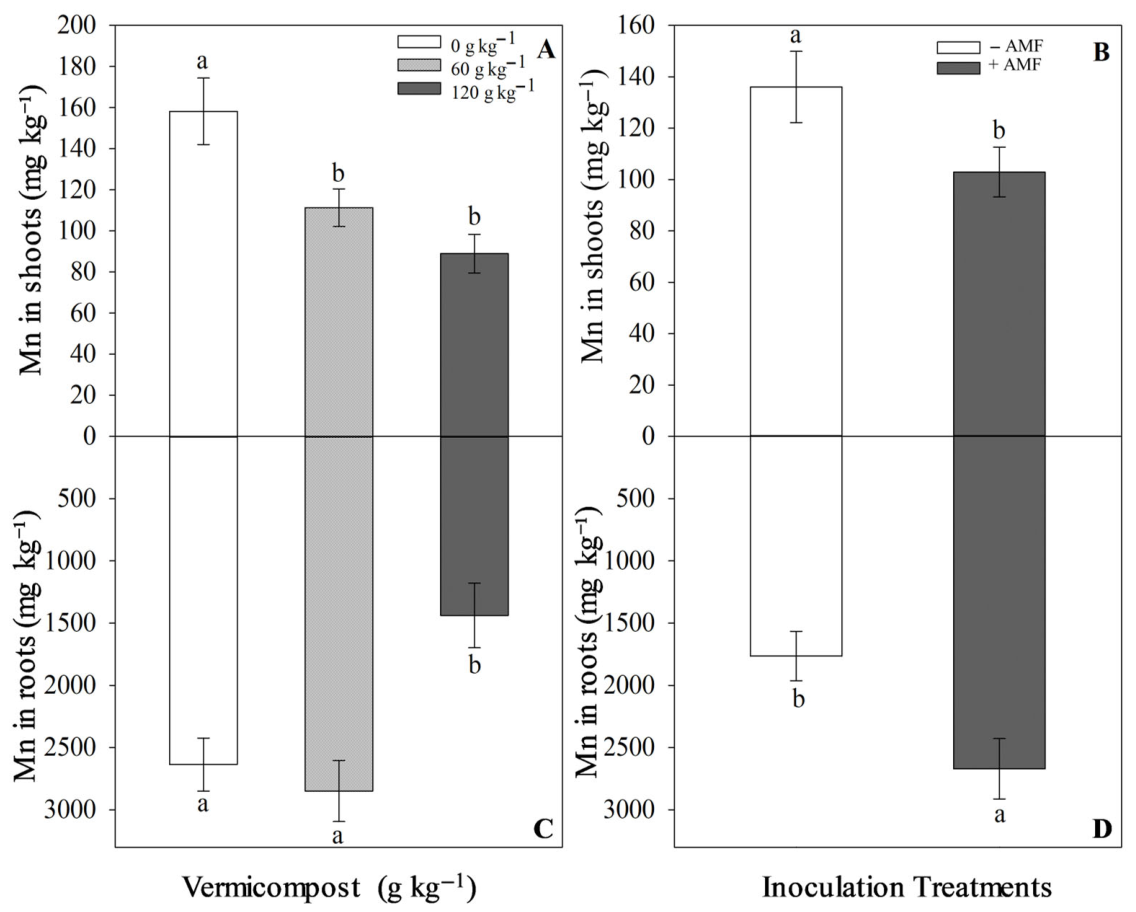
Mn dynamics in plant tissues were significantly modulated by both vermicompost and AMF (Figure 3). Vermicompost application reduced Mn concentrations in shoots and roots, with the lowest values observed at 120 g kg−1 (Figure 3A,C). At this dose, Mn concentrations reached 88.91 mg kg−1 in shoots and 1437.95 mg kg−1 in roots, corresponding to reductions of 44% and 39%, respectively, compared to the control. Inoculation treatments also influenced Mn distribution (Figure 3B,D), with AMF reducing Mn accumulation in shoots while increasing Mn retention in roots.
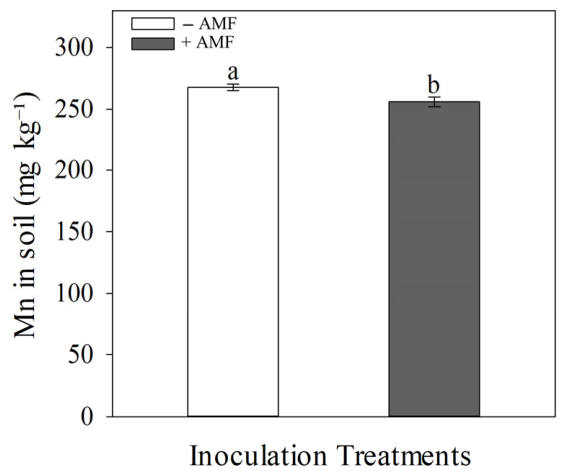
Mn in soil was also affected by inoculation treatments (Figure 4). The presence of AMF reduced Mn concentration in the soil by approximately 4% compared to the non-inoculated treatment (−AMF).

3.4. Mn Phytotoxicity

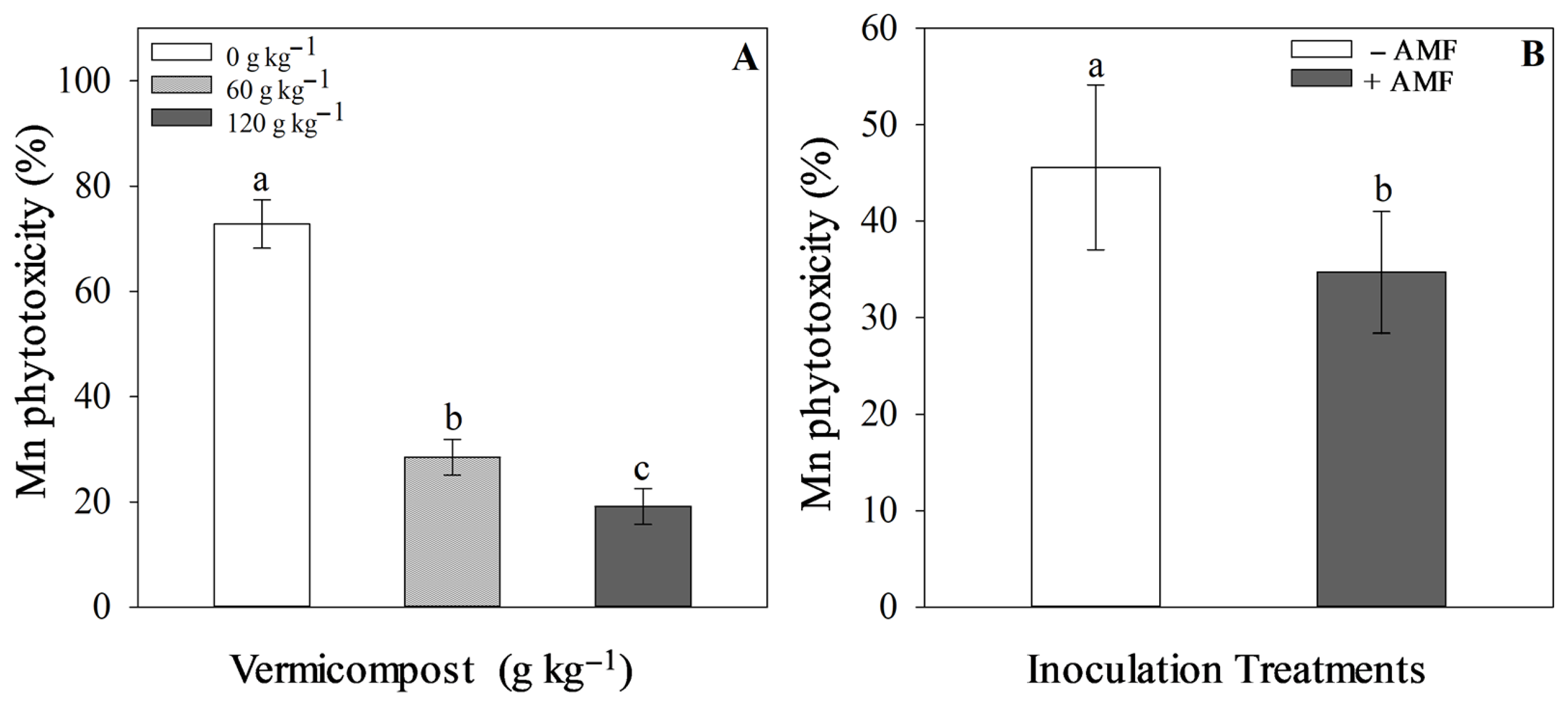
Mn phytotoxicity was significantly reduced by vermicompost application (Figure 5A). The lowest value was observed at 120 g kg−1, reaching 19.13%, which corresponds to a 74% reduction compared to the control treatment (0 g kg−1). Inoculation treatments also significantly affected Mn phytotoxicity (Figure 5B). The presence of AMF (+AMF) reduced phytotoxicity by 24% compared to the non-inoculated treatment (−AMF).

4. Discussion

The present study shows that vermicompost and AMF contributed independently to plant growth and Mn dynamics, highlighting distinct responses relevant to strategies with phytostabilization potential in degraded soils. The progressive increase in shoot biomass with the addition of vermicompost indicates an improvement in soil fertility and nutrient bioavailability. Vermicompost is widely recognized as a source of labile organic matter, humic substances, and plant growth-promoting compounds, which enhance nutrient uptake and physiological performance [23,24]. Similar results have been reported in metal-contaminated soils, where vermicompost application enhances plant growth and biomass [25]. This effect may be associated with reduced Mn bioavailability, possibly through complexation and immobilization processes, combined with improvements in soil chemical properties, which may collectively alleviate toxicity and promote plant development [26]. However, the reduction in root biomass at the highest vermicompost dose may possibly indicate a shift in C allocation, with reduced investment in root growth under improved nutrient availability, or may be associated with potential constraints related to excess organic inputs.
AMF inoculation significantly enhanced both shoot and root biomass, reinforcing their role in promoting plant growth through improved nutrient acquisition and enhanced stress tolerance. This response is commonly attributed to the extensive extraradical mycelium of AMF, which increases the soil exploration capacity and facilitates the uptake of relatively immobile nutrients, particularly P, thereby improving plant nutritional status and physiological performance [11,18]. Furthermore, recent evidence suggests that AMF structures, particularly spores, can act as sinks for heavy metals, including Mn, sequestering them and forming a protective barrier that reduces their bioavailability and toxicity to the host plant [18,27]. This sequestration mechanism, combined with improvements in soil chemical properties and nutrient acquisition, likely explains the enhanced plant growth and biomass accumulation observed under AMF inoculation.
The increase in AMF spore abundance following inoculation indicates an active fungal presence in the soil, although spore density alone is not necessarily a reliable indicator of successful symbiosis establishment, as it can be strongly influenced by environmental conditions such as seasonality, resource availability, and fungal life cycle dynamics [28,29]. Moreover, spore production and root colonization are regulated by distinct biological processes and may respond independently to environmental conditions. In contrast, the decline in root colonization with increasing vermicompost doses suggests a reduced plant reliance on the symbiosis under improved soil fertility conditions [30]. This response aligns with the resource balance framework, in which plants adjust C allocation to mycorrhizal partners according to nutrient availability, particularly under conditions of increased phosphorus and nitrogen supply [31,32]. In addition, organic inputs can reshape soil microbial communities and increase competition for root niches, further limiting AMF colonization [33,34]. Despite this reduction, the maintenance of positive plant responses indicates that AMF functionality was preserved. This suggests that even moderate colonization levels are sufficient to sustain key functions such as nutrient acquisition and mitigation of Mn-induced stress, highlighting the resilience of the symbiosis in degraded soils contaminated with this element.
The reduction in Mn concentrations in shoots and roots with increasing vermicompost doses indicates a strong immobilization effect in the soil–plant system. Vermicompost effects may be associated with processes previously reported for organic amendments, including adsorption to organic functional groups, complexation with humic substances, and changes in soil pH that can reduce metal bioavailability [26,35,36], although these mechanisms were not directly assessed here. These processes likely contributed to the substantial reductions in Mn accumulation observed at 120 g kg−1.
AMF inoculation reshaped Mn partitioning by increasing root retention and reducing Mn accumulation in shoots: a response that may be associated with patterns relevant to phytostabilization, as previously reported for restricted metal transfer to aboveground compartments [37]. This pattern has been widely reported for Mn across diverse plant species, with AMF consistently reducing shoot accumulation while enhancing root sequestration [12,18,27]. Recent evidence indicates that AMF-driven phytostabilization is mediated by multiple complementary mechanisms, including metal immobilization in fungal structures such as hyphae and spores, as well as the production of glomalin-related soil proteins that enhance metal sorption and stabilization in the rhizosphere [27,38,39]. The slight decrease in soil Mn concentrations under AMF inoculation may indicate changes in Mn distribution, possibly related to uptake and sequestration processes.
The marked reduction in Mn phytotoxicity with vermicompost application highlights its protective role against Mn-induced stress, which was accompanied by enhanced plant growth and tolerance. This response suggests that the alleviation of toxicity is closely linked to improved physiological performance under Mn exposure. Recent studies indicate that organic amendments can stimulate antioxidant enzyme systems, improve nutrient balance, and mitigate oxidative stress, thereby reducing metal toxicity and promoting plant growth [26,40]. Similarly, AMF inoculation reduced phytotoxicity, likely through improved nutrient acquisition, modulation of metal uptake, and activation of plant defense mechanisms. AMF are known to enhance antioxidant capacity and regulate stress-responsive pathways, contributing to reduced oxidative damage and increased tolerance under metal stress [41,42]. The effects observed here suggest that vermicompost and AMF may contribute through potentially complementary responses, enhancing plant growth and resilience under Mn stress.
Together, these findings suggest that vermicompost and AMF may provide independent contributions relevant to the restoration of Mn-degraded soils. The effects of vermicompost were associated with increased plant growth and reduced Mn bioavailability, while AMF contributed to plant performance and influenced Mn distribution, representing a potentially sustainable approach aligned with nature-based solutions for ecosystem rehabilitation. While these findings are promising, they should be interpreted within the context of the experimental conditions, as the study was conducted under controlled greenhouse conditions, over a relatively short period, and focused on a single plant species. Further studies under field conditions would help to confirm the broader applicability of these results.

5. Conclusions

This study indicates that vermicompost and AMF C. etunicatum contributed independently to promoting plant growth and influencing Mn dynamics in M. caesalpiniifolia grown in mining-degraded soil. Vermicompost enhanced plant biomass and decreased Mn bioavailability, with effects consistent with those previously reported for organic amendments. Concurrently, AMF inoculation improved plant performance and modulated Mn distribution, promoting its retention in roots while reducing Mn accumulation in shoots, a response potentially relevant to phytostabilization. Despite a reduction in mycorrhizal colonization at higher vermicompost rates, the functional contribution of AMF remained evident, indicating resilience of the symbiosis under amended conditions. These findings underscore the ecological significance of plant–fungus interactions in environments subjected to metal stress. Overall, the application of vermicompost (120 g kg−1) and AMF inoculation enhanced plant establishment and regulated Mn dynamics. The results support the hypothesis that organic amendments and mycorrhizal inoculation may represent a potentially effective and sustainable strategy for the restoration of mining-degraded soils, particularly under semiarid conditions. These findings provide valuable initial insights, and future studies under field conditions will be important to validate their broader applicability and ecological relevance.

Supplementary Materials

The following supporting information can be downloaded at https://www.mdpi.com/article/10.3390/biosphere2020005/s1. Table S1: Analysis of variance (ANOVA) for Shoot and Root dry mass. Table S2: Analysis of variance (ANOVA) for AMF Spores and Mycorrhizal Colonization. Table S3: Analysis of variance (ANOVA) for Mn Shoot, Mn Root, and Mn Soil. Table S4: Analysis of variance (ANOVA) for Mn Phytotoxicity.

Author Contributions

Conceptualization, K.G.V.G. and P.F.M.F.; methodology, K.G.V.G., A.P.d.A.P., L.M.A.d.S., R.F.A.S., G.G.d.S., J.E.S. and M.E.d.S.Á.; validation, K.G.V.G., A.P.d.A.P. and P.F.M.F.; formal analysis, K.G.V.G. and A.P.d.A.P.; investigation, K.G.V.G., A.P.d.A.P., R.F.A.S., G.G.d.S. and J.E.S.; resources, P.F.M.F.; data curation, K.G.V.G., L.M.A.d.S. and M.E.d.S.Á.; writing—original draft preparation, K.G.V.G., A.P.d.A.P. and P.F.M.F.; writing—review and editing, K.G.V.G., A.P.d.A.P., P.F.M.F. and J.d.S.O.F.; visualization, K.G.V.G., L.M.A.d.S. and R.F.A.S.; supervision, K.G.V.G., A.P.d.A.P. and P.F.M.F.; project administration, K.G.V.G. and A.P.d.A.P.; funding acquisition, P.F.M.F. All authors have read and agreed to the published version of the manuscript.

Funding

This research received no external funding.

Institutional Review Board Statement

Not applicable.

Informed Consent Statement

Not applicable.

Data Availability Statement

The original contributions presented in this study are included in the article. Further inquiries can be directed to the corresponding author.

Acknowledgments

The authors would like to thank the Coordenação de Aperfeiçoamento de Pessoal de Nível Superior (CAPES), Brazil—Finance Code 001.

Conflicts of Interest

The authors declare no conflicts of interest.

References

  1. Reichl, C.; Schatz, M. World Mining Data 2019; Federal Ministry for Sustainability and Tourism: Vienna, Austria, 2019; ISBN 978-3-903101-38-1. [Google Scholar]
  2. Safarov, R.Z.; Baikenov, Y.A.; Zhandildenova, A.K.; Kopishev, E.E.; Kamatov, R.M.; Kargin, J.B.; Sanchez Cornejo, H.; Barnes, C.H.W.; De Los Santos Valladares, L. Phase Transitions and Structural Evolution of Manganese Ores During High-Temperature Treatment. Metals 2025, 15, 89. [Google Scholar] [CrossRef]
  3. Li, H.; Santos, F.; Butler, K.; Herndon, E. A Critical Review on the Multiple Roles of Manganese in Stabilizing and Destabilizing Soil Organic Matter. Environ. Sci. Technol. 2021, 55, 12136–12152. [Google Scholar] [CrossRef]
  4. Zhou, S.; Kong, J.; Song, Z.; Zhang, X.; Bi, X. Manganese Reduction Regulates Soil Organic Carbon Loss from an Acidified Cambisol. Eur. J. Soil Sci. 2022, 73, e13333. [Google Scholar] [CrossRef]
  5. Jin, C.; Li, Z.; Hursthouse, A.S.; Ding, X.; Zhou, M.; Chen, J.; Li, B. Manganese Oxides Mediated Dissolve Organic Matter Compositional Changes in Lake Sediment and Cadmium Binding Characteristics. Ecotoxicol. Environ. Saf. 2023, 256, 114916. [Google Scholar] [CrossRef]
  6. Xiao, E.; Wang, Y.; Xiao, T.; Sun, W.; Deng, J.; Jiang, S.; Fan, W.; Tang, J.; Ning, Z. Microbial Community Responses to Land-Use Types and Its Ecological Roles in Mining Area. Sci. Total Environ. 2021, 775, 145753. [Google Scholar] [CrossRef]
  7. Kumi, S.; Adu-Poku, D.; Attiogbe, F. Dynamics of Land Cover Changes and Condition of Soil and Surface Water Quality in a Mining–Altered Landscape, Ghana. Heliyon 2023, 9, e17859. [Google Scholar] [CrossRef]
  8. Pantoja-Guerra, M.; Ramirez-Pisco, R.; Valero-Valero, N. Improvement of Mining Soil Properties through the Use of a New Bio-Conditioner Prototype: A Greenhouse Trial. J. Soils Sediments 2019, 19, 1850–1865. [Google Scholar] [CrossRef]
  9. Dobbss, L.B.; dos Santos, T.C.; Pittarello, M.; de Souza, S.B.; Ramos, A.C.; Busato, J.G. Alleviation of Iron Toxicity in Schinus Terebinthifolius Raddi (Anacardiaceae) by Humic Substances. Environ. Sci. Pollut. Res. 2018, 25, 9416–9425. [Google Scholar] [CrossRef] [PubMed]
  10. Wyszkowski, M.; Kordala, N. Effects of Humic Acids on Calorific Value and Chemical Composition of Maize Biomass in Iron-Contaminated Soil Phytostabilisation. Energies 2024, 17, 1691. [Google Scholar] [CrossRef]
  11. Maia, E.P.V.; Garcia, K.G.V.; de Souza Oliveira Filho, J.; Pinheiro, J.I.; Filho, P.F.M. Co-Inoculation of Rhizobium and Arbuscular Mycorrhiza Increases Mimosa Caesalpiniaefolia Growth in Soil Degraded by Manganese Mining. Water Air Soil Pollut. 2023, 234, 289. [Google Scholar] [CrossRef]
  12. Garcia, K.G.V.; Gomes, V.F.F.; Mendes, P.F.; Martins, C.M.; de Almeida, A.M.M.; da Silva, J.M.T. Tolerância de Mimosa Caesalpiniaefolia Benth. Associada a Micorrizas Arbusculares Em Substrato Da Mineração de Manganês. Rev. Ciências Agrar. Amaz. J. Agric. Environ. Sci. 2017, 60, 247–255. [Google Scholar] [CrossRef]
  13. Garcia, K.G.V.; Gomes, V.F.F.; Filho, P.F.M.; Martins, C.M.; da Silva, J.M.T., Jr.; Cunha, C.S.M.; Pinheiro, J.I. Arbuscular Mycorrhizal Fungi in the Phytostabilization of Soil Degraded by Manganese Mining. J. Agric. Sci. 2018, 10, 192. [Google Scholar] [CrossRef][Green Version]
  14. Shi, W.; Zhang, Y.; Chen, S.; Polle, A.; Rennenberg, H.; Luo, Z.-B. Physiological and Molecular Mechanisms of Heavy Metal Accumulation in Nonmycorrhizal versus Mycorrhizal Plants. Plant Cell Environ. 2019, 42, 1087–1103. [Google Scholar] [CrossRef] [PubMed]
  15. Garcia, K.G.V.; Almeida, M.d.S.; Barbosa, F.L.A.; Pereira, A.P.d.A. The Contribution of Arbuscular Mycorrhizal Fungi to Soil Enzyme Activity and the Performance of Mimosa Caesalpiniaefolia in Soil Degraded by Scheelite Mining: Implications for Restoration. Resources 2025, 14, 50. [Google Scholar] [CrossRef]
  16. Duarte, L.M.; Bertini, S.C.B.; Stürmer, S.L.; Lambais, M.R.; Azevedo, L.C.B. Arbuscular Mycorrhizal Fungal Communities in Soils under Three Phytophysiognomies of the Brazilian Atlantic Forest. Acta Bot. Bras. 2019, 33, 50–60. [Google Scholar] [CrossRef]
  17. Teixeira, P.C.; Donagemma, G.K.; Fontana, A.; Teixeira, W.G. Manual de Métodos de Análise de Solo, 3 rev. ed.; Embrapa Solos: Brasília, Brazil, 2017; ISBN 978-85-7035-771-7. [Google Scholar]
  18. Garcia, K.G.V.; Mendes Filho, P.F.; Pinheiro, J.I.; do Carmo, J.F.; de Araújo Pereira, A.P.; Martins, C.M.; de Abreu, M.G.P.; Oliveira Filho, J.d.S. Attenuation of Manganese-Induced Toxicity in Leucaena Leucocephala Colonized by Arbuscular Mycorrhizae. Water Air Soil Pollut. 2020, 231, 22. [Google Scholar] [CrossRef]
  19. Koske, R.E.; Gemma, J.N. A Modified Procedure for Staining Roots to Detect VA Mycorrhizas. Mycol. Res. 1989, 92, 486–488. [Google Scholar] [CrossRef]
  20. Mcgonigle, T.P.; Miller, M.H.; Evans, D.G.; Fairchild, G.L.; Swan, J.A. A New Method Which Gives an Objective Measure of Colonization of Roots by Vesicular—Arbuscular Mycorrhizal Fungi. New Phytol. 1990, 115, 495–501. [Google Scholar] [CrossRef] [PubMed]
  21. Gerdemann, J.W.; Nicolson, T.H. Spores of Mycorrhizal Endogone Species Extracted from Soil by Wet Sieving and Decanting. Trans. Br. Mycol. Soc. 1963, 46, 235–244. [Google Scholar] [CrossRef]
  22. Ferreira, D.F. Sisvar: A Computer Statistical Analysis System Review Sisvar: A Computer Statistical Analysis System Sisvar: Um Sistema Computacional de Análise Estatística. Ciênc. Agrotec. 2011, 35, 1039–1042. [Google Scholar] [CrossRef]
  23. Manzoor, A.; Naveed, M.S.; Ali, R.M.A.; Naseer, M.A.; UL-Hussan, M.; Saqib, M.; Hussain, S.; Farooq, M. Vermicompost: A Potential Organic Fertilizer for Sustainable Vegetable Cultivation. Sci. Hortic. 2024, 336, 113443. [Google Scholar] [CrossRef]
  24. Hafez, M.; Zhang, Z.; Younis, M.; Abdelhamid, M.A.; Rashad, M. Enhancing Micronutrient Availability Through Humic Substances and Vermicompost While Growing Artichoke Plants in Calcareous Soil: Insights from a Two-Year Field Study. Plants 2025, 14, 1224. [Google Scholar] [CrossRef]
  25. Alam, M.; Khan, A.; Zaman, R.; Khan, S.; Khan, M.A.; Ahmad, I.; Jalal, A.; Kim, K.I. Vermi-Remediation Impacts on Growth and Metals Bioaccumulation in Tomato Irrigated with Wastewater. Chemosphere 2024, 362, 142848. [Google Scholar] [CrossRef]
  26. Iqbal, A.; Khan, R.; Hussain, Q.; Imran, M.; Mo, Z.; Hua, T.; Adnan, M.; Abid, I.; Rizwana, H.; Soliman Elshikh, M.; et al. Vermicompost Application Enhances Soil Health and Plant Physiological and Antioxidant Defense to Conferring Heavy Metals Tolerance in Fragrant Rice. Front. Sustain. Food Syst. 2024, 8, 1418554. [Google Scholar] [CrossRef]
  27. Garcia, K.G.V.; de Souza Oliveira Filho, J.; de Araújo Pereira, A.P.; Mendes Filho, P.F. Can Inoculation of Native Arbuscular Mycorrhizal Fungi from a Mining Area Attenuate Stress of Acacia Mangium Willd. to Excess Manganese? J. Soils Sediments 2024, 24, 3252–3264. [Google Scholar] [CrossRef]
  28. Han, S.; Wang, X.; Cheng, Y.; Wu, G.; Dong, X.; He, X.; Zhao, G. Multidimensional Analysis Reveals Environmental Factors That Affect Community Dynamics of Arbuscular Mycorrhizal Fungi in Poplar Roots. Front. Plant Sci. 2023, 13, 1068527. [Google Scholar] [CrossRef]
  29. Zeng, K.; Huang, D.; Zhang, X.; Liu, S.; Huang, X.; Xin, G. Fern Species and Seasonal Variation Alter Arbuscular Mycorrhizal Fungal Colonization and Co-Occurrence Patterns in the Heishiding Natural Reserve, South China. Appl. Soil Ecol. 2024, 193, 105172. [Google Scholar] [CrossRef]
  30. Muniz, B.C.; Kapoor, R.; Almeida, J.R.G.d.S.; Bastos Filho, C.J.A.; da Silva, F.S.B. Arbuscular Mycorrhizae Increase but Vermicompost Decrease the Sun Protection Factor (SPF) in Leaves of Hymenaea Martiana Hayne Seedlings. Rhizosphere 2023, 27, 100781. [Google Scholar] [CrossRef]
  31. Li, P.; Liu, J.; Zhang, S.; Zhu, Y.; Yin, X.; Xing, L.; Wei, D.; Jin, L. Effects of Nitrogen and Phosphorus Levels on Arbuscular Mycorrhizal Symbiosis and Associated Bacterial Communities in Culture. J. Fungi 2025, 11, 757. [Google Scholar] [CrossRef]
  32. Trinquier, M.; Lecloux, E.; Patrick, B.; Gasciolli, V.; Jouany, C.; Roux, C.; Lefebvre, B.; Ardanuy, A. Interactive Effects of Soil Phosphorus and Nitrogen Availability on Mycorrhiza-Mediated Nutrition in Wheat. Plant Soil 2026, 520, 383–401. [Google Scholar] [CrossRef]
  33. Juntahum, S.; Kuyper, T.W.; Ekprasert, J.; Boonlue, S. Impact of Bio-Organic Amendment Supplemented with Phosphate-Solubilizing Bacteria and Arbuscular Mycorrhizal Fungi on Sugarcane Cultivation. Sci. Rep. 2025, 15, 40948. [Google Scholar] [CrossRef]
  34. Zeng, Z.; Kong, T.; Lv, G.; Cheng, H.; Bao, S.; Xiao, L. Organic Amendments Regulate Soil Bacterial Diversity and Cooperative Network Structure in Reclaimed Coal Gangue Soil. Microorganisms 2026, 14, 17. [Google Scholar] [CrossRef] [PubMed]
  35. Ma, F.; Zhu, T.; Wang, Y.; Torii, S.; Wang, Z.; Zhao, C.; Li, X.; Zhang, Y.; Quan, H.; Yuan, C.; et al. Adsorption Mechanism and Remediation of Heavy Metals from Soil Amended with Hyperthermophilic Composting Products: Exploration of Waste Utilization. Bioresour. Technol. 2024, 410, 131292. [Google Scholar] [CrossRef] [PubMed]
  36. Maffia, A.; Oliva, M.; Marra, F.; Mallamaci, C.; Nardi, S.; Muscolo, A. Humic Substances: Bridging Ecology and Agriculture for a Greener Future. Agronomy 2025, 15, 410. [Google Scholar] [CrossRef]
  37. Kafle, A.; Timilsina, A.; Gautam, A.; Adhikari, K.; Bhattarai, A.; Aryal, N. Phytoremediation: Mechanisms, Plant Selection and Enhancement by Natural and Synthetic Agents. Environ. Adv. 2022, 8, 100203. [Google Scholar] [CrossRef]
  38. Salazar, M.J.; Cáceres-Mago, K.; Becerra, A.G. Role of Arbuscular Mycorrhizal Fungi in Lead Translocation from Bidens pilosa L. Plants to Soil. J. Environ. Manag. 2024, 365, 121626. [Google Scholar] [CrossRef]
  39. Xu, Y.; Ke, J.; Zhang, Y.; Chen, X.; Wang, Y. Harnessing AMF-Plant-Microbe Systems for Heavy Metal Remediation. Ecotoxicol. Environ. Saf. 2026, 311, 119885. [Google Scholar] [CrossRef]
  40. Rehman, S.U.; De Castro, F.; Aprile, A.; Benedetti, M.; Fanizzi, F.P. Vermicompost: Enhancing Plant Growth and Combating Abiotic and Biotic Stress. Agronomy 2023, 13, 1134. [Google Scholar] [CrossRef]
  41. Zhang, X.; Zhao, B.; Zheng, Y.; Li, M.; Zhang, H.; Wang, P.; Chen, S.; Jin, X.; Wu, X. Arbuscular Mycorrhizal Fungi Mitigate Lead Toxicity in Maize by Restructuring Rhizosphere Microbiome and Enhancing Antioxidant Defense Mechanisms. Agronomy 2025, 15, 1310. [Google Scholar] [CrossRef]
  42. Ju, C.; Wang, L.; You, Y.; Ma, F.; Bai, S. Enhancing the Resistance of Hyperaccumulator with Arbuscular Mycorrhizal Fungi in Cadmium-Contaminated Saline Soil: A Physiological and Transcriptional Mechanistic Study. J. Clean. Prod. 2025, 501, 145330. [Google Scholar] [CrossRef]
Figure 1. Effects of vermicompost application and inoculation treatments on plant biomass of M. caesalpiniifolia. Shoot dry mass as affected by vermicompost doses (A) and inoculation treatments (B), and root dry mass as affected by vermicompost doses (C) and inoculation treatments (D). Vermicompost was applied at 0, 60, and 120 g kg−1. Inoculation treatments consisted of non-inoculated (−AMF) and inoculated (+AMF) plants. Bars represent mean ± standard error (n = 4). Different letters indicate significant differences among treatments according to the Scott–Knott test (p ≤ 0.05).
Biosphere 02 00005 g001
Figure 2. Effects of inoculation treatments and vermicompost application on mycorrhizal parameters in soil and roots of M. caesalpiniifolia. Number of AMF spores in the soil as affected by inoculation treatments (A), and mycorrhizal colonization (%) as affected by vermicompost doses (B). Vermicompost was applied at 0, 60, and 120 g kg−1. Inoculation treatments consisted of non-inoculated (−AMF) and inoculated (+AMF) plants. Bars represent mean ± standard error (n = 4). Different letters indicate significant differences among treatments according to the Scott–Knott test (p ≤ 0.05).
Biosphere 02 00005 g002
Figure 3. Effects of vermicompost application and inoculation treatments on manganese (Mn) concentrations in plant tissues of M. caesalpiniifolia. Mn concentration in shoots as affected by vermicompost doses (A) and inoculation treatments (B), and Mn concentration in roots as affected by vermicompost doses (C) and inoculation treatments (D). Vermicompost was applied at 0, 60, and 120 g kg−1. Inoculation treatments consisted of non-inoculated (−AMF) and inoculated (+AMF) plants. Bars represent mean ± standard error (n = 4). Different letters indicate significant differences among treatments according to the Scott–Knott test (p ≤ 0.05).
Biosphere 02 00005 g003
Figure 4. Effect of inoculation treatments on Mn concentration in soil cultivated with M. caesalpiniifolia. Mn in soil as affected by inoculation treatments. Inoculation treatments consisted of non-inoculated (−AMF) and inoculated (+AMF) plants. Bars represent mean ± standard error (n = 4). Different letters indicate significant differences between treatments according to the Scott–Knott test (p ≤ 0.05).
Biosphere 02 00005 g004
Figure 5. Effects of vermicompost application and inoculation treatments on Mn phytotoxicity in M. caesalpiniifolia. Mn phytotoxicity (%) as affected by vermicompost doses (A) and inoculation treatments (B). Vermicompost was applied at 0, 60, and 120 g kg−1. Inoculation treatments consisted of non-inoculated (−AMF) and inoculated (+AMF) plants. Bars represent mean ± standard error (n = 4). Different letters indicate significant differences among treatments according to the Scott–Knott test (p ≤ 0.05).
Biosphere 02 00005 g005
Disclaimer/Publisher’s Note: The statements, opinions and data contained in all publications are solely those of the individual author(s) and contributor(s) and not of MDPI and/or the editor(s). MDPI and/or the editor(s) disclaim responsibility for any injury to people or property resulting from any ideas, methods, instructions or products referred to in the content.